Monthly Archives: September 2019

Honeysuckle aphid (Rhopalomyzus lonicerae) on Reed Canary Grass being eaten by a Syrphid fly larva

Honeysuckle aphid (Rhopalomyzus lonicerae) on Reed Canary Grass
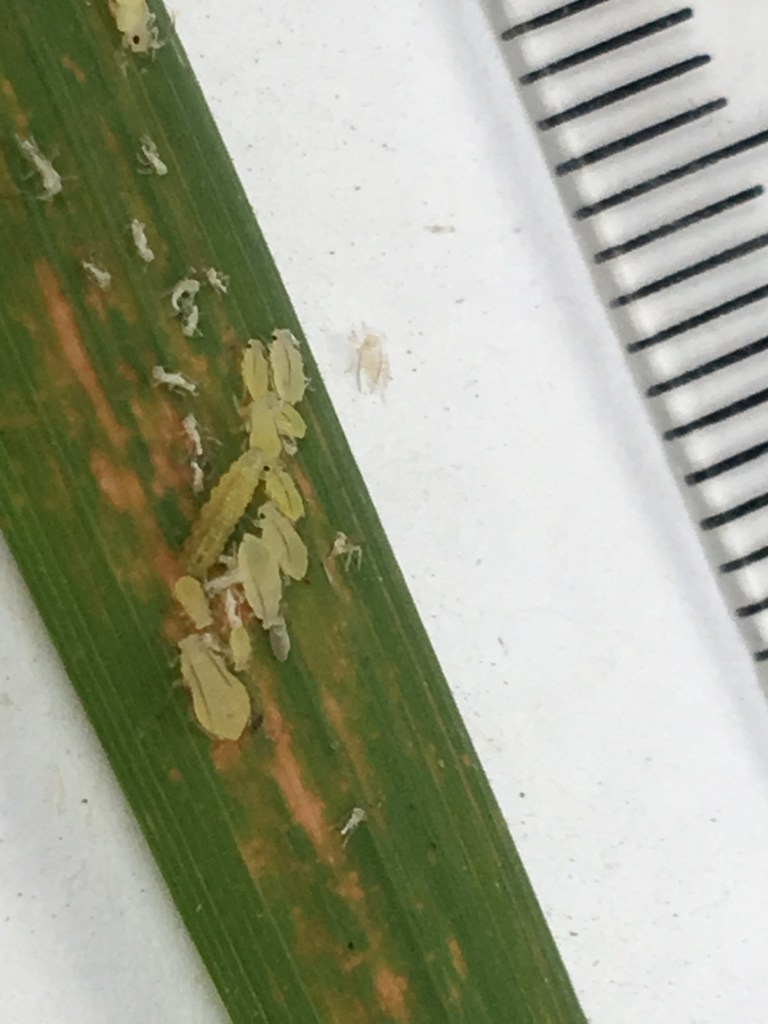
Honeysuckle aphids on Reed Canary Grass

I photographed and filmed these tiny white “lambs” over the weekend (Sept. 21, 2019). There is a patch of Reed canary grass growing in a wetland area near my house and I wanted to see what sort of insects I might find associated with this particular plant.

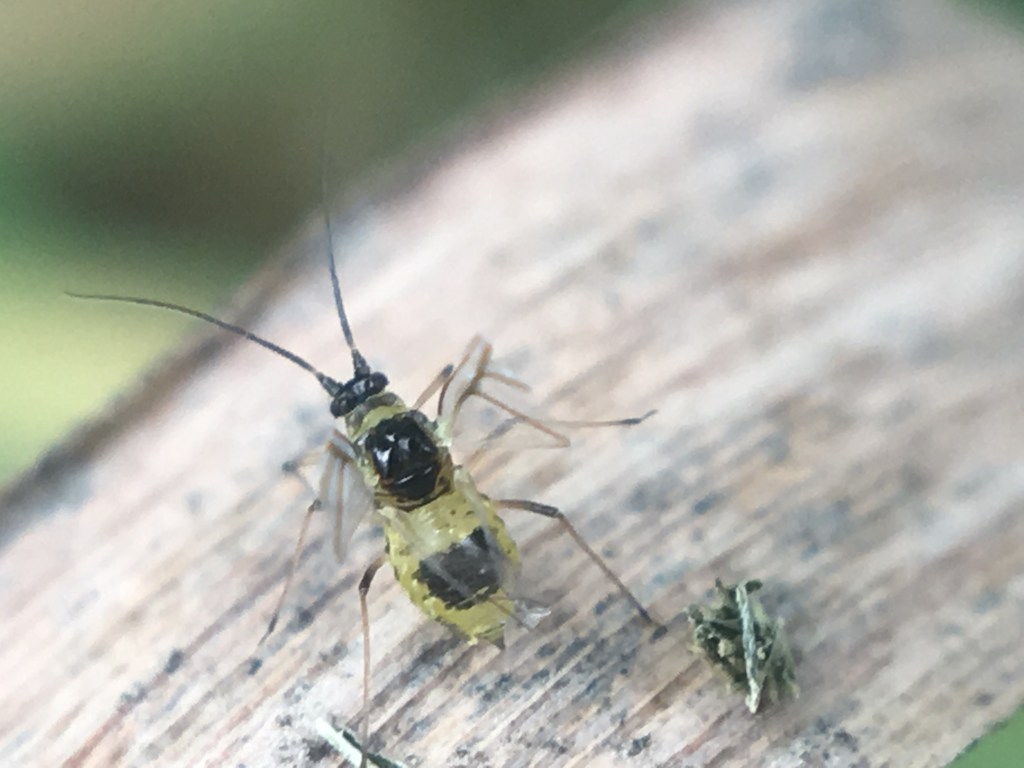
These “lambs” are actually Honeysuckle aphids (Rhopalomyzus lonicerae). The species epithet, lonicerae refers to honeysuckle. These particular aphids live on honeysuckle in the winter and in grasses (as in the Reed Canary grass) in summer (4,5). The creamy white form (pictured above) are wingless, sub-adults, the apterae (without-wings) ~ Aphid glossary here: https://influentialpoints.com/aphid/Aphid-glossary.htm . There were quite a few of them and they were huddled together somewhat herd-like (see video below) on the grass stems. I did spot an adult or two (photo below), dispersed in other patches of grass, but absent from the groups of young.

Adult Honeysuckle Aphid on Reed Canary Grass
Sept. 21, 2019

The most amazing part to me was the “wolf” disguised in my herd of aphid lambs. This big bad wolf was actually a syrphid fly larva devouring one little lamb after another. It surprised me that they all waited, rather obediently, without resistance, as one after another was sucked dry by the fly-wolf. Note the dried out skins remaining on the leaf when you view the videos of the little lambs I found in the grass below. 🐑

Honeysuckle aphid (Rhopalomyzus lonicerae) on Reed Canary Grass being eaten by a Syrphid fly larva

Baaad or Good? Give me a thumbs up or down and let me know what you think! Thanks for reading.

****

Reed canary grass (Phalaris arundinacea) is in the plant family Poacea. Historically, reed canary grass has been considered good fodder for livestock, especially in areas too wet to grow traditional hay crops (3). In Washington State, it is now considered a non-native, noxious weed by the Washington State Noxious Weed Control Board (1). However in further review of literature about this plant, I came across one publication contradicting this view. This one cites published research that, in the Pacific Northwest there is evidence that some varieties of this widespread “circumboreal” grass are native to Western North America (2) .

Native? Noxious? Invasive? If you want to read more about Reed Canary grass, please do take a minute to check out the referenced links below.

Honeysuckle aphid (Rhopalomyzus lonicerae) on reed canary grass being eaten by syrphid fly larva (Sept. 21, 2019) San Juan Island, WA

References:

1.https://www.nwcb.wa.gov/weeds/reed-canarygrass

2. https://www.fs.fed.us/database/feis/plants/graminoid/phaaru/all.html

3.https://plants.usda.gov/factsheet/pdf/fs_phar3.pdf

4. https://bugguide.net/node/view/358533

5.https://influentialpoints.com/Gallery/Rhopalomyzus_lonicerae_honeysuckle-grass_aphid.htm

Got Aphids? Honey, Dew I!

BUGGING YOU FROM San Juan Island's avatarBugging You From San Juan Island

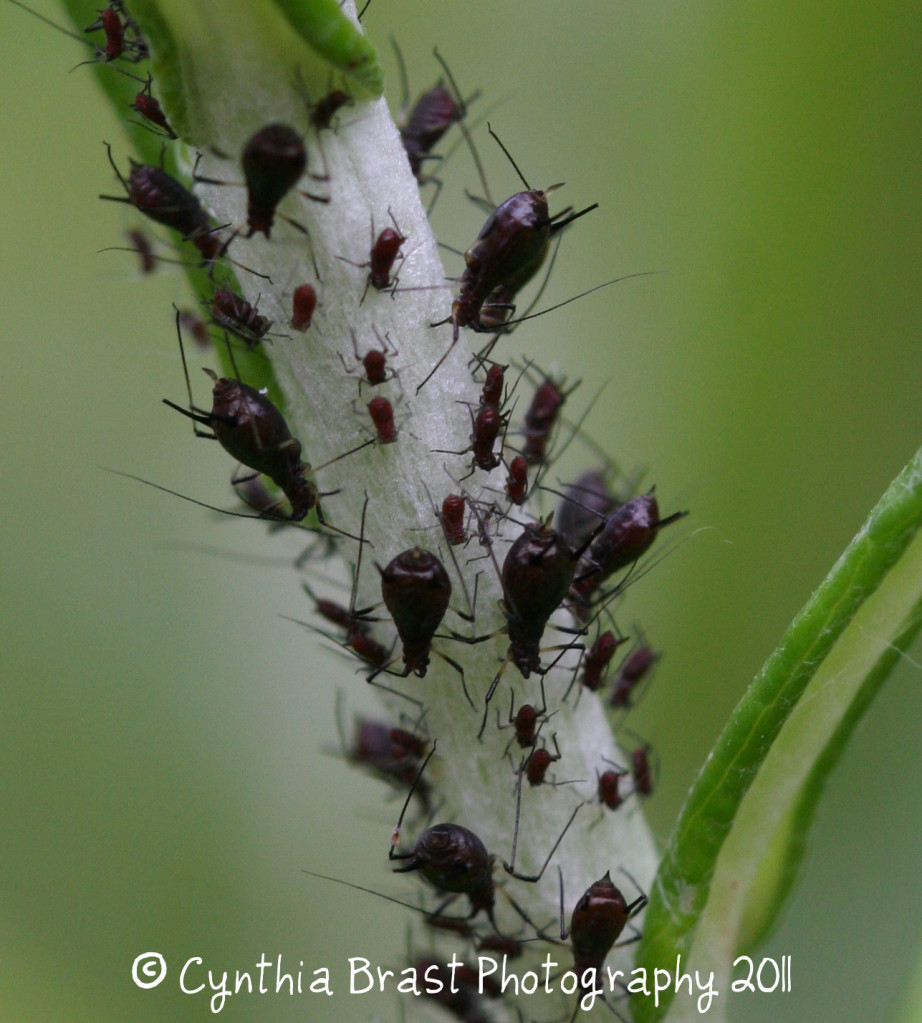
Black Aphids

These tiny pear-shaped insects can be a serious garden pest. Aphids use their long slender mouthparts like a syringe, piercing the tender parts of plants and sucking out the juices….but this isn’t the only way they damage your plants. Feeding aphids also excrete a sticky waste byproduct called honeydew – honeydew helps the sooty mold fungus grow and sooty mold fungus blocks the plant from getting enough sunlight. No sunlight…no photosynthesis! The leaves of your plant can drop off and die. What other ways do aphids damage your plants? When they feed, they also can inject the plant with pathogenic viruses. These aphid-transmitted viruses can cause plants to yellow, leaves to curl and the plant’s growth will often be stunted.

Compounding the problem is the rate at which these “little devils” multiply. Why call them “devils?” I like to refer to them that way because it helps me…

View original post 659 more words

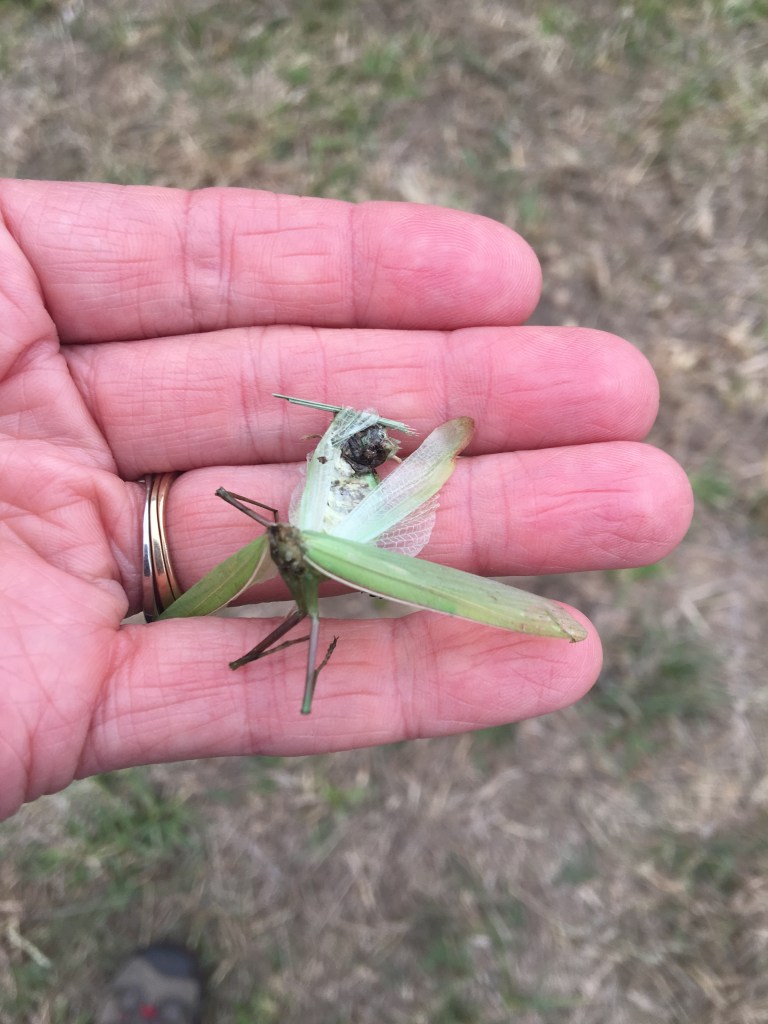
We know what happened to him!

Avec sa tête
European Mantis (Mantis religiosa)
San Juan Island, WA 09-07-19

A picture says it all, right? I found this poor fellow when I attended the San Juan County Land Bank’s open house at the new Zylstra Lake Preserve on September 7, 2019 ~ http://sjclandbank.org/zylstra-lake-preserve-san-juan-island/ .

We know what activity he must have been participating in!

Lots of amazing artwork by Steve Thompson available on tees and posters here ~ https://www.redbubble.com/people/stevet3214/works/26202642-praying-mantis-family-photo?p=poster

Yes, it’s that time of year. You may be seeing lots of European Mantids (Mantis religiosa) about right now. They’re mate seeking. While not native, don’t worry, they aren’t taking over the island. If you’re curious about them, read my post from last year when there were rumors of them invading the San Juan’s and devouring hummingbirds (not true) https://sanjuanislander.com/news-articles/environment-science-whales/environment/28146/revenge-of-the-mantids .

While they are generalist feeders, they aren’t going to decimate our native pollinators OR eat birds. It’s far more likely they’ll be eaten (or beheaded) before they take over!

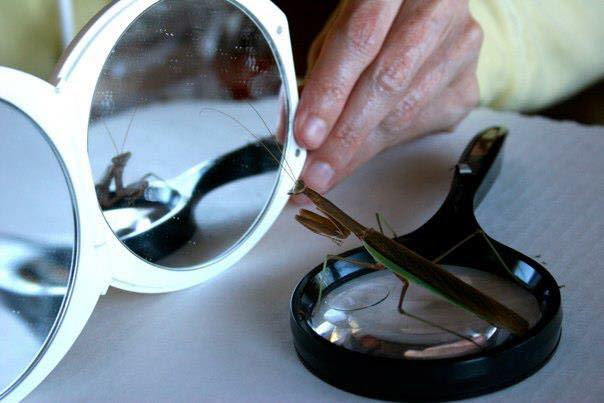
My pet mantis, Merlina
San Juan Island, 2010

The Meadow Spittlebug (Philaenus spumarius) aka “Foam Lover”

Meadow Spittlebug (Philaenus spumarius)
Zylstra Lake Preserve, San Juan Island, WA 9-7-19

I took this photo of a Meadow Spittlebug (Philaenus spumarius) on September 7, 2019 when I attended the San Juan County Land Bank’s open house at the new Zylstra Lake Preserve http://sjclandbank.org/zylstra-lake-preserve-san-juan-island/ . It was a bit cloudy, but fortunately it didn’t rain during the event.

While there weren’t many insects out and about, I was happy to get a shot of the adult version of this species. It was hanging out with some family members on the stem of a thistle growing alongside the walking path.

Meadow Spittlebugs on Thistle
Zylstra Lake Preserve
San Juan Island, WA
09-07-19

Spittlebugs are in the insect order Hemiptera and the family Cercopidae (1). You might recognize these as the mystery bug that hides as a nymph inside a frothy dollop of bubbles on stems of vegetation. This particular species is widespread in North America and very common in the Pacific Northwest (1). So, if you’re out for a walk in the springtime, you’ll see lots of vegetation that appears to have wads of spit stuck to it…and the tiny meadow nymph is hiding inside!

The Meadow Spittlebug (Philaenus spumarius) is also known as the Common Froghopper and it does indeed look very frog like to me. 🐸 Even more interesting, a Google search of the etymology of this little bug’s name yielded this (from Wikipedia):

“The genus name Philaenus comes from the Greek philein (“love”), while the species name spumarius is from the Latin spuma (“sparkling”), referred to the foam nests; the binomial Philaenus spumarius can be translated as “foam lover.”

The adult spittlebug is small (approximately 6mm in length). Both adults and nymphs (which go through 5 instars or developmental stages before reaching adulthood) feed on plant xylem and have been found to feed on over 450 species of plants (2,3,4). While they have the ability to transmit viruses and cause damage to plants from feeding, they are typically not considered serious pests unless they are present in large numbers. It was interesting to learn that the nymphs consume up to 280 times their own weight of plant sap in 24 hours (2,3,4).

Also interesting is that only the soft-bodied nymphs live in the foam. It provides them with protection from predation and from drying out (desiccation). The spittle is a fluid produced from their anus and combined with a surfactant secreted by epidermal glands near the end of their abdomen. Caudal appendages on the insect create air bubbles, turning the spittle into a frothy foam. The tiny (1/4″ long) spittlebug nymph usually rests on the plant facing downward. When the spittle is produced, it flows downward over the body and covers the nymph, concealing it and providing it with the moist habitat it requires as it develops (4).

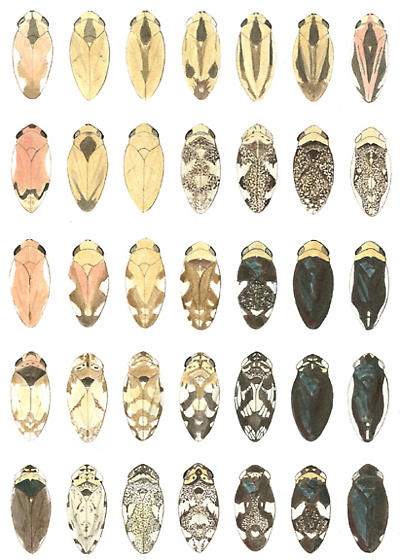
Another interesting bit about the Meadow Spittlebug is that it is quite polymorphic with no less than 16 adult color forms (1). Andy Hamilton (2006) has contributed a wonderful chart, shared on Bugguide https://bugguide.net/node/view/72602 to illustrate the color varieties of the adult forms of this highly variable species (1, 2). Because of the diversity among adult specimens within this species, many researchers have been interested in Philaenus spumarius for genetic study (4).

Andy Hamilton 2006 ~ bugguide.net

*I wanted to include a personal observation about natural enemies of spittlebugs. Hamilton (1982) gives the most detailed account of these, but I didn’t note any mention of predation by yellow jackets (Hymenoptera: Vespidae), or dragonflies (2). I have observed both of these flying through meadow grasses appearing (but not confirmed) to glean spittlebugs from plants in early summer on San Juan Island.

References:

1. Bugguide.net https://bugguide.net/node/view/7452

2. Hamilton, K.G.A., 1982, The spittlebugs of Canada: Homoptera: Cercopidae, Insects and Arachnids of Canada Handbook Series, 10, 102 http://esc-sec.ca/publications/aafc/

3. Horsfield, D., Evidence for xylem feeding by Philaenus spumarius(L.) (Homoptera: Cercopidae). Ent. Exp. Appl., 24: 95-99, 1978.

4. Yurtsever, Selcuk. (2000). On the meadow spittlebug Philaenus spumarius. Turkish Journal of Zoology. 24. 447-459.

Not a Spider!

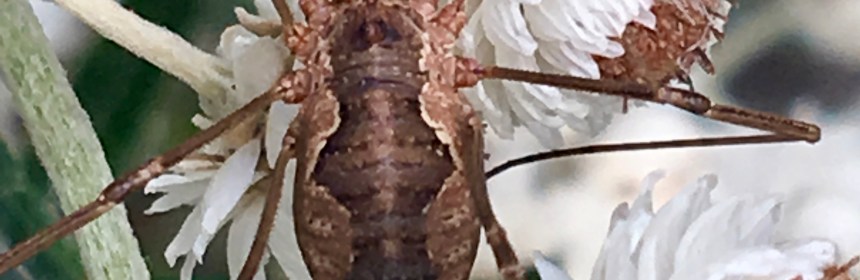
Harvestman probably Phalangium opilio

I found this the other morning (Sept. 8, 2018) when my husband had to drive over to unlock the gates at Mount Grant, San Juan Island Land Bank Preserve.

While I was waiting for him at the top, I had a chance to photograph this really interesting spider (or so I thought). It had 8 legs and looked like a spider to me, but not one I’d seen before on San Juan Island. I spent that evening going through my spider ID book without any luck.

So I sent off an email to Rod Crawford, curator of the arachnid collection at the Burke Museum in Seattle and all around “spider man” genius. Here was his response.

“Dear Cyndi,
The reason you could not find the top specimen in the Adams spider book, is that it isn’t a spider. It’s a harvestman (member of a separate order of arachnids). Even a scorpion is more closely related to a spider, than a harvestman is. Harvestmen have segmented bodies that are all in one piece (not 2 separate pieces), 2 eyes close together on a little bump, totally different mouthparts, respiratory system and reproductive system, no venom and no silk. Yours is probably the common European import Phalangium opilio.”

So, I learned something new today. I hope this will inspire you to read up on Harvestmen or Opiliones. I know that’s what I’ll be doing this evening for my light reading! Here’s a link to get you started ~ https://bugguide.net/node/view/33857 and while you’re at it, check out Rod Crawford’s great spider myth’s website at https://www.burkemuseum.org/collections-and-research/biology/arachnology-and-entomology/spider-myths

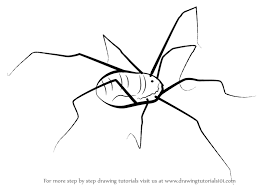
Illustration of a Harvestman

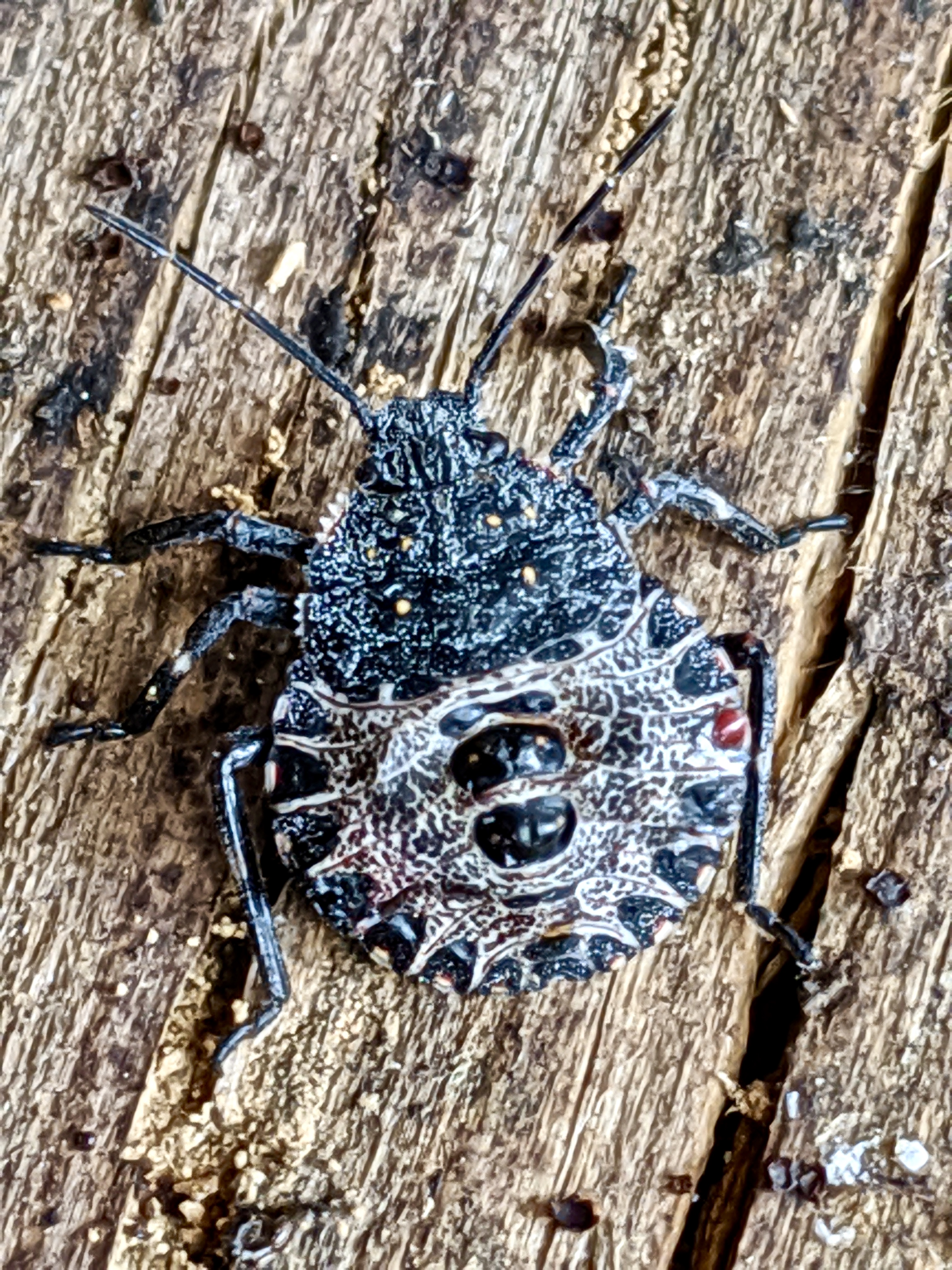
Rough Stink Bug, Brochymena spp.

This is a quick post! I just wanted to share the stink bug nymph I found over the weekend (Sunday, Sept. 1, 2019). It’s a Rough Stink Bug nymph, in the genus Brochymena. I believe it’s Brochymena quadripustulata, the Four-humped Stink Bug. However, Brochymena sulcata and B. affinis are two other species found in our area so similar, they are difficult to distinguish.

Brochymena quadripustulata nymph

Often Brochymena stink bugs are confused with the Brown Marmorated Stink Bug, Halyomorpha halys. These two species can be distinguished by the teeth on the outer edge of the pronoun found on Brochymena spp. and the lack of white rings on Brochymena spp. antennae. Great diagram here ~ http://www.stopbmsb.org/stink-bug-basics/look-alike-insects/%23nbsb

I’m not certain what the red spot is on the bug in my photo, but curiously, I found another photo on bugguide.net with a similar spot https://bugguide.net/node/view/1596719/bgimage . I wish I’d kept my specimen for further investigation, but let it go after taking a few photos. The quality of the photo when enlarged just isn’t good enough to determine if the spot is a parasite. My first thought was it sure looks like a honey bee varroa mite, but I haven’t found any literature describing mites on stink bugs. For the time being, it’s on my “shelf” of things to figure out.

References/Further Reading

https://webdoc.agsci.colostate.edu/bspm/Hexapoda%20(Insects)/Rough%20Stink%20Bugs.pdf

https://bugguide.net/node/view/156717

https://www.oregon.gov/ODA/shared/Documents/Publications/IPPM/StinkBugGuide.pdf