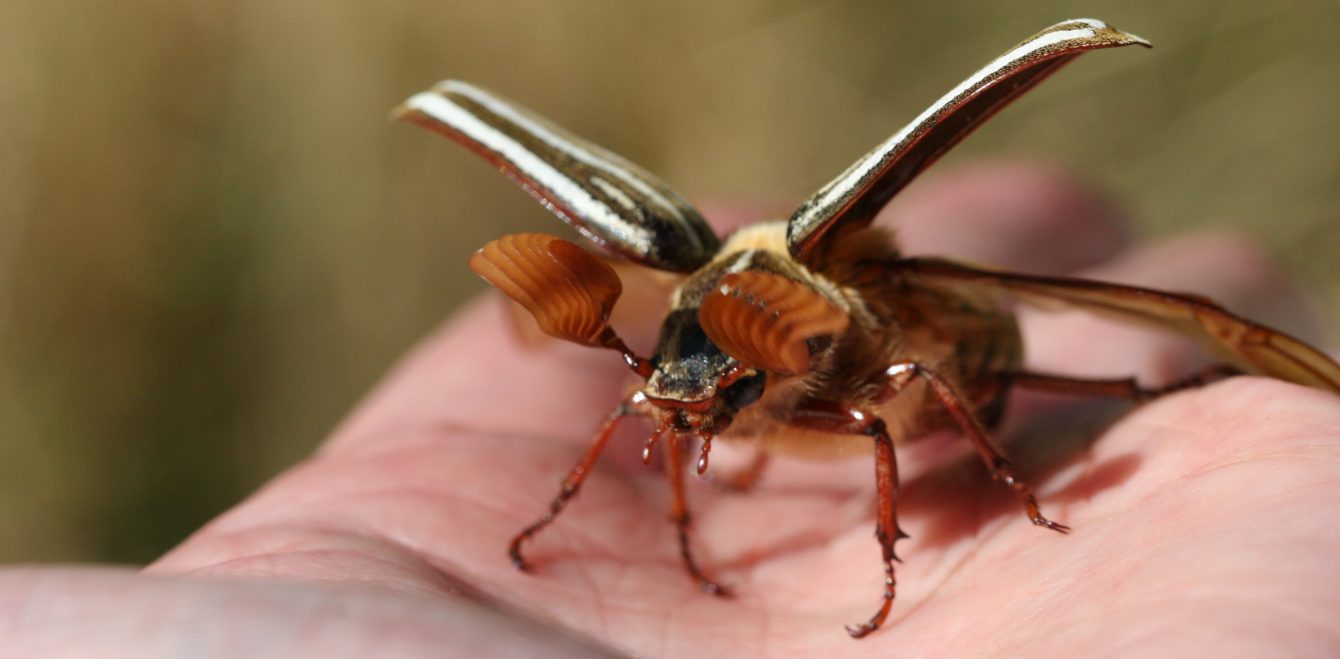
Is our fear of murder hornets turning us into the real murderers?

A neighbor sent me this video footage late last night. She asks, “Why are all the black and yellow bumble bees on the ground dying?” This occurred locally at an island lavender farm where the bumble bees are LOVED and no one is applying any pesticides. In the video you can certainly see the bees she refers to. Why only those?
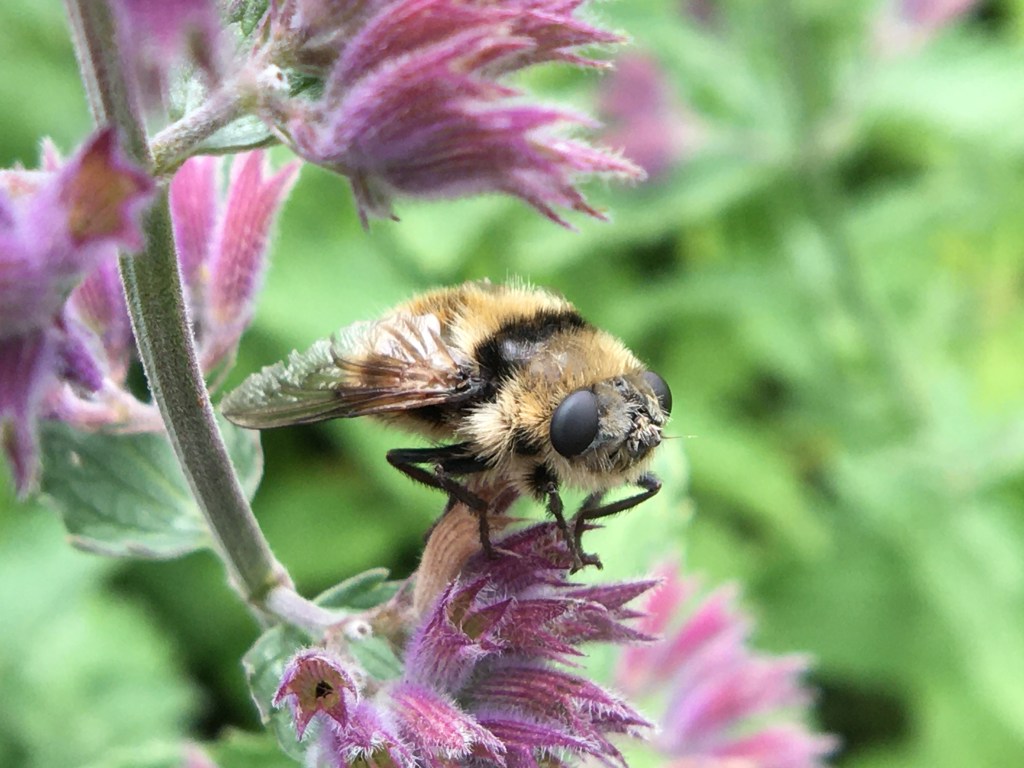
The dying bees are the lovely Yellow-Faced bumble bees, Bombus vosnesenskii. I personally appreciate these because not only are they avid tomato pollinators, but they have such adorably chubby and fuzzy bodies with a yellow face and a yellow band around their little black bottom.

Bumble bees are cavity nesters. Many will select an empty mouse burrow in the ground to create their nest. The fertilized queen overwinters and begins her colony in late March or early April, foraging for herself and the eggs she laid that would soon hatch into larvae needing to be fed.
In order to obtain nutrients necessary for survival, bumble bee foragers can travel long distances (up to 11 miles), especially here as our growing season ends in summer. Right now, they are visiting the lavender in bloom.
These poor bees are most likely victims of pesticide. The fact that all of them are the same species, at the same location, indicates to me that someone applied pesticide at their nest site, likely a property owner within foraging distance of the worker bees visiting the lavender farm. The workers dispersed from the nest to try to do what they are programmed to do (forage for food), but simply succumbed to the toxic residues that some fearful homeowner applied.
“I can’t have bees in my yard!” “I’m allergic.” “I have pets.” “I hate insects.” “It could be murder hornets.”
Do you want to have food?
If you, as a homeowner, continue spraying your yard every time you see a bee and can’t learn to live with them, you are going to be the end of all of us. Bumble bees are some of our most important agricultural pollinators. More important than honey bees!
The dying bees in this video are native bees. “Native” means they are adapted to this environment. They have the ability to survive here better than European honey bees (Apis mellifera) which are not native. Honey bees were transported to North America by Europeans who brought sheep, cattle, swine, and other domesticated species to this continent.
Back to the over-sensationalized “murder hornets.” This term makes me angry! 😡 The media hype is much like the hype over the mantids that are going to eat our hummingbirds ! Just because it is printed in the paper doesn’t mean it is the whole truth or entirely accurate. The primary reason the Asian Giant Hornet (Vespa mandarinia) is of concern is their ability to kill European honey bees (Apis mellifera), an agricultural commodity. To read some of the news stories, you’d think we were dealing with Africanized Bees…remember those?
It is possible Vespa mandarinia will not survive here. They aren’t native. They will be susceptible to parasites, and viral, bacterial, and fungal diseases (not unlike the same problems our non-native European honey bees face) potentially making it difficult for populations to establish themselves. We could also, as many Asians do, learn to eat them. Yes, do read the publication about them in my references section!
Please put that can of pesticide away. Don’t spray. If you are truly afraid of bees, then educate yourself about how to live alongside them. First off, don’t wear shades of blue or black colors when you’re near an area that has bees. Bumble bees and honey bees are attracted to these colors. Avoid wearing fragrances. Wash your clothing in unscented detergent and avoid using those noxious, heavily scented dryer sheets. Finally, if you do see an insect that you believe is the Asian Giant Hornet, take a photo or collect the specimen if it is already dead and contact WSU following these guidelines.
In Washington State only, people should report potential sightings of the AGH through the Washington State Department of Agriculture’s website. Outside of Washington, contact your state apiary inspector. If it is safe to do so, take a photo or collect a dead specimen of the pest to help experts identify the insect.
In the meantime, please don’t fall victim to media hype and do your best not to murder innocent bumble bees!
References and further reading:
Bombus vosnesenskii. Bugguide.net https://bugguide.net/node/view/19538
John M. Mola, Neal M. Williams. (2019) A review of methods for the study of bumble bee movement. Apidologie 56.
Jha, Shalene, and Claire Kremen. (2019) Resource diversity and landscape-level homogeneity drive native bee foraging. Proceedings of the National Academy of Sciences of the United States of America vol. 110,2: 555-8. doi:10.1073/pnas.1208682110
Sujaya Rao, George Hoffman, Julie Kirby & Danielle Horne (2019) Remarkable long-distance returns to a forage patch by artificially displaced wild bumble bees (Hymenoptera: Apidae), Journal of Apicultural Research, 58:4, 522-530, DOI: 10.1080/00218839.2019.1584962
(Vespa mandarinia) Asian giant hornet. New Pest Response Guidelines. (2020) USDA Animal and Plant Health Inspection Service. Plant Protection and Quarantine. https://cms.agr.wa.gov/WSDAKentico/Documents/PP/PestProgram/Vespa_mandarinia_NPRG_10Feb2020-(002).pdf





 Bugging You From San Juan Island