Monthly Archives: August 2022

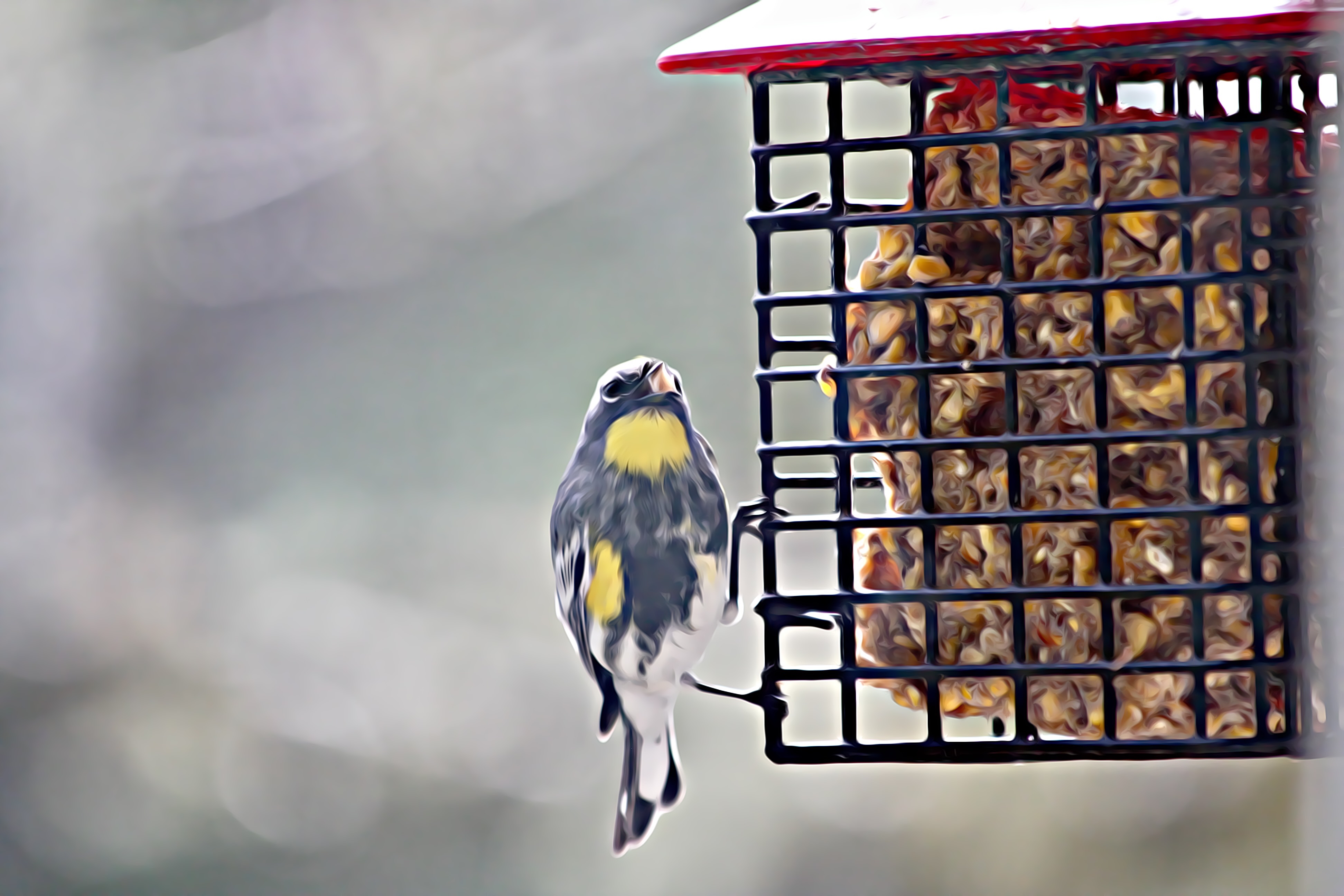
Birdie Buffet

Yellow Rumped Warbler – San Juan Island, WA

I have an observation I was fortunate enough to see in person last September (2021) that I’d like to share, including a short video or two I filmed, and a wonderful animation slide made for me by one of our local San Juan Island artists, April Randall, who I asked to illustrate what I witnessed, but did not have an opportunity to record on camera.

We are entering the season – late summer/early fall, when some species of ants and termites send out their winged reproductives, also known in scientific lingo as “alates.” These flying individuals have reached reproductive maturity and their purpose is utilitarian: to fly away from home, mate, and establish a new colony…IF they are lucky enough not to be eaten or fall to some other random fate in nature.

Over the past seven years, I’ve been able to watch as one particular colony of Western Subterranean Termites (Reticulitermes hesperus) sends out their offspring to do exactly this. The event happens annually during the first 12 days of September without fail. They swarm to the surface, exiting en-masse out of the little hole in the ground, to launch out into the great, wide world. The air is filled with their tiny black bodies and translucent wings – wings that last just long enough for them to disperse far enough away from home, so as to not compete with the parent colony.

Many, or probably it would be fair to say “most” of these winged reproductives or alates, aren’t successful, if by defining success, your measure is for them to begin a new colony. However, if you measure success from another perspective – that of Mother Nature, this event is indeed a success – for Mother Nature hasn’t forgotten the food web and the myriad of other species who must forage for food in order to survive.

In the videos below, you will see a close up of these Western Subterranean Termite alates emerging from their underground colony which lies below our driveway in a network of old Douglas fir roots that were cut down long ago by the former homeowner. As “momma” to a bearded dragon, I included some video of my pet, Drago, feasting on these termites as they emerged. Bearded Dragons are known to dine on termites in their native range in Australia, so I thought, “Why not?” Yes, he loves them! What I unfortunately don’t have video footage of is what we saw after we came back into the house. There was a little flock of Yellow-Rumped Warblers waiting for us (mostly for Drago) to leave that spot. As soon as the coast was clear, those little birds were down on the ground, eating the termites as fast as they emerged.

So here’s where I brought April into the picture. April made the animation and I think it’s important because it gives you something to share with your friends about how the food web works – or how it’s supposed to work. It’s also important because many, many people automatically see termites as something bad, a PEST. While that may be true if they are eating your home, it isn’t true in this case.

These termites have never bothered our home (not once in 7 years). We border a wooded area and there is plenty of habitat that termites need for survival. Some pest control operators will tell you right off though, that you have to be proactive. Get rid of the colony. Well, they also want you to PAY them, so don’t believe everything you hear. What I’d like you to consider is how Mother Nature is providing for these little birds – and other species of wildlife. The Warblers (and other wildlife) don’t have a grocery store to pop into whenever they are hungry. They rely on seasonal (often temporary surges) where food is abundant, so they can eat enough, storing energy to survive whenever they can’t find food. Feast or famine is a common theme for wildlife. They may even have to travel for long distances to take advantage of a resource. Because Yellow-Rumped Warblers can live for 6-7 years, they may well remember how to find this exact spot on our property each year.

Western Subterranean Termites (Reticulitermes hesperus)
Drago, the bearded dragon eats Western Subterranean Termites on San Juan Island – Sep. 12, 2021
Animation by April Randall, Orcas Island, WA

Please feel free to share with you friends and family. I hope you enjoy the animation. This year, I’m going to be waiting with my camera in hopes of capturing this special moment.

About Reticulitermes hesperus:

Lifespan of a Queen – up to 30 years

Family: Rhinotermitidae

Geographic Distribution: along the Pacific Coast (BC-CA-Mexico) east to ID & w. NV

References, Further Reading, and Artist Information

Bugguide (Reticulitermes Hesperus) https://bugguide.net/node/view/183940

Keller, Laurent. (1998). Queen lifespan and colony characteristics in ants and termites [Review]. Insectes Sociaux. 45. 235-246. 10.1007/s000400050084.

April Randall, The Windy Painter – https://www.instagram.com/windypainter/?hl=en&fbclid=IwAR26Joo9sFvw1KUnA_0tiQe2wObCAMTNh8Rzxy6pkZU1WKaMtD_vcmDEliw

Musings on the complicated topic of native pollinators, food production, and climate change

Bee Balm, nasturtiums, and Stinky daisies


Our native pollinators were slow to emerge this year in the San Juans because of the cool weather. Usually, we can rely on flies, solitary bees and wasps, and even moths, ants, and others to pollinate our fruit trees. I did see some species of flies out this spring, but again, weather conditions were poor. 

We have PLENTY of “pollinators” out in our yard right now. So, in trying to explain to people when they ask me about a decline in native pollinators, I have a few points I like to throw out for consideration.

1) honey bees are poor pollinators to keep on the island. It has to be above 50 degrees for them to come out of the hive.

2) native flies and other insects like moths (which fly at night and we don’t typically see) are better at pollinating in cooler temperatures.  While they also won’t be out if it’s rainy and super cold, they can fly in temperature ranges lower than 50 degrees F.  

3) the critical importance of native pollinators may not be in their “pollination” services – but their role as pest predators and/or role in the food cycle for other organisms, and for creating biodiversity in our ecosystem, which helps keep everything healthier.   I think this part is important.  If you look at some of the plants we put in our gardens (native perennials), they actually do not require pollination to survive and reproduce, but do offer pollen and nectar to many insects, spiders, and hummingbirds.  Looking further at the food web, we need a variety of native insects for more than pollination.  Tachinid flies, syrphid flies, solitary wasps, ants, and even spiders can be pollinators, but also help regulate populations of orchard, garden, and forest pests.  

My take on all of this is as humans, our focus has largely been on how to grow food over environmental conservation and maintaining balanced, functioning ecosystems.  With climate change, many of our food growing operations may fail.  Our fruit trees (at least none that I know of) are not native.  In spite of the best intentions, conditions may decline to a point where we can’t produce great fruit here.  Weather is only one limiting factor.    We have poor soils or no soil in many locations, limited water resources, and the pressures of continuing development resulting in loss of natural habitats.  I don’t have the answers for you when it comes to fruit production or any way to personally mitigate climate change, so we may have to figure out a substitute for growing apples, plums, and such.  

Let’s go back to the importance of native pollinators though.  If you think of our island as a living organism with many different functions, it is important to have all the essential pieces to keep the “body” healthy.  These native pollinators (and the native plants they visit), and all the other myriad species of invertebrates, fungi, birds, mammals, amphibians, reptiles, soil, water, etc. are all part of the “body,” a body that has to fight off occasional or repeated assaults from being thrown off balance by exposures to external forces.  Just like we need a variety of foods and minerals and other things to keep our body healthy, so does an ecosystem.  We need all of these pieces (and that includes our native pollinators and all the other diverse species) to keep our island home healthy.  

As to the fruit trees and other food crops requiring pollination, for now, some of these issues can be mediated by planting around your orchard and garden with plenty of diverse native species and providing habitat for all of these native species to develop.  Some of our practices of cleaning and sanitizing our orchards and gardens, burning yard clippings, and applying fertilizers and pesticides can adversely affect the biodiversity needed to help our food production thrive.   

I imagine it can be frustrating to see an orchard fail to produce fruit.  My grandparents were tenant farmers and wholly dependent on growing cotton and corn and the bit of garden and livestock they had around the home on the property they did not own.  When it was a drought year, and crops failed, things were utterly miserable.  Destitute would be a better adjective.  I believe we may have an inherent desire to be “part of the land,” and grow our own food, but sometimes, despite our best efforts, conditions aren’t favorable.  Crops fail.  Historically, we have tried (and failed) to control some of these external forces – like applying pesticides in amounts that probably will poison us forever.  

I’ve gone way beyond the “pollinator” topic here, but it is next to impossible for me to see a one-dimensional issue.  We have a much larger and more complex picture before us.  How do we either re-create or maintain a healthy functioning system, navigate the perils of climate change, and feed ourselves?  I like to believe that protecting diversity in our ecosystems is an important facet of this complex, multi-layered crisis we face. 

Resources and Further Reading

Washington Native Plant Society – https://www.wnps.org

Xerces Society – http://www.xerces.org

WSU Extension Master Gardeners of San Juan County – https://extension.wsu.edu/sanjuan/master-gardeners/