
Author Archives: BUGGING YOU FROM San Juan Island

Autumn is for Arachnids!

Last month I held my 2nd annual virtual event, “September Spider Sleuthing in the San Juans.” Little did I know it would turn out to be so popular. Even the Journal of the San Juan Islands interviewed me. One of the questions asked was, “What led me to create the event in the first place?” Let me answer that for you.

Well, I happen to be an entomologist (someone who studies insects), but after living here for twelve years, I’ve come to LOVE the diversity of spiders that share our islands. I want to help others understand how important spiders are in our ecosystem and dispel some of the unfortunate and undeserved myths associated with our eight-legged friends.

This week, the spider sleuthing continues, albeit informally. I received some emails about spiders, and actually had two folks drop off spiders at my husband’s office in little cups for me to take a look at. “What ARE these?” inquiring minds wanted to know.

One was a suspected Black Widow that turned out to be a look-a-like False Widow (Steatoda grossa). While instinctively protective of the little sack of clustered eggs laid in a matrix of messy web in the plastic cup, I could sense she was alarmed. I was able to remove the lid and take a few photos without disturbing her too much. For now, she remains in the plastic cup. I may relocate her and her egg sack to our greenhouse tomorrow. Steatoda grossa spiders are not medically significant to humans. She’s a friend. Her presence helps keep the actual black widow spiders from colonizing our homes.

Steatoda grossa spider with egg sack
Steatoda grossa ventral view

The other cup held two spiders. All I knew ahead of picking them up was they were presumed deceased. One of those two spiders moved ever so slightly when I opened the lid. Where there is movement, there is LIFE! I was mesmerized with this spider, a Woodlouse hunter (Dysdera crocata). After photographing this beauty, I set it free in our stack of cut wood that doubles as a fence along the edge of our property. It will find plenty of isopods in the forest floor and the wood will double as a nice winter home with all its nooks and crevices. Woodlouse hunters are also harmless to humans. Consider them friendly!

Woodlouse Hunter (Dysdera crocata)

The last poor little soul was unfortunately frozen after it was collected. Yes, I opened the lid knowing this, but imagining movement, and hoping that maybe it hadn’t been frozen long enough to kill it. I don’t personally enjoy killing bugs. They’re much more interesting to me alive. I took the post mortem photos, but I’d have preferred being able to resurrect it.

Callobius severus

This sweet little dude is a Hackelmesh Weaver. His scientific name is Callobius severus. He’s harmless (a friend). He was only trying to find a mate. Male spiders often wander this time of year in search of a female. Look at those little palps! Those are the organs the male spider uses to transfer sperm to the female. They looks like little paws…or maybe tiny furry boxing gloves. I’m sorry this fella didn’t find a friend. May he R.I.P.

Callobius severus
Callobius severus

Thanks for reading!

Facebook Fail

The social media giant we all have become overly dependent on in recent years, had a big, giant F-A-I-L today. The entire site was down. I couldn’t share bug photos or look to see what crazy or amazing things my friends had been up to. I also couldn’t watch the fabulous video of the frog and bearded dragon that I’ve been replaying over, and over, and over because it’s so DARN cute! You can find it on Tik Tok if you can’t find it on Facebook.

In the void, I resorted to the fail safe backup. It’s called E-mail. I really feel old because I actually remember how we communicated before the advent of cyberspace – handwriting letters that you put a stamp on and eventually were delivered by USPS.

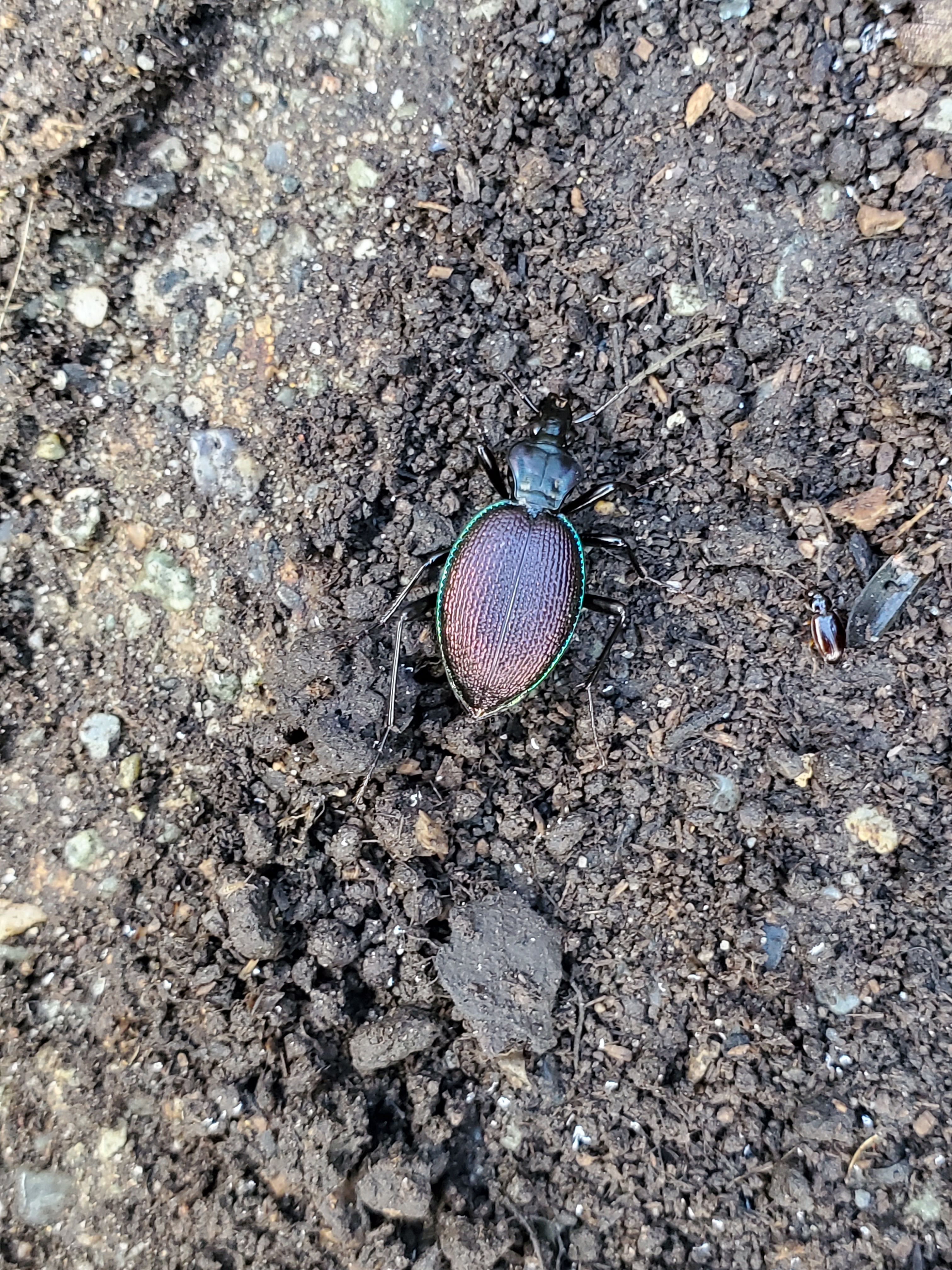
So, in my email, I actually had received two nice bug pictures I want to share with you. Victoria Compton (who is running for Friday Harbor Port Commissioner btw) sent these to me. The first, a caterpillar, is going to turn into my favorite moth, Lophocampa roseata or the Rosy Amelia Moth. The 2nd, is a ground beetle in the family Carabidae (Scaphinotus marginatus) – also sometimes called the Margined Snail-eating Carabid Beetle.

Happy Bug Viewing! Thanks for checking these out and thanks for sending the photos Victoria! You have my vote. 😉

Lophocampa roseata moth caterpillar

Scaphinotus marginatus Carabid beetle

Links to read more about these two bugs

Lophocampa roseatahttps://buggingyoufromsanjuanisland.com/2018/10/02/lophocampa-roseata-rosy-aemilia/

Lophocampa roseata https://bugguide.net/node/view/247272

Scaphinotus marginatus https://bugguide.net/node/view/327898

Spider Vivarium DIY

It’s wet and rainy out today, so I thought I’d share an indoor spider post for you to view. This isn’t my own, but I just watched it and it’s an informative, short, DIY on how to set up a vivarium for a jumping spider. Yes! Sometimes having a dog or a cat is impractical or impossible. Time, space, and affordability can impact our choice of animal companion. There’s also the environmental impact. 🤔 Hmmm, how many of us really consider that? On the enviro-scale, keeping a spider is far greener than probably any other pet you could choose. No greenhouse gases!

Eunuch or “U-neek” Eeek! Another Spider Sex Story!”

Yesterday I was literally in bed most of the day recovering from a precautionary step to prevent severe illness.   I felt like I had been in a bad auto accident, but that’s got to be better than actually having and/or dying from a virus, right?   Well, I used the time to read.  Mostly I read spider behavior stuff.  Believe me, some of these things are pretty interesting!  Spider sex for instance.  Who knew! I found this somewhat sensational spider story. This spider doesn’t live in the San Juans, but it’s so weird, I just have to share!  

DID YOU KNOW there is such thing as a Eunuch spider? (Tidarren sisyphoides), one of the Theridiidae or Tangle Web Spiders, AMPUTATES one of its own pedipalps (the male sex organs).  The species name (Tidarren sisyphoides) is a combination translation from Gosiute-Greek meaning ‘small male’.  Male spiders of this species are very tiny (1mm) in comparison to females ( only 1% the size of the female).  

According to R.J. Adams (2014) and Ramos et al (2004), Tidarren sisyphoides male spiders are born with, and develop two palps, just like other spiders, but at the penulitimate (next to last) molt (shedding of the exoskeleton as part of growth/development), the male spider amputates one of these palps ON PURPOSE!  

The amputation process isn’t done by chewing or anything of that sort.  The tiny spider wraps it in a silk scaffold, then dismembers the palp by twisting or moving around in circles until it breaks off.  The remaining palp is quite large in proportion to the 1mm sized body of this tiny spider, making up 10% of the total body mass. 

Why would the spider amputate one of its palps?  Well, turns out that males with one palp can move around and chase females much faster with only one palp.  It is supposed to give these guys an evolutionary reproductive advantage.  Males only mate once, so the reproductive drive is stronger than the drive to preserve one’s palp! Once he’s inserted that single palp, he will die within minutes,  still attached to the female. Hmmm, getting laid might not be so lucky depending on how you look at it.

After mating, the female will extricate the palp from her epigynum (the female reproductive receptacle).   While some other species of spiders are known to eat the male after mating, this species does not. She will merely discard the body.   

Interesed in reading more?  Check out these links, and read my blog about spider sex too! 

Adams, R. J., & Manolis, T. D. (2014). Field Guide to the Spiders of California and the Pacific Coast States (1st ed.). University of California Press. http://www.jstor.org/stable/10.1525/j.ctt5hjhpb

Kuntner, M., Agnarsson, I. and Li, D. (2015), The eunuch phenomenon: adaptive evolution of genital emasculation in sexually dimorphic spiders. Biol Rev, 90: 279-296. https://doi.org/10.1111/brv.12109

Ramos,M.,  Irschick, D. J., and Christenson, T.E.  2004. Overcoming an evolutionary conflict: Removal of a reproductive organ greatly increases locomotor performance. Proceedings of the National Academy of Sciences  101 (14) 4883-4887; DOI: 10.1073/pnas.0400324101 https://www.pnas.org/content/101/14/4883

The Teeny Tiny “Trashline Orb Weaver” – Yes, that’s really the name!

Trashline Orb Weaver (Cyclosa sp.) San Juan Island, WA 09.06.2021

I am very nearly blind when I try to see things up close, so it truly surprises me how I SEE things like the tiny “laundry” line of dead bugs this little orb weaver had strewn along a filmy thread between the boughs of our fir tree. At first, I thought it was just debris, stuck to the remnant of a spider thread, long abandoned. Upon closer inspection, I saw more threads and then my attention focused on the center, where I was able to discern what looked like teeny legs curled up around a body.

Trashline Orb Weaver

I used my clip on macro lens to get a better look. Indeed, there was a tiny spider in the center. I thought it was dead. That’s EXACTLY what the spider was hoping I’d think, and then I’d move on and the spider could enjoy the morning sun, and maybe a tiny bug for breakfast too.

Trashline Orb Weaver

Trashline Orb Weaver

I had a hard time getting decent photos. Even with the macro lens, focusing was tough. The wind would blow at just the WRONG second and I’d have to start all over again. I couldn’t find my tripod, but finally got a decent pole to help me balance, and went out to take photos at different times over a period of 2 days. I even went out last night and took a picture.

Awake or Sleeping? Trashline Orb Weaver (Cyclosa sp.) at night. San Juan Island 09.07.2021

It was fairly easy to identify the spider to Genus (Cyclosa), but species ???? . After going through the literature I had, I narrowed it to 2 possibilities, but reached out to Rod Crawford for help. Rod is the curator of arachnids at Seattle’s Burke Museum and this is what he says,

“Yes, it’s a Cyclosa. This time of year all Cyclosa are juvenile, and I for one cannot distinguish between our 2 species (C. conica, C. turbinata) as juveniles. However, C. conica is more common.”

So, my little spider with a laundry line of bugs is either Cyclosa conica or Cyclosa turbinata.

Why exactly do they string the debris along their web lines? Well, again, this debris is usually made up of dead bugs and other tiny bits of debris attached to the silk line. Typically, the spider is positioned somewhere in the middle, using the debris as camouflage against predators. Often, the female spiders’ egg sacks are attached to this “laundry line” too. I think laundry line sounds better than trash line, but I don’t think I get to rename the spider.

There are five species of Cyclosa spiders in North America, north of Mexico. I believe we only have the two mentioned by Rod here. I’m going back out to check on my new friend after I finish my post. Enjoy the day and remember to Be Nice to Spiders!

Thanks for reading.

References and Fun Reading

Eaton, E. 2012. Spider Sunday: Trashline Orb Weavers. Bug Eric Blogspot. http://bugeric.blogspot.com/2012/06/spider-sunday-trashline-orb-weavers.html

Bugguide.net. 2021. Genus Cyclosa – Trashline Orb Weavers. https://bugguide.net/node/view/1989

Trashline Orb Weavers. Missouri Department of Conservation. https://mdc.mo.gov/discover-nature/field-guide/trashline-orbweavers

Flight of The Phantoms (Phantom Hemlock Loopers – Nepytia phantasmaria)

Yesterday, August 29, 2021, I received an email from C. Croll requesting ID of a moth photographed by T. Ormenyi. Their query read,

“I live on Orcas and kayak quite a bit. Today I was paddling from Patos Island back home, and there were thousands of moths in the air. They were heading from south to north. We first saw them on Patos but then all the way home. Some had fallen onto the water on the crossing. ”

And,

“I had not witnessed so many moths all traveling together before. Seemed like a migration of some sort? When they first arrived I thought there were cottonwood seeds floating on the breeze, took a second to realize that it was moths. The air was full of them for almost an hour. “

Phantom Hemlock Looper (Nepytia phantasmaria ) – photo by Tessa Ormenyi

These moths sighted by Calvin and Tessa are the Phantom Hemlock Loopers, (Nepytia phantasmaria). They are in the family Geometridae. This species ranges from southern BC to California. There is one generation produced per year and larvae feed on conifers, including Western Hemlock, Douglas-fir, Grand Fir, Amabilis Fir, Sitka Spruce, and Western Red cedar (Bugguide.net).

Adults typically emerge in fall (September and October), so seeing them now is a bit earlier than when I’ve typically collected specimens at my porch light on San Juan Island. Last year, I photographed my first specimen of the season on Sept. 7, 2020. As these moths are nocturnally active, Calvin and Tessa’s report of of them traveling en-masse like this during daylight was intriguing. I was curious to know more.

William H. Hendrix III’s thesis titled Migration and behavioral studies of two adult noctuid (Lepidoptera: Noctuidae) species plus feeding observations of some moths common to Iowa (1990), cites (Johnson, 1969), stating these migration events are part of the “oogenesis flight syndrome” stage where the newly emerged adult insects move en-masse before reproduction and egg laying takes place. Hendrix (1990) also provides some theories as to WHY these moths migrate in the first place. Several theories have attempted to explain this, but he concludes, “Migration, consequently, occurs primarily in young adults and its chief function is to allow escape from unfavorable habitats and allow colonization of a broad range of environments” (Hendrix, 1990).

After reading about this particular species, I believe the migration witnessed yesterday could be attributed to either 1) the sudden weather change we experienced overnight in the islands, or 2) the lack of suitable habitat for reproduction because of the drought we are experiencing. I’m guessing the drought may have more to do with this and we will see more evidence as other species struggle to survive the coming environmental shifts associated with global warming.

Thanks to Calvin and Tessa for sending in their observations!

References and Further Reading

https://bugguide.net/node/view/88329

http://mothphotographersgroup.msstate.edu/species.php?hodges=6907

Edwards, D.. (2011). Activity rhythms of Lepidopterous defoliators. II. Halisidota argentata Pack. (Arctiidae) and Nepytia phantasmaria Strkr. (Geometridae). Canadian Journal of Zoology. 42. 939-958. 10.1139/z64-093.

Hendrix, William Hurston III, “Migration and behavioral studies of two adult noctuid (Lepidoptera: Noctuidae) species plus feeding observations of some moths common to Iowa ” (1990). Retrospective Theses and Dissertations. 9373. https://lib.dr.iastate.edu/rtd/9373 https://lib.dr.iastate.edu/cgi/viewcontent.cgi?article=10372&context=rtd

Johnson, C. G. 1969. Lepidoptera: Long-distance displacement. In MigrationandDispersalofInsectsbyFlight. Methuen&Co.,Ltd., London. 763 pp.

Biting Black Flies on San Juan Island

This little critter landed on me the morning of August 14, 2021 (with a few friends). I managed to collect the specimen for a photo op session. AND, I let it bite me. It felt like it was sawing into my skin. I have a pretty high pain tolerance though, so it wasn’t so awful. My husband suggested I save the specimen in case I came down with any weird disease!

I have it in a vial on my desk. ID…for starters, it’s a fly (Diptera). This is a black fly (Simulium sp.) and I’ve found the larvae in the seasonal stream near our house before. At some point, I’ll write up a better post for you about these, but for today, you can watch as this female uses her serrated mouthparts to cut through my skin and take a blood meal. She’ll use the protein to help her with egg development.

Black Fly (Simulium sp) – San Juan Island August 14, 2021
Black fly (Simulium sp) biting my finger
April 8, 2020 – San Juan Island, WA – Black Fly larvae in stream

My recommendation if you’re visiting or planning to visit the San Juan Islands in summertime is to bring long sleeves and wear long pants. With climate change, my guess is we will have more biting flies out in the summer evenings.

More about black flies on BugGuide – https://bugguide.net/node/view/16613

Thanks for reading!

Green Bean leaf Grabs Miss Fly Snuffleupagus

Every once in awhile you observe something in nature that makes a story to share. I hope you will enjoy this one.

I have a love hate relationship with my climbing green beans. First of all, I don’t really like eating greens beans that much. The leaves are pretty to look at, but they are lethal to my poor bugs!!!


This morning when I was watering my bean vines, I noticed a teeny little fly, seemingly stuck to one of the leaves. My eyesight is terrible up close, so I had to use both my reading glasses AND my clip on macro lens attached to my Iphone camera to take a closer look.

Not only was the little fly stuck, but it looked like the green bean had somehow glued her to the leaf by her proboscis. I swear that poor little fly LOOKED at me with a plea for help.


Of course I was going to help, but I wasn’t exactly sure how to go about it without causing further injury or accidentally amputating her mouthpart (the proboscis), which looks like a teeny little trunk and reminded me of the character, Mr. Snuffleupagus from Sesame Street.


Finding the tiniest piece of straw on the ground, I gently pried her free. She flew away, filled with relief and maybe a wee bit of gratitude for my efforts in helping her.

Be kind to all living beings.

Two Tints! Araneus spiders – Araneus diadematus

I wanted to share with you photos of two spiders I photographed recently. Location: San Juan Island, WA. Both are in the family Araneidae or what we know as Orb Weavers. The first (orangey one), was observed on a tomato plant July 31, 2021, and the 2nd (brown one) was observed yesterday evening, August 10, 2021, on some sort of wetland grass near my home.

While I knew the orangey one was a Cross Orb Weaver, Araneus diadematus, I wasn’t certain of the brown one’s ID beyond genus Araneus, so I reached out to Seattle Burke Museum’s arachnologist, Rod Crawford to see what he’d say. He responded to my query this afternoon and offered that both are Araneus diadematus spiders. There can be variability in color tint (many of us know the Cross Orb Weaver A. diadematus as pumpkin orange).

Rod continued with, “the ventral view of the brown one shows it is penultimate (still one molt to go). Once they mature they will be more noticeable. Seattle specimens are at this same stage now.” He also offered in terms of color variants among spiders, …”I imagine there is a genetic component to this variation, at least in most cases, but I’ve never looked into the details. I have found situations where spiders living amidst a population explosion of green leafhoppers all tended to be greenish in color, presumably derived from their food.”

It’s all so very interesting, isn’t it! I’m glad we have scientists who are willing to share their knowledge and experience. Thanks to Rod for his help!

Araneus diadematus (San Juan Island 07.31.2021)
Ventral View – penultimate molt – Araneus diadematus (San Juan Island 08.10.2021)
Araneus diadematus (San Juan Island 08.10.2021)

To learn more about spiders, be sure to stop by Rod’s website, Spider Myths – Everything that ‘everybody knows’ about spiders is wrong! https://www.burkemuseum.org/collections-and-research/biology/arachnology-and-entomology/spider-myths

Thanks for reading!

Physocephala burgessi (Thick-Headed Fly)

Found this cool Thick-headed Fly in the family Conopidae on my daisies while I was watering this morning. I believe this one to be Physocephala burgessi.

Thick headed flies are known for a behavior called “hilltopping” where flies will aggregate to find a mate. Adults are wasp mimics and seek out Hymenoptera species (bees/wasps) for development of their offspring.

A parasitoid of bees and wasps, Conopid flies will target an unsuspecting host typically while it is leaving its nest or nectaring on floral sources. The adult fly grabs the host and oviposits into the body of the individual.

The fly’s eggs hatch and migrate into the abdominal cavity of the bee/wasp where development continues as the fly larvae consume the contents within the abdominal cavity of the host. The bee or wasp host continues to live, and is able to fly throughout the duration of the larval development period.

Just before the end of larval development and transition to pupation, the host dies. The death of the host usually occurs somewhere near the entrance to its nest or within the nest itself. Pupation occurs in the abdomen of the now deceased bee or wasp host.

The adult fly typically emerges after overwintering in the abdominal puparium of the bee.

Note*** Typically, populations of these flies are fairly low. In twelve years on San Juan Island, this is the 2nd specimen I have ever seen. I photographed my first Conopid fly at American Camp, on the bluff overlooking Grannies Cove in 2010. In reviewing records on iNaturalist, it looks like my two are the only ones reported in San Juan County. This past year (2021), another resident sent in a photograph, bringing the total, that I know of, to 3.

References and Further Reading

https://bugguide.net/node/view/7190

https://www.ncbi.nlm.nih.gov/pmc/articles/PMC3014735/

https://www.biodiversitylibrary.org/page/2700384#page/126/mode/1up

http://staff.royalbcmuseum.bc.ca/wp-content/uploads/2018/02/Gibson_JESBC_2017.pdf

https://curve.carleton.ca/system/files/etd/6ab4c500-3013-43c0-aa9e-9f94353f1ff5/etd_pdf/139b167a8dbbb1d5ba97e1cd968dda3c/gibson-theevolutionarybiologyofconopidaedipteraa.pdf

https://link.springer.com/article/10.1007/s00114-019-1634-9

https://uwm.edu/field-station/tricks-of-the-trade-thick-headed-flies/

http://www.faculty.ucr.edu/~legneref/identify/conopid.htm

« Older Entries Recent Entries »