Category Archives: Beetles

Your Garden’s Guardian: A Soldier in Miniature (Silis sp.)

Soldier Beetle (Genus Silis)

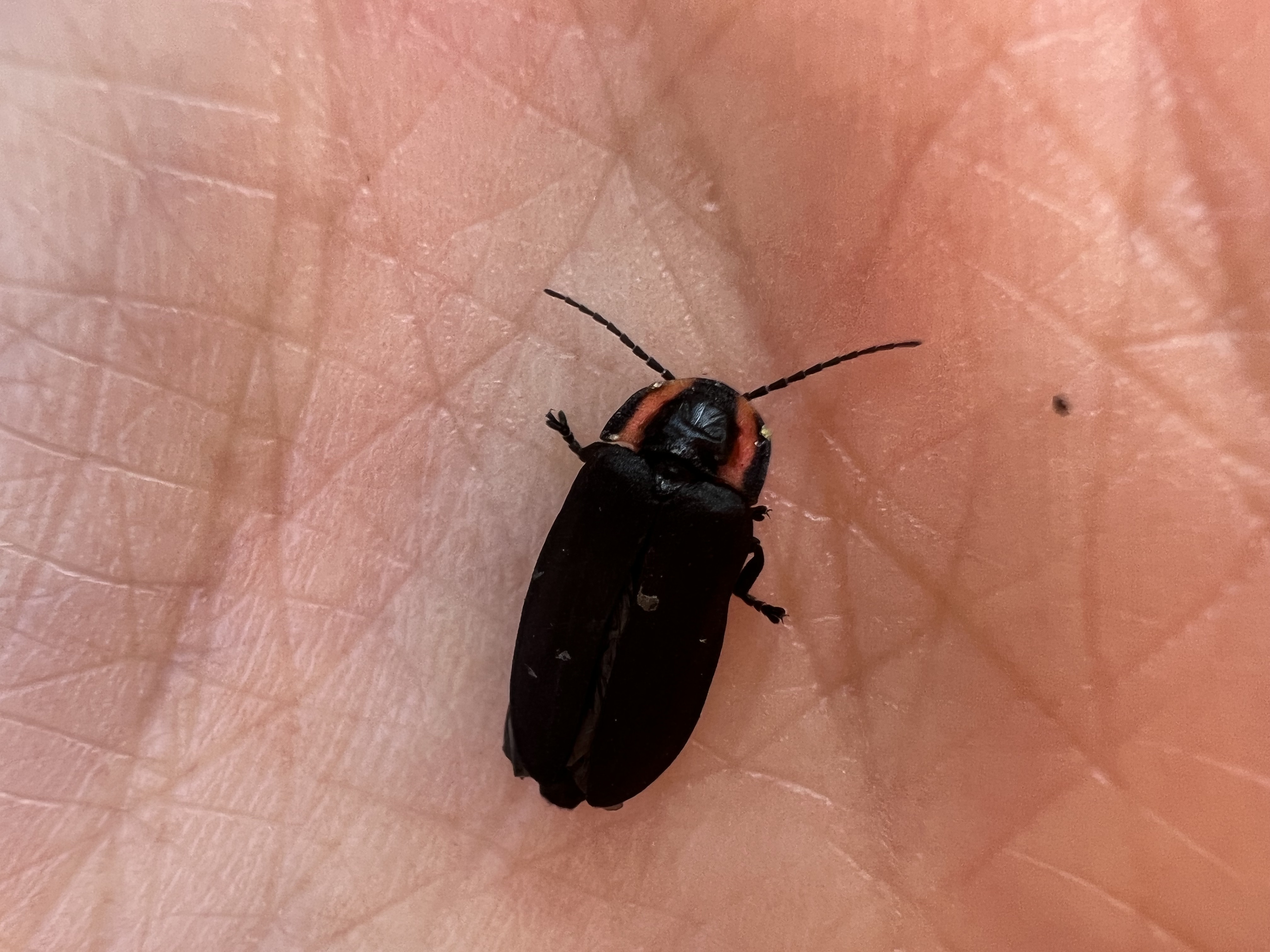
This tiny little friend (approx. 6mm) sporting a red collar is a soldier beetle in the family Cantharidae. It is in the Genus Silis, but there are so many species, that I will just leave it at the genus level for now.

Soldier Beetle (Genus Silis)

Silis beetles are quite cosmopolitan in distribution, associated with wooded areas and leaf litter, and active daytime fliers in early summer.

Adults are typically found on foliage and flowers. Primarily, they are pest predators, feeding on insects, but also serve as pollinators, feeding on nectar and pollen. Silis species are known to prey on aphid populations infesting trees, plants, and shrubs, so gardeners can appreciate them as a “friend.”

Silis beetles can also attack other groups of invertebrates, feeding on small soft-bodied specimens or consuming their eggs. However, the ecology of some species is remains to be investigated. While Fender (1973) found the larvae would eat earthworms and are mostly carnivorous in the soil, little else is known about the feeding habits in this stage. (Pelletier and Hébert , 2014).

The etymology of the nomenclature for the genus (Silis) comes from Σίλας in Greek. It is derived from the Latin name Silvanus, meaning “forest” or “wood,” and a contraction of the Greek form Silouanos, a transliteration of Silvanus. Silis or Silas is also associated with the Roman god of the countryside, Silvanus, a god who was worshipped by those who lived in wooded areas or worked with wood. Even older than the etymology is this tidbit. Silis beetles are quite ancient. Fairly recent research has identified specimens of the genus discovered in Baltic Amber (Parisi and Fanti, 2019).
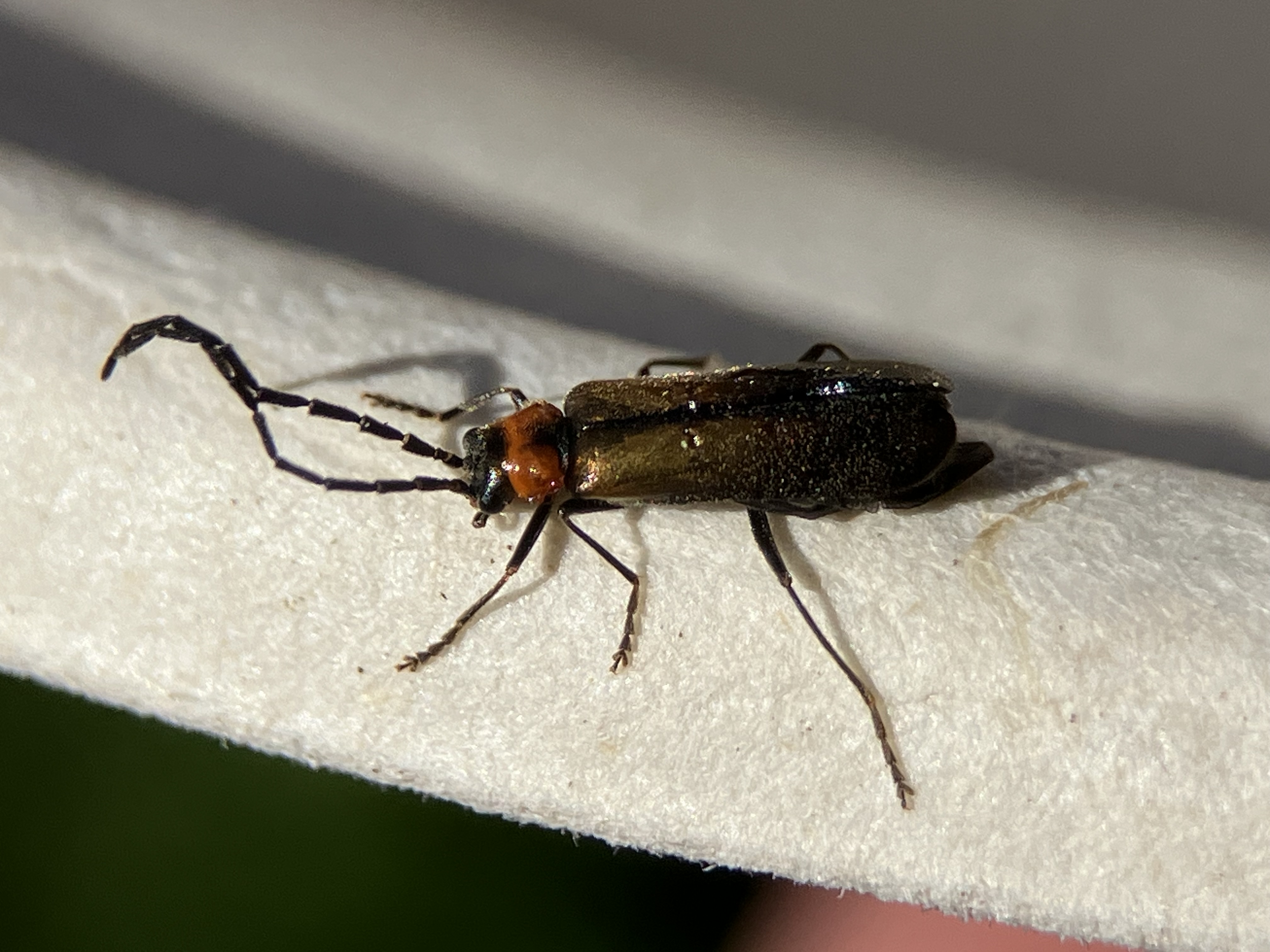
Soldier Beetle (Genus Silis)

While I have now scooped a few out of our pool, thankfully in time to save them from drowning, some of them (perhaps the ones I’ve rescued) are also finding me. I have had them on my clothing and peeping in the door at me!

Thanks for reading!

Soldier Beetle (Genus Silis) looking in our door at me!

References

Bugguide 2025. Genus Silis. Iowa State University. https://bugguide.net/node/view/11961

Green, John Wagener. 1966. Revision of the Nearctic species of Silis (Cantharidae: Coleoptera). Proceedings of the California Academy of Sciences, 4th Series, 32, 447–513. https://www.biodiversitylibrary.org/part/52839

Pelletier, G., Hébert, C. 2014. The Cantharidae of Eastern Canada and Northeastern United States. Canadian Journal of Arthropod Identification No. 25. February 28, 2014. Available online doi: 10.3752/cjai.2014.25

Parisi, F. and Fanti, F. 2019. On the first Silis Charpentier, 1825 from Baltic amber (Coleoptera, Cantharidae), Foss. Rec., 22, 119–123, https://doi.org/10.5194/fr-22-119-2019
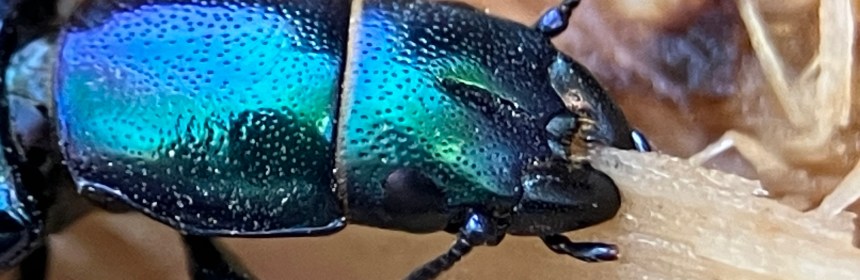
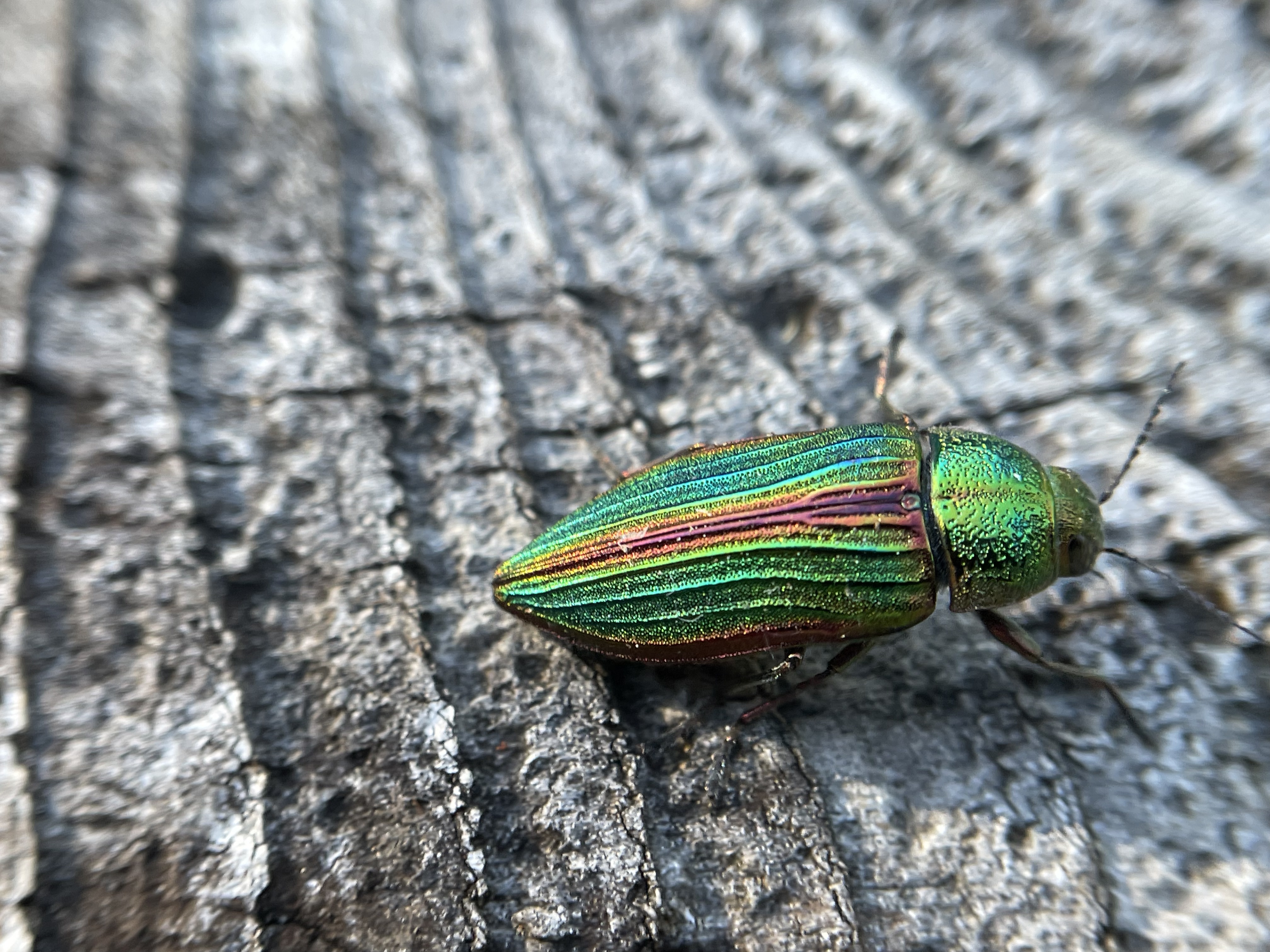
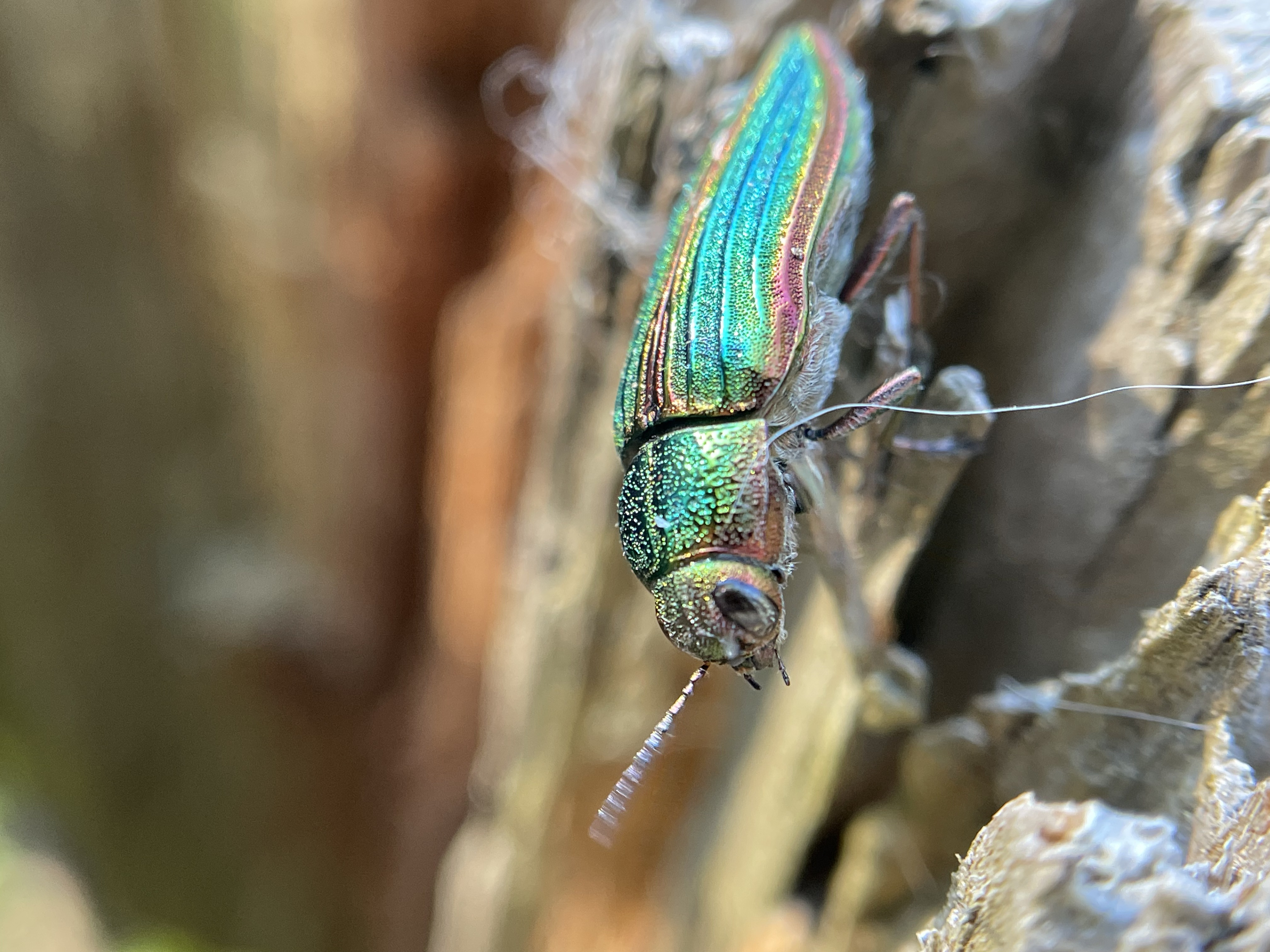
Green Ostomid beetle

I found this gorgeous BENEFICIAL Green Ostomid beetle yesterday on the floor of our barn in the sand. Moved him over to some alder logs we have stacked as wildlife habitat and discovered he appeared to be quite thirsty. Yes, I did actually bring him some more water to drink from our outdoor above ground “pond.” More in the video description. Also want to add that if you have Alders on your property – please don’t grind them up or burn them. They are extremely important resources for many species of wildlife. They hold water even as dead trees, and they are full of insects that feed many birds (and other insects and spiders).

Six Spotted Spider Beetle

Spider Beetle (Ptinus sexpunctatus) May 24, 2024

I found this interesting beetle on the side of our pool the other afternoon and realized I’d actually seen one like it about a week earlier, so I did some digging to figure out what it was. This is a Spider Beetle (subfamily Ptininae), and the species is Ptinus sexpunctatus or Six Spotted Spider Beetle.

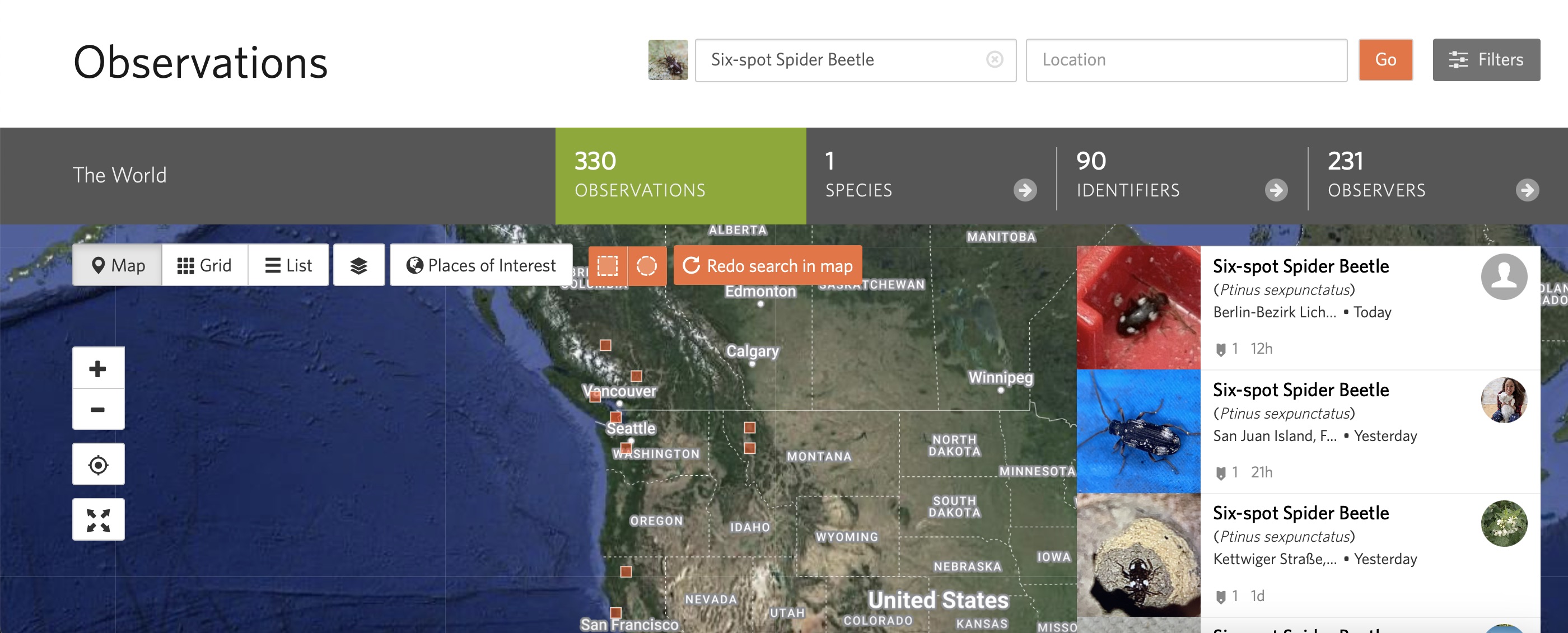
These beetles are quite small at about 2.8-4.2 mm. I used my clip-on Apexel macro lens to get these photos. What I found about this beetle’s life history is that the species is not native to North America. The very first record I found was in Pennsylvania in 1915 where the beetle entered via an imported English Walnut, but subsequent discoveries of populations are as recent as 2003 in Nova Scotia, and 2004 in Utah (Majka et al. 2007). I have not found any data as to how recently they may have arrived in the PNW, and found only 1 other record in WA state, aside from my own, when I searched on iNaturalist

Records of Ptinus sexpunctatus – iNaturalist (as of 05.25.2024)

Within its native range, Ptinus sexpunctatus, is a known associate of cavity- nesting solitary bees. These include bees in the genera Osmia and Megachile. It has also been collected in the galleries of longhorned beetles (Cerambycidae) in oak (Quercus) forests (Majka et al. 2007). Because of these associations, it is possible that Ptinus sexpunctatus was accidentally imported when two Osmia bee species, Osmia cornuta (Latreille) from Spain and O. cornifrons (Radosz- kowski) from Japan, were introduced into the United States for research and evaluation as pollinators of tree fruits  (Cane 2003; Majka et al. 2007). Majka et al. (2007) believe that after arriving in the U.S., Ptinus sexpunctatus colonized the nests of our native Osmia bee, (Osmia lignaria).

The relationship and impact of the nest association between Ptinus sexpunctatus and Osmia lignaria needs further study. Some observations of these associations in Europe describe the beetle as being destructive to Osmia nests, preying on bee larvae and pupae (Majka et al 2007).

References and Further Reading

Bugguide.net. 2007. Pinus sexpunctatus. https://bugguide.net/node/view/107176

Cane, J. H. 2003. Exotic nonsocial bees (Hymenoptera: Apiformes) in North America: Ecological implications. pp. 113–126. In, K. Strickler and J. H. Cane (Editors). For Nonnative crops, Whence Pollinators of the Future? Thomas Say Publications in Entomology: Proceedings. Entomological Society of America. Lanham, Maryland, U.S.A. 204 pp.

Majka C.G., Philips T.K., Sheffield C. (2007) Ptinus sexpunctatus Panzer (Coleoptera: Anobiidae, Ptininae) newly recorded in North America. Entomological News 118: 73-76 (Full text)

Watch Me Take Off!

It’s a short clip, and you’ll have to check out the end to see this little beetle take flight. I fished this one out of the pool and it’s the 2nd one I’ve seen this week, albeit a new one for me to observe. I believe this is Hylastes macer, but hoping a friend will take a look for me to confirm. I have tentatively based my ID on size (approx 5mm) and locale being under our Shore Pine trees, but I wasn’t confident using Wood’s key with only my photo and video in lieu of an actual specimen under the microscope. At minimum, Hylastes should be correct for Genus. These beetles are in the family Curculionidae and subfamily Scolytinae, one of the Bark and Ambrosia beetle species.  

As to their life history, they construct galleries in phloem tissues of roots and stumps of Pinus or Pine trees and occasionally Picea or Spruce trees. According to Atkinson (2024), there are six species of Hylastes known in Washington State. Some of the species in this genus range from BC to CA. For more on distribution, take a look at Wood, 1982.

While identifying a bug is part of the process, the most fun for me is observing their behaviors. I knew when I saw the march of those little front feet, that the launch was about to take place.

References and Further Reading: 

Atkinson, T.H.  2024. Regional Checklist: Bark and Ambrosia Beetles of Washington. Bark and Ambrosia Beetles of Washington.  U.S. Forest Service. https://www.barkbeetles.info/regional_chklist_condensed.php#hylastes

Bugguide.net. 2024. Halastes macer. https://bugguide.net/node/view/495026 

Evans, A. 2021. Beetles of Western North America. Princeton University Press.

Wood, S.L. 1982. The bark and ambrosia beetles of North and Central America (Coleoptera: Scolytidae), a taxonomic monograph. Great Basin Nat. Mem. 6: 1-1356.

A Minute Scavenger

I found this very tiny (1mm) beetle on the rim of the pool outside yesterday (Dec. 8, 2023). In my investigational efforts to identify my specimen, I have concluded it should be one of the Minute Brown Scavenger Beetles in the family Latridiidae (pronounced la-trid-eye-i-dee). As to species, I think it is Cartodere bifasciata – based on the color pattern of elytra – black markings between 2nd and 5th stria in anteriour third and behind middle; lateral black spot in about middle. (Bugguide, 2014).

This particular species is an Australian native and likely introduced to North America via international shipping. Records show this species in Nova Scotia about 1989 (Majka et al 2009). Looking on iNaturalist for observational reports of this species, I see a few (about 15 or so) in the box I drew. You can see in the attached screenshot the general area where they are turning up in the Western US. Again, likely introduced via international shipping cargo.

Reported observations of Cartodere bifasciata in the PNW Region

Adults of beetles in this family are generally known to feed on the reproductive structures of fungi, plant and animal materials, and slime molds (Evans, 2021). They are found in association with wet or damp habitats in open or forested areas, especially in leaf litter, decomposing wood, on trees, herbaceous vegetation, and in bird, mammalian, or hymenopteran nests (Majka, 2009).

Cartodere bifasciata

References and Further Reading

Bugguide 2014. Cartodere bifasciata. Iowa State University. https://bugguide.net/node/view/108526

Evans, A. V. 2021. Beetles of Western North America. Princeton University Press, N.J.

Majka CG, Langor D, Rücker WH. 2009. Latridiidae (Coleoptera) of Atlantic Canada: new records, keys to identification, new synonyms, distribution, and zoogeography. The Canadian Entomologist. 141(4):317-370. doi:10.4039/n09-050.

Headless Gnasher

Matthew’s Angry Gnashing Beetle (Zacotus matthewsii)

Boy was I disappointed today when I found this beetle on the path near my home and it was HEADLESS!

This is one of my favorite San Juan Island beetles. It is the ground beetle Zacotus matthewsii, also known by the common name Matthew’s Angry Gnashing Beetle. “Zacotus” translates from Greek into “Very Angry” in English. I’m certain I’ve never seen one angry, but this one may indeed have been angry right before it lost its head. Or perhaps the predator that removed it took this beetle entirely by surprise.

I can tell you the EXACT date I last saw one of these beetles. They are reported as “rare.” It was February 16, 2020. Also in roughly the same spot. The beetles are associated with conifer forests and believed to prefer old-growth areas. There are some old trees near our home, but I believe San Juan is losing many, many trees. Lots to new home construction (happening at a rate that I never imagined), and some to the impact of a warming climate – likely accelerated by all the land use changes in the region. Many times I feel extremely saddened by the loss of nature. It is happening so fast. We are becoming suburbia.

If you would like to see a photo of this beetle intact, meaning a non-headless version. Check out my previous blog post from 2020 here – https://buggingyoufromsanjuanisland.com/2020/02/17/forest-co-habitating-microfauna/

Thanks for reading!

Matthew’s Angry Gnashing Beetle (Zacotus matthewsii)

A Diurnal Firefly (and some of my thoughts about the declines of fireflies in general)

Winter Firefly (Ellychnia sp.)

Here’s my “Bug of the day” (for Saturday, October 15, 2022).  I spied it on our wood table outside.  It’s a Diurnal Firefly in the genus Ellychnia.  The Latin name, Ellychnia, comes from Greek, lychnos, translating into ‘lamp’ or ‘lamp wick.’ Obviously, lamps are something associated with the nighttime or darkness.  However, the common name of this genus, diurnal, means “day.”   It’s only a bit confusing, right?  Also, this is a beetle in the family Lampyridae and not a fly at all.  The adults of this genus don’t light up at night or in the day either.  However, they are closely related to the fireflies that DO light up, or luminesce, at night found on the East Coast.  Since this genus, the Ellychnia, don’t have nighttime blinkers, they find their mates by detecting each other’s pheromones.   Lloyd (2002), notes however that all species of Lampyrid beetle larvae have an organ at the end of their abdominal segment 8 that bioluminesces. I’ve never found an Ellychnia larva myself, but these are referred to colloquially as “glow worms.”

Ellychnia sp. firefly

In our area, the genus Ellychnia are also known as winter fireflies.  This is because they spend the winter as adults, and are equipped to tolerate cold temperatures.  You might even see them on days when we have snow.  Larvae of this beetle genus hatch in early summer and live in leaf litter or under bark in decaying trees.  They are carnivorous predators of organisms like snails, slugs, earthworms, and soft-bodied insects.  

Winter Firefly (Ellychnia sp.)

Do we have any blinking species of fireflies in the PNW?  That’s an interesting question.  I found some literature that says we do, but I’m not certain this applies to the San Juan Islands, although a few sparse (and unsubstantiated) records from Vancouver Island, BC exist.  However, western records for flashing fireflies are known from interior B.C. (Cannings et al., 2010) and throughout the western U.S. as reported by Larry Buschman (2016).  

While fireflies that flash or bioluminesce are well known on the eastern side of the U.S. and North America, it is not exactly known how they moved all the way over to the western side.  There is an interesting commentary in the paper by Cannings et al. 2010, with the thought that perhaps at least one of the species of flashing fireflies reported in B.C., (Photinus obscurellus), may have arrived via the railways. 

Because luminescing fireflies are associated with wetlands, it would have been difficult for them to have crossed over the dry Rocky Mountain system without help. Cannings et al. (2010) report sightings across B.C. in association with railways, in fact, with most of these sightings falling within a 30 km distance from a railway.  The thought is that even going across the mountains in drier areas, most railways wound through low lying valleys where the topography is more likely to cross through wetlands.  Even the presence of railroad berms can create areas of new wetland habitat which may also have attributed to the westward distribution of these fireflies.  

Sadly, we have, and continue to degrade, pollute, drain, and lose wetlands in our continued (horrific) adherence to the destructive and entitled ideology of Manifest Destiny.  Development, ranching, hobby farms, and suburban sprawl have eliminated more than 50% of wetlands that previously existed in North America (Fallon et al., 2021).  The remainder have been seriously impacted by chemical pollutants, light pollution, and overall climate change, contributing to further declines to remaining populations.  We may lose all of the species of these iconic and charismatic summertime blinking lanterns without taking special steps to conserve and protect their habitat.   We will have no one to blame but ourselves either.  

Please support environmental conservation and protection in your community – wherever you live.  It is important to reduce our human footprint in order to preserve the natural world, its beauty, and our life support system to perpetuate for future generations.  

How can you help?  Live minimally.  Turn off outdoor lights at night.  Plant native vegetation.  Switch to use of non-toxic household products.  Don’t use lawn fertilizers or chemicals.  Better yet, get rid of your lawn and landscape with native plants.  Eat less meat.  It all adds up.  💡

References

Buschman, L. 2016. Field Guide to Western North American Fireflies. https://buggingyoufromsanjuanisland.com/wp-content/uploads/2022/10/ab7ca-westernfirefliesmarch2016a.pdf

Cannings, Robert & Branham, Marc & McVickar, R.H. 2010. The fireflies (Coleoptera: Lampyridae) of British Columbia, with special emphasis on the light-flashing species and their distribution, status and biology. Journal of the Entomological Society of British Columbia. 107. 33-41.

Fallon CE, Walker AC, Lewis S, Cicero J, Faust L, Heckscher CM, et al. 2021. Evaluating firefly extinction risk: Initial red list assessments for North America. PLoS ONE 16(11): e0259379. https://doi.org/10.1371/journal.pone.0259379

Fender, K.M. 1970. Ellychnia of western North America. (Coleoptera-Lampyridae). Northwest Science 44: 31-43.

Lloyd, J.E. 2002. Lampyridae Latreille 1817. Pp 187-196 in R.H. Arnett, Jr., M.C. Thomas, P.E. Skelly and. J.H. Frank (Eds.). American Beetles. Volume 2.

Living Jewels of San Juan

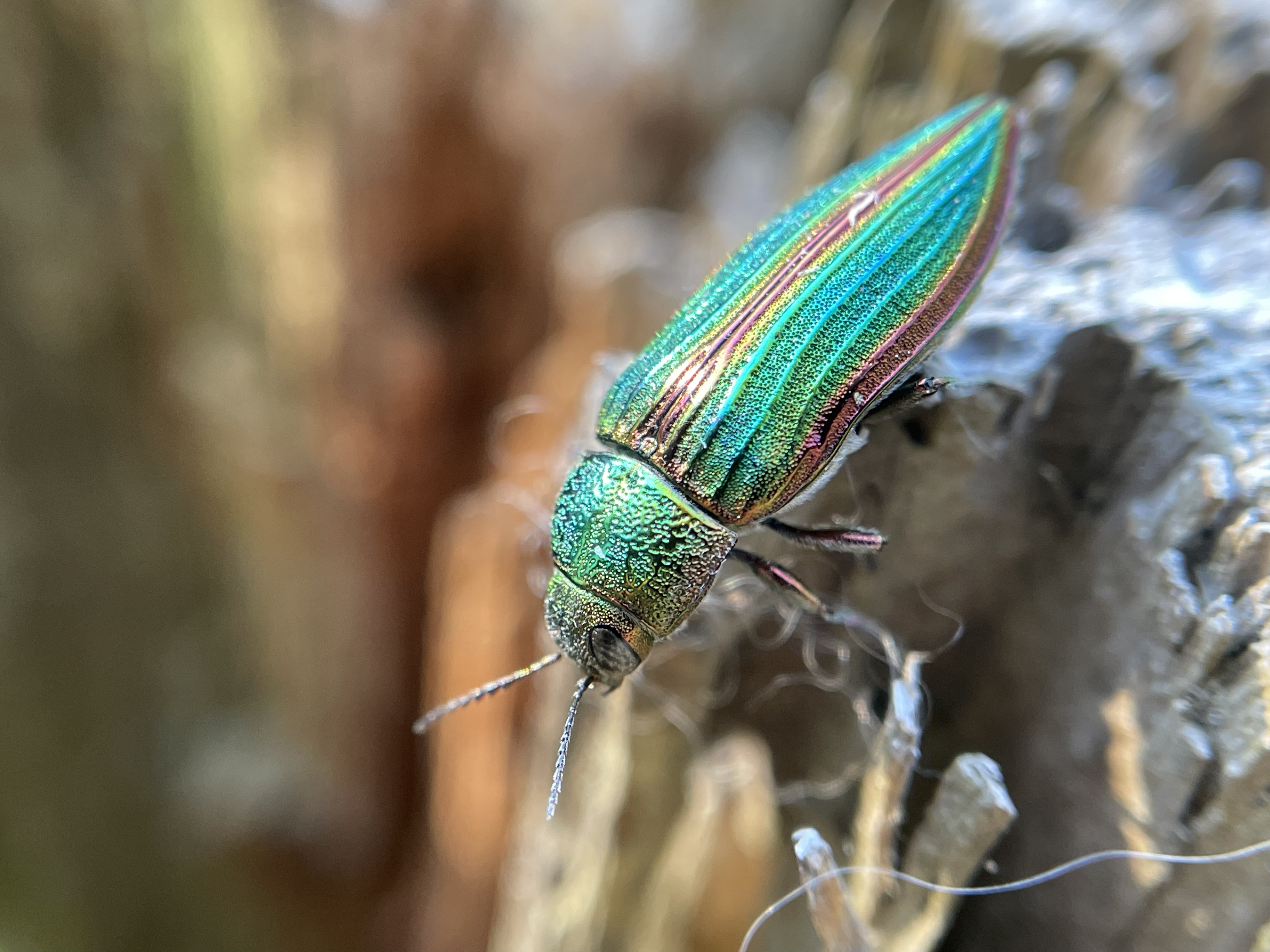
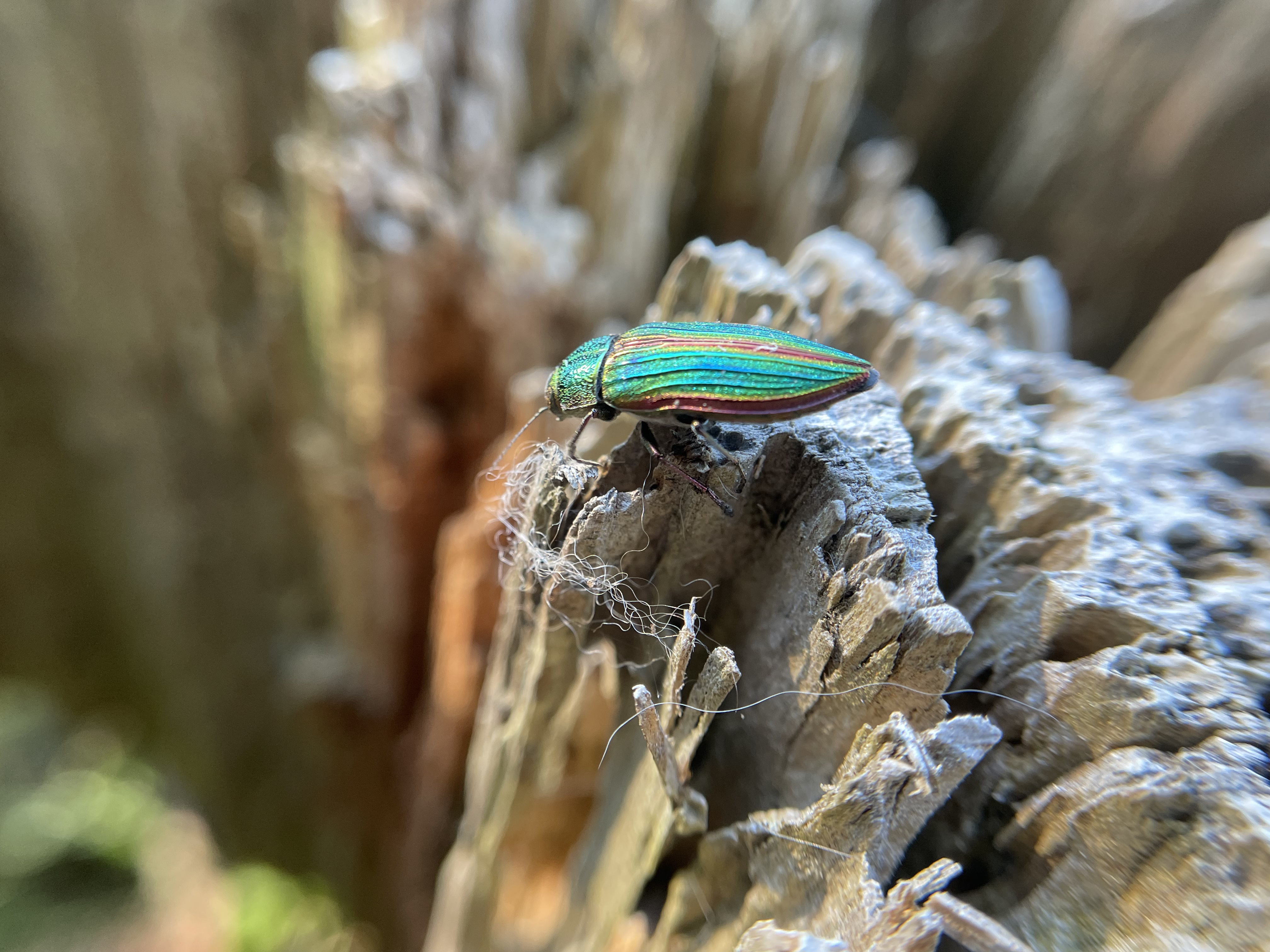
Buprestis aurulenta or Golden Buprestid Beetle

I found this little green beetle (and another sad little black and yellow beetle missing its antennae) in the pool yesterday. The black and yellow beetle is alive and… well, sort of living in a special habitat right now because of those missing antennae.

The green one was completely waterlogged and lifeless. I had left it on the table next to Drago’s enclosure last night, thinking I’d pin it and keep it in my collection. I am SO GLAD I DIDN’T stick it with a pin! This morning, I found it moving those little legs around at me. It was alive! RIP woke up.  

Golden Buprestid beetle (Buprestis aurulenta)

Golden Buprestid beetle (Buprestis aurulenta


This is a Golden Buprestid Beetle (Buprestis aurulenta). They are a native species in the Pacific Northwest. I have referred to them often as the Rip Van Winkle beetle because they take such a long time to develop from egg to adult. In fact, the record is 51 years!  


Why so long? Well, the developmental time depends a lot on the quality of what they’re eating (they develop in dead or dying trees) and miscellaneous environmental factors. When they come out as an adult, they leave behind a little oval hole. I think it adds character to your wood trim if you have them “sleeping” in timber used to build your house.

We had one in our door trim that didn’t make it all the way out and probably had been stuck for awhile before I noticed. It became a fascinating object to show anyone who came to visit our home.

Golden Buprestid stuck in door trim (March 20, 2016)

I’m not sure what gives them this beautiful iridescence, but they are undeniably one of nature’s jewels, thus the name “Jewel” Beetle. 

Golden Buprestid Beetle – San Juan Island 07.27.2022
Golden buprestid set free to fly away in the forest.

References and further reading:

Zeng, Y. 1995. University of Florida Book of Insect Records, Chapter 12 Longest Life Cycle. Department of Entomology & Nematology University of Florida, Gainesville, Florida 32611-0620 https://entnemdept.ufl.edu/walker/ufbir/files/pdf/UFBIR_Chapter12.pdf

Bugguide.net https://bugguide.net/node/view/74029

Nelson, D. 2021. Buprestis aurulenta (Golden Buprestid) 10,000 Things of the Pacific Northwest http://10000thingsofthepnw.com/2021/05/19/buprestis-aurulenta-golden-buprestid/

No Clowning Around in the Pool Without a Life Jacket.

Yesterday I was the lifeguard. And, I had swimmers needing saving!

Hister Beetle (Genus Margarinotus I believe) – April 7, 2022 San Juan Island, WA

Here’s one of the species I used a piece of cardboard to rescue from drowning. This is a beetle in the family Histeridae, also known as a Clown Beetle. I told him no more clowning around without a life jacket. 🤣 Watch as it wrings its hindwings out, rolling them in under the leathery elytra (the outer wings).

I believe this beetle is in the genus Margarinotus. For ID beyond this, I’d need more time and a lot of patience. However, I can tell you I’ve learned some species of Hister beetles are associated with the nests of rodents, birds, and even ants and termites. They are pest predators, meaning they eat other insects at all life stages. They also are especially adept predators of fly eggs. You can often find them in leaf litter, dung, carrion, and under tree bark, or living in those ant mounds where they may be fed by ants, eat the leftovers the ants discard, or in some cases, they eat the ants!

Some other curious tidbits about these beetles include their acting ability. They play dead (Thanatosis) to deter predators. The word Hister is derived from Latin and means “Actor.”

Hister Beetle (I believe Margarinotus sp) – San Juan Island, WA

References:

Caterino, M. S. (2010). A review of California Margarinotus Marseul (Coleoptera: Histeridae: Histerinae: Histerini), with descriptions of two new species. The Coleopterists Bulletin64(1), 1-12. https://bioone.org/journals/The-Coleopterists-Bulletin/volume-64/issue-1/0010-065X-64.1.1/A-Review-of-California-Margarinotus-Marseul-Coleoptera–Histeridae/10.1649/0010-065X-64.1.1.pdf?casa_token=FFQE6VfrPhwAAAAA:6hS4kWWWX-lGeUPQFiU-7Dc2atg_nhsgP0almrxzvWjgwhxDLMShzekiAS7HWEKT5_AL2n4i

Wenzel, R. L. (1960). Three new histerid beetles from the Pacific Northwest, with records and synonymies of additional species (Coleoptera: Histeridae). https://www.biodiversitylibrary.org/page/2847194

Bugs Like the Color Blue

Bugs like Blue. I found a bunch of these little ones yesterday floating on the surface of our above ground pool. They were also all along the outside of the pool (which is blue). I scooped out all the ones that were struggling in the water and watched as this one dried itself off. It reminded me of watching my cats grooming after finishing a meal of Fancy Feast wet cat food.

Listrus Flower Beetle on Side of Pool – April 7, 2022 – San Juan Island, WA

A Soft-Winged Flower Beetle, these are in the family Melyridae (Genus Listrus). At only about 2 mm in size, they were indeed pretty tiny. Listrus beetles feed on both pollen and nectar. They are covered with dense setae (little hairs) that pollen easily adheres to. Check out the paper reference below and learn how they have been recognized as one of the most important pollinators of plants in Western North America.

Listrus sp. flower beetle

Reference: Jonathan R. Mawdsley. (2003). The Importance of Species of Dasytinae (Coleoptera: Melyridae) as Pollinators in Western North America. The Coleopterists Bulletin, 57(2), 154–160 pdf link at Bioone.org *Note* It will directly download the pdf when you click the link. https://bioone.org/journals/the-coleopterists-bulletin/volume-57/issue-2/541/The-Importance-of-Species-of-Dasytinae-Coleoptera–Melyridae-as/10.1649/541.pdf?casa_token=luFq1Z9jff4AAAAA:3-9zCg42504MZ0w5J1bfFu28XAWIA91G8bbrmDfDckmhTGAI6FTAjgcgBQVqCv847ogua3mL

« Older Entries