Bubbles
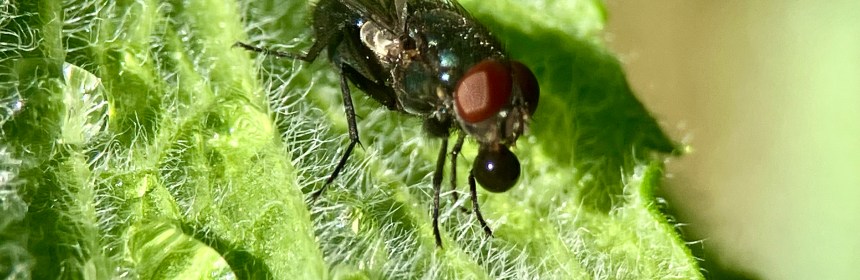
Well, this little fly got my attention yesterday. We had a contest. The fly bet it could outlast my grip on my phone as I took video of the bubble blowing. We called a tie somewhere around the 4 minute mark when my hand was shaking and I was about to drop my phone. The fly, quite satisfied with its performance, waltzed about on the mint leaf and posed for a few still photos, after I got the blood flowing into my hand again.
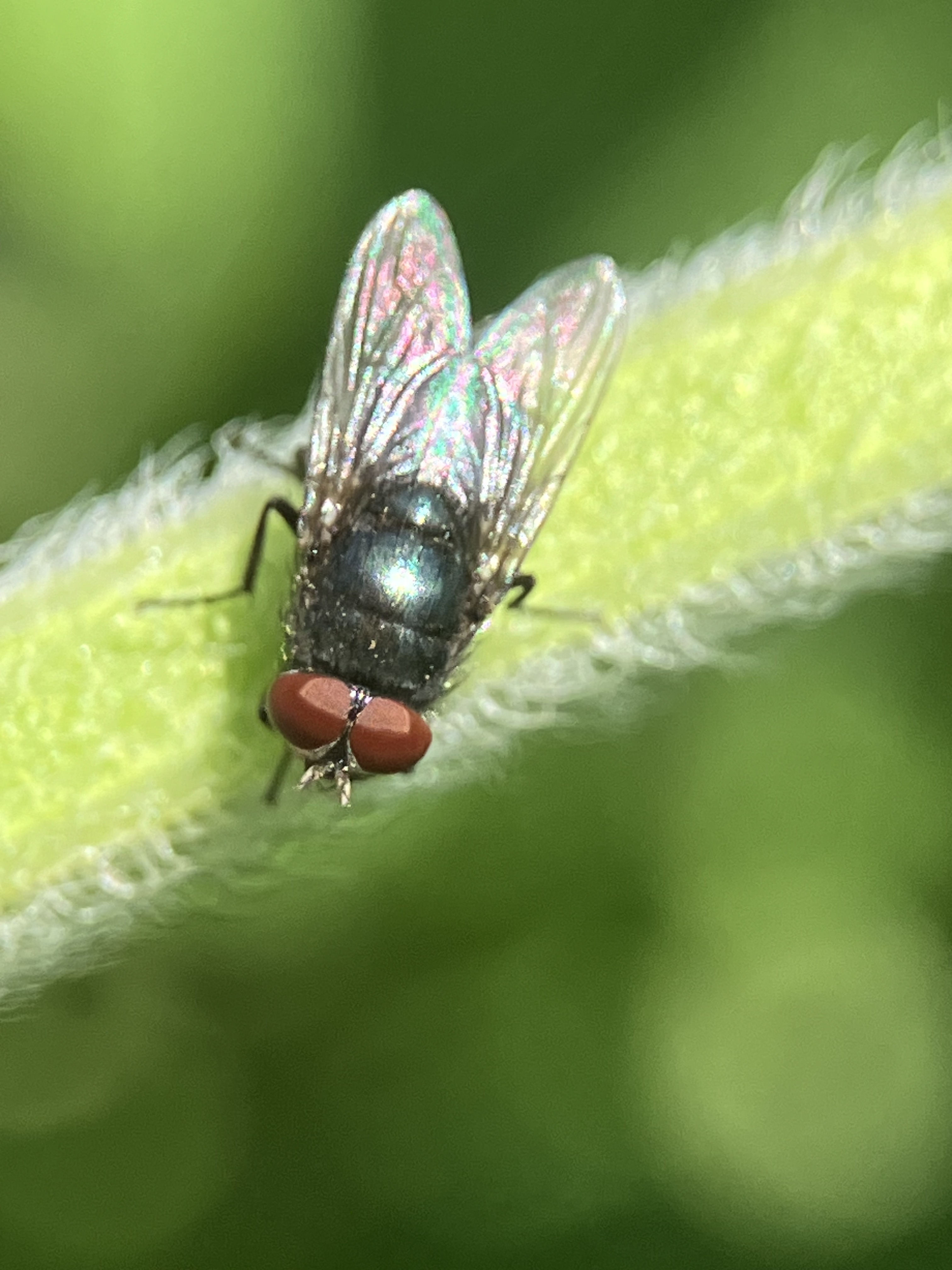
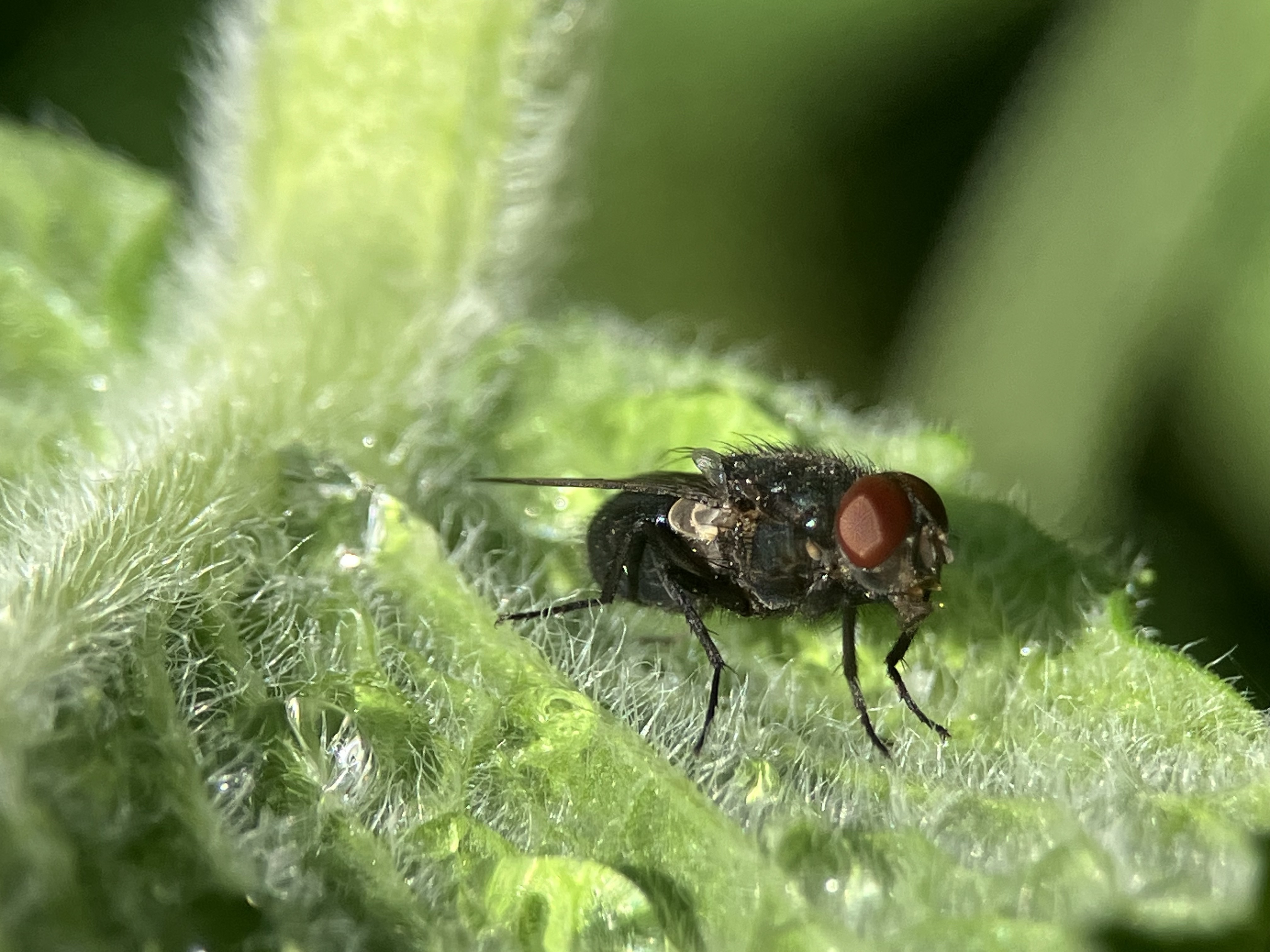
This is a Black Blow Fly (Phormia regina) in the family Calliphoridae. These flies are found ranging throughout North America, Eurasia, and Hawaii. They are a species of importance in the science of Forensics. Blow flies are attracted to dung and carrion, and when found on a corpse, they can be used to estimate time of death. The larvae or maggots of sterile blow flies are also used in the cleaning of wounds, removing decaying flesh and secreting antimicrobial peptides as they feed (Díaz-Roa et. al. 2018). Occasionally, they can contribute to secondary myiasis “fly-strike” of wounds in livestock, wildlife, and pets.
Why is the fly blowing bubbles? It’s not black bubblegum. I’m not sure why the bubbles were black in color. Perhaps something to do with what the fly had been eating. The fly is blowing bubbles to cool down and it’s actually called BUBBLING. Take a look at Ray Cannon’s Nature Notes and you’ll learn it’s part of an evaporative process where the fly moves a droplet of fluid in and out and of their buccopharyngeal cavity over and again before eventually swallowing it (Gomes et al., 2018, Cannon, R. 2020).

Flies aren’t the only group that practices bubbling. Various species of Hymenoptera also use this method to cool themselves and also to evaporate the excess water from the food (nectar) they’ve consumed (Portman et. al. 2021).
Thanks for stopping by!
References and Further Reading
Cannon, Ray. 2020. Flies Blowing Bubbles. Ray Cannon’s Nature Notes. https://rcannon992.com/2020/09/07/flies-blowing-bubbles/
Díaz-Roa A, Patarroyo MA, Bello FJ, Da Silva PI Jr. 2018. Sarconesin: Sarconesiopsis magellanica Blowfly Larval Excretions and Secretions With Antibacterial Properties. Front Microbiol. Sep 28;9:2249. doi: 10.3389/fmicb.2018.02249. PMID: 30323791; PMCID: PMC6172317. https://www.ncbi.nlm.nih.gov/pmc/articles/PMC6172317/
Gomes, G., Köberle, R., Von Zuben, C. J., & Andrade, D. V. 2018. Droplet bubbling evaporatively cools a blowfly. Scientific reports, 8 (1), 1-7.
Murray, T. 2023. Species Phormia regina – Black Blow Fly. Bugguide. https://bugguide.net/node/view/53678
Portman, Z., Ascher, J. & Cariveau, D. 2021. Nectar concentrating behavior by bees (Hymenoptera: Anthophila). Apidologie 52, 1169–1194. https://link.springer.com/article/10.1007/s13592-021-00895-1
 Bugging You From San Juan Island