Category Archives: Hemiptera

December 18, 2025, A Kybos bug story
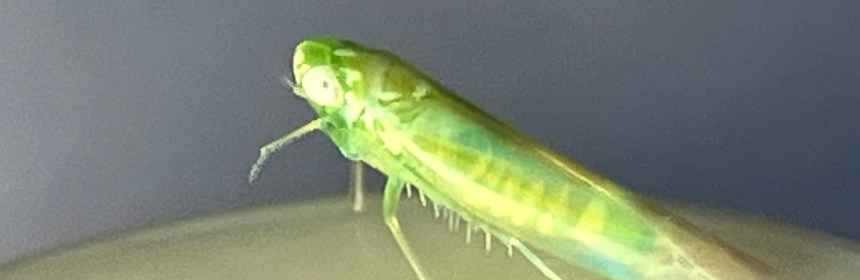
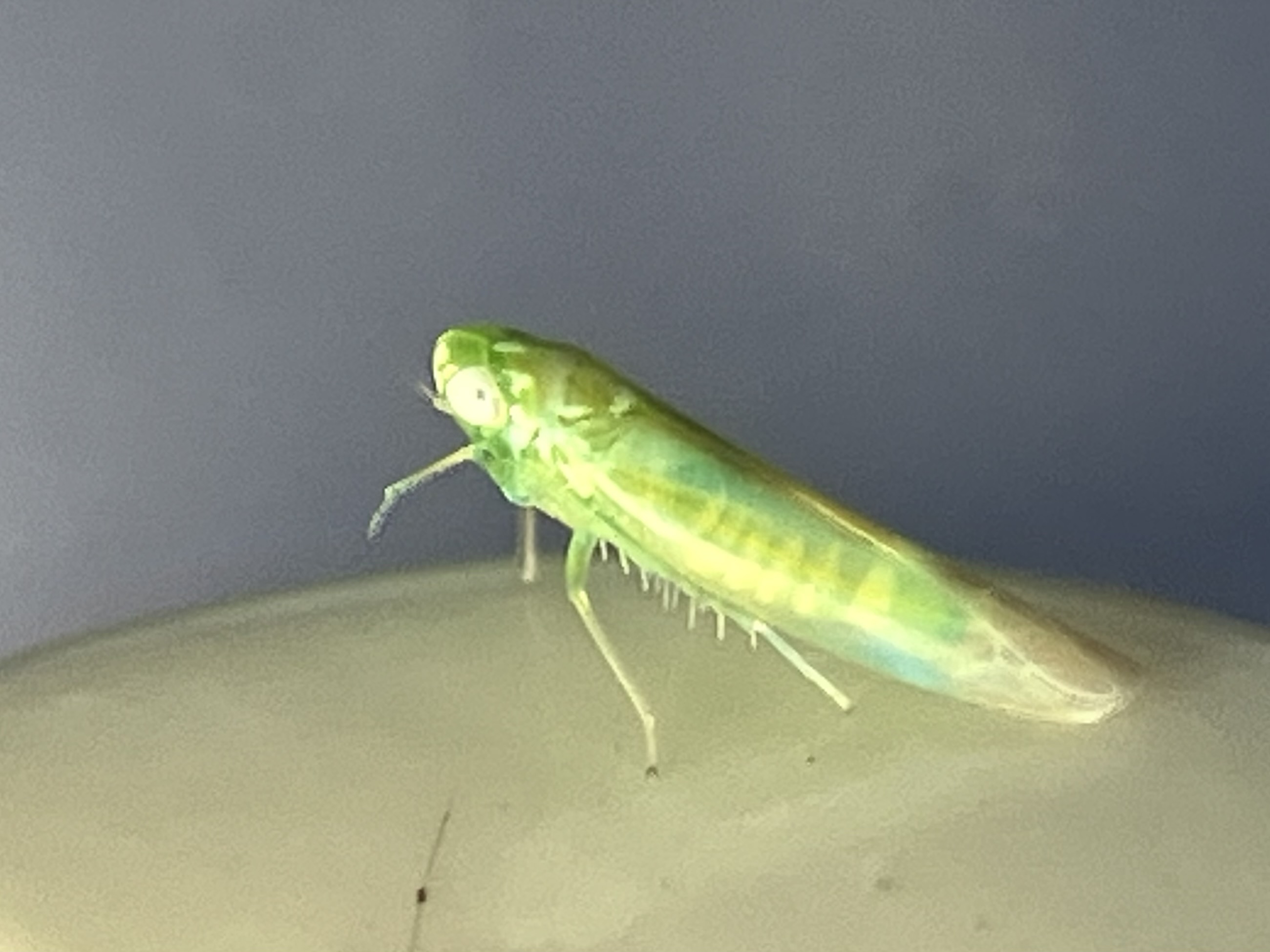
Kybos sp. Leafhopper, I believe

It’s been a good while since I’ve written up a blog post, but I found something I thought worth sharing after seeing these little ones on the side of our above ground pool the afternoon of December 18, 2025.   My story, however, is going to take us back to September of 2022.


One evening, carrying out the recycles to our barn storage area, I noticed this pile of sawdust and peculiar arrangement of little green bugs around a hole in the middle on a cedar log in our yard.
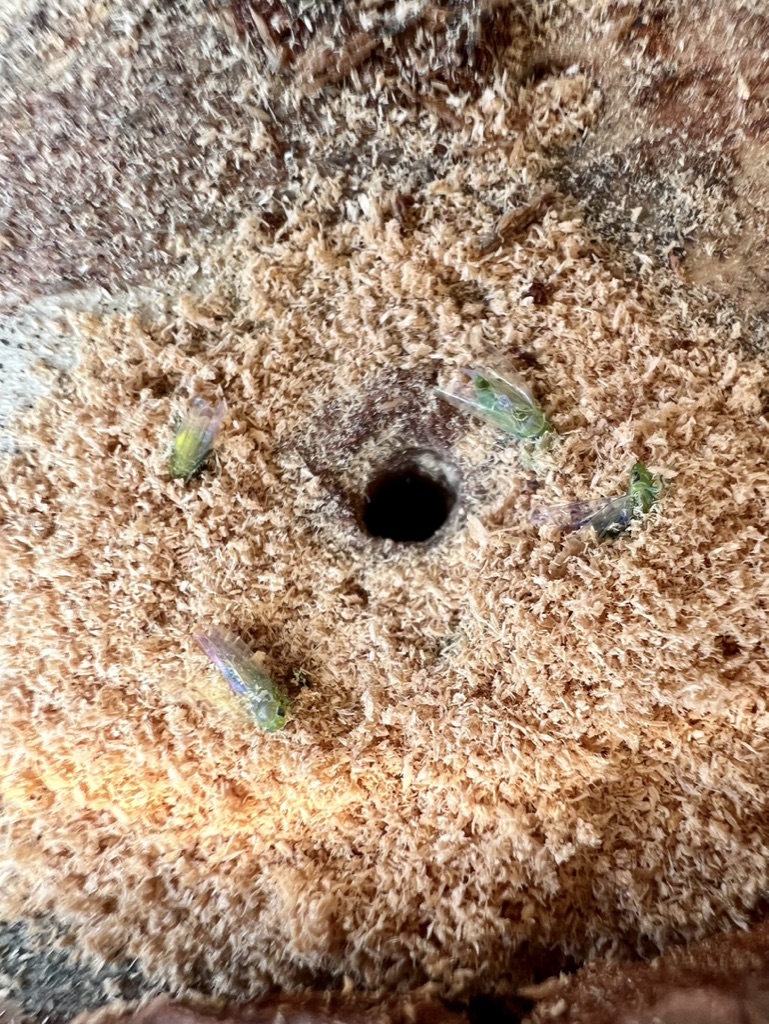
September 6, 2022

Identification of the occupant and creator of this unique arrangement took me awhile.   I believe the wasp is a Crabronid wasp in the genus Crossocerus.   She was using an old beetle exit hole as the perfect burrow for her nest construction. 

Crossocerus sp. Crabronid Wasp – September 27, 2022

Fascinated, I sat and watched her for hours on end for about two weeks.  She would be gone by morning when I woke up, but at the end of the day, I’d find a little pile of sawdust from her excavation work and a circle of ONLY these green bugs arranged so carefully on top. 

Just before sunset, she would return to pack in her assembled collection of tiny prizes one at a time, provisioning each of the cells she had constructed for her eggs with the little iridescent green bugs, paralyzed, but still alive.  Creepy, right?  Later, the eggs she would lay in these cells would hatch into little wasp larvae and consume the still-living, little green bugs…one by one.

Alas, later that winter, I noticed my wasp’s cluster of burrows in that log had been excavated by one of our resident Hairy Woodpeckers.   They find all the buried bugs – especially it seems they find the ones in the wood siding of our house.  We have a line of little holes pecked all ‘round.  Naughty birds! 


Identifying the little green bugs took me a long while. Mostly, because I get distracted and have to come back to a multitude of projects! I believe these little green bugs are in the genus Kybos.  Kybos bugs are a type of leafhopper in the family Cicadellidae. They are associated with Salix sp. (Willows) and (Populus sp.) Poplars which are their host plants (Hamilton, 1972).  The bugs feed on sap.  That would certainly fit.  We have lots of Willows nearby and three Quaking Aspen trees on our property.    

And the wasp?  One of the identifying features of Crossocerus is the ocelli form an equilateral triangle.  In the video, I think I can make out just enough of this to be definitive.   The ecology for some species in this genera also fits with a description found in Krombein (1979) about this group modifying pre-existing cavities or burrows in wood formed by wood boring insects.    

The relationship between this wasp and the Kybos leafhoppers was intriguing to me because it was the ONLY species of bug I found the little wasp to collect and arrange to provision her offspring with. While I looked for information about this relationship extensively, I did not find any literature with previously reported documentation about this. Krombein (1979) mentions the collection of prey for various species, but none more specific than family Cicadellidae.

I wish it had been possible to identify the wasp to species. It would be amazing to see this again. Perhaps I will be lucky enough to stumble upon another one in action one day.


Coming back to the video I began with.  Yesterday, December 18, 2025, I saw another of those little green bugs on the side of our pool.  It was hanging out with a friend, a Bark Louse (Eptopsocus sp).  Either they were enjoying the wind in their antennae or hanging onto the rim for their very lives.  It was a very blustery day! 

Kybos sp. Leafhopper and Eptopsocus sp. bark louse, December 18, 2025, San Juan Island, WA

References

Bugguide.net. 2025. Kybos. Iowa State University. https://bugguide.net/node/view/120601

Hamilton,  K G A. (1972). The leafhopper genus Empoasca subgenus Kybos in southern interior of British Columbia. Journal of the Entomological Society of British Columbia, 69, 58–67. https://www.biodiversitylibrary.org/part/213774

Krombein,  Karl V. (1979). Catalog of hymenoptera in America north of Mexico (Vol. 2). Smithsonian Institution Press. https://www.biodiversitylibrary.org/item/26295

Krombein,  Karl V. (1979). Catalog of hymenoptera in America north of Mexico (Vol. 2, p. 1665). Smithsonian Institution Press. https://www.biodiversitylibrary.org/page/4575889

What’s Biting Me?

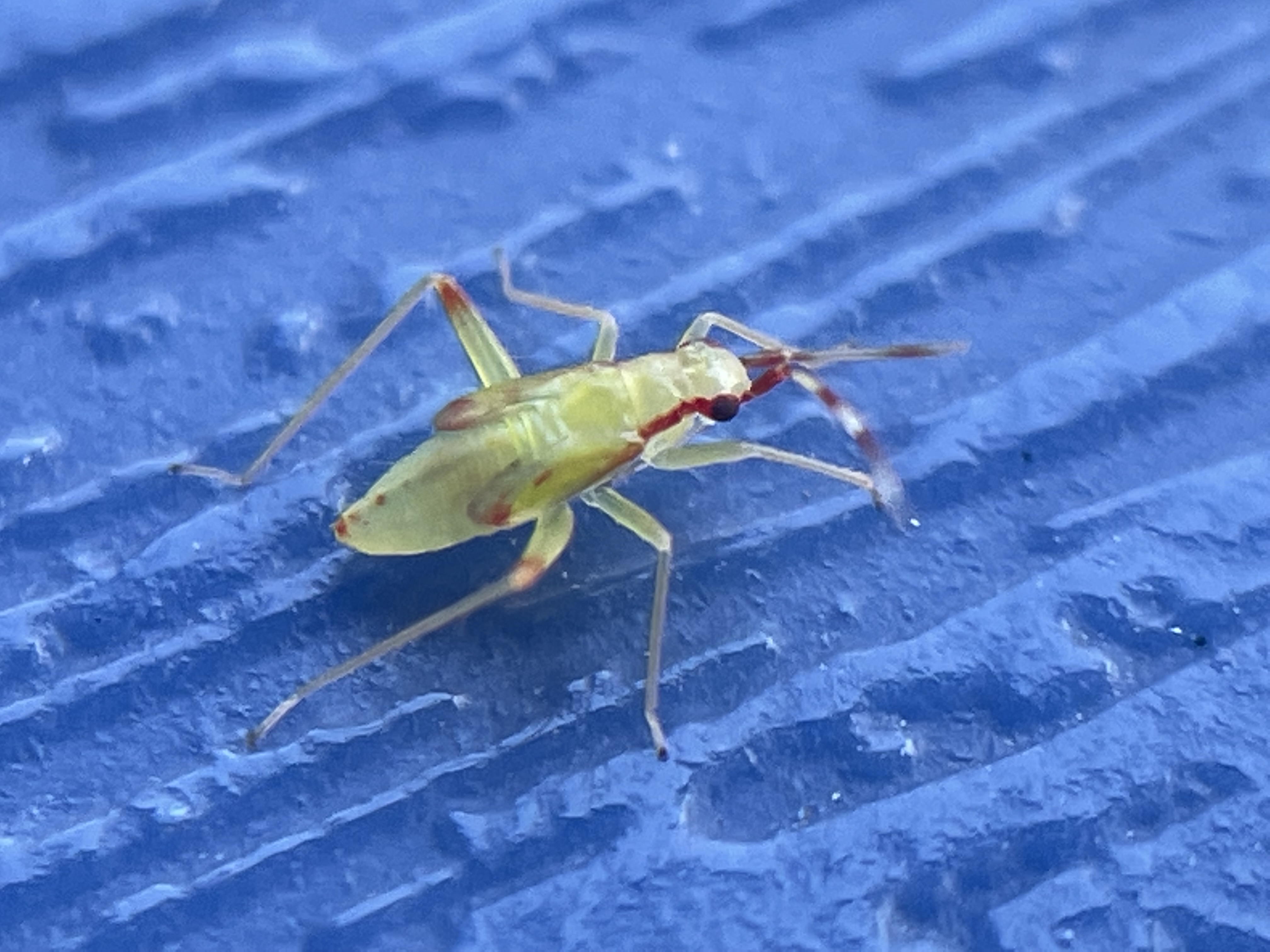
Campyloneura virgula

I may have used this title before, so I’ll have to double check, and perhaps since I get this query frequently I will go back and edit with a numerical system or something like that.

So in this video, I am receiving a bite from 1) a mosquito? 2) a tick? or 3) a thrips? or 4) a bug?

If you chose option 4, a bug, you are correct. Indeed it is a bug, but not just any kind of bug. It is a bug in that it falls into the insect order Hemiptera (the true bugs). This “bug” is a species named Campyloneura virgula, a type of plant bug in the family Miridae.

It’s not the first time one has bitten me either, though most of my reactive bites on San Juan Island have been from thrips in the summertime when it is super dry and they are looking for moisture. I react badly to thrips bites. My husband says they are so small you can’t even see them. I think he really believes I am imagining them, but hey, I’m the entomologist in our family, right?

They’re not imaginary.

Neither is this biter. You can see the action on my ankle for yourself.

Then read the reference material and watch out for ankle biters in your yard.

References

Thomas J. Henry “First Eastern North American Records of Campyloneura virgula (Hemiptera: Heteroptera: Miridae: Bryocorinae),” Proceedings of the Entomological Society of Washington, 114(1), 159-163, (1 January 2012). https://bioone.org/journals/proceedings-of-the-entomological-society-of-washington/volume-114/issue-1/082.114.0101/First-Eastern-North-American-Records-of-Campyloneura-virgula-Hemiptera/10.4289/082.114.0101.short#:~:text=It%20also%20is%20known%20to,(Lattin%20and%20Stonedahl%201984).

Zarrabi Ahrabi, Salar & Şakacı, Zafer & Akyıldız, Gürkan & Gargili, Ayşen & Talay, Şengül & Kar, Sirri. (2024). Human Biting Plant Bug Campyloneura virgula (Hemiptera: Miridae): First Case Report in Türkiye. Clinical and Experimental Health Sciences. 10.33808/clinexphealthsci.1268203. https://www.researchgate.net/publication/381681450_Human_Biting_Plant_Bug_Campyloneura_virgula_Hemiptera_Miridae_First_Case_Report_in_Turkiye

The Meadow Spittlebug (Philaenus spumarius) aka “Foam Lover”

Meadow Spittlebug (Philaenus spumarius)
Zylstra Lake Preserve, San Juan Island, WA 9-7-19

I took this photo of a Meadow Spittlebug (Philaenus spumarius) on September 7, 2019 when I attended the San Juan County Land Bank’s open house at the new Zylstra Lake Preserve http://sjclandbank.org/zylstra-lake-preserve-san-juan-island/ . It was a bit cloudy, but fortunately it didn’t rain during the event.

While there weren’t many insects out and about, I was happy to get a shot of the adult version of this species. It was hanging out with some family members on the stem of a thistle growing alongside the walking path.

Meadow Spittlebugs on Thistle
Zylstra Lake Preserve
San Juan Island, WA
09-07-19

Spittlebugs are in the insect order Hemiptera and the family Cercopidae (1). You might recognize these as the mystery bug that hides as a nymph inside a frothy dollop of bubbles on stems of vegetation. This particular species is widespread in North America and very common in the Pacific Northwest (1). So, if you’re out for a walk in the springtime, you’ll see lots of vegetation that appears to have wads of spit stuck to it…and the tiny meadow nymph is hiding inside!

The Meadow Spittlebug (Philaenus spumarius) is also known as the Common Froghopper and it does indeed look very frog like to me. 🐸 Even more interesting, a Google search of the etymology of this little bug’s name yielded this (from Wikipedia):

“The genus name Philaenus comes from the Greek philein (“love”), while the species name spumarius is from the Latin spuma (“sparkling”), referred to the foam nests; the binomial Philaenus spumarius can be translated as “foam lover.”

The adult spittlebug is small (approximately 6mm in length). Both adults and nymphs (which go through 5 instars or developmental stages before reaching adulthood) feed on plant xylem and have been found to feed on over 450 species of plants (2,3,4). While they have the ability to transmit viruses and cause damage to plants from feeding, they are typically not considered serious pests unless they are present in large numbers. It was interesting to learn that the nymphs consume up to 280 times their own weight of plant sap in 24 hours (2,3,4).

Also interesting is that only the soft-bodied nymphs live in the foam. It provides them with protection from predation and from drying out (desiccation). The spittle is a fluid produced from their anus and combined with a surfactant secreted by epidermal glands near the end of their abdomen. Caudal appendages on the insect create air bubbles, turning the spittle into a frothy foam. The tiny (1/4″ long) spittlebug nymph usually rests on the plant facing downward. When the spittle is produced, it flows downward over the body and covers the nymph, concealing it and providing it with the moist habitat it requires as it develops (4).

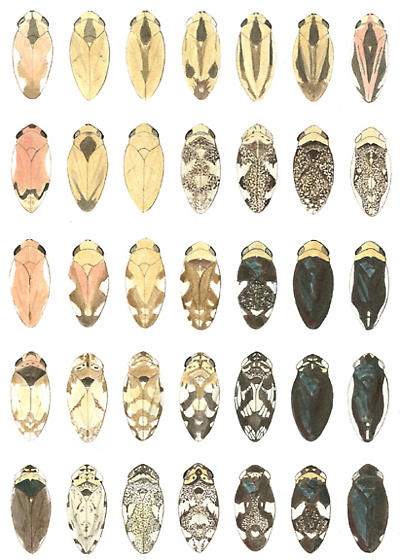
Another interesting bit about the Meadow Spittlebug is that it is quite polymorphic with no less than 16 adult color forms (1). Andy Hamilton (2006) has contributed a wonderful chart, shared on Bugguide https://bugguide.net/node/view/72602 to illustrate the color varieties of the adult forms of this highly variable species (1, 2). Because of the diversity among adult specimens within this species, many researchers have been interested in Philaenus spumarius for genetic study (4).

Andy Hamilton 2006 ~ bugguide.net

*I wanted to include a personal observation about natural enemies of spittlebugs. Hamilton (1982) gives the most detailed account of these, but I didn’t note any mention of predation by yellow jackets (Hymenoptera: Vespidae), or dragonflies (2). I have observed both of these flying through meadow grasses appearing (but not confirmed) to glean spittlebugs from plants in early summer on San Juan Island.

References:

1. Bugguide.net https://bugguide.net/node/view/7452

2. Hamilton, K.G.A., 1982, The spittlebugs of Canada: Homoptera: Cercopidae, Insects and Arachnids of Canada Handbook Series, 10, 102 http://esc-sec.ca/publications/aafc/

3. Horsfield, D., Evidence for xylem feeding by Philaenus spumarius(L.) (Homoptera: Cercopidae). Ent. Exp. Appl., 24: 95-99, 1978.

4. Yurtsever, Selcuk. (2000). On the meadow spittlebug Philaenus spumarius. Turkish Journal of Zoology. 24. 447-459.

Rough Stink Bug, Brochymena spp.

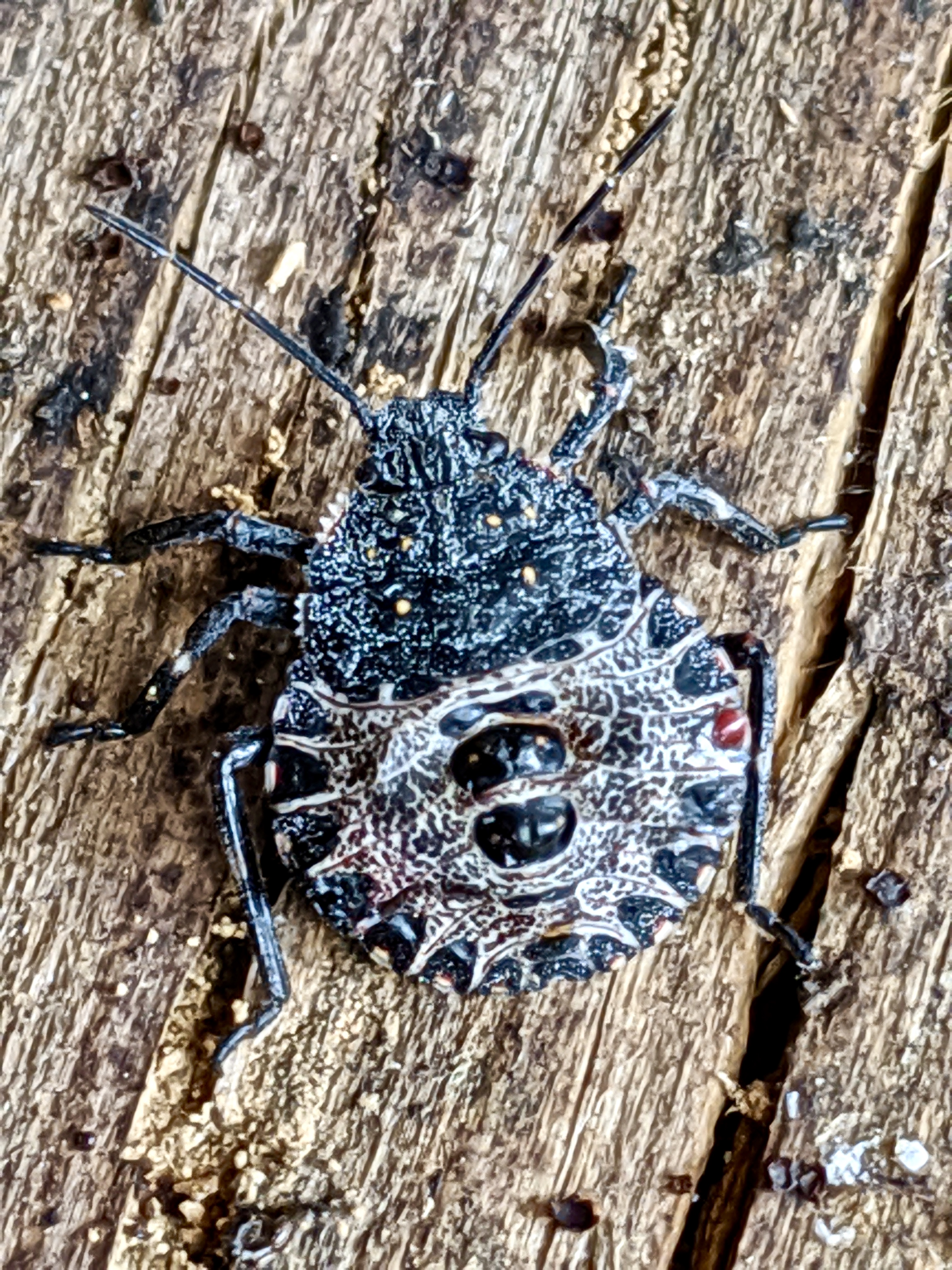
This is a quick post! I just wanted to share the stink bug nymph I found over the weekend (Sunday, Sept. 1, 2019). It’s a Rough Stink Bug nymph, in the genus Brochymena. I believe it’s Brochymena quadripustulata, the Four-humped Stink Bug. However, Brochymena sulcata and B. affinis are two other species found in our area so similar, they are difficult to distinguish.

Brochymena quadripustulata nymph

Often Brochymena stink bugs are confused with the Brown Marmorated Stink Bug, Halyomorpha halys. These two species can be distinguished by the teeth on the outer edge of the pronoun found on Brochymena spp. and the lack of white rings on Brochymena spp. antennae. Great diagram here ~ http://www.stopbmsb.org/stink-bug-basics/look-alike-insects/%23nbsb

I’m not certain what the red spot is on the bug in my photo, but curiously, I found another photo on bugguide.net with a similar spot https://bugguide.net/node/view/1596719/bgimage . I wish I’d kept my specimen for further investigation, but let it go after taking a few photos. The quality of the photo when enlarged just isn’t good enough to determine if the spot is a parasite. My first thought was it sure looks like a honey bee varroa mite, but I haven’t found any literature describing mites on stink bugs. For the time being, it’s on my “shelf” of things to figure out.

References/Further Reading

https://webdoc.agsci.colostate.edu/bspm/Hexapoda%20(Insects)/Rough%20Stink%20Bugs.pdf

https://bugguide.net/node/view/156717

https://www.oregon.gov/ODA/shared/Documents/Publications/IPPM/StinkBugGuide.pdf