Tag Archives: aphid

Your Garden’s Guardian: A Soldier in Miniature (Silis sp.)

Soldier Beetle (Genus Silis)

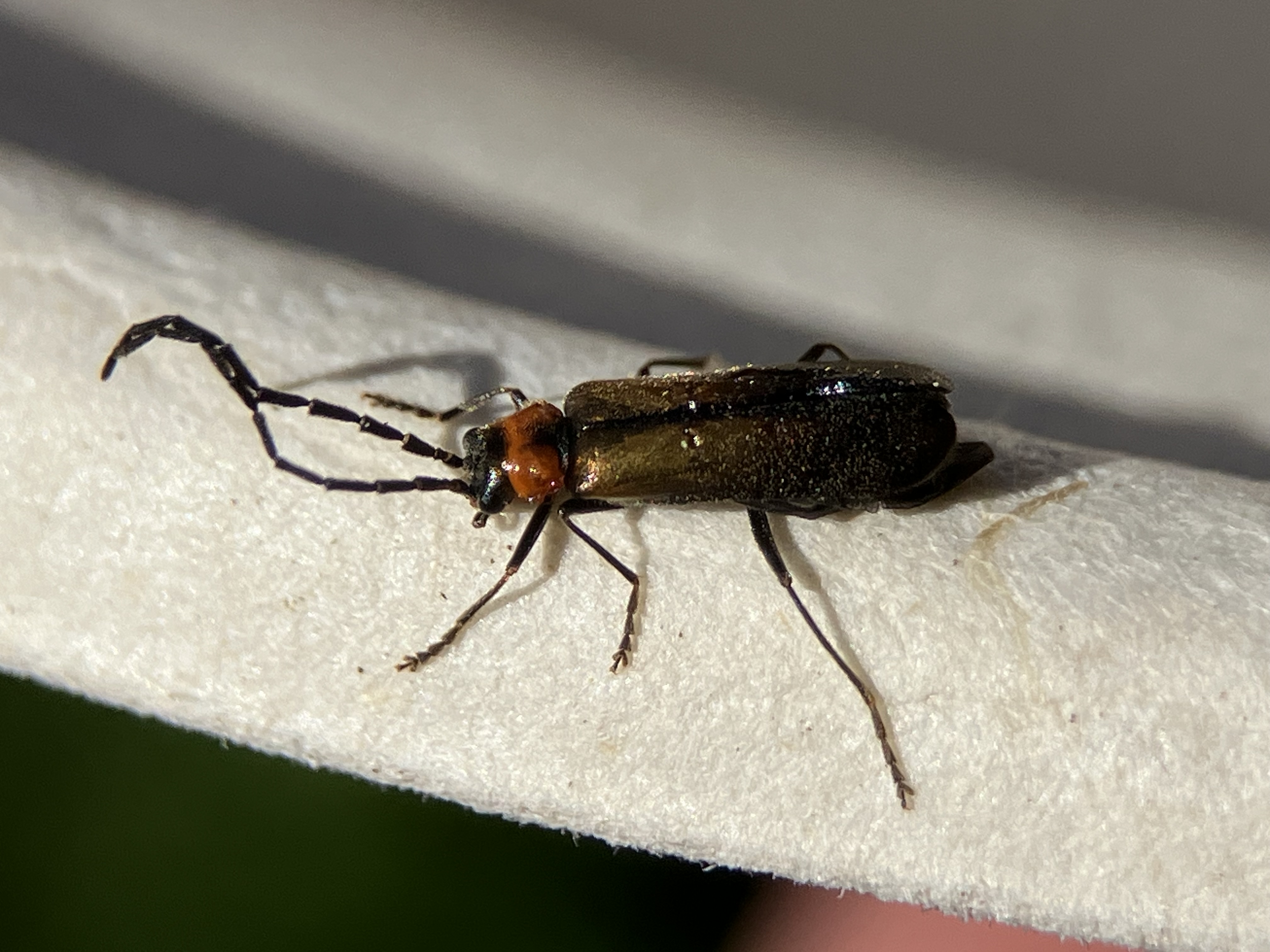
This tiny little friend (approx. 6mm) sporting a red collar is a soldier beetle in the family Cantharidae. It is in the Genus Silis, but there are so many species, that I will just leave it at the genus level for now.

Soldier Beetle (Genus Silis)

Silis beetles are quite cosmopolitan in distribution, associated with wooded areas and leaf litter, and active daytime fliers in early summer.

Adults are typically found on foliage and flowers. Primarily, they are pest predators, feeding on insects, but also serve as pollinators, feeding on nectar and pollen. Silis species are known to prey on aphid populations infesting trees, plants, and shrubs, so gardeners can appreciate them as a “friend.”

Silis beetles can also attack other groups of invertebrates, feeding on small soft-bodied specimens or consuming their eggs. However, the ecology of some species is remains to be investigated. While Fender (1973) found the larvae would eat earthworms and are mostly carnivorous in the soil, little else is known about the feeding habits in this stage. (Pelletier and Hébert , 2014).

The etymology of the nomenclature for the genus (Silis) comes from Σίλας in Greek. It is derived from the Latin name Silvanus, meaning “forest” or “wood,” and a contraction of the Greek form Silouanos, a transliteration of Silvanus. Silis or Silas is also associated with the Roman god of the countryside, Silvanus, a god who was worshipped by those who lived in wooded areas or worked with wood. Even older than the etymology is this tidbit. Silis beetles are quite ancient. Fairly recent research has identified specimens of the genus discovered in Baltic Amber (Parisi and Fanti, 2019).
Soldier Beetle (Genus Silis)

While I have now scooped a few out of our pool, thankfully in time to save them from drowning, some of them (perhaps the ones I’ve rescued) are also finding me. I have had them on my clothing and peeping in the door at me!

Thanks for reading!

Soldier Beetle (Genus Silis) looking in our door at me!

References

Bugguide 2025. Genus Silis. Iowa State University. https://bugguide.net/node/view/11961

Green, John Wagener. 1966. Revision of the Nearctic species of Silis (Cantharidae: Coleoptera). Proceedings of the California Academy of Sciences, 4th Series, 32, 447–513. https://www.biodiversitylibrary.org/part/52839

Pelletier, G., Hébert, C. 2014. The Cantharidae of Eastern Canada and Northeastern United States. Canadian Journal of Arthropod Identification No. 25. February 28, 2014. Available online doi: 10.3752/cjai.2014.25

Parisi, F. and Fanti, F. 2019. On the first Silis Charpentier, 1825 from Baltic amber (Coleoptera, Cantharidae), Foss. Rec., 22, 119–123, https://doi.org/10.5194/fr-22-119-2019
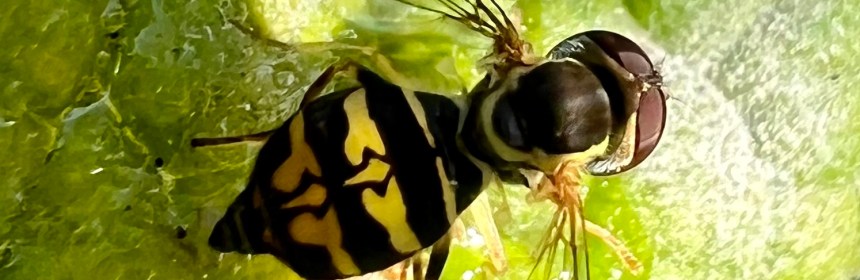
Western Calligrapher (Toxomerus occidentalis)

I sat outside today in the sunshine, forced convalescence if you will, exhausted and achey after getting my Covid Omicron Variant booster vaccine yesterday at the San Juan County Fairgrounds. My outdoor time was unfortunately cut short because we have been inundated with construction development noise. I’m fairly certain I will be forever challenged to have an amiable relationship with our newest neighbors. In part, because they sited their VACATION home, right in front of our view. Mind you, they could have moved over 100 feet and we would not have to look across the top of our driveway at their newly constructed 2nd home. It has definitely impacted us. We’ve lost a lot of our privacy out here in the woods. It was never my desire to have close neighbors. I am a bit of a recluse….which is what the new neighbor said about his wife, yet, it begs me to ask again, WHY DID YOU BUILD YOUR HOUSE RIGHT ON TOP OF US?

Oh, and the jackhammering! That noise is enough to make a person homicidal. We had an entire summer of jackhammering from the former owners of that property. Really, truly, that property should never have been zoned for development. Not any development. It’s partly (half) wetland, and the other half is bedrock. Imagine the task of trying to excavate enough to bury your septic lines down the hill when you have solid bedrock! Also, our house is on that same shelf of bedrock, so the hammering shakes the walls and vibrates the floors of our home in the process of all this construction. The development on this lot has gone on for multiple years. I’m really tired of the disruption.

I digress. Sorry, I just had to vent. San Juan Island would be a much friendlier place for wildlife and bugs and such if we didn’t allow anyone to build a 2nd, or 3rd home here. We are outgrowing our space and it isn’t pretty.

Here’s my bug of the day. This beauty is a Western Calligrapher Fly (Toxomerus occidentalis). I was mesmerized watching it rest on the mint leaf. The patterning on the dorsal side of the abdomen reminds me of some sort of totem design.

The adults of this fly species are pollinators. They lay eggs on plants near aphids and when larvae emerge they are predatory on the aphids. It is believed that late instar larvae overwinter, pupation takes place in the soil cavities in the spring and adults emerge later in summer. The name for this group of flies comes from Greek toxon ‘bow’ + meron ‘thigh’ (refers to the bow-shaped hind femur). You can see the curve in the first photo below, circled in red. Something else interesting pertaining to the adult coloration I found on bugguide.net: “Colors vary with overall temperature during pupation: if it was hot, the yellow/orange increases and the background becomes lighter, but if it was cold, the dark/black increases and the yellow/orange becomes darker like the background.”

Enjoy the last few days of sunshine and embrace our native pollinators. We are heading into the dark part of the year. For those of us who live here year round, you know what to expect. Lots and lots of rain.

Thanks for reading!

Western Calligrapher Fly (Toxomerus occidentalis)

Western Calligrapher Fly (Toxomerus occidentalis)

A Beneficial Buzz!

This fly was in my yard last week. San Juan Island, WA. 06.19.2021. It’s taken me about a week to get around to ID, but I believe this to be Eupeodes fumipennis (the Western Aphideater, a syrphid fly that happens to be a bee mimic.

In case you are wondering about that name. The Western Aphideater does actually eat aphids in the larval stage. To see what a syrphid fly larva looks like in action, check out my blog post with more video footage here –https://buggingyoufromsanjuanisland.com/…/honeysuckle…/ – also viewable in the photo below. While I have not been able to identify the species name of the syrphid fly larva in that post, you can definitely see where the Western Aphideater fly might get its name.

Unidentified Syrphid fly larva with aphid

Thanks for reading!

Honeysuckle aphid (Rhopalomyzus lonicerae) on Reed Canary Grass being eaten by a Syrphid fly larva

Honeysuckle aphid (Rhopalomyzus lonicerae) on Reed Canary Grass
Honeysuckle aphids on Reed Canary Grass

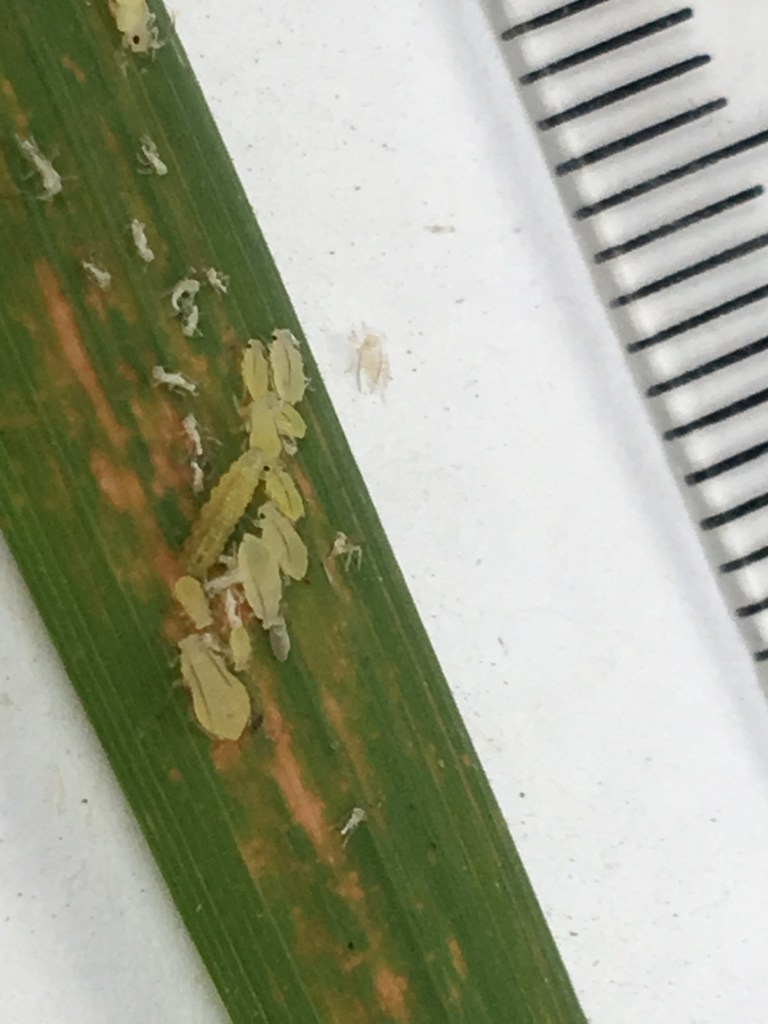
I photographed and filmed these tiny white “lambs” over the weekend (Sept. 21, 2019). There is a patch of Reed canary grass growing in a wetland area near my house and I wanted to see what sort of insects I might find associated with this particular plant.

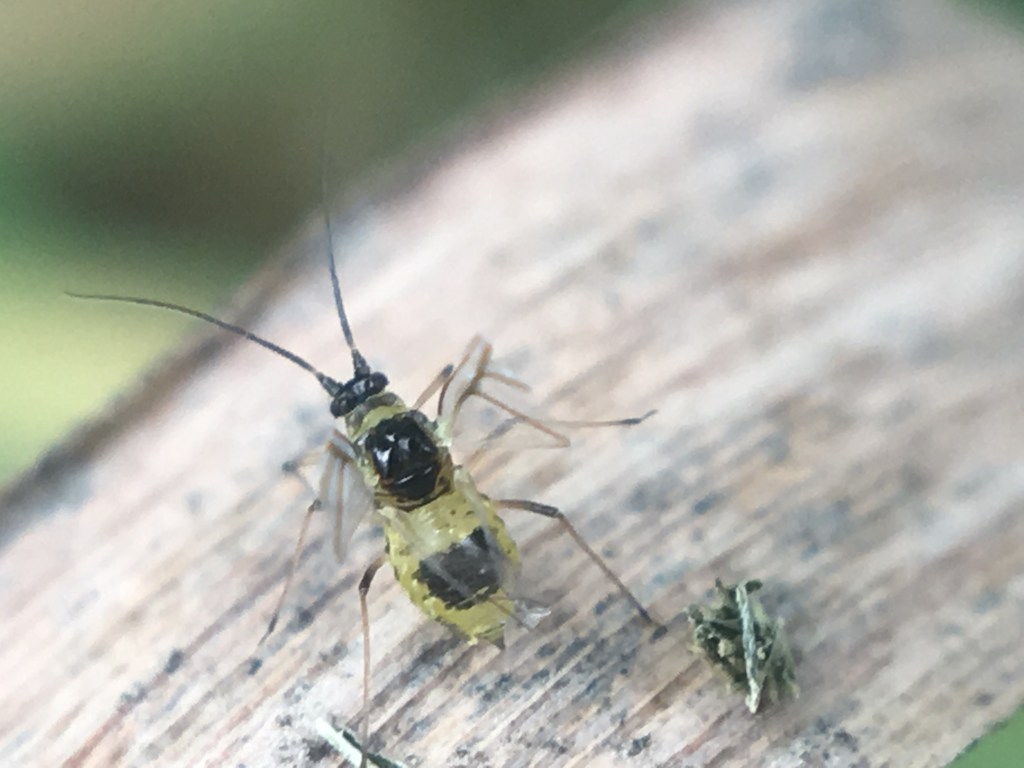
These “lambs” are actually Honeysuckle aphids (Rhopalomyzus lonicerae). The species epithet, lonicerae refers to honeysuckle. These particular aphids live on honeysuckle in the winter and in grasses (as in the Reed Canary grass) in summer (4,5). The creamy white form (pictured above) are wingless, sub-adults, the apterae (without-wings) ~ Aphid glossary here: https://influentialpoints.com/aphid/Aphid-glossary.htm . There were quite a few of them and they were huddled together somewhat herd-like (see video below) on the grass stems. I did spot an adult or two (photo below), dispersed in other patches of grass, but absent from the groups of young.

Adult Honeysuckle Aphid on Reed Canary Grass
Sept. 21, 2019

The most amazing part to me was the “wolf” disguised in my herd of aphid lambs. This big bad wolf was actually a syrphid fly larva devouring one little lamb after another. It surprised me that they all waited, rather obediently, without resistance, as one after another was sucked dry by the fly-wolf. Note the dried out skins remaining on the leaf when you view the videos of the little lambs I found in the grass below. 🐑

Honeysuckle aphid (Rhopalomyzus lonicerae) on Reed Canary Grass being eaten by a Syrphid fly larva

Baaad or Good? Give me a thumbs up or down and let me know what you think! Thanks for reading.

****

Reed canary grass (Phalaris arundinacea) is in the plant family Poacea. Historically, reed canary grass has been considered good fodder for livestock, especially in areas too wet to grow traditional hay crops (3). In Washington State, it is now considered a non-native, noxious weed by the Washington State Noxious Weed Control Board (1). However in further review of literature about this plant, I came across one publication contradicting this view. This one cites published research that, in the Pacific Northwest there is evidence that some varieties of this widespread “circumboreal” grass are native to Western North America (2) .

Native? Noxious? Invasive? If you want to read more about Reed Canary grass, please do take a minute to check out the referenced links below.

Honeysuckle aphid (Rhopalomyzus lonicerae) on reed canary grass being eaten by syrphid fly larva (Sept. 21, 2019) San Juan Island, WA

References:

1.https://www.nwcb.wa.gov/weeds/reed-canarygrass

2. https://www.fs.fed.us/database/feis/plants/graminoid/phaaru/all.html

3.https://plants.usda.gov/factsheet/pdf/fs_phar3.pdf

4. https://bugguide.net/node/view/358533

5.https://influentialpoints.com/Gallery/Rhopalomyzus_lonicerae_honeysuckle-grass_aphid.htm