Tag Archives: aphids

Your Garden’s Guardian: A Soldier in Miniature (Silis sp.)

Soldier Beetle (Genus Silis)

This tiny little friend (approx. 6mm) sporting a red collar is a soldier beetle in the family Cantharidae. It is in the Genus Silis, but there are so many species, that I will just leave it at the genus level for now.

Soldier Beetle (Genus Silis)

Silis beetles are quite cosmopolitan in distribution, associated with wooded areas and leaf litter, and active daytime fliers in early summer.

Adults are typically found on foliage and flowers. Primarily, they are pest predators, feeding on insects, but also serve as pollinators, feeding on nectar and pollen. Silis species are known to prey on aphid populations infesting trees, plants, and shrubs, so gardeners can appreciate them as a “friend.”

Silis beetles can also attack other groups of invertebrates, feeding on small soft-bodied specimens or consuming their eggs. However, the ecology of some species is remains to be investigated. While Fender (1973) found the larvae would eat earthworms and are mostly carnivorous in the soil, little else is known about the feeding habits in this stage. (Pelletier and Hébert , 2014).

The etymology of the nomenclature for the genus (Silis) comes from Σίλας in Greek. It is derived from the Latin name Silvanus, meaning “forest” or “wood,” and a contraction of the Greek form Silouanos, a transliteration of Silvanus. Silis or Silas is also associated with the Roman god of the countryside, Silvanus, a god who was worshipped by those who lived in wooded areas or worked with wood. Even older than the etymology is this tidbit. Silis beetles are quite ancient. Fairly recent research has identified specimens of the genus discovered in Baltic Amber (Parisi and Fanti, 2019).
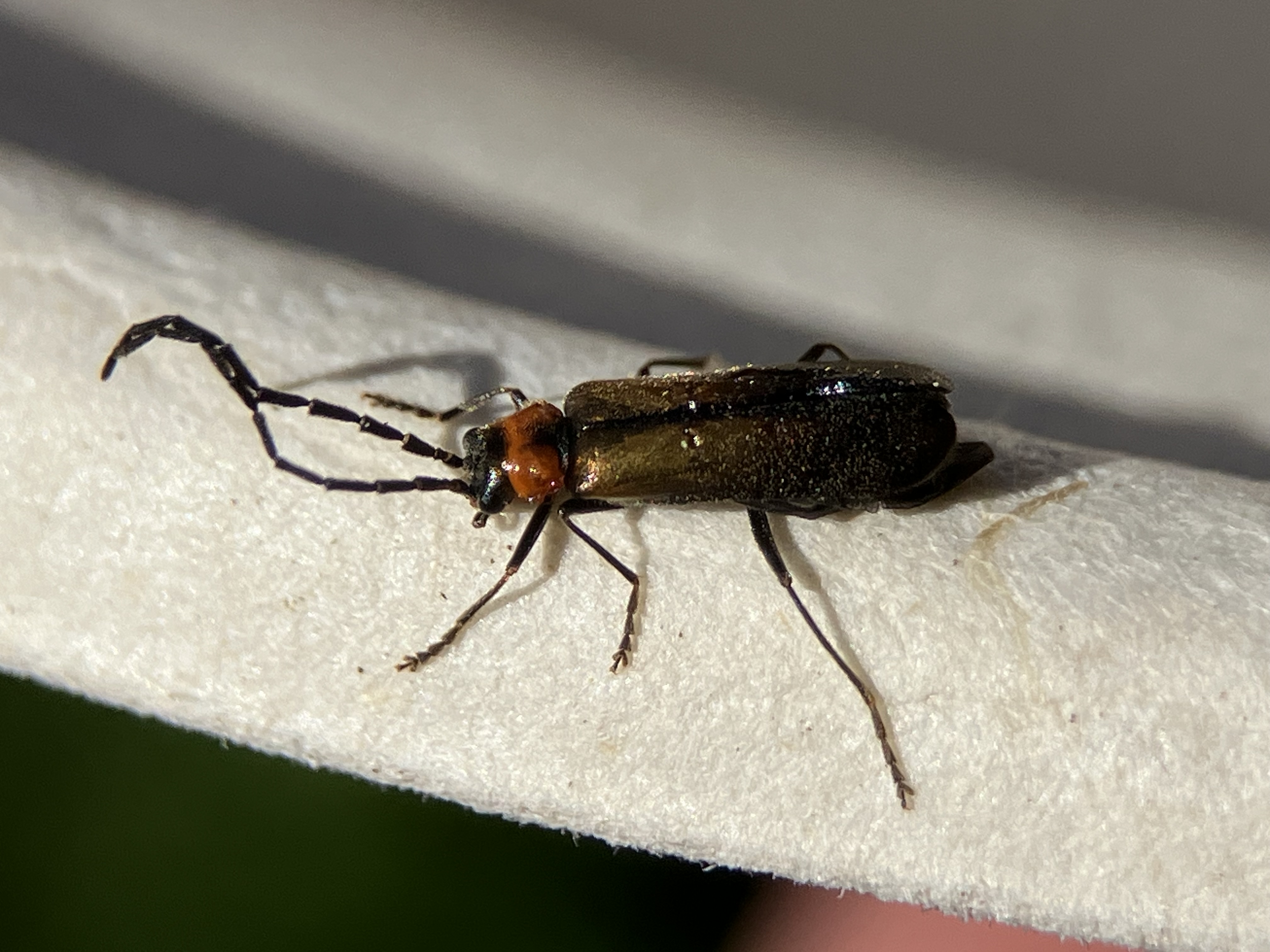
Soldier Beetle (Genus Silis)

While I have now scooped a few out of our pool, thankfully in time to save them from drowning, some of them (perhaps the ones I’ve rescued) are also finding me. I have had them on my clothing and peeping in the door at me!

Thanks for reading!

Soldier Beetle (Genus Silis) looking in our door at me!

References

Bugguide 2025. Genus Silis. Iowa State University. https://bugguide.net/node/view/11961

Green, John Wagener. 1966. Revision of the Nearctic species of Silis (Cantharidae: Coleoptera). Proceedings of the California Academy of Sciences, 4th Series, 32, 447–513. https://www.biodiversitylibrary.org/part/52839

Pelletier, G., Hébert, C. 2014. The Cantharidae of Eastern Canada and Northeastern United States. Canadian Journal of Arthropod Identification No. 25. February 28, 2014. Available online doi: 10.3752/cjai.2014.25

Parisi, F. and Fanti, F. 2019. On the first Silis Charpentier, 1825 from Baltic amber (Coleoptera, Cantharidae), Foss. Rec., 22, 119–123, https://doi.org/10.5194/fr-22-119-2019
A Sedgesitter

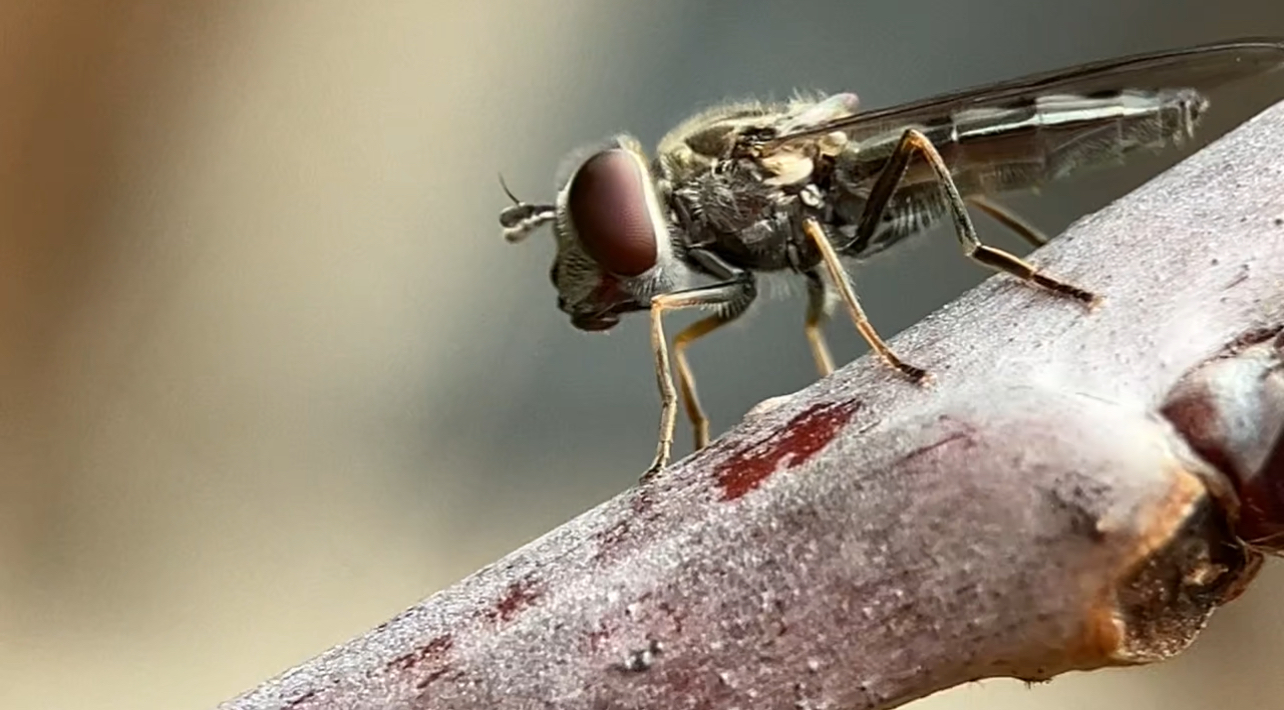
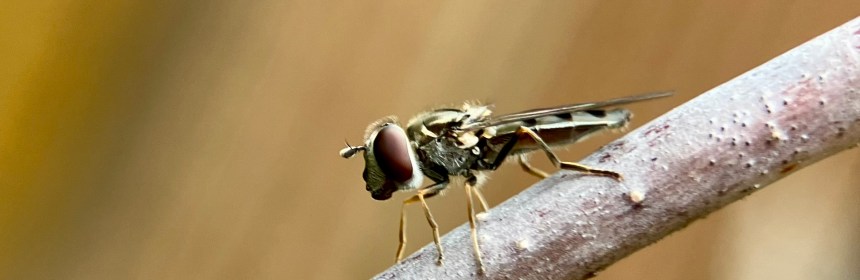
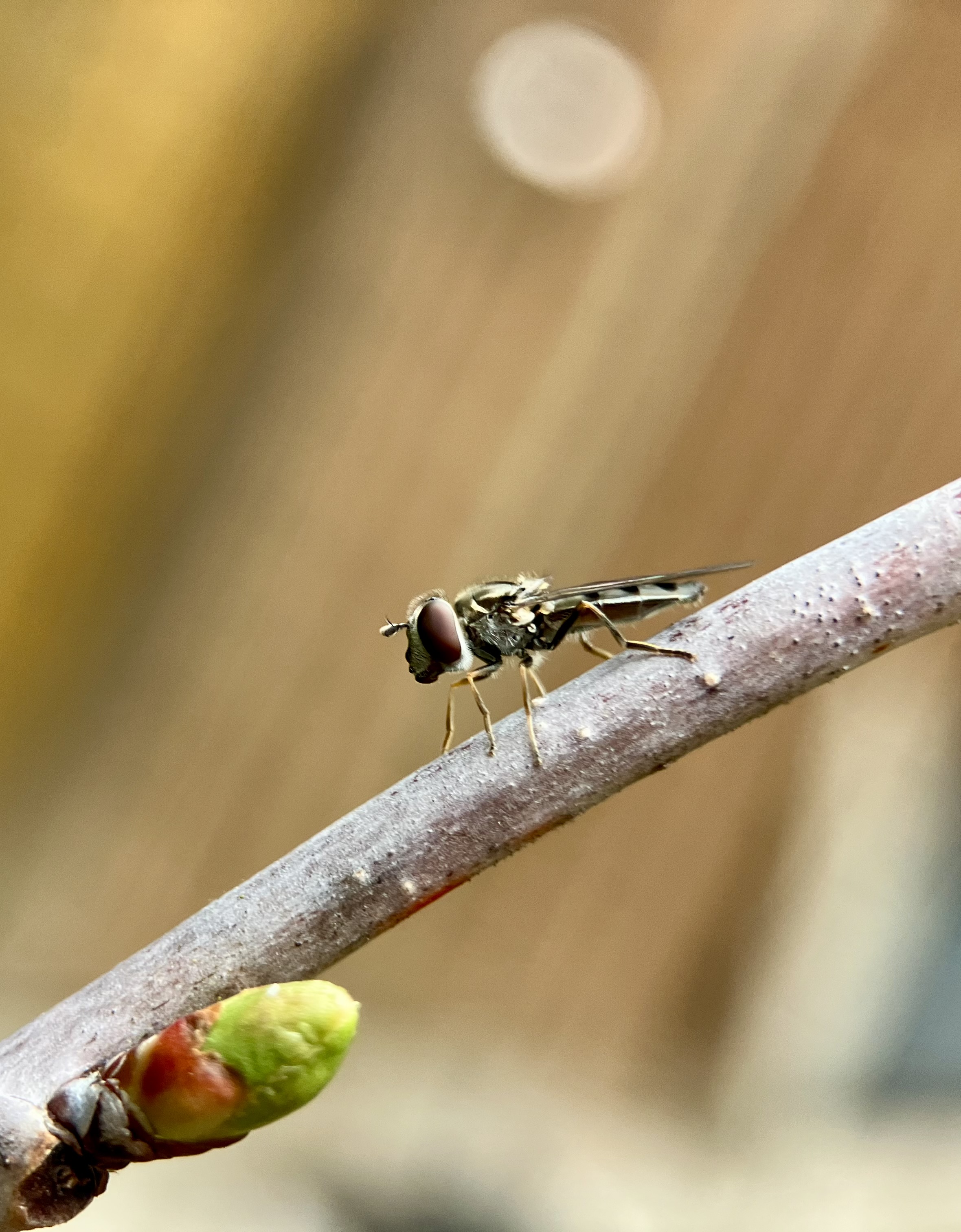
This was Wednesday’s bug of the day. I’m a day behind writing up my post. Although I have tried to get out for a quick bug search every day, it’s been overcast and/or drizzly here this past week. I was excited to see this little fly hunkered down on a twig of our fruitless cherry tree, the tree that I whacked off as an unwanted upstart for several years before I discovered how interesting it is.

Western Forest Sedgesitter, (Platycheirus trichopus), I believe

That tree is a mini ecosystem: floral nectaries that feed the aphids, aphids, slave making ants that have fights to the death (winning) with the carpenter ants that try to invade our home every spring, and the birds that rip the leaves apart trying to get the aphids. Now I can add Syrphid flies to the list!

That’s what this is. A syrphid fly. Syrphid flies eat aphids. It would make perfect sense for this adult to lay eggs on the tree, though I’m not sure what would happen because the ants that farm those aphids are certainly willing to die defending them. I could definitely see the ants overtaking the syrphid fly larvae. Nevertheless, the fly flew off. Somewhere.

I believe this particular fly is the Syrphid fly species Platycheirus trichopus, the Western Forest Sedgesitter. While difficult to ID to species, I did reference the helpful ID guide by fly expert, Even Dankowicz. https://docs.google.com/presentation/d/19F1qRGpmNDgaGE13M2SMUBlI846JicTOYjIescjVTHw/preview?slide=id.g8918834f0e_0_92

This species, as mentioned earlier is pretty small at only about 6.8-9.4 mm. Geographic distribution ranges from the Rocky Mountains west from Alaska to Mexico (bugguide.net). Adults of this genus are known to feed on the pollen of wind pollinated plants like Willow (Salix sp.) and various grasses (Poaceae), and sedges (Cyperaceae). It is believed they are better adapted to activity in cooler temperatures and that fits with yesterday’s rather gloomy spring day.

Thanks for reading!

References:

Dankowicz, Even (2023). “Common Pipizini, Paragini, and Bacchini Species of the Southwestern U.S. (CA NV AZ UT NM CO)”The Fly Guide: Field/Photo ID for Flies. pp. 9–10.

Bugguide.net. 2025. Syrphidae. https://bugguide.net/node/view/196

Bird notes 🎶

Something happened in the yard yesterday afternoon. We have a fruitless cherry tree in a cage that I didn’t plant. At least I think it’s a fruitless cherry tree. It sort of popped up on its own.

In the beginning, I didn’t really want it there, so I cut it down – a few times. It kept coming back, intent on sticking around. A couple of years ago, I just stopped trying to get rid of it. I even put a little cage around it. That was actually for the juncos that built a nest in the grass below that little tree though, to keep them safe from the mower.

Aside from me personally whacking it down a few times, the little tree has suffered other adversities. It has been attacked by cherry slugs (sawfly larvae). They ate its leaves.

Sawfly larva or Cherry Slug

It has had a few tent caterpillars munching too. One year that it was super dry, it lost its leaves and I thought it was dead. Only it came back again. I started to pay more attention to this little tree, even watering it in the summer. It’s not very tall, but this year it looks more healthy than ever before.

Last year, I noticed in the spring that it put out these cool little red bumps on the stem just above the leaf.

extrafloral nectaries
Formica ascerva ant at extrafloral nectaries

Those little bumps soon had little red and black ants visiting. I learned the red bumps are extrafloral nectaries. They produce nectar that attracts pollinators to the tree. I haven’t seen any flowers, so I’m not sure what would be pollinated. Maybe the tree isn’t old enough yet. I’m still learning. I sure need to figure out if I’m right that it’s a fruitless cherry.

Well, the other thing that is interesting is shortly after the little red bumps attract the red and black ants, there are little black aphids. I’ve seen this for 2 years in a row now. The ants tend those little aphid flocks like sheep. They are guarding them in exchange for the sugary honey dew the aphids produce.

The aphids and the ants seem to multiply. I have seen 2 or 3 ants per leaf with aphids. Not all the leaves have aphids, but maybe 1/3 of the tree does, and each guarded by the ants. The ants are Formica ascerva species.

They are interesting in their own right because aside from guarding the “sheep,” they also are fierce warriors, driving away (and killing) the large Camponotus sp. carpenter ants that try to invade every spring.

This colony of Formica ants lives under a bedroom of our home. They are welcome to stay since they don’t eat wood.

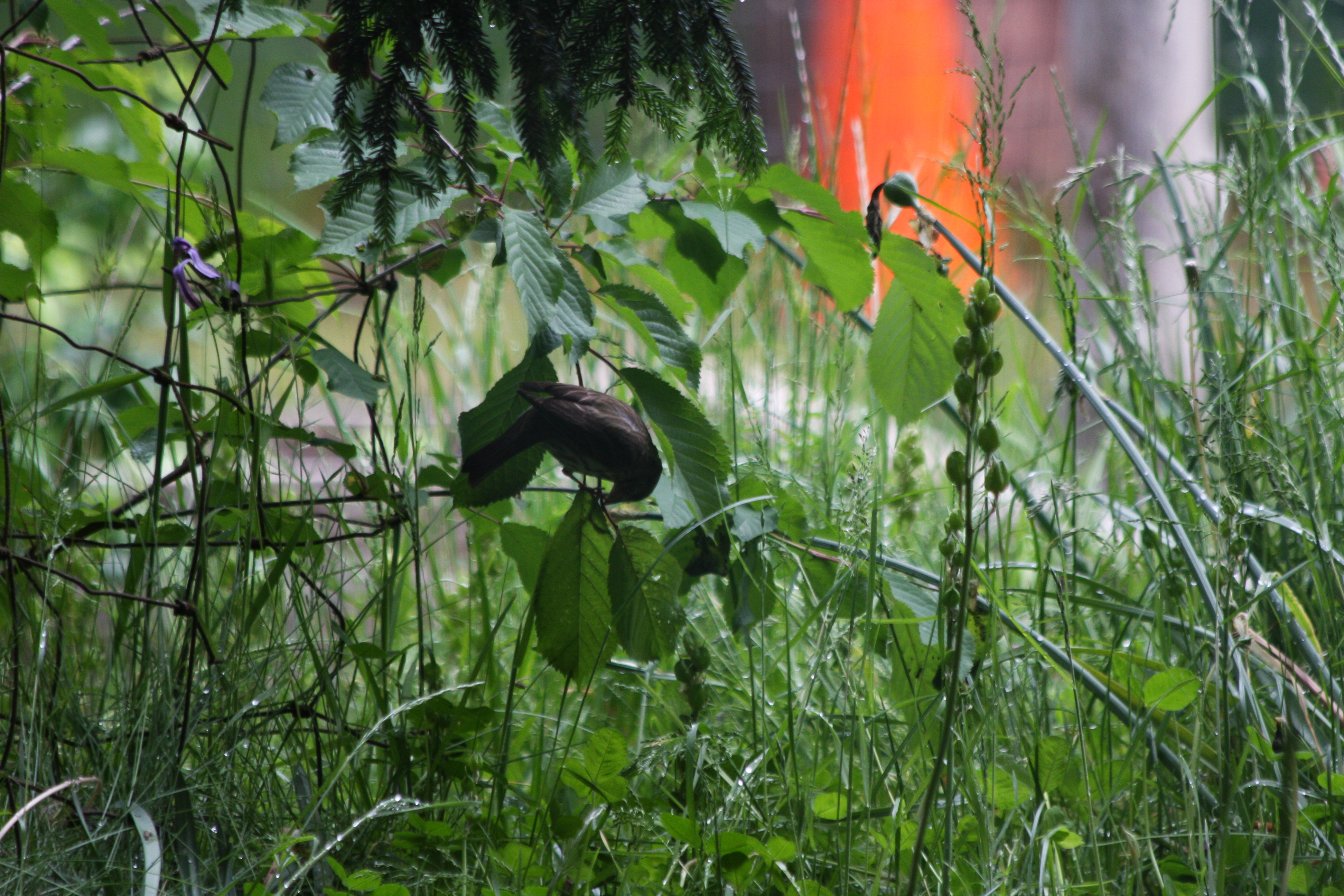
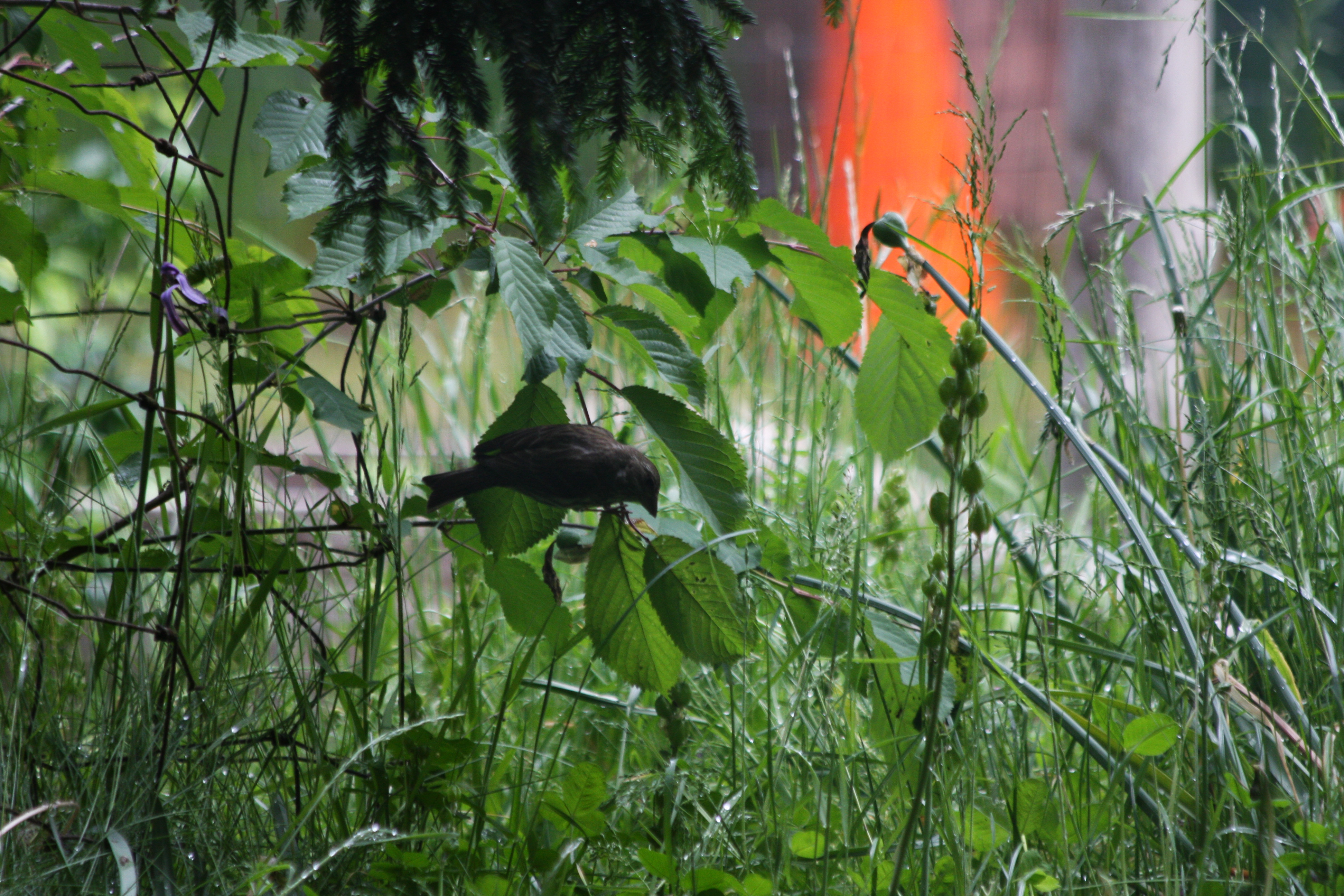
Today, when I looked out the window though, I saw something challenging the fearsome Formica ants. There were birds inside the tree caging and they were hungrily pecking and even tearing at the leaves with aphids. I grabbed and clumsily set up my camera to video the scene.

Birds attacking aphids farmed by Formica ascerva ants

I saw finches first, then there was a chickadee, and even a hummingbird. I thought I saw bumble bees, but they wouldn’t have been eating the aphids. Perhaps they were visiting the extrafloral nectaries or maybe even sipping honeydew produced by the aphids, but I wasn’t close enough to be certain.

Afterwards, I went out to survey the damage. I saw one leaf with lots of shreds. Aphid parts scattered about. Ants wandering somewhat aimlessly. Another leaf had an ant that died courageously in battle protecting his little flock.

I wanted to share my observations with you because a lot of folks really dislike aphids. Others also dislike ants and don’t understand their role in nature’s ecosystems. Maybe this will help others to understand there are a lot of hungry birds that eat aphids (and ants). Without them, the birds might not find enough food to feed their nestlings. It’s all part of the cycle of life.

If you see aphids your garden that you are worried about, you can mitigate some of their feeding damage by hanging a hummingbird feeder nearby. The hummingbirds have to have protein along with all that carbohydrate sugar water and they will most certainly find your aphids delicious. In fact, insects and spiders make up about 85 % of the diet of hummingbirds. Birds need bugs. And not all ants are pests. Some are extremely beneficial. I challenge you to take up bird and bug watching. You will not be disappointed!

Thanks for reading!

Below are more images of the birds feeding on the aphids inside the caged tree.

References and further reading

Bentley, B. L. (1977). Extrafloral Nectaries and Protection by Pugnacious Bodyguards. Annual Review of Ecology and Systematics8, 407–427. http://www.jstor.org/stable/2096735

Bugguide. 2024. Formica Ascerva. https://bugguide.net/node/view/497956

Aliens in the Garden

I’ve seen some pretty fascinating insects over the years, but using this clip on macro lens https://www.amazon.com/dp/B07LG651ZD/ref=sspa_dk_detail_3?psc=1&pd_rd_i=B07LG651ZD my husband bought me to use with my iPhone has opened up a whole new world. Last night we went down to our garden and while he was busy picking lettuce and tomatoes, I wandered around inspecting leaves and flowers with my new “eye.” I saw aliens! 👽

While I can’t tell you the exact names of all of these creatures, I can tell you that 7 pm must be dinnertime for some of them…like these micro beetles all over my flowering parsley. https://youtu.be/9_NRtS1HJTg

Unidentified micro beetles on Parsley blossoms
July 21, 2019
San Juan Island, WA

One of my favorites was this ladybug larva. I’ve been seeing several different species of ladybugs in the garden. This larva is probably Coccinella septempunctata or the Seven Spotted Lady Bug. A voracious predator, ladybug adults and larvae love to eat aphids. Curiously, while I saw plenty of aphids in my garden, I also saw some strangely mutant ones, so keep reading and scroll down for photos.

Ladybug larva
July 21, 2019
San Juan Island, WA
photo by Cynthia Brast-Bormann

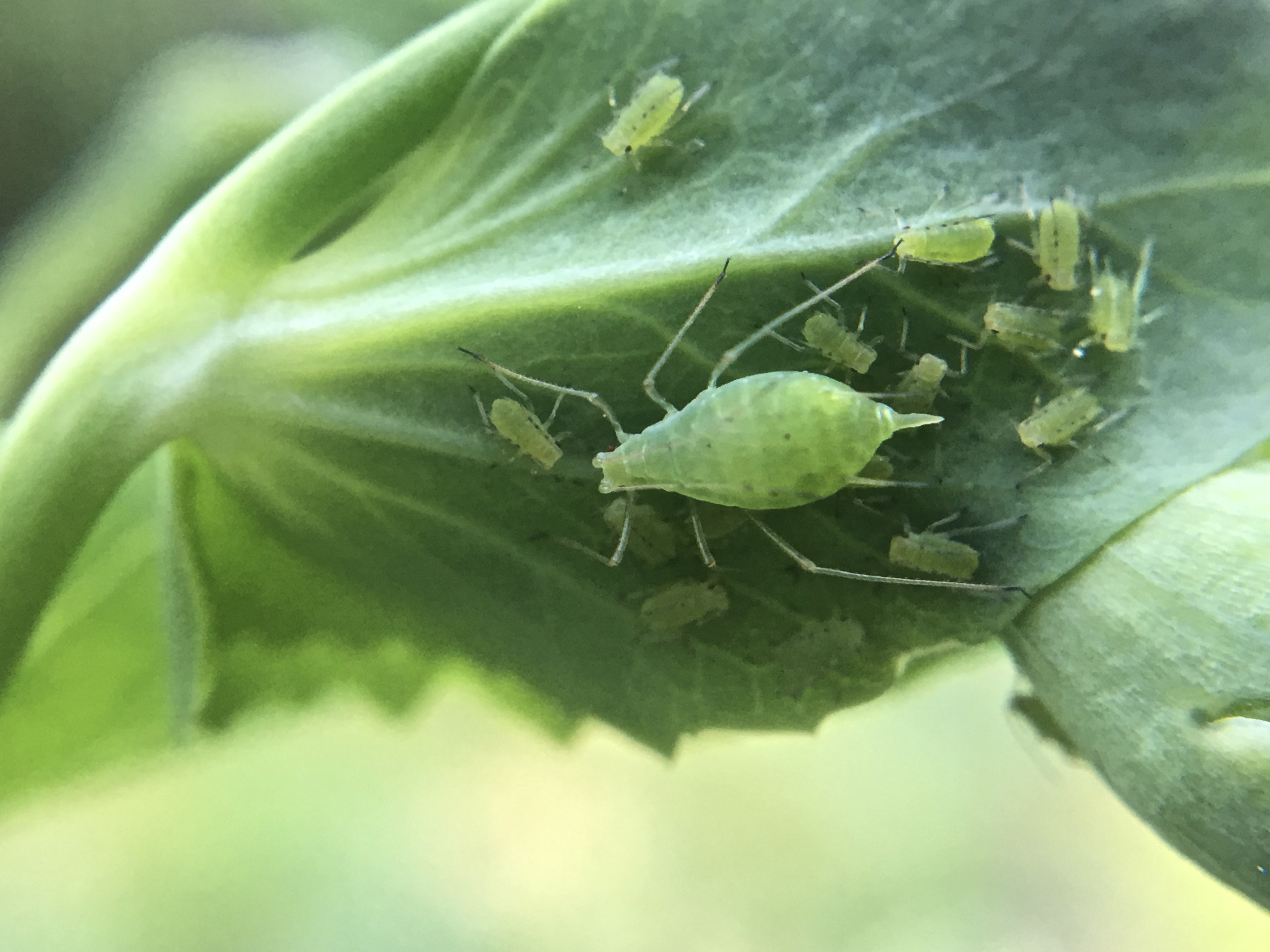
The normal, healthy aphids look like this one. Isn’t she sort of cute watching over all her little babies on the leaf!

Mom aphid with young nymphs
July 21, 2019
San Juan Island, WA
photo by Cynthia Brast-Bormann
Mom aphid with young nymphs
July 21, 2019
San Juan Island, WA
photo by Cynthia Brast-Bormann

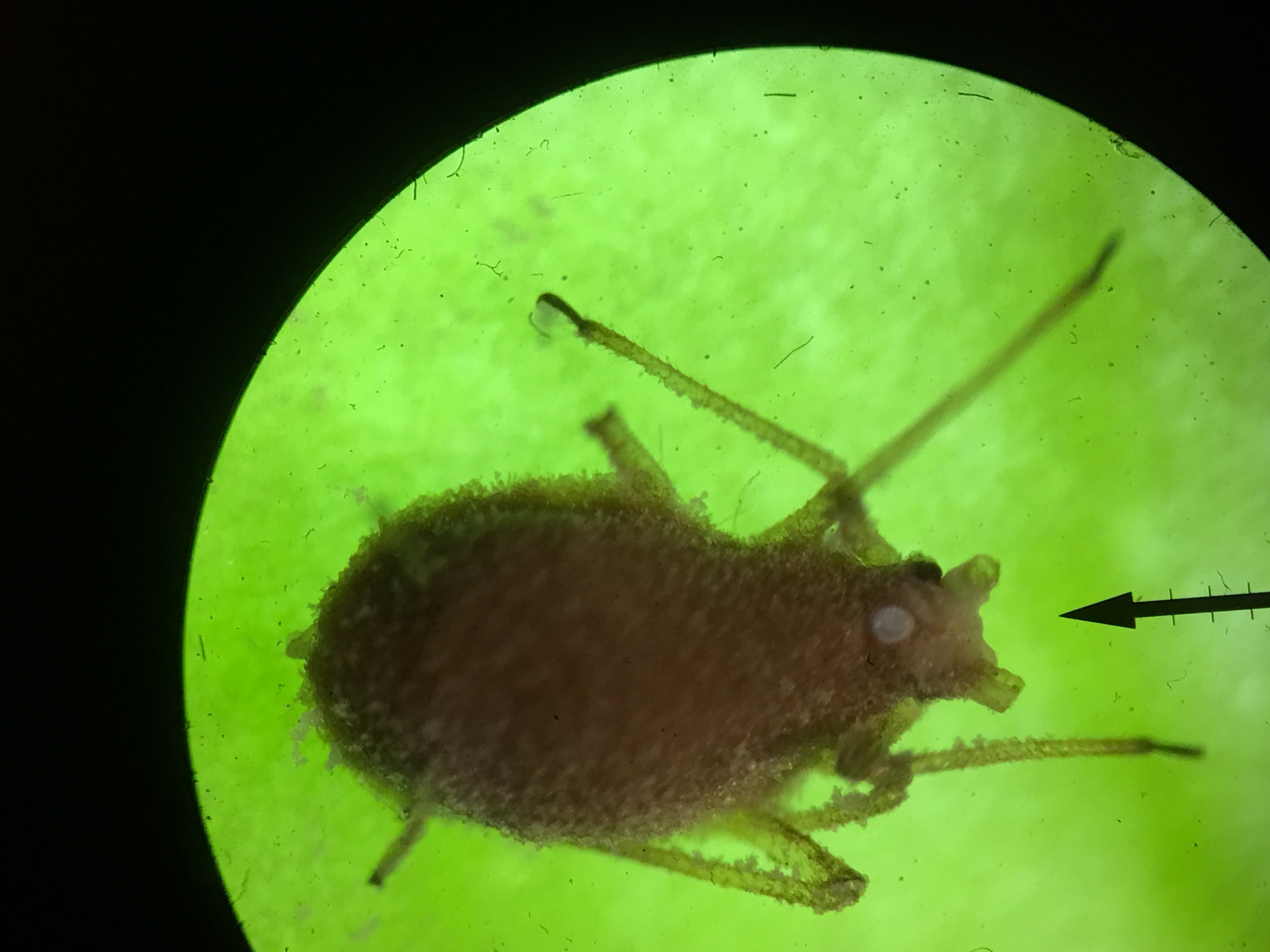
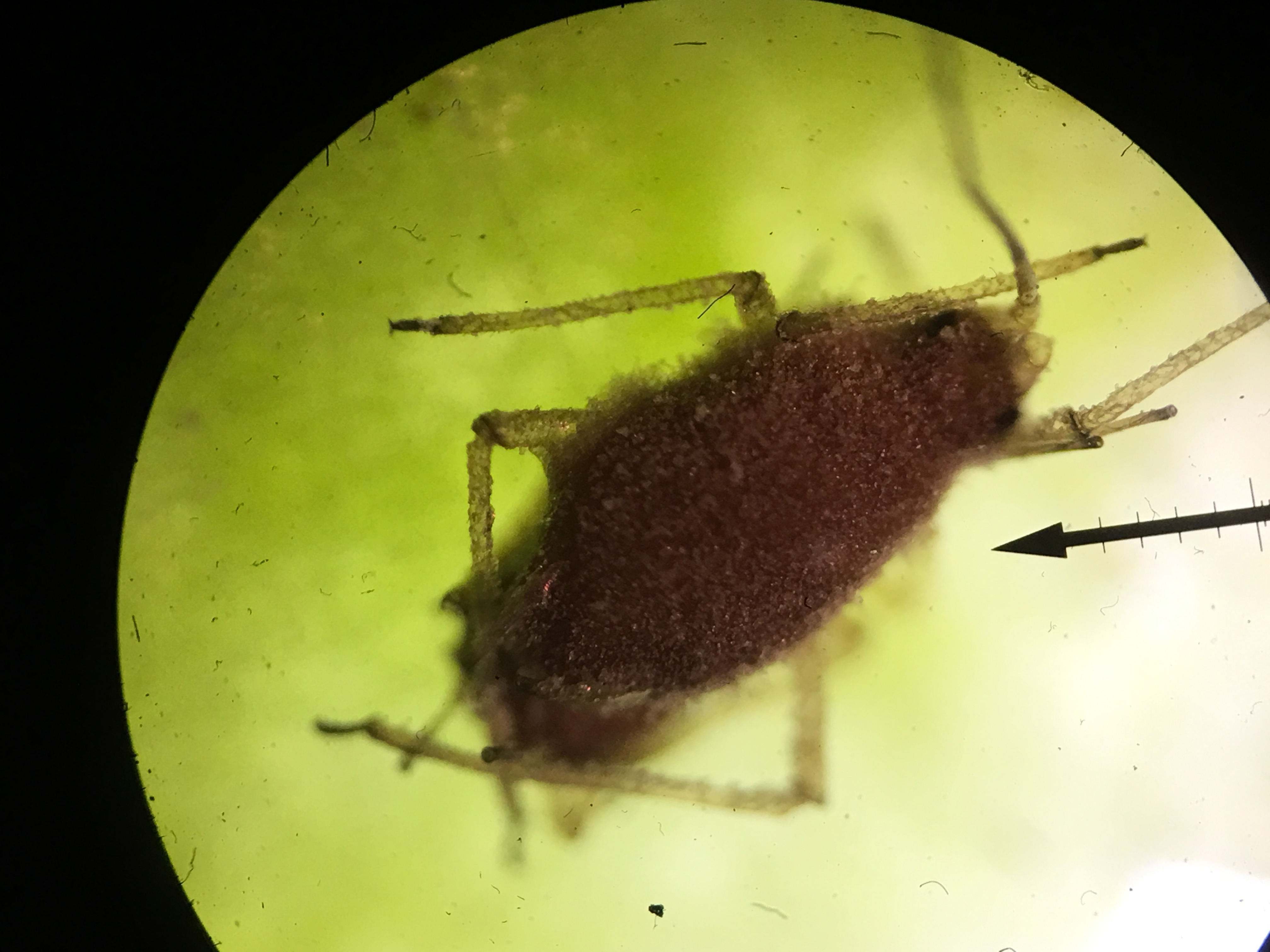
The strange aphids I noticed when I was picking peas. I am not 100% certain, but I believe this is a pea aphid that has been infected with fungi. After doing a bit of reading about these fungal pathogens, I believe it could possibly be (Pandora neoaphidis), an aphid specific entomopathogenic fungus that acts as a biocontrol for aphid populations. The taxonomy and ecological roles of fungi is beyond the scope of my knowledge and experience, so if you decide to read more about this, I suggest googling “Pandora neoaphidis” with “biocontrol.” One interesting bit I did note in my reading was that certain native ladybugs won’t eat aphids that are infected with the fungi, but that the non-native Asian ladybird beetle, Harmonia axyridis eats aphids indiscriminately, fungal infected ones too! Since I was eating peas while I was picking, I’m glad I stopped before popping the pea with these in my mouth. While I’m not entirely opposed to eating insects, I imagine my taste to be a bit more like the native lady bugs.

Pea aphid with fungal pathogen, possibly ( Pandora neoaphidis)
July 21, 2019
San Juan Island, WA
photo by Cynthia Brast-Bormann
Pea aphid under the microscope
possibly infected with (Pandora neoaphidis)
July 21, 2019
San Juan Island, WA
photo by Cynthia Brast-Bormann
Pea aphid with entomopathogenic fungi
July 21, 2019
San Juan Island, WA
photo by Cynthia Brast-Bormann

The next image is of the weirdest looking creature yet. This is another aphid, but instead of entomopathogenic fungi, it is the victim of a parasitic wasp that has injected it with eggs that will hatch, consume the remainder of the aphid body, then eat their way out. Here’s a link to another photo I found online of this stranger-than-strange occurrence in nature. http://www.aphotofauna.com/hymenoptera_wasp_praon_mummified_aphid_22-09-14.html

The Alien
Mummified aphid infected with parasitic wasp larva
July 21, 2019
San Juan Island, WA
photo by Cynthia Brast-Bormann

Got Aphids? Honey, Dew I!

Black Aphids

These tiny pear-shaped insects can be a serious garden pest.  Aphids use their long slender mouthparts like a syringe,  piercing the tender parts of plants and sucking out the juices….but this isn’t the only way they damage your plants. Feeding aphids also excrete a sticky waste byproduct called honeydew – honeydew helps the sooty mold fungus grow and sooty mold fungus blocks the plant from getting enough sunlight.  No sunlight…no photosynthesis!  The leaves of your plant can drop off and die. What other ways do aphids damage your plants?  When they feed, they also can inject the plant with pathogenic viruses.  These aphid-transmitted viruses can cause plants to yellow, leaves to curl and the plant’s growth will often be stunted.

Compounding the problem is the rate at which these “little devils” multiply.  Why call them “devils?”  I like to refer to them that way because it helps me remember they have something called cornicles. What are cornicles you ask? Cornicles are these unique anatomical structures, resembling little horns (or maybe old-timey rabbit ear TV antennae), sticking out of the back of the aphid’s abdomen.  These “horns” or “antennae” emit alarm pheromones, an aphid secret messaging system!  When a predator attacks, aphid fire off something called E-β-farnesene.  This chemical signal is broadcast from aphid cornicles into the surrounding airspace as a warning to other aphids….”Run…jump…fly…for your lives!!!”

I mentioned there can be A LOT of aphids!   So, exactly how fast do they reproduce?  Adult female aphids can give birth to as many as 12 live offspring per day!  No male needed. The young aphids, called nymphs, are born looking like a junior-sized version of the parent.  They will molt (shed their skin) several times before they reach a full-size adult.  If the weather is warm, these nymphs can achieve adulthood, and the ability to reproduce, in as few as 7-8 days.  When I think of 80 offspring per adult aphid, per week, sucking the life out of my garden plants, I have my own alarm pheromones going off!

So, what to do about the “little devils?”   Monitor your plants often.  Look for invading aphids near the upwind edges of your garden and be sure to check the undersides of leaves.  Learn about the aphids natural enemies.  These are your friends! Lady beetles, syrphid fly larvae, and lacewings all aid your efforts to reduce aphid populations.  When monitoring,  also look for ants.  Ants love to feed on aphid honeydew and will lead you to the source.  You may have to deal with the ants some way as they will try to defend the aphids from predators and parasites.  It’s garden warfare, so pull out your best strategy here!

What about insecticides?  Well, they will work, but remember the part I mentioned about aphids spreading viruses?  Aphids can infect the plants with pathogens before the insecticide has a chance to work. You’ve spent money on a product and your plant still gets sick and dies…AND, you’ve also killed off all your friends (the good bug soldiers). Instead, try prevention. Before you start your garden, remove any weeds or plants (sowthistle and mustard in particular) that might harbor aphids.  Check your transplants for aphids (and wash them off if you find any) before planting.  Localized aphid problems can be handled by pruning or pulling up plants and disposing of them.

Don’t fertilize heavily with nitrogen.  You might as well be giving the aphids fertility drugs.  Nitrogen just helps them reproduce faster.  Use fertilizer sparingly.  Try organic urea-based formulations that are time-released. Protective coverings or reflective mulches will help your plants in the seedling stage when they are most susceptible to damage from aphids. If you can, keep your seedlings in a greenhouse or under cover in the garden until they are older and able to withstand some feeding by aphids. Reflective mulches aid in repelling aphid populations by visually disorienting them from landing with the added benefit of increasing plant biomass through solar energy reflected back into the leaves.  Your warfare strategy keeps the little devils off your garden runway and your plants turn into bigger soldiers able to sustain later invasion.  It’s a win-win!

Another strategy to try…the garden hose!  You can call in the Navy…or the Marines and send the aphids away with a strong spray of water. Once dislodged they usually won’t be able to return.  No one is going to throw them the life preserver.  Use this strategy early in the day so you also get the honeydew off your plants and prevent the onset of sooty mold growing. If none of these options appeal to you, there is always all-out “nuclear warfare”  i.e. the chemicals!  We all remember the effects of Hiroshima and Nagasaki, so I would encourage you to rethink your strategy.  You want to be able to eat your vegetables and be around to enjoy your rose blossoms don’t you?