Tag Archives: Araneus diadematus

Spider Sack Sneakers
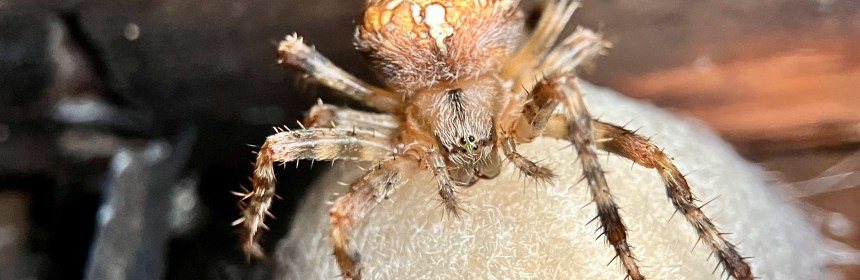
I wanted to show you something I noticed the other morning when I went out to check my moth light. When I was trying to photograph a moth on one of the beams of our covered deck, I noticed something else had been disturbed. If you follow along with my blog and social media posts, you may have seen photos and video I posted on YouTube https://youtu.be/vUlu32SyvZg?si=Z8TrNSzt29tJidkd back in December of 2025. This video features a female Cross Orb Weaver (Araneus diadematus) constructing her egg sack. It’s pretty cool, so watch it if you get a chance.
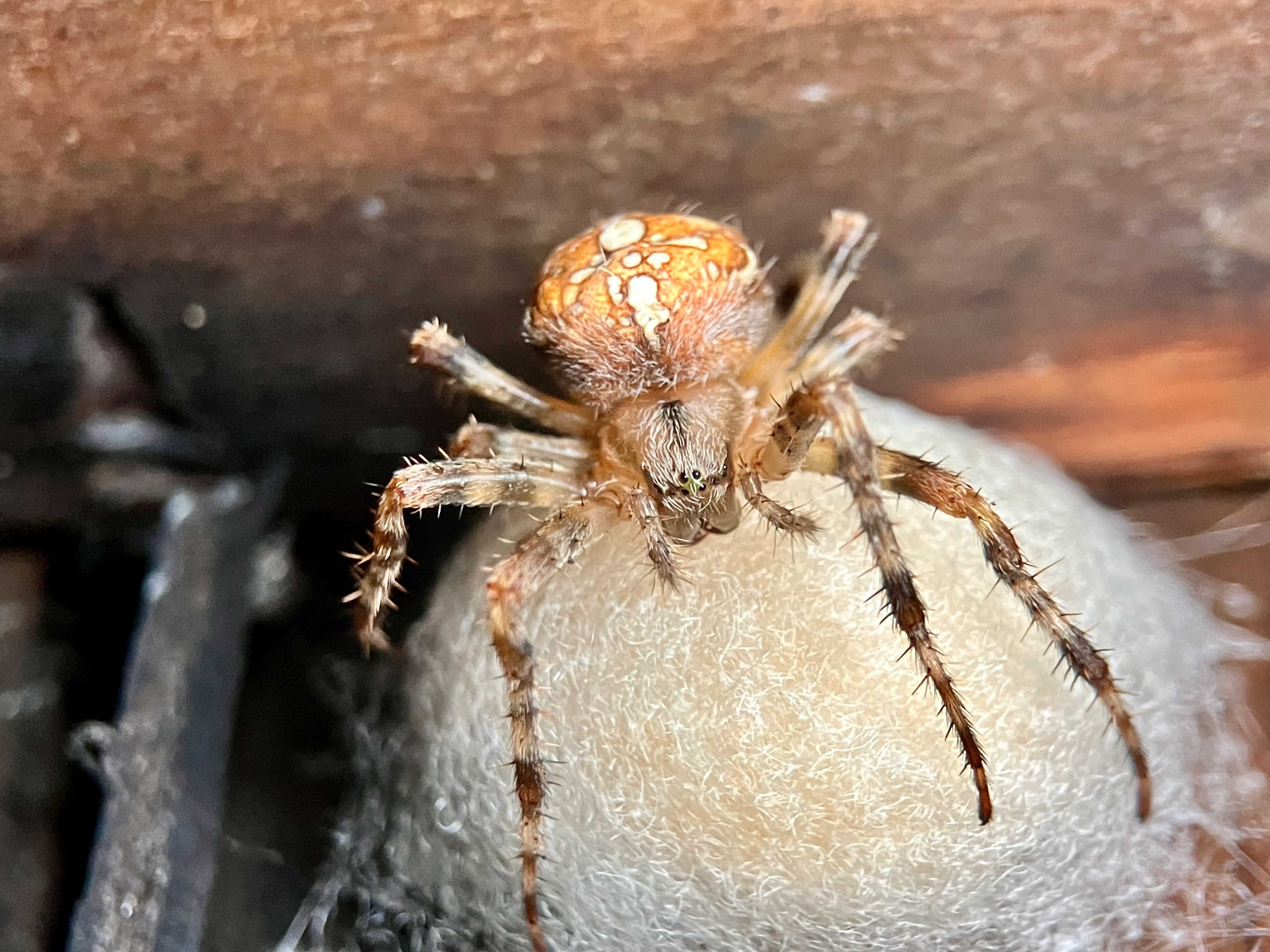
Araneus diadematus egg sack construction, San Juan Island, WA
Araneus diadematus with egg sack – December 12 2025

The female spider stayed on her egg sack, guarding it and probably resting from all of her hard work. She was there for more than a week. Maybe two. I noticed one morning after the temperatures had become quite cold, that she was no longer in her spot. Perhaps she dropped to the deck floor in the night and was picked up by one of our resident Juncos for breakfast. I had grown quite fond of watching her, so it was sad to find her missing. Yes, I was also a fan of Charlotte so long ago.

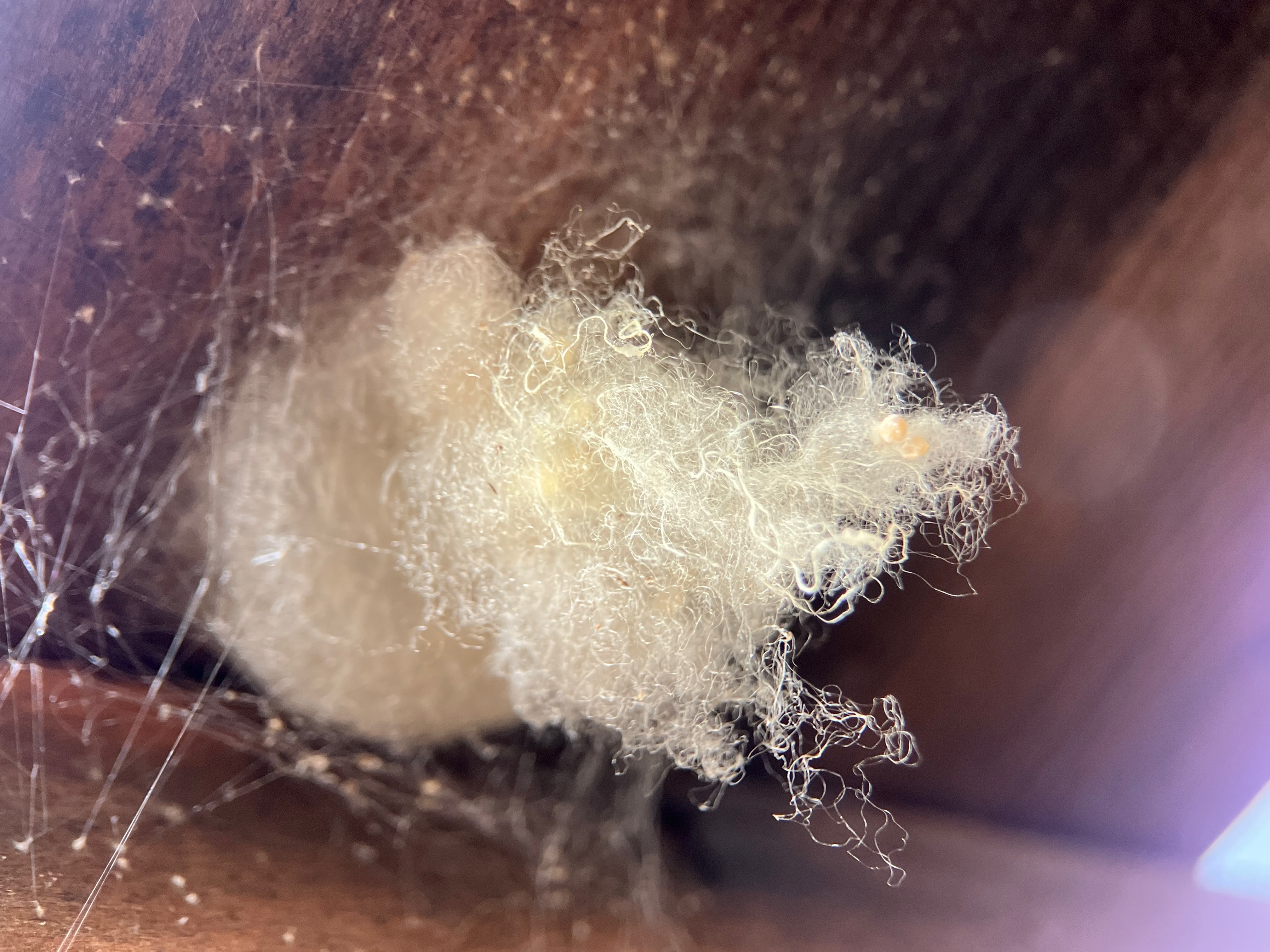
I have been keeping an eye on MY Charlotte’s incubating little ones since then, and was surprised to see that some of the beautifully woven fibers of her baby bassinet had been plucked away.

It’s not a huge surprise. This beautiful silk is likely the perfect lining for a tiny hummingbird nest. My hunch is one of our little Anna’s hummingbirds plucked from the spider sac to cushion her own eggs.

I don’t know if the spiderlings developing in the remains of this egg sack are still viable, but I will continue to watch and film them if I see activity.

Fun facts for you ~ Hummingbirds and other birds feed their nestlings spiders because they contain the amino acid, taurine, essential for brain development. Hummingbirds’ diets are actually comprised of approximately 80% insects and spiders. Hummingbirds (especially growing babies) need sources of protein in their diet. Adults rely on sugar water (and plant nectar, and even aphid honeydew) as sources of carbohydrates.

The best way to support hummingbirds and other wildlife in your area is to get rid of your lawn. Leave the leaves in the fall and don’t go overboard cleaning things up in Spring. Leave the moths, flies, native bees, and other insects that are still sleeping, undisturbed. Grow native plants that produce nectar and feed insects, and minimize or eliminate any use of fertilizers, herbicides, and pesticides around your home. The world will be better for it. 🌎 🕷️🪲🐞🍃
References

Bartlett, P. 2018. Fueling the Hummingbird’s Extreme Biology. Fundamentals. Johns Hopkins University. https://www.hopkinsmedicine.org/news/articles/2018/10/fueling-the-hummingbirds-extreme-biology

Choose Natives. 2026. How to Feed a Hummingbird. https://choosenatives.org/articles/how-to-feed-hummingbird-part-i-insects-protein/

Connor, J. 2010. Not All Sweetness And Light: The Real Diet Of Hummingbird. All About Birds. Cornell Lab. https://www.allaboutbirds.org/news/not-all-sweetness-and-light-the-real-diet-of-hummingbirds/

Kelly, J. W. 1955. History of the Nesting of an Anna Hummingbird. The Condor57(6), 347–353. https://doi.org/10.2307/1364792

University of Glasgow. 2007. Super spiders make bolder birds. University of Glasgow. https://www.gla.ac.uk/news/archiveofnews/2007/august/headline_37851_en.html

Williamson, S. 2015. Nesting material for hummingbirds. https://fieldguidetohummingbirds.com/nesting-material-hummingbirds/

Araneus diadematus, My Cross Orb Weaver friend named “Louisa.”

I first spotted this beauty on October 1, 2021 while I was taking a walk along our road on San Juan Island. There was a cluster of sun loving mullein (Verbascum thapsus) mixed with one or two thistles (probably Canada thistle) growing along the road. The glistening silk threads woven between them drew me over to investigate. There were several Cross Orb Weavers sharing the space here, but one of these was not like the other. The spider that caught my attention was quite a bit darker than the others. Describing it as brown just doesn’t do it justice. Brown sounds much too plain. She was a lovely brunette amongst a few redheads!

~ After you’re done reading, come back and check out this link to learn more about pigmentation in arachnids – https://www.bio.fsu.edu/~miller/Spider%20photos/spider_literature/color%20in%20spiders%20papers/Oxford_Gillespie_20xx.pdf

Since I often enjoy walking on our road on sunny days, I started looking for her when I passed her home – the Mullein “apartments.” It wasn’t just the spiders enjoying the sunny housing complex, but these units housed a few other species as well. I found some Stilt Bugs (Neoneides sp.) and some Pentatomidae hiding in the fuzzy star shaped trichomes (little hairs) of the Mullein leaves.

Now that autumn has ushered in falling leaves, falling temperatures, and a good bit of rain, I thought of my friend Louisa, the Orb Weaver out in the cold. Had she managed to find a sheltered spot to survive the recent storms? Several times over the past two weeks I’ve looked for her, but she was just gone. Since the lifespan for this species is only a year or less, I suspected she’d reached her end with our last dip in temperatures, gusty winds, and precipitation. I held out a tiny bit of hope though. Just a bit!

Today (November 6, 2021), my husband and I walked our road. It was sprinkling and the precipitation was cold. When we got down to the point on the road to turn around, shortening our walk to just the point where the old cabin used to be, I asked him to wait one second while I looked one more time at that patch of Mullein and the drying stand of thistles.

As I bent down to look closely, I saw a single strand of silk. Examining the attachment and following closely, it led me to Louisa. She was tucked under the dried nodding inflorescence of the thistle. Once a purply-pink sugar treat for pollinators, the now nodding blooms have been repurposed into a thatch roof to keep this little spider dry.

I’ve thought about relocating her so the county doesn’t mow her when they scalp the roadside vegetation. It is bound to happen at some point. For now, I’m going to leave her be, and just keep a close eye on her. Maybe I’ll make a sign! Be Nice to Spiders. ❤️ Louisa lives here!

Fun Fact! Did you know that 25% of the diet of Orb Weaver spiderlings is pollen? Check it out. Article linked in my list of sources below.

Araneus diadematus (Cross Orb Weaver) October 1, 2021 – San Juan Island, WA

Araneus diadematus (Cross Orb Weaver) October 1, 2021 – San Juan Island, WA

Araneus diadematus (Cross Orb Weaver) October 1, 2021 – San Juan Island, WA

Araneus diadematus (Cross Orb Weaver) October 13, 2021 – San Juan Island, WA
Araneus diadematus (Cross Orb Weaver) October 16, 2021 – San Juan Island, WA

This is “Louisa,” the Land Bank Orb Weaver Spider. She lives on a Mullein plant alongside the road. I’ve been watching her since October 1, 2021. Hoping she will not become a casualty of San Juan County’s pre-winter roadside mowing. She’s also an expecting mom!

This is “Louisa,” the Land Bank Orb Weaver Spider. She lives on a Mullein plant alongside the road. I’ve been watching her since October 1, 2021. Hoping she will not become a casualty of San Juan County’s pre-winter roadside mowing. She’s also an expecting mom!

Araneus diadematus (Cross Orb Weaver) November 6, 2021 – San Juan Island, WA

References and further Reading –

Eggs B, Sanders D (2013) Herbivory in Spiders: The Importance of Pollen for Orb-Weavers. PLoS ONE 8(11): e82637. https://doi.org/10.1371/journal.pone.0082637

Gucker, Corey L. 2008. Verbascum thapsus. In: Fire Effects Information System, [Online]. U.S. Department of Agriculture, Forest Service, Rocky Mountain Research Station, Fire Sciences Laboratory (Producer). Available: https://www.fs.fed.us/database/feis/plants/forb/vertha/all.html [2021, November 6]. 

Horton DR, Lewis TM (2003) Numbers and types of arthropods overwintering on common mullein, Verbacsum thapsus L. (Scrophulariacae), in a central Washington fruit-growing region. Journal of the Entomology Society of British Columbia 100, 79–87.

Oxford, Geoff & Gillespie, Rosemary. (1998). Evolution and ecology of spider coloration. Annual review of entomology. 43. 619-43. 10.1146/annurev.ento.43.1.619.

Riaz, Muhammad, Zia-Ul-Haq, Muhammad and Jaafar, Hawa Z.E.Common mullein, pharmacological and chemical aspects. Revista Brasileira de Farmacognosia [online]. 2013, v. 23, n. 6 [Accessed 6 November 2021] , pp. 948-959. Available from: <https://doi.org/10.1590/S0102-695X2013000600012&gt;. ISSN 1981-528X. https://doi.org/10.1590/S0102-695X2013000600012.

Turker AU, Gurel E. Common mullein (Verbascum thapsus L.): recent advances in research. Phytother Res. 2005 Sep;19(9):733-9. doi: 10.1002/ptr.1653. PMID: 16222647. https://onlinelibrary.wiley.com/doi/10.1002/ptr.1653

Two Tints! Araneus spiders – Araneus diadematus

I wanted to share with you photos of two spiders I photographed recently. Location: San Juan Island, WA. Both are in the family Araneidae or what we know as Orb Weavers. The first (orangey one), was observed on a tomato plant July 31, 2021, and the 2nd (brown one) was observed yesterday evening, August 10, 2021, on some sort of wetland grass near my home.

While I knew the orangey one was a Cross Orb Weaver, Araneus diadematus, I wasn’t certain of the brown one’s ID beyond genus Araneus, so I reached out to Seattle Burke Museum’s arachnologist, Rod Crawford to see what he’d say. He responded to my query this afternoon and offered that both are Araneus diadematus spiders. There can be variability in color tint (many of us know the Cross Orb Weaver A. diadematus as pumpkin orange).

Rod continued with, “the ventral view of the brown one shows it is penultimate (still one molt to go). Once they mature they will be more noticeable. Seattle specimens are at this same stage now.” He also offered in terms of color variants among spiders, …”I imagine there is a genetic component to this variation, at least in most cases, but I’ve never looked into the details. I have found situations where spiders living amidst a population explosion of green leafhoppers all tended to be greenish in color, presumably derived from their food.”

It’s all so very interesting, isn’t it! I’m glad we have scientists who are willing to share their knowledge and experience. Thanks to Rod for his help!

Araneus diadematus (San Juan Island 07.31.2021)
Ventral View – penultimate molt – Araneus diadematus (San Juan Island 08.10.2021)
Araneus diadematus (San Juan Island 08.10.2021)

To learn more about spiders, be sure to stop by Rod’s website, Spider Myths – Everything that ‘everybody knows’ about spiders is wrong! https://www.burkemuseum.org/collections-and-research/biology/arachnology-and-entomology/spider-myths

Thanks for reading!

September Spider Sleuthing in the San Juans – Day 8 Araneus diadematus, the Cross Orb weaver

Yesterday my husband was outside working on our deck (without much help from me). The weekend projects can be overwhelming, especially when I’m so easily distracted every time I find a BUG. This one was perfect for my post today!

Female Cross Orb Weaver, Araneus diadematus 09.07.2020

First off, it’s a SHE spider! This fall beauty is a female Cross Orb Weaver, Araneus diadematus. She was hanging out on the side of the house, just under the eave. I had to carefully climb a ladder to get a photo, but it was completely worth the risk.

Female Cross Orb Weaver, Araneus diadematus 09.07.2020

Orb Weavers are in the family Araneidae. These are some of the most beautiful and commonly seen spiders in our area. They weave the classic and typically vertical, orb-shaped web that we often see in our gardens.

March 29, 2013, Photo by Cynthia Brast-Bormann

While Araneus diadematus is not a native species and was introduced from Western and Northern Europe, it has become naturalized here and ranges across North America now. Bugguide.net gives the North American (including Canada) range for A. diadematus as the following localities – “diadematus – BC, WA, OR, MI, OH, PA, ON, NY, QC, RI, MA, NS, NL.”

Male and female specimens have different morphology (size, shape). Female body length can be from 6-20mm and they are fuller and more rounded. Male body length varies from 6-13mm and they are more narrowed in body shape.

Male A. diadematus

Typically, even though they are around in spring, we don’t notice them until later in the fall (like now). Females will be waiting on their web for a wandering male to find them. Males are not usually seen on webs since they are often on the move to find “Miss Right.”

The female A. diadematus will lay her last clutch of eggs in fall before dying, usually timed with our first frost. The eggs will overwinter. The eggs will hatch in springtime when temperatures warm, releasing hundreds of baby spiderlings!

June 13, 2013 – San Juan Island “Orb-Weaver Spiderlings”

I found this interesting poem online about Orb Weavers that I’ll leave you with today. Thanks for stopping by!

Araneus diadematus

Our cradle empty, we shall climb

To a high place, to catch the wind

And fly, strewing gossamer as we go,

Singly, flowing without will, to land

Wherever.

We shall know, by the compass

Blotched in white upon our backs,

Where to spin the spokes, and how

To spire the wheel; with one leg, feel

The trembling.

Approach too fast, and we shall quake,

And blur the whorl with shaking

From the underside, the compass

Pointing down, our legs the eight points

Taking.

At night we eat the orb, conserve

The silk, to spin again by morning,

Indelicately, cramming all

Into open mouths, every spoke

Consuming.

We spin the globes of nurture

After mating, span them so,

With loving claws, adore the

Minor worlds we make, compass

Turning.

Entwined in silk, their spinnerets

Are forming, massed bundles

Of eyes, and legs, and fangs

Entangling. Each of us

Expiring.

Source material. Veronica Godines, Araneus diadematus, http://animaldiversity.ummz.umich.edu. Theodore H. Savory, The Spiders and Allied Orders of the British Isles, London, 1945, pp. 130–131. The common “Garden Spider” has a characteristic “cross” on its back, and is the archetypal orb-weaver. Immatures, already orphans by the time they emerge, go out to seek their fortunes by abseiling more or less at random on air-currents, attached to an anchor point by nothing but a thread of gossamer.