Tag Archives: Be Nice to Spiders

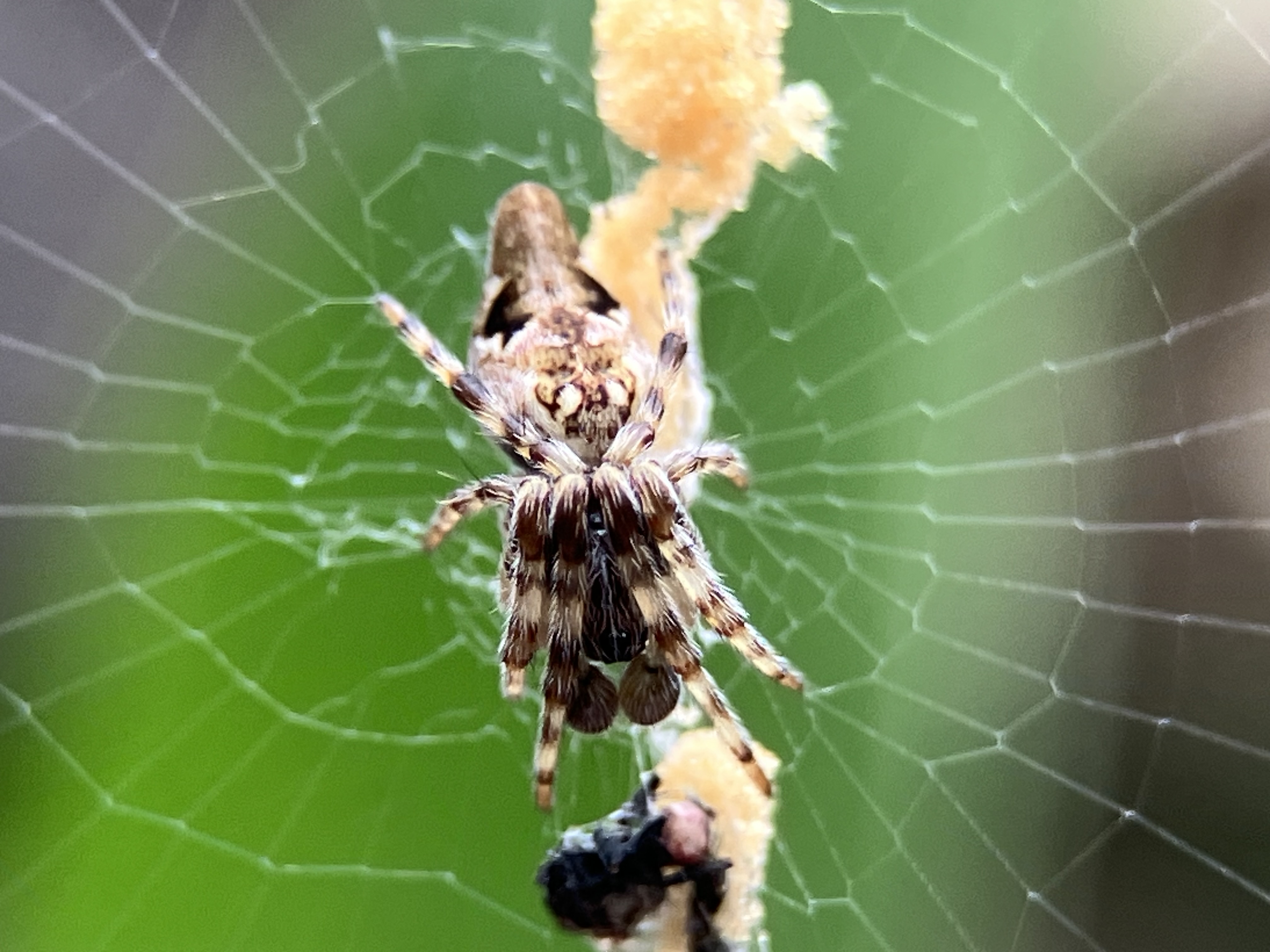
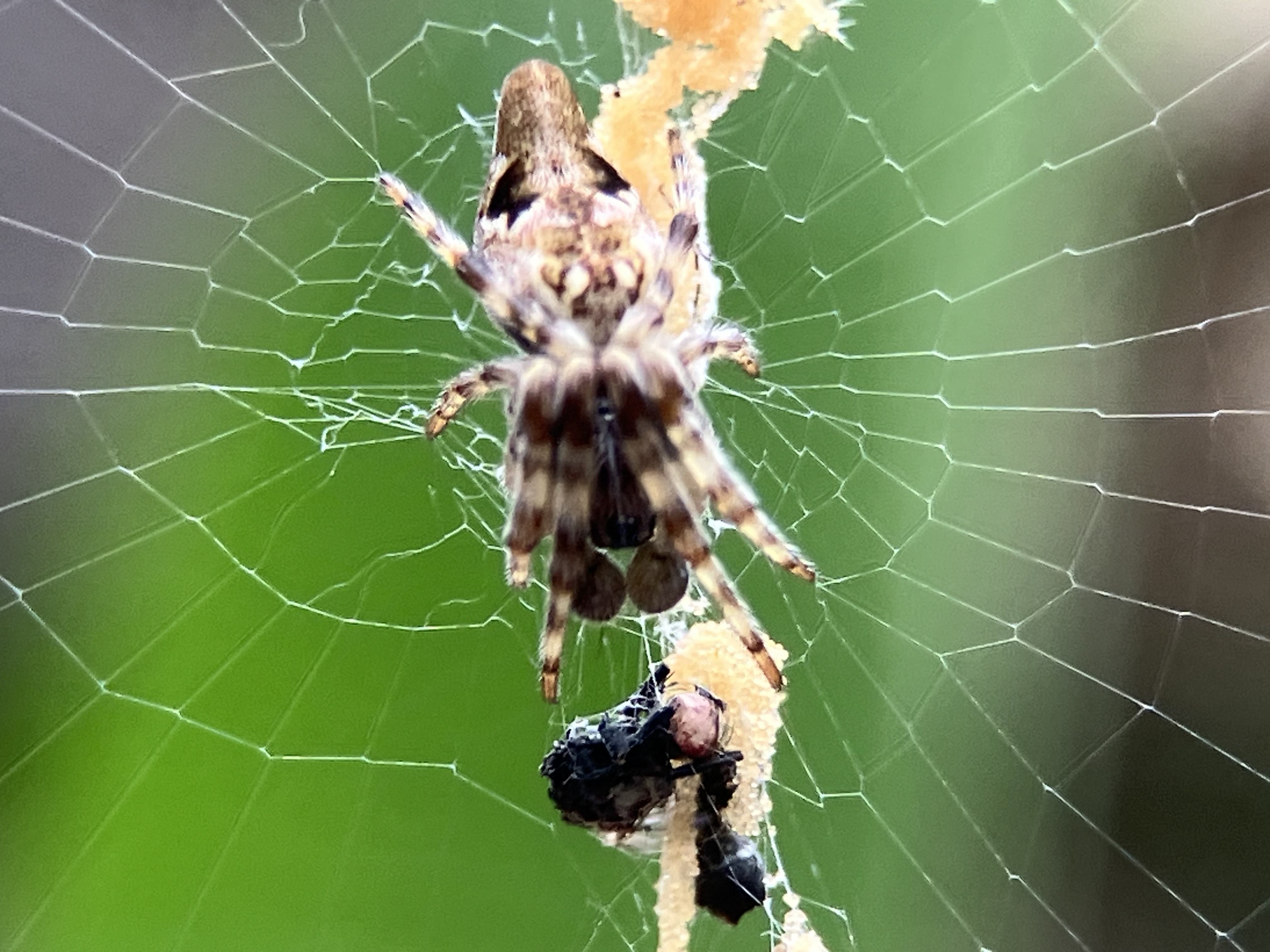
Trash Line Orb Weaver (Cyclosa conica)

I feel like my posts have been a bit random. There are so many things I want to share and yet, I find myself getting distracted by something, saying “I’ll come back,” but then something else comes along. Isn’t that called LIFE?

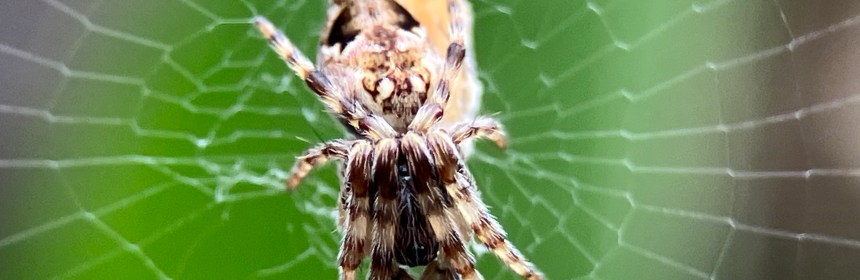
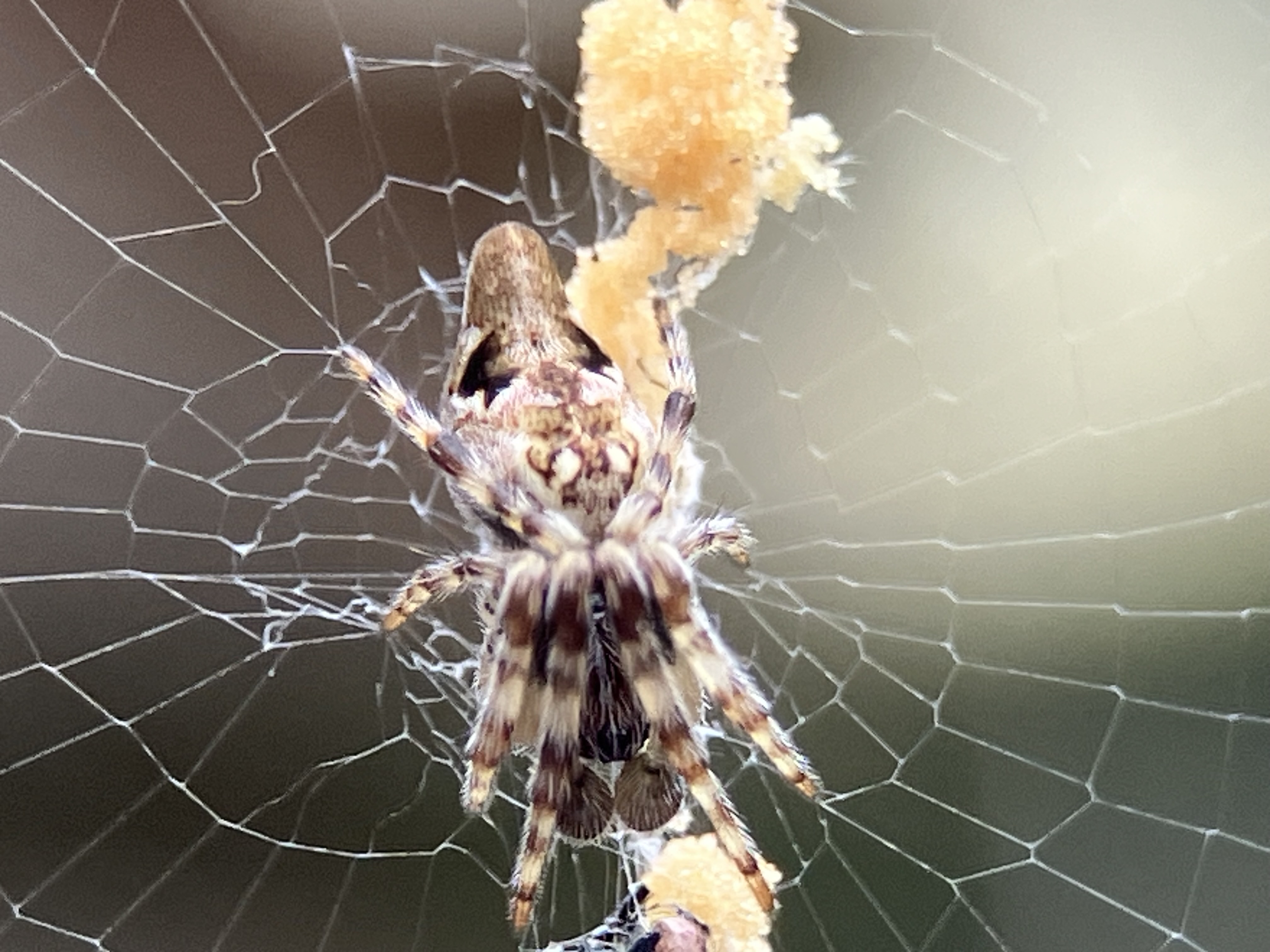
Well, I don’t want you to miss seeing this very cool spider I found (April 11, 2026). I had not seen one of these in a while – over a year. This one was in a perfect place for me to get a few photos and I was happy with how they turned out.

Trash Line Orb Weaver (Cyclosa conica)
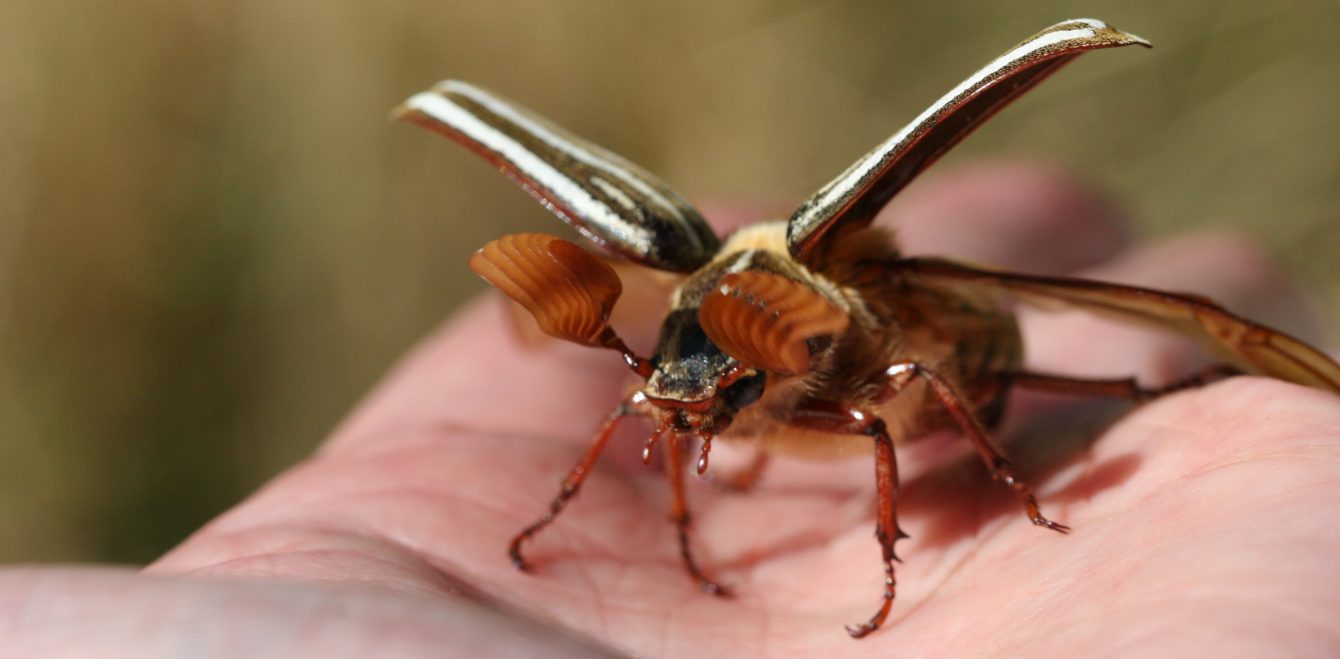
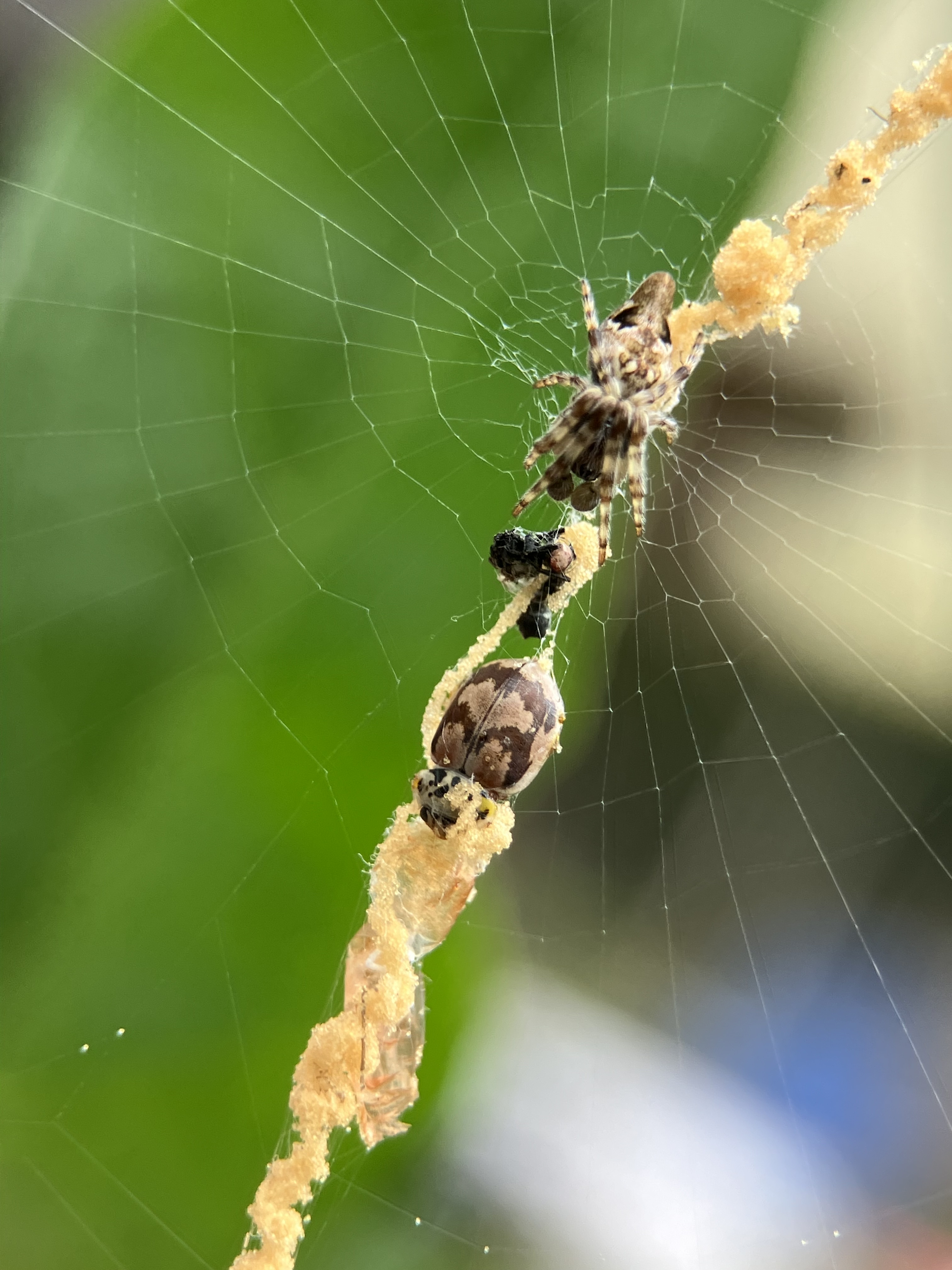
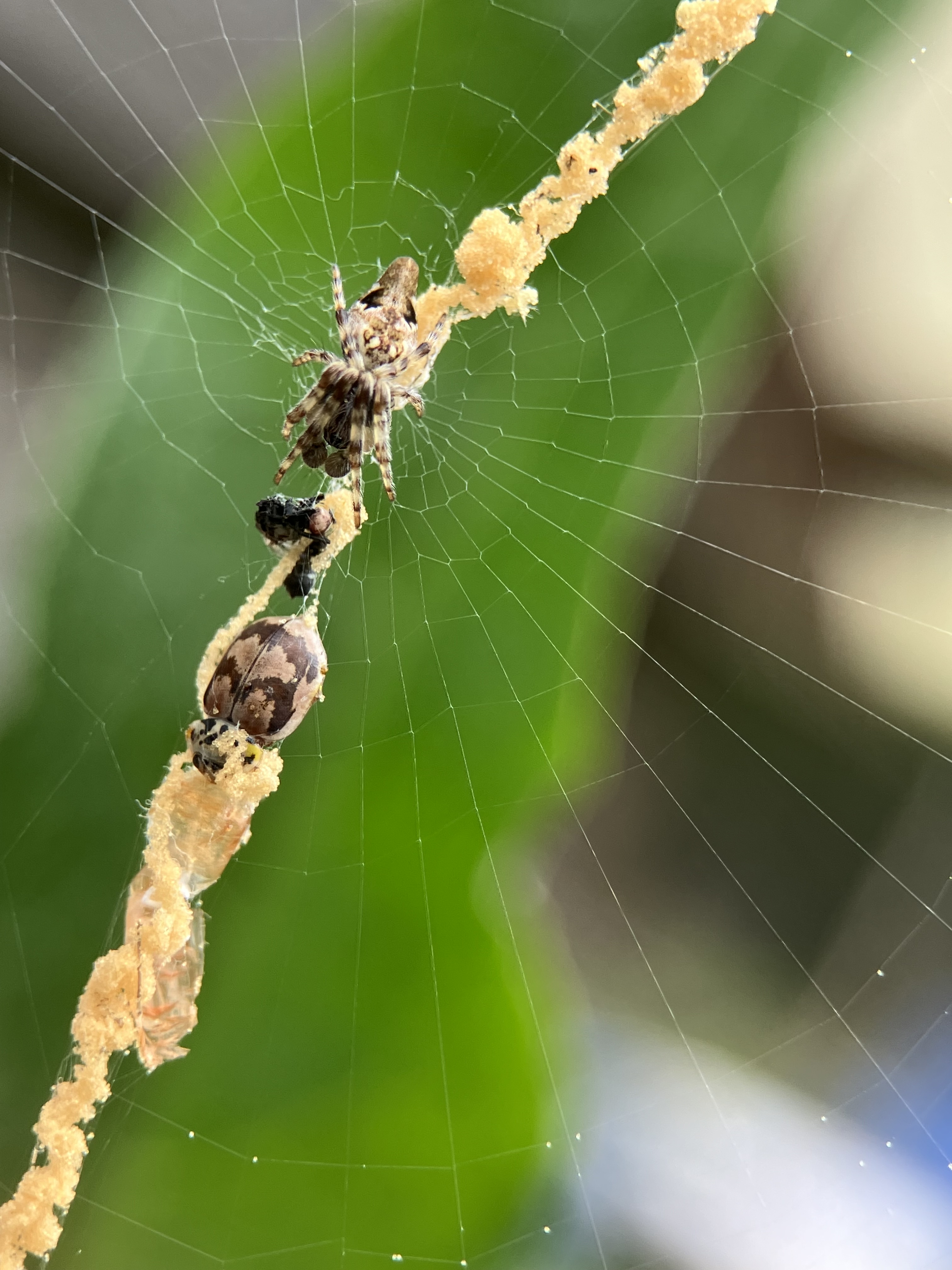
Meet the Trash Line Orb Weaver in the family Araneidae. The species is Cyclosa conica. I believe it’s a “he.” The debris along the web mimics bird droppings. When you look closer, you can usually see remnants of prey left in the line. This looks to have a Painted Lady Bug (Mulsantina picta) saved for a meal.
Trash Line Orb Weaver (Cyclosa conica)

I believe the yellow bits on the line are pollen. It’s coating everything out here these days. In case you didn’t know, some spiders will actually consume pollen (and even supplement with nectar) when other food sources may be limited or they are too small to catch other invertebrates.

I’ve linked an earlier blog post I wrote up about this spider back in 2023 here https://buggingyoufromsanjuanisland.com/tag/cyclosa-conica/ and you can read a bit about spiders consuming pollen when you check out this blog post https://buggingyoufromsanjuanisland.com/2022/04/29/ill-have-some-salad-said-the-spider/

If you are interested in a deeper dive about Cyclosa spiders or spiders and pollen, check out the reference section below.

Thanks for reading!

References

Brast, Cynthia. 2021. THE TEENY TINY “TRASHLINE ORB WEAVER” – YES, THAT’S REALLY THE NAME! Bugging You From San Juan Island. https://buggingyoufromsanjuanisland.com/tag/cyclosa-conica/

Brast, Cynthia. 2022. I’ll Have Some Salad Said the Spider. Bugging You From San Juan Island. https://buggingyoufromsanjuanisland.com/2022/04/29/ill-have-some-salad-said-the-spider/

Bugguide.net. 2021. Genus Cyclosa – Trashline Orb Weavers. https://bugguide.net/node/view/1989

Eaton, E. 2012. Spider Sunday: Trashline Orb Weavers. Bug Eric Blogspot. http://bugeric.blogspot.com/2012/06/spider-sunday-trashline-orb-weavers.html

Eggs B, Sanders D (2013) Herbivory in Spiders: The Importance of Pollen for Orb-Weavers. PLoS ONE 8(11): e82637. https://doi.org/10.1371/journal.pone.0082637

Nahas, L., Gonzaga, M.O. and Del-Claro, K. (2017), Wandering and web spiders feeding on the nectar from extrafloral nectaries in neotropical savanna. J Zool, 301: 125-132. https://doi.org/10.1111/jzo.12400

Peterson, J.A. Obrycki, J. J. Harwood, J.D. 2016. Spiders from multiple functional guilds are exposed to Bt-endotoxins in transgenic corn fields via prey and pollen consumption. Biocontrol Science and Technology 26:9 (2016), pp 1230–1248. doi 10.1080/09583157.2016.1193591 https://digitalcommons.unl.edu/entomologyfacpub/466/#:~:text=formica%2C%20and%20Cyclosa%20turbinata%20(Araneidae,factored%20into%20future%20risk%20assessment.

Trashline Orb Weavers. Missouri Department of Conservation. https://mdc.mo.gov/discover-nature/field-guide/trashline-orbweavers
Wanna feel my palps? Said the HE to the SHE. This is a Spider Sex Story 😱

Wanna feel my palps?  Said the HE to the SHE.  

My husband said this title was far to risque’ but I’m going with it anyway.  I would tell you to “get your mind out of the gutter,” but this is a SPIDER sex story.  Sex education is not a bad thing and it’s good to know how it all works, right?

So male spiders have these fuzzy, enlarged “paws” that sort of hang down in front of their face.  People who study spiders call them palps.  They are sort of like a 5th pair of legs, but used by the spider to manipulate food and “smell” things.  These palps are also where the sex organs are housed in adult male.  The hairs on the palps have chemoreceptors that help the fellas follow the pheromone trails of SHE spiders.   This is the mating season for one of our commonly seen spiders in the San Juans…the Giant House Spider (Eratigena duellica) who happens to be harmless, just horny.

How do spiders DO it?  Well, an adult male spider will weave a small silken sheet called a sperm web.  He deposits a drop of semen on the sheet and then dips the tips of his palps into the semen, drawing it up into what is called the emboli.  The emboli act like a syringe, drawing the fluid up to be held in the palp for transfer to a SHE spider.  With his palps “charged and loaded,” he gleefully wanders off to woo all the ladies. 

Some of these male spiders really go all out to impress a gal.  They will drum (with their palps), dance, and display all sorts of postures to show how great they are.  They better do EVERYTHING they can to impress her too since SHE might eat them if it’s not good enough. Watch a jumping spider perform his quirky courtship ritual here –

https://www.scientificamerican.com/video/spiders-perform-a-spooky-seduction-dance/?fbclid=IwAR16qMBBajQ7UVnZAZHepFCuHToEch2LCtUETkKlSFB6r31qZKMgN2zygqc

If mating is successful, the male usually makes his exit…quite literally.  He’s at the end.  

And THAT, my friends, is the end of this spider sex story.  

Thanks for reading!  

Spider Sleuthing in the San Juans – Day 5 Be Nice to Spiders!

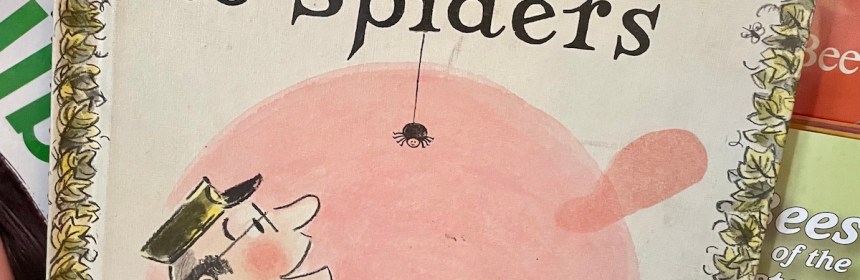
Be Nice to Spiders by Margaret Bloy Graham


When I was a little girl, my mom read me this book, “Be Nice to Spiders.” We read it together many, many times! It was probably one of my earliest introductions to the wonder of ecological systems and definitely played a role in the development of my love for animals and nature.

My mom didn’t have the opportunity for a college education, and was a young mom at 23. She did however, grow up in the mountains of North Carolina, loved nature, and she had a “story” for everything! It made learning about leaves, bugs, rocks, and animals of all kinds really fun.

I was extremely lucky to have a mom like that and to be exposed to so many science opportunities, even though I didn’t really see it as science at the time. As a parent myself, and someone with a background in education, I can’t express enough to other parents out there how important it is to connect your children with nature…in a kind way! Help them to see living things with wonder and respect for all life. Especially spiders!

Here’s a YouTube read aloud of Be Nice to Spiders. There were several, but I just liked this woman for some reason. I’m sure the San Juan Island library has a copy of the book too, and if not, there’s always Griffin Bay Books, Serendipity, Abebooks, and Amazon where you can find a copy for your bookshelf.