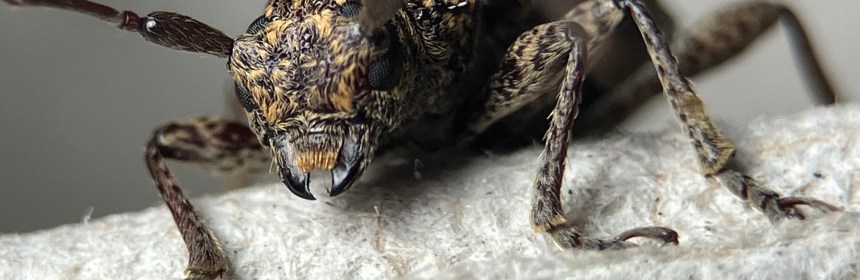
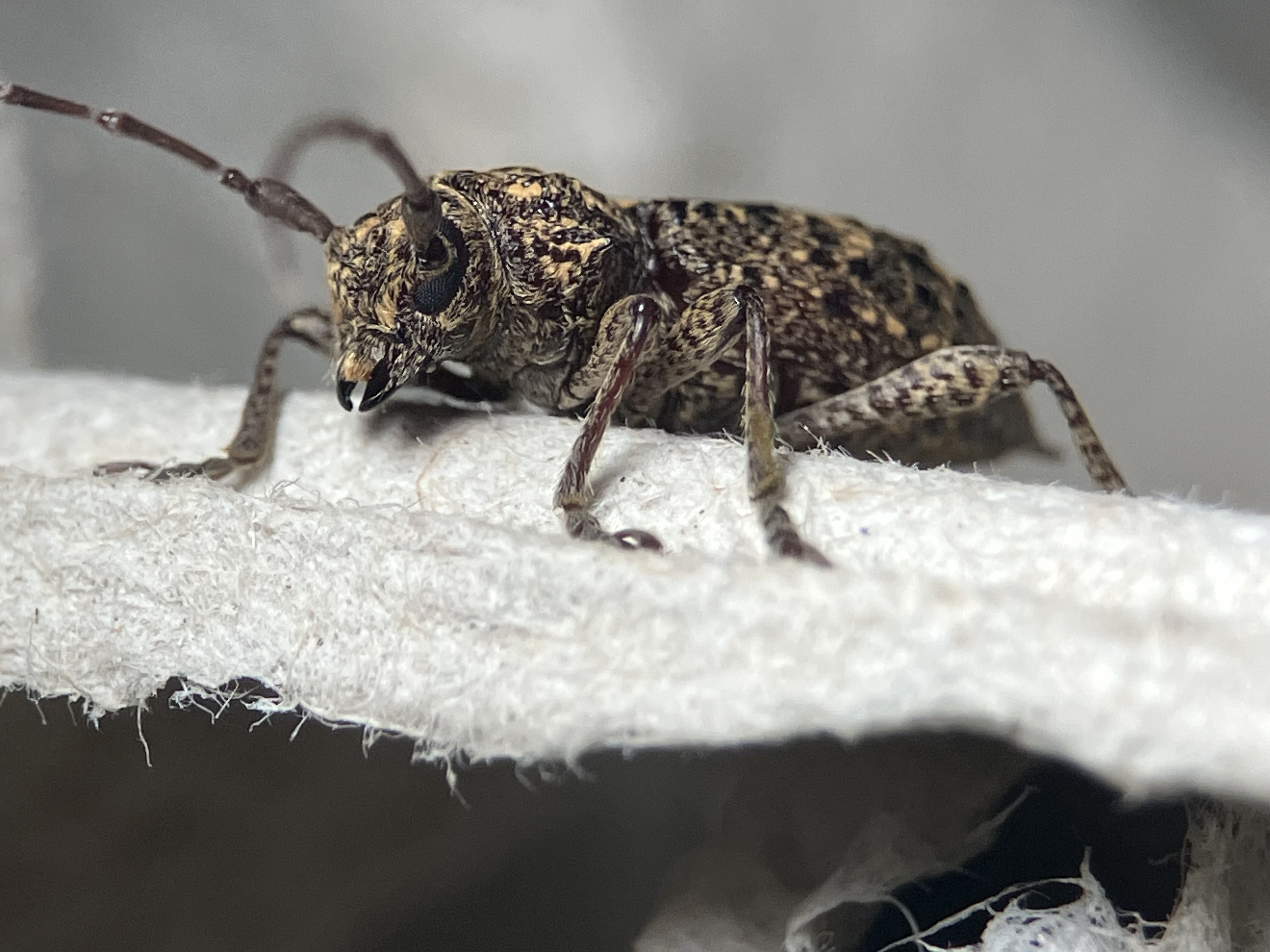
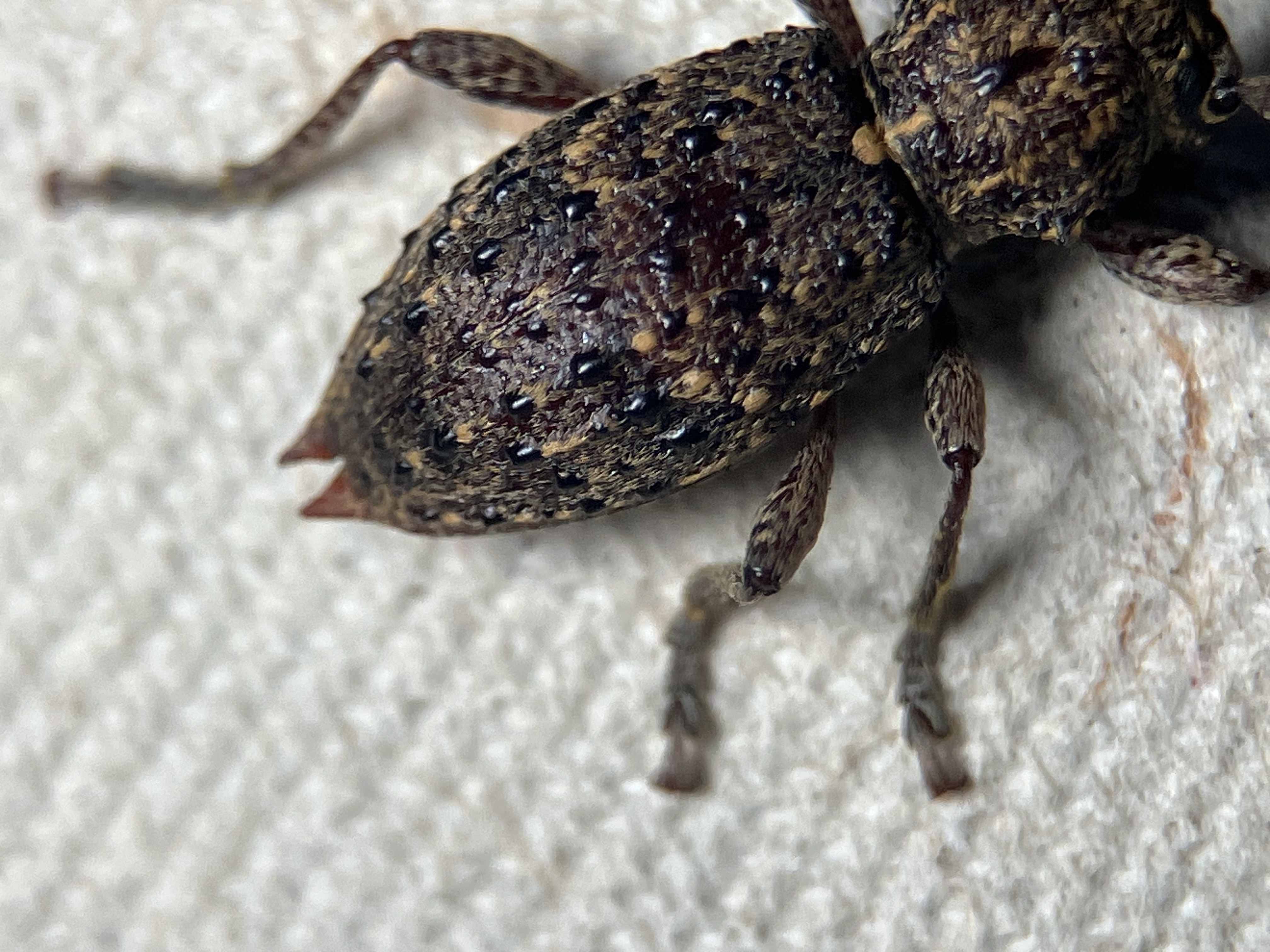
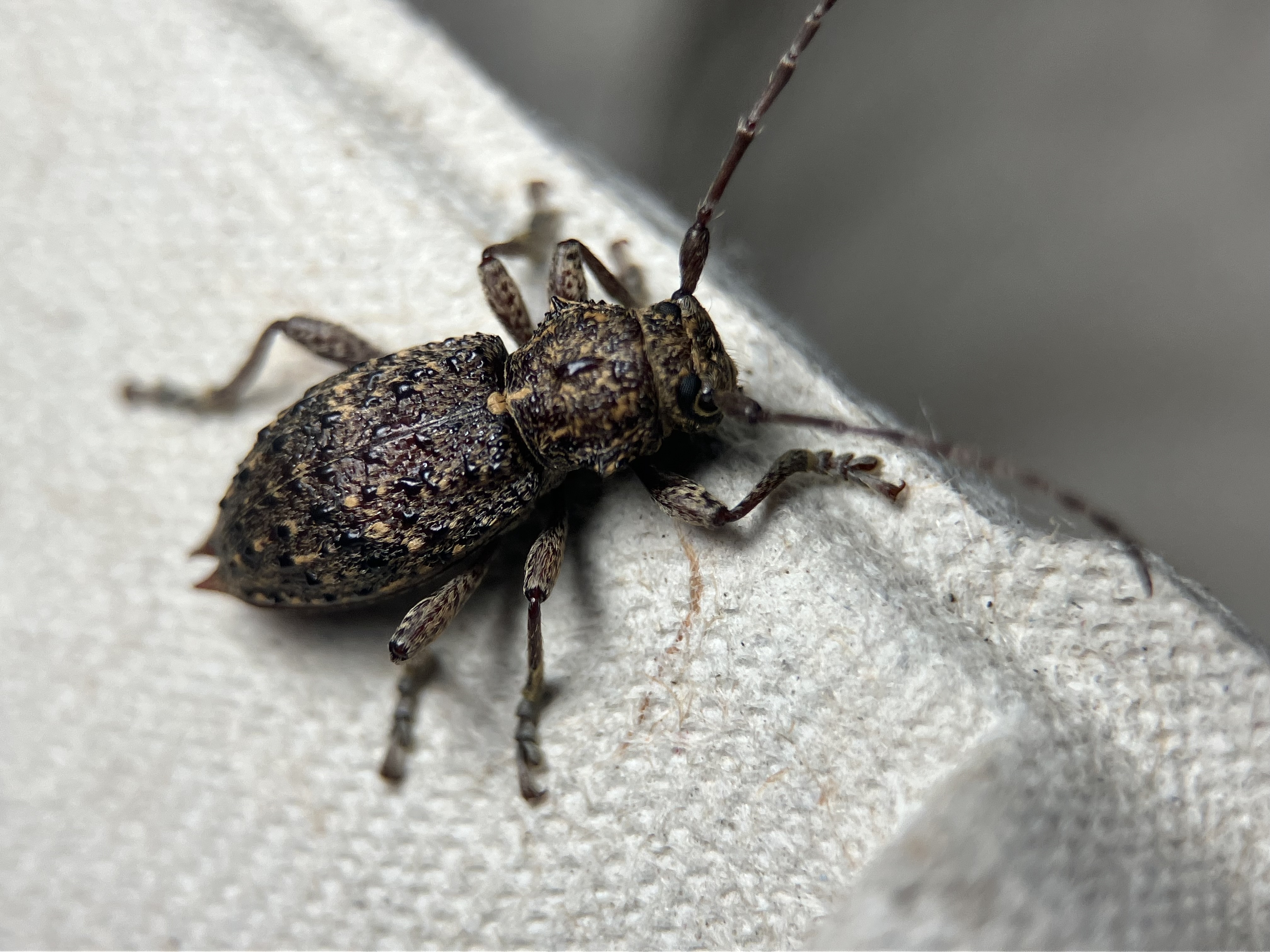
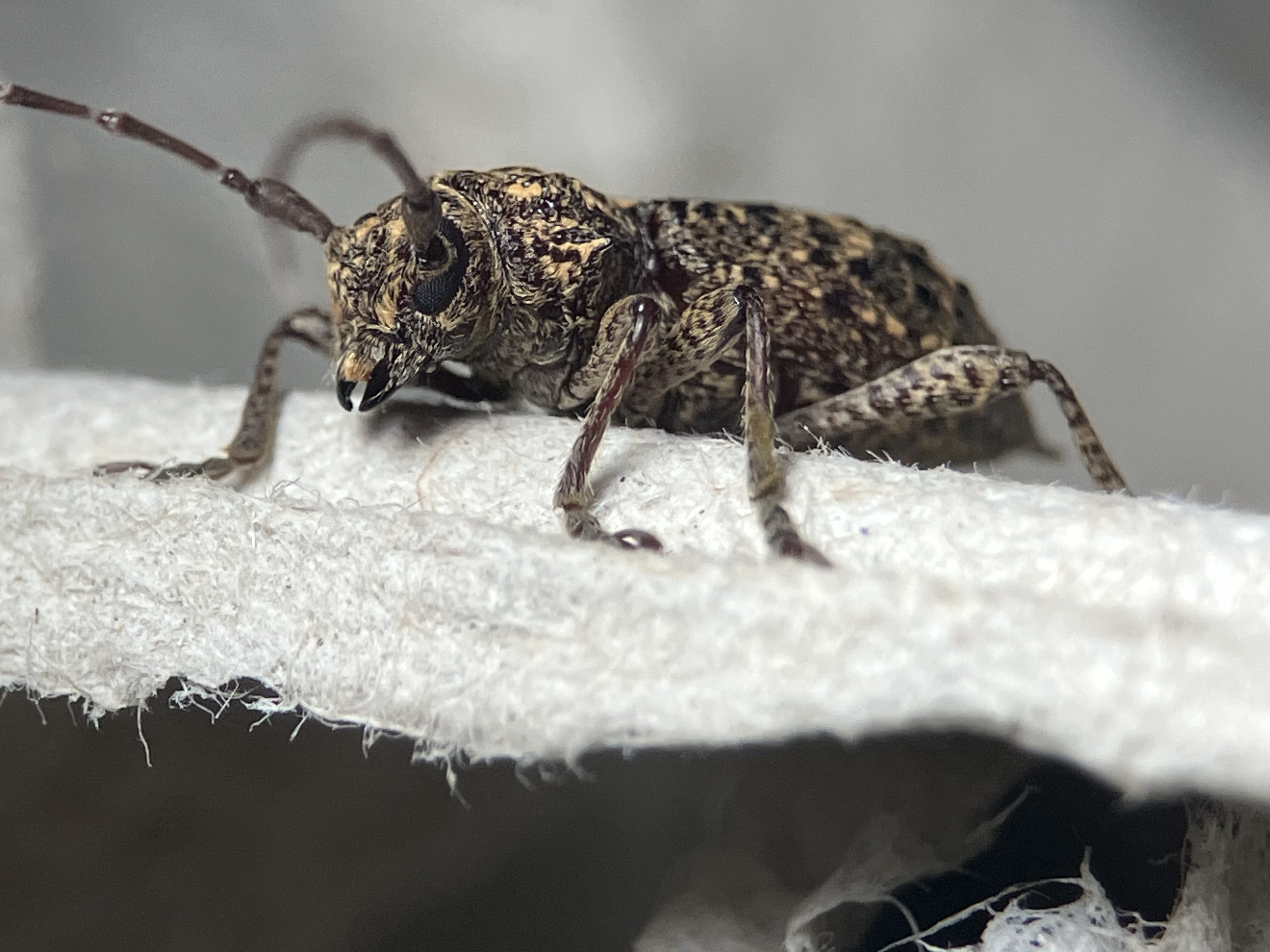
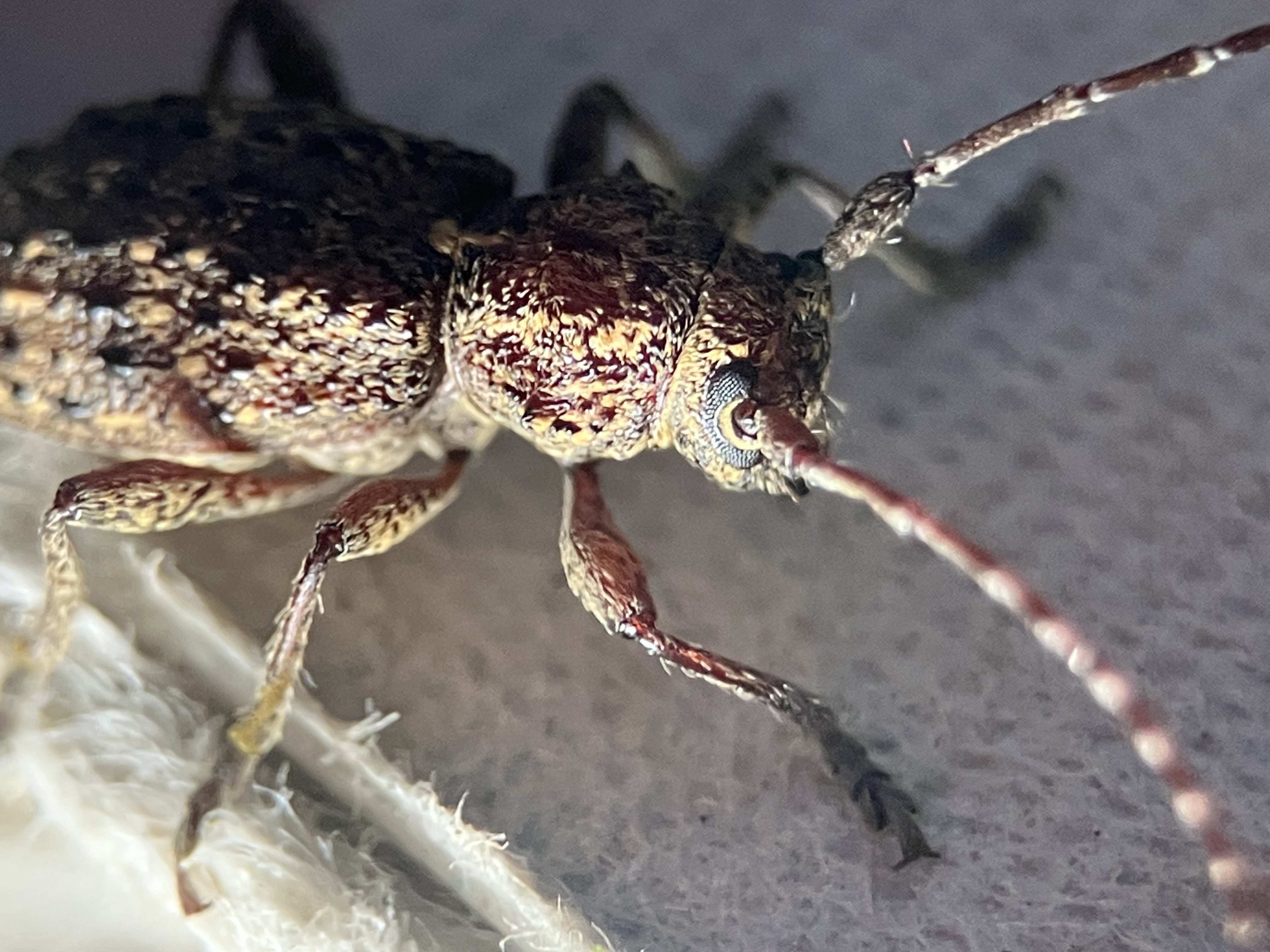
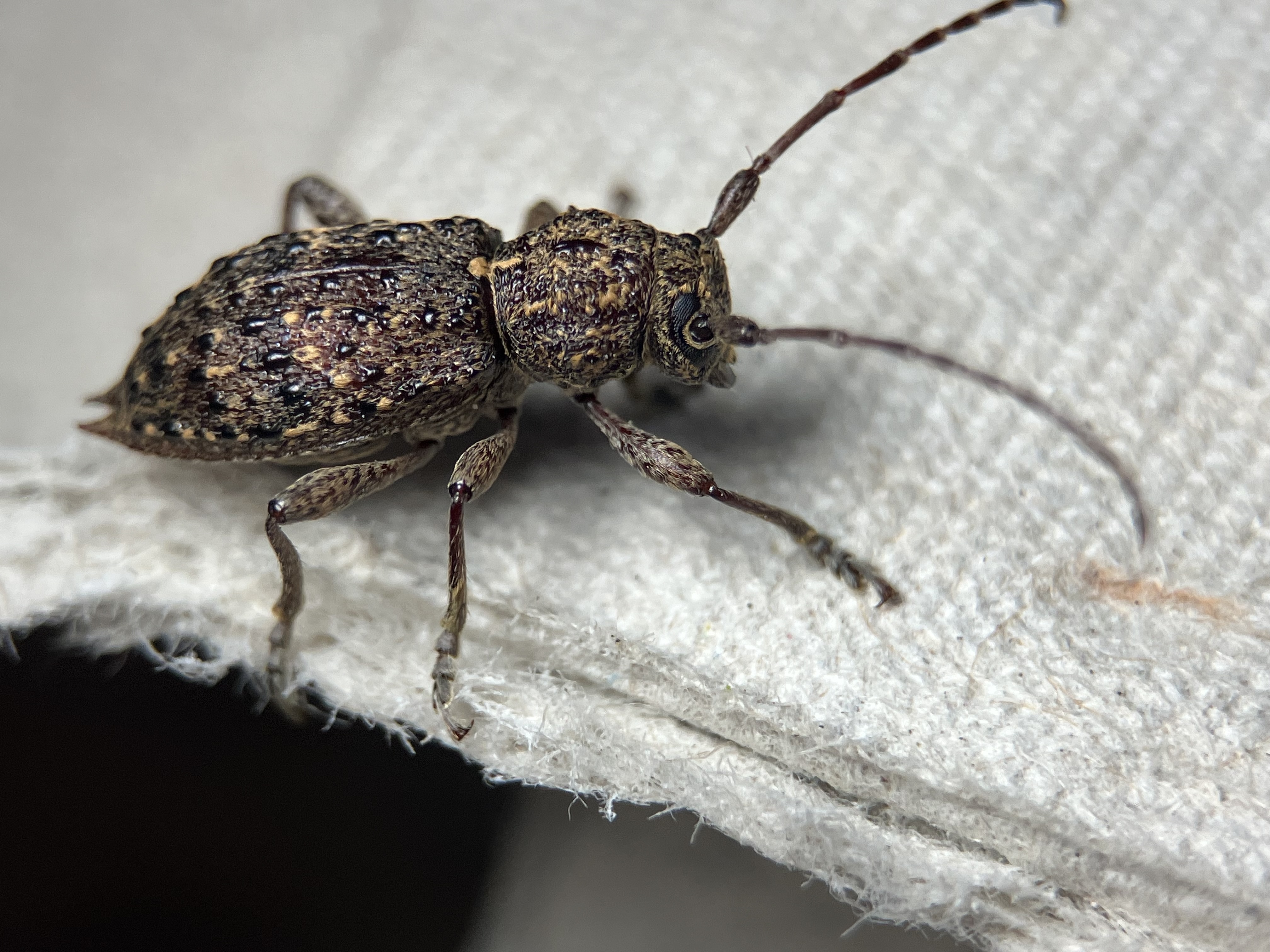
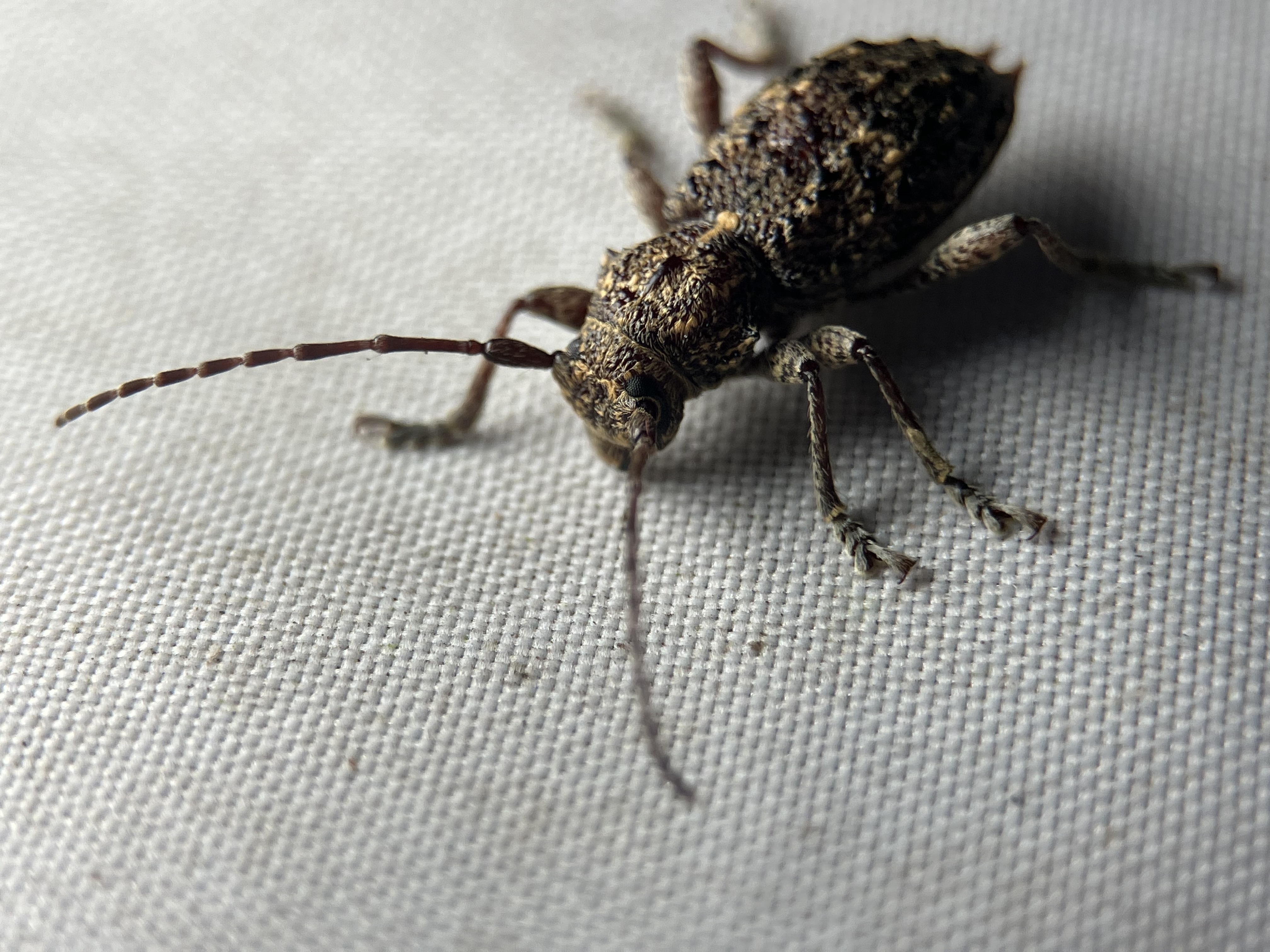
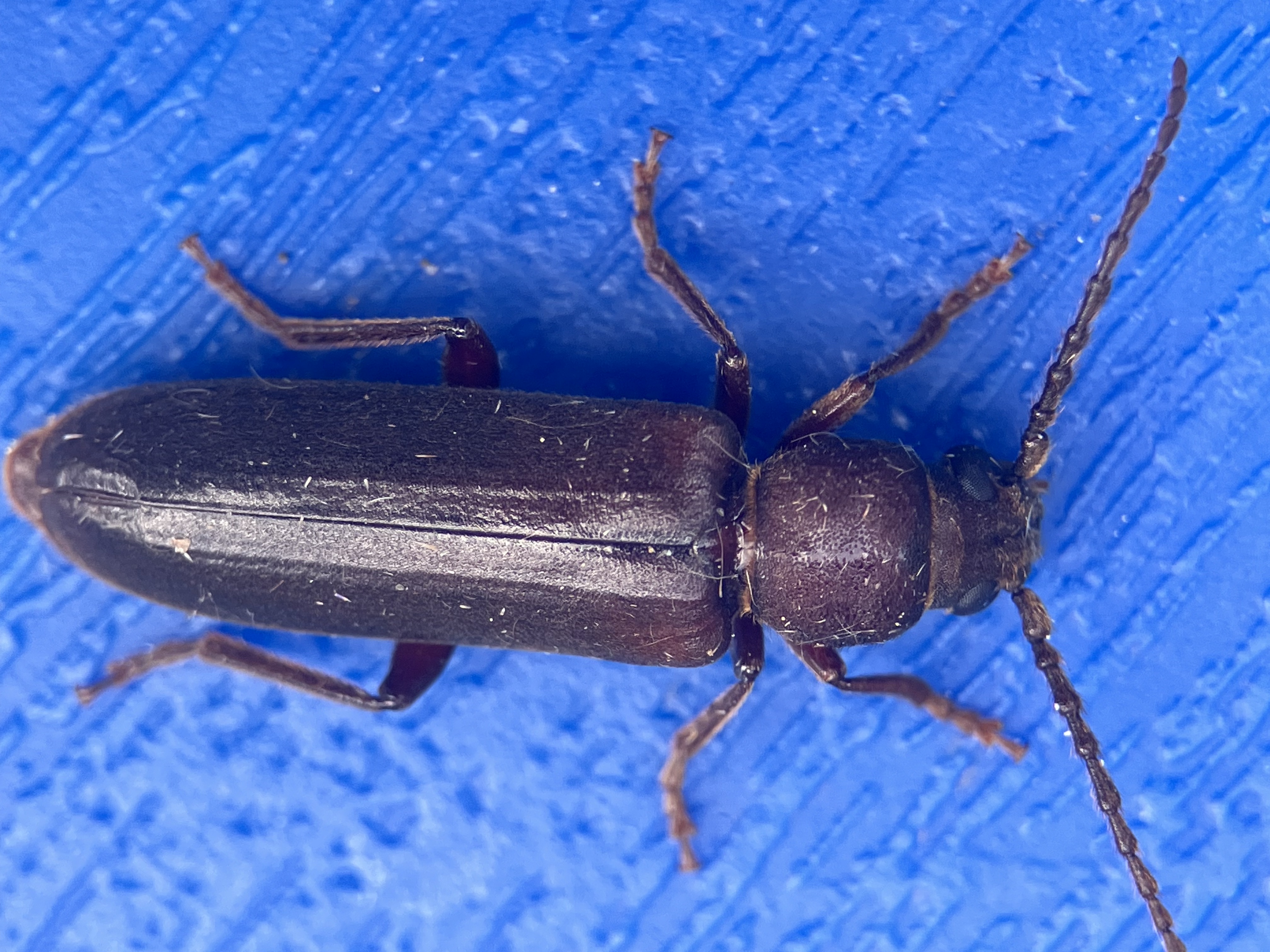
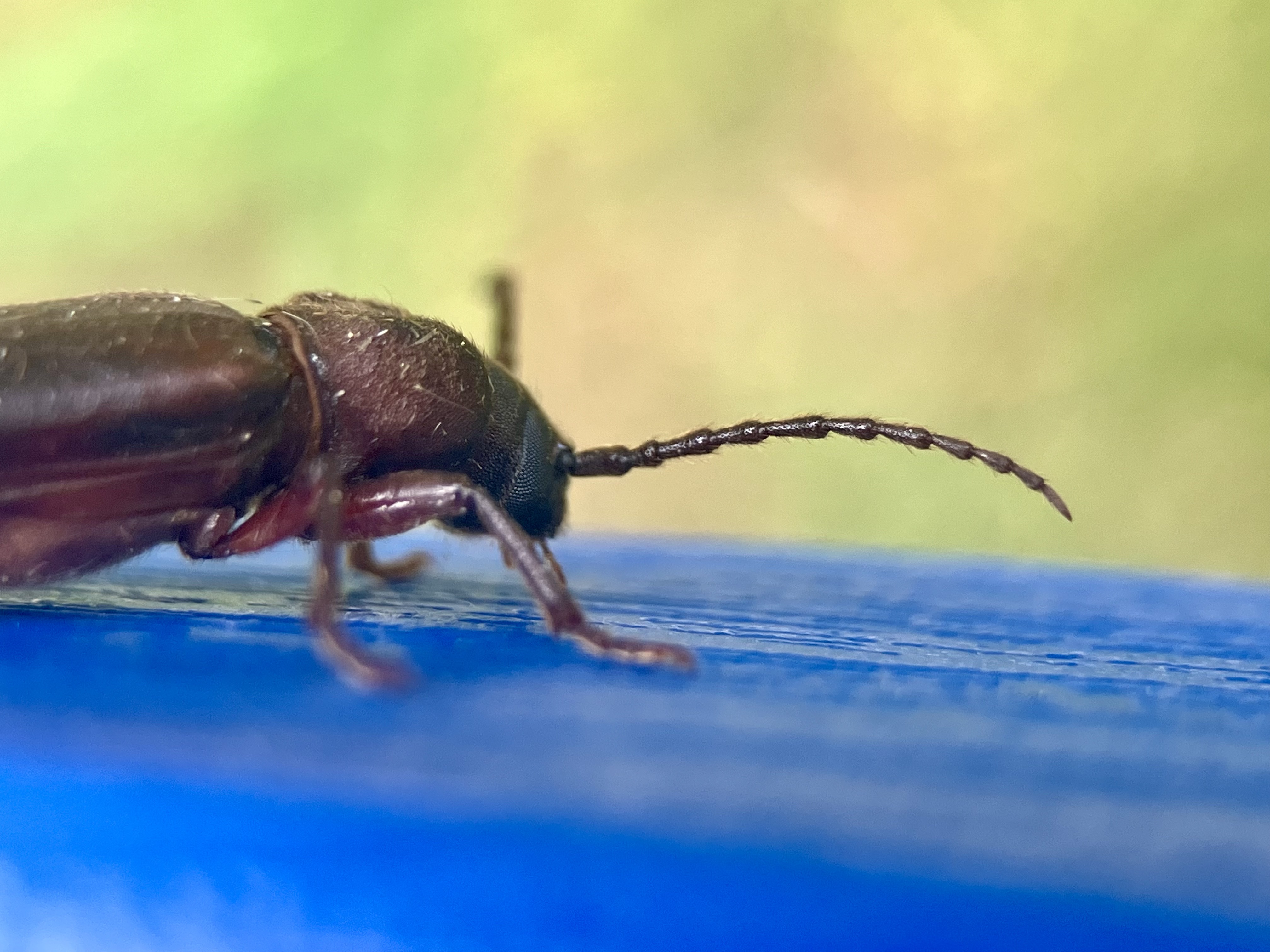
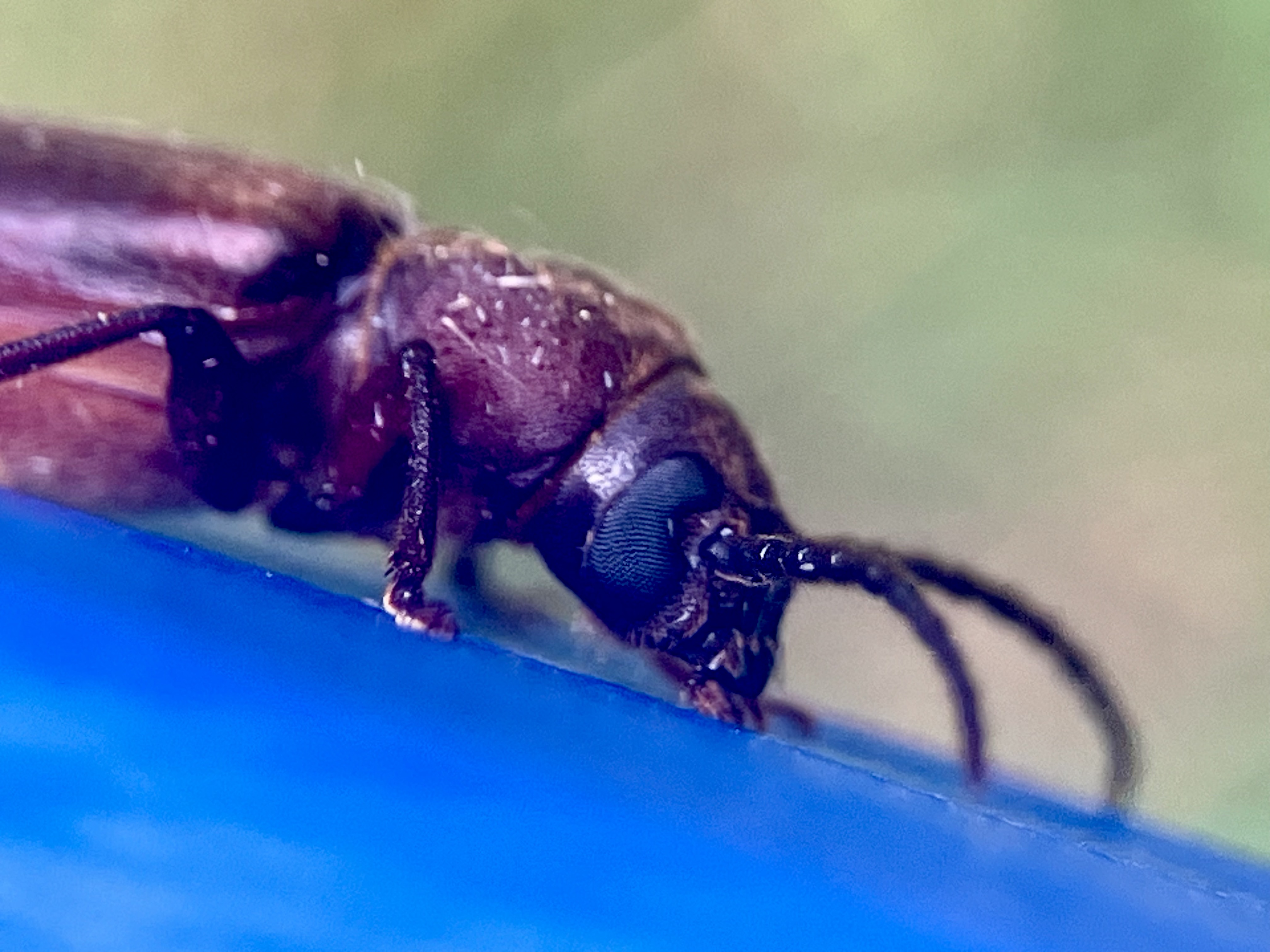
This unusual looking critter is a Long horned beetle in the family Cerambycidae, sometimes referred to as the Thorn- Tailed Longhorn Beetle because of the spiny projections at the posterior end of its body. The species is Plectrura spinicauda. Etymology for this bug’s binomial nomenclature consists of the generic name, derived from a combination of plektron (Greek for instrument to strike/pick) or plekein (to weave/twist) with oura (Greek for tail), and the species epithet combines from Latin spina (spine/thorn) and cauda (tail), translating to “spiny tail.”
Plectrua spinicauda
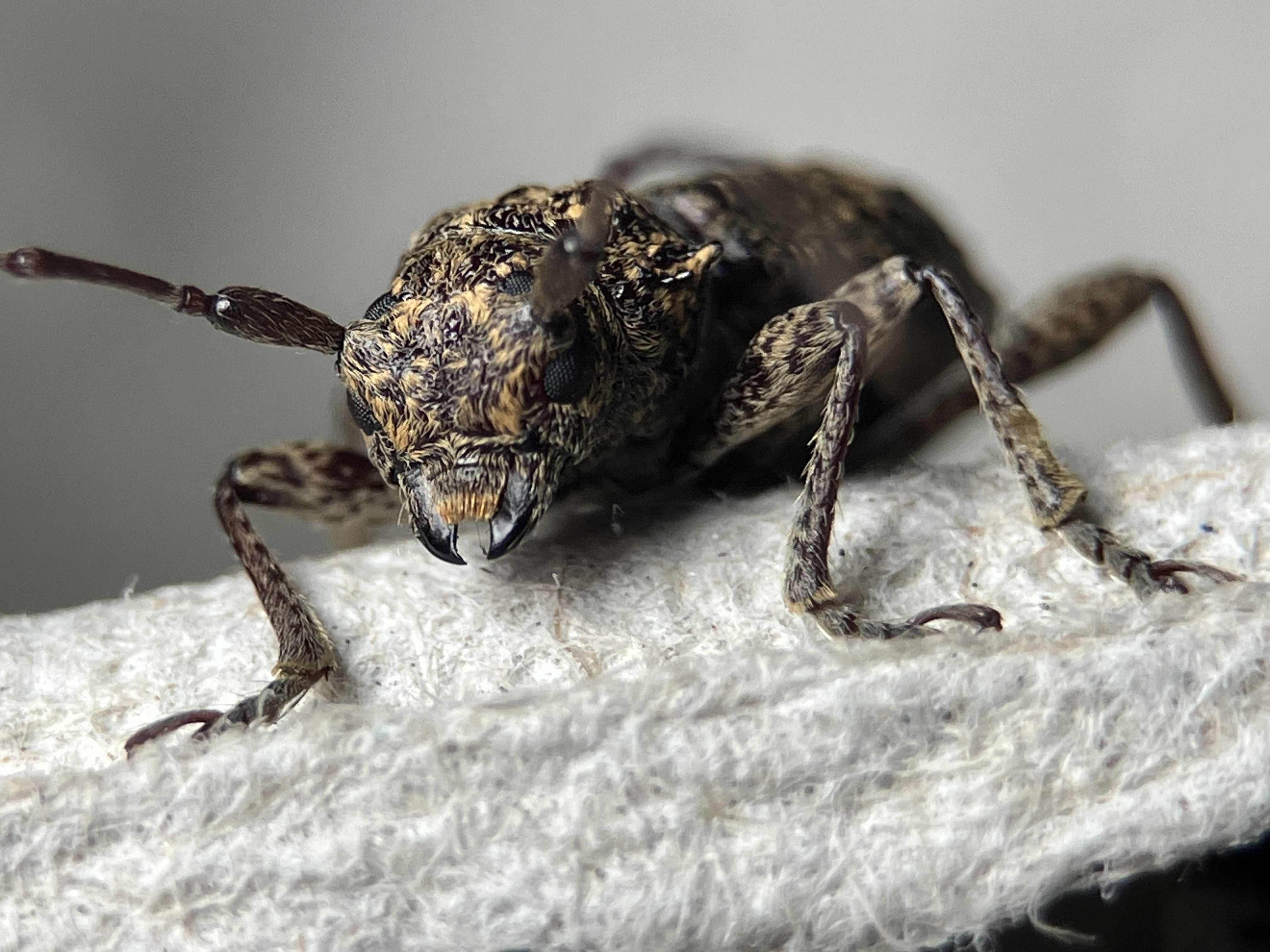
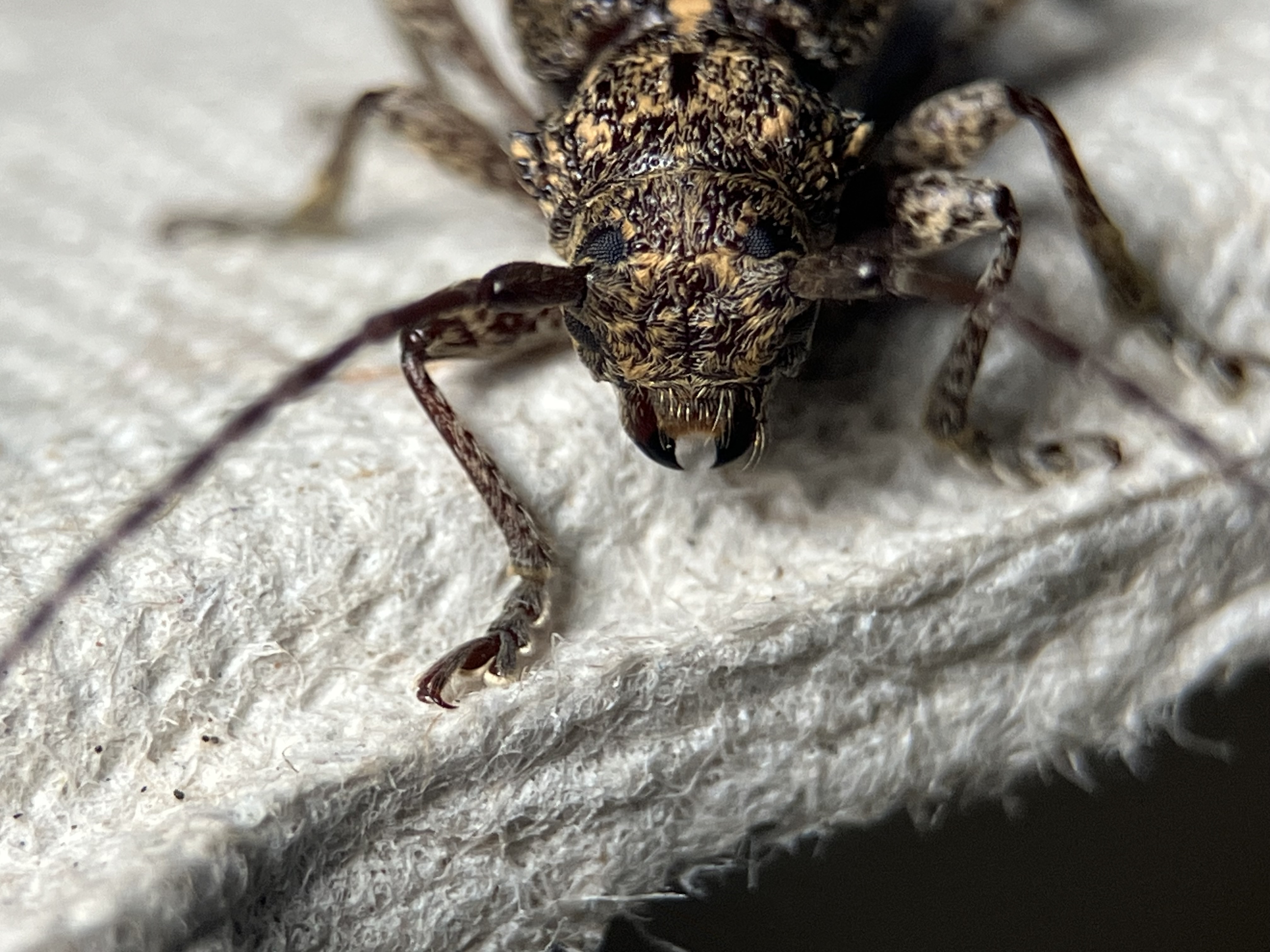
They are native to North America, with a geographic distribution in Western N. America (Alaska-n CA). P. spinicauda is a flightless beetle species with cool wrap around eyes, and as the name suggests, thorny projections at the end of its abdomen. The larvae have been found to develop in Alder, Willow, and Maple. They are important as decomposers and nutrient recyclers.
Author’s note. It is quite common for people to state that wood boring beetles kill trees. This is not necessarily true at all. In fact, most trees that are attacked by beetles are already in a state of decline. Just like humans decline with age or become ill with health problems, so do other things. Nature’s way of handling diseased and dying trees is to send beetles in (all sorts of beetle species) to help with the decomposition process – to recycle waste products and release nutrients back into the environment for other life forms to utilize.
Spraying a tree with pesticides as a preventative from the course of nature only worsens the situation. If you step back to assess the situation, you might ask yourself why the tree is dying. Is it from drought, heat, competition from other nearby trees, did someone weed whack too close to the trunk and cut or scar the bark? Are you running your lawn mower over exposed roots? Is the tree a short-lived species or maybe just entering the sunset of its lifespan?
There are many various reasons for trees to decline and die. Don’t blame the beetles for doing their job. They don’t just clean up the mess, but they feed many other organisms with their own lives. Beetle larvae are wonderful food for woodpeckers and other birds. Birds are in decline. Do something! Care! Get a book at your local library about how to create habitat so you have diversity of life and a healthy ecosystem in your yard space.
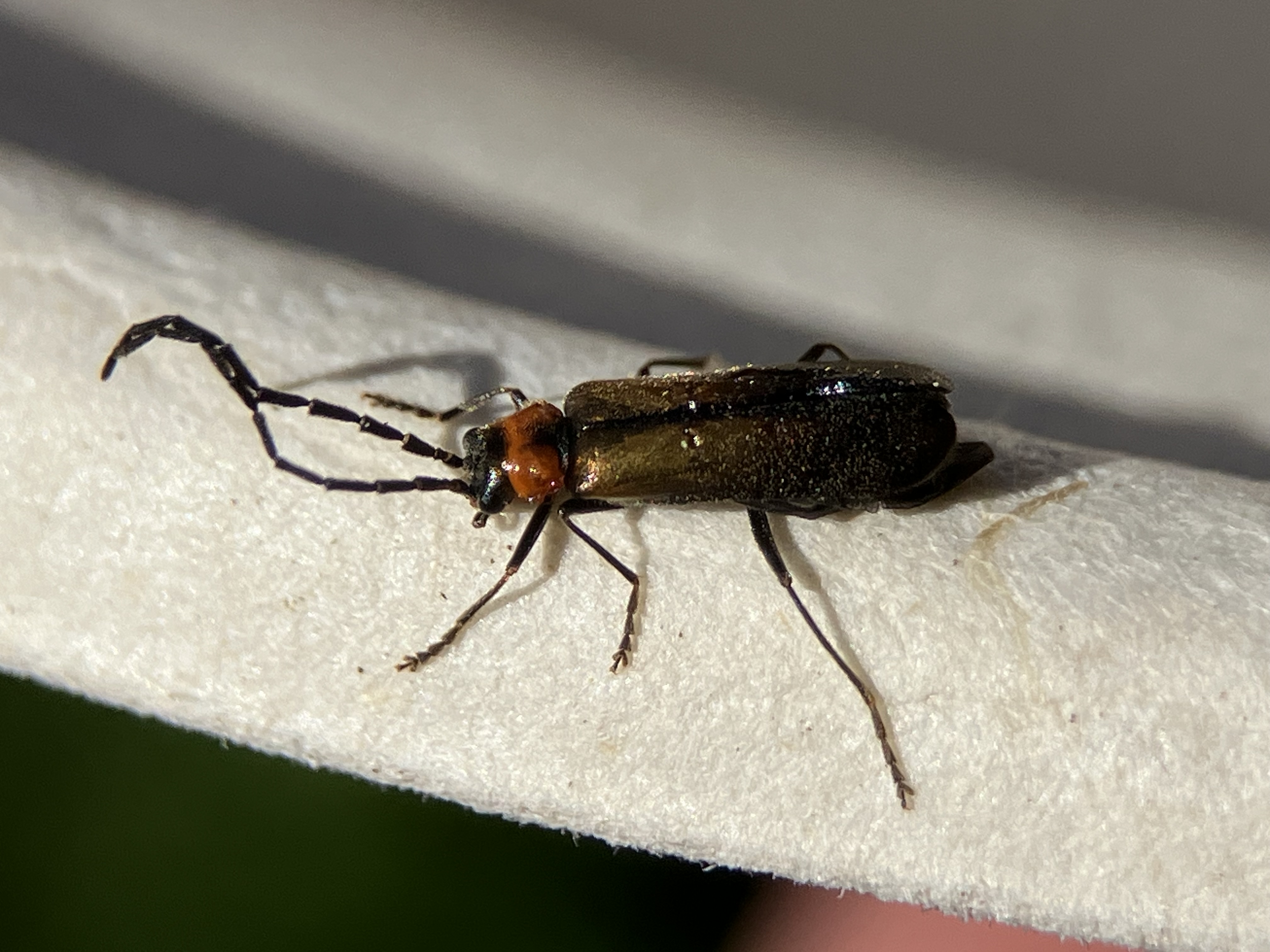
This tiny little friend (approx. 6mm) sporting a red collar is a soldier beetle in the family Cantharidae. It is in the Genus Silis, but there are so many species, that I will just leave it at the genus level for now.
Soldier Beetle (Genus Silis)
Silis beetles are quite cosmopolitan in distribution, associated with wooded areas and leaf litter, and active daytime fliers in early summer.
Adults are typically found on foliage and flowers. Primarily, they are pest predators, feeding on insects, but also serve as pollinators, feeding on nectar and pollen. Silis species are known to prey on aphid populations infesting trees, plants, and shrubs, so gardeners can appreciate them as a “friend.”
Silis beetles can also attack other groups of invertebrates, feeding on small soft-bodied specimens or consuming their eggs. However, the ecology of some species is remains to be investigated. While Fender (1973) found the larvae would eat earthworms and are mostly carnivorous in the soil, little else is known about the feeding habits in this stage. (Pelletier and Hébert , 2014).
The etymology of the nomenclature for the genus (Silis) comes from Σίλας in Greek. It is derived from the Latin name Silvanus, meaning “forest” or “wood,” and a contraction of the Greek form Silouanos, a transliteration of Silvanus. Silis or Silas is also associated with the Roman god of the countryside, Silvanus, a god who was worshipped by those who lived in wooded areas or worked with wood. Even older than the etymology is this tidbit. Silis beetles are quite ancient. Fairly recent research has identified specimens of the genus discovered in Baltic Amber (Parisi and Fanti, 2019).
Soldier Beetle (Genus Silis)
While I have now scooped a few out of our pool, thankfully in time to save them from drowning, some of them (perhaps the ones I’ve rescued) are also finding me. I have had them on my clothing and peeping in the door at me!
Thanks for reading!
Soldier Beetle (Genus Silis) looking in our door at me!
Green, John Wagener. 1966. Revision of the Nearctic species of Silis (Cantharidae: Coleoptera). Proceedings of the California Academy of Sciences, 4th Series, 32, 447–513. https://www.biodiversitylibrary.org/part/52839
Pelletier, G., Hébert, C. 2014. The Cantharidae of Eastern Canada and Northeastern United States. Canadian Journal of Arthropod Identification No. 25. February 28, 2014. Available online doi: 10.3752/cjai.2014.25
Parisi, F. and Fanti, F. 2019. On the first Silis Charpentier, 1825 from Baltic amber (Coleoptera, Cantharidae), Foss. Rec., 22, 119–123, https://doi.org/10.5194/fr-22-119-2019
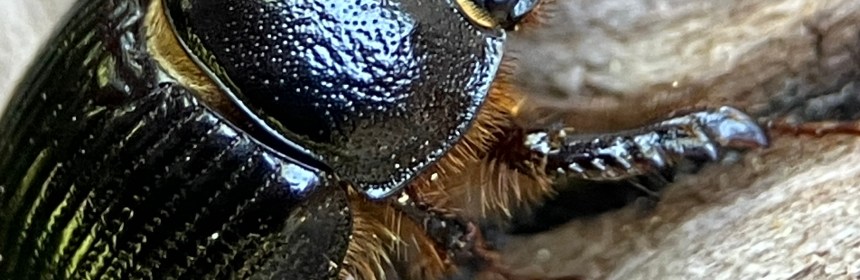
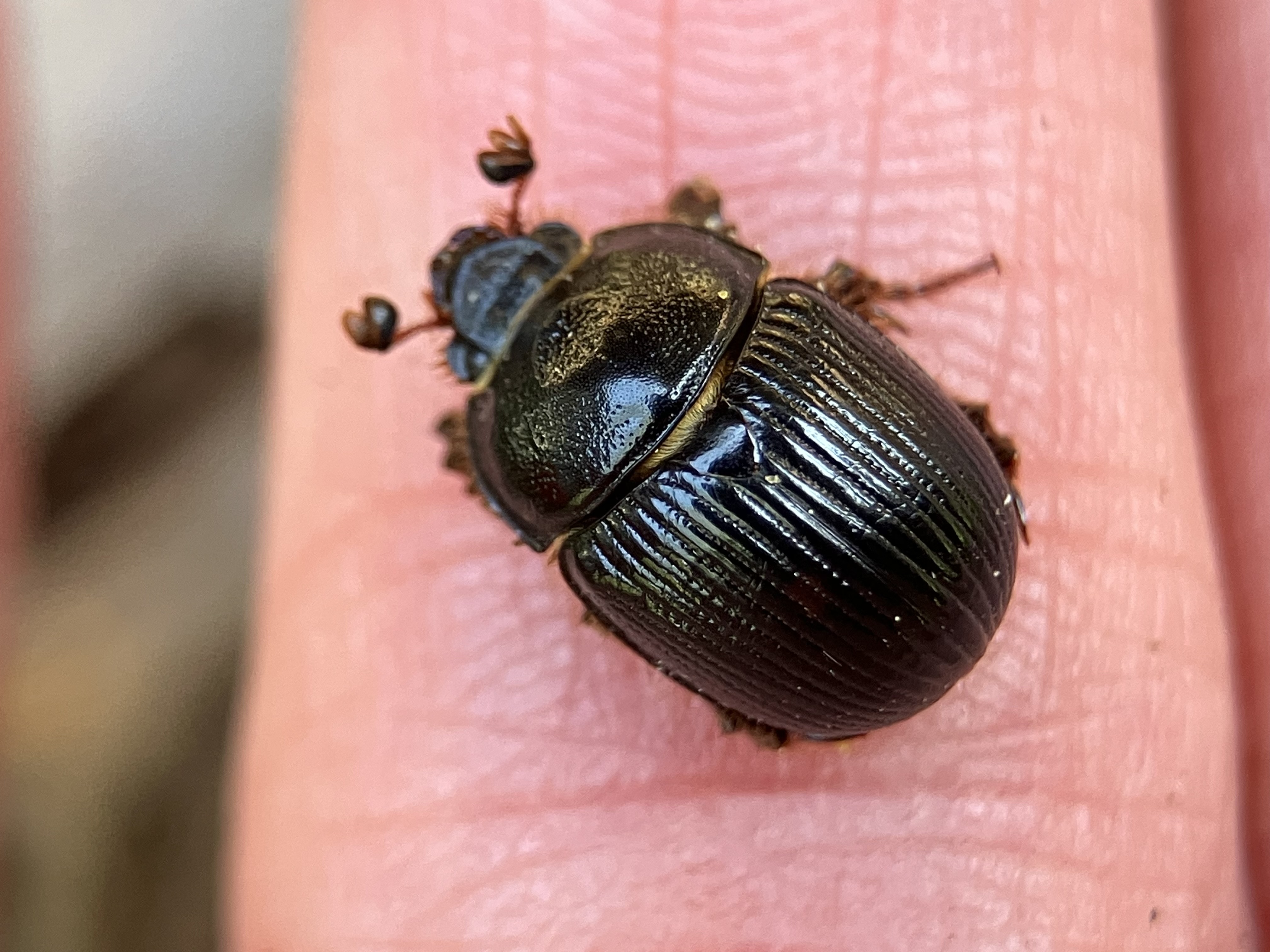
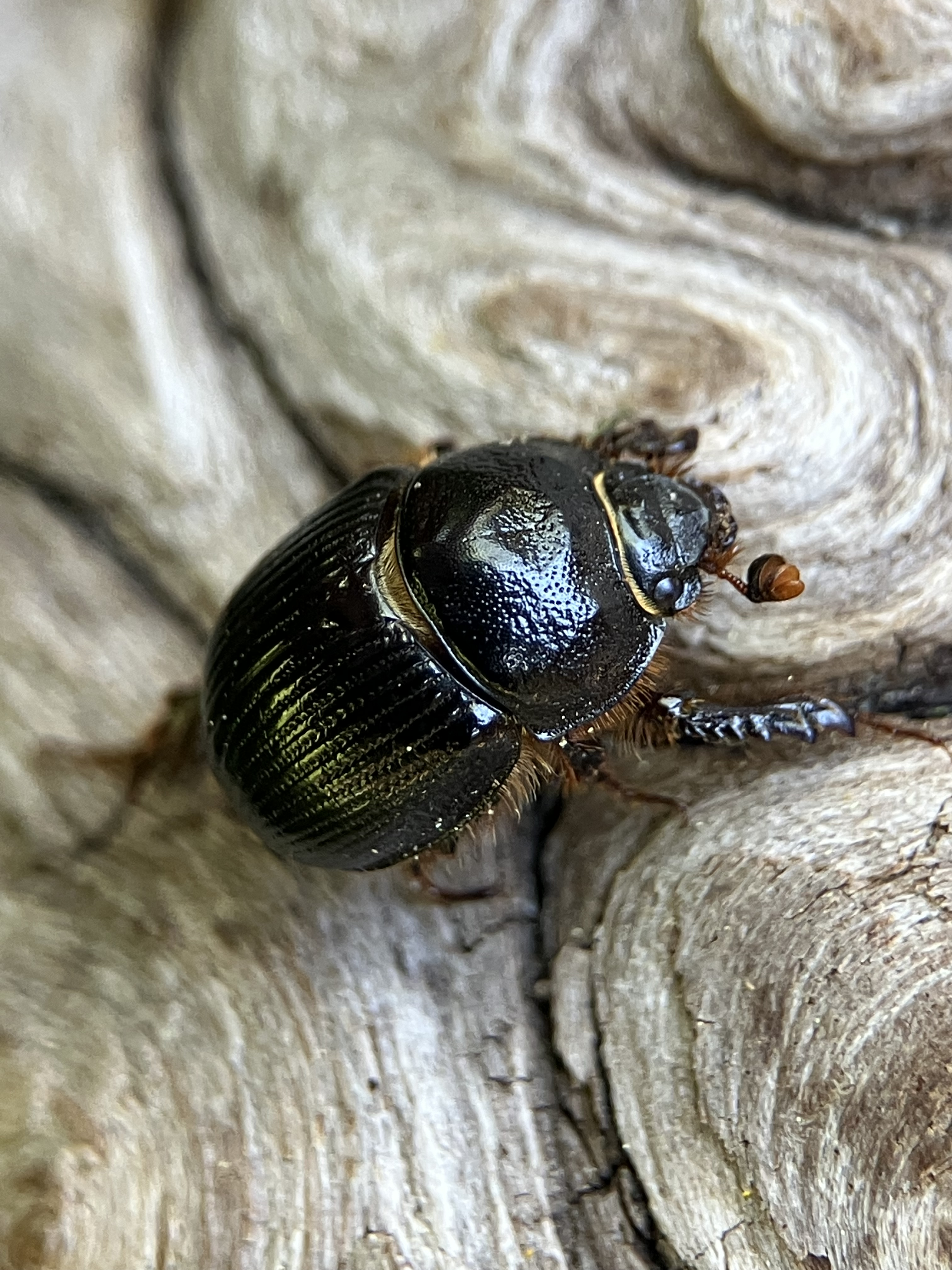
This is a post about one of the most unusual beetles I’ve ever found on San Juan Island. The species is Odonteus obesus. I’m hoping to attract a male specimen to my bug light after finding this female over the weekend, but haven’t had any luck yet. A few years ago, I found a male though. They are simply incredible, beautiful and weird all at once… like finding a unicorn in the forest. Literally! The male of this species has a sharply pointed unicorn horn that protrudes from the front of its head. If you are curious to see a male specimen, check out an earlier blog post I wrote about them here – https://buggingyoufromsanjuanisland.com/tag/odonteus-obesus/
These beetles are in the family Geotrupidae. “Geo” from Greek, meaning earth, and “trypetes” or “trupes” which means to bore or drill. In Europe, these beetles are referred to as dor beetles. “Dor” because they hum. Check out the etymology I’ve copied for you below for the word Dor.
Greek “dor” (δορ):. Primarily used in Proto-Indo-European languages, “dor” and “dorn” meant “bee,” “hornet,” or “drone,” as explained by Wiktionary. It’s related to the Middle English “dorre” and Old English “dora,” also meaning “humming insect,”.
Geotrupid beetles live in the earth in burrows they excavate that can be up to 4 feet deep, often in material composed of dead leaves, cow or horse dung, or humus. We don’t have any horse or cow dung in our yard, so I’m guessing the decaying forest leaf litter is a suitable substrate for them or perhaps they are incorporating deer or the dung of other wildlife (fox, raccoon, or rodents) for use.
Why are Geotrupid beetles (and other dung beetles ) extremely beneficial? They are a source of food for other wildlife that eat them, but perhaps even more important for the role they play in improving soils by adding nutrients and removing animal waste. The beetle’s burrowing nature helps build healthy soil by incorporating organic matter, resulting in increased soil friability (it isn’t as clumpy), improved soil aeration, as well as improved water-holding capacity.
Additionally, these, and other species of dung beetles, have been found to be effective biological control agents for gastrointestinal parasites of livestock. In agricultural areas, they “clean” the pasture by removing manure or decomposing material as they burrow into the earth https://attra.ncat.org/publication/dung-beetle-benefits-in-the-pasture-ecosystem/.
Unfortunately, the increasing dependence of livestock producers on veterinary anthelmintic medications is threatening populations of nature’s best (and free) helpers. Many of the worming medications (like Ivermectin) given to livestock, pass through into the dung and then kill off the dung beetles when they feed. The result is an increased reliance on veterinary medications to control livestock pests and parasites and decreased pasture health because there is no beetle to break down the animal dung. As the pasture is littered with scattered dung, it becomes harder for the livestock to feed because they will avoid areas contaminated with dung.
To learn more about this species and other dung beetles, please check out the linked references below.
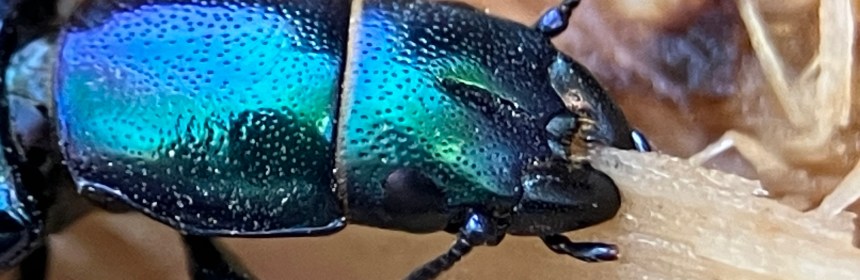
I found this gorgeous BENEFICIAL Green Ostomid beetle yesterday on the floor of our barn in the sand. Moved him over to some alder logs we have stacked as wildlife habitat and discovered he appeared to be quite thirsty. Yes, I did actually bring him some more water to drink from our outdoor above ground “pond.” More in the video description. Also want to add that if you have Alders on your property – please don’t grind them up or burn them. They are extremely important resources for many species of wildlife. They hold water even as dead trees, and they are full of insects that feed many birds (and other insects and spiders).
Here is a new-to-me Cerambycid (longhorn) beetle. I haven’t added one of these to my photo collection in the 15 years I’ve lived on San Juan Island, so note here that they are “UNCOMMON” and not populous in number.
This species is the only one in its genus in North America. It is Megasemum asperum. I see in perusing iNaturalist.org that there have been 67 reported observations dating back to 2007.
Season: July to August (this is when you could see an adult)
Numbers: a single species in the New World & in NE Asia
It was described by John Lawrence LeConte in 1854
From Beetles of Western North America – “Larvae mine Douglas-fir (Pseudotsuga menziesii) and fir (Abies). Adults are attracted to lights during the summer. Found in coniferous forests of western North America,” (Dr. Art Evans, entomologist, 2021).
Your take away message – NOT a pest. NOT a tree killer. NATIVE species! Performs important recycling of nutrients role in ecosystems allowing regeneration in our forests. Appreciate Biodiversity.
Today was a day of bird encounters. I saw our poor little cowbird that can’t fly because he’s been injured (likely by our neighbor’s marauding outdoor cat). He’s survived three nights so far even though he seems to have a wing injury and I haven’t figured out yet if I can capture him to check. He’s had his little mate following him around.
Cowbird male
I know it’s a cowbird and cowbirds are brood parasites, but they are actually quite beautiful little birds and I feel sympathy for wildlife that are impacted by our human “pets.” It isn’t fair and we should do much better to keep our pets under control. I don’t know what my response would be if I see this cat attacking our Tanager or one of the Grosbeaks. It is doing what cats do and the problem isn’t the cat, but the owner who evidently doesn’t care and is probably too lazy to clean a litter box and play with the cat and keep it inside. Ok. So, I vented. Sigh…
I was going out to take a walk in nature to unwind when I heard a sad little thunk on our window. We have Acopian Bird Savers https://www.birdsavers.com/make-your-own/ on the largest window, but not the smaller one. That’s gonna change. I’m going to put them on ALL our windows.
Well, I looked out and saw a tiny little nuthatch on the ground, on its back, mouth open, but it was breathing. I ran out to pick it up and when I scooped that little creature into my hand, its feet wrapped around my finger so tightly that I felt hopeful. It was a newly fledged nuthatch. I sat with it quietly in the shade under the suet feeder, my hand stretched out onto my knee into a little cup shape.
The bird closed its eyes and slept a bit. I talked to it very very softly. An adult nuthatch landed on the feeder above, eyeing me cautiously. I believe it was the parent. I spoke to the adult too, trying to convey my earnest intent not to harm her child. The little one blinked and looked about. Then it closed its eyes and slept a bit again. The parent flew over to the fruitless cherry tree to another feeder, then off, I expect to feed another hungry mouth.
After a good 15 minutes, the little nuthatch was much more alert. It kept eyeing the suet feeder and the adult bird that returned again and again. I rose slowly from sitting, carefully supporting the little one – still gripping my finger. Raising my arm, I chose a small branch just beside the suet feeder and in a breath, the little one hopped off my finger and onto the new perch.
The adult nuthatch flew onto a nearby branch and I saw the fledgling flutter its little wings like baby birds do to get their parents’ attention to be fed. In another breath, it was airborne, flying after the parent. I was so grateful for a happy end to that incident.
My walk down our road was uneventful for the most part. I did see a Clown millipede (Harpahe crossing the wetland area and squatted down to observe its somewhat awkward, but systematic locomotion. It almost looks suspended in motion over the ground. After making sure it was safely out of harm’s way and not in a car path, I continued on.
(Harpahe hayadienana) Clown millipede
My destination was the “soon to open officially” nature preserve. I have walked on this property for about 10 years now. It is an amazing place.
Giant cedars tower overhead through the wetland. Along the seasonal stream, the path I took meanders amidst the primordial assortment of ferns, swamp lanterns, and horsetail. There are creatures there in the forest. If you see them, you will leave feeling a sense of awe.
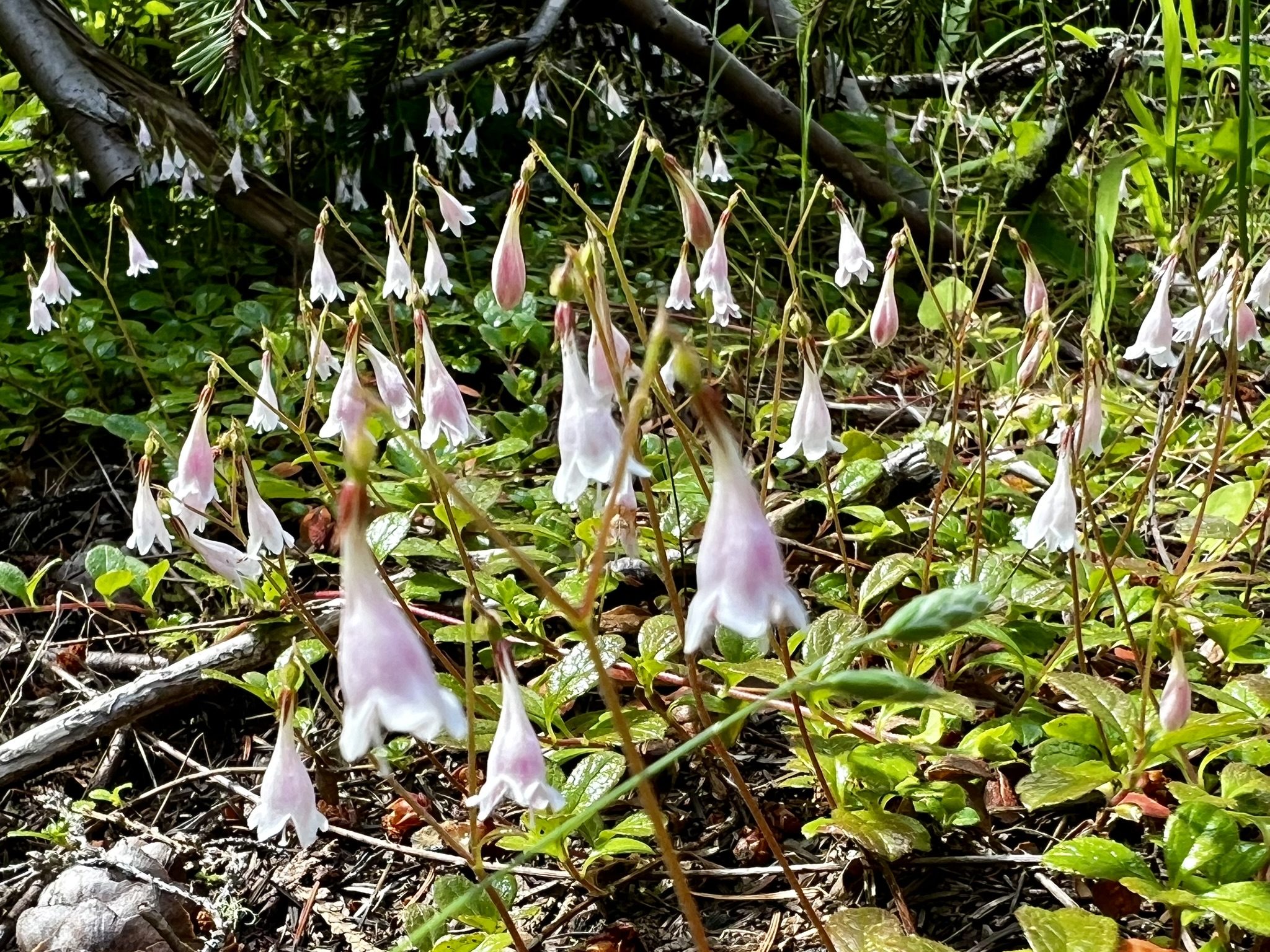
Twinflowers on the forest floor
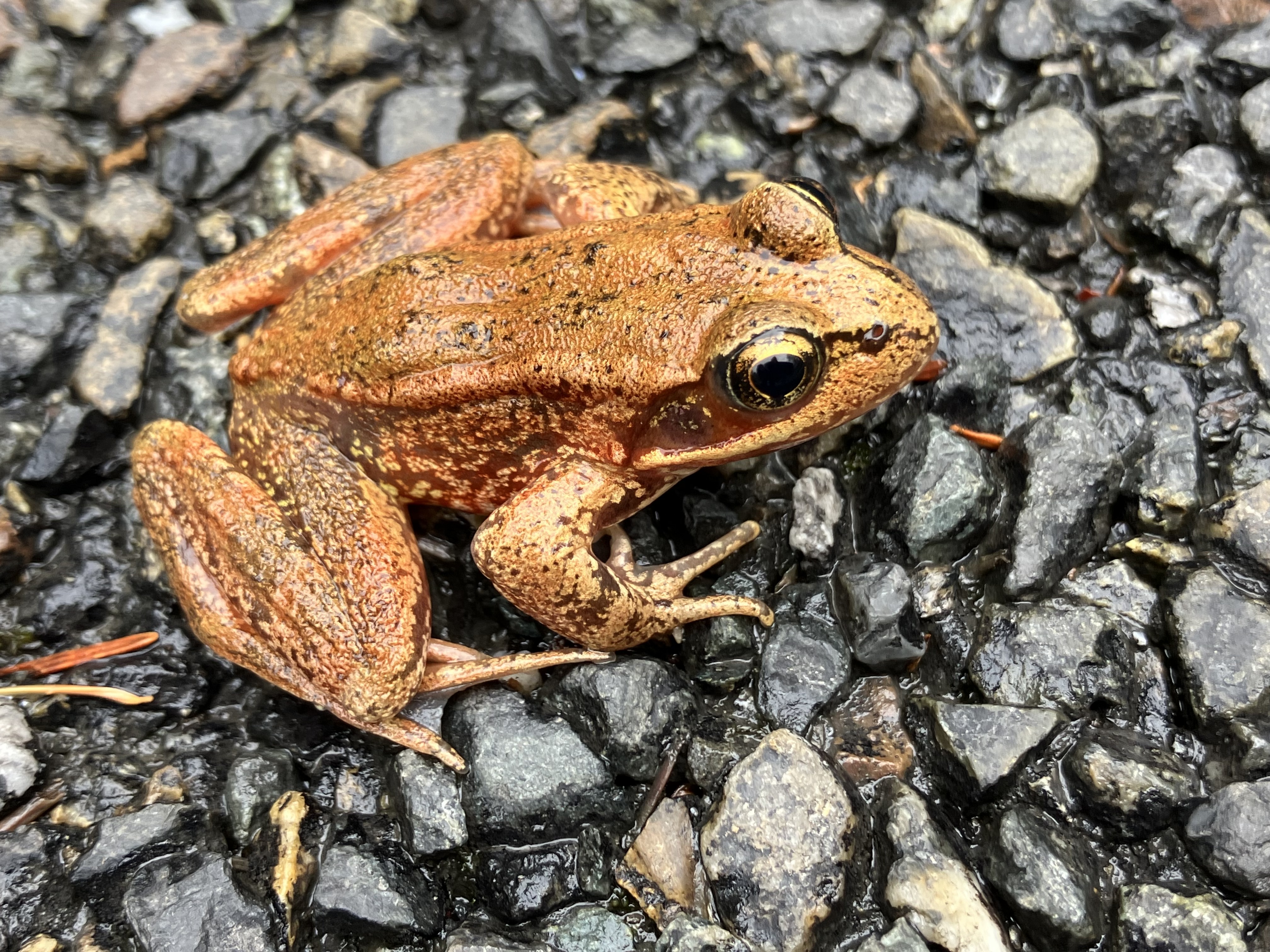
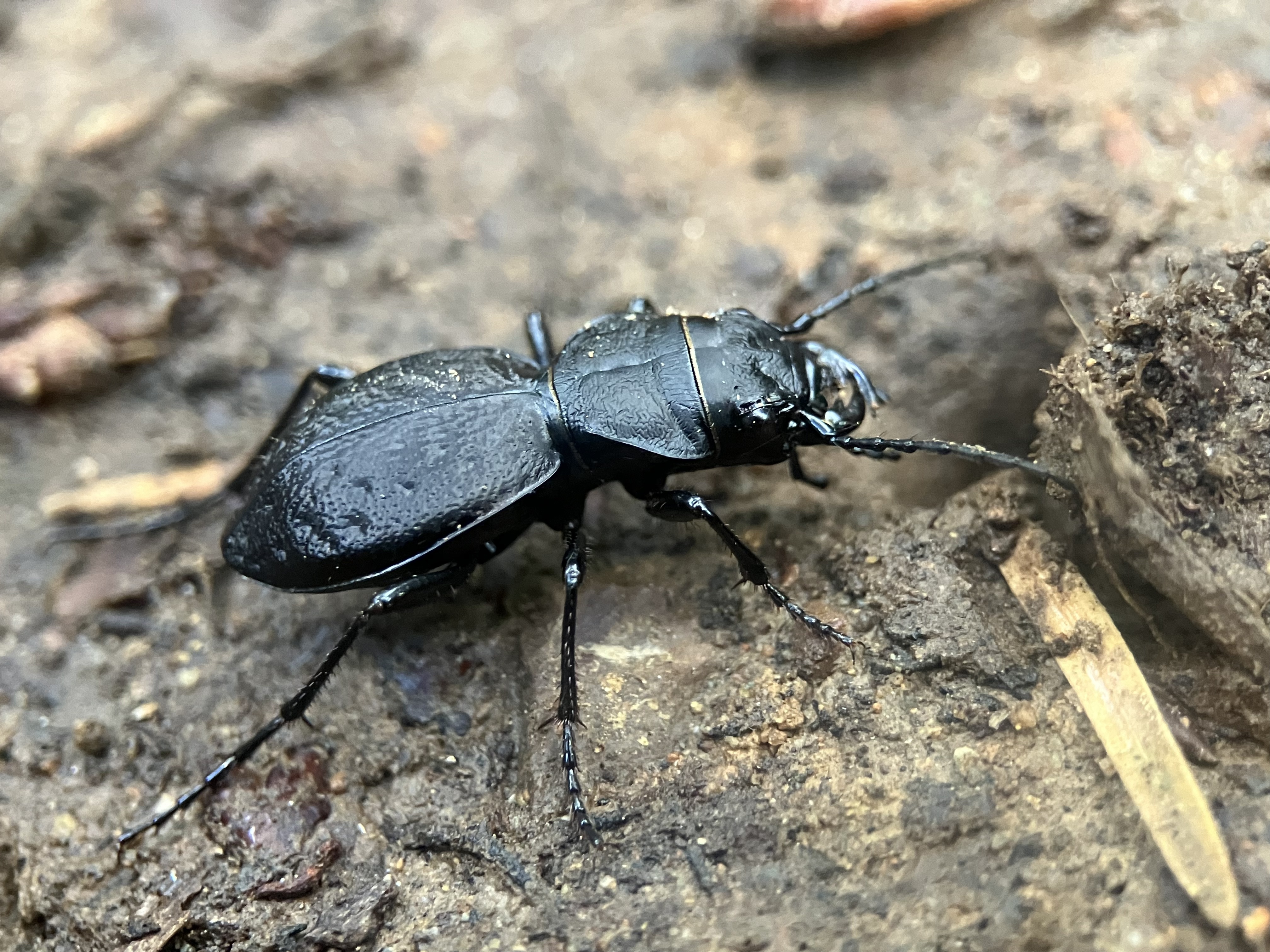
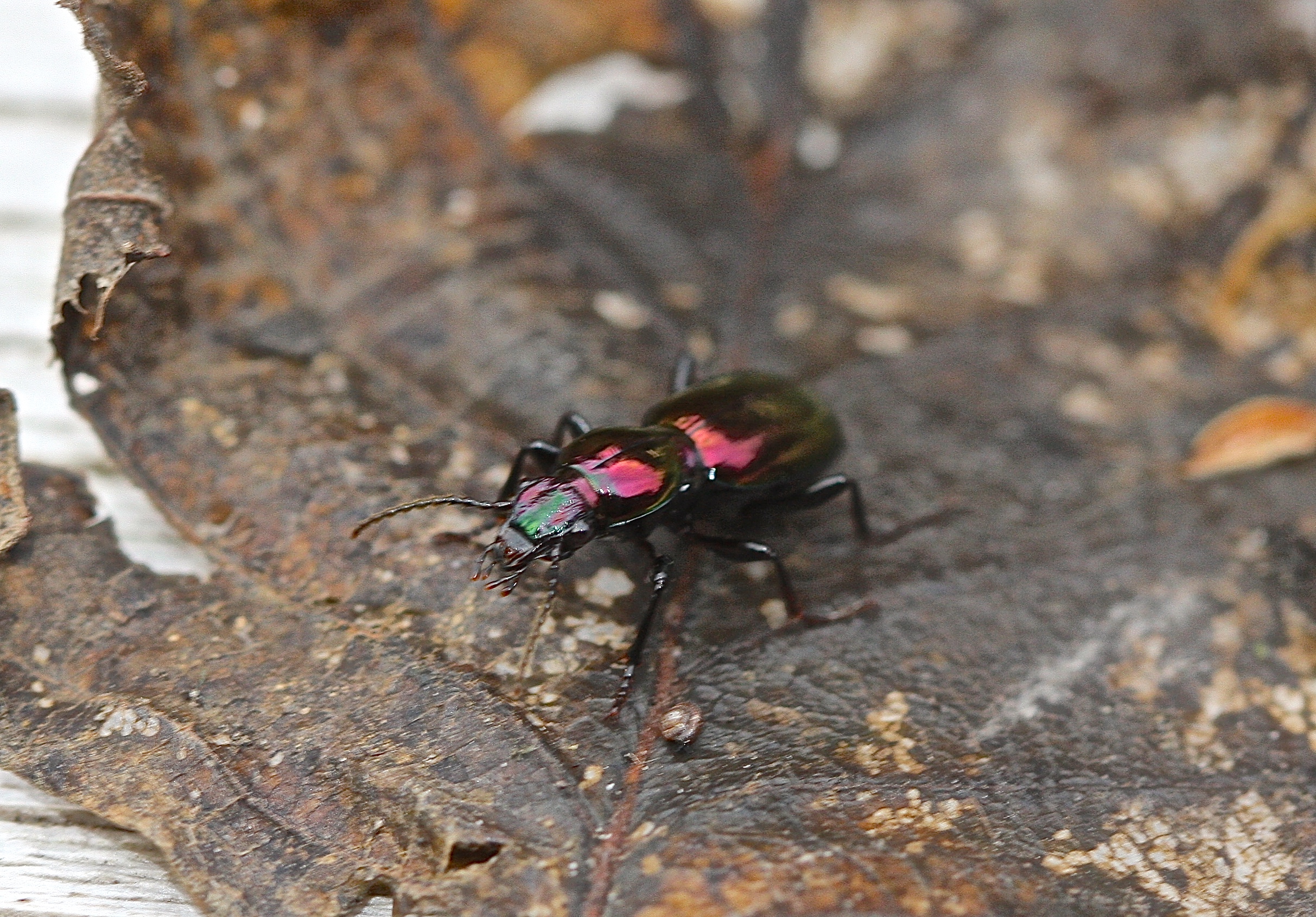
Red legged frogs, salamanders, and newts make their homes in the wetland. They dine on the myriad of invertebrates that live in the stream and mud. On the forest floor, you’ll find Night-stalking tiger beetles (Omus dejeanii) with fierce jaws hunting for prey. If you’re really really lucky, you might see the burgundy metallic carabid beetle (Zacotus matthewsii) that I’ve only seen less than a handful of times in the past decade. Overhead, you’ll hear the family of ravens that have a nearby nest. Always in the same place.
The hawks hunt in a small clearing where the stream attracts other animals that come for a drink. There are other birds hidden too. Flycatchers nesting in rotting snags, Pileated Woodpeckers drilling after carpenter ants. And the owl.
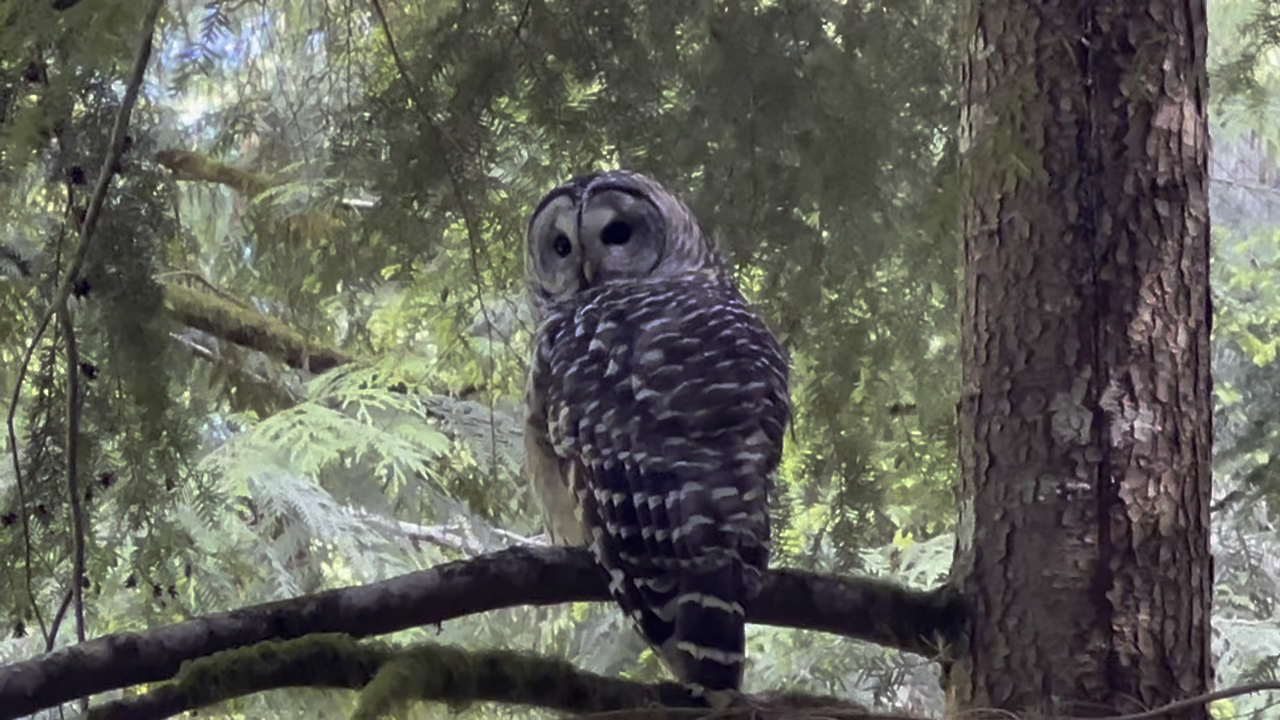
The owl has been there for a long time. You can hear it calling in the night – “Who Cooks for You?” It was wonderful before there were too many houses. Now, it is harder and harder to hear the owl over the din of barking dogs. In the woods though, the owl has a baby.
I heard it calling the other day. Screeching is more like it. I heard the noise before saw them. The mother owl was watching me cautiously from high above. A snake dangled from her mouth. In spite of this, I heard her utter sounds of caution to her child. She flew over to feed it as I quietly backed out of the area. I did not want to disrupt them and when I walk, I try always to remember that I am entering the home of others. I walk quietly and respect their spaces.
Momma owl with snake
Today, when I walked back to the place of the owl, I heard the baby again. It was calling repeatedly, but mom was nowhere to be seen. Again, I backed away quietly, hoping the owl was able to find food for her little one. They must hunt through the day and not only at night in order to rear their offspring.
I thought of the owl as I walked back to the trailhead and then I momentarily became distracted as I reached the site where I’d been poking around in a raccoon carcass on the trail. There are some very cool bugs that you find in carrion. Unfortunately, the remains were not to be found.
Stepping off the trail to look in the underbrush for any sign of the carcass, I heard a flutter overhead. I looked up and she was there. It was the mother owl.
She landed on a branch right in front of me. I was too dumbfounded to move. We stayed like that for what seemed like a very long minute. She gazed at me and I watched her in turn, not daring to blink. There was no threat. I felt like she knew me.
The robins were not happy and began to flail at her, creating a cacophony of rebuke. She ignored them. I slowly brought my phone around and took a video of her. She just looked at me.
Then she looked around, gazing through the forest at things unseen. After about five minutes, she reoriented her body, turning away from me, surveying the surrounding area. With a glance back at me, she flew away.
This encounter is why saving spaces for WILDLIFE is so incredibly important to me. These places should belong to them. When we visit a preserve, remember that. It is their home.
I hope others will reflect on what I’ve shared, and maybe there will be one less person who lets their dog off leash or one less person who throws trash onto the forest floor. Think about the creatures that call these places home. Walk softly and be respectful of their need and struggle to survive in ever-shrinking spaces.
Thank you for reading. Support Conservation. Save Spaces for Nature.
I found this very tiny (1mm) beetle on the rim of the pool outside yesterday (Dec. 8, 2023). In my investigational efforts to identify my specimen, I have concluded it should be one of the Minute Brown Scavenger Beetles in the family Latridiidae (pronounced la-trid-eye-i-dee). As to species, I think it is Cartodere bifasciata – based on the color pattern of elytra – black markings between 2nd and 5th stria in anteriour third and behind middle; lateral black spot in about middle. (Bugguide, 2014).
This particular species is an Australian native and likely introduced to North America via international shipping. Records show this species in Nova Scotia about 1989 (Majka et al 2009). Looking on iNaturalist for observational reports of this species, I see a few (about 15 or so) in the box I drew. You can see in the attached screenshot the general area where they are turning up in the Western US. Again, likely introduced via international shipping cargo.
Reported observations of Cartodere bifasciata in the PNW Region
Adults of beetles in this family are generally known to feed on the reproductive structures of fungi, plant and animal materials, and slime molds (Evans, 2021). They are found in association with wet or damp habitats in open or forested areas, especially in leaf litter, decomposing wood, on trees, herbaceous vegetation, and in bird, mammalian, or hymenopteran nests (Majka, 2009).
Evans, A. V. 2021. Beetles of Western North America. Princeton University Press, N.J.
Majka CG, Langor D, Rücker WH. 2009. Latridiidae (Coleoptera) of Atlantic Canada: new records, keys to identification, new synonyms, distribution, and zoogeography. The Canadian Entomologist. 141(4):317-370. doi:10.4039/n09-050.
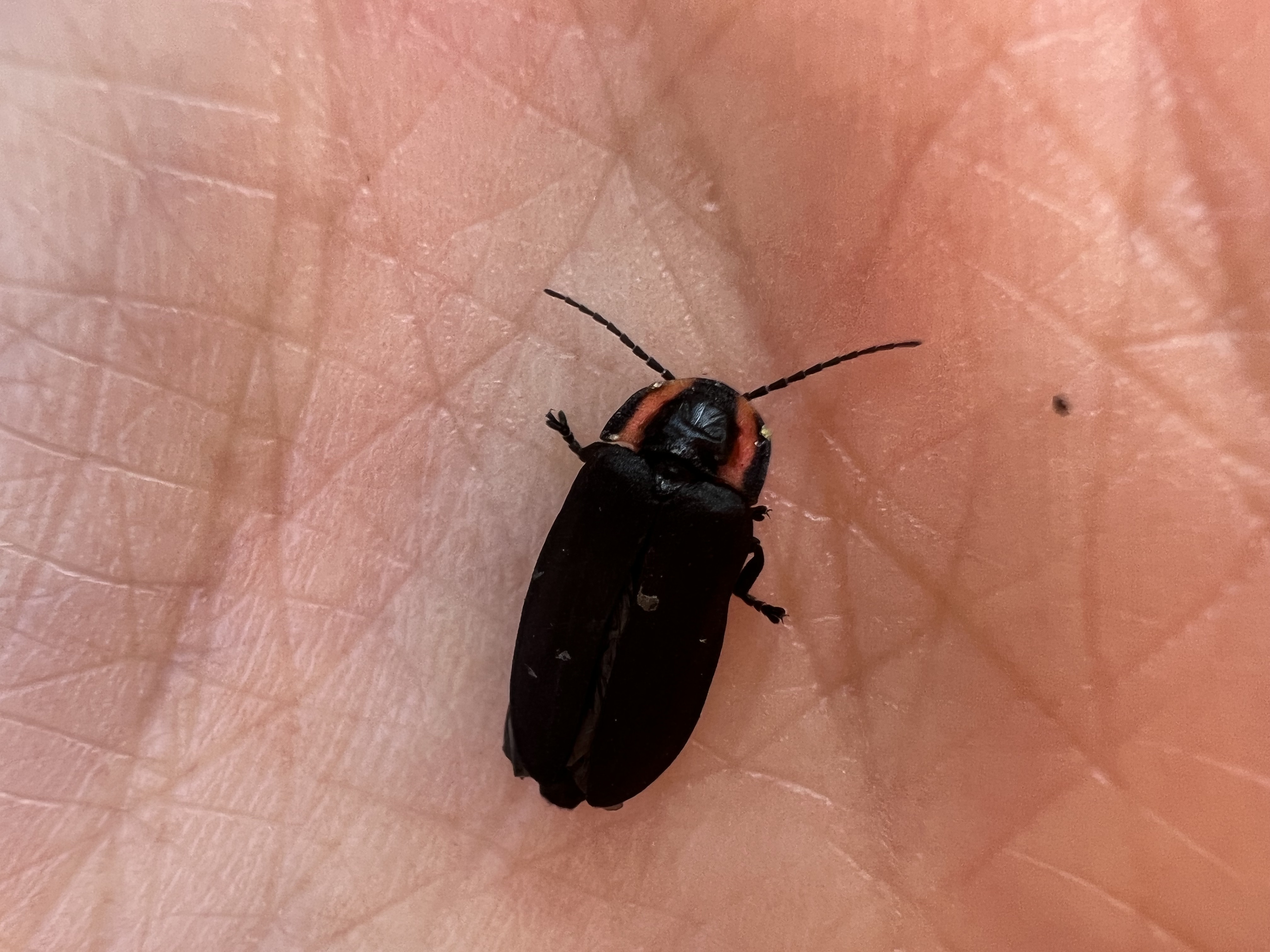
Here’s my “Bug of the day” (for Saturday, October 15, 2022). I spied it on our wood table outside. It’s a Diurnal Firefly in the genus Ellychnia. The Latin name, Ellychnia, comes from Greek, lychnos, translating into ‘lamp’ or ‘lamp wick.’ Obviously, lamps are something associated with the nighttime or darkness. However, the common name of this genus, diurnal, means “day.” It’s only a bit confusing, right? Also, this is a beetle in the family Lampyridae and not a fly at all. The adults of this genus don’t light up at night or in the day either. However, they are closely related to the fireflies that DO light up, or luminesce, at night found on the East Coast. Since this genus, the Ellychnia, don’t have nighttime blinkers, they find their mates by detecting each other’s pheromones. Lloyd (2002), notes however that all species of Lampyrid beetle larvae have an organ at the end of their abdominal segment 8 that bioluminesces. I’ve never found an Ellychnia larva myself, but these are referred to colloquially as “glow worms.”
Ellychnia sp. firefly
In our area, the genus Ellychnia are also known as winter fireflies. This is because they spend the winter as adults, and are equipped to tolerate cold temperatures. You might even see them on days when we have snow. Larvae of this beetle genus hatch in early summer and live in leaf litter or under bark in decaying trees. They are carnivorous predators of organisms like snails, slugs, earthworms, and soft-bodied insects.
Winter Firefly (Ellychnia sp.)
Do we have any blinking species of fireflies in the PNW? That’s an interesting question. I found some literature that says we do, but I’m not certain this applies to the San Juan Islands, although a few sparse (and unsubstantiated) records from Vancouver Island, BC exist. However, western records for flashing fireflies are known from interior B.C. (Cannings et al., 2010) and throughout the western U.S. as reported by Larry Buschman (2016).
While fireflies that flash or bioluminesce are well known on the eastern side of the U.S. and North America, it is not exactly known how they moved all the way over to the western side. There is an interesting commentary in the paper by Cannings et al. 2010, with the thought that perhaps at least one of the species of flashing fireflies reported in B.C., (Photinus obscurellus), may have arrived via the railways.
Because luminescing fireflies are associated with wetlands, it would have been difficult for them to have crossed over the dry Rocky Mountain system without help. Cannings et al. (2010) report sightings across B.C. in association with railways, in fact, with most of these sightings falling within a 30 km distance from a railway. The thought is that even going across the mountains in drier areas, most railways wound through low lying valleys where the topography is more likely to cross through wetlands. Even the presence of railroad berms can create areas of new wetland habitat which may also have attributed to the westward distribution of these fireflies.
Sadly, we have, and continue to degrade, pollute, drain, and lose wetlands in our continued (horrific) adherence to the destructive and entitled ideology of Manifest Destiny. Development, ranching, hobby farms, and suburban sprawl have eliminated more than 50% of wetlands that previously existed in North America (Fallon et al., 2021). The remainder have been seriously impacted by chemical pollutants, light pollution, and overall climate change, contributing to further declines to remaining populations. We may lose all of the species of these iconic and charismatic summertime blinking lanterns without taking special steps to conserve and protect their habitat. We will have no one to blame but ourselves either.
Please support environmental conservation and protection in your community – wherever you live. It is important to reduce our human footprint in order to preserve the natural world, its beauty, and our life support system to perpetuate for future generations.
How can you help? Live minimally. Turn off outdoor lights at night. Plant native vegetation. Switch to use of non-toxic household products. Don’t use lawn fertilizers or chemicals. Better yet, get rid of your lawn and landscape with native plants. Eat less meat. It all adds up. 💡
Cannings, Robert & Branham, Marc & McVickar, R.H. 2010. The fireflies (Coleoptera: Lampyridae) of British Columbia, with special emphasis on the light-flashing species and their distribution, status and biology. Journal of the Entomological Society of British Columbia. 107. 33-41.
Fallon CE, Walker AC, Lewis S, Cicero J, Faust L, Heckscher CM, et al. 2021. Evaluating firefly extinction risk: Initial red list assessments for North America. PLoS ONE 16(11): e0259379. https://doi.org/10.1371/journal.pone.0259379
Fender, K.M. 1970. Ellychnia of western North America. (Coleoptera-Lampyridae). Northwest Science 44: 31-43.
Lloyd, J.E. 2002. Lampyridae Latreille 1817. Pp 187-196 in R.H. Arnett, Jr., M.C. Thomas, P.E. Skelly and. J.H. Frank (Eds.). American Beetles. Volume 2.
Yesterday I was the lifeguard. And, I had swimmers needing saving!
Hister Beetle (Genus Margarinotus I believe) – April 7, 2022 San Juan Island, WA
Here’s one of the species I used a piece of cardboard to rescue from drowning. This is a beetle in the family Histeridae, also known as a Clown Beetle. I told him no more clowning around without a life jacket. 🤣 Watch as it wrings its hindwings out, rolling them in under the leathery elytra (the outer wings).
I believe this beetle is in the genus Margarinotus. For ID beyond this, I’d need more time and a lot of patience. However, I can tell you I’ve learned some species of Hister beetles are associated with the nests of rodents, birds, and even ants and termites. They are pest predators, meaning they eat other insects at all life stages. They also are especially adept predators of fly eggs. You can often find them in leaf litter, dung, carrion, and under tree bark, or living in those ant mounds where they may be fed by ants, eat the leftovers the ants discard, or in some cases, they eat the ants!
Some other curious tidbits about these beetles include their acting ability. They play dead (Thanatosis) to deter predators. The word Hister is derived from Latin and means “Actor.”
Hister Beetle (I believe Margarinotus sp) – San Juan Island, WA
Wenzel, R. L. (1960). Three new histerid beetles from the Pacific Northwest, with records and synonymies of additional species (Coleoptera: Histeridae). https://www.biodiversitylibrary.org/page/2847194
I found a’nutter weevil! They’ve been everywhere this week! Looks like this may be the Nut Leaf Weevil (Strophosoma melanogrammum). These weevils feed on the leaves of broad leafed shrubs. I saw it on a chunk of rotting alder. It was pretty small and tough to photograph in low light. Probably about 3.2 mm in size. San Juan Island, WA October 13, 2021.














 Bugging You From San Juan Island