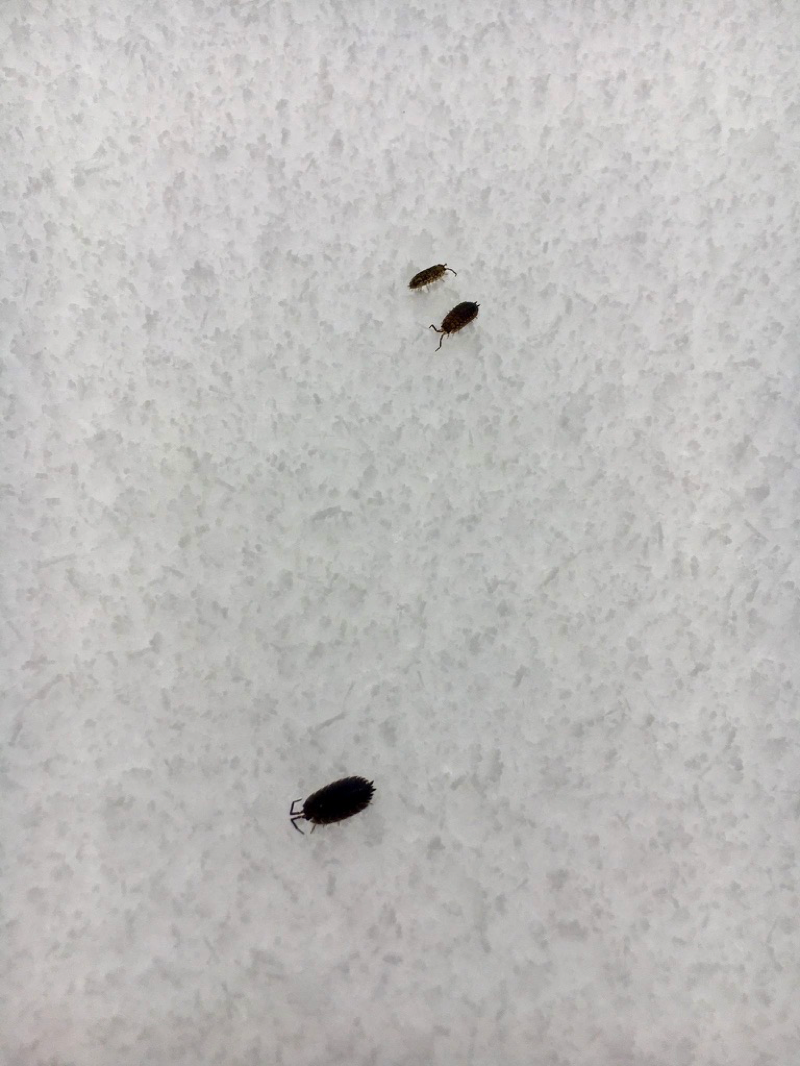
Tag Archives: Bugging you from San Juan Island

A Little Weevil House

Key Words: masting, Curculio, Quercus, mast seeding, acorn weevil, diapause

I picked up these acorns (Quercus sp.) when I visited my folks recently in Texas. They have several oak trees on their property and there was an abundance of acorns all over the ground this year, so I brought a few home with me in a ziplock bag. I like acorns. My mom used to draw little faces on them and I had acorn “people” to play with when I was a child.

Acorn “person”

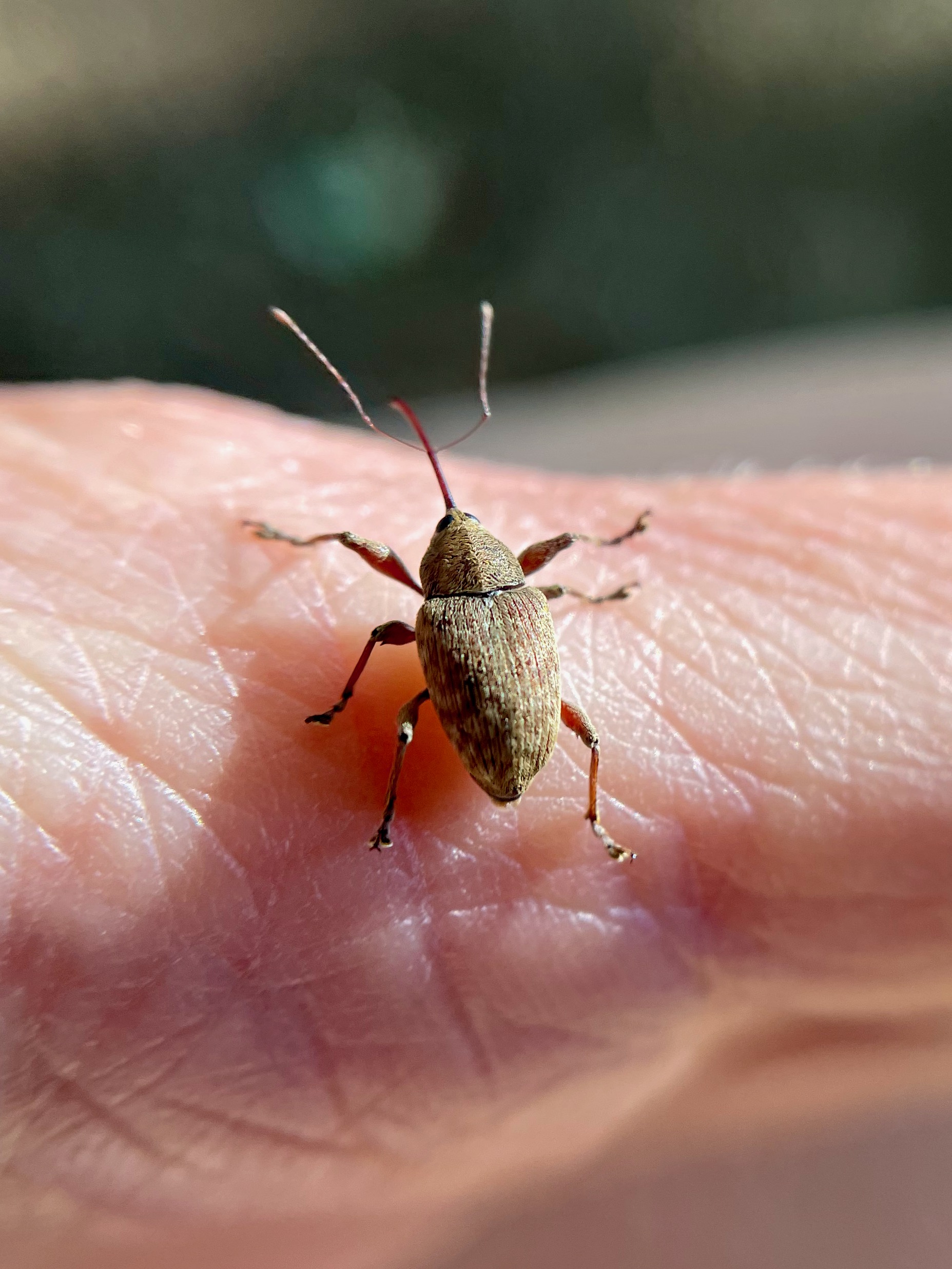
I also found a very cool bug under one of those oak trees while I was there. This strange looking creature is one of the Nut and Acorn Weevils (Curculio sp). It has an extremely long snout. When you find out how this weevil uses it to DRILL, you may be amazed. The adult female weevil will use this drill on her very long snout to make a hole in those acorns!

Nut and Acorn Weevil (Curculio sp).

Keep reading. It really is amazing.
A female weevil will make a hole in the acorn so she can put her eggs inside it!

Hole drilled by Nut and Acorn Weevil

Because I like word games, I thought I’d point out to you that rearranging the letters in the word weevil will make the words “we live?” Well, those eggs hatch into baby weevils who LIVE in a little house that is an acorn (and sometimes in other nuts too). Some folks call them grubs or worms. They are actually the larvae of the adult weevil mom who selected the acorn for her nursery.

If you are assessing this situation from an agricultural perspective (say that nut is a pecan), invested in harvesting a profitable crop, you might be feeling very worried. Sometimes the worry may indeed be justified, but in many cases, like with these acorns, the tree has evolved a strategy to deal with occasional waves of weevils and other insects we consider pests. In actuality, they are just utilizing the resources of the tree like we do when WE (the humans) eat the nut or fruit.

Larvae of Nut and Acorn Weevil (Curculio sp).

I’m going to name the trees’ strategy of dealing with this bug FEAR NO WEEVIL. However, the actual scientific moniker for this strategy (and it applies to other pests and adverse weather stressors as well) is MASTING. The word mast has been used since way back in the Middle Ages to refer to the acorns and seeds of forest trees that drop and accumulate on the ground. It comes from Old English, mæst. Essentially, masting is an ecological term referring to the highly variable and often synchronized periodic cycles of fruiting/seeding in the reproductive processes of trees (both forest and fruit trees).

How is it a strategy for circumventing the deleterious affects of pests? Well, the idea is that in some years, bumper crops of nuts and seeds are produced in order to satiate the predators, so some are left to germinate and continue new generations. In this particular case, you could think of it as the oak trees sacrificing some of their offspring to the weevil gods. When there are more acorns than there are adult female weevils, some of those acorns will escape the weevil drill and makeover into little bug nurseries.

In reality, this relationship is much more complicated. In some cases, acorns parasitized by only a few weevil larvae will germinate, while those acorns with many larvae will not. The trees’ bumper crops of seeds and nuts will also cycle with years of low production, where resources are scarce for the weevil (and other organisms). Nature is incredibly dynamic though. Studies show some species of weevils have adapted a counter mechanism to circumvent the trees’ strategy of masting. It’s called prolonged diapause. This means these weevils are able to sleep longer (more than one year) as they develop in order to synchronize adult emergence with years when the trees’ seed/nut production is high.
If you are interested in reading more about the history and MYSTERY of masting, I encourage you to delve into the literature I’ve listed in the references below. It’s quite fascinating – especially going back in history to the link between masting and pannage. Way more than I can cover here. Check it out.

References

Baldwin, M. 2021. Pigging out in the forest: the Common of Mast (Pannage) in Britain https://www.wildlifeonline.me.uk/blog/post/pigging-out-in-the-forest-the-common-of-mast-in-britain

Bugguide 2021. Curculio. https://bugguide.net/node/view/6682

Higaki M (2016) Prolonged diapause and seed predation by the acorn weevil, Curculio robustus, in relation to masting of the deciduous oak Quercus acutissima. Entomol Exp Appl 159:338–346. https://doi.org/10.1111/eea.12444

Jefferson, R. 2006. Why Are More Acorns Falling? Excessive Drops of Nuts from Oak Trees Is Part of Normal ‘Mast Year’ Phenomenon. Scientific Times. https://www.sciencetimes.com/articles/33795/20211006/why-more-acorns-falling-excessive-drops-nuts-oak-trees-part.htm and https://youtu.be/EQ748TZcuqs

Jesse, L. No date. The dark side of collecting acorns. Plant and Insect Diagnostic Clinic. Iowa State University Extension and Outreach. https://www.extension.iastate.edu/news/2007/sep/072107.htm

Koenig WD. 2021 A brief history of masting research. Phil. Trans. R. Soc. B 376: 20200423. https://doi.org/10.1098/rstb.2020.0423 Koenig, W. D., & Knops, J. M. H. (2005). The Mystery of Masting in Trees: Some trees reproduce synchronously over large areas, with widespread ecological effects, but how and why? American Scientist93(4), 340–347. http://www.jstor.org/stable/27858609

Araneus diadematus, My Cross Orb Weaver friend named “Louisa.”

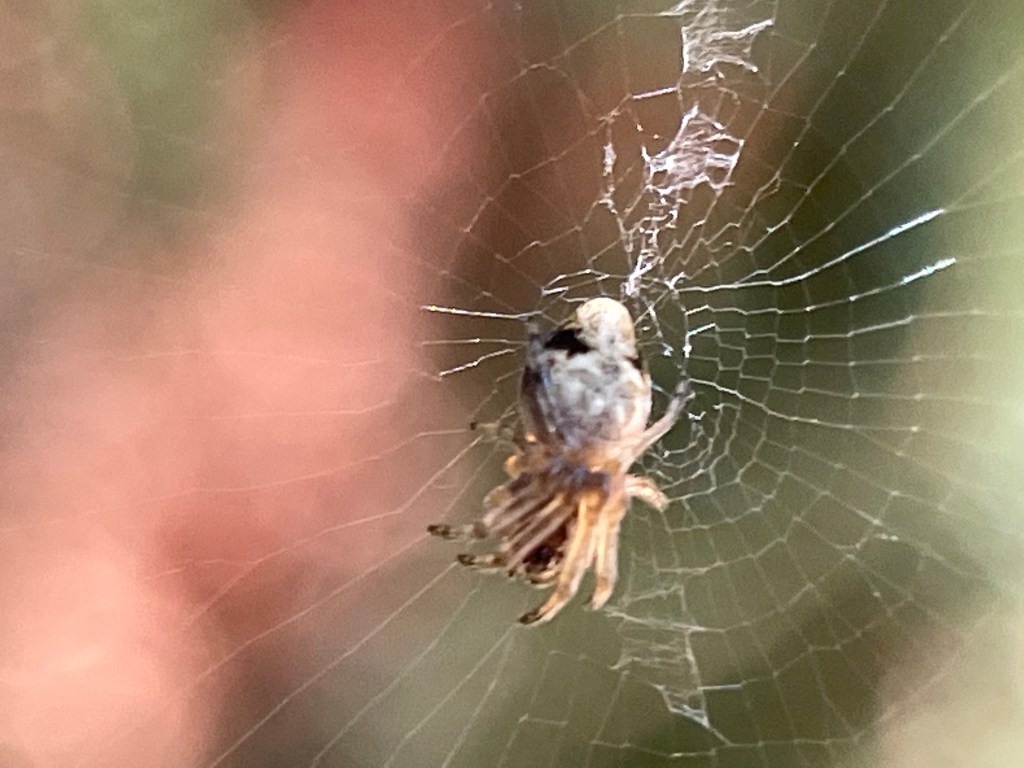
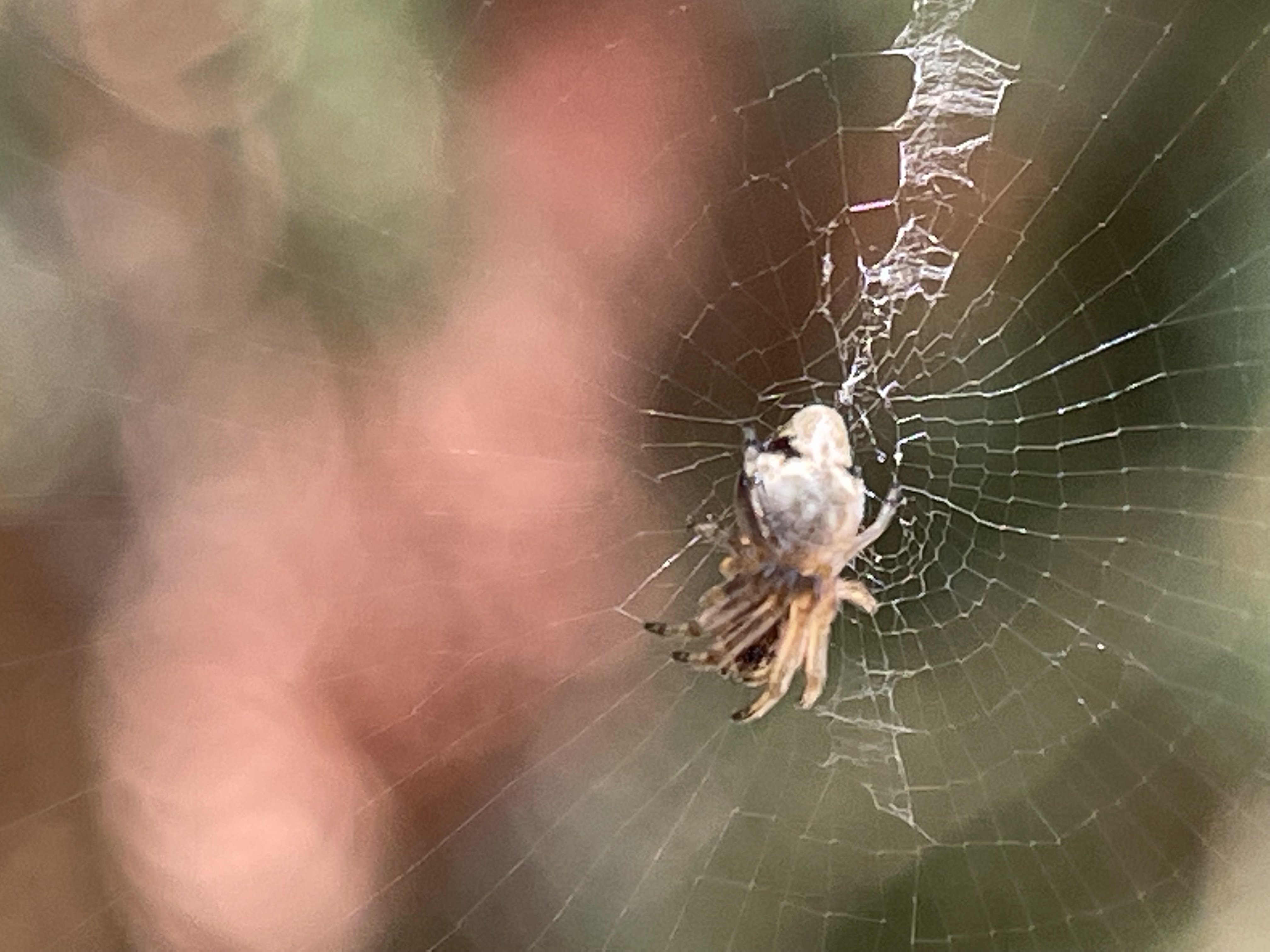
I first spotted this beauty on October 1, 2021 while I was taking a walk along our road on San Juan Island. There was a cluster of sun loving mullein (Verbascum thapsus) mixed with one or two thistles (probably Canada thistle) growing along the road. The glistening silk threads woven between them drew me over to investigate. There were several Cross Orb Weavers sharing the space here, but one of these was not like the other. The spider that caught my attention was quite a bit darker than the others. Describing it as brown just doesn’t do it justice. Brown sounds much too plain. She was a lovely brunette amongst a few redheads!

~ After you’re done reading, come back and check out this link to learn more about pigmentation in arachnids – https://www.bio.fsu.edu/~miller/Spider%20photos/spider_literature/color%20in%20spiders%20papers/Oxford_Gillespie_20xx.pdf

Since I often enjoy walking on our road on sunny days, I started looking for her when I passed her home – the Mullein “apartments.” It wasn’t just the spiders enjoying the sunny housing complex, but these units housed a few other species as well. I found some Stilt Bugs (Neoneides sp.) and some Pentatomidae hiding in the fuzzy star shaped trichomes (little hairs) of the Mullein leaves.

Now that autumn has ushered in falling leaves, falling temperatures, and a good bit of rain, I thought of my friend Louisa, the Orb Weaver out in the cold. Had she managed to find a sheltered spot to survive the recent storms? Several times over the past two weeks I’ve looked for her, but she was just gone. Since the lifespan for this species is only a year or less, I suspected she’d reached her end with our last dip in temperatures, gusty winds, and precipitation. I held out a tiny bit of hope though. Just a bit!

Today (November 6, 2021), my husband and I walked our road. It was sprinkling and the precipitation was cold. When we got down to the point on the road to turn around, shortening our walk to just the point where the old cabin used to be, I asked him to wait one second while I looked one more time at that patch of Mullein and the drying stand of thistles.

As I bent down to look closely, I saw a single strand of silk. Examining the attachment and following closely, it led me to Louisa. She was tucked under the dried nodding inflorescence of the thistle. Once a purply-pink sugar treat for pollinators, the now nodding blooms have been repurposed into a thatch roof to keep this little spider dry.

I’ve thought about relocating her so the county doesn’t mow her when they scalp the roadside vegetation. It is bound to happen at some point. For now, I’m going to leave her be, and just keep a close eye on her. Maybe I’ll make a sign! Be Nice to Spiders. ❤️ Louisa lives here!

Fun Fact! Did you know that 25% of the diet of Orb Weaver spiderlings is pollen? Check it out. Article linked in my list of sources below.

Araneus diadematus (Cross Orb Weaver) October 1, 2021 – San Juan Island, WA

Araneus diadematus (Cross Orb Weaver) October 1, 2021 – San Juan Island, WA

Araneus diadematus (Cross Orb Weaver) October 1, 2021 – San Juan Island, WA

Araneus diadematus (Cross Orb Weaver) October 13, 2021 – San Juan Island, WA
Araneus diadematus (Cross Orb Weaver) October 16, 2021 – San Juan Island, WA

This is “Louisa,” the Land Bank Orb Weaver Spider. She lives on a Mullein plant alongside the road. I’ve been watching her since October 1, 2021. Hoping she will not become a casualty of San Juan County’s pre-winter roadside mowing. She’s also an expecting mom!
This is “Louisa,” the Land Bank Orb Weaver Spider. She lives on a Mullein plant alongside the road. I’ve been watching her since October 1, 2021. Hoping she will not become a casualty of San Juan County’s pre-winter roadside mowing. She’s also an expecting mom!
Araneus diadematus (Cross Orb Weaver) November 6, 2021 – San Juan Island, WA

References and further Reading –

Eggs B, Sanders D (2013) Herbivory in Spiders: The Importance of Pollen for Orb-Weavers. PLoS ONE 8(11): e82637. https://doi.org/10.1371/journal.pone.0082637

Gucker, Corey L. 2008. Verbascum thapsus. In: Fire Effects Information System, [Online]. U.S. Department of Agriculture, Forest Service, Rocky Mountain Research Station, Fire Sciences Laboratory (Producer). Available: https://www.fs.fed.us/database/feis/plants/forb/vertha/all.html [2021, November 6]. 

Horton DR, Lewis TM (2003) Numbers and types of arthropods overwintering on common mullein, Verbacsum thapsus L. (Scrophulariacae), in a central Washington fruit-growing region. Journal of the Entomology Society of British Columbia 100, 79–87.

Oxford, Geoff & Gillespie, Rosemary. (1998). Evolution and ecology of spider coloration. Annual review of entomology. 43. 619-43. 10.1146/annurev.ento.43.1.619.

Riaz, Muhammad, Zia-Ul-Haq, Muhammad and Jaafar, Hawa Z.E.Common mullein, pharmacological and chemical aspects. Revista Brasileira de Farmacognosia [online]. 2013, v. 23, n. 6 [Accessed 6 November 2021] , pp. 948-959. Available from: <https://doi.org/10.1590/S0102-695X2013000600012&gt;. ISSN 1981-528X. https://doi.org/10.1590/S0102-695X2013000600012.

Turker AU, Gurel E. Common mullein (Verbascum thapsus L.): recent advances in research. Phytother Res. 2005 Sep;19(9):733-9. doi: 10.1002/ptr.1653. PMID: 16222647. https://onlinelibrary.wiley.com/doi/10.1002/ptr.1653

Nut Leaf Weevil

I found a’nutter weevil! They’ve been everywhere this week! Looks like this may be the Nut Leaf Weevil (Strophosoma melanogrammum). These weevils feed on the leaves of broad leafed shrubs. I saw it on a chunk of rotting alder. It was pretty small and tough to photograph in low light. Probably about 3.2 mm in size. San Juan Island, WA October 13, 2021.

Strophosoma melanogrammum 

Mystery Eggs Hatch

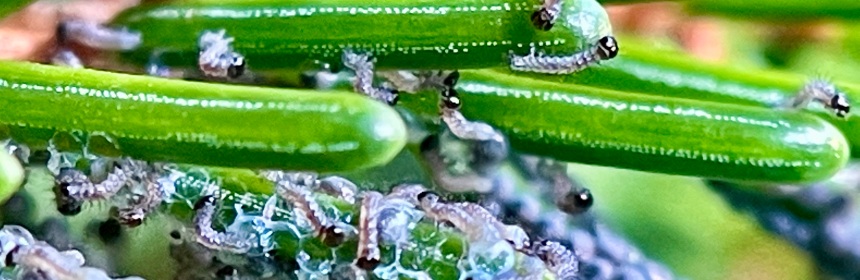
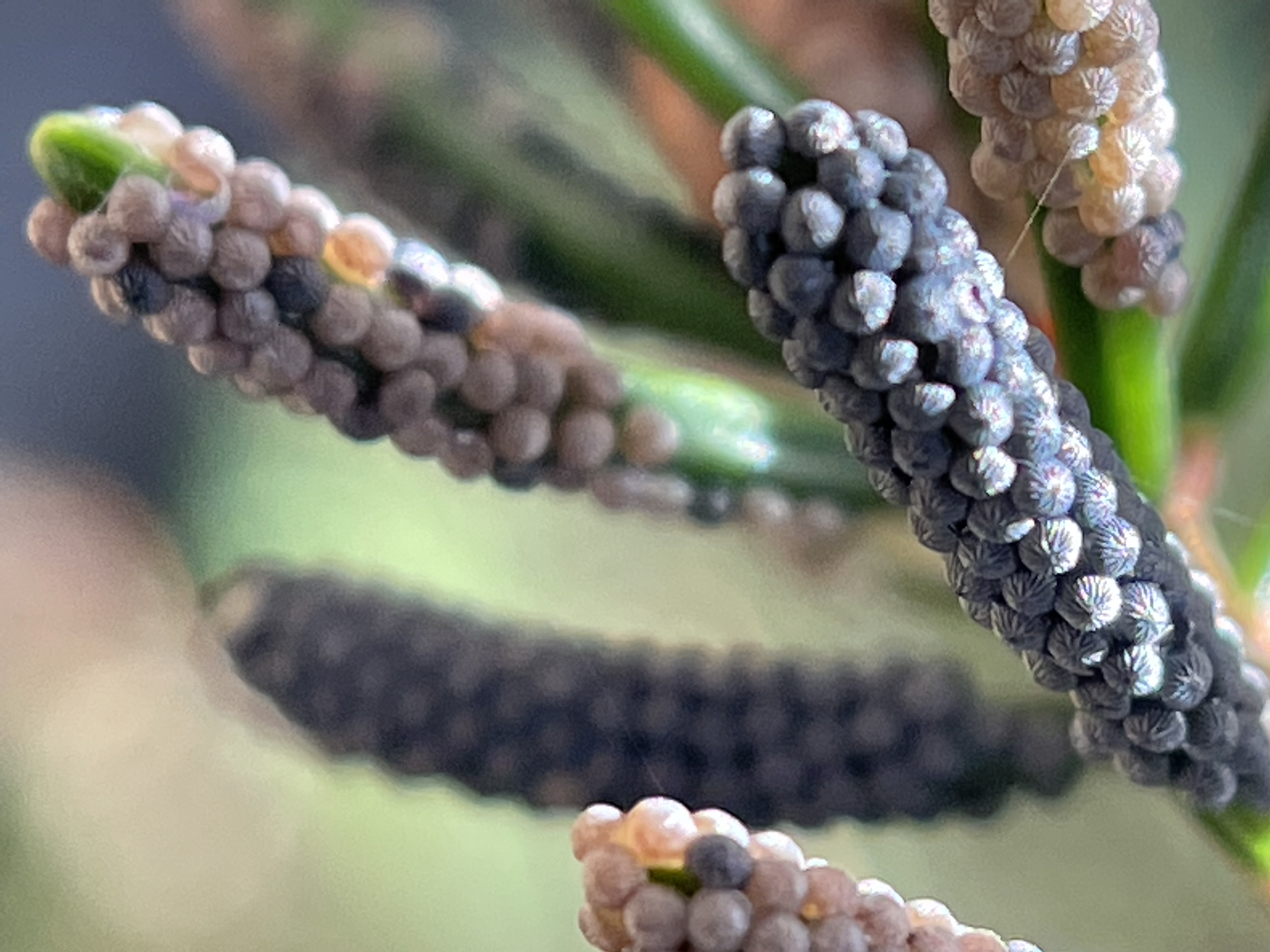
They hatched!

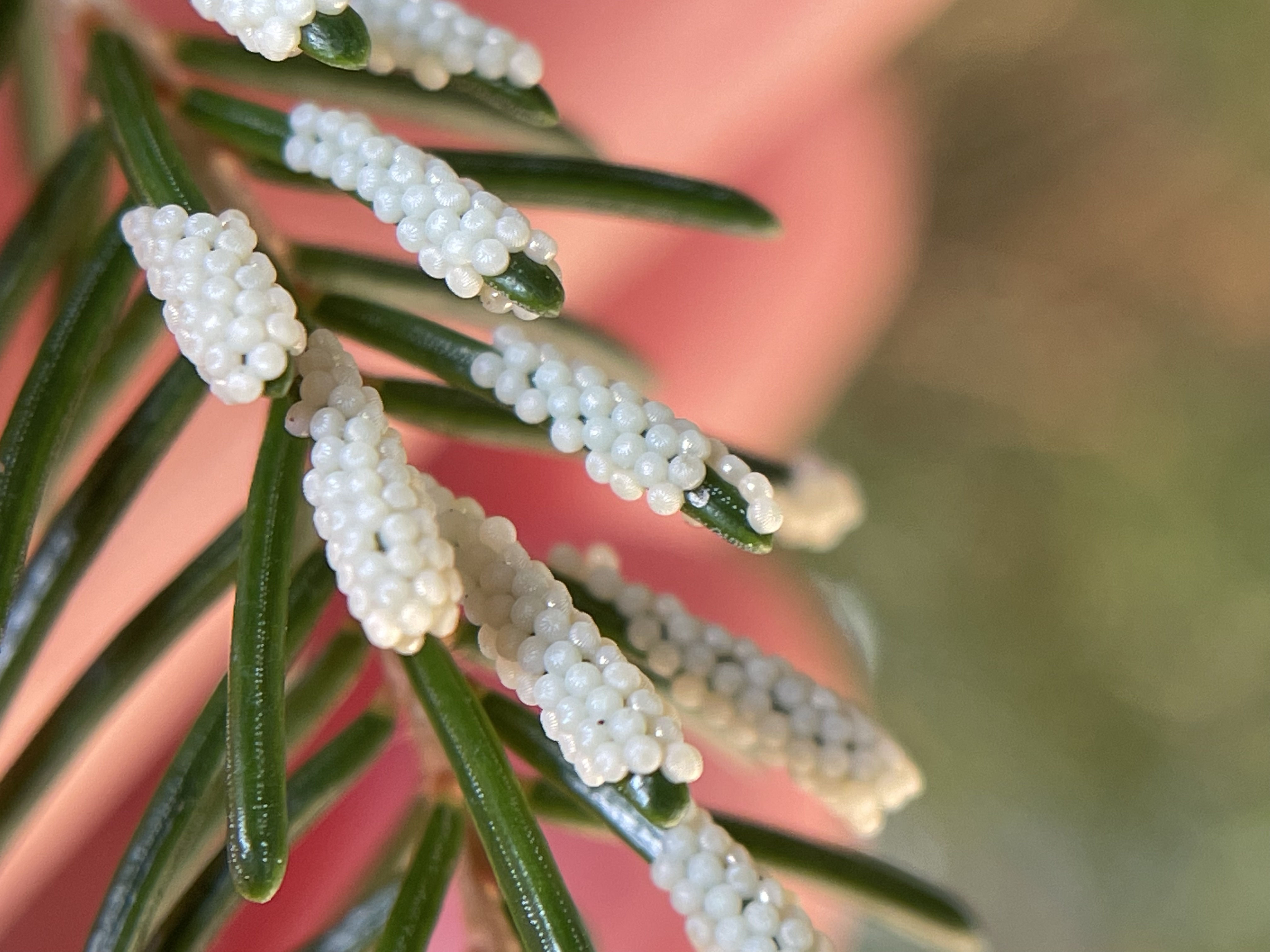
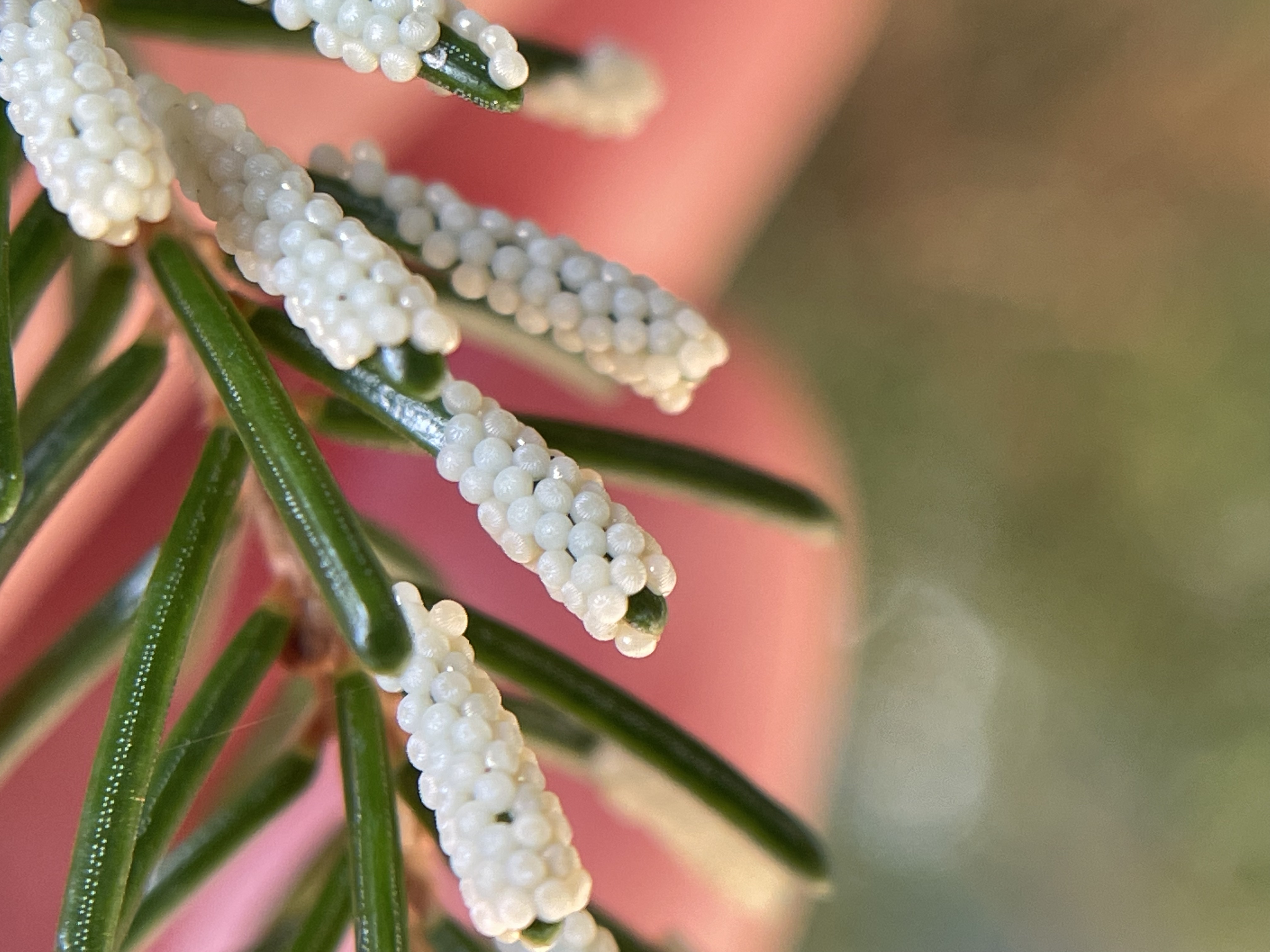
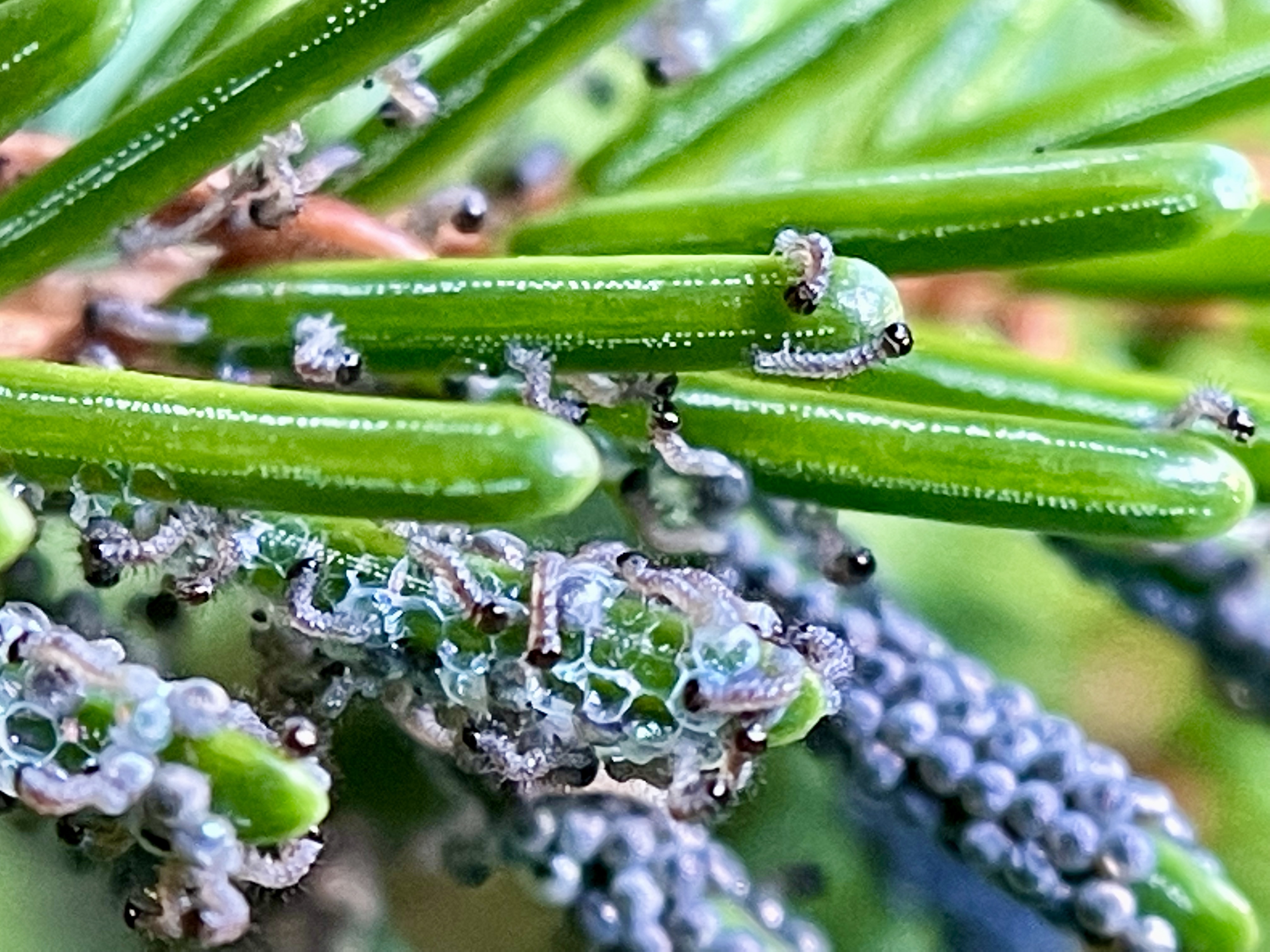
Well, I was wrong in my theory about these possibly being Nepytia phantasmaria or Phantom Hemlock Looper eggs, so my next steps will be to review all my moth photos from early September to try and thread out any other possibilities. That may take some time. Initial observation (date eggs laid) was Sept. 12, 2021. Today is Oct. 7, 2021. They are indeed pretty tiny and if you look closely, you can see the caterpillar body rolled up in the eggs that haven’t hatched. The tree is a Caucasian Fir (Abies nordmanniana).

eggs on Caucasian Fir, San Juan Island, WA 09.12.2021
Eggs darkening – September 18, 2021 San Juan Island
They hatched! Oct. 7, 2021

Mystery moth eggs hatch – October 7, 2021

Thanks for reading! Stay tuned for further updates. I’ll do my best to figure out an ID for these. 🙂

Facebook Fail

The social media giant we all have become overly dependent on in recent years, had a big, giant F-A-I-L today. The entire site was down. I couldn’t share bug photos or look to see what crazy or amazing things my friends had been up to. I also couldn’t watch the fabulous video of the frog and bearded dragon that I’ve been replaying over, and over, and over because it’s so DARN cute! You can find it on Tik Tok if you can’t find it on Facebook.

In the void, I resorted to the fail safe backup. It’s called E-mail. I really feel old because I actually remember how we communicated before the advent of cyberspace – handwriting letters that you put a stamp on and eventually were delivered by USPS.

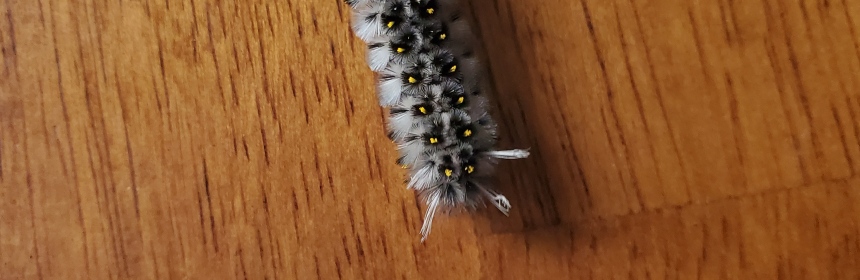
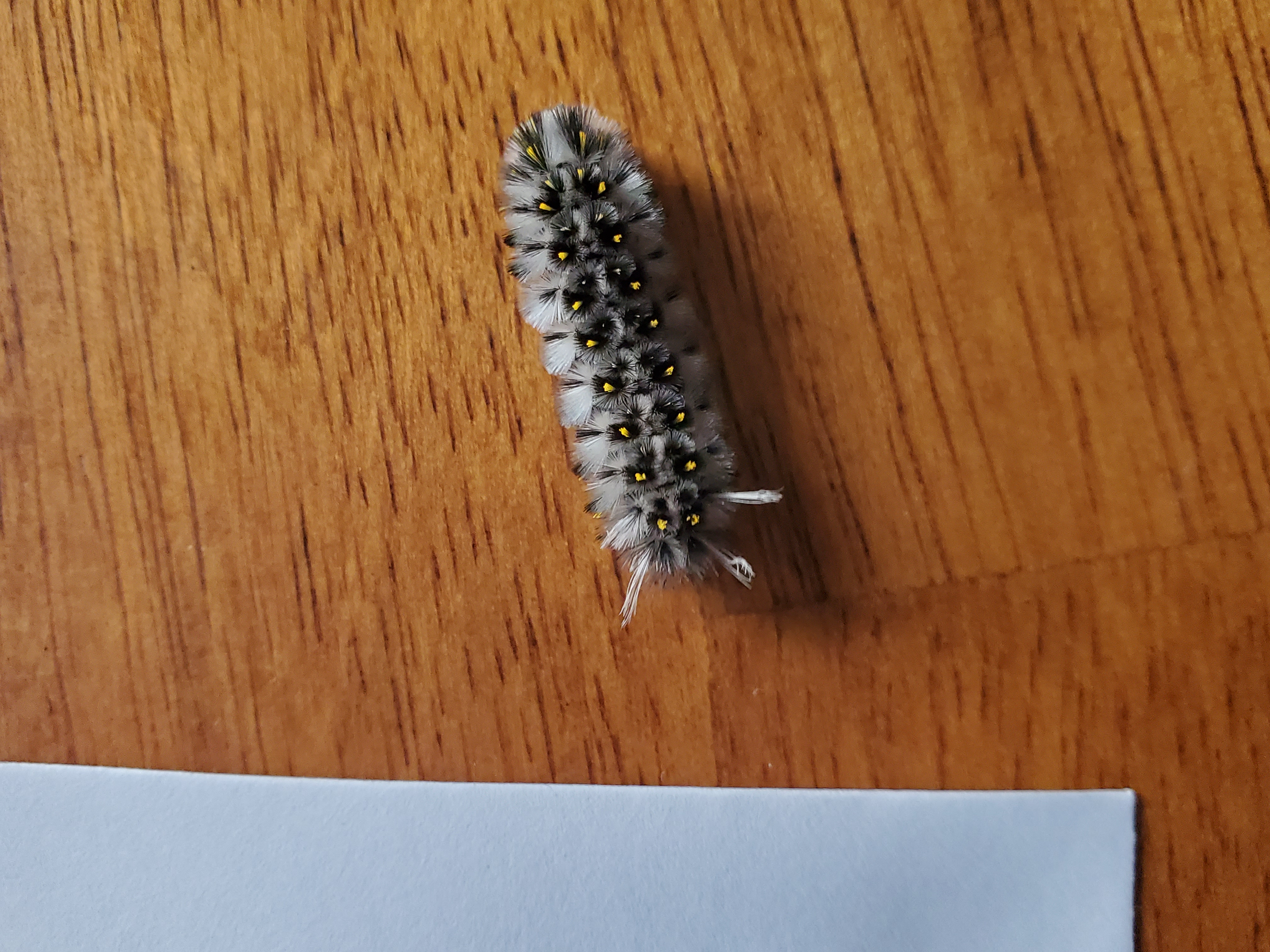
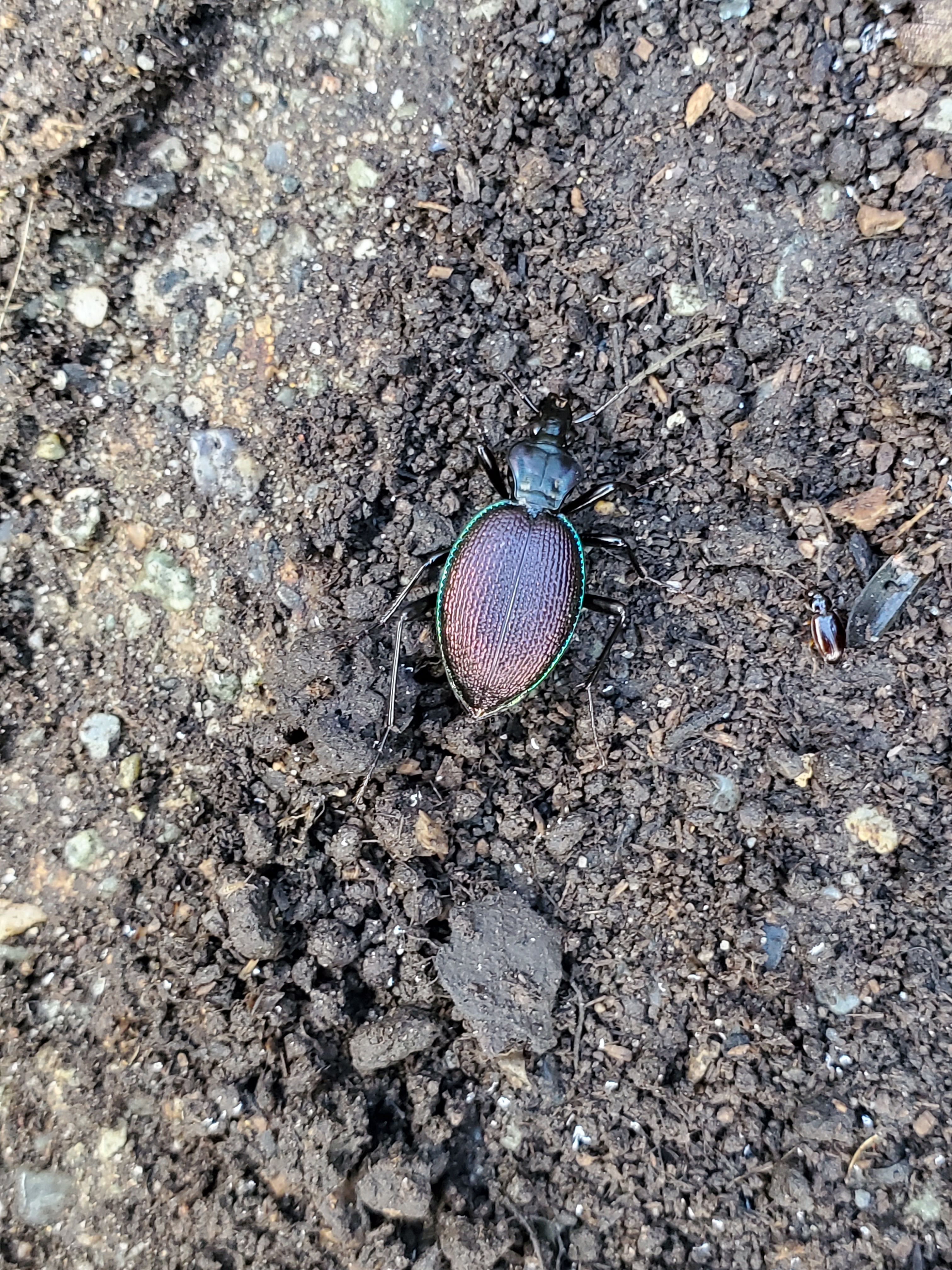
So, in my email, I actually had received two nice bug pictures I want to share with you. Victoria Compton (who is running for Friday Harbor Port Commissioner btw) sent these to me. The first, a caterpillar, is going to turn into my favorite moth, Lophocampa roseata or the Rosy Amelia Moth. The 2nd, is a ground beetle in the family Carabidae (Scaphinotus marginatus) – also sometimes called the Margined Snail-eating Carabid Beetle.

Happy Bug Viewing! Thanks for checking these out and thanks for sending the photos Victoria! You have my vote. 😉

Lophocampa roseata moth caterpillar

Scaphinotus marginatus Carabid beetle

Links to read more about these two bugs

Lophocampa roseatahttps://buggingyoufromsanjuanisland.com/2018/10/02/lophocampa-roseata-rosy-aemilia/

Lophocampa roseata https://bugguide.net/node/view/247272

Scaphinotus marginatus https://bugguide.net/node/view/327898

The Teeny Tiny “Trashline Orb Weaver” – Yes, that’s really the name!

Trashline Orb Weaver (Cyclosa sp.) San Juan Island, WA 09.06.2021

I am very nearly blind when I try to see things up close, so it truly surprises me how I SEE things like the tiny “laundry” line of dead bugs this little orb weaver had strewn along a filmy thread between the boughs of our fir tree. At first, I thought it was just debris, stuck to the remnant of a spider thread, long abandoned. Upon closer inspection, I saw more threads and then my attention focused on the center, where I was able to discern what looked like teeny legs curled up around a body.

Trashline Orb Weaver

I used my clip on macro lens to get a better look. Indeed, there was a tiny spider in the center. I thought it was dead. That’s EXACTLY what the spider was hoping I’d think, and then I’d move on and the spider could enjoy the morning sun, and maybe a tiny bug for breakfast too.

Trashline Orb Weaver

Trashline Orb Weaver

I had a hard time getting decent photos. Even with the macro lens, focusing was tough. The wind would blow at just the WRONG second and I’d have to start all over again. I couldn’t find my tripod, but finally got a decent pole to help me balance, and went out to take photos at different times over a period of 2 days. I even went out last night and took a picture.

Awake or Sleeping? Trashline Orb Weaver (Cyclosa sp.) at night. San Juan Island 09.07.2021

It was fairly easy to identify the spider to Genus (Cyclosa), but species ???? . After going through the literature I had, I narrowed it to 2 possibilities, but reached out to Rod Crawford for help. Rod is the curator of arachnids at Seattle’s Burke Museum and this is what he says,

“Yes, it’s a Cyclosa. This time of year all Cyclosa are juvenile, and I for one cannot distinguish between our 2 species (C. conica, C. turbinata) as juveniles. However, C. conica is more common.”

So, my little spider with a laundry line of bugs is either Cyclosa conica or Cyclosa turbinata.

Why exactly do they string the debris along their web lines? Well, again, this debris is usually made up of dead bugs and other tiny bits of debris attached to the silk line. Typically, the spider is positioned somewhere in the middle, using the debris as camouflage against predators. Often, the female spiders’ egg sacks are attached to this “laundry line” too. I think laundry line sounds better than trash line, but I don’t think I get to rename the spider.

There are five species of Cyclosa spiders in North America, north of Mexico. I believe we only have the two mentioned by Rod here. I’m going back out to check on my new friend after I finish my post. Enjoy the day and remember to Be Nice to Spiders!

Thanks for reading.

References and Fun Reading

Eaton, E. 2012. Spider Sunday: Trashline Orb Weavers. Bug Eric Blogspot. http://bugeric.blogspot.com/2012/06/spider-sunday-trashline-orb-weavers.html

Bugguide.net. 2021. Genus Cyclosa – Trashline Orb Weavers. https://bugguide.net/node/view/1989

Trashline Orb Weavers. Missouri Department of Conservation. https://mdc.mo.gov/discover-nature/field-guide/trashline-orbweavers

Flight of The Phantoms (Phantom Hemlock Loopers – Nepytia phantasmaria)

Yesterday, August 29, 2021, I received an email from C. Croll requesting ID of a moth photographed by T. Ormenyi. Their query read,

“I live on Orcas and kayak quite a bit. Today I was paddling from Patos Island back home, and there were thousands of moths in the air. They were heading from south to north. We first saw them on Patos but then all the way home. Some had fallen onto the water on the crossing. ”

And,

“I had not witnessed so many moths all traveling together before. Seemed like a migration of some sort? When they first arrived I thought there were cottonwood seeds floating on the breeze, took a second to realize that it was moths. The air was full of them for almost an hour. “

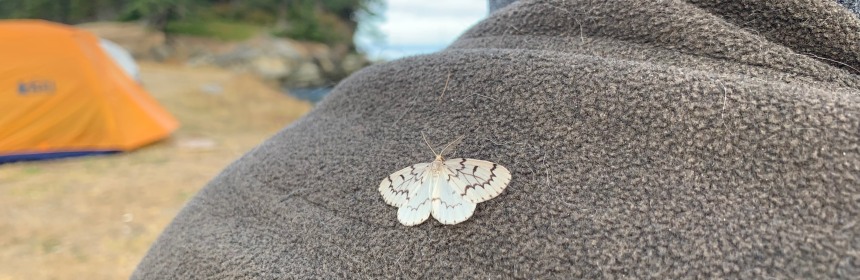
Phantom Hemlock Looper (Nepytia phantasmaria ) – photo by Tessa Ormenyi

These moths sighted by Calvin and Tessa are the Phantom Hemlock Loopers, (Nepytia phantasmaria). They are in the family Geometridae. This species ranges from southern BC to California. There is one generation produced per year and larvae feed on conifers, including Western Hemlock, Douglas-fir, Grand Fir, Amabilis Fir, Sitka Spruce, and Western Red cedar (Bugguide.net).

Adults typically emerge in fall (September and October), so seeing them now is a bit earlier than when I’ve typically collected specimens at my porch light on San Juan Island. Last year, I photographed my first specimen of the season on Sept. 7, 2020. As these moths are nocturnally active, Calvin and Tessa’s report of of them traveling en-masse like this during daylight was intriguing. I was curious to know more.

William H. Hendrix III’s thesis titled Migration and behavioral studies of two adult noctuid (Lepidoptera: Noctuidae) species plus feeding observations of some moths common to Iowa (1990), cites (Johnson, 1969), stating these migration events are part of the “oogenesis flight syndrome” stage where the newly emerged adult insects move en-masse before reproduction and egg laying takes place. Hendrix (1990) also provides some theories as to WHY these moths migrate in the first place. Several theories have attempted to explain this, but he concludes, “Migration, consequently, occurs primarily in young adults and its chief function is to allow escape from unfavorable habitats and allow colonization of a broad range of environments” (Hendrix, 1990).

After reading about this particular species, I believe the migration witnessed yesterday could be attributed to either 1) the sudden weather change we experienced overnight in the islands, or 2) the lack of suitable habitat for reproduction because of the drought we are experiencing. I’m guessing the drought may have more to do with this and we will see more evidence as other species struggle to survive the coming environmental shifts associated with global warming.

Thanks to Calvin and Tessa for sending in their observations!

References and Further Reading

https://bugguide.net/node/view/88329

http://mothphotographersgroup.msstate.edu/species.php?hodges=6907

Edwards, D.. (2011). Activity rhythms of Lepidopterous defoliators. II. Halisidota argentata Pack. (Arctiidae) and Nepytia phantasmaria Strkr. (Geometridae). Canadian Journal of Zoology. 42. 939-958. 10.1139/z64-093.

Hendrix, William Hurston III, “Migration and behavioral studies of two adult noctuid (Lepidoptera: Noctuidae) species plus feeding observations of some moths common to Iowa ” (1990). Retrospective Theses and Dissertations. 9373. https://lib.dr.iastate.edu/rtd/9373 https://lib.dr.iastate.edu/cgi/viewcontent.cgi?article=10372&context=rtd

Johnson, C. G. 1969. Lepidoptera: Long-distance displacement. In MigrationandDispersalofInsectsbyFlight. Methuen&Co.,Ltd., London. 763 pp.

A Beneficial Buzz!

This fly was in my yard last week. San Juan Island, WA. 06.19.2021. It’s taken me about a week to get around to ID, but I believe this to be Eupeodes fumipennis (the Western Aphideater, a syrphid fly that happens to be a bee mimic.

In case you are wondering about that name. The Western Aphideater does actually eat aphids in the larval stage. To see what a syrphid fly larva looks like in action, check out my blog post with more video footage here –https://buggingyoufromsanjuanisland.com/…/honeysuckle…/ – also viewable in the photo below. While I have not been able to identify the species name of the syrphid fly larva in that post, you can definitely see where the Western Aphideater fly might get its name.

Unidentified Syrphid fly larva with aphid

Thanks for reading!

Nodding Thistle Rhinoceros Beetle

I found a “new-to-me” bug the other day when I put on my heavy duty gloves and reached to pull out some bull thistle growing in a pile of dirt near our home.  I was being extra careful because the thistle has spines and they kind of hurt when you get them stuck in your hand.   The beetle was right in front of me when I pushed apart some leaves to get a better grasp on the stem.  

Nodding Thistle Receptacle Weevil (Rhinocycyllus conicus) or, The Nodding Rhinoceros Beetle

As I looked a bit more closely, I saw there were quite a few of these beetles on the thistle, especially on the buds.  I went back to the house to get my camera, took some photos, then went about figuring out what this was.  Definitely a beetle. 

It was weevil-like, and pretty hairy.  There were quite a few of them paired up.  They have spring fever like a lot of other bugs I’ve seen of late.  That’s how we get more bugs though, and we need them, whether we like all of them or not.  

(Rhinocyllus conicus) on Bull Thistle

Identification took me about an hour.  I am getting better at piecing bits of information collected over the years.  Bull Thistle is not exactly a popular plant.  It’s managed to get itself on the noxious weed list.  No one seems to want this plant in their garden, aside from Eeyore, who really loves thistle, right?  

Noxious weed made me think of biocontrol.  That narrowed things down a bit and I learned this is the Nodding Thistle Receptacle weevil (Rhinocyllus conicus).  Personally, I’m calling it the Nodding Thistle Rhinoceros Beetle because being in the family Curculionidae, it has the appearance of a nodding rhinoceros. 

 So, the beetle was introduced to control thistle in the US because thistle isn’t welcome, at least the non-native species like bull thistle aren’t.  The part that got me reading to find out more was the adjective used to describe this beetle as “controversial.”  Well, what I found is that the beetle doesn’t just eat non-native thistles.  It eats NATIVE thistles too (Cirsium edule and Cirsium brevistylum).  

Ventral view of my Nodding Thistle Receptacle Beetle – It’s kinda cute!

Why does that matter?  Well, disrupting native ecosystems can have ripple effects.  I found out another reason the beetle is controversial is because there are native pollinators that depend on thistle, like the beautiful Painted Lady Butterflies that we love.  Thistles also produce seed and flax used by our very own state bird, the American Goldfinch. Which brings me to the question, “If the butterflies and birds have begun to utilize the non-native species, are we making the problem worse by introducing another non-native species?”

In my continued reading , I actually began to connect the fact that I buy bags of expensive thistle seed at the store to attract the goldfinches, but I’ve got LIVING food for them in my yard that is free (and also free of pesticides), and here I am pulling it out.   Am I going to waste my energy trying to eradicate a small patch of bull thistle?  Nope.  If it starts to get out of control, we can just mow it down. For now, I am leaving it for the birds and the butterflies…and all the other little creatures I’ve seen living on it.  There were lots of super cute little jumping spiders all over it yesterday!

I’ll leave you with a question. Should we have introduced this hairy little beetle that isn’t native?  I don’t have a good answer.  Maybe it will just help control the spread of thistle and won’t eradicate it entirely.  I’d like to be able to have Painted Lady’s, Goldfinches, and lots of jumping spiders in my garden, even if I occasionally get pricked by the spines of those thistles.  For now, I’m going to stick to improving my drawing skills!

https://sanjuanislander.com/news-articles/environment-science-whales/1898/noxious-weed-alert-thistle

http://biology.burke.washington.edu/herbarium/imagecollection/taxon.php?Taxon=Cirsium%20edule

https://www.wnps.org/native-plant-directory/88-cirsium-edule

https://uwm.edu/field-station/thistle-head-weevil/

It’s all connected! Know your Ecosystem – Butterflies and Moths Love Ocean Spray (Holodiscus discolor)

We all love butterflies and moths, right?

Did you know Ocean spray is one of our native plants? Lots of folks don’t even know this and label it as “invasive,” or a “fire hazard,” then rip it out of the ground to replace it with non-native ornamentals or worse, leaving the formerly healthy, forested understory devoid of vegetation.

Image from – http://nativeplantspnw.com/ocean-spray-holodiscus-discolor/

Did you know?

Here’s a bit of historical trivia – Ocean spray is sometimes called Indian arrowwood because Native Americans made use of its straight hardwood branches for arrow shafts. They also used oceanspray for treating viral and skin diseases. Other names for this plant are Holodiscus discolor, ironwood or creambush. There is actually a novel phenolic component in the plant called Stilbene a Xyloside that has been associated with varied biological and medicinal activities.

Some reasons I’d like you to appreciate Ocean Spray….

  1. It is a larval host plant to some of our native butterflies and moths. These include the beautiful Pale Swallowtail (Papilio eurymedon), Spring Azure (Celastrina sp.), Lorquin’s Admiral (Limenitis lorquini), and Gray Hairstreaks (Strymon melinus). One particularly notable one here on our island is the delicate Fairy Moth (Adela septentrionella). Calscape (California Native Plant Society) lists 14 confirmed species of Lepidoptera associated with Ocean Spray (and 23 as likely) for a total of 37 species native to the state of CA. I could not find published studies for this in WA state, but link the Calscape page here https://calscape.org/plantleps.php?hostsloc=california&species=Holodiscus+discolor
  2. Ocean spray provides cover and forage for wildlife. Birds, small amphibians, and deer rely on native plant species like Ocean Spray that make up part of the forest understory and are a component of a healthy ecosystem. Fire-scaping may be on your mind, but one way around this is to look at installing adequate water cachement around your home to help keep vegetation from drying out and dying in late summer and fall. We want to live in the forest, but if we remove the native understory, we risk altering the landscape even more and losing these beautiful creatures!
  3. Ocean Spray flowers provide pollen and nectar for native bees! 🐝
Fairy Moth – https://bugguide.net/node/view/26749

Read more about Ocean Spray here:

https://www.researchgate.net/publication/222005193_A_stilbene_xyloside_from_Holodiscus_discolor_bark

http://nativeplantspnw.com/ocean-spray-holodiscus-discolor/

https://blogs.oregonstate.edu/treetopics/2016/07/14/shrubs-wildlife-oceanspray/

Thanks for reading!

« Older Entries Recent Entries »