Tag Archives: Bugging You From SJI

Tiger Craneflies (Phoroctenia vittata angustipennis)

Tiger Craneflies (Phoroctenia vittata angustipennis)
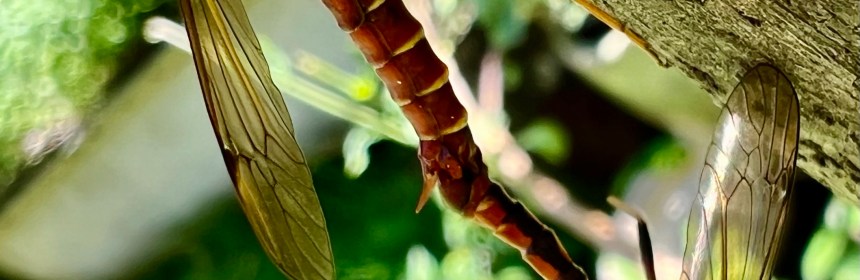
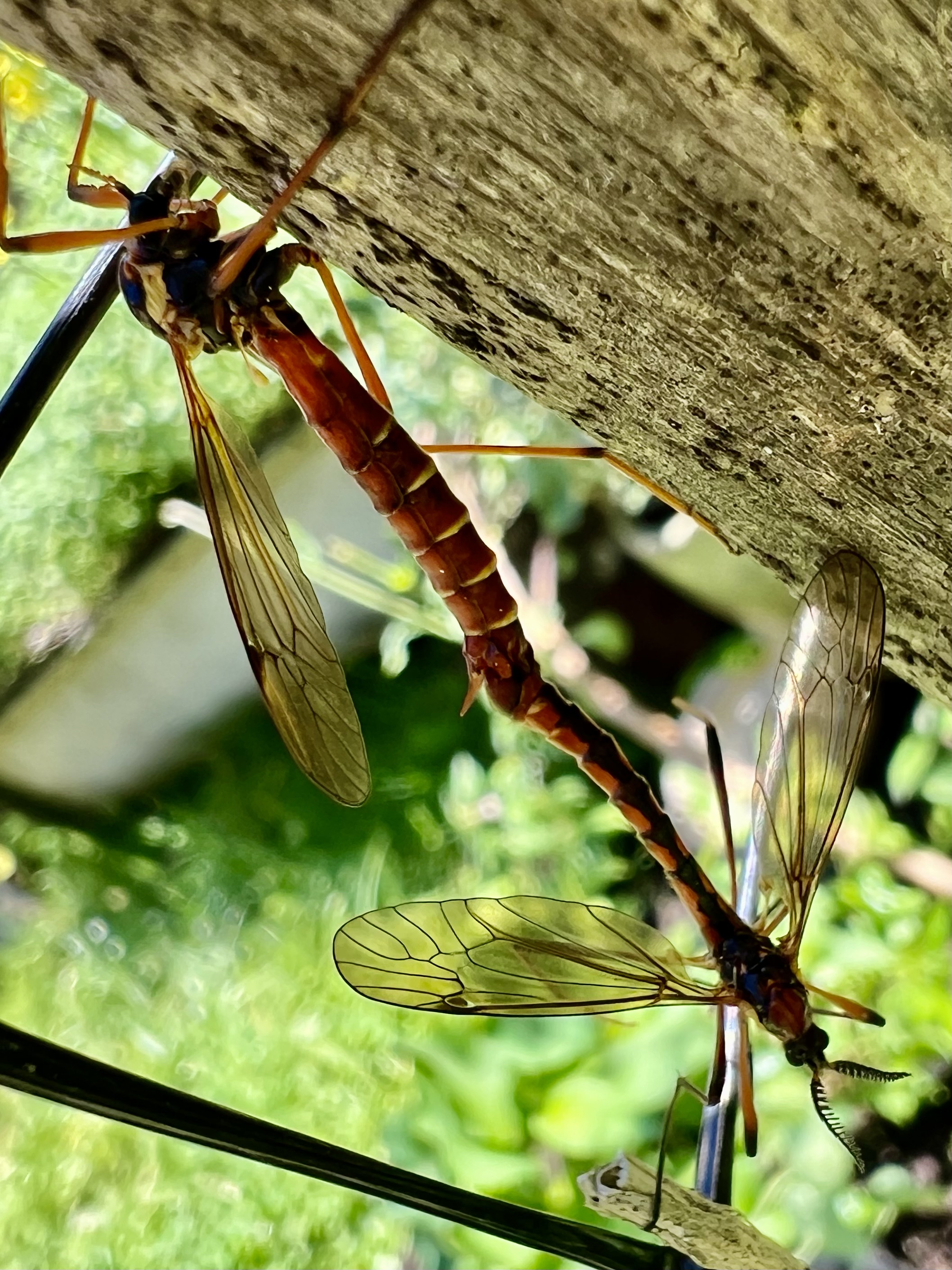
I finally got a few photos of these two after trying (and failing) in my attempts when I first spotted them on Sunday. Curiously, they were “bumping” onto tiny little cones on our fir tree, creating intermittent bursts of pollen with each “hit.” I wondered if they were perhaps eating pollen in advance of mating – with protein a necessary element in egg production.

These flies aren’t extraordinarily abundant. I checked my bug records, and the only other one I’ve seen in the yard was May 2, 2021. They are unique enough that I remembered looking them up and finding that the West Coast species is actually a subspecies, thus the 3rd name, angustipennis, tacked on to the binomial (Phoroctenia vittata).

Going back through my computer, I did find my previous source. Sometimes my computer filing system actually works and I remember to put labels and tags on my saved papers. It makes it so much easier to find them again! Re-reading the paper by Oosterbroek, Pjotr & Bygebjerg, Rune & Munk, Thorkild (2006), I was especially interested in their antennal illustrations, but found another part about the larvae interesting. They state, “the larvae of all these species develop in decaying wood of deciduous trees and might turn out to represent an especially significant conservation and monitoring element of the saproxylic fauna, as most of the species are rather scarce and some of them even very rare. Moreover, they are usually confined to old forests, orchards and similar habitats where there has been a long continuity of the presence of old, dying and fallen trees (Stubbs 2003).”

Our Landscape is Changing

The area near our home has remnants of older growth trees, though many are being cut and cleared for development, and the creation of homesteads. I worry that we will lose some of these species as the forests become more and more fragmented and the trees are more stressed with the advent of higher temperatures brought about by climate and landscape change. Yes, cutting trees = hotter spaces. We need trees! And bugs. Or will sorely regret our choices and actions when we are face to face with the reality of the great die-off of species.

Back to the antennae for these Tiger Craneflies. Can you spot the male and the female in my photos? The male antennae are quite distinctive with their comb-like shape. Entomologists describe the comb-like antennae as Pectinate. If you haven’t figured it out yet, the male is the smaller of the pair. His antennae are wider, and he’s hanging on the bottom.

Tiger Craneflies (Phoroctenia vittata angustipennis) – Note the striking comb-like antennae of the males 

Why might craneflies be useful? Well, aside from population size being an indicator for forest ecological relationships, they make great food for wildlife, especially baby birds and their parents.

Isn’t nature amazing! Thanks for reading.

References and further reading

Saproxylic definitionhttps://www.amentsoc.org/insects/glossary/terms/saproxylic/#:~:text=Saproxylic%20invertebrates%20are%20those%20invertebrates,stage%20is%20dependent%20on%20wood.

Bugguide.net Subspecies Phoroctenia vittata angustipennis https://bugguide.net/node/view/109143

Oosterbroek, Pjotr & Bygebjerg, Rune & Munk, Thorkild. (2006). The West Palaearctic species of Ctenophorinae (Diptera: Tipulidae): key, distribution and references. IEEE Transactions on Information Theory – TIT. 138-149.
https://www.researchgate.net/publication/237714614_The_West_Palaearctic_species_of_Ctenophorinae_Diptera_Tipulidae_key_distribution_and_references

Bill the Beetle, aka Zeke the Greek

I thought I’d post about something new I discovered today when reading about the Darkling Beetle species Zophobas morio.  These are beetles that some folks will know by the common name for their larval form, Superworms.  

First off, the beetle I’ll be using as my representative here is named “Bill.” I discovered Bill one day in my bin of feeder roaches for my Bearded Dragon (Drago).  When I first met Bill, he was a weird waxy, mummy-looking mutant lying motionless amongst the frass (roach poo) at the bottom of the plastic bin. 

He almost got dumped into the trash, but I gently picked him out recognizing the wax museum-like form as the pupal stage of some sort of bug.  It definitely was NOT a roach since roaches have hemimetabolous development.  This means their intermediary stages or nymphs, basically look like mini replicas of their adult parents. 

Zophabus morio, “Bill”

Bill didn’t stay red for very long and in fact, the next day he was pretty BLACK.  While investigating a bit about the meaning of his scientific or Latin name, I couldn’t find much in the entomological references I checked.  I delved a bit deeper and came up with this and thought you might find it interesting.  

In Greek, Zophos refers to “black” or “black darkness of the nether world.”  Mori refers to “death.”   

I think I like the name Bill if he’s going to hang out on my kitchen counter, but maybe for Halloween he can be scary Zeke the Greek, herald of black death of the netherworld.  

Bill is also going to be a family member for about as long as Drago.  I’m not sure how my husband will feel about this.  He asked me when I got Drago how long Bearded Dragons live.  I said “about 15 years with good care.”  Wow!  That means we will be in our 60’s.  

Drago was 3 when he came to live with us in March 2020, so if he lives to be 15, I will be the very old age of 68.  Well, BILL can live for about the exact same amount of time!  FIFTEEN years.  That’s right!  I read it here -https://sciencing.com/superworm-life-cycle-5347598.html

Bill in his habitat

If you’re interested in a pet beetle like mine, here’s a link to a care sheet. They are easy to keep, low maintenance, and don’t bite! https://beta-static.fishersci.com/content/dam/fishersci/en_US/documents/programs/education/technical-documents/data-sheets/carolina-biological-darkling-beetle-data-sheet.pdf

Thanks for reading! 🐞🦋🐝🐛🐜🦗🦟

Nicrophorus Burying Beetle Powerpoint – Grave to Cradle

The links here are for a project I worked on in grad school about Burying Beetles. I was having some trouble getting the code to share it on WordPress, so if you have trouble viewing, let me know. Powerpoint link is via OneDrive at https://1drv.ms/b/s!AnuXRWM_ynxHcba_40yxFvTJCgw?e=toCNNE but I also have it on Slideshare.net at https://www.slideshare.net/CyndiBormann/burying-beetles-powerpoint?qid=e930baf4-87e9-4553-a366-0044098db422&v=&b=&from_search=1

Is our fear of murder hornets turning us into the real murderers?

A neighbor sent me this video footage late last night.  She asks, “Why are all the black and yellow bumble bees on the ground dying?”  This occurred locally at an island lavender farm where the bumble bees are LOVED and no one is applying any pesticides.  In the video you can certainly see the bees she refers to.  Why only those?  

The dying bees are the lovely Yellow-Faced bumble bees, Bombus vosnesenskii.  I personally appreciate these because not only are they avid tomato pollinators, but they have such adorably chubby and fuzzy bodies with a yellow face and a yellow band around their little black bottom. 

Bombus vosnesenskii, Yellow-faced Bumble Bee

Bumble bees are cavity nesters.  Many will select an empty mouse burrow in the ground to create their nest. The fertilized queen overwinters and begins her colony in late March or early April, foraging for herself and the eggs she laid that would soon hatch into larvae needing to be fed.  

Bumble bee nest on San Juan Island, WA 2010

In order to obtain nutrients necessary for survival, bumble bee foragers can travel long distances (up to 11 miles), especially here as our growing season ends in summer.  Right now, they are visiting the lavender in bloom.

These poor bees are most likely victims of pesticide.  The fact that all of them are the same species, at the same location, indicates to me that someone applied pesticide at their nest site, likely a property owner within foraging distance of the worker bees visiting the lavender farm.  The workers dispersed from the nest to try to do what they are programmed to do (forage for food), but simply succumbed to the toxic residues that some fearful homeowner applied.  

“I can’t have bees in my yard!”  “I’m allergic.”  “I have pets.”  “I hate insects.” “It could be murder hornets.”  

Do you want to have food? 

If you, as a homeowner, continue spraying your yard every time you see a bee and can’t learn to live with them, you are going to be the end of all of us.  Bumble bees are some of our most important agricultural pollinators.  More important than honey bees!  

The dying bees in this video are native bees.  “Native” means they are adapted to this environment.  They have the ability to survive here better than European honey bees (Apis mellifera) which are not native.  Honey bees were transported to North America by Europeans who brought sheep, cattle, swine, and other domesticated species to this continent.  

Back to the over-sensationalized “murder hornets.”  This term makes me angry!  😡 The media hype is much like the hype over the mantids that are going to eat our hummingbirds !  Just because it is printed in the paper doesn’t mean it is the whole truth or entirely accurate.  The primary reason the Asian Giant Hornet (Vespa mandarinia) is of concern is their ability to kill European honey bees (Apis mellifera), an agricultural commodity.  To read some of the news stories, you’d think we were dealing with Africanized Bees…remember those? 

It is possible Vespa mandarinia will not survive here.  They aren’t native.  They will be susceptible to parasites, and viral, bacterial, and fungal diseases (not unlike the same problems our non-native European honey bees face) potentially making it difficult for populations to establish themselves.   We could also, as many Asians do, learn to eat them. Yes, do read the publication about them in my references section!

Please put that can of pesticide away.  Don’t spray.  If you are truly afraid of bees, then educate yourself about how to live alongside them.  First off, don’t wear shades of blue or black colors when you’re near an area that has bees.  Bumble bees and honey bees are attracted to these colors.  Avoid wearing fragrances.  Wash your clothing in unscented detergent and avoid using those noxious, heavily scented dryer sheets.  Finally, if you do see an insect that you believe is the Asian Giant Hornet, take a photo or collect the specimen if it is already dead and contact WSU following these guidelines. 

In Washington State only, people should report potential sightings of the AGH through the Washington State Department of Agriculture’s website. Outside of Washington, contact your state apiary inspector. If it is safe to do so, take a photo or collect a dead specimen of the pest to help experts identify the insect.

In the meantime, please don’t fall victim to media hype and do your best not to murder innocent bumble bees!   

References and further reading: 

Bombus vosnesenskii. Bugguide.net https://bugguide.net/node/view/19538

John M. Mola, Neal M. Williams. (2019) A review of methods for the study of bumble bee movement. Apidologie 56. 

Jha, Shalene, and Claire Kremen. (2019) Resource diversity and landscape-level homogeneity drive native bee foraging. Proceedings of the National Academy of Sciences of the United States of America vol. 110,2: 555-8. doi:10.1073/pnas.1208682110

Sujaya Rao, George Hoffman, Julie Kirby & Danielle Horne (2019) Remarkable long-distance returns to a forage patch by artificially displaced wild bumble bees (Hymenoptera: Apidae), Journal of Apicultural Research, 58:4, 522-530, DOI: 10.1080/00218839.2019.1584962

(Vespa mandarinia) Asian giant hornet. New Pest Response Guidelines. (2020) USDA Animal and Plant Health Inspection Service. Plant Protection and Quarantine. https://cms.agr.wa.gov/WSDAKentico/Documents/PP/PestProgram/Vespa_mandarinia_NPRG_10Feb2020-(002).pdf

Blister Beetles

Meloe strigulosus
Ventral view
San Juan Island, WA 11/2/2019

I posted back in April about an encounter with Blister Beetles not far from my house. You can read about that here ~ (https://cynthiabrast.wordpress.com/2019/04/16/a-blistery-spring-day/ ). Over the weekend of November 2-3, I came across quite a few more of these in the exact same spot as in April. This time I didn’t see any live beetles, but there were at least 25-30 dead in the road.

Meloe strigulosus
San Juan Island, WA
11/2/2019

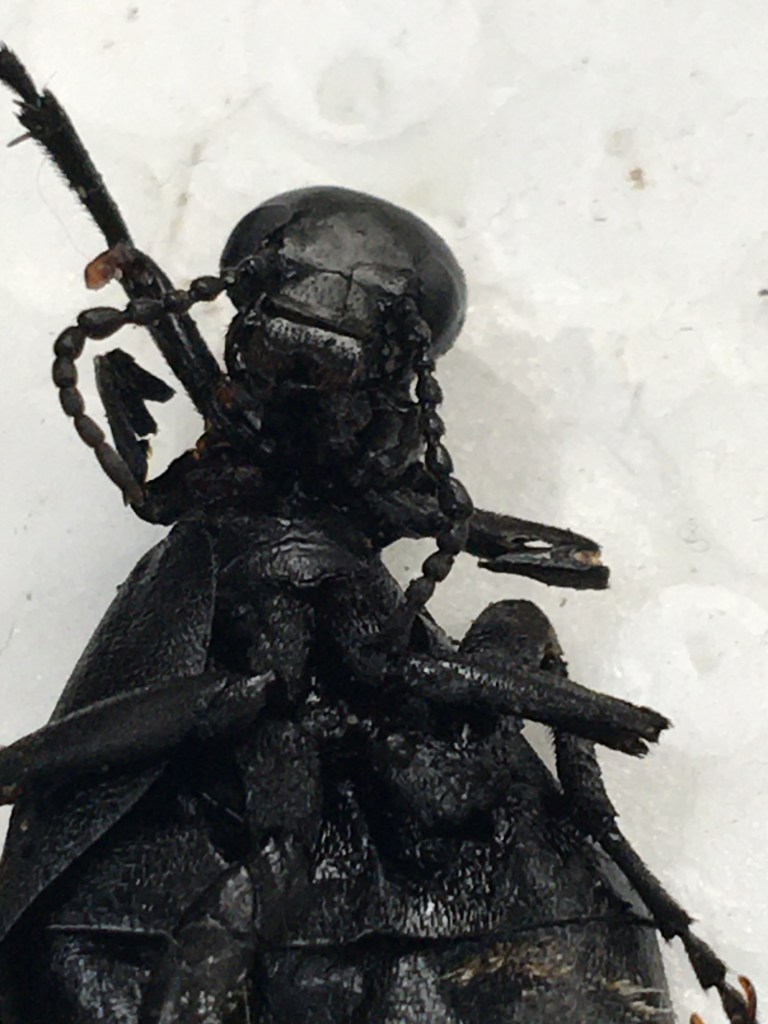
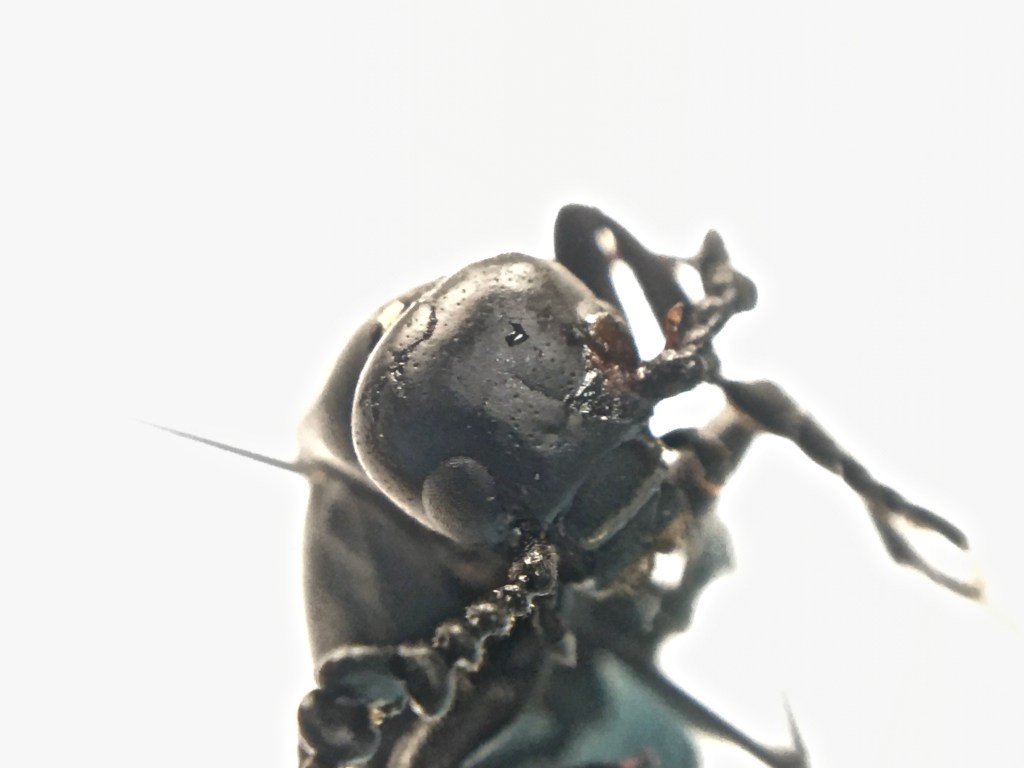
Ever the opportunist, I scraped up as many that weren’t quite so smushed into a container and brought them home. Out of the 5 I collected, 2 were male, 2 were female, and one missed antennae altogether. Given the number of beetles in the road in this one spot, I believe this was a mating aggregation.

Meloe strigulosus (male)
San Juan Island, WA
11/2/2019

So, I’ve been reading about them and communicating with a two experts on blister beetles. If you don’t know what these are, they are significant because of a defensive chemical in them called Cantharidin. Cantharidin is quite toxic and it’s a blistering agent. This is where they got the name Blister Beetles in the first place.

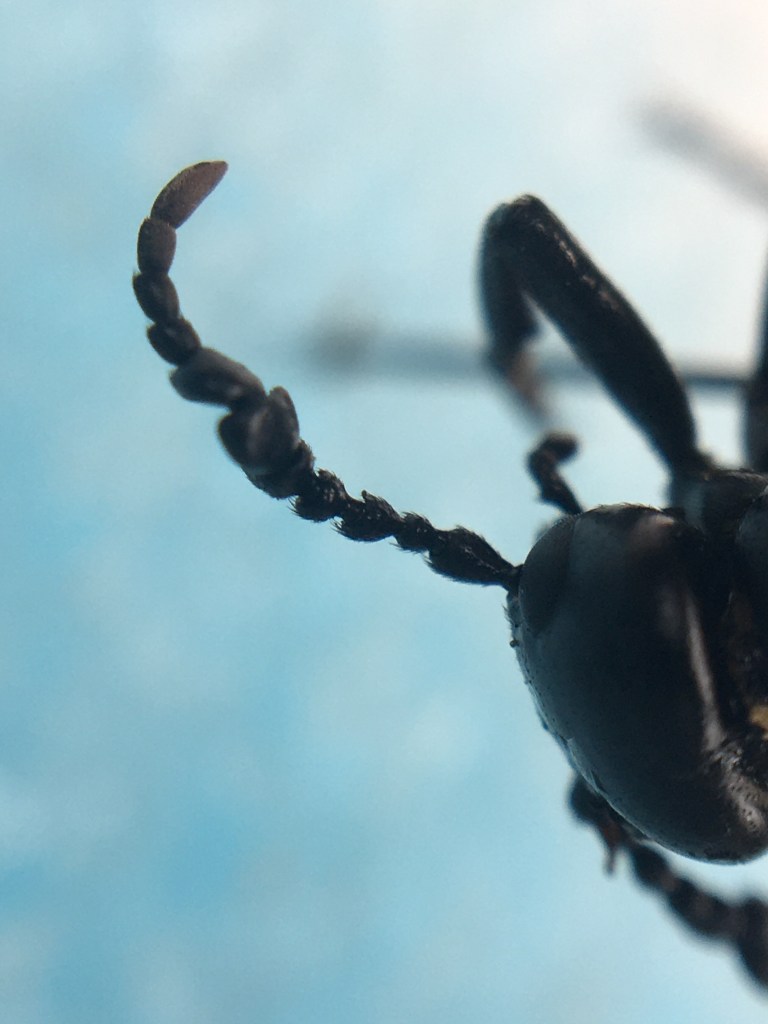
antennal segmentation of male Meloe strigulosus
San Juan Island, WA
11/2/2019

Since my first sighting of these beetles back in April, I’ve learned quite a bit about them. The ones here (Meloe strigulosus) are black, flightless, tanker-like beetles, carrying around a cargo of toxic brew. They are sometimes a hazard to livestock (actually almost all mammals) that might eat them because the Cantharidin is toxic. Horses, goats, cows, and sheep that eat alfalfa hay can get really sick with colic if there are even parts of dead beetles in the hay.

While we don’t really know exactly how Cantharidin is produced in the beetle, we do know these two things: 1) it’s produced in the male and transferred to the female during mating. 2) the female transfers Cantharidin as a protective coating for her eggs during oviposition. It’s believed that the first instar larvae (called triungulin) are equipped with a supply of Cantharidin as well.

After hatching, the triungulin crawl up onto flowers to hang out and wait to attach to the hairs of a visiting bee, riding back to its nesting site. The later developmental stages of larvae are protected underground or in holes in wood where native bees are developing. They consume the developing bee eggs, larvae and nest provisions (pollen and nectar).

Is there anything good about blister beetles? Well, strangely, the populations of some species of blister beetles are timed to coincide with grasshopper abundance. Adult blister beetles feed on grasshopper eggs. That’s good, right?

What else? Humans have used Cantharidin for years to remove warts and to remove tattoos as well. For ages, it has been used as a sexual stimulant. Even birds called Great Bustards have picked up on this! Read more here: https://www.ncbi.nlm.nih.gov/pmc/articles/PMC6521026/

Blister beetles seem to be beneficial to some other species of beetles too. There is one beetle that actually has been found to chew on the blister beetle as a means of obtaining Cantharidin for its own protection. Other animals like toads, frogs, and armadillos are known to eat these beetles or use them in some way to confer protection. There is even a nuthatch that uses the beetle to “sweep” the wood where it wants to build a nest to protect it from parasites.

Back to my weekend sighting and collection of a few of these specimens. I had two that were intact enough to pin for my collection. I wore nitrile gloves to make sure I didn’t come into contact with any blistering agent. It’s a good thing I did. Some fluid made contact with one of the fingers of my gloved hand and actually started eating through it. That’s pretty caustic!

If you’re interested in more information about them, I’m happy to email some of my collected literature. There are also links you can check out in my previous post from April.

Thanks for reading!