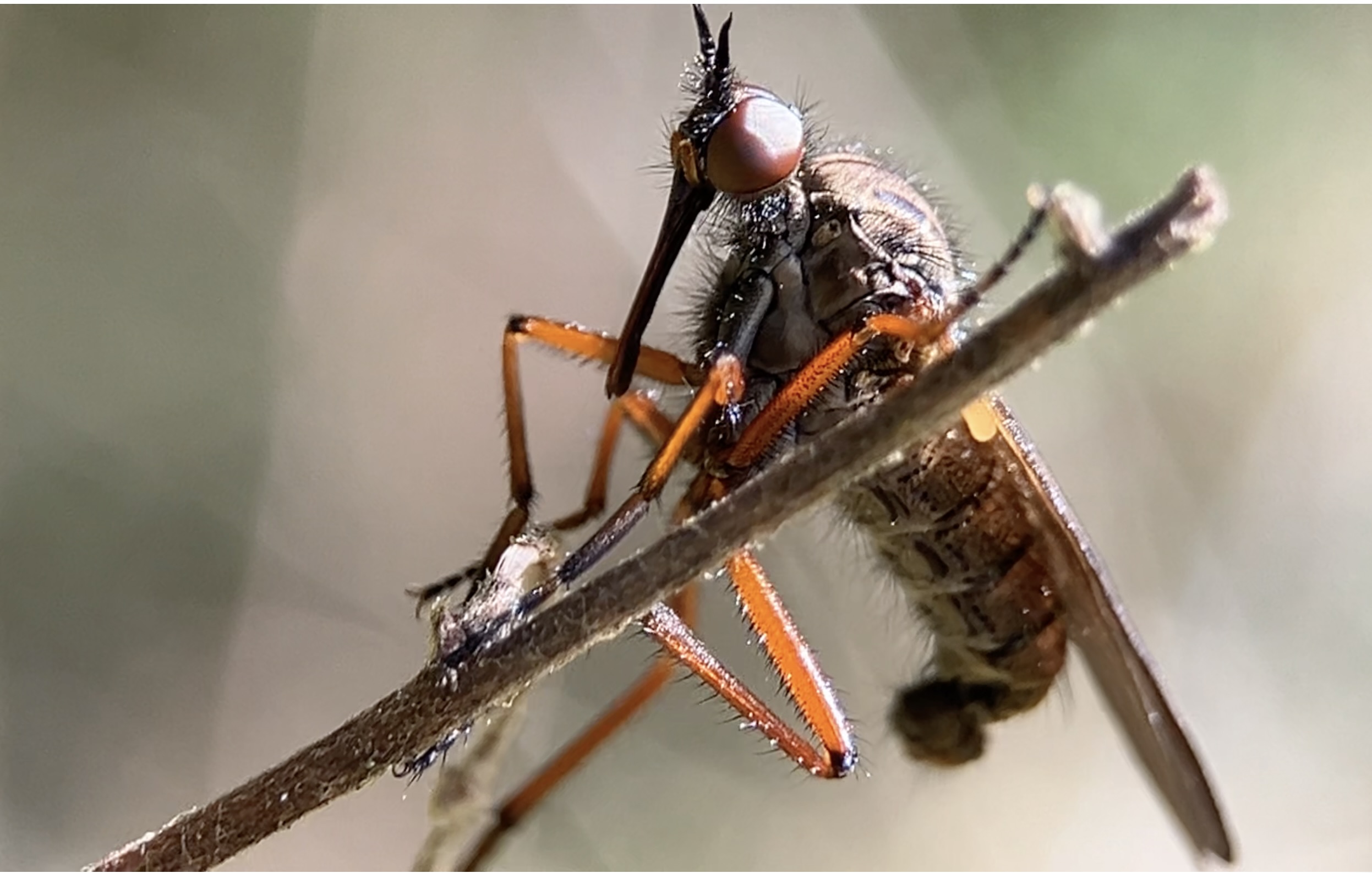
That’s right! Herman the Persian found something interesting in the yard when we were outside sunning ourselves a bit this afternoon. He found one of the Bibionid March flies (a female). If you read my post yesterday https://buggingyoufromsanjuanisland.com/2025/04/04/nuptial-gifts/, you might note that Bibionid flies were being hunted by Empis flies who rolled them into little balls as nuptial gifts used to woo the lady Empids to mate.
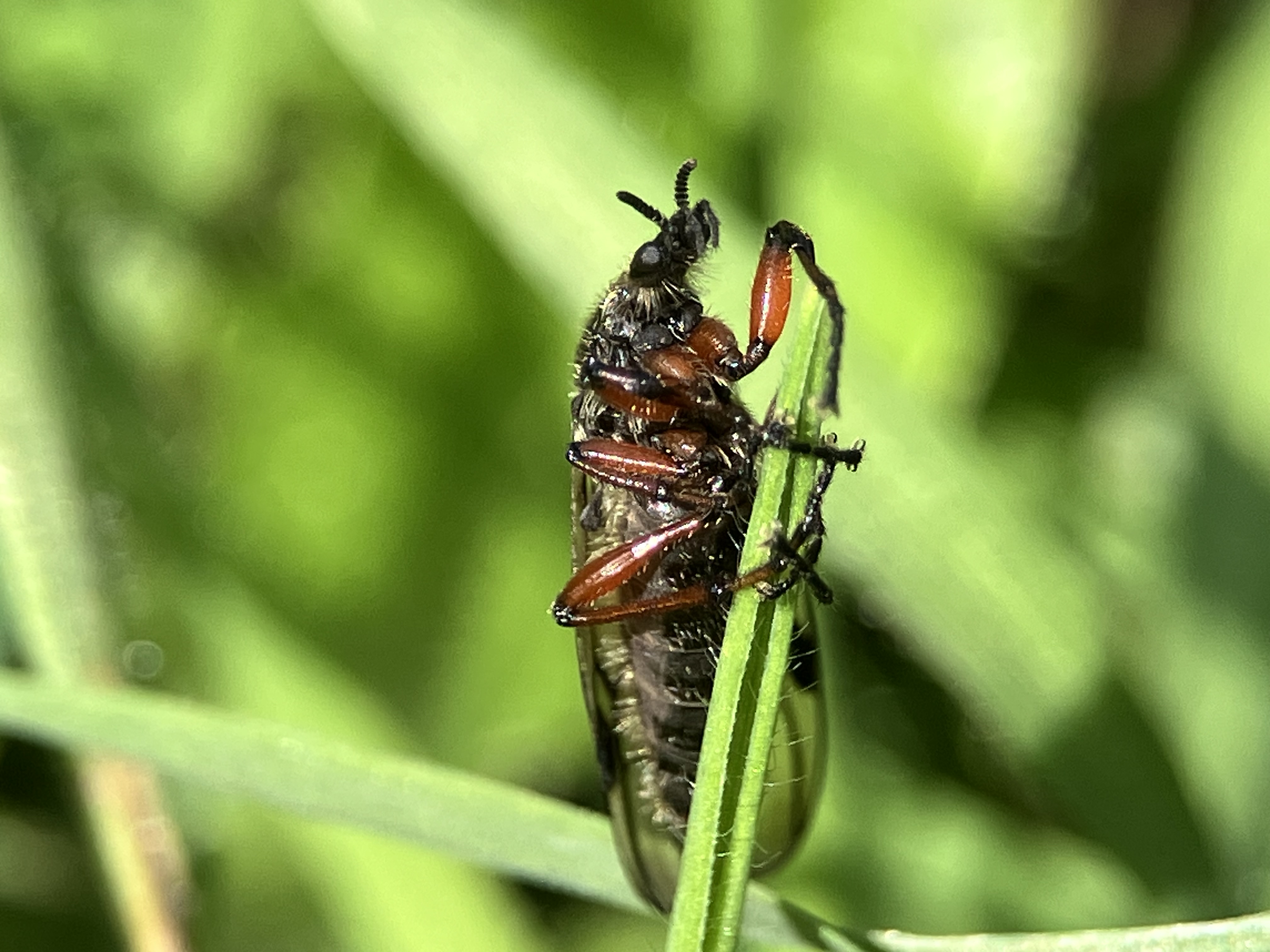
Female Bibionid fly digging chamber to lay her eggs.
Evidently, a few of these Bibionid flies escaped that destiny and actually mated with their own kind. THIS one, that Herman found, was hard at work digging her own death chamber where she would expire soon after laying her eggs. Incidentally, the adults are very short-lived, and in fact, live only about 5-7 days with the primary objective of mating, and for the adult female to lay her fertilized eggs. In spite of their brief existence, adults are also thought to be important early pollinators of orchard trees. Yes, you heard me right! Flies don’t get nearly as much credit for pollinating as they deserve to receive.
I watched her digging with her fossorial forelegs. It seemed to be an impossible task, but she made slow and steady progress. She was still hard at work before we went back into the house about half an hour later. I marked the spot with a rock so I could go back and check, but I suspect even with the rock nearby as a marker, it will be next to impossible to detect any disturbance in the soil tomorrow. We’re supposed to get rain this evening.
In approximately 30-35 days, the eggs she lays will hatch underground. The larvae will live in the top layer of soil and feed gregariously on leaf and needle litter, decaying organic matter, and sometimes on below-ground parts of plants.
If you’re curious, you can read more about Bibionid flies in the attached links. I did see some additional Empis fly males dancing about today with their Bibionid “balloons” or nuptial gift balls for prospective mates.
Morris, H. No date. The larval and pupal stages of the Bibionidae. Entomological Department, Institute of Plant Pathology, Rothamsted ExperimentalStation, Harpenden. https://core.ac.uk/download/pdf/212009582.pdf
This afternoon I would rate a 10/10 for entomological adventure. It happened outside, just behind our barn about 3:30pm. I went out to feed our resident raven and took a stroll over to a sunny corner of our property. As I neared an old barbed wire fence line, I noticed an aggregation of flies bobbing around over one of the native Ocean Spray (Holodiscus discolor) shrubs. Moving closer, as stealthily as possible, I saw these were Empis dance flies and I got very excited. There seemed to be about 15-20 in the group.
Empis Dance Fly (male) with Bibionid fly nuptial gift
I watched as I stood in the sun. The sun’s warmth felt really good on my body. Hopefully, we will have more sunshine and some days of vitamin D will infuse my cells and pull me out of this funk I have been wallowing in. The flies dancing in the sun were a sight. I crept forward a bit closer, trying not to slip into the fencing, but enough so as to get some video to share.
You will have to forgive me for the shake in the footage. It is not easy to remain steady and focus on a nervous fly that leaves its perch if you so much as breathe too deeply when you are moving the camera close enough to zoom in for a good macro shot. I think I was holding my breath a lot while I was trying to take pictures.
Empis Dance Fly with nuptial offering
This fly should be classified in the genus Empis. Last year, I found Empis barbatoides in our orchard. You can read an earlier blog post I wrote about them here https://buggingyoufromsanjuanisland.com/category/dance-fly/empis-barbatoides/ I believe these may be the same species, but I say this with a caveat. I am hoping to get my hands on a copy of the revisions by Sinclair, Brooks, and Cumming I have referenced below. It appears I may need this and the updated keys to try and ID my fly beyond genus level, so I’ve emailed the lead author and hopefully will hear something back.
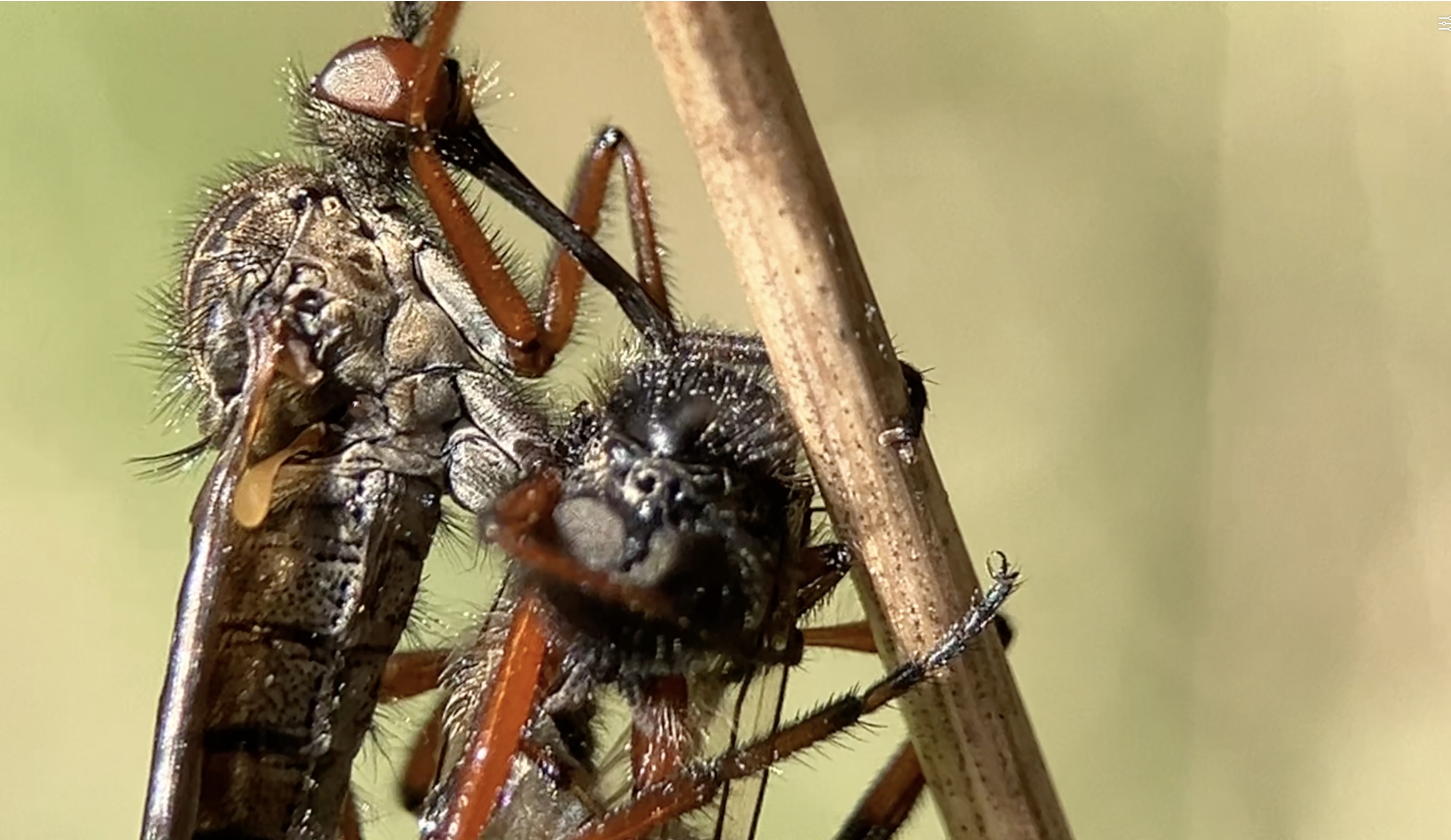
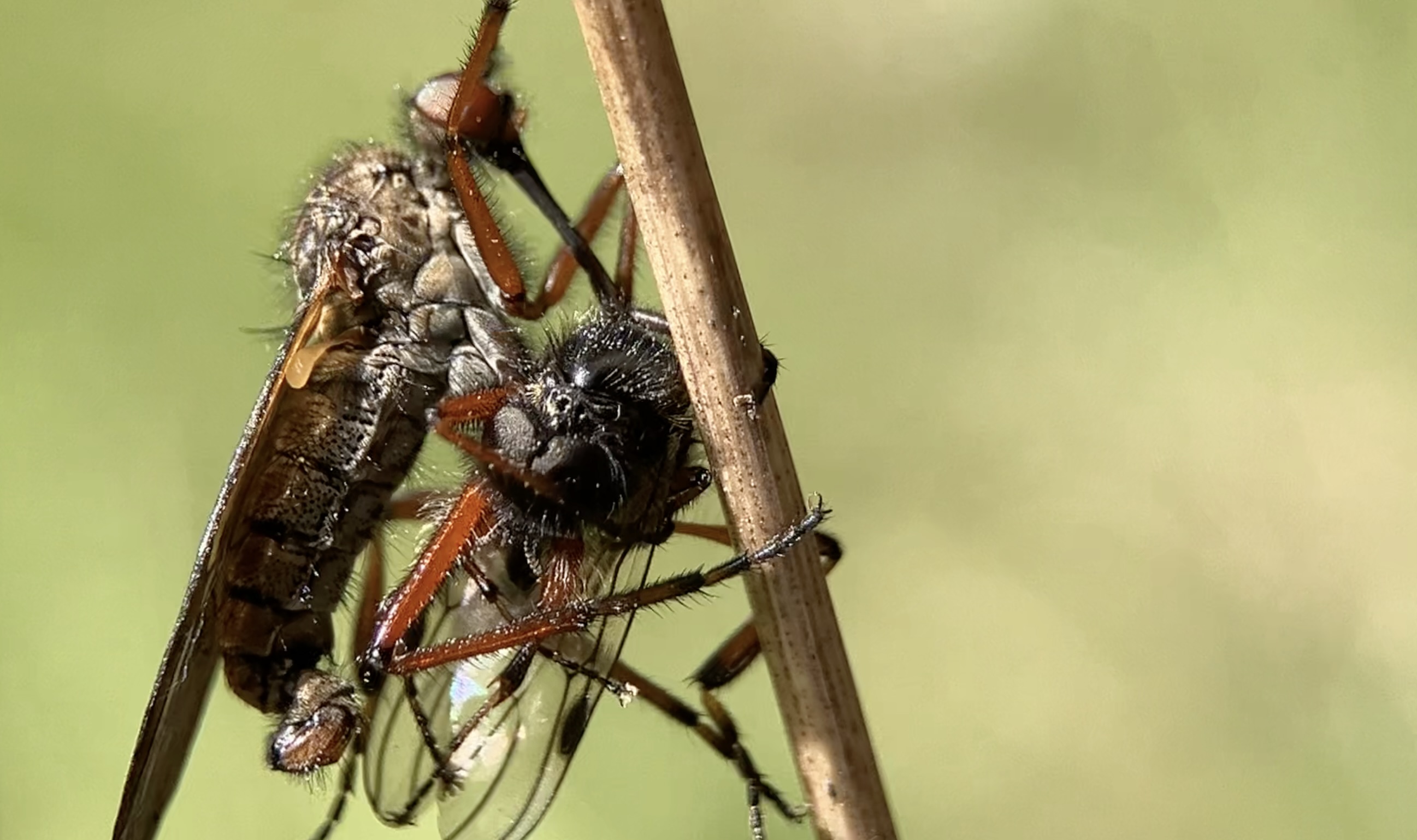
If you look closely, you’ll see in some of the photos the fly is holding a balled up insect. This is a species of March fly in the family Bibionidae. I saw a few hiding around in the tall grass like this one in the photo below.
March fly (Bibionidae) hiding in the grass
Evidently, they were being picked out by the male flies and rolled up into a nice nuptial gift to present to a female Empis fly to entice her to mate. The male Empis fly will carry this balled up dead insect and “dance” around to attract a female. That’s what I found so fascinating to actually watch in person. It isn’t every day you see something like this! Since flies seem to be attracted to certain spots for mating aggregations (it’s called hilltopping), perhaps this is a spot where I might be lucky enough to see this action again.
References and Further Reading:
Alcock , John. 1973. The mating behaviour of Empis barbatoides Melander and Empis poplitea Loew (Diptera: Empididae), Journal of Natural History, 7:4, 411-420, DOI: 10.1080/00222937300770301
Sinclair BJ, Brooks SE, Cumming JM. Revision of the western Nearctic species of Empis subgenus Enoplempis (Diptera: Empididae). Zootaxa. 2025 Mar 31;5615(1):1-200. doi: 10.11646/zootaxa.5615.1.1. PMID: 40173481. https://pubmed.ncbi.nlm.nih.gov/40173481/
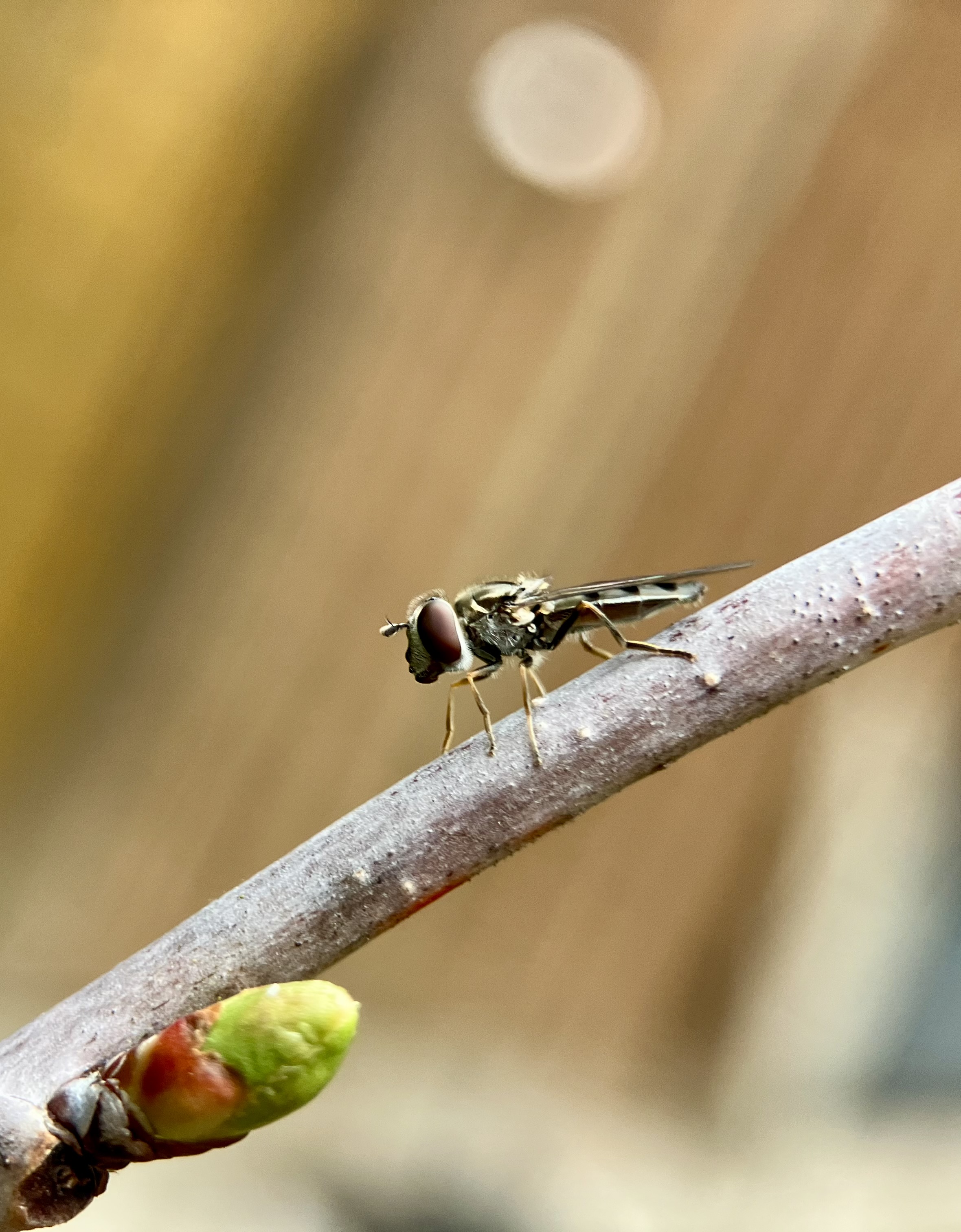
This was Wednesday’s bug of the day. I’m a day behind writing up my post. Although I have tried to get out for a quick bug search every day, it’s been overcast and/or drizzly here this past week. I was excited to see this little fly hunkered down on a twig of our fruitless cherry tree, the tree that I whacked off as an unwanted upstart for several years before I discovered how interesting it is.
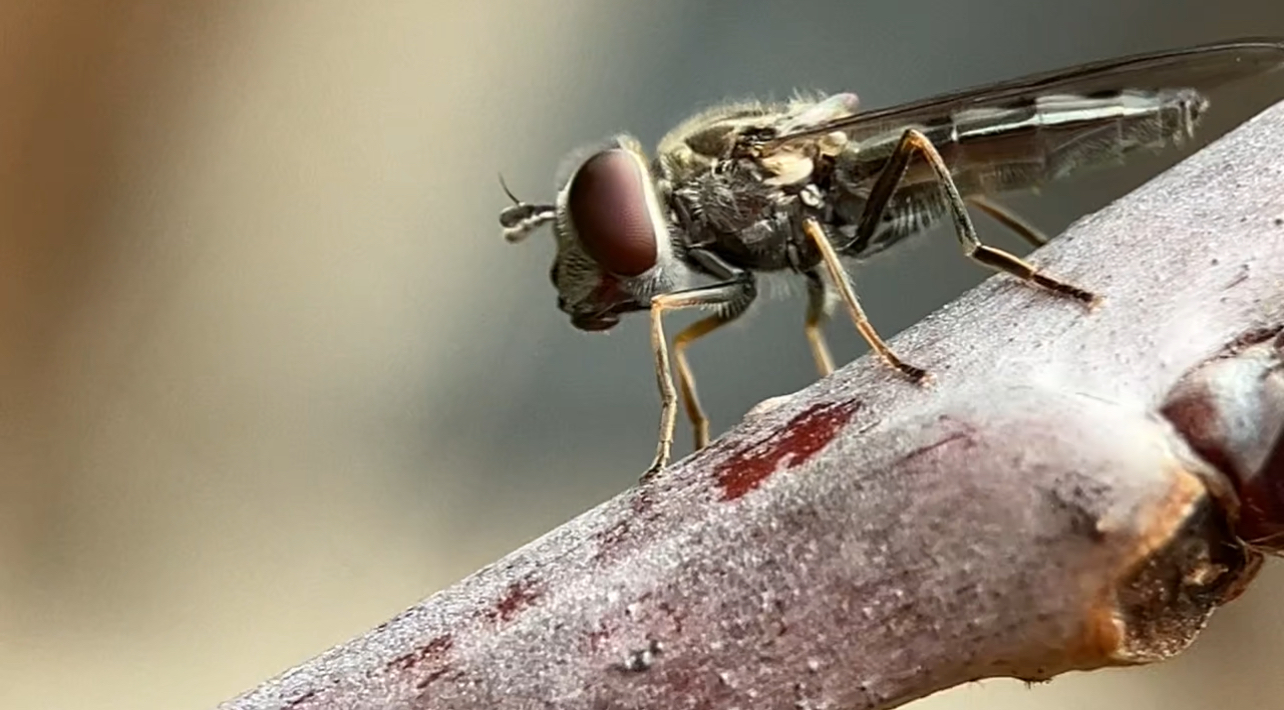
Western Forest Sedgesitter, (Platycheirus trichopus), I believe
That tree is a mini ecosystem: floral nectaries that feed the aphids, aphids, slave making ants that have fights to the death (winning) with the carpenter ants that try to invade our home every spring, and the birds that rip the leaves apart trying to get the aphids. Now I can add Syrphid flies to the list!
That’s what this is. A syrphid fly. Syrphid flies eat aphids. It would make perfect sense for this adult to lay eggs on the tree, though I’m not sure what would happen because the ants that farm those aphids are certainly willing to die defending them. I could definitely see the ants overtaking the syrphid fly larvae. Nevertheless, the fly flew off. Somewhere.
This species, as mentioned earlier is pretty small at only about 6.8-9.4 mm. Geographic distribution ranges from the Rocky Mountains west from Alaska to Mexico (bugguide.net). Adults of this genus are known to feed on the pollen of wind pollinated plants like Willow (Salix sp.) and various grasses (Poaceae), and sedges (Cyperaceae). It is believed they are better adapted to activity in cooler temperatures and that fits with yesterday’s rather gloomy spring day.
I found this very tiny (1mm) beetle on the rim of the pool outside yesterday (Dec. 8, 2023). In my investigational efforts to identify my specimen, I have concluded it should be one of the Minute Brown Scavenger Beetles in the family Latridiidae (pronounced la-trid-eye-i-dee). As to species, I think it is Cartodere bifasciata – based on the color pattern of elytra – black markings between 2nd and 5th stria in anteriour third and behind middle; lateral black spot in about middle. (Bugguide, 2014).
This particular species is an Australian native and likely introduced to North America via international shipping. Records show this species in Nova Scotia about 1989 (Majka et al 2009). Looking on iNaturalist for observational reports of this species, I see a few (about 15 or so) in the box I drew. You can see in the attached screenshot the general area where they are turning up in the Western US. Again, likely introduced via international shipping cargo.
Reported observations of Cartodere bifasciata in the PNW Region
Adults of beetles in this family are generally known to feed on the reproductive structures of fungi, plant and animal materials, and slime molds (Evans, 2021). They are found in association with wet or damp habitats in open or forested areas, especially in leaf litter, decomposing wood, on trees, herbaceous vegetation, and in bird, mammalian, or hymenopteran nests (Majka, 2009).
Evans, A. V. 2021. Beetles of Western North America. Princeton University Press, N.J.
Majka CG, Langor D, Rücker WH. 2009. Latridiidae (Coleoptera) of Atlantic Canada: new records, keys to identification, new synonyms, distribution, and zoogeography. The Canadian Entomologist. 141(4):317-370. doi:10.4039/n09-050.
Two weeks ago, I stopped by the San Juan County Conservation Land Bank’s office to take a look at the newly transformed “lawn-to-meadow” native plant garden. This sample meadow is an effort coordinated by Land Steward, Eliza Habagger, as part of The Salish Seeds Project (https://sjclandbank.org/the-salish-seeds-project-bringing-back-island-wildflowers/). I was astonished at how quickly (seemingly overnight), the wildflowers planted in this small space bloomed. Aside from being much more appealing than grass, this new wildflower meadow is hosting an assortment of pollinators.
Hemipenthes sp. Bee Fly (Bombyliidae) at San Juan County Land Bank demonstration meadow – May 18, 2023
Here’s a species of fly I saw that, at first-glance, looks a lot like a biting deer fly. It is actually a type of Bee Fly in the family Bombyliidae with no common name. Its Latin genus name is Hemipenthes, and this one keys out to Hemipenthes morioides.
Hemipenthes means ‘half-veiled in black’ and refers to the wing pattern seen in this group. I used a key by Ávalos-Hernández (2009) to work out my identification and consulted with another fly specialist who agreed. In the video clip of the fly, it looks to be ovipositing in the sand, indicating my specimen is female. I’ll come back to this in a bit.
I believe this is Hemipenthes morioides, a Bee Fly – May 18, 2023, San Juan County Land Bank Native Plant Garden
Literature describes Hemipenthes morioides flies as hyperparasites (a parasite of a parasite) of the larvae of parasitic flies (Diptera, Tachinidae), as well as parasitic wasp larvae (Hymenoptera, Ichneumonidae). Brooks (1952) cited this species as a predator of the tachinid fly Bessa harveyi, which is a parasite of the sawfly Pristiphora sp. (Hull, 1973). H. morioides has been collected mainly in the western states of the USA (Ávalos-Hernández (2009). They also are known to parasitize caterpillars of moths in the family Noctuidae (Bugguide.net 2020). Preferred habitats are forest edges and meadows.
Of course, this leads me to ask all sorts of questions about how exactly this process of hyperparasitism takes place, especially with regard to being parasites of Tachinid flies. That’s because most parasitic tachinid flies lay eggs directly onto their host’s body. How would the Hemipenthes fly eggs, laid in sandy substrate, get into a Tachinid fly egg laid onto another host?
Do Hemipenthes fly eggs laid into soil hatch, and then migrate through the soil to find an about-to-pupate or already pupating host? As to finding literature specific to Hemipenthes morioides with detailed descriptions about this process in the wild, I wasn’t successful. It seems to be such a complex relationship that chances of observing this happening in a natural setting are slim. For now, I’ll just have to be satisfied with knowing the taxonomy. The rest may remain a mystery…🤔
Except I like to solve mysteries, or try to at least! I reversed direction (taxonomically) in my literature search to see what studies are published around the Family (Bombyliidae). In The Evolutionary Pattern of Host Use in the Bombyliidae (Diptera): a diverse family of parasitoid flies by David K. Yeates and David Greathead (1997), I discovered the “ovipositing” I observed is something entirely different. This female Hemipenthes fly was filling her “sand chamber” or “psammophore,” a ventral abdominal pocket into which the eggs are laid, and a feature unique to “higher” Bombyliidae (Yeates & Greathead, 1997; Calderwood, 2007).
Further, Calderwood (2007) comments in Bugguide.net, “It is said that eggs are coated with sand in the chamber to fascilitate release later. I (Calderwood) think that, given the relative size of sand grains and Bombyliid eggs, the reverse is true: the tiny eggs coat sand grains in the chamber, which are heavy and easier to toss with accuracy, kind of like sticking a piece of gum to a baseball. Ovipositing looks like little aerial dipping movements accompanied by flicks of the keester. Eggs are thrown through the air.” I agree with Calderwood’s statement, and how fascinating this behavior is!
Two weeks later, I’m still threading through a stack of literature about Bee flies Bombyliidae. I’ve discovered that almost all Bombyliidae bee flies (including this Hemipenthes fly) go through what is called hypermetamorphosis. Those eggs, which were flung through the air onto vegetation or the soil substrate will hatch into what is known as a first instar planidium. This is the form of the fly that must search to find a suitable host for development (Yeates & Greathead, 1997).
The planidium morphology is such that it is adapted for mobility/locomotion, host-finding, and attachment. It has an elongate body with two long setae and fleshy pseudopods at the end of its abdomen. There are also a pair of elongate setae on each thoracic segment (Du Merle, 1972). Examples of hypermetamorphosis and this mobile, first-instar form of larvae include quite a few other groups of insects. One example being the one between Strepsipteran larvae (known as triungulins) and Blister Beetles (Meloidae).
I’ll leave you with a nudge to pick up the Yeates and Greathead (1997) paper. It’s really pretty fascinating. Complex?Yes. Studying nature is one of the most intriguing topics you can delve into. There are many intricate pieces all woven together. Yeates and Greathead describe the chance observations of the process of development in Bombyliidae by scientists as serendipitous. I think it’s quite serendipitous that these tiny, first instar larvae ever find a host in the first place. More on Hemipenthes flies below.
Thanks for reading!
Taxonomy (bugguide.net, 2020)
Family: Bombyliidae (Bee Flies)
Subfamily: Anthracinae
Tribe: Villini
Genus: Hemipenthes
Species: Hemipenthes morioides
Identification (bugguide.net, 2020)
Head: Round; dark brown to black.
Male and female: identical, eyes of female only slightly wider, barely discernable.
Antenna: Black, very short.
Thorax: Dark brown to black with rust hairs across shoulders; sometimes thorax is bald. Thorax sides may have some yellowish hairs which do not form a definite line.
Wings: Dark brown, covering about 2/3rds of the wing, lower dark margin step-like. The dark extends to the inner margin or anal cell. Three sets of cross veins have a light mark on each side of the vein, called aureoles. One near base, one about mid-wing, and another small one below (or R4 + R5, M2 and CUP).
Legs: Dark brown with a row of spines on front shin (tibiae). Feet lighter.
Abdomen: Dark brown to black with small to large yellowish spots across each segment and a yellowish line across lower margin. Dark fringe mixed intermittently with some white on side edges of abdomen.
Habitat
Forest edges and meadows.
Season
All season in southern U.S. Late May to August in the north.
Distribution
Canada (British Columbia), USA (Arizona, California, Colorado, Idaho, Illinois, Indiana, Iowa, Massachusetts, Michigan, Minnesota, Montana, New Jersey, New Mexico, New York, Ohio, Oregon, Pennsylvania, Utah, Washington, Wisconsin, Wyoming), Ávalos-Hernández (2009).
References and Further Reading
Ávalos-Hernández, Omar. (2009). A Review Of The North American Species Of Hemipenthes Loew, 1869 (Diptera: Bombyliidae). Zootaxa. 2074. 1-49. 10.5281/zenodo.187152.
Brooks, A.R. (1952) Identification of bombyliid parasites and hyperparasites of Phalaenidae of the prairie province of Canada, with descriptions of six other bombyliid pupae (Diptera). Canadian Entomologist, 84, 357–373.
Yeates, D. K., & Greathead, D. 1997. The evolutionary pattern of host use in the Bombyliidae (Diptera): a diverse family of parasitoid flies. Biological Journal of the Linnean Society, 60(2), 149-185.
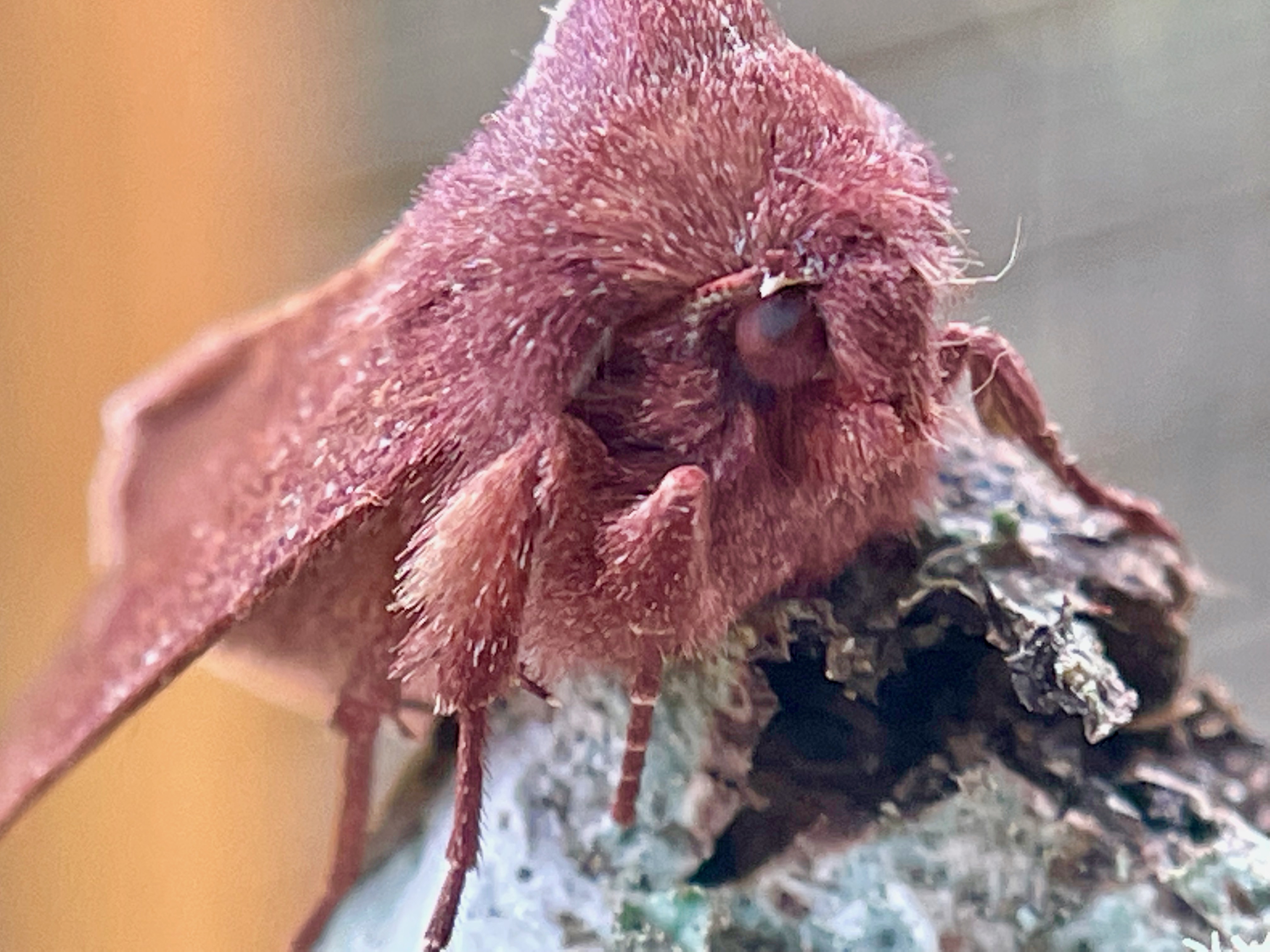
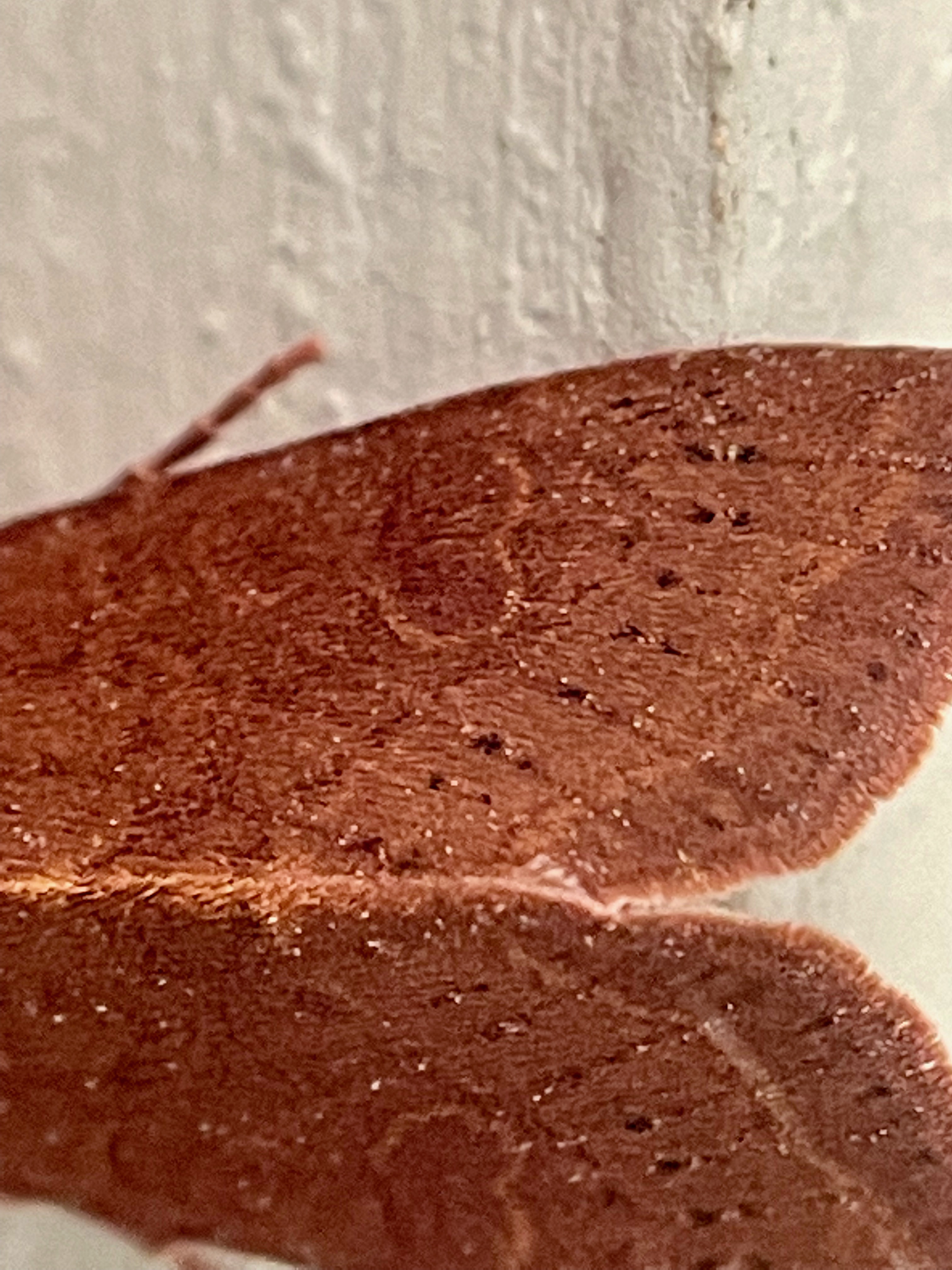
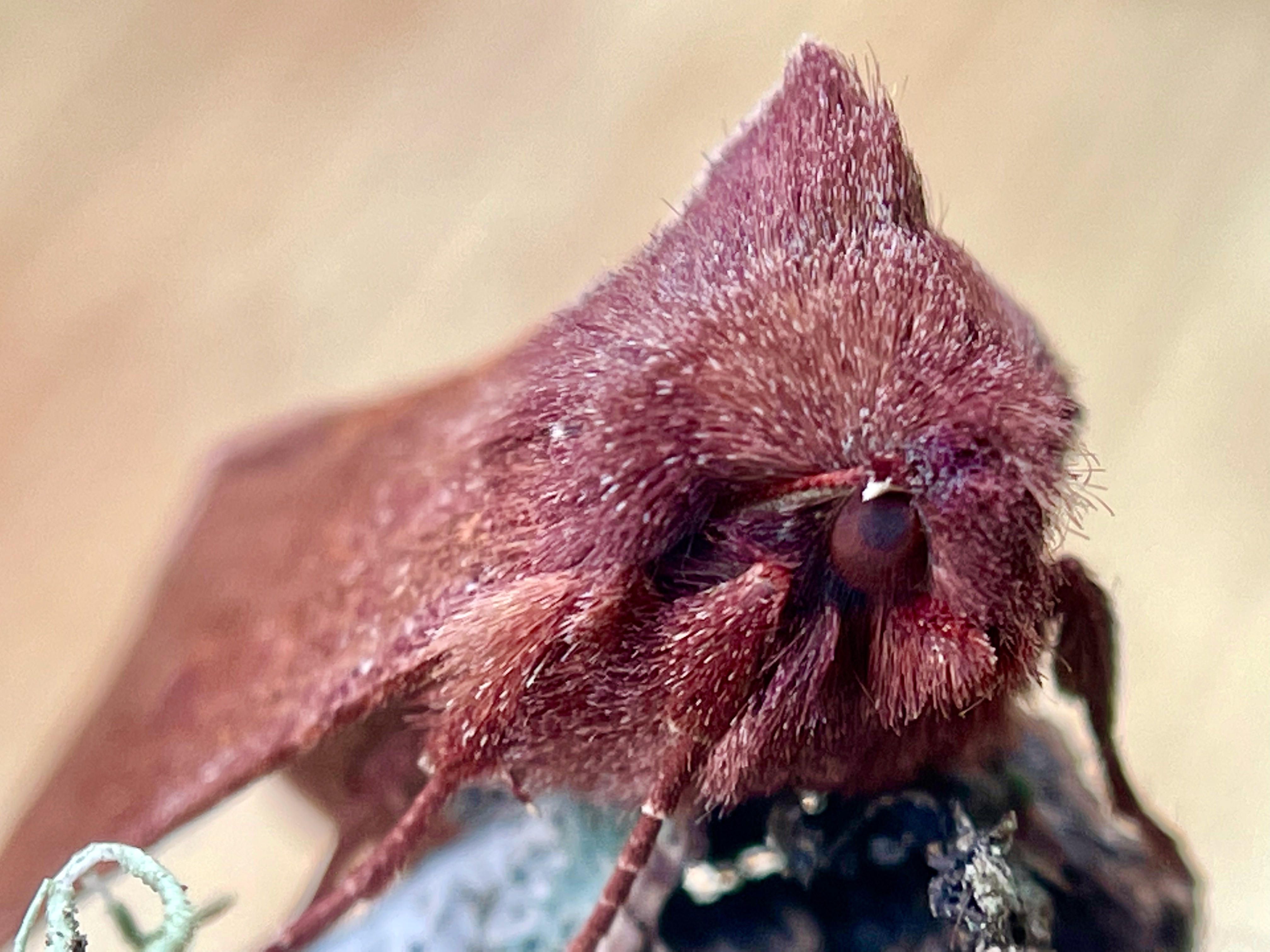
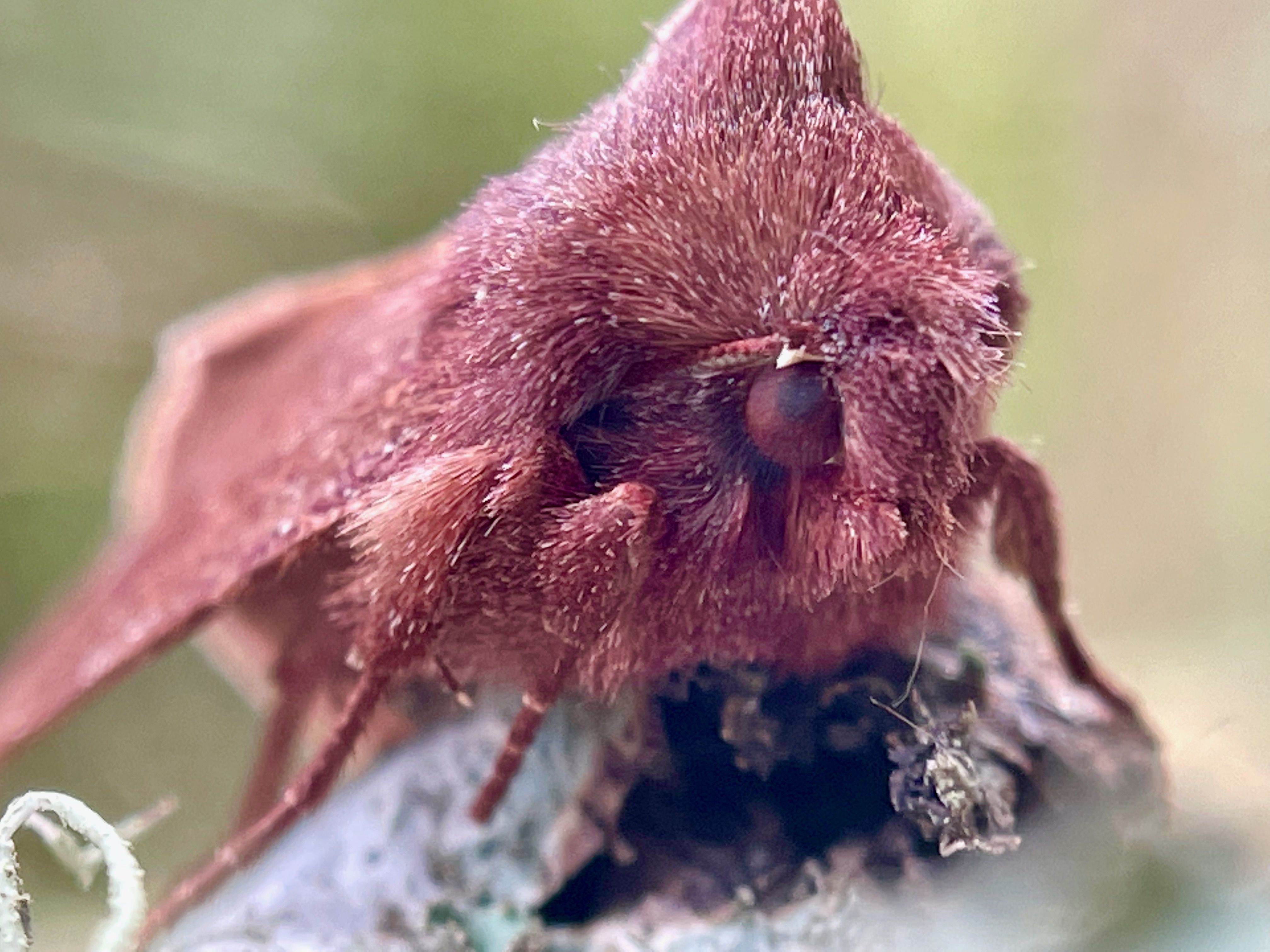
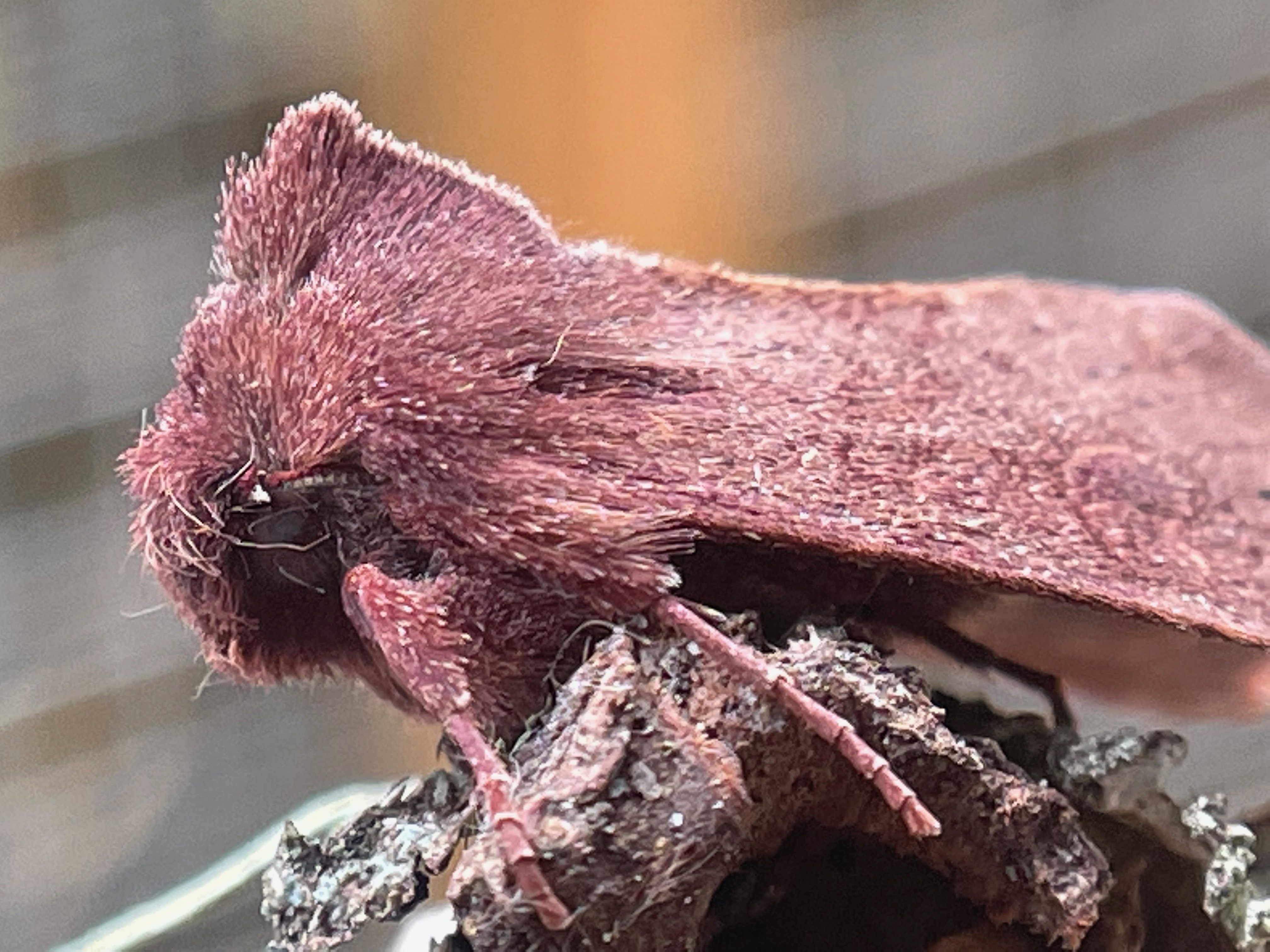
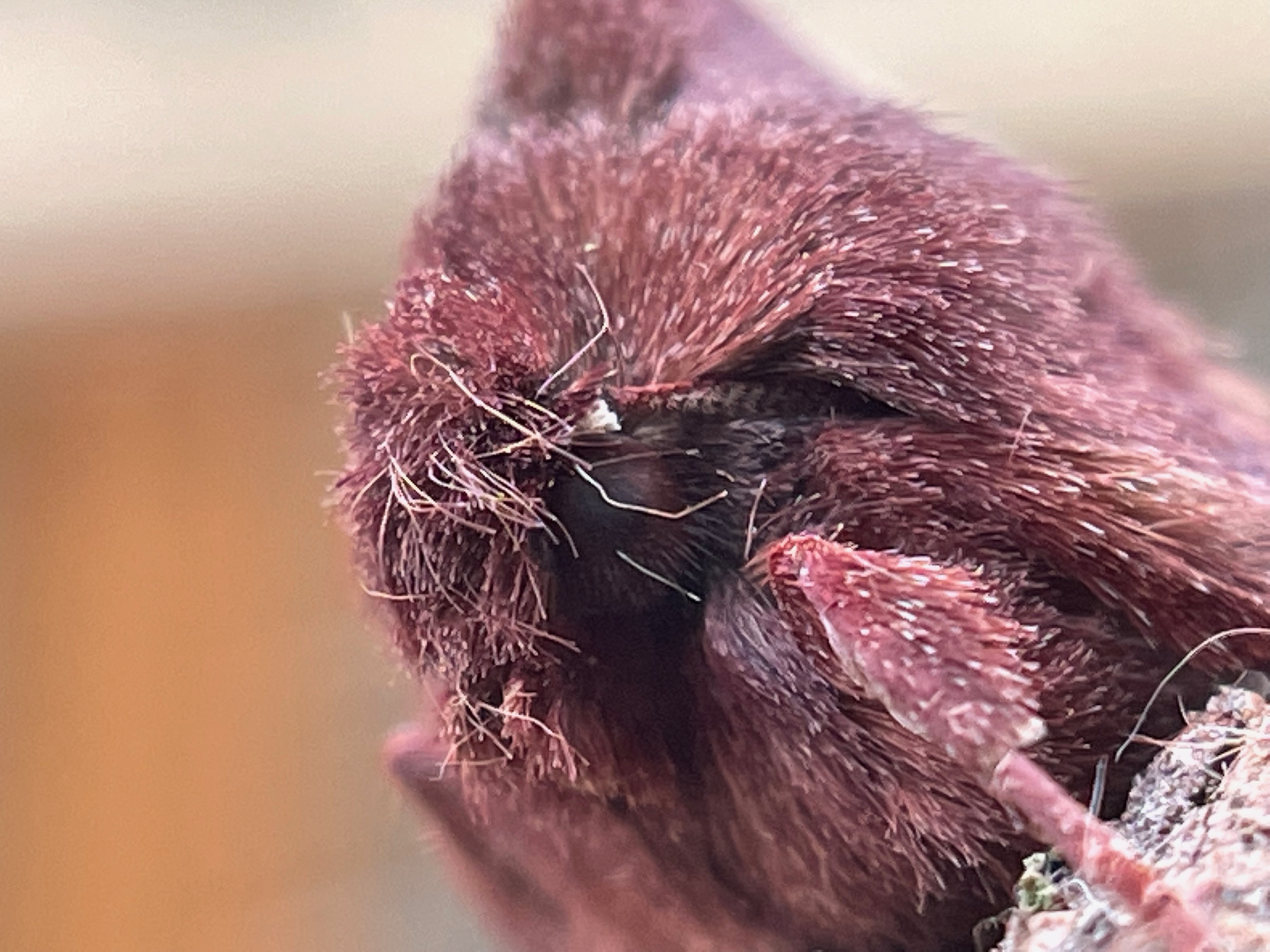
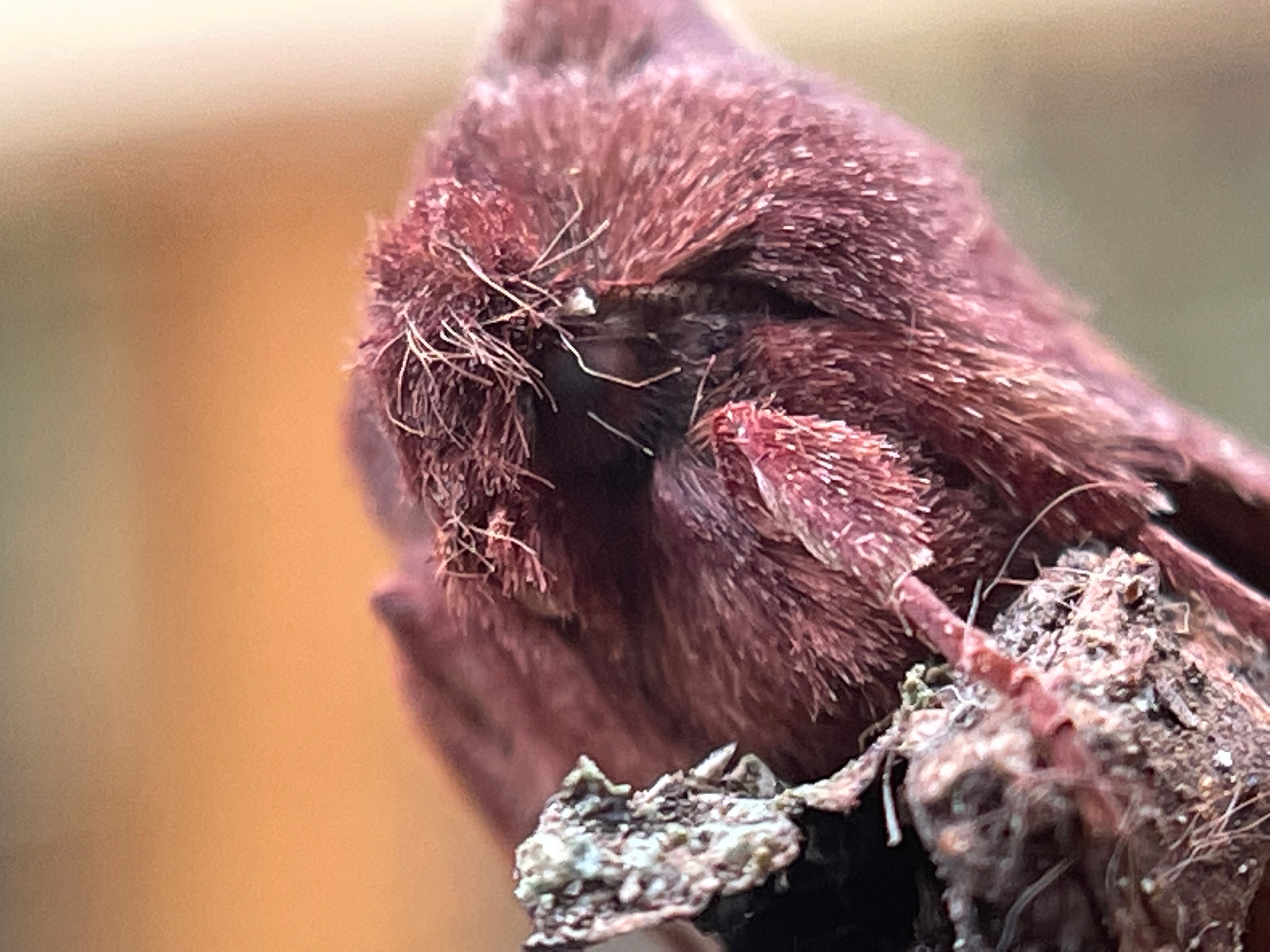
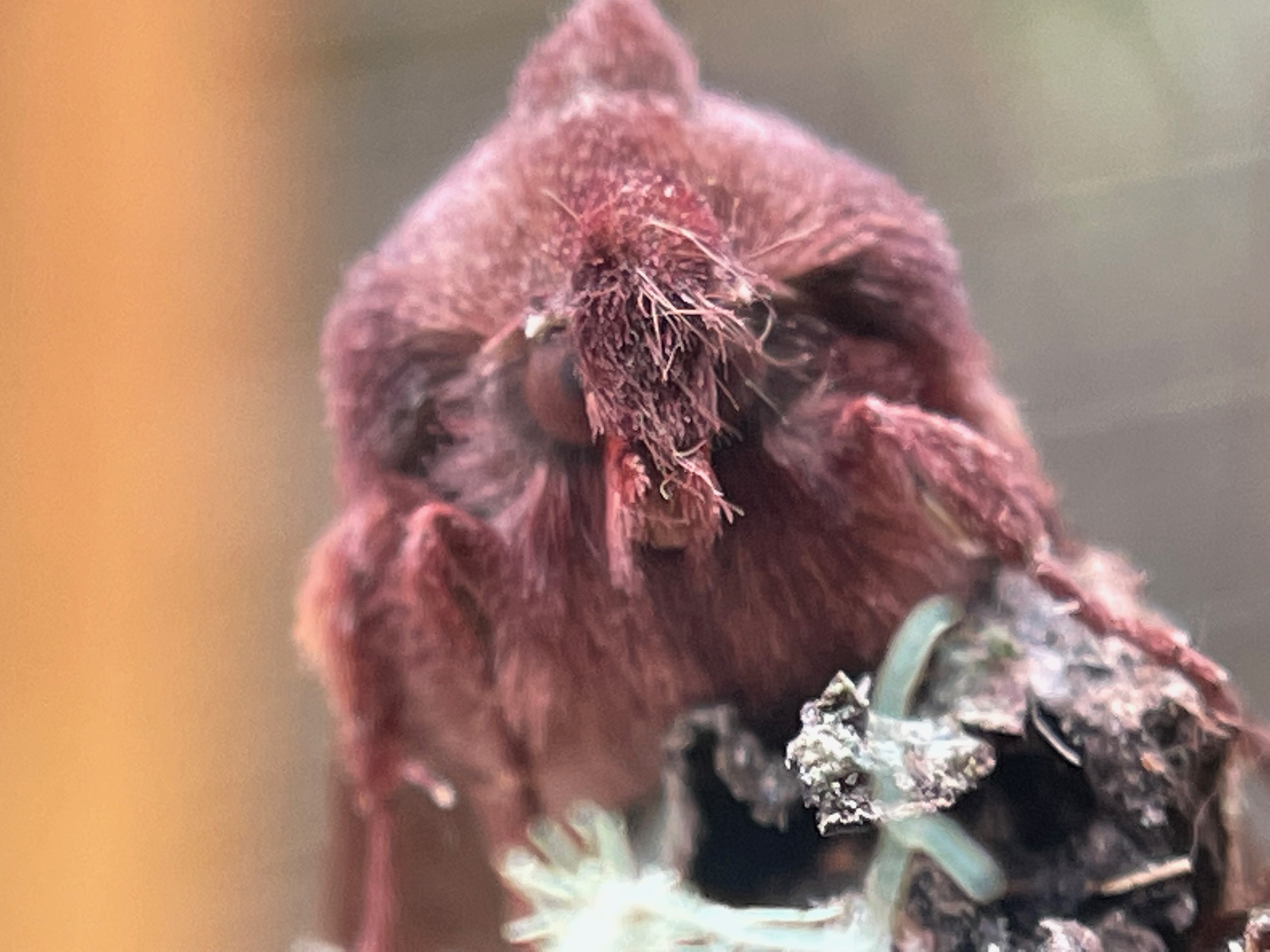
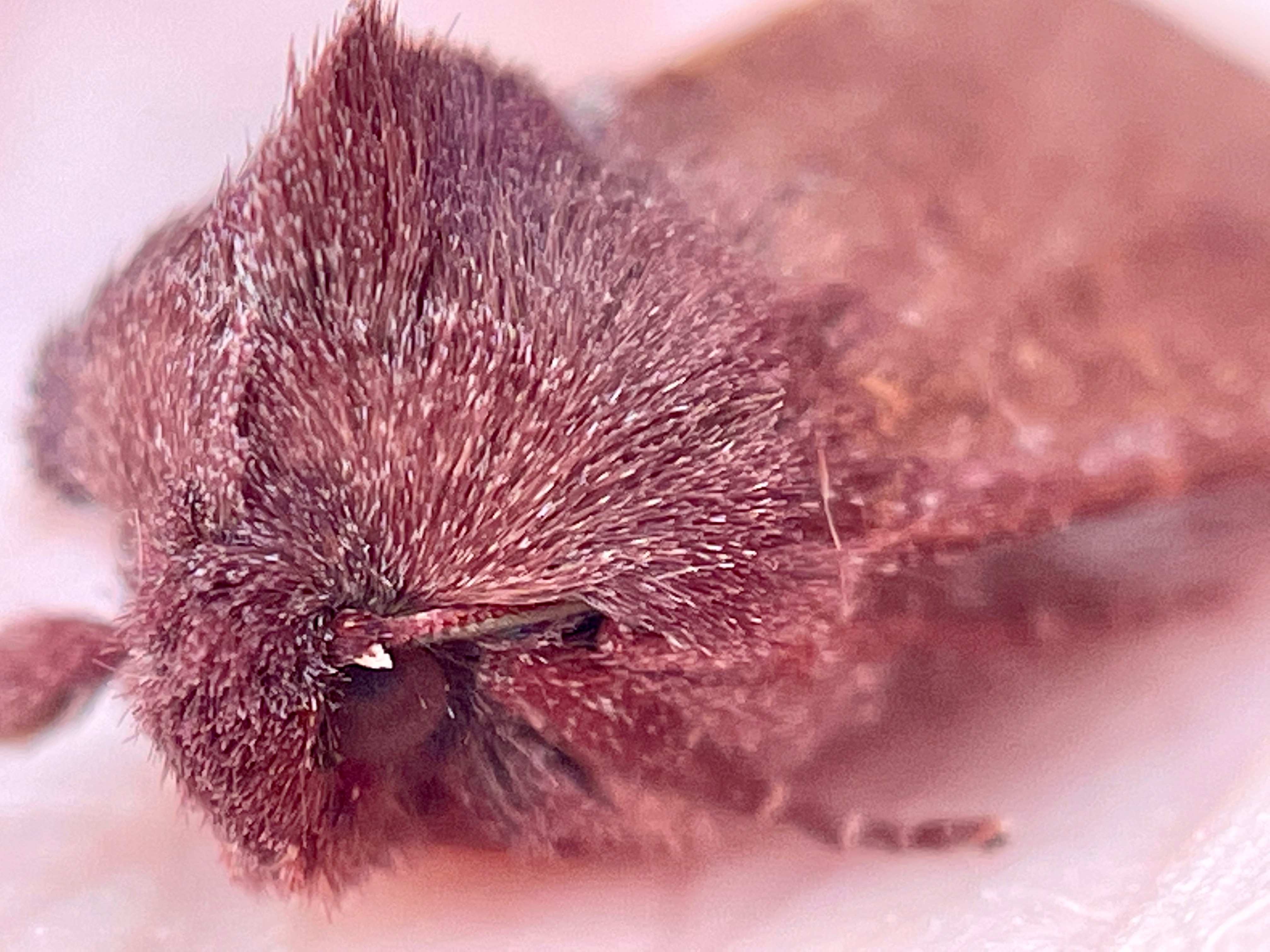
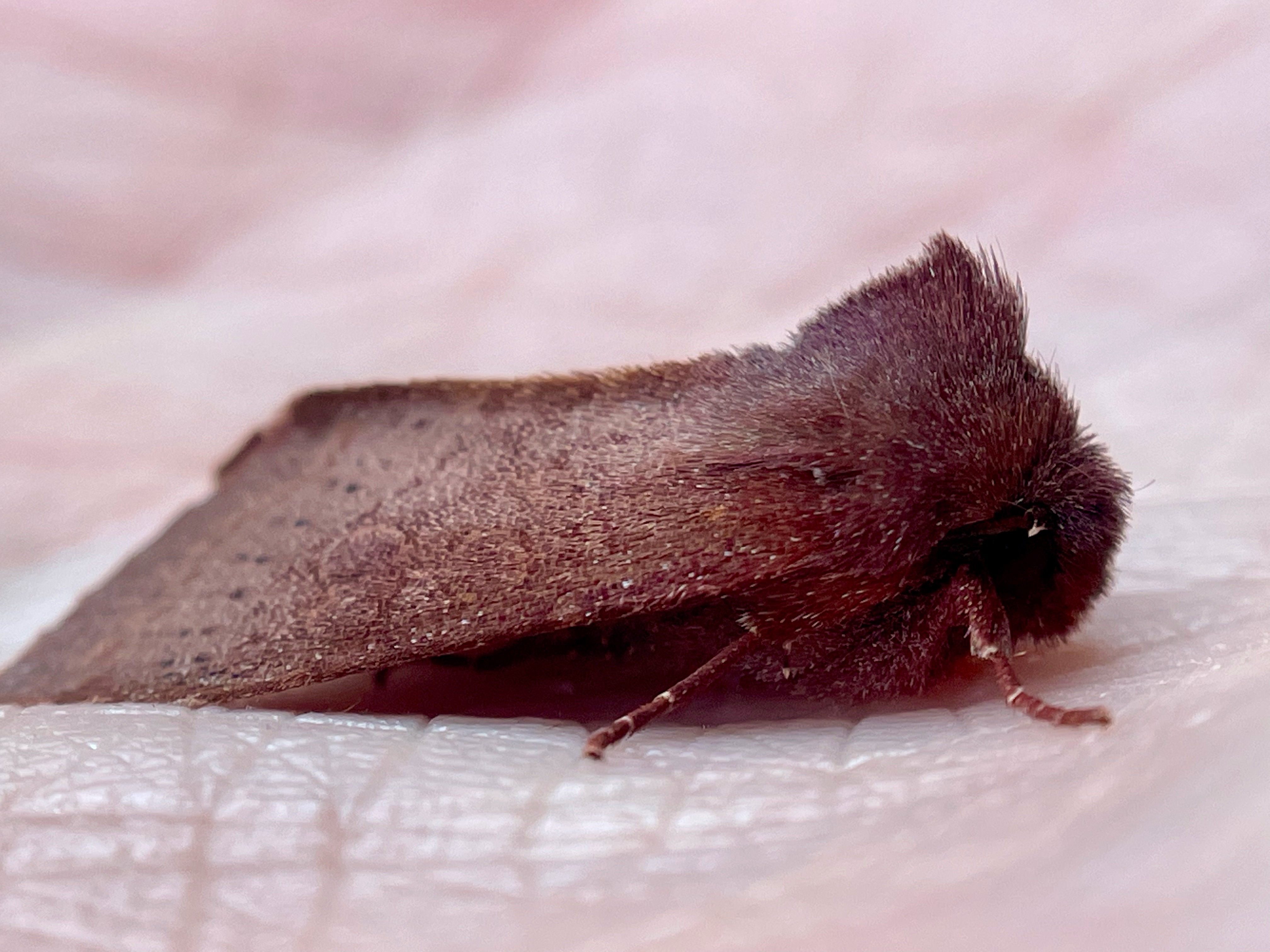
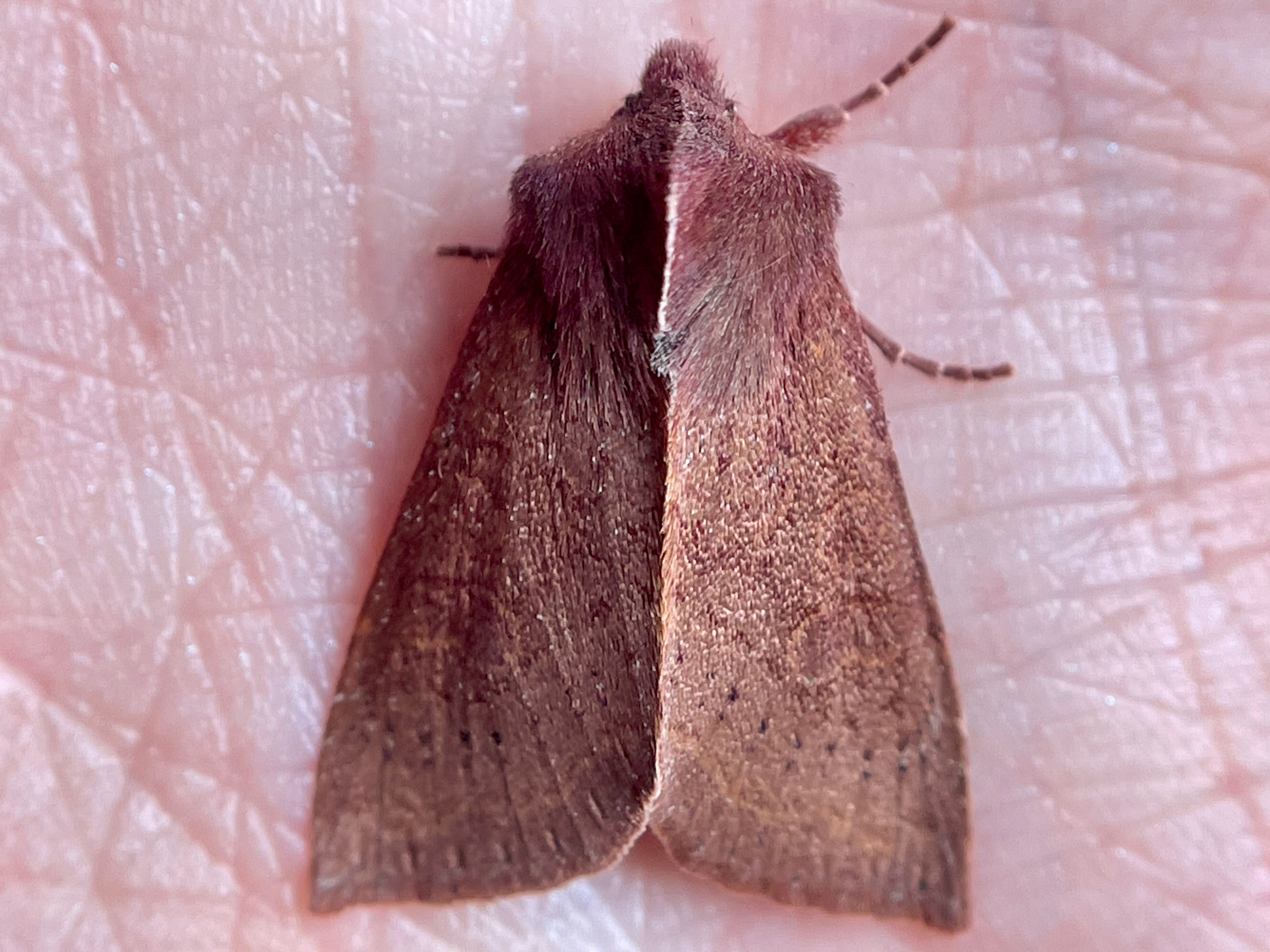
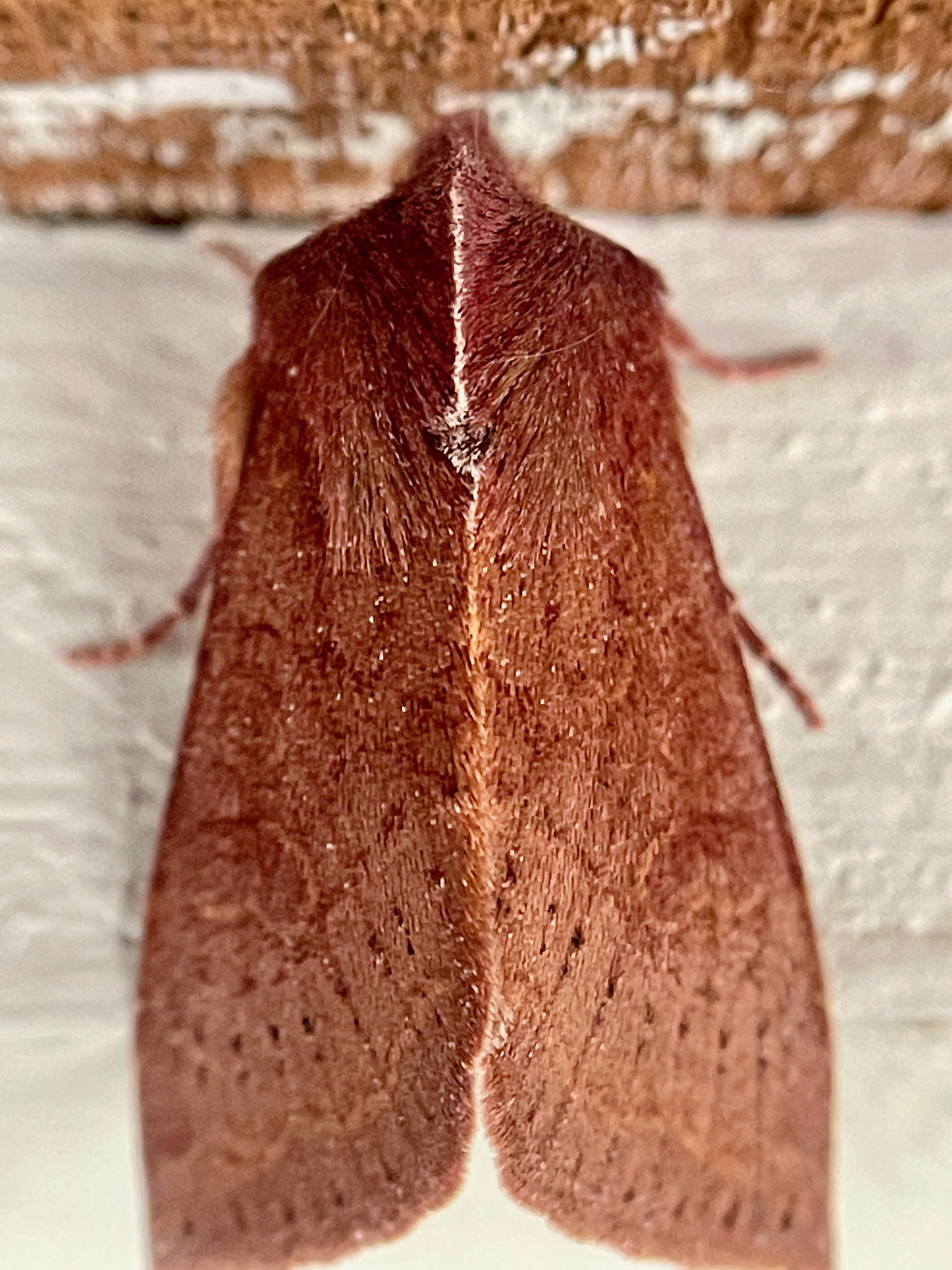
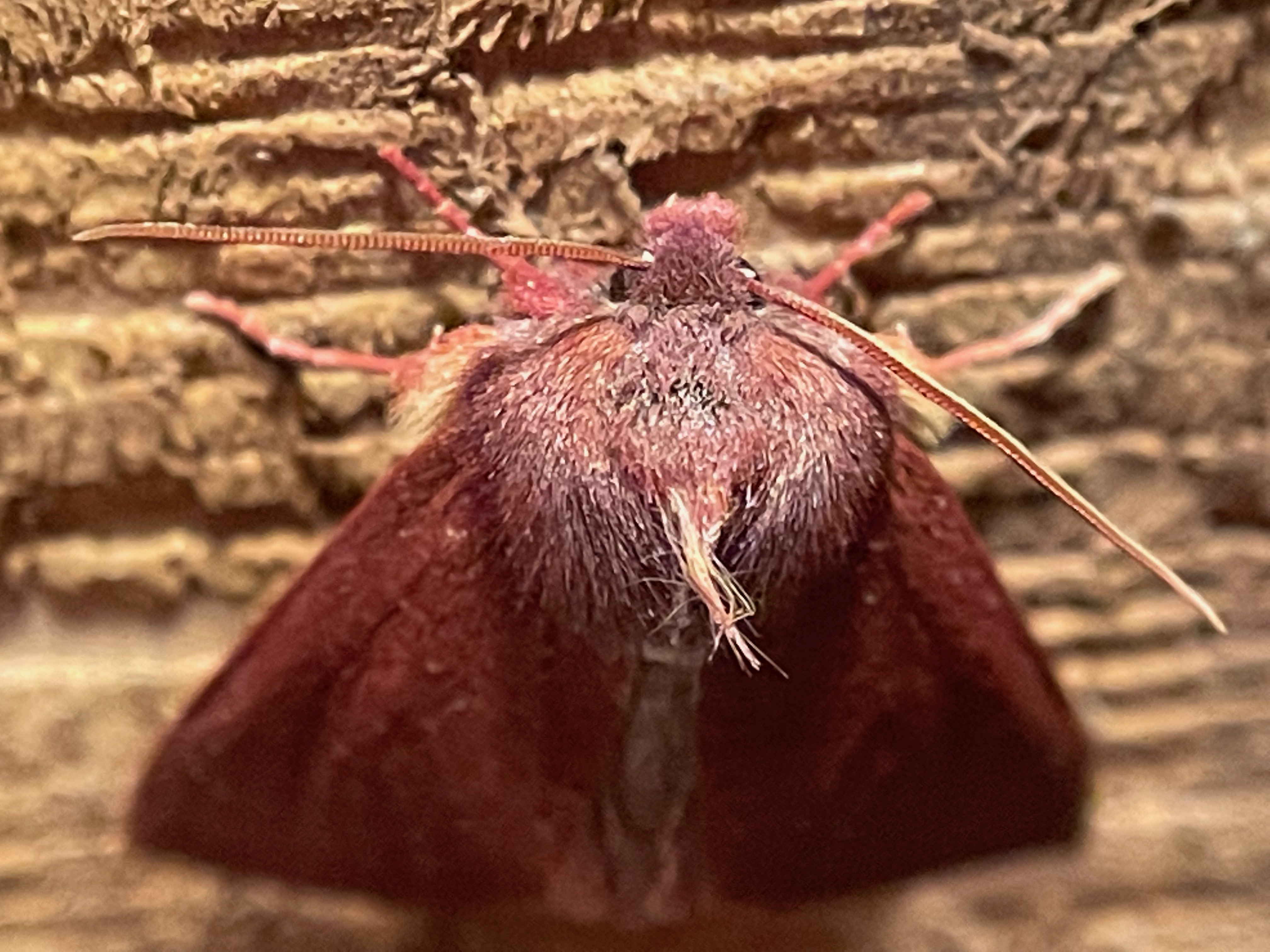
Orthosia transparens – the Transparent Quaker Moth
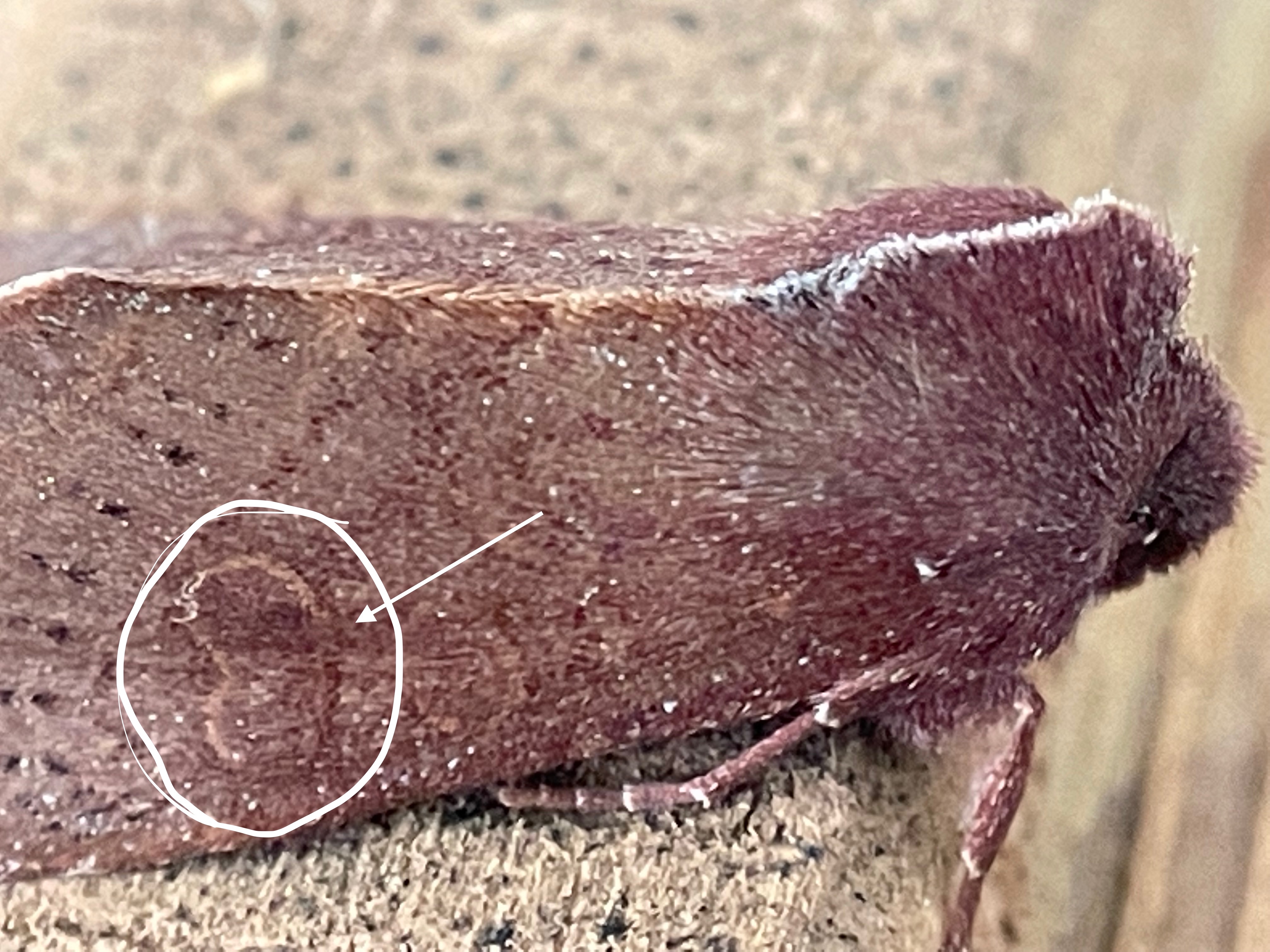
I’d really love it if I could rename this moth. Strawberry muppet heart moth is what I’d call it. Check out the little heart-shaped markings on it’s wings.
Orthosia transparensOrthosia transparensOrthosia transparensOrthosia transparens – with heart mark on wing
Orthosia transparens is a medium sized (15-17mm) , brownish red Noctuid moth that flies in our region in early spring. The common name for the species is Transparent Quaker Moth. Caterpillar food plants include salal (Gaultheria shallon), madrone (Arbutus menziesii), and rhododendron (Rhododendron macrophyllum). This species is native to the PNW region and not considered pests of economic significance. A map of the geographic distribution can be accessed here – http://mothphotographersgroup.msstate.edu/species.php?hodges=10479
Noctuidae is the family with the awful common name, “cutworm,” which leads folks to deem them evil little garden gremlins that should be stomped on or tossed out on the ground for birds to scavenge. Not all cutworms are bad, and certainly many more of us would embrace them if we knew they were going to turn out to be so cute.
I’m fine with a bit of herbivory on our salal, madrone, and rhododendrons. These little Strawberry Muppets are welcome to fly to my porch light any spring night.
A neighbor sent me this video footage late last night. She asks, “Why are all the black and yellow bumble bees on the ground dying?” This occurred locally at an island lavender farm where the bumble bees are LOVED and no one is applying any pesticides. In the video you can certainly see the bees she refers to. Why only those?
The dying bees are the lovely Yellow-Faced bumble bees, Bombus vosnesenskii. I personally appreciate these because not only are they avid tomato pollinators, but they have such adorably chubby and fuzzy bodies with a yellow face and a yellow band around their little black bottom.
Bombus vosnesenskii, Yellow-faced Bumble Bee
Bumble bees are cavity nesters. Many will select an empty mouse burrow in the ground to create their nest. The fertilized queen overwinters and begins her colony in late March or early April, foraging for herself and the eggs she laid that would soon hatch into larvae needing to be fed.
Bumble bee nest on San Juan Island, WA 2010
In order to obtain nutrients necessary for survival, bumble bee foragers can travel long distances (up to 11 miles), especially here as our growing season ends in summer. Right now, they are visiting the lavender in bloom.
These poor bees are most likely victims of pesticide. The fact that all of them are the same species, at the same location, indicates to me that someone applied pesticide at their nest site, likely a property owner within foraging distance of the worker bees visiting the lavender farm. The workers dispersed from the nest to try to do what they are programmed to do (forage for food), but simply succumbed to the toxic residues that some fearful homeowner applied.
“I can’t have bees in my yard!” “I’m allergic.” “I have pets.” “I hate insects.” “It could be murder hornets.”
Do you want to have food?
If you, as a homeowner, continue spraying your yard every time you see a bee and can’t learn to live with them, you are going to be the end of all of us. Bumble bees are some of our most important agricultural pollinators. More important than honey bees!
The dying bees in this video are native bees. “Native” means they are adapted to this environment. They have the ability to survive here better than European honey bees (Apis mellifera) which are not native. Honey bees were transported to North America by Europeans who brought sheep, cattle, swine, and other domesticated species to this continent.
Back to the over-sensationalized “murder hornets.” This term makes me angry! 😡 The media hype is much like the hype over the mantids that are going to eat our hummingbirds ! Just because it is printed in the paper doesn’t mean it is the whole truth or entirely accurate. The primary reason the Asian Giant Hornet (Vespa mandarinia) is of concern is their ability to kill European honey bees (Apis mellifera), an agricultural commodity. To read some of the news stories, you’d think we were dealing with Africanized Bees…remember those?
It is possible Vespa mandarinia will not survive here. They aren’t native. They will be susceptible to parasites, and viral, bacterial, and fungal diseases (not unlike the same problems our non-native European honey bees face) potentially making it difficult for populations to establish themselves. We could also, as many Asians do, learn to eat them. Yes, do read the publication about them in my references section!
Please put that can of pesticide away. Don’t spray. If you are truly afraid of bees, then educate yourself about how to live alongside them. First off, don’t wear shades of blue or black colors when you’re near an area that has bees. Bumble bees and honey bees are attracted to these colors. Avoid wearing fragrances. Wash your clothing in unscented detergent and avoid using those noxious, heavily scented dryer sheets. Finally, if you do see an insect that you believe is the Asian Giant Hornet, take a photo or collect the specimen if it is already dead and contact WSU following these guidelines.
In Washington State only, people should report potential sightings of the AGH through the Washington State Department of Agriculture’s website. Outside of Washington, contact your state apiary inspector. If it is safe to do so, take a photo or collect a dead specimen of the pest to help experts identify the insect.
In the meantime, please don’t fall victim to media hype and do your best not to murder innocent bumble bees!
John M. Mola, Neal M. Williams. (2019) A review of methods for the study of bumble bee movement. Apidologie 56.
Jha, Shalene, and Claire Kremen. (2019) Resource diversity and landscape-level homogeneity drive native bee foraging. Proceedings of the National Academy of Sciences of the United States of America vol. 110,2: 555-8. doi:10.1073/pnas.1208682110
Sujaya Rao, George Hoffman, Julie Kirby & Danielle Horne (2019) Remarkable long-distance returns to a forage patch by artificially displaced wild bumble bees (Hymenoptera: Apidae), Journal of Apicultural Research, 58:4, 522-530, DOI: 10.1080/00218839.2019.1584962












 Bugging You From San Juan Island