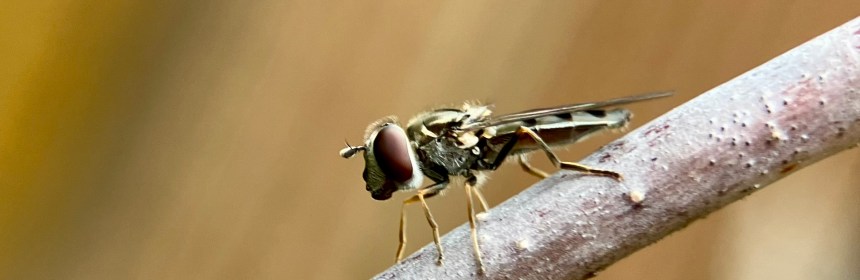
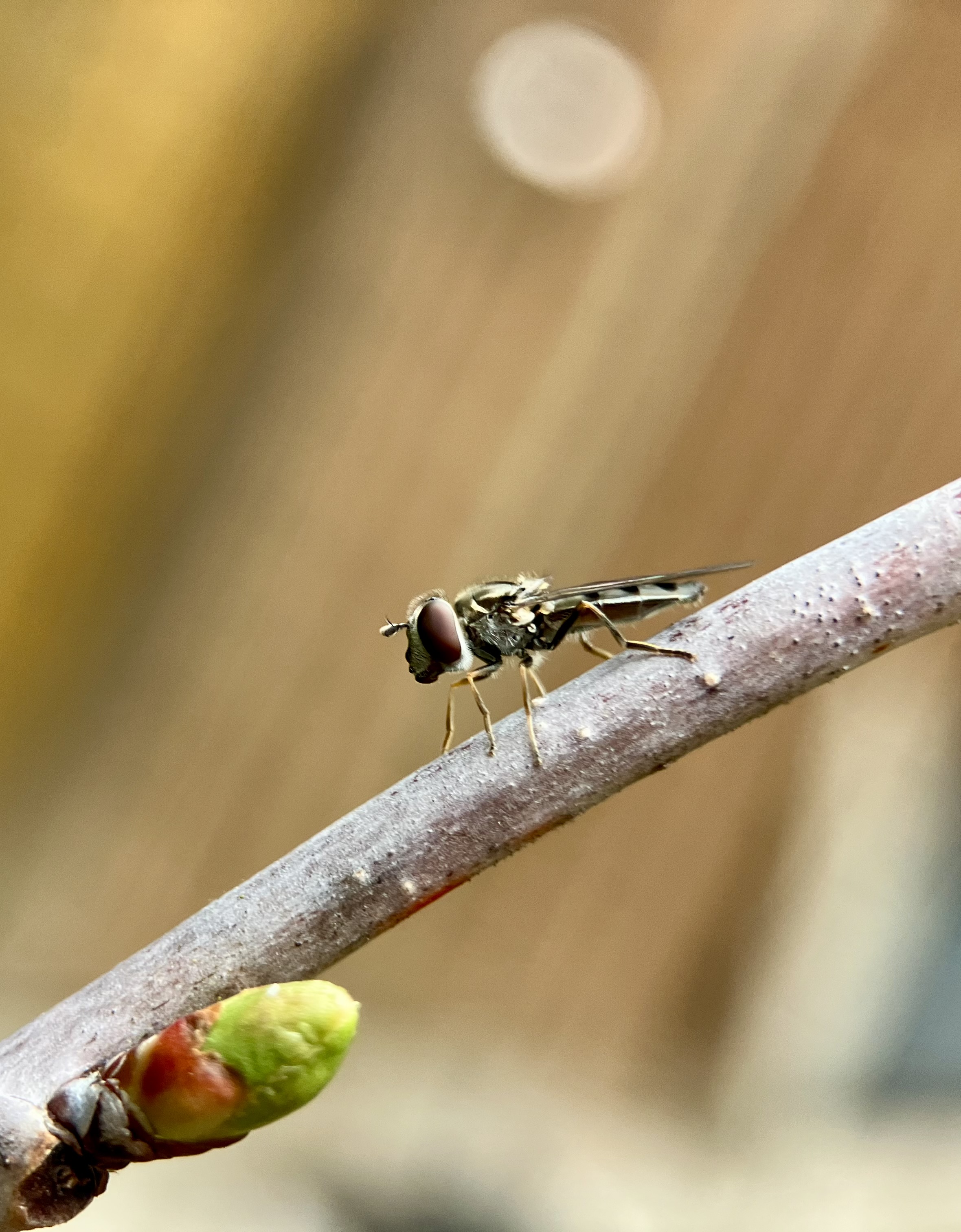
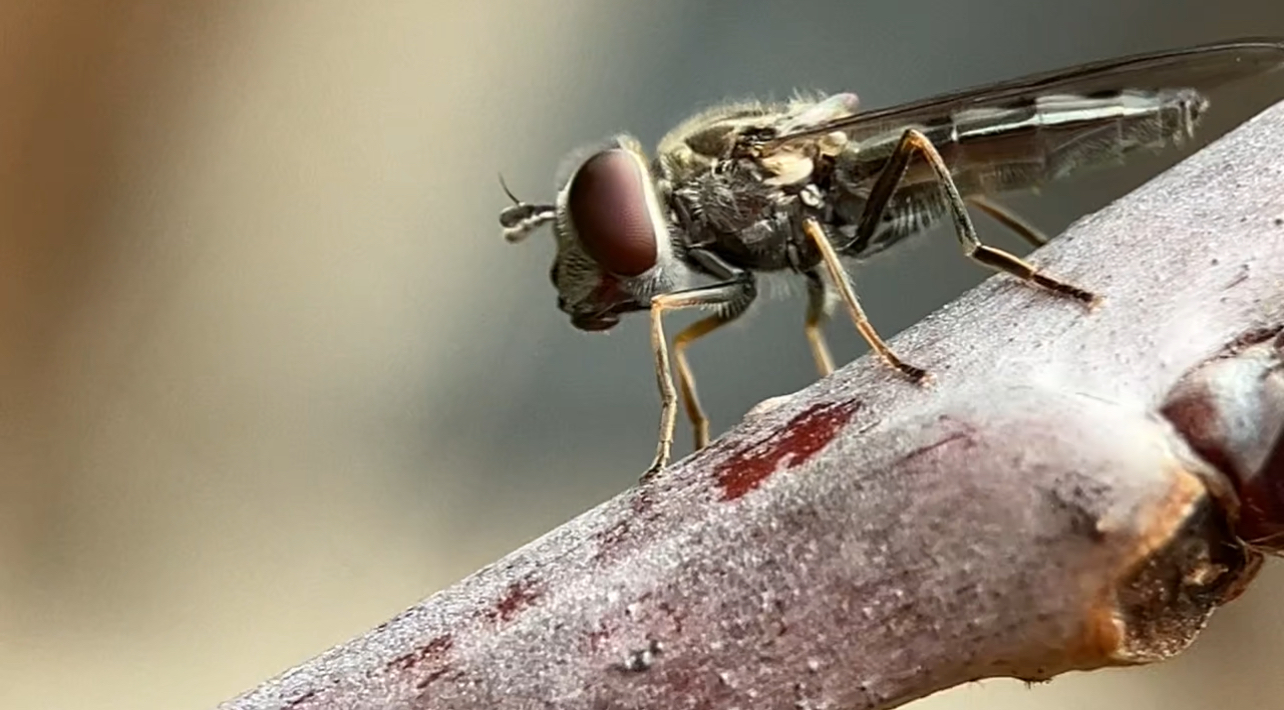
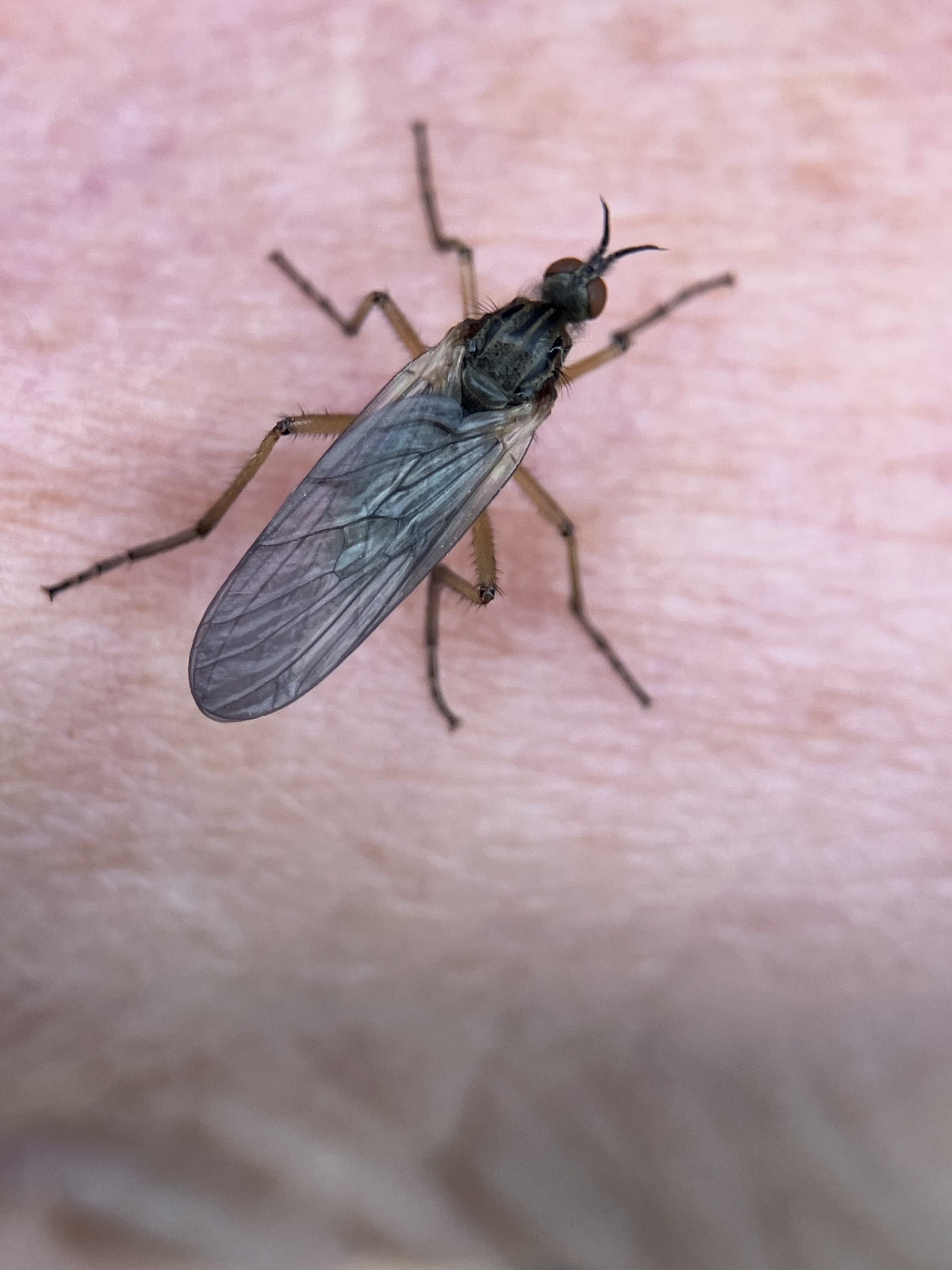
This was Wednesday’s bug of the day. I’m a day behind writing up my post. Although I have tried to get out for a quick bug search every day, it’s been overcast and/or drizzly here this past week. I was excited to see this little fly hunkered down on a twig of our fruitless cherry tree, the tree that I whacked off as an unwanted upstart for several years before I discovered how interesting it is.
Western Forest Sedgesitter, (Platycheirus trichopus), I believe
That tree is a mini ecosystem: floral nectaries that feed the aphids, aphids, slave making ants that have fights to the death (winning) with the carpenter ants that try to invade our home every spring, and the birds that rip the leaves apart trying to get the aphids. Now I can add Syrphid flies to the list!
That’s what this is. A syrphid fly. Syrphid flies eat aphids. It would make perfect sense for this adult to lay eggs on the tree, though I’m not sure what would happen because the ants that farm those aphids are certainly willing to die defending them. I could definitely see the ants overtaking the syrphid fly larvae. Nevertheless, the fly flew off. Somewhere.
This species, as mentioned earlier is pretty small at only about 6.8-9.4 mm. Geographic distribution ranges from the Rocky Mountains west from Alaska to Mexico (bugguide.net). Adults of this genus are known to feed on the pollen of wind pollinated plants like Willow (Salix sp.) and various grasses (Poaceae), and sedges (Cyperaceae). It is believed they are better adapted to activity in cooler temperatures and that fits with yesterday’s rather gloomy spring day.
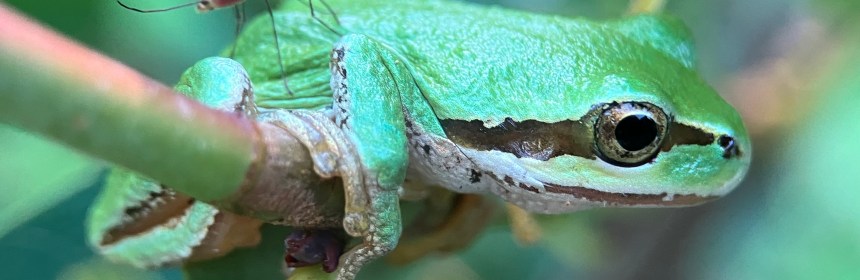
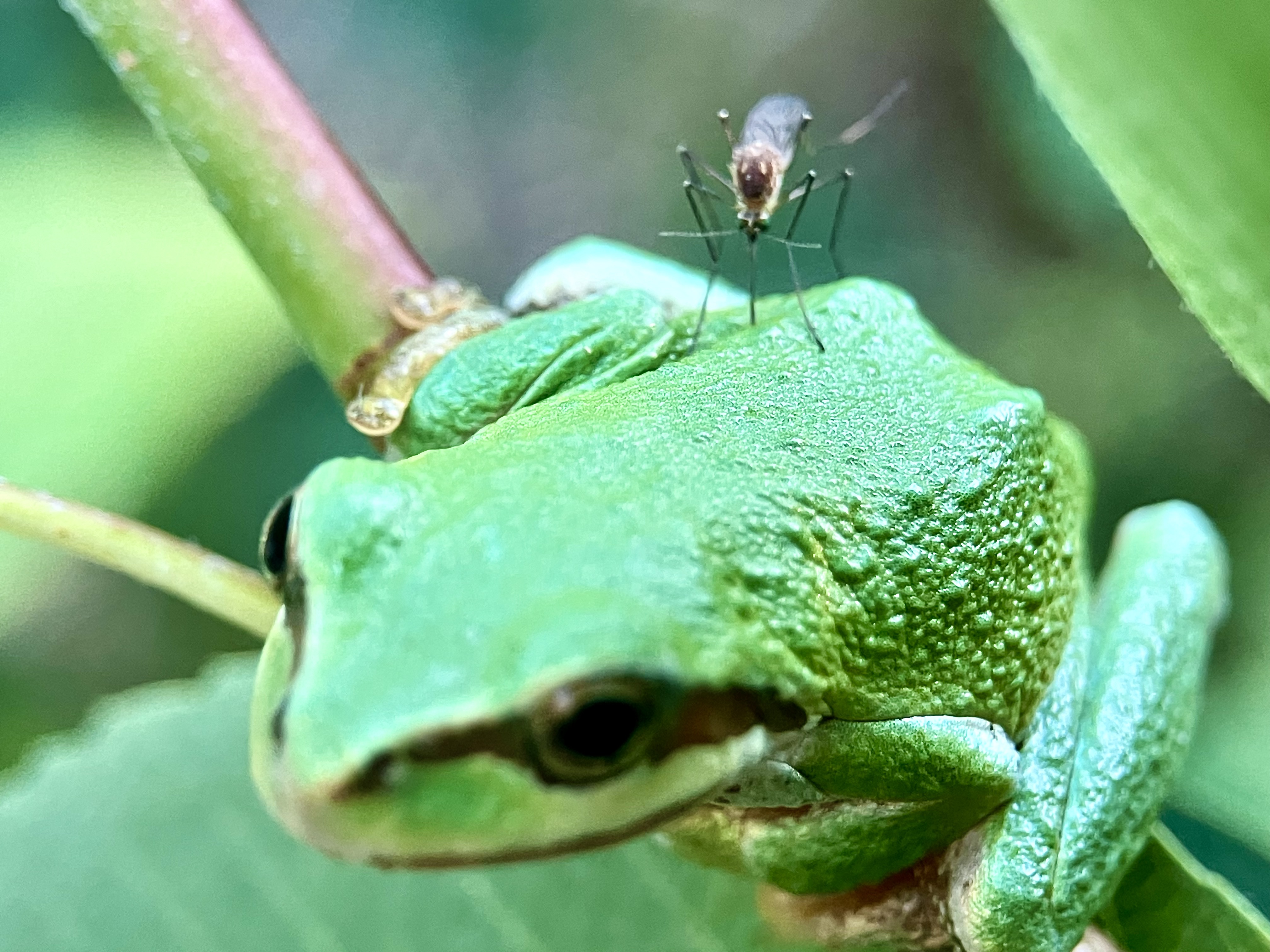
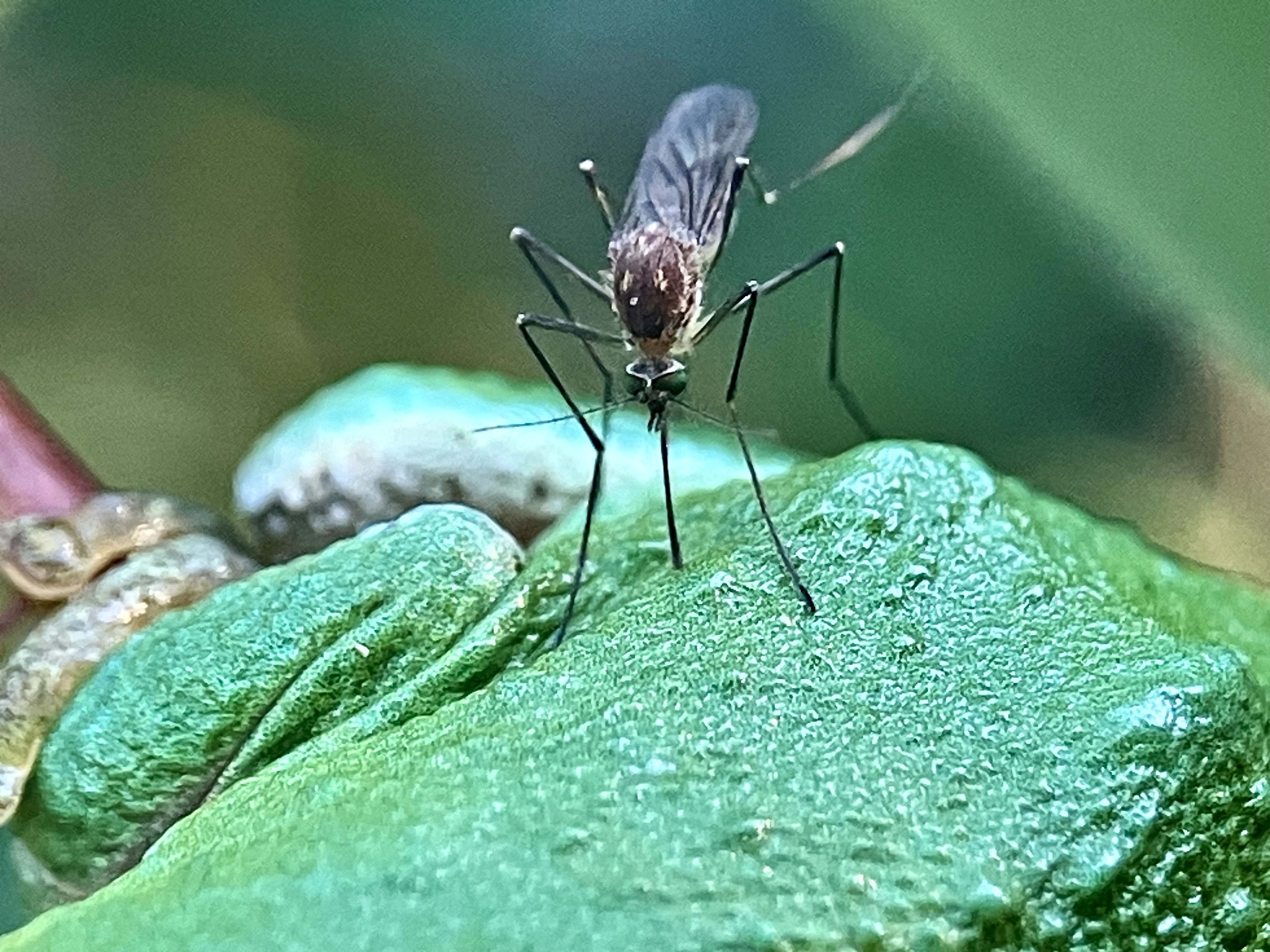
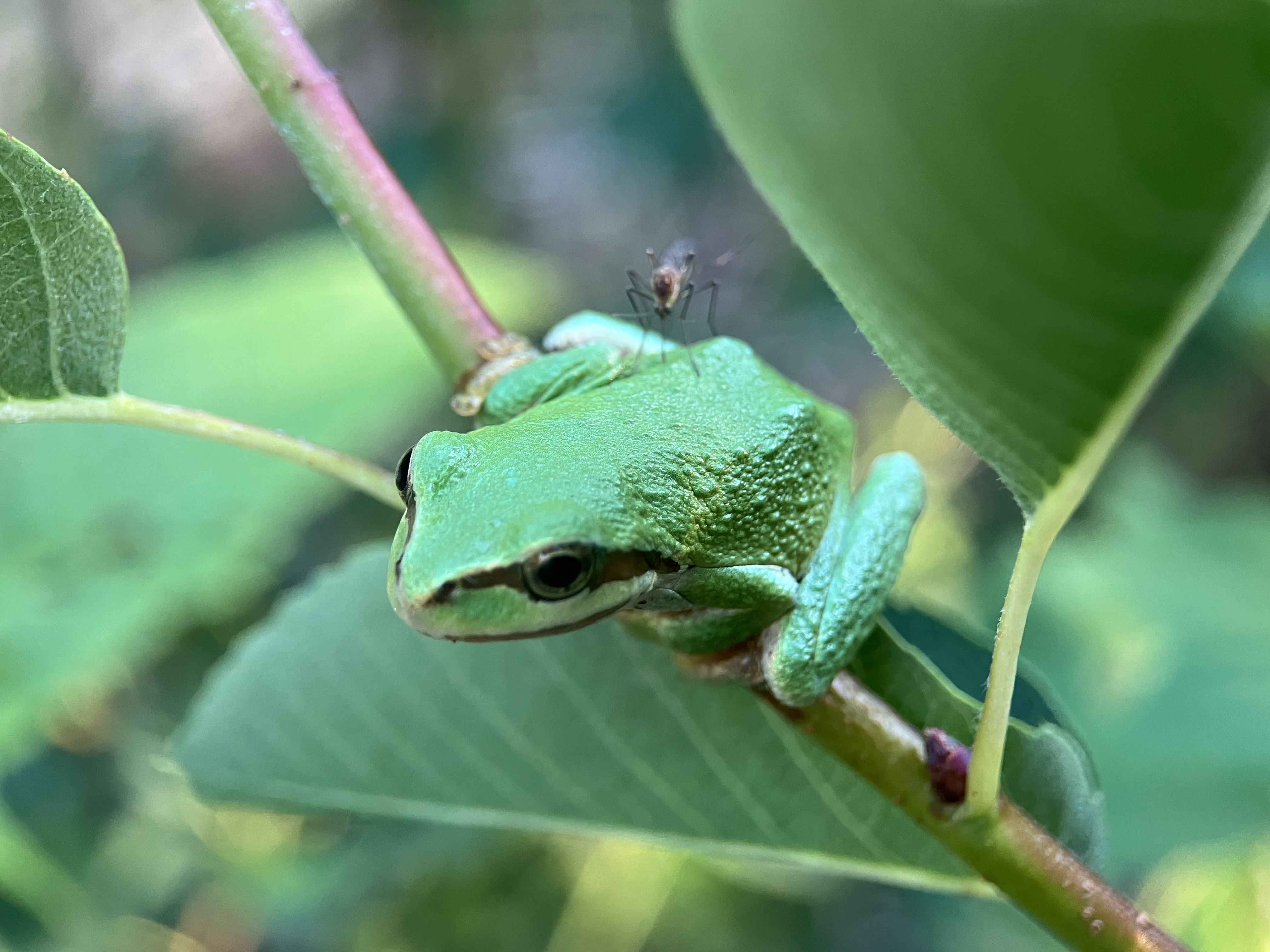
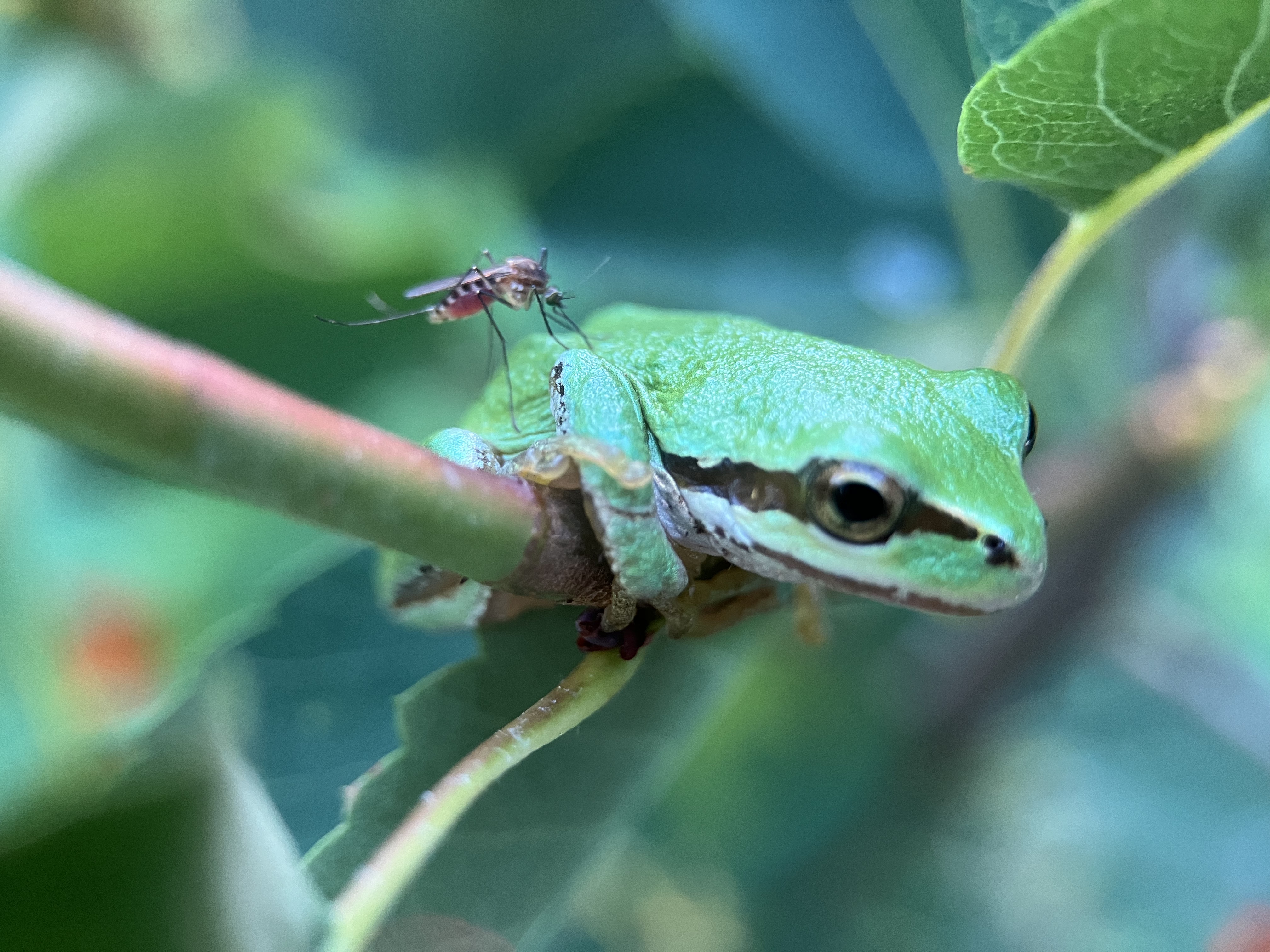
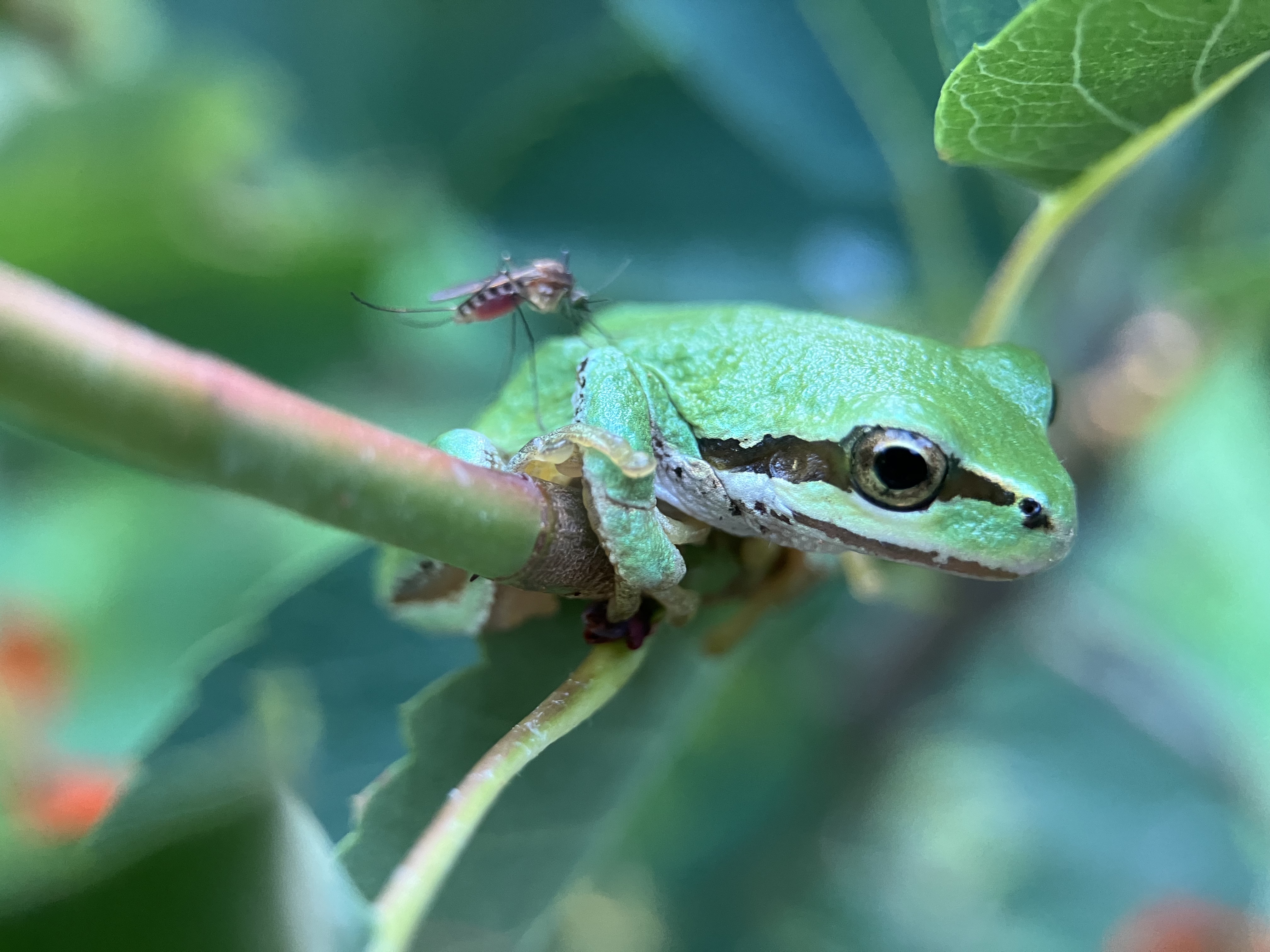
Watch and you’ll see this incredibly amazing association. This is Culex territans, the Northern Frog Biting Mosquito. Culex territans is found in a wide variety of habitats, but is most commonly associated with freshwater marshes, bogs, and ponds or streams with emergent vegetation.
Culex territans prefers feeding on cold blooded animals (amphibians and reptiles), but feeds most frequently on Anurans (frogs and toads). Here you see the mosquito feeding on a Pacific Tree Frog (Pseudacris regilla). The MOST interesting thing about this species is that females find their amphibian hosts via phonotaxis. This means they find their host via acoustics. They utilize the frog vocalizations to locate these animals for bloodmeals (Bartlett-Healy et al., 2008b). Mosquitoes can hear! 🦟🦻🏻
Bartlett-Healy,K. Wayne Crans, Randy Gaugler. 2008. Phonotaxis to Amphibian Vocalizations in Culex territans (Diptera: Culicidae), Annals of the Entomological Society of America. 101 (1) 95–103. https://doi.org/10.1603/0013-8746(2008)101[95:PTAVIC]2.0.CO;2
Hoover Pantoja-Sánchez, Brian C. Leavell, Bianca Rendon, W. A. Priyanka P. de-Silva, Richa Singh, Jian Zhou, Gil Menda, Ronald R. Hoy, Ronald N. Miles, Neil D. Sanscrainte, Ximena E. Bernal; Tiny spies: mosquito antennae are sensitive sensors for eavesdropping on frog calls. J Exp Biol 15 December 2023; 226 (24): jeb245359. doi: https://doi.org/10.1242/jeb.245359
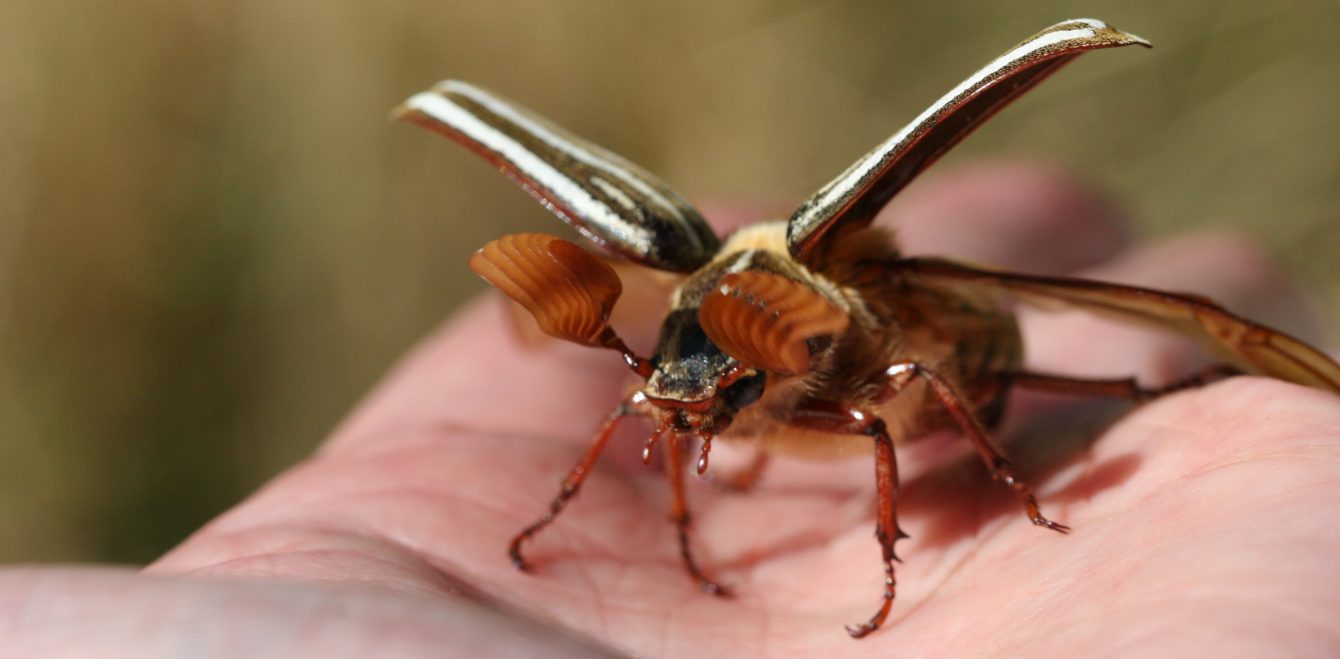
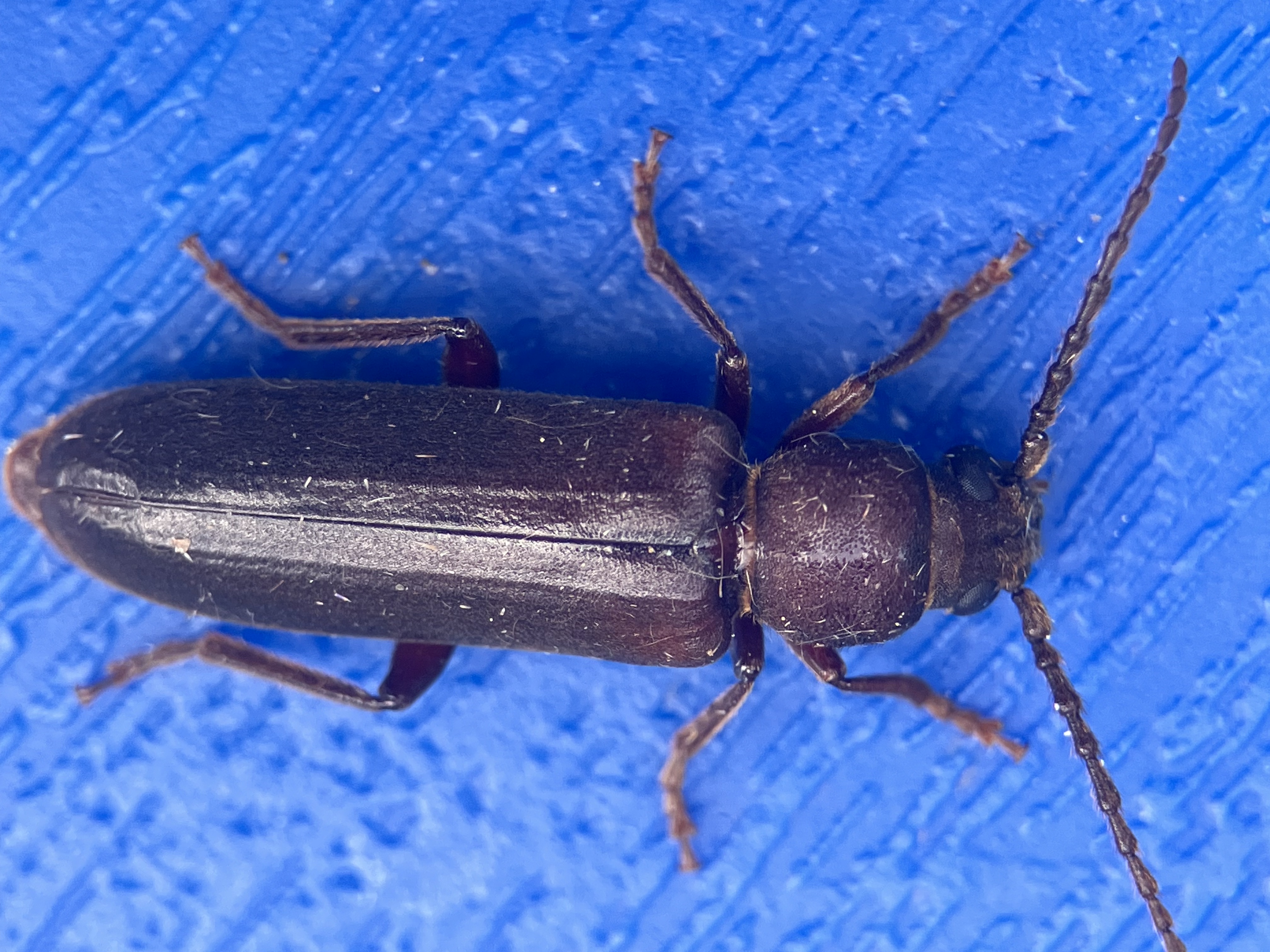
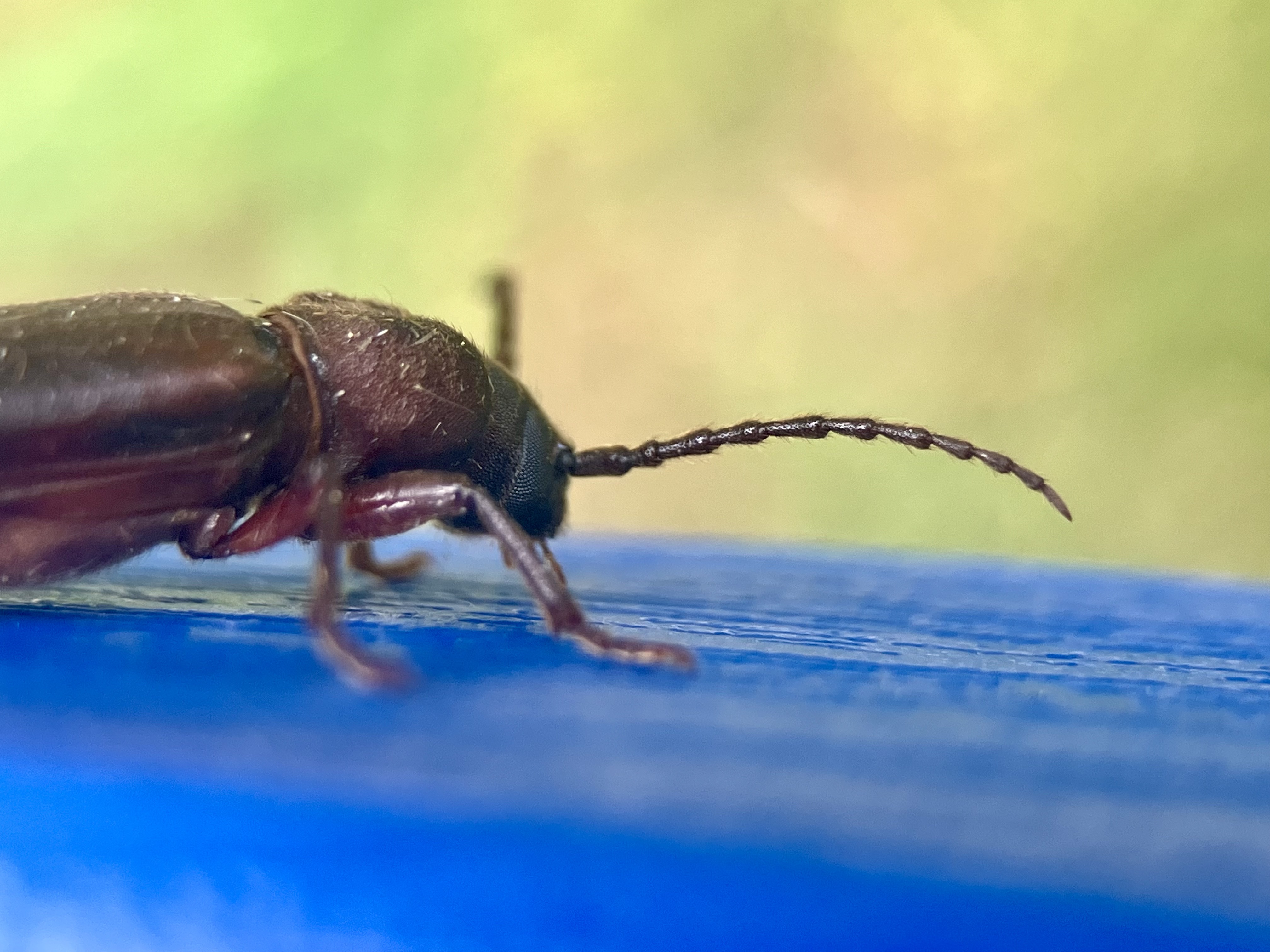
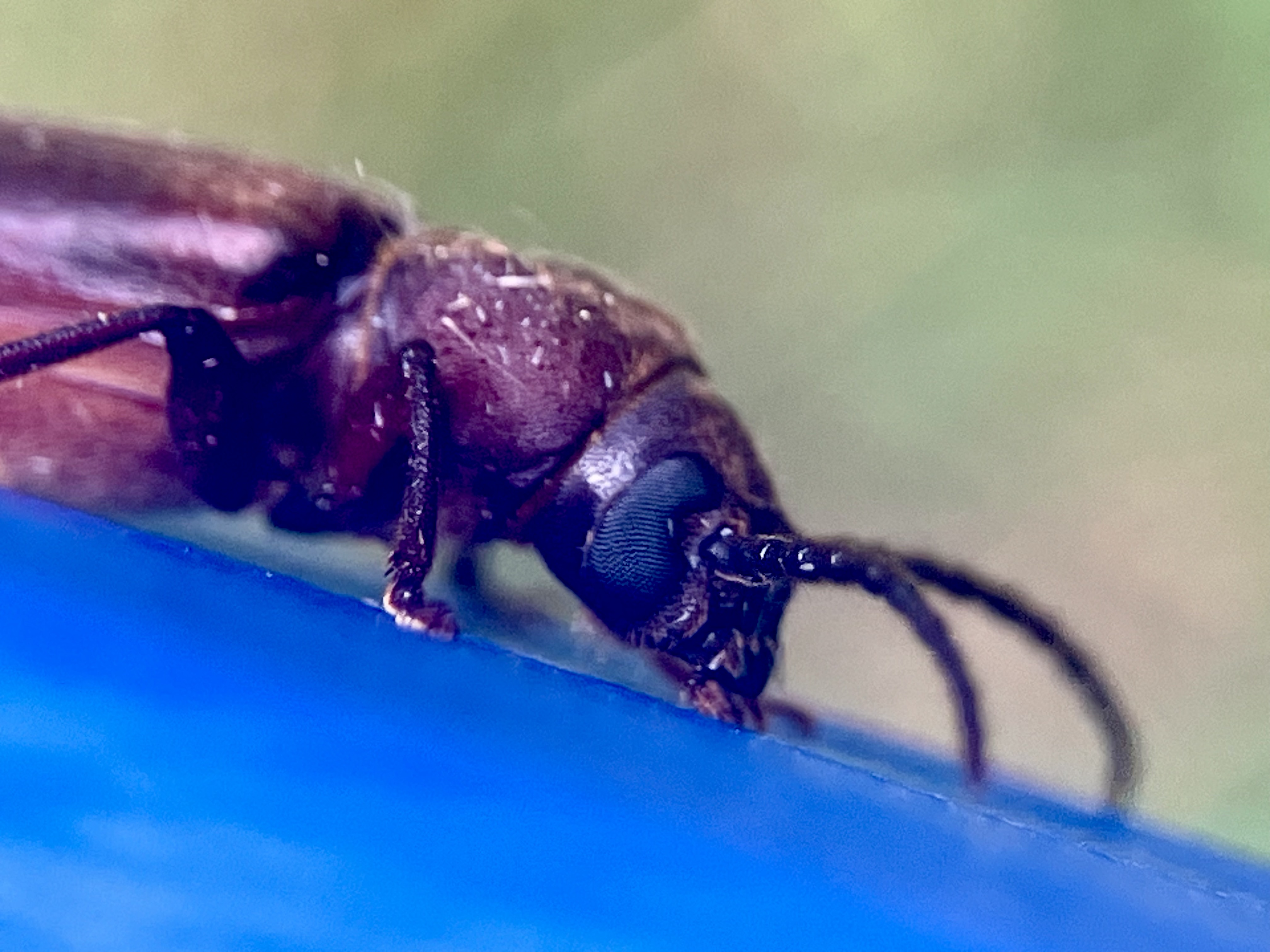
Here is a new-to-me Cerambycid (longhorn) beetle. I haven’t added one of these to my photo collection in the 15 years I’ve lived on San Juan Island, so note here that they are “UNCOMMON” and not populous in number.
This species is the only one in its genus in North America. It is Megasemum asperum. I see in perusing iNaturalist.org that there have been 67 reported observations dating back to 2007.
Season: July to August (this is when you could see an adult)
Numbers: a single species in the New World & in NE Asia
It was described by John Lawrence LeConte in 1854
From Beetles of Western North America – “Larvae mine Douglas-fir (Pseudotsuga menziesii) and fir (Abies). Adults are attracted to lights during the summer. Found in coniferous forests of western North America,” (Dr. Art Evans, entomologist, 2021).
Your take away message – NOT a pest. NOT a tree killer. NATIVE species! Performs important recycling of nutrients role in ecosystems allowing regeneration in our forests. Appreciate Biodiversity.
Something happened in the yard yesterday afternoon. We have a fruitless cherry tree in a cage that I didn’t plant. At least I think it’s a fruitless cherry tree. It sort of popped up on its own.
In the beginning, I didn’t really want it there, so I cut it down – a few times. It kept coming back, intent on sticking around. A couple of years ago, I just stopped trying to get rid of it. I even put a little cage around it. That was actually for the juncos that built a nest in the grass below that little tree though, to keep them safe from the mower.
Aside from me personally whacking it down a few times, the little tree has suffered other adversities. It has been attacked by cherry slugs (sawfly larvae). They ate its leaves.
Sawfly larva or Cherry Slug
It has had a few tent caterpillars munching too. One year that it was super dry, it lost its leaves and I thought it was dead. Only it came back again. I started to pay more attention to this little tree, even watering it in the summer. It’s not very tall, but this year it looks more healthy than ever before.
Last year, I noticed in the spring that it put out these cool little red bumps on the stem just above the leaf.
extrafloral nectariesFormica ascerva ant at extrafloral nectaries
Those little bumps soon had little red and black ants visiting. I learned the red bumps are extrafloral nectaries. They produce nectar that attracts pollinators to the tree. I haven’t seen any flowers, so I’m not sure what would be pollinated. Maybe the tree isn’t old enough yet. I’m still learning. I sure need to figure out if I’m right that it’s a fruitless cherry.
Well, the other thing that is interesting is shortly after the little red bumps attract the red and black ants, there are little black aphids. I’ve seen this for 2 years in a row now. The ants tend those little aphid flocks like sheep. They are guarding them in exchange for the sugary honey dew the aphids produce.
The aphids and the ants seem to multiply. I have seen 2 or 3 ants per leaf with aphids. Not all the leaves have aphids, but maybe 1/3 of the tree does, and each guarded by the ants. The ants are Formica ascerva species.
They are interesting in their own right because aside from guarding the “sheep,” they also are fierce warriors, driving away (and killing) the large Camponotus sp. carpenter ants that try to invade every spring.
This colony of Formica ants lives under a bedroom of our home. They are welcome to stay since they don’t eat wood.
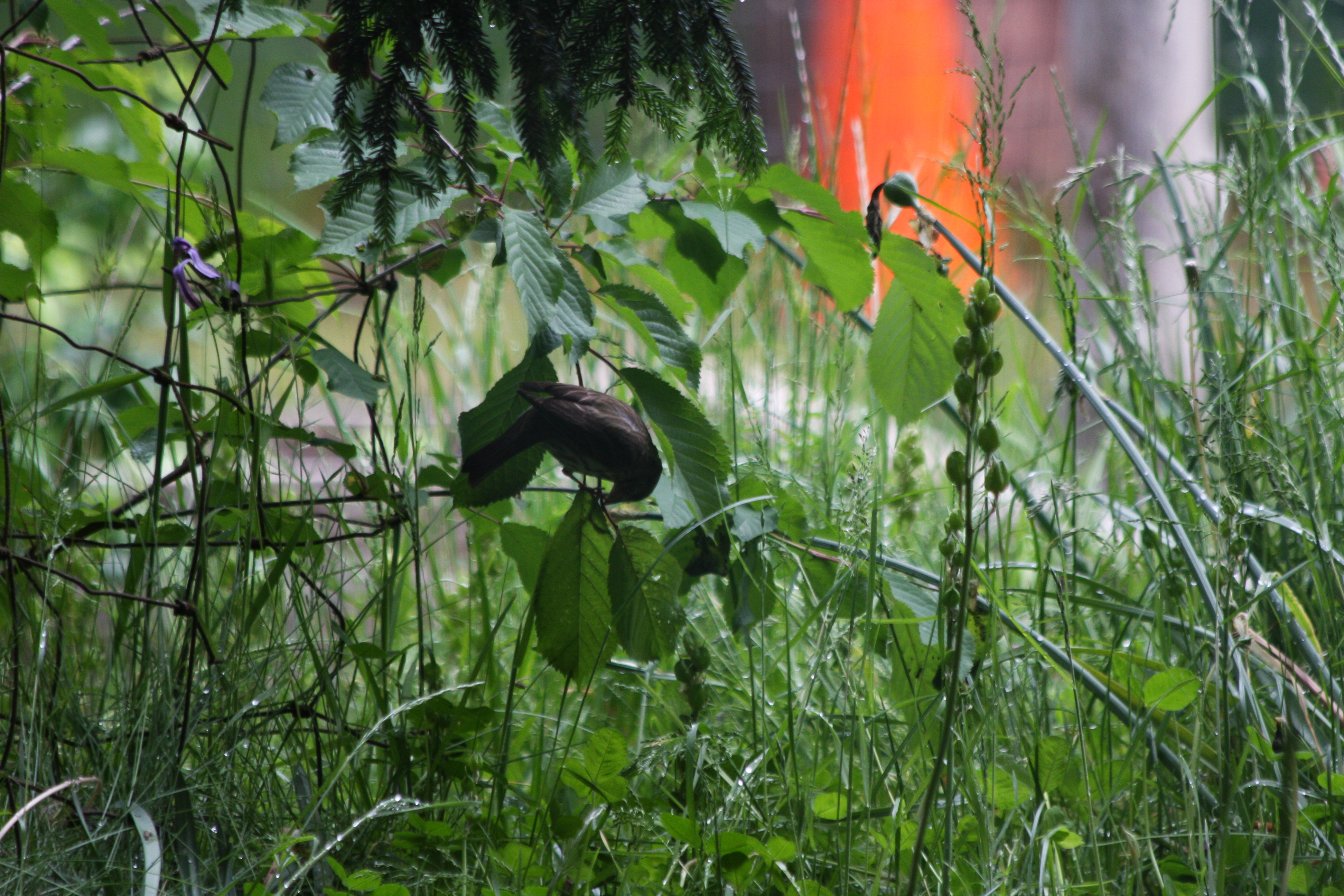
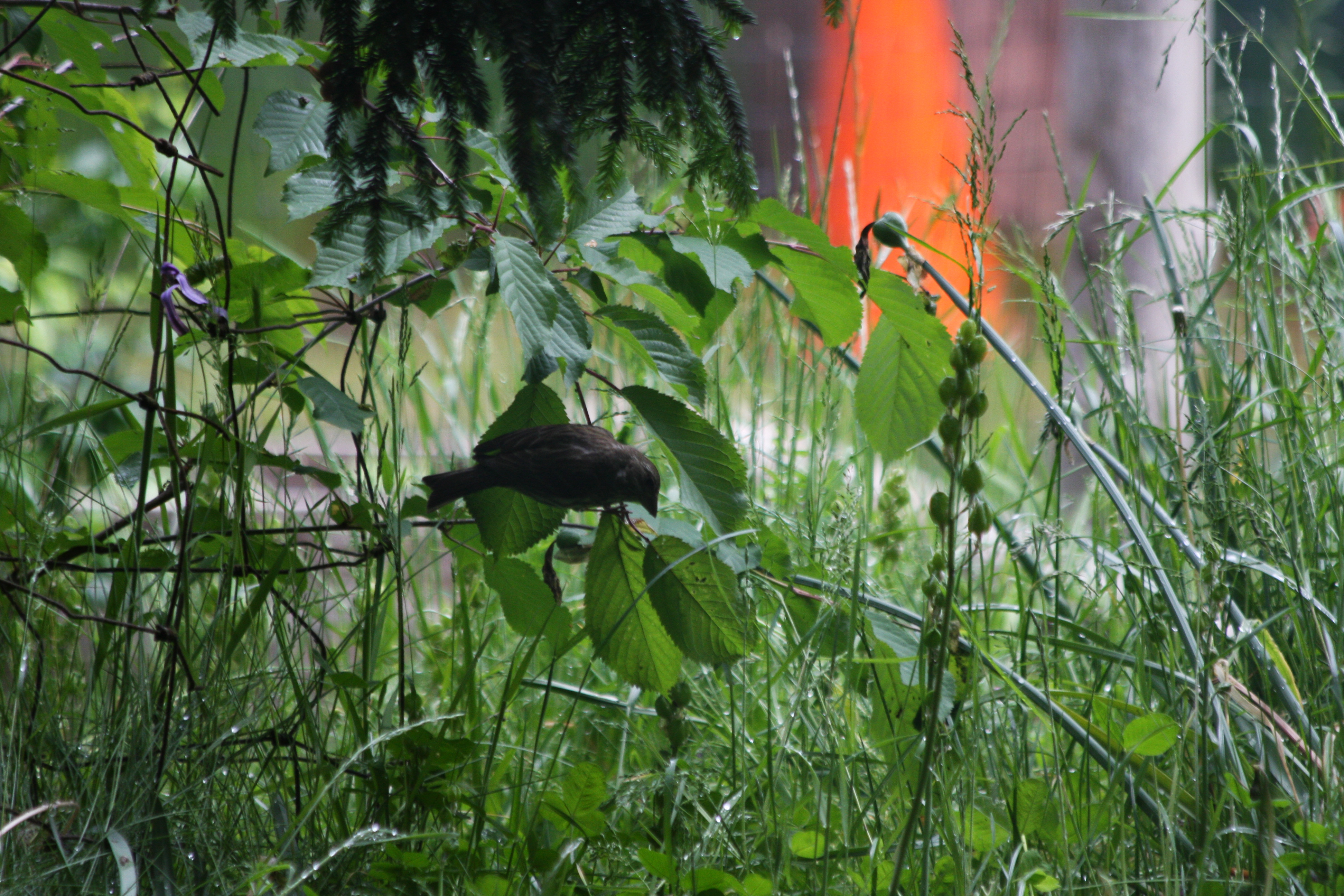
Today, when I looked out the window though, I saw something challenging the fearsome Formica ants. There were birds inside the tree caging and they were hungrily pecking and even tearing at the leaves with aphids. I grabbed and clumsily set up my camera to video the scene.
Birds attacking aphids farmed by Formica ascerva ants
I saw finches first, then there was a chickadee, and even a hummingbird. I thought I saw bumble bees, but they wouldn’t have been eating the aphids. Perhaps they were visiting the extrafloral nectaries or maybe even sipping honeydew produced by the aphids, but I wasn’t close enough to be certain.
Afterwards, I went out to survey the damage. I saw one leaf with lots of shreds. Aphid parts scattered about. Ants wandering somewhat aimlessly. Another leaf had an ant that died courageously in battle protecting his little flock.
I wanted to share my observations with you because a lot of folks really dislike aphids. Others also dislike ants and don’t understand their role in nature’s ecosystems. Maybe this will help others to understand there are a lot of hungry birds that eat aphids (and ants). Without them, the birds might not find enough food to feed their nestlings. It’s all part of the cycle of life.
If you see aphids your garden that you are worried about, you can mitigate some of their feeding damage by hanging a hummingbird feeder nearby. The hummingbirds have to have protein along with all that carbohydrate sugar water and they will most certainly find your aphids delicious. In fact, insects and spiders make up about 85 % of the diet of hummingbirds. Birds need bugs. And not all ants are pests. Some are extremely beneficial. I challenge you to take up bird and bug watching. You will not be disappointed!
Thanks for reading!
Below are more images of the birds feeding on the aphids inside the caged tree.
References and further reading
Bentley, B. L. (1977). Extrafloral Nectaries and Protection by Pugnacious Bodyguards. Annual Review of Ecology and Systematics, 8, 407–427. http://www.jstor.org/stable/2096735
It’s a short clip, and you’ll have to check out the end to see this little beetle take flight. I fished this one out of the pool and it’s the 2nd one I’ve seen this week, albeit a new one for me to observe. I believe this is Hylastes macer, but hoping a friend will take a look for me to confirm. I have tentatively based my ID on size (approx 5mm) and locale being under our Shore Pine trees, but I wasn’t confident using Wood’s key with only my photo and video in lieu of an actual specimen under the microscope. At minimum, Hylastes should be correct for Genus. These beetles are in the family Curculionidae and subfamily Scolytinae, one of the Bark and Ambrosia beetle species.
As to their life history, they construct galleries in phloem tissues of roots and stumps of Pinus or Pine trees and occasionally Picea or Spruce trees. According to Atkinson (2024), there are six species of Hylastes known in Washington State. Some of the species in this genus range from BC to CA. For more on distribution, take a look at Wood, 1982.
While identifying a bug is part of the process, the most fun for me is observing their behaviors. I knew when I saw the march of those little front feet, that the launch was about to take place.
Evans, A. 2021. Beetles of Western North America. Princeton University Press.
Wood, S.L. 1982. The bark and ambrosia beetles of North and Central America (Coleoptera: Scolytidae), a taxonomic monograph. Great Basin Nat. Mem. 6: 1-1356.
I had an amazing BUG day! It’s always amazing when you find one as interesting as this one. Check out the proboscis.
This is Empis barbatoides, I believe, a species of Dance fly in the family Empididae. SHE (you can see her ovipositor at the end), was in the back of my truck on some cardboard I am using for landscaping.
I find the behavior of these flies to be so interesting. When they are in mating swarms, the male flies will dance about to entice the female. The most fascinating part is they often are carrying a captured insect, usually a Bibionid fly, wrapped in silk, as an offering or nuptial gift.
Females seem to prefer a male with the most enticing balloon. Some males only carry an empty ball of silk. My guess is they get whoever is leftover. 😉
These flies and their developing larvae are found in moist wooded habitats (mixed deciduous and coniferous) with many clearings and open patches.
Larvae are often in decaying vegetation, or even under the bark of trees.
Adult flies are approx 9-10mm
For some fantastic (not mine) photos of the males carrying balloons, check out the bugguide link below.
References
Alcock , John. 1973. The mating behaviour of Empis barbatoides Melander and Empis poplitea Loew (Diptera: Empididae), Journal of Natural History, 7:4, 411-420, DOI: 10.1080/00222937300770301
I found this very tiny (1mm) beetle on the rim of the pool outside yesterday (Dec. 8, 2023). In my investigational efforts to identify my specimen, I have concluded it should be one of the Minute Brown Scavenger Beetles in the family Latridiidae (pronounced la-trid-eye-i-dee). As to species, I think it is Cartodere bifasciata – based on the color pattern of elytra – black markings between 2nd and 5th stria in anteriour third and behind middle; lateral black spot in about middle. (Bugguide, 2014).
This particular species is an Australian native and likely introduced to North America via international shipping. Records show this species in Nova Scotia about 1989 (Majka et al 2009). Looking on iNaturalist for observational reports of this species, I see a few (about 15 or so) in the box I drew. You can see in the attached screenshot the general area where they are turning up in the Western US. Again, likely introduced via international shipping cargo.
Reported observations of Cartodere bifasciata in the PNW Region
Adults of beetles in this family are generally known to feed on the reproductive structures of fungi, plant and animal materials, and slime molds (Evans, 2021). They are found in association with wet or damp habitats in open or forested areas, especially in leaf litter, decomposing wood, on trees, herbaceous vegetation, and in bird, mammalian, or hymenopteran nests (Majka, 2009).
Evans, A. V. 2021. Beetles of Western North America. Princeton University Press, N.J.
Majka CG, Langor D, Rücker WH. 2009. Latridiidae (Coleoptera) of Atlantic Canada: new records, keys to identification, new synonyms, distribution, and zoogeography. The Canadian Entomologist. 141(4):317-370. doi:10.4039/n09-050.
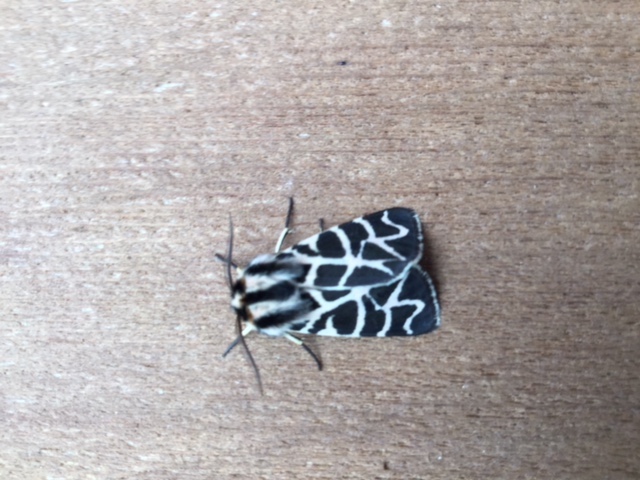
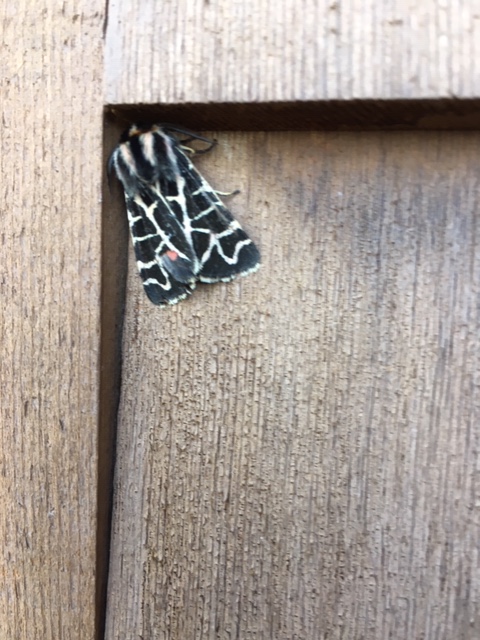
Sunday evening, August 18, 2019, my husband took me to a lovely Farm to Table dinner at Sweet Earth Farm, San Juan Island, WA http://sweetearthfarm.com/products/farm-events/ Aside from the amazing food and beautiful scenery, I got to sit at a table with some really great folks who, after finding out about my love of bugs, sent me a photo of a Tiger Moth that was on the side of their garage door. Turns out this particular moth was going to be pretty interesting!
Apantesis nevadensis superba 08.22.18 San Juan Island, WA photo by N. Hamlin
As I worked through my usual steps to ID the specimen, I noted the photo came to me with “Ornate Tiger Moth” in the subject line. This specimen was indeed very similar to the Ornate Tiger Moth (Apantesis ornata). To complicate things a bit more, not only has this family of moths (Tiger moths) been reclassified (from Arctiidae to Erebidae), but this genus has also recently been renamed. Formerly Grammia ornata, Apantesis ornata (Ornate Tiger Moth’s) have not been recorded in San Juan County and records for adult flying periods of this species are earlier than for this particular specimen. I believed this specimen was something different.
There were records of another species of Tiger Moth in the Pacific Northwest I came across that better matched the image of my photo and timing of adult emergence. Apantesis nevadensis, the Nevada Tiger Moth, has been recorded as widely distributed in the Pacific Northwest, but according to information on Pacific Northwest Moths http://pnwmoths.biol.wwu.edu/browse/family-erebidae/subfamily-arctiinae/tribe-arctiini/apantesis/apantesis-nevadensis/, A. nevadensis is “only found in a few locations west of the Cascade Mountain crest, including on Vancouver Island, the south Puget Sound, and coastal Oregon.”
However, a fairly recent (2007) review in Zootaxa by Ferguson and Schmidt described a subspecies of Apantesis nevadensis, A. n. superba that had been recorded on Vancouver Island, B.C., our neighbor. Could the San Juan’s be a new geographical locality for this subspecies?
Apantesis nevadensis superba 08.22.18 San Juan Island, WA photo by N. Hamlin
I emailed the photo to Merrill A. Peterson at WWU. He has a great book available called Pacific Northwest Insects too. You can find it here ~ (https://pacificnorthwestinsects.com). Merrill is Professor and Chair of Biology and Insect Collection Curator at Western Washington University and my all around go-to person for confirmation of insects in our region. Merrill agreed that my ID was correct. Since this was a FIRST record for the San Juan’s, he asked if I could collect locality (GPS) data and date of sighting from the original photographer.
My next task was to email the gentleman who sat with us that night at dinner and ask him if he was willing to share this, enabling Merrill to post the record online. We needed first initial, last name, GPS data, and date of sighting. Not only did I receive a response with this information AND permission for me to use the photographs in my blog, but I received a photo of a second moth taken the very day this gentleman went out to register the GPS coordinates on his phone. Now we have a record of two sightings, almost exactly one year apart!
Apantesis nevadensis superba 08.28.19 San Juan Island, WA photo by N. Hamlin
Sohow exactly can you tell the Apantesis nevada from Apantesis ornata?
Here are the morphological descriptions for adult specimens of each species, taken from http://www.bugguide.com to get you started. Please feel free to contact me here or at https://www.facebook.com/buggingyoufromSJI/ with questions or to report sightings of insects in the San Juan’s. 🐛🐞🦋🐜🐝🦗
Apantesis ornata~
Adult: FW appear black, typically with a net-like pattern of extensive yellowish or rosy off-white transverse lines and thinner pale veins. HW color is variable from yellow-orange, orange, to orange-red, rarely entirely black. HW is heavily marked with black, including the basal wing, multiple spots, and an irregular marginal band. These are often fused to each other, especially near the wing margin.
Apantesis nevada ~
Adult: forewing black with 3 variably thin to wide pale bands crossing wing; subterminal line W-shaped, touching PM line at top of W, and outer margin at bottom; single pale line from base of costa to anal angle; hindwing varies from bright red with several black spots to pale pink with merged spots forming extensive black area; top of thorax white with 3 longitundinal black stripes; ptagia (collar) has one black spot on each side
Ferguson, D. C. and C. Schmidt. 2007. Taxonomic review of the Grammia nevadensis species group (Lepidoptera: Arctiidae) with descriptions of two new species, Zootaxa 1405, pp. 39-49: 42-44.












 Bugging You From San Juan Island