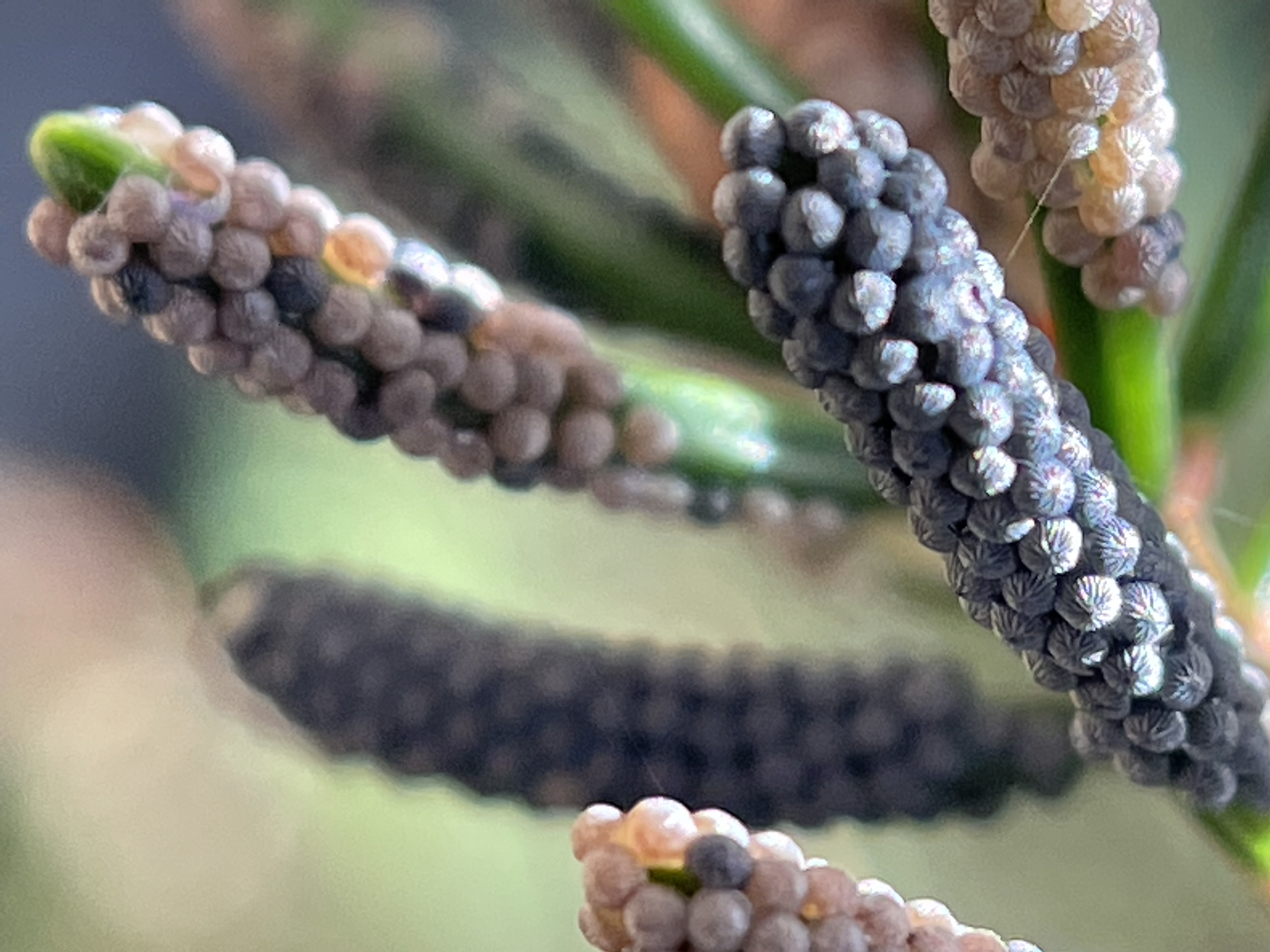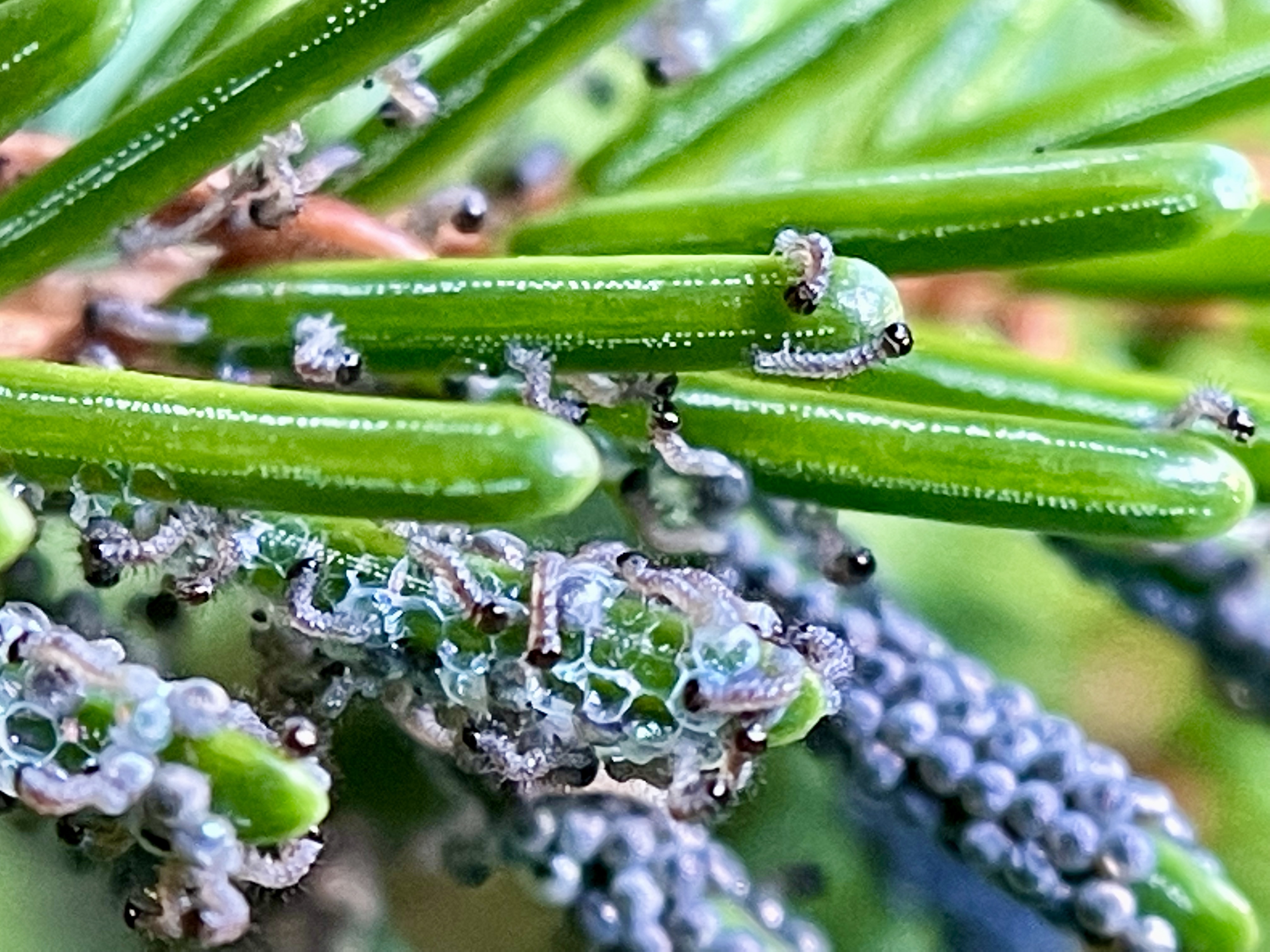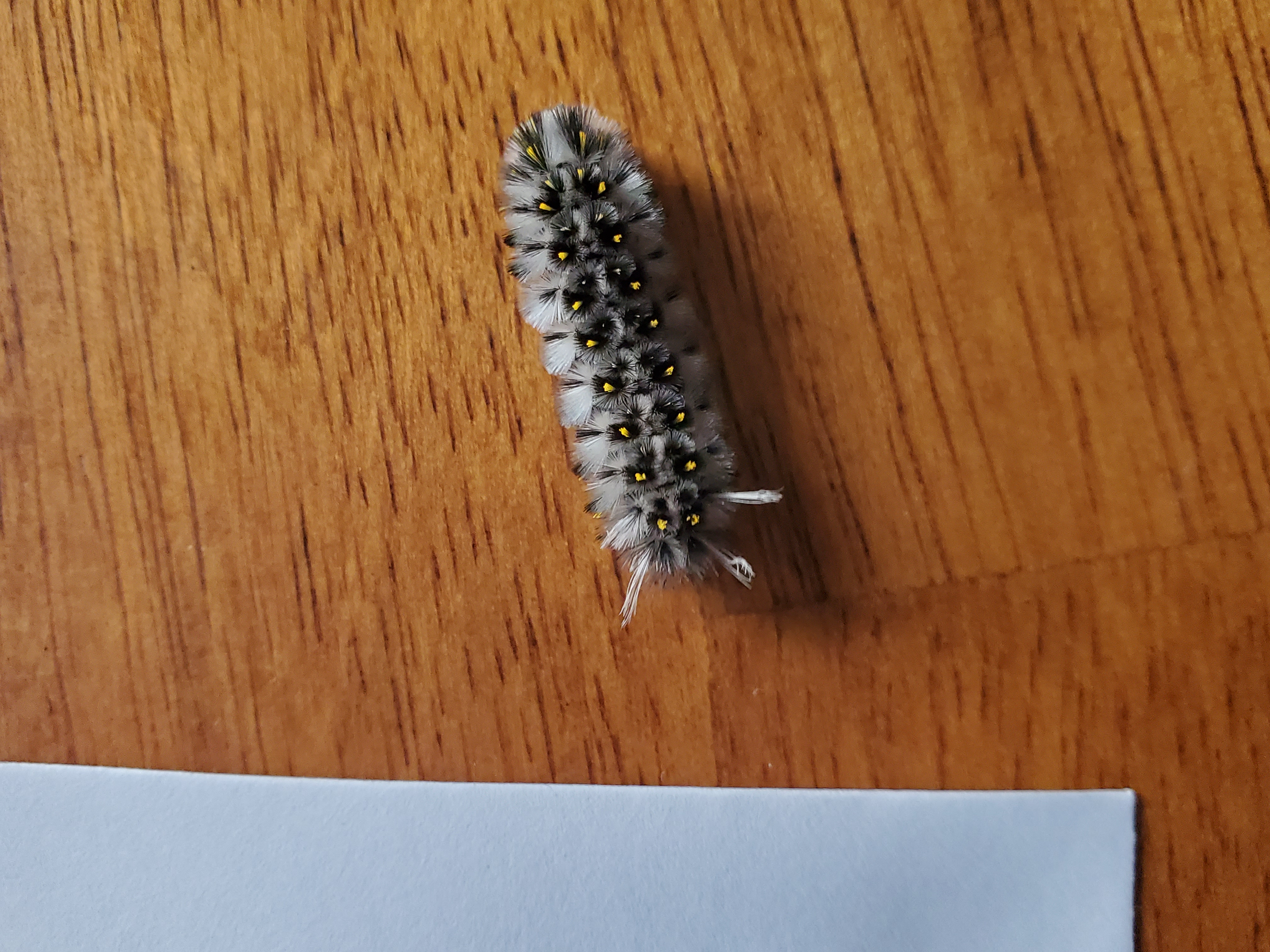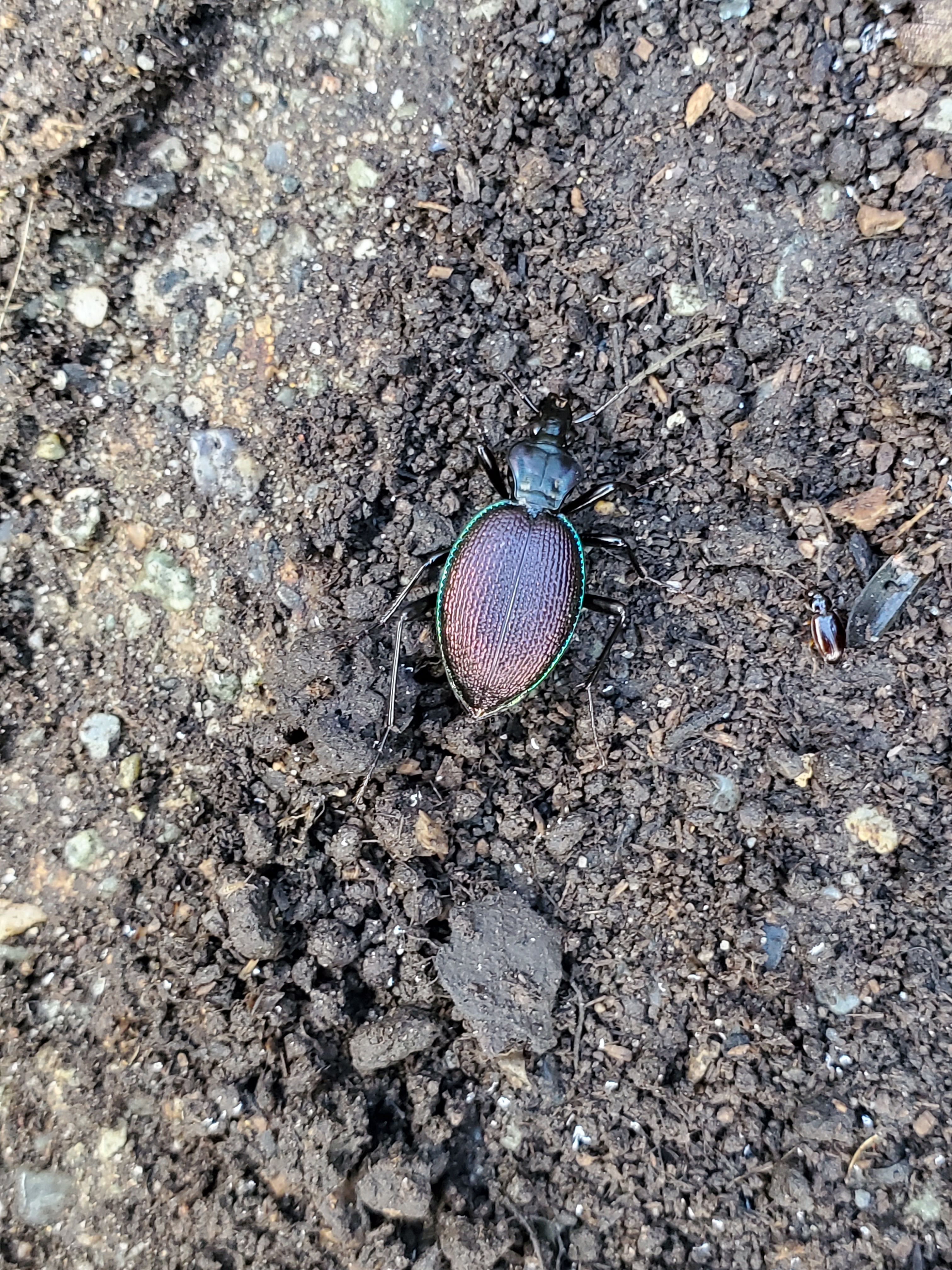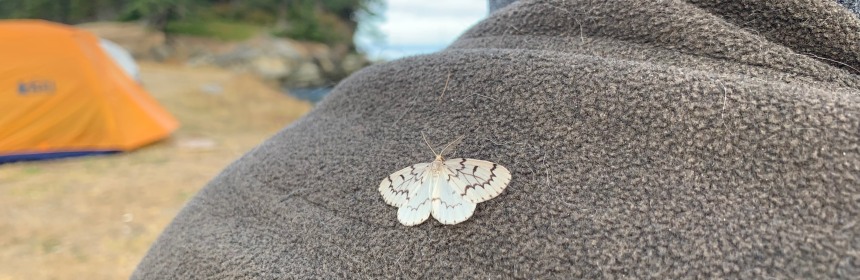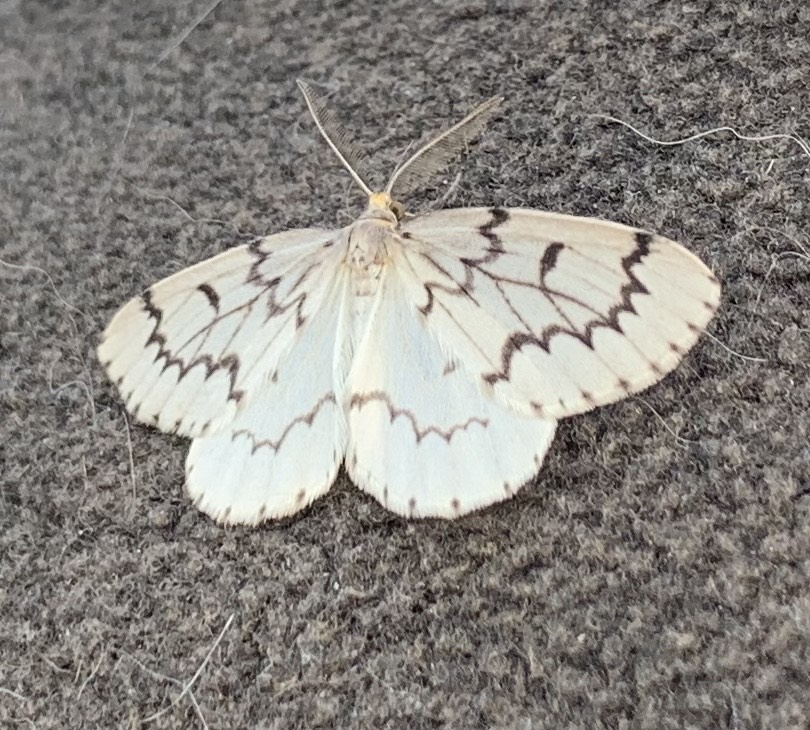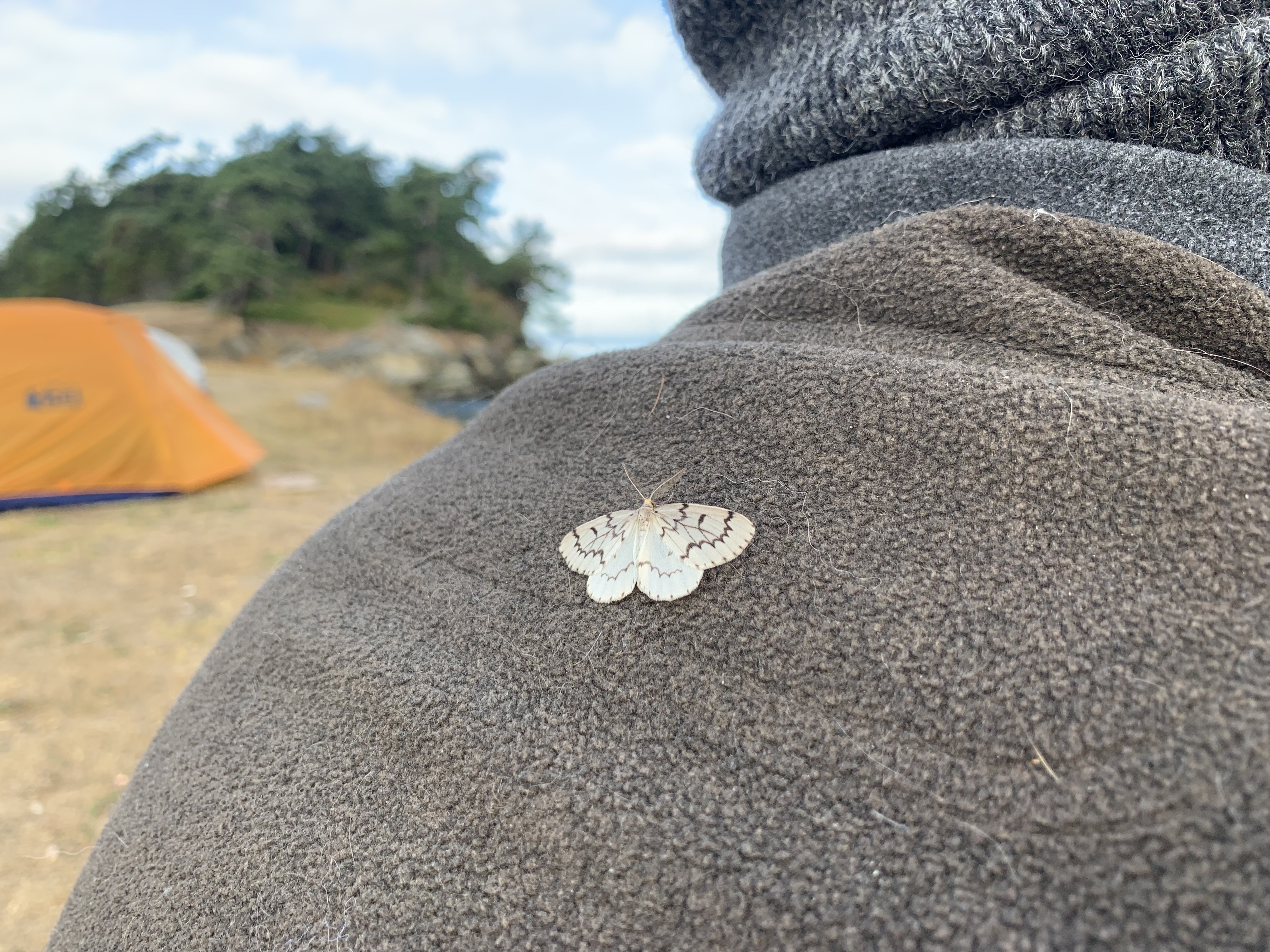
Yesterday, August 29, 2021, I received an email from C. Croll requesting ID of a moth photographed by T. Ormenyi. Their query read,
“I live on Orcas and kayak quite a bit. Today I was paddling from Patos Island back home, and there were thousands of moths in the air. They were heading from south to north. We first saw them on Patos but then all the way home. Some had fallen onto the water on the crossing. ”
And,
“I had not witnessed so many moths all traveling together before. Seemed like a migration of some sort? When they first arrived I thought there were cottonwood seeds floating on the breeze, took a second to realize that it was moths. The air was full of them for almost an hour. “
These moths sighted by Calvin and Tessa are the Phantom Hemlock Loopers, (Nepytia phantasmaria). They are in the family Geometridae. This species ranges from southern BC to California. There is one generation produced per year and larvae feed on conifers, including Western Hemlock, Douglas-fir, Grand Fir, Amabilis Fir, Sitka Spruce, and Western Red cedar (Bugguide.net).
Adults typically emerge in fall (September and October), so seeing them now is a bit earlier than when I’ve typically collected specimens at my porch light on San Juan Island. Last year, I photographed my first specimen of the season on Sept. 7, 2020. As these moths are nocturnally active, Calvin and Tessa’s report of of them traveling en-masse like this during daylight was intriguing. I was curious to know more.
William H. Hendrix III’s thesis titled Migration and behavioral studies of two adult noctuid (Lepidoptera: Noctuidae) species plus feeding observations of some moths common to Iowa (1990), cites (Johnson, 1969), stating these migration events are part of the “oogenesis flight syndrome” stage where the newly emerged adult insects move en-masse before reproduction and egg laying takes place. Hendrix (1990) also provides some theories as to WHY these moths migrate in the first place. Several theories have attempted to explain this, but he concludes, “Migration, consequently, occurs primarily in young adults and its chief function is to allow escape from unfavorable habitats and allow colonization of a broad range of environments” (Hendrix, 1990).
After reading about this particular species, I believe the migration witnessed yesterday could be attributed to either 1) the sudden weather change we experienced overnight in the islands, or 2) the lack of suitable habitat for reproduction because of the drought we are experiencing. I’m guessing the drought may have more to do with this and we will see more evidence as other species struggle to survive the coming environmental shifts associated with global warming.
Thanks to Calvin and Tessa for sending in their observations!
Edwards, D.. (2011). Activity rhythms of Lepidopterous defoliators. II. Halisidota argentata Pack. (Arctiidae) and Nepytia phantasmaria Strkr. (Geometridae). Canadian Journal of Zoology. 42. 939-958. 10.1139/z64-093.
Hendrix, William Hurston III, “Migration and behavioral studies of two adult noctuid (Lepidoptera: Noctuidae) species plus feeding observations of some moths common to Iowa ” (1990). Retrospective Theses and Dissertations. 9373. https://lib.dr.iastate.edu/rtd/9373 https://lib.dr.iastate.edu/cgi/viewcontent.cgi?article=10372&context=rtd
Johnson, C. G. 1969. Lepidoptera: Long-distance displacement. In MigrationandDispersalofInsectsbyFlight. Methuen&Co.,Ltd., London. 763 pp.
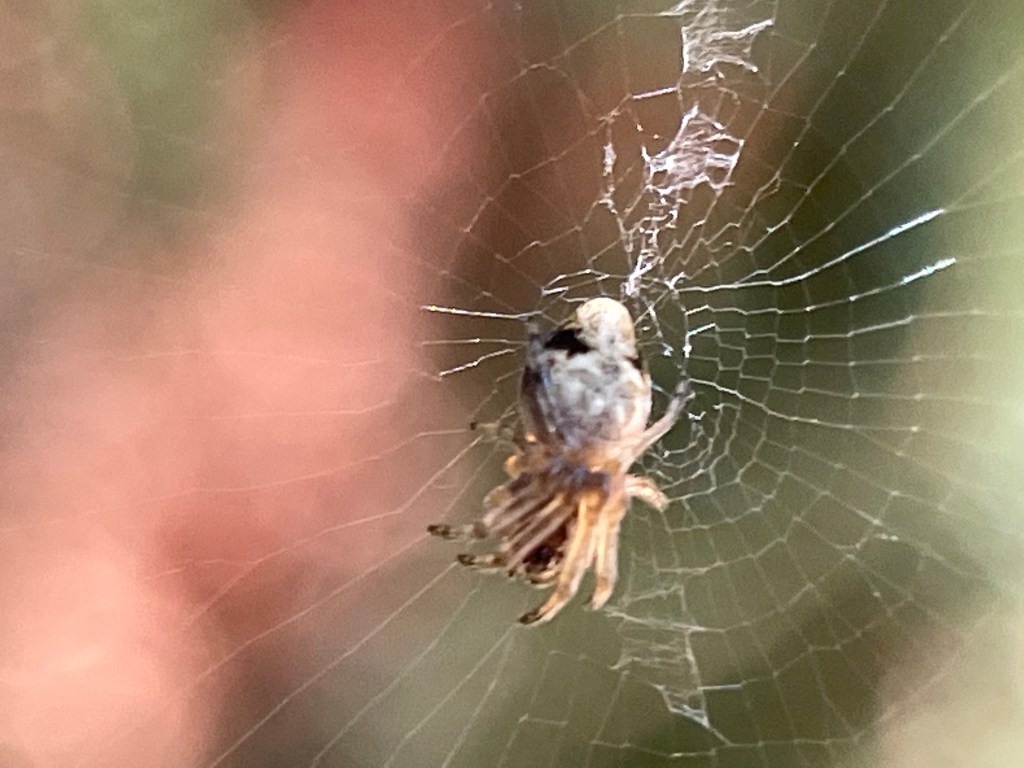
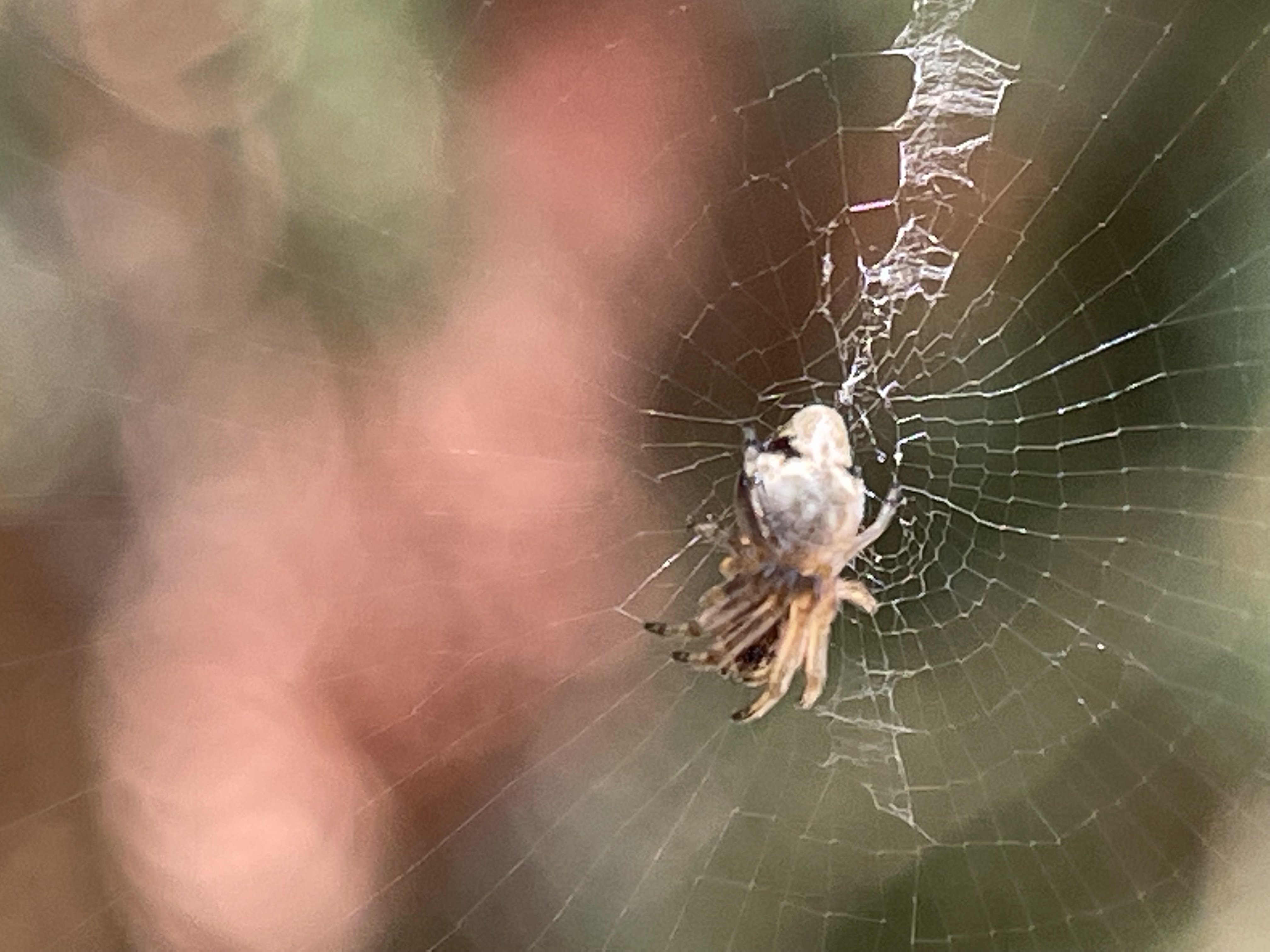
I wanted to share with you photos of two spiders I photographed recently. Location: San Juan Island, WA. Both are in the family Araneidae or what we know as Orb Weavers. The first (orangey one), was observed on a tomato plant July 31, 2021, and the 2nd (brown one) was observed yesterday evening, August 10, 2021, on some sort of wetland grass near my home.
While I knew the orangey one was a Cross Orb Weaver, Araneus diadematus, I wasn’t certain of the brown one’s ID beyond genus Araneus, so I reached out to Seattle Burke Museum’s arachnologist, Rod Crawford to see what he’d say. He responded to my query this afternoon and offered that both are Araneus diadematus spiders. There can be variability in color tint (many of us know the Cross Orb Weaver A. diadematus as pumpkin orange).
Rod continued with, “the ventral view of the brown one shows it is penultimate (still one molt to go). Once they mature they will be more noticeable. Seattle specimens are at this same stage now.” He also offered in terms of color variants among spiders, …”I imagine there is a genetic component to this variation, at least in most cases, but I’ve never looked into the details. I have found situations where spiders living amidst a population explosion of green leafhoppers all tended to be greenish in color, presumably derived from their food.”
It’s all so very interesting, isn’t it! I’m glad we have scientists who are willing to share their knowledge and experience. Thanks to Rod for his help!
Araneus diadematus (San Juan Island 07.31.2021)Araneus diadematus (San Juan Island 07.31.2021)Araneus diadematus (San Juan Island 07.31.2021)Ventral View – penultimate molt – Araneus diadematus (San Juan Island 08.10.2021)Araneus diadematus (San Juan Island 08.10.2021)
June 29,2021. So happy we’re not broiling today. Since many of us will be eager to enjoy the outdoors the rest of the week, I’m sharing something I’ll describe as an “insect-related public health announcement.” Please find some humor and some good advice in my post.
While we are lucky we live here and not in the south where bugs are much more likely to bite and transmit all sorts of icky things (like Dengue, West Nile, Yellow Fever, EEEV, and a long laundry list of others), we still get various bites and stings that cause reactions.
If you’re like me, your skin may over-react (large, localized reactions), or worse if you’re extremely allergic or even anaphylactic.
After living here almost 12 years, I’ve become pretty familiar with the bugs, including the biting and stinging ones. Every year, when the grass is tall, I’ve gotten these extremely irritating, itchy bites that look a lot like the chigger bites I used to get in the south. They are angry-red, and the itching can last for WEEKS!
Well, a little over a week ago, I was sitting outside in our freshly mowed “yard” which is really a field of miscellaneous native and non-native grasses. We have 3 different colors of lawn chairs – royal blue, white, and brown. I love the blue, so I plopped down to relax and watch my bearded dragon while we both enjoyed some sun. I made a couple of mistakes here, but also solved a mystery.
Fierce Dragon
First mistake. I wore my new shorts. Yep. After this much time, you’d think I would finally learn. Wearing shorts in the San Juans is like coating yourself with sugar water and sitting down next to a nest of yellow jackets. You’re advertising you’re open for dining.
Second mistake. The chair. Yep. That blue chair is a bug magnet. If you’ve been following my posts, you’ll notice I’ve photographed a few bugs on that blue chair. I should have picked the brown chair…or at least worn long pants.
Blue chair
I felt the bite when it happened. My desire to figure out what critter has caused me a multi-annual summer season of itchy aggravation that compels me to cover up with long pants to prevent future bites, and hide the leprosy-looking splotches, was finally realized when I found I had the teeny culprit between my fingers. I ran into the house to stick it under the microscope and found…it was SQUISHED beyond determination. Sigh!
But wait! I was able to rule out a few potential offenders. It was definitely NOT a spider. Come on! Spiders get blamed for more things than they deserve. Most spiders are innocent. It was not a mosquito, no-see-um, flea, tick, bee, wasp, and, I’ll repeat again – NOT a spider!
The thing about being an entomologist is you are 100% oriented to try to identify bugs. I’m ALWAYS looking at bugs. They are fascinating to me. Especially the ones that have super powers or weird behaviors and even the ones that bite. So, I sat down and became OBSESSED with trying to figure out what I squished.
My breakthrough came in going back outside. I took my cellphone and the little macro-lens that attaches to the camera since it helps me see tiny things that age makes impossible to see. My eyes failed at about age 50. If you’re younger than me, SEE what you have to look forward to! 👀
I scanned the chair for any salt-grain sized objects and THERE it was! I made a short video clip and then took a still image from my video. A thrips.
Thrips on a blue chairstill image – thrips on a blue chair
Thrips are tiny (1-2mm). Their name is also interesting. It’s the same for singular and plural. One thrips, two thrips! Sounds like Dr. Seuss should have written a story about these. I will forever remember thrips because when I was in Florida for my graduate school exit exams, I had to answer questions in front of my committee chair and a few other profs. One of the questions I got was about what insect order these were in. I went completely BLANK.
It is one of those moments where you want to slink down into your chair, slide under the table, and crawl away in shame. Even worse, the comment made by one of the committee members. He hinted, “but your committee chair made his career studying these!” OMG, I wanted to die. Nothing prompted my memory. I would have been utterly humiliated except for the fact that when they were trying to set up the computer to Skype in my co-committee chair who was in South Africa, they couldn’t get the technology to work and guess who fixed it? Yep. ME. I think that may have saved me that day.
Also, it WAS the only question I missed. And, in case you’re wondering, THRIPS are in the insect order THYSANOPTERA.
Back to thrips. They bite. I found quite a few records of folks being bitten by these TEENY, TINY bugs. Check my list of references when you’re done reading. If you can’t access these online and want to read more, shoot me an email and I’ll figure out how to get you a copy.
This review was pretty interesting. They actually found reports of bites by thrips dating back to 1883. One article I found is actually titled, “Night of the Living Thrips: An Unusual Outbreak of Thysanoptera Dermatitis.” That one is about an outbreak of skin eruptions at the Marine Corps Training Area Bellows in Oahu, Hawaii. The photos I saw made me itchy just looking at them.
The itching is intense! My bite had the exact features described in the literature I found, down to the presentation of the classic “anaemic halo” or white ring around the bite. Irritation and itching is attributed to the thrips injecting you with saliva when they bite.
More about thrips. They have a variety of niches in ecosystems, typically as plant eaters (phytophagous), fungi eaters (fungivorous), and eaters of other invertebrates (predacious). I should add, occasional biters of vertebrates!
Most thrips species have two pair of wings and can fly. Some are known agricultural pests. Sometimes they swarm and people notice them then, but typically, when they bite a human, it’s a case of mistaken ID. That means, a mosquito gets blamed.
from wikipedia
It’s an easy mistake to make. Thrips actually have mouthparts somewhat similar to mosquitoes. They have piercing sucking mouthparts with a single mandibular stylet and two opposable and interlocking maxillary stylets. That mandibular stylet is the hole puncher! More about how that all works in Childers et al. 2005. If you remember nothing else, just remember that adult and larval thrips can bite.
Another thing I found out in my obsessive reading. Thrips like BLUE. They like white too and have been reported getting on laundry hung outdoors to dry, then biting people when they bring that sun-dried, fresh shirt (or underwear) indoors and put it on. The blue chair is a thrips magnet. I’ve resorted to rinsing it off with the hose and wiping it dry before I sit down on it.
This most recent bite I had resulted in this baseball-sized diameter welt. It also had the white halo ring.
Thrips bite with white halo ring
I ended up calling the after hours line at my doctor’s office to get an antibiotic prescription because it was the weekend and the bite sure looked to be getting infected. I took Benadryl. The call-a-nurse at my insurance company said if you’re ever having a bad reaction to chew Benadryl tablets. It gets into your system faster. I already knew this, but liquid Benadryl also works fast. The itching was miserable given the heat, but I also took a bath in hot water with a lot of iodized salt. I didn’t take the antibiotic because the salt seemed to stave off infection.
My bite is healing, but I ended up with another on my other thigh. The halo ring around this one is fainter, but still visible.
I didn’t see that bite happen, but I know it wasn’t a mosquito because I saw a mosquito bite my ankle when I was outside watering and even though I felt it, I didn’t get any mark or subsequent itching at all. Mosquitoes here don’t have the same effect on me as the mosquitoes in the south had.
Take away message here. Don’t blame the spiders next time you get a weird bite. Especially if it’s summer and you’ve been outdoors. Take a shower before getting into bed and if your pets go outside and come indoors to sleep with you and lie around on furniture, just be aware it may not be fleas biting you, but thrips. Also…avoid blue. Blue is one color that bugs in general seem to like, so unless you’re into entomology and WANT to attract bugs, wear another color. The way it’s looking to me is that gray and beige may be the only safe choices.
Oh…and before I go, the person who coined the term “delusory parasitosis…” Bah to you! Lucky for the poor farmer fellow I read about who complained of being bitten by an “invisible” bug. He’d been diagnosed with delusional parasitosis, but in his persistent presentation to his dermatologist, finally had the culprit of his irritation identified as a grain thrips.
Remember that while you might hope to have that bite diagnosed at your doctor’s office, medical professionals may not have the additional expertise in identifying what bug bit you. They’re there to treat symptoms, but in some cases, it’s important to know what bit you. So, if you feel a bite, look for a culprit and collect it if you can. In some situations, with tiny things, I’ve used scotch tape. A plastic baggie or small cup or jar with a lid works too. Collecting that specimen also means you’re less likely to walk out with “delusional” written in your file!
Further Reading
Carness, J.M., J.C. Winchester, M.J. Oras, and N.S. Arora. 2016. Night of the living thrips. Cutis. 97:13
Leigheb, G., R. Tiberio, G. Filosa, L. Bugatti, and G. Ciattaglia. 2005. Thysanoptera dermatitis. European Academy of Dermatology and Venereology. 19:722-724 DOE: 10.1111/j.1468-3083.2005.01243.x
*Author’s note – While this post attributes pest status to thrips, please know that although thrips can occasionally bite humans and animals, there are thousands of species. Not all of them are biters. Many are actually beneficial and pollinate plants. Lots become food for other organisms, including spiders (which are mostly friendly)! Pesticides are completely unnecessary and often do more harm than good.
This fly was in my yard last week. San Juan Island, WA. 06.19.2021. It’s taken me about a week to get around to ID, but I believe this to be Eupeodes fumipennis (the Western Aphideater, a syrphid fly that happens to be a bee mimic.
In case you are wondering about that name. The Western Aphideater does actually eat aphids in the larval stage. To see what a syrphid fly larva looks like in action, check out my blog post with more video footage here –https://buggingyoufromsanjuanisland.com/…/honeysuckle…/ – also viewable in the photo below. While I have not been able to identify the species name of the syrphid fly larva in that post, you can definitely see where the Western Aphideater fly might get its name.
This amazing little creature is a Tiger Fly in the genus Coenosia, and I believe C. tigrina. Photographed on May 30, 2021 with prey that appears to be a spittlebug nymph.
This particular tiger fly is a European native, introduced to North America in the 1800’s. It is now found throughout the northeastern and western United States and adjacent Canada.
Tiger flies, also sometimes known as hunter or killer flies, are indeed fantastic predators of other pest insects, including Drosophila sp. flies. Even the larval stage of this fly is predatory on other organisms. Because of their success in hunting, they are often used as biological control of pests in greenhouses.
I found a “new-to-me” bug the other day when I put on my heavy duty gloves and reached to pull out some bull thistle growing in a pile of dirt near our home. I was being extra careful because the thistle has spines and they kind of hurt when you get them stuck in your hand. The beetle was right in front of me when I pushed apart some leaves to get a better grasp on the stem.
As I looked a bit more closely, I saw there were quite a few of these beetles on the thistle, especially on the buds. I went back to the house to get my camera, took some photos, then went about figuring out what this was. Definitely a beetle.
It was weevil-like, and pretty hairy. There were quite a few of them paired up. They have spring fever like a lot of other bugs I’ve seen of late. That’s how we get more bugs though, and we need them, whether we like all of them or not.
(Rhinocyllus conicus) on Bull Thistle
Identification took me about an hour. I am getting better at piecing bits of information collected over the years. Bull Thistle is not exactly a popular plant. It’s managed to get itself on the noxious weed list. No one seems to want this plant in their garden, aside from Eeyore, who really loves thistle, right?
Noxious weed made me think of biocontrol. That narrowed things down a bit and I learned this is the Nodding Thistle Receptacle weevil (Rhinocyllus conicus). Personally, I’m calling it the Nodding Thistle Rhinoceros Beetle because being in the family Curculionidae, it has the appearance of a nodding rhinoceros.
So, the beetle was introduced to control thistle in the US because thistle isn’t welcome, at least the non-native species like bull thistle aren’t. The part that got me reading to find out more was the adjective used to describe this beetle as “controversial.” Well, what I found is that the beetle doesn’t just eat non-native thistles. It eats NATIVE thistles too (Cirsium edule and Cirsium brevistylum).
Ventral view of my Nodding Thistle Receptacle Beetle – It’s kinda cute!
Why does that matter? Well, disrupting native ecosystems can have ripple effects. I found out another reason the beetle is controversial is because there are native pollinators that depend on thistle, like the beautiful Painted Lady Butterflies that we love. Thistles also produce seed and flax used by our very own state bird, the American Goldfinch. Which brings me to the question, “If the butterflies and birds have begun to utilize the non-native species, are we making the problem worse by introducing another non-native species?”
In my continued reading , I actually began to connect the fact that I buy bags of expensive thistle seed at the store to attract the goldfinches, but I’ve got LIVING food for them in my yard that is free (and also free of pesticides), and here I am pulling it out. Am I going to waste my energy trying to eradicate a small patch of bull thistle? Nope. If it starts to get out of control, we can just mow it down. For now, I am leaving it for the birds and the butterflies…and all the other little creatures I’ve seen living on it. There were lots of super cute little jumping spiders all over it yesterday!
I’ll leave you with a question. Should we have introduced this hairy little beetle that isn’t native? I don’t have a good answer. Maybe it will just help control the spread of thistle and won’t eradicate it entirely. I’d like to be able to have Painted Lady’s, Goldfinches, and lots of jumping spiders in my garden, even if I occasionally get pricked by the spines of those thistles. For now, I’m going to stick to improving my drawing skills!
Did you know Ocean spray is one of our native plants? Lots of folks don’t even know this and label it as “invasive,” or a “fire hazard,” then rip it out of the ground to replace it with non-native ornamentals or worse, leaving the formerly healthy, forested understory devoid of vegetation.
Here’s a bit of historical trivia – Ocean spray is sometimes called Indian arrowwood because Native Americans made use of its straight hardwood branches for arrow shafts. They also used oceanspray for treating viral and skin diseases. Other names for this plant are Holodiscus discolor, ironwood or creambush. There is actually a novel phenolic component in the plant called Stilbene a Xyloside that has been associated with varied biological and medicinal activities.
Some reasons I’d like you to appreciate Ocean Spray….
It is a larval host plant to some of our native butterflies and moths. These include the beautiful Pale Swallowtail (Papilio eurymedon), Spring Azure (Celastrina sp.), Lorquin’s Admiral (Limenitis lorquini), and Gray Hairstreaks (Strymon melinus). One particularly notable one here on our island is the delicate Fairy Moth (Adela septentrionella). Calscape (California Native Plant Society) lists 14 confirmed species of Lepidoptera associated with Ocean Spray (and 23 as likely) for a total of 37 species native to the state of CA. I could not find published studies for this in WA state, but link the Calscape page here https://calscape.org/plantleps.php?hostsloc=california&species=Holodiscus+discolor
Ocean spray provides cover and forage for wildlife. Birds, small amphibians, and deer rely on native plant species like Ocean Spray that make up part of the forest understory and are a component of a healthy ecosystem. Fire-scaping may be on your mind, but one way around this is to look at installing adequate water cachement around your home to help keep vegetation from drying out and dying in late summer and fall. We want to live in the forest, but if we remove the native understory, we risk altering the landscape even more and losing these beautiful creatures!
Ocean Spray flowers provide pollen and nectar for native bees! 🐝
This is a Northern Carrion Beetle – Thanatophilus lapponicus, one of the carrion beetles in the family Silphidae. The origin of the name Thanatophilus is from Greek thanatos (θανατος)- “death” + philos (φιλος)- “loving, liking” (Bugguide.net, 2003-2021).
Death is part of a biological process that can be unsettling for many of us. That said, death makes way for new life. This past February, a small fawn died on our property.
February 17, 2021
We left the body where it lay. First the eagles came, then a pair of ravens. I believe a fox visited too (tracks in the snow).
Bald Eagle 2.18.2021Fox (?) tracks in snow
Over the course of the past 12 weeks, I’ve found some very cool bugs developing in the carcass, even now in the bits of hide and bones that remain.
Did you know?
There is actually an entire field of scientific study (Forensic Entomology) where time of death of a body can be estimated by the presence and developmental stage of certain insects involved in the decomposition process. This is called determining the Post Mortem Interval or PMI. Forensic entomologists can aid law enforcement in crime investigations by surveying for species of arthropods on a corpse, and determining stages of development and feeding behavior of the arthropods present (Barnes, 2000).
Carrion beetles in the family Silphidae fall into two subfamilies: the Nicrophorinae and Silphinae. While both feed on the remains of animals, the Nicrophorinae or Burying Beetles are associated with smaller corpses like birds, mice, voles, etc., weighing under 300g, while the Silphinae utilize larger cadavers (Watson & Carlton, 2005). This preference or niche, makes them ideal for investigations related to human death or death of larger species of wildlife (as in poaching or other crimes against animals).
Distribution. Thanatophilus lapponicus ranges broadly throughout Canada and Alaska, across the norther United States from coast to coast, and south to Southern California, Arizona, and New Mexico (Anderson and Peck 1985, Peck and Kaulbars 1987). It is also found in Northern Europe and Asia (Hatch 1928, Schwaller 1982).
Remarks. Thanatophilus lapponicus is readily identified because of the presence of a row of small tubercles on each of the elytra intervals (Figs. 31-32, 62); it is the only silphid in North America with this distinctive form of elytra sculpturing.
The larval stage was described by Dorsey (1940) , and a brief synopsis was given by Anderson and Peck (1985). The larva of this species is characterized by a dark brown to black color on the dorsal surface, urogomphi that are about two times the length of the 10th abdominal segment, and antennae with a large sense cone on the second segment (as in Fig. 40).
Anderson and Peck (1985) reported that individual females lay about ten eggs in the soil surrounding a carcass. The egg stage lasts 5-6 days, the first instar about 7 days, the second instar 8-10 days, and the third instar 10-12 days. While Anderson and Peck did not observe pupae, they did note that T. lapponicus is a cold-adapted species that occurs at higher elevations in the western Mountains of North America. It is often the only silphid present in some of these areas. Thanatophilus lapponicus shows a strong preference for open areas (Anderson 1982c).
Clark (1895) observed extensive predation on fly larvae by adult beetles.
Size. 9-14mm
Time of Year Seen. March-October
References:
Anderson, R.S. and Peck, S.B. (1985) The carrion beetles of Canada and Alaska. The insects and arachnids of Canada, part 13, 1–121.
Watson, E., & Carlton, C. 2005. Succession of Forensically Significant Carrion Beetle Larvae on Large Carcasses (Coleoptera: Silphidae). Southeastern Naturalist,4(2), 335-346. Retrieved April 27, 2021, from http://www.jstor.org/stable/3877967
This little guy got into my pants yesterday! 😁 What is it? This is a Treehugger Soldier Beetle (Dichelotarsus piniphilus) in the family Cantharidae or soldier beetles ( because their wings resemble military uniforms). More interesting though is the Greek translation of Cantharis or κανθαρισ, translating to ‘blister beetle.’
I’m pointing this out because this little Treehugger got confused yesterday and when it was hugging my leg and my pants were hugging back a bit too tightly, it either bit me or exuded some of the defensive chemicals that they use to repel would-be predators . In either case, I was fine aside from a bit of a temporary stinging sensation.
Treehugger Soldier Beetle
This species is common in the west. Surprisingly, very little is known about the life histories of these beetles. I’ve spotted them on nettle this time of year. Adults are known to feed on insects (including aphids), nectar, and pollen.
I wondered if there is some uptake of the chemical constituents of the nettle to produce the defense secretions in the beetle, either via consuming pollen from the nettle, or via feeding on another insect feeding on the nettle. A literature search failed to yield any supporting information, though I did find an older publication listing insects found in association with nettle. Quite a few were some of our lovely Lepidoptera, so you might want to leave those nettle patches instead of clearing them away 🦋
I thought I’d post about something new I discovered today when reading about the Darkling Beetle species Zophobas morio. These are beetles that some folks will know by the common name for their larval form, Superworms.
First off, the beetle I’ll be using as my representative here is named “Bill.” I discovered Bill one day in my bin of feeder roaches for my Bearded Dragon (Drago). When I first met Bill, he was a weird waxy, mummy-looking mutant lying motionless amongst the frass (roach poo) at the bottom of the plastic bin.
He almost got dumped into the trash, but I gently picked him out recognizing the wax museum-like form as the pupal stage of some sort of bug. It definitely was NOT a roach since roaches have hemimetabolous development. This means their intermediary stages or nymphs, basically look like mini replicas of their adult parents.
Zophabus morio, “Bill”
Bill didn’t stay red for very long and in fact, the next day he was pretty BLACK. While investigating a bit about the meaning of his scientific or Latin name, I couldn’t find much in the entomological references I checked. I delved a bit deeper and came up with this and thought you might find it interesting.
In Greek, Zophos refers to “black” or “black darkness of the nether world.” Mori refers to “death.”
I think I like the name Bill if he’s going to hang out on my kitchen counter, but maybe for Halloween he can be scary Zeke the Greek, herald of black death of the netherworld.
Bill is also going to be a family member for about as long as Drago. I’m not sure how my husband will feel about this. He asked me when I got Drago how long Bearded Dragons live. I said “about 15 years with good care.” Wow! That means we will be in our 60’s.
Drago was 3 when he came to live with us in March 2020, so if he lives to be 15, I will be the very old age of 68. Well, BILL can live for about the exact same amount of time! FIFTEEN years. That’s right! I read it here -https://sciencing.com/superworm-life-cycle-5347598.html