I had my bearded dragon outdoors the other afternoon to get his 20 minutes of sunshine (me too!) when I spied something unusual moving in the grass. The object of my attention was a fairly large caterpillar lying in the middle of 25-30 voracious Thatching Ants (Formica obscuripes), intent on relocating the caterpillar (their dinner), even if they had to do it one bite at a time.
Observing them at work, I thought of how the Egyptian pyramids were built. Humans. Lots of them. Carrying those giant blocks and stacking them required formidable effort. Perhaps these ants in their orchestrated labor efforts would successfully lug this lepidopteran larvae back to their nest.
I did not stay and watch to the end. I watched just long enough and filmed this clip. I felt a bit sad for the caterpillar, wondered about the butterfly or moth it might have become, and I marveled a little about these industrious ants that cooperate for the collective benefit of the colony.
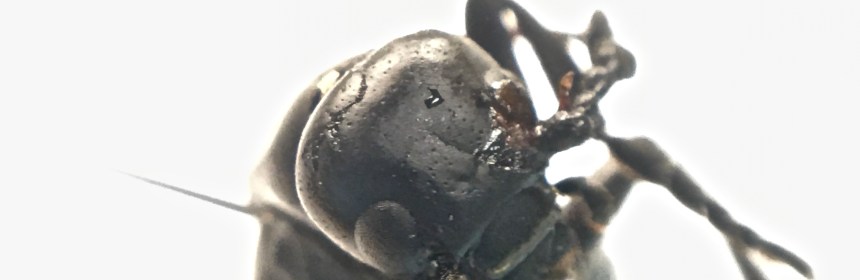
Meloe strigulosus Ventral view San Juan Island, WA 11/2/2019
I posted back in April about an encounter with Blister Beetles not far from my house. You can read about that here ~ (https://cynthiabrast.wordpress.com/2019/04/16/a-blistery-spring-day/ ). Over the weekend of November 2-3, I came across quite a few more of these in the exact same spot as in April. This time I didn’t see any live beetles, but there were at least 25-30 dead in the road.
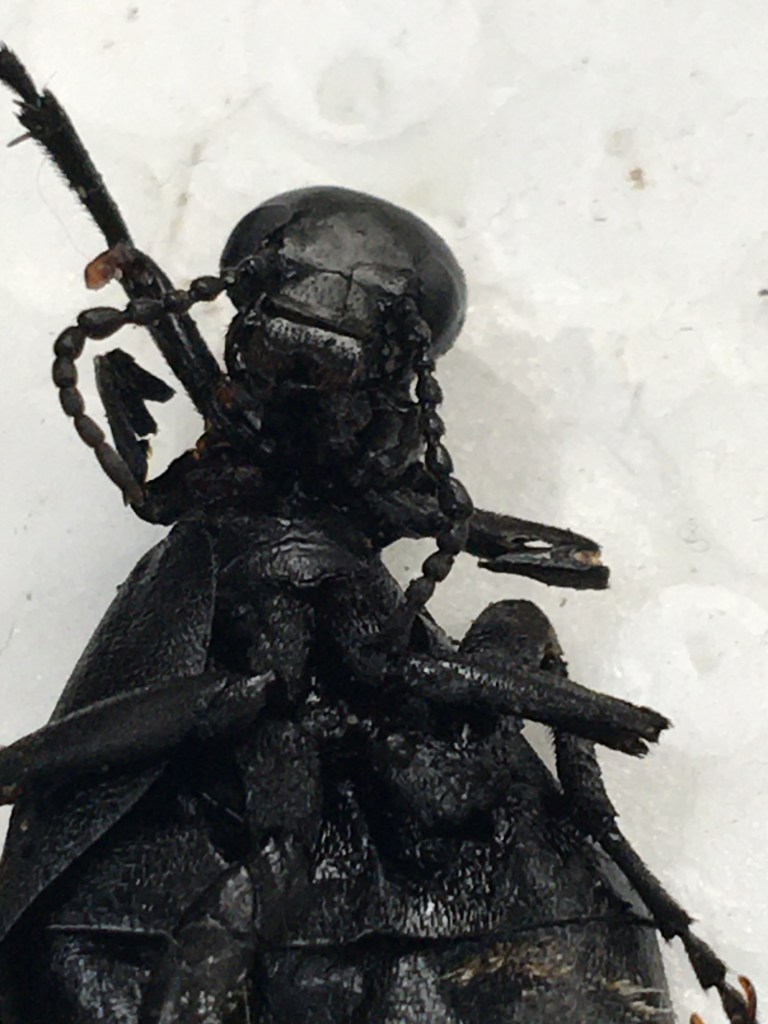
Meloe strigulosus San Juan Island, WA 11/2/2019
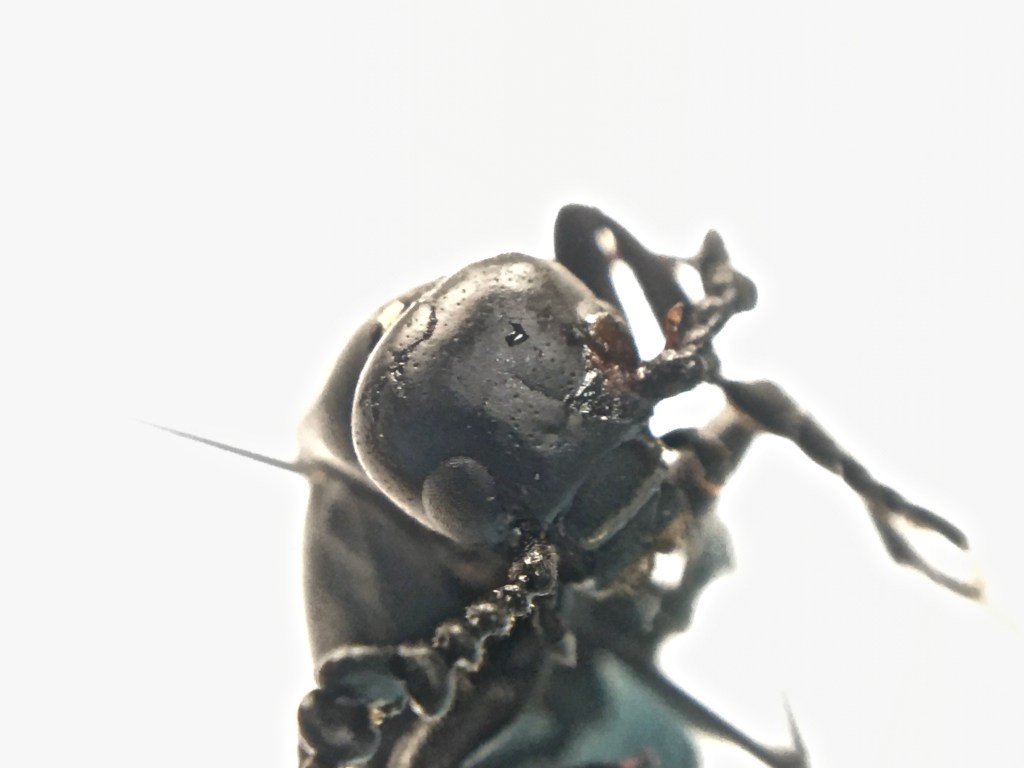
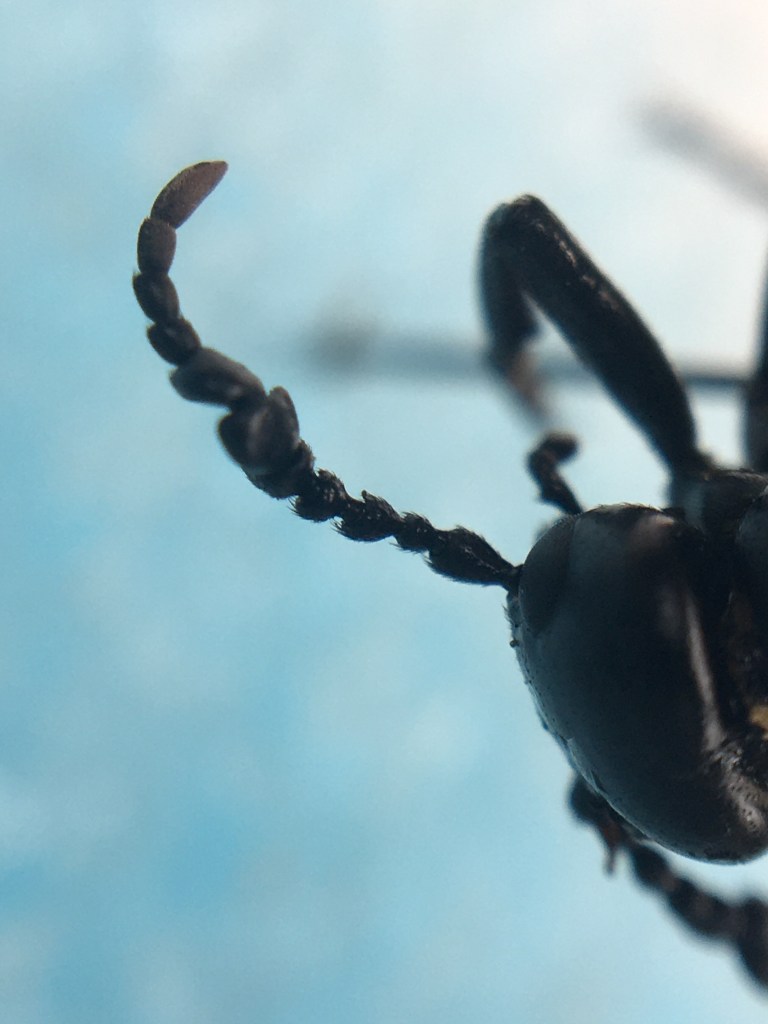
Ever the opportunist, I scraped up as many that weren’t quite so smushed into a container and brought them home. Out of the 5 I collected, 2 were male, 2 were female, and one missed antennae altogether. Given the number of beetles in the road in this one spot, I believe this was a mating aggregation.
Meloe strigulosus (male) San Juan Island, WA 11/2/2019
So, I’ve been reading about them and communicating with a two experts on blister beetles. If you don’t know what these are, they are significant because of a defensive chemical in them called Cantharidin. Cantharidin is quite toxic and it’s a blistering agent. This is where they got the name Blister Beetles in the first place.
antennal segmentation of male Meloe strigulosus San Juan Island, WA 11/2/2019
Since my first sighting of these beetles back in April, I’ve learned quite a bit about them. The ones here (Meloe strigulosus) are black, flightless, tanker-like beetles, carrying around a cargo of toxic brew. They are sometimes a hazard to livestock (actually almost all mammals) that might eat them because the Cantharidin is toxic. Horses, goats, cows, and sheep that eat alfalfa hay can get really sick with colic if there are even parts of dead beetles in the hay.
While we don’t really know exactly how Cantharidin is produced in the beetle, we do know these two things: 1) it’s produced in the male and transferred to the female during mating. 2) the female transfers Cantharidin as a protective coating for her eggs during oviposition. It’s believed that the first instar larvae (called triungulin) are equipped with a supply of Cantharidin as well.
After hatching, the triungulin crawl up onto flowers to hang out and wait to attach to the hairs of a visiting bee, riding back to its nesting site. The later developmental stages of larvae are protected underground or in holes in wood where native bees are developing. They consume the developing bee eggs, larvae and nest provisions (pollen and nectar).
Is there anything good about blister beetles? Well, strangely, the populations of some species of blister beetles are timed to coincide with grasshopper abundance. Adult blister beetles feed on grasshopper eggs. That’s good, right?
What else? Humans have used Cantharidin for years to remove warts and to remove tattoos as well. For ages, it has been used as a sexual stimulant. Even birds called Great Bustards have picked up on this! Read more here: https://www.ncbi.nlm.nih.gov/pmc/articles/PMC6521026/
Blister beetles seem to be beneficial to some other species of beetles too. There is one beetle that actually has been found to chew on the blister beetle as a means of obtaining Cantharidin for its own protection. Other animals like toads, frogs, and armadillos are known to eat these beetles or use them in some way to confer protection. There is even a nuthatch that uses the beetle to “sweep” the wood where it wants to build a nest to protect it from parasites.
Back to my weekend sighting and collection of a few of these specimens. I had two that were intact enough to pin for my collection. I wore nitrile gloves to make sure I didn’t come into contact with any blistering agent. It’s a good thing I did. Some fluid made contact with one of the fingers of my gloved hand and actually started eating through it. That’s pretty caustic!
If you’re interested in more information about them, I’m happy to email some of my collected literature. There are also links you can check out in my previous post from April.
Eek! There’s a spider in the bathtub! Do you really want to turn on the water and drown it? Hopefully you are not nodding your head “yes,” but instead finding courage to overcome your arachnophobia and finding a tiny bit of compassion. Just take a deep breath. Get a towel, or a cup and a card, and find your brave inner self to save this poor little eight-legged individual to live out its life. Say this mantra with me….”Be NICE to spiders!” Then say it over and over and over to yourself. It will make you a much more confident person. You can tell your friends and co-workers about how YOU got a spider out of the BATHTUB!
At my house, the number one threat to spiders is my cat. Millhouse is determined his job is to be spider exterminator. He squashes them. He used to eat them! Once he ate one. He fainted. I had to rush him to the vet. He revived on the way. The next time, he bit one and spit it out. I don’t know if the spider was foaming from being punctured or if the cat was foaming because well….maybe cats foam at the mouth sometimes when they eat something they shouldn’t. In any case, he’s evolving his kill techniques. Now he eats too much cat food and uses his massive body weight (he thinks it’s muscle) to flatten them.
I’m on the other side. My job is to save them. It was a good thing I saw this one before Millhouse did. You see, Millhouse loves to drink his water out of the bathtub. I have to leave the water dripping for him. That’s why you’ll note the stain on the tub. It’s from hard well water. One day I will scrub off the yellowing, but for now, pretend it’s not there.
The first thing I recommend to get the spider out is to grab something like a hand towel or a plastic cup and some sort of paper (mailer, index card, envelop, etc.). I used a towel. Watch my video and see how easy it is! The spider isn’t going to bite you. It just wants OUT of the tub. Probably it was thirsty. See my post from October 27, and you can read all about how to give a dehydrated spider a drink. At this point, it needs your help. It is stuck. The sides of the tub are too slippery for it to crawl out. It’s really easy! Here goes…
The general idea is to be extremely gentle. You don’t want to injure the spider. Keep chanting your mantra…”Be nice to spiders!” Over and over and over!
Safe!
See! It’s not that hard. The spider didn’t attack me. Isn’t it so cute! By the way, this spider is a Hackelmesh weaver (Callobius severus) https://bugguide.net/node/view/7018. I checked later today and it has crawled off somewhere. Happy to escape the cat!



 Bugging You From San Juan Island