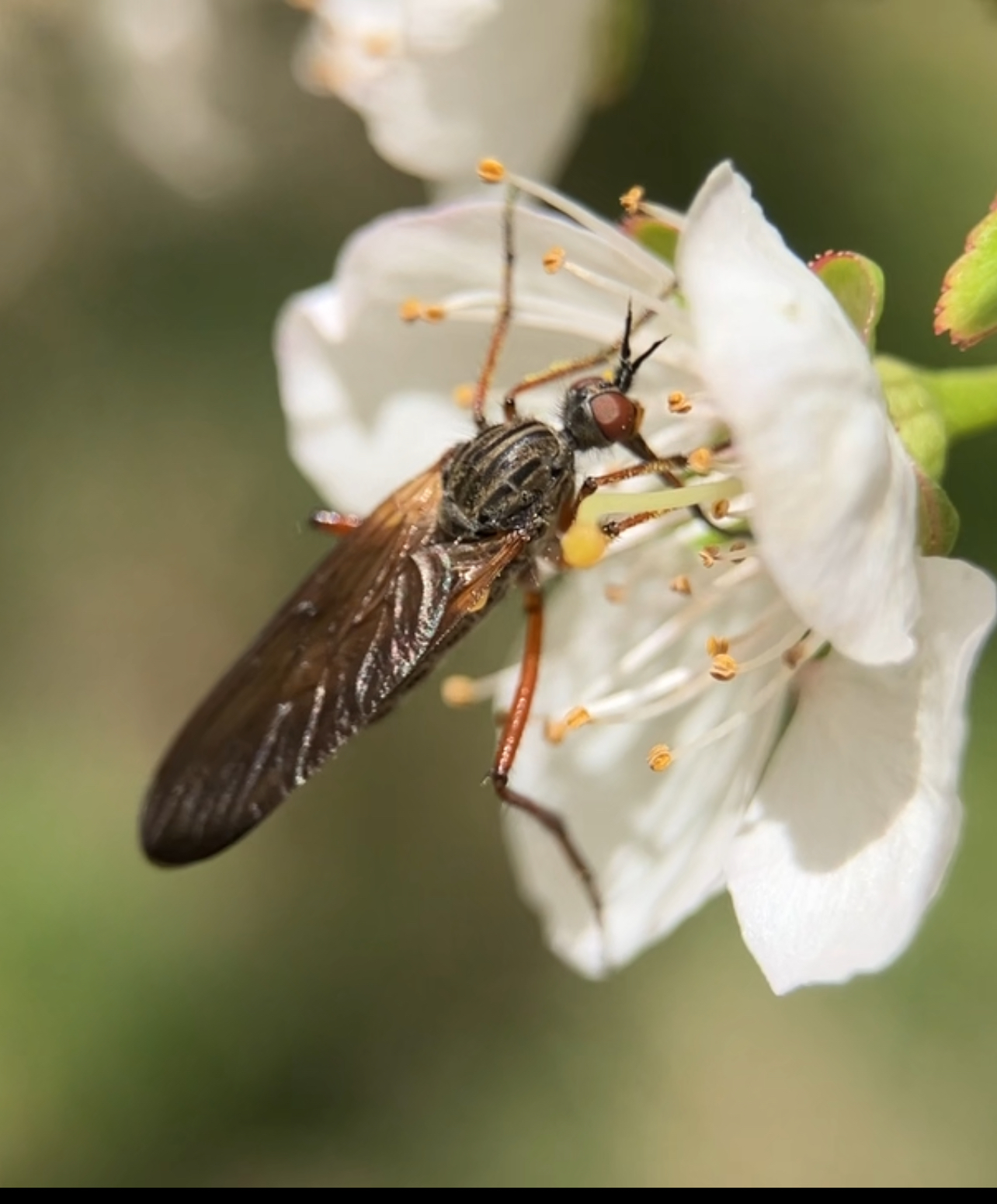
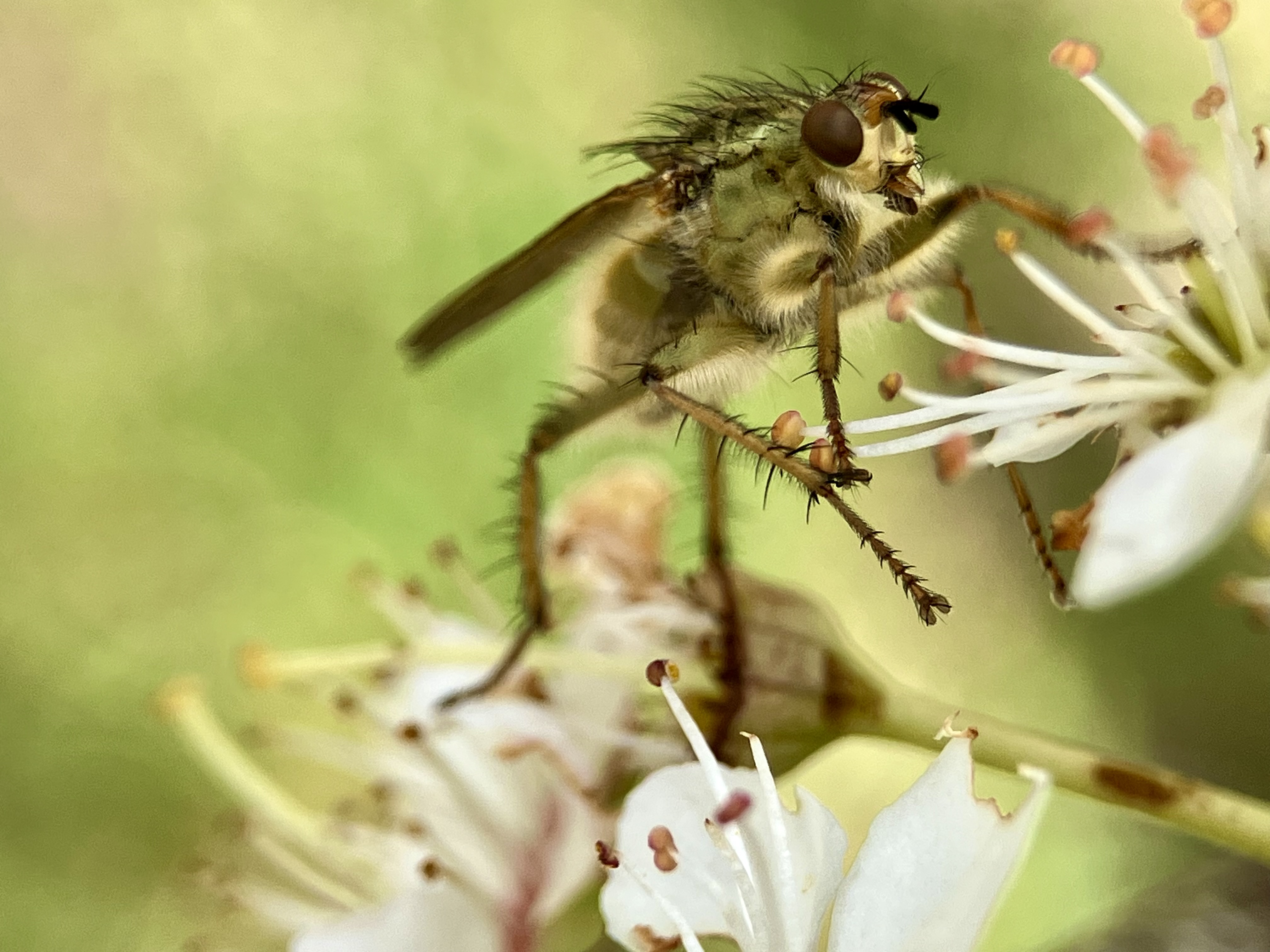
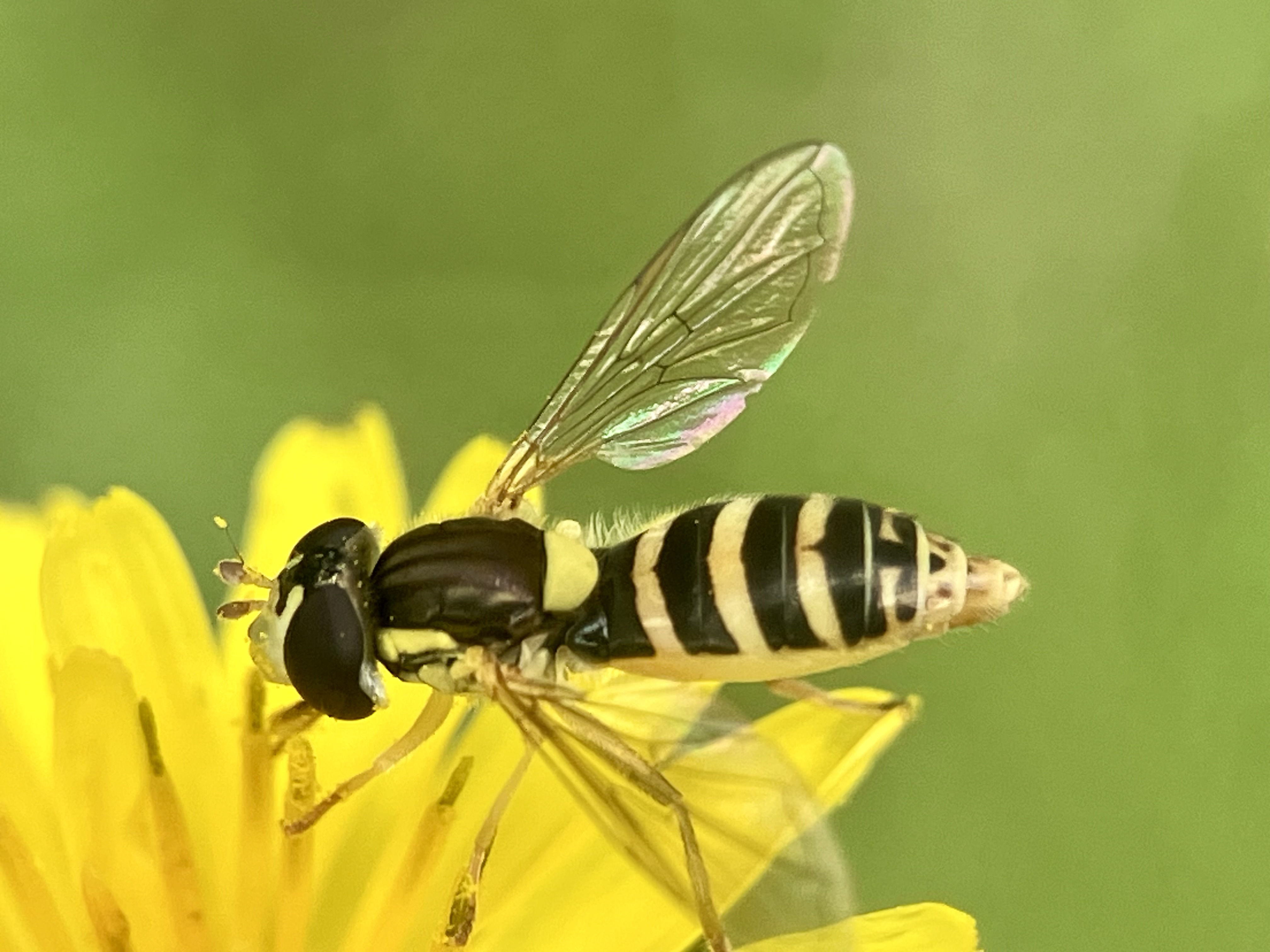
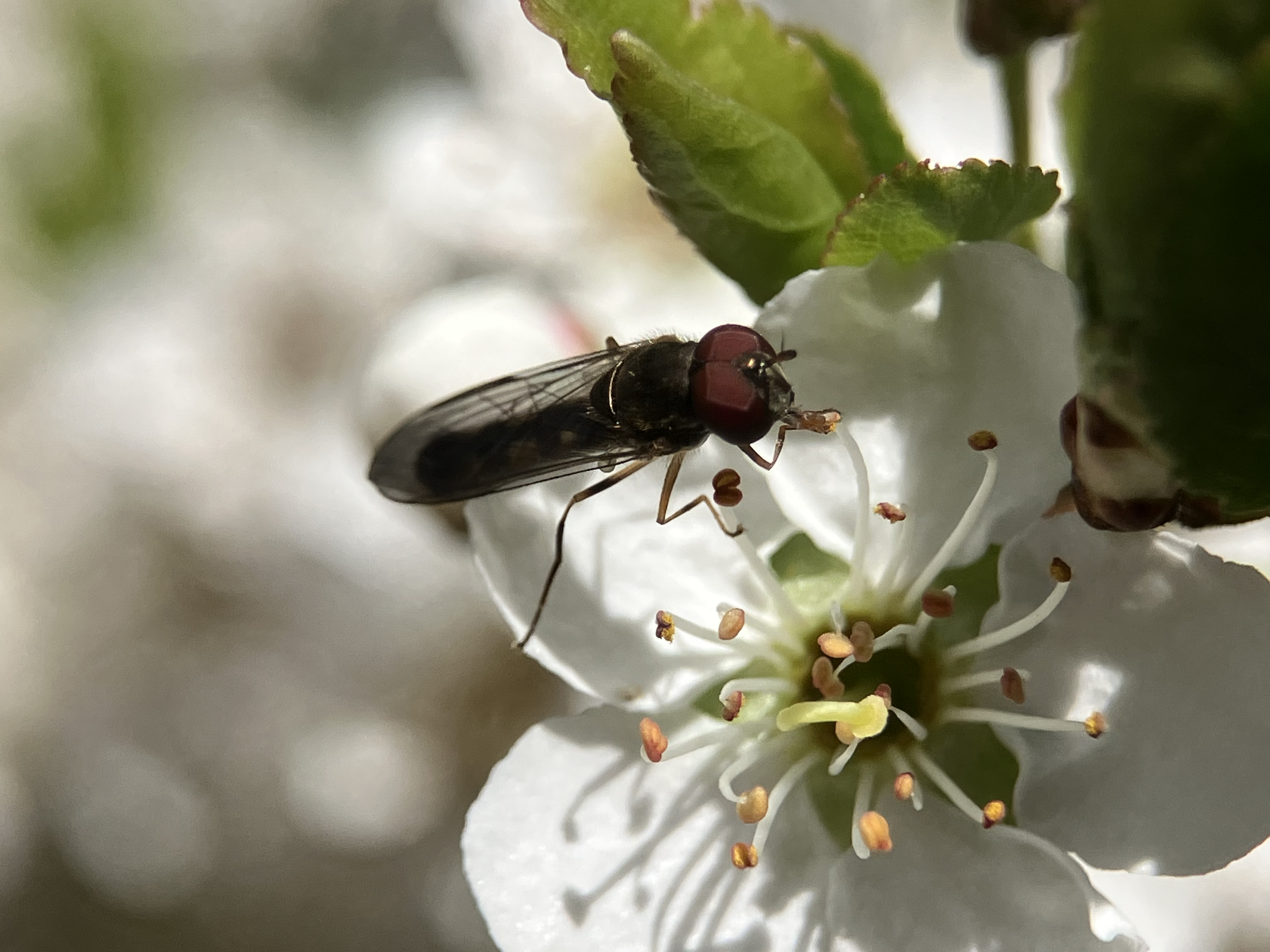
Aren’t we all? Hanging on for dear life? Whether it is financial, emotional, or health-related, it sure seems like folks in the world are facing a crisis of one sort or another. Some are facing outright catastrophic ones. We need a global re-set for the chaos. To calm my mind, I ponder bugs. How do you cope?
If you are just seeing my blog, it’s Fantasic Fly Friday. Flies are so varied and amazing. They literally fuel the world as we know it.
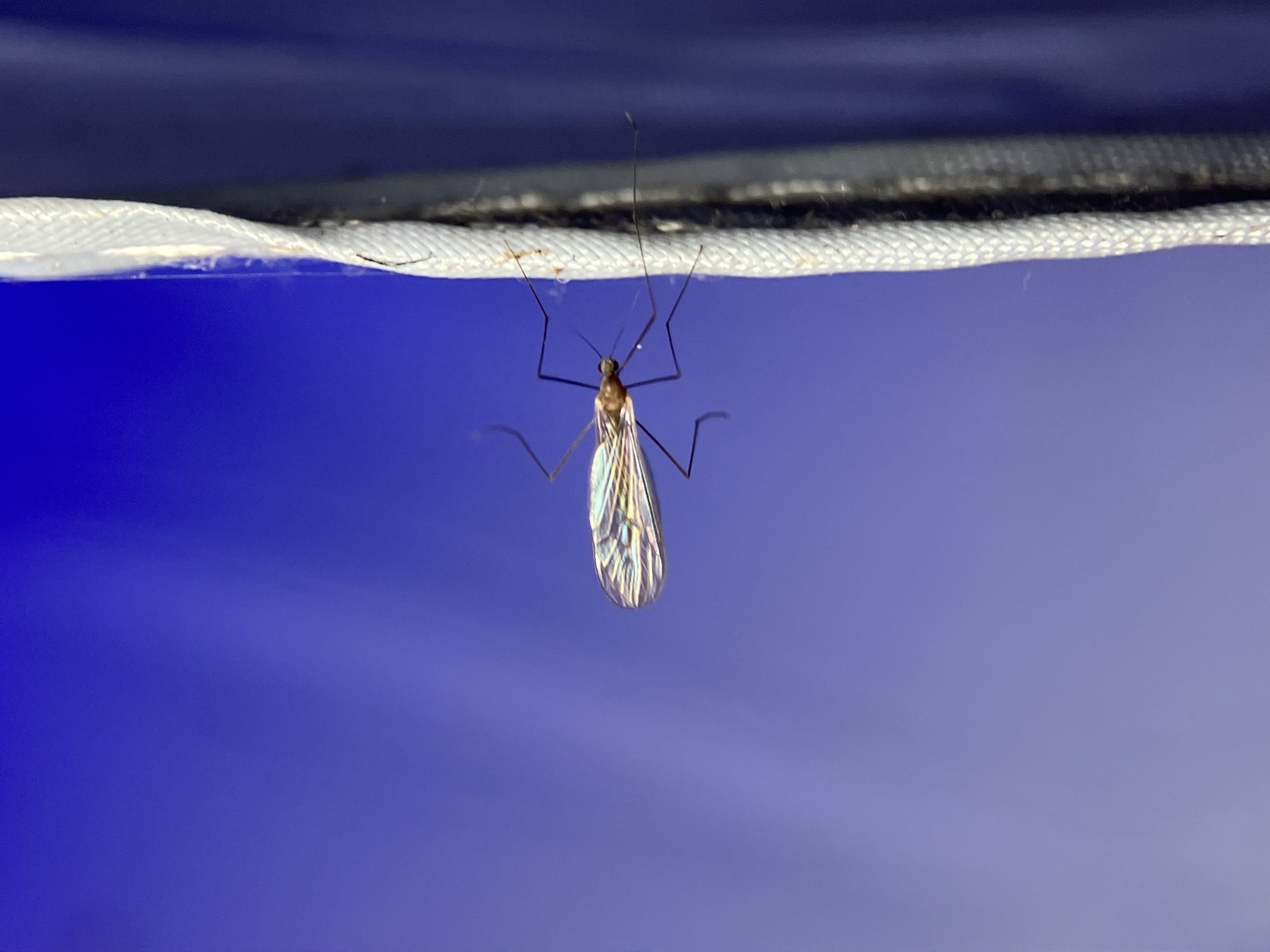
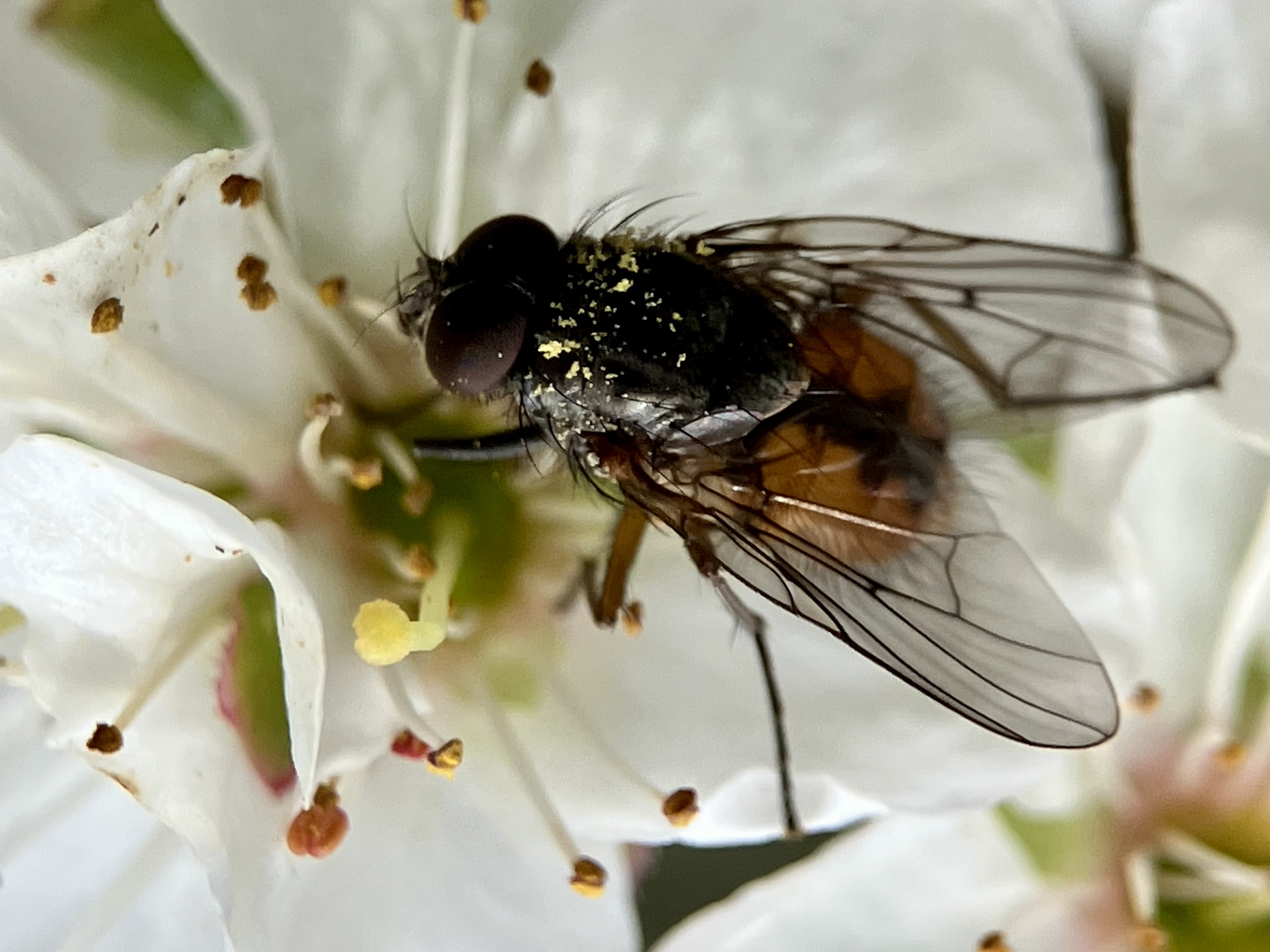
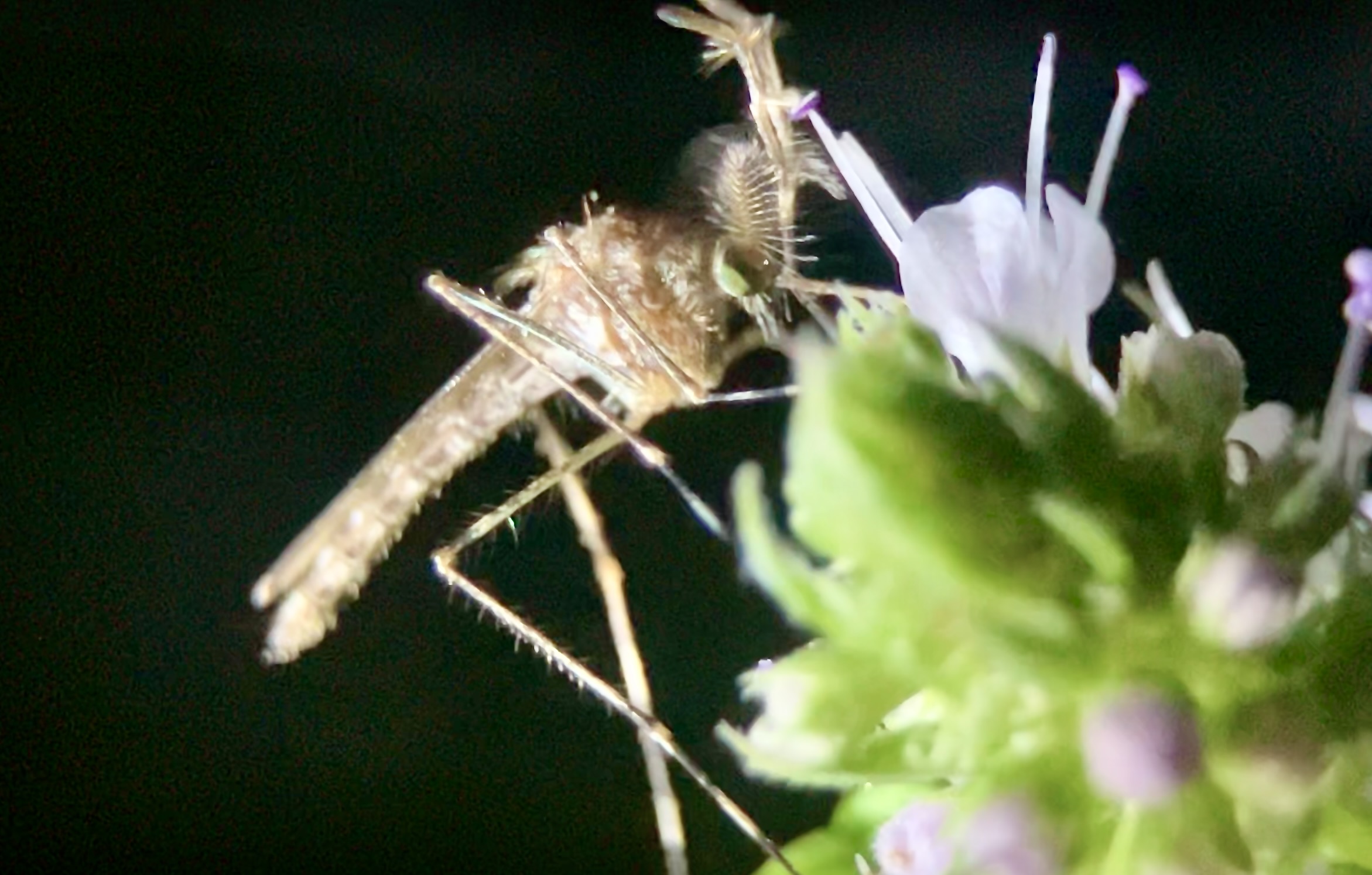
I photographed this one last night at my moth light. It was raining on San Juan Island, so there were more than a few bugs enjoying the refugia beneath our covered deck. Some nights it’s quite a party. A bug disco!
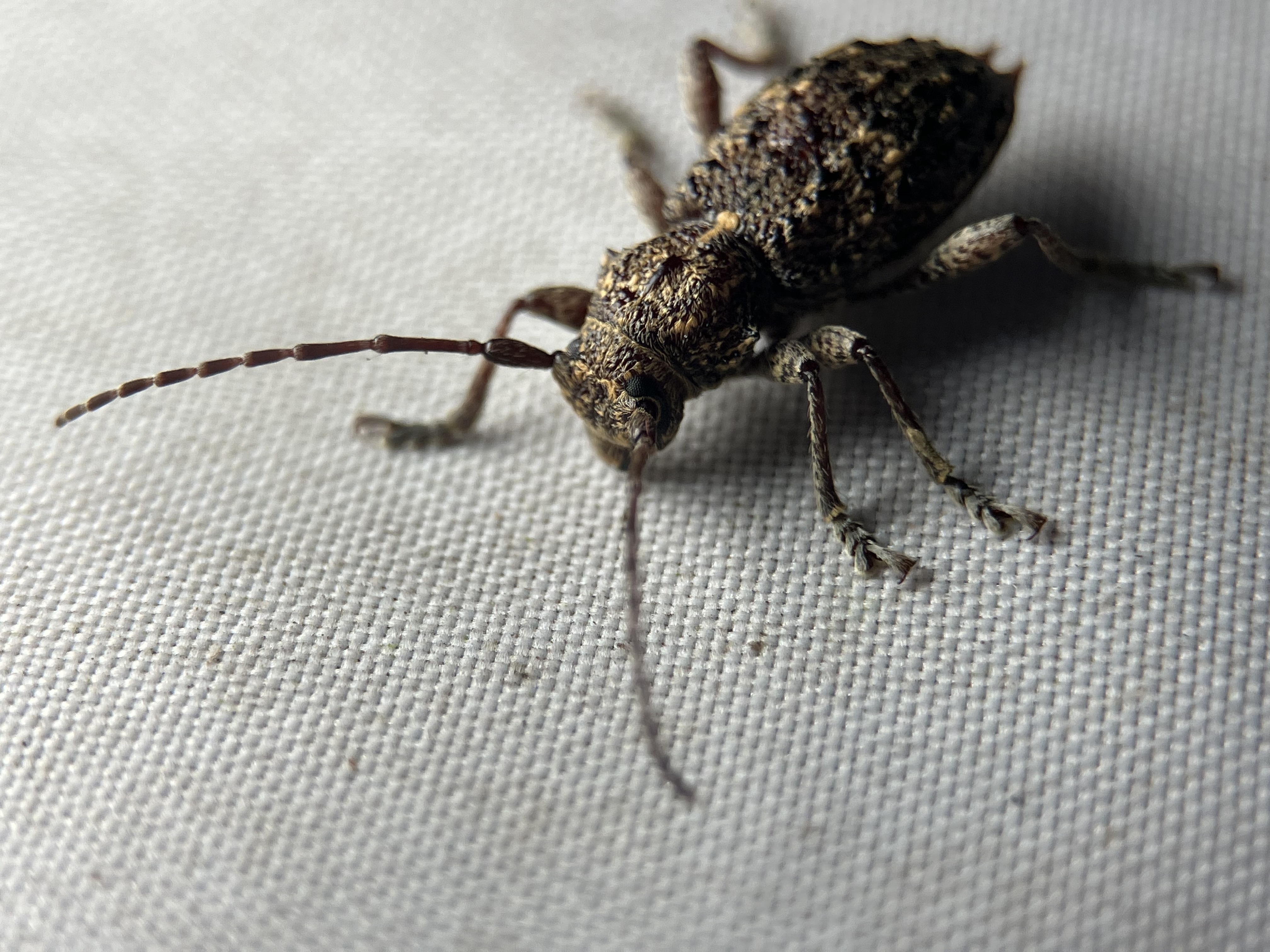
This is one of the more primitive flies in the family Trichoceridae (the Winter Gnats or Winter Crane Flies). Sometimes people call them hanging flies. I believe this one here is in the Genus Trichocera. However, I didn’t pluck my specimen off and take his or her life to determine that for certain under the microscope. I rather enjoy watching them alive because they all have quirky behaviors that are far more interesting to observe than counting wing veins on a dead bug.
The Trichoceridae are a family of Nematoceran flies grouped in the overarching infraorder Tipulomorpha (Crane Flies). There are approximately twenty-seven to thirty species of winter crane flies in the family Trichoceridae found in North America north of Mexico, depending on what source you use (Bugguide, 2021; Pratt, 2003). These are small to medium sized flies (wing up to 12mm), with a slender body and long, slender legs are distinguished from other families of crane flies by the presence of three ocelli (the primitive light detecting “eyes” found on the top of the head. Other identifying features include a V-shaped suture on the mesonotum that is incomplete in the middle, and long, hairlike 16-segmented antennae.
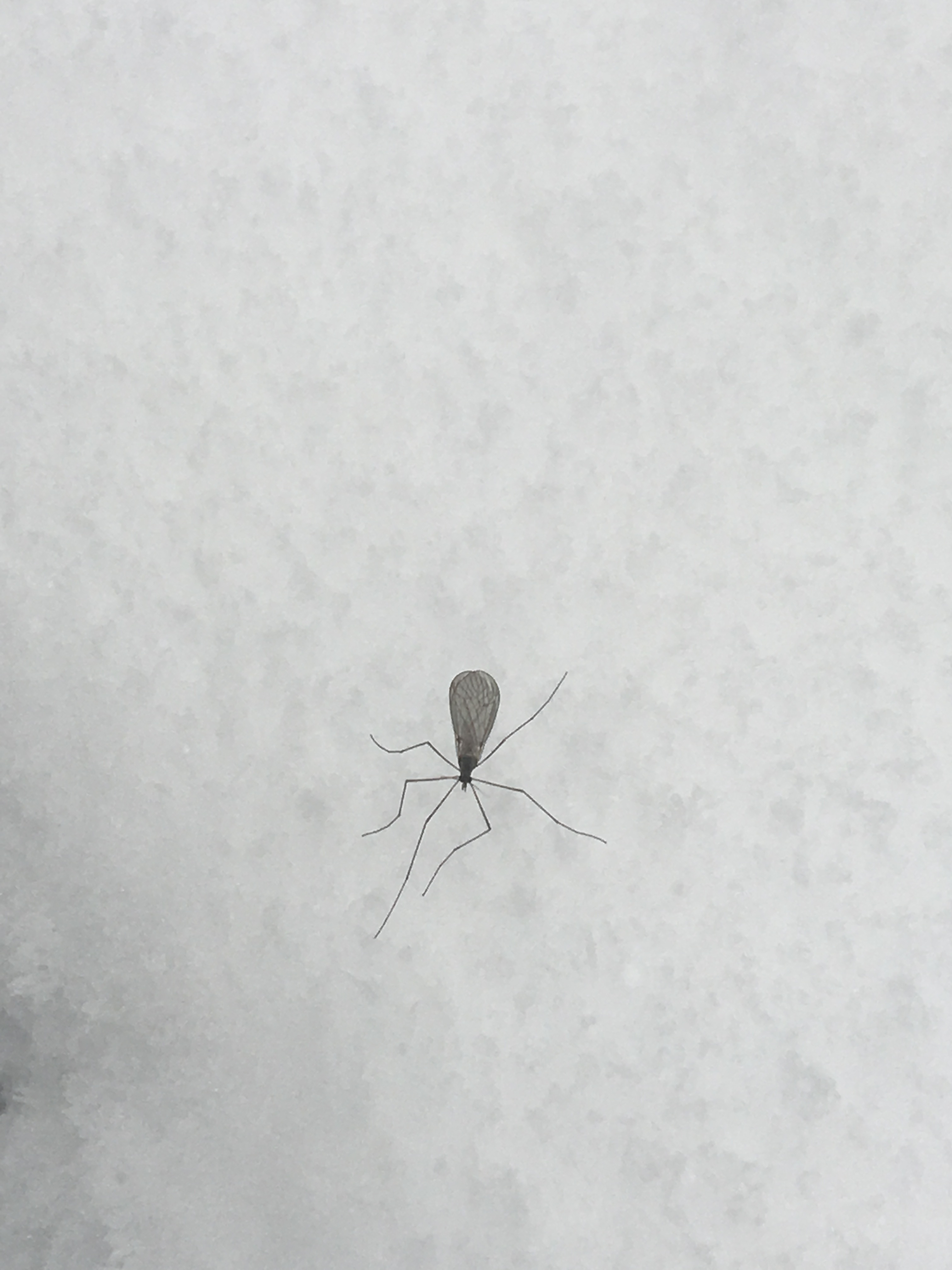
The larvae of Trichoceridae develop in moist or wet terrestrial biotopes. They can be found in decaying leaves, manure, fungi, stored roots/tubers, and rodent burrows (Bugguide, 2021). Adults are able to tolerate cool temperatures and sometimes, like I have seen, you may find them out walking on the surface in snow. Being active in winter, means there is little food available, but adults may feed on sap, or other carbohydrate sources. According to The Bug Lady (2015), they have been collected in molasses traps, and I have found them in our hummingbird feeder in winter when I take it down to change the sugar water and they are often on the sides of our seed and suet bird feeders as well. Perhaps taking nutrients in small amounts from the fruit in the bird feed mixes.
Winter Crane Fly in Snow, 2017 – San Juan Island, WA
Even though they are small (perhaps you have never even noticed them), these flies are significant in ecosystems, with the short-lived adults providing a winter protein source for birds and even bats. The larvae feed other organisms that go unseen in the winter (beetles, spiders, millipedes and such) that wake up hungry on warmer days. They are important decomposers, nutrient recyclers, and a wonderful bioindicator of ecosystem health. They do not bite, nor do they transmit disease.
Remember the behaviors I mentioned? Well, these flies dance like the world is ending. At least the males do. They can be find swarming on cool winter afternoons, bobbing up and down in what are known as ghosts (Burton-Hargreaves, 2026). Friendly ones! When I read that, it reminded me of a book by Robert Bright my mother read to me often as a child, Georgie and the Noisy Ghost. Just like the ghost in this childrens’ book, I find these little flies dancing about at my moth light to be delightful.
Winter Crane Flies may have a brief existence, but they make the most of it. We can too. Live in the moment. Read to your child. Be present and helpful. Check on your neighbor. Maybe Clang and Rattle a Bit about the state of our country to your representatives (in a polite email, of course). Stay connected, and hang on for the wild ride that is LIFE.
Pratt, Harry D. (2003). The winter crane flies of North America north of Mexico (Diptera: Trichoceridae). Proceedings of the Entomological Society of Washington, 105, 901–914. https://www.biodiversitylibrary.org/part/55628
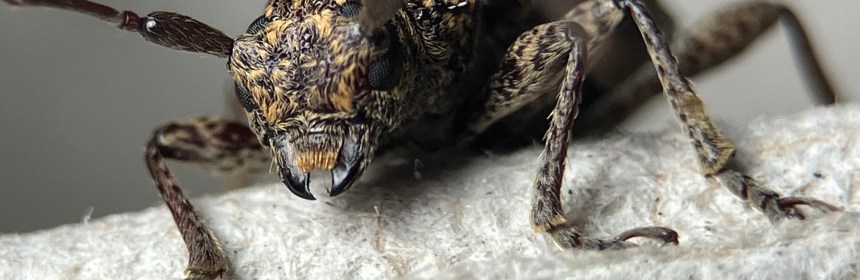
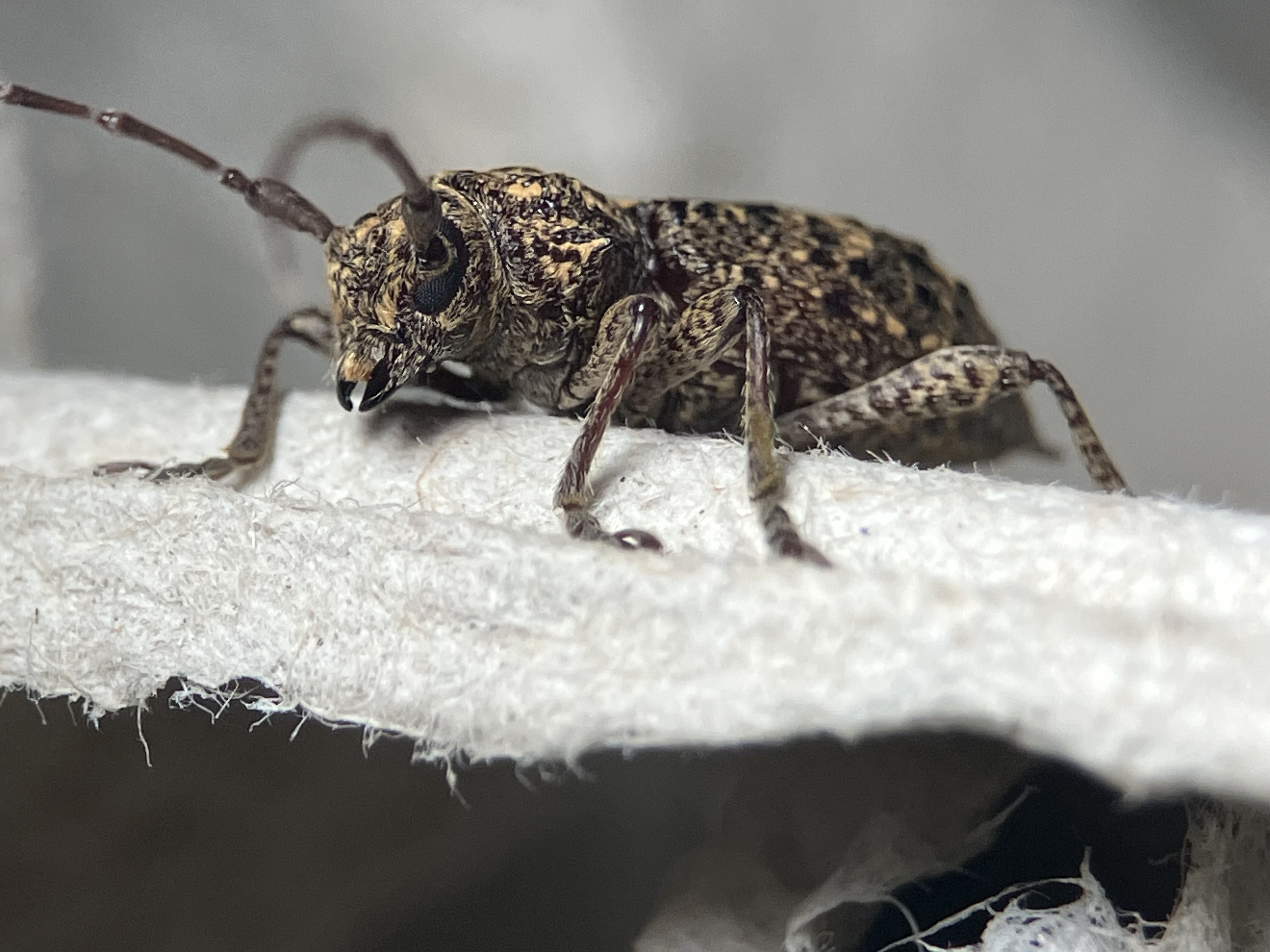
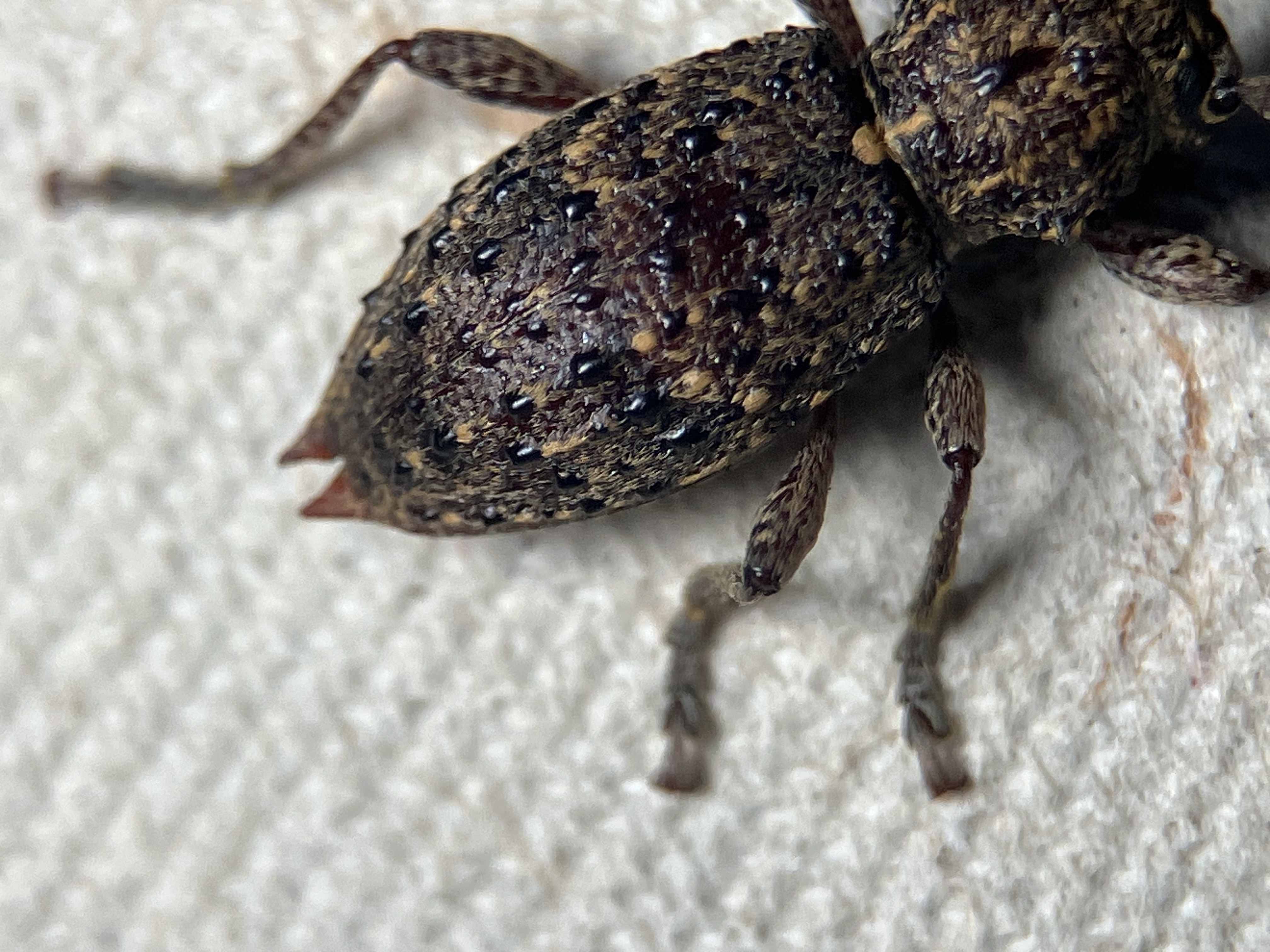
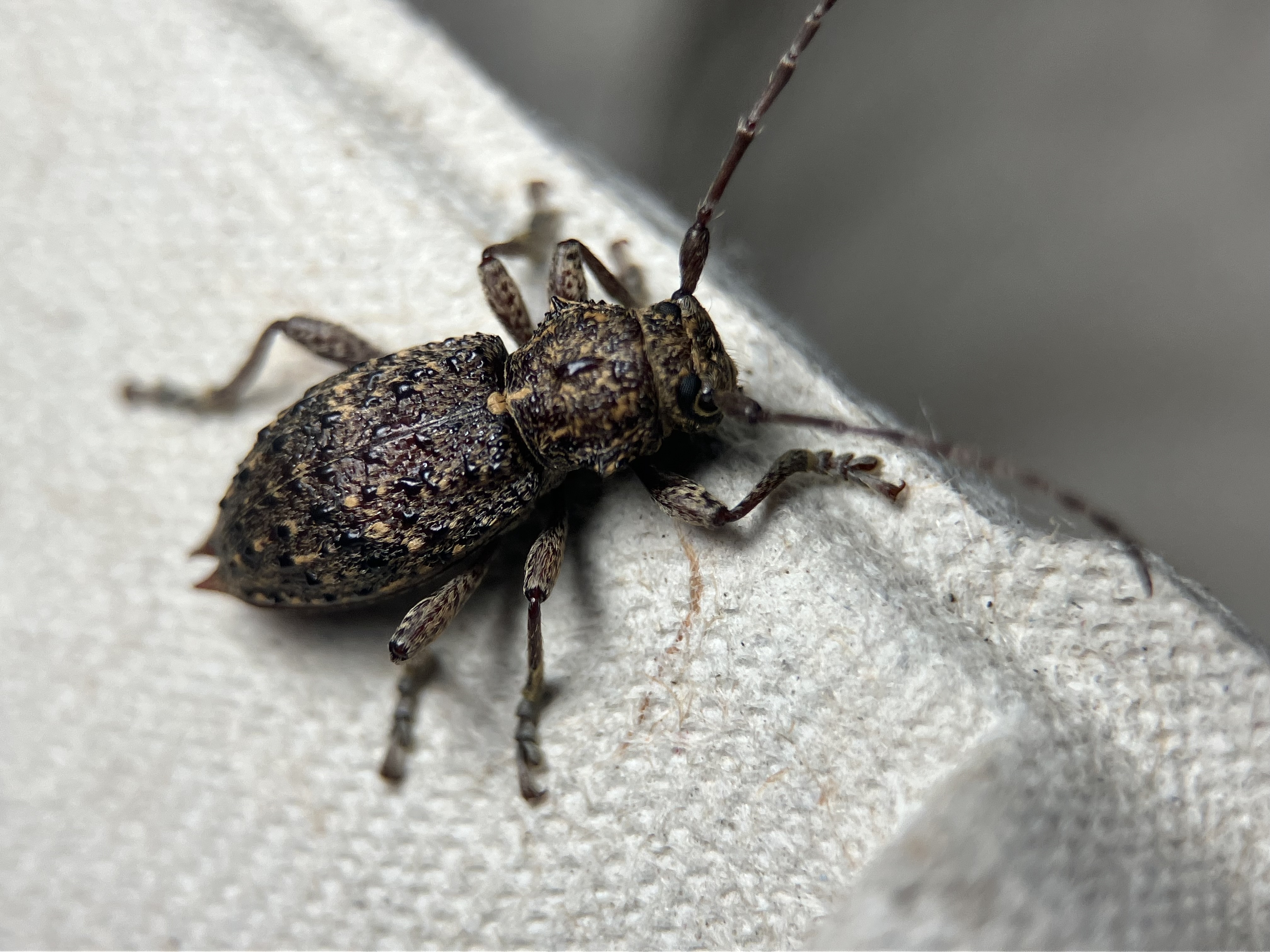
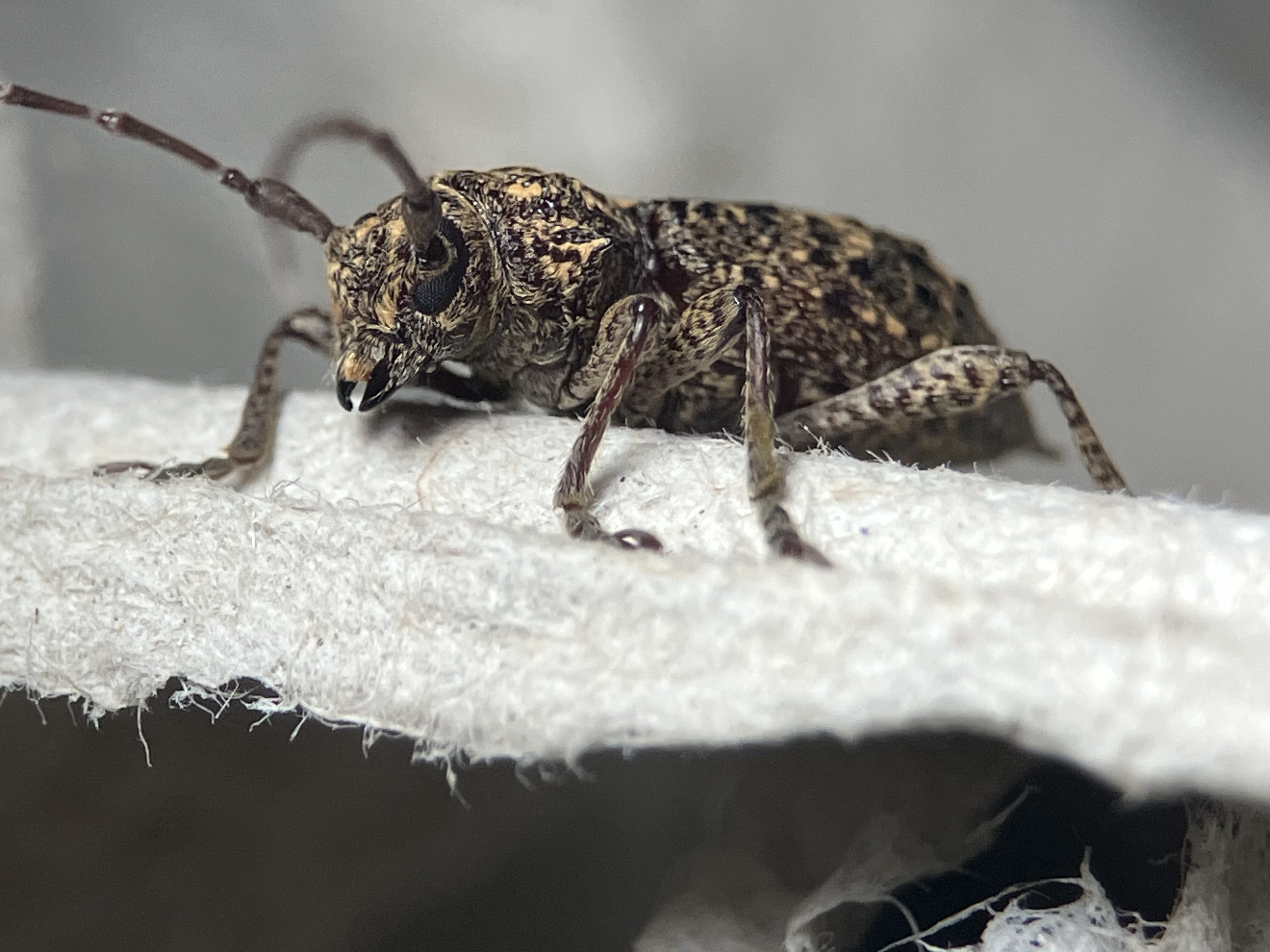
This unusual looking critter is a Long horned beetle in the family Cerambycidae, sometimes referred to as the Thorn- Tailed Longhorn Beetle because of the spiny projections at the posterior end of its body. The species is Plectrura spinicauda. Etymology for this bug’s binomial nomenclature consists of the generic name, derived from a combination of plektron (Greek for instrument to strike/pick) or plekein (to weave/twist) with oura (Greek for tail), and the species epithet combines from Latin spina (spine/thorn) and cauda (tail), translating to “spiny tail.”
Plectrua spinicauda
They are native to North America, with a geographic distribution in Western N. America (Alaska-n CA). P. spinicauda is a flightless beetle species with cool wrap around eyes, and as the name suggests, thorny projections at the end of its abdomen. The larvae have been found to develop in Alder, Willow, and Maple. They are important as decomposers and nutrient recyclers.
Author’s note. It is quite common for people to state that wood boring beetles kill trees. This is not necessarily true at all. In fact, most trees that are attacked by beetles are already in a state of decline. Just like humans decline with age or become ill with health problems, so do other things. Nature’s way of handling diseased and dying trees is to send beetles in (all sorts of beetle species) to help with the decomposition process – to recycle waste products and release nutrients back into the environment for other life forms to utilize.
Spraying a tree with pesticides as a preventative from the course of nature only worsens the situation. If you step back to assess the situation, you might ask yourself why the tree is dying. Is it from drought, heat, competition from other nearby trees, did someone weed whack too close to the trunk and cut or scar the bark? Are you running your lawn mower over exposed roots? Is the tree a short-lived species or maybe just entering the sunset of its lifespan?
There are many various reasons for trees to decline and die. Don’t blame the beetles for doing their job. They don’t just clean up the mess, but they feed many other organisms with their own lives. Beetle larvae are wonderful food for woodpeckers and other birds. Birds are in decline. Do something! Care! Get a book at your local library about how to create habitat so you have diversity of life and a healthy ecosystem in your yard space.
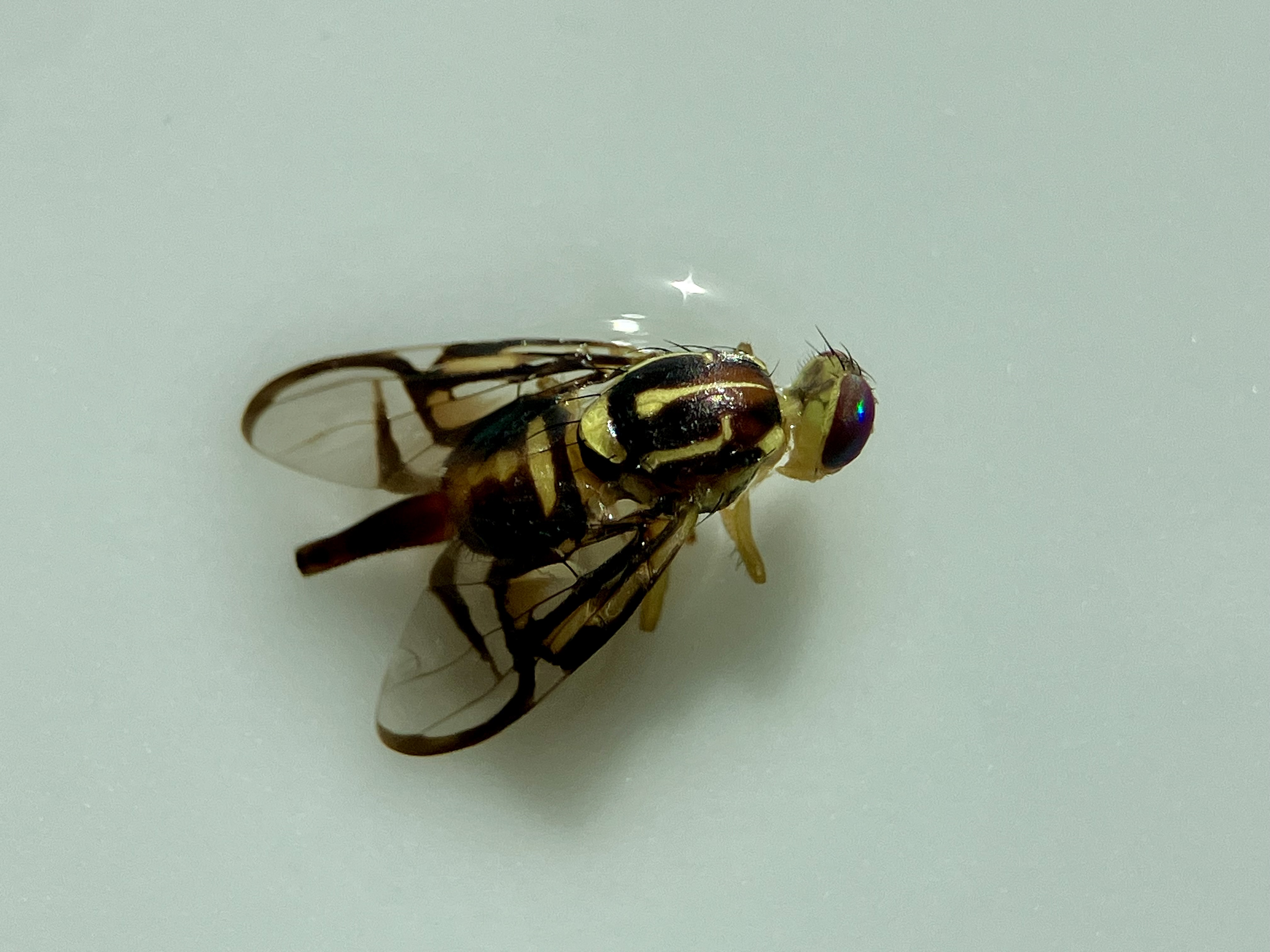
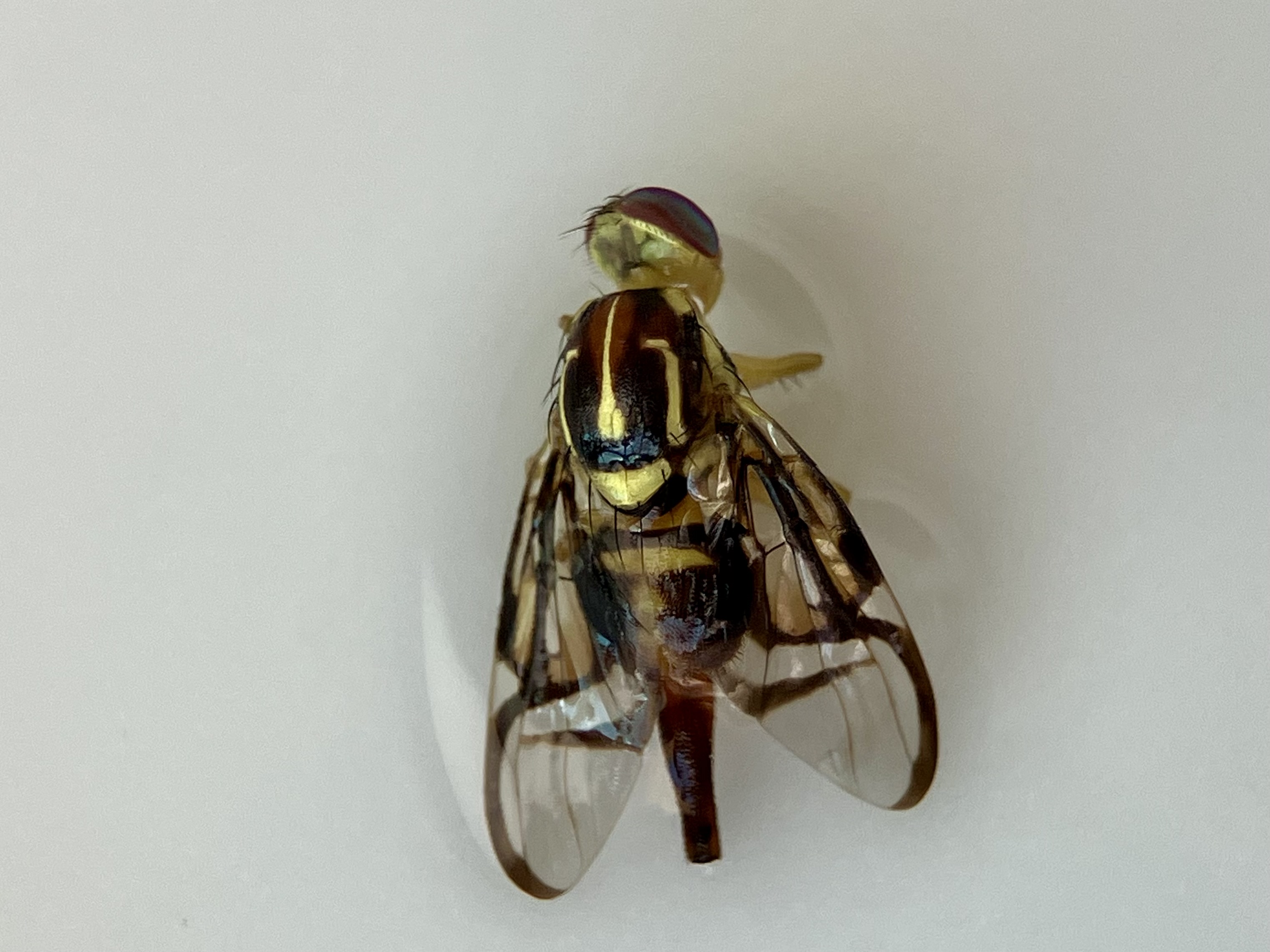
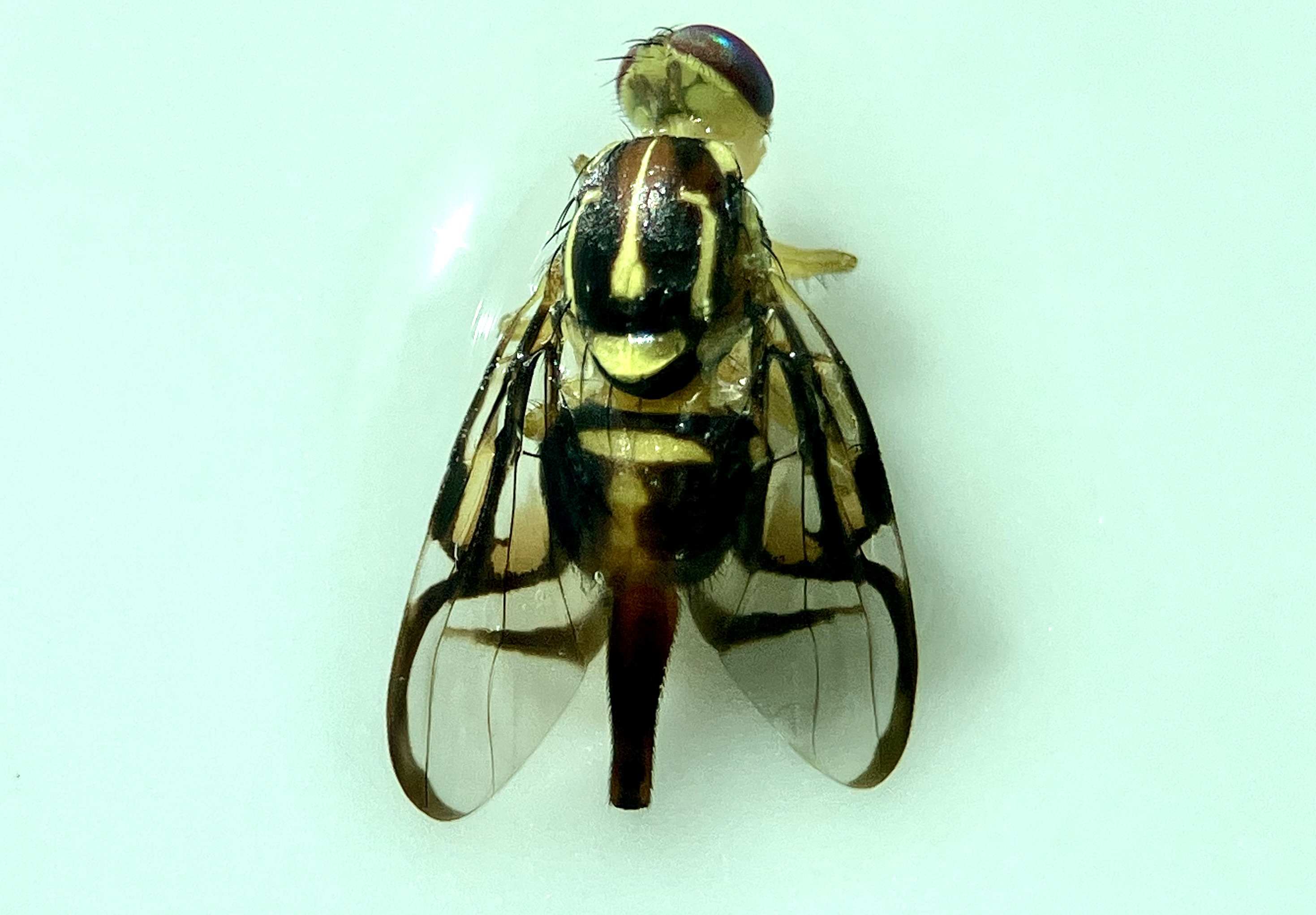
Today I have a beautiful Fruit Fly (Genus Anastrepha) to show you. I found this specimen when visiting Tulum, Quintana Roo, MX in late January. The place we stay in Tulum has a swimming pool virtually no one ever uses. I love this place so much because I almost always have the pool entirely to myself. Everyone else is at the beach!
Anastrepha fruit fly
However, this particular pool is not maintained so well. More often than not, the filtration system isn’t turned on. I spend the first 15 minutes or so walking around in the pool to skim off all the bugs with a cup I bring from our room.
Unfortunately, my efforts to communicate, in broken Spanish, a request for a pool skimmer to the maintenance workers was a total failure. Probably they secretly referred to me as loco el bicho señora, or something like that. My Spanish is terrible. If you know me well though, finding bugs in the pool is literally one of the reasons I love staying at this place. I have my own vacay niche! Surveying for entomological diversity found in the pool.
There were more than a few bugs for me to “save,” that had landed on the water surface. Some, like this fly, had unfortunately already expired. I skimmed them all out, photographed them, then uploaded my observations onto iNaturalist. I even resuscitated a few that I thought were dead. Toilet paper or tissue paper “beds” work pretty well for drying them out in a pinch.
Fruit Fly (Anastrepha sp.)
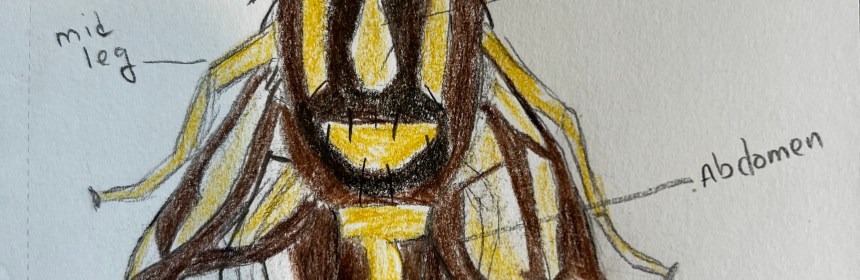
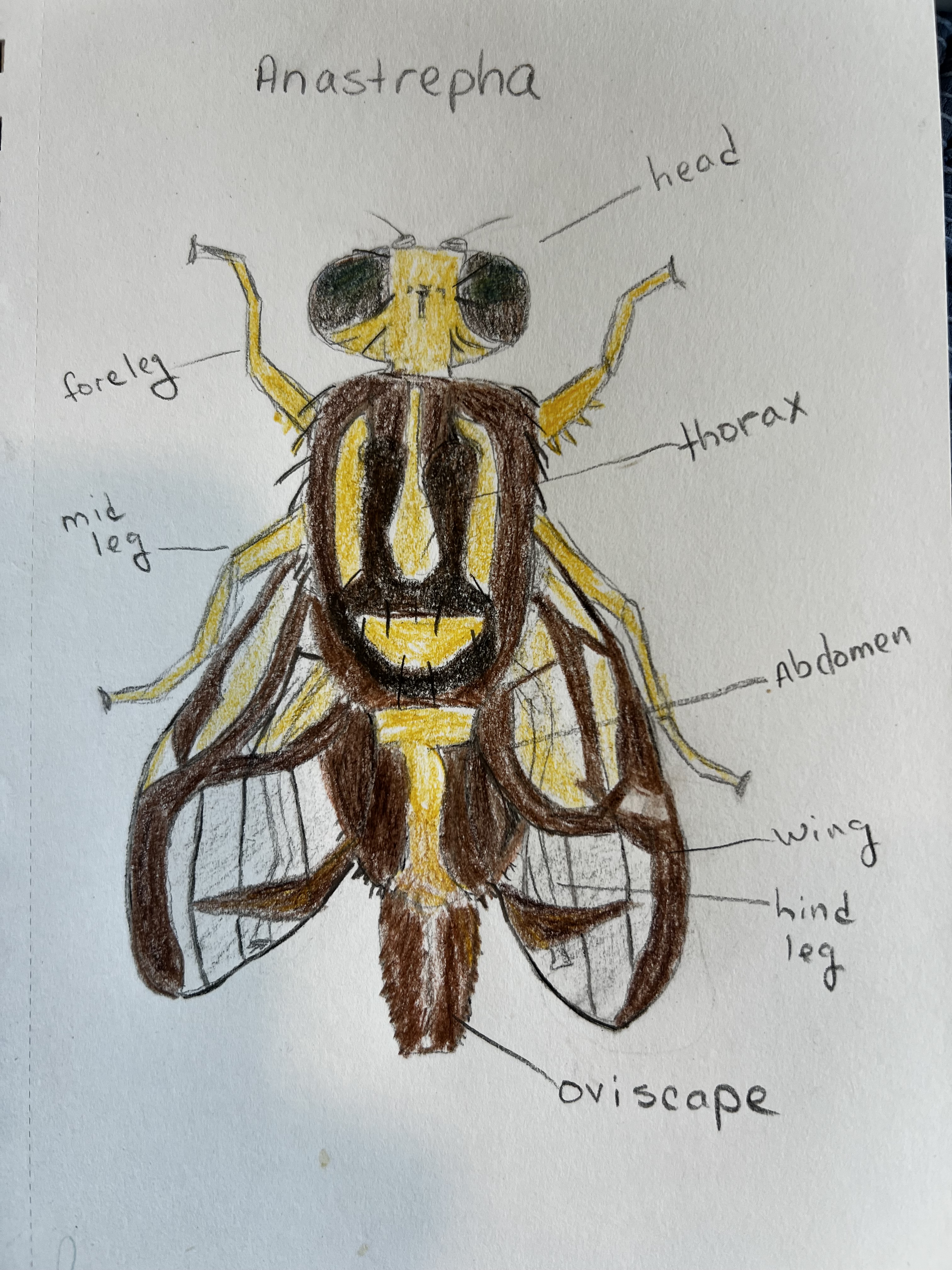
I collected these photographs because I really appreciated the cool picture window patterns on the wings. This is one characteristic of fruit flies. This is also a female specimen as you can see from the longish posterior appendage, her oviscape. Last week, I tried to create a space away from social media to decompress, so I sketched her (to the best of my ability) and used my colored pencils to bring her to life. Probably I did not get all her bristles in the right places. On flies, bristles are diagnostically quite important. I’m not quite there with my artistic rendering, but it was a relaxing activity.
Fruit Fly (Anastrepha sp.)
In spite of their unique and beautiful wing patterns, fruit flies are often considered agricultural pests. Probably they wouldn’t be a pest except that we have these giant industrialized agricultural operations to feed more people than the planet should ever support, and probably, we artificially enable populations of various pests to explode because we are creating extra habitat for them. Fortunately, some targeted biocontrol and Sterile Insect Technique (SIT) has been effective enough to move producers away from utilizing harmful and unsustainable methods of chemical control, although I imagine some operations continue to apply pesticides.
This particular fruit fly is in the Genus Anastrepha. I haven’t really attempted going beyond genus level to identify this one to species. Anastrepha ludens, however, is a name that pops up often in literature from studies in Mexico and California. Anastrepha is a genus in the Family Tephritidae and I believe there are over 200 species of Anastrepha fruit flies in the Americas.
If you are interested in reading more about this genus, I would start off sending you to the 1963 study by Foote and Blanc, referenced below. I am currently waiting on a text I ordered from Abe Books on fruit flies, and will be doing additional reading once it arrives.
One interesting taxonomic tip I can leave you with: Tephritidae are true fruit flies. Those small flies that get into the bananas on your counter or into your rotting compost that many folks refer to as fruit flies aren’t fruit flies at all. They are vinegar or pomace flies, a completely different family called Drosophilidae.
Find out more when you follow me on Fantastic Fly Fridays!
References and Further Reading
Arias OR, Fariña NL, Lopes GN, Uramoto K, Zucchi RA. 2014. Fruit flies of the genus Anastrepha (Diptera: Tephritidae) from some localities of Paraguay: new records, checklist, and illustrated key. J Insect Sci. 1;14:224. doi: 10.1093/jisesa/ieu086. PMID: 25525098; PMCID: PMC5634125.
Greene C. T. 1934. . A revision of the genus Anastrepha based on a study of the wing and on the length of the ovipositor sheath. (Diptera: Tephritidae) . Proc. Entomol. Soc. Wash . 36 : 127 – 179 .
My short post for the day brings you these interesting little critters that are technically not insects. Taxonomically, they are Arthopods (Phyla) in the Subphylum Hexapoda. If you’re into Etymology, “hex” = 6, and “pod” = foot or leg.
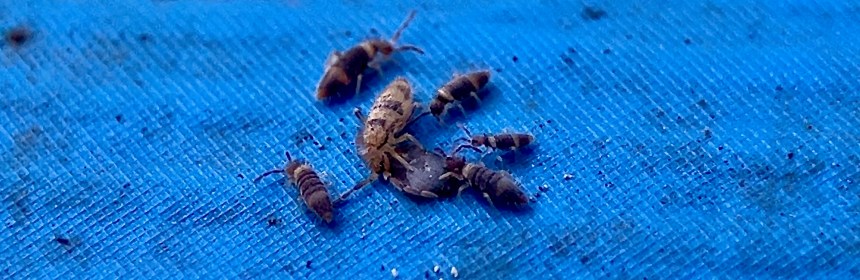
Within the Hexapod group, you will find 3 smaller groups of these wingless organisms: Protura, Diplura, and Collembola. These are Collembolans, the springtails. This particular group of Springtails is in the family Entomobryidae, and I believe most of the species you see here are Entomobrya clitellaria forma albocincta, a name revision suggested per Frans Janssens as found on Bugguide.net https://www.bugguide.net/node/view/272565 There is one Globular Springtail (Ptenothrix beta) that shows up at about 00:43 and the large Slender Springtail showing up about 2:44 is a different species of Entomobrya (Entomobrya triangularis).
I didn’t really want to deep dive much into taxonomy though. Mostly, I wanted you to enjoy watching them as I did. I suspect they are all together here in this varied group to share the food resource, which looks like bird poo to me.
If you watch the video, I think you’ll see the group isn’t always a Hexapod of Hexapods either. At some points, there is a Quartet of Hexapods and at others, you’ll see an Octad of Hexapods. They are quite cute when they thump their antennae in an attempt to move their dining partners enough to edge up to the buffet.
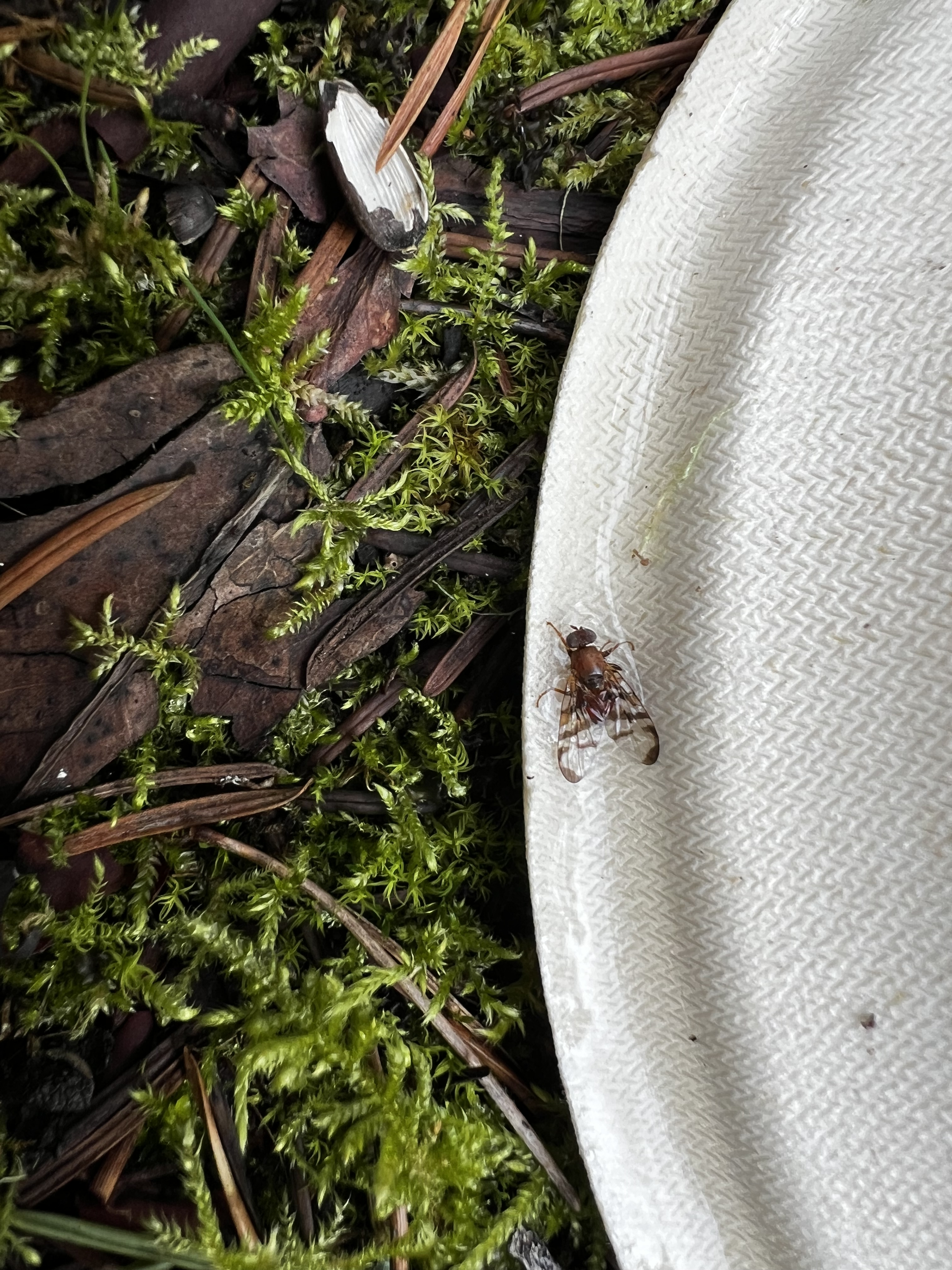
Here’s a unique specimen I have to show you. I found this fly on Wednesday after lunch when I went to look for a different species of fly around our above ground pool. I was actually looking for Woodpecker Flies when I found this one. Since I’ve committed to doing a presentation about them for the Scarab Society in September, I’m hoping to observe these weird Woodpecker flies again in the wild and take additional photos and videos to add to what I have collected already.
I didn’t expect to see anything IN the pool. Mostly, I was looking at vertical surfaces, like the sides of the pool and the sides of a nearby tree. When I glanced across the surface of the water, this little one stood out right away. I got a paper bowl to gently scoop it out, expecting it was deceased. It surprised me when it moved just a bit, then wiggled and flipped off the bowl onto the ground.
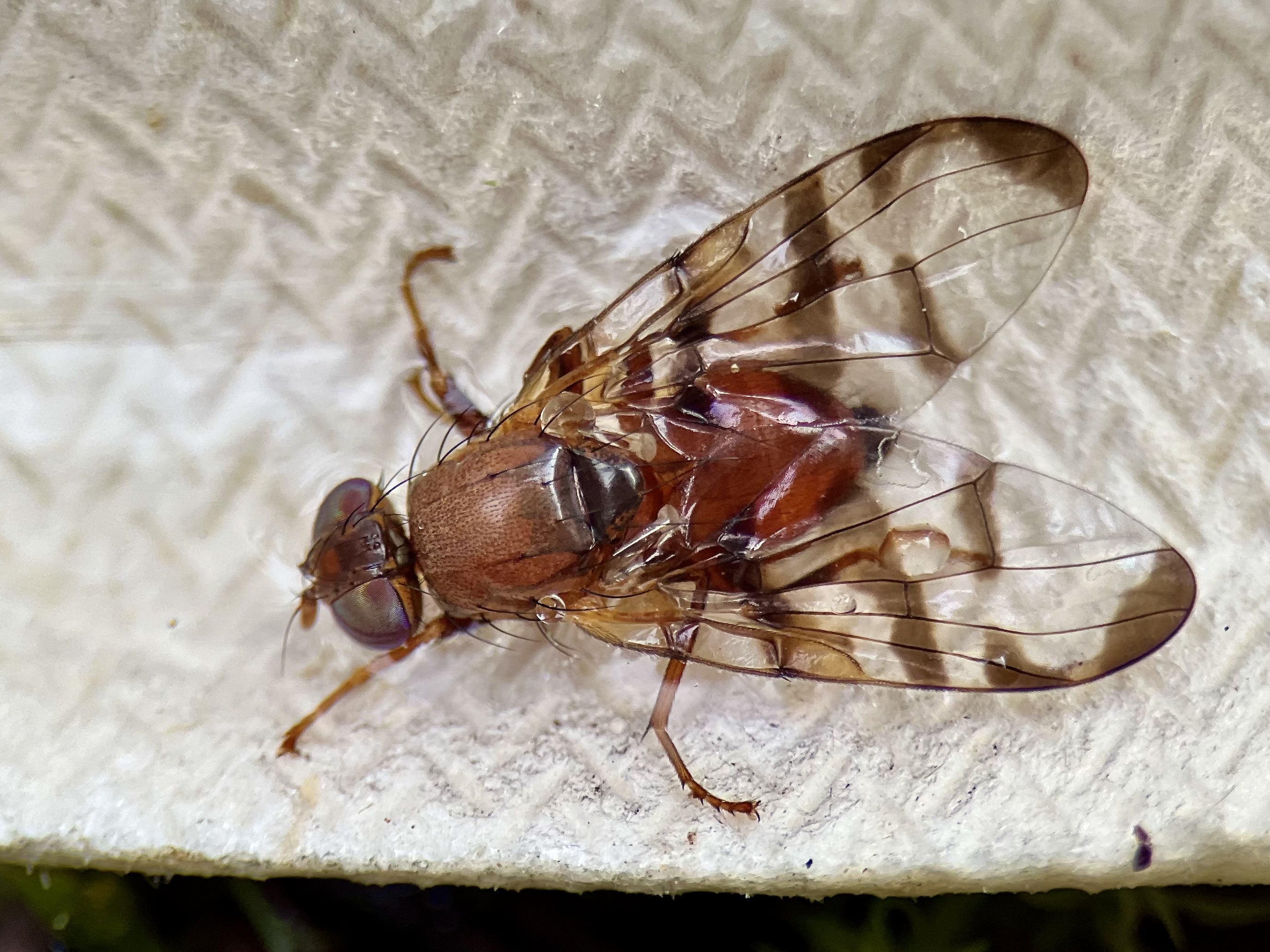
Chetostoma californicum
I bent down to inspect it, and when I touched it, it flipped around again like a fish out of water. Strange.
I had a plastic cup, so I managed to recapture the fly, wet and bedraggled as it was. I took it back into the house long enough for me to get my other camera. The lighting was better outside, so back out we went.
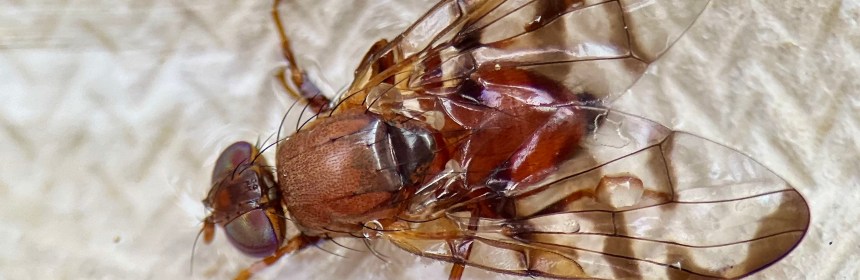
In case you are wondering, this is one of the Picture Wing Flies in the family Tephrididae. Also known as Fruit Flies. “Picture” references the patterned spots or stripes on the wings. There are other flies, like Drosophila sp., called fruit flies that aren’t actually fruit flies at all. THIS is a true fruit fly.
Many species of fruit flies are known for their pest status, however, there are over 4,300 described species in this family and the great majority of them are not pestiferous at all. They are merely a part of the local, natural ecosystem at large.
I used a key and geographic distribution records to determine the species for this one and believe it to be Chetostoma californicum. Trying to find host plant information led to me to do some deeper digging and to actually order a few more reference books on Tephridid flies. I have another fruit fly specimen I found when we were in Mexico, and plan to share that one with you next Friday. As I learn more about this particular one though, I will update my blog post accordingly.
The reference material I did find about Chetostoma californicum was largely from California and Arizona. Inferring from the documented host plant relationships recorded, it is likely one relationship possible in our immediate area is with native honeysuckle (Lonicera sp.). I also read adults of this species have been collected from Pines (Pinus sp.). We have a Pine tree just next to our above ground pool where the fly was collected.
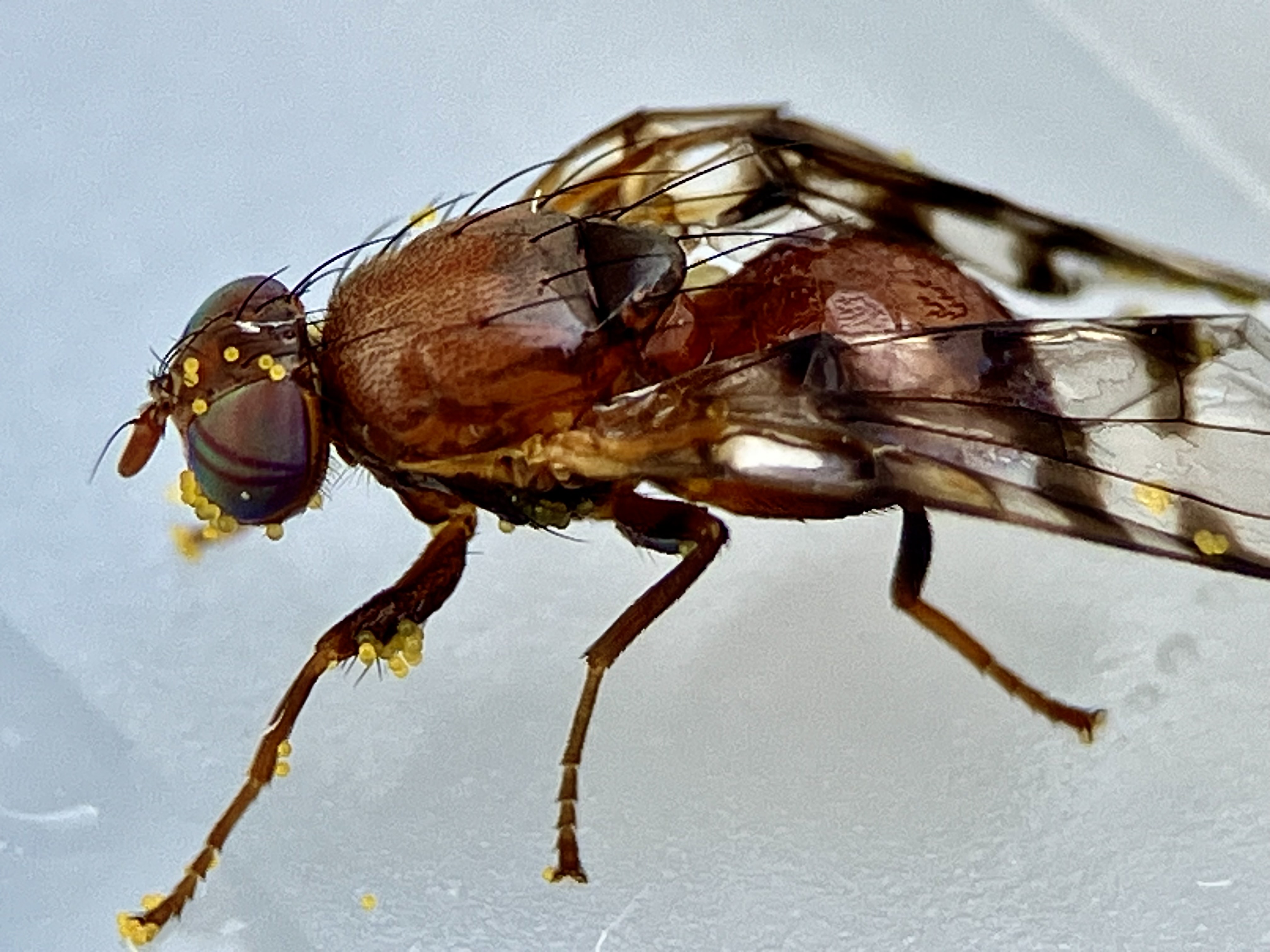
Chetostoma californicum, identified by the oral edge of bucca (cheek) with a row of about 10 coarse, black bristles with a few finer black setae at the posterior end of the row. (LeBlanc, 1959)
The only additional personal record I have of this fly on San Juan Island is from February 16, 2024. I would conclude, based on my own observations, that this fly is not particularly an abundant species here. In checking for reports of the species on San Juan, my two posted observations are two of three total for the county.
Now if I can just find out what’s behind the fish flippy behavior…..stay tuned!
Chetostoma californicum (with pollen stuck to it after I accidentally dropped it into a Crocus flower)
Cole, F. 1969. The Flies of Western North America. University of California Press. Berkeley and Los Angeles.
Foote, R.H. and Blanc. F.L. 1963. The Fruit Flies or Tephritidae of California. Bulletin of the California Insect Survey. University of California Press. Berkeley and Los Angeles. https://essig.berkeley.edu/documents/cis/cis07.pdf
LeBlanc, 1959. A new species of Chaetostoma from California (Diptera: Tephritidae). Pan-Pacific Entomologist. 35:201-204. https://biostor.org/reference/225819
Wasbauer MS. 1972. An annotated host catalog of the fruit flies of America north of Mexico (Diptera: Tephritidae). Occas. Pap. Calif. Dep. Agric. Bur. Entomol. 19:1–172.
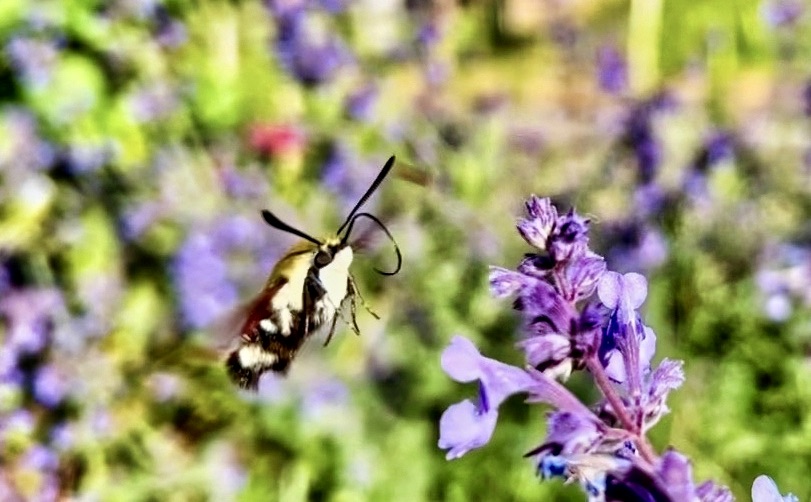
Hemaris thetis moth nectaring at Catmint (Nepeta sp.)
With spring around the corner, I thought it might be a good time to write up a post about bees. For those of you who don’t know me, I’ve been a San Juan Island resident now for over 17 years. When I was finishing my Masters Degree in Entomology and Nematology, I was required to take bee keeping as part of my advanced Apiculture coursework.
My former bee keeping days! 2010
I won’t lie, I did enjoy the bees. I had one of the hives under a bedroom window, and it smelled so wonderful to open that window and smell the bees in the house. In my studies, I learned a lot about social insects. The other thing I learned was bee keeping sure is an expensive endeavor.
Why? Well mostly because the bees had to be replaced every year after they died over the winter from starvation. They didn’t always starve, but in the 6 years or so of keeping bees on the island, I think my longest surviving hive lasted about 4 seasons. That one, I can assure you, only lasted that long because I fed them sugar water. I was feeding the bees a quart of sugar water at least twice a day. They had all of that, and I never took any honey from my hives. All the costs added up. They also sting.
In my experience, I concluded honey bees weren’t exactly the best pollinators here either. As I spent more and more time in my study of insects and moved to a property with an old orchard (plums and apple trees), I saw the insects doing most of the pollination were flies. We have some incredibly cool species of flies too! At night, the insects pollinating these trees included many moths. Just an FYI, flies and moths are particularly attracted to the color white (same color as early flowering fruit trees).
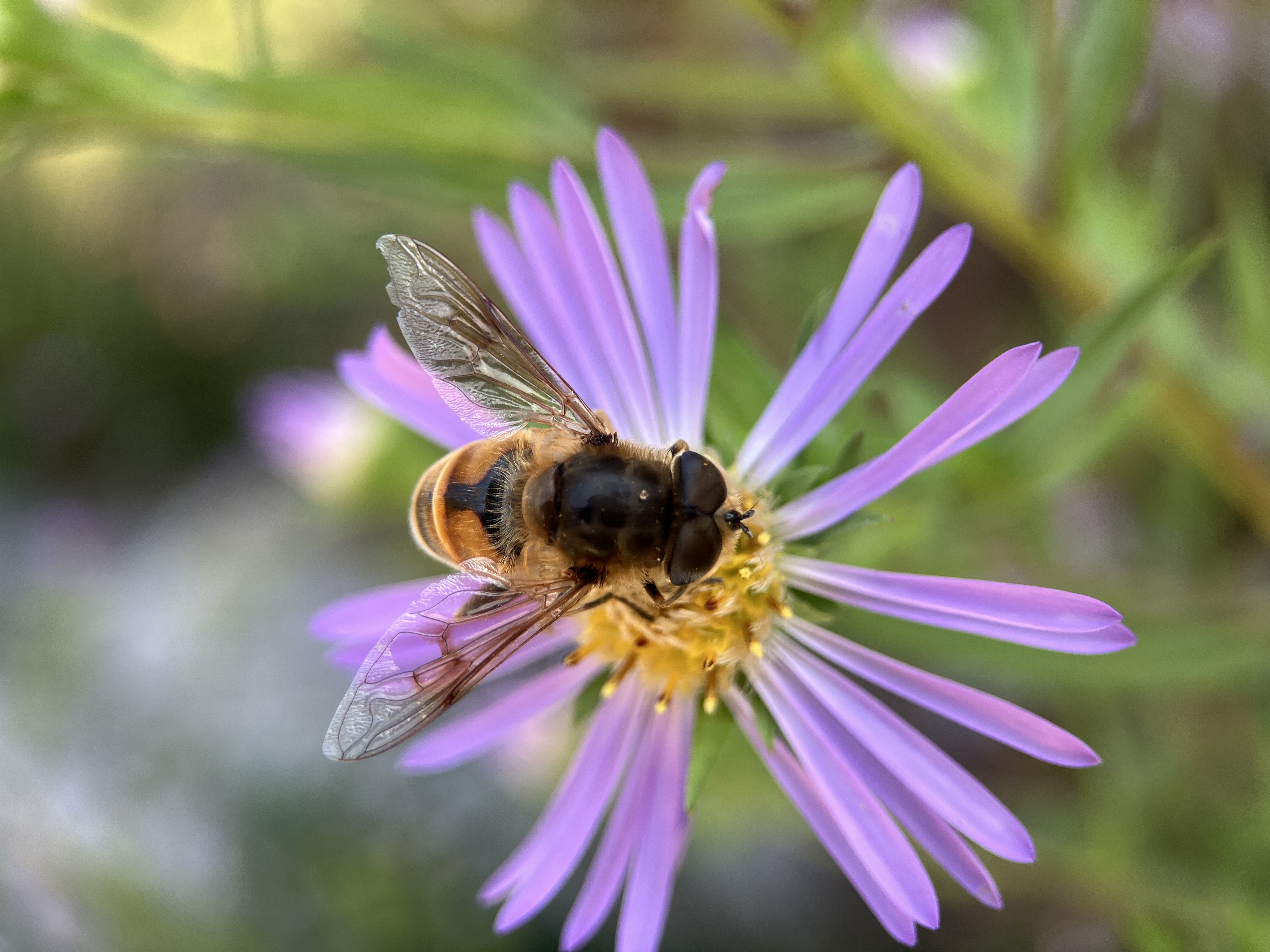
Eristalis tenax fly on Aster
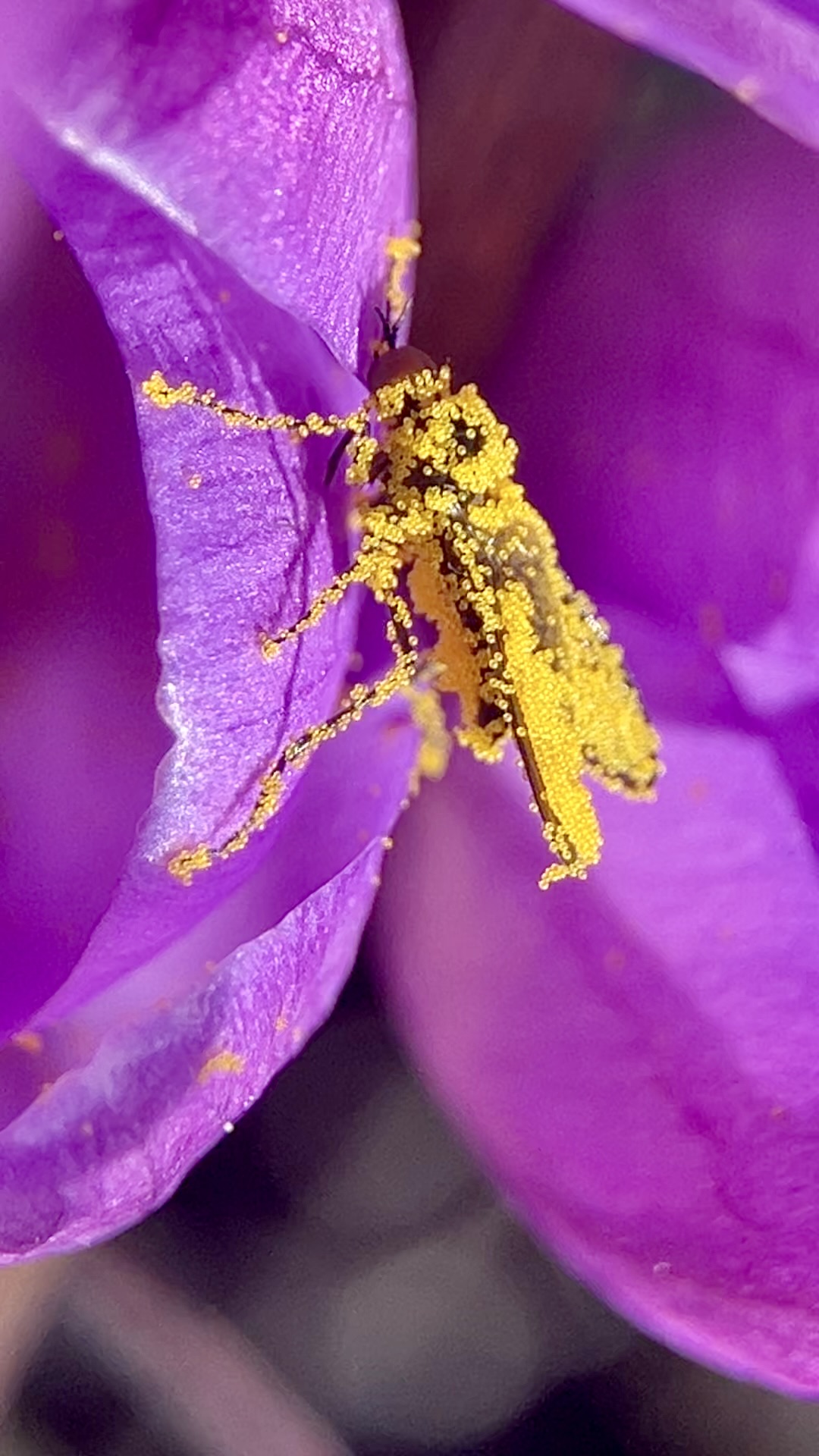
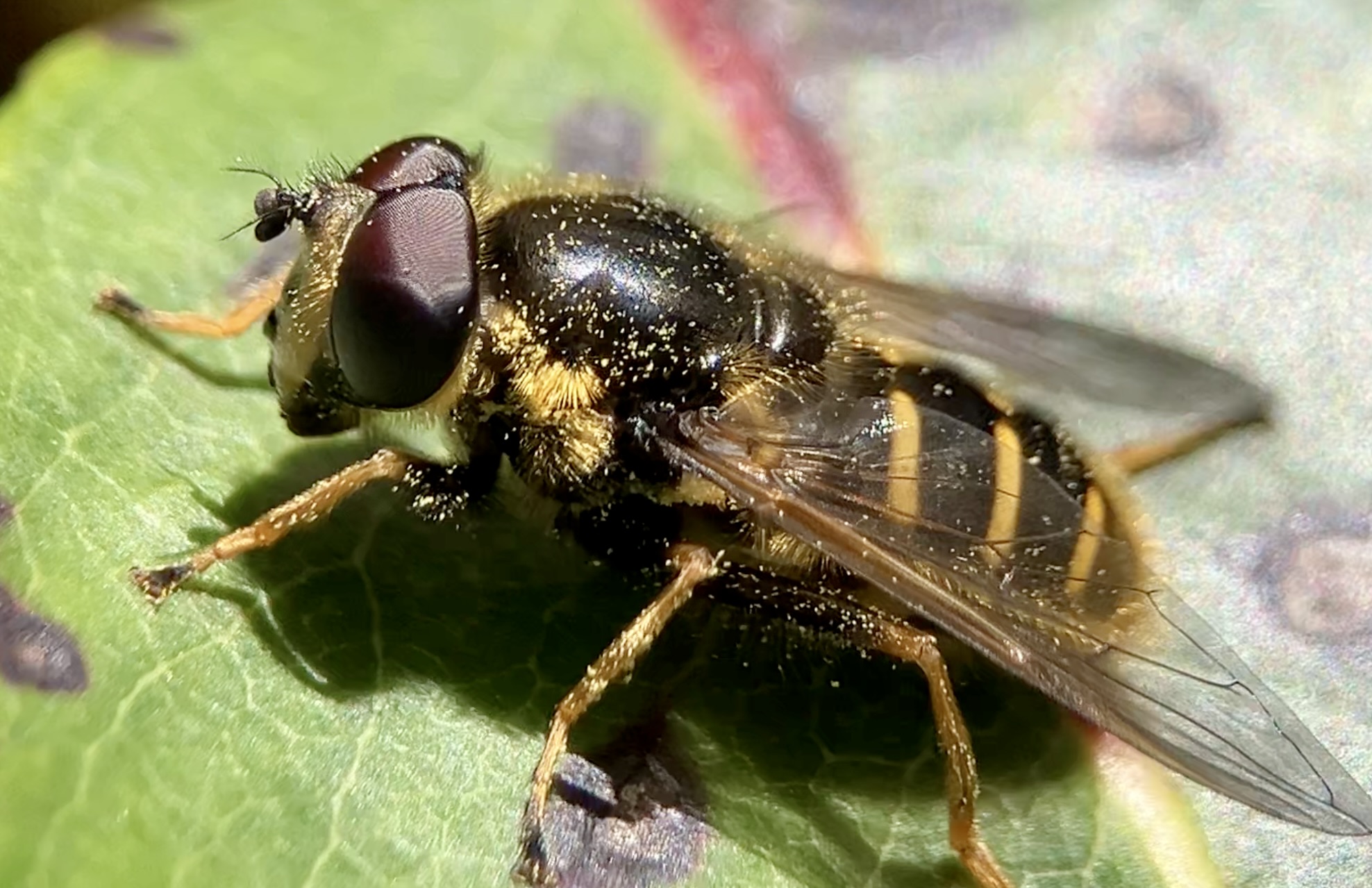
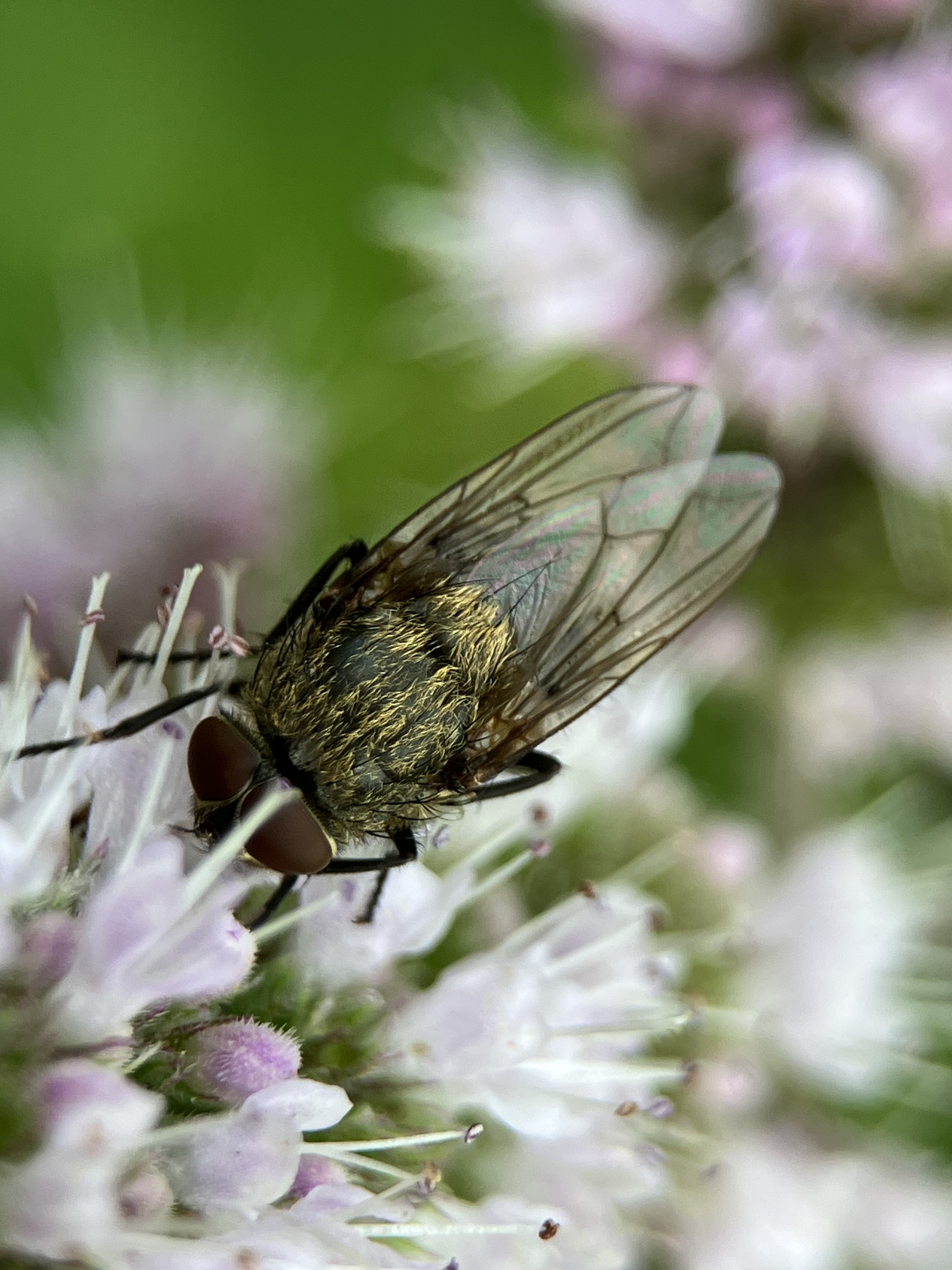
Empididae Dance Fly Covered in PollenEmpis barbatoidesEmpis sp. Golden Dung Fly (Scathophaga stercoraria) Forked Globetail (Sphaerophoria sulphuripes ), a Syrphid Fly Melanostoma mellinum Variable Duskyface Fly, a Syrphid Fly Musca sp. (I believe Musca autumnalis)Sericomyia chalcopyga – Western Pond Fly, A Syrphid FlyPollenia sp. Cluster fly
Honestly, I am not much of a food gardener, but I do love watching for insects in our garden and observing the relationships that exist. Not just between the insects and the plants, but also the relationships between different species of insects (and I’ll lump spiders in here too).
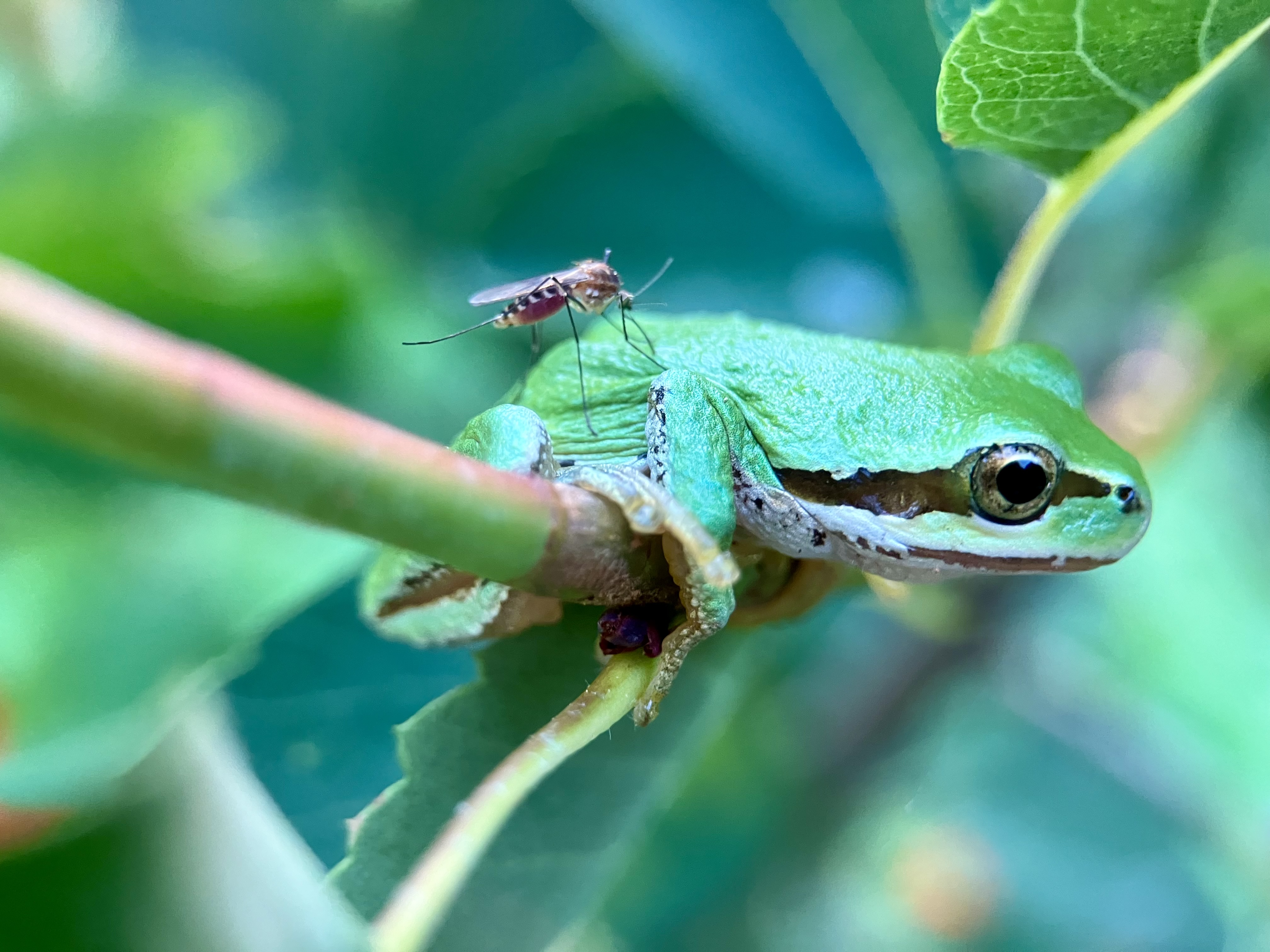
Every year, I watch our resident chickadees and nuthatches glean insects off twigs and branches. Nature’s pest control. The little tree frogs gobble bugs off garden plants. Those same frogs are also food for a species of female mosquito. Yes, you might detest mosquitoes, but even mosquitoes are pollinators. Go out at night with a flashlight and look at those fruit tree flowers!
Culex territans mosquito feeding on tree frogMale mosquito, night time pollinator
Even now, in February, I watch our year round, Anna’s hummingbirds zip along eaves of our home taking spider webbing to glue their nests together. They also eat many small bugs like fungus gnats and other small flies, even spiders!
If you just take a moment to look closely, there are many varied relationships between species at all trophic levels going on around us that have evolved to work in balance in our island ecosystem. Native species usually have multiple roles in the ecosystem. Some are pollinators, but also pest predators. Others we may consider pests, but they are also predators of pests. Most are food for some other organism in the food chain. Remember too, that just as we are healthier with a diverse diet, other organisms also stay healthy from sourcing nutrients from an assortment of food. When we lose diversity, we all suffer. We need a complex working ecosystem, and that comes from nature!
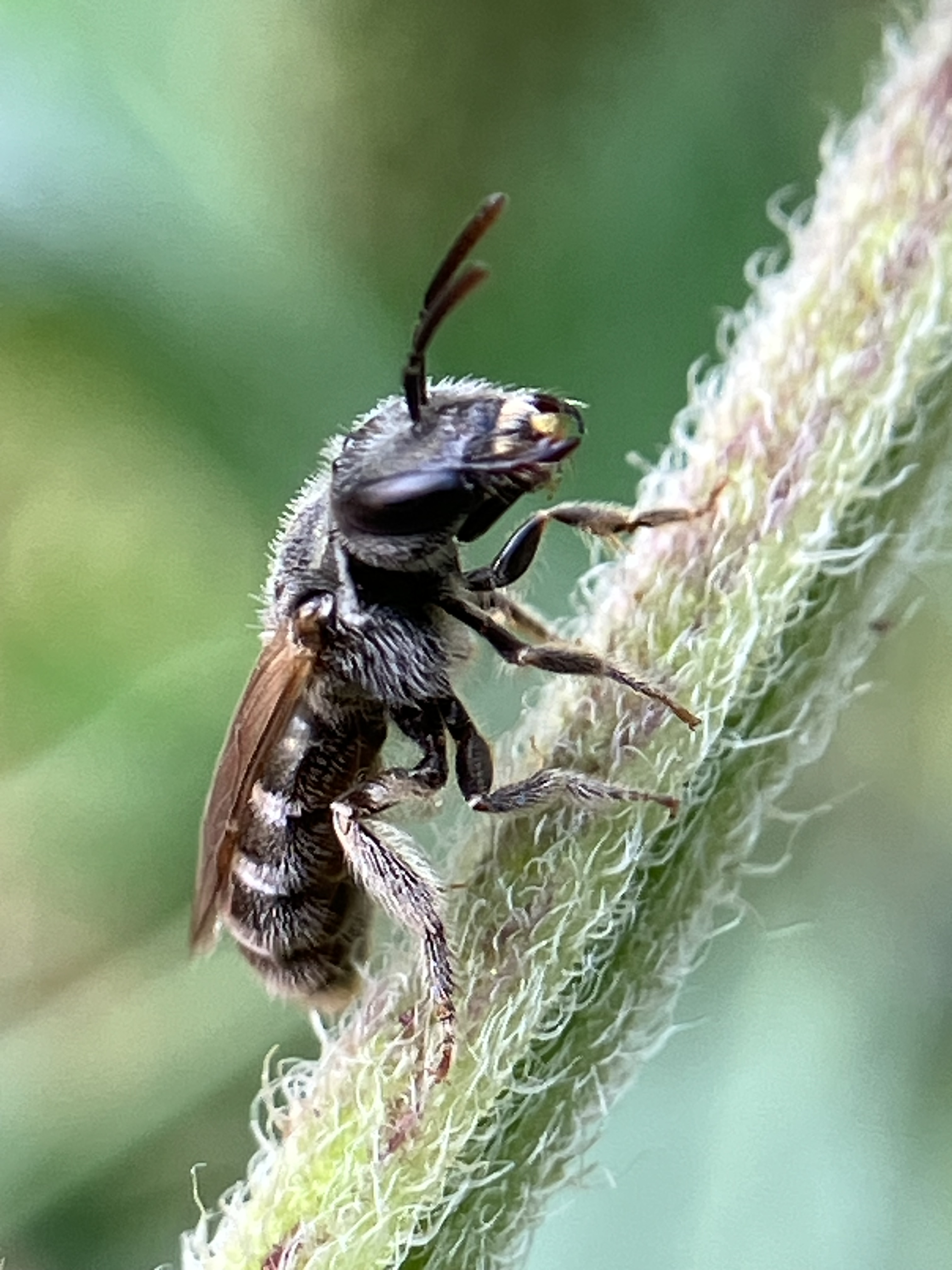
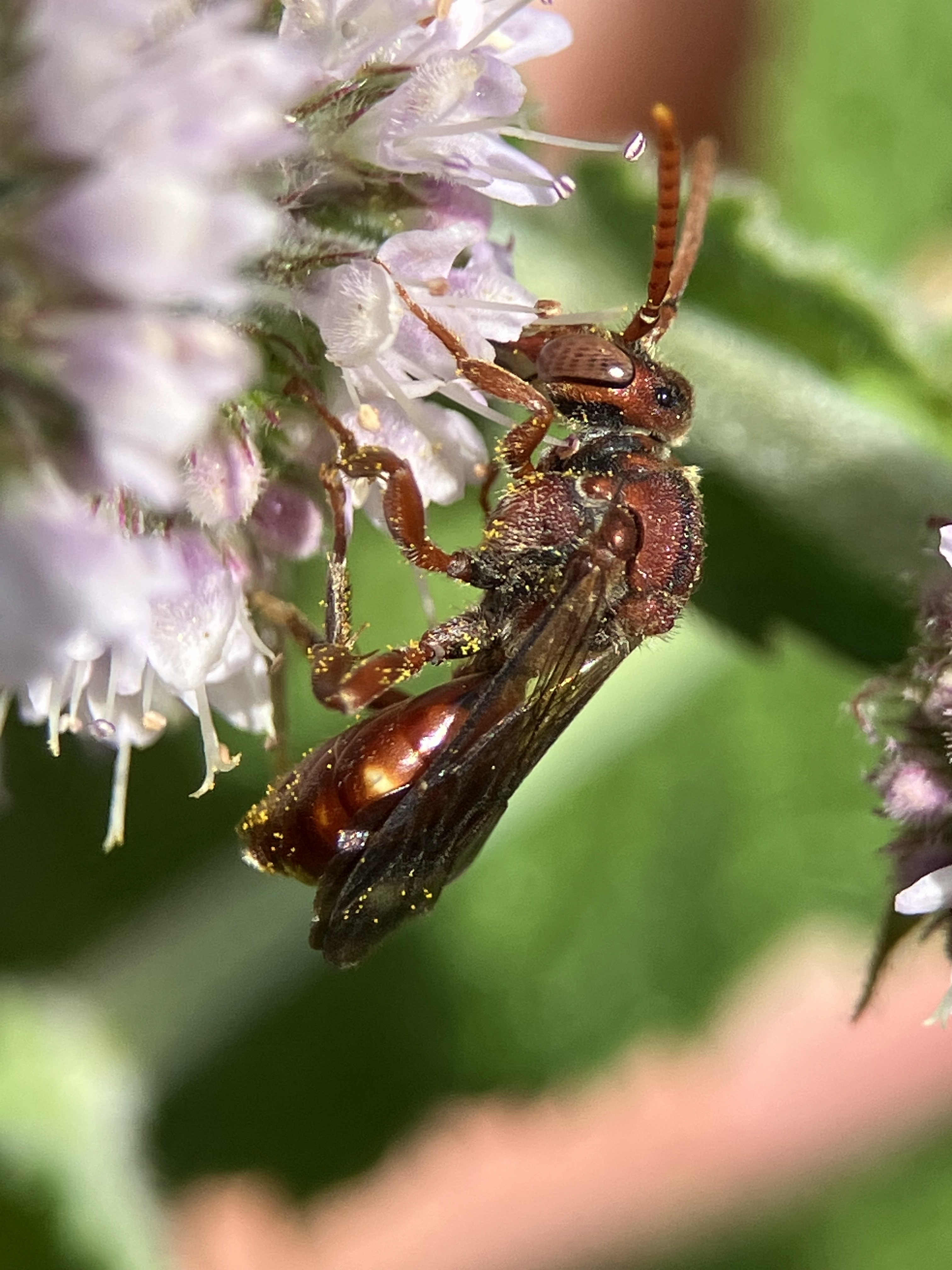
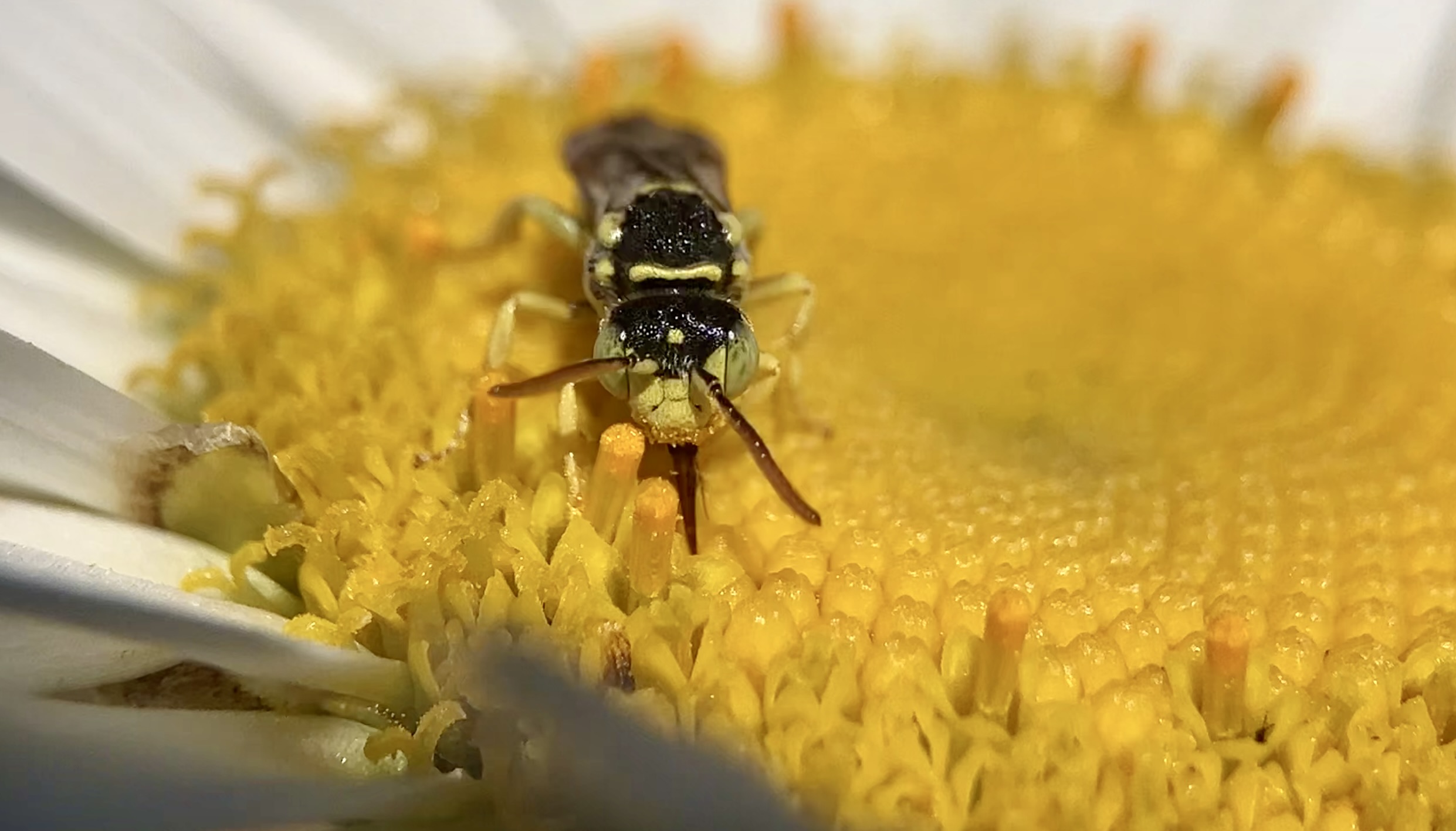
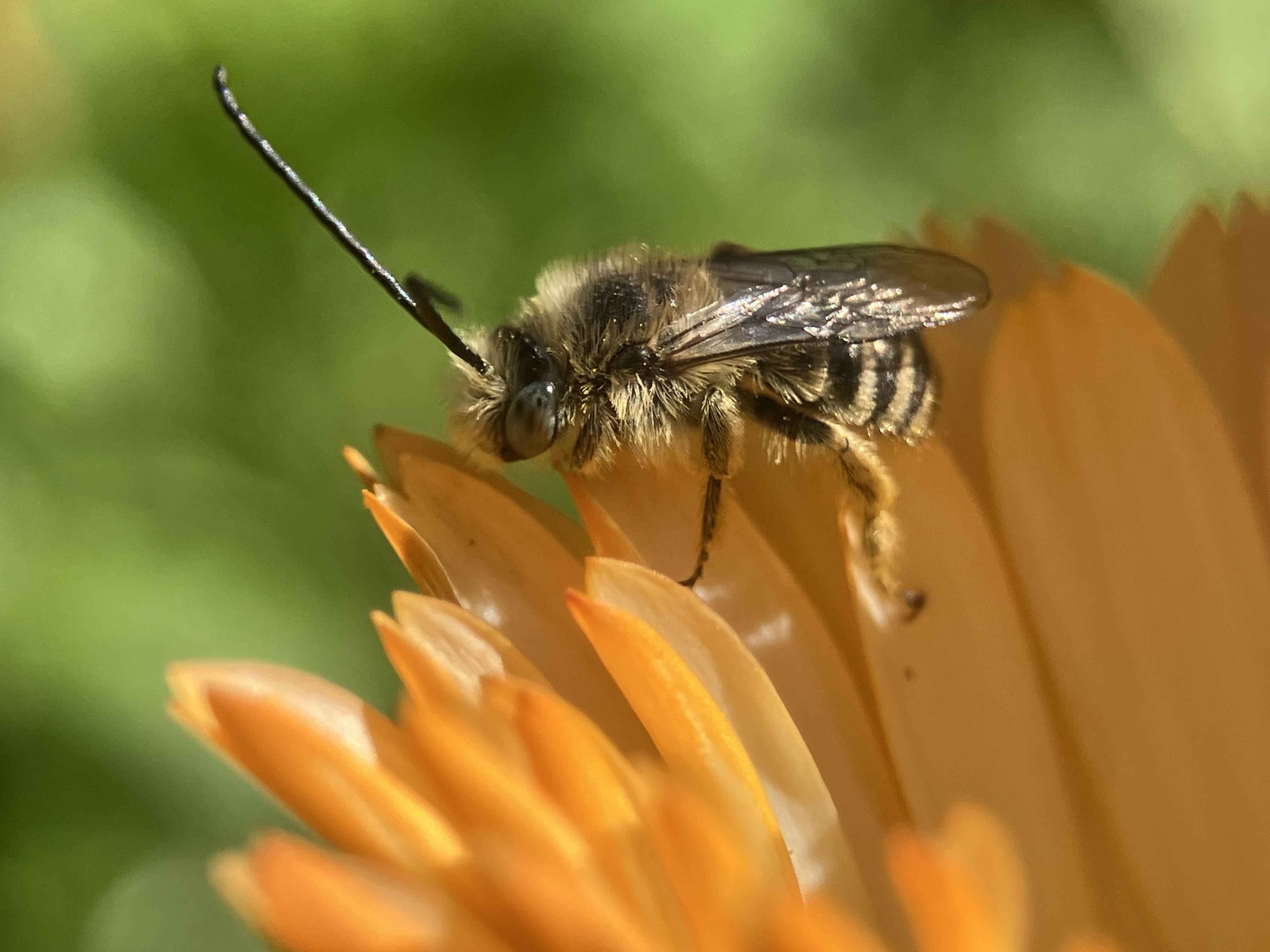
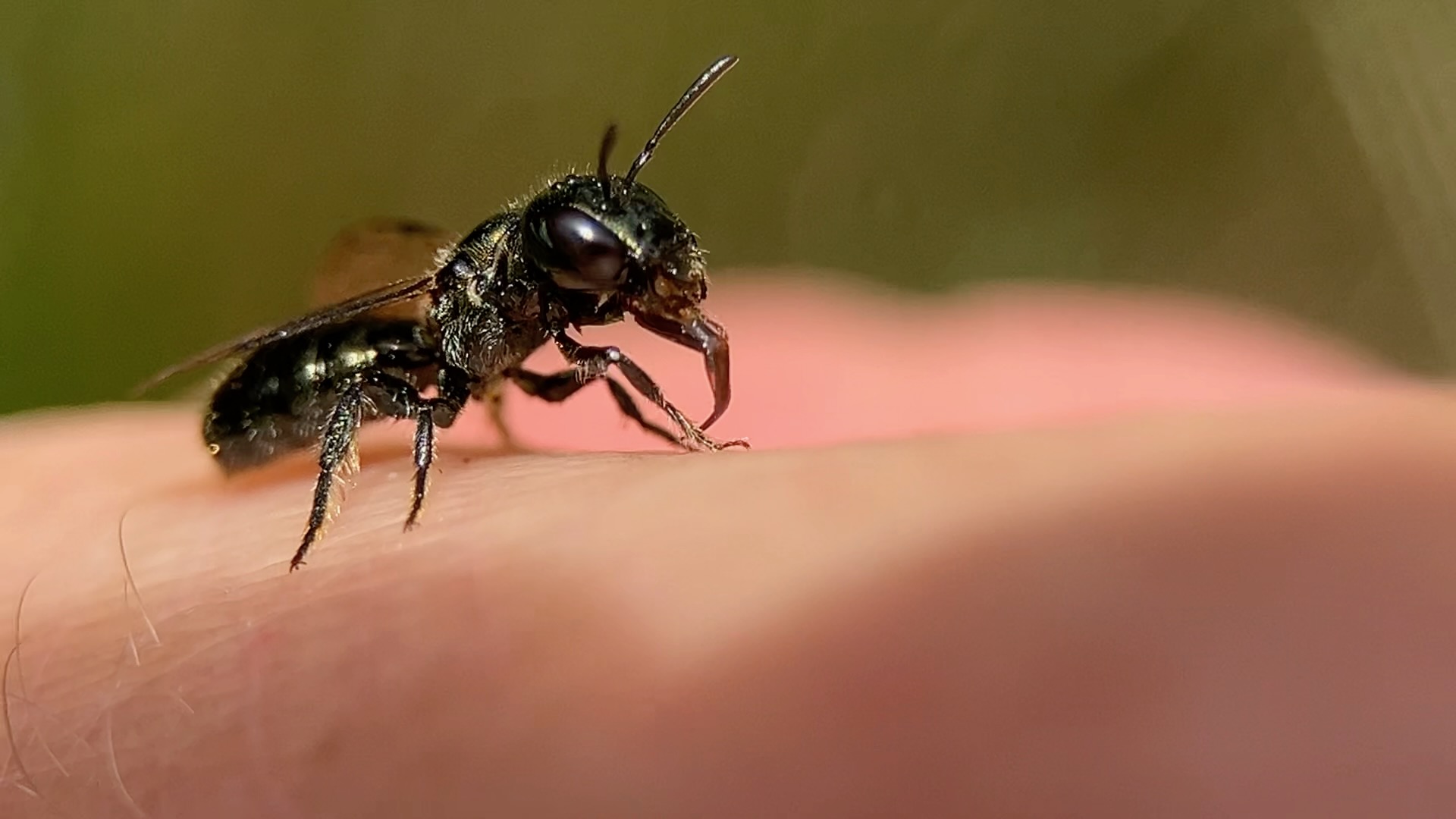
Some of our island native bee pollinators include bumble bees, sweat bees, alkali bees, blood bees, orchard bees, leaf cutter bees, nomad bees, digger bees, fairy bees, and others. These bees may not produce honey, but they are pollinators of immensely great value.
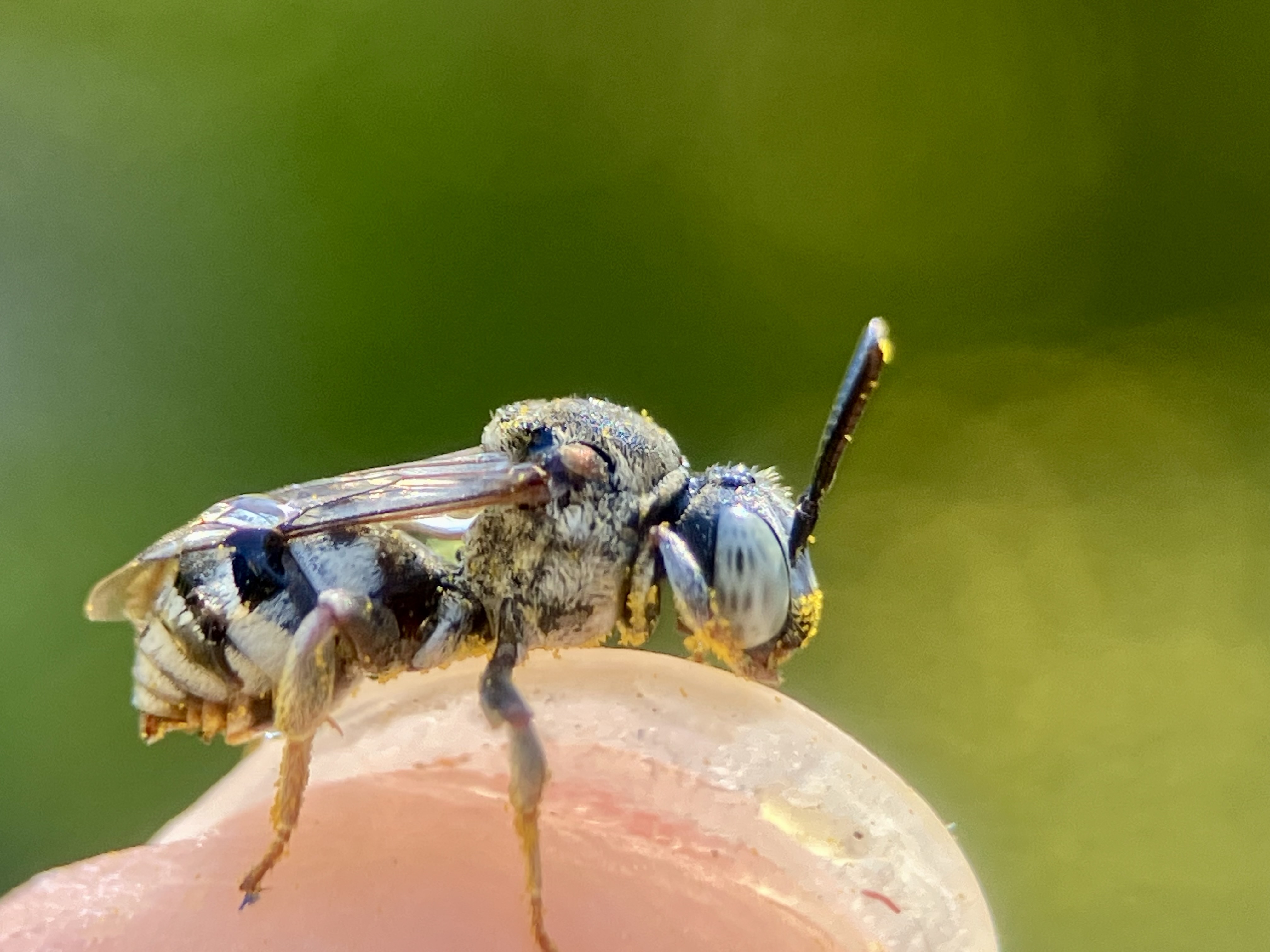
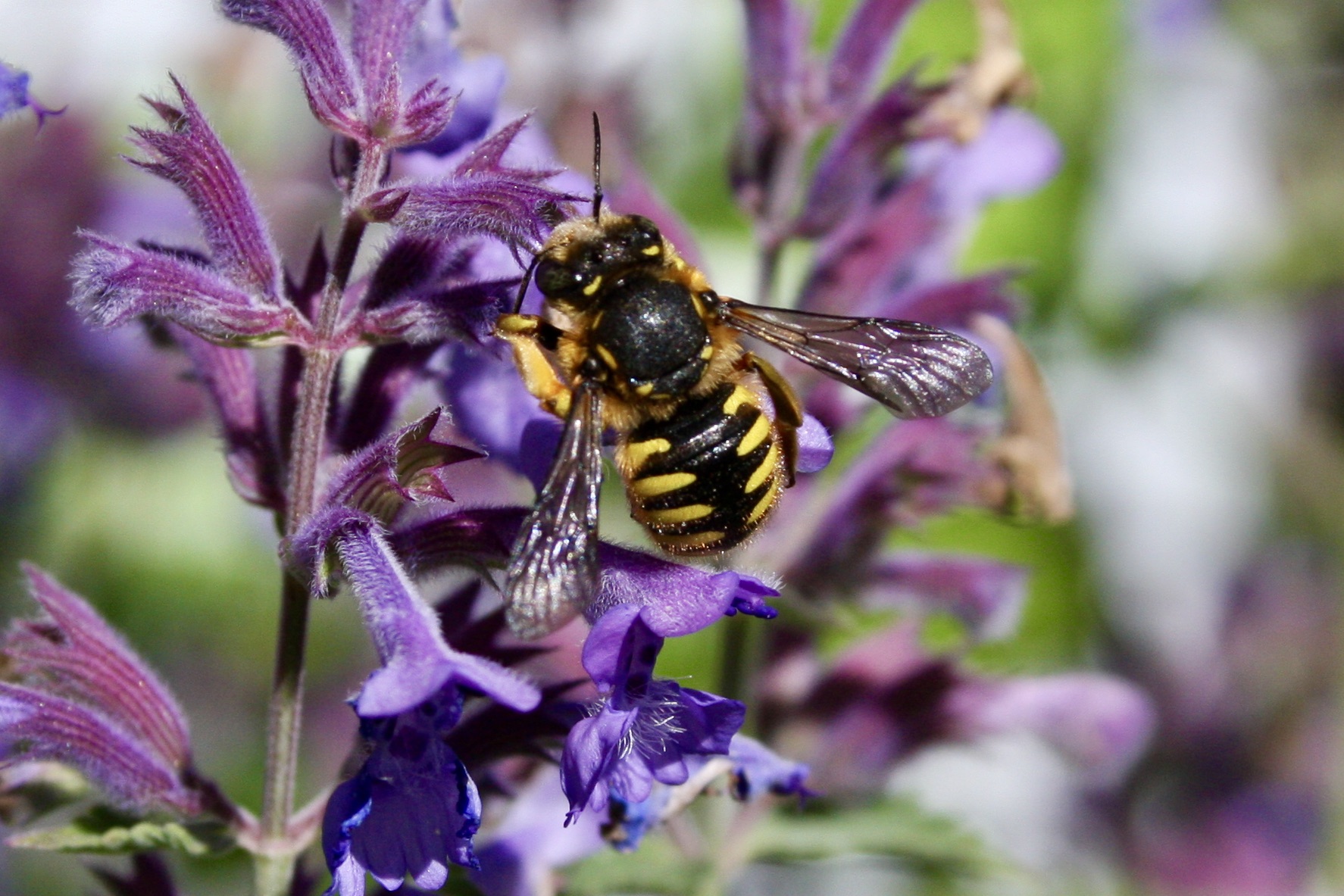
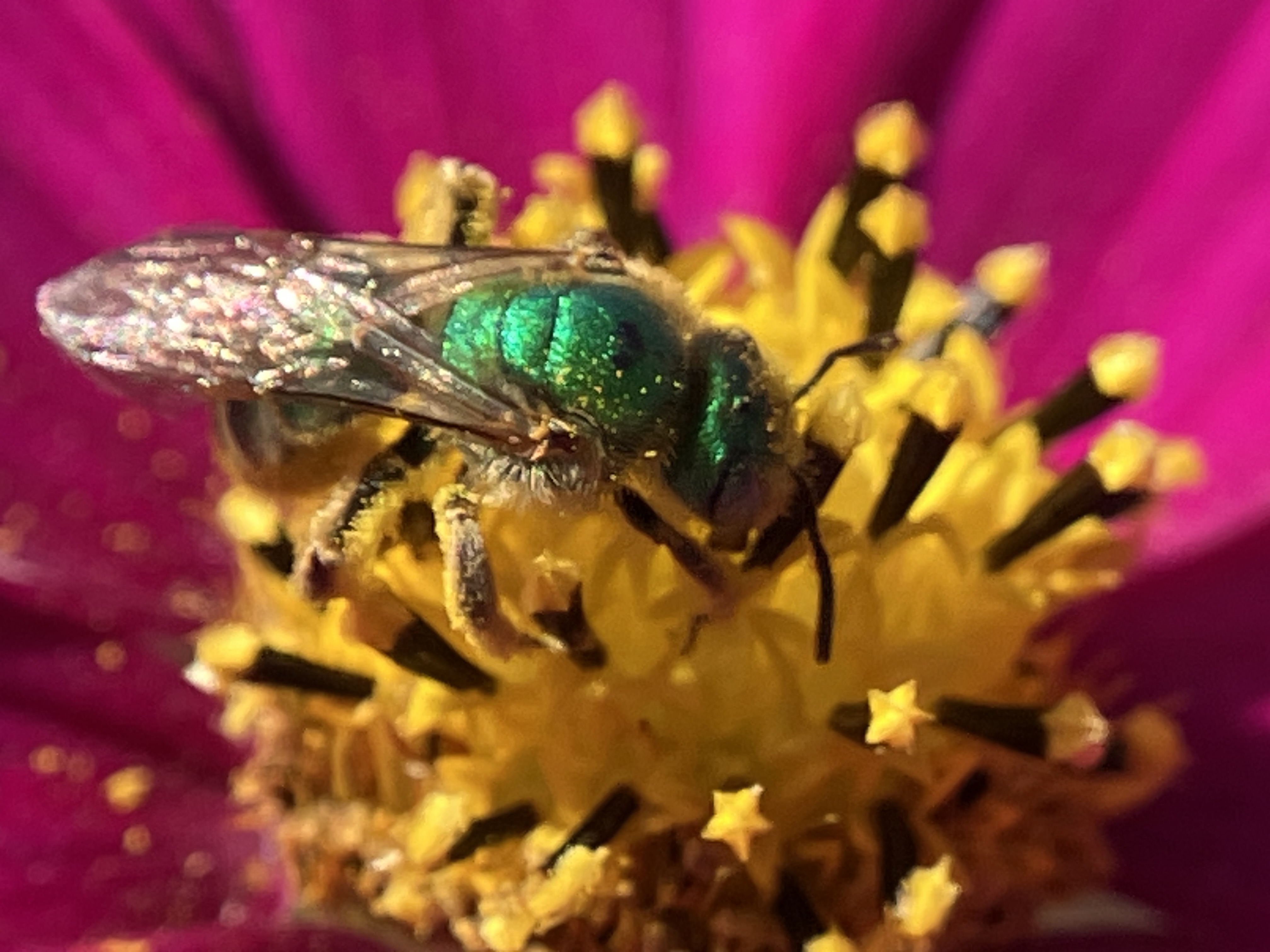
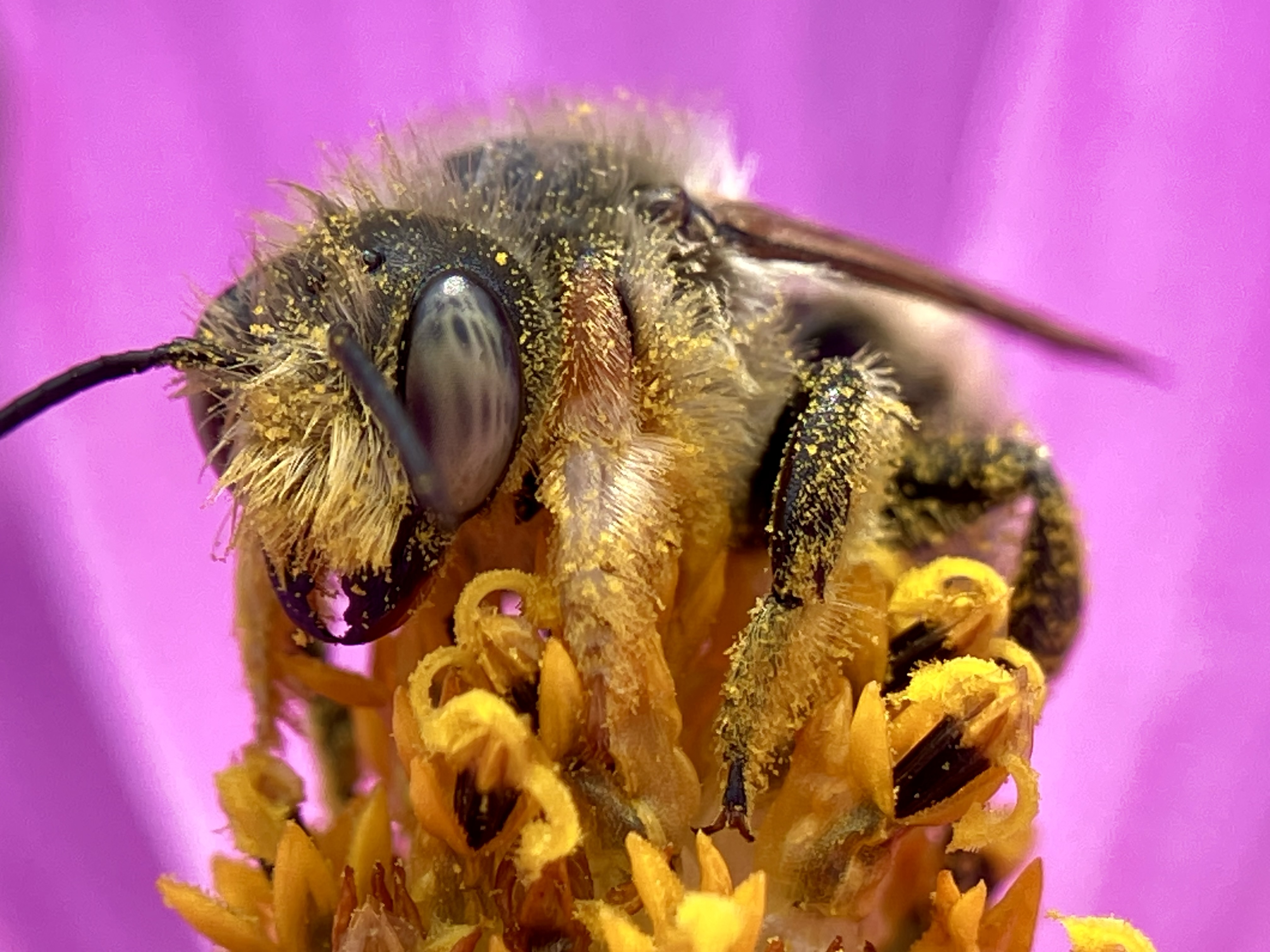
Golden Furrow Bees Subgenus Seladoniaa member of Furrow Bees Genus HalictusNomad BeeNomad BeeTriepeolus Cuckoo BeeMining Bee (Genus Andrena)Lasioglossum bee Sleeping beeAnthidium manicatum European Wool Carder Bee 06.28.2020Agapostemon Sweat beeMegachile bee
In fact, research over the past decade is illuminating just how critical these native bees and other native pollinators are for biodiversity. Biodiversity that is disappearing from our world due to habitat loss, land use changes, agricultural practices, and competition over resources with non-native species (like honey bees). You don’t have to take my word for it though. The Washington Native Bee Society and the Xerces Society will give you similar information.
Try Googling a bit on your own and you might find some pretty cool statistics about how native bees are actually better pollinators than honey bees, AND that their pollination services can yield larger, healthier fruits (like blueberries and strawberries for example). Competition over resources and displacement of native bees due to honey bee keeping isn’t limited to our island or our state. It’s been something happening world wide where honey bees are used for agricultural practices, whether for pollination or honey production. The encouraging news is that supporting native pollinators is gaining momentum. I’ve compiled a resource list for you to look at, read, and share if you are inclined.
Ceratina bee
If you are still dead set on setting up a honey bee hive, I’m happy to walk you through it. I can give you a list of everything you’ll need, provide the cost of all those supplies, and advise you on how not to get stung, why you should never eat a banana near your bee hive, what problems you can anticipate with pests and pathogens, and how to avoid losing your bees due to swarming. I will also tell you that if you set up a honey bee hive, you must file and register your colony with WSDA per state law. Hopefully, you will make your way to the same conclusion as I have. It’s cheaper and also ethically responsible to support native pollinators and conserve habitat in your own yard for pollinator diversity. It’s also quite fun and rewarding to watch and learn about native bees and the bugs you probably never even knew existed.
KEARNS, C. A. 2001. North American dipteran pollinators: assessing their value and conservation status. Conservation Ecology 5(1): 5. [online] URL: http://www.consecol.org/vol5/iss1/art5/
MacInnis, G, Forrest, JRK. 2019. Pollination by wild bees yields larger strawberries than pollination by honey bees. J Appl Ecol. 56: 824– 832. https://doi.org/10.1111/1365-2664.13344
Mallinger, R.E. and Gratton, C., 2015. Species richness of wild bees, but not the use of managed honeybees, increases fruit set of a pollinator-dependent crop. J Appl Ecol. 52: 323-330. https://doi.org/10.1111/1365-2664.12377
Angelella GM, McCullough CT, O’Rourke ME. 2021. Honey bee hives decrease wild bee abundance, species richness, and fruit count on farms regardless of wildflower strips. Sci Rep. Feb 5;11(1):3202. doi: 10.1038/s41598-021-81967-1. Erratum in: Sci Rep. 2021 Aug 17;11(1):17043. doi: 10.1038/s41598-021-95368-x. PMID: 33547371; PMCID: PMC7865060. https://pmc.ncbi.nlm.nih.gov/articles/PMC7865060/
Page, Maureen L., and Neal M. Williams. 2023. “ Honey Bee Introductions Displace Native Bees and Decrease Pollination of a Native Wildflower.” Ecology 104(2): e3939. https://doi.org/10.1002/ecy.3939
Lorenzo Pasquali, Claudia Bruschini, Fulvia Benetello, Marco Bonifacino, Francesca Giannini, Elisa Monterastelli, Marco Penco, Sabrina Pesarini, Vania Salvati, Giulia Simbula, Marta Skowron Volponi, Stefania Smargiassi, Elia van Tongeren, Giorgio Vicari, Alessandro Cini, Leonardo Dapporto. 2025. Island-wide removal of honeybees reveals exploitative trophic competition with strongly declining wild bee populations. Current Biology. 35(7) : 1576-1590.e12, ISSN 0960-9822, https://doi.org/10.1016/j.cub.2025.02.048https://www.sciencedirect.com/science/article/pii/S0960982225002623
Thomson, D. (2004), COMPETITIVE INTERACTIONS BETWEEN THE INVASIVE EUROPEAN HONEY BEE AND NATIVE BUMBLE BEES. Ecology, 85: 458-470. https://doi.org/10.1890/02-0626
It’s been a good while since I’ve written up a blog post, but I found something I thought worth sharing after seeing these little ones on the side of our above ground pool the afternoon of December 18, 2025. My story, however, is going to take us back to September of 2022.
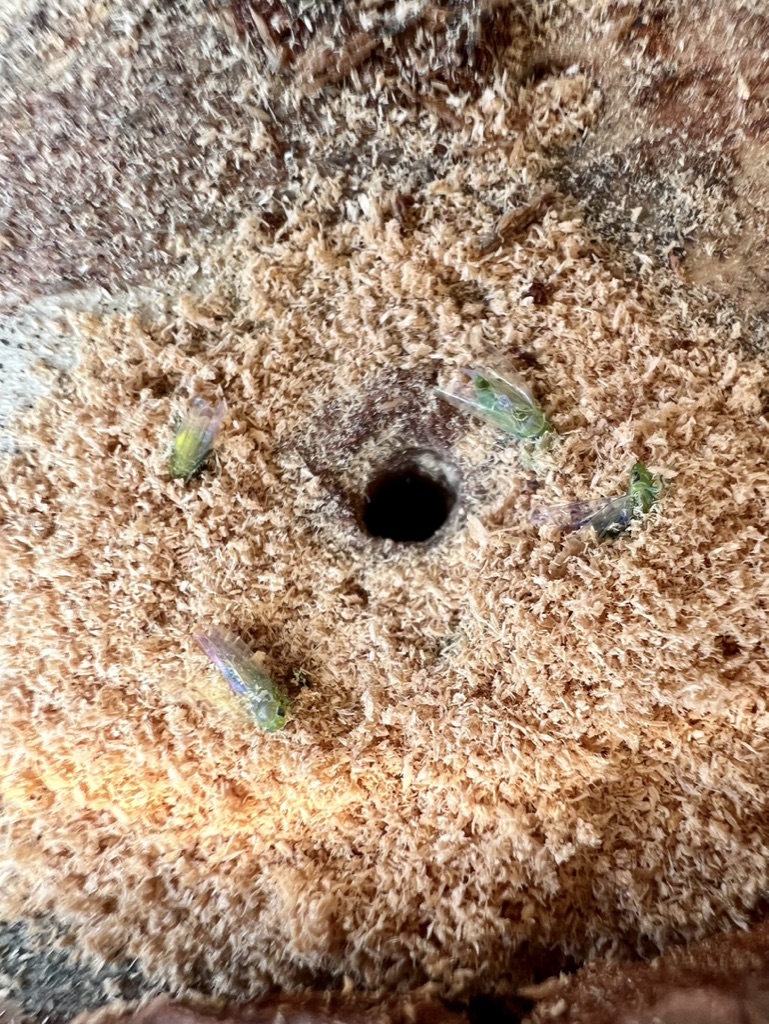
One evening, carrying out the recycles to our barn storage area, I noticed this pile of sawdust and peculiar arrangement of little green bugs around a hole in the middle on a cedar log in our yard.
September 6, 2022
Identification of the occupant and creator of this unique arrangement took me awhile. I believe the wasp is a Crabronid wasp in the genus Crossocerus. She was using an old beetle exit hole as the perfect burrow for her nest construction.
Crossocerus sp. Crabronid Wasp – September 27, 2022
Fascinated, I sat and watched her for hours on end for about two weeks. She would be gone by morning when I woke up, but at the end of the day, I’d find a little pile of sawdust from her excavation work and a circle of ONLY these green bugs arranged so carefully on top.
Just before sunset, she would return to pack in her assembled collection of tiny prizes one at a time, provisioning each of the cells she had constructed for her eggs with the little iridescent green bugs, paralyzed, but still alive. Creepy, right? Later, the eggs she would lay in these cells would hatch into little wasp larvae and consume the still-living, little green bugs…one by one.
Alas, later that winter, I noticed my wasp’s cluster of burrows in that log had been excavated by one of our resident Hairy Woodpeckers. They find all the buried bugs – especially it seems they find the ones in the wood siding of our house. We have a line of little holes pecked all ‘round. Naughty birds!
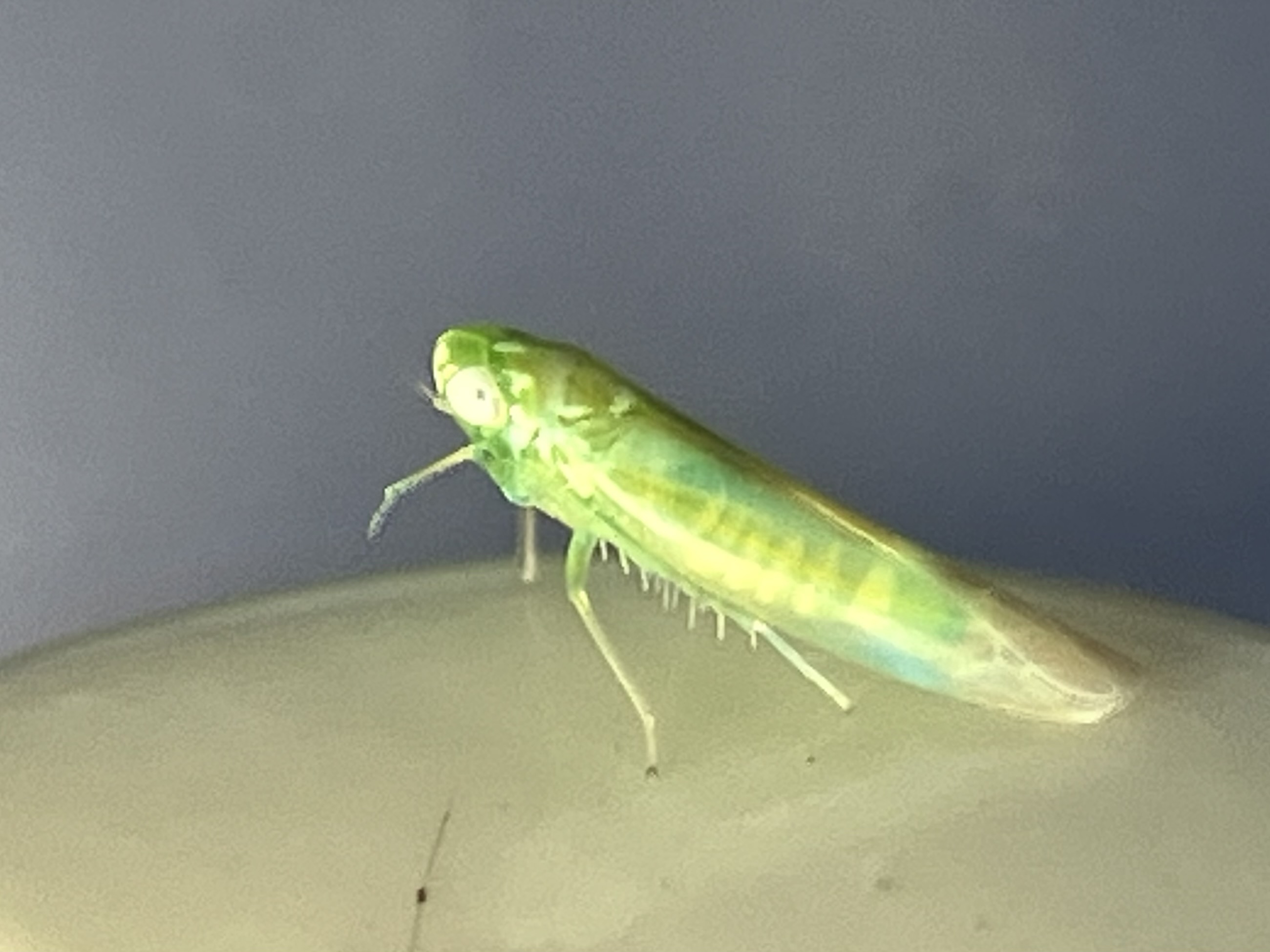
Identifying the little green bugs took me a long while. Mostly, because I get distracted and have to come back to a multitude of projects! I believe these little green bugs are in the genus Kybos. Kybos bugs are a type of leafhopper in the family Cicadellidae. They are associated with Salix sp. (Willows) and (Populus sp.) Poplars which are their host plants (Hamilton, 1972). The bugs feed on sap. That would certainly fit. We have lots of Willows nearby and three Quaking Aspen trees on our property.
And the wasp? One of the identifying features of Crossocerus is the ocelli form an equilateral triangle. In the video, I think I can make out just enough of this to be definitive. The ecology for some species in this genera also fits with a description found in Krombein (1979) about this group modifying pre-existing cavities or burrows in wood formed by wood boring insects.
The relationship between this wasp and the Kybos leafhoppers was intriguing to me because it was the ONLY species of bug I found the little wasp to collect and arrange to provision her offspring with. While I looked for information about this relationship extensively, I did not find any literature with previously reported documentation about this. Krombein (1979) mentions the collection of prey for various species, but none more specific than family Cicadellidae.
I wish it had been possible to identify the wasp to species. It would be amazing to see this again. Perhaps I will be lucky enough to stumble upon another one in action one day.
Coming back to the video I began with. Yesterday, December 18, 2025, I saw another of those little green bugs on the side of our pool. It was hanging out with a friend, a Bark Louse (Eptopsocus sp). Either they were enjoying the wind in their antennae or hanging onto the rim for their very lives. It was a very blustery day!
Kybos sp. Leafhopper and Eptopsocus sp. bark louse, December 18, 2025, San Juan Island, WA
Hamilton, K G A. (1972). The leafhopper genus Empoasca subgenus Kybos in southern interior of British Columbia. Journal of the Entomological Society of British Columbia, 69, 58–67. https://www.biodiversitylibrary.org/part/213774
For the past few years, I have observed one of our native shrubs to see what pollinators are visiting. Calscape has recorded Ocean Spray (Holodiscus discolor) as a host plant to approximately 14 species of Lepidoptera. Yet, I have actually never seen a single pollinator visiting the cascades of snowy white, delicate blossoms. I’ve also heard from a handful of local folks on San Juan Island. They say Ocean Spray is “invasive” and should be brush-hogged. According to them, it’s a “fire hazard.” This view is disturbing to me. I felt it important to find concrete evidence of this native plant’s value in our ecosystem.
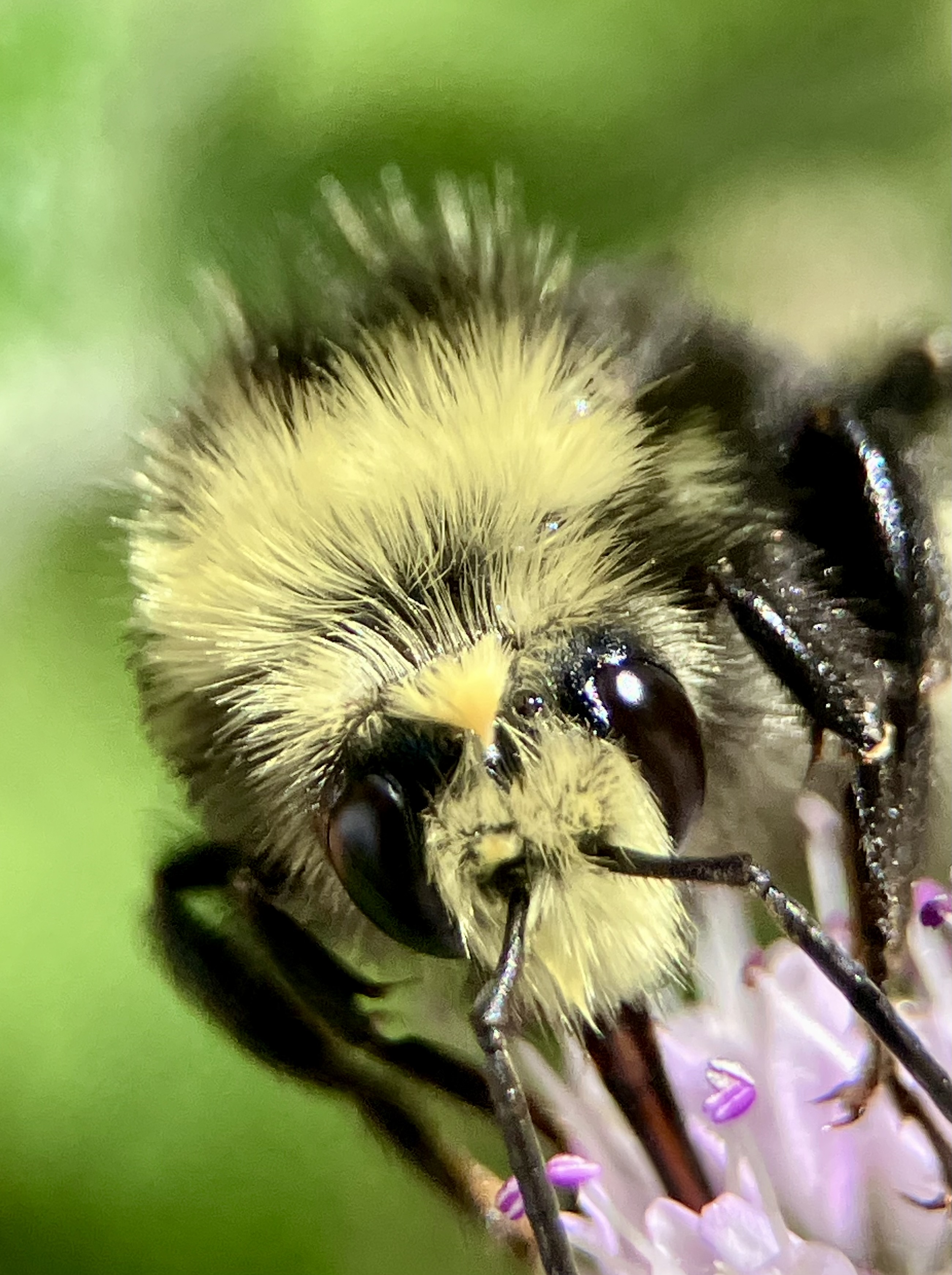
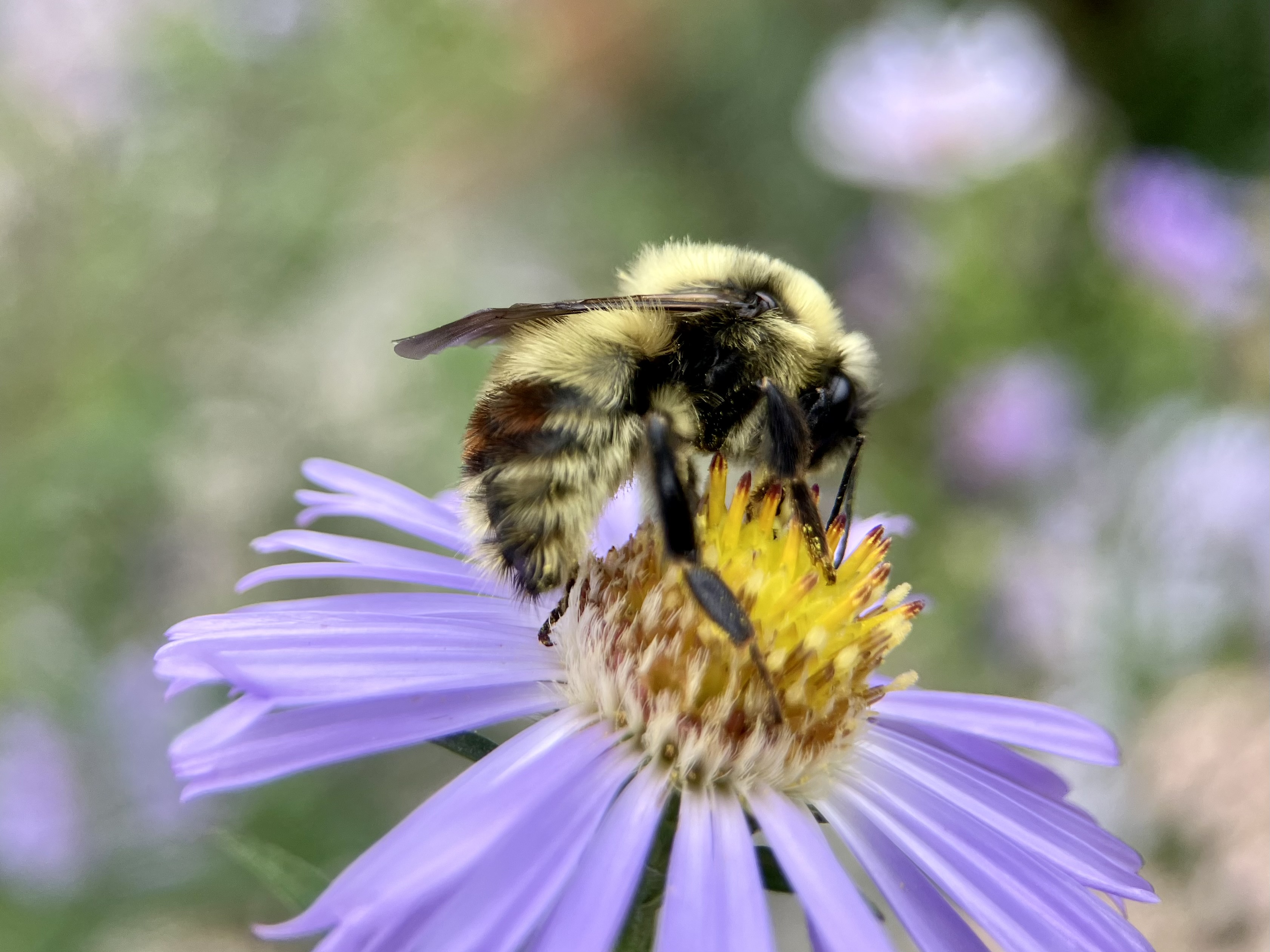
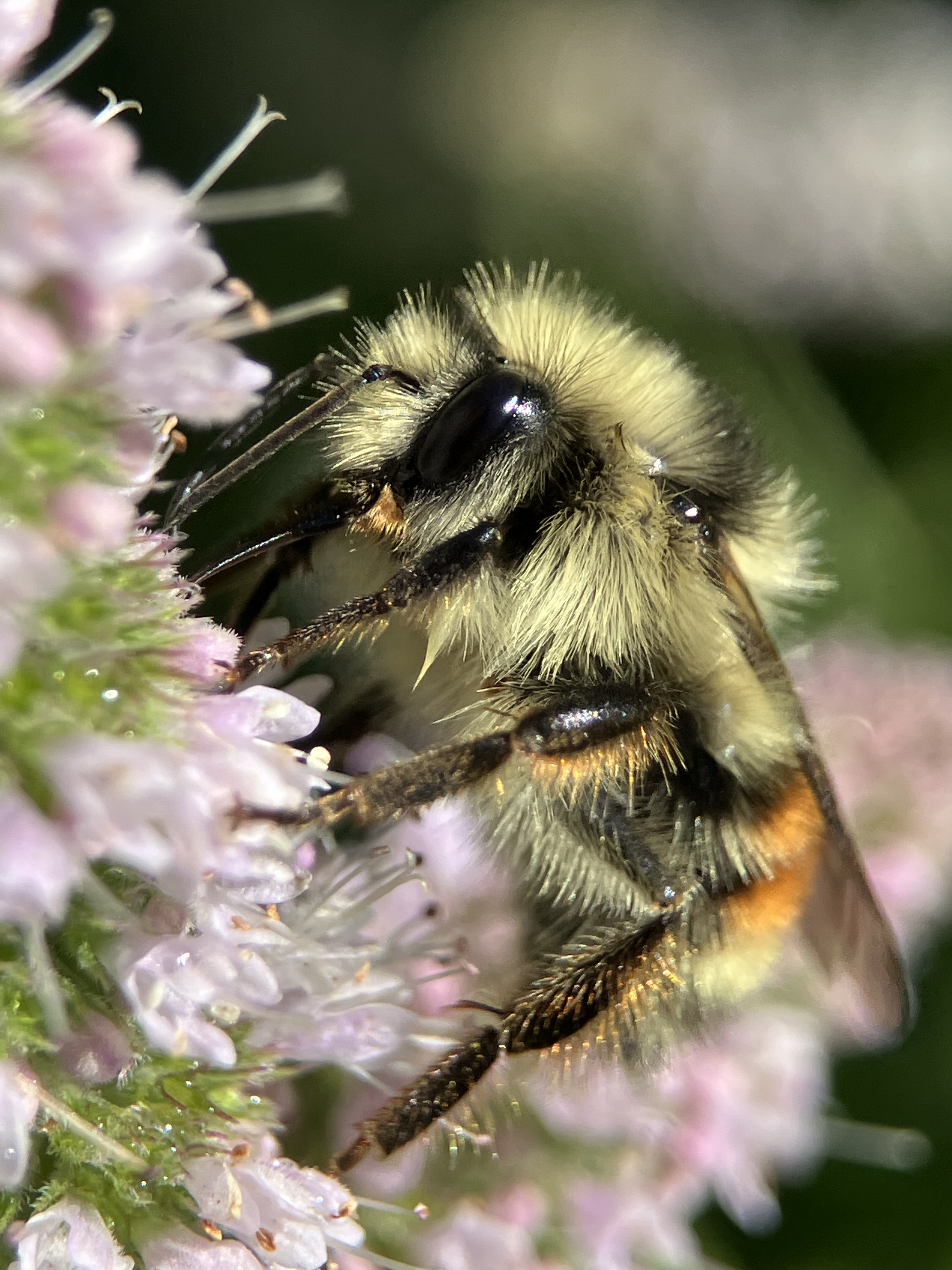
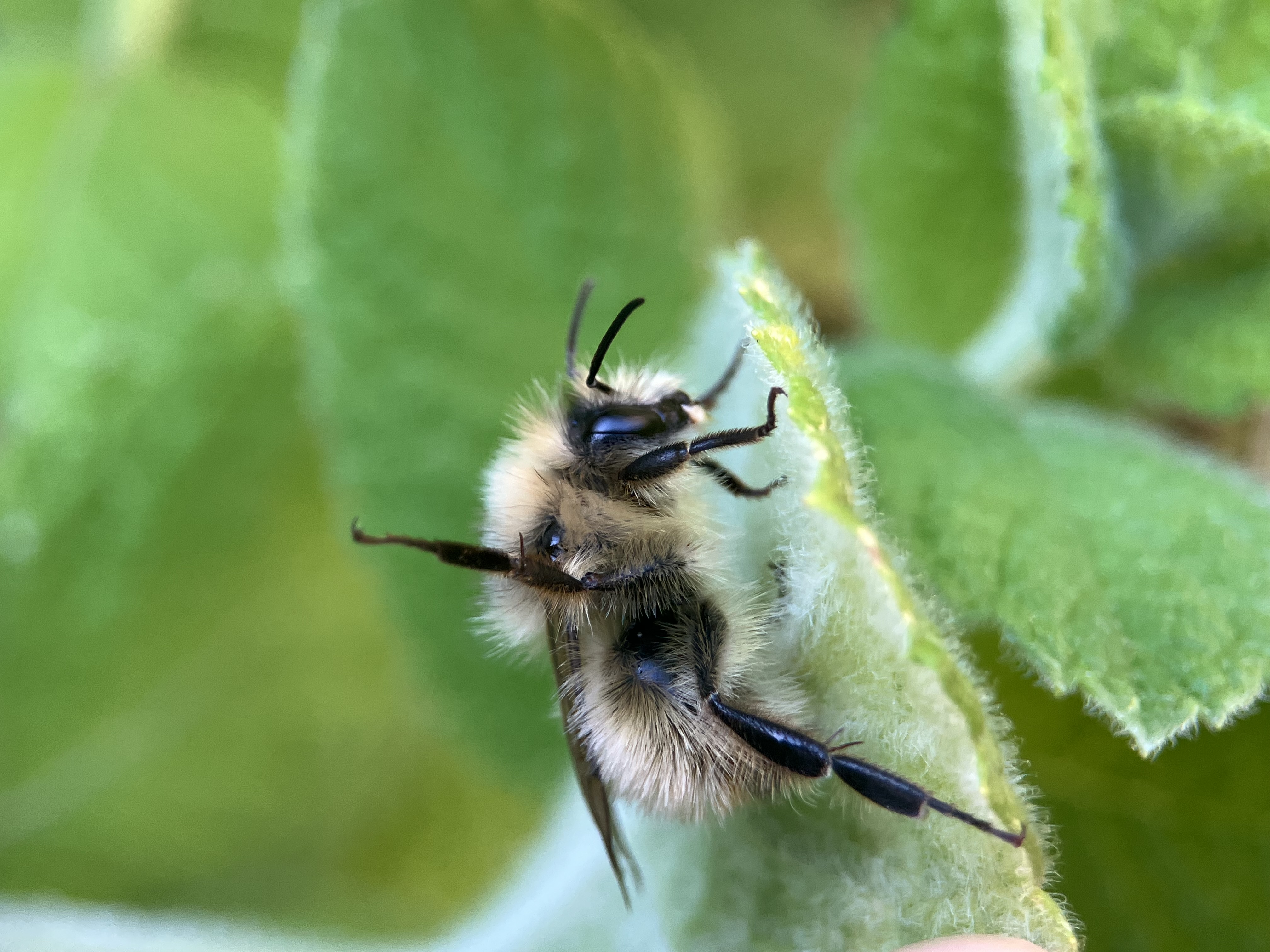
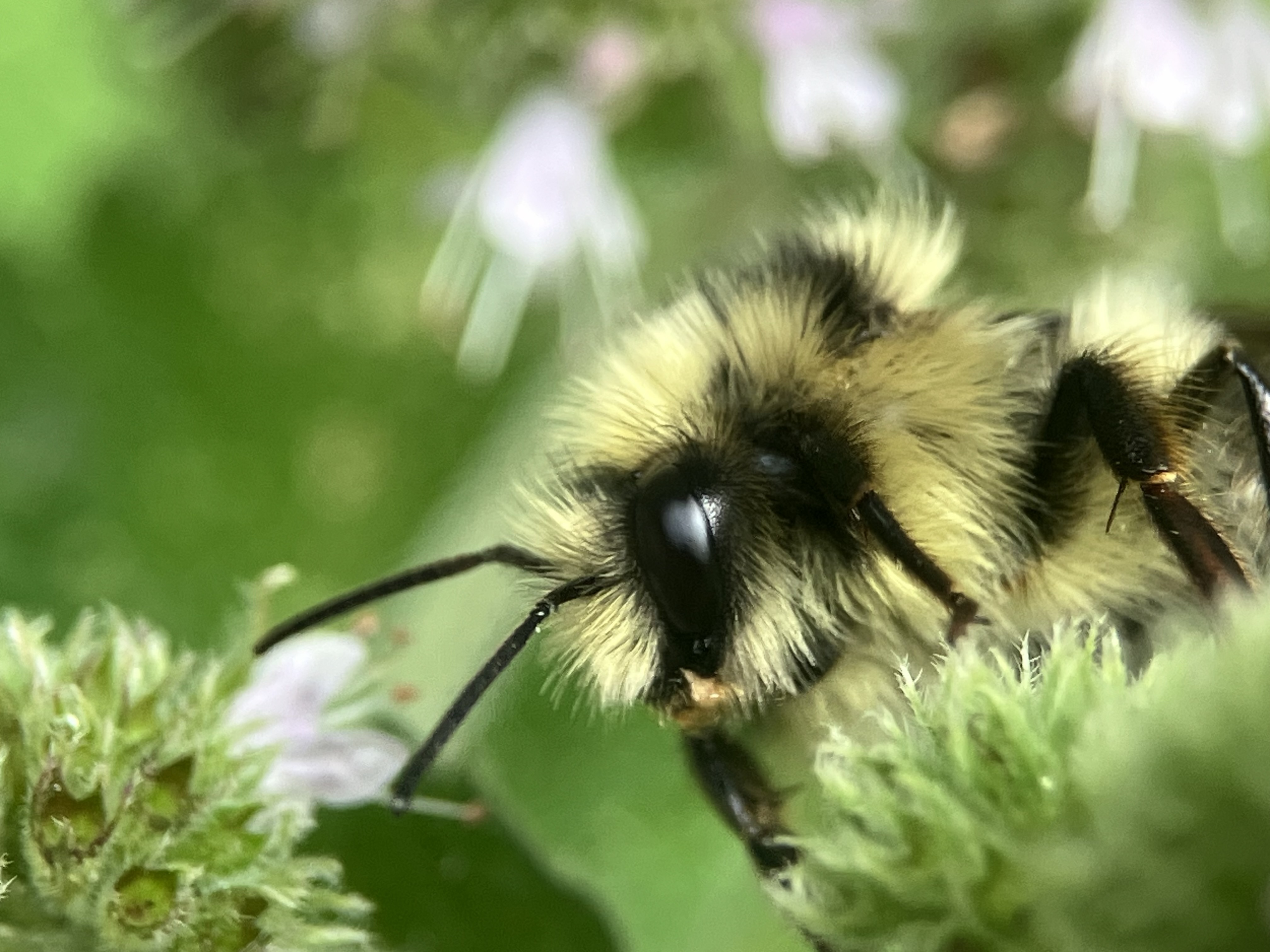
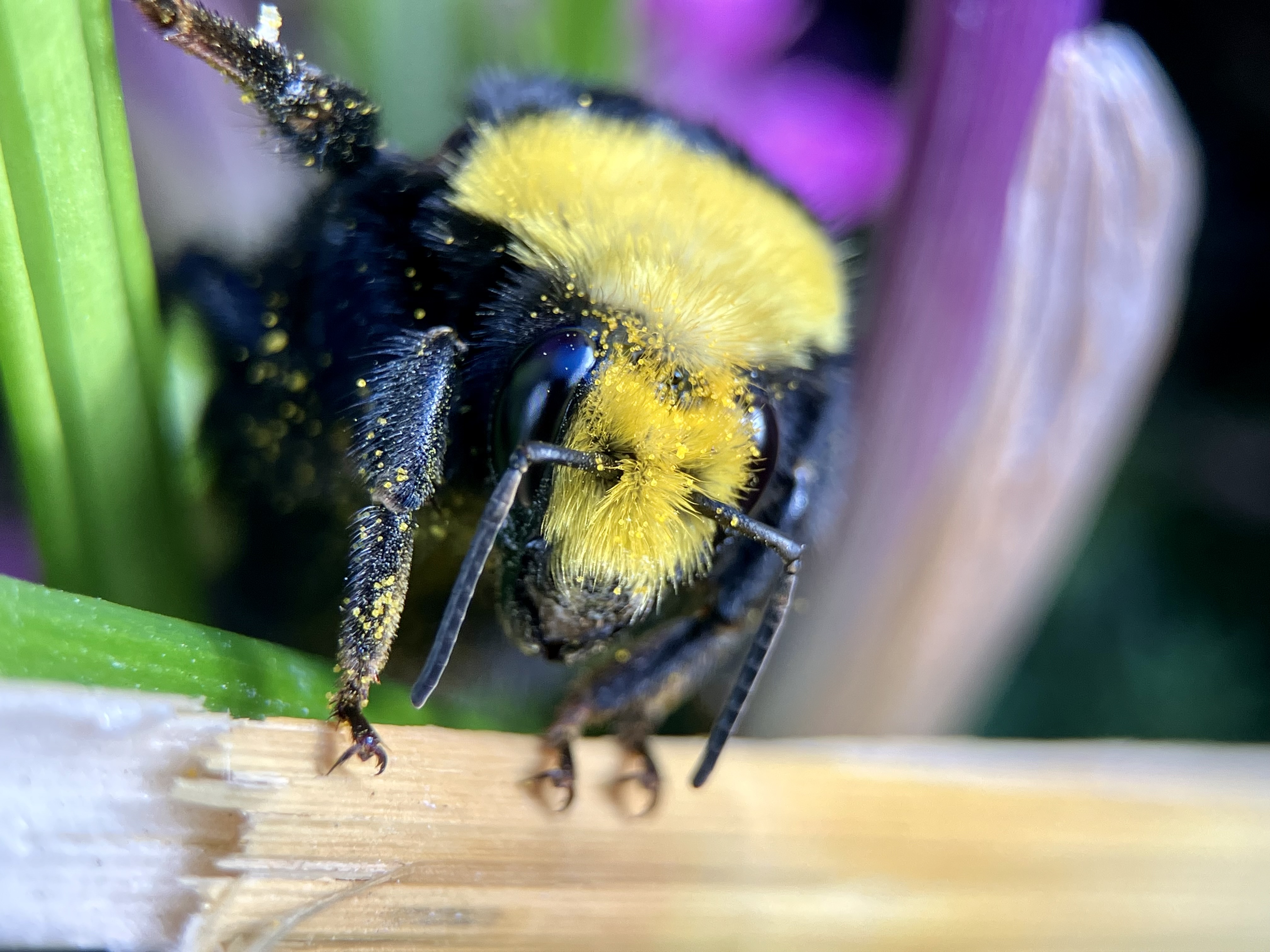
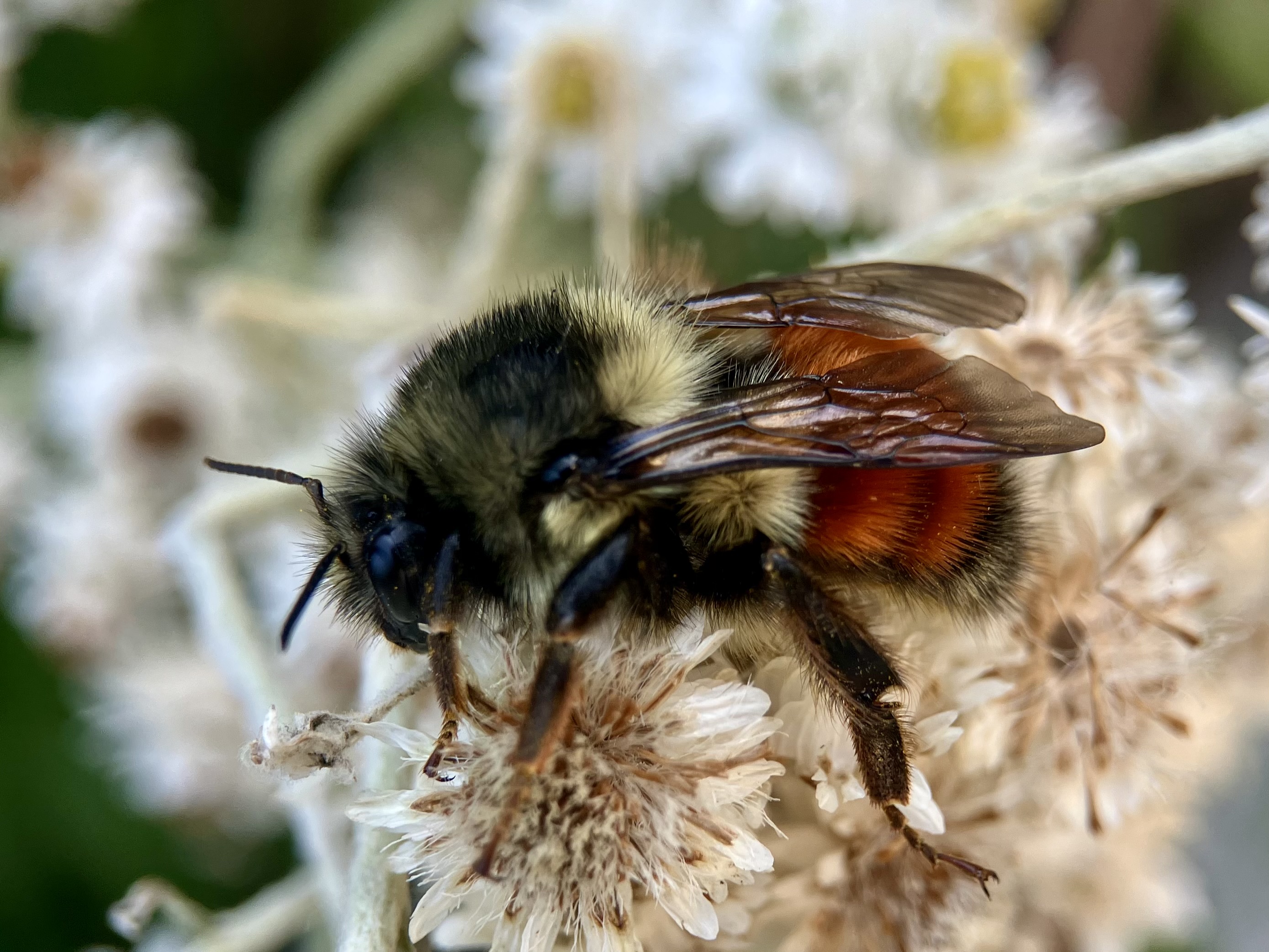
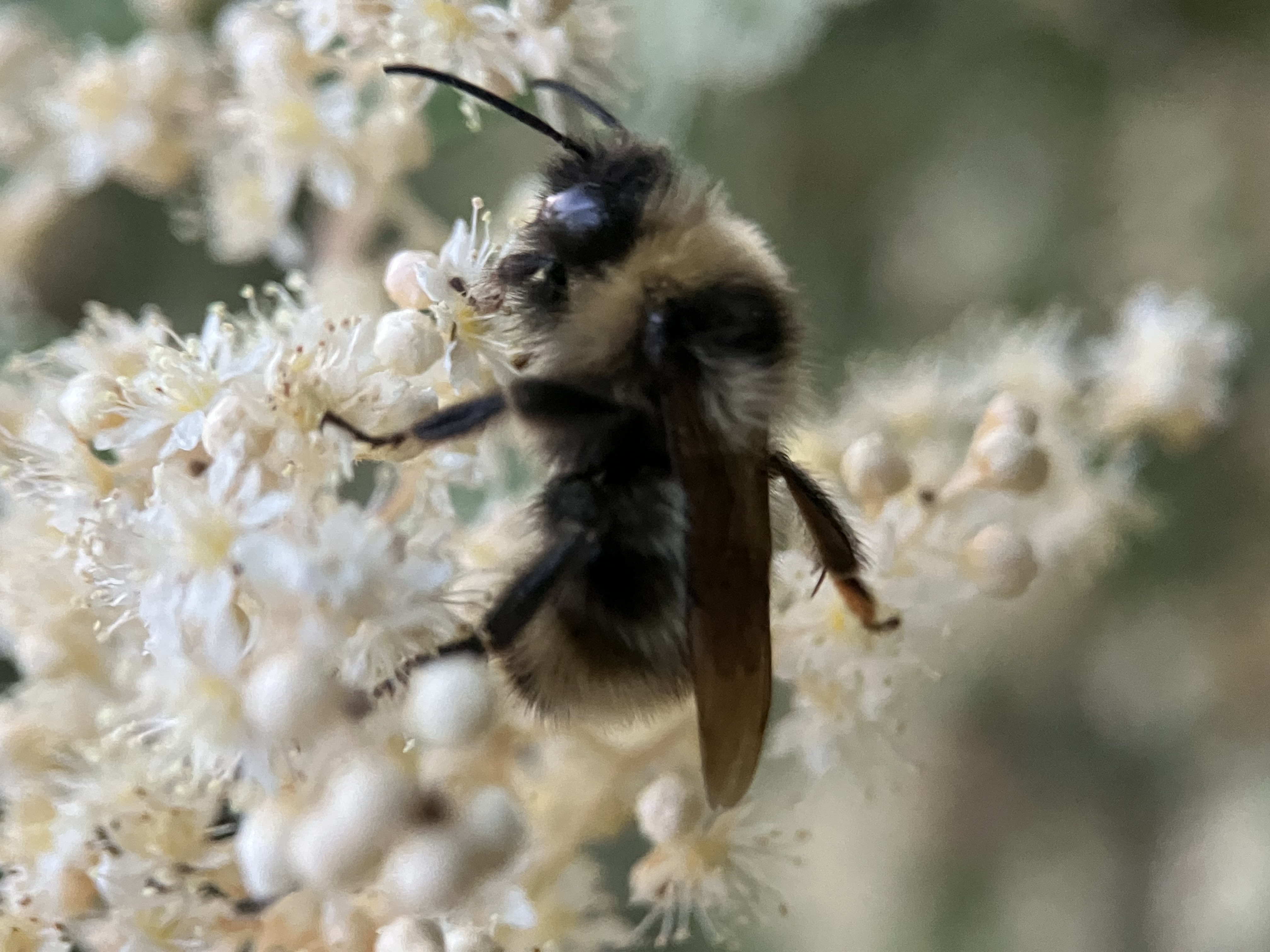
Bombus flavidus ssp. flavidus
Well, the other evening, I documented the first pollinator I’ve ever seen visiting these blossoms. There is a gorgeous Ocean Spray out our bathroom window. I noticed movement in the upper portions of the shrub. It wasn’t windy, so something else was causing the movement. I went out later, around 9:00 pm, to investigate the cause of the disturbances. Can you guess what I found? Bumble bees!
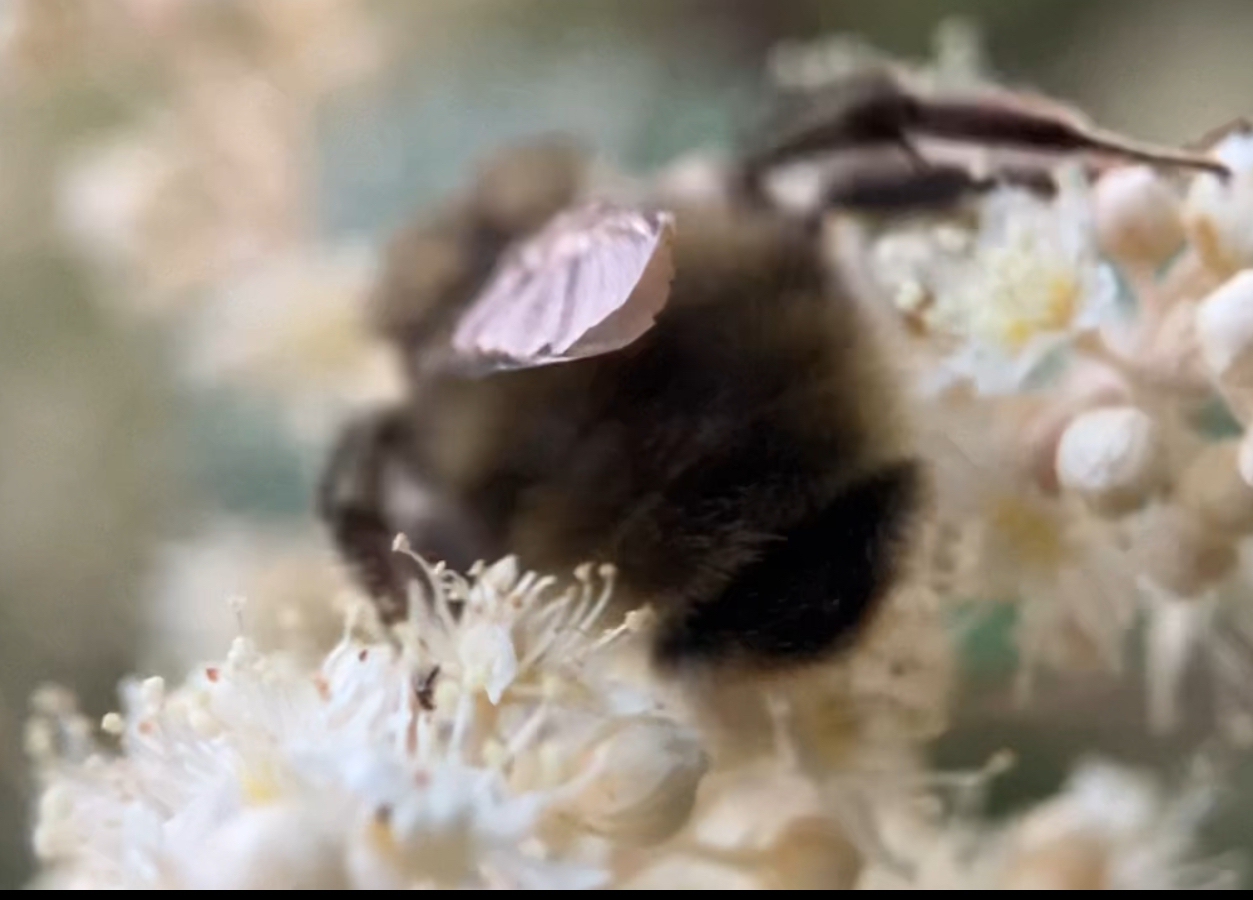
Bombus flavidus ssp. flavidus
I also experienced annoyance from another buzzer. A Cattail mosquito, Coquillettidia perturbans (say co-KEE-luh-tih-dee-uh PURR-tuh-binz) promptly discovered my bare arm. It slipped its hypodermic proboscis into my epidermis with effortless precision, a precision superior to any medical professional’s injection. I didn’t feel it at all.
Cattail mosquito (Coquillettidia perturbans)
I would describe the bites from these mosquitoes as a very mild annoyance. I didn’t have any after-reaction at all. It was certainly not anything like the bites from some of the other insects I’ve experienced here, especially not thrips. I’m definitely not a thrips fan! You can read about thrips here in case you’re interested. https://buggingyoufromsanjuanisland.com/2021/06/29/public-health-alert-and-some-free-advice/
Getting back to the other buzz in the Ocean Spray. The buzz I was so happy to discover is the bumble bee (Bombus flavidus ssp. flavidus). I didn’t make the identification to subspecies on my own. That was with the help of a fellow named John Ascher on iNaturalist. If you’re curious about his work, you can learn more here: https://extension.oregonstate.edu/podcast/pollination-podcast/137-john-ascher-problem-measuring-bee-decline
Bombus flavidus ssp. flavidus
Bombus flavidus is a species of Cuckoo Bumble Bee, and one of the most widespread species in the world. These bees don’t have a worker cast like other species of bumble bees. They find nests of other bumble bees to occupy and invade these nests. The host bumble bee workers then rear the offspring of the cuckoo bumble bee along with their own offspring.
I hope my discovery leaves you curious about what pollinators visit Ocean Spray in your yard. My next goal is to make nighttime observations. I want to see what is visiting the flowers while they are still in bloom. I suspect they have nocturnal pollinators. If you find any, I hope you’ll report your findings with me. 🙂
To see more of San Juan Island’s invertebrates, please join and follow me on iNaturalist – https://www.inaturalist.org/observations?place_id=any&user_id=cyndibrast&verifiable=any . If you have never used iNaturalist, try it out! I love it because it’s a way to connect with other entomologists. It also helps me organize my findings into appropriate categories for referencing when I want to look something up.
Also, please don’t go crazy with the brush hog. Nature loves messy. Humans cause fires. We can do much on that end to prevent them by changing our behaviors and being more careful. Scraping the earth bare and/or parking out your parcel to be “fire wise” is actually not kind to nature. We need to protect habitat for the wild things, not eradicate it. Even mosquitoes have a role in the food web.
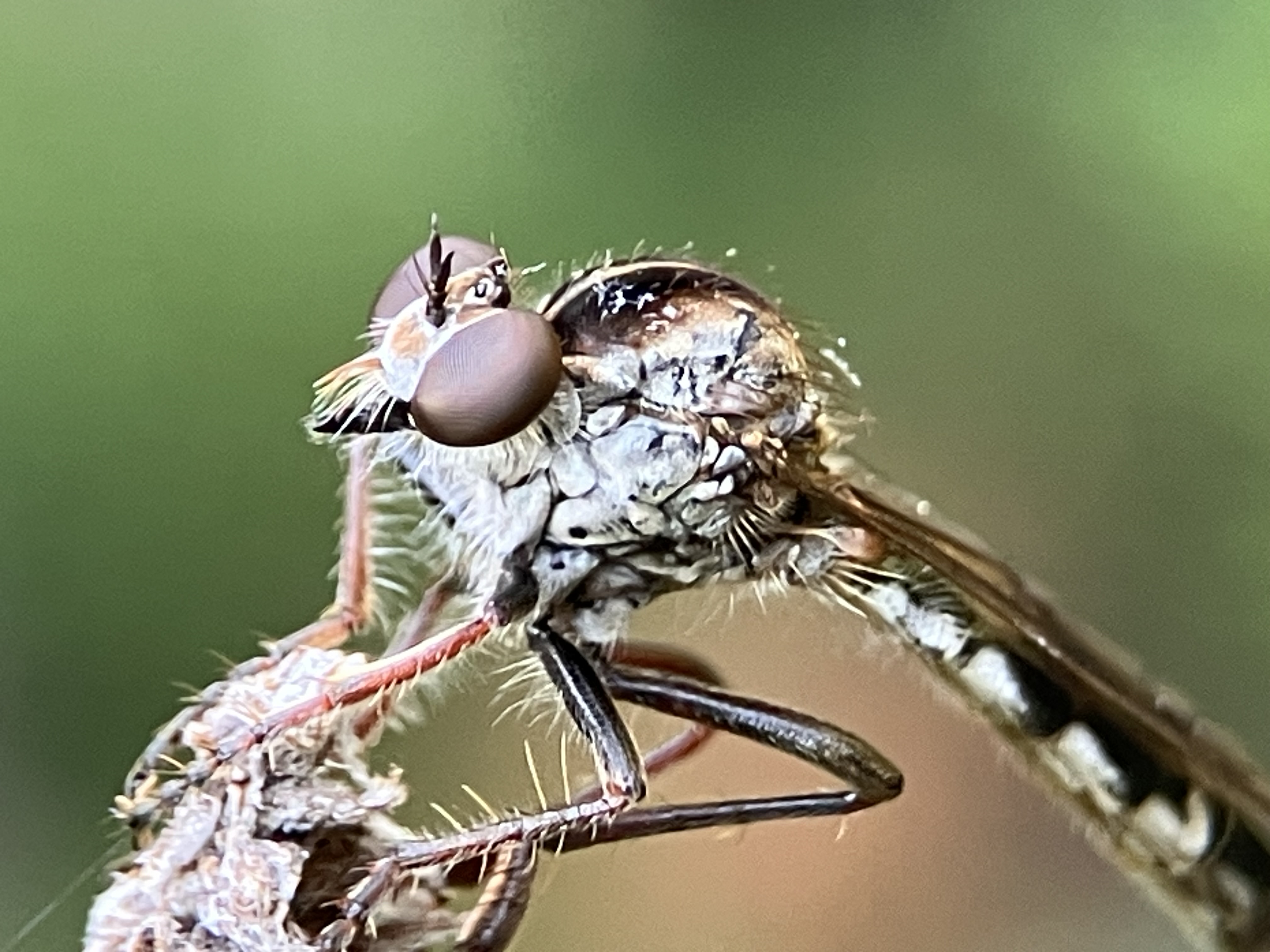
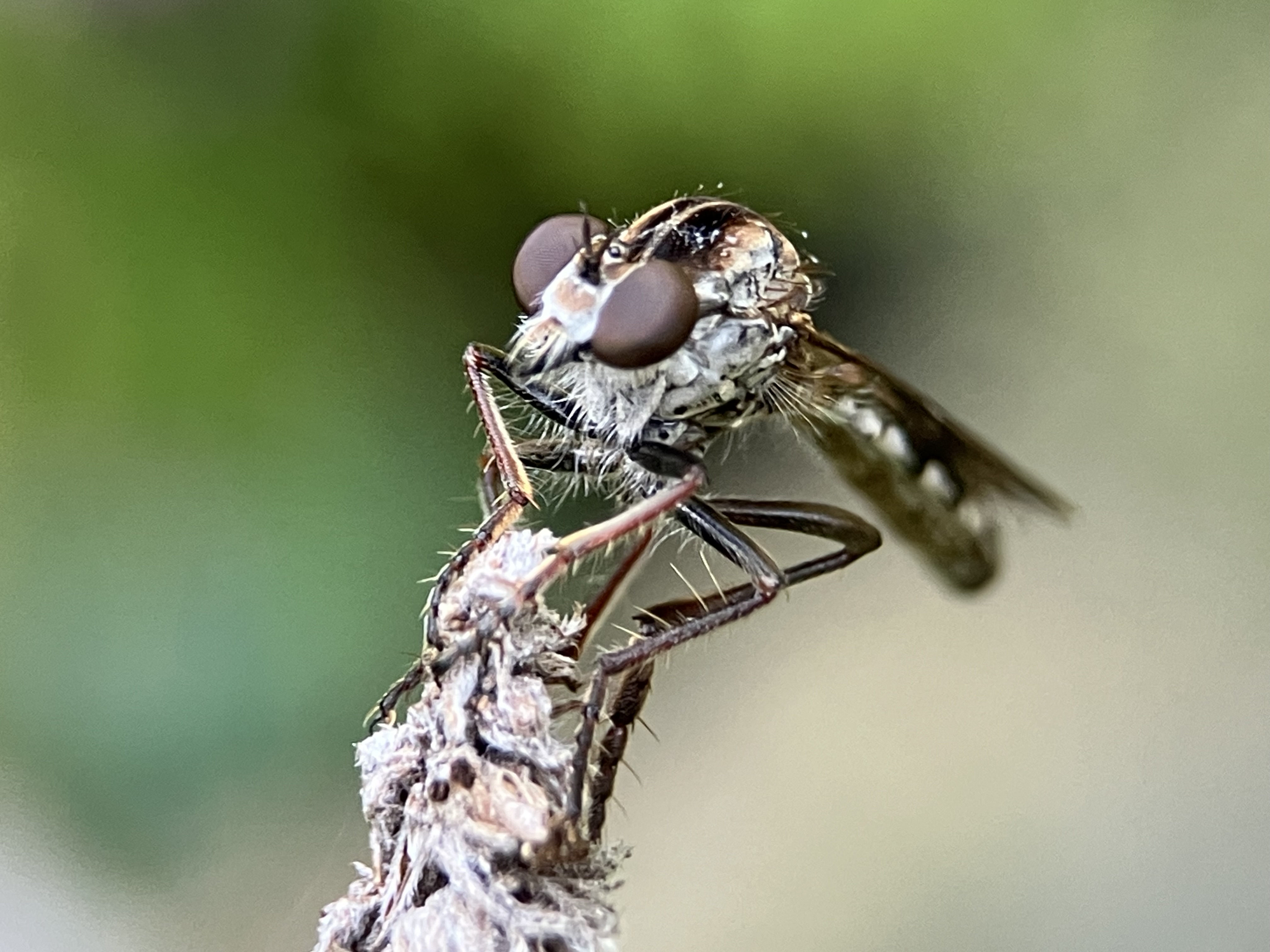
It has taken a bit of time to finally sort out genus and species for this very cool Robber fly with beautiful caramel-brown mottled wings I spied the evening of June 6, 2025. It perched on a dried apple mint stem from last season, no doubt scouting the terrain to see what might be on the menu for dinner. Robber flies (Family Asilidae) are predatory. They catch other small invertebrates to eat, paralyzing them with special salivary digestive enzymes and then sucking up the liquified contents through the proboscis (Cannings, 2013).
Getting to an identification beyond Genus for this one has been incredibly frustrating, and complicating the process is the limitation of the key I was using (Wilcox, 1946), which primarily describes male specimens.
Robert Cannings has studied the Asilidae for many years in British Columbia and states this genus “sorely requires systematic attention.” I finally just gave up and reached out to Rob for help. He wrote me and said, “I’m pretty sure this is Nicocles canadensis. It’s a female, and some females are difficult, even when under a scope, because the Wilcox key, which is the best we have for now, deals with them poorly and concentrates on males. Nicocles canadensis is the species in the genus most often seen on BC’s south coast and, I assume, in your area.”
This is the only Nicocles fly I’ve ever found on our property on San Juan. According to Rob’s 2014 publication (linked in the references below) in Canada, ” Nicocles canadensis is restricted to Garry oak savanna and adjacent dry woodland on southern Vancouver Island (Saanich is the type locality),” so I anticipate this may be similar for our neighboring area.
Check out the attached references if you are interested in learning more about Robber Flies in our region.
Cannings, R.A. 2013. Robber Flies (INSECTA: DIPTERA: ASILIDAE) Of The Montane Cordillera Ecozone.
Cannings, R.A. 1994. Robber Flies (Diptera: Asilidae) new to Canada, British Columbia, Yukon, and the Northwest Territories with notes on distribution and habitat. J. Entomol. Soc. British Columbia: 91: 19-26. https://www.biodiversitylibrary.org/part/213777
Cole, F. R. 1969. The Flies of Western North America. University of California Press. Berkeley and Los Angeles.
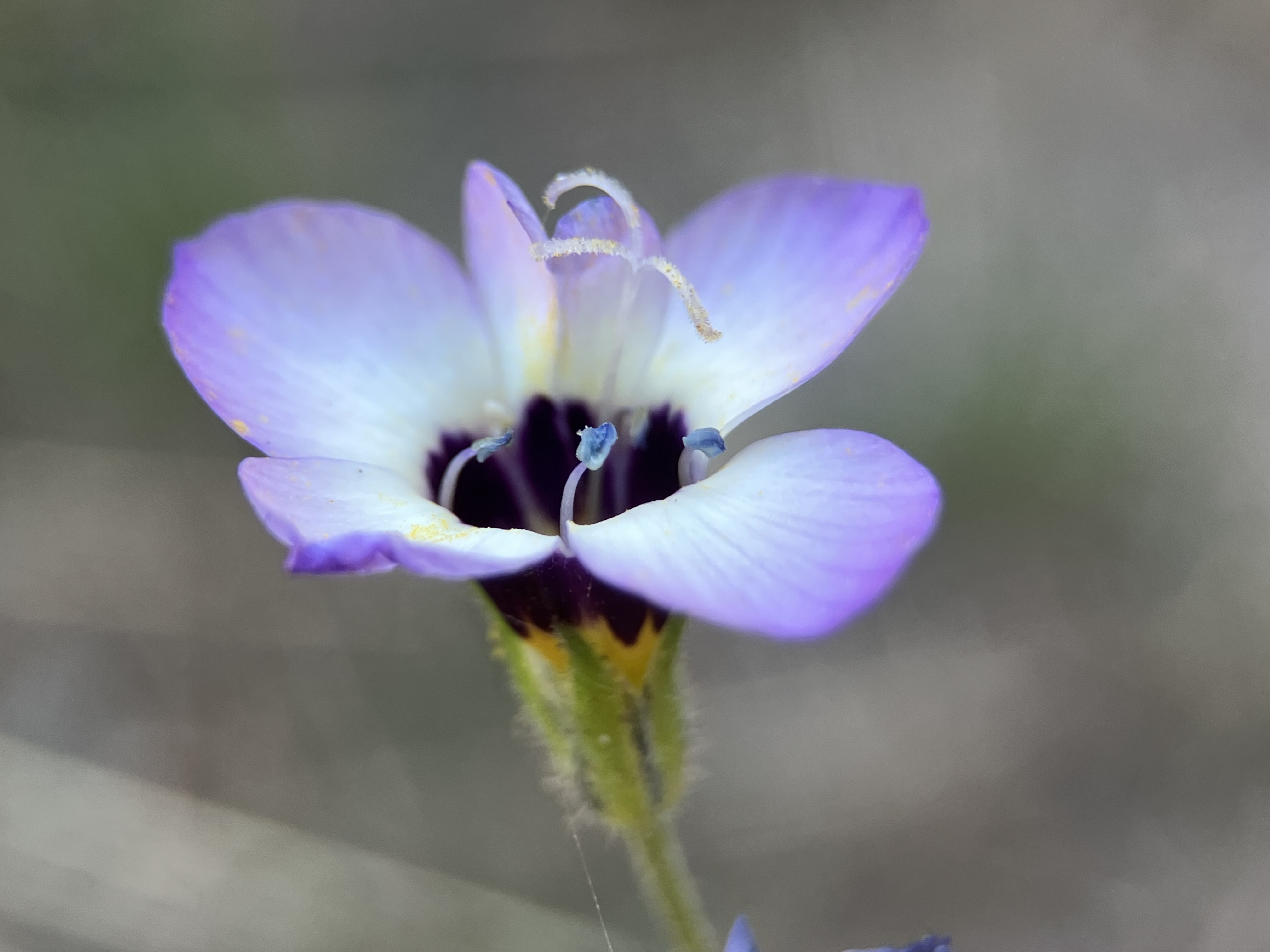
I’m quite fascinated by the rapid colonization of the very dry soil in the strip where our internet fiber cable was installed this past spring. Because disturbed soils can be great for seeding native wildflowers, I threw out several packets of a Pacific Northwest seed blend to see what might grow and I’ve been checking often to see what is coming up. In spite of the very dry weather we are having, there are some lovely Bird’s-eye Gilia (Gilia tricolor) blooming now.
Bird’s-eye Gilia (Gilia tricolor)
I see some Farewell to Spring (Clarkia sp.) popping up too, though they have not bloomed yet. There are others I have yet to identify. It’s been so hot and dry, I’m hoping the lack of water doesn’t ruin my efforts at re-wilding this spot.
In spite of the dry, cracked earth, there are Andrena sp. mining bees already claiming this strip. There are little holes everywhere.
I also saw one quite unique hole surrounded with round dirt “pebbles,” that looked to have been arranged to mark the entrance.
As I leaned closer to inspect this architectural oddity, I saw something I would never have even noticed without the help of my macro lens. It was a colony of Globular springtails (Fasciosminthurus quinquefasciatus). There were easily about 8 or so. Can you spy the one on one of the “pebbles?”
I was able to get one or two in focus. These springtails are incredibly small – perhaps only 1mm, and recognizable by the 5 transverse bands (jailbird stripes) across the dorsal abdomen. This species is unique among springtails in that while most species require moist habitats to survive, F. quinquefasciatus thrives in arid environments with little to no vegetation in areas with southern or south western exposure.
If you follow closely in the video here, you might notice that the individual I was tracking either pooped or laid an egg on that piece of straw (between the 45 and 55 second mark. I will add some still shots clipped from the video as well.
Globular springtail (Fasciosminthurus quinquefasciatus)Globular springtail (Fasciosminthurus quinquefasciatus) leaves behind a small white objectGlobular springtails (Fasciosminthurus quinquefasciatus)
A personal note ~ While our daily lives are often complicated with work and family obligations, as well as anxieties many of us have about climate change and political uncertainties, taking time to notice the natural world around, even in seemingly uninhabitable habitats can bring a bit of hope. There is life around us. We just might have to sit on the ground and get dirty to see it.
Thank you for reading and thank you for caring about nature.