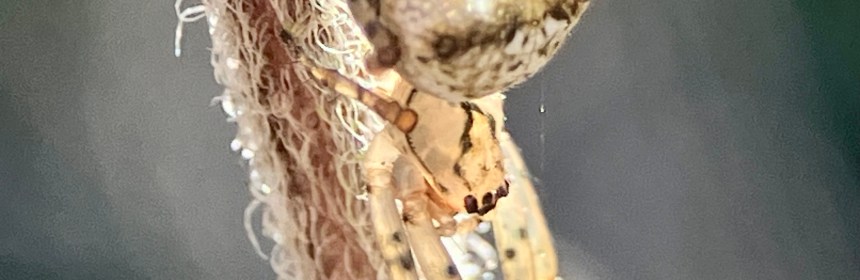
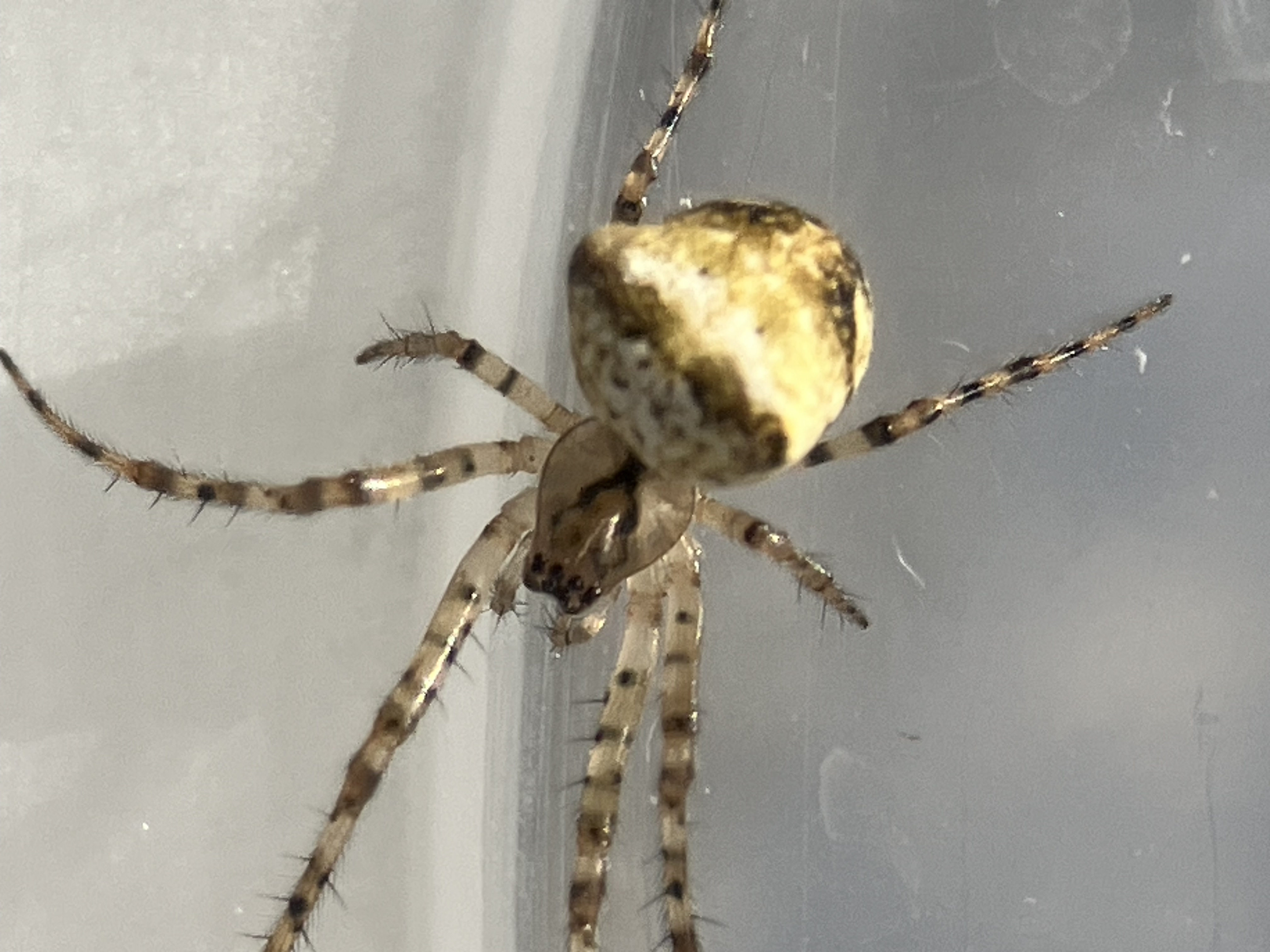
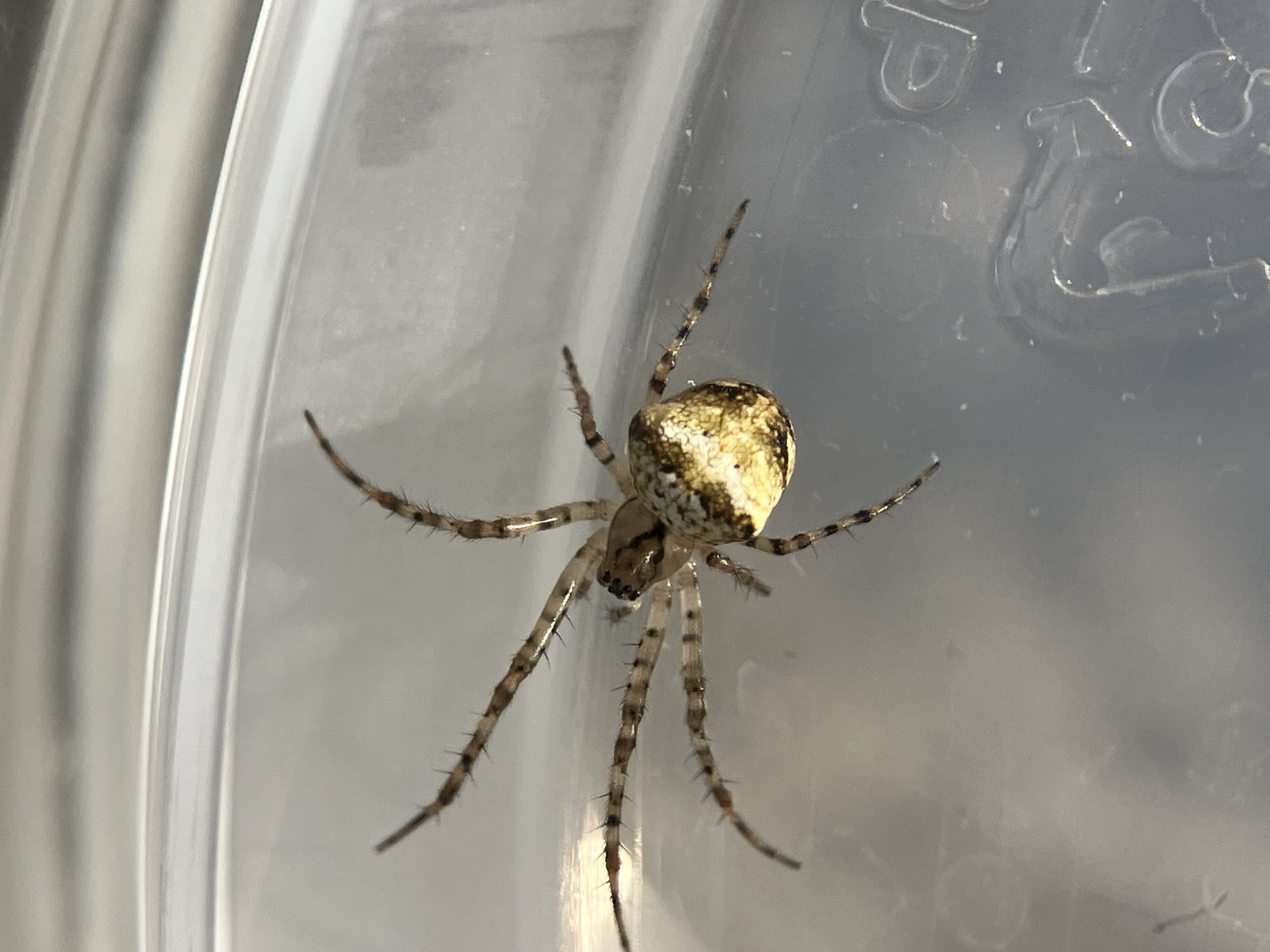
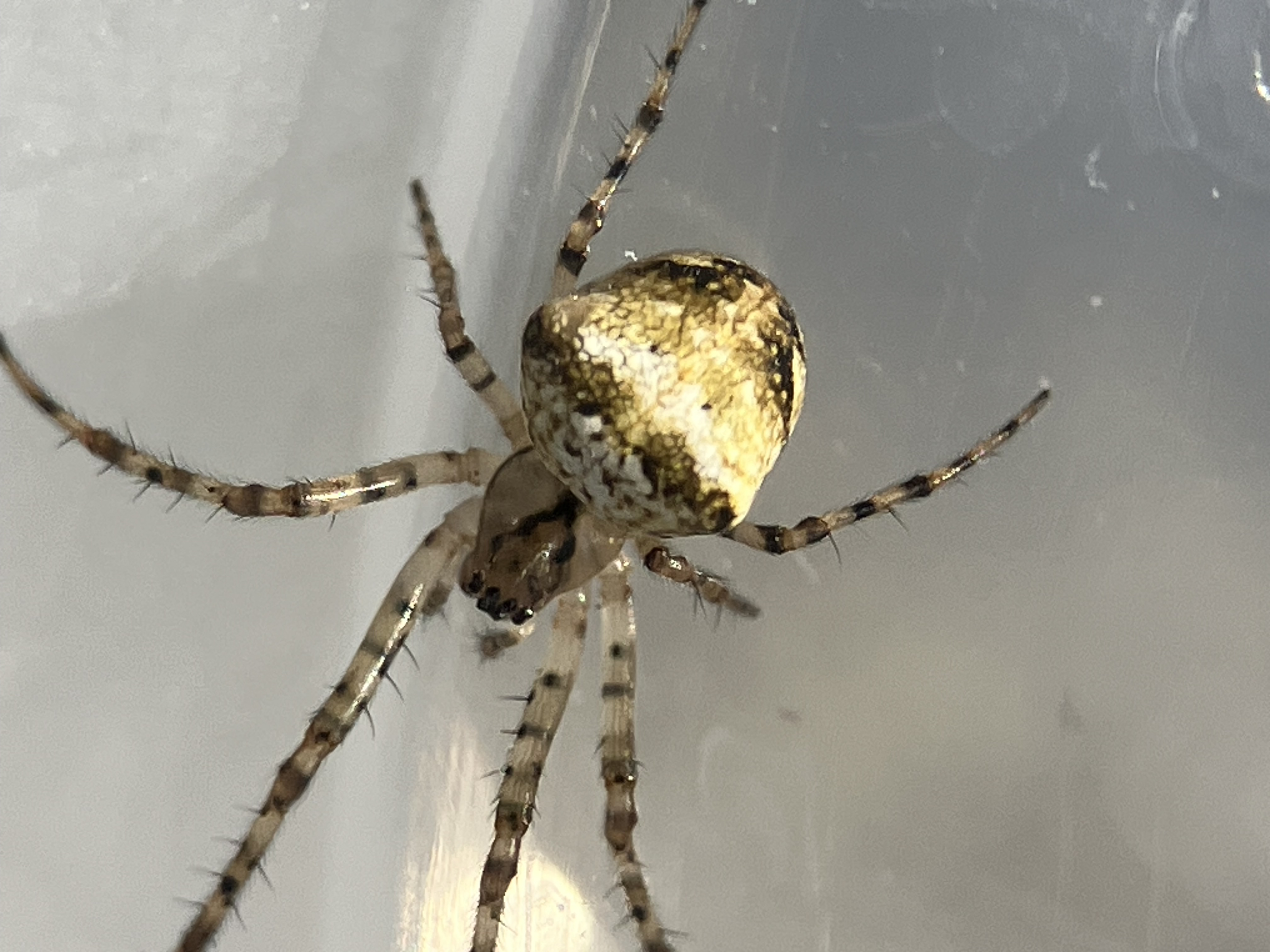
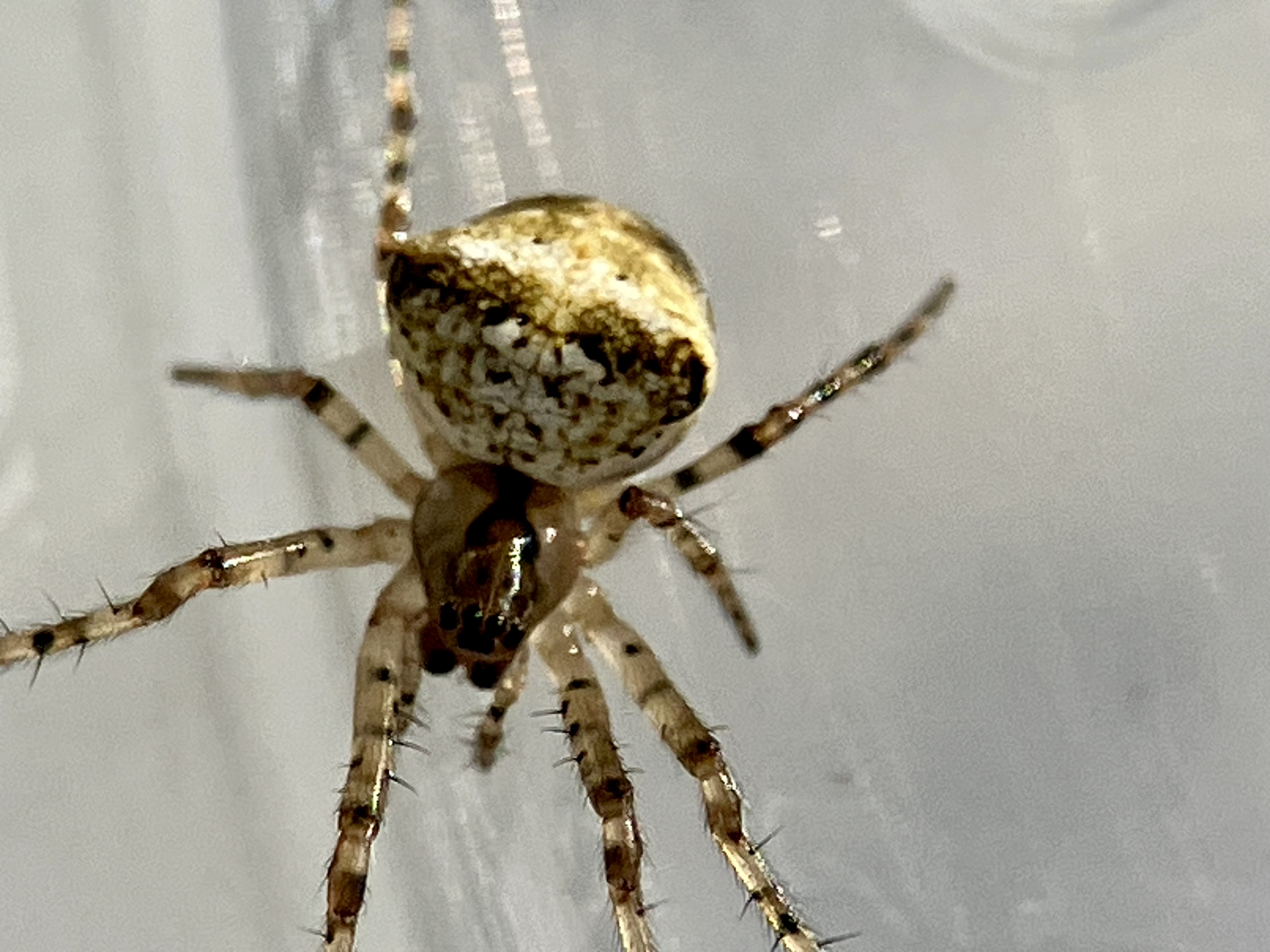
I thought I’d take a moment to profile a new-to-me spider found in my kitchen last week. This one was awfully small at about 4-5 mm, and threading the beginning of a web from my kitchen counter to the dishwasher. I needed a cup for my morning coffee, and the kitchen (at least our kitchen) is not a safe place for a free roaming spider. Not with Herman the Persian and his furry duster of a tail.
I collected her gently, took these photos, and released her outdoors on one of my mint plants. My efforts at ID-ing this unusual beauty, beyond family Tetragnathidae and possibly genus (Metellina) necessitated sending the photos to my friend, Rod Crawford at the Burke Museum, for further help.
Rod quickly wrote back with, “Metellina mimetoides, only local species in genus with humped abdomen.”
Metellina mimetoides is a species native to North America and found along the Pacific Coast from Southern California through Northern Washington. I would say these are not particularly abundant though. This was my first ever sighting of one on San Juan Island, WA.
Scared of Spiders? Here’s a go-to info-sheet (that I plan to update as time allows) with links to verifiable, research-backed Spider Information/Literature. Let’s end all the misinformation and our arachnophobia. Too often people buy into false reports. Don’t listen to someone’s tall tale of horror. These stories are sensationalized and inaccurate. Know the facts. Dispel the rumors. Spiders are not out to kill you. It’s just not true.
YOU have to do the reading! These are scientifically based, accurate studies with information related to spider bites.
*Bennett RG, Vetter RS. An approach to spider bites. Erroneous attribution of dermonecrotic lesions to brown recluse or hobo spider bites in Canada. Can Fam Physician. 2004 Aug;50:1098-101. PMID: 15455808; PMCID: PMC2214648 https://www.ncbi.nlm.nih.gov/pmc/articles/PMC2214648/pdf/15455808.pdf.
*Melissa M. Gaver-Wainwright, Richard S. Zack, Matthew J. Foradori, Laura Corley Lavine, Misdiagnosis of Spider Bites: Bacterial Associates, Mechanical Pathogen Transfer, and Hemolytic Potential of Venom From the Hobo Spider, Tegenaria agrestis (Araneae: Agelenidae), Journal of Medical Entomology, Volume 48, Issue 2, 1 March 2011, Pages 382–388, https://doi.org/10.1603/ME09224
Brown Recluse Spiders (Loxoceles sp) – NO! I repeat “NO, none, nada!” established populations in our area.
In the attached links below, you will find links to information about the Brown Recluse Spider. Information that comes from a verified, reputable source – from an actual expert. Brown Recluse spiders do not live in the San Juan Islands. Caveat: this is not to say that if you move here from an area where there ARE established populations, one might be found hitching on your moving boxes. It’s possible, BUT – they have not been able to survive and breed here. If you see a large brown spider in your house – especially on the ceiling, it is most likely (99.99%) going to be a Giant House Spider (Eratigena duellica). They are very common and harmless. If you don’t like them, just catch in a cup and take it to a sheltered area outside – preferably another structure where it might have a chance to survive. They won’t hurt you.
Map showing distribution of Brown Recluse spiders (Please note that San Juan County is NOT found on this map) – https://spiders.ucr.edu/spiders-map
Map of Brown Recluse Spider distribution – UC Riverside
Where else can I find reliable information on Spiders?
There are a few sources I’ll list here. The first two are the ones you should look at first. They are valuable resources with information from highly credentialed experts in all things arachnid-related. If you read something written by either Rod Crawford (Seattle Burke Museum curator of the arachnid collection) or by Rick Vetter (UC Riverside Department of Entomology), you can be assured it is correct.
As a local resource, you can also check out the Facebook Bug Group (Bugs of the San Juan Islands). There are several group “experts” with experience identifying spiders. These folks generously volunteer their time and knowledge, so keep that in mind and please refrain if you feel inclined to INSIST they are wrong and there are INDEED Brown Recluse Spiders living in your house in San Juan County. If you have a spider you’d like identified, it helps to have a couple of clear photos to submit. Try and get a shot of the dorsal (top) of the spider, and if you’re able, one of its face – showing eye pattern. You may contact me, Cynthia Brast-Bormann at cynthiabrast@icloud.com to submit live or deceased specimens for identification. I will help you coordinate a drop off point for collection. Please don’t indiscriminately KILL a spider though and ask me to ID it. It will likely make reliable identification more difficult. Just get a cup and a lid with some air holes punched in the top. I appreciate your showing kindness to the helpless creature you’ve caught. I will ID and humanely release.
Bugs of the San Juan Islands Facebook Group – There are at least 4 spider group experts and folks with entomology degrees or experienced backgrounds in the group who are more than qualified to help you. https://m.facebook.com/groups/bugsofthesanjuanislands/about/
Great YouTube information and fun links to watch from one of Bugs of the San Juan Island’s group experts, Arlo Pelegrin (entomologist and arachnologist)
Spiders of the West and their Medical Significance – Arlo Pelegrin at Dept of Health
Today, I’m going to introduce you to Rod Crawford in my post. Rod is the curator and spider expert (GENIUS) at the Burke Museum in Seattle. He is the go-to guy for anything you would possibly want to know about spiders.
One thing I really like about Rod are his efforts to debunk some of the most common myths about spiders. For instance, putting that spider you find in your house outdoors is good for the spider and where it belongs. Nope. Nope. Nope,….and one more big ole’ NOPE! Take a look here to read what Rod says about where some spiders live (including indoors), and why tossing them outdoors is not a good idea.
I found this the other morning (Sept. 8, 2018) when my husband had to drive over to unlock the gates at Mount Grant, San Juan Island Land Bank Preserve.
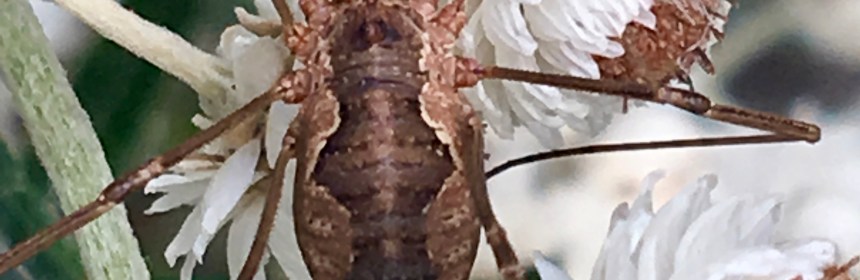
While I was waiting for him at the top, I had a chance to photograph this really interesting spider (or so I thought). It had 8 legs and looked like a spider to me, but not one I’d seen before on San Juan Island. I spent that evening going through my spider ID book without any luck.
So I sent off an email to Rod Crawford, curator of the arachnid collection at the Burke Museum in Seattle and all around “spider man” genius. Here was his response.
“Dear Cyndi, The reason you could not find the top specimen in the Adams spider book, is that it isn’t a spider. It’s a harvestman (member of a separate order of arachnids). Even a scorpion is more closely related to a spider, than a harvestman is. Harvestmen have segmented bodies that are all in one piece (not 2 separate pieces), 2 eyes close together on a little bump, totally different mouthparts, respiratory system and reproductive system, no venom and no silk. Yours is probably the common European import Phalangium opilio.”







 Bugging You From San Juan Island