Tag Archives: Cannings

Identifying the Nicocles canadensis Robber Fly
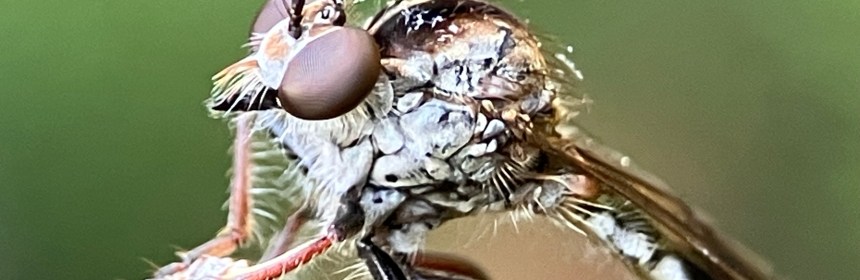
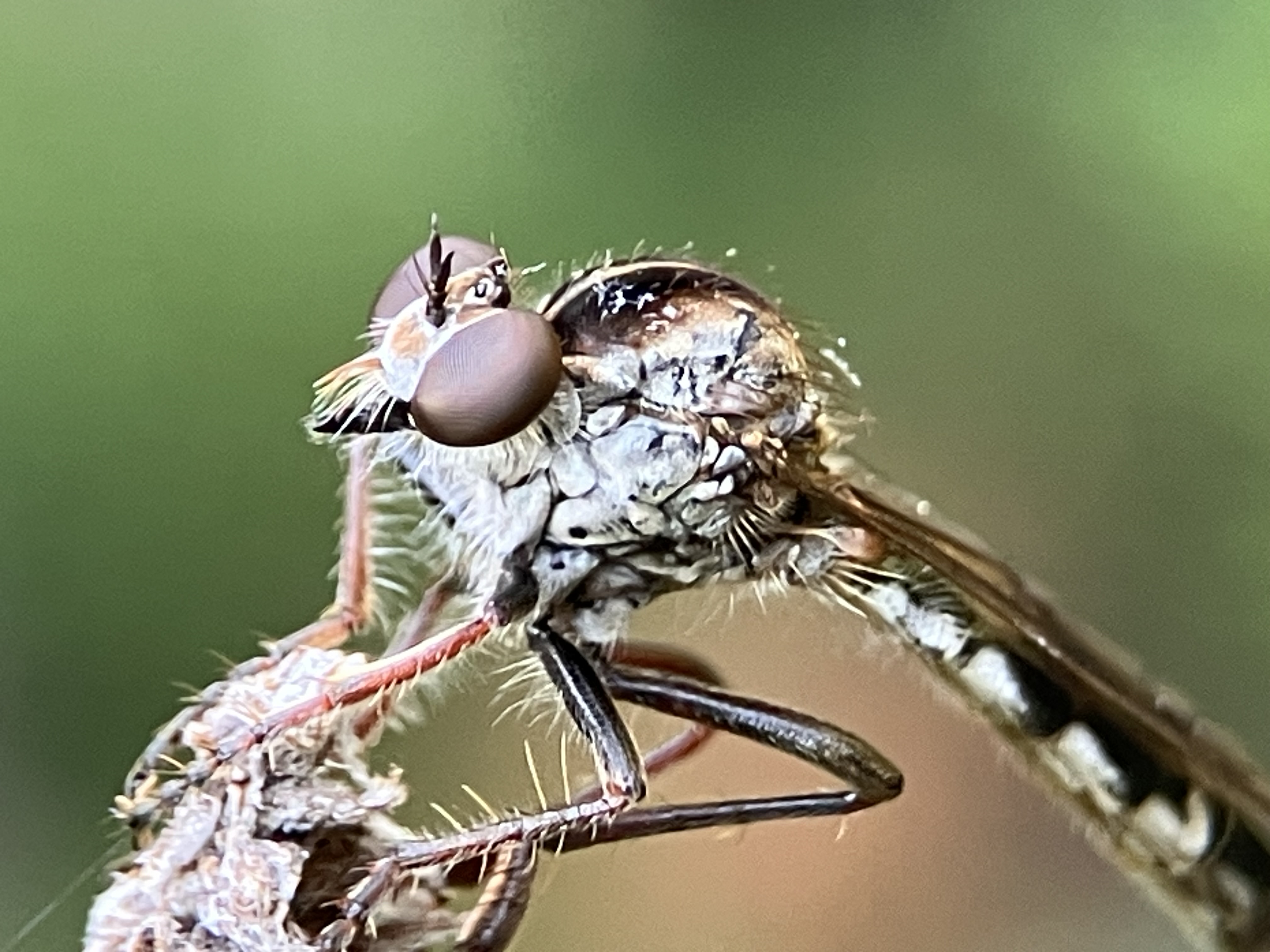
Robber Fly (Asilidae), Nicocles sp.

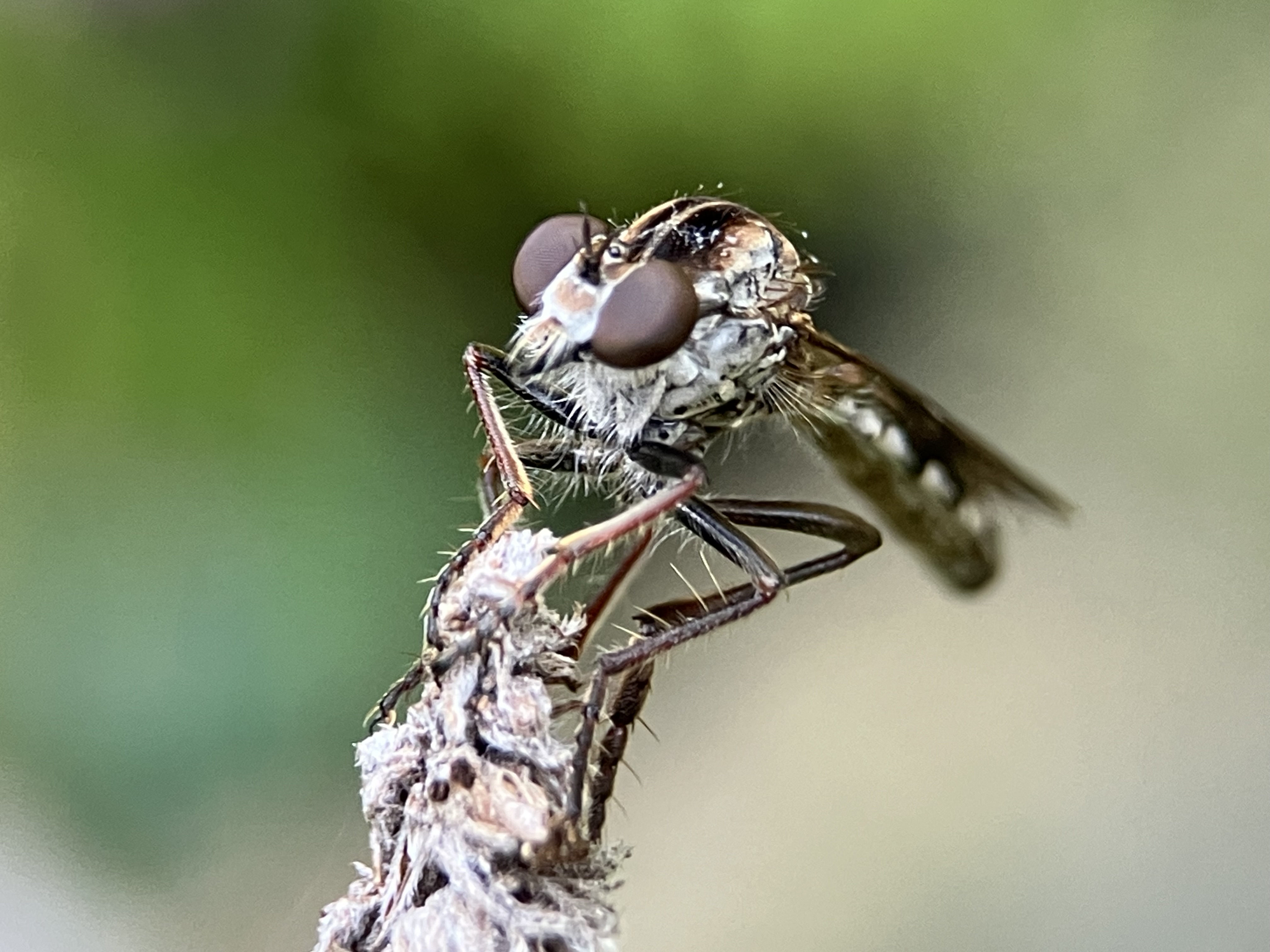
It has taken a bit of time to finally sort out genus and species for this very cool Robber fly with beautiful caramel-brown mottled wings I spied the evening of June 6, 2025. It perched on a dried apple mint stem from last season, no doubt scouting the terrain to see what might be on the menu for dinner. Robber flies (Family Asilidae) are predatory. They catch other small invertebrates to eat, paralyzing them with special salivary digestive enzymes and then sucking up the liquified contents through the proboscis (Cannings, 2013).

Getting to an identification beyond Genus for this one has been incredibly frustrating, and complicating the process is the limitation of the key I was using (Wilcox, 1946), which primarily describes male specimens.

Robert Cannings has studied the Asilidae for many years in British Columbia and states this genus “sorely requires systematic attention.” I finally just gave up and reached out to Rob for help. He wrote me and said, “I’m pretty sure this is Nicocles canadensis. It’s a female, and some females are difficult, even when under a scope, because the Wilcox key, which is the best we have for now, deals with them poorly and concentrates on males. Nicocles canadensis is the species in the genus most often seen on BC’s south coast and, I assume, in your area.”

This is the only Nicocles fly I’ve ever found on our property on San Juan. According to Rob’s 2014 publication (linked in the references below) in Canada, ” Nicocles canadensis is restricted to Garry oak savanna and adjacent dry woodland on southern Vancouver Island (Saanich is the type locality),” so I anticipate this may be similar for our neighboring area.

Check out the attached references if you are interested in learning more about Robber Flies in our region.

Thanks for reading!
References

Cannings, R.A. 2014. The Robber Flies (Diptera: Asilidae) of Western Canadian Grasslands. 10.3752/9780968932179.ch7. https://www.researchgate.net/publication/268524943_The_Robber_Flies_Diptera_Asilidae_of_Western_Canadian_Grasslands

Cannings, R.A. 2013. Robber Flies (INSECTA: DIPTERA: ASILIDAE) Of The Montane Cordillera Ecozone.

Cannings, R.A. 1994. Robber Flies (Diptera: Asilidae) new to Canada, British Columbia, Yukon,
and the Northwest Territories with notes on distribution and habitat. J. Entomol. Soc.
British Columbia
: 91: 19-26. https://www.biodiversitylibrary.org/part/213777

Cole, F. R. 1969. The Flies of Western North America. University of California Press. Berkeley and Los Angeles.

Fisher, E.M., and Wilcox, J. 1997. Catalogue of the robber flies (Diptera: Asilidae) of the
Nearctic Region. Unpublished preliminary draft.https://staff.royalbcmuseum.bc.ca/wp-content/uploads/2013/08/Catalog-Nearctic-Fisher-Wilcox-1997-manuscript-copy.pdf

Geller-Grimm, F. 2008. Robber Flies (Asilidae). Internet site at http://www.geller-grimm.de/asilidae.htm

Melander, A.L. (1924) Studies in Asilidae (Diptera). Psyche [1923] 30: 207-19. https://onlinelibrary.wiley.com/doi/pdf/10.1155/1923/83461

Wilcox, J. 1946. New Nicocles with a key to the species (Diptera, Asilidae). Bulletin of the Brooklyn Entomological Society 40 (1945): 161-165; New York – Lancaster. https://www.biodiversitylibrary.org/page/50573094#page/180/mode/1up

A Diurnal Firefly (and some of my thoughts about the declines of fireflies in general)

Winter Firefly (Ellychnia sp.)

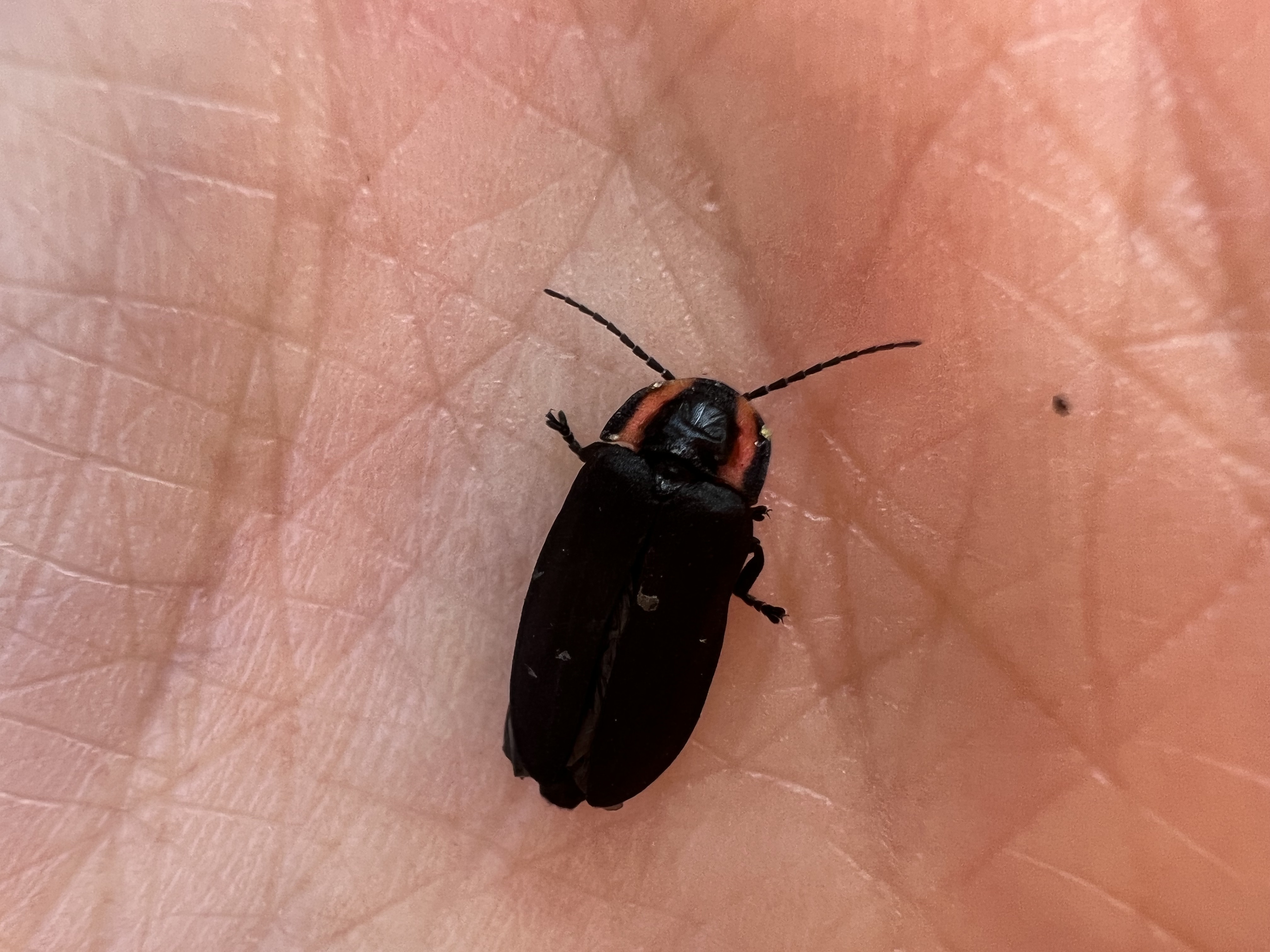
Here’s my “Bug of the day” (for Saturday, October 15, 2022).  I spied it on our wood table outside.  It’s a Diurnal Firefly in the genus Ellychnia.  The Latin name, Ellychnia, comes from Greek, lychnos, translating into ‘lamp’ or ‘lamp wick.’ Obviously, lamps are something associated with the nighttime or darkness.  However, the common name of this genus, diurnal, means “day.”   It’s only a bit confusing, right?  Also, this is a beetle in the family Lampyridae and not a fly at all.  The adults of this genus don’t light up at night or in the day either.  However, they are closely related to the fireflies that DO light up, or luminesce, at night found on the East Coast.  Since this genus, the Ellychnia, don’t have nighttime blinkers, they find their mates by detecting each other’s pheromones.   Lloyd (2002), notes however that all species of Lampyrid beetle larvae have an organ at the end of their abdominal segment 8 that bioluminesces. I’ve never found an Ellychnia larva myself, but these are referred to colloquially as “glow worms.”

Ellychnia sp. firefly

In our area, the genus Ellychnia are also known as winter fireflies.  This is because they spend the winter as adults, and are equipped to tolerate cold temperatures.  You might even see them on days when we have snow.  Larvae of this beetle genus hatch in early summer and live in leaf litter or under bark in decaying trees.  They are carnivorous predators of organisms like snails, slugs, earthworms, and soft-bodied insects.  

Winter Firefly (Ellychnia sp.)

Do we have any blinking species of fireflies in the PNW?  That’s an interesting question.  I found some literature that says we do, but I’m not certain this applies to the San Juan Islands, although a few sparse (and unsubstantiated) records from Vancouver Island, BC exist.  However, western records for flashing fireflies are known from interior B.C. (Cannings et al., 2010) and throughout the western U.S. as reported by Larry Buschman (2016).  

While fireflies that flash or bioluminesce are well known on the eastern side of the U.S. and North America, it is not exactly known how they moved all the way over to the western side.  There is an interesting commentary in the paper by Cannings et al. 2010, with the thought that perhaps at least one of the species of flashing fireflies reported in B.C., (Photinus obscurellus), may have arrived via the railways. 

Because luminescing fireflies are associated with wetlands, it would have been difficult for them to have crossed over the dry Rocky Mountain system without help. Cannings et al. (2010) report sightings across B.C. in association with railways, in fact, with most of these sightings falling within a 30 km distance from a railway.  The thought is that even going across the mountains in drier areas, most railways wound through low lying valleys where the topography is more likely to cross through wetlands.  Even the presence of railroad berms can create areas of new wetland habitat which may also have attributed to the westward distribution of these fireflies.  

Sadly, we have, and continue to degrade, pollute, drain, and lose wetlands in our continued (horrific) adherence to the destructive and entitled ideology of Manifest Destiny.  Development, ranching, hobby farms, and suburban sprawl have eliminated more than 50% of wetlands that previously existed in North America (Fallon et al., 2021).  The remainder have been seriously impacted by chemical pollutants, light pollution, and overall climate change, contributing to further declines to remaining populations.  We may lose all of the species of these iconic and charismatic summertime blinking lanterns without taking special steps to conserve and protect their habitat.   We will have no one to blame but ourselves either.  

Please support environmental conservation and protection in your community – wherever you live.  It is important to reduce our human footprint in order to preserve the natural world, its beauty, and our life support system to perpetuate for future generations.  

How can you help?  Live minimally.  Turn off outdoor lights at night.  Plant native vegetation.  Switch to use of non-toxic household products.  Don’t use lawn fertilizers or chemicals.  Better yet, get rid of your lawn and landscape with native plants.  Eat less meat.  It all adds up.  💡

References

Buschman, L. 2016. Field Guide to Western North American Fireflies. https://buggingyoufromsanjuanisland.com/wp-content/uploads/2022/10/ab7ca-westernfirefliesmarch2016a.pdf

Cannings, Robert & Branham, Marc & McVickar, R.H. 2010. The fireflies (Coleoptera: Lampyridae) of British Columbia, with special emphasis on the light-flashing species and their distribution, status and biology. Journal of the Entomological Society of British Columbia. 107. 33-41.

Fallon CE, Walker AC, Lewis S, Cicero J, Faust L, Heckscher CM, et al. 2021. Evaluating firefly extinction risk: Initial red list assessments for North America. PLoS ONE 16(11): e0259379. https://doi.org/10.1371/journal.pone.0259379

Fender, K.M. 1970. Ellychnia of western North America. (Coleoptera-Lampyridae). Northwest Science 44: 31-43.

Lloyd, J.E. 2002. Lampyridae Latreille 1817. Pp 187-196 in R.H. Arnett, Jr., M.C. Thomas, P.E. Skelly and. J.H. Frank (Eds.). American Beetles. Volume 2.