Tag Archives: Cowbird

The Owl (and others)
Today was a day of bird encounters. I saw our poor little cowbird that can’t fly because he’s been injured (likely by our neighbor’s marauding outdoor cat). He’s survived three nights so far even though he seems to have a wing injury and I haven’t figured out yet if I can capture him to check. He’s had his little mate following him around.

Cowbird male

I know it’s a cowbird and cowbirds are brood parasites, but they are actually quite beautiful little birds and I feel sympathy for wildlife that are impacted by our human “pets.” It isn’t fair and we should do much better to keep our pets under control. I don’t know what my response would be if I see this cat attacking our Tanager or one of the Grosbeaks. It is doing what cats do and the problem isn’t the cat, but the owner who evidently doesn’t care and is probably too lazy to clean a litter box and play with the cat and keep it inside. Ok. So, I vented. Sigh…

I was going out to take a walk in nature to unwind when I heard a sad little thunk on our window. We have Acopian Bird Savers https://www.birdsavers.com/make-your-own/ on the largest window, but not the smaller one. That’s gonna change. I’m going to put them on ALL our windows.

Well, I looked out and saw a tiny little nuthatch on the ground, on its back, mouth open, but it was breathing. I ran out to pick it up and when I scooped that little creature into my hand, its feet wrapped around my finger so tightly that I felt hopeful. It was a newly fledged nuthatch. I sat with it quietly in the shade under the suet feeder, my hand stretched out onto my knee into a little cup shape.

The bird closed its eyes and slept a bit. I talked to it very very softly. An adult nuthatch landed on the feeder above, eyeing me cautiously. I believe it was the parent. I spoke to the adult too, trying to convey my earnest intent not to harm her child. The little one blinked and looked about. Then it closed its eyes and slept a bit again. The parent flew over to the fruitless cherry tree to another feeder, then off, I expect to feed another hungry mouth.

After a good 15 minutes, the little nuthatch was much more alert. It kept eyeing the suet feeder and the adult bird that returned again and again. I rose slowly from sitting, carefully supporting the little one – still gripping my finger. Raising my arm, I chose a small branch just beside the suet feeder and in a breath, the little one hopped off my finger and onto the new perch.

The adult nuthatch flew onto a nearby branch and I saw the fledgling flutter its little wings like baby birds do to get their parents’ attention to be fed. In another breath, it was airborne, flying after the parent. I was so grateful for a happy end to that incident.

My walk down our road was uneventful for the most part. I did see a Clown millipede (Harpahe crossing the wetland area and squatted down to observe its somewhat awkward, but systematic locomotion. It almost looks suspended in motion over the ground. After making sure it was safely out of harm’s way and not in a car path, I continued on.

(Harpahe hayadienana) Clown millipede

My destination was the “soon to open officially” nature preserve. I have walked on this property for about 10 years now. It is an amazing place.

Giant cedars tower overhead through the wetland. Along the seasonal stream, the path I took meanders amidst the primordial assortment of ferns, swamp lanterns, and horsetail. There are creatures there in the forest. If you see them, you will leave feeling a sense of awe.
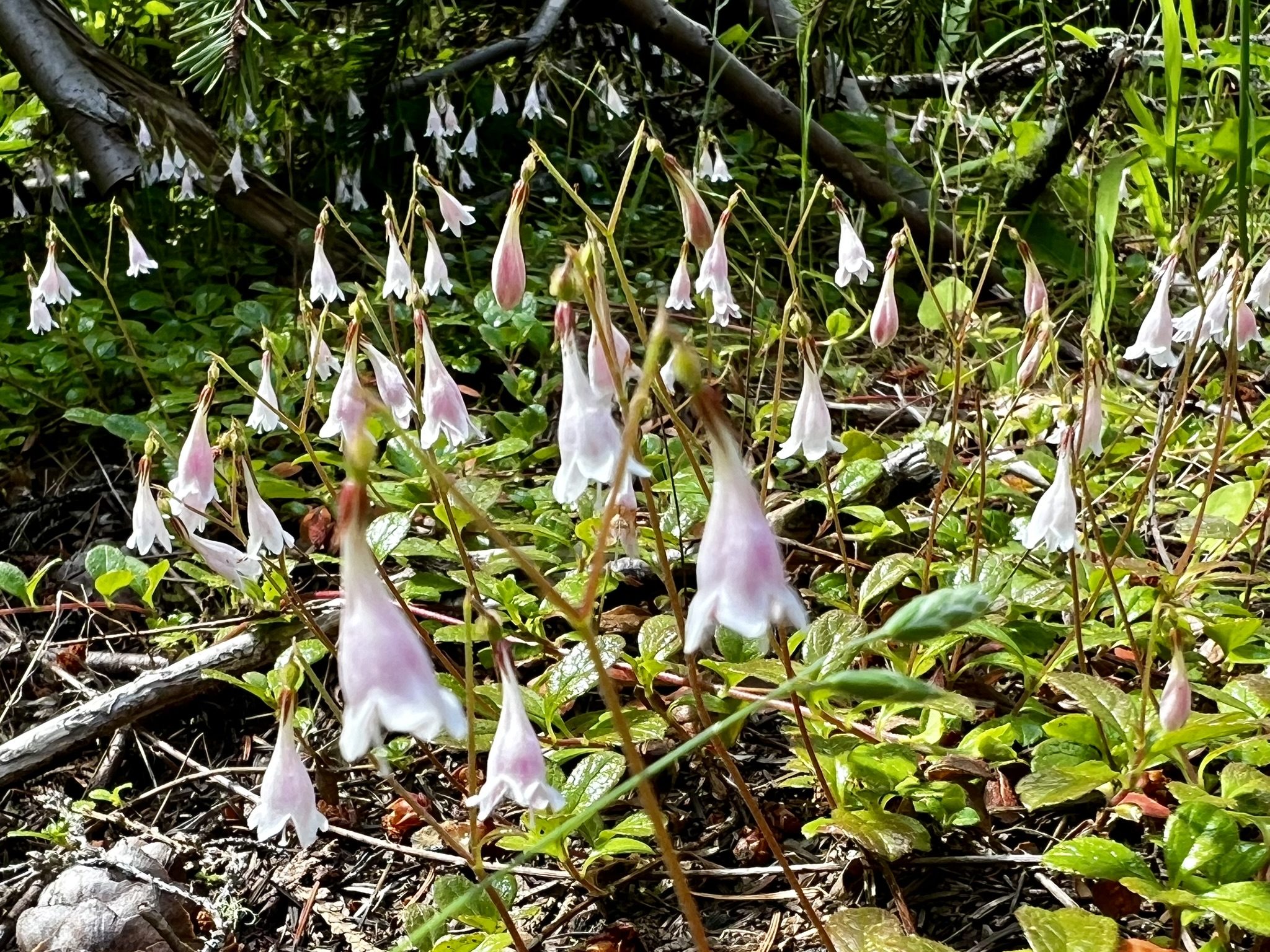
Twinflowers on the forest floor

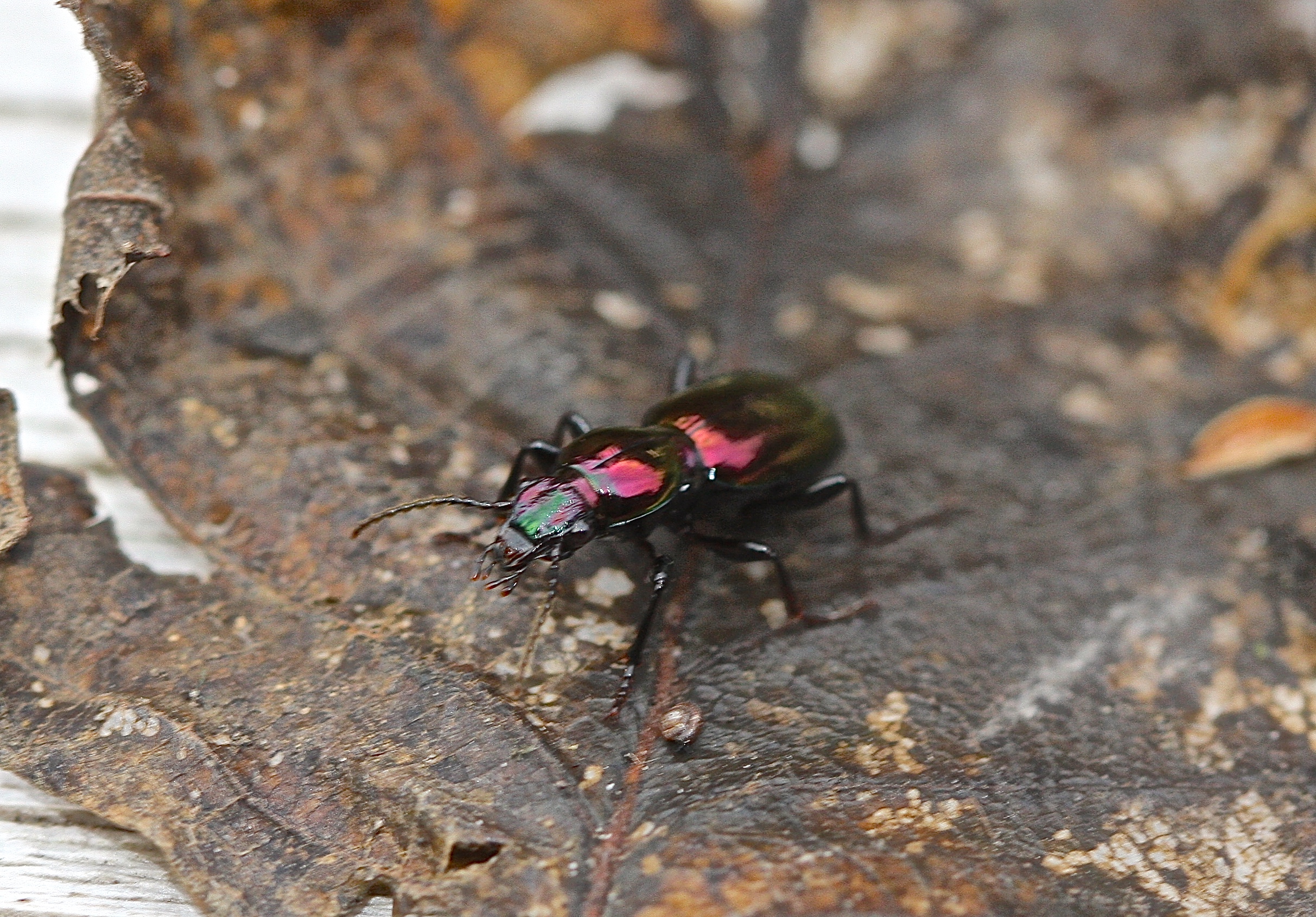
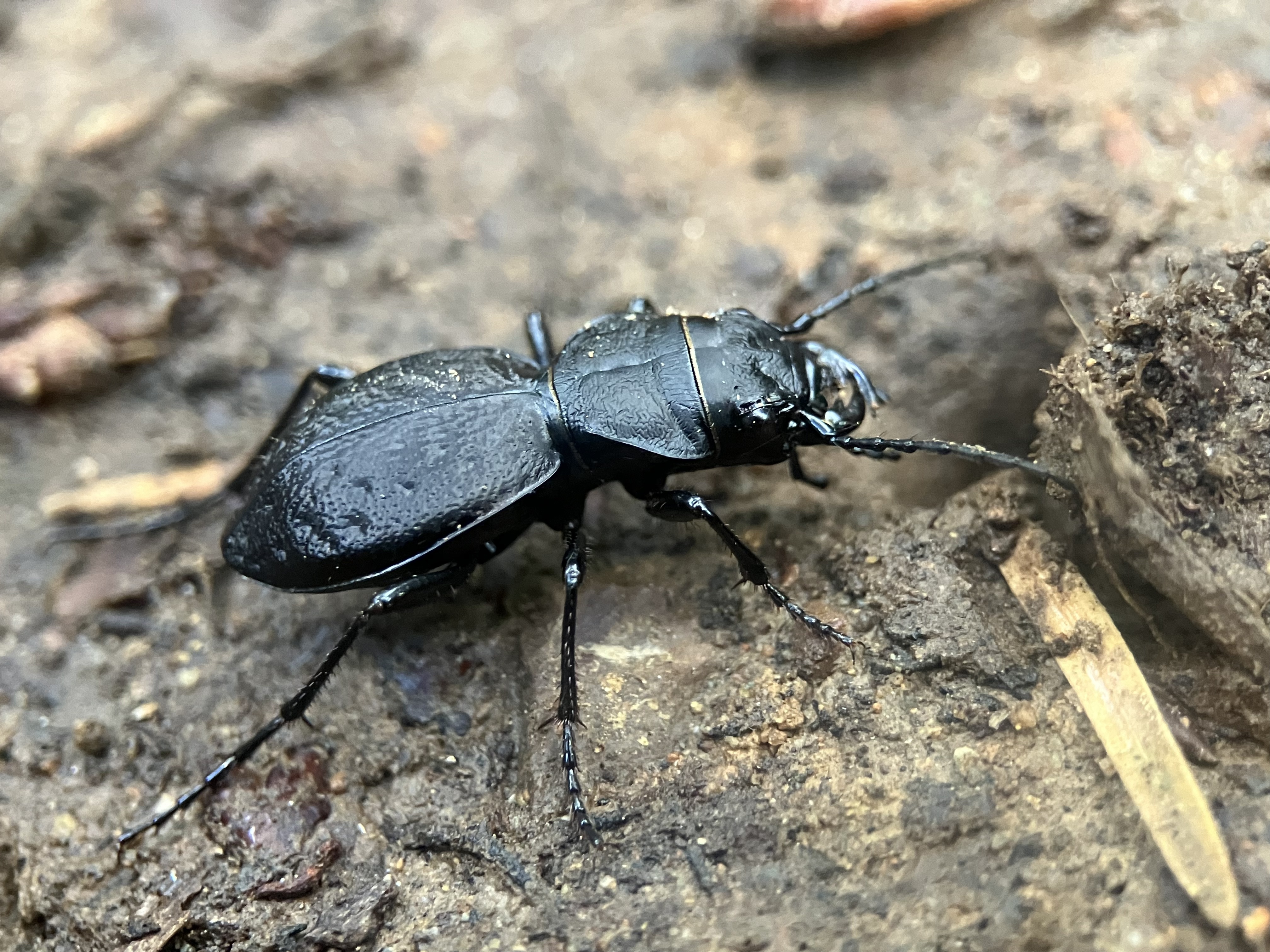
Red legged frogs, salamanders, and newts make their homes in the wetland. They dine on the myriad of invertebrates that live in the stream and mud. On the forest floor, you’ll find Night-stalking tiger beetles (Omus dejeanii) with fierce jaws hunting for prey. If you’re really really lucky, you might see the burgundy metallic carabid beetle (Zacotus matthewsii) that I’ve only seen less than a handful of times in the past decade. Overhead, you’ll hear the family of ravens that have a nearby nest. Always in the same place.
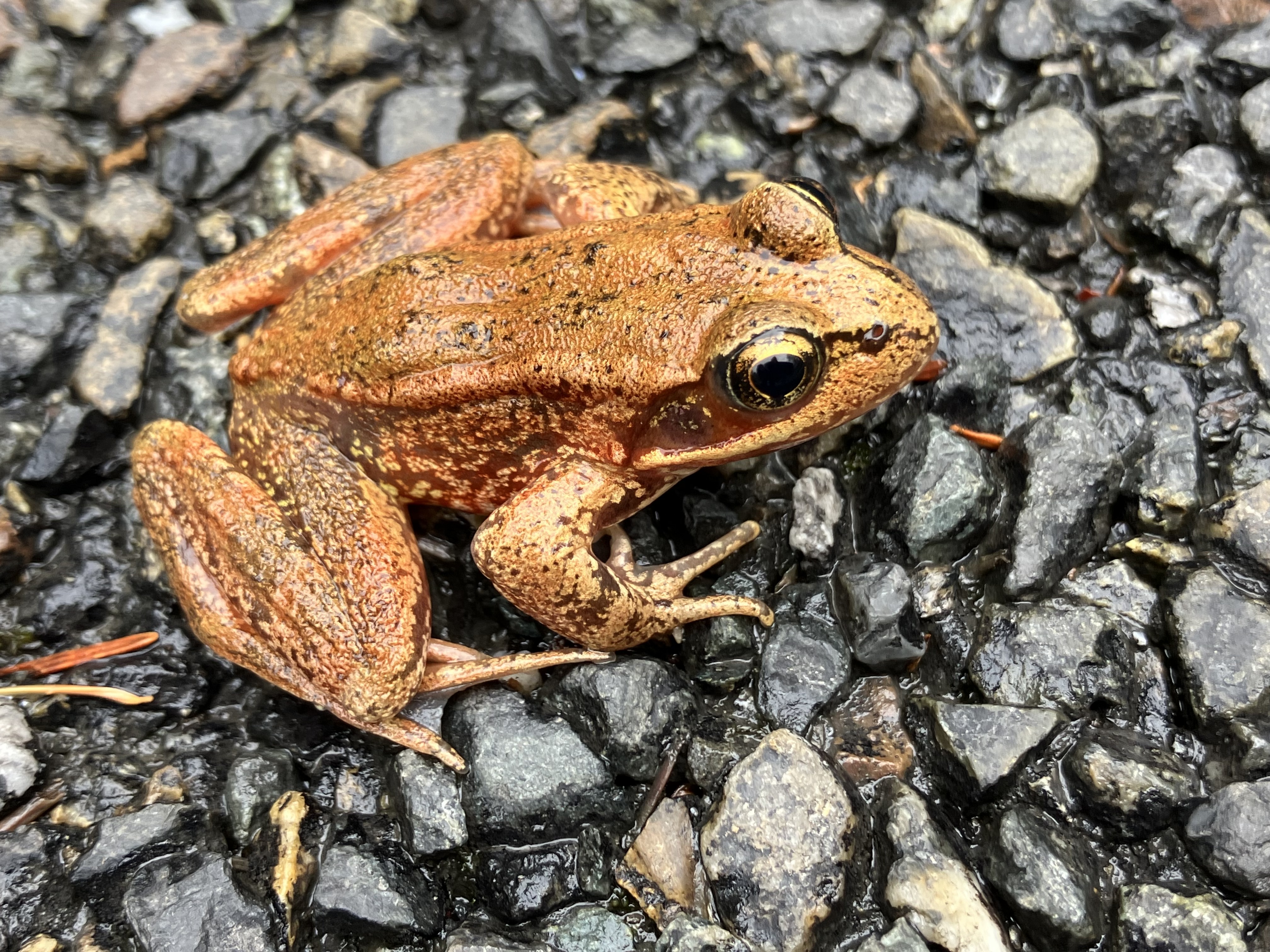
Northern Red-legged Frog Rana aurora
Greater Night Stalking Tiger Beetle (Omus dejeanii)
Zacotus matthewsii

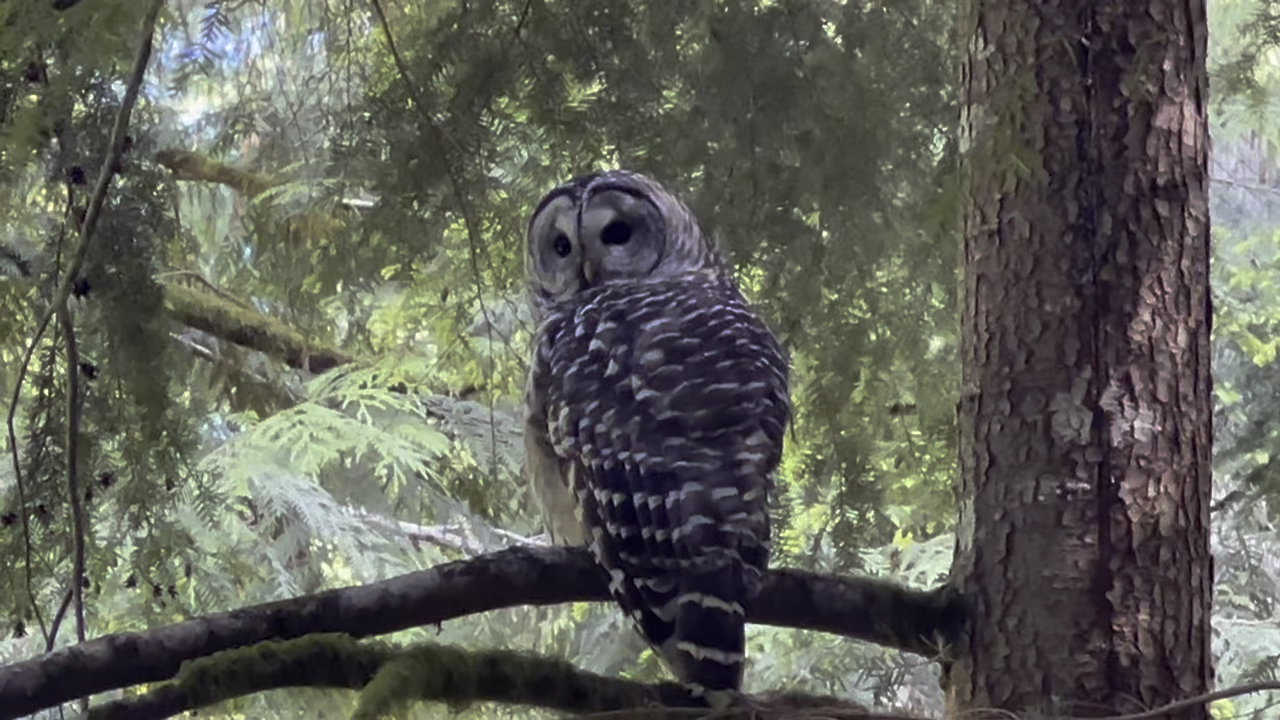
The hawks hunt in a small clearing where the stream attracts other animals that come for a drink. There are other birds hidden too. Flycatchers nesting in rotting snags, Pileated Woodpeckers drilling after carpenter ants. And the owl.

The owl has been there for a long time. You can hear it calling in the night – “Who Cooks for You?” It was wonderful before there were too many houses. Now, it is harder and harder to hear the owl over the din of barking dogs. In the woods though, the owl has a baby.

I heard it calling the other day. Screeching is more like it. I heard the noise before saw them. The mother owl was watching me cautiously from high above. A snake dangled from her mouth. In spite of this, I heard her utter sounds of caution to her child. She flew over to feed it as I quietly backed out of the area. I did not want to disrupt them and when I walk, I try always to remember that I am entering the home of others. I walk quietly and respect their spaces.

Momma owl with snake

Today, when I walked back to the place of the owl, I heard the baby again. It was calling repeatedly, but mom was nowhere to be seen. Again, I backed away quietly, hoping the owl was able to find food for her little one. They must hunt through the day and not only at night in order to rear their offspring.

I thought of the owl as I walked back to the trailhead and then I momentarily became distracted as I reached the site where I’d been poking around in a raccoon carcass on the trail. There are some very cool bugs that you find in carrion. Unfortunately, the remains were not to be found.

Stepping off the trail to look in the underbrush for any sign of the carcass, I heard a flutter overhead. I looked up and she was there. It was the mother owl.

She landed on a branch right in front of me. I was too dumbfounded to move. We stayed like that for what seemed like a very long minute. She gazed at me and I watched her in turn, not daring to blink. There was no threat. I felt like she knew me.

The robins were not happy and began to flail at her, creating a cacophony of rebuke. She ignored them. I slowly brought my phone around and took a video of her. She just looked at me.

Then she looked around, gazing through the forest at things unseen. After about five minutes, she reoriented her body, turning away from me, surveying the surrounding area. With a glance back at me, she flew away.

This encounter is why saving spaces for WILDLIFE is so incredibly important to me. These places should belong to them. When we visit a preserve, remember that. It is their home.

I hope others will reflect on what I’ve shared, and maybe there will be one less person who lets their dog off leash or one less person who throws trash onto the forest floor. Think about the creatures that call these places home. Walk softly and be respectful of their need and struggle to survive in ever-shrinking spaces.

Thank you for reading. Support Conservation. Save Spaces for Nature.
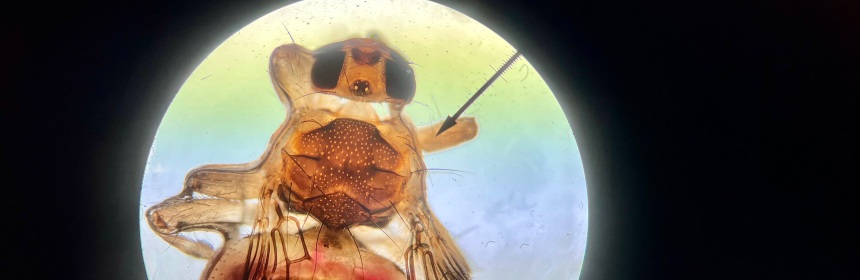
Louse in the House

Hmmm, I was trying to think of a catchy title. “Louse in the House” made you look, right? Well, indeed one did escape and I can’t find it. Would you like to come over for dinner tonight? I thought I saw it flying around the dining room.

Here’s how it happened. Yesterday afternoon, a bird hit the window. It was a hard strike on a window where we haven’t had many bird collisions. I suppose I’ll have to make more Acopian Bird Blinds to put up. They’ve sure help mitigate the bird strikes. Link to DIY instructions here: https://www.birdsavers.com/make-your-own/

Back to the bird. I went out to see if the poor bird was still alive. It was, but died in my hands soon after I picked it up and carried it into the house to assess for injuries. I took the bird into the bathroom so I could shut out my ever-curious indoor cats, Herman and Nimbus. After realizing I was holding a lifeless body, I set the bird down in the bathtub. Right away, I noticed a fly crawling through the bird’s feathers. Hurriedly, I left the bathroom, grabbed my camera, and went back to examine my specimen more closely.

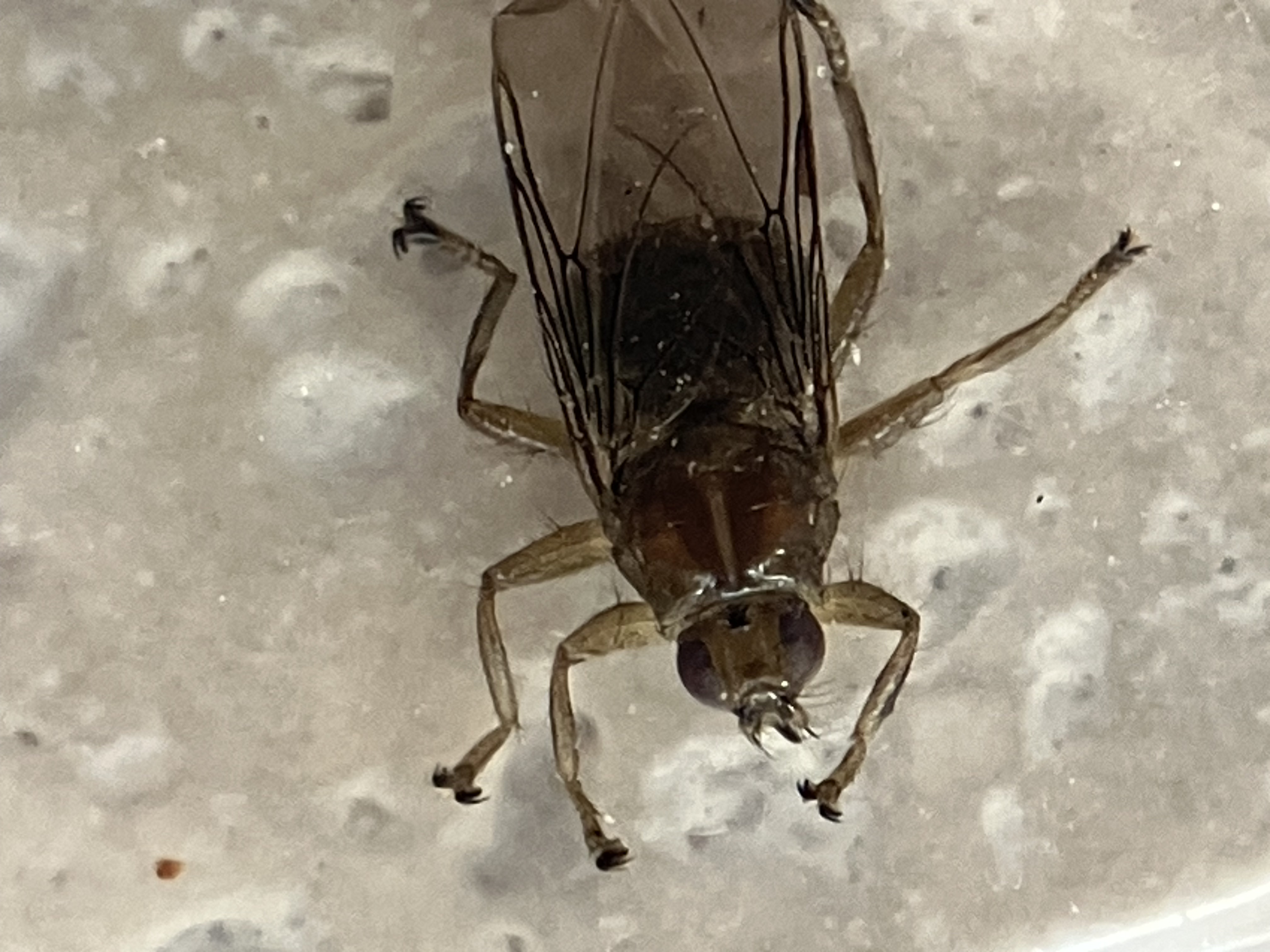
Hippoboscid Fly (Icosta americana)

As I bent over to look through the feathers, a fly zoomed up and nearly entered my nostril. I backed away, rubbing my nose. Wouldn’t be my first strange experience with a fly. There was that incident with the botfly that could have been a medical ophthalmological emergency. Don’t ask. You truly don’t want to know.

Leaning back over the tub, I started to look through the feathers again, but thought better. I went out of the bathroom again. This time to retrieve a large plastic bag and a collection vial for specimens. The bird went into the clear plastic bag. Now, I could look while containing the flies in the bag if there were others to be found.

I found two more.

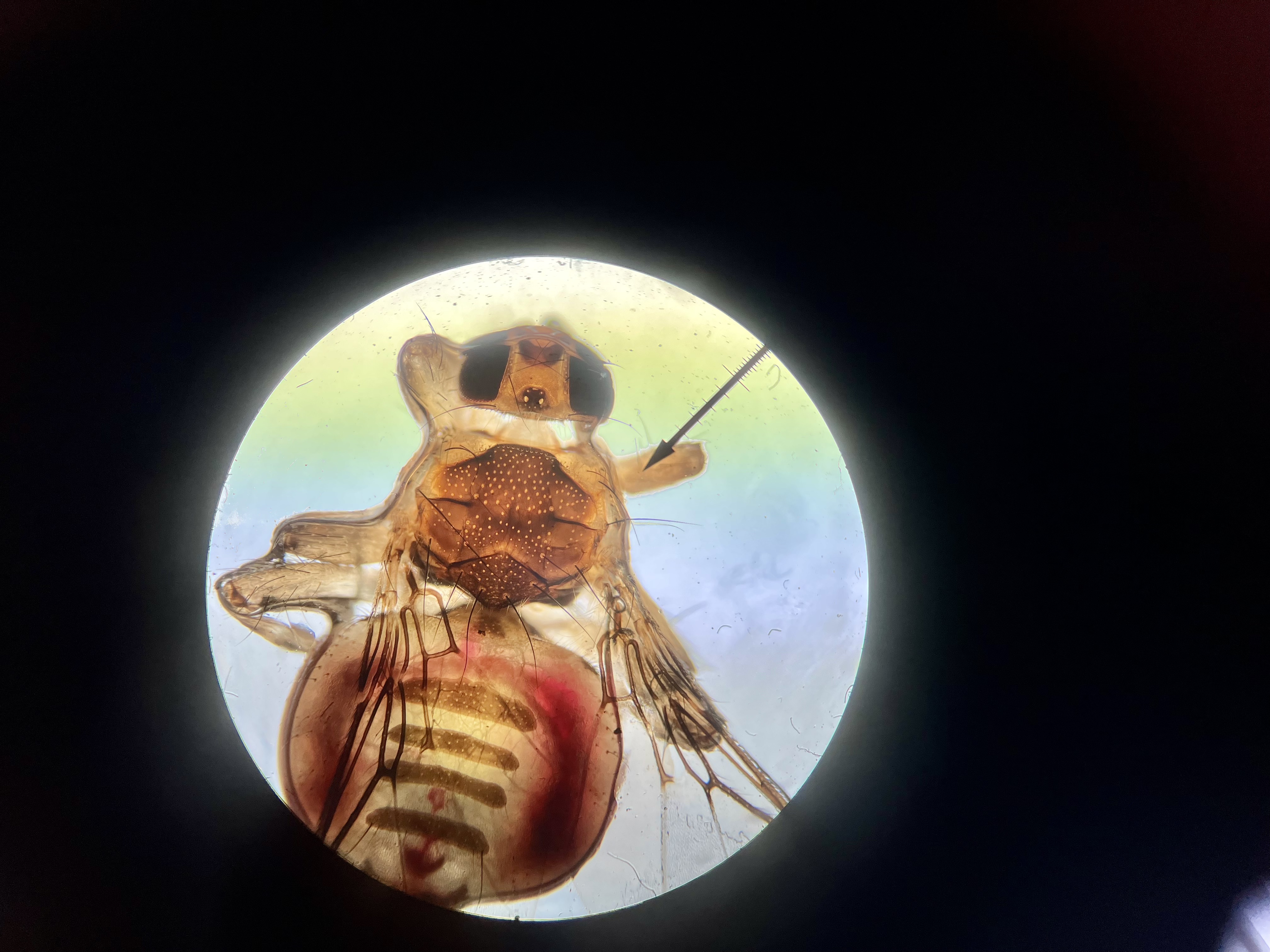
These are Louse Flies in the family Hippoboscidae. The ID for this particular species is Icosta americana. Also, my husband identified the bird as a juvenile Brown Headed Cowbird (Molothrus ater). Strangely, this species is known to be chiefly associated with the bird families Accipitridae (birds of prey – hawks), Phasianidae (pheasants), and Strigidae (owls). So, why might it be on a cowbird? The bizarre exception. Maybe the cowbird parents laid their egg in the nest of one of the above? I suppose it will be a mystery.

Hippoboscid louse flies are pretty interesting. First off, don’t they look weird? Trust me when I tell you they are one of the most bizarre families of flies out there. They are obligate ectoparasites that feed on the blood of their host, nothing else. Unlike other fly groups, both male and female flies in this family feed exclusively on blood.

There are more than 200 species of Hippoboscid flies, and each species is particular about what sort of host it feeds on. Some feed on sheep, some on deer, others on bats, but the ones I found feed on birds. In fact, approximately 75% of species of Hippoboscid flies are bird parasites. Of these 75%, some are so picky, they only prefer a particular species of bird.

Another interesting thing about these flies is the fact they vector diseases like Avian Malaria, West Nile virus, and various Trypanosomes among the host species they parasitize. Unlike some other Hippoboscid species which have deciduous wings (wings that are quickly lost when reaching a host), the ones that parasitize birds can fly during their entire adult life. This means if their host dies, like my bird that hit the window, the flies are able to leave the bird’s body and fly off to parasitize another bird host.

While one fly may have attempted to target my nose, these flies are not known to parasitize humans, although incidental bites have been recorded. Some species of female Hippoboscid flies are actually known to only be able to develop their eggs from the blood of their particular host species.

While on a host, Hippoboscid flies move about with ease. They have bodies that are dorso-ventrally flattened, somewhat like an unfed tick body or a squished bug body. In fact, the Hippoboscid flies that parasitize deer are often mistaken for ticks. Because of the flattened body, sometimes these flies are referred to as flat flies. This shape makes it easy for them to glide between fur or feathers, and it also makes it hard for the host to groom them off.

The most remarkable thing about Hippoboscid flies is their reproductive biology. It is known by the term, Adenotrophic viviparity. Adenotrophic viviparity is where eggs hatch inside the female, and the larvae are fed internally until they are mature enough to pupate. In layman lingo, the female fly gives birth to a single live larva just as it is ready to pupate. She has invested all her resources into producing a single offspring.

This is unique as most fly species cast eggs onto a substrate and the eggs hatch into larvae, feed independently of the parent, pupate, and emerge as adults. With Hippoboscid flies, the female parent retains the single egg inside her uterus, the egg hatches into a larva, and she feeds it with special milk glands until the larva reaches the last stage of larval development or “prepuparium.” Finally, the adult fly “births” her offspring larva enclosed in a shell that quickly hardens into a true pupa. With Hippoboscid species that parasitize birds, the adult fly will leave her pupa in a bird’s nest or roosting site where it can easily find a host when emerges as an adult. For more on the life cycle of Hippoboscidae, you can view one of my YouTube videos here – https://youtu.be/zCD1B2GjCxU


*** In case you’re sitting here scratching your head and I wasn’t clear in the text, ALL of the collective names for Hippoboscid Flies include the following: Flat Fly, Louse Fly, Ked Fly, or just plain ole Ked. And yes, they ARE known to have a painful bite!

References and Further Reading

Coatney, G. R. (1931). On the Biology of the Pigeon Fly, Pseudolynchia maura Bigot (Diptera, Hippoboscidae). Parasitology, 23(04), 525.

Dick, C.W. 2006. Checklist of world Hippoboscidae (Diptera: Hippoboscoidea); Department of Zoology, Field Museum of Natural History: Chicago, IL, USA, pp. 1–7.

Levesque-Beaudin, V. Sinclair, B.J. 2021. Louse fly (Diptera, Hippoboscidae) associations with raptors in southern Canada, with new North American and European records. International Journal for Parasitology: Parasites and Wildlife,
16: 168-174. ISSN 2213-2244. https://doi.org/10.1016/j.ijppaw.2021.09.007

Maa, T. C. 1969. a Revised Checklist & Concise Host Index of Hippoboscidae (Diptera). Pacific Insects Monog., Honolulu: Bishop Museum, Honolulu, Hawaii. 20: 261–299. http://hbs.bishopmuseum.org/fiji/pdf/maa1969b.pdf

Santolíková,A.;Brzonˇová, J.;Cˇepicˇka,I.;Svobodová,M. 2022. Avian Louse Flies and Their Trypanosomes: New Vectors, New Lineages and Host–Parasite Associations. Microorganisms. 10, 584. https://doi.org/10.3390/ microorganisms10030584

Small RW. 2005. A review of Melophagus ovinus (L.), the sheep ked. Vet Parasitol. 130(1–2):141–55. https://doi.org/10.1016/j.vetpar.2005.03.005 PMID: 15893081

Walker, Meredith Swett 2015. Behold the Hippoboscidae: Bizarre Biting Flies that Give Live Birth! Entomology Today. https://entomologytoday.org/2015/05/18/hippoboscidae-flies-live-birth/