Shield Man
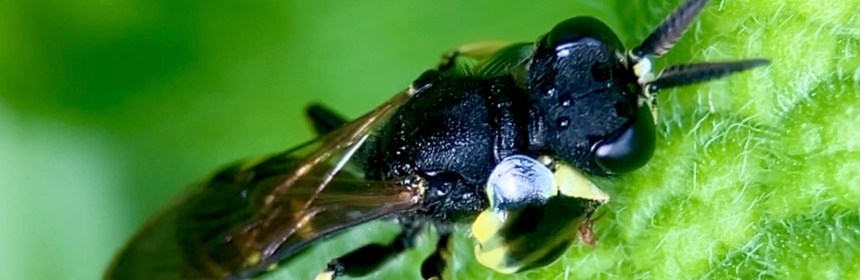
I found this darling little male wasp the other day in the mint in our garden. According to what I am reading about this genus, I may have to go out in the evening to scout for female activity. Digging through literature to learn about these wasps has been fascinating.
My identification for this one (and it’s a male) is Crabro latipes. The name Crabro translates from Latin as “wasp-like,” and latipes translates from Latin “latus” as broad or wide, and “pes” or “pedis” as foot. I referenced Bohart, 1976 for a description:
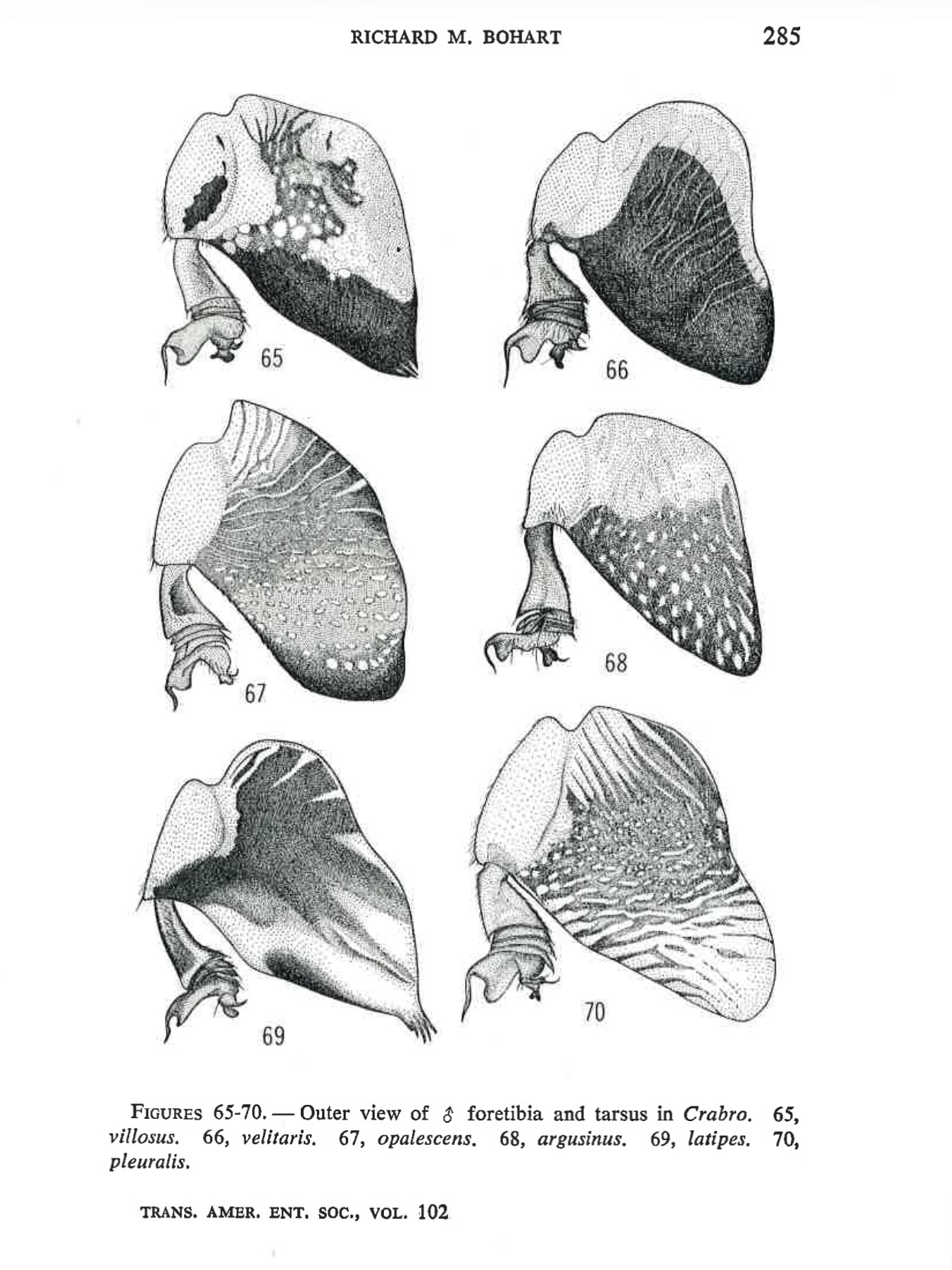
Both sexes have the mandible partly and scape mostly pale, orbital silvery stripe ending before apex of scape, scutal punctures separated by two or more diameters medially, and proposal enclosure with close longitudinal ridging, especially in female. Male latices have flagellomere I broader than long, but without a ventral hair tuft, forefemur with basoventral spine long and curved, outer fore femoral angle stoutly projecting backward, foretibia proper with an apical black spot or line, shield with three pale stripes of which most ventral one reaches posterior membranous tip (usually frayed fig. 69), basal declivity of mesopleural venter polished and sharply margined posteriorly, middle nearly all pale ventrally, midtarsomere I twice as long as rest of articles combined. Female latipes have clypeal bevel weakly impressed and about half as high as broad, hair of upper front fulvous to brown, mesopleural side extensively polished, tergal bands often complete except on II-III where spots are usually close. Markings on the shield are unique and diagnostic (fig. 69).
I also learned reading Bohart that C. latipes is the most abundant species in America north of Mexico, accounting for at least half of all Crabro in collections. In spite of this, their biology not well known. He records observing one female provisioning a nest with mucoid flies (Musca domestic) in gravelly meadow soil at an elevation of 8,000 feet on Mt. Rose, Nevada.
Digging further, I turned to Crompton, 1955, Peckham & Peckham, 1898, and also Evans, 1960 & 1963. There was, as Bohart suggested, little to be found about the biology of this particular species. However, Evans describes another species, C. advenus as collecting cluster flies (Pollenia) for nest provisioning. We do have Pollenia flies about our garden space as you can see here. They are interesting enough themselves, being parasites of earthworms. More on that perhaps in a to-be-written blog post.
Other Crabro species were described as collecting flies belonging to families Muscidae, Calliphoridae,Tabanidae, Rhagionidae, Sarcophagidae, and Otitidae. Apparently these wasps exhibit a strong preference for flies, though Peckham and Peckham observed one species (C. interruptus) provisioning a nest near a shoreline with white moths.
Interestingly, Peckham and Peckham also reported finding live flies interred into the nest cells with no indication of paralysis. Paralyzing prey is typical in other groups of solitary wasps provisioning nests. Crompton and Peckham recount observations of the genus as well, describing them toiling through the night excavating pithy stems (raspberry and blackberry briars or other woody perennials), though one species reportedly excavates tunnels into tree roots.
And the shield? Well, according to Bohart (1976), the shield is utilized by the male who holds these over the female’s eyes during mating. He also suggests that due to the variety in shape and ornamentation of the shield, that it may perhaps be a display function to entice females during courtship.
This is as far as I got tonight. I’m going to post, but will likely come back to make updates and revisions. Sometimes these write ups are as much for me as for anyone else reading. I like to write up my notes and keep references and this is a handy way to organize them for future use.
Thanks for reading! If you find anything you’d like to share, please feel free to send me a note. I like hearing from my readers.
References
Bohart, R. M. 1976. A Review of the Nearctic Species of Crabro (Hymenoptera: Sphecidae). Transactions of the American Entomological Society (1890-), 102(2), 229–287. http://www.jstor.org/stable/25078192
Crompton, J. 1948. The hunting wasp. London: Collins.
Evans, H.E. 1963. Wasp Farm. American Museum of Natural History. 178 pp.
Evans, H.E. 1960. Observations on the nesting behavior of three species of the Genus Crabro (Hymenoptera: Sphecidae). Journal of the New York Entomological Society, 68:123-134. https://researcharchive.calacademy.org/research/entomology/Entomology_Resources/Hymenoptera/sphecidae/copies/Evans_1960_Crabro.pdf
Fabre, J. Henri 1823-1915. (1916). The hunting wasps. London: Hodder and Stoughton.
Peckham, G. W. 1898. On the instincts and habits of the solitary wasps. Madison, Wis.: Published by the State.