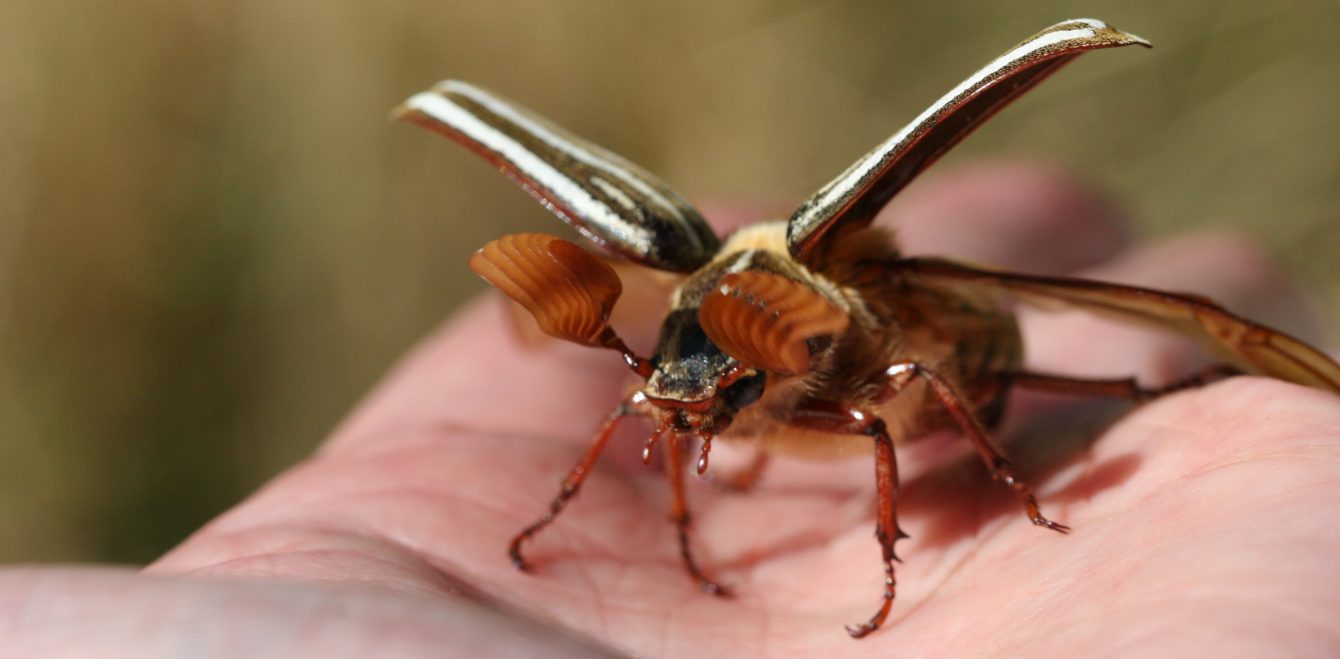
It’s a short clip, and you’ll have to check out the end to see this little beetle take flight. I fished this one out of the pool and it’s the 2nd one I’ve seen this week, albeit a new one for me to observe. I believe this is Hylastes macer, but hoping a friend will take a look for me to confirm. I have tentatively based my ID on size (approx 5mm) and locale being under our Shore Pine trees, but I wasn’t confident using Wood’s key with only my photo and video in lieu of an actual specimen under the microscope. At minimum, Hylastes should be correct for Genus. These beetles are in the family Curculionidae and subfamily Scolytinae, one of the Bark and Ambrosia beetle species.
As to their life history, they construct galleries in phloem tissues of roots and stumps of Pinus or Pine trees and occasionally Picea or Spruce trees. According to Atkinson (2024), there are six species of Hylastes known in Washington State. Some of the species in this genus range from BC to CA. For more on distribution, take a look at Wood, 1982.
While identifying a bug is part of the process, the most fun for me is observing their behaviors. I knew when I saw the march of those little front feet, that the launch was about to take place.
Evans, A. 2021. Beetles of Western North America. Princeton University Press.
Wood, S.L. 1982. The bark and ambrosia beetles of North and Central America (Coleoptera: Scolytidae), a taxonomic monograph. Great Basin Nat. Mem. 6: 1-1356.
So, this was not without a LOT of frustration on my end – due to lack of practice converting Powerpoint presentations to YouTube. The audio just wouldn’t sync. Finally…figured…it…out. 🤦♀️ Here’s my presentation from this past Sunday’s Garry Oak Symposium at the Grange. Feel free to watch and ask questions if you weren’t able to attend. For anyone interested, I’ve included references and literature at the end. Sorry in advance if there are some audio issues. They are minor and I just decided to go with it. 🙂 I’d like to add a special thanks to April Randall for her amazing artwork. She drew “Garry,” as in Garry the Oak Tree. Enjoy!
I found a’nutter weevil! They’ve been everywhere this week! Looks like this may be the Nut Leaf Weevil (Strophosoma melanogrammum). These weevils feed on the leaves of broad leafed shrubs. I saw it on a chunk of rotting alder. It was pretty small and tough to photograph in low light. Probably about 3.2 mm in size. San Juan Island, WA October 13, 2021.
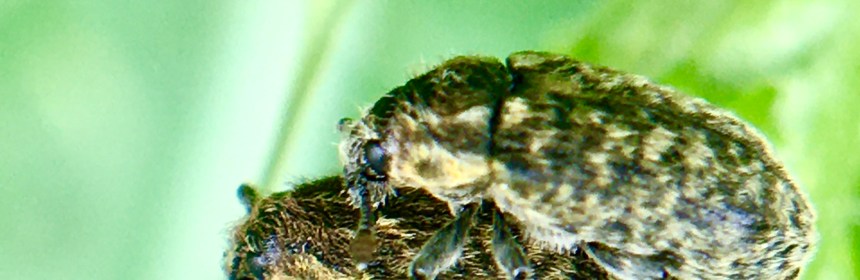
I found a “new-to-me” bug the other day when I put on my heavy duty gloves and reached to pull out some bull thistle growing in a pile of dirt near our home. I was being extra careful because the thistle has spines and they kind of hurt when you get them stuck in your hand. The beetle was right in front of me when I pushed apart some leaves to get a better grasp on the stem.
As I looked a bit more closely, I saw there were quite a few of these beetles on the thistle, especially on the buds. I went back to the house to get my camera, took some photos, then went about figuring out what this was. Definitely a beetle.
It was weevil-like, and pretty hairy. There were quite a few of them paired up. They have spring fever like a lot of other bugs I’ve seen of late. That’s how we get more bugs though, and we need them, whether we like all of them or not.
(Rhinocyllus conicus) on Bull Thistle
Identification took me about an hour. I am getting better at piecing bits of information collected over the years. Bull Thistle is not exactly a popular plant. It’s managed to get itself on the noxious weed list. No one seems to want this plant in their garden, aside from Eeyore, who really loves thistle, right?
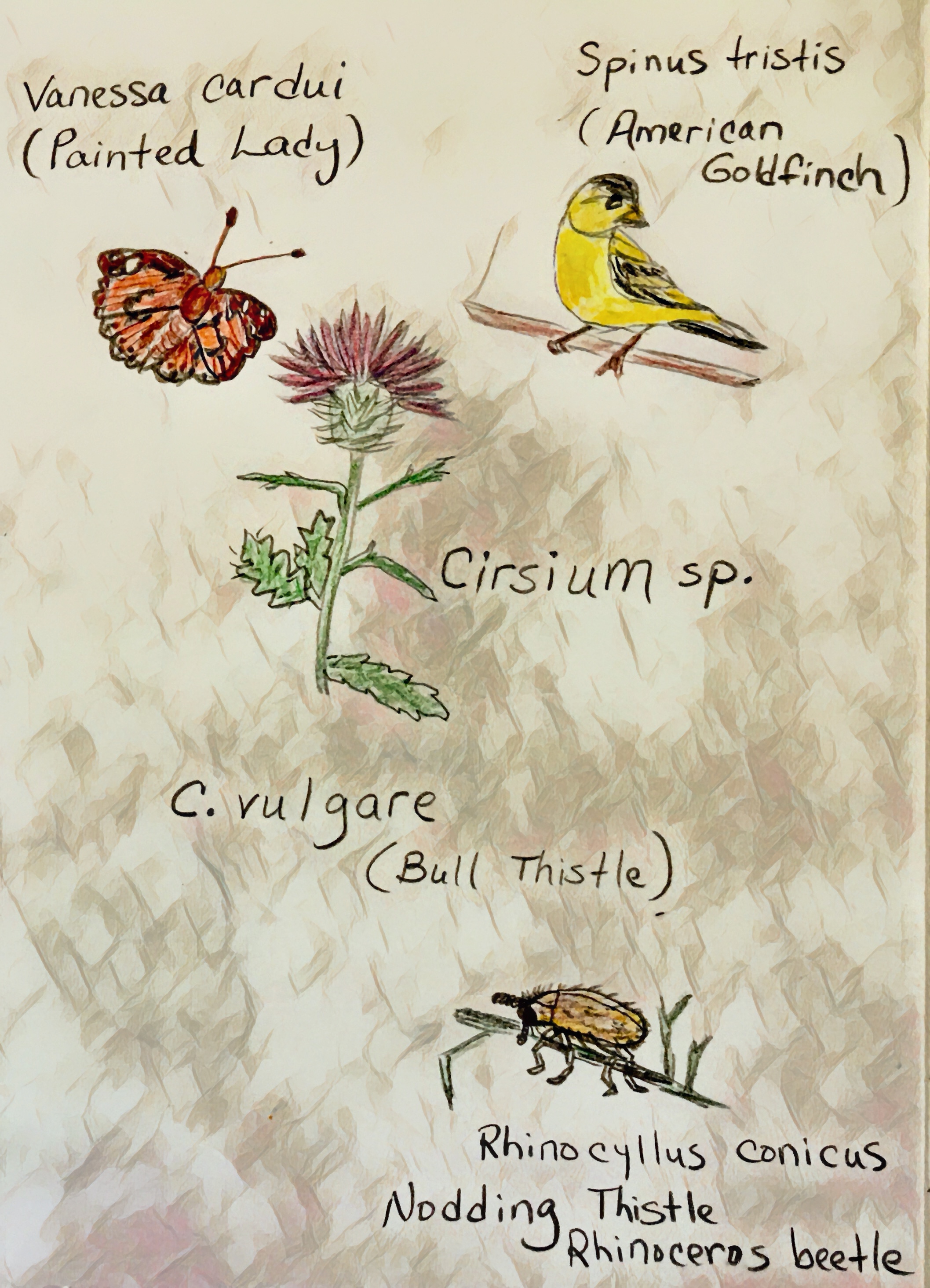
Noxious weed made me think of biocontrol. That narrowed things down a bit and I learned this is the Nodding Thistle Receptacle weevil (Rhinocyllus conicus). Personally, I’m calling it the Nodding Thistle Rhinoceros Beetle because being in the family Curculionidae, it has the appearance of a nodding rhinoceros.
So, the beetle was introduced to control thistle in the US because thistle isn’t welcome, at least the non-native species like bull thistle aren’t. The part that got me reading to find out more was the adjective used to describe this beetle as “controversial.” Well, what I found is that the beetle doesn’t just eat non-native thistles. It eats NATIVE thistles too (Cirsium edule and Cirsium brevistylum).
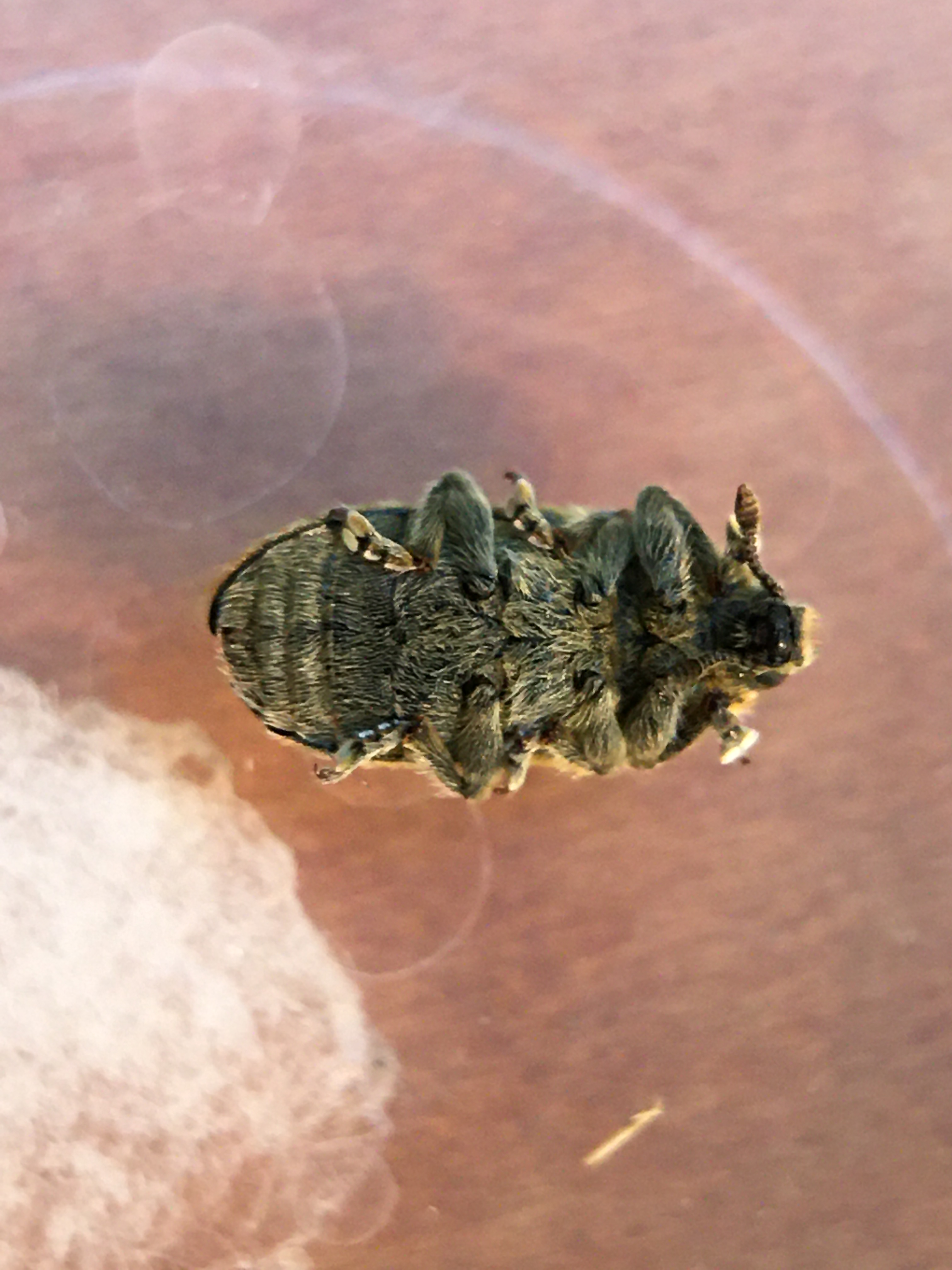
Ventral view of my Nodding Thistle Receptacle Beetle – It’s kinda cute!
Why does that matter? Well, disrupting native ecosystems can have ripple effects. I found out another reason the beetle is controversial is because there are native pollinators that depend on thistle, like the beautiful Painted Lady Butterflies that we love. Thistles also produce seed and flax used by our very own state bird, the American Goldfinch. Which brings me to the question, “If the butterflies and birds have begun to utilize the non-native species, are we making the problem worse by introducing another non-native species?”
In my continued reading , I actually began to connect the fact that I buy bags of expensive thistle seed at the store to attract the goldfinches, but I’ve got LIVING food for them in my yard that is free (and also free of pesticides), and here I am pulling it out. Am I going to waste my energy trying to eradicate a small patch of bull thistle? Nope. If it starts to get out of control, we can just mow it down. For now, I am leaving it for the birds and the butterflies…and all the other little creatures I’ve seen living on it. There were lots of super cute little jumping spiders all over it yesterday!
I’ll leave you with a question. Should we have introduced this hairy little beetle that isn’t native? I don’t have a good answer. Maybe it will just help control the spread of thistle and won’t eradicate it entirely. I’d like to be able to have Painted Lady’s, Goldfinches, and lots of jumping spiders in my garden, even if I occasionally get pricked by the spines of those thistles. For now, I’m going to stick to improving my drawing skills!











 Bugging You From San Juan Island