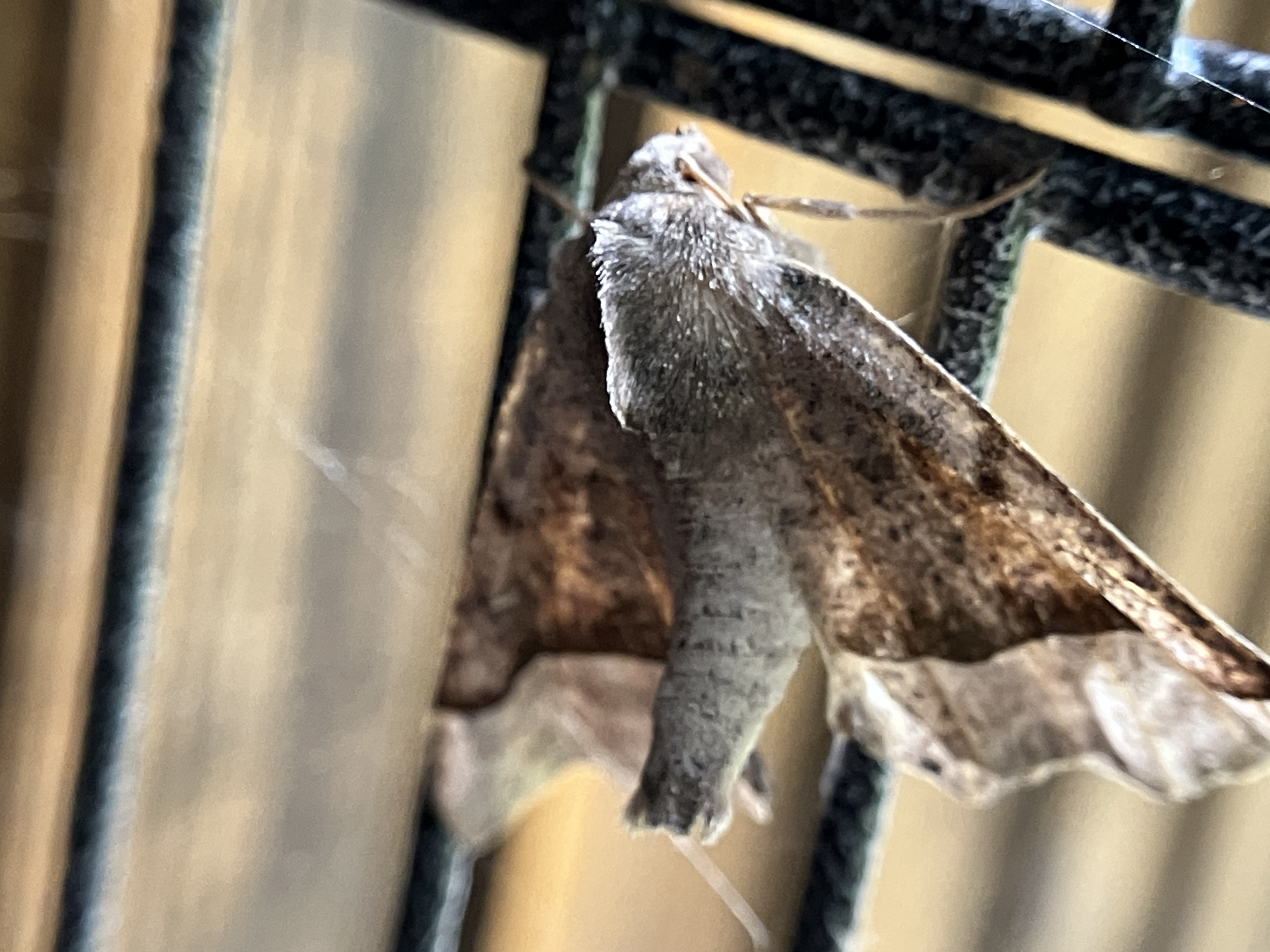
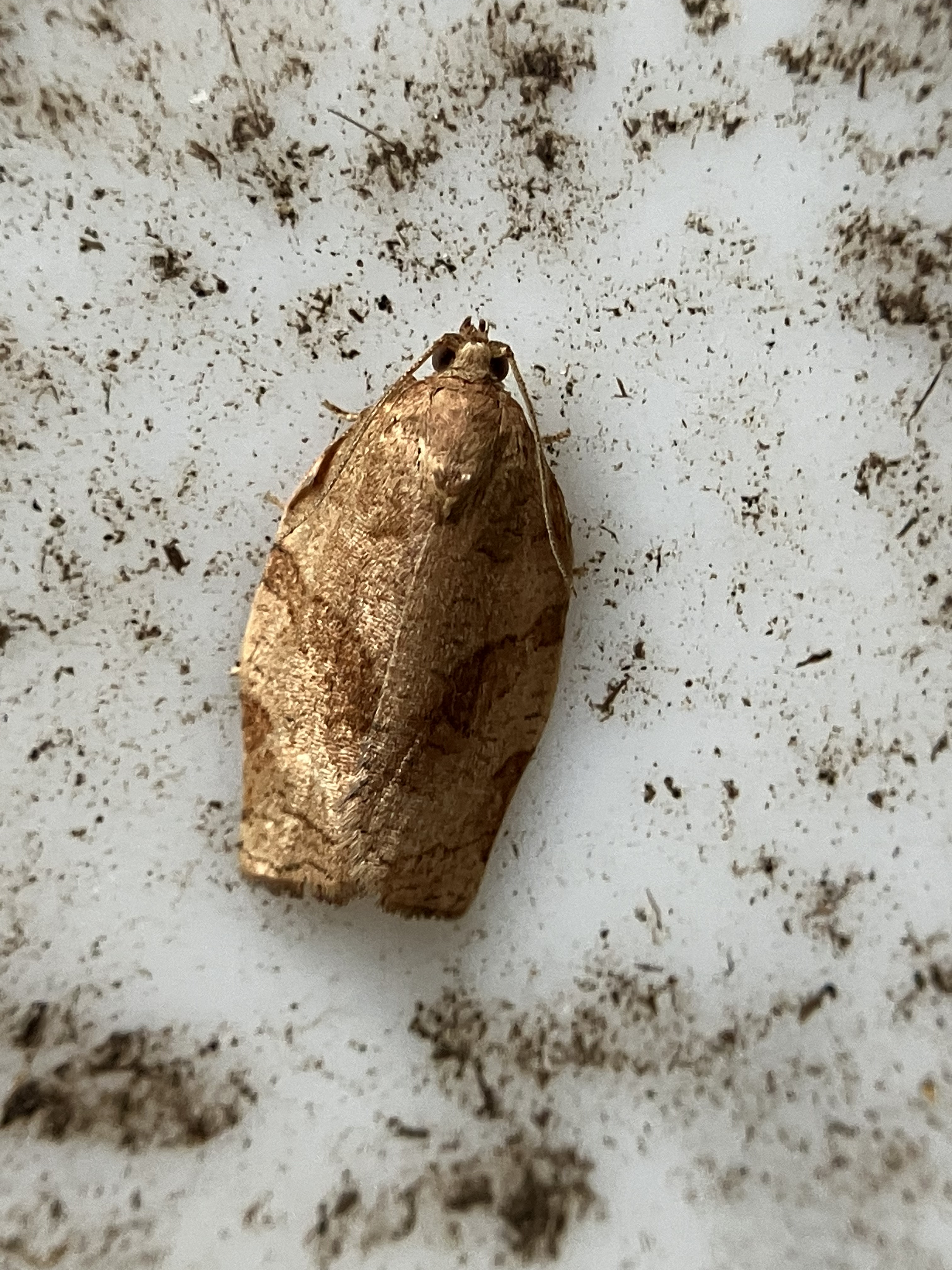
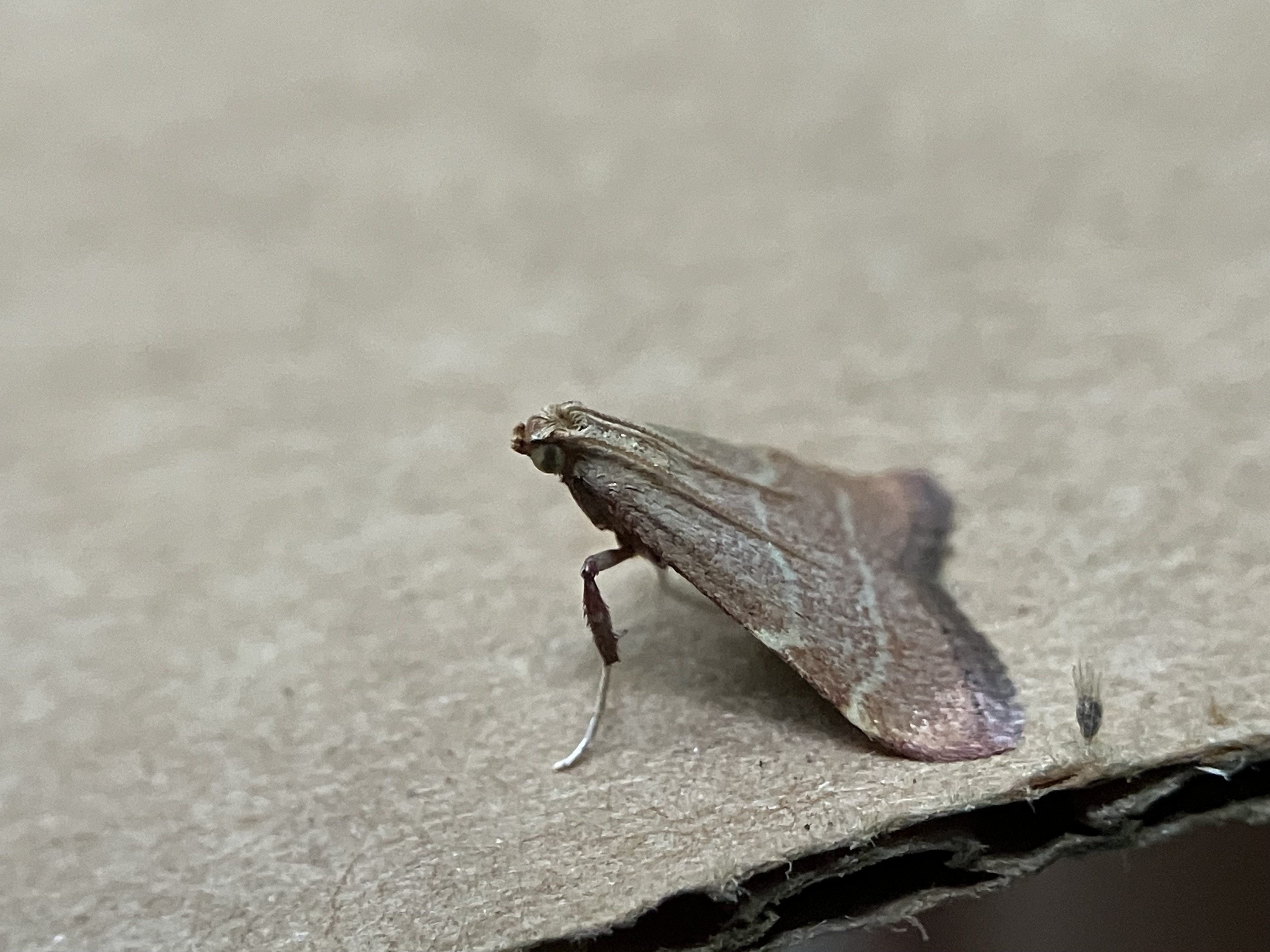
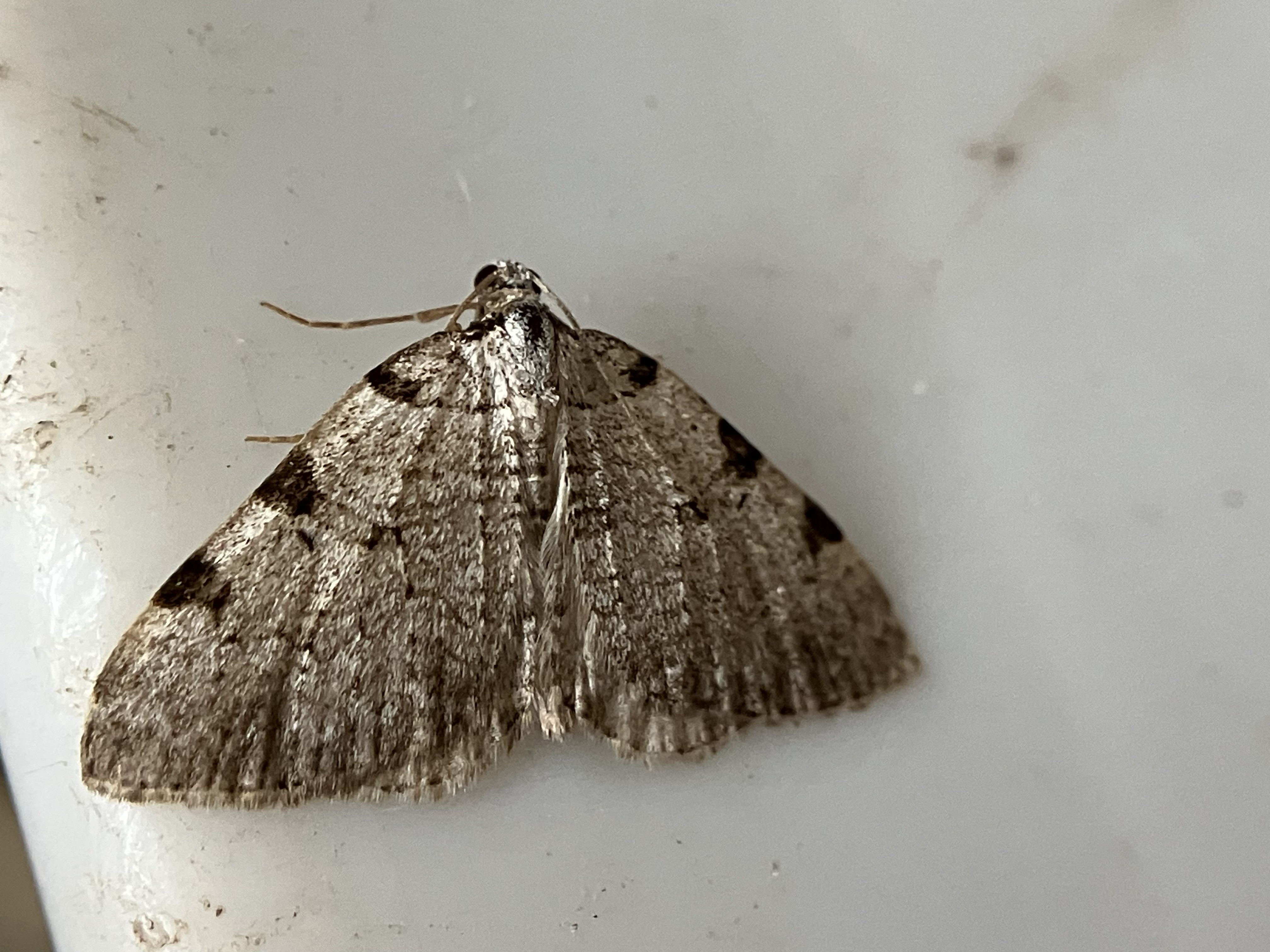
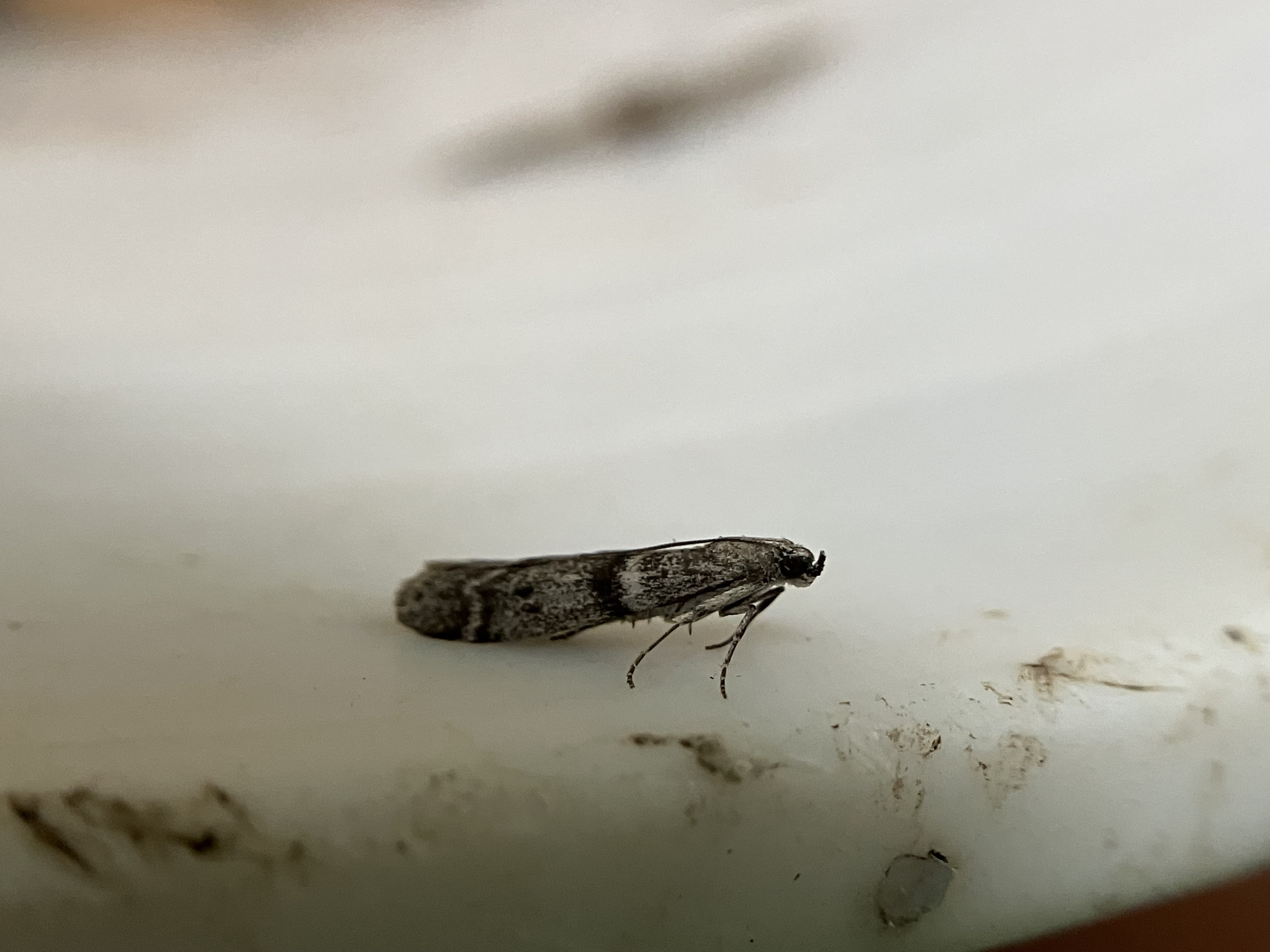
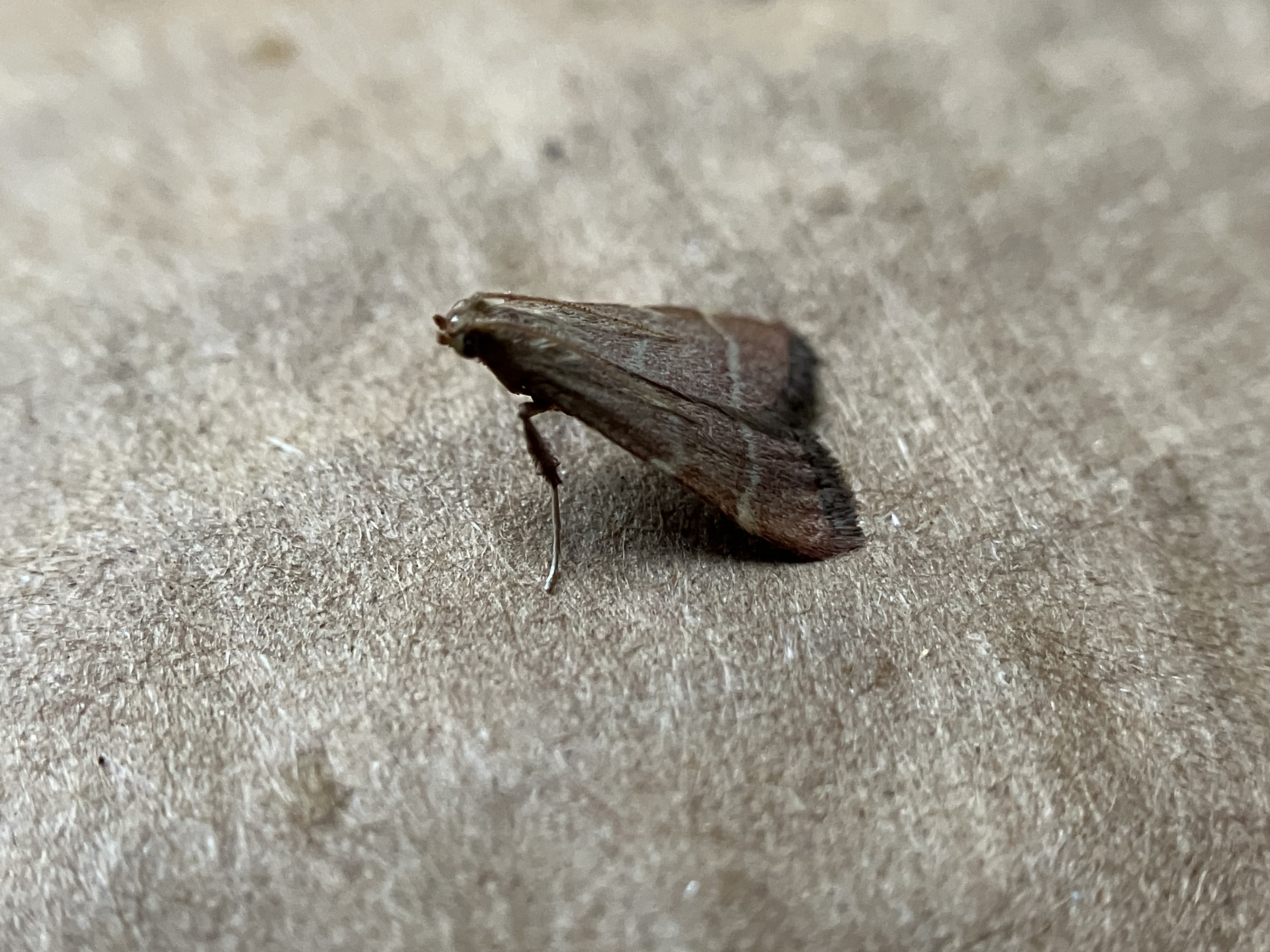
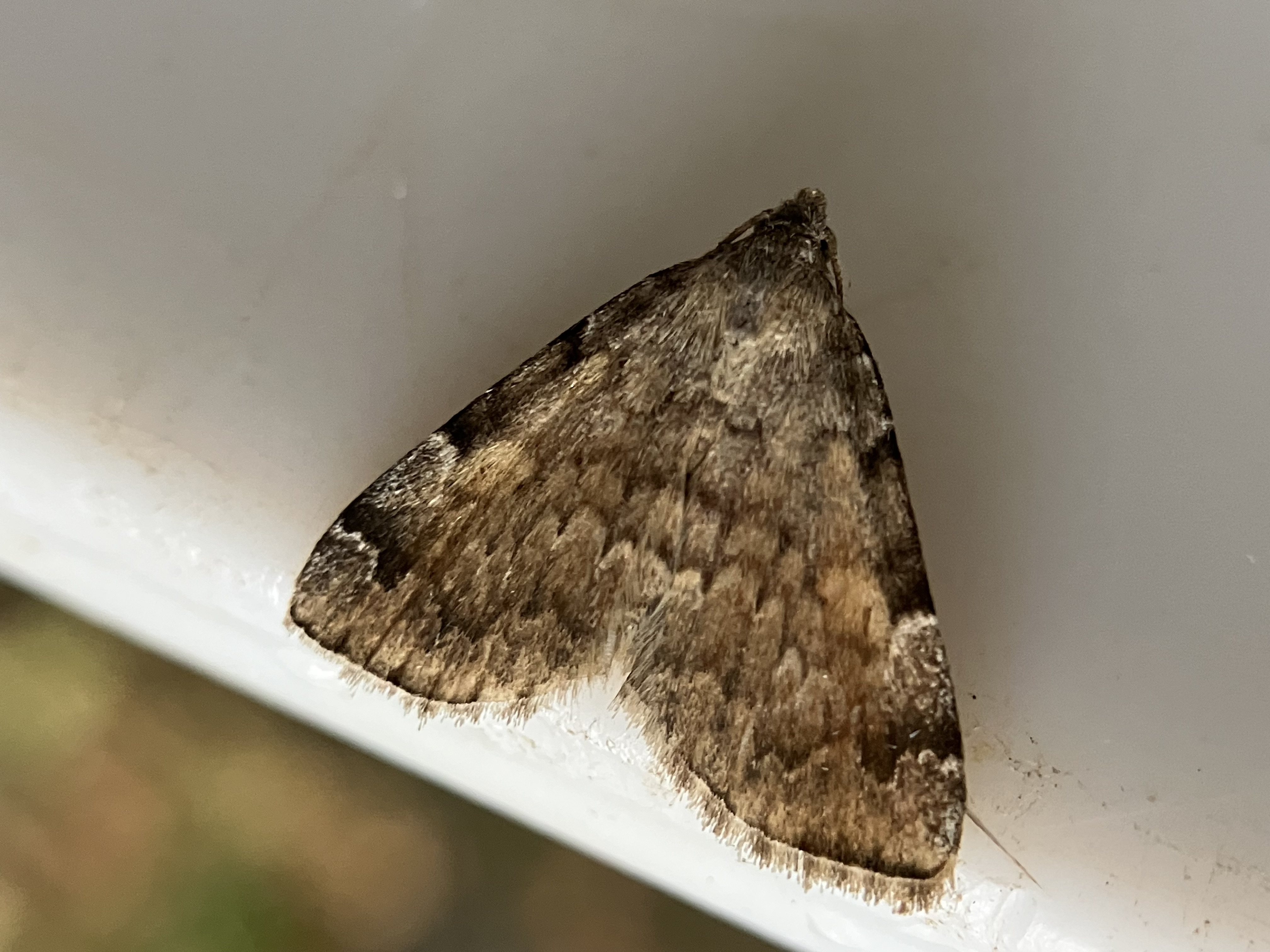
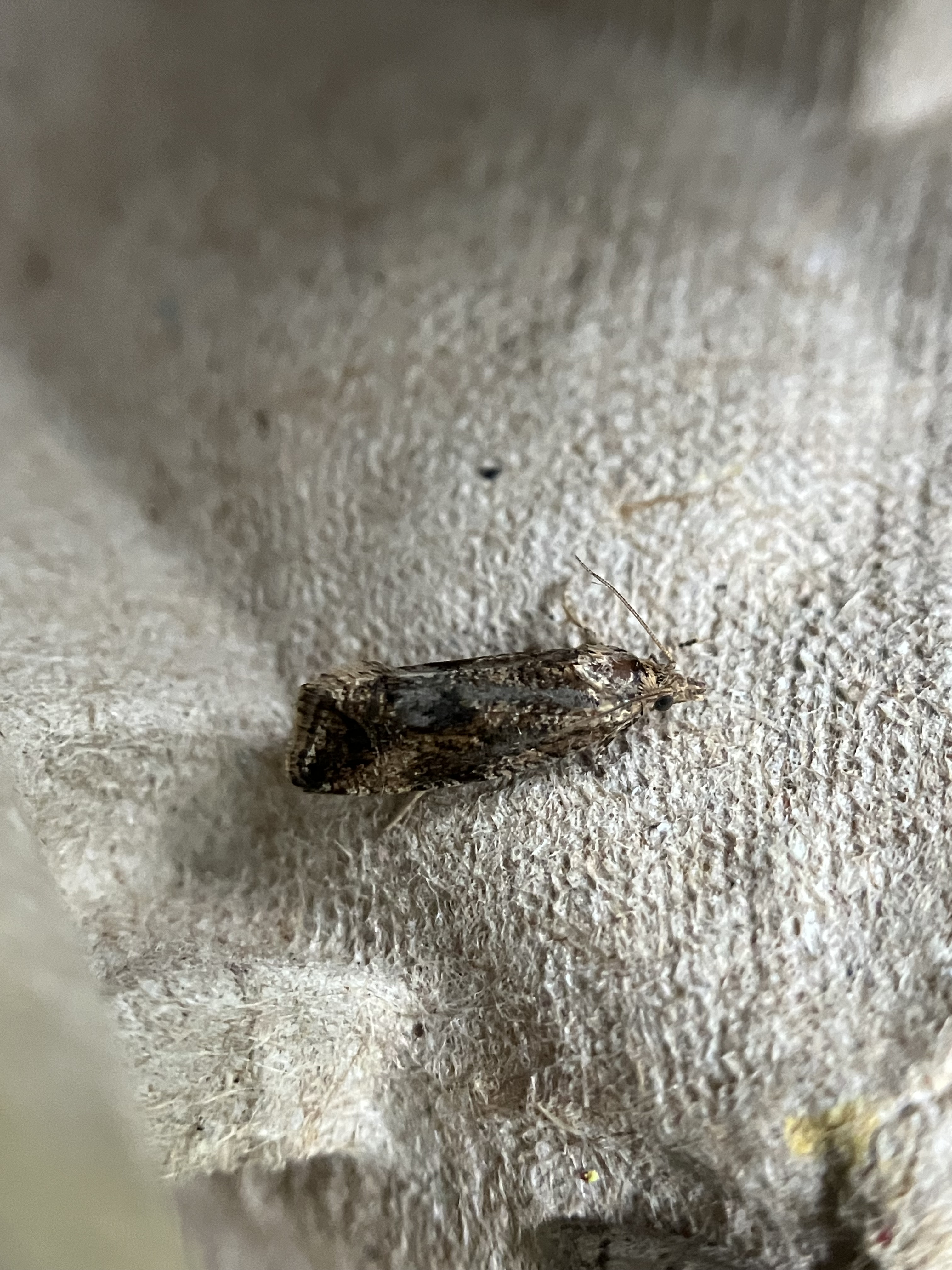
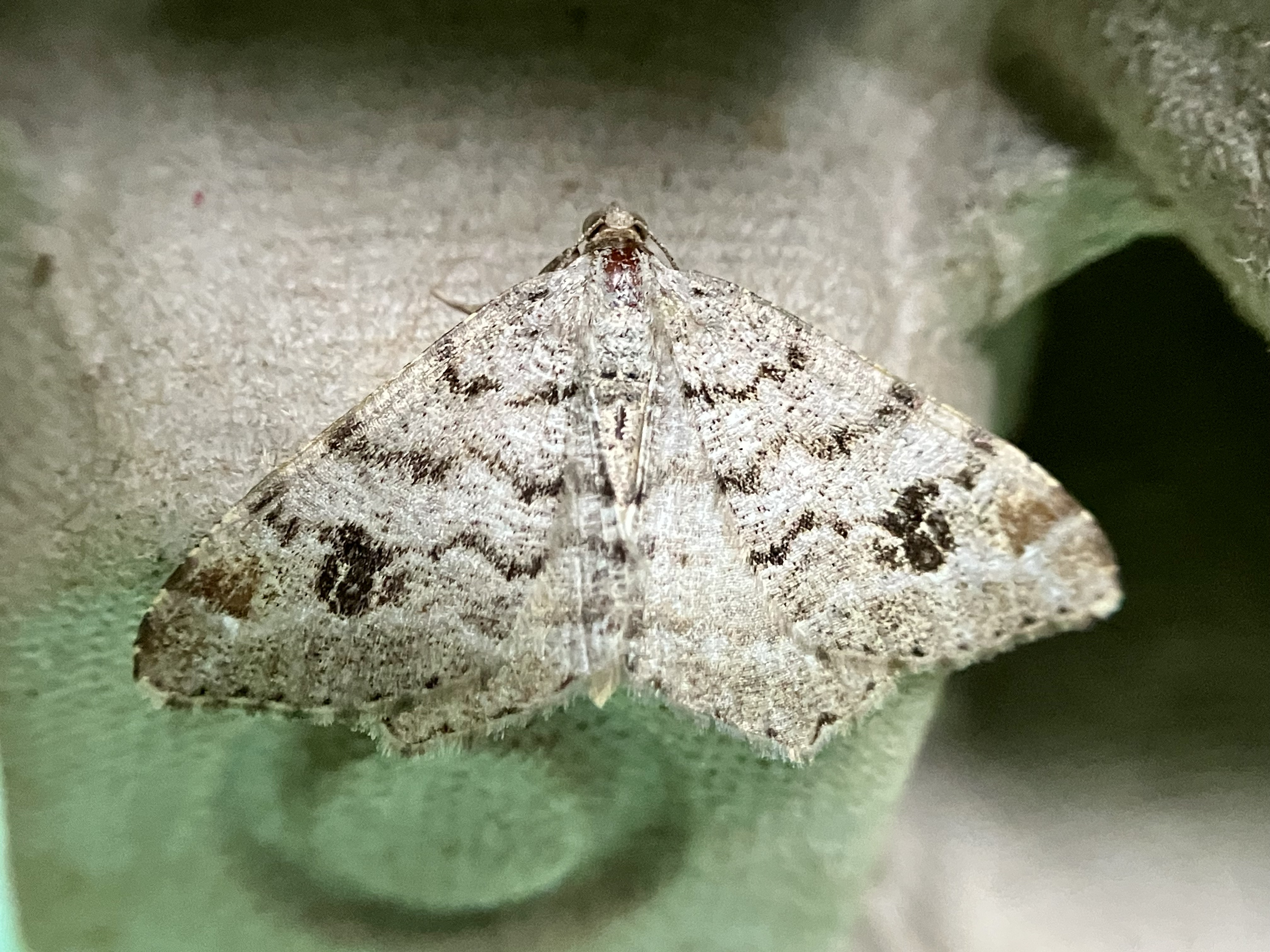
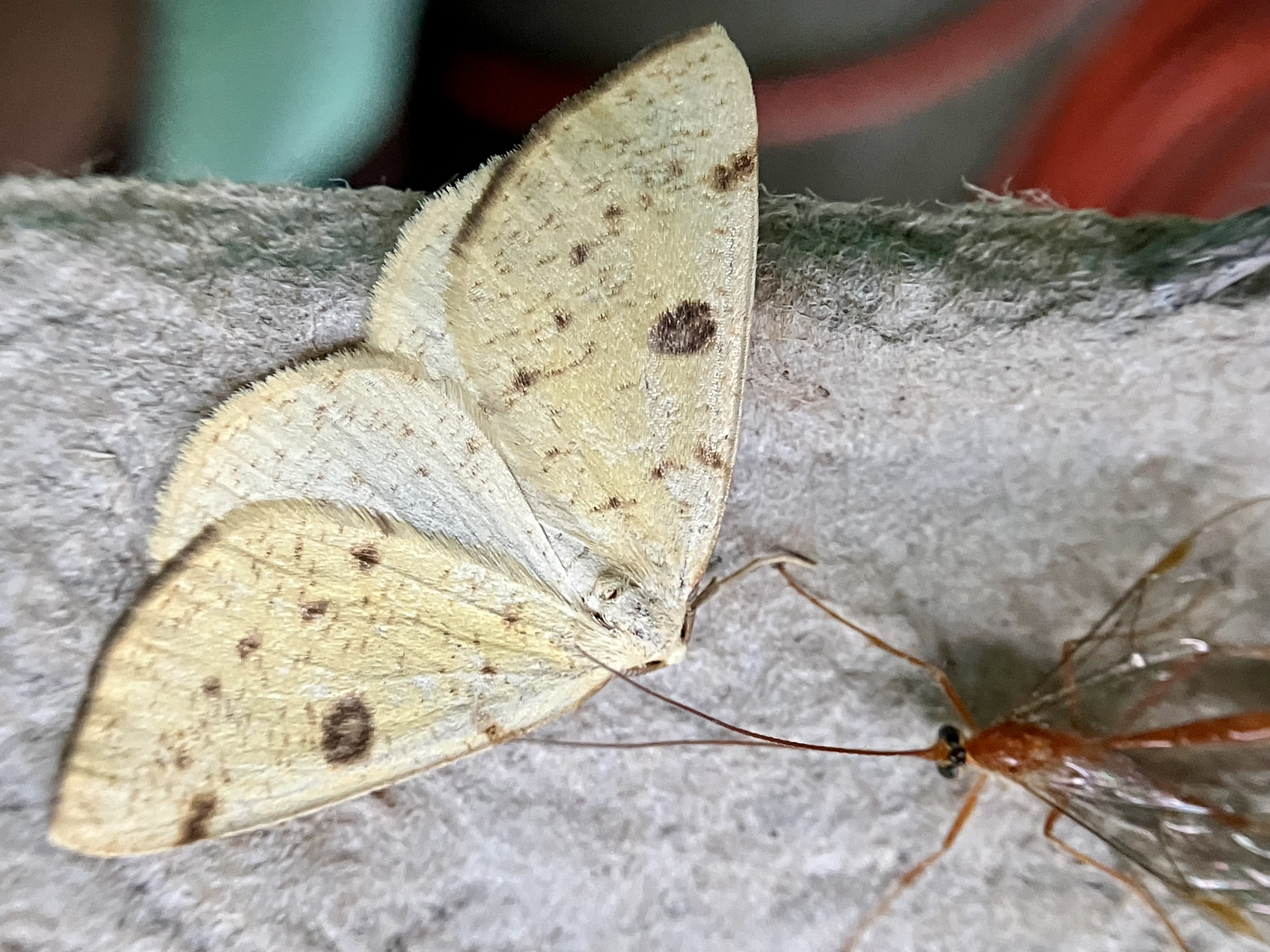
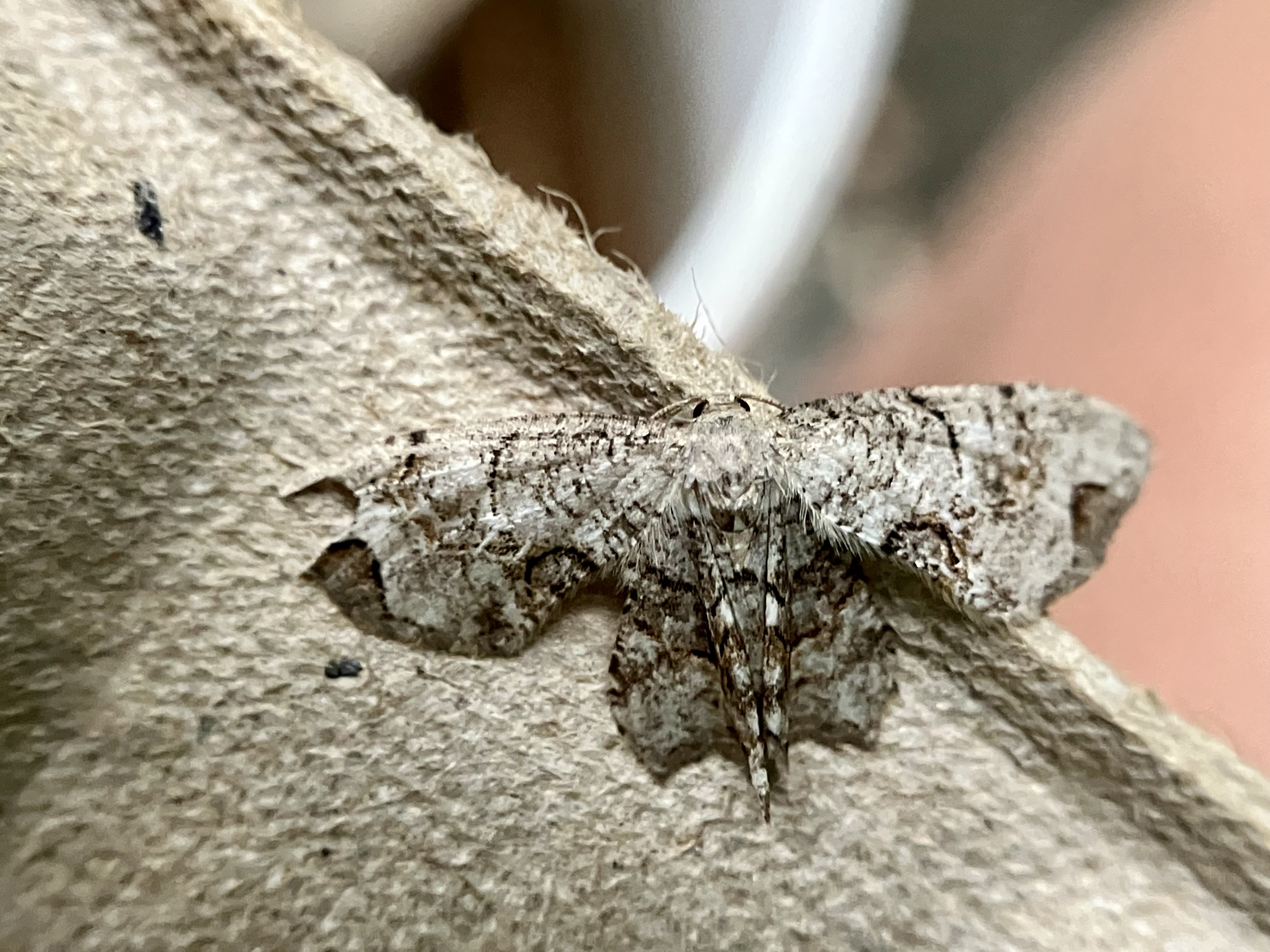
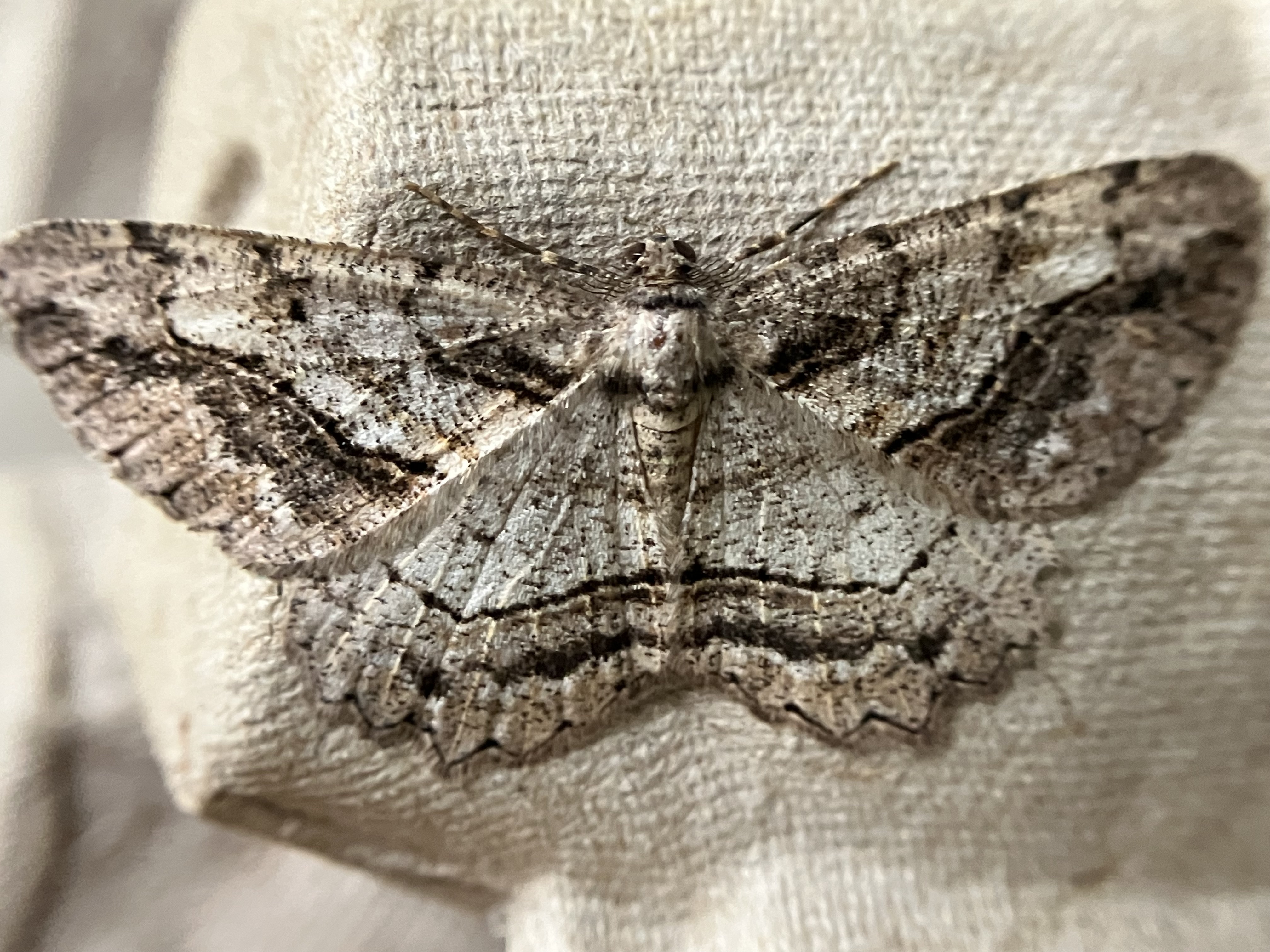
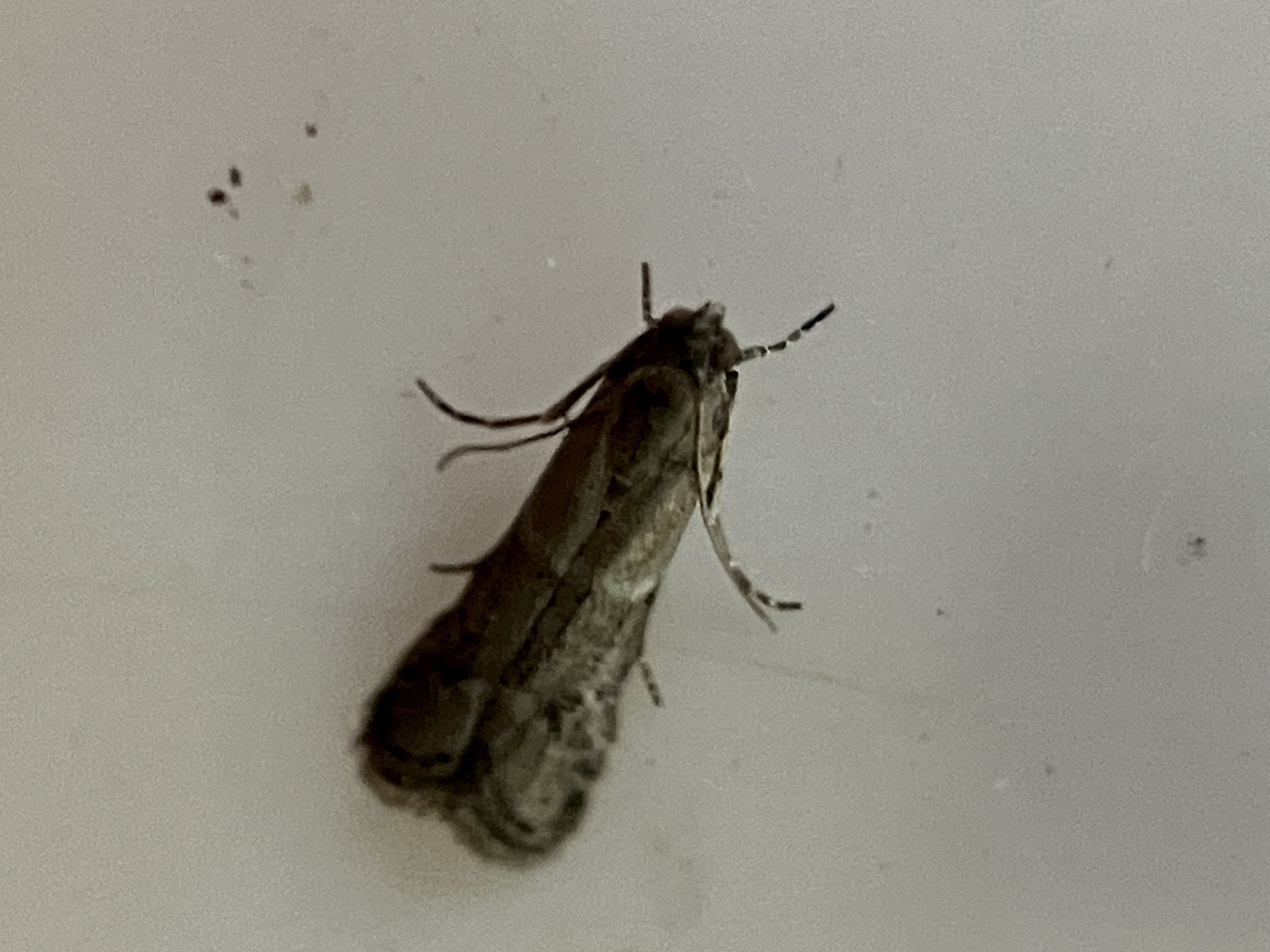
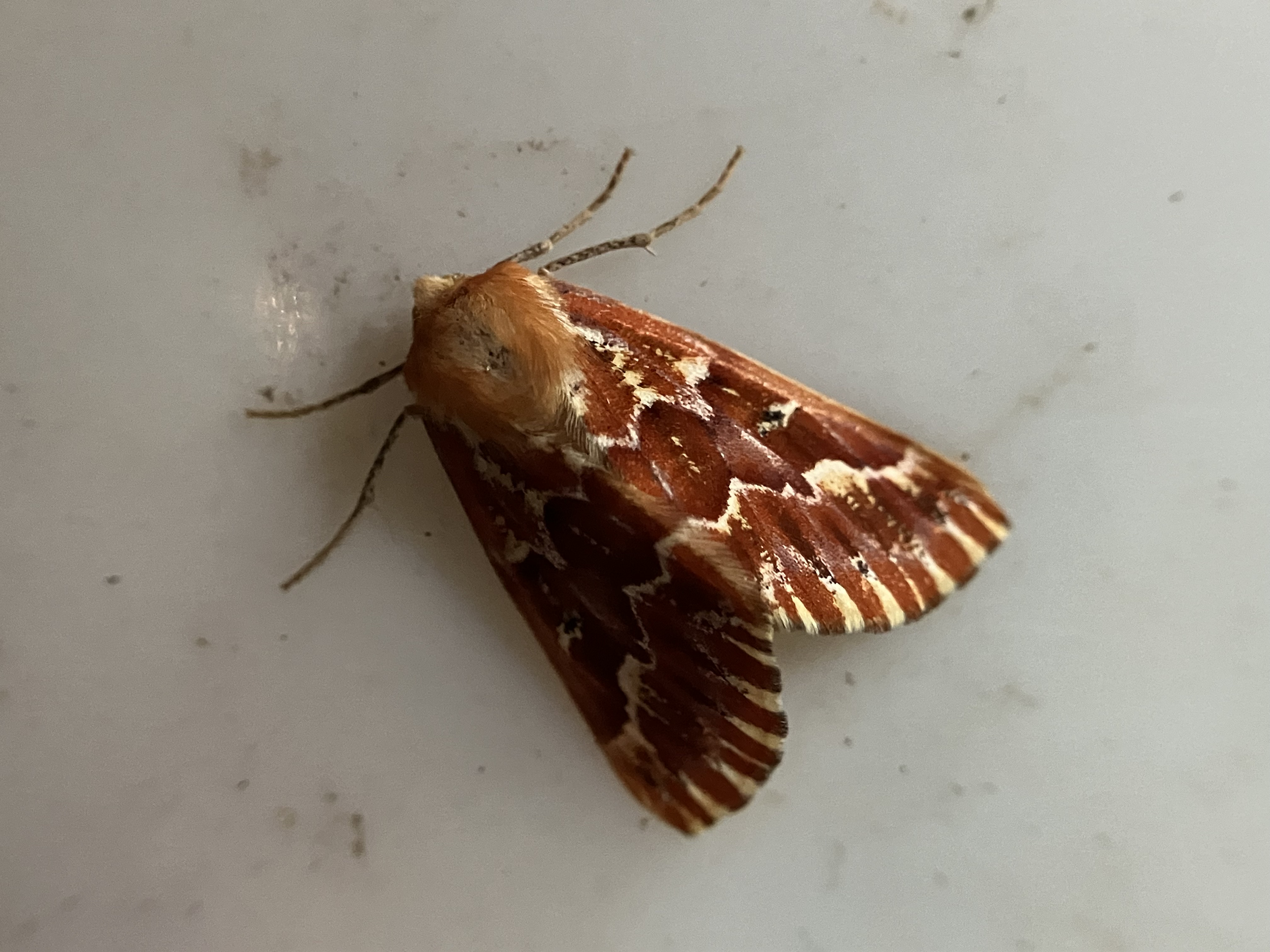
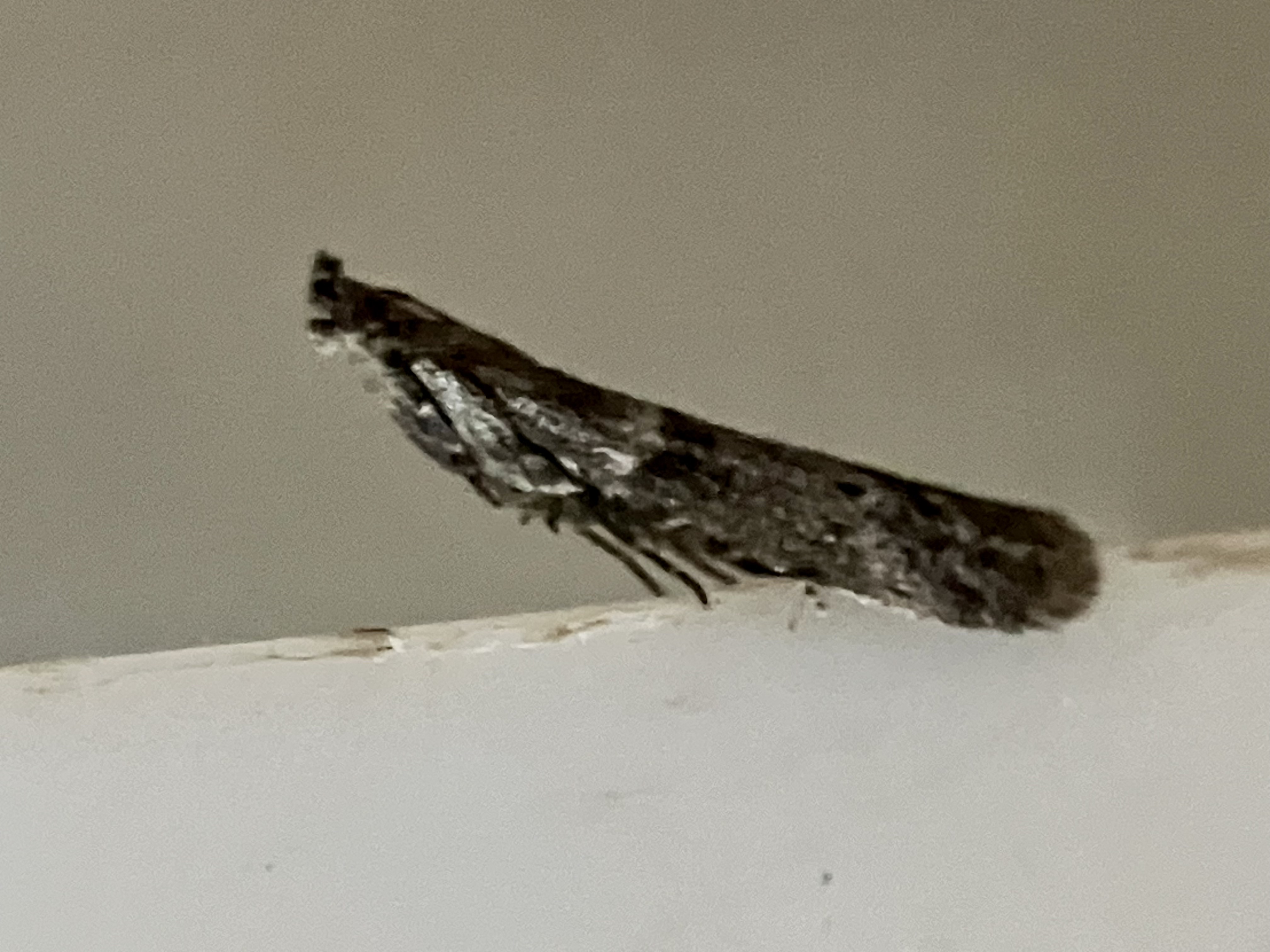
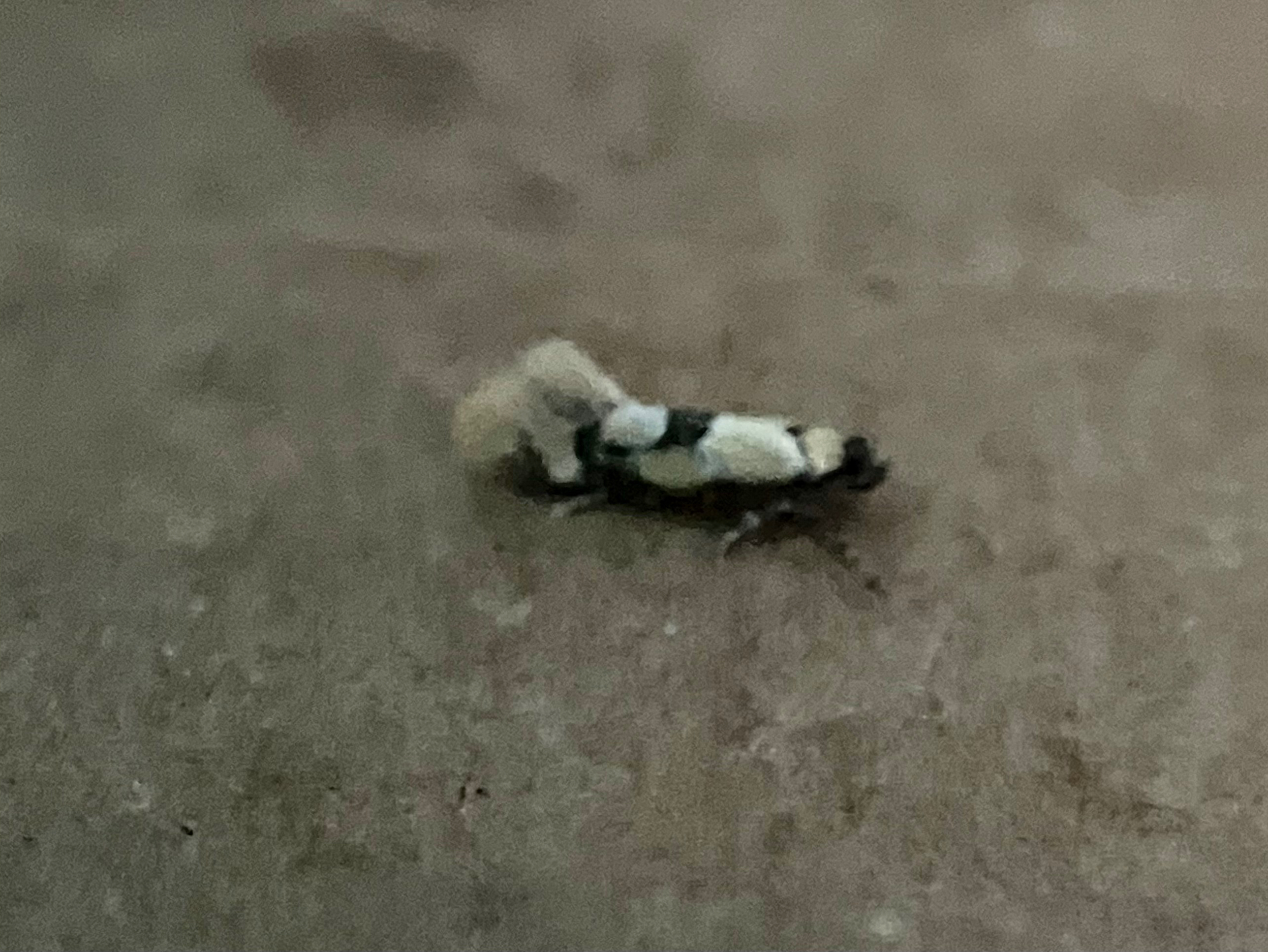
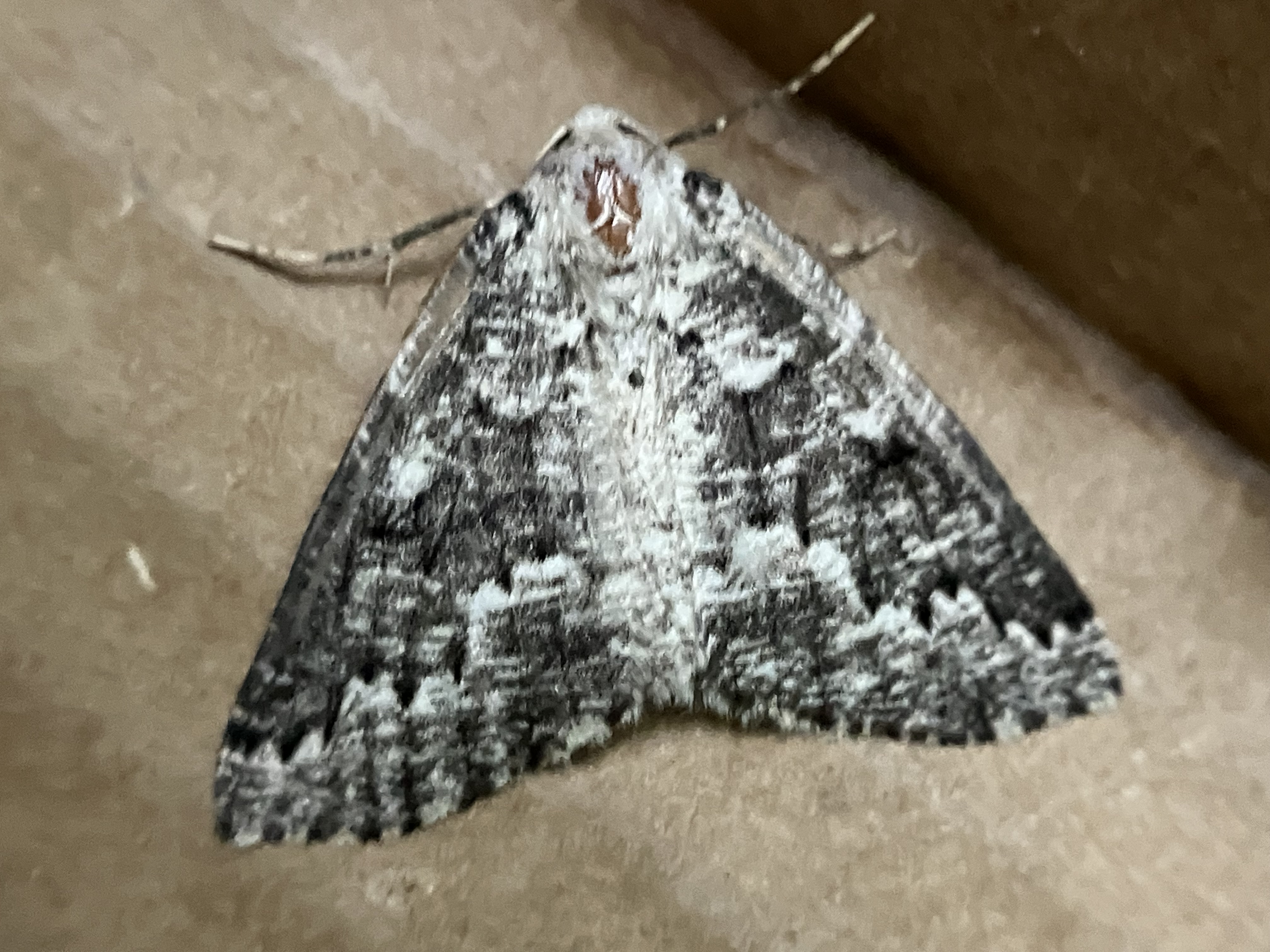
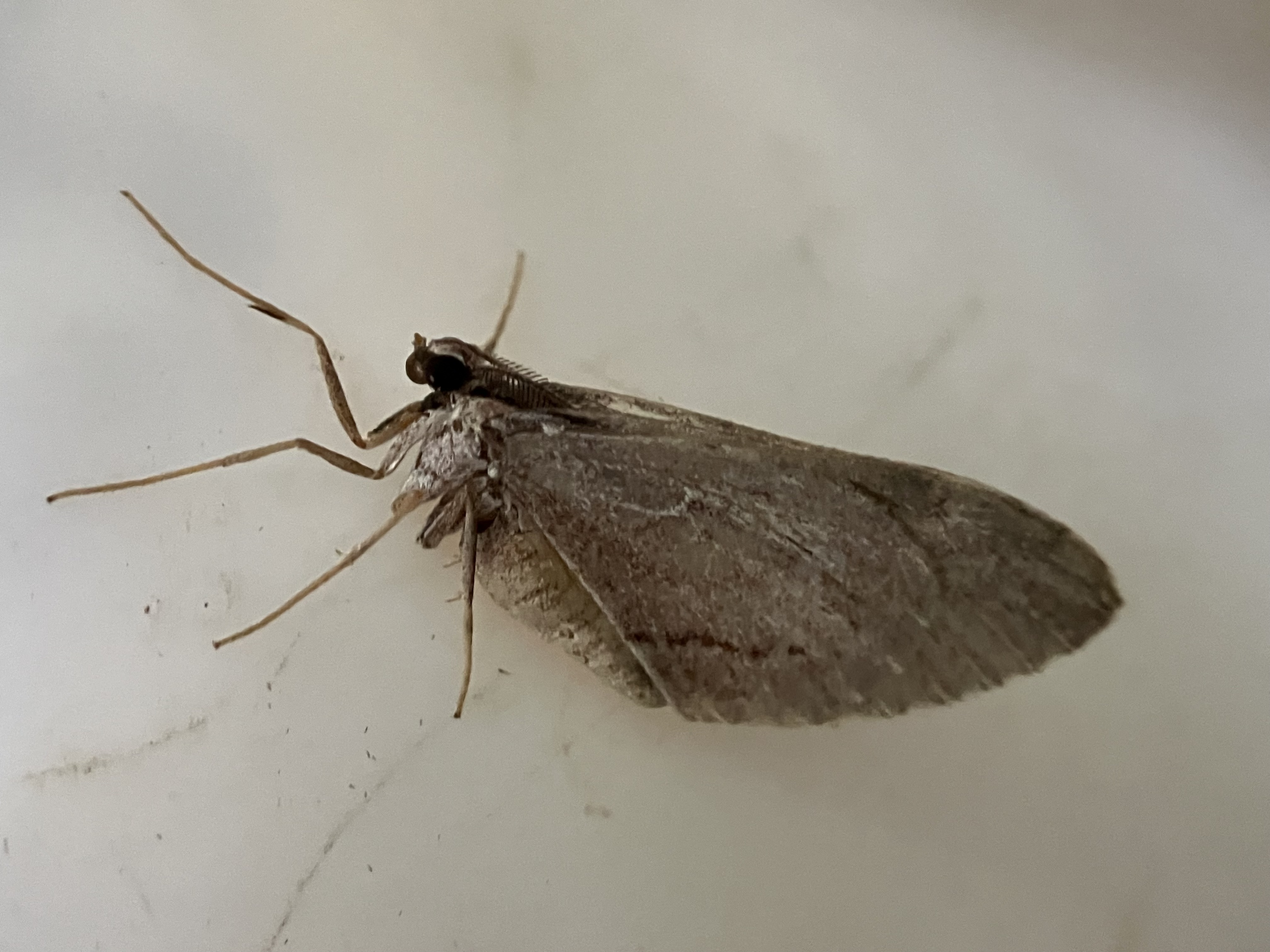
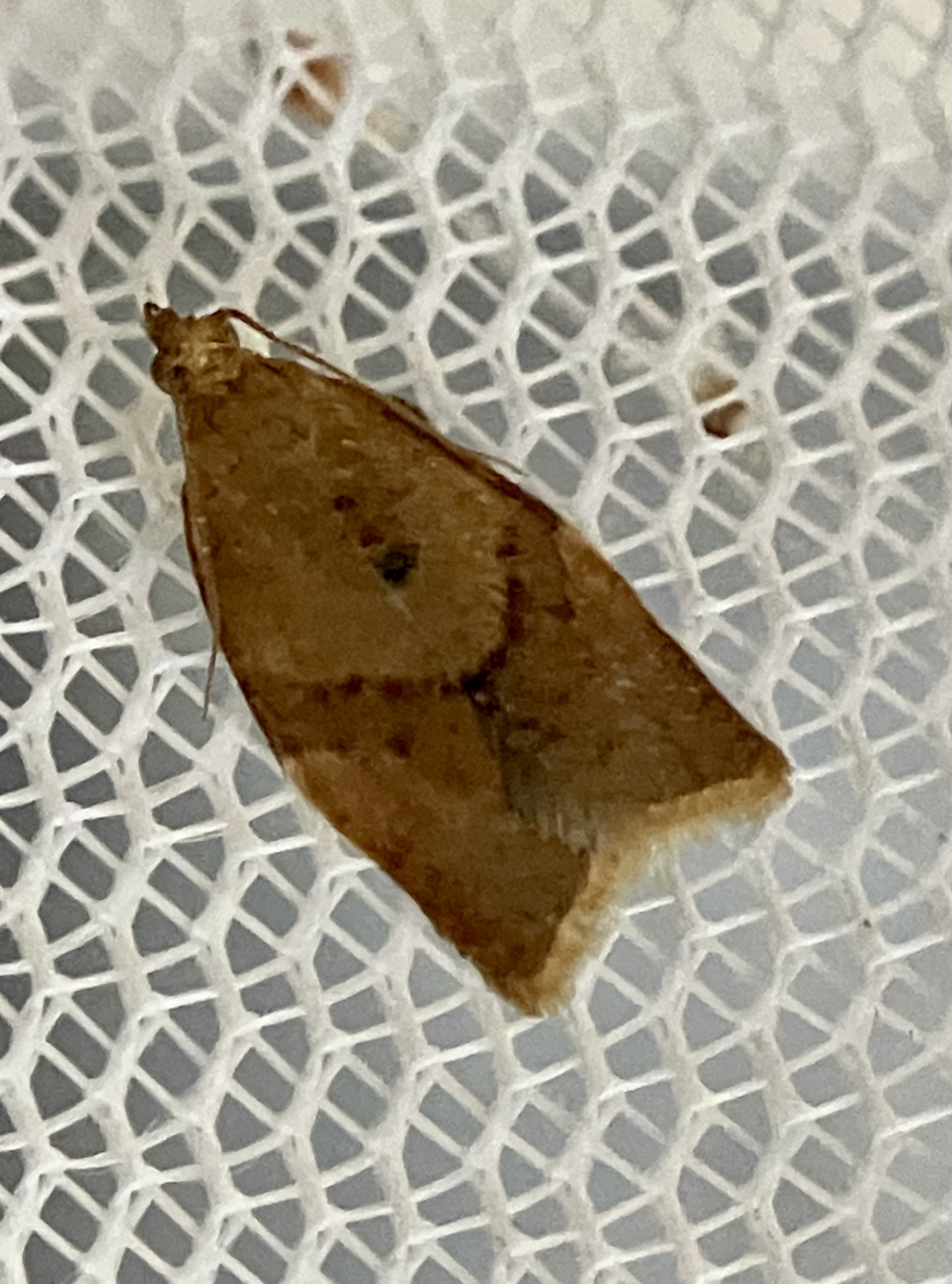
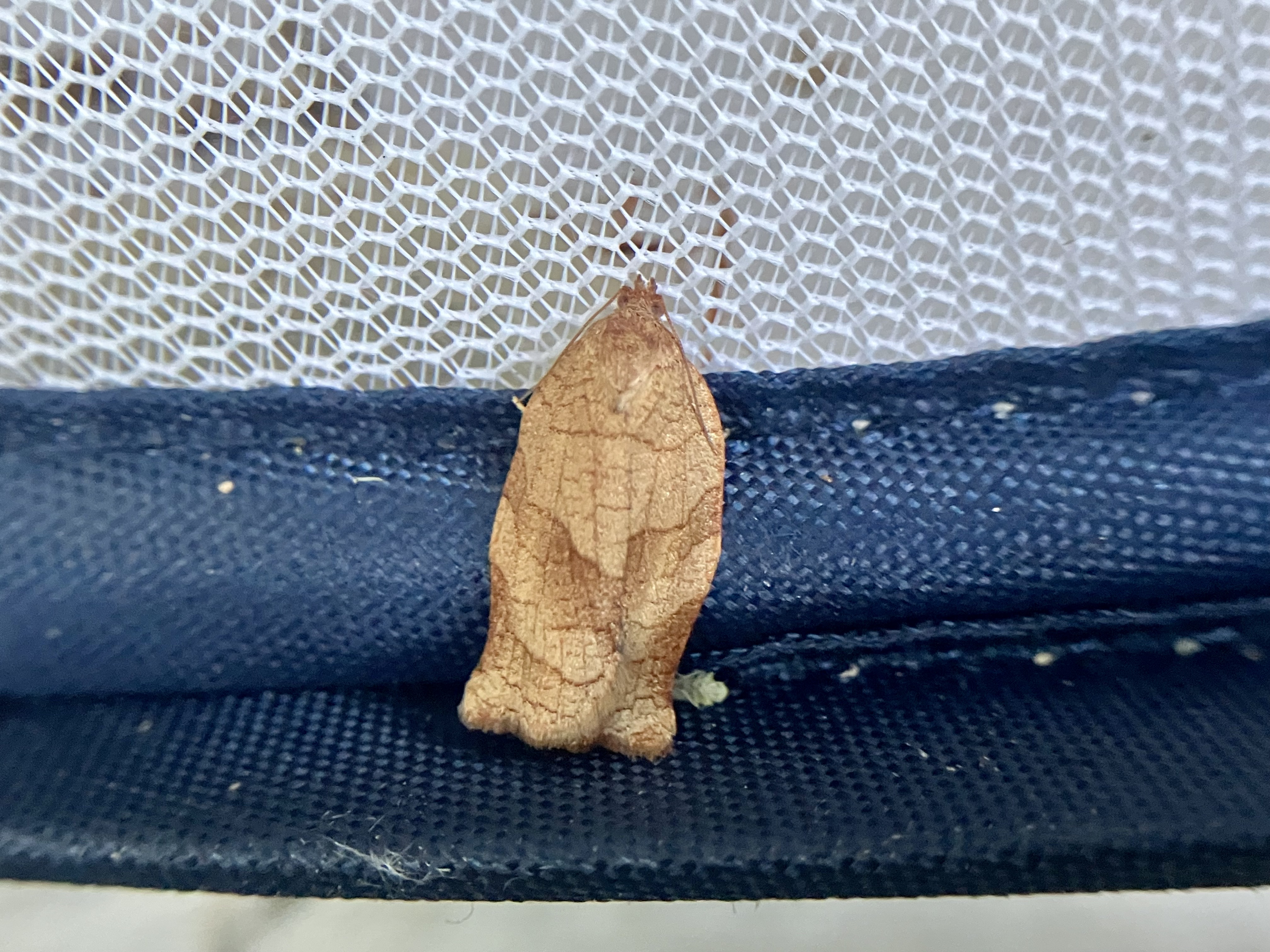
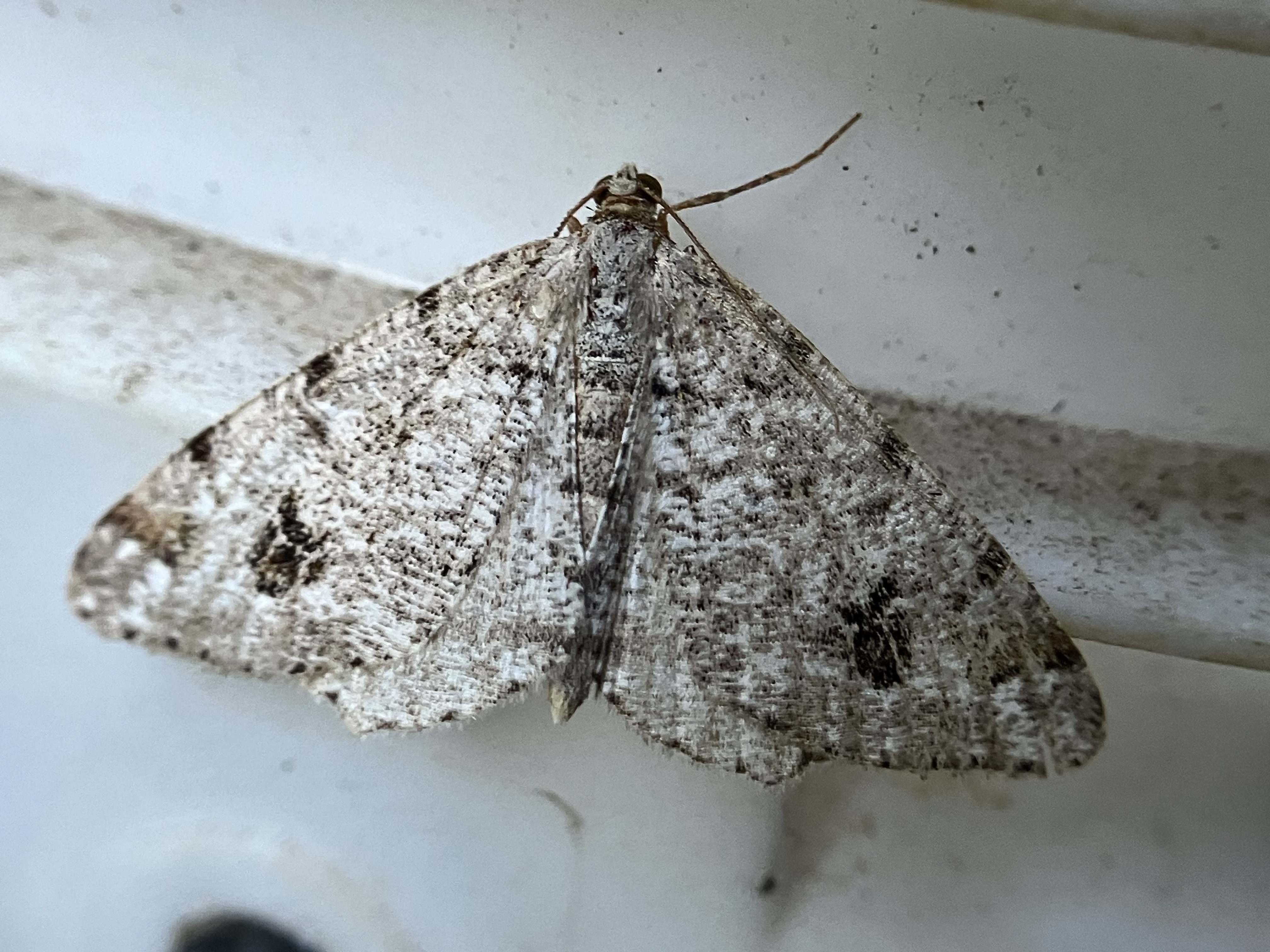
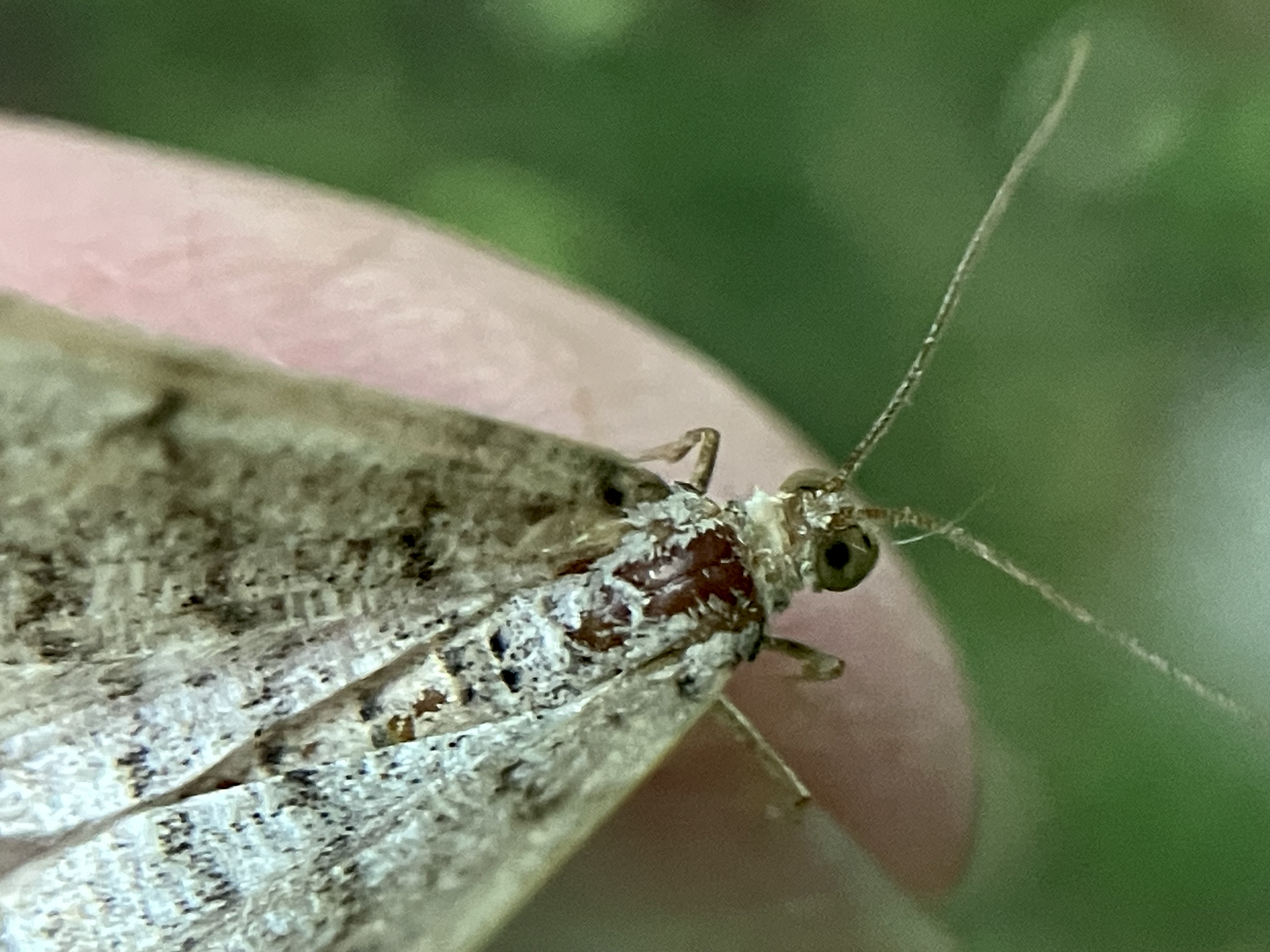
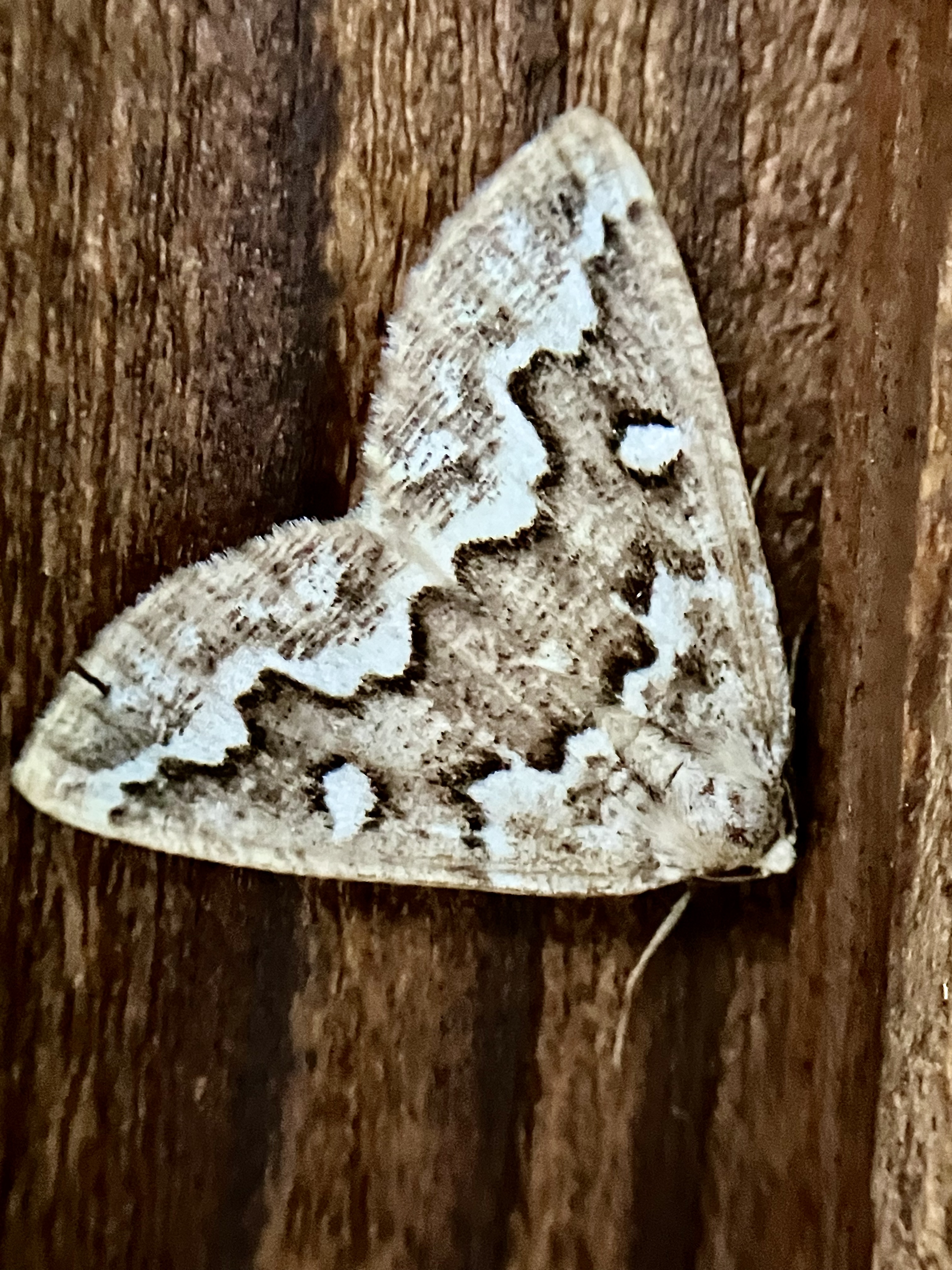
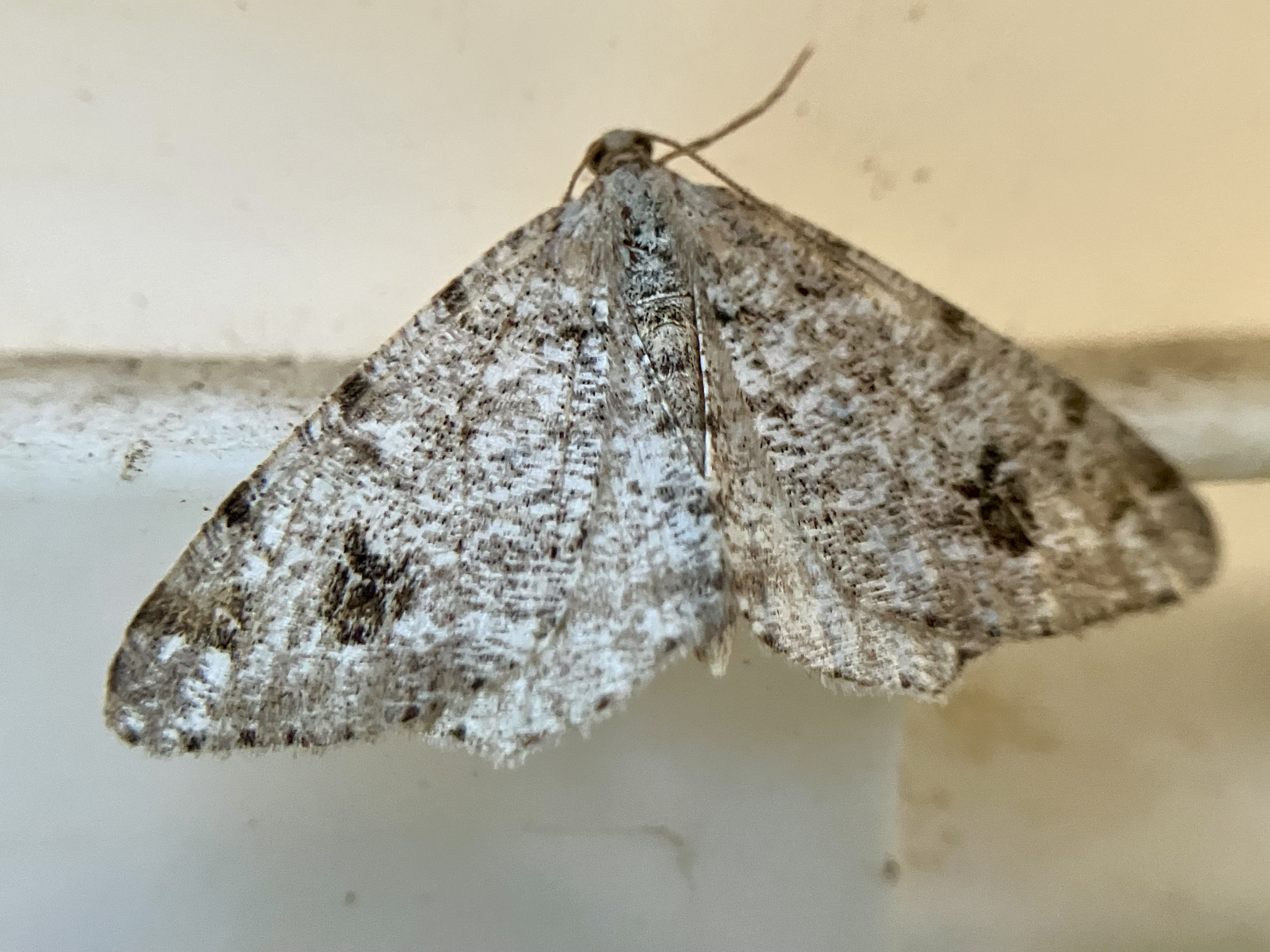
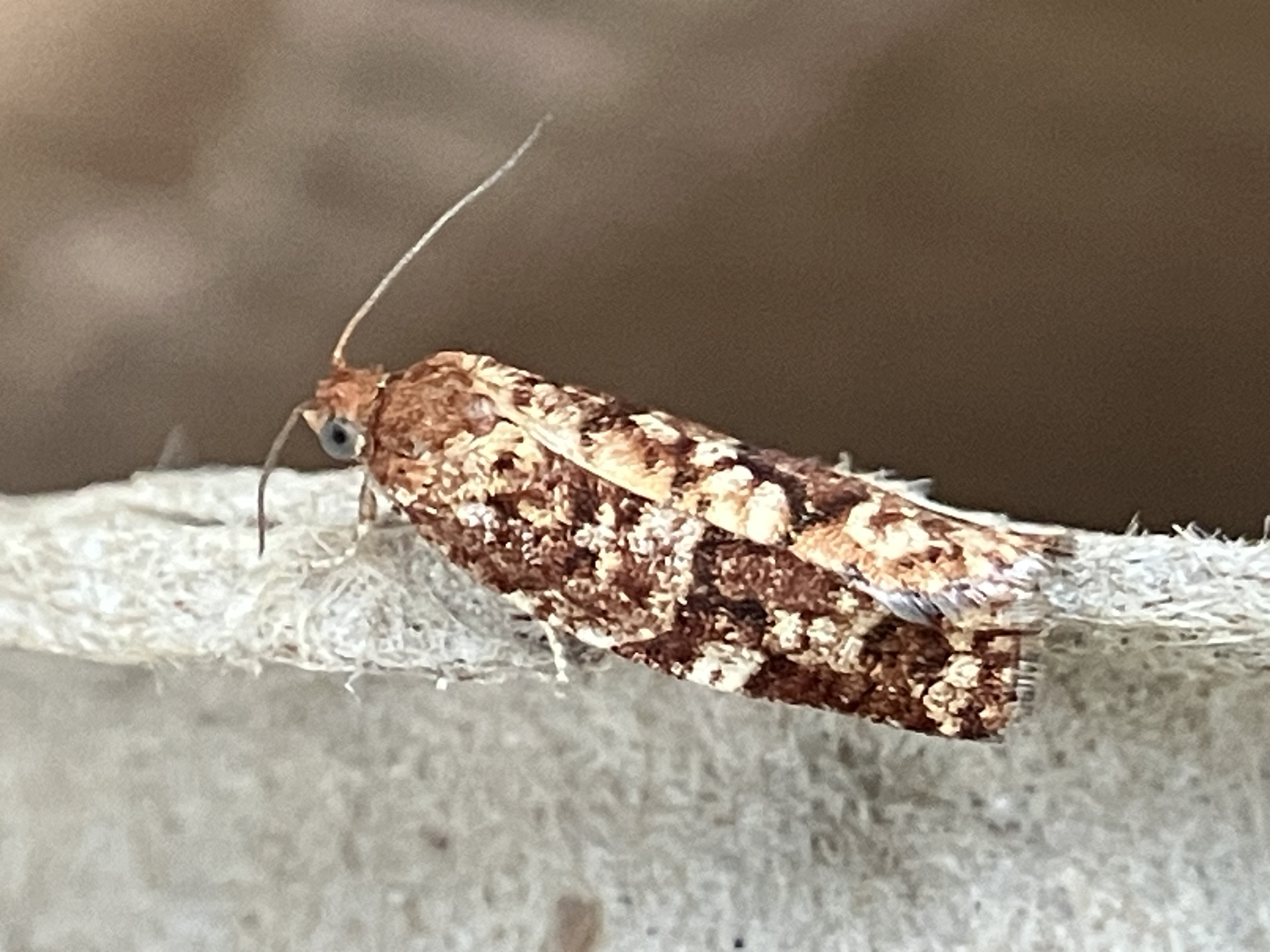
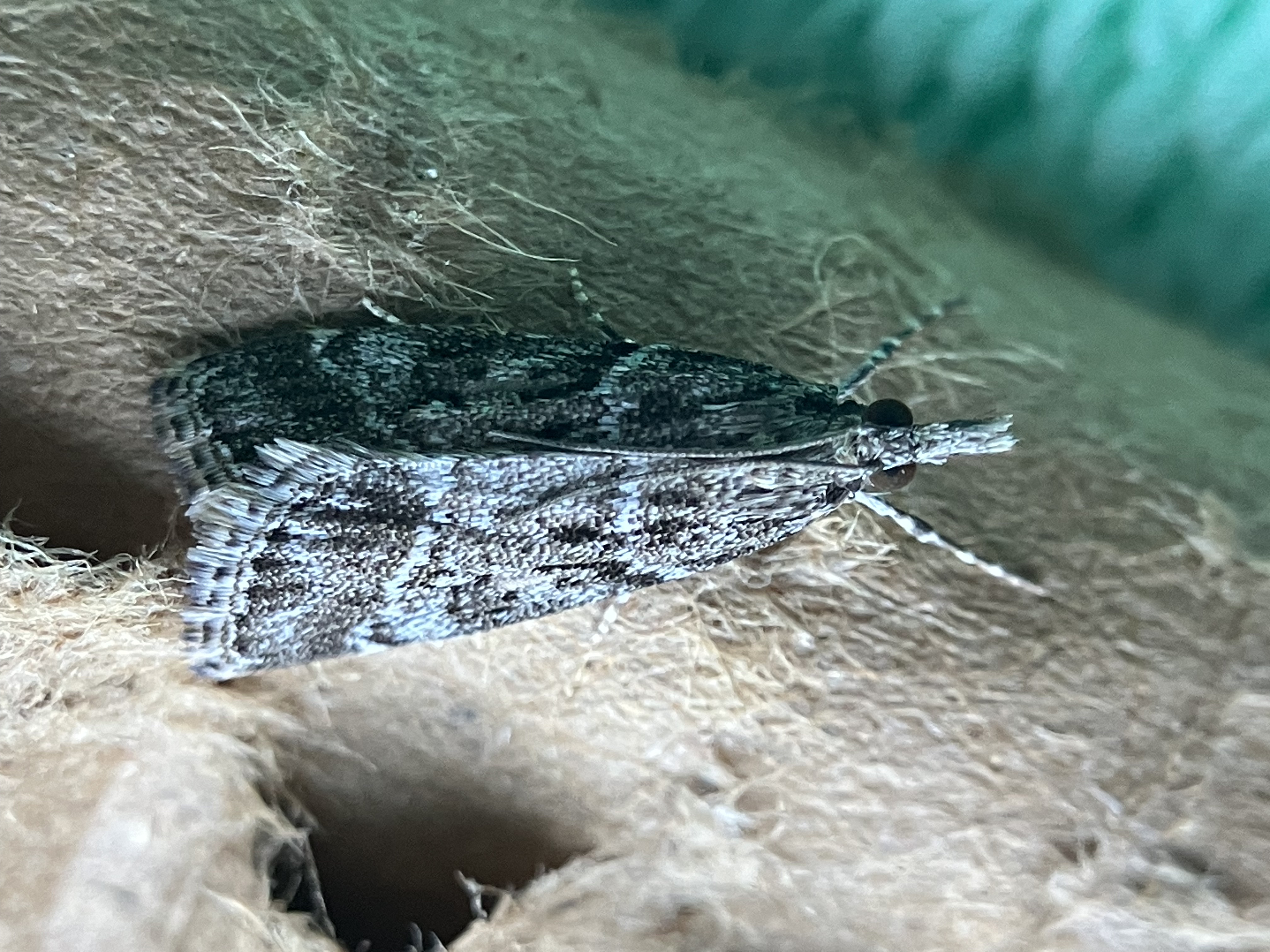
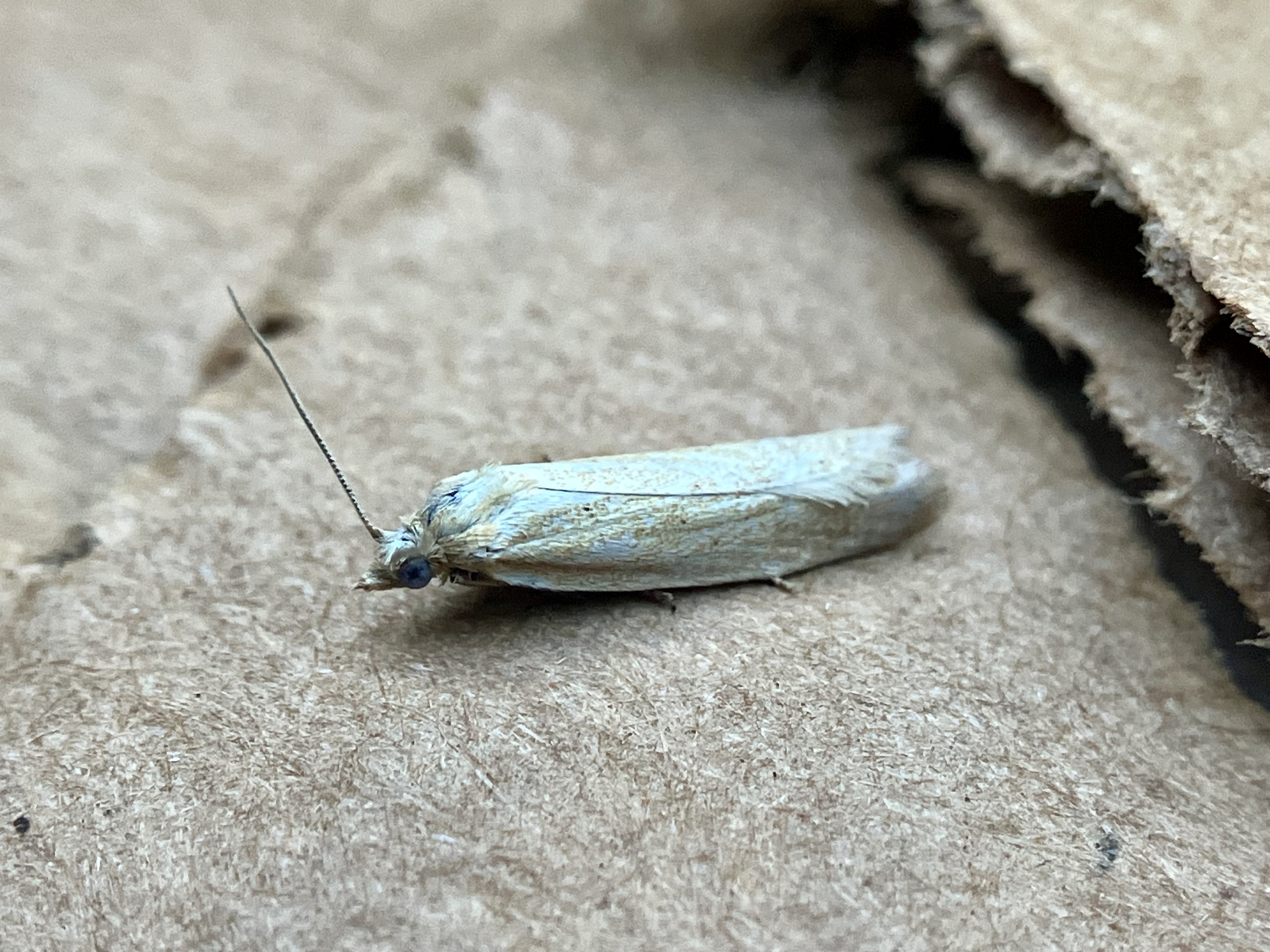
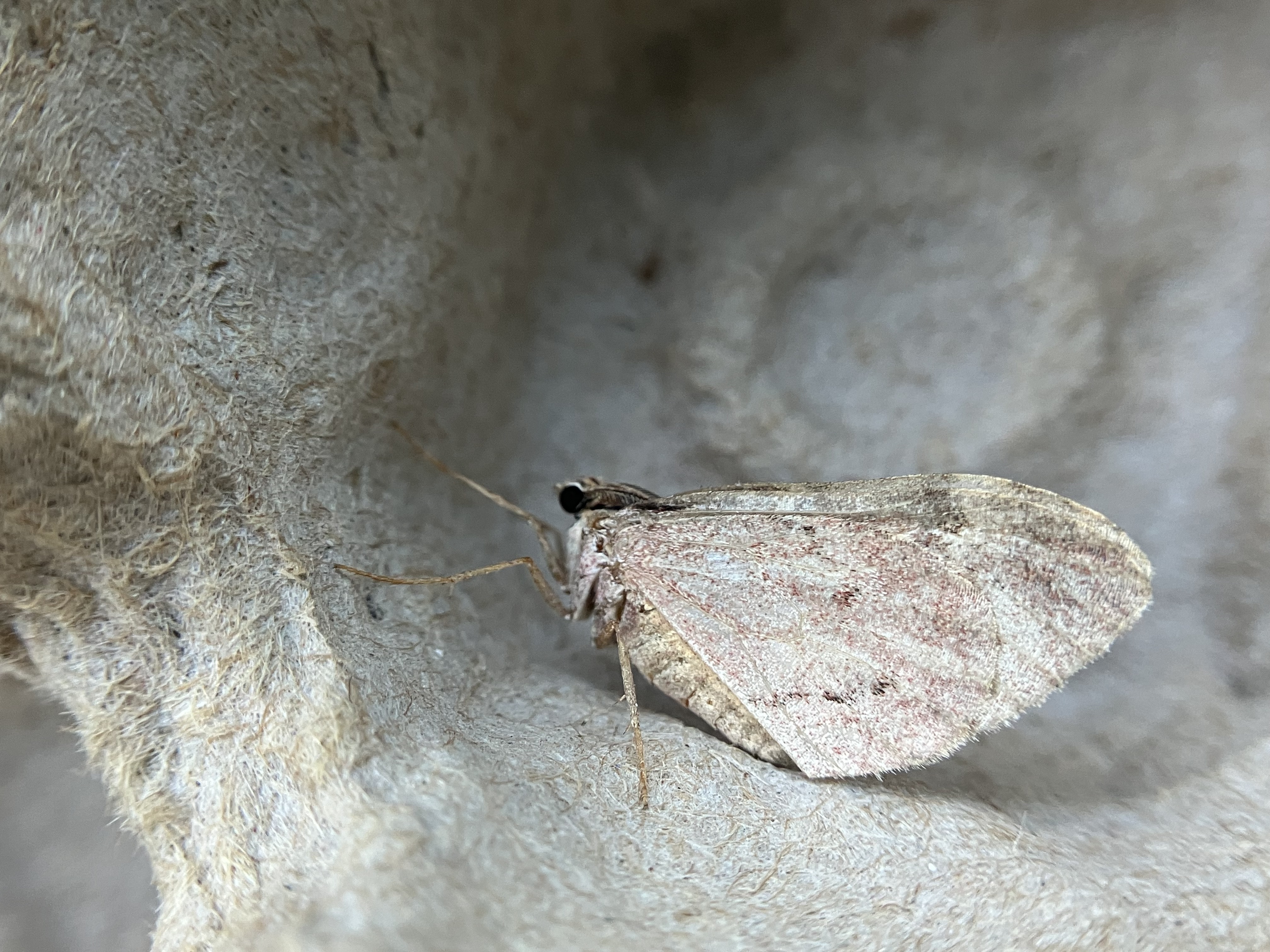
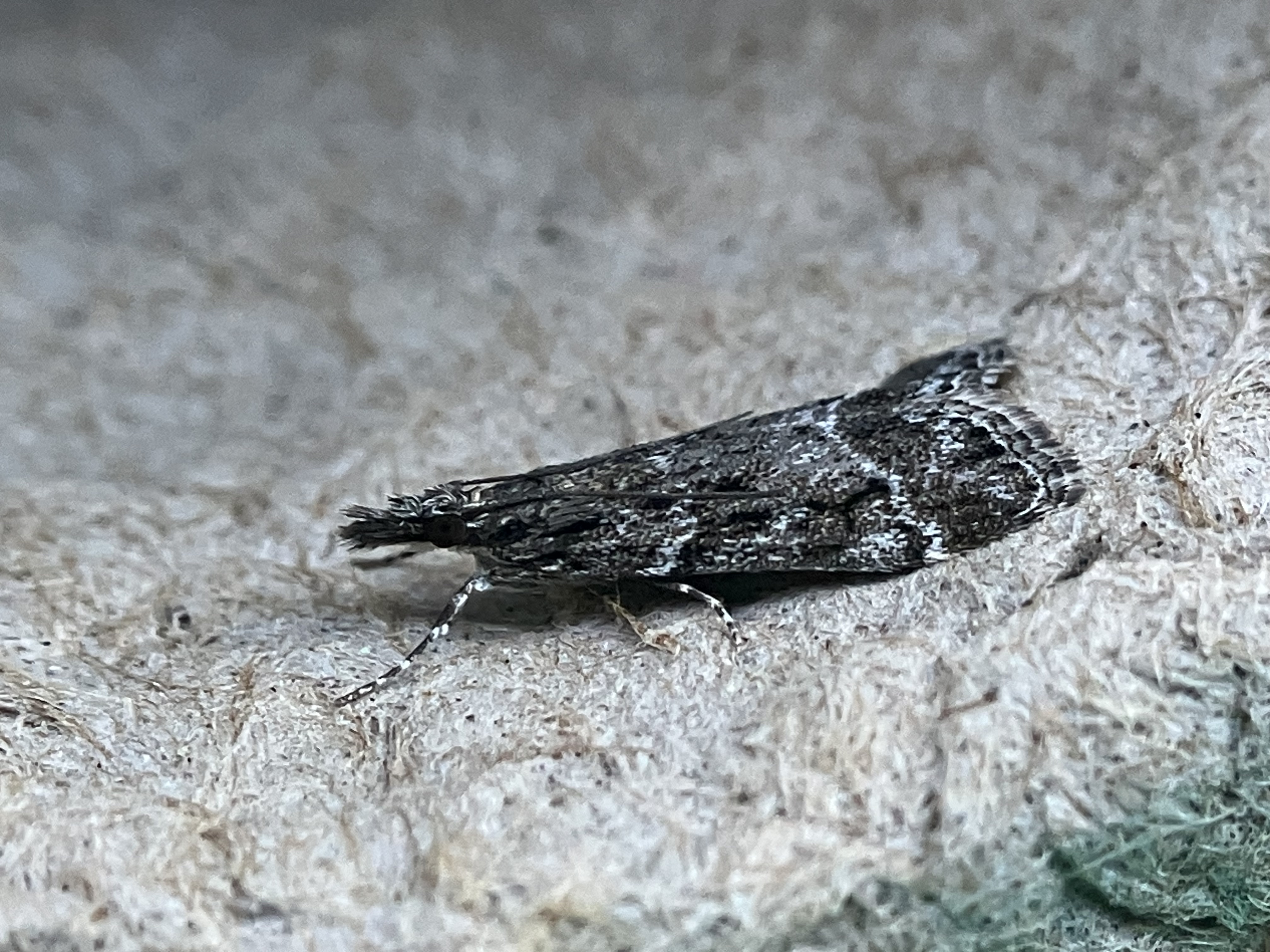
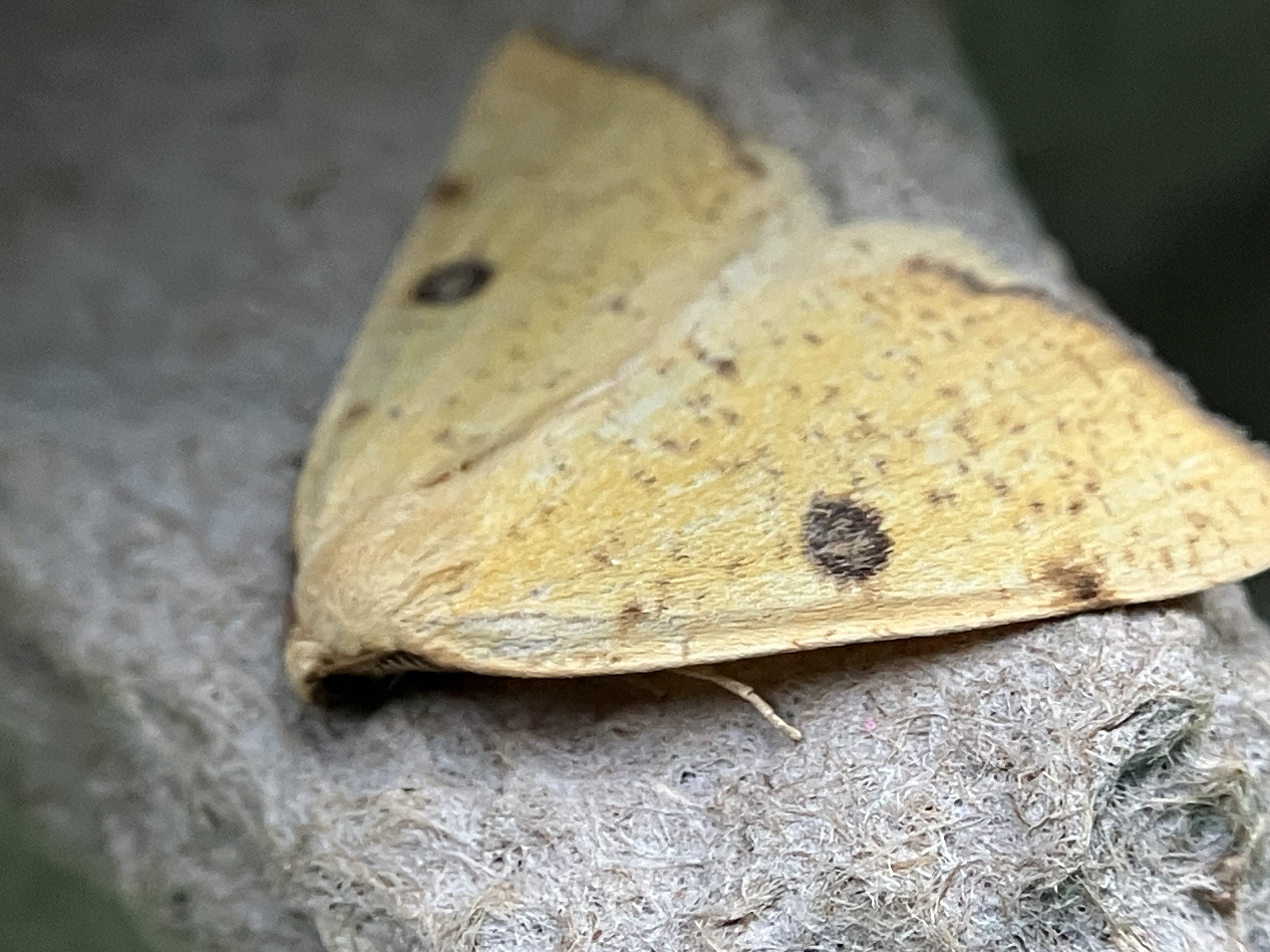
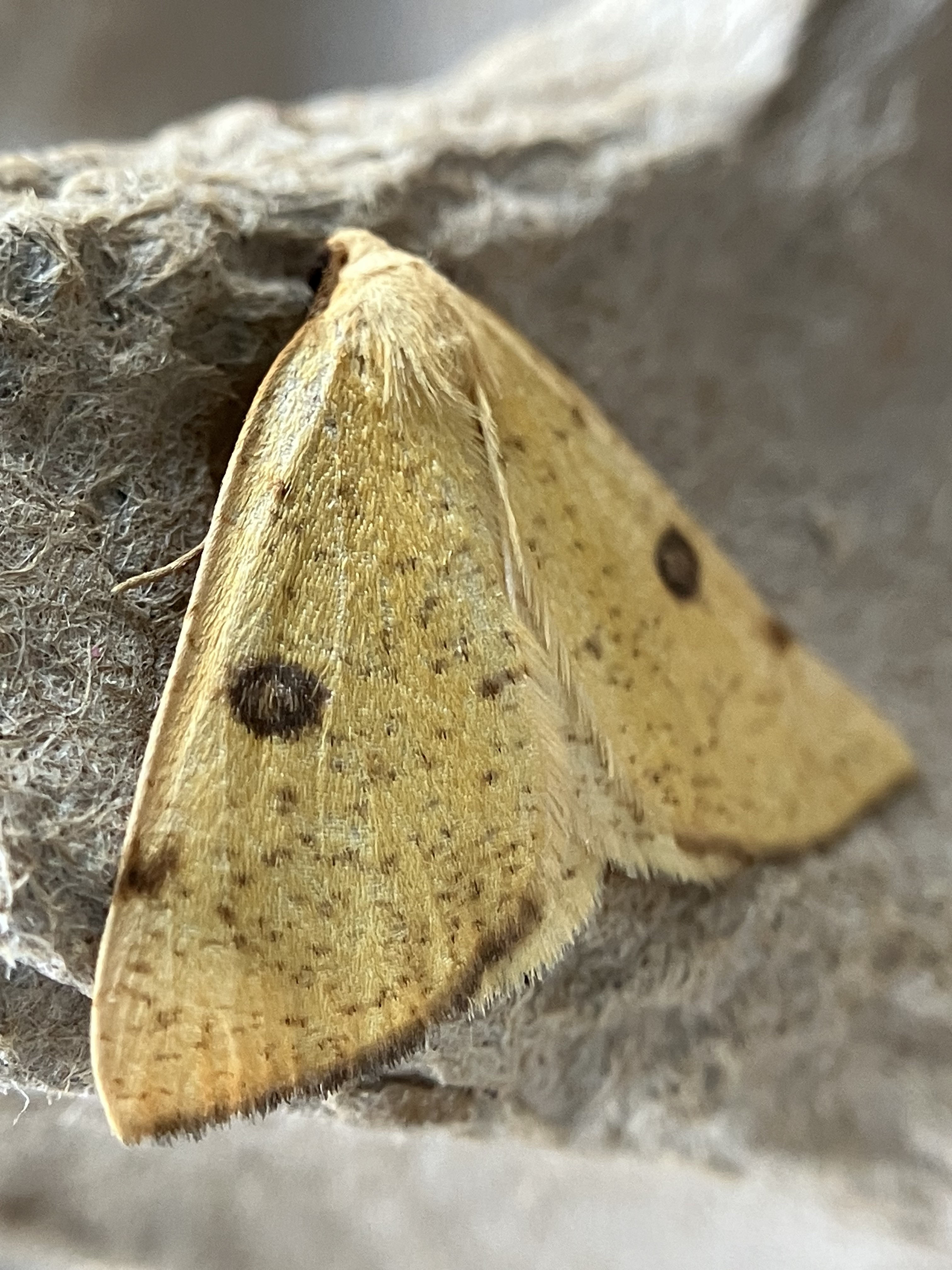
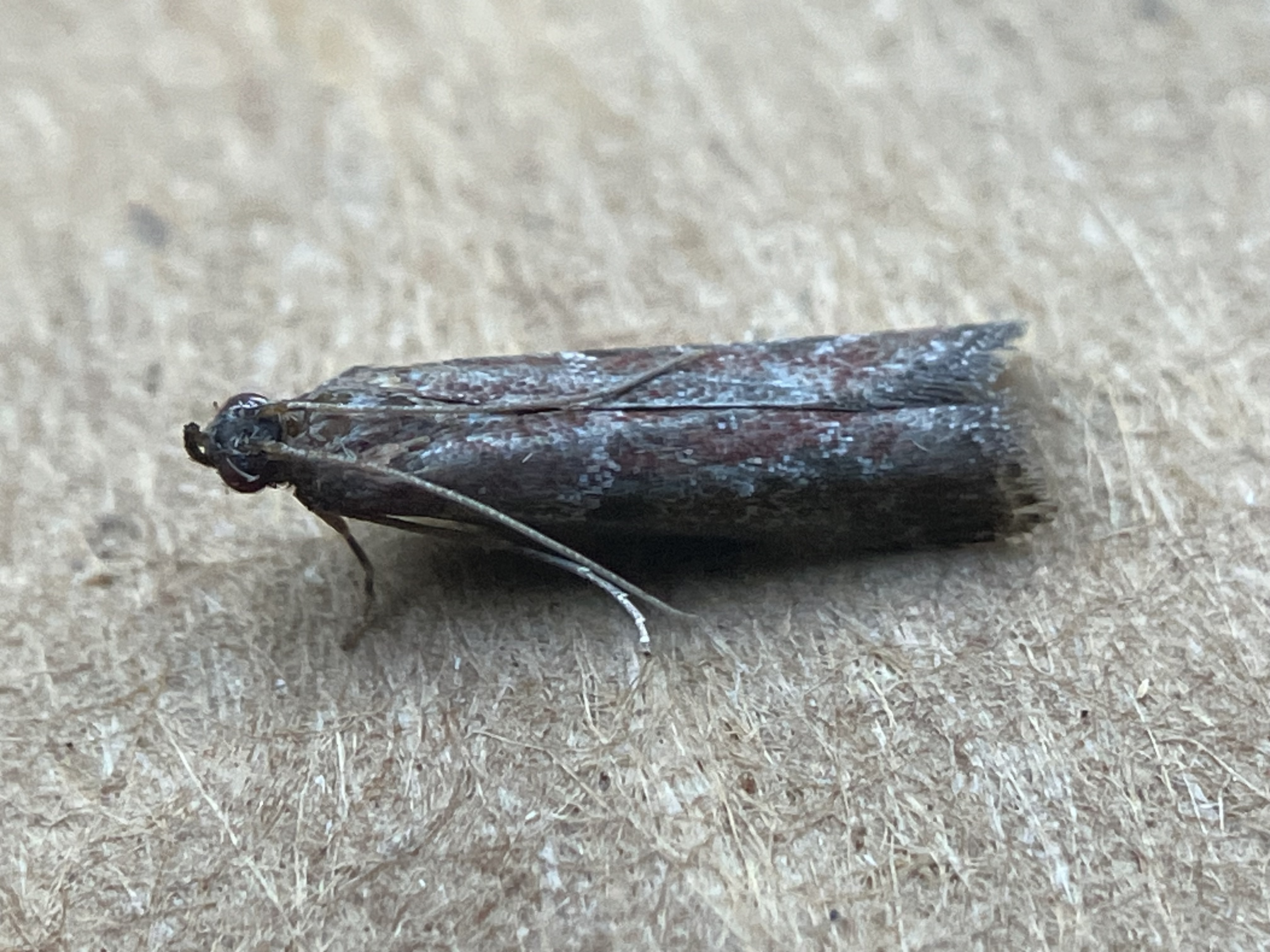
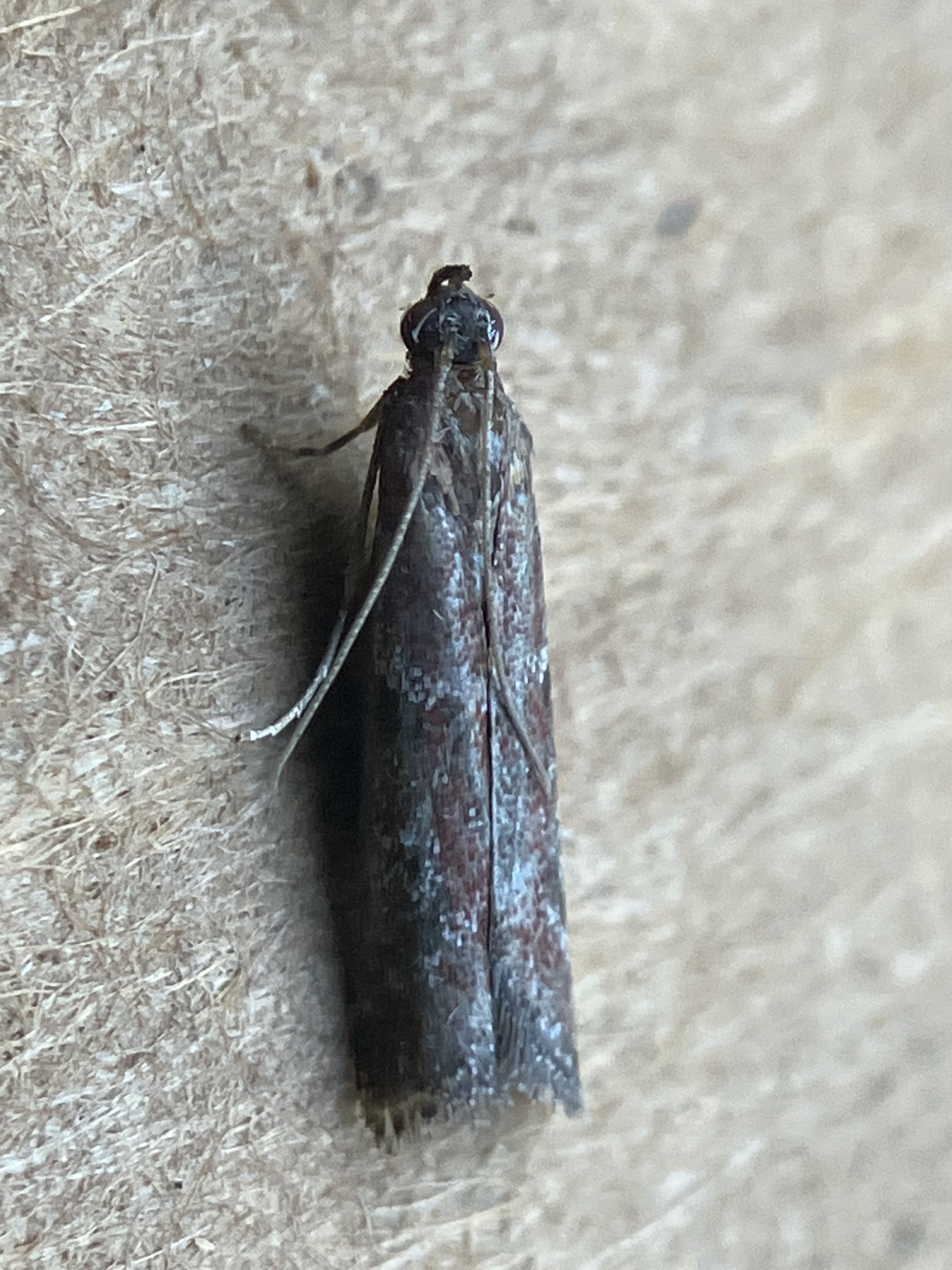
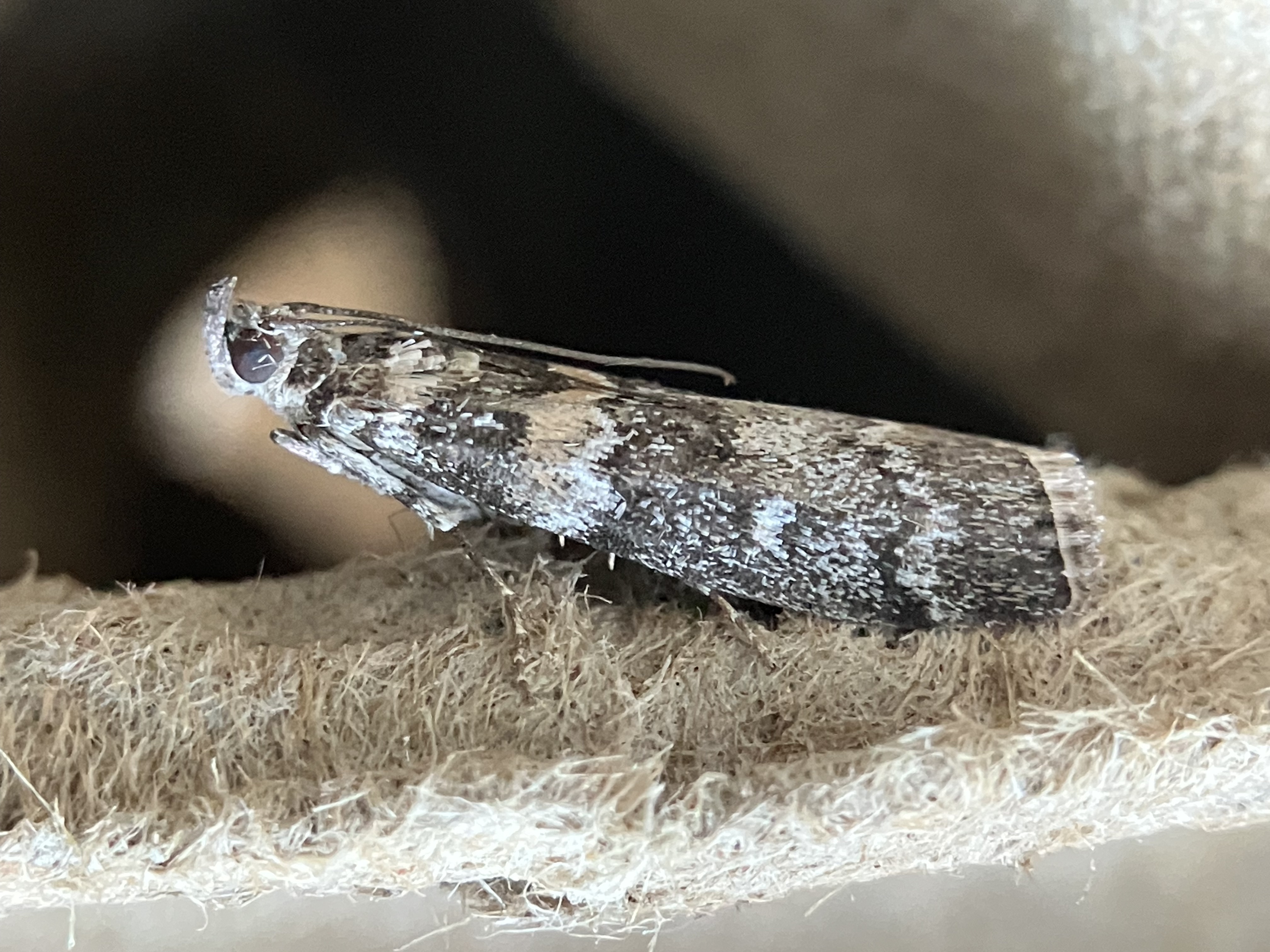
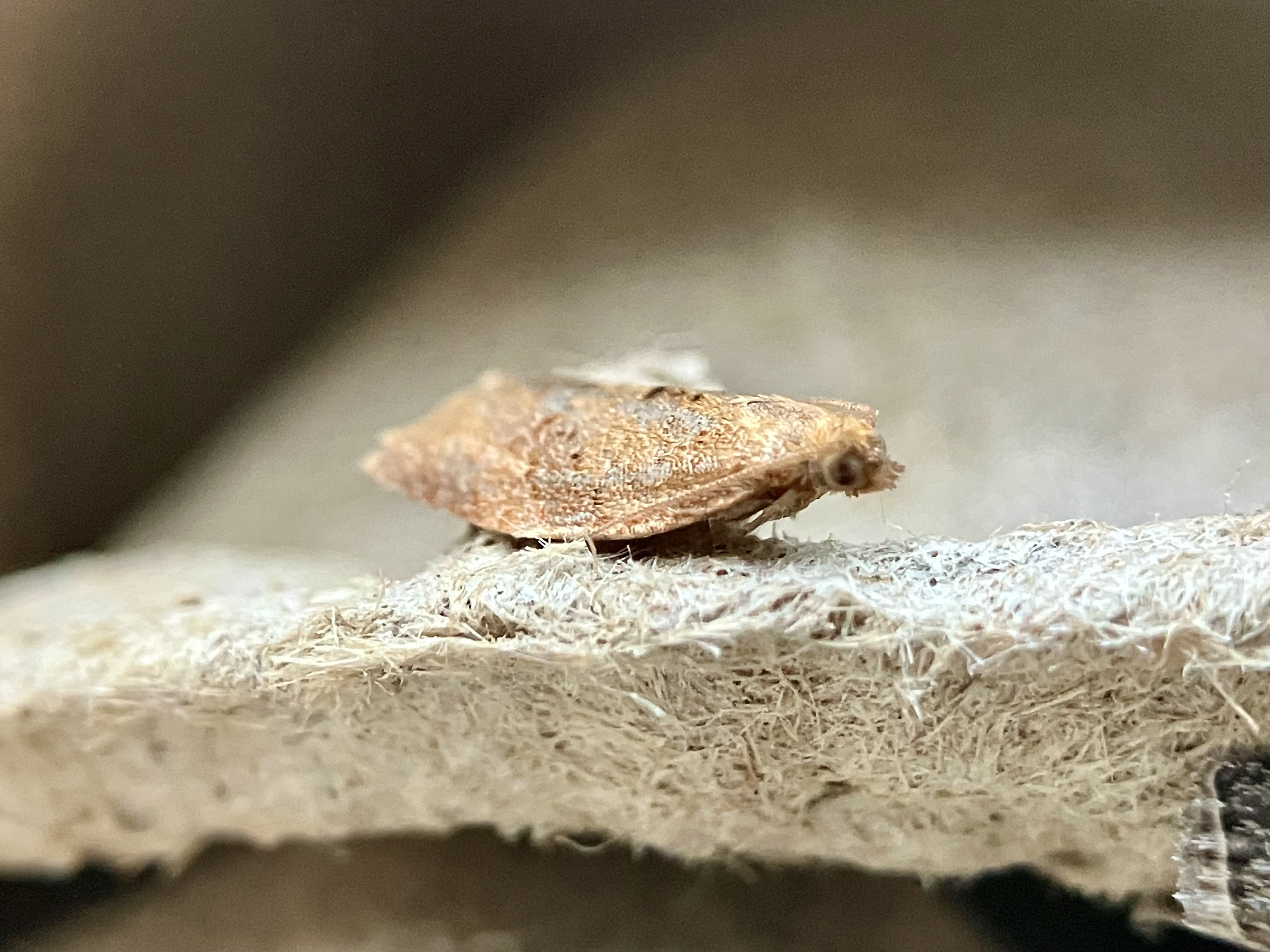
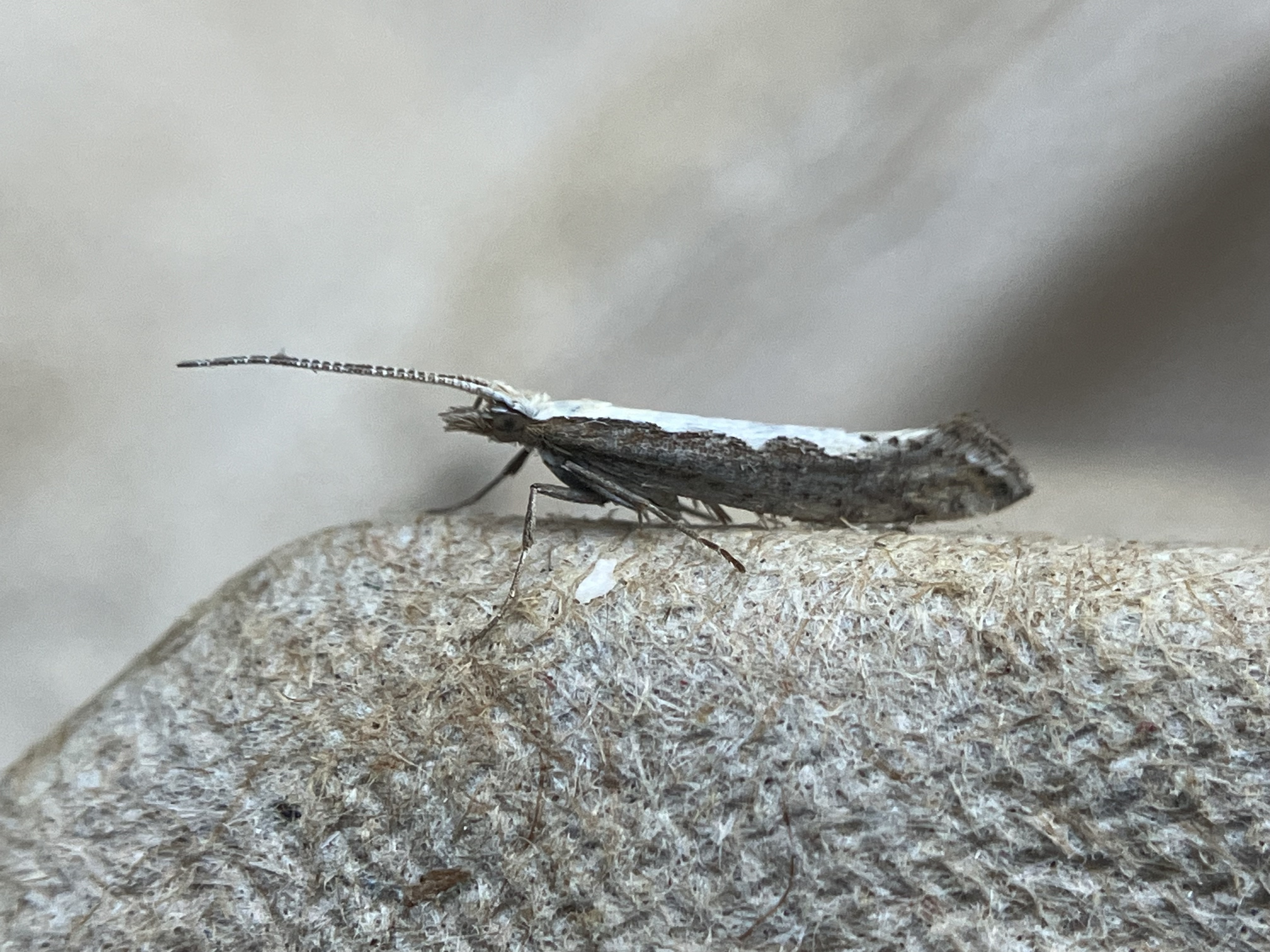
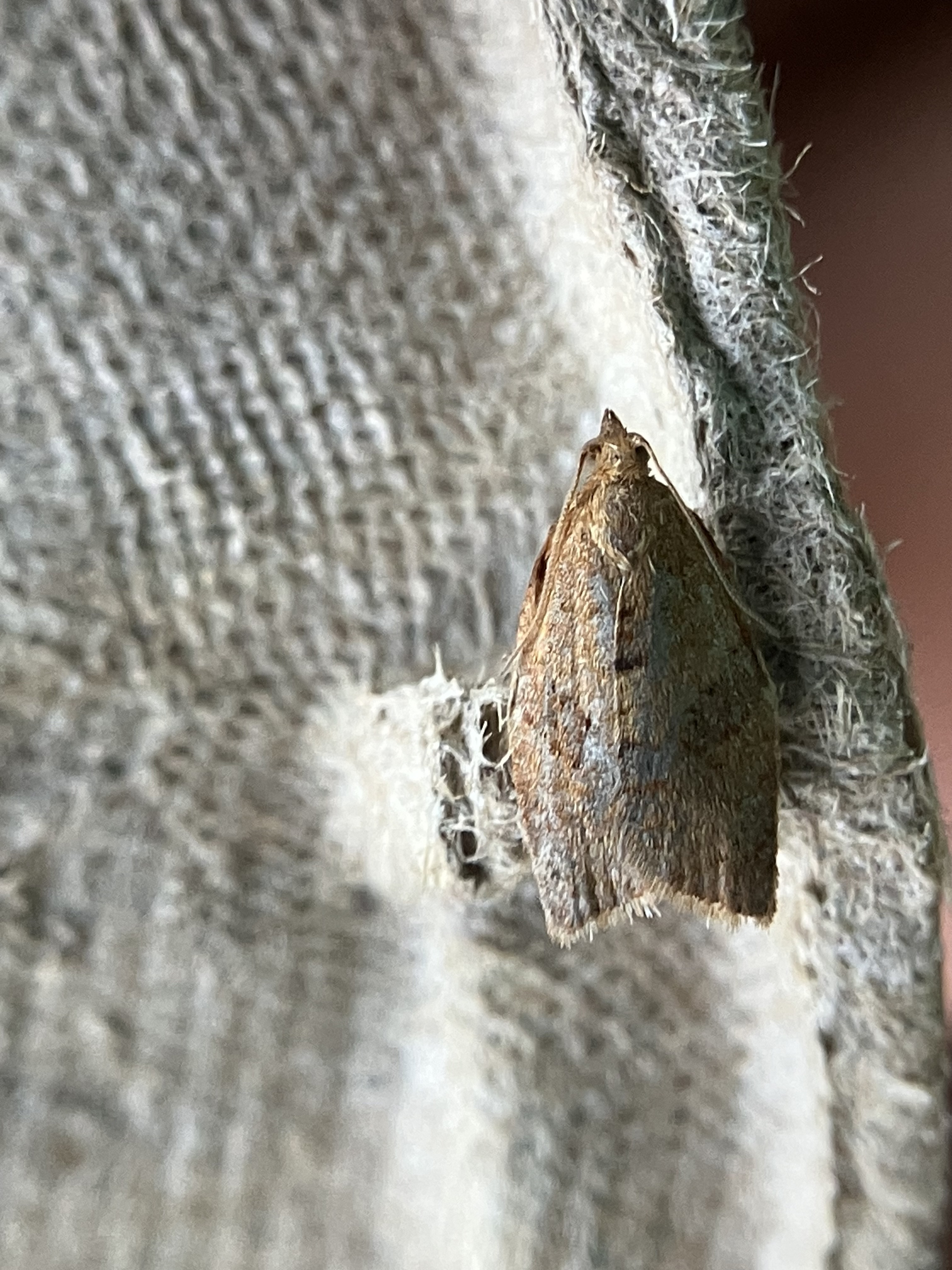
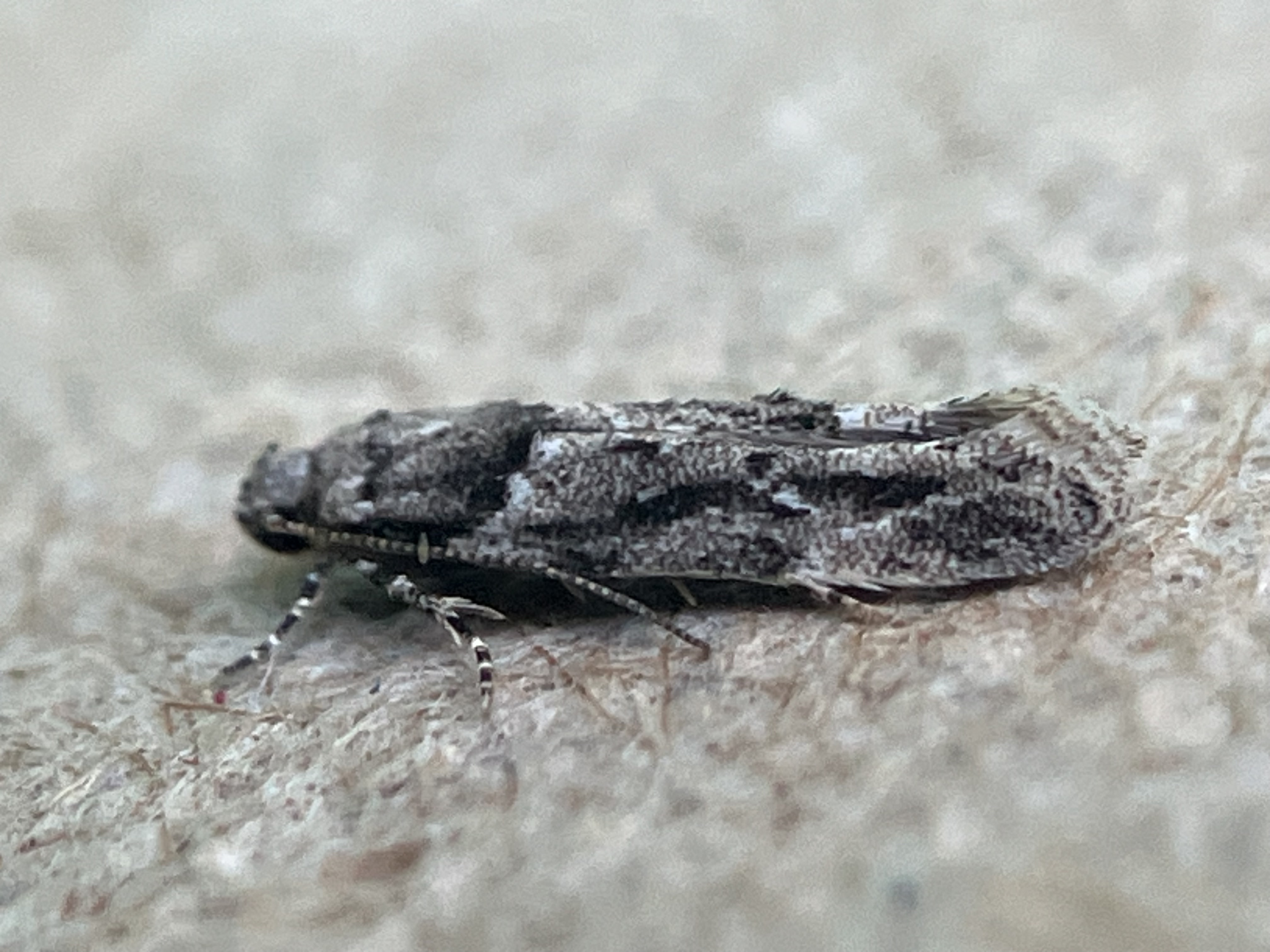
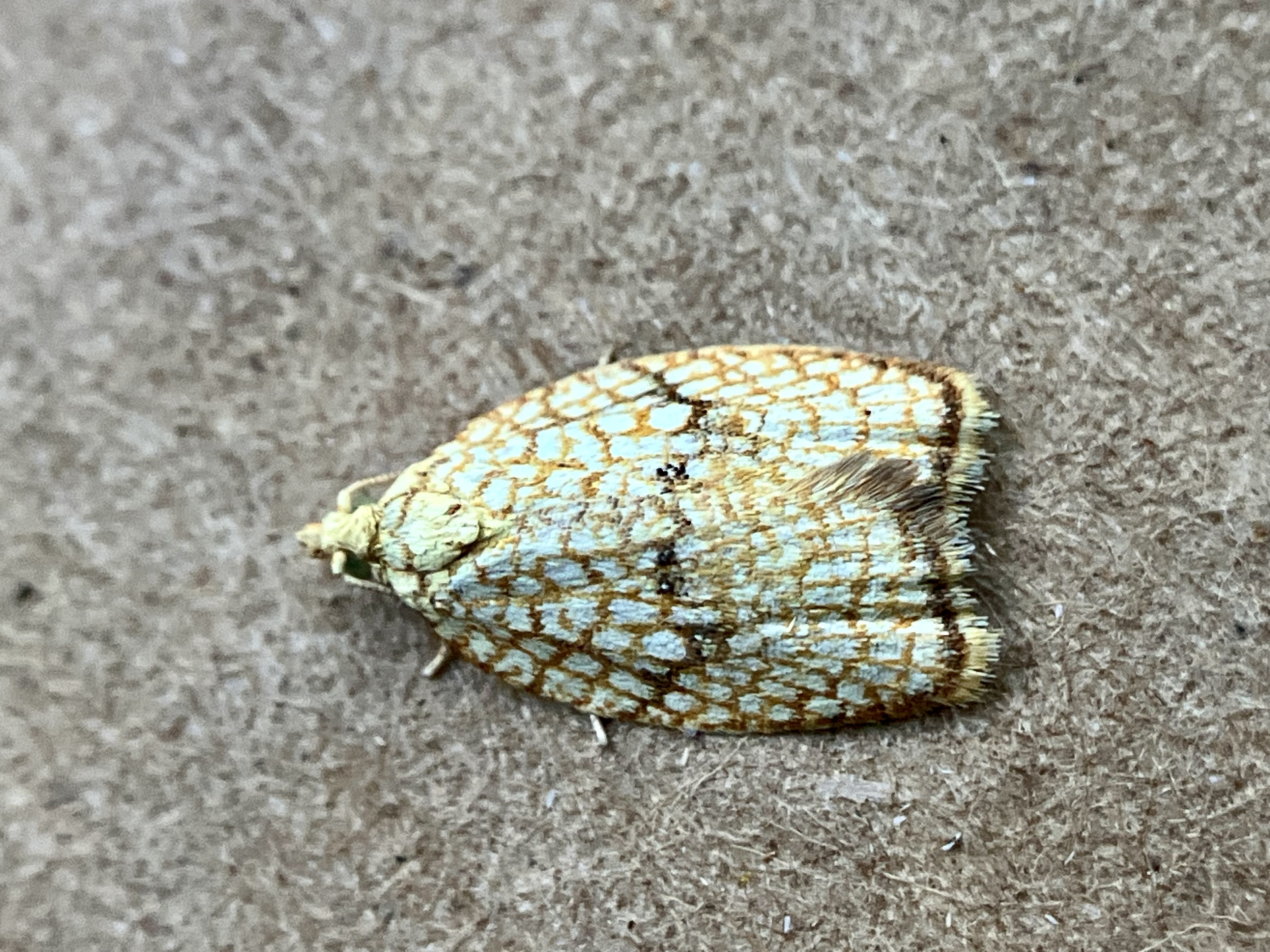
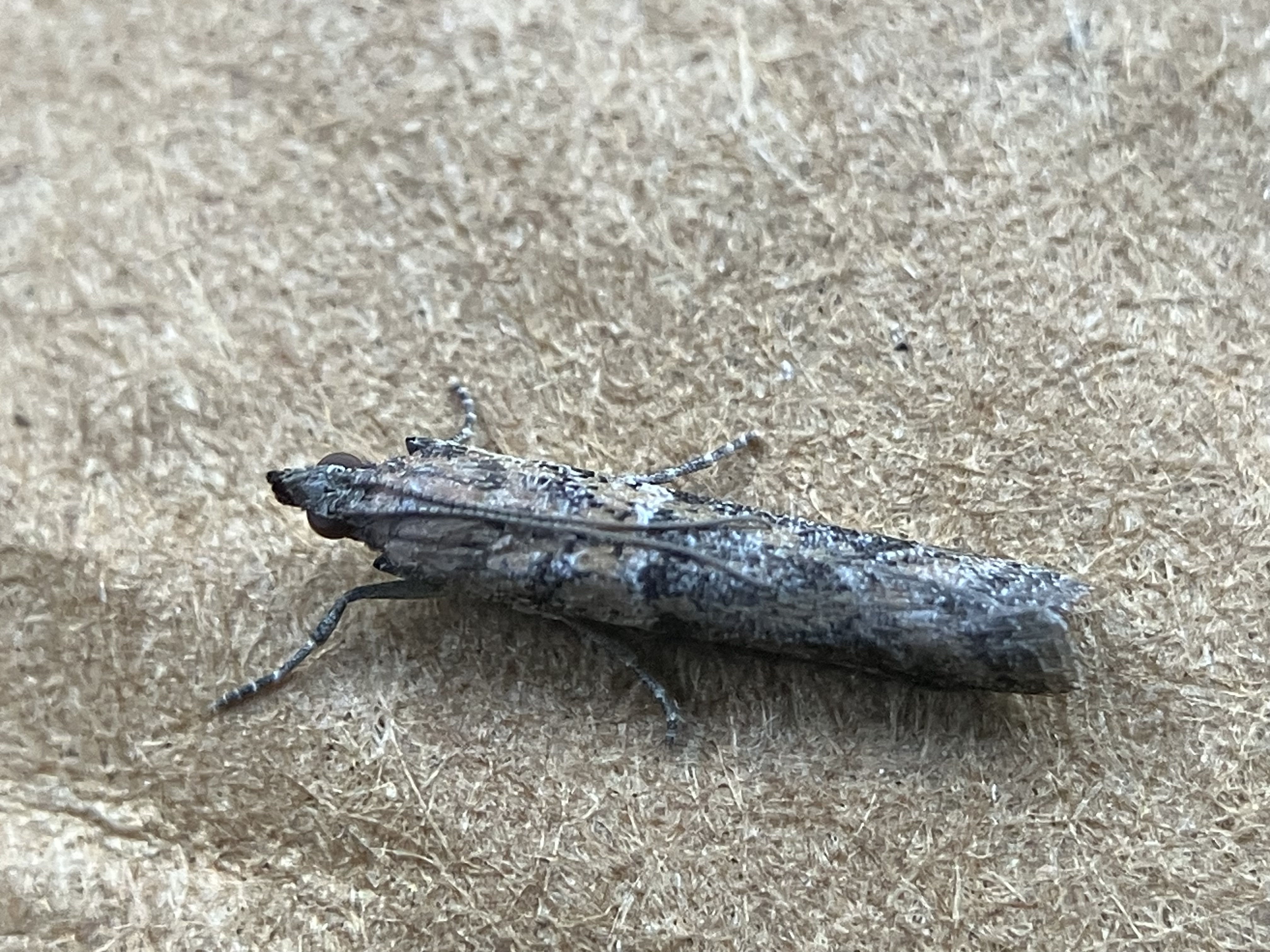
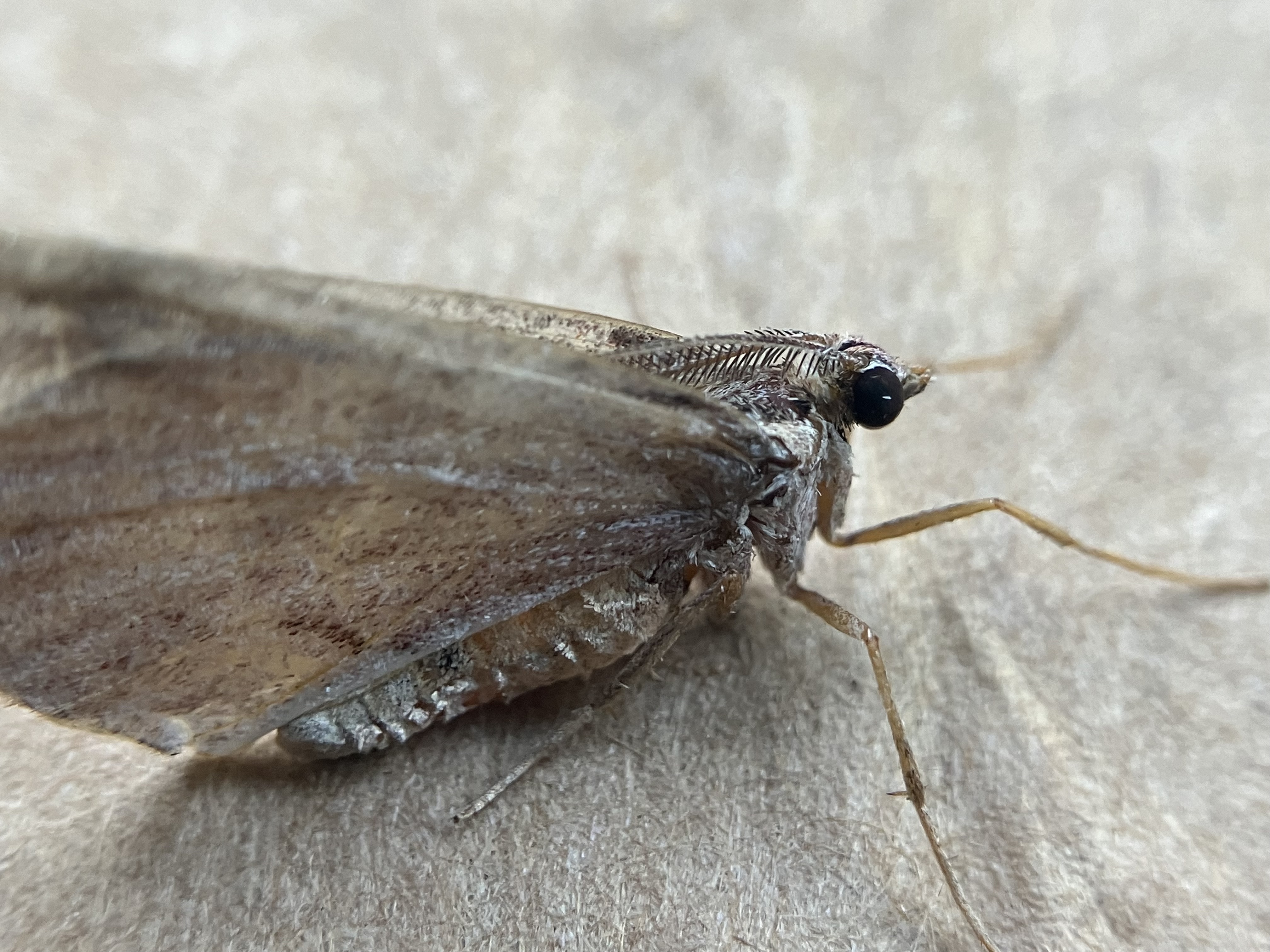
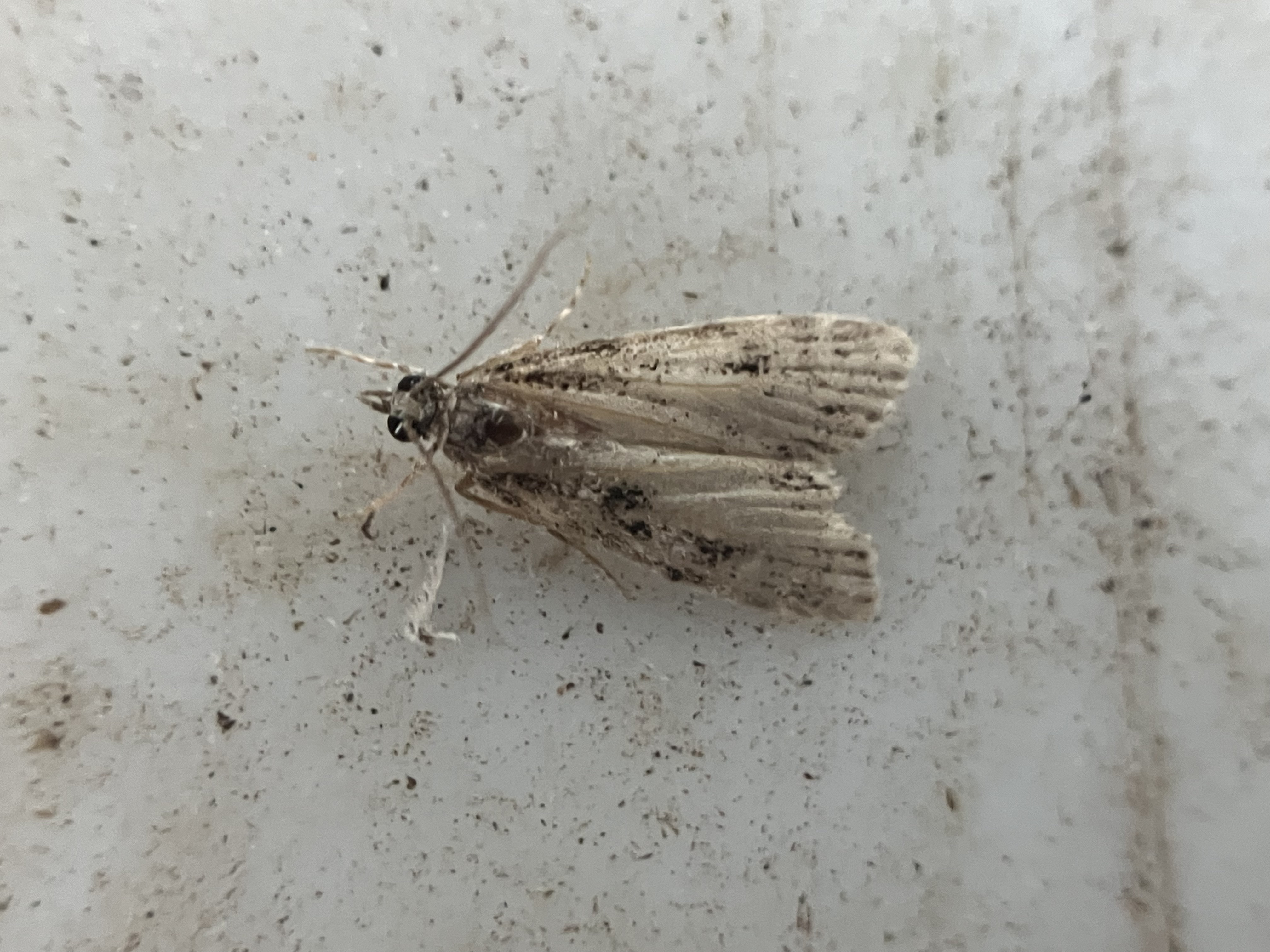
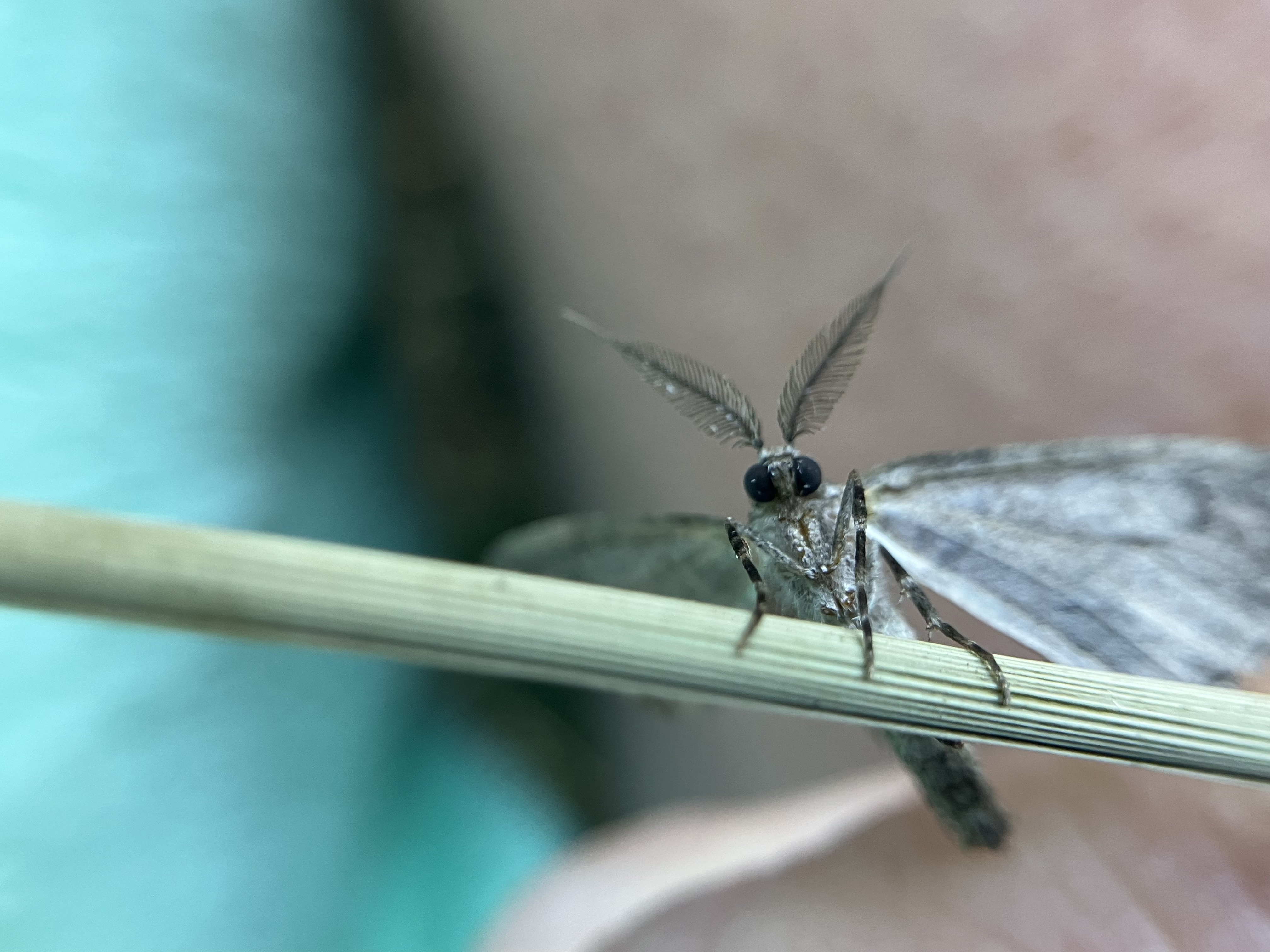
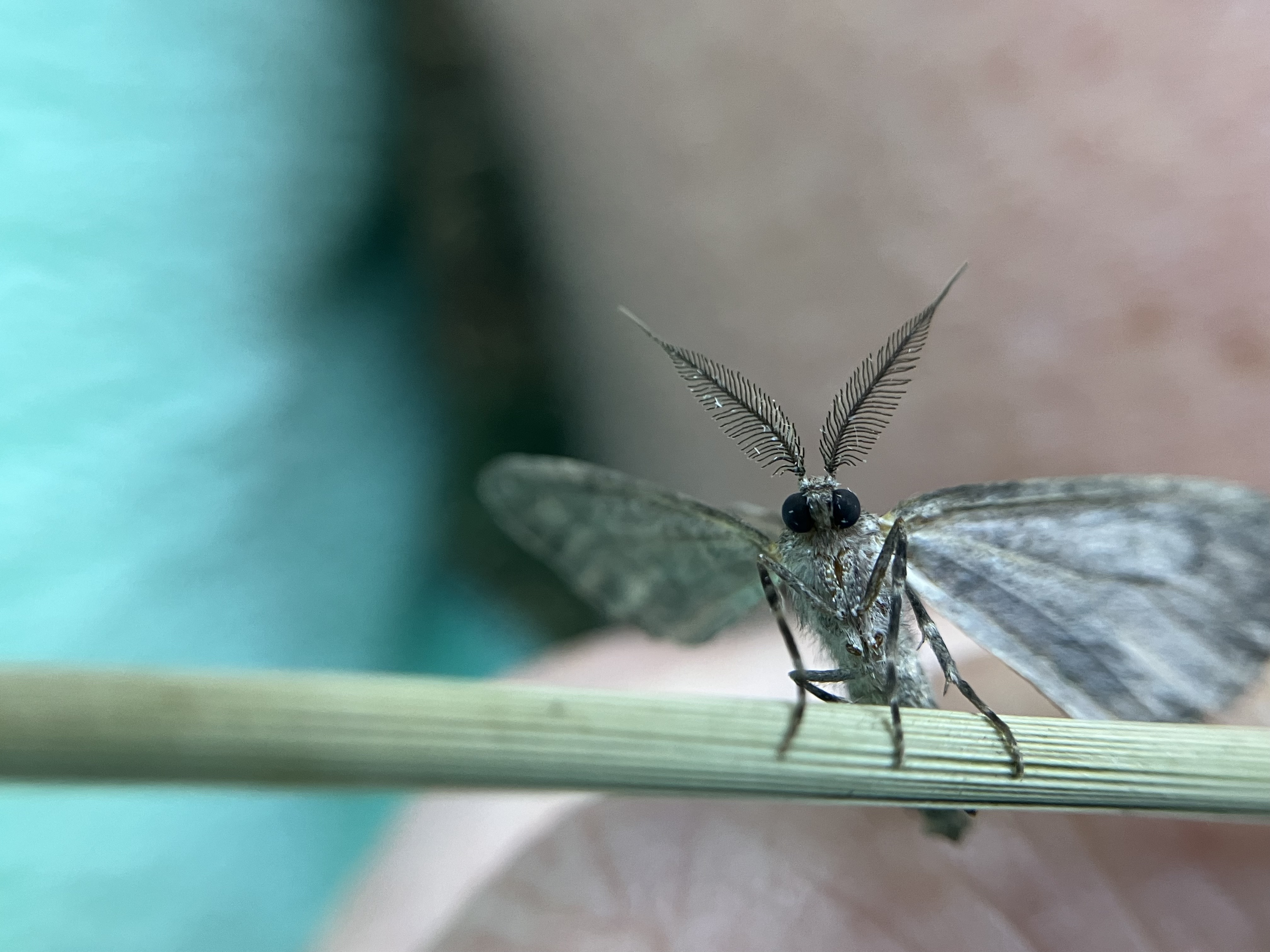
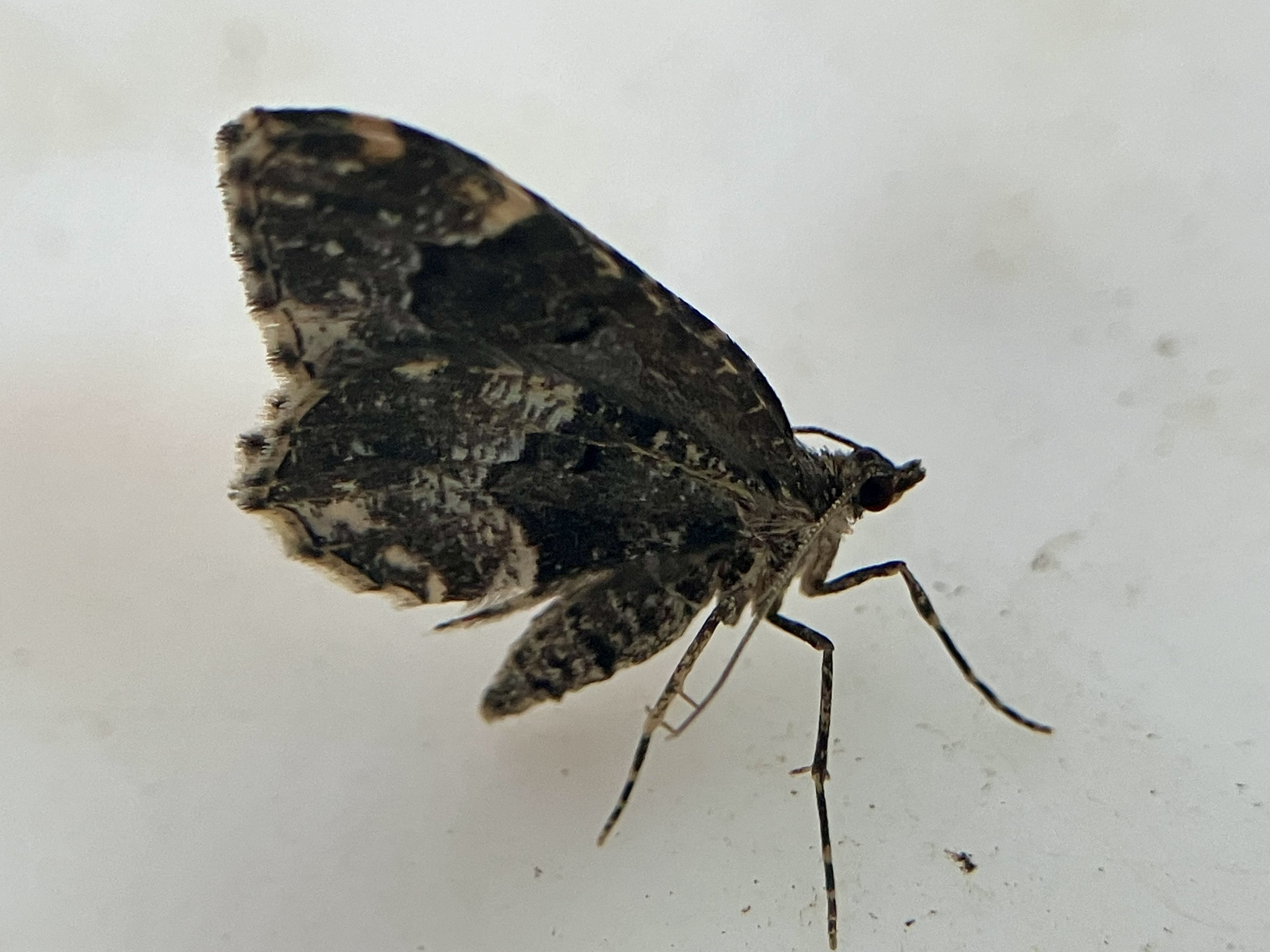
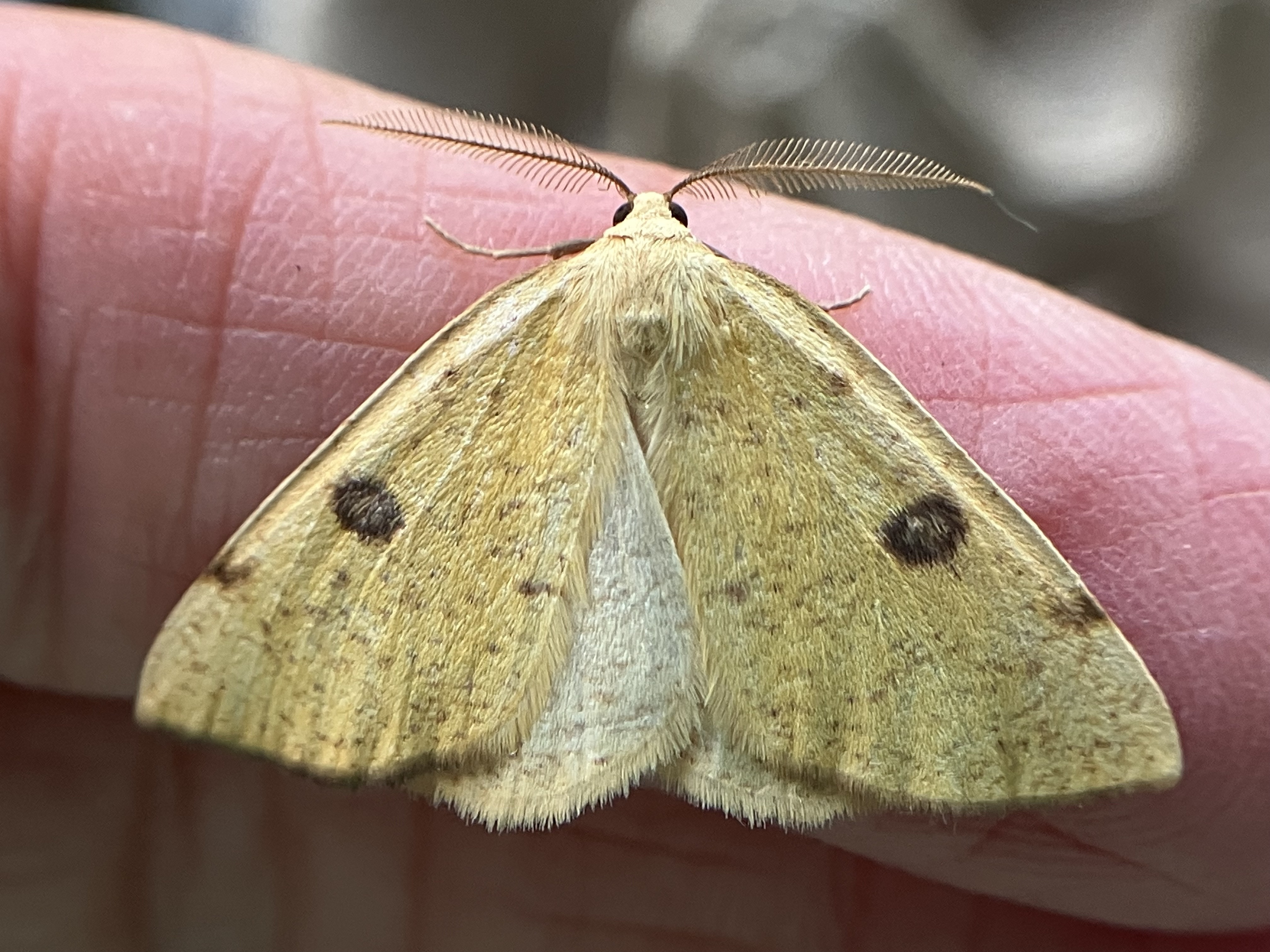
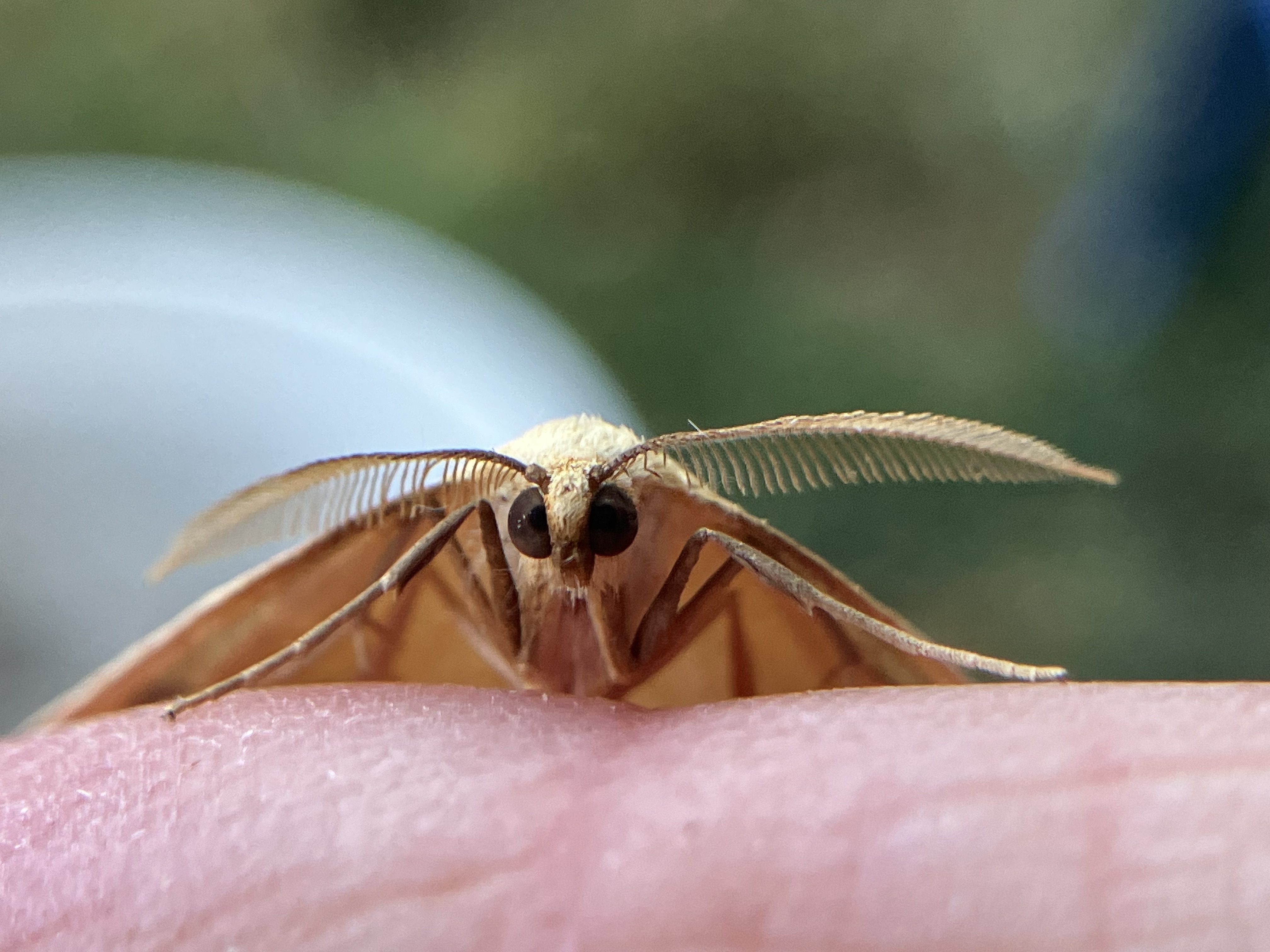
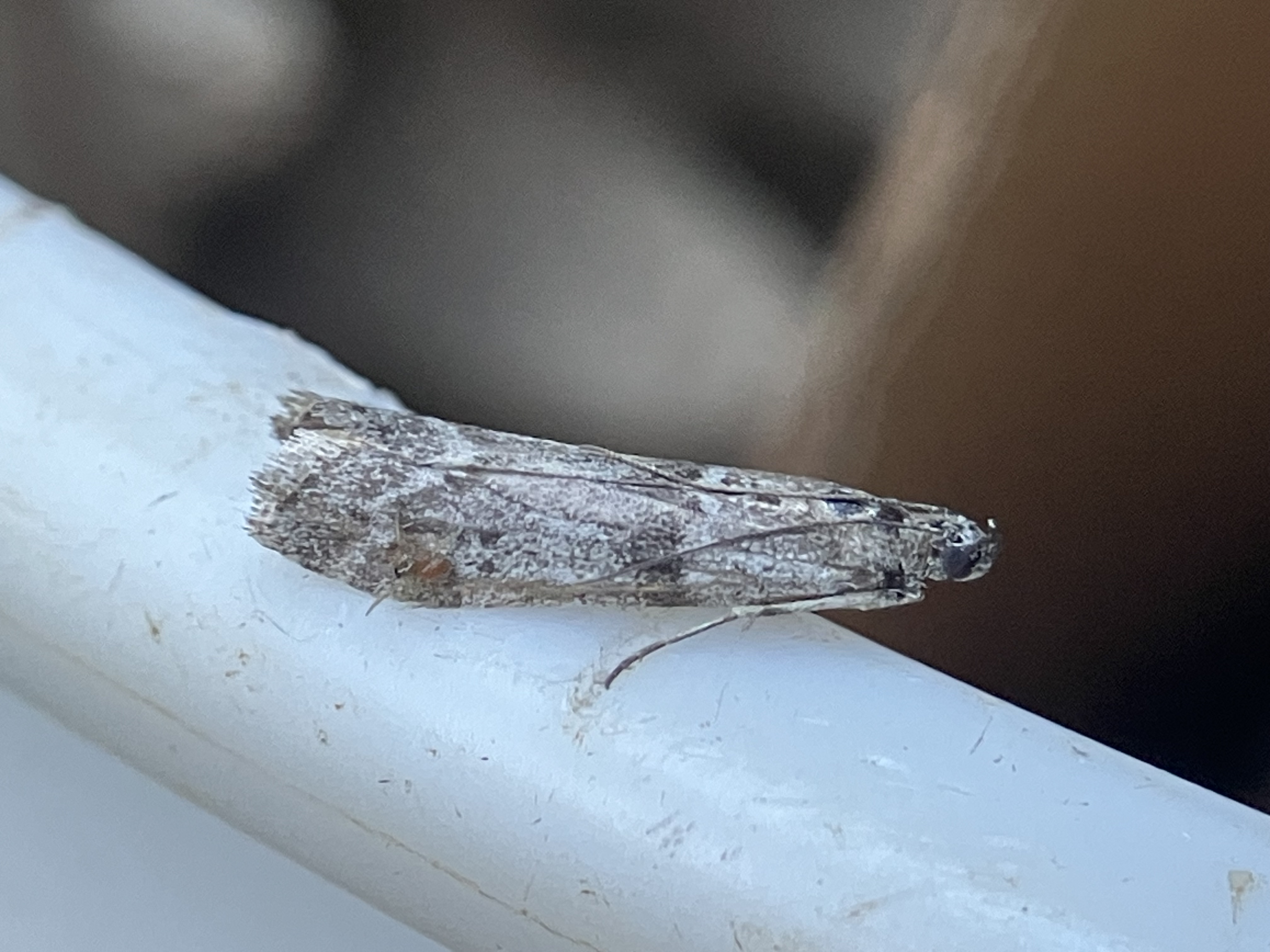
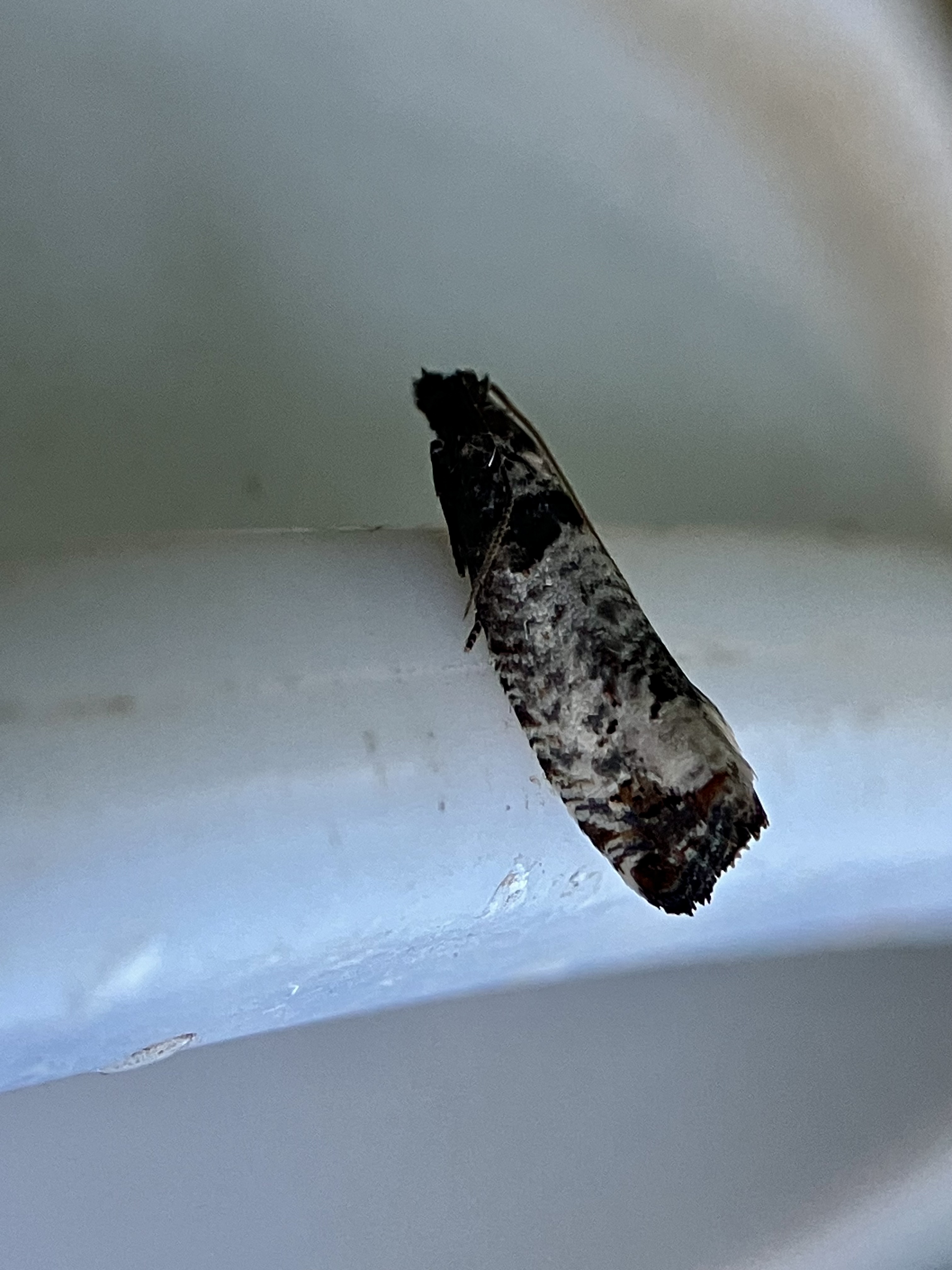
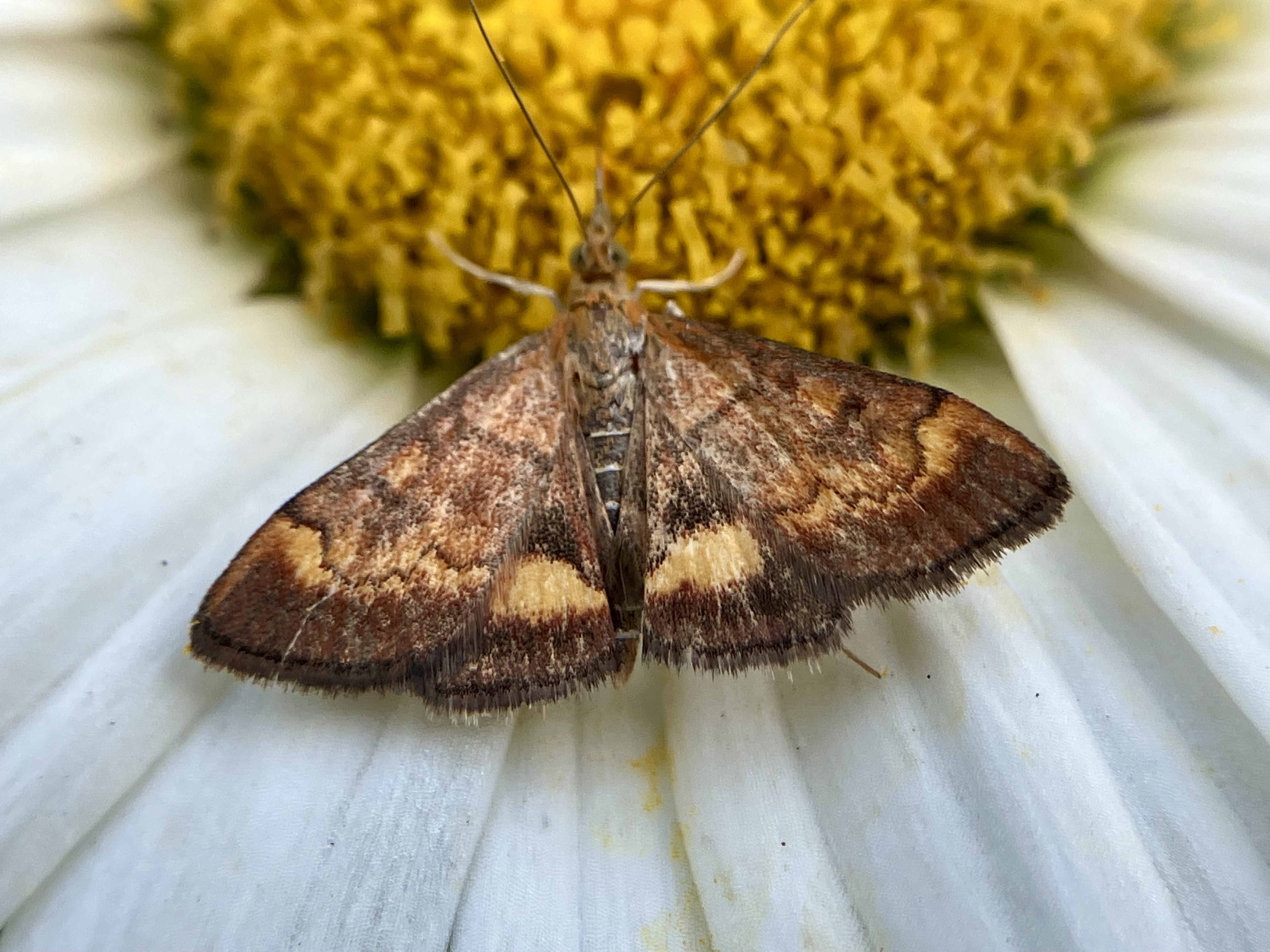
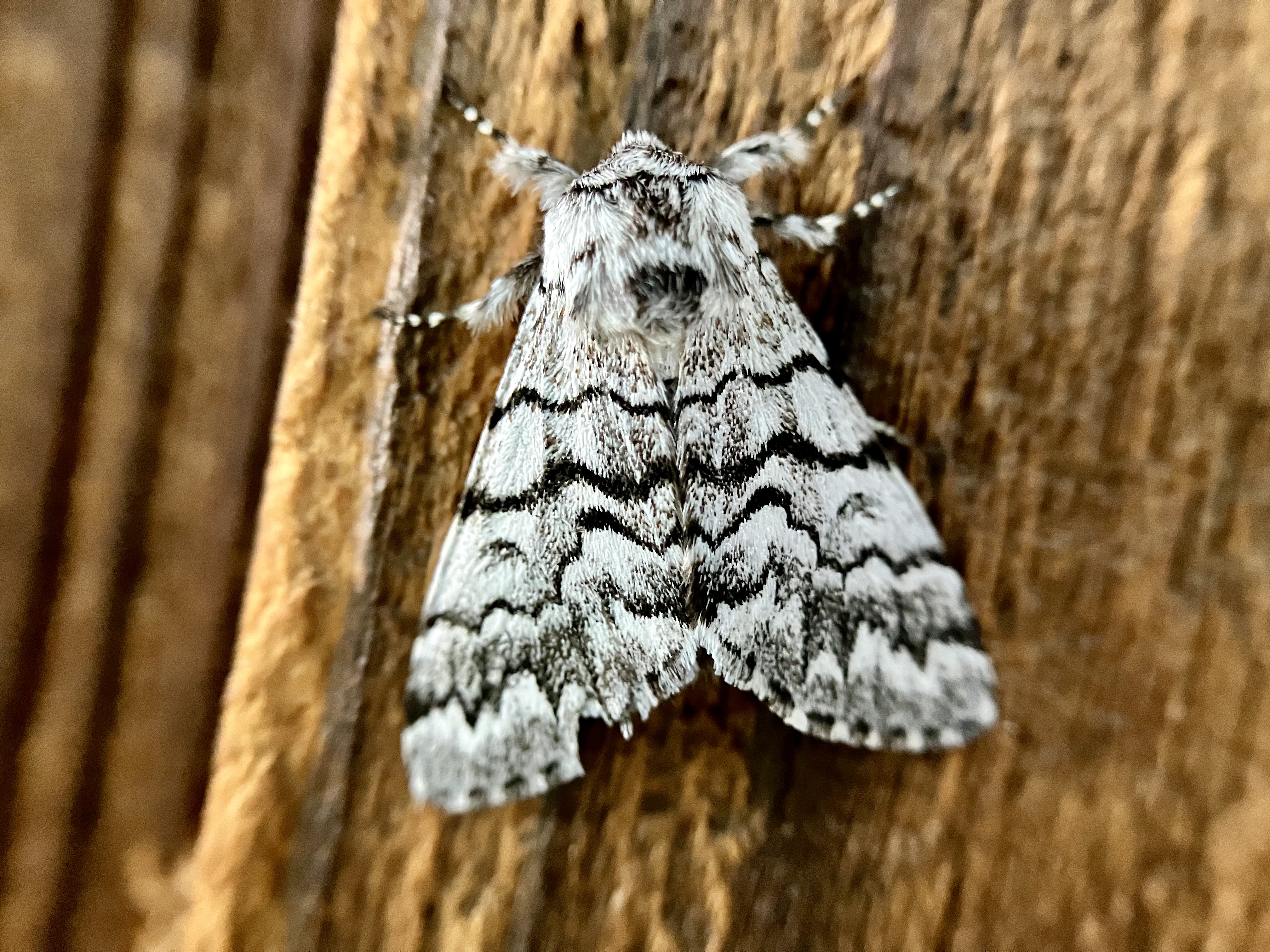
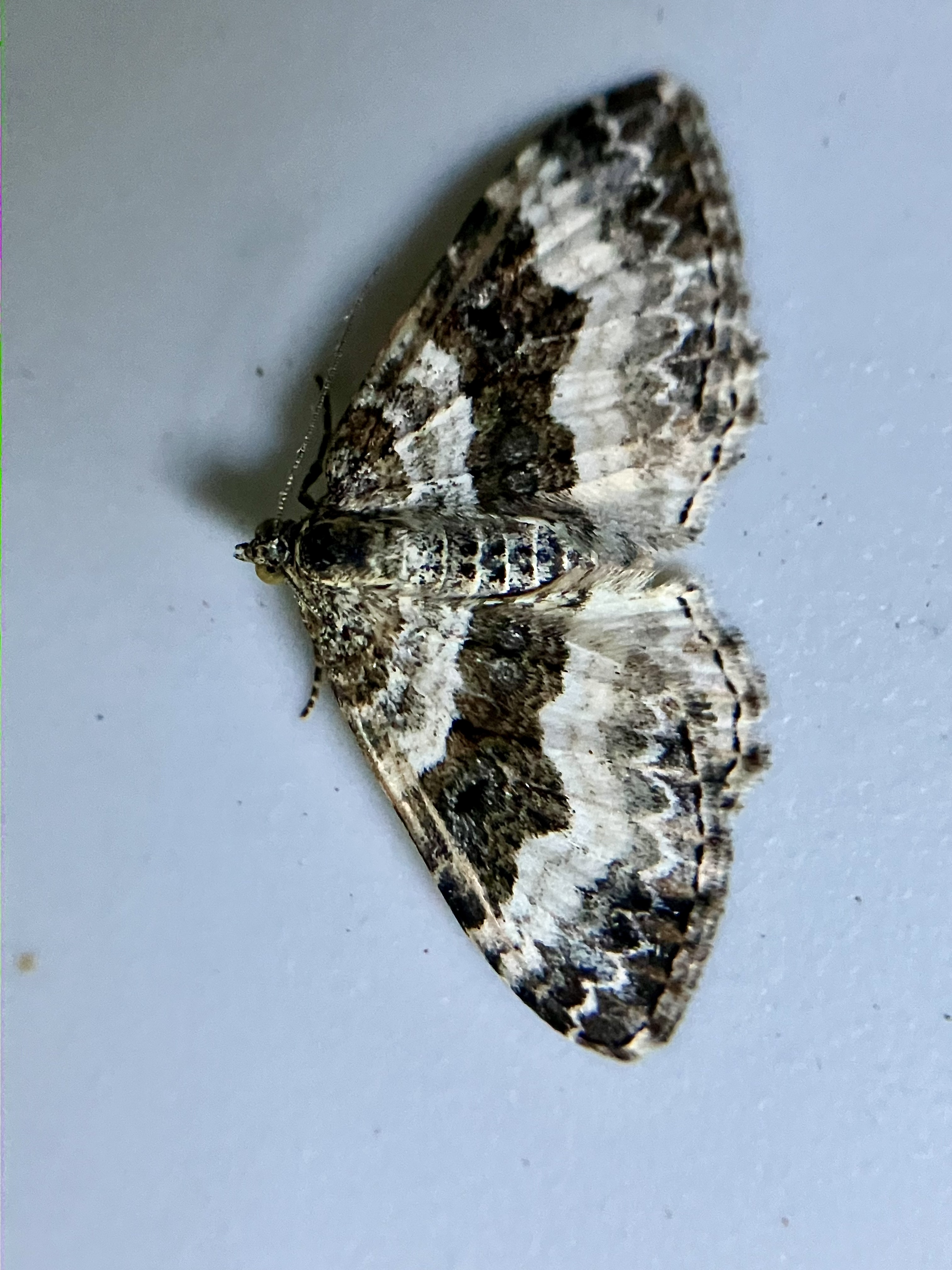
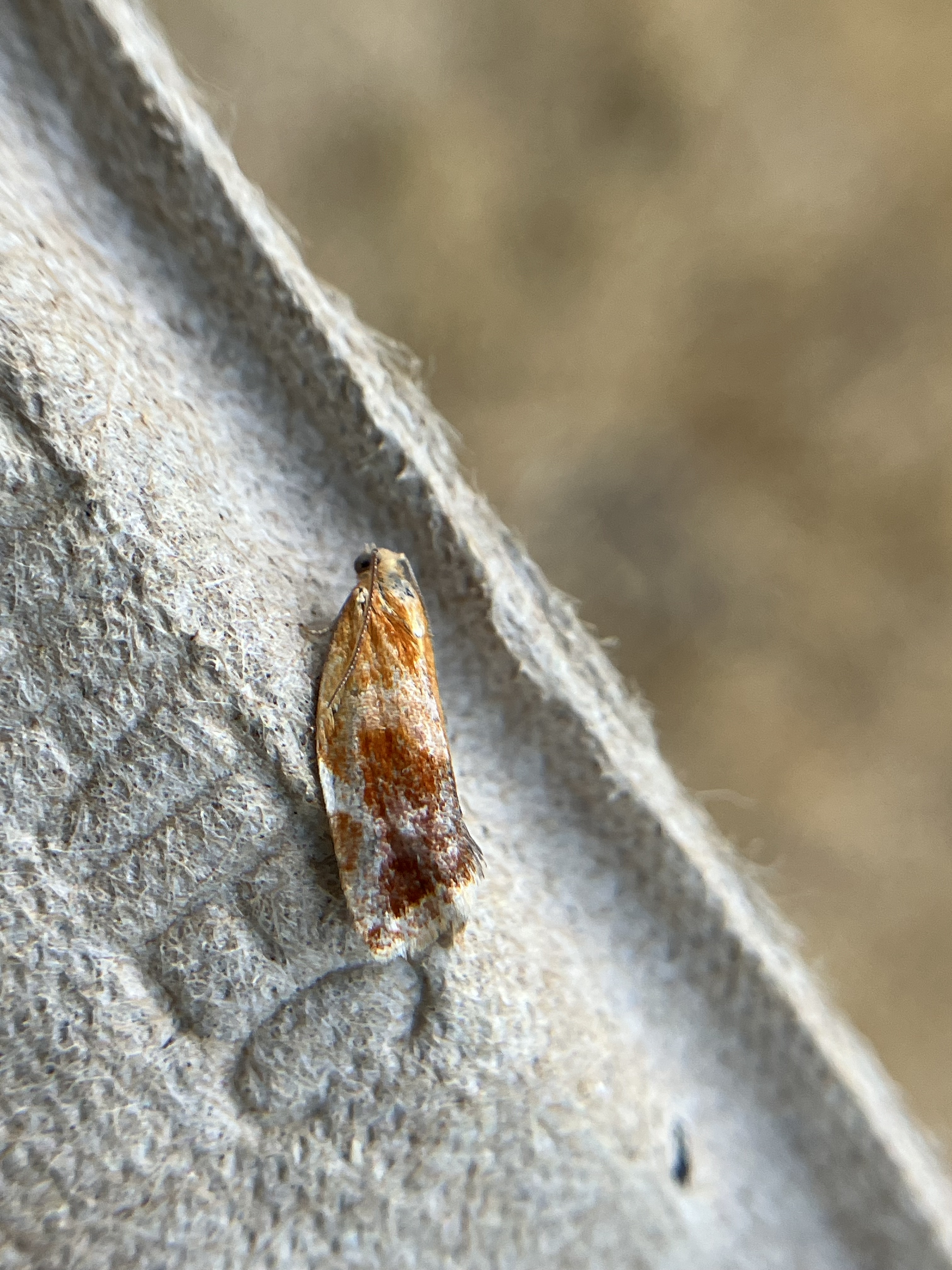
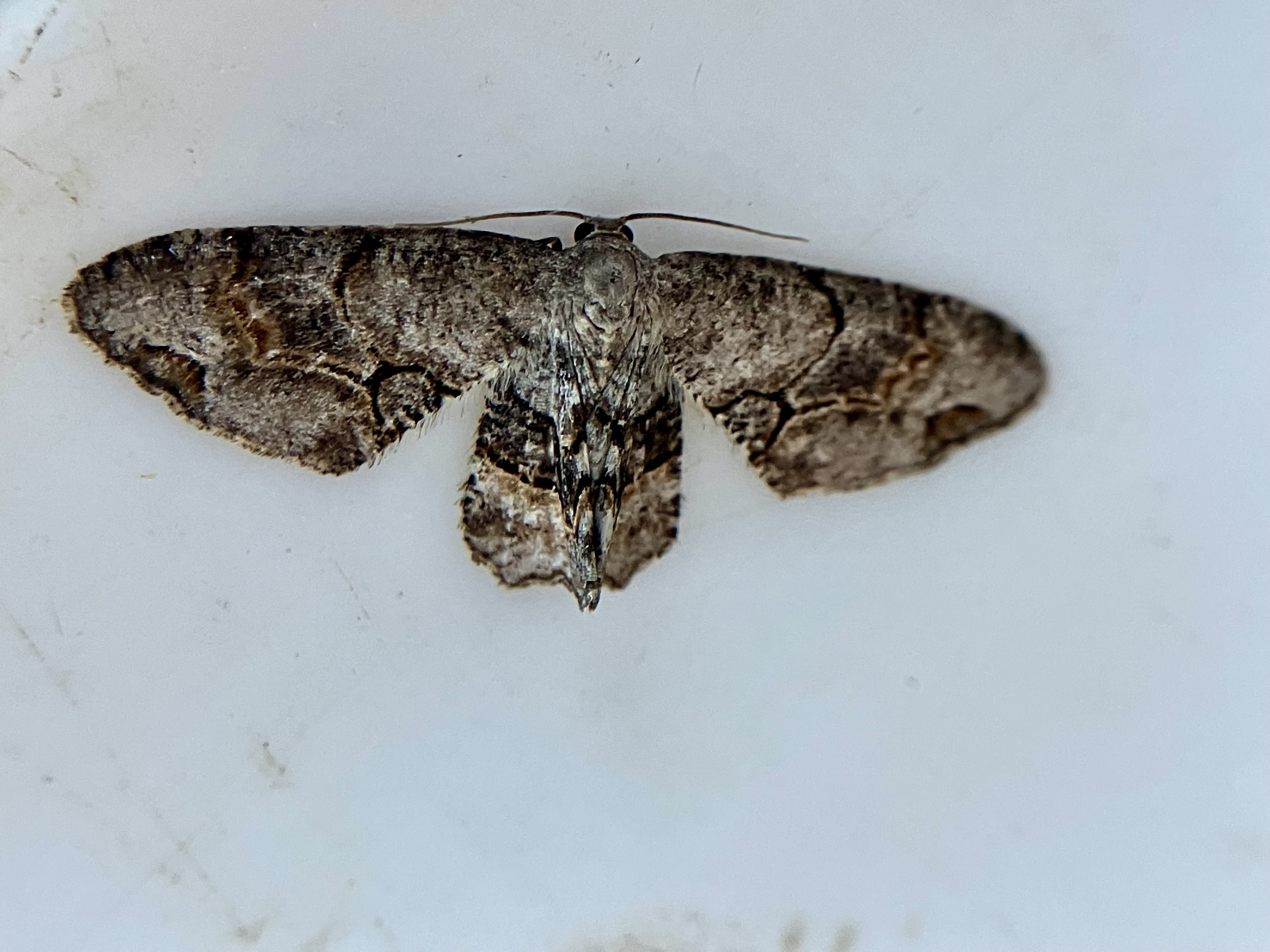
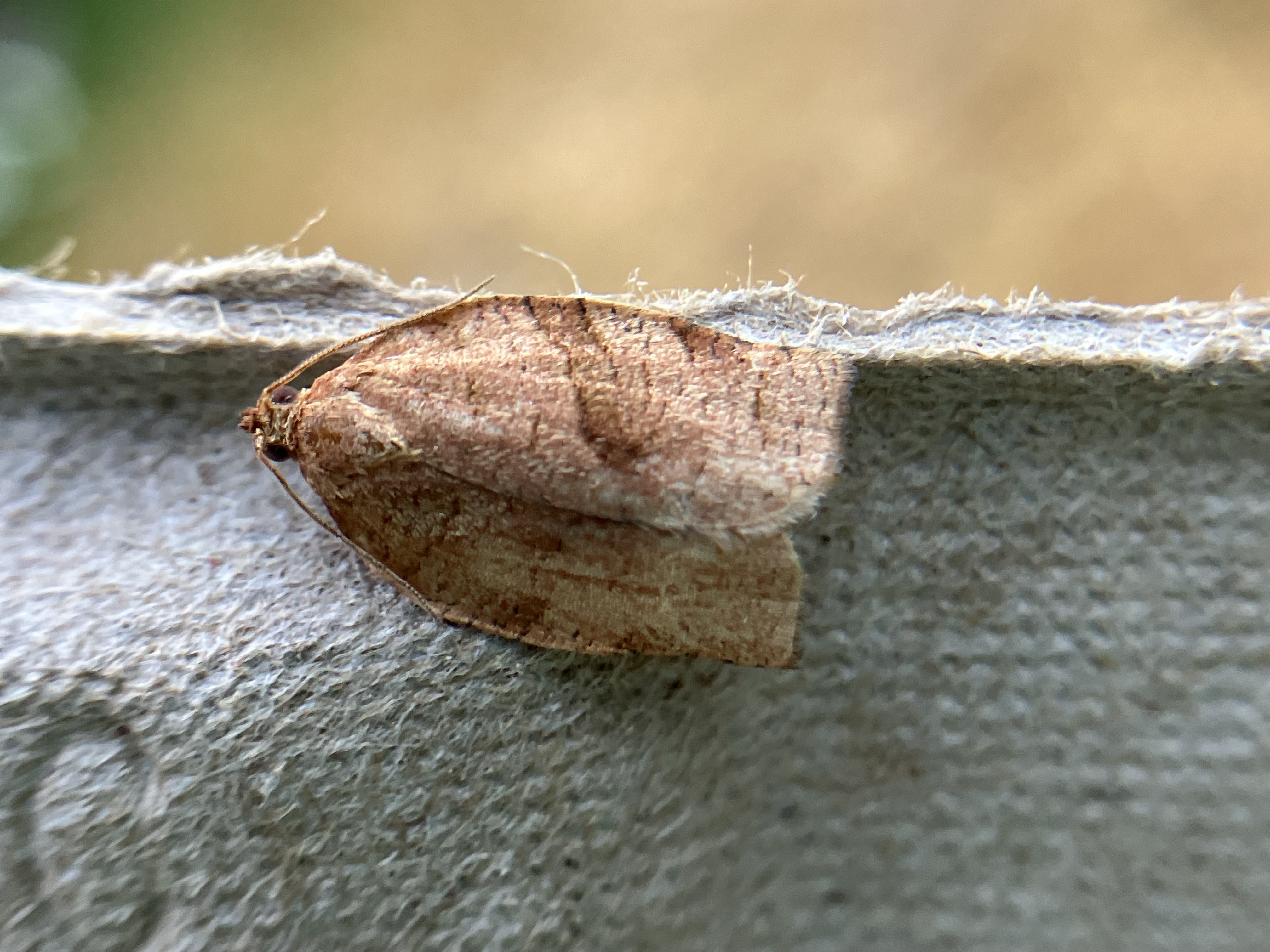
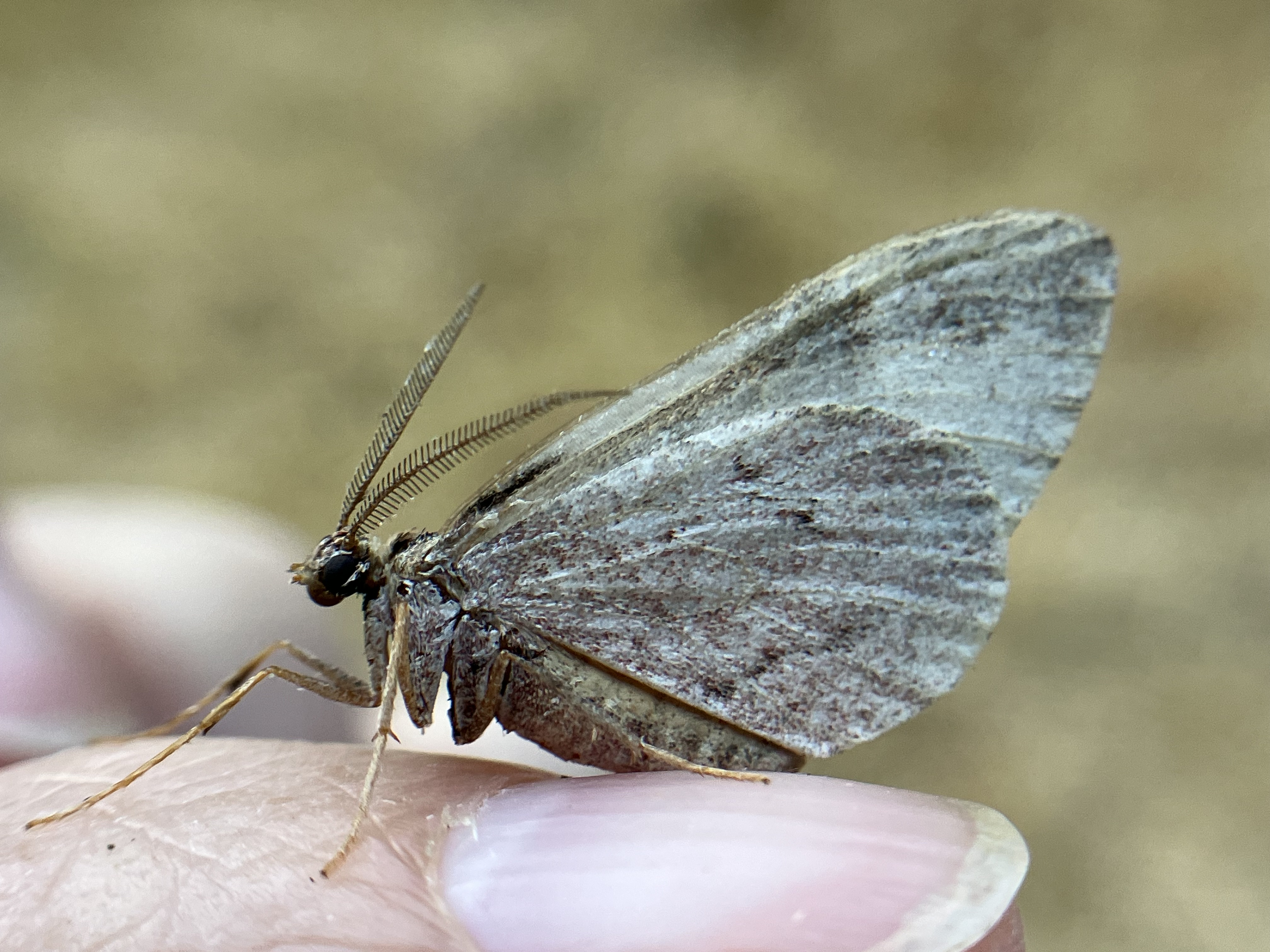
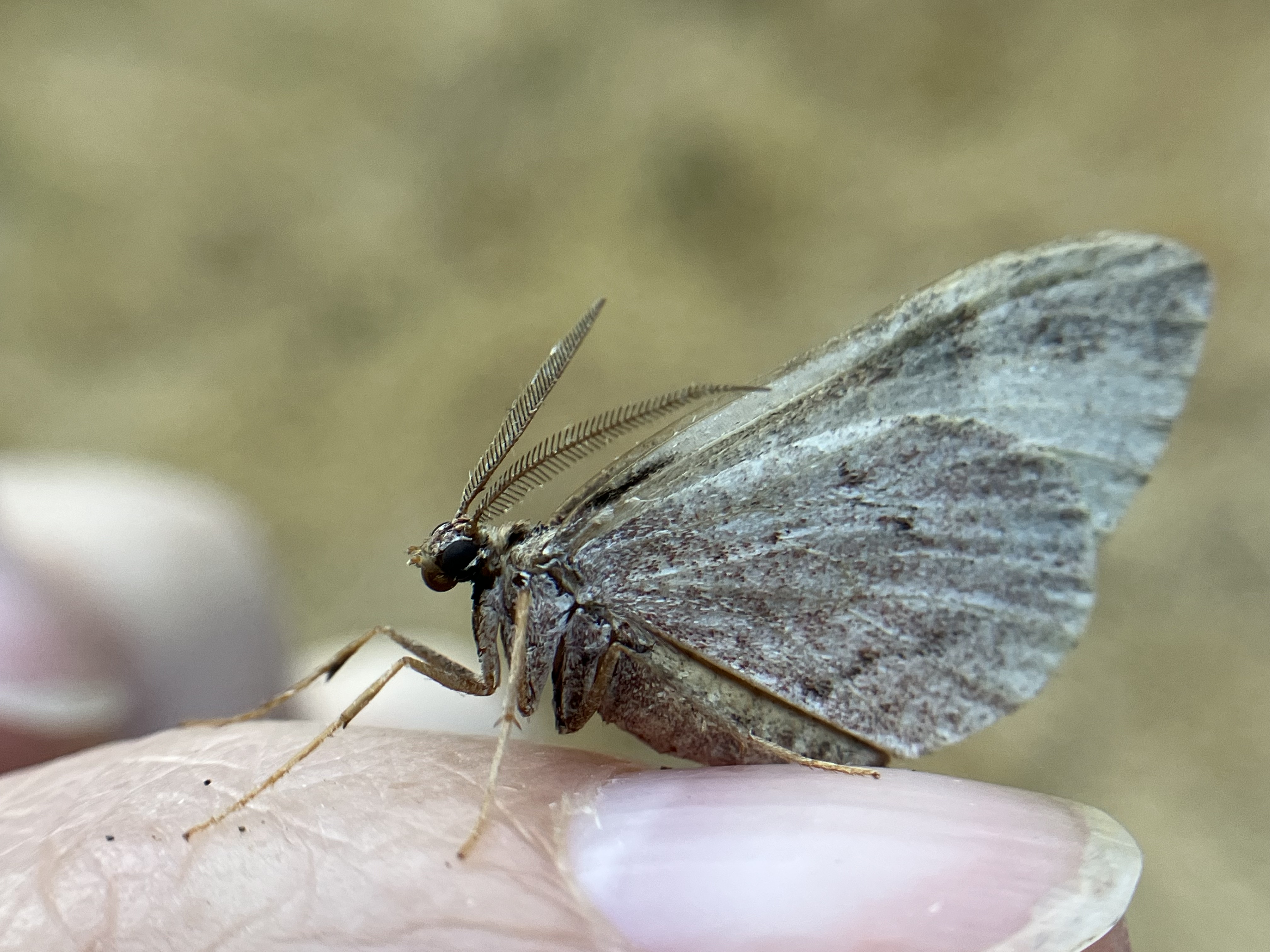
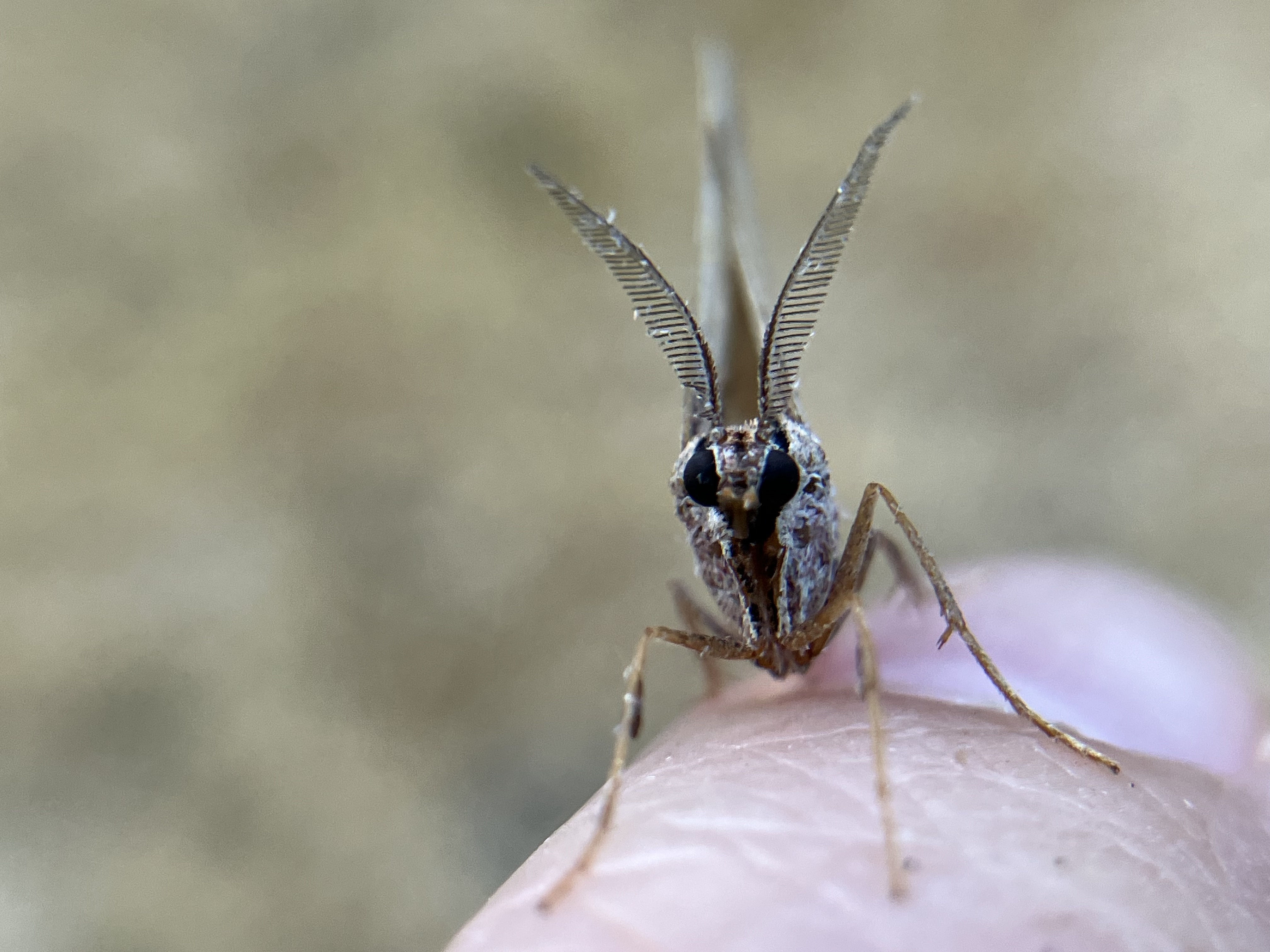
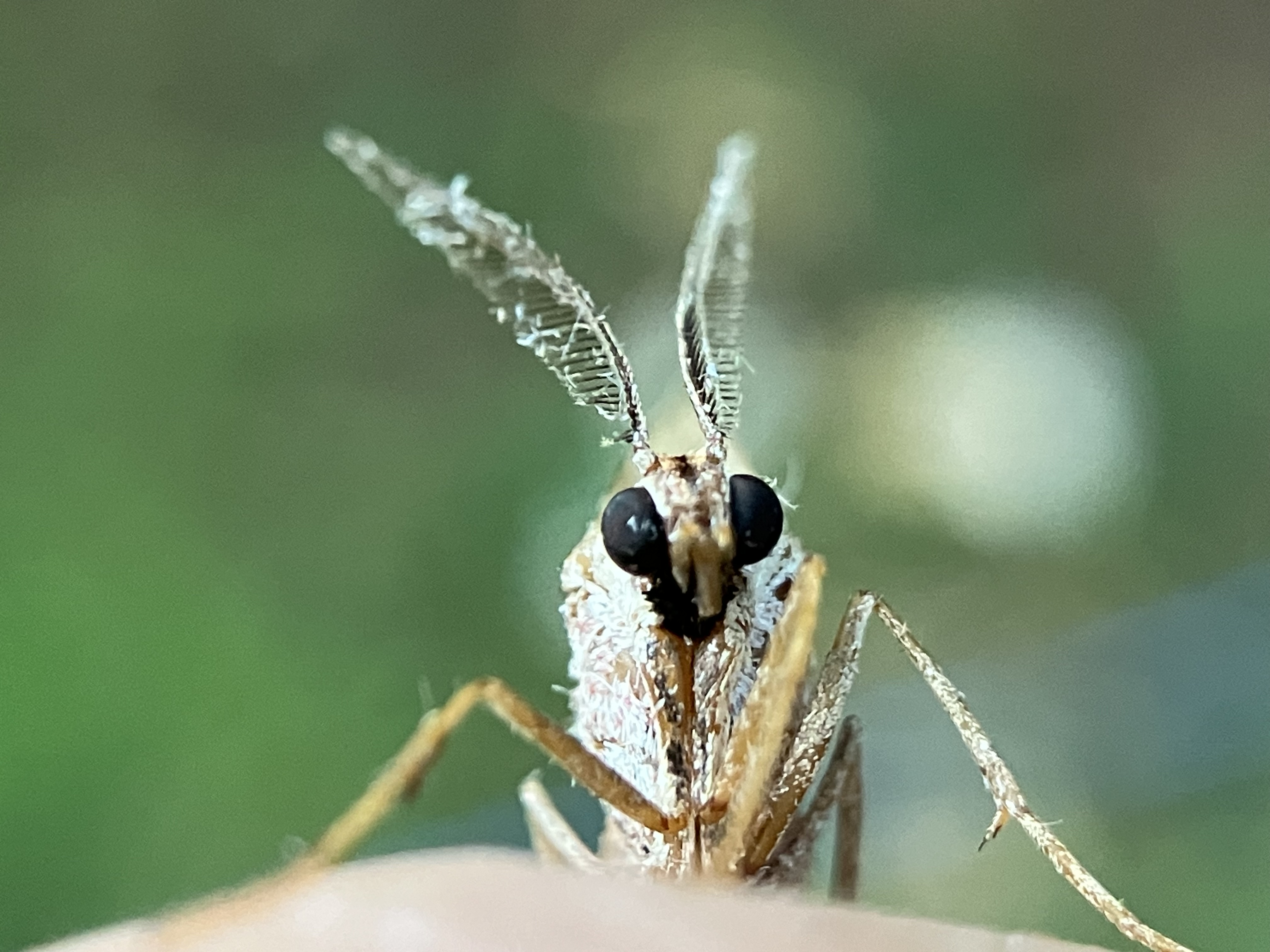
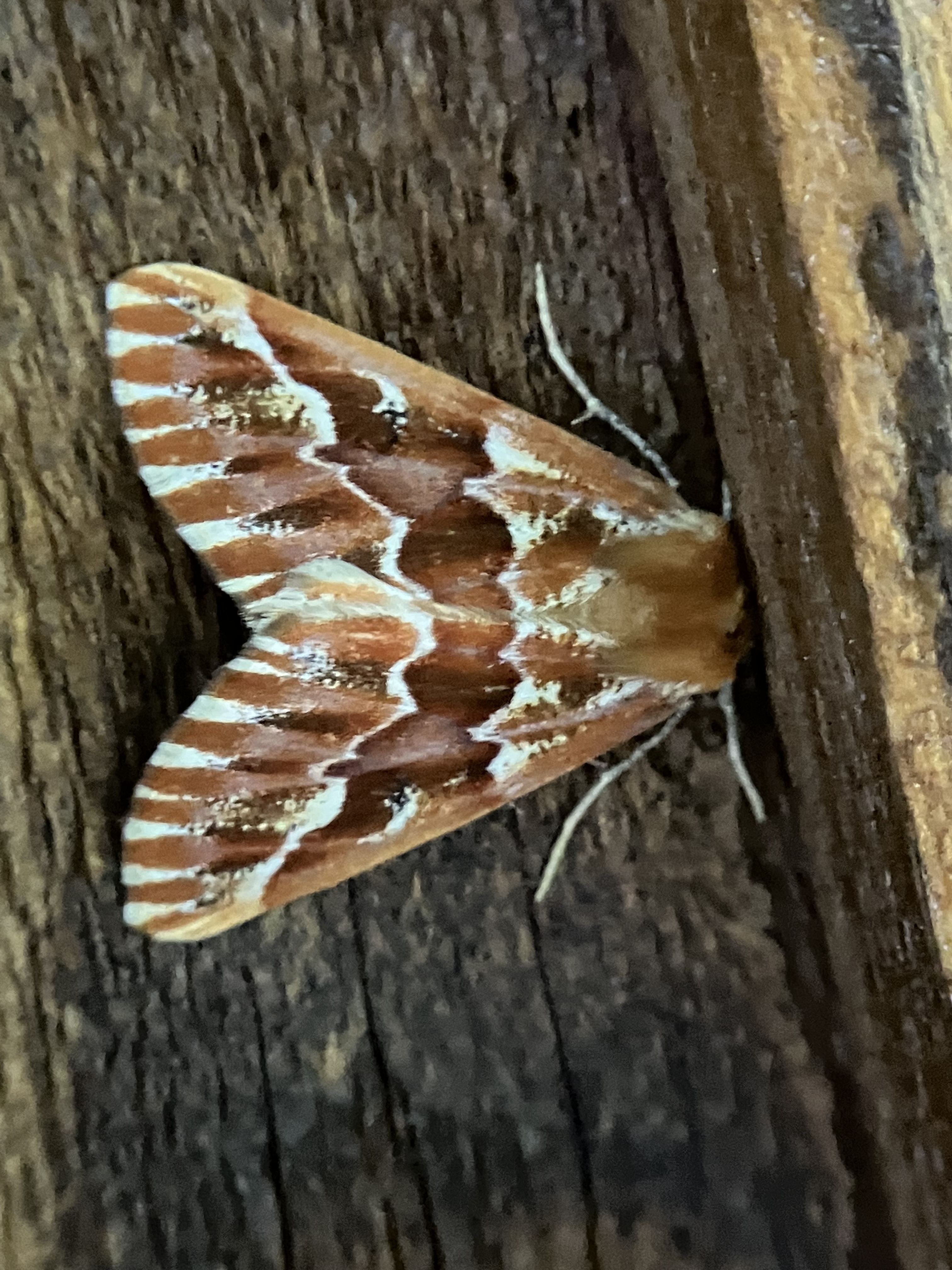
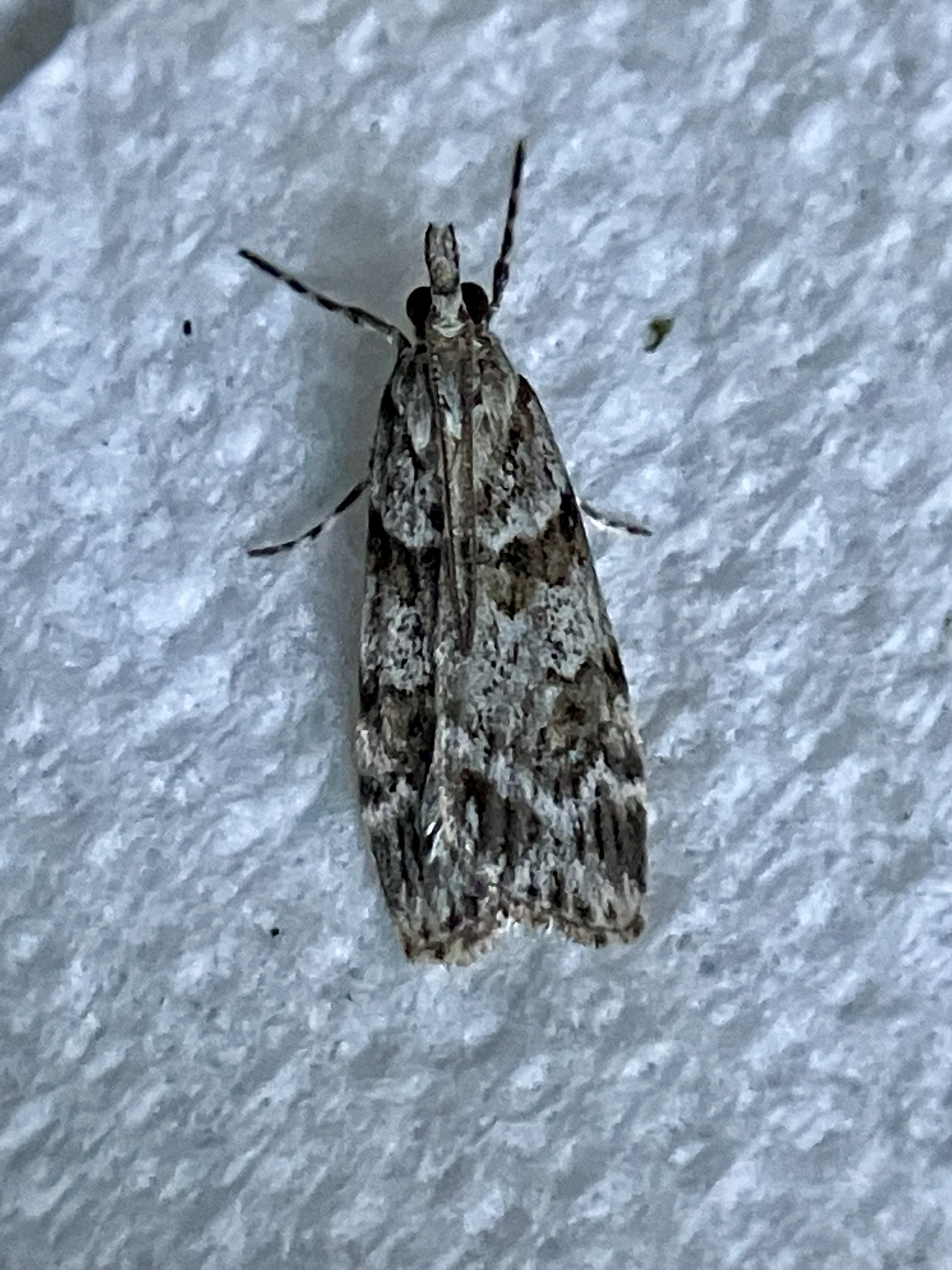
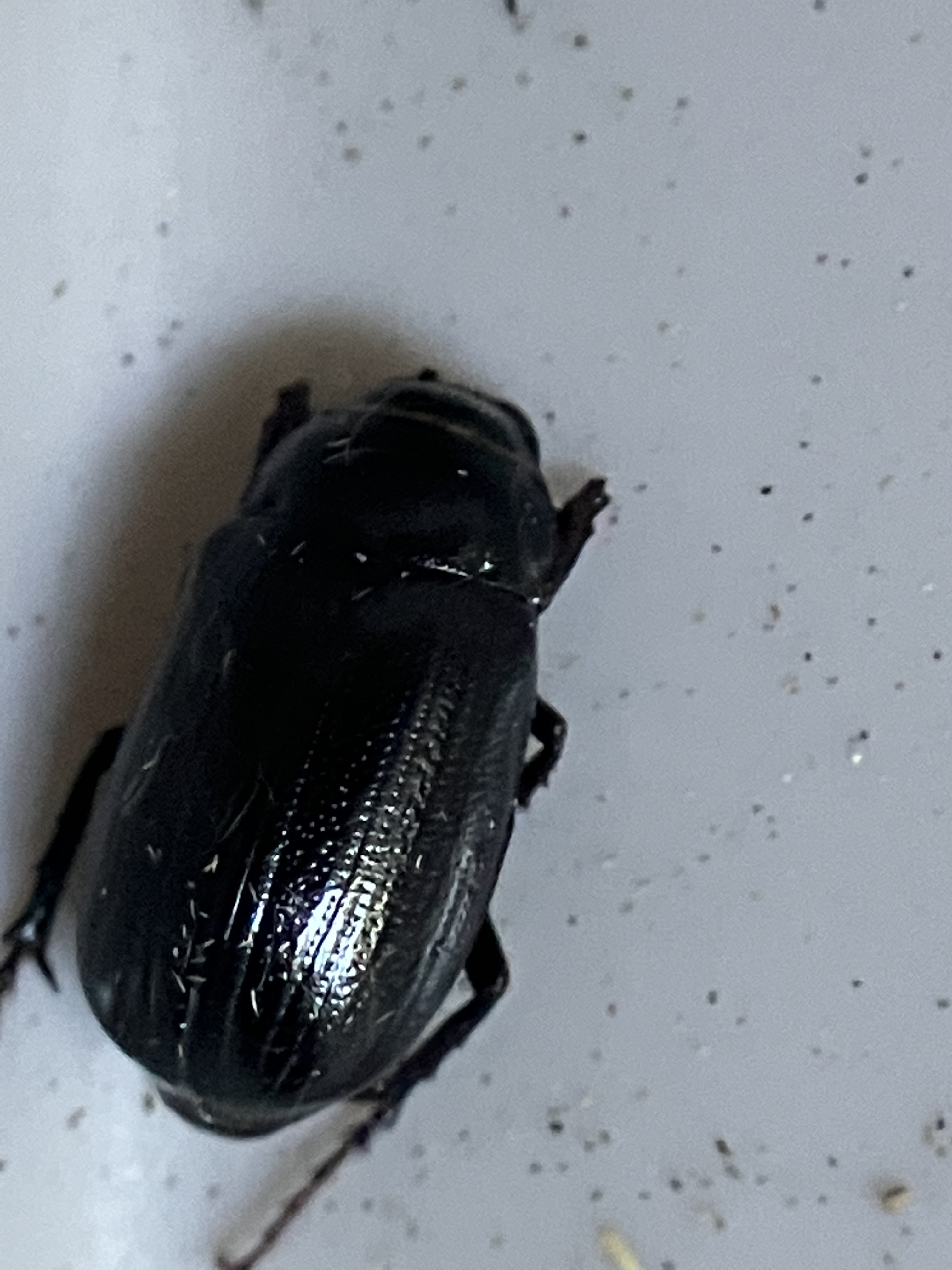
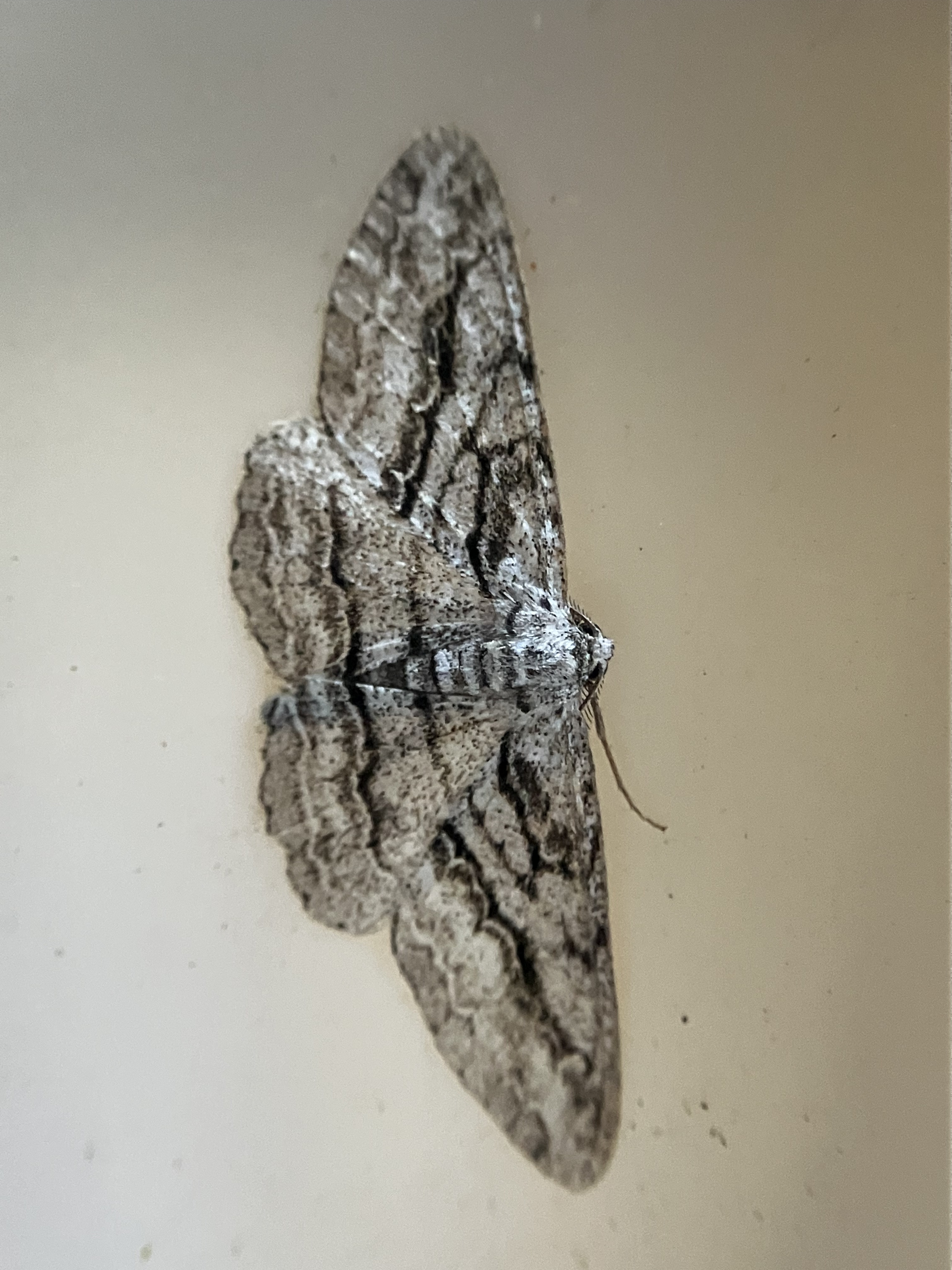
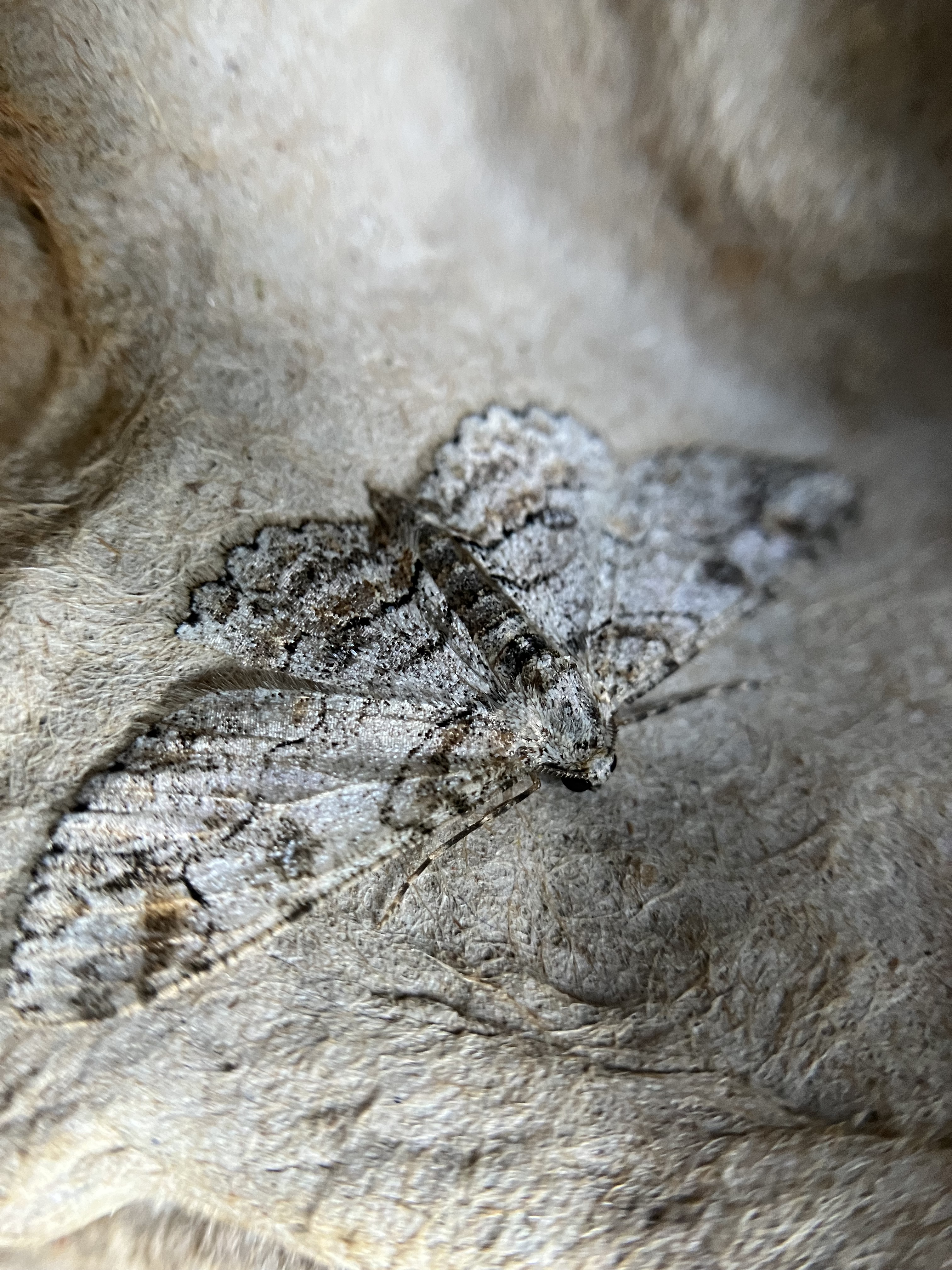
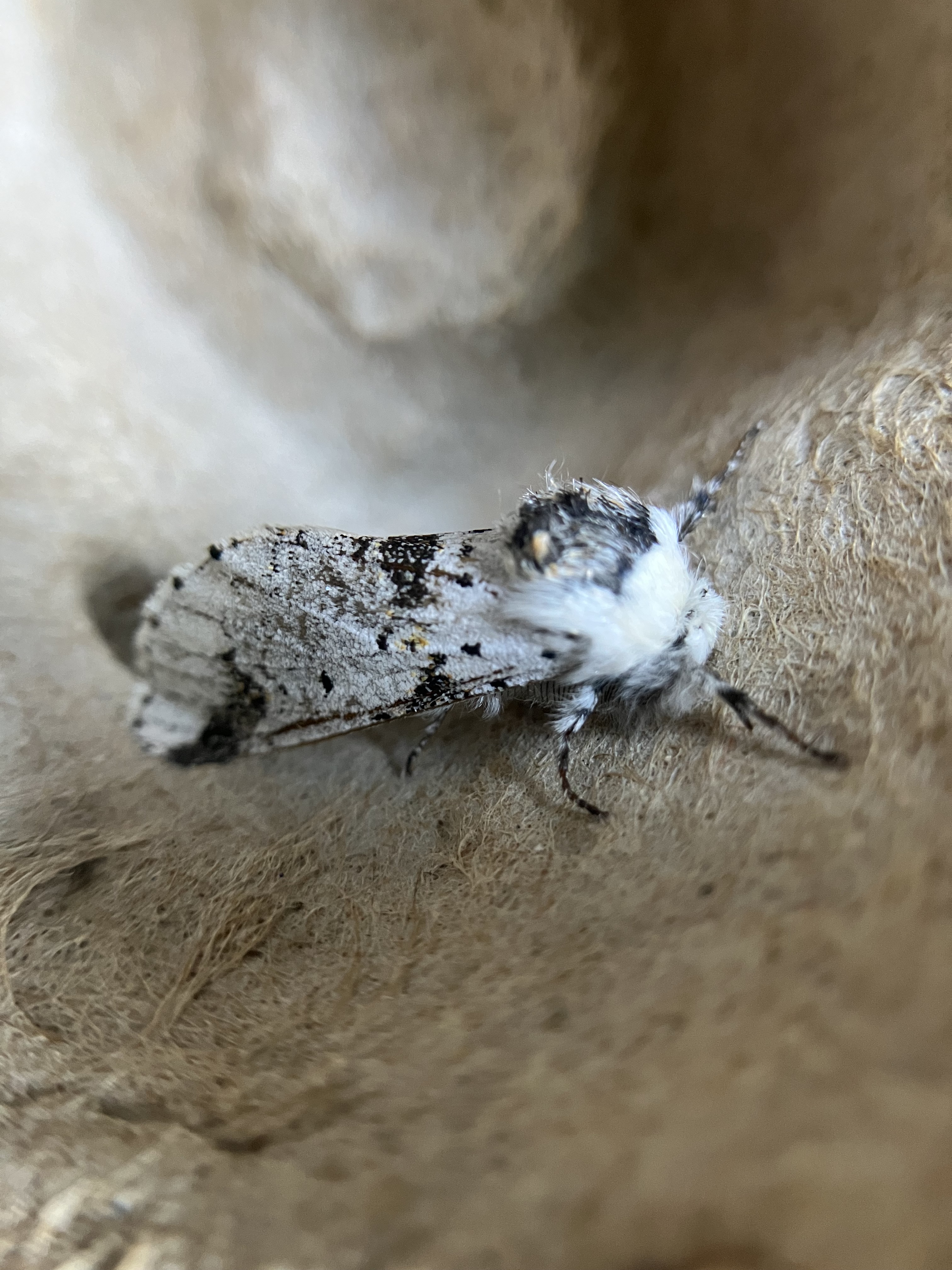
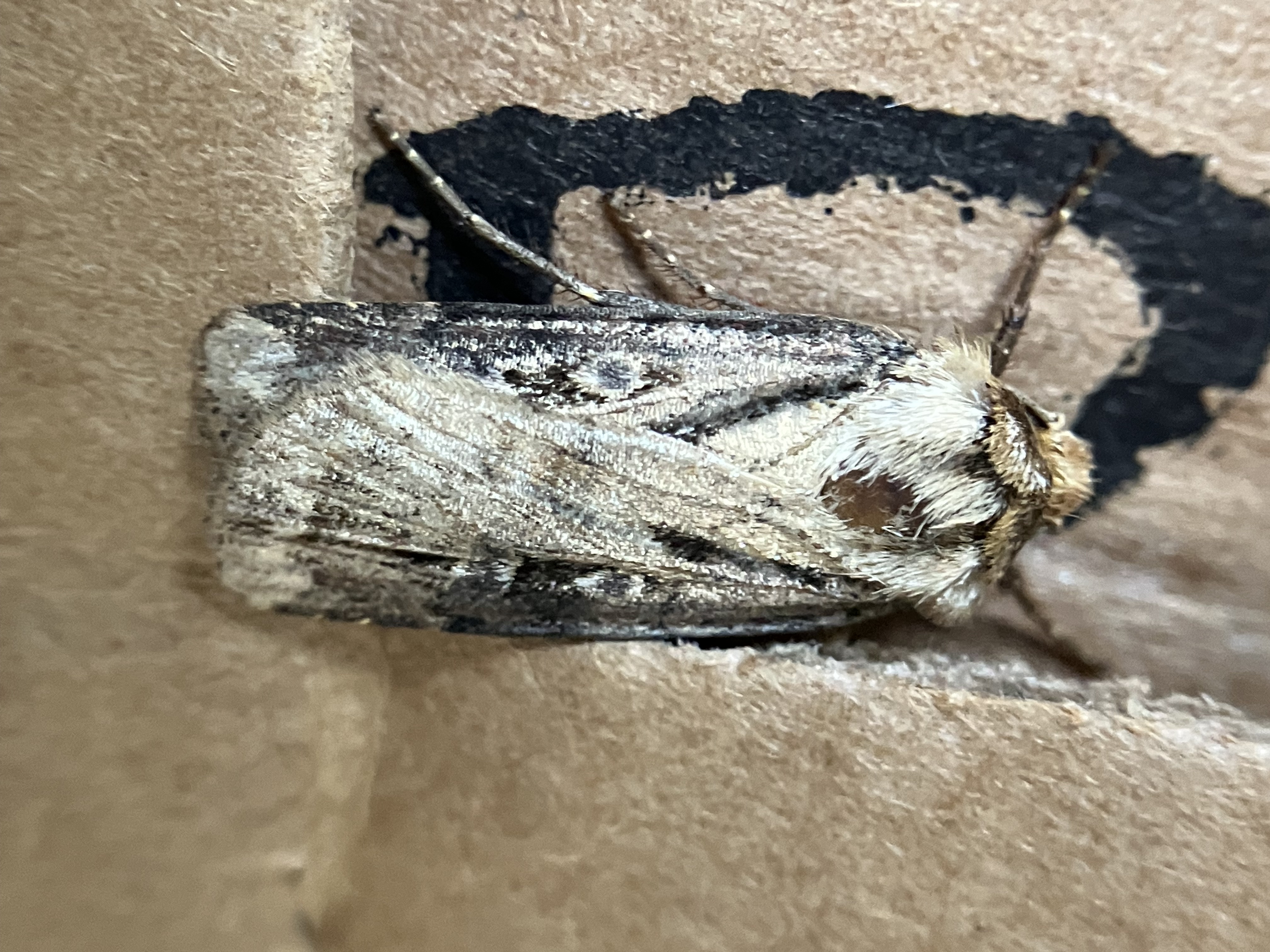
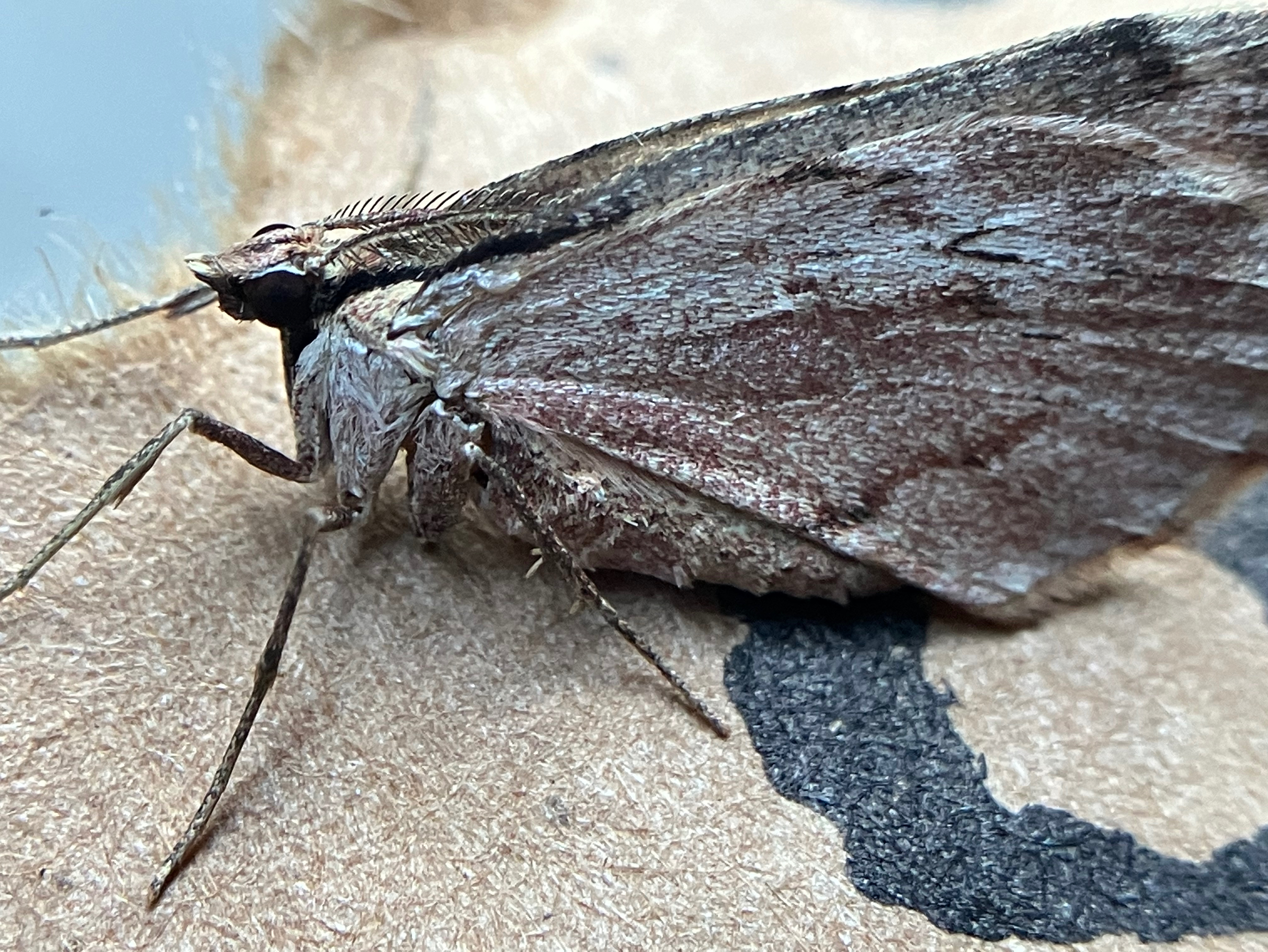
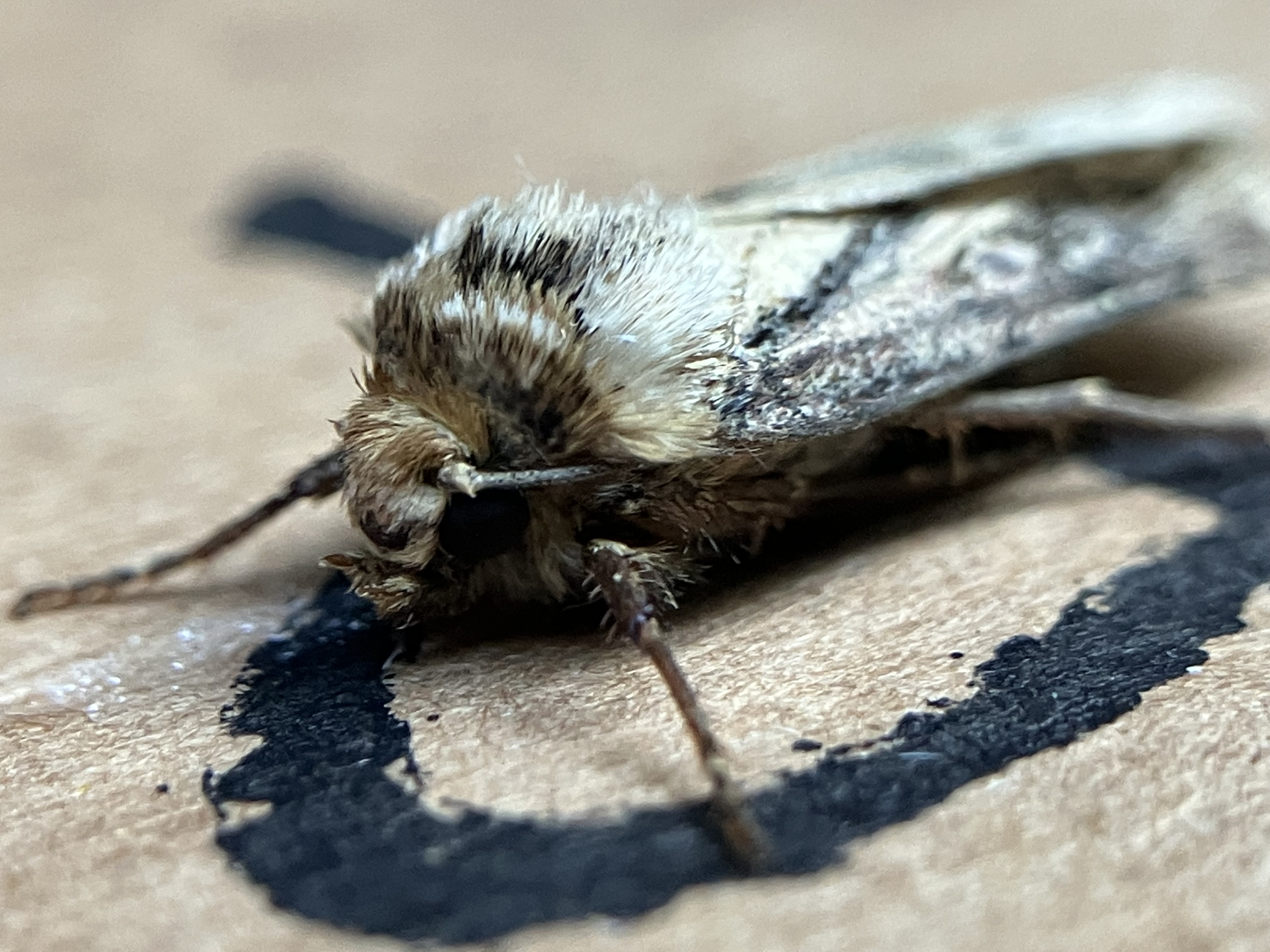
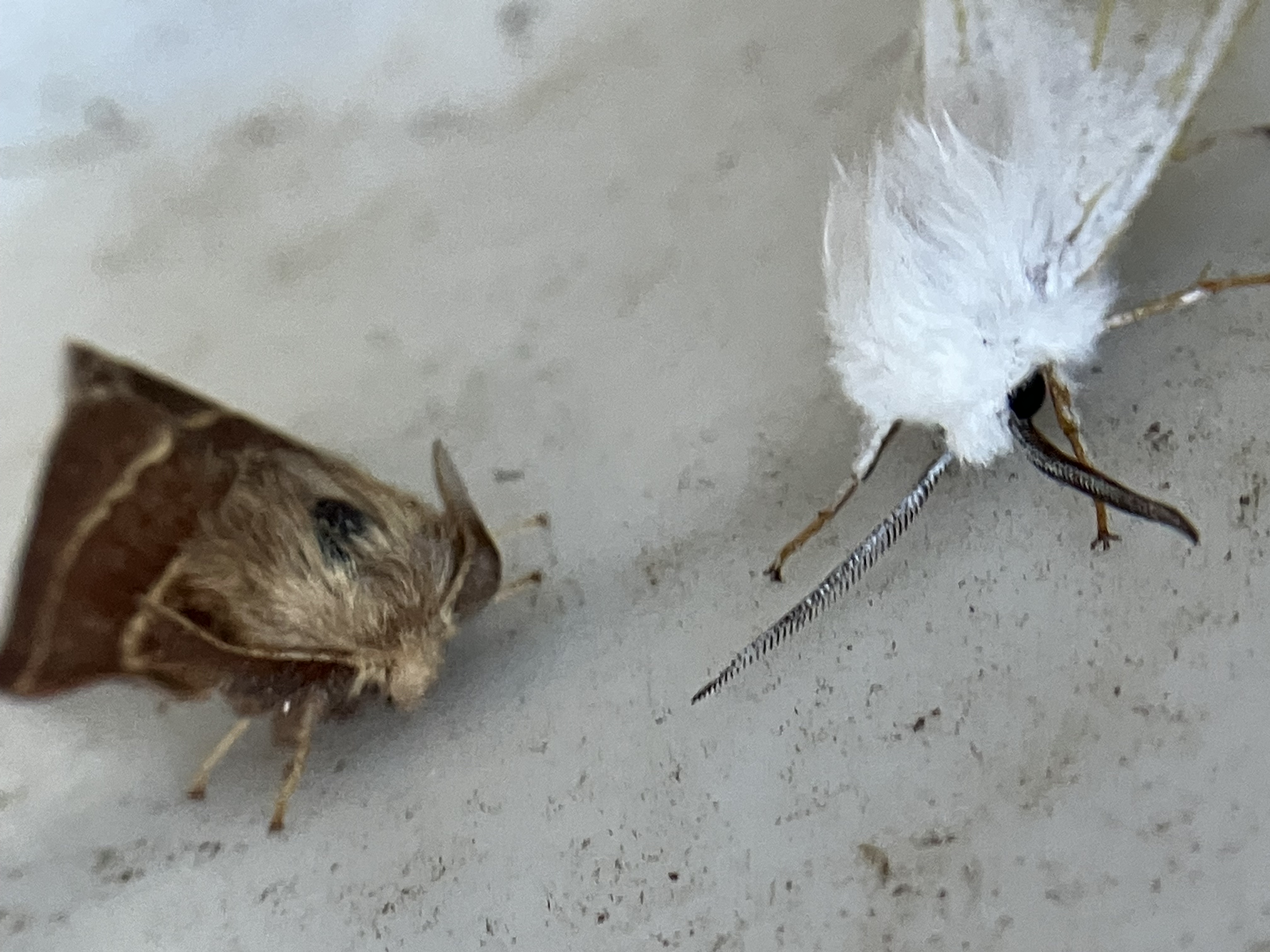
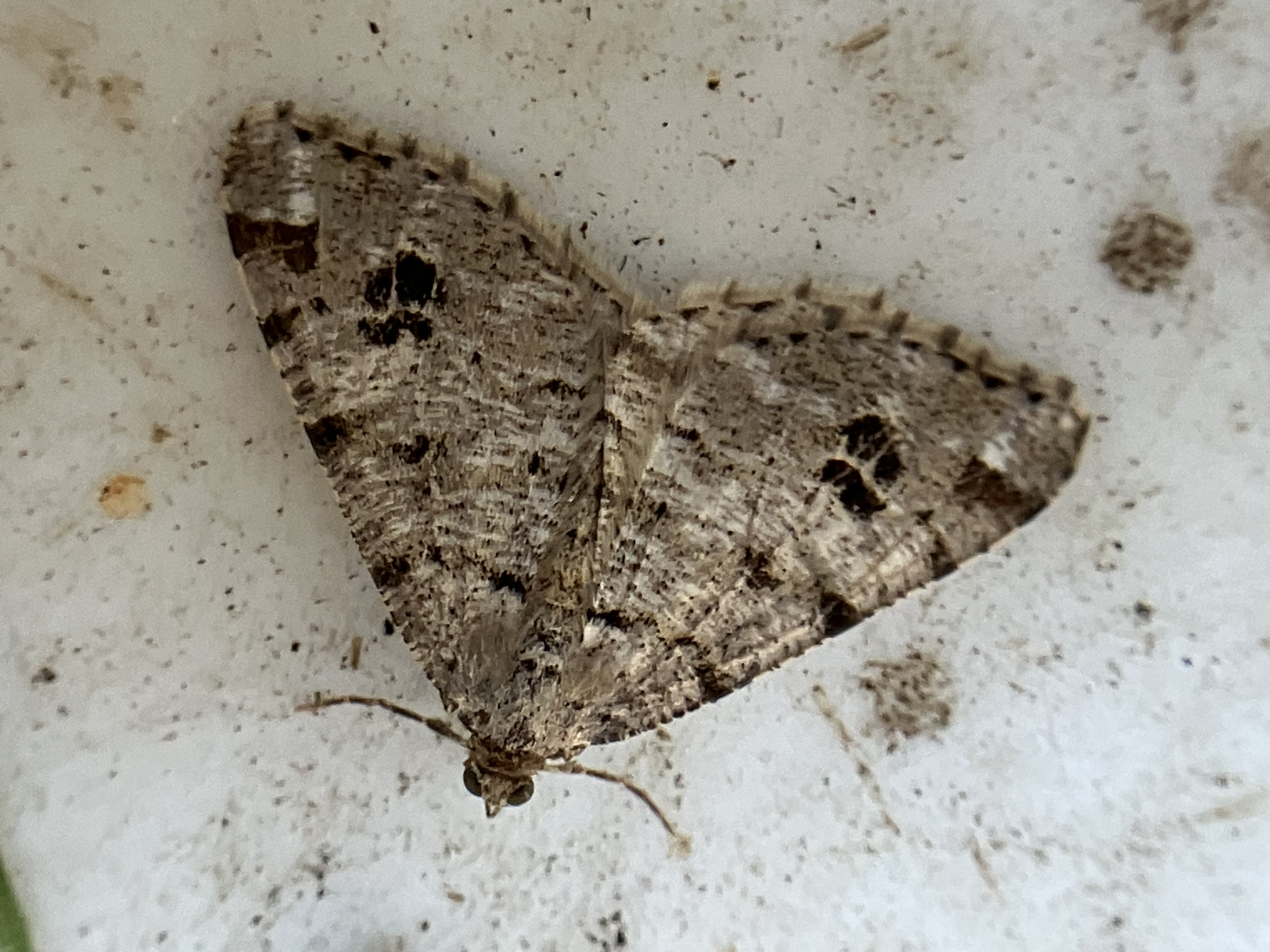
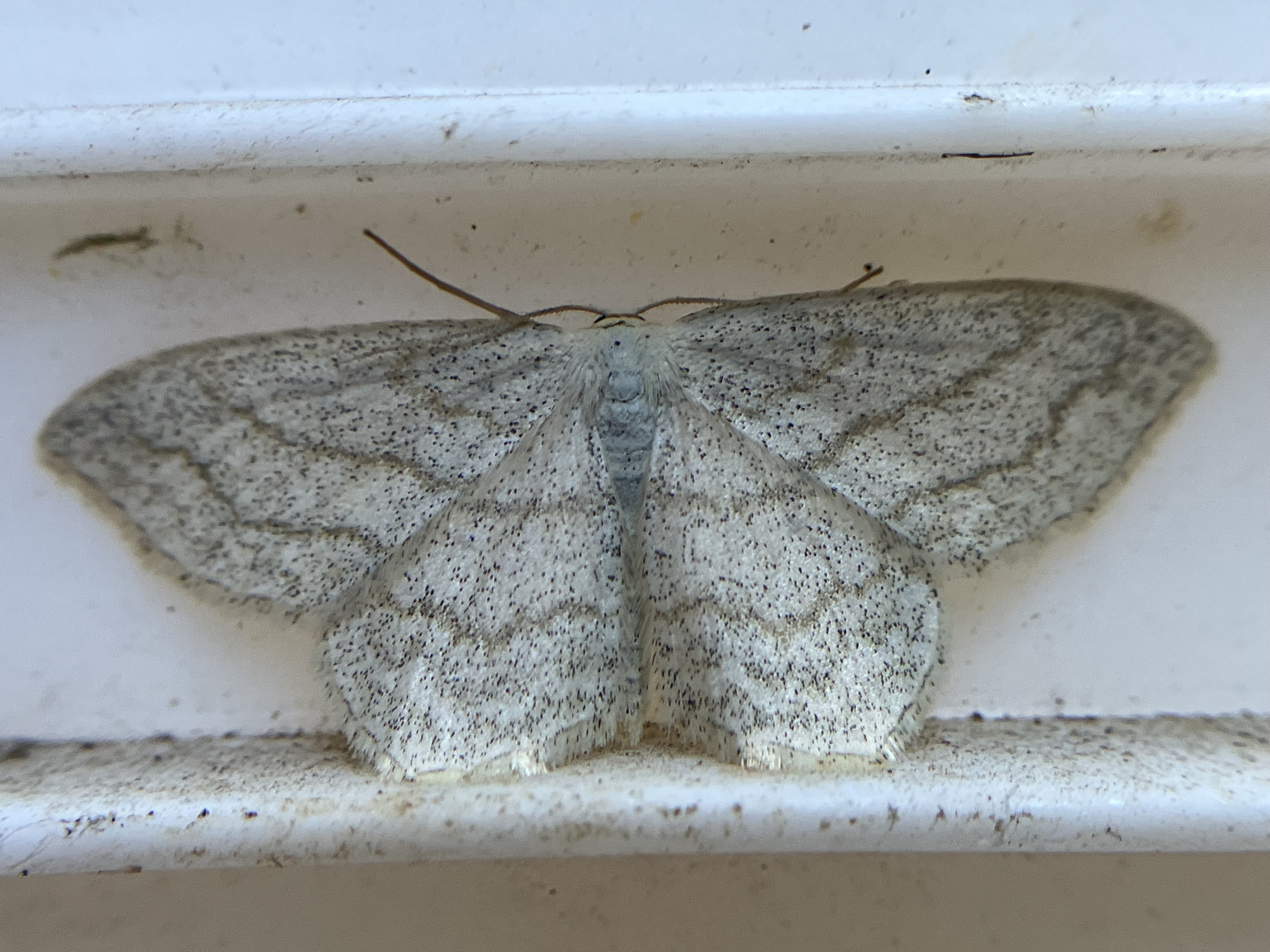
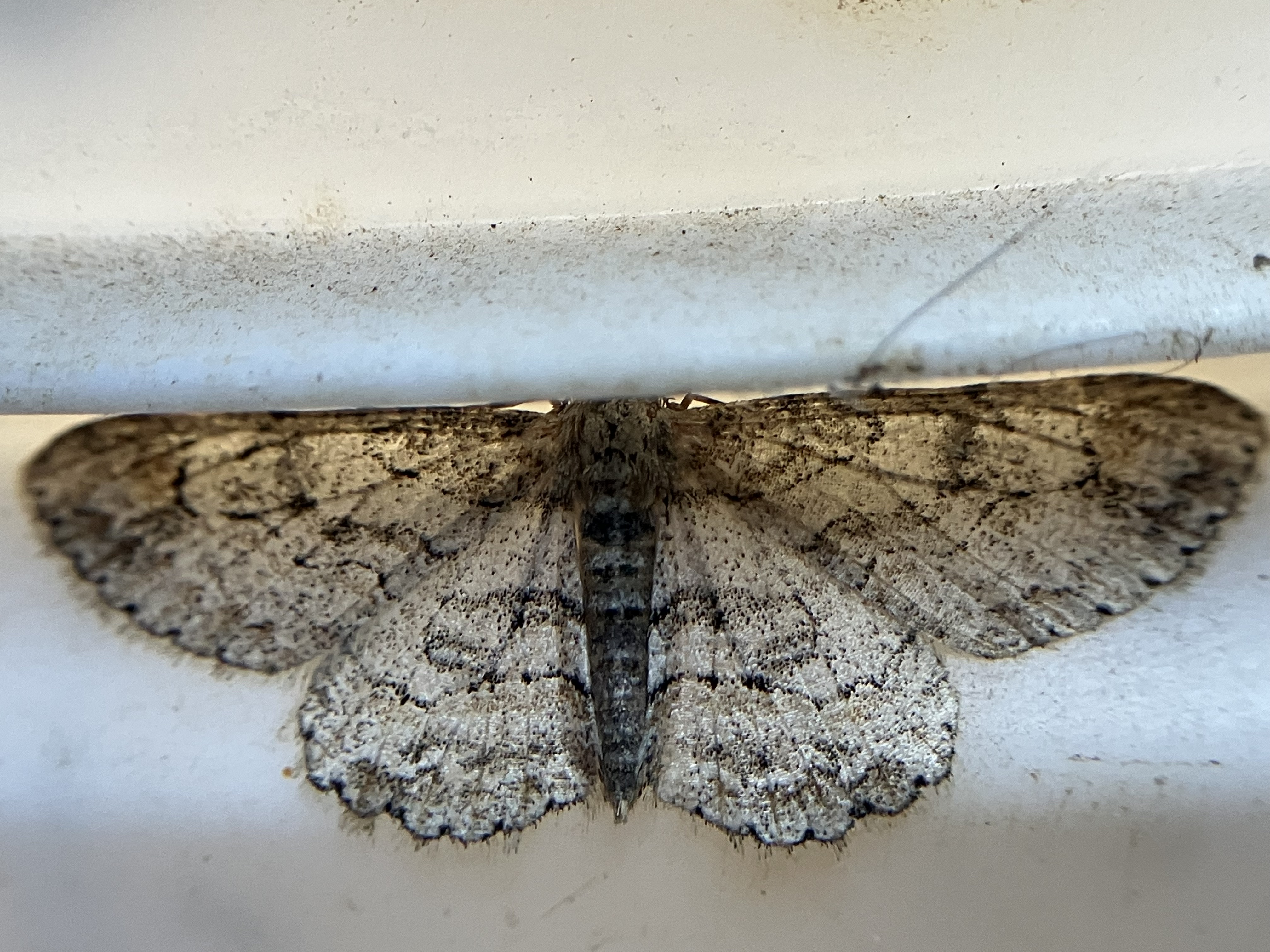
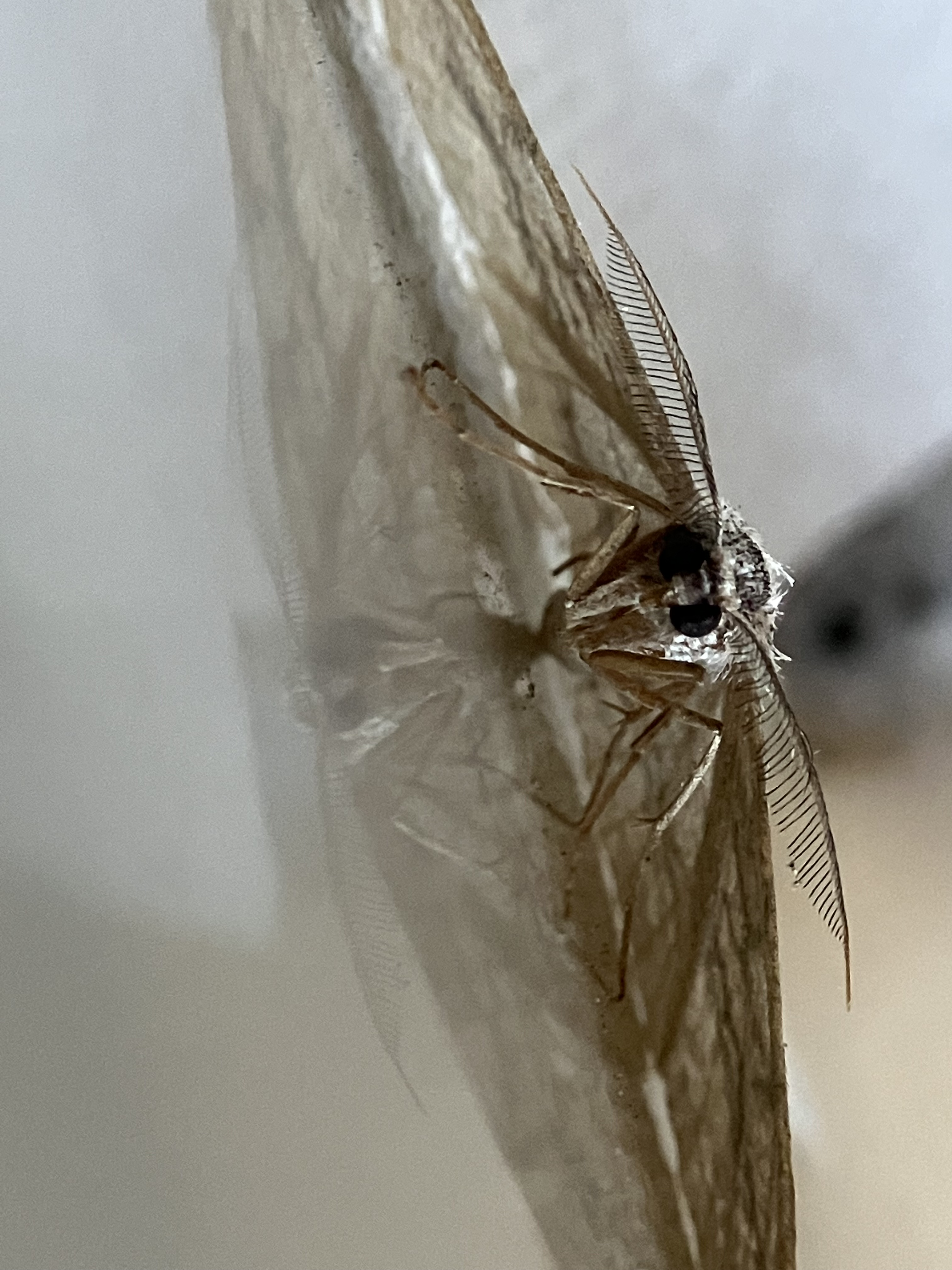
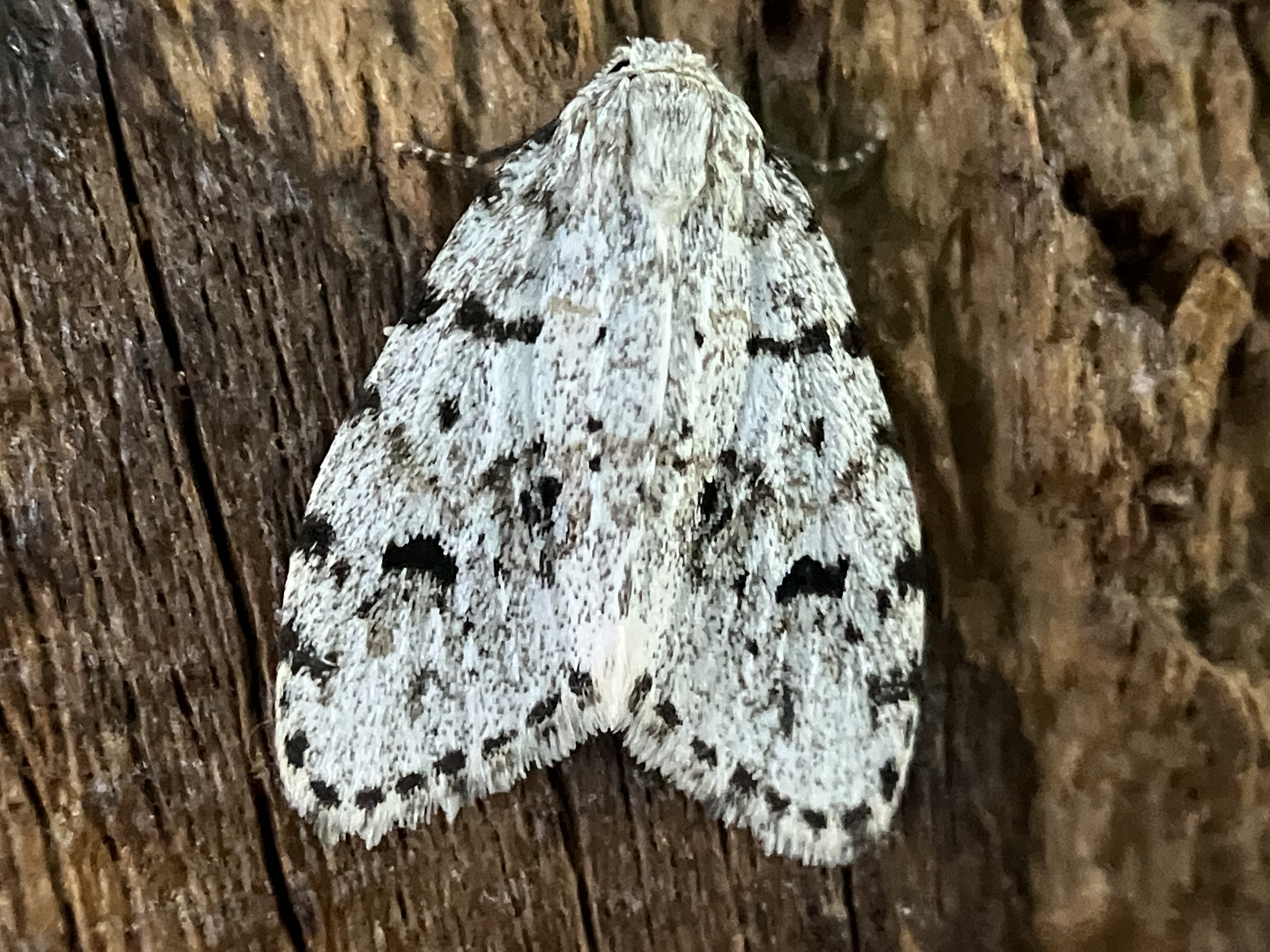
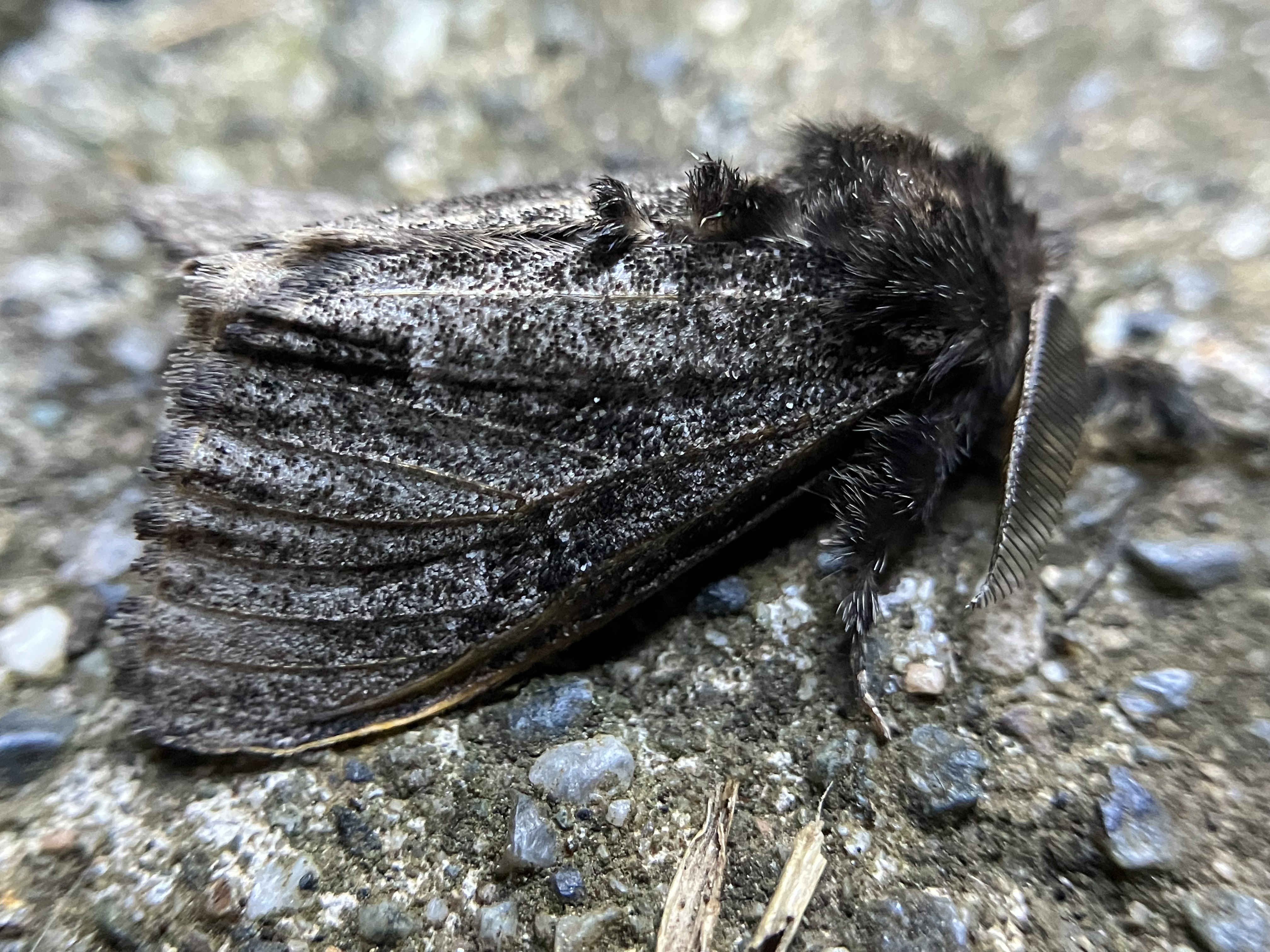
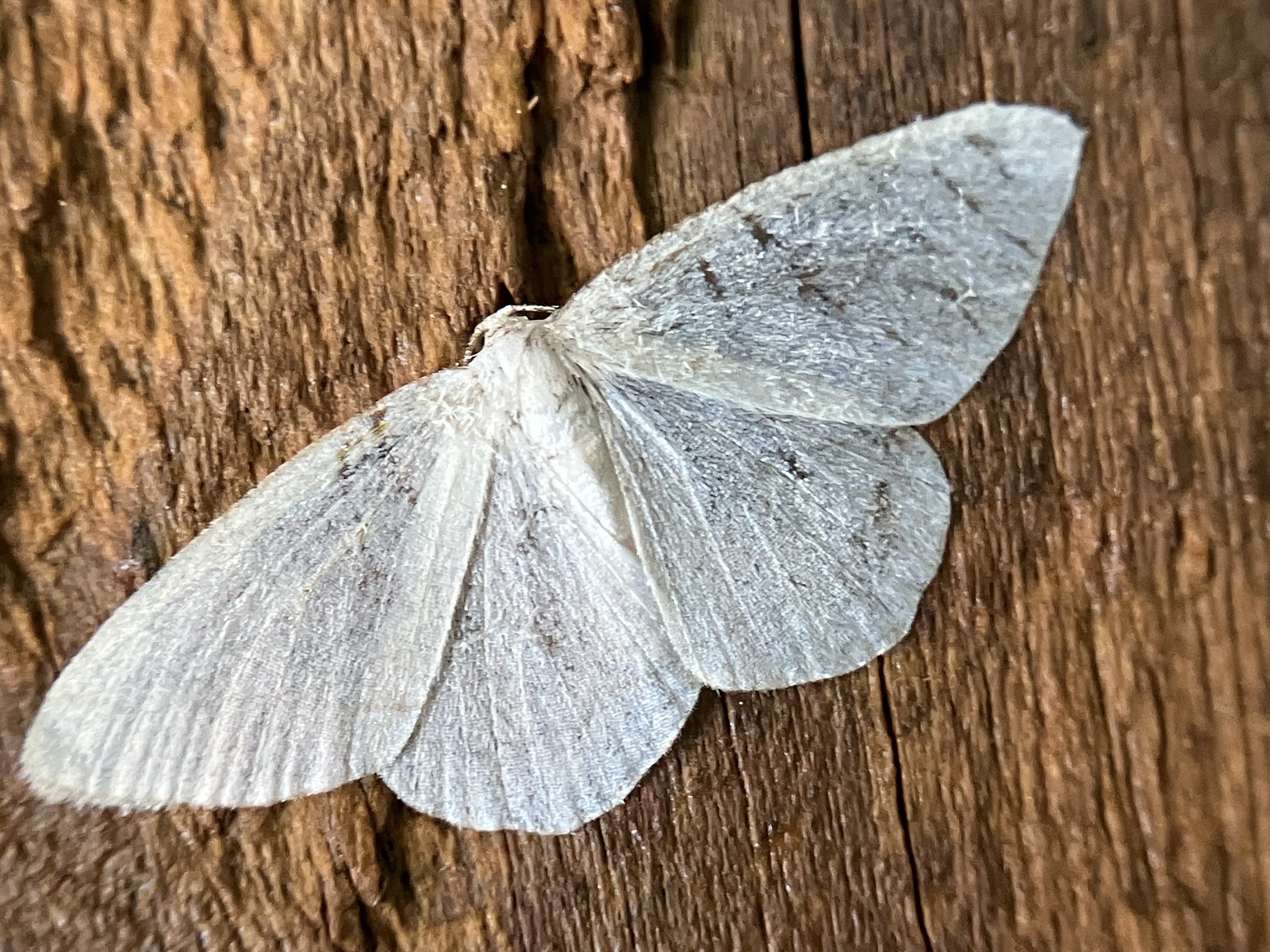
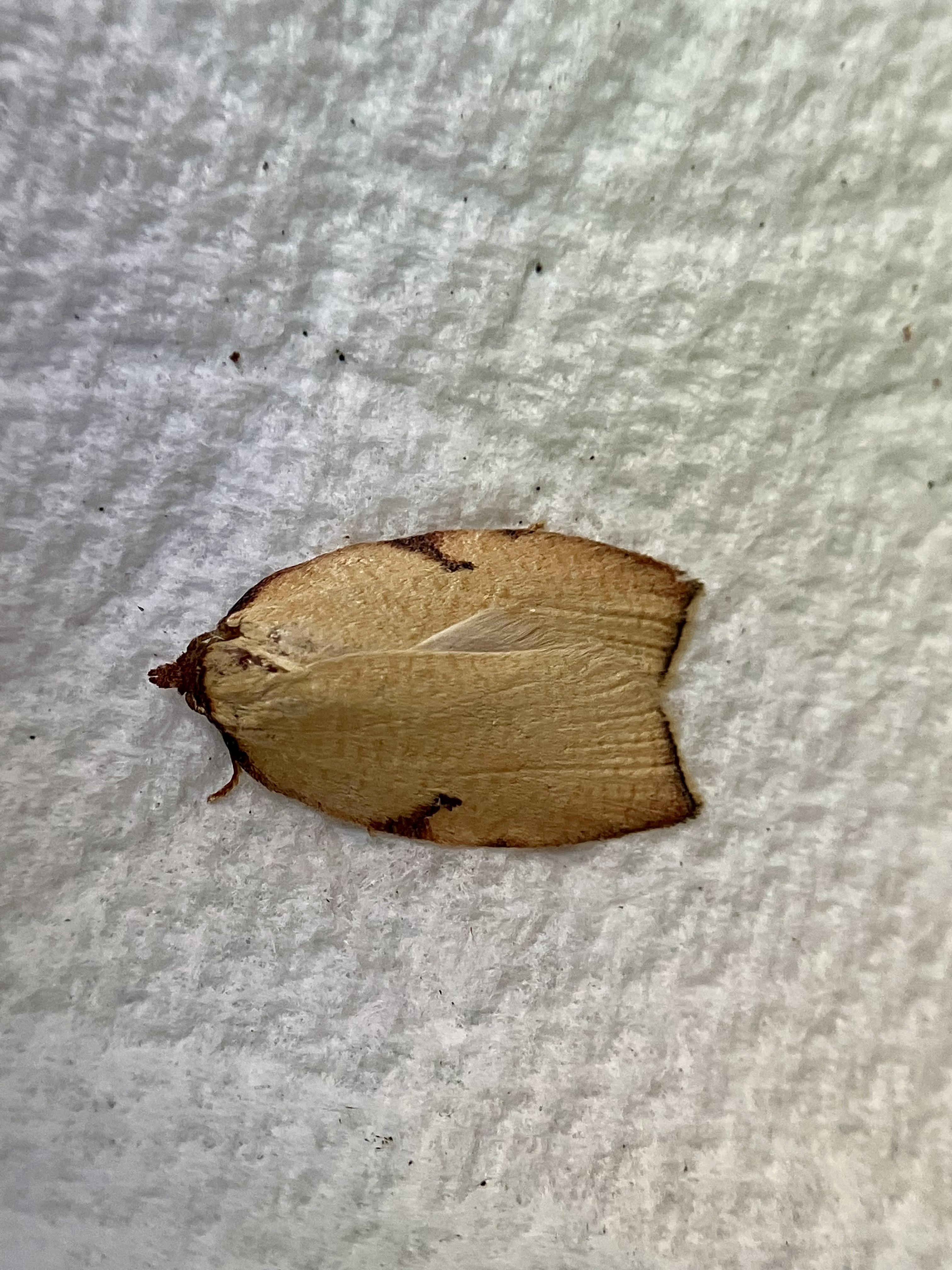
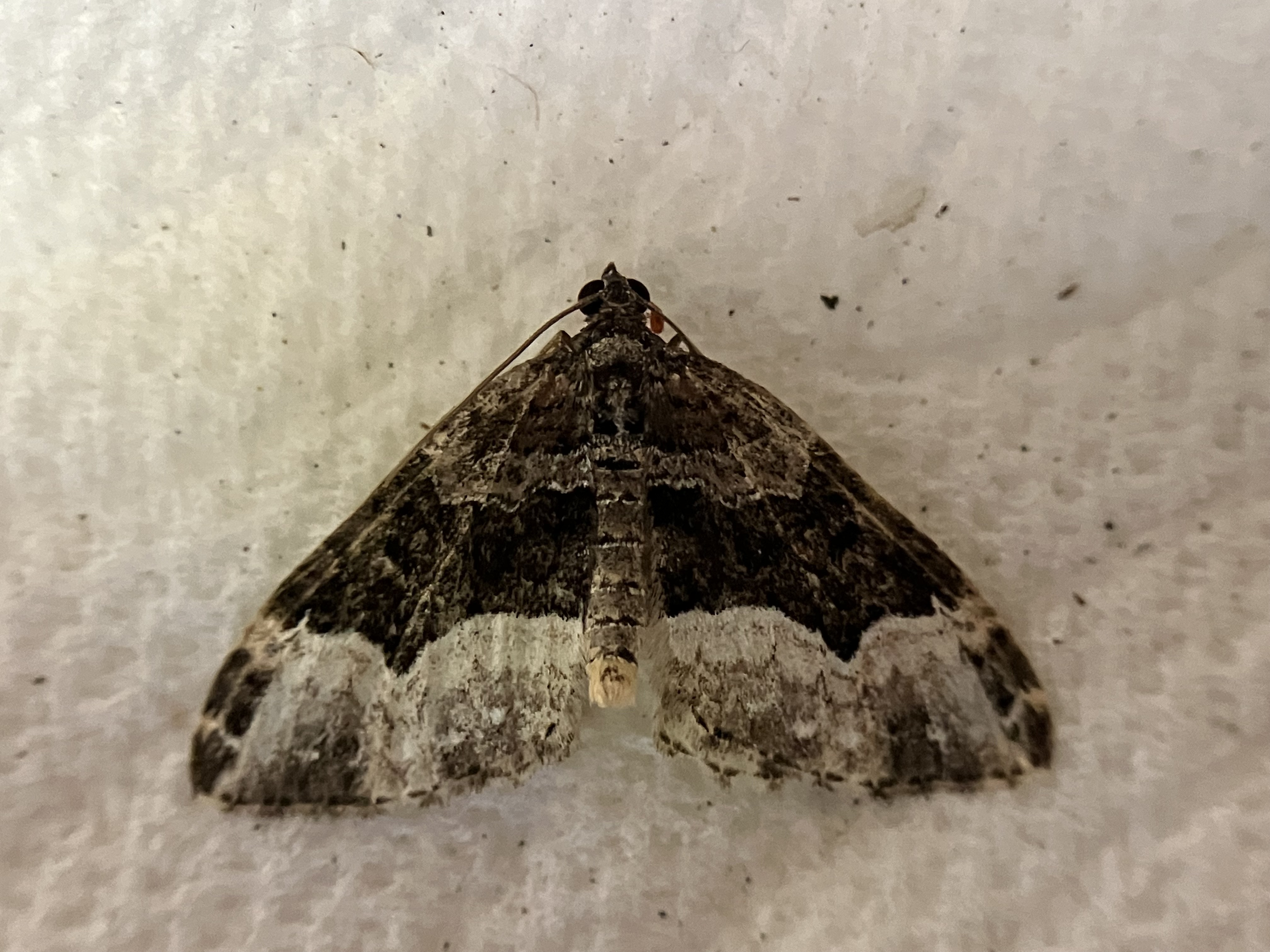
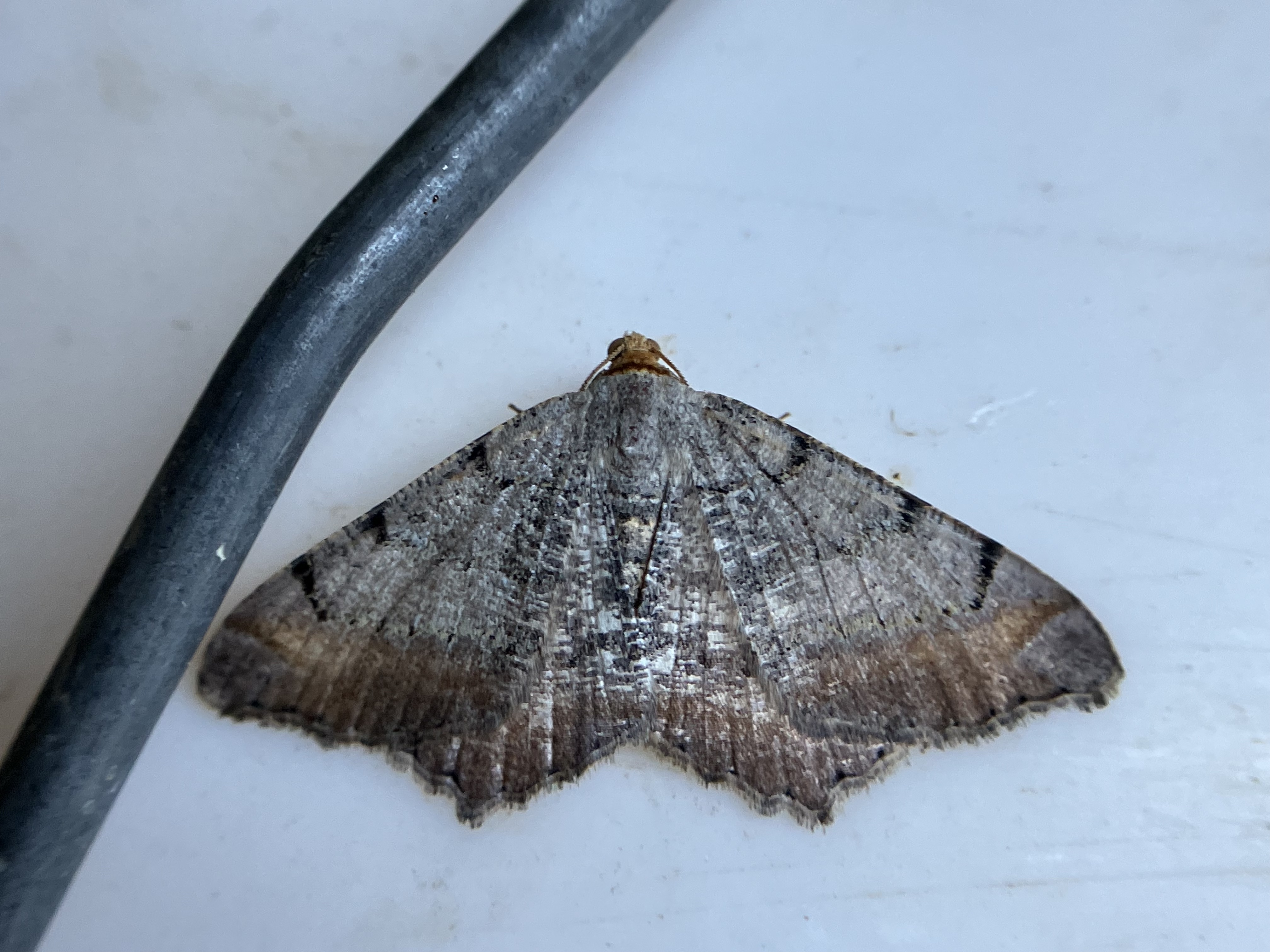
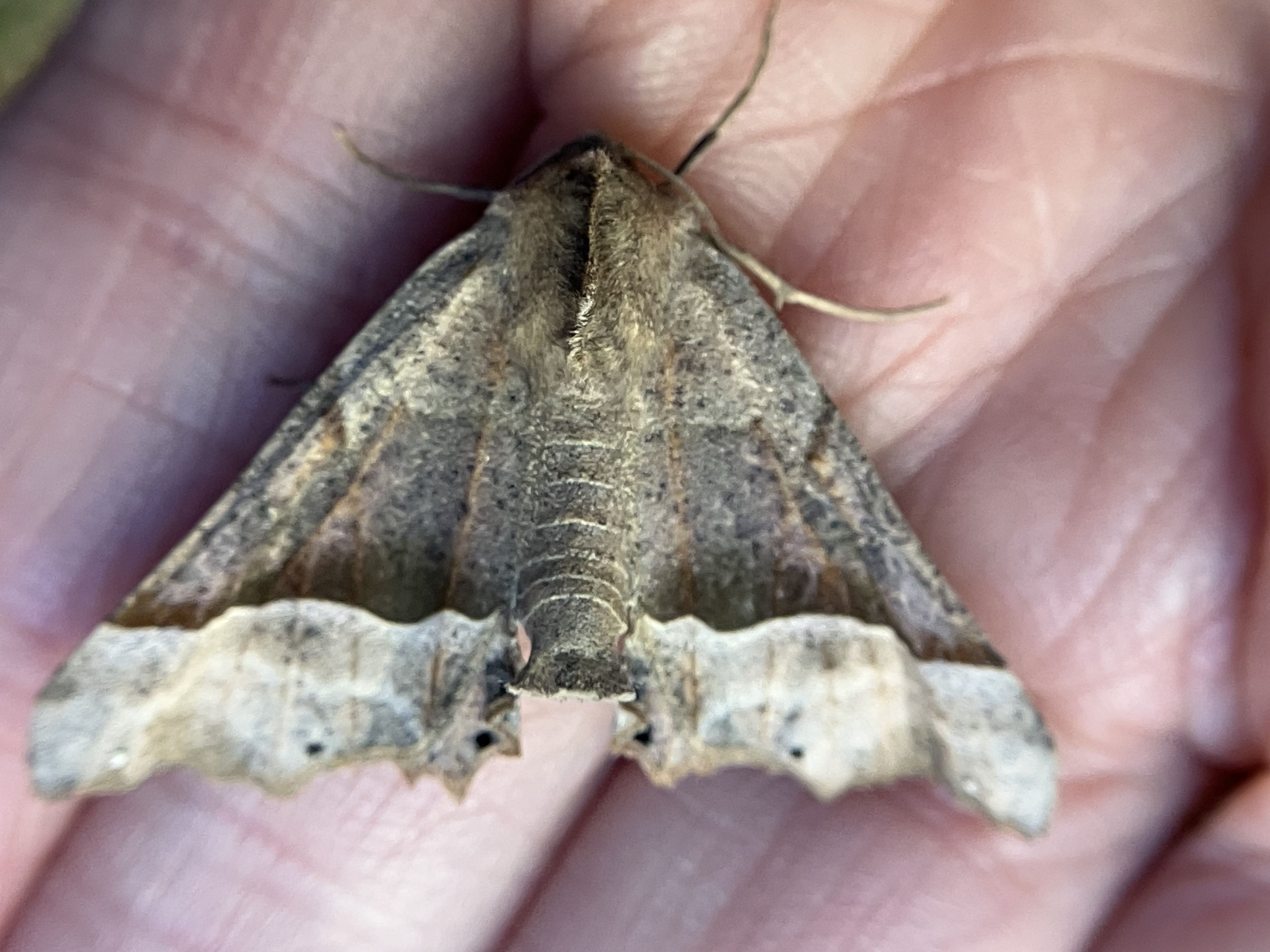
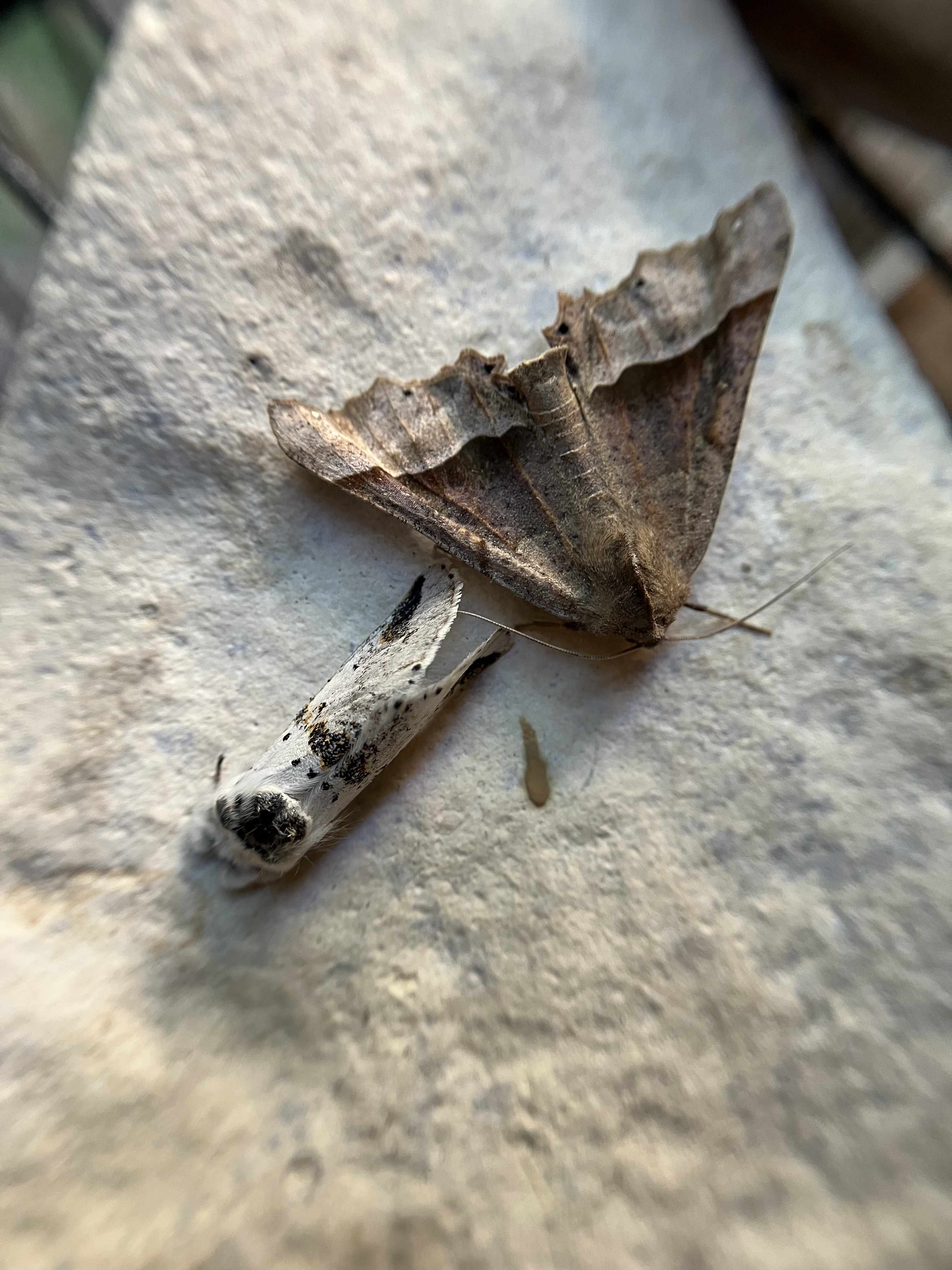
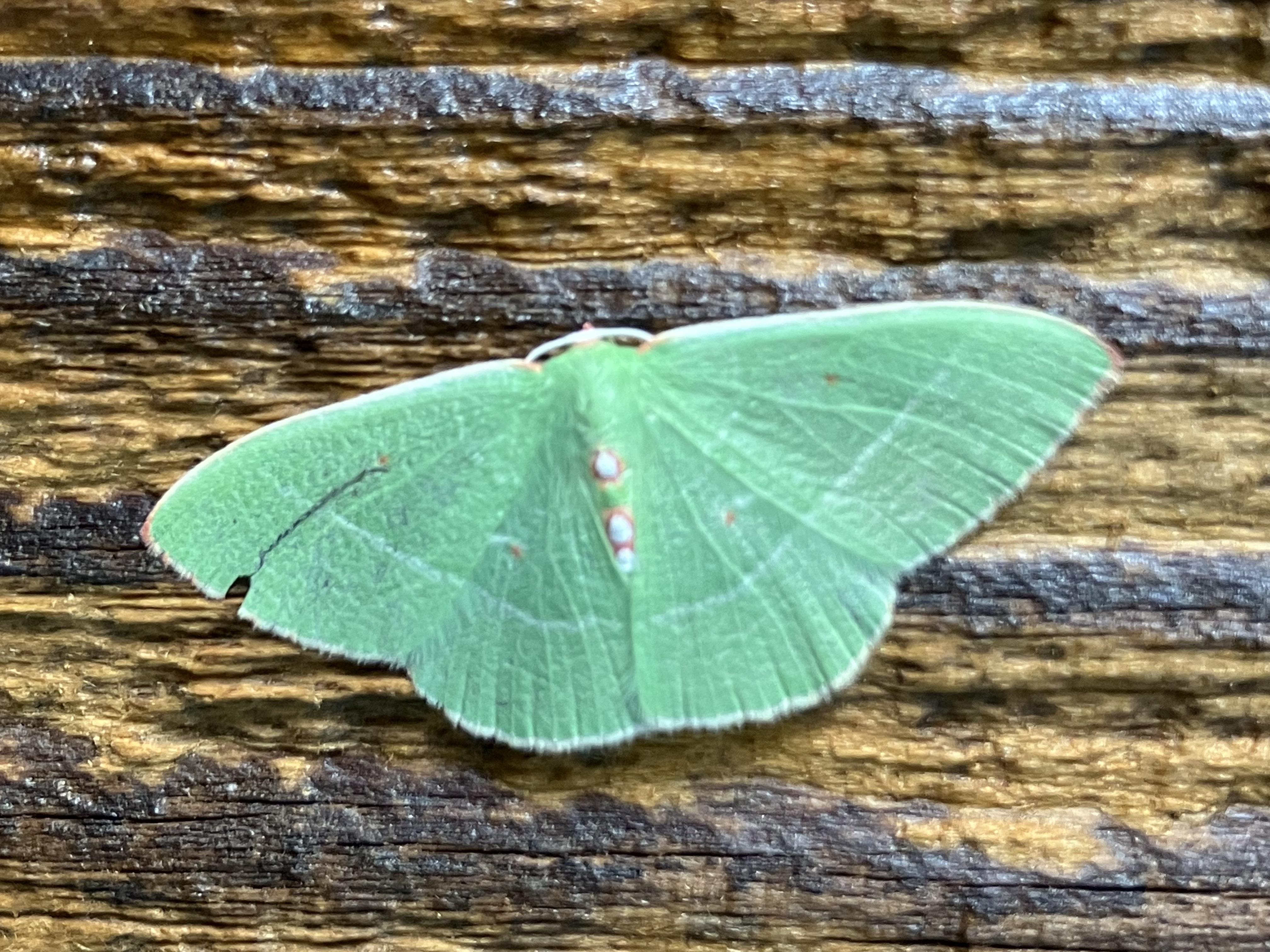
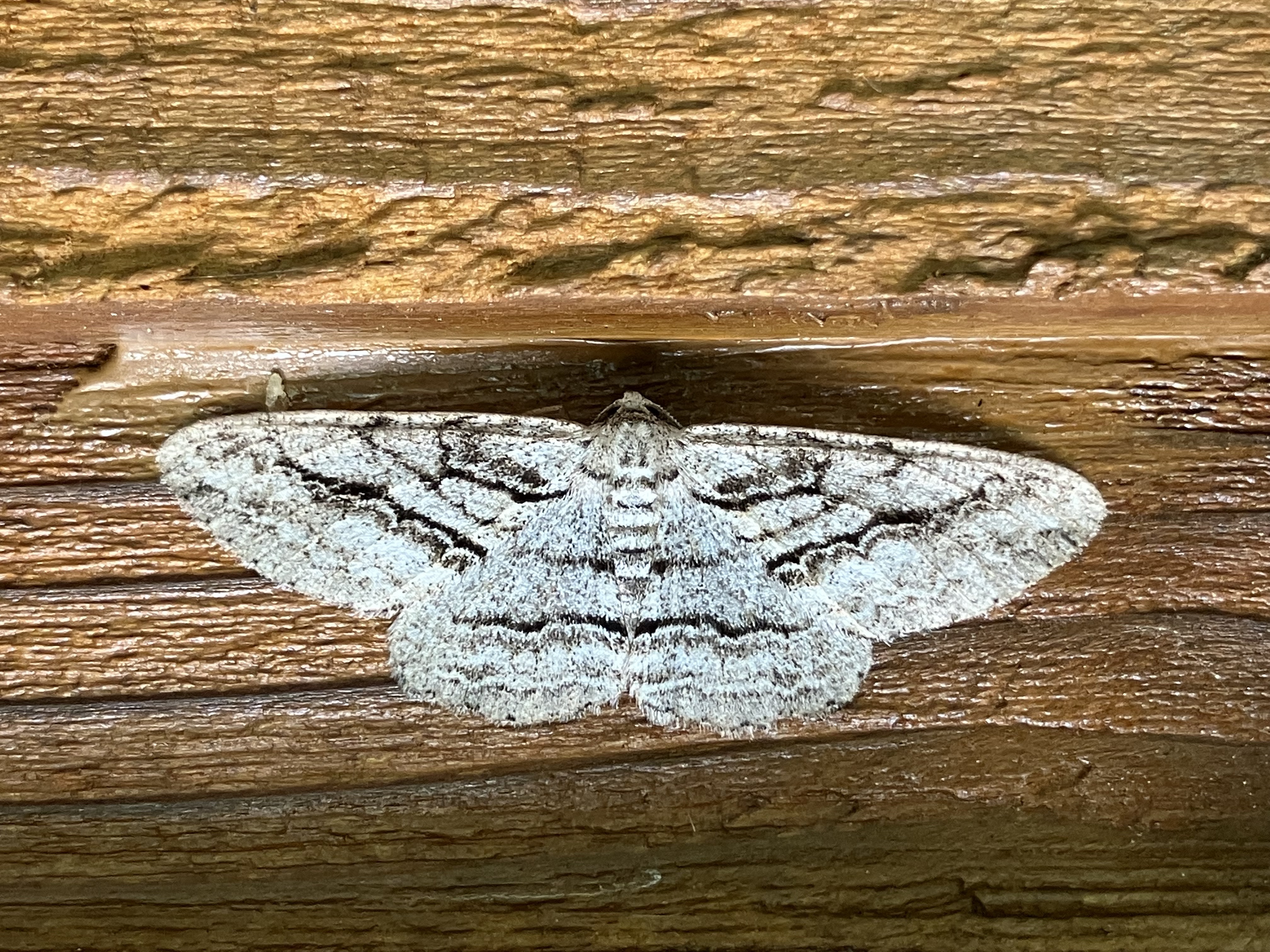
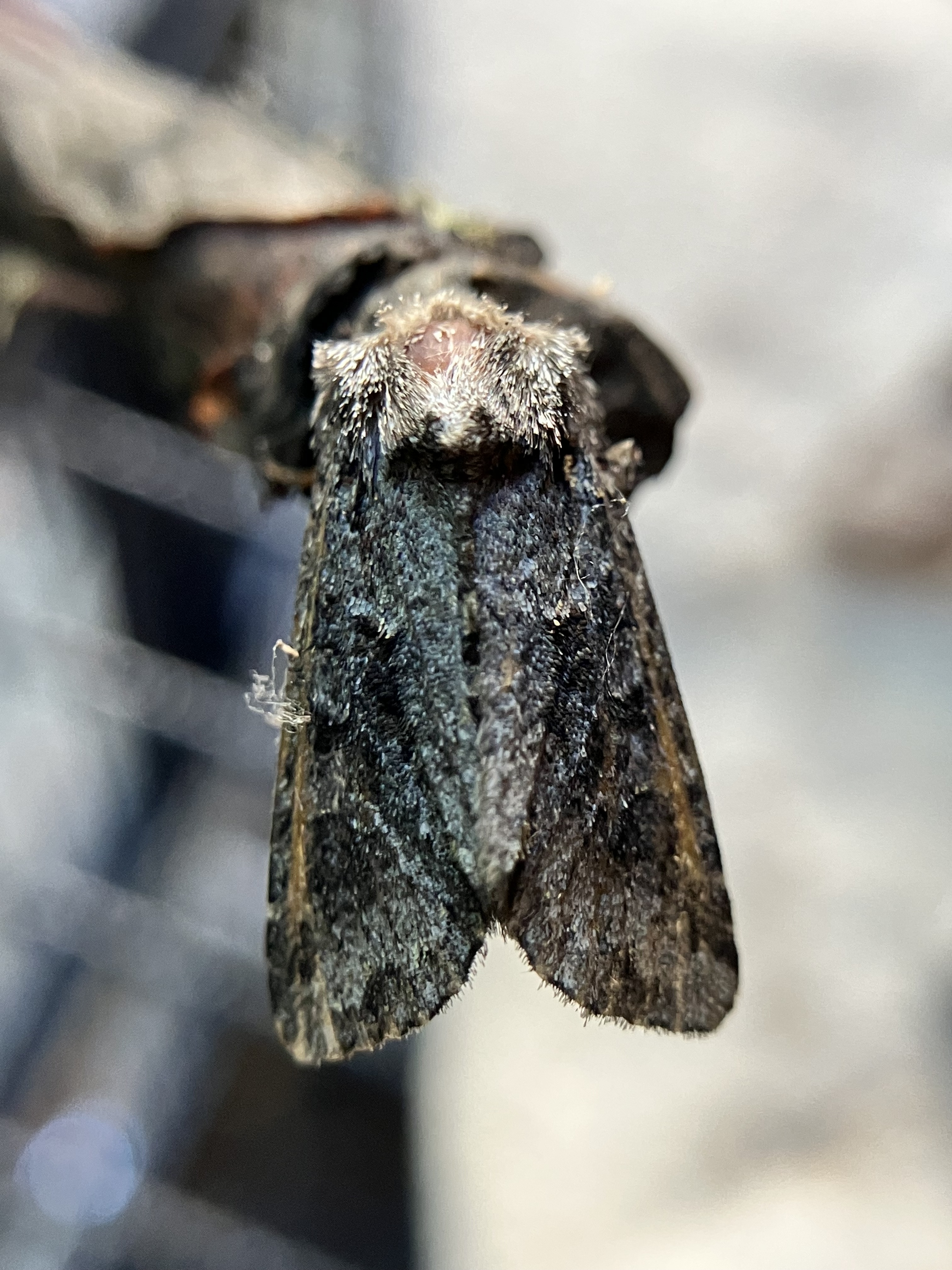
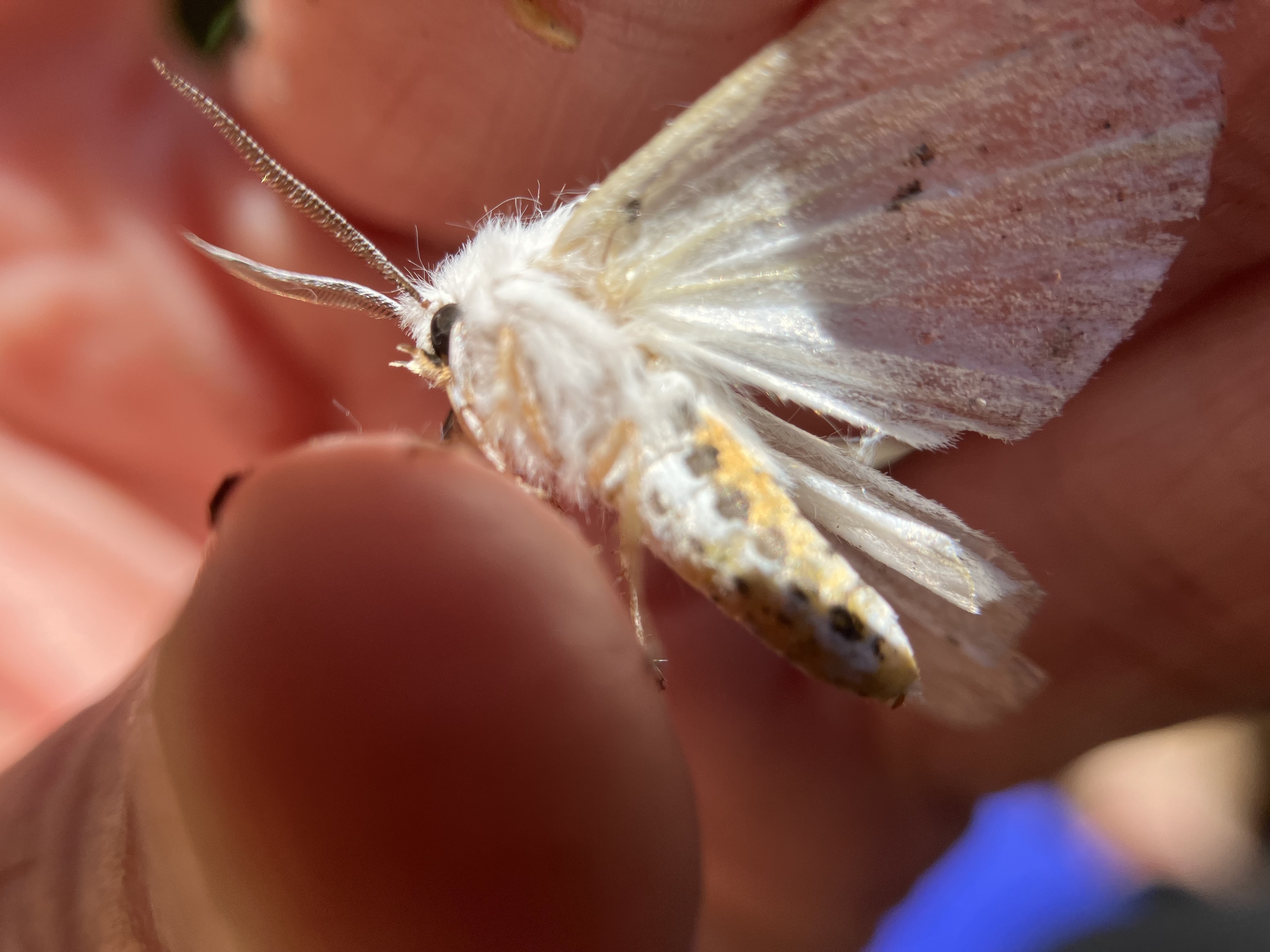
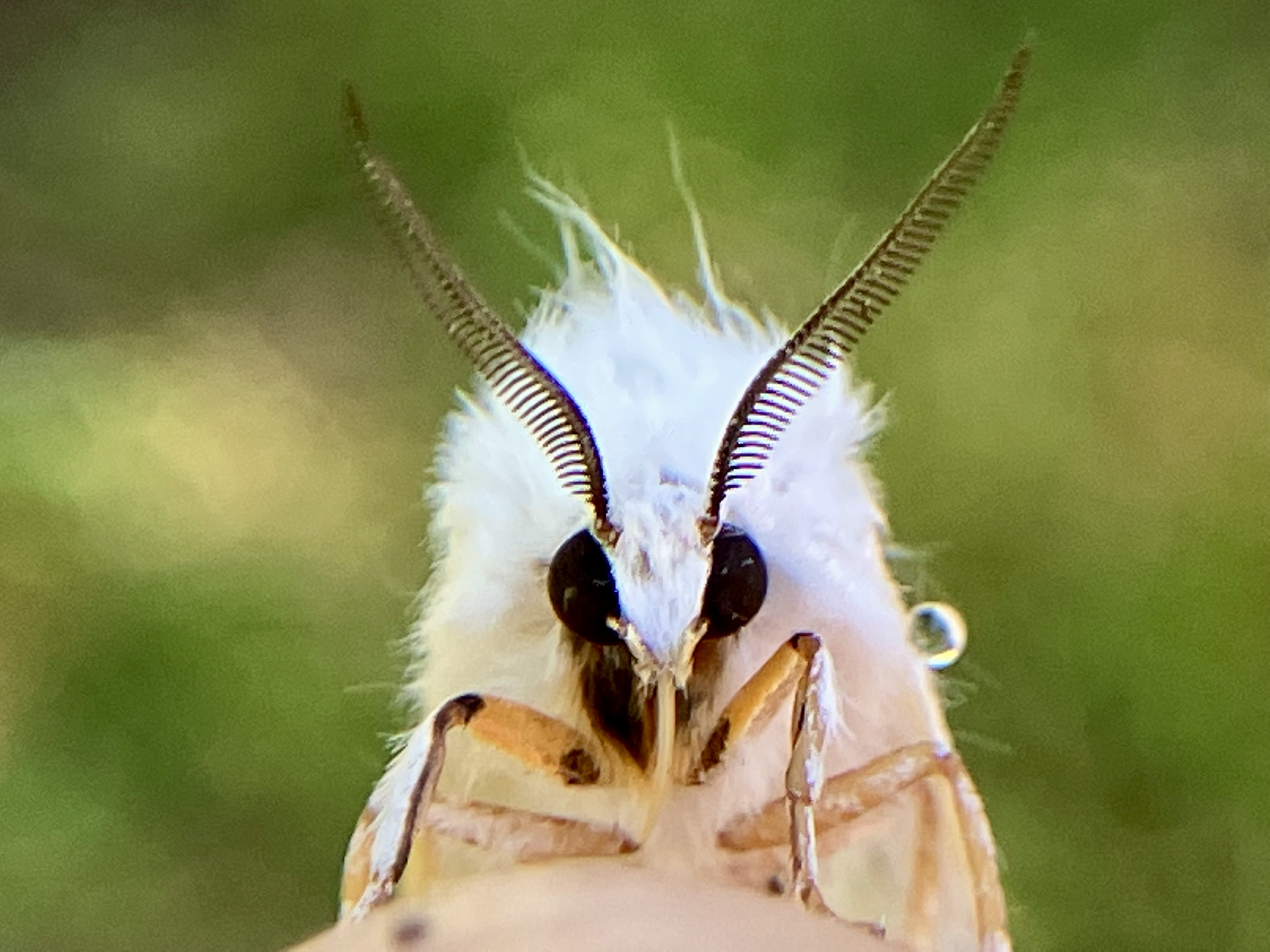
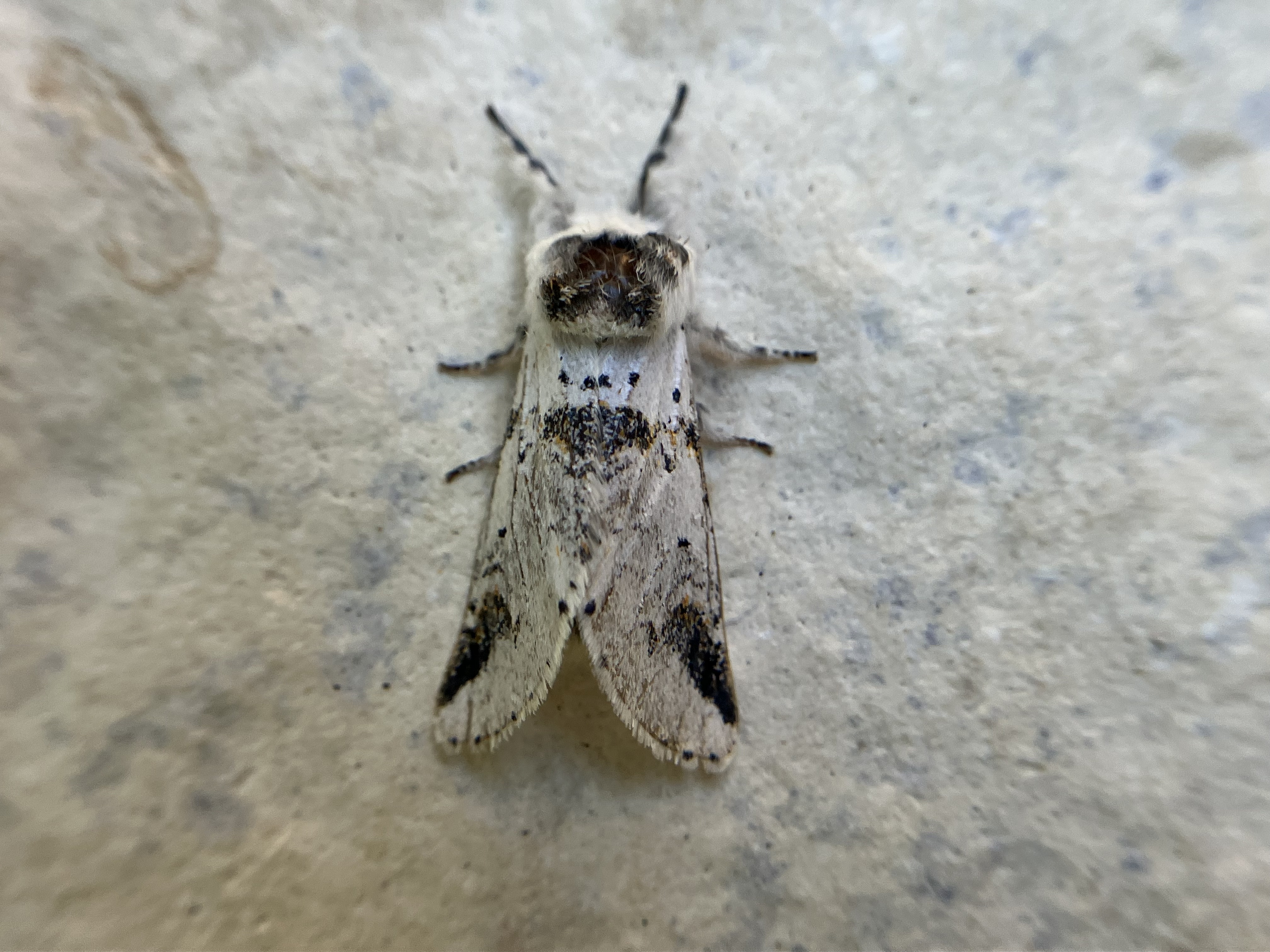
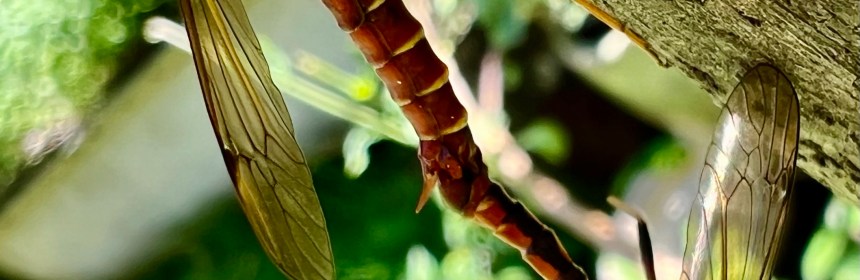
Leading up to the Twelfth Annual National Moth Week, July 22-30, 2023 https://nationalmothweek.org, I am getting into moth mode with some early collecting to see what is flying about the forest near our home at night.
My first attempts at this were quite unsatisfying, save for the two awesome beetles that came to visit. The bug station I set up just wasn’t yielding much in the way of moths, at least until I discovered my station had been discovered by some thieving yellow jackets who were picking off my moths right in front of my eyes. Something had to change. I sure didn’t want to lure in these beautiful creatures to become a breakfast buffet.
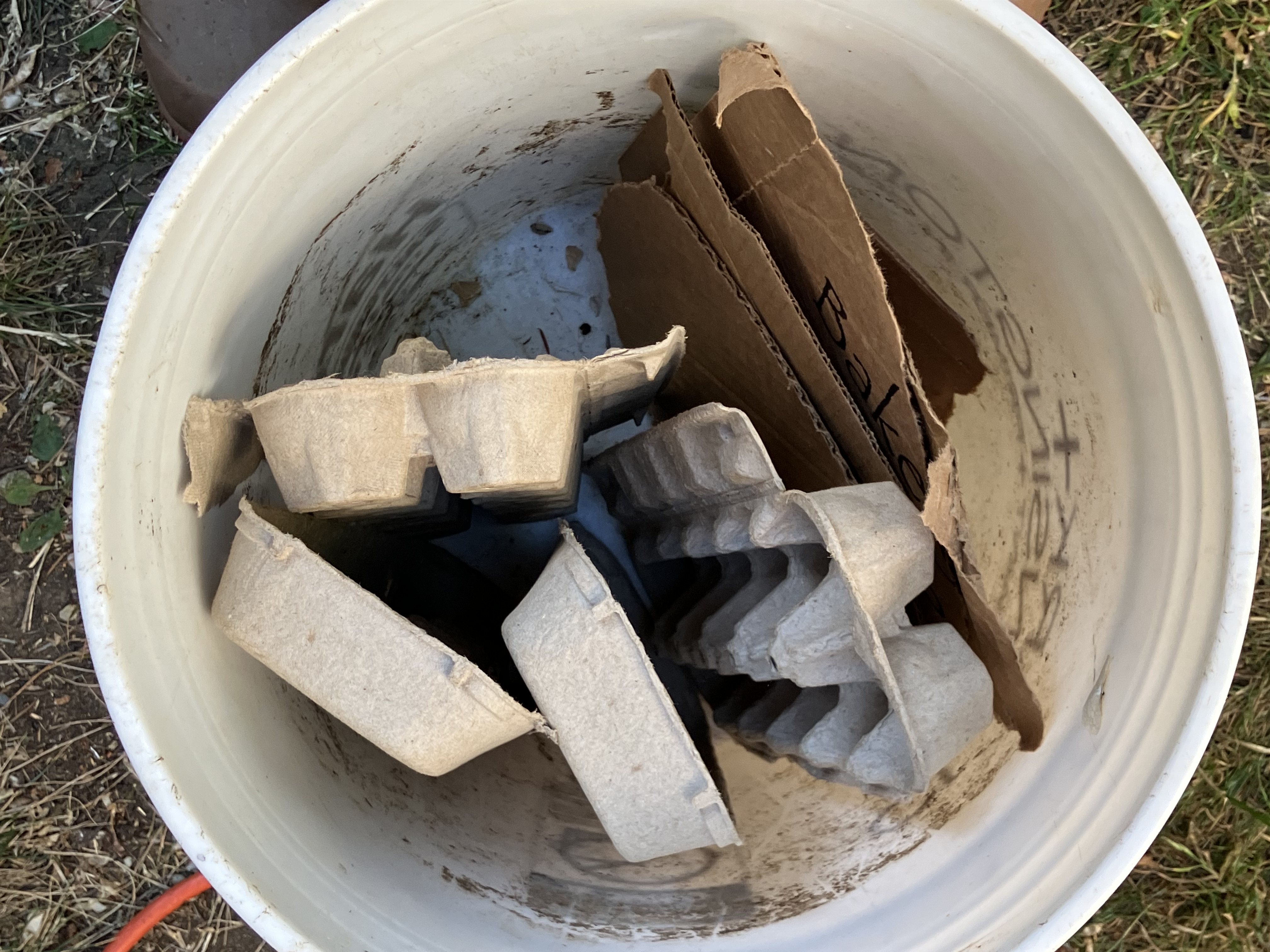
I got some very helpful advice from a friend named Carl. Carl is an expert moth-er, and he recommended putting some egg cartons in my bug bucket so they would have a place to hide. I tried this last night, adding two egg cartons and some pieces of cardboard. Then, I went to hang my bucket up and turn on the light – EXCEPT, those darn yellow jackets showed up at 9 pm. They must have excellent memory. I suppose they wanted to be first in line at the moth buffet.
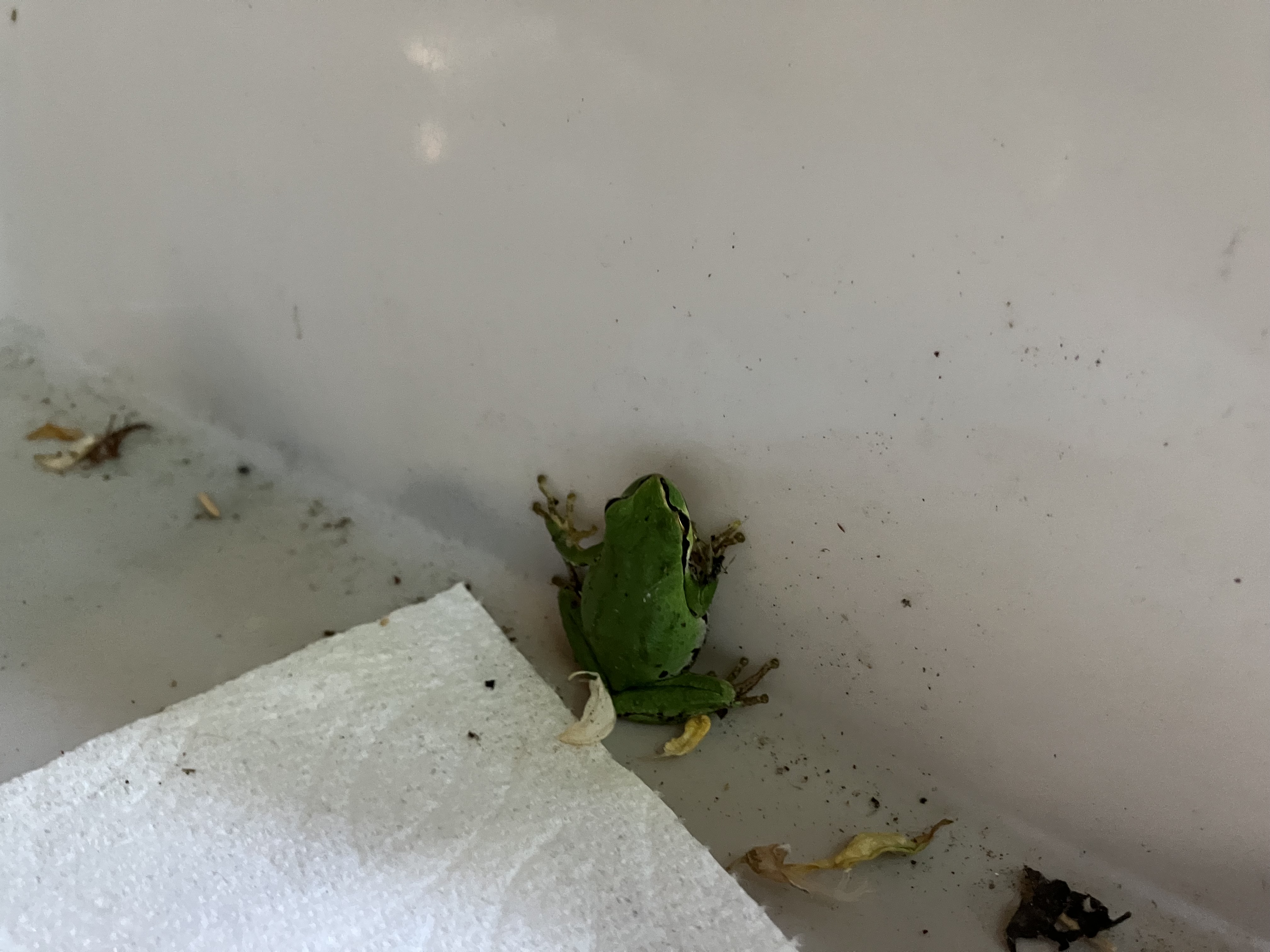
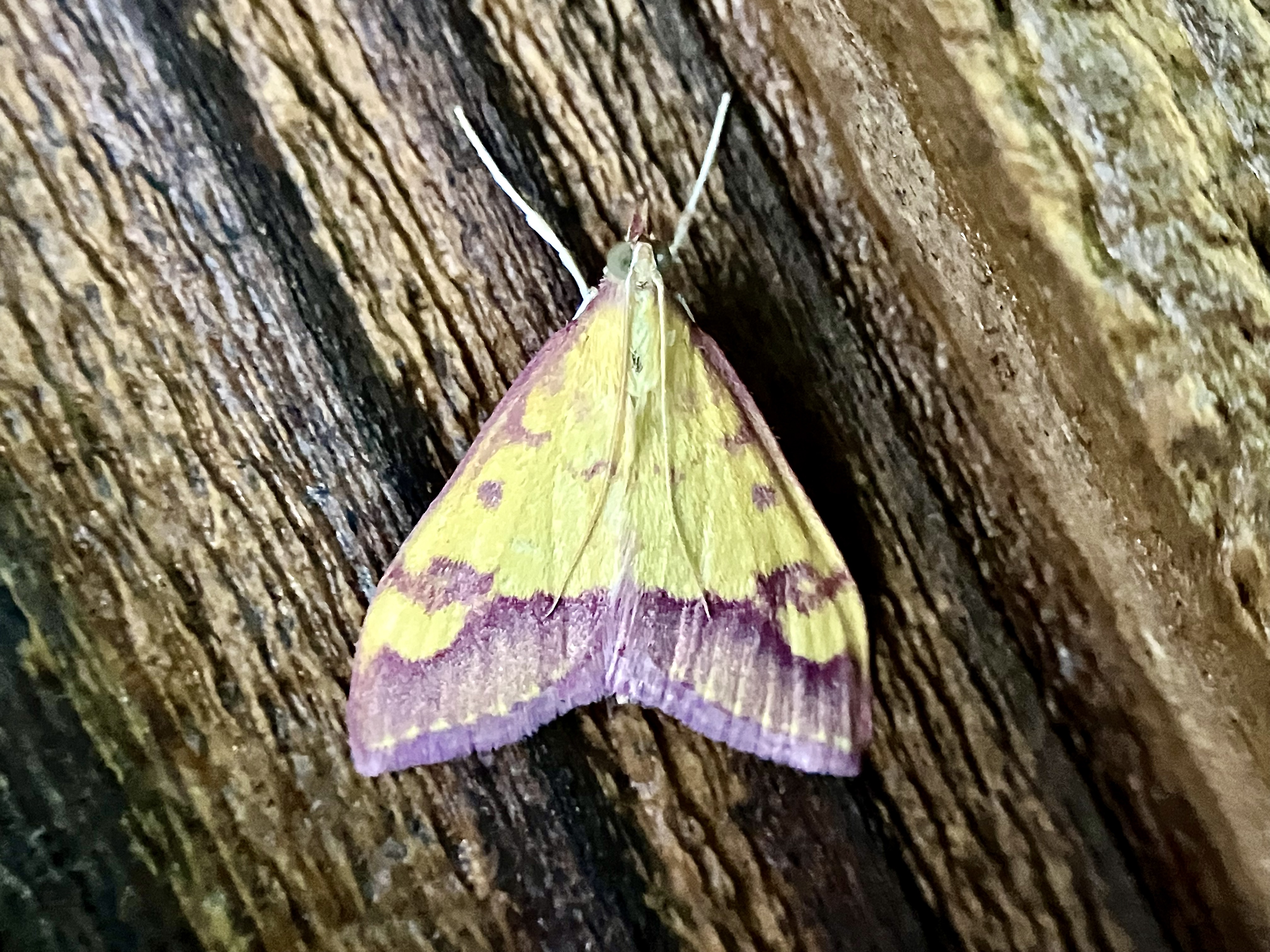
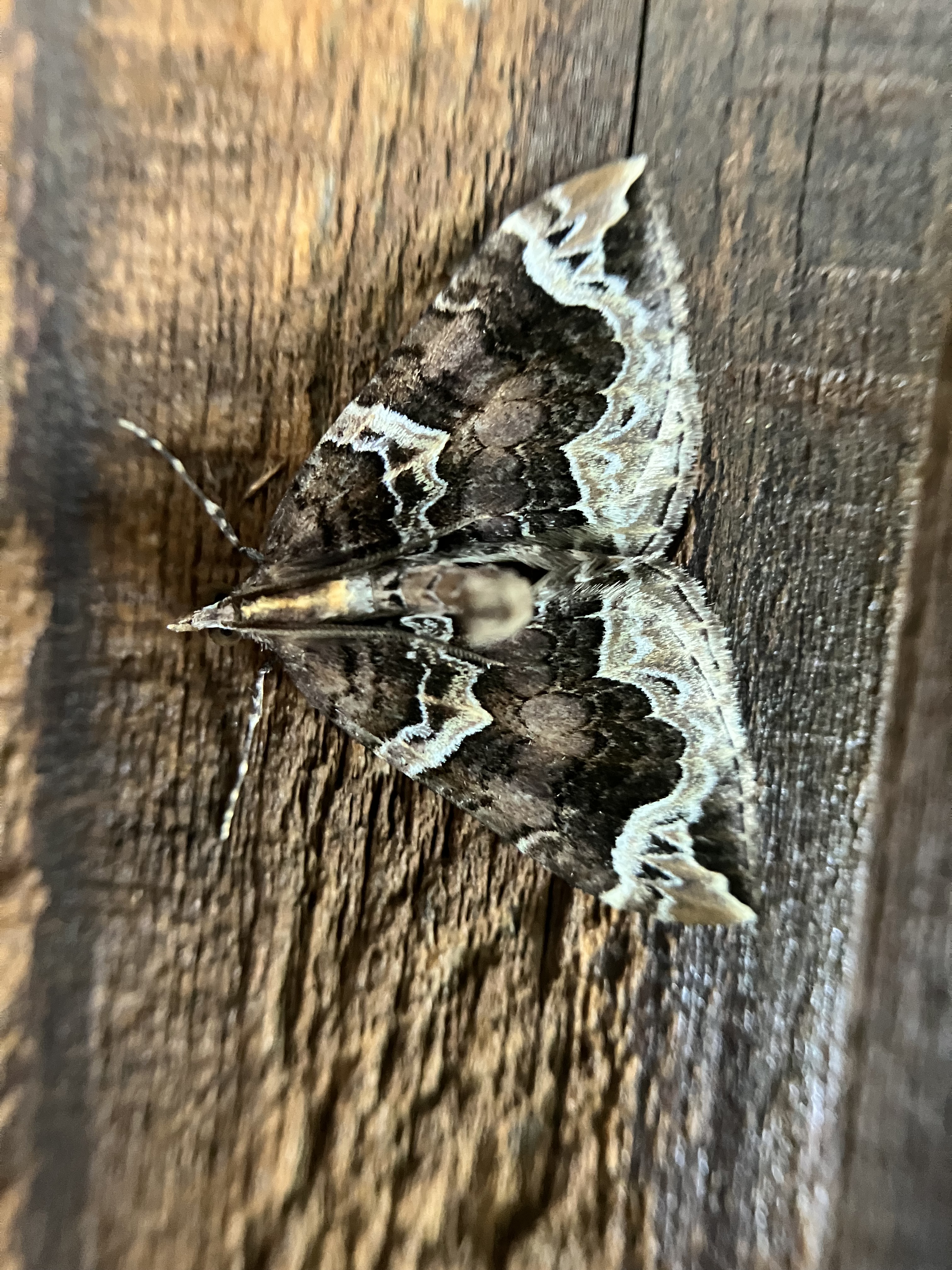
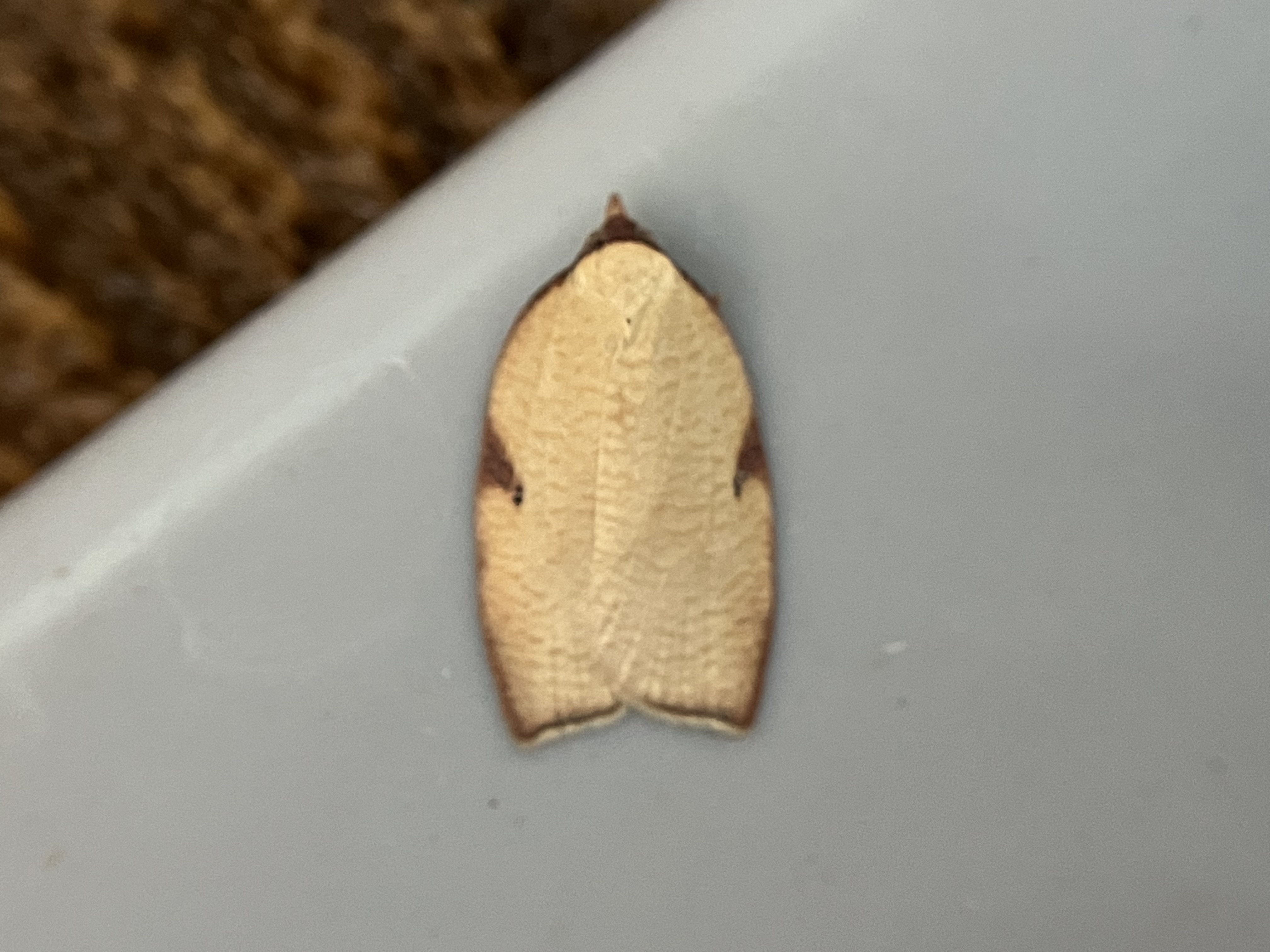
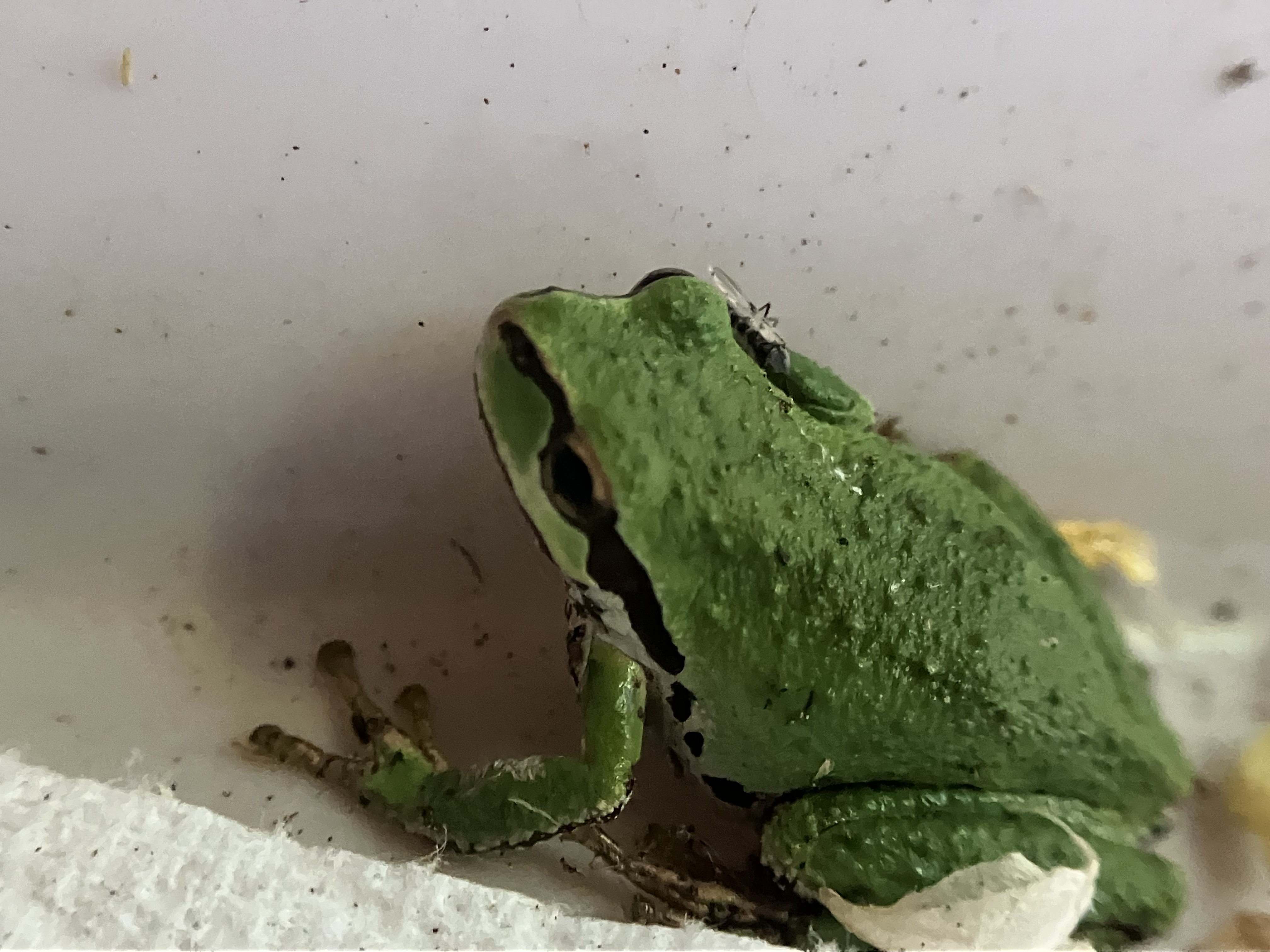
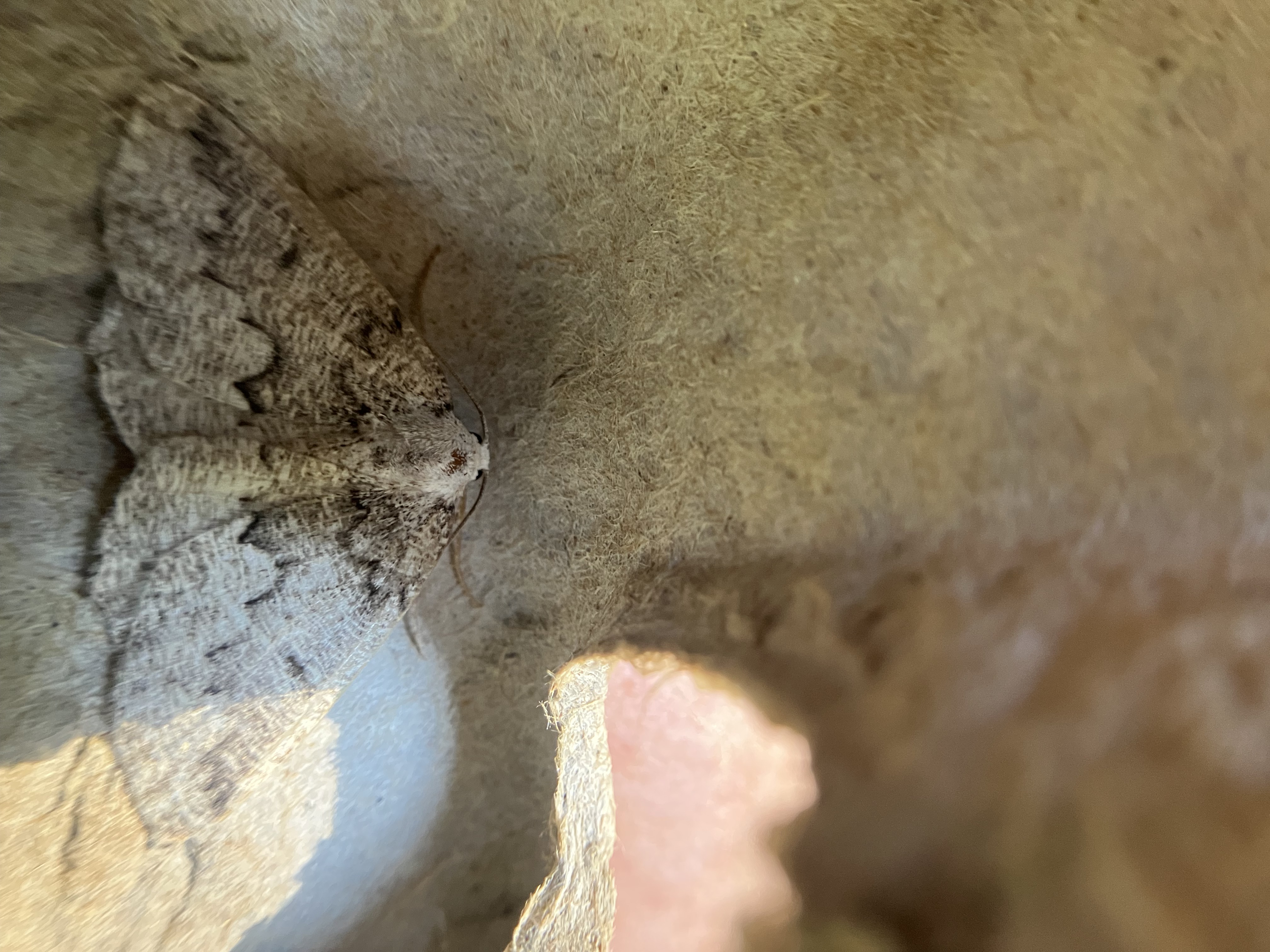
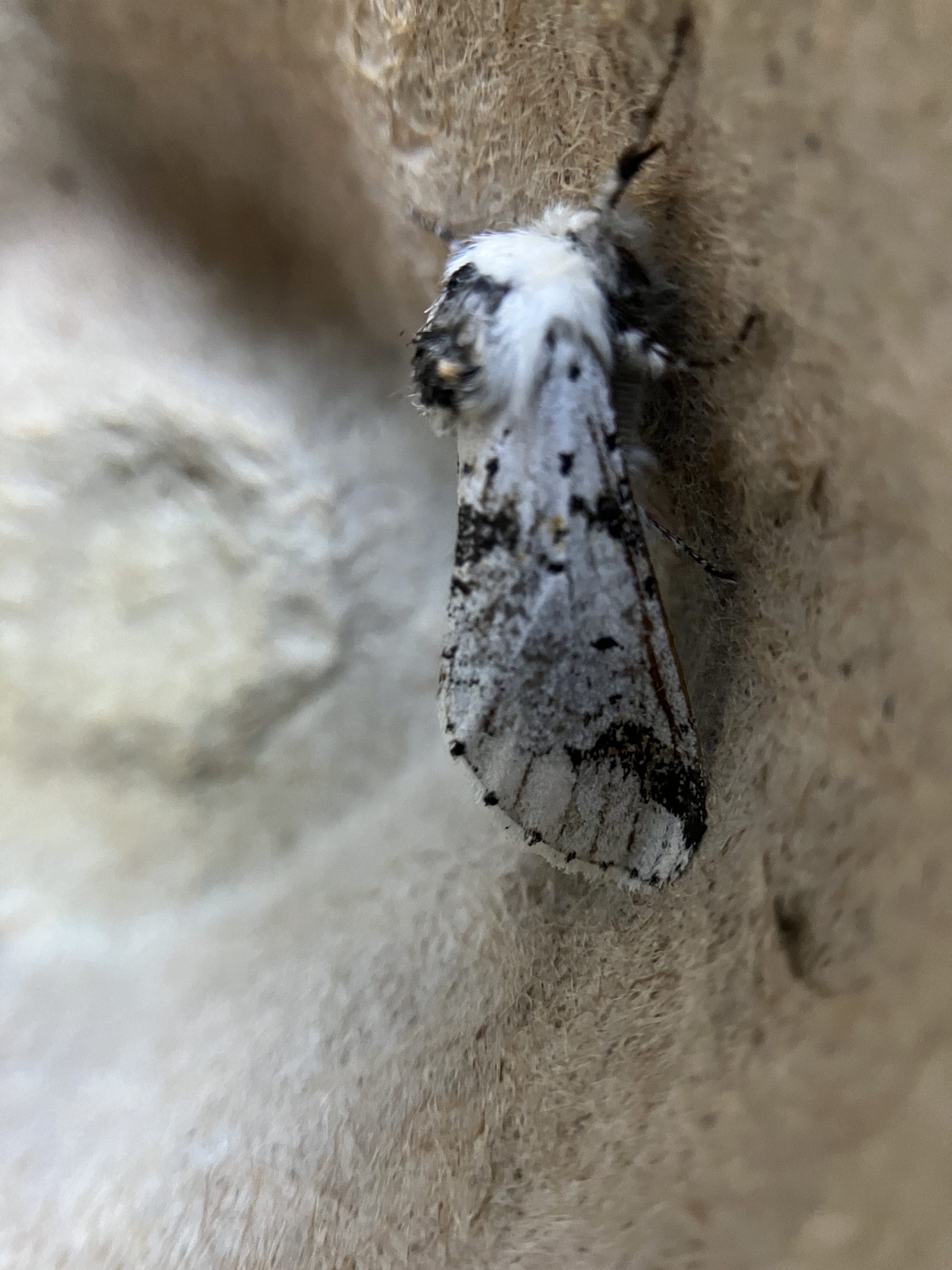
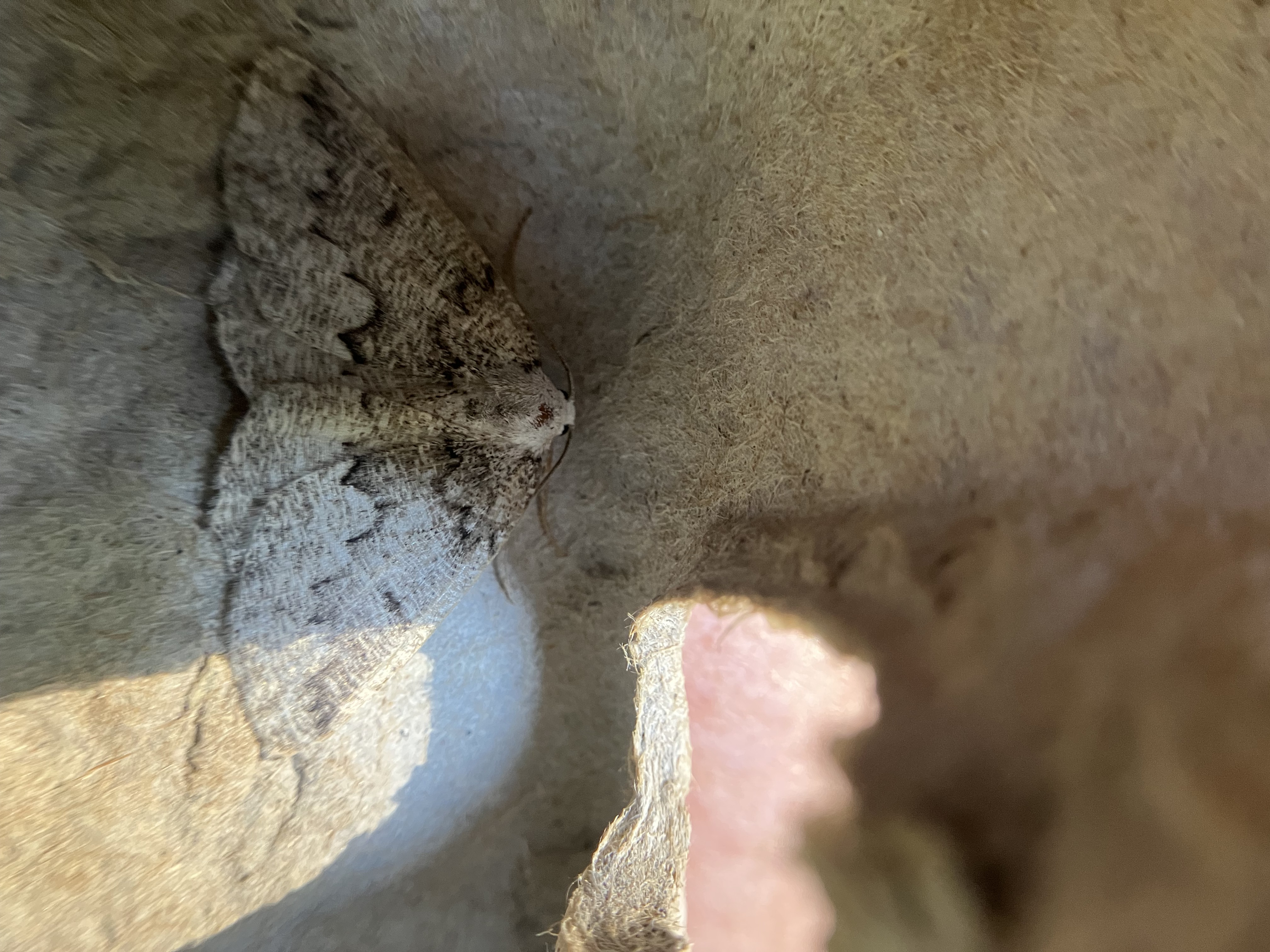
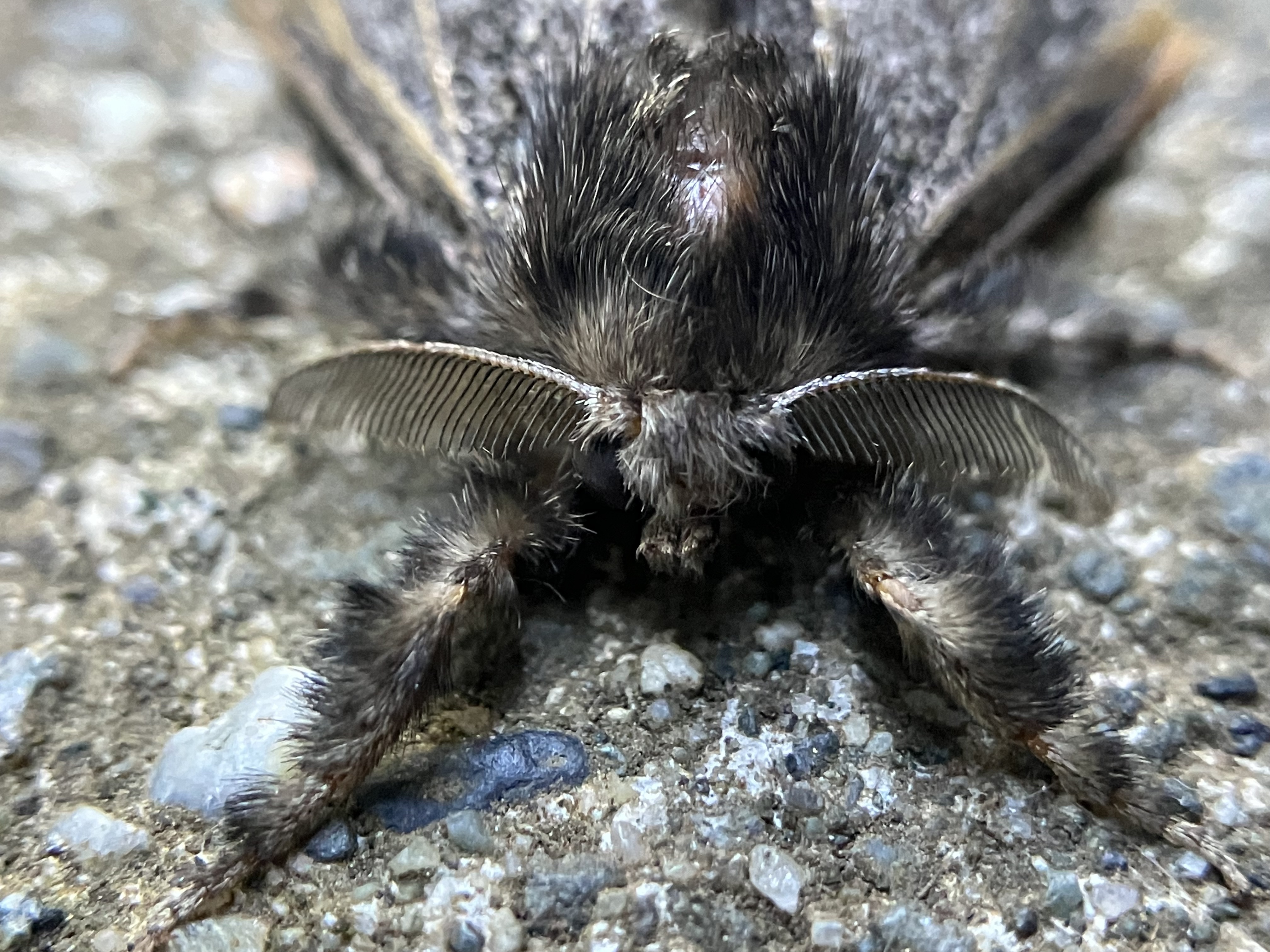
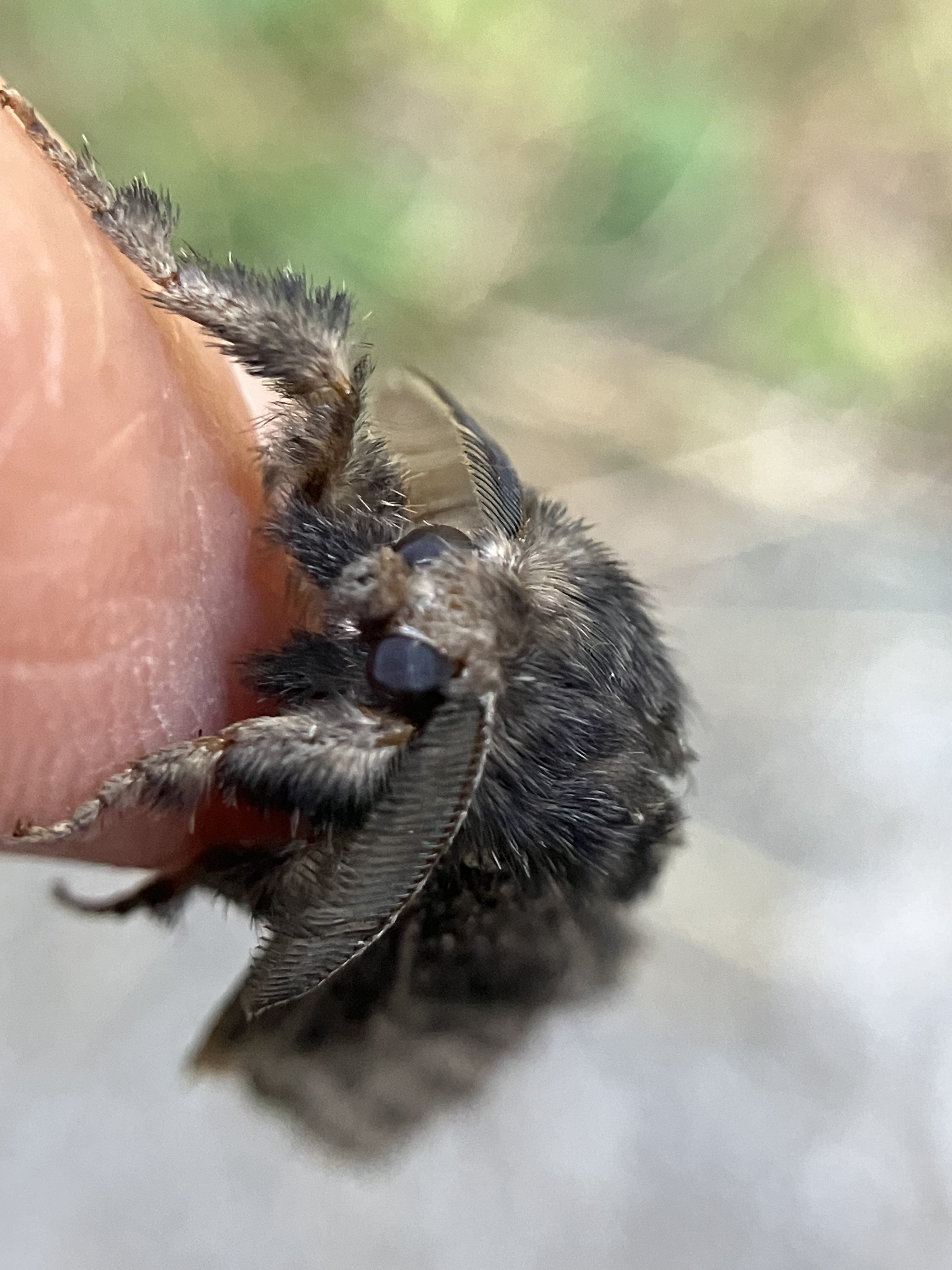
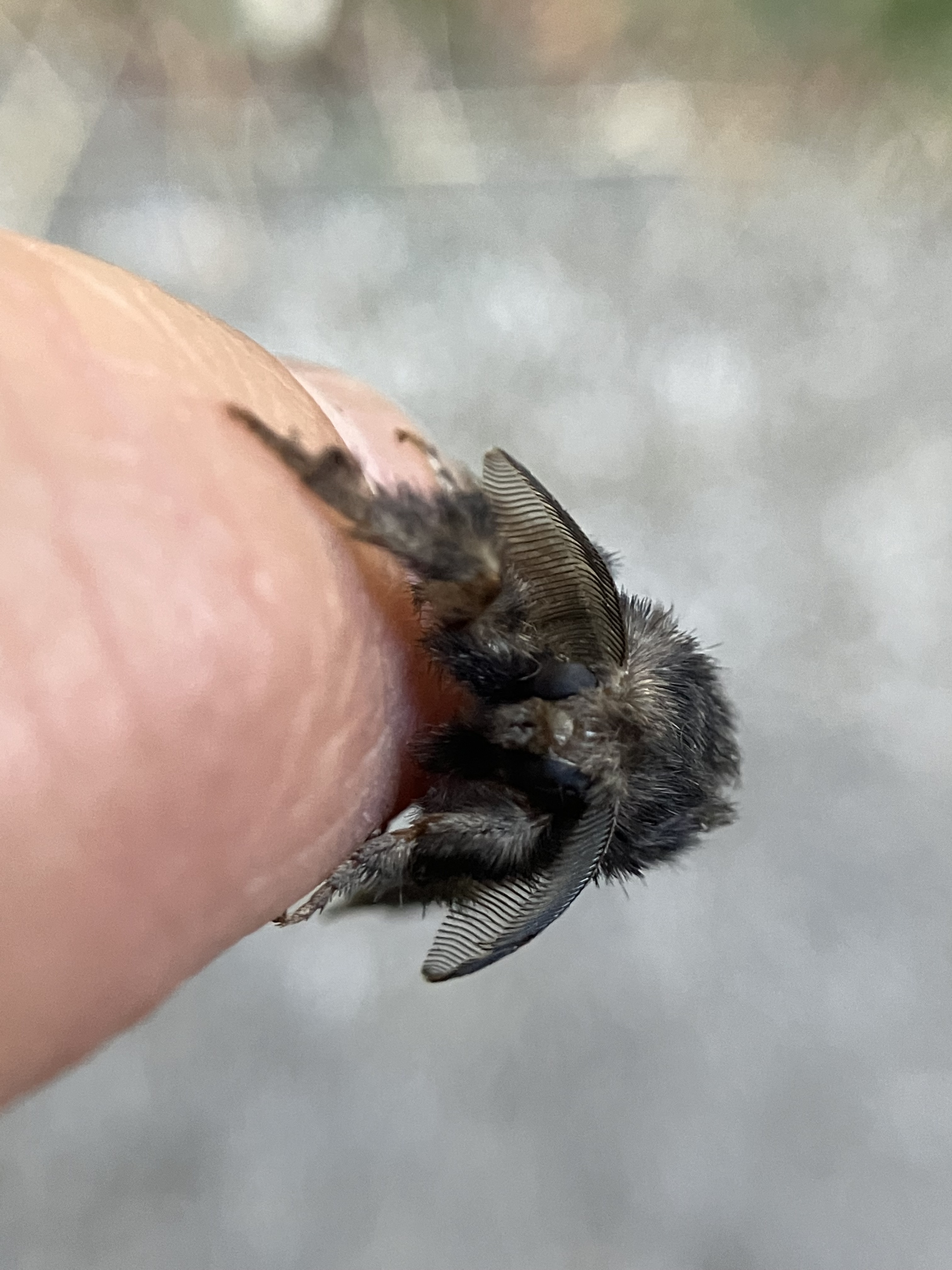
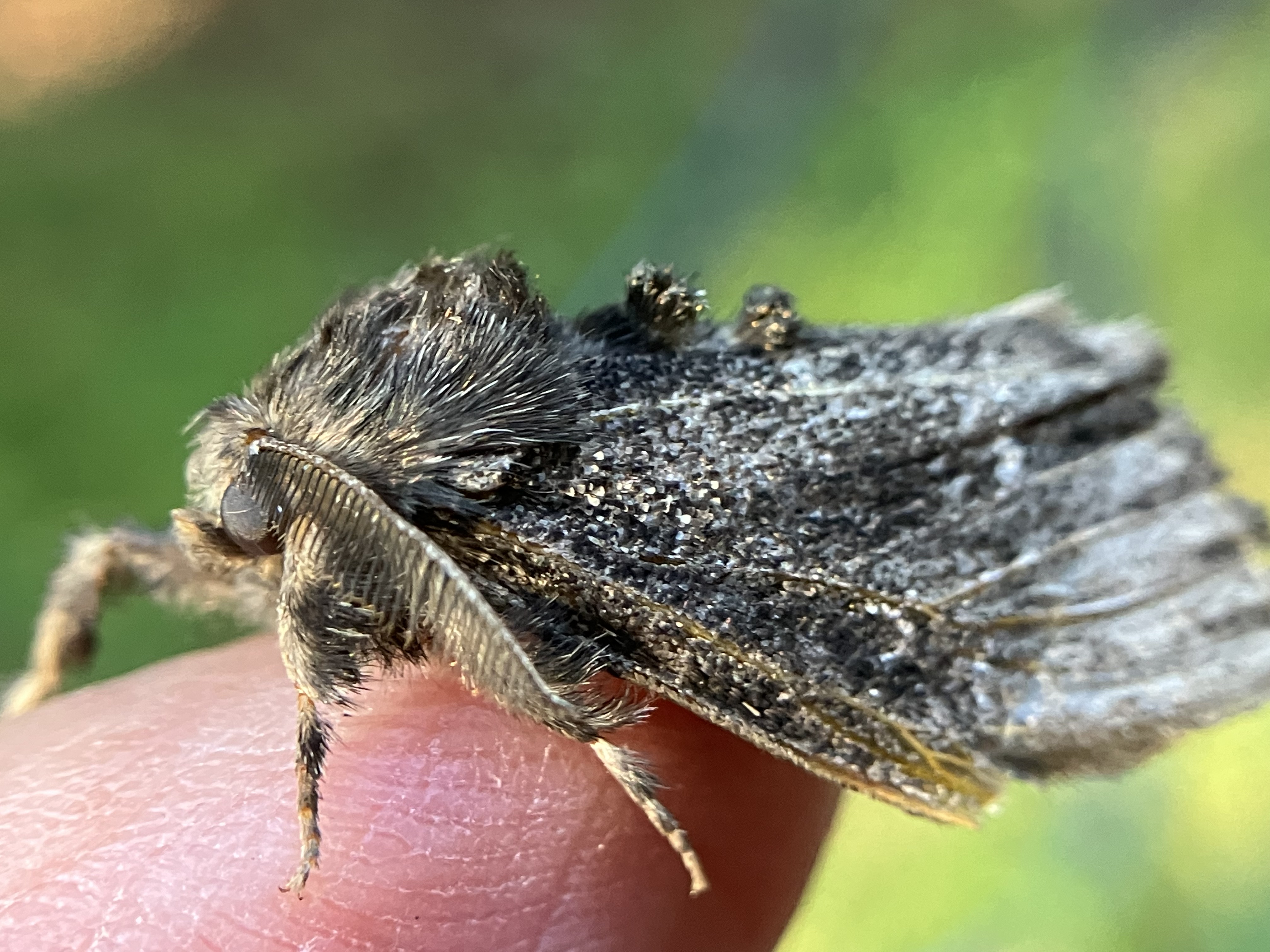
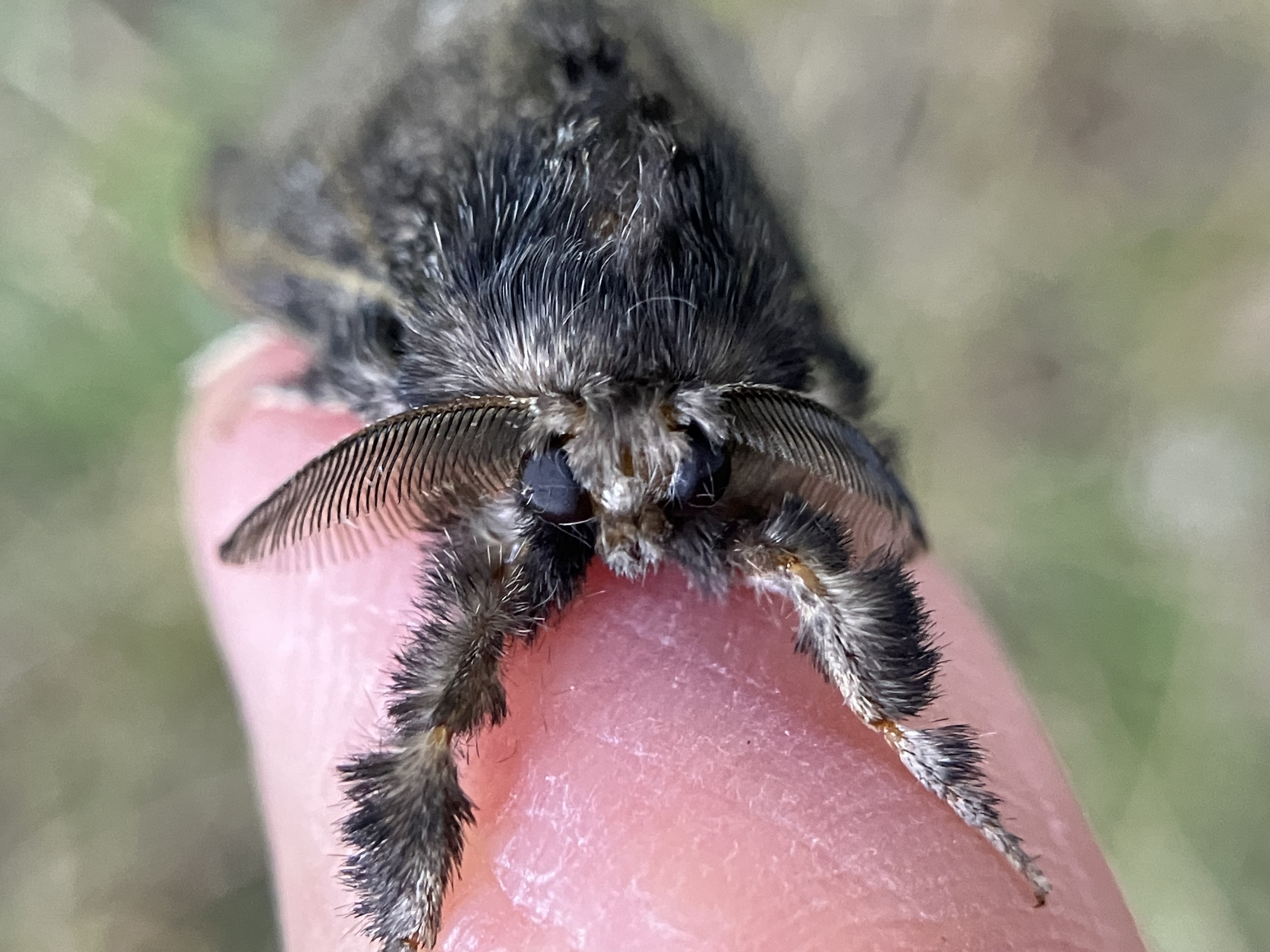
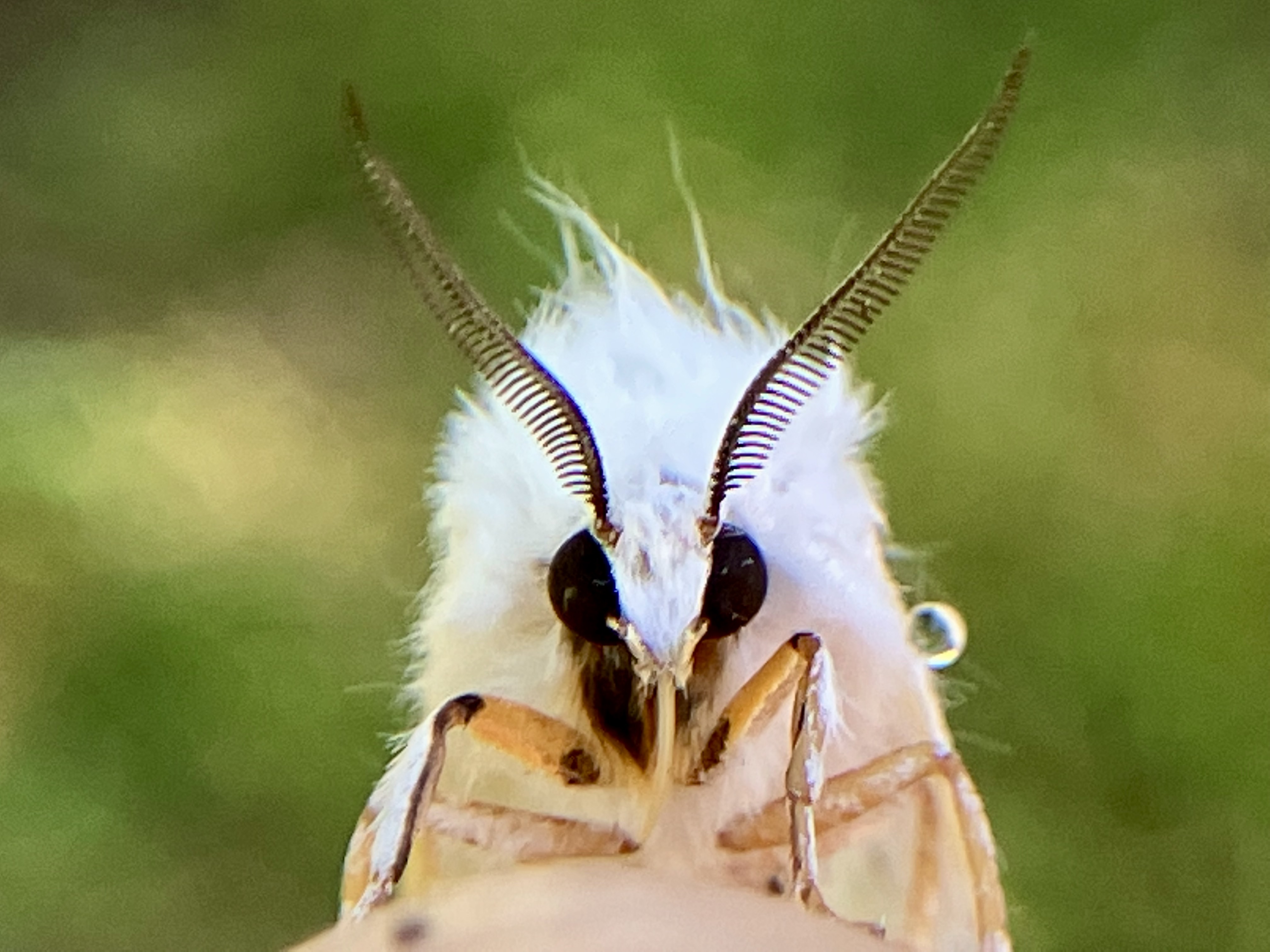
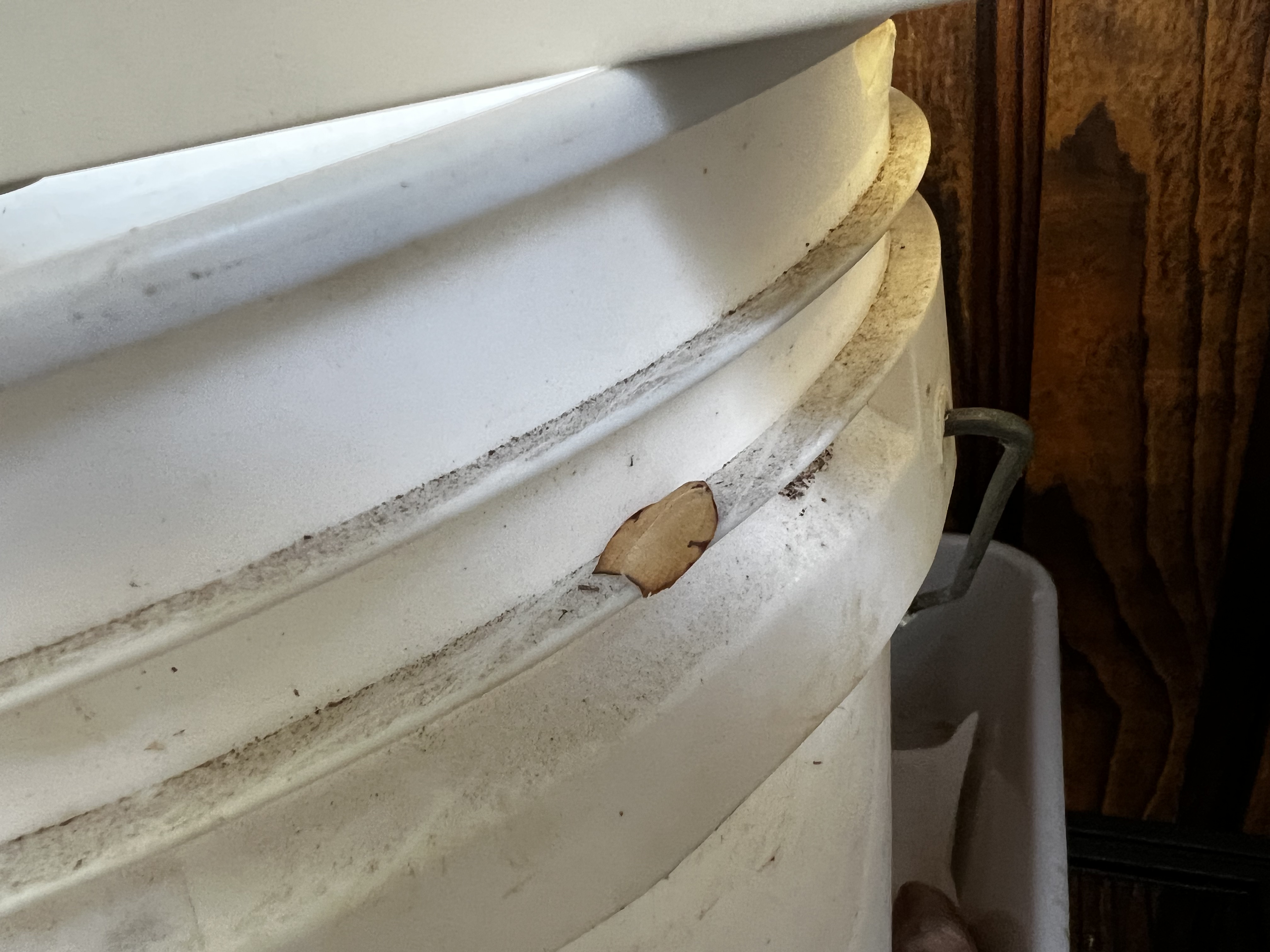
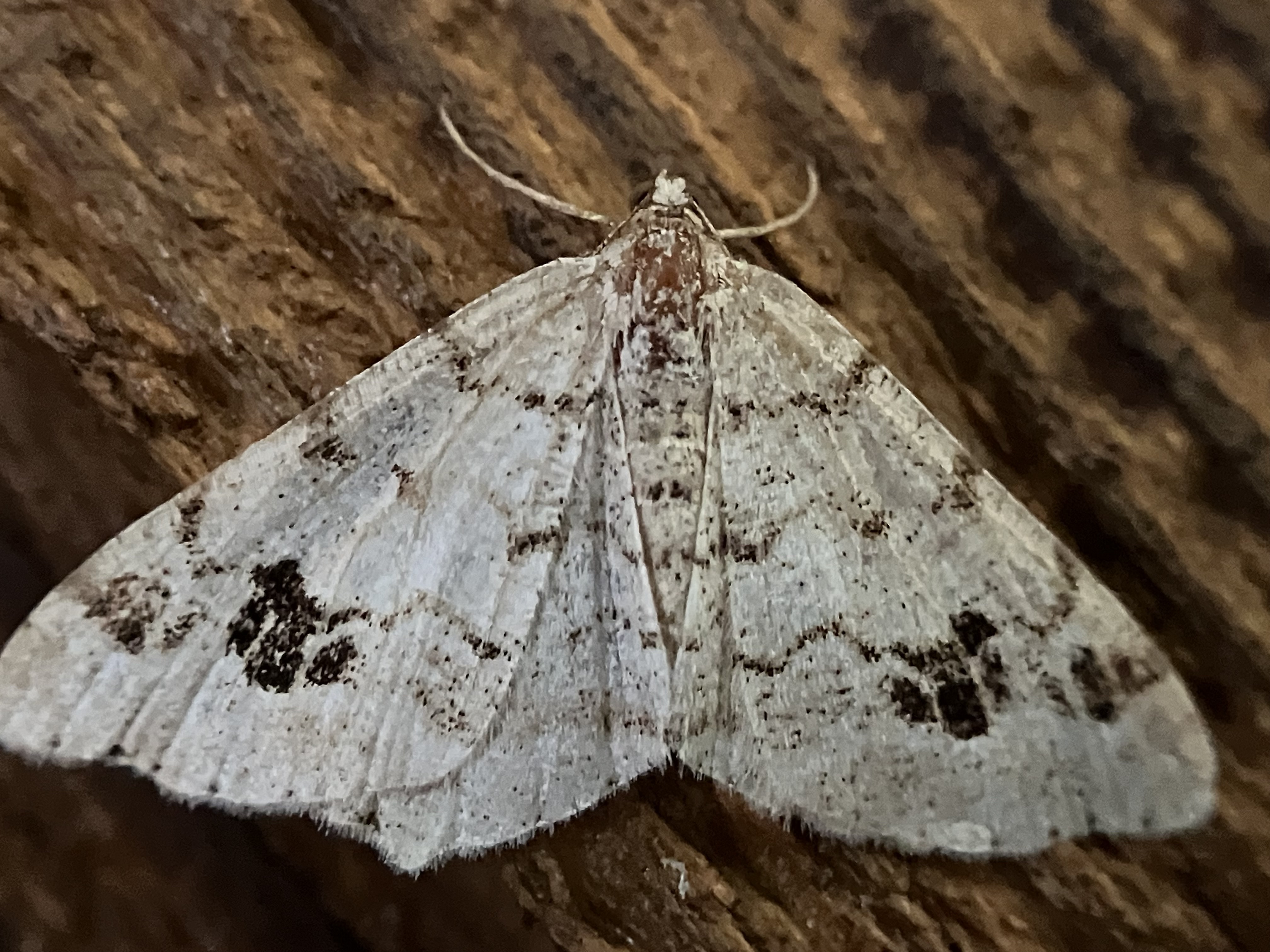
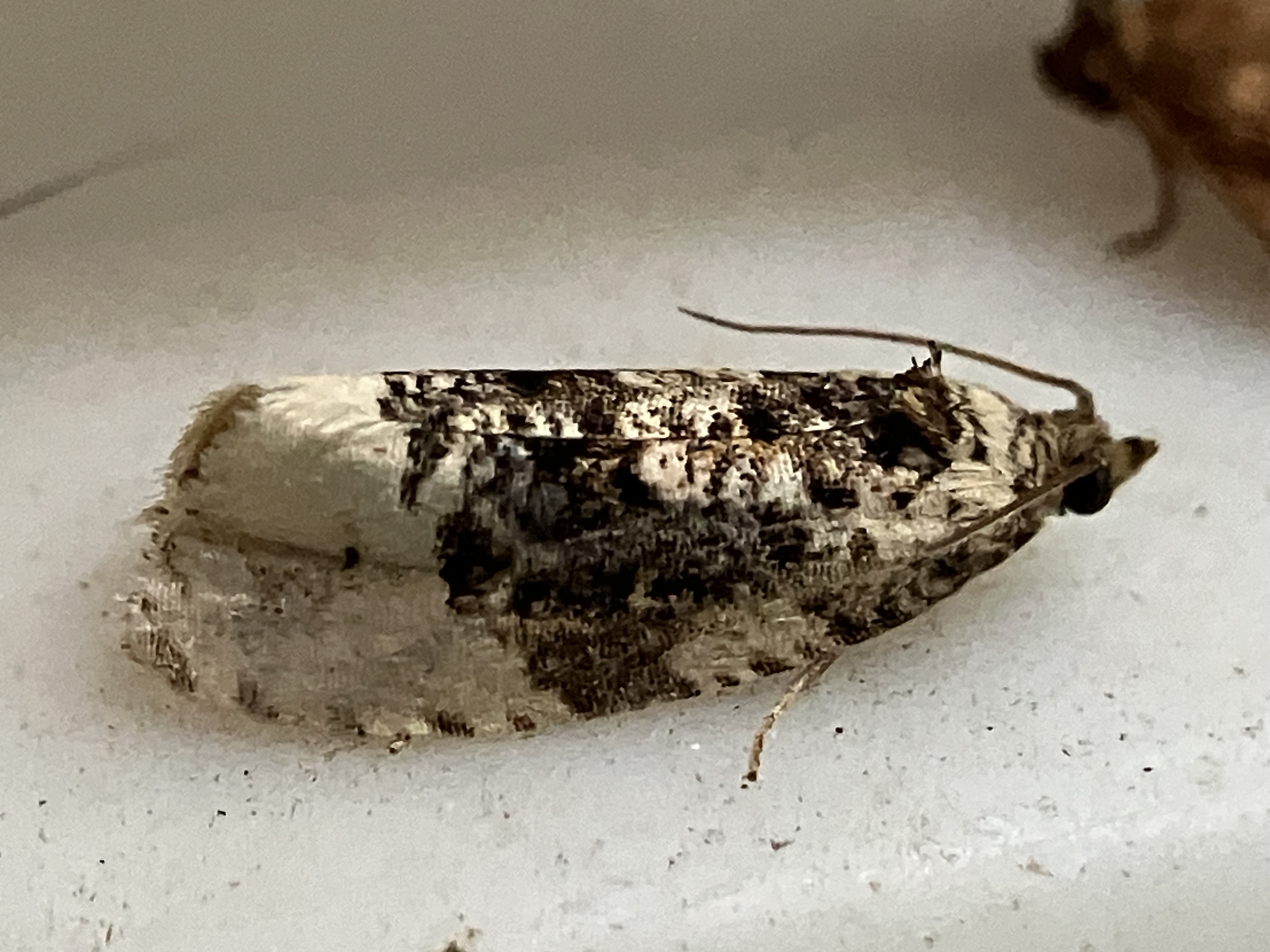
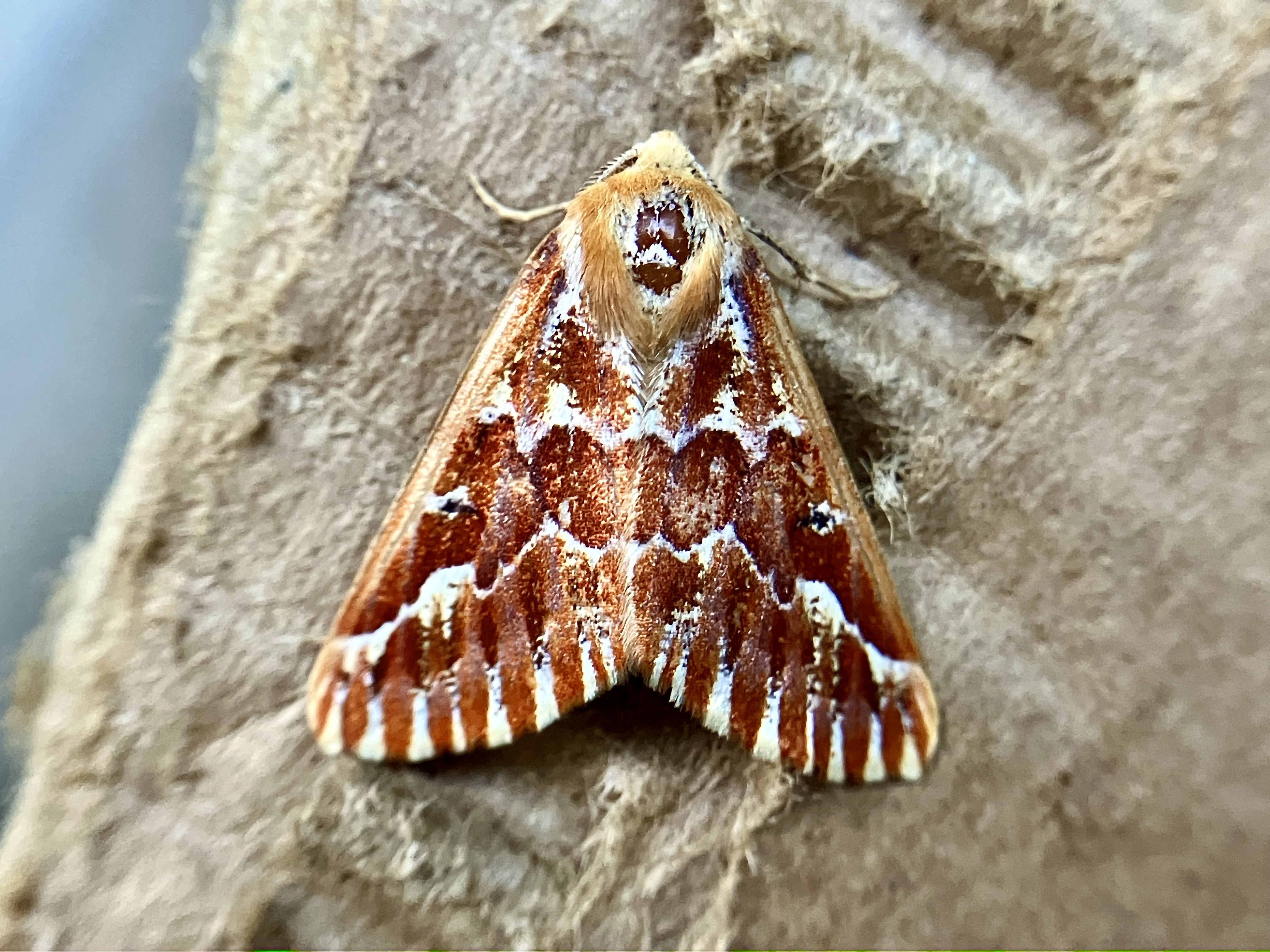
I moved my bug bucket and light to another location. It was a success. Here is the assortment of moths I collected last night. All were handled with gentle care and photographed. Afterwards, I moved them to hiding spots in the forest to make them less susceptible to predation.
If you’re interested in participating locally in National Moth Week, please don’t hesitate to reach out for more information. You can find me via email at cynthiabrast@icloud.com or on Facebook at Bugs of the San Juan Islands – a private group, but easy to join by answering a couple of questions and agreeing to follow the group rules to prove you aren’t a spammer and won’t be disruptive. 😉
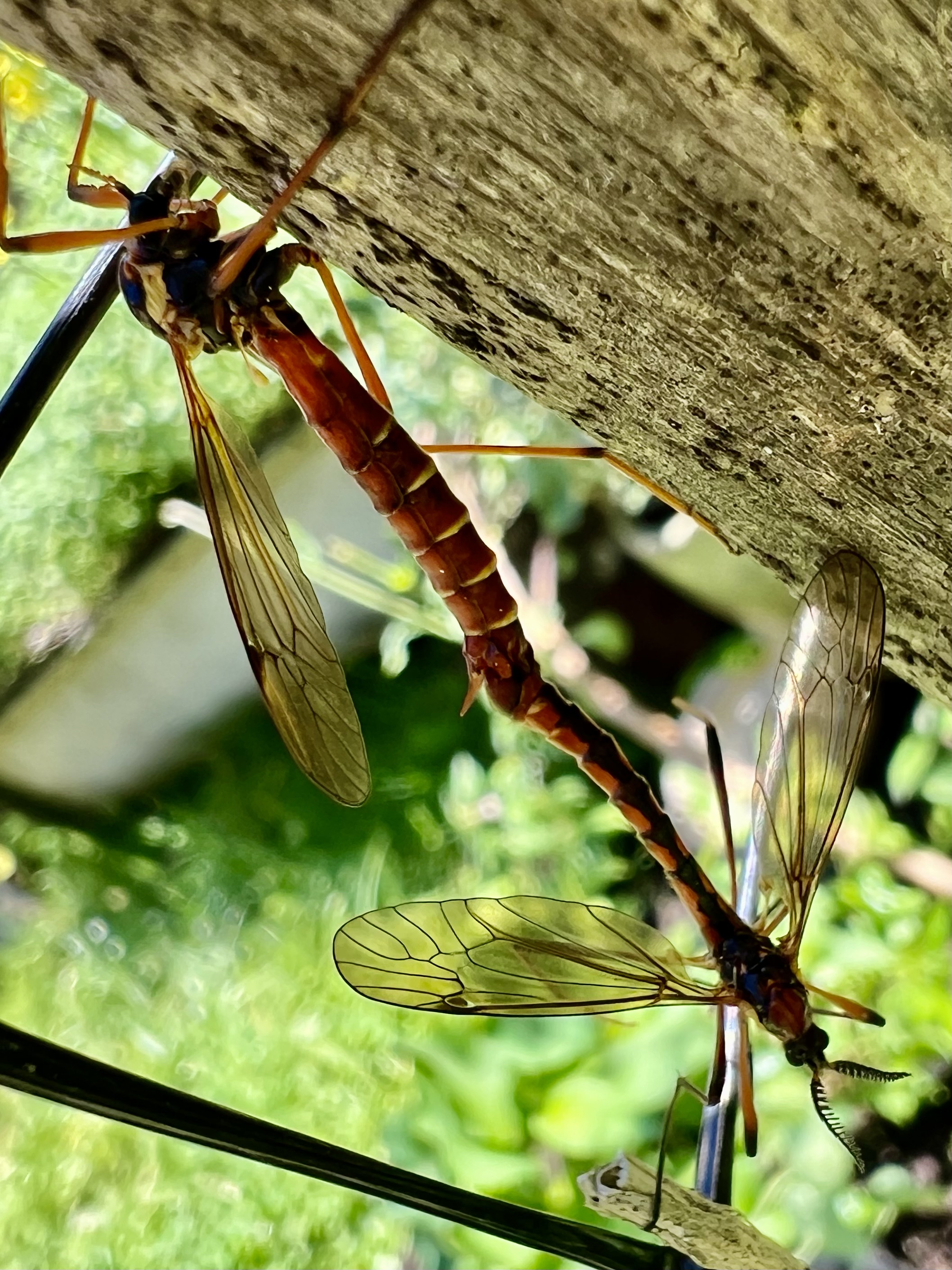
I finally got a few photos of these two after trying (and failing) in my attempts when I first spotted them on Sunday. Curiously, they were “bumping” onto tiny little cones on our fir tree, creating intermittent bursts of pollen with each “hit.” I wondered if they were perhaps eating pollen in advance of mating – with protein a necessary element in egg production.
These flies aren’t extraordinarily abundant. I checked my bug records, and the only other one I’ve seen in the yard was May 2, 2021. They are unique enough that I remembered looking them up and finding that the West Coast species is actually a subspecies, thus the 3rd name, angustipennis, tacked on to the binomial (Phoroctenia vittata).
Going back through my computer, I did find my previous source. Sometimes my computer filing system actually works and I remember to put labels and tags on my saved papers. It makes it so much easier to find them again! Re-reading the paper by Oosterbroek, Pjotr & Bygebjerg, Rune & Munk, Thorkild (2006), I was especially interested in their antennal illustrations, but found another part about the larvae interesting. They state, “the larvae of all these species develop in decaying wood of deciduous trees and might turn out to represent an especially significant conservation and monitoring element of the saproxylic fauna, as most of the species are rather scarce and some of them even very rare. Moreover, they are usually confined to old forests, orchards and similar habitats where there has been a long continuity of the presence of old, dying and fallen trees (Stubbs 2003).”
Our Landscape is Changing
The area near our home has remnants of older growth trees, though many are being cut and cleared for development, and the creation of homesteads. I worry that we will lose some of these species as the forests become more and more fragmented and the trees are more stressed with the advent of higher temperatures brought about by climate and landscape change. Yes, cutting trees = hotter spaces. We need trees! And bugs. Or will sorely regret our choices and actions when we are face to face with the reality of the great die-off of species.
Back to the antennae for these Tiger Craneflies. Can you spot the male and the female in my photos? The male antennae are quite distinctive with their comb-like shape. Entomologists describe the comb-like antennae as Pectinate. If you haven’t figured it out yet, the male is the smaller of the pair. His antennae are wider, and he’s hanging on the bottom.
Tiger Craneflies (Phoroctenia vittata angustipennis) – Note the striking comb-like antennae of the males
Why might craneflies be useful? Well, aside from population size being an indicator for forest ecological relationships, they make great food for wildlife, especially baby birds and their parents.
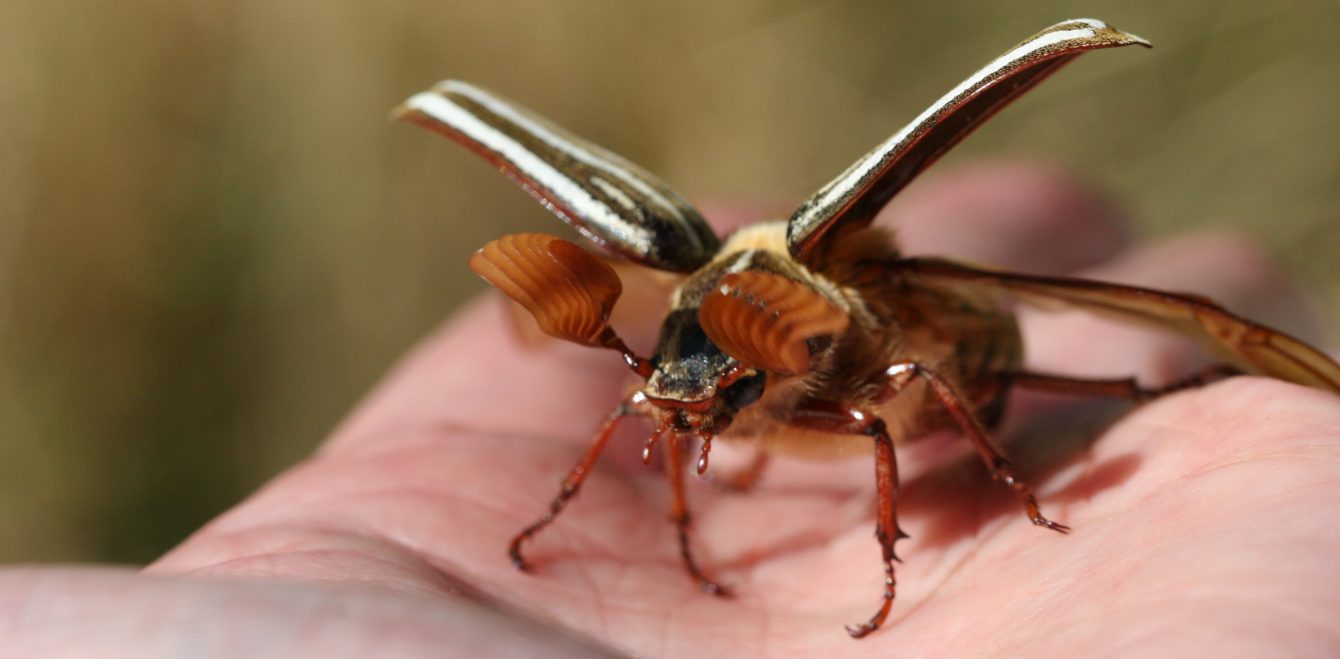
Here’s what I have compiled for anyone contemplating acquiring a bearded dragon. These are not inexpensive animals to own or keep and many are impulse purchases. My Drago came to us as a re-home, after another re-home. To the best of my knowledge, I am his 3rd owner, though I don’t really think of “owning” him, rather being his caregiver and advocate. Please do NOT buy your child a pet to teach responsibility or as a “REWARD” or “BRIBE.” If you have kids you need to bribe, get them a therapist and fix that problem when they are young. Animals should not be sold or traded to make a child happy. Children are not mature enough to care for a Bearded Dragon. Parents end up taking over and the animal suffers when families are too busy. Please don’t buy a bearded dragon to impress your friends. Before you walk out of the Pet Store with a 10 gallon tank, a lizard, and a bunch of stinking crickets, read through this! If you proceed with getting your bearded dragon, please adopt from a rescue group.
Supply List/Price List for Caring for Bearded Dragon
Enclosure/tank with screened top and front open doors (minimum size is 55 gallons, but for an adult bearded dragon, you will need a 4x2x2 (120 gallon) enclosure. My advice? Just get the 120 Gallon from the start!
CHE fixture – same as for basking light – Fluker’s 8.5” Clamp lamp with dimmer $20.95 (multiply this x 2 because you need 2 CHE’s for a 120 gallon enclosure) $41.90
UVB tube light – MOST IMPORTANT PIECE of equipment. Do not get a bearded dragon if you cannot afford to buy and replace these 4 times per year. Your animal will get metabolic bone disease and suffer greatly as its bones disintegrate.
Food – ALSO IMPORTANT. Don’t think your bearded dragon will survive its entire life on stinking pellet food, crickets, or mealworms.
Babies and juvenile dragons need 80% of their diet to be high quality feeder bugs. Dubia roaches and Black Soldier Fly larvae are good staples. Your little dragon will be hungry and EAT at least 25 roaches or fly larvae per day. You can buy 25 medium dubia roaches online for about $7.25, then add shipping to that. If you are feeding your pet 25 per day, get a lottery ticket and pray you win. Soldier fly larva are cheaper and you can get about 100 for $3, but again, add shipping. Also pray the weather cooperates and they arrive alive. Your animal is hungry and can starve if you don’t feed it. The secret remedy for all of this is to start your own colony of Dubia roaches. I can write a “how to” for that if you’re interested. My feeder bug price checks come from Dubia.com. I don’t care what Petco or Petland or any other stupid pet store tells you, you should not feed crickets as a staple. They are dirty. Don’t dump them into your reptile enclosure either. They will chew on your pet.
Substrate – this is what goes on the floor of your enclosure. If you have a baby dragon, use paper towels (NO FRAGRANCES). They are sensitive to fragrances and the chemicals in things like air fresheners, laundry detergents, dryer sheets are extremely toxic to their respiratory system. Use of paper towels will allow you to see their poo and urate and remind you to CLEAN UP after them so they don’t get a nasty respiratory infection when ammonia from their urate builds up in the tank. It’s gross. You also need to learn how to look at their poo and urate so you can tell if they are healthy or not. As you become more experienced, you can change to something else. If you use repticarpet, plan to change it daily, launder in hot water – NO FRAGRANCE OR DRYER SHEETS – and replace it DAILY.
Cleaners – Use white vinegar and hot water. $5 for a jug at Marketplace. No bleach. No alcohol. No scented cleaners.
Time and attention. Think about how YOU would feel stuck in an enclosure 24 hours a day where you are dependent on someone else to feed you, clean up after you, entertain you at least a bit, etc.). If you are working full time and/or you have children in school all day, this is NOT a good pet. In reality, they shouldn’t be pets at all. Please do not get your child one of these animals as a pet because they HAVE to have one or to teach them responsibility. Teach your child to be responsible about making their bed, folding cloths, sweeping the porch, doing homework. Don’t use an animal to teach responsibility. You will be doing the work and they have a normal lifespan of 15 years in captivity. If they live a shorter life, it may be from owner neglect and that will be on you. If you work from home or have a set up where you can take your dragon with you back and forth to work and home (think of all the expenses times 2), then maybe you can give an animal like this a decent quality of life.
Veterinary care. We do not have any experienced reptile vets in the islands. You will have to travel off island to find an experienced and capable vet. I have names, but again, this is not cheap or easy given our reliance on ferries.
Pet sitting. Going rate is about $60 per day. You will have to train someone to care for your animal. Good luck.
Estimate – not including the animal = Approximately $763.45 start up and plan on at least $196 monthly for food (25 roaches per day for a growing baby or juvenile dragon) – not including shipping charges.
I’ve been home on San Juan Island, WA for 4 days now and clearly I picked up a bug traveling home. Not exactly the sort of bug I wanted, but it was inevitable given the crowded airplane and traveling stress. My husband came down with the BUG first. Then it hopped over to a new host – ME.
So, I’ve spent the afternoon on the couch labeling and sorting photos from one of our nature walks in Texas. This was the first of two hikes we took at the Lewisville Lake Environmental Learning Area Nature Preserve https://www.llela.org/about-llela/mission-and-vision. This area (approximately 2000 acres, I believe) has been conserved in conjunction with U.S. Army Corps of Engineers, the University of North Texas, the City of Lewisville, Lewisville ISD, the University of Texas in Arlington, and Texas A & M Agrilife Extension. It is a true jewel in the madness of the DFW metropolis where over 6.7 million people are displacing wildlife and native ecosystems are lost in the process. The BEST part of these hikes for me is the fact they do not allow dogs. NOT ANY! I am thrilled that the focus is on wildlife and habitat conservation and preservation instead of human recreation. I could actually be outdoors, enjoying nature AND viewing wildlife.
We’ve been to this preserve in prior trips to Texas. This year, we focused on hiking some trails we hadn’t been on before. Here is the gallery of some of the bugs I photographed, along with a few wonderful landscape scenes we viewed on the Redbud Trail – map here: https://www.llela.org/home/showdocument?id=9417
Please support environmental conservation wherever you are. This habitat may seem large at 2000 acres, but the former Blackland Prairie once covered 12 MILLION acres in the state of Texas. We need to set aside more if we are to weather the changes coming ahead.
Stay tuned for Bugging You From Texas, Part 3. I have more wonderful photos to share with you.
Trichopoda lanipesTrichopoda lanipesTrichopoda lanipesTrichopoda lanipesTrichopoda lanipesEastern Leaf-footed Bug
(Leptoglossus phyllopus)
Eastern Leaf-footed Bug
(Leptoglossus phyllopus)Eastern Leaf-footed Bug
(Leptoglossus phyllopus)Oblique Streaktail (Allograpta obliqua)Oblique Streaktail (Allograpta obliqua)Oblique Streaktail (Allograpta obliqua)Oblique Streaktail (Allograpta obliqua)Oblique Streaktail (Allograpta obliqua)Oblique Streaktail (Allograpta obliqua)Oblique Streaktail (Allograpta obliqua)Spotted Cucumber beetle
(Diabrotica undecimpunctata)Spotted Cucumber beetle
(Diabrotica undecimpunctata)Grass Spiders
Genus Agelenopsis
Grass Spiders
Genus Agelenopsis
Eastern hornet fly Spilomyia longicornisEastern hornet fly Spilomyia longicornisEastern Hornet Fly (Spilomyia longicornis)Eastern Hornet Fly (Spilomyia longicornis)Eastern Hornet Fly (Spilomyia longicornis)Trichopoda lanipes Feather-legged flyEastern Hornet Fly (Spilomyia longicornis)Eastern Hornet Fly (Spilomyia longicornis)Asian Lady Beetle (Harmonia axyridis)Asian Lady Beetle (Harmonia axyridis)Elm Fork of the Trinity RiverHyaline Grass Bug ( Liorhyssus hyalinus)American Bird Grasshopper (Schistocerca americana)Thyanta custator ssp. accerra
a member of Stink Bugs Family Pentatomidae
Elm Fork of the Trinity River
Lewisville Lake Environmental Learning Area Nature PreserveElm Fork of the Trinity RiverAmerican Bird Grasshopper (Schistocerca americana)I believe this is also Thyanta custator ssp. accerra
a member of Stink Bugs Family Pentatomidae
Thyanta custator ssp. accerra
a member of Stink Bugs Family Pentatomidae
Thyanta custator ssp. accerra
a member of Stink Bugs Family Pentatomidae
Thyanta custator ssp. accerra
a member of Stink Bugs Family Pentatomidae
Spotted Cucumber Beetle
Diabrotica undecimpunctata
Spotted Cucumber Beetle
Diabrotica undecimpunctataTrinity River-Elm Fork
Lewisville Lake Environmental Learning Area Nature PreserveAmerican Bird Grasshopper (Schistocerca americana)I believe this is Narrowleaf Gumweed (Grindelia lanceolata) – a native aster species.Eastern Leaf footed bug (Leptoglossus phyllopus)American Bird Grasshopper (Schistocerca americana)American Bird Grasshopper (Schistocerca americana)American Bird Grasshopper (Schistocerca americana)American Bird Grasshopper (Schistocerca americana)Eastern Leaf footed bug (Leptoglossus phyllopus)Eastern Leaf footed bug (Leptoglossus phyllopus)Insect House by Elm Fork Master NaturalistsEastern Leaf-footed Bug (Leptoglossus phyllopus)
I sat outside today in the sunshine, forced convalescence if you will, exhausted and achey after getting my Covid Omicron Variant booster vaccine yesterday at the San Juan County Fairgrounds. My outdoor time was unfortunately cut short because we have been inundated with construction development noise. I’m fairly certain I will be forever challenged to have an amiable relationship with our newest neighbors. In part, because they sited their VACATION home, right in front of our view. Mind you, they could have moved over 100 feet and we would not have to look across the top of our driveway at their newly constructed 2nd home. It has definitely impacted us. We’ve lost a lot of our privacy out here in the woods. It was never my desire to have close neighbors. I am a bit of a recluse….which is what the new neighbor said about his wife, yet, it begs me to ask again, WHY DID YOU BUILD YOUR HOUSE RIGHT ON TOP OF US?
Oh, and the jackhammering! That noise is enough to make a person homicidal. We had an entire summer of jackhammering from the former owners of that property. Really, truly, that property should never have been zoned for development. Not any development. It’s partly (half) wetland, and the other half is bedrock. Imagine the task of trying to excavate enough to bury your septic lines down the hill when you have solid bedrock! Also, our house is on that same shelf of bedrock, so the hammering shakes the walls and vibrates the floors of our home in the process of all this construction. The development on this lot has gone on for multiple years. I’m really tired of the disruption.
I digress. Sorry, I just had to vent. San Juan Island would be a much friendlier place for wildlife and bugs and such if we didn’t allow anyone to build a 2nd, or 3rd home here. We are outgrowing our space and it isn’t pretty.
Here’s my bug of the day. This beauty is a Western Calligrapher Fly (Toxomerus occidentalis). I was mesmerized watching it rest on the mint leaf. The patterning on the dorsal side of the abdomen reminds me of some sort of totem design.
The adults of this fly species are pollinators. They lay eggs on plants near aphids and when larvae emerge they are predatory on the aphids. It is believed that late instar larvae overwinter, pupation takes place in the soil cavities in the spring and adults emerge later in summer. The name for this group of flies comes from Greek toxon ‘bow’ + meron ‘thigh’ (refers to the bow-shaped hind femur). You can see the curve in the first photo below, circled in red. Something else interesting pertaining to the adult coloration I found on bugguide.net: “Colors vary with overall temperature during pupation: if it was hot, the yellow/orange increases and the background becomes lighter, but if it was cold, the dark/black increases and the yellow/orange becomes darker like the background.”
Enjoy the last few days of sunshine and embrace our native pollinators. We are heading into the dark part of the year. For those of us who live here year round, you know what to expect. Lots and lots of rain.
Here’s my “Bug of the day” (for Saturday, October 15, 2022). I spied it on our wood table outside. It’s a Diurnal Firefly in the genus Ellychnia. The Latin name, Ellychnia, comes from Greek, lychnos, translating into ‘lamp’ or ‘lamp wick.’ Obviously, lamps are something associated with the nighttime or darkness. However, the common name of this genus, diurnal, means “day.” It’s only a bit confusing, right? Also, this is a beetle in the family Lampyridae and not a fly at all. The adults of this genus don’t light up at night or in the day either. However, they are closely related to the fireflies that DO light up, or luminesce, at night found on the East Coast. Since this genus, the Ellychnia, don’t have nighttime blinkers, they find their mates by detecting each other’s pheromones. Lloyd (2002), notes however that all species of Lampyrid beetle larvae have an organ at the end of their abdominal segment 8 that bioluminesces. I’ve never found an Ellychnia larva myself, but these are referred to colloquially as “glow worms.”
Ellychnia sp. firefly
In our area, the genus Ellychnia are also known as winter fireflies. This is because they spend the winter as adults, and are equipped to tolerate cold temperatures. You might even see them on days when we have snow. Larvae of this beetle genus hatch in early summer and live in leaf litter or under bark in decaying trees. They are carnivorous predators of organisms like snails, slugs, earthworms, and soft-bodied insects.
Winter Firefly (Ellychnia sp.)
Do we have any blinking species of fireflies in the PNW? That’s an interesting question. I found some literature that says we do, but I’m not certain this applies to the San Juan Islands, although a few sparse (and unsubstantiated) records from Vancouver Island, BC exist. However, western records for flashing fireflies are known from interior B.C. (Cannings et al., 2010) and throughout the western U.S. as reported by Larry Buschman (2016).
While fireflies that flash or bioluminesce are well known on the eastern side of the U.S. and North America, it is not exactly known how they moved all the way over to the western side. There is an interesting commentary in the paper by Cannings et al. 2010, with the thought that perhaps at least one of the species of flashing fireflies reported in B.C., (Photinus obscurellus), may have arrived via the railways.
Because luminescing fireflies are associated with wetlands, it would have been difficult for them to have crossed over the dry Rocky Mountain system without help. Cannings et al. (2010) report sightings across B.C. in association with railways, in fact, with most of these sightings falling within a 30 km distance from a railway. The thought is that even going across the mountains in drier areas, most railways wound through low lying valleys where the topography is more likely to cross through wetlands. Even the presence of railroad berms can create areas of new wetland habitat which may also have attributed to the westward distribution of these fireflies.
Sadly, we have, and continue to degrade, pollute, drain, and lose wetlands in our continued (horrific) adherence to the destructive and entitled ideology of Manifest Destiny. Development, ranching, hobby farms, and suburban sprawl have eliminated more than 50% of wetlands that previously existed in North America (Fallon et al., 2021). The remainder have been seriously impacted by chemical pollutants, light pollution, and overall climate change, contributing to further declines to remaining populations. We may lose all of the species of these iconic and charismatic summertime blinking lanterns without taking special steps to conserve and protect their habitat. We will have no one to blame but ourselves either.
Please support environmental conservation and protection in your community – wherever you live. It is important to reduce our human footprint in order to preserve the natural world, its beauty, and our life support system to perpetuate for future generations.
How can you help? Live minimally. Turn off outdoor lights at night. Plant native vegetation. Switch to use of non-toxic household products. Don’t use lawn fertilizers or chemicals. Better yet, get rid of your lawn and landscape with native plants. Eat less meat. It all adds up. 💡
Cannings, Robert & Branham, Marc & McVickar, R.H. 2010. The fireflies (Coleoptera: Lampyridae) of British Columbia, with special emphasis on the light-flashing species and their distribution, status and biology. Journal of the Entomological Society of British Columbia. 107. 33-41.
Fallon CE, Walker AC, Lewis S, Cicero J, Faust L, Heckscher CM, et al. 2021. Evaluating firefly extinction risk: Initial red list assessments for North America. PLoS ONE 16(11): e0259379. https://doi.org/10.1371/journal.pone.0259379
Fender, K.M. 1970. Ellychnia of western North America. (Coleoptera-Lampyridae). Northwest Science 44: 31-43.
Lloyd, J.E. 2002. Lampyridae Latreille 1817. Pp 187-196 in R.H. Arnett, Jr., M.C. Thomas, P.E. Skelly and. J.H. Frank (Eds.). American Beetles. Volume 2.
I was eating my lunch outdoors yesterday (October 6, 2022), and considering the end of season, depauperate community of bugs. There are fewer and fewer buzzing about the lingering tiny blossoms on my mint plants, which have been well-visited this season. Many of the winged flyers die out on their own accord. Lives spent – an ending synchronized with leaves falling from the trees. They’ve lived a season, maybe longer depending on the species. As adults, they’ve mated and sewn seeds for a new generation to emerge in spring. Some though, are captured and eaten by other organisms that are fueling stores for their own reproductive event – like these Long-jawed orb weaver spiders (Metallina segmentata) I witnessed, working together to wrap up their “lunch,” a Thick-legged Hoverfly (Syritta pipiens).
Metellina segmentata spiders (male and female) with lunch (Syritta pipiens) hoverflyLong Jawed Orb Weavers (Metellina segmentata) with prey, a Thick-Legged Hoverfly (Syritta pipiens)
I didn’t realize it at the time, but depauperate was not to be the theme of my day!
Shortly after observing and filming the spiders, I noted some buzzing around our fruitless cherry tree. I walked over, thinking to myself, “You’re getting too close to that Yellowjacket!” Well, it wasn’t a yellowjacket at all. It was a Robberfly (Laphria ventralis), I believe – and SHE was ovipositing into our tree.
Laphria ventralis Robber Fly – 10.6.22, San Juan Island, WA
Later this evening when I was showing my husband the photos, he asked what the eggs would eat when they hatch. I had to look it up. Well, Robber Fly larvae are known to prey on the eggs, larvae, and pupae of other insects, especially beetle larvae living in decaying trees. Read more about this linked here: https://www.geller-grimm.de/genera07.htm
This Robber fly was an incredible mimic of a Yellowjacket – not only in appearance, but also in the way she flew about the tree. Fascinated, I watched her find a niche under some old bark and begin to oviposit. She did not like my camera or my presence, but tolerated me to a degree. Then she buzzed right into my face with complete confidence her mimicry would chase me away. Guess what? It worked. At least temporarily.
Laphria ventralis Robber fly ovipositing 10.06.22 – San Juan Island, WA
Laphria ventralis 10.6.22 San Juan Island, WA
Buzz Off! Laphria ventralis Robber Fly 10.6.22
The next fun finds in Bug-landia were two caterpillars. I found an Eyed Sphinx Moth caterpillar (Smerinthus opthalmica) making headway down our driveway, undoubtedly wandering off to find a suitable location to pupate.
The second caterpillar I found is my absolute favorite moth species, the Rosy Aemilia moth (Lophocampa roseata). Since it was navigating down the middle of the road, I did gently relocate it to a safer spot so it wouldn’t get smooshed by the giant gravel trucks that fly up and down our once quiet country road.
Lophocampa roseata, the Rosy Amelia Moth caterpillar
Last, but not least is my new “pet.” I found her on my walk and she needed some help, so she’s come home to stay with us for some R&R, and a bit of end of life care. I’ve named her Wanda… One-Eyed Wanda. Wanda had evidently become an assault victim sometime just before I found her. The thought is that she was attacked and bitten by another female mantis – who evidently fled the scene before I got there. Poor wounded Wanda was not in great shape when I picked her up. She is missing an eye. It was not a pretty sight, but I couldn’t just leave her in the road.
She’s hanging out in the dining room tonight in a bug habitat/safe room so my indoor cats don’t batter her. I think she’s had enough battering in this life. I’m hoping she will still be able to lay an egg sack for me before she expires. Definitely plan to try and feed her tomorrow. I doctored her eye as best as I could. She can still see with the other one. Poor Wanda. 😦
Next up – Look for my post and forthcoming PowerPoint slide show about What’s Bugging Gary! Even better, check out the event (Garry Oak Conservation Symposium) in person if you’re on San Juan Island. It’s this Sunday at the Grange.
Cannings, R.A. 2007. Recent range expansion of the Praying Mantis, Mantis religiosa Linnaeus (Mantodeaz Mantidae), in British Columbia. Journal of the Entomological Society of British Columbia, 104, 73-80. https://journal.entsocbc.ca/index.php/journal/article/view/101
McAtee, W.L. 1918. Key to the Nearctic Species of the Genus Laphria (Diptera, Asilidae). The Ohio Journal of Science. v19 n2 (December, 1918), 143-172. https://kb.osu.edu/handle/1811/2019
Scared of Spiders? Here’s a go-to info-sheet (that I plan to update as time allows) with links to verifiable, research-backed Spider Information/Literature. Let’s end all the misinformation and our arachnophobia. Too often people buy into false reports. Don’t listen to someone’s tall tale of horror. These stories are sensationalized and inaccurate. Know the facts. Dispel the rumors. Spiders are not out to kill you. It’s just not true.
YOU have to do the reading! These are scientifically based, accurate studies with information related to spider bites.
*Bennett RG, Vetter RS. An approach to spider bites. Erroneous attribution of dermonecrotic lesions to brown recluse or hobo spider bites in Canada. Can Fam Physician. 2004 Aug;50:1098-101. PMID: 15455808; PMCID: PMC2214648 https://www.ncbi.nlm.nih.gov/pmc/articles/PMC2214648/pdf/15455808.pdf.
*Melissa M. Gaver-Wainwright, Richard S. Zack, Matthew J. Foradori, Laura Corley Lavine, Misdiagnosis of Spider Bites: Bacterial Associates, Mechanical Pathogen Transfer, and Hemolytic Potential of Venom From the Hobo Spider, Tegenaria agrestis (Araneae: Agelenidae), Journal of Medical Entomology, Volume 48, Issue 2, 1 March 2011, Pages 382–388, https://doi.org/10.1603/ME09224
Brown Recluse Spiders (Loxoceles sp) – NO! I repeat “NO, none, nada!” established populations in our area.
In the attached links below, you will find links to information about the Brown Recluse Spider. Information that comes from a verified, reputable source – from an actual expert. Brown Recluse spiders do not live in the San Juan Islands. Caveat: this is not to say that if you move here from an area where there ARE established populations, one might be found hitching on your moving boxes. It’s possible, BUT – they have not been able to survive and breed here. If you see a large brown spider in your house – especially on the ceiling, it is most likely (99.99%) going to be a Giant House Spider (Eratigena duellica). They are very common and harmless. If you don’t like them, just catch in a cup and take it to a sheltered area outside – preferably another structure where it might have a chance to survive. They won’t hurt you.
Map showing distribution of Brown Recluse spiders (Please note that San Juan County is NOT found on this map) – https://spiders.ucr.edu/spiders-map
Map of Brown Recluse Spider distribution – UC Riverside
Where else can I find reliable information on Spiders?
There are a few sources I’ll list here. The first two are the ones you should look at first. They are valuable resources with information from highly credentialed experts in all things arachnid-related. If you read something written by either Rod Crawford (Seattle Burke Museum curator of the arachnid collection) or by Rick Vetter (UC Riverside Department of Entomology), you can be assured it is correct.
As a local resource, you can also check out the Facebook Bug Group (Bugs of the San Juan Islands). There are several group “experts” with experience identifying spiders. These folks generously volunteer their time and knowledge, so keep that in mind and please refrain if you feel inclined to INSIST they are wrong and there are INDEED Brown Recluse Spiders living in your house in San Juan County. If you have a spider you’d like identified, it helps to have a couple of clear photos to submit. Try and get a shot of the dorsal (top) of the spider, and if you’re able, one of its face – showing eye pattern. You may contact me, Cynthia Brast-Bormann at cynthiabrast@icloud.com to submit live or deceased specimens for identification. I will help you coordinate a drop off point for collection. Please don’t indiscriminately KILL a spider though and ask me to ID it. It will likely make reliable identification more difficult. Just get a cup and a lid with some air holes punched in the top. I appreciate your showing kindness to the helpless creature you’ve caught. I will ID and humanely release.
Bugs of the San Juan Islands Facebook Group – There are at least 4 spider group experts and folks with entomology degrees or experienced backgrounds in the group who are more than qualified to help you. https://m.facebook.com/groups/bugsofthesanjuanislands/about/
Great YouTube information and fun links to watch from one of Bugs of the San Juan Island’s group experts, Arlo Pelegrin (entomologist and arachnologist)
Spiders of the West and their Medical Significance – Arlo Pelegrin at Dept of Health
I have an observation I was fortunate enough to see in person last September (2021) that I’d like to share, including a short video or two I filmed, and a wonderful animation slide made for me by one of our local San Juan Island artists, April Randall, who I asked to illustrate what I witnessed, but did not have an opportunity to record on camera.
We are entering the season – late summer/early fall, when some species of ants and termites send out their winged reproductives, also known in scientific lingo as “alates.” These flying individuals have reached reproductive maturity and their purpose is utilitarian: to fly away from home, mate, and establish a new colony…IF they are lucky enough not to be eaten or fall to some other random fate in nature.
Over the past seven years, I’ve been able to watch as one particular colony of Western Subterranean Termites (Reticulitermes hesperus) sends out their offspring to do exactly this. The event happens annually during the first 12 days of September without fail. They swarm to the surface, exiting en-masse out of the little hole in the ground, to launch out into the great, wide world. The air is filled with their tiny black bodies and translucent wings – wings that last just long enough for them to disperse far enough away from home, so as to not compete with the parent colony.
Many, or probably it would be fair to say “most” of these winged reproductives or alates, aren’t successful, if by defining success, your measure is for them to begin a new colony. However, if you measure success from another perspective – that of Mother Nature, this event is indeed a success – for Mother Nature hasn’t forgotten the food web and the myriad of other species who must forage for food in order to survive.
In the videos below, you will see a close up of these Western Subterranean Termite alates emerging from their underground colony which lies below our driveway in a network of old Douglas fir roots that were cut down long ago by the former homeowner. As “momma” to a bearded dragon, I included some video of my pet, Drago, feasting on these termites as they emerged. Bearded Dragons are known to dine on termites in their native range in Australia, so I thought, “Why not?” Yes, he loves them! What I unfortunately don’t have video footage of is what we saw after we came back into the house. There was a little flock of Yellow-Rumped Warblers waiting for us (mostly for Drago) to leave that spot. As soon as the coast was clear, those little birds were down on the ground, eating the termites as fast as they emerged.
So here’s where I brought April into the picture. April made the animation and I think it’s important because it gives you something to share with your friends about how the food web works – or how it’s supposed to work. It’s also important because many, many people automatically see termites as something bad, a PEST. While that may be true if they are eating your home, it isn’t true in this case.
These termites have never bothered our home (not once in 7 years). We border a wooded area and there is plenty of habitat that termites need for survival. Some pest control operators will tell you right off though, that you have to be proactive. Get rid of the colony. Well, they also want you to PAY them, so don’t believe everything you hear. What I’d like you to consider is how Mother Nature is providing for these little birds – and other species of wildlife. The Warblers (and other wildlife) don’t have a grocery store to pop into whenever they are hungry. They rely on seasonal (often temporary surges) where food is abundant, so they can eat enough, storing energy to survive whenever they can’t find food. Feast or famine is a common theme for wildlife. They may even have to travel for long distances to take advantage of a resource. Because Yellow-Rumped Warblers can live for 6-7 years, they may well remember how to find this exact spot on our property each year.
Western Subterranean Termites (Reticulitermes hesperus)
Drago, the bearded dragon eats Western Subterranean Termites on San Juan Island – Sep. 12, 2021
Animation by April Randall, Orcas Island, WA
Please feel free to share with you friends and family. I hope you enjoy the animation. This year, I’m going to be waiting with my camera in hopes of capturing this special moment.
About Reticulitermes hesperus:
Lifespan of a Queen – up to 30 years
Family: Rhinotermitidae
Geographic Distribution: along the Pacific Coast (BC-CA-Mexico) east to ID & w. NV
References, Further Reading, and Artist Information
Keller, Laurent. (1998). Queen lifespan and colony characteristics in ants and termites [Review]. Insectes Sociaux. 45. 235-246. 10.1007/s000400050084.
The Western Tent Caterpillar is probably one of the most studied and also one of the most loathed insects in the Pacific Northwest. I’m hoping to change attitudes by shining a light on some of the ecological facets of the species and how it connects to the larger food web. We often deem something a pest before really considering the whole picture. Is there anything good about a caterpillar eating leaves off a tree? It depends on a lot of factors. Why not take time to examine the web…and I’m not referring to the tent here either.
It was just last week in my community (San Juan Island), that I heard a story about a woman who fell and hit her head after getting on a ladder to BURN the tent caterpillars out of her fruit trees. Hmmm. Please don’t try this at home. It isn’t safe. Burning the tents out of trees can actually do more damage to the tree than the caterpillars do by eating the leaves.
The photos below show something that happens to the tent caterpillars we may not notice in our panic to eradicate them from our trees. The egg on the caterpillar was laid by a parasitic Tachinid fly. It chose the head, so the caterpillar can’t chew it off its body. The egg is shed when the caterpillar molts, but the fly is already developing inside the caterpillar. It will literally eat the caterpillar from the inside out. So, when you clip off those tents and throw them into the fire, you are also killing the natural and best pest predators along with them. Naturus interruptus! We do more harm than good by intervening.
Western Tent Caterpillar with Tachinid Fly egg on headWestern Tent Caterpillars (Malocosoma californicum pluviale) with deceased individuals in background likely affected by nucleopolyhedrovirus
The Western Tent Moth caterpillars are affected by a few other parasitoids. Braconid wasps also attack them. Some lay eggs on the cocoons. There is also a nucleopolyhedrovirus that infects them when populations are high. In my rush to get this out, I may come back and edit, but I’ve referenced lots of great information below so you can read more about this on your own.
To add to all of this, over the weekend, my daughter and I found some tents in the orchard trees on our property. I might just be the ONLY resident in the San Juans excited to see them. Hmmm. Well, what I found was even more interesting. The tents had dead caterpillars inside and living family groups of earwigs. We also found a super cute jumping spider!
I was curious about this because earwigs are known to be garden pests, I did find some studies about earwigs that are PREDATORY on species of Lepidoptera. While these studies addressed other species of moths, the gist was that the plant species sends out a chemical signal that calls pest predators when it is being attacked by caterpillars. Every plant and pest predator sends and responds (respectively) to various signals, some very specific to each relationship. The plant is calling in the army! It may not always be earwigs, but there are wasps, flies, and others that come to aid the plant when it is under attack. Yes, it is very cool!!!
Earwigs and Jumping spider eat tent caterpillars
Oh, and those Western Tent Caterpillars turn into adult moths in mid summer. They are attracted to light. Turn off your outdoor lights. Nature will thank you and you will be less attractive to the mating moths. Many moth species also tend to fly off en-masse when they are mate seeking. These periodic, seasonal pulses of terrestrial invertebrates in our region end up in nearshore marine habitats when they fly out over the ocean.
Various studies have surveyed the stomach contents of Chinook and Coho Salmon, and other fishes in nearshore marine habitats during their first year at sea. Two studies I found reported finding Western Tent Moths and Spruce Budworm Moths (species considered as pests in northern boreal forests) in sampled gut contents. Brodeur et al., (1987) reported the following from one survey, “The incidence of several juvenile coho collected after the storm which had stomachs that were distended with over 100 of these insects exemplifies the ability of these juvenile coho to readily exploit these allochthonous inputs into the marine environment.” They were referring to the “pest” species, (Choristoneura occidentalis) or Spruce Budworm Moth in this instance. In Brennan et al. (2002), sampling of salmon in Central Puget Sound found insect prey included Western Tent Moths (Malocosoma sp.), and that “Lepidoptera in 2002 diets were gravimetrically dominated by tent caterpillar moths (Malocosoma sp.) 51% of Lepidoptera category by weight.” They also reported that Lepidoptera in their samples “were only abundant in 2002.” Coincidentally perhaps, this was a year of a recorded outbreak of tent caterpillars in WA state.
Other studies acknowledge terrestrial invertebrates as a better quality food than marine crustaceans for developing salmon. Periodic, cyclic, or seasonal events resulting in abundant insect flotsam in marine habitats may be missed, or difficult to record, but undoubtedly play a role in feeding fish in nearshore marine habitats.
Take away point here. Even bugs we see as pests have a role in ecosystems. Salmon and other species of wildlife don’t have grocery stores to visit when they need a meal. They rely on seasonal and periodic availability of food. It’s all they have, and it’s important for us to appreciate that.
Please take a moment to scroll through some of the photos below. Definitely check out the fantastic animation by April Randall about the adult moths flying out over the shoreline and being eaten by salmon! Don’t miss checking out those references and reading material too. If you are curious to know more, shoot me an email and I’m happy to send you literature for further reading.
Thank you!
Malocosoma californicum pluviale with Tachinid fly egg on headMalocosoma californicum pluviale caterpillars affected by nucleopolyhedrovirus
Jumping spider eating Malocosoma californicum pluviale caterpillar (photo credit to Alex Maas and artistic rendering by Cynthia Brast-Bormann)Parasitized Malocosoma californicum pluviale cocoon (Tachinid fly parasite)
Animation by April Randall, Orcas Island
References and Further Reading
Bell, K., Naranjo-Guevara, N., Santos, R., Meadow, R., & Bento, J. (2020). Predatory Earwigs are Attracted by Herbivore-Induced Plant Volatiles Linked with Plant Growth-Promoting Rhizobacteria. Insects, 11(5), 271. https://doi.org/10.3390/insects11050271
Clark, E. C. (1958). Ecology of the Polyhedroses of Tent Caterpillars. Ecology, 39(1), 132–139. https://doi.org/10.2307/1929975
Cooper, Dawn & Cory, Jenny & Theilmann, David & Myers, Judith. (2003). Nucleopolyhedroviruses of forest and western tent caterpillars: Cross-infectivity and evidence for activation of latent virus in high-density field populations. Ecological Entomology. 28. 41 – 50. 10.1046/j.1365-2311.2003.00474.x.
Furniss RL, Carolin VM. 1977. Western forest insects. U.S. Department of Agriculture, Forest Service, Washington, D.C. Miscellaneous Publication 1339. 654 p.
Knight, G. A.; Lavigne, R. J.; and Pogue, M. G. 1991. “The Parasitoid Complex of Forest Tent Caterpillar, Malacosoma Disstria (Lepidoptera: Lasiocampidae), in Eastern Wyoming Shelterbelts,” The Great Lakes Entomologist, vol 24 (4) Available at: https://scholar.valpo.edu/tgle/vol24/iss4/7
Rodstrom, R & Resources, Greenwood & Portland, Oregon & John, J & Brown, John. (2017). FOREST AND WESTERN TENT CATERPILLARS Insect Pest Management in Hybrid Poplars Series. 10.13140/RG.2.2.24262.37442.
Witter JA, Kuhlman HM. 1972. A review of the parasites and predators of tent caterpillars (Malacosoma spp.) in North America. Minnesota Agricultural Experiment Station. Technical Bulletin 289. 48 p.
Additional References***Updated 06.23.2022
Brennan, J.S., K.F. Higgins, J.R. Cordell, and V.A. Stamatiou. 2004. Juvenile Salmon Composition, Timing Distribution, and Diet in Marine Nearshore Waters of Central Puget Sound in 2001-2002. King County Department of Natural Resources and Parks, Seattle Wa. 164pp.
Brodeur, R. D., Mundy, B. C., Pearcy, W. G., & Wisseman, R. W. 1987. The neustonic fauna in coastal waters of the northeast Pacific: abundance, distribution, and utilization by juvenile salmonids. Oregon State University Publication ORESU-T-87-001.
Brodeur, R. D. (1989). Neustonic feeding by juvenile salmonids in coastal waters of the Northeast Pacific. Canadian Journal of Zoology, 67(8), 1995-2007.
Brodeur, R. D., Lorz, H. V., & Pearcy, W. G. (1987). Food habits and dietary variability of pelagic nekton off Oregon and Washington, 1979-1984. NOAA Technical Report NMFS 57. U.S. Department of Commerce National Oceanic and Atmospheric Administration National Marine Fisheries Service.
Cheng L, Birch M. 2008. Insect flotsam: an unstudied marine resource. Ecol Entomol 3:87–97.
Cheng L. 1975. Marine pleuston: animals at the sea-air interface. Oceanogr Mar Biol Annu Rev. 13:181–212.
Cheng, L., M. C. Birch. 2009. Terrestrial insects at sea. Journal of the Marine Biological Association of the United Kingdom. 57, 4, (995-997).
DNR TreeLink. Tenting in the Trees. 2012. WSU Extension Puget Sound Stewardship E-Newletter 5:4
Drake, V.A., D. R. Reynolds, Radar Entomology: Observing Insect Flight and Migration (CABI, Wallingford, UK, 2012).
Duffy, E.J., D.A. Beauchamp, R. Sweeting, R. Beamish, and J. Brennan. 2010. Ontogenetic diet shifts of juvenile Chinook salmon in nearshore and offshore habitats of Puget Sound. Transactions of the American Fisheries Society. 139:803-823.
Glick P. 1939. The distribution of insects, spiders, and mites in the air. Washington D.C.: US Department of Agriculture.
Green K., 2011. The transport of nutrients and energy into the Australian Snowy Mountains by migrating bogong moths Agrotis infusa. Austral. Ecol.36, 25–34.
Gutierrez, L. 2011. Terrestrial invertebrate prey for juvenile Chinook salmon: Abundance and environmental controls on an interior Alaskan river. MS Thesis, University of Alaska Fairbanks, Fairbanks, AK.
Hardy AC, Cheng L. 1986. Studies in the distribution of insects by aerial currents. III. Insect drift over the sea. Ecol Entomol. 113:283–90.
Helm RR. 2021. The mysterious ecosystem at the ocean’s surface. Plos Biology. Apr;19(4):e3001046.
Holland RA, Wikelski M, Wilcove DS. How and why do insects migrate? Science. 2006 Aug 11;313(5788):794-6. doi: 10.1126/science.1127272. PMID: 16902129.
Hu G, Lim KS, Horvitz N, Clark SJ, Reynolds DR, Sapir N, Chapman JW. Mass seasonal bioflows of high-flying insect migrants. Science. 2016 Dec 23;354(6319):1584-1587. doi: 10.1126/science.aah4379. PMID: 28008067.
Landry J. S., Parrott L., Could the lateral transfer of nutrients by outbreaking insects lead to consequential landscape-scale effects? Ecosphere7, e01265 (2016).
Locke, A., S. Corey. 1986. Terrestrial and freshwater invertebrates in the neuston of the Bay of Fundy, Canada. Canadian Journal of Zoology. 64(7): 1535-1541. https://doi.org/10.1139/z86-228
Myers, J. 2000. Population fluctuations of the western tent caterpillar in southwestern British Columbia. Popul Ecol42, 231–241. https://doi.org/10.1007/PL00012002
Satterfield, Dara & Sillett, T & Chapman, Jason & Altizer, Sonia & Marra, Peter. 2020. Seasonal insect migrations: massive, influential, and overlooked. Frontiers in Ecology and the Environment. 18. 10.1002/fee.2217.