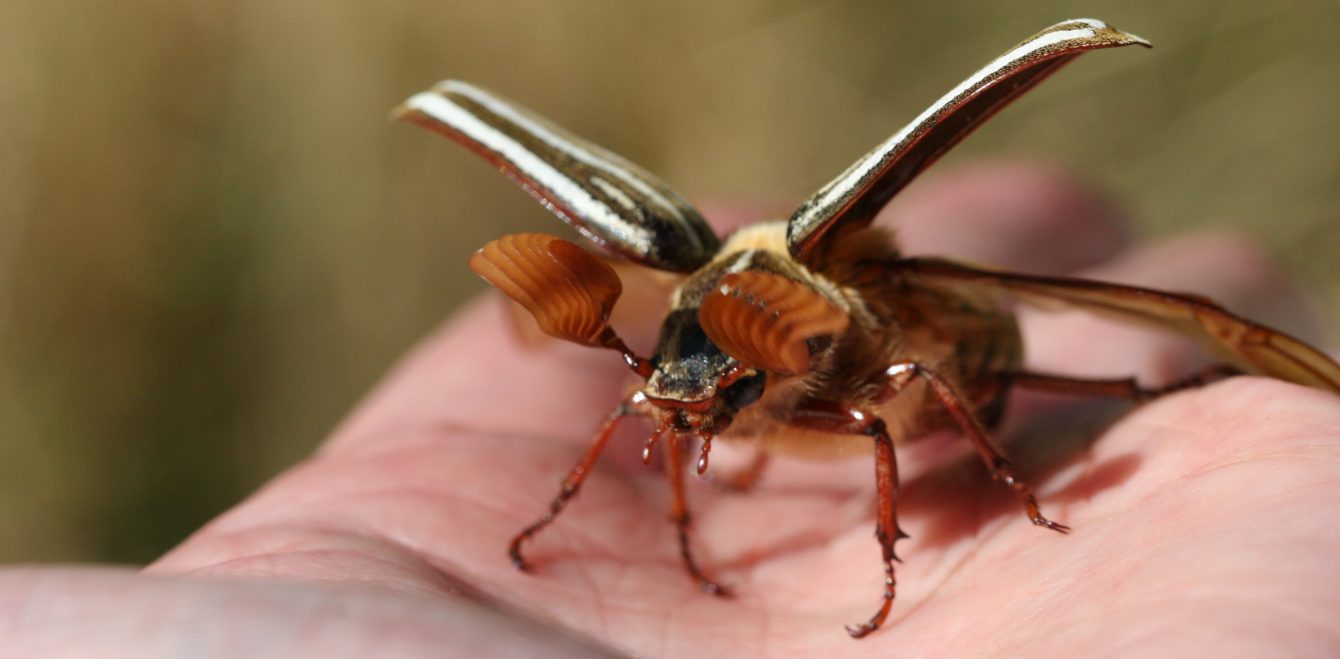
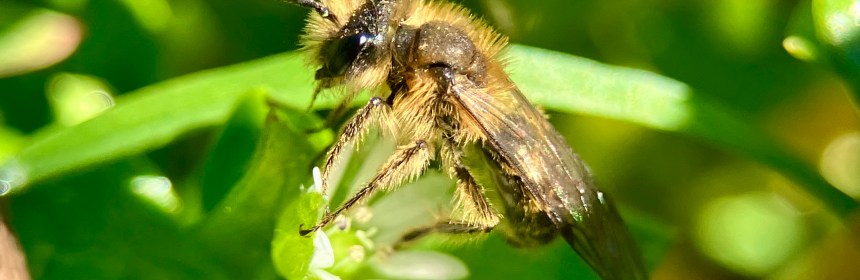
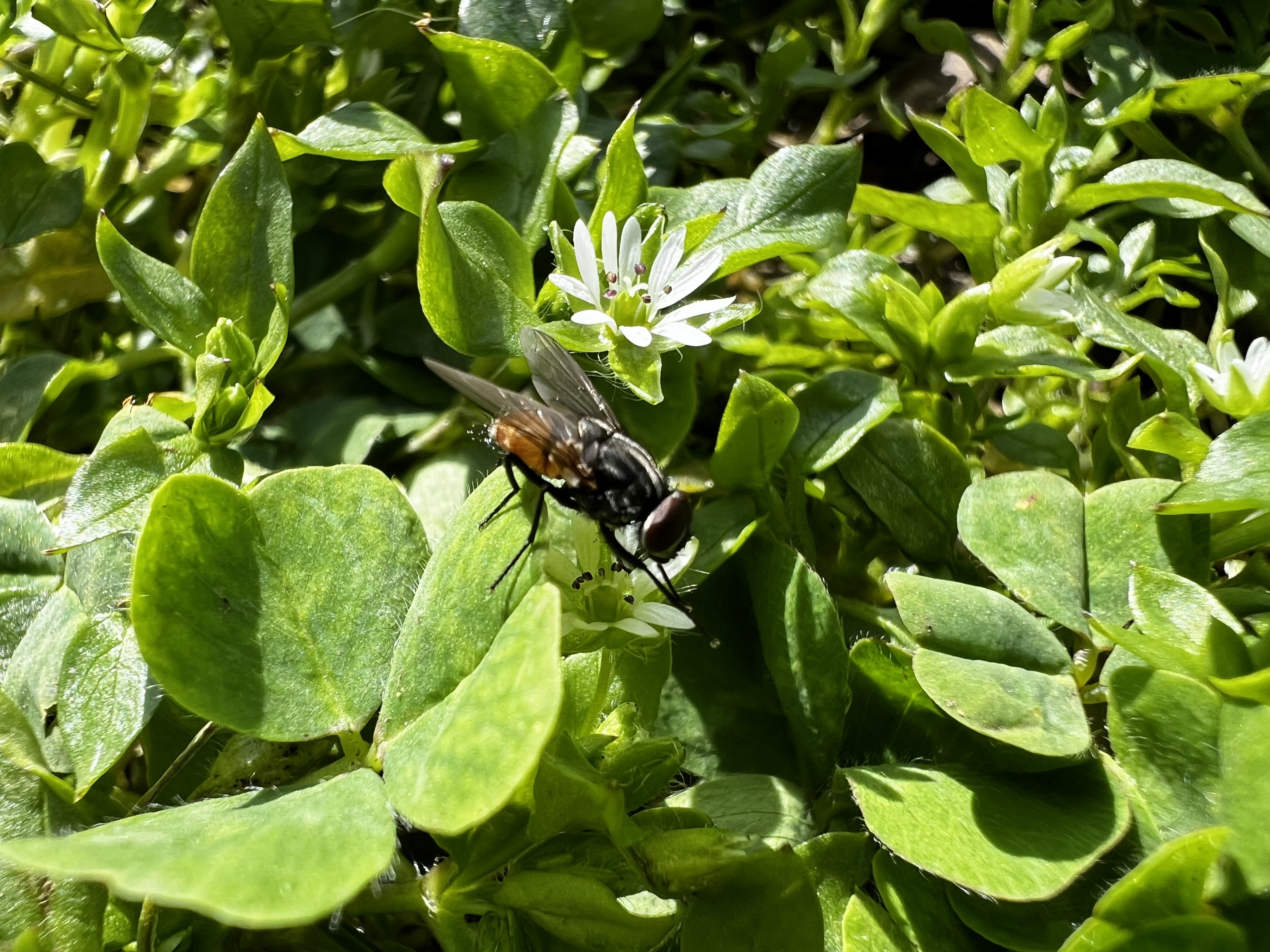
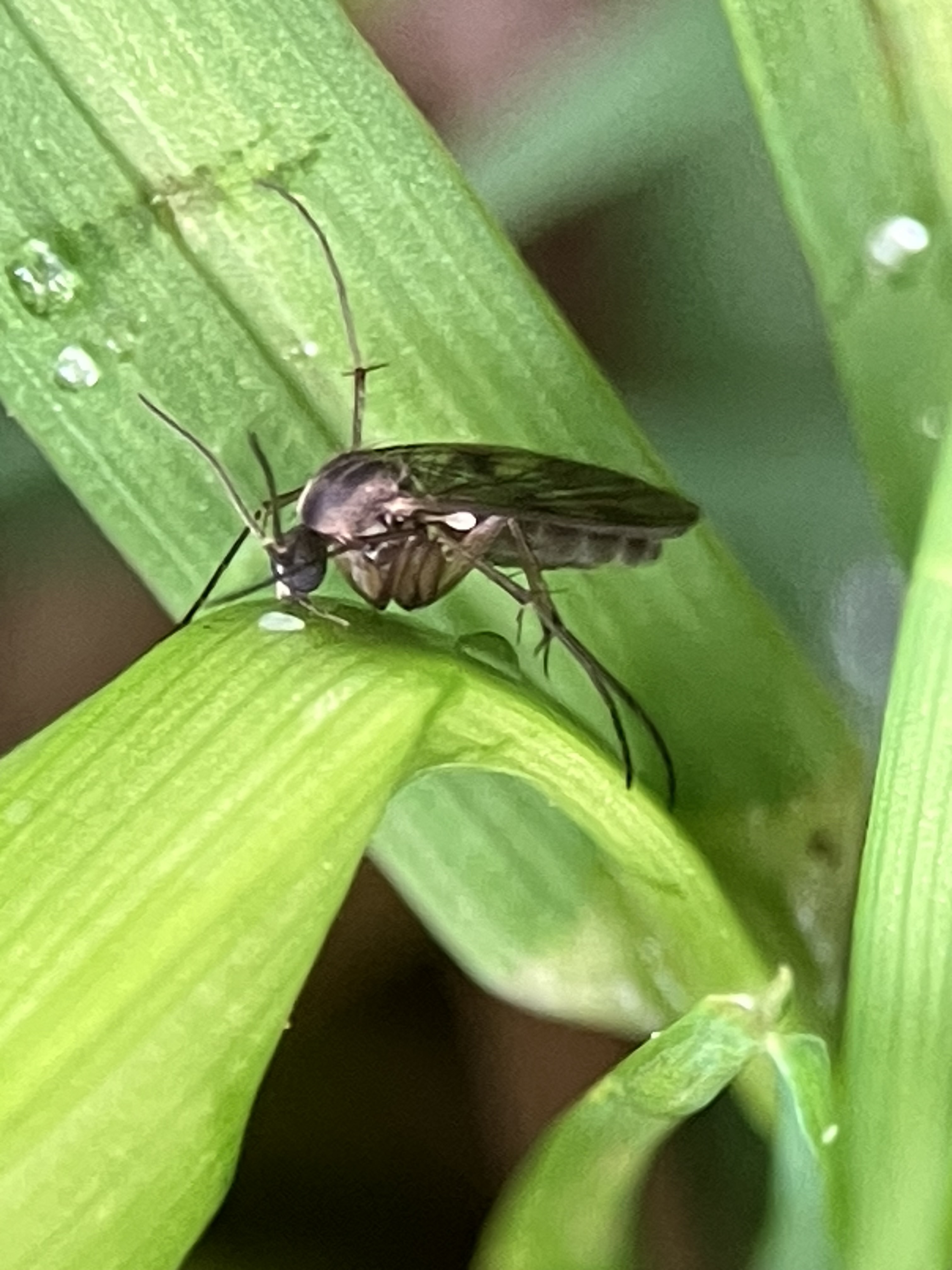
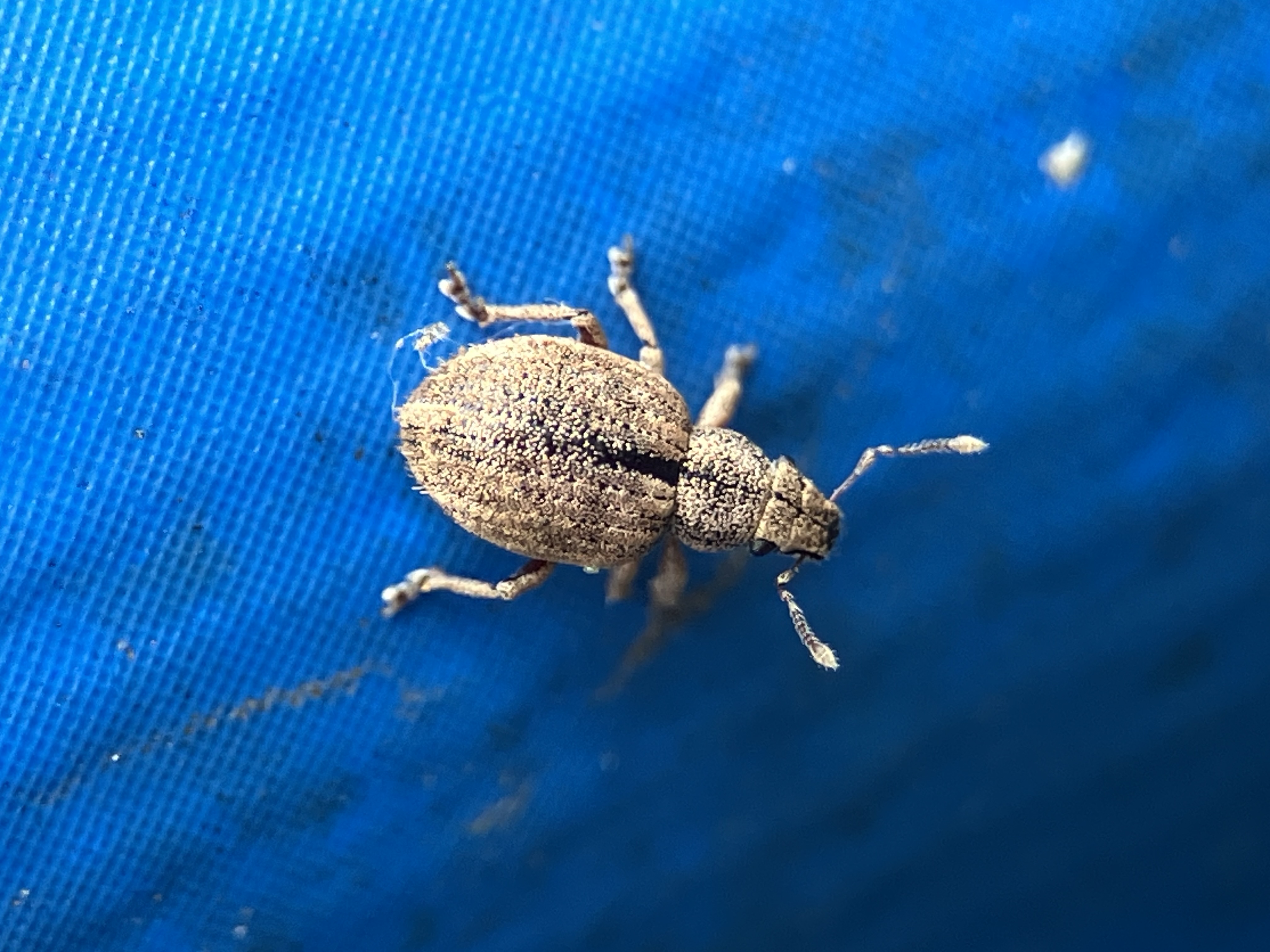
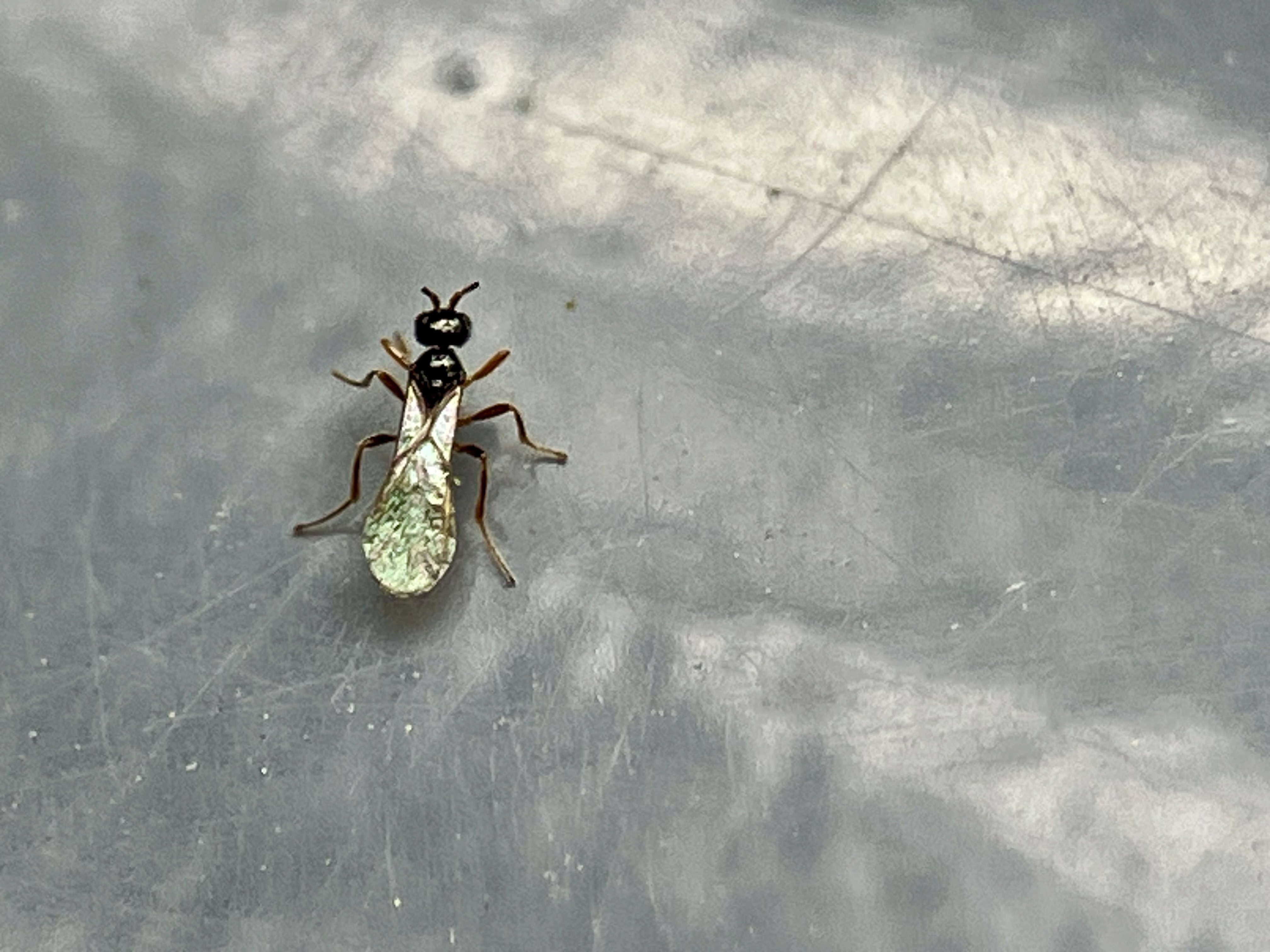
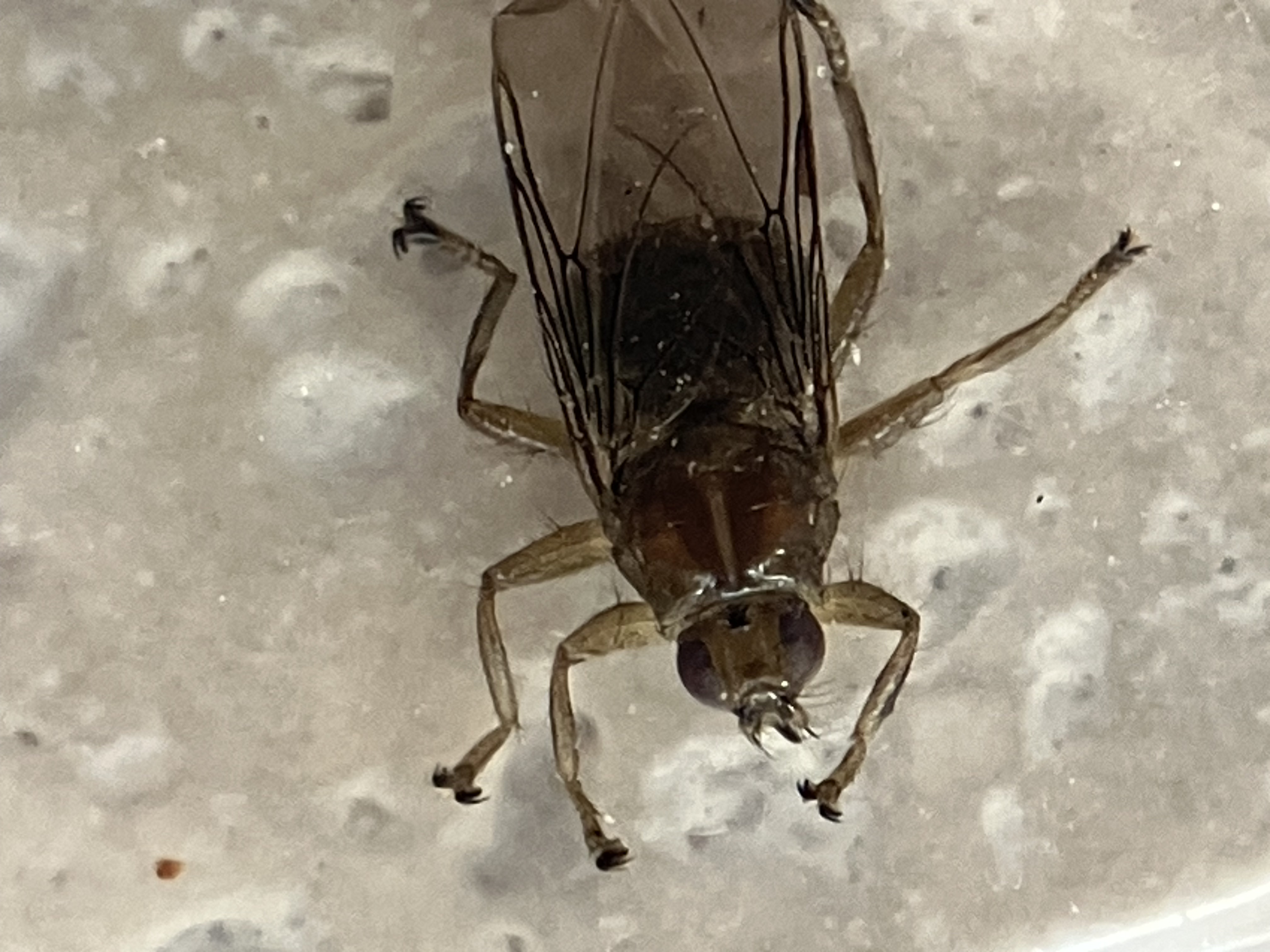
I hope it’s safe to say that Spring has finally arrived in the San Juans. We have enjoyed tiny blips of sunshine the past two afternoons, enough to awaken life in miniature around our home. I’ve found these tiny lives going about business on the “highway” around the top of our above ground pool, crumbled mounds of dirt in hard-packed soil where little mining bees have excavated their way to the surface from a long winter sleep, and a suite of species of flies (our best early spring pollinators) sipping at the miniature chickweed flowers that opened overnight. I’ve also seen my first tiny “sugar” ant in the house, most definitely a harbinger of spring!
In these days where we are likely weary of the many assaults on our souls – from reading that we are at the precipice of mass species extinction to the news reports of fires and other natural disasters (intensifying from climate change), and the horror of what we face watching our nation torn apart and not really knowing what the fateful consequences of unchecked power will be, I hope you will do as I am trying to do…take each day moment by moment, and find some beauty wherever you can. Remember the dandelion that blooms in the crack in the concrete. If you’re reading this, go outside and B-R-E-A-T-H-E.
Yesterday I saw the first Yellow Rumped Warbler of the season. The Violet Green Tree Swallows are going to show up any day now. Go soak yourself in nature while we still have nature around us.
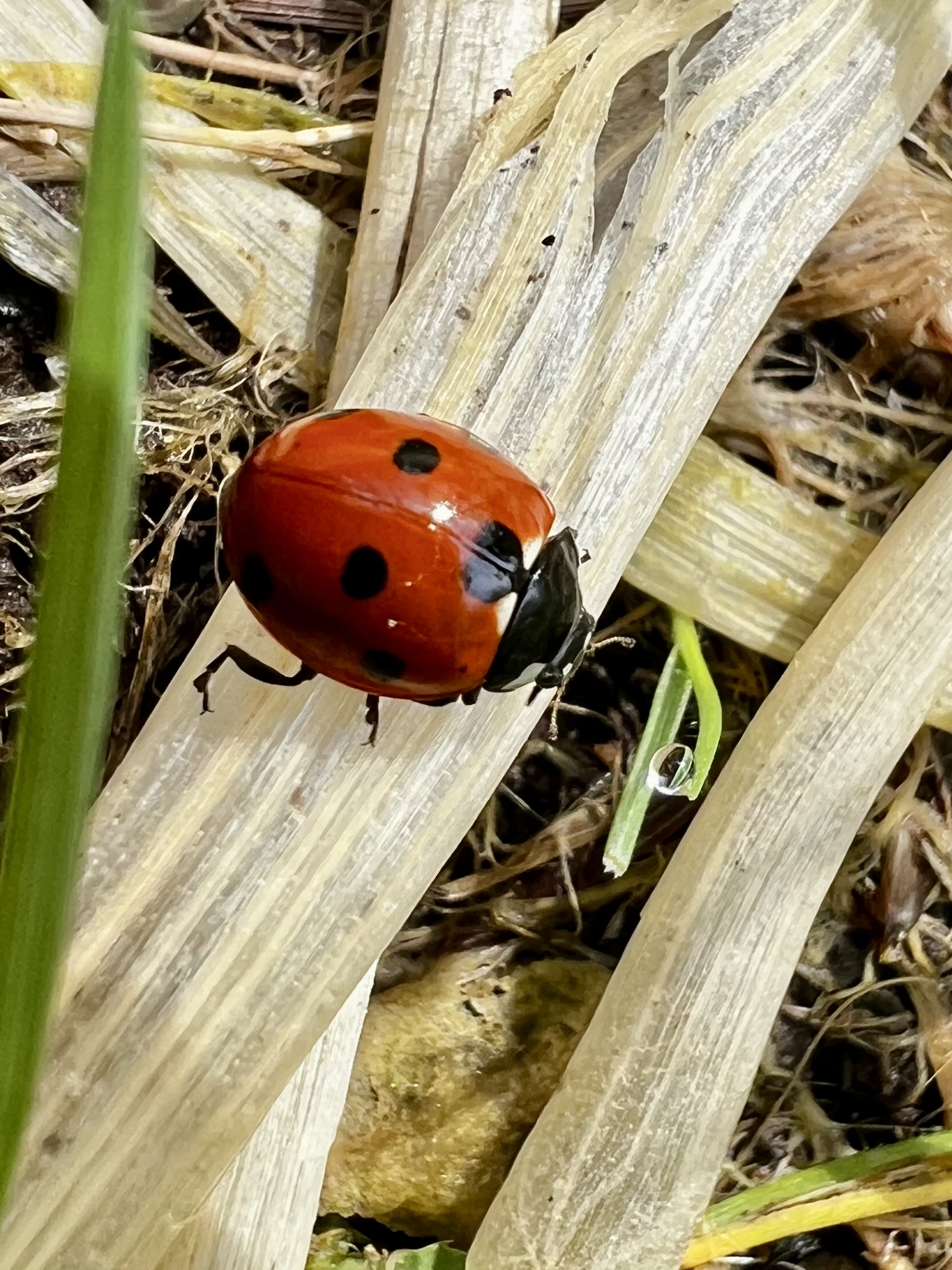
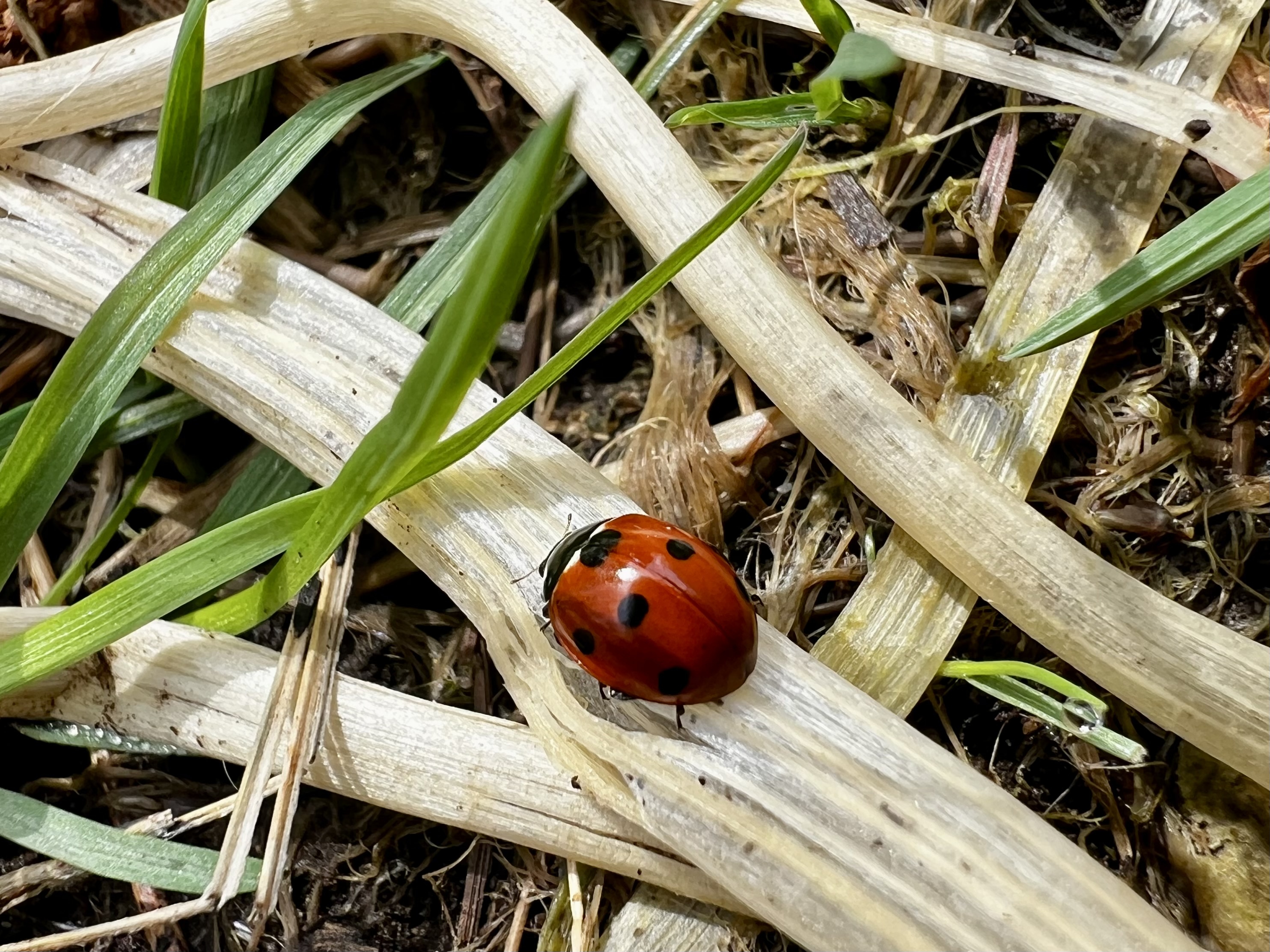
Golden Dung Fly (Scathophaga stercoraria)Face Fly (Genus Musca) on Drago’s backCluster Fly (Pollenia sp)Cluster Fly (Pollenia sp)Seven Spotted Lady Bug (Coccinella septempunctata)Seven Spotted Lady Bug (Coccinella septempunctata)Blowfly (Calliphora sp)Face Fly (Genus Musca and I believe Musca autumnalis)Cluster Fly (Pollenia sp)Fungus Gnat (Family Mycetophilidae )Vinegar Fly (Genus Scaptomyza) Fungus Gnat (Family Mycetophilidae )Pea/Bean Weevil (Genus Bruchidius)Pea/Bean Weevil (Genus Bruchidius)Fungus Gnat (Mycetophilidae)Fungus gnat (Mycetophilidae)Fungus Gnat (Mycetophilidae)Darkling Beetle (Tenebrionidae)Dark Winged Fungus Gnat (Sciaridae family)Nut Leaf Weevil (Strophosoma melanogrammum)Slender Springtail (Orchesella cincta)Nut Leaf Weevil (Strophosoma melanogrammum)Harvestman (Phalangioidea)Narrow Barklouse (Genus Graphopsocus)This is either a Diapriidae Wasp (some use Mycetophilidae fungus gnats as hosts for development) or Braconidae (maybe Aphidiine) Mining Bee (Andrena sp)Mining Bee (Andrena sp.)Mining Bee (Andrena sp.)Mining Bee (Andrena sp.)Mining Bee (Andrena sp.)Mining Bee (Andrena sp.)Mining Bee excavationMining Bee excavationCarpet moth (Larentiinae) hoping to escape last night’s deluge
I’ll leave you to shadow dance with this happy little Cereal fly on my blue garden chair….💙
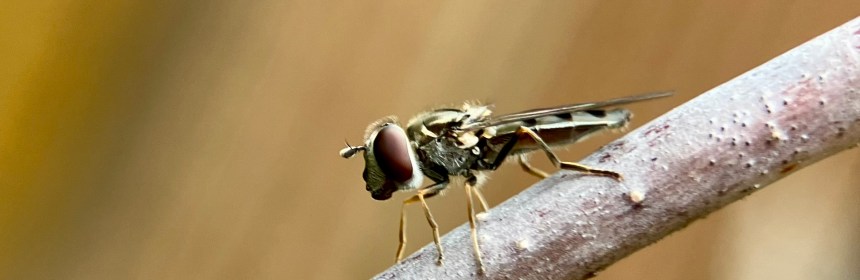
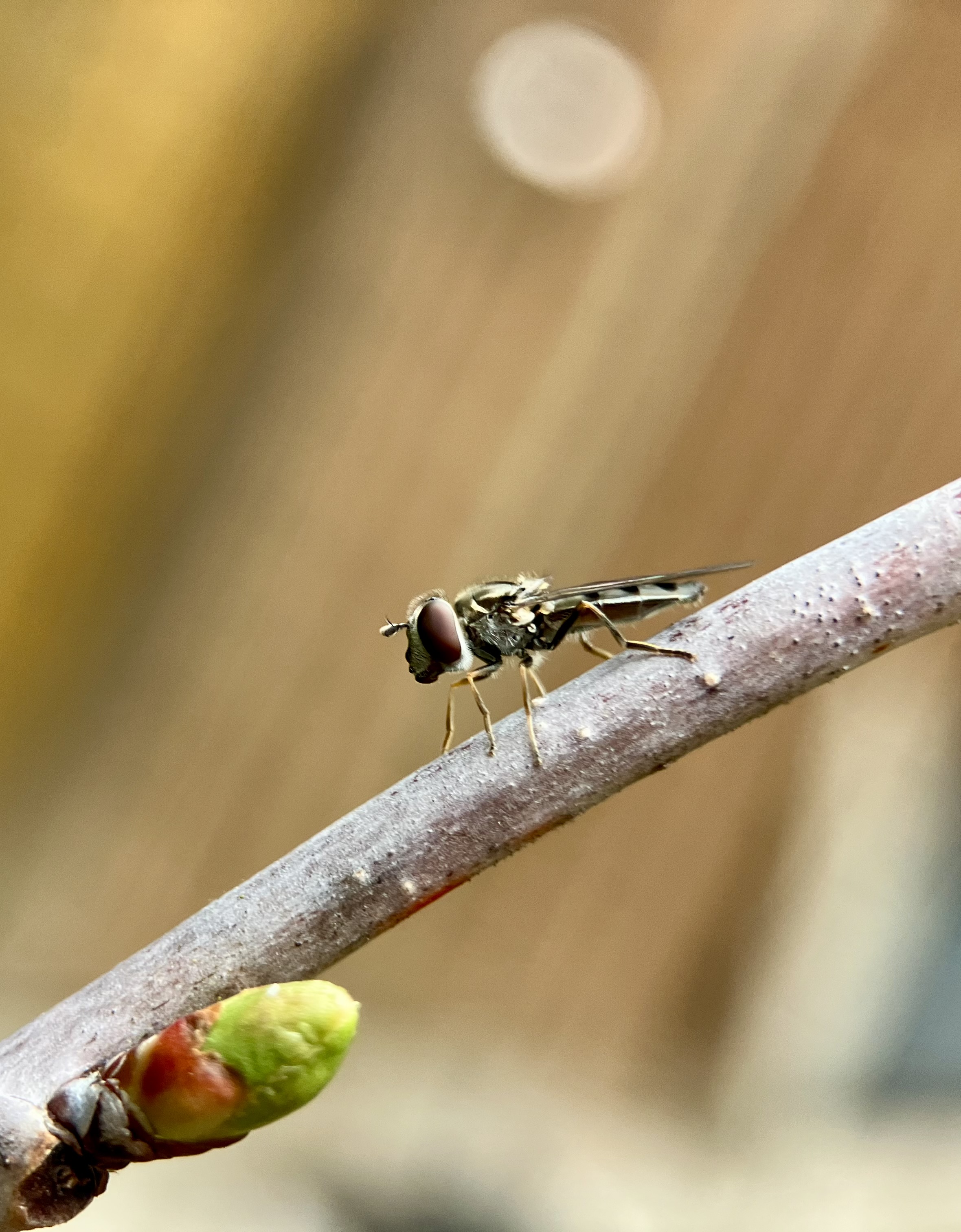
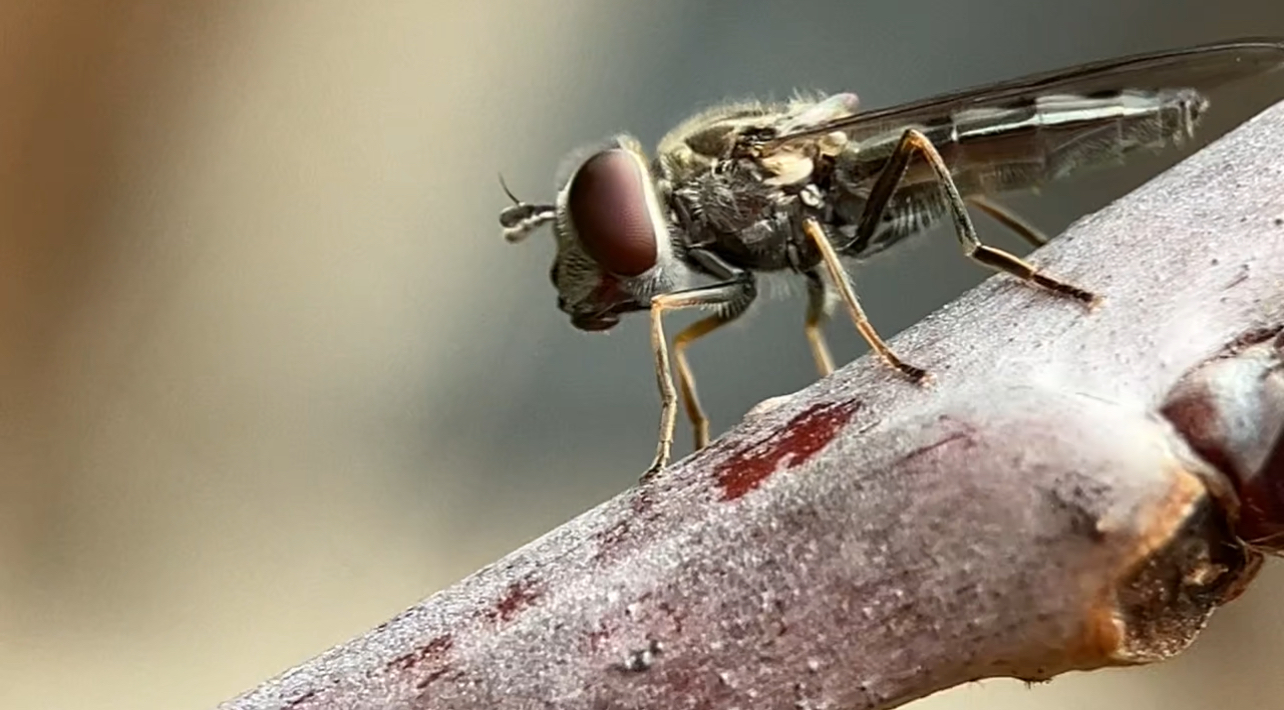
This was Wednesday’s bug of the day. I’m a day behind writing up my post. Although I have tried to get out for a quick bug search every day, it’s been overcast and/or drizzly here this past week. I was excited to see this little fly hunkered down on a twig of our fruitless cherry tree, the tree that I whacked off as an unwanted upstart for several years before I discovered how interesting it is.
Western Forest Sedgesitter, (Platycheirus trichopus), I believe
That tree is a mini ecosystem: floral nectaries that feed the aphids, aphids, slave making ants that have fights to the death (winning) with the carpenter ants that try to invade our home every spring, and the birds that rip the leaves apart trying to get the aphids. Now I can add Syrphid flies to the list!
That’s what this is. A syrphid fly. Syrphid flies eat aphids. It would make perfect sense for this adult to lay eggs on the tree, though I’m not sure what would happen because the ants that farm those aphids are certainly willing to die defending them. I could definitely see the ants overtaking the syrphid fly larvae. Nevertheless, the fly flew off. Somewhere.
This species, as mentioned earlier is pretty small at only about 6.8-9.4 mm. Geographic distribution ranges from the Rocky Mountains west from Alaska to Mexico (bugguide.net). Adults of this genus are known to feed on the pollen of wind pollinated plants like Willow (Salix sp.) and various grasses (Poaceae), and sedges (Cyperaceae). It is believed they are better adapted to activity in cooler temperatures and that fits with yesterday’s rather gloomy spring day.
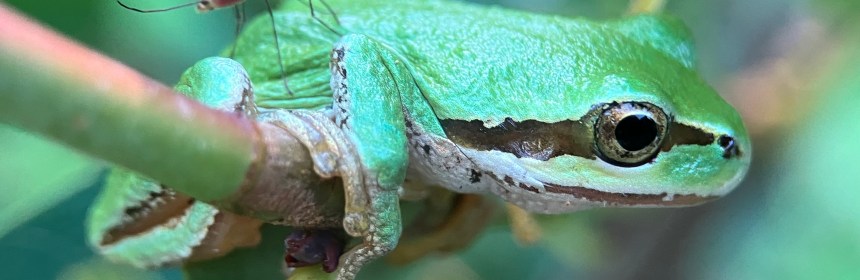
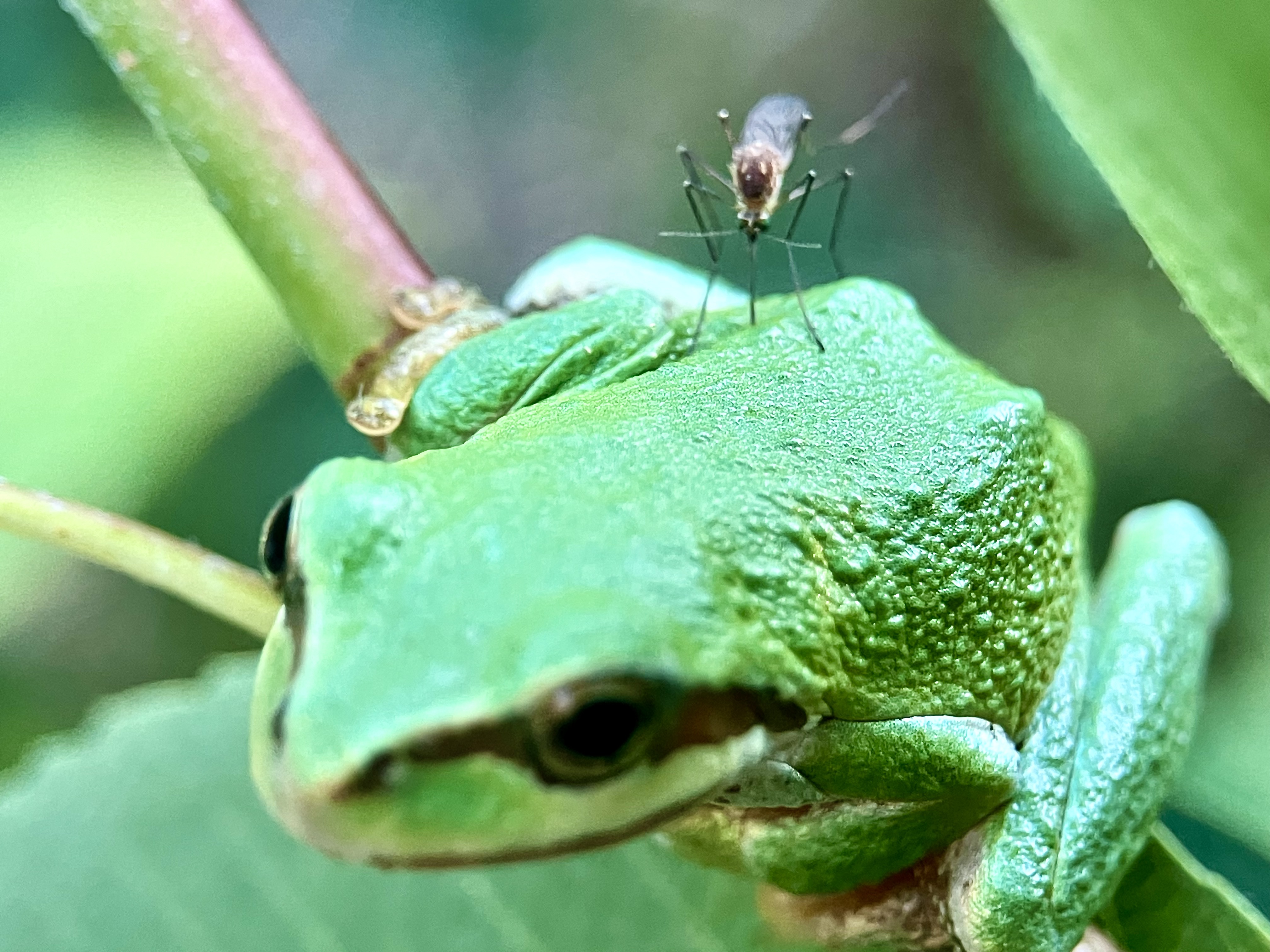
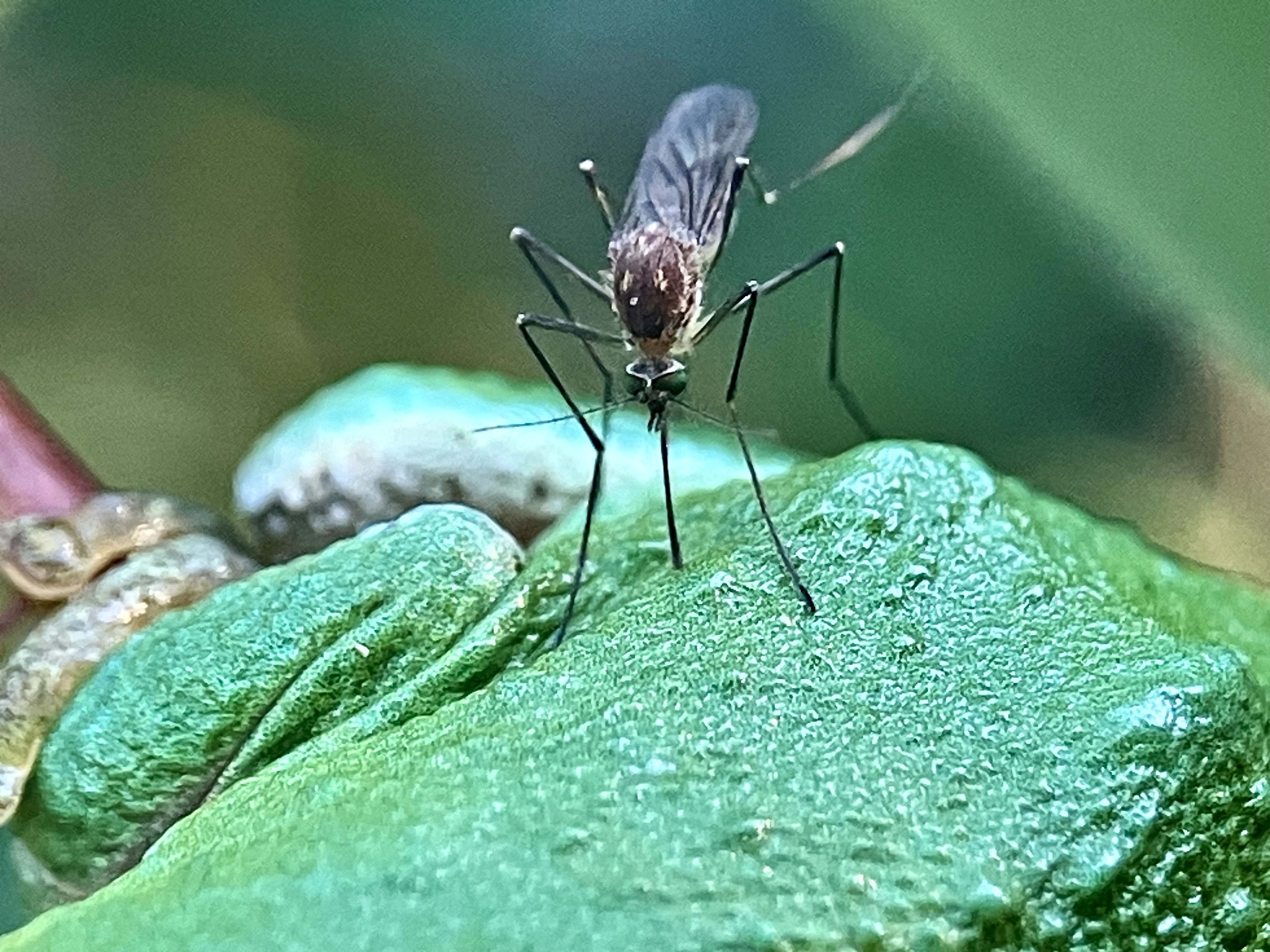
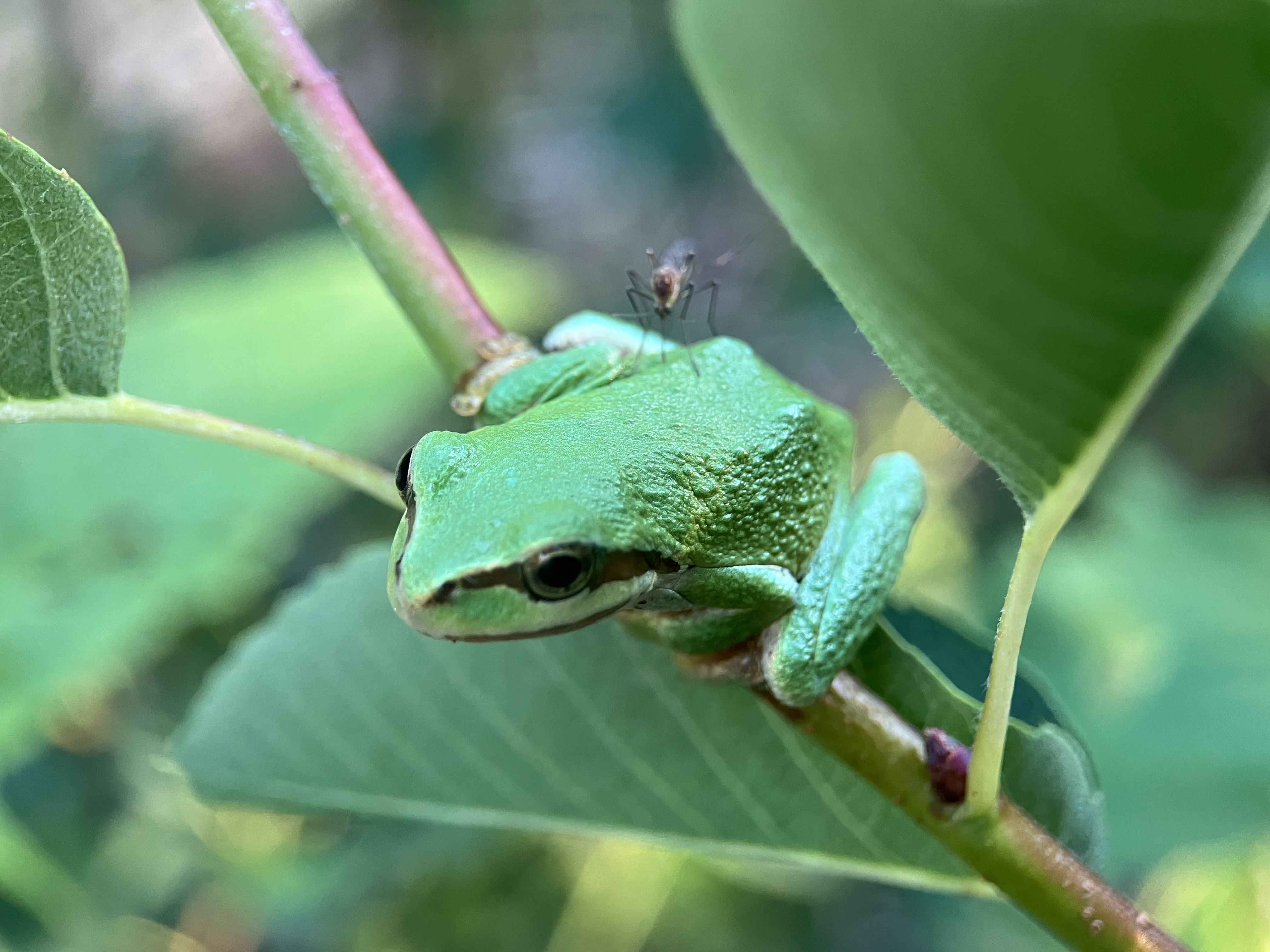
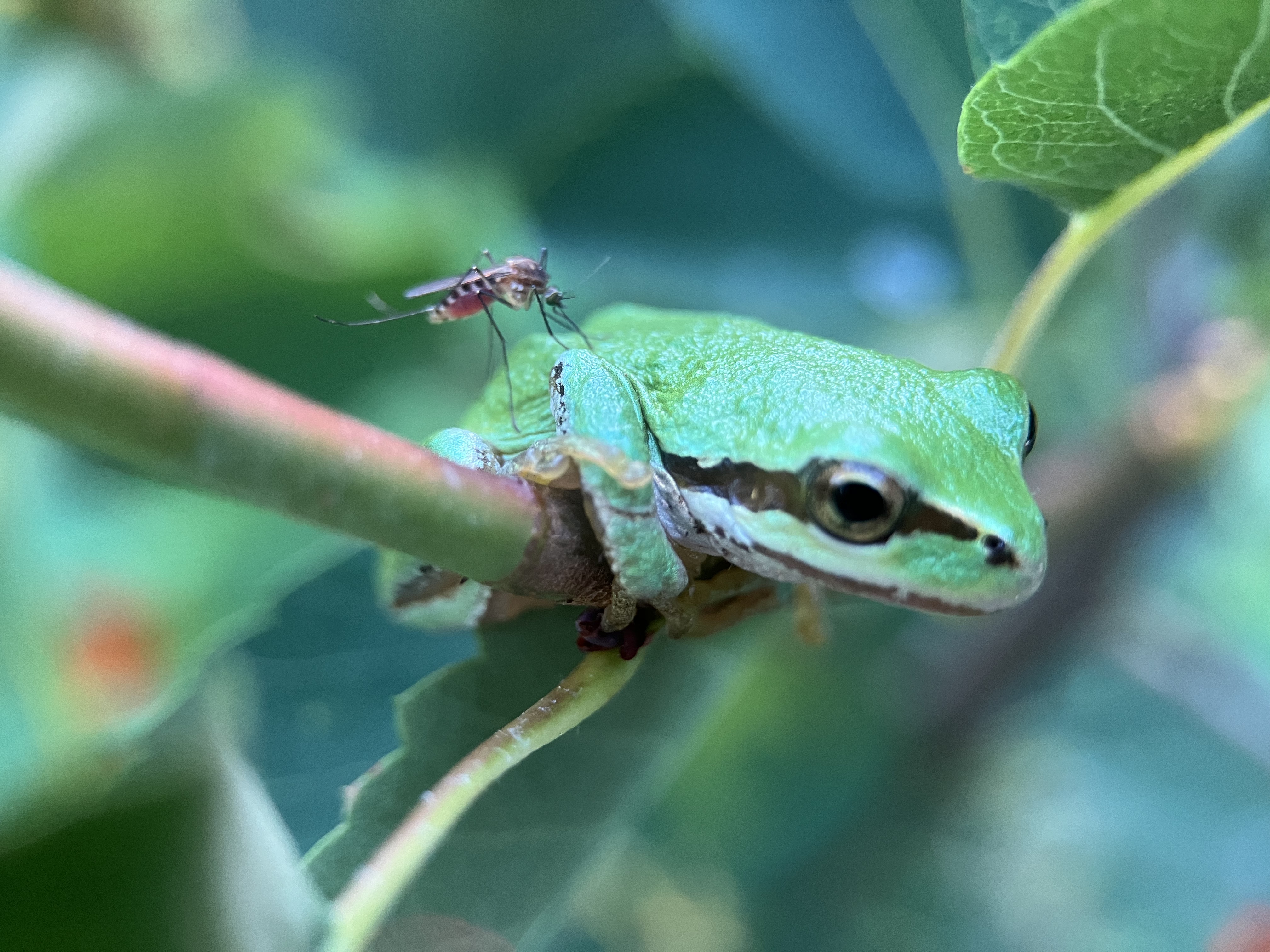
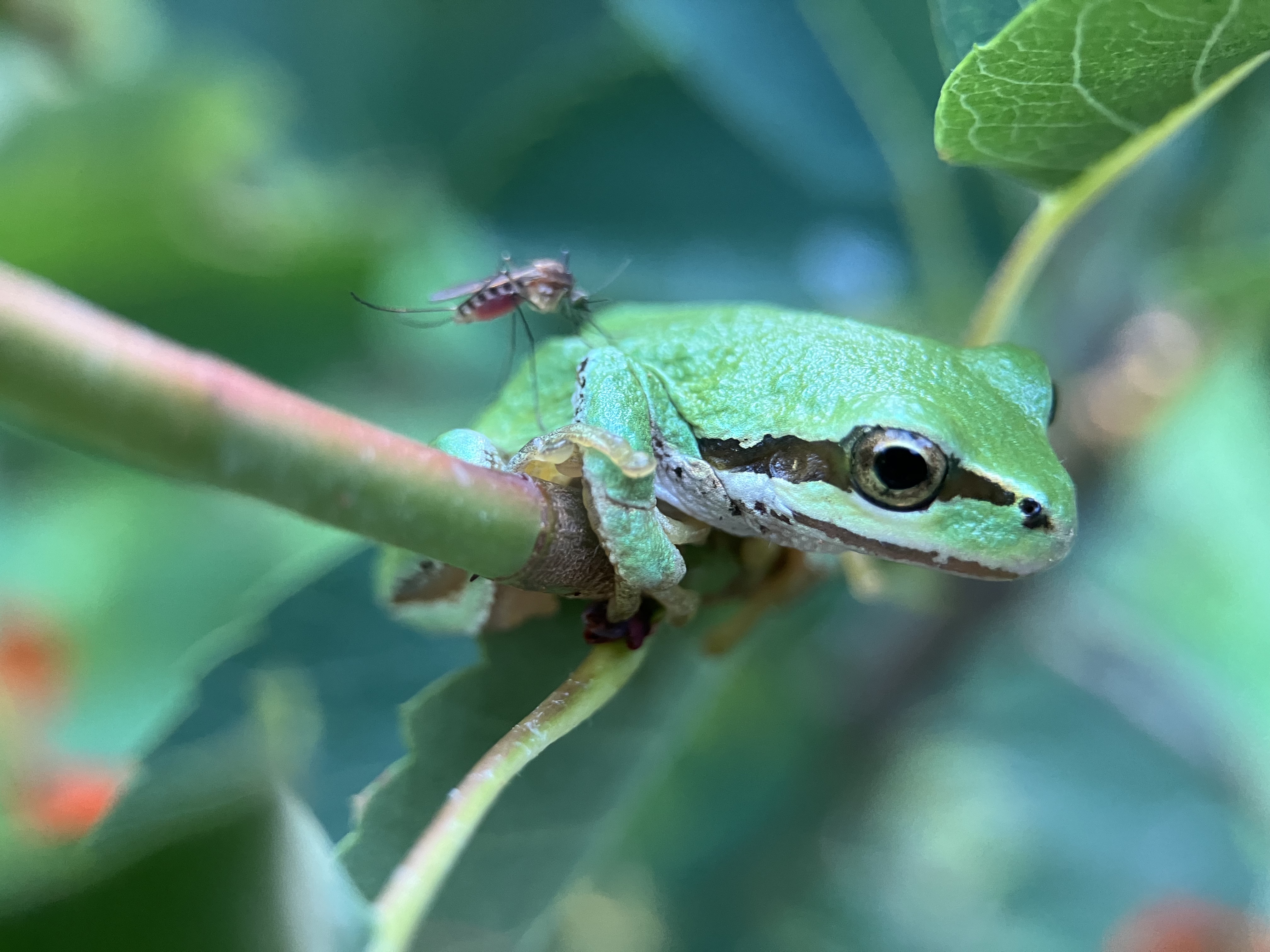
Watch and you’ll see this incredibly amazing association. This is Culex territans, the Northern Frog Biting Mosquito. Culex territans is found in a wide variety of habitats, but is most commonly associated with freshwater marshes, bogs, and ponds or streams with emergent vegetation.
Culex territans prefers feeding on cold blooded animals (amphibians and reptiles), but feeds most frequently on Anurans (frogs and toads). Here you see the mosquito feeding on a Pacific Tree Frog (Pseudacris regilla). The MOST interesting thing about this species is that females find their amphibian hosts via phonotaxis. This means they find their host via acoustics. They utilize the frog vocalizations to locate these animals for bloodmeals (Bartlett-Healy et al., 2008b). Mosquitoes can hear! 🦟🦻🏻
Bartlett-Healy,K. Wayne Crans, Randy Gaugler. 2008. Phonotaxis to Amphibian Vocalizations in Culex territans (Diptera: Culicidae), Annals of the Entomological Society of America. 101 (1) 95–103. https://doi.org/10.1603/0013-8746(2008)101[95:PTAVIC]2.0.CO;2
Hoover Pantoja-Sánchez, Brian C. Leavell, Bianca Rendon, W. A. Priyanka P. de-Silva, Richa Singh, Jian Zhou, Gil Menda, Ronald R. Hoy, Ronald N. Miles, Neil D. Sanscrainte, Ximena E. Bernal; Tiny spies: mosquito antennae are sensitive sensors for eavesdropping on frog calls. J Exp Biol 15 December 2023; 226 (24): jeb245359. doi: https://doi.org/10.1242/jeb.245359
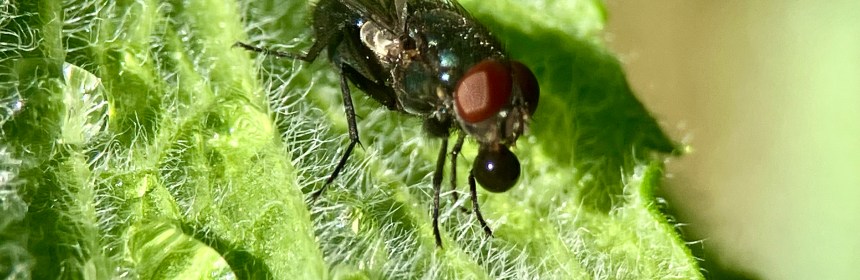
Well, this little fly got my attention yesterday. We had a contest. The fly bet it could outlast my grip on my phone as I took video of the bubble blowing. We called a tie somewhere around the 4 minute mark when my hand was shaking and I was about to drop my phone. The fly, quite satisfied with its performance, waltzed about on the mint leaf and posed for a few still photos, after I got the blood flowing into my hand again.
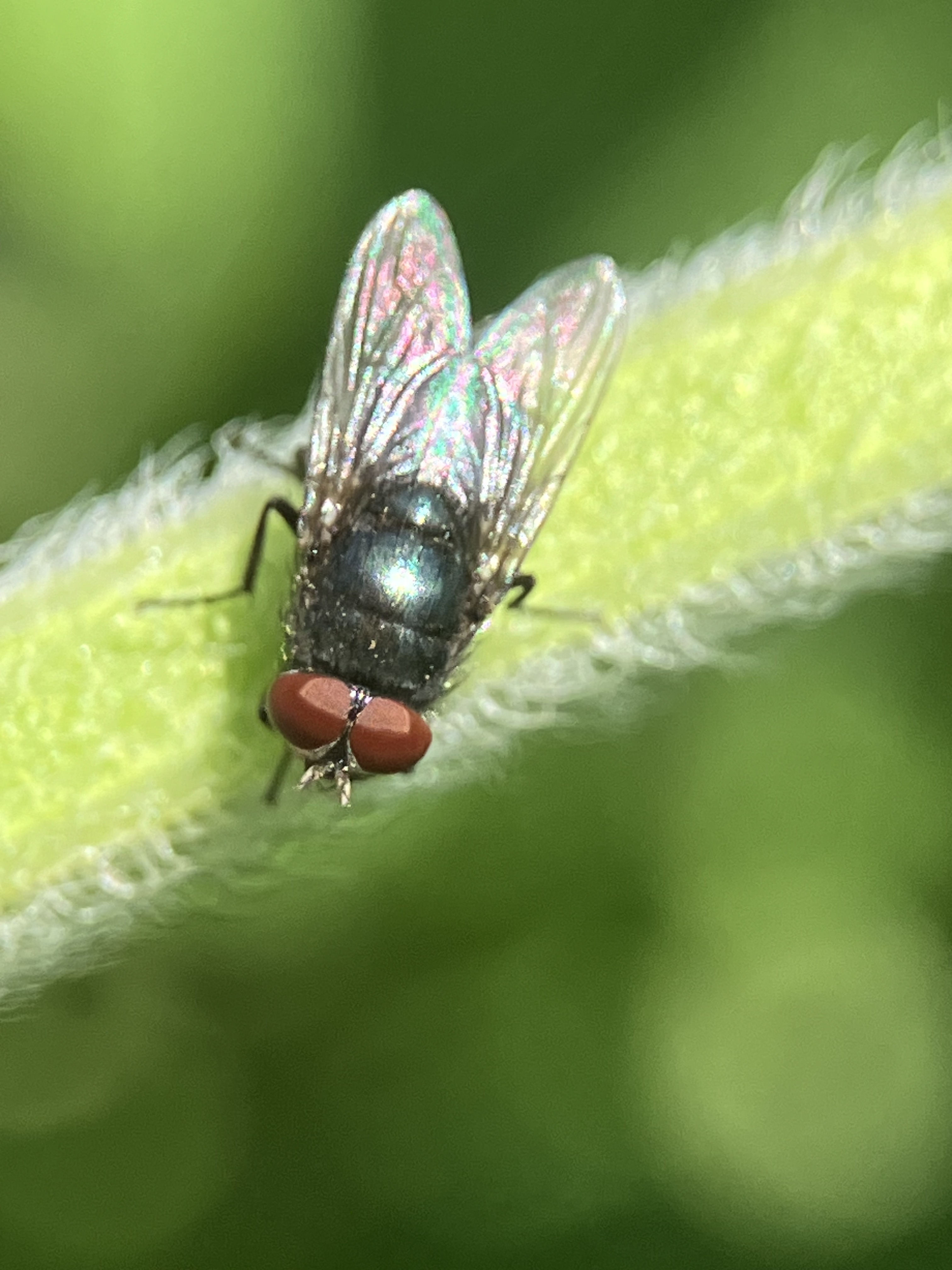
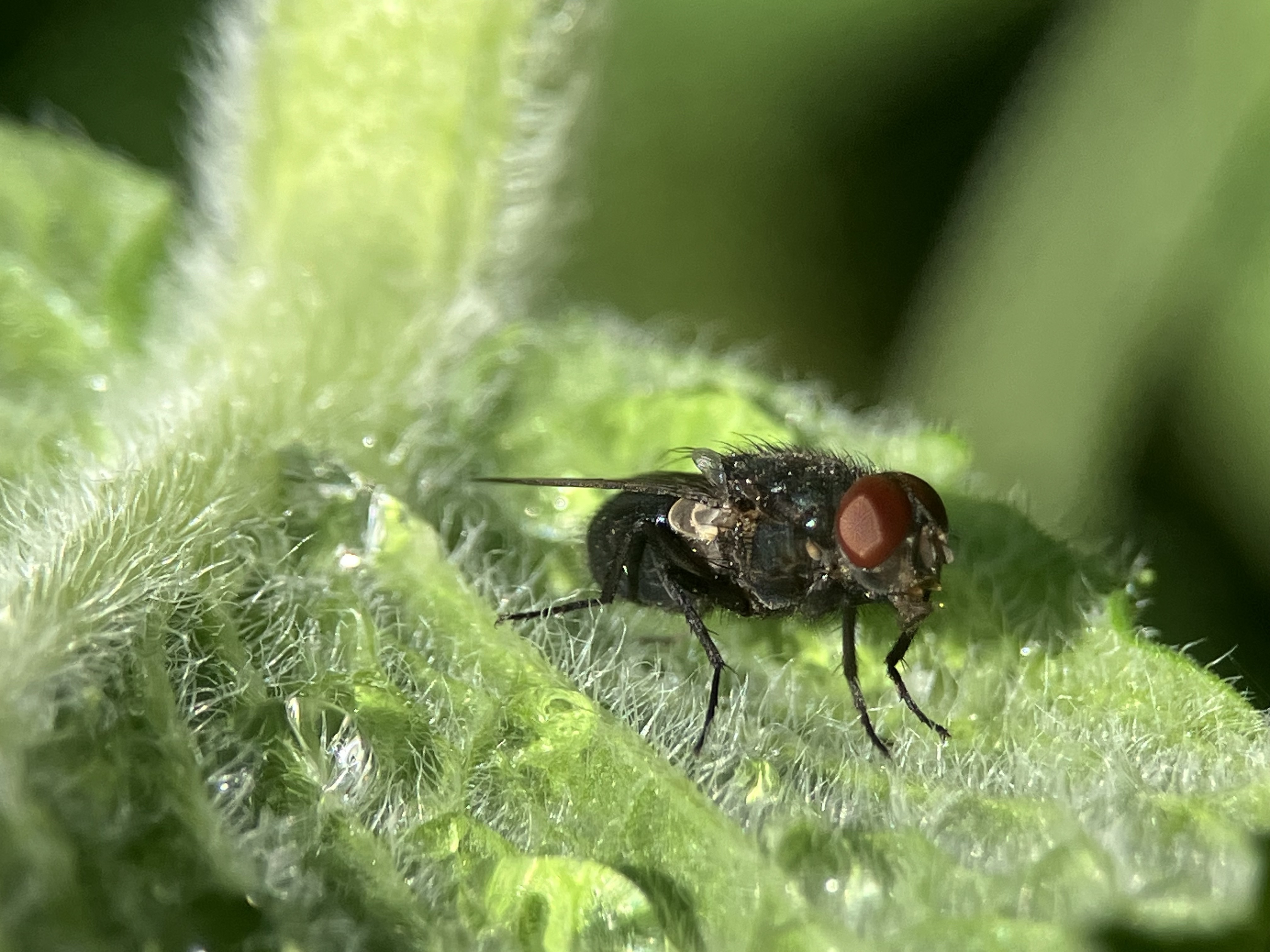
This is a Black Blow Fly (Phormia regina) in the family Calliphoridae. These flies are found ranging throughout North America, Eurasia, and Hawaii. They are a species of importance in the science of Forensics. Blow flies are attracted to dung and carrion, and when found on a corpse, they can be used to estimate time of death. The larvae or maggots of sterile blow flies are also used in the cleaning of wounds, removing decaying flesh and secreting antimicrobial peptides as they feed (Díaz-Roa et. al. 2018). Occasionally, they can contribute to secondary myiasis “fly-strike” of wounds in livestock, wildlife, and pets.
Phormia regina Fly – San Juan Island, WA 07.11.2024
Why is the fly blowing bubbles? It’s not black bubblegum. I’m not sure why the bubbles were black in color. Perhaps something to do with what the fly had been eating. The fly is blowing bubbles to cool down and it’s actually called BUBBLING. Take a look at Ray Cannon’s Nature Notes and you’ll learn it’s part of an evaporative process where the fly moves a droplet of fluid in and out and of their buccopharyngeal cavity over and again before eventually swallowing it (Gomes et al., 2018, Cannon, R. 2020).
Phormia regina Fly – San Juan Island, WA 07.11.2024Phormia regina Fly – San Juan Island, WA 07.11.2024Phormia regina Fly – San Juan Island, WA 07.11.2024
Flies aren’t the only group that practices bubbling. Various species of Hymenoptera also use this method to cool themselves and also to evaporate the excess water from the food (nectar) they’ve consumed (Portman et. al. 2021).
Díaz-Roa A, Patarroyo MA, Bello FJ, Da Silva PI Jr. 2018. Sarconesin: Sarconesiopsis magellanica Blowfly Larval Excretions and Secretions With Antibacterial Properties. Front Microbiol. Sep 28;9:2249. doi: 10.3389/fmicb.2018.02249. PMID: 30323791; PMCID: PMC6172317. https://www.ncbi.nlm.nih.gov/pmc/articles/PMC6172317/
Gomes, G., Köberle, R., Von Zuben, C. J., & Andrade, D. V. 2018. Droplet bubbling evaporatively cools a blowfly. Scientific reports, 8 (1), 1-7.
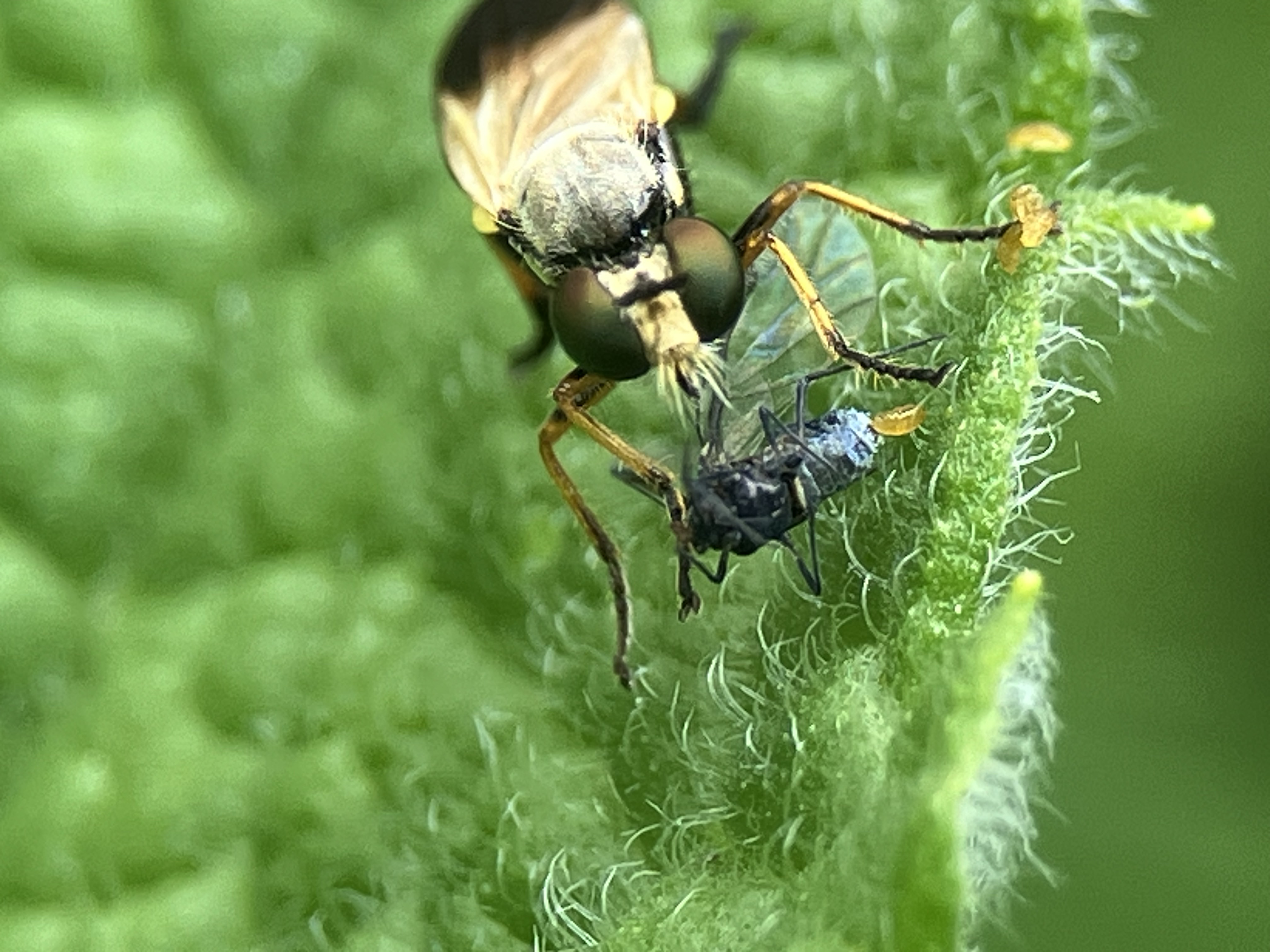
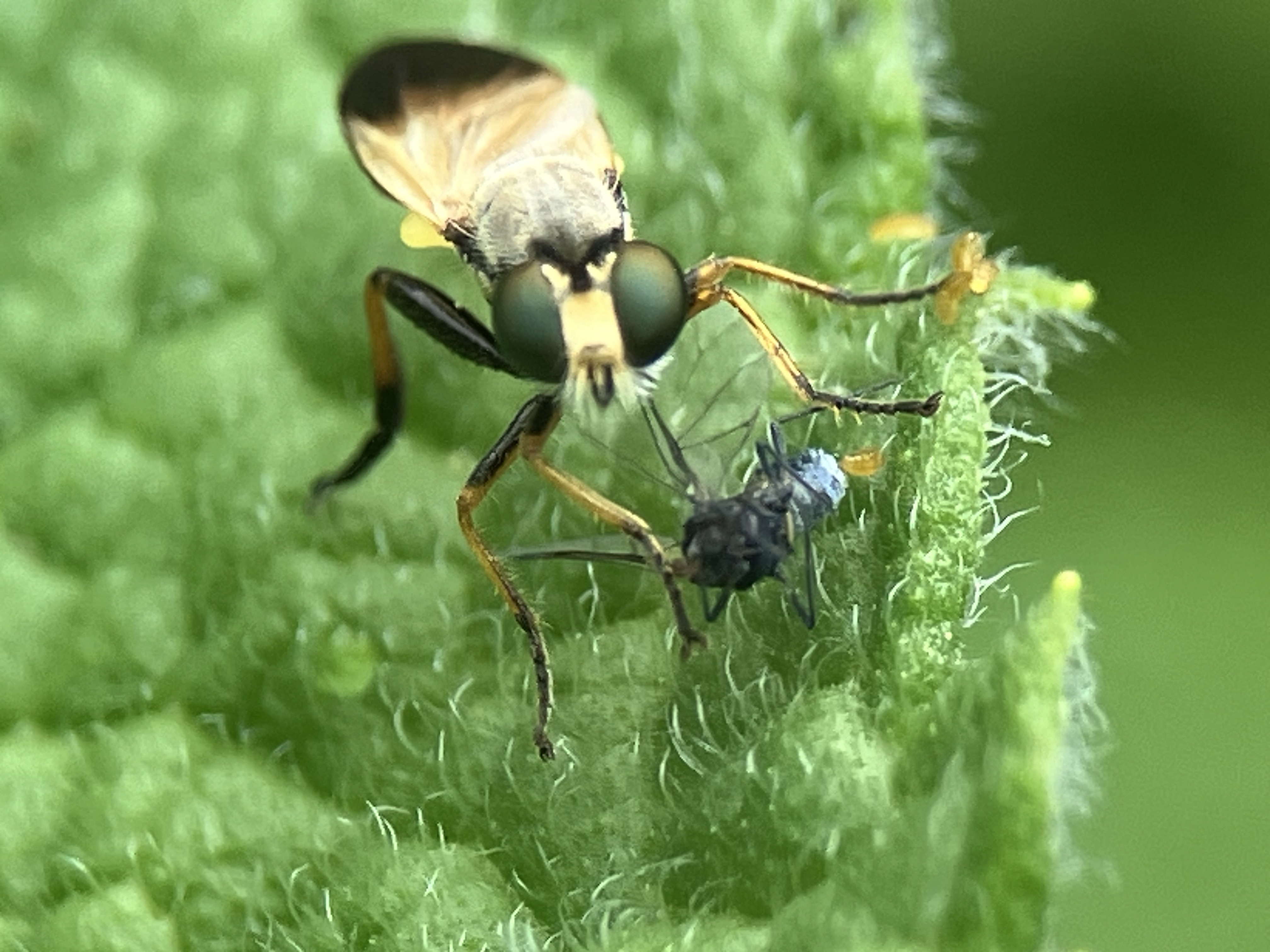
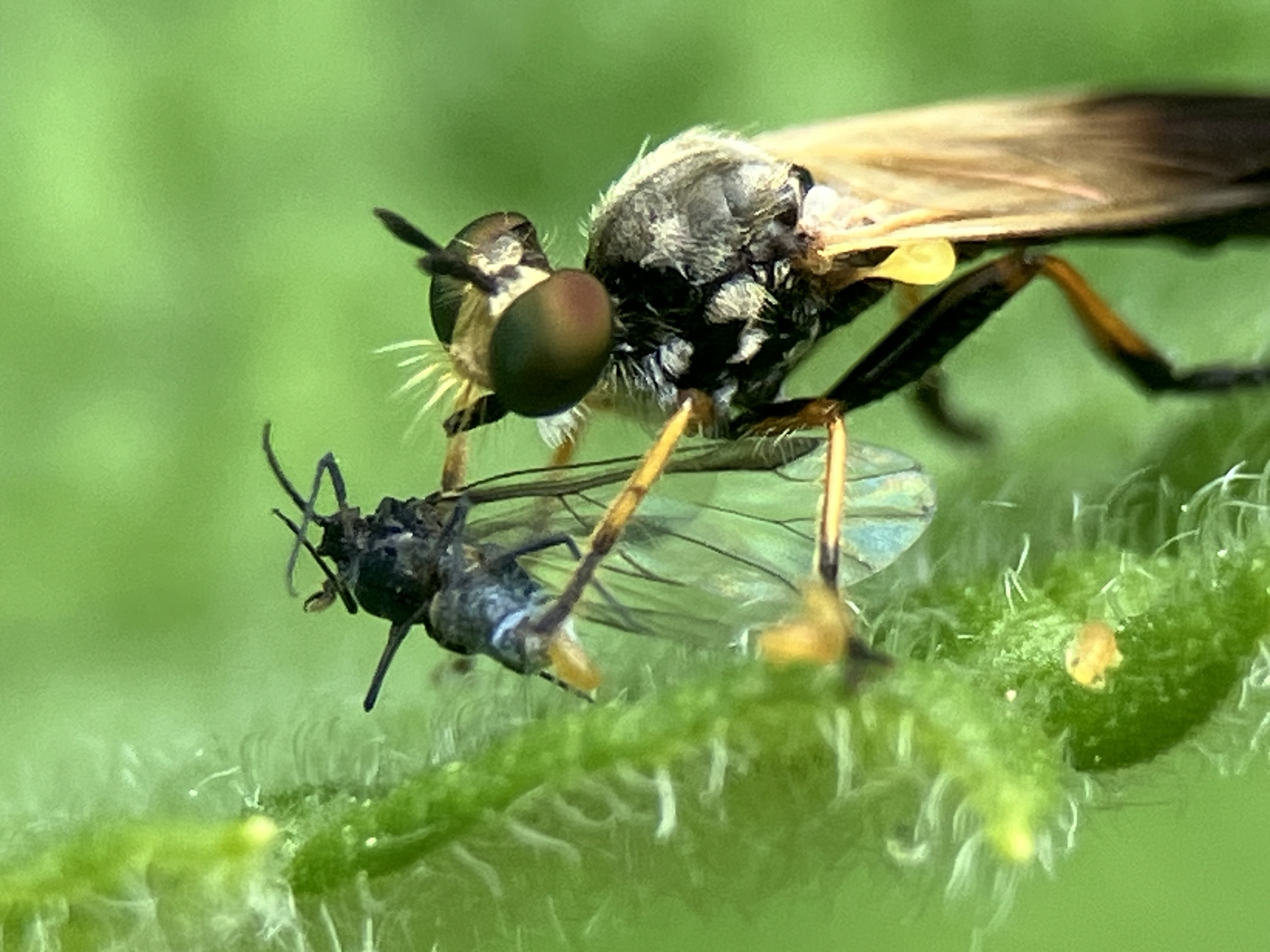
This is one of my favorite garden residents (Eudioctria sackeni), or the Sacken Longhorn Robber. I remember the first time I saw one of these, I thought, “Wow, it’s an Ombre Fly!” If you didn’t know, “ombre” means the blending of one particular color hue to another, often from light tints to dark. The coloration in this particular fly is distinctly “ombre,” though it varies in individuals within the species.
Eudioctria flies are in the family group, Asilidae or Robber flies. They are voracious predators of small insects that can be pests of gardens and orchards. Here, you see this one enjoying a small dipteran (fly) of some variety, perched on the leaf of one of my mint plants. The mint is a popular scouting platform. On any given day in the summer, I’ll see 4 or 5 of these flies in a six foot strip of mint which has become quite abundant in the yard over the past few years. The mint seems to be quite attractive to pollinators, and it also provides shelter for other bugs and critters. Our little tree frogs love to sit in the mint too.
I’m going to start a new bug series called “What’s Biting Me?”
I’m starting this series because I have such bad reactions to bug bites in general, and I’m exasperated when people blame mosquitoes and spiders for everything. Also, if you’re one of those who is tired of it getting crowded here in the San Juans, feel free to share this with anyone who is thinking about moving here – or with anyone you WISH would move off the island. Maybe they’ll decide to live somewhere else. 😉
Epidode ONE, the San Juan Sniper
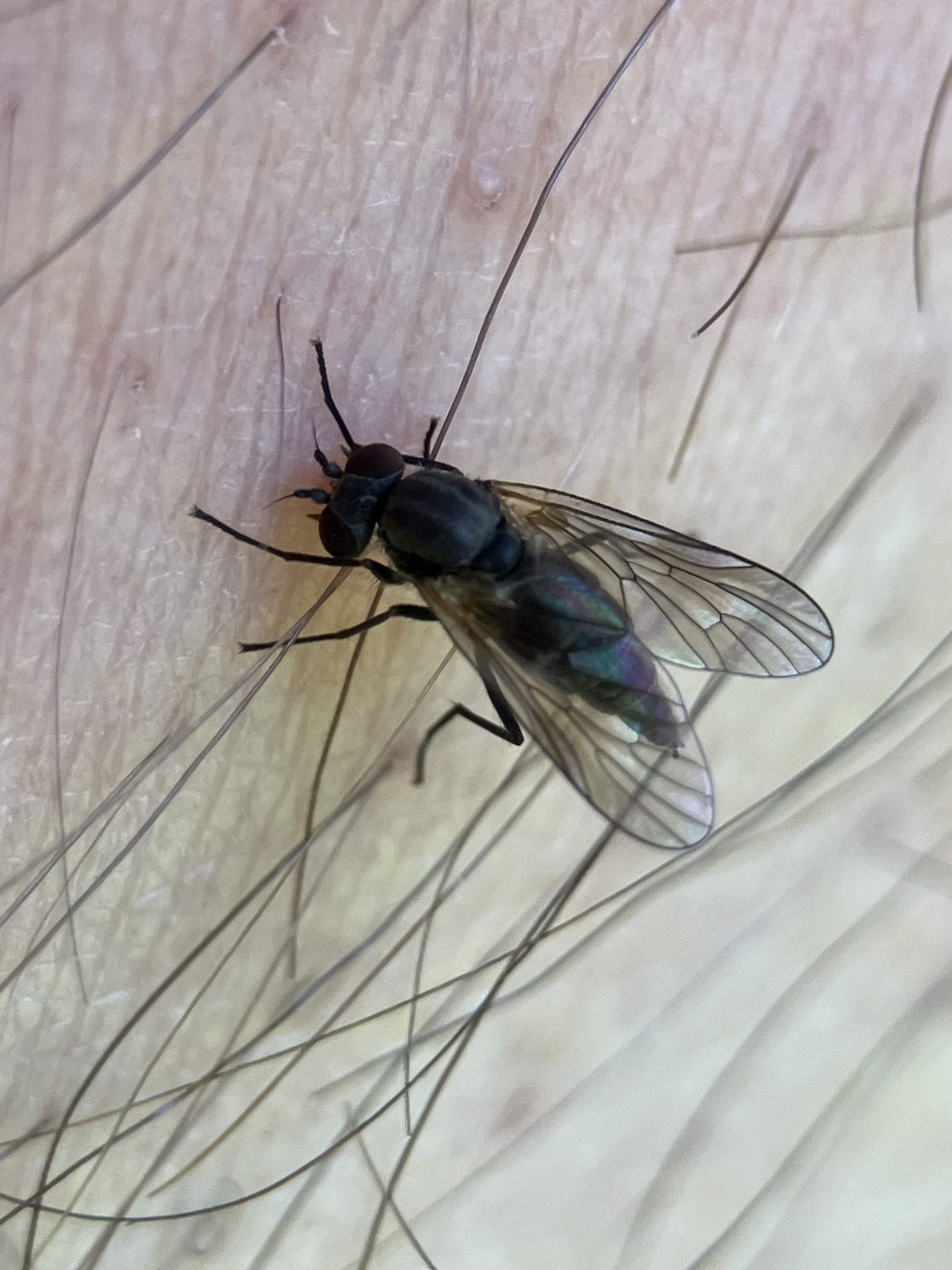
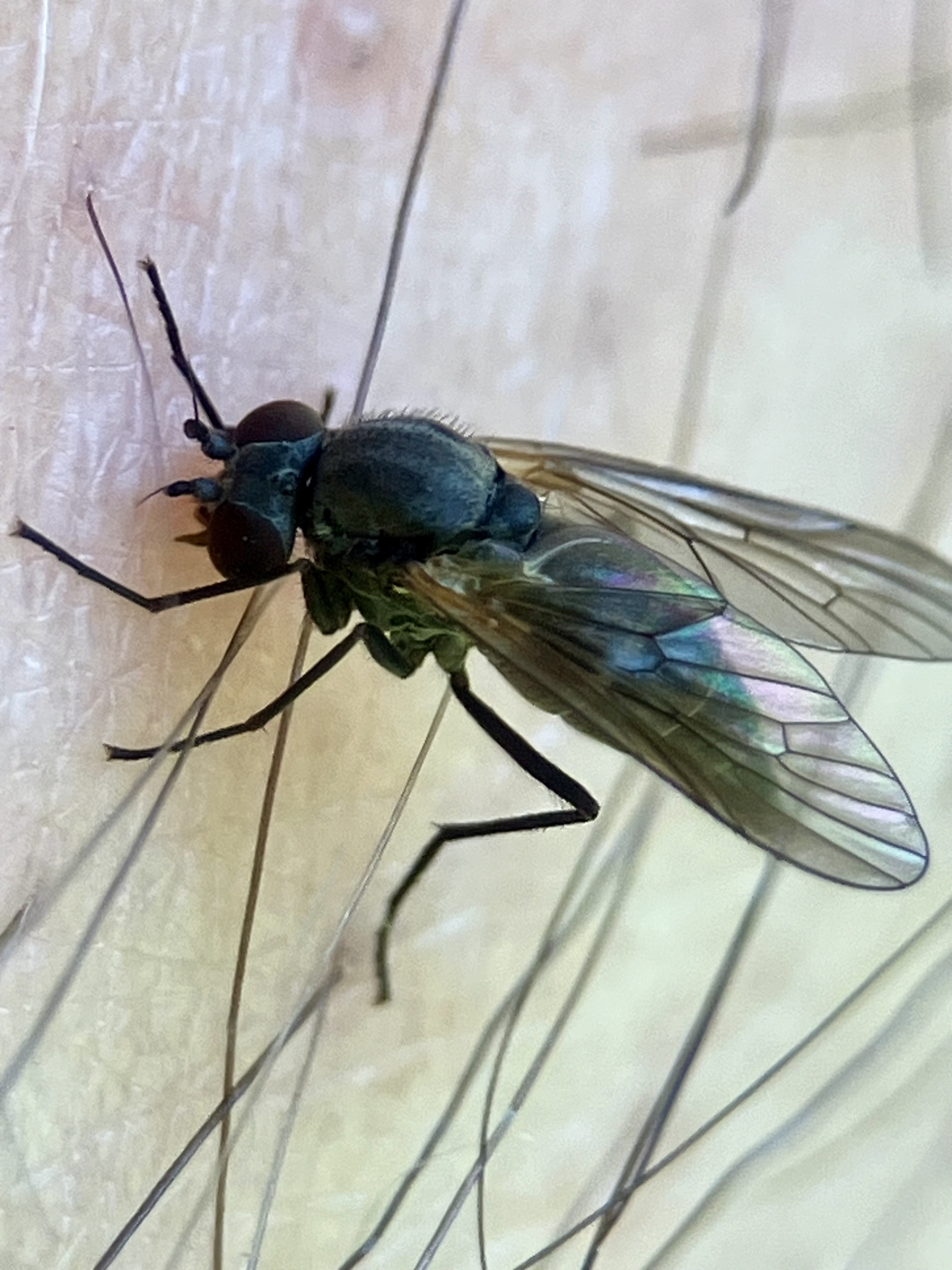
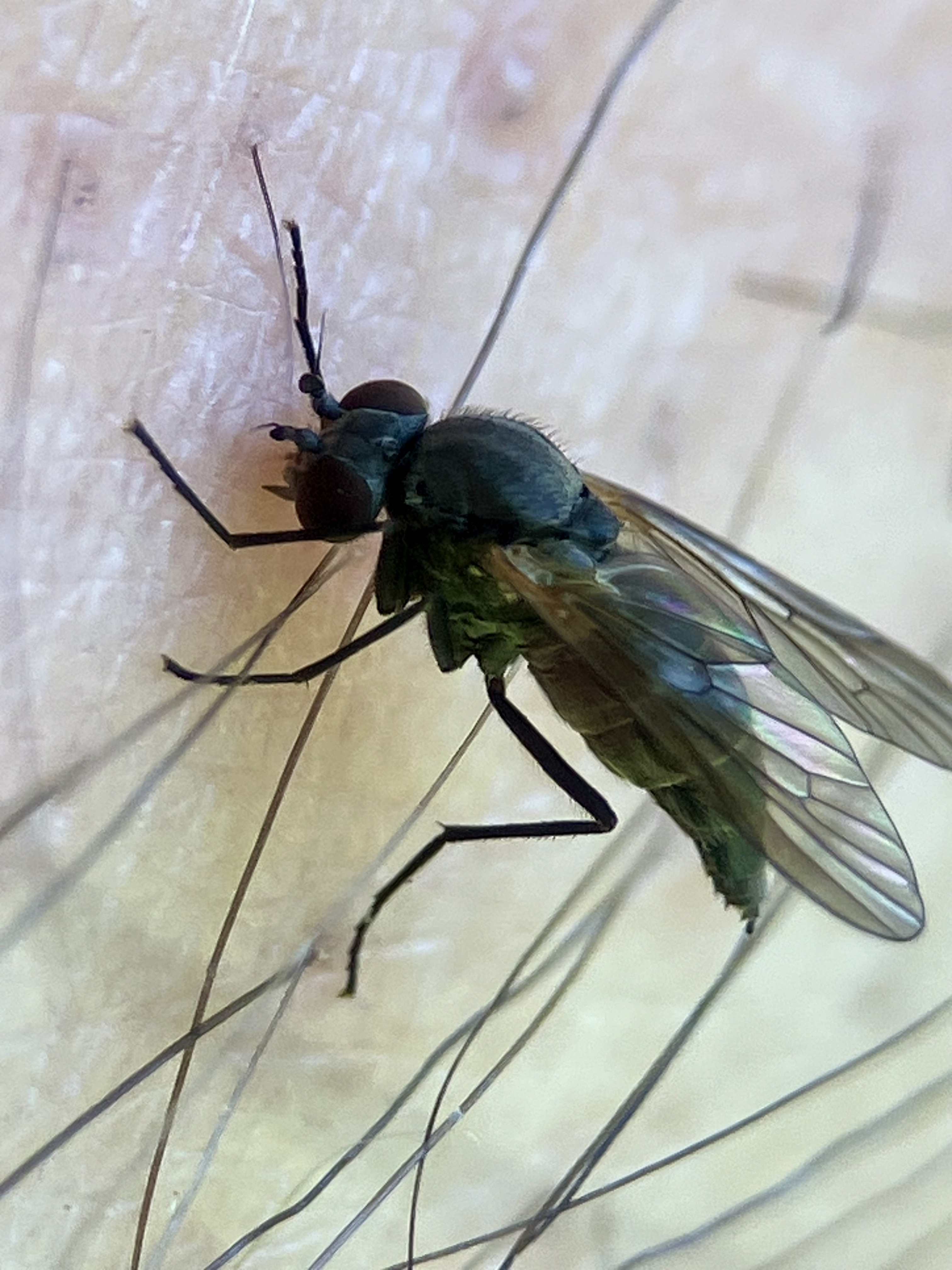
This is one of the Rocky Mountain Bite Flies (Symphoromyia sp.). It’s a Snipe fly in the family Family Rhagionidae, and it bit my husband today. Those are NOT my hairy legs. They’re my husband’s.
Rocky Mountain Bite Flies (Symphoromyia sp)
After getting some pictures, I went inside to look up what information I could find about the Genus and narrow down what species are in WA state. In doing so, I came across this interesting, and disturbing medical case report of a woman who had a severe allergic reaction to the bites of these flies. Now this was in the 70’s, in Forks, WA, but if this fly had bitten ME instead of my husband, it’s very likely I’d be the next case write up.
Attaching the paper in the link here if you care to read it. The woman could have D-I-E-D from anaphylactic shock.
You’ve been warned.
No worries, just stay indoors and you’ll avoid being bitten by the San Juan Sniper.
Symphoromyia Genus
Size: 4.7-9mm
Food: Females of some species of this genus are blood feeders. Symphoromyia females are common biting pests in the west. Males do not take blood meals. Both adults and larvae will prey on small insects.
Habitat: Adults are commonly found in woods near moist places, often found on foliage or grass, positioned with head resting head downward. Larvae occur in moist meadow soil, moss, decaying wood (incl. galleries of wood-boring insects), under bark, occasionally in water (bug guide.net).
References and Further Reading
Aldrich, J. M. 1905. A Catalogue of North American Diptera. Smithsonian Miscellaneous Collections 46:680.
Turner WJ. A case of severe human allergic reaction to bites of Symphoromyia (Diptera: Rhagionidae). J Med Entomol. 1979 Feb 8;15(2):138-9. doi: 10.1093/jmedent/15.2.138. PMID: 448692 https://www.tesble.com/10.1093/jmedent/15.2.138
This is one of my “Know your pest predators” posts, featuring one of our PNW flies. Flies are all too often maligned and under-appreciated. We think of flies as spreading disease and being a nuisance, yet many of them perform incredibly important jobs as pollinators and pest predators. Yesterday I was sleuthing flies in the yard and found these metallic green beauties. Here is a Dolichopus (“doe-LICK-uh-pus”) male and female. The “dolicho-“ part means “long”, and the “-pus/-pod” part means “leg” or “foot.”
Some species of Dolichopus males (like this one) have little “flags ” or “mitten” front feet they wave or flap around to woo the ladies. Reading about this very large group of flies has been interesting and you can learn more about their courtship behaviors in Van DuZee et al. (1921).
Dolichopus sp. male fly
These flies are predators of small, soft-bodied invertebrates as adults and during their larval stage. You can thank them for helping keep populations of aphids under control in your garden.
Dolichopus sp. fly (male)
You’ll find these flies in northern latitudes in North America. “Dolichopus species are among the largest and most common members of the family Dolichopodidae in North America. The majority of Dolichopus species prefer humid habitats and some are restricted to saltmarshes,” (Pollet et al. 2004).
MARC A.A. POLLET, SCOTT E. BROOKS, JEFFREY M. CUMMING. 2004. “CATALOG OF THE DOLICHOPODIDAE (DIPTERA) OF AMERICA NORTH OF MEXICO,” Bulletin of the American Museum of Natural History, 283, 1-114,
Van Duzee, M. C., Cole, Fr R., and Aldrich, John Merton. 1921. “The dipterous genus Dolichopus Latreille in North America.” Bulletin of the United States National Museum. i–vi, 1-304, 16 pls. https://doi.org/10.5479/si.03629236.116.i
I’m doing a short write up of this fly just to get you thinking a bit. It was observed April 29, 2024 on San Juan Island, WA. While identification to Genus/Species may not be possible until I can actually catch a specimen to be keyed out, it is Family Tachinidae and Tribe Goniini. Hoping to come back with at least a Genus update at some point.
What I want to SHARE is the life history of this tribe of flies. The Goniini flies are parasites of various Lepidoptera, mostly Noctuids, Arctiids, and Lymantriids. Translating this for you a bit, it would be cutworms (if you’re a gardener) , tiger moths, and tussock moths.
How does this play out?
The female Goniini fly lays a “black microtype,” usually ovate and flattened egg, varying in size from very small to medium, on foliage utilized by the feeding host caterpillar. The caterpillar (usually Noctuids) munch the foliage, ingesting the fly egg. The caterpillar will continue feeding and then wander off to complete its life cycle as a pupa. At some point after ingestion by the caterpillar, the fly egg hatches and the fly larva develops inside the body of the pupating moth that is inside its chrysalis.
A myriad of ecological relationships exist in nature that are often unobserved. Many remain undescribed or unknown. Sometimes, they are disrupted by humans who intervene out of ignorance. If you’re one of those folks who squish what you believe are cutworm pupae in your garden bed, you might be smooshing the pest predator developing inside.
Hmmm, I was trying to think of a catchy title. “Louse in the House” made you look, right? Well, indeed one did escape and I can’t find it. Would you like to come over for dinner tonight? I thought I saw it flying around the dining room.
Here’s how it happened. Yesterday afternoon, a bird hit the window. It was a hard strike on a window where we haven’t had many bird collisions. I suppose I’ll have to make more Acopian Bird Blinds to put up. They’ve sure help mitigate the bird strikes. Link to DIY instructions here: https://www.birdsavers.com/make-your-own/
Back to the bird. I went out to see if the poor bird was still alive. It was, but died in my hands soon after I picked it up and carried it into the house to assess for injuries. I took the bird into the bathroom so I could shut out my ever-curious indoor cats, Herman and Nimbus. After realizing I was holding a lifeless body, I set the bird down in the bathtub. Right away, I noticed a fly crawling through the bird’s feathers. Hurriedly, I left the bathroom, grabbed my camera, and went back to examine my specimen more closely.
Hippoboscid Fly (Icosta americana)
As I bent over to look through the feathers, a fly zoomed up and nearly entered my nostril. I backed away, rubbing my nose. Wouldn’t be my first strange experience with a fly. There was that incident with the botfly that could have been a medical ophthalmological emergency. Don’t ask. You truly don’t want to know.
Leaning back over the tub, I started to look through the feathers again, but thought better. I went out of the bathroom again. This time to retrieve a large plastic bag and a collection vial for specimens. The bird went into the clear plastic bag. Now, I could look while containing the flies in the bag if there were others to be found.
I found two more.
These are Louse Flies in the family Hippoboscidae. The ID for this particular species is Icosta americana. Also, my husband identified the bird as a juvenile Brown Headed Cowbird (Molothrus ater). Strangely, this species is known to be chiefly associated with the bird families Accipitridae (birds of prey – hawks), Phasianidae (pheasants), and Strigidae (owls). So, why might it be on a cowbird? The bizarre exception. Maybe the cowbird parents laid their egg in the nest of one of the above? I suppose it will be a mystery.
Hippoboscid louse flies are pretty interesting. First off, don’t they look weird? Trust me when I tell you they are one of the most bizarre families of flies out there. They are obligate ectoparasites that feed on the blood of their host, nothing else. Unlike other fly groups, both male and female flies in this family feed exclusively on blood.
There are more than 200 species of Hippoboscid flies, and each species is particular about what sort of host it feeds on. Some feed on sheep, some on deer, others on bats, but the ones I found feed on birds. In fact, approximately 75% of species of Hippoboscid flies are bird parasites. Of these 75%, some are so picky, they only prefer a particular species of bird.
Another interesting thing about these flies is the fact they vector diseases like Avian Malaria, West Nile virus, and various Trypanosomes among the host species they parasitize. Unlike some other Hippoboscid species which have deciduous wings (wings that are quickly lost when reaching a host), the ones that parasitize birds can fly during their entire adult life. This means if their host dies, like my bird that hit the window, the flies are able to leave the bird’s body and fly off to parasitize another bird host.
While one fly may have attempted to target my nose, these flies are not known to parasitize humans, although incidental bites have been recorded. Some species of female Hippoboscid flies are actually known to only be able to develop their eggs from the blood of their particular host species.
While on a host, Hippoboscid flies move about with ease. They have bodies that are dorso-ventrally flattened, somewhat like an unfed tick body or a squished bug body. In fact, the Hippoboscid flies that parasitize deer are often mistaken for ticks. Because of the flattened body, sometimes these flies are referred to as flat flies. This shape makes it easy for them to glide between fur or feathers, and it also makes it hard for the host to groom them off.
The most remarkable thing about Hippoboscid flies is their reproductive biology. It is known by the term, Adenotrophic viviparity. Adenotrophic viviparity is where eggs hatch inside the female, and the larvae are fed internally until they are mature enough to pupate. In layman lingo, the female fly gives birth to a single live larva just as it is ready to pupate. She has invested all her resources into producing a single offspring.
This is unique as most fly species cast eggs onto a substrate and the eggs hatch into larvae, feed independently of the parent, pupate, and emerge as adults. With Hippoboscid flies, the female parent retains the single egg inside her uterus, the egg hatches into a larva, and she feeds it with special milk glands until the larva reaches the last stage of larval development or “prepuparium.” Finally, the adult fly “births” her offspring larva enclosed in a shell that quickly hardens into a true pupa. With Hippoboscid species that parasitize birds, the adult fly will leave her pupa in a bird’s nest or roosting site where it can easily find a host when emerges as an adult. For more on the life cycle of Hippoboscidae, you can view one of my YouTube videos here – https://youtu.be/zCD1B2GjCxU
*** In case you’re sitting here scratching your head and I wasn’t clear in the text, ALL of the collective names for Hippoboscid Flies include the following: Flat Fly, Louse Fly, Ked Fly, or just plain ole Ked. And yes, they ARE known to have a painful bite!
References and Further Reading
Coatney, G. R. (1931). On the Biology of the Pigeon Fly, Pseudolynchia maura Bigot (Diptera, Hippoboscidae). Parasitology, 23(04), 525.
Dick, C.W. 2006. Checklist of world Hippoboscidae (Diptera: Hippoboscoidea); Department of Zoology, Field Museum of Natural History: Chicago, IL, USA, pp. 1–7.
Levesque-Beaudin, V. Sinclair, B.J. 2021. Louse fly (Diptera, Hippoboscidae) associations with raptors in southern Canada, with new North American and European records. International Journal for Parasitology: Parasites and Wildlife, 16: 168-174. ISSN 2213-2244. https://doi.org/10.1016/j.ijppaw.2021.09.007
Maa, T. C. 1969. a Revised Checklist & Concise Host Index of Hippoboscidae (Diptera). Pacific Insects Monog., Honolulu: Bishop Museum, Honolulu, Hawaii. 20: 261–299. http://hbs.bishopmuseum.org/fiji/pdf/maa1969b.pdf
Santolíková,A.;Brzonˇová, J.;Cˇepicˇka,I.;Svobodová,M. 2022. Avian Louse Flies and Their Trypanosomes: New Vectors, New Lineages and Host–Parasite Associations. Microorganisms. 10, 584. https://doi.org/10.3390/ microorganisms10030584
Two weeks ago, I stopped by the San Juan County Conservation Land Bank’s office to take a look at the newly transformed “lawn-to-meadow” native plant garden. This sample meadow is an effort coordinated by Land Steward, Eliza Habagger, as part of The Salish Seeds Project (https://sjclandbank.org/the-salish-seeds-project-bringing-back-island-wildflowers/). I was astonished at how quickly (seemingly overnight), the wildflowers planted in this small space bloomed. Aside from being much more appealing than grass, this new wildflower meadow is hosting an assortment of pollinators.
Hemipenthes sp. Bee Fly (Bombyliidae) at San Juan County Land Bank demonstration meadow – May 18, 2023
Here’s a species of fly I saw that, at first-glance, looks a lot like a biting deer fly. It is actually a type of Bee Fly in the family Bombyliidae with no common name. Its Latin genus name is Hemipenthes, and this one keys out to Hemipenthes morioides.
Hemipenthes means ‘half-veiled in black’ and refers to the wing pattern seen in this group. I used a key by Ávalos-Hernández (2009) to work out my identification and consulted with another fly specialist who agreed. In the video clip of the fly, it looks to be ovipositing in the sand, indicating my specimen is female. I’ll come back to this in a bit.
I believe this is Hemipenthes morioides, a Bee Fly – May 18, 2023, San Juan County Land Bank Native Plant Garden
Literature describes Hemipenthes morioides flies as hyperparasites (a parasite of a parasite) of the larvae of parasitic flies (Diptera, Tachinidae), as well as parasitic wasp larvae (Hymenoptera, Ichneumonidae). Brooks (1952) cited this species as a predator of the tachinid fly Bessa harveyi, which is a parasite of the sawfly Pristiphora sp. (Hull, 1973). H. morioides has been collected mainly in the western states of the USA (Ávalos-Hernández (2009). They also are known to parasitize caterpillars of moths in the family Noctuidae (Bugguide.net 2020). Preferred habitats are forest edges and meadows.
Of course, this leads me to ask all sorts of questions about how exactly this process of hyperparasitism takes place, especially with regard to being parasites of Tachinid flies. That’s because most parasitic tachinid flies lay eggs directly onto their host’s body. How would the Hemipenthes fly eggs, laid in sandy substrate, get into a Tachinid fly egg laid onto another host?
Do Hemipenthes fly eggs laid into soil hatch, and then migrate through the soil to find an about-to-pupate or already pupating host? As to finding literature specific to Hemipenthes morioides with detailed descriptions about this process in the wild, I wasn’t successful. It seems to be such a complex relationship that chances of observing this happening in a natural setting are slim. For now, I’ll just have to be satisfied with knowing the taxonomy. The rest may remain a mystery…🤔
Except I like to solve mysteries, or try to at least! I reversed direction (taxonomically) in my literature search to see what studies are published around the Family (Bombyliidae). In The Evolutionary Pattern of Host Use in the Bombyliidae (Diptera): a diverse family of parasitoid flies by David K. Yeates and David Greathead (1997), I discovered the “ovipositing” I observed is something entirely different. This female Hemipenthes fly was filling her “sand chamber” or “psammophore,” a ventral abdominal pocket into which the eggs are laid, and a feature unique to “higher” Bombyliidae (Yeates & Greathead, 1997; Calderwood, 2007).
Further, Calderwood (2007) comments in Bugguide.net, “It is said that eggs are coated with sand in the chamber to fascilitate release later. I (Calderwood) think that, given the relative size of sand grains and Bombyliid eggs, the reverse is true: the tiny eggs coat sand grains in the chamber, which are heavy and easier to toss with accuracy, kind of like sticking a piece of gum to a baseball. Ovipositing looks like little aerial dipping movements accompanied by flicks of the keester. Eggs are thrown through the air.” I agree with Calderwood’s statement, and how fascinating this behavior is!
Two weeks later, I’m still threading through a stack of literature about Bee flies Bombyliidae. I’ve discovered that almost all Bombyliidae bee flies (including this Hemipenthes fly) go through what is called hypermetamorphosis. Those eggs, which were flung through the air onto vegetation or the soil substrate will hatch into what is known as a first instar planidium. This is the form of the fly that must search to find a suitable host for development (Yeates & Greathead, 1997).
The planidium morphology is such that it is adapted for mobility/locomotion, host-finding, and attachment. It has an elongate body with two long setae and fleshy pseudopods at the end of its abdomen. There are also a pair of elongate setae on each thoracic segment (Du Merle, 1972). Examples of hypermetamorphosis and this mobile, first-instar form of larvae include quite a few other groups of insects. One example being the one between Strepsipteran larvae (known as triungulins) and Blister Beetles (Meloidae).
I’ll leave you with a nudge to pick up the Yeates and Greathead (1997) paper. It’s really pretty fascinating. Complex?Yes. Studying nature is one of the most intriguing topics you can delve into. There are many intricate pieces all woven together. Yeates and Greathead describe the chance observations of the process of development in Bombyliidae by scientists as serendipitous. I think it’s quite serendipitous that these tiny, first instar larvae ever find a host in the first place. More on Hemipenthes flies below.
Thanks for reading!
Taxonomy (bugguide.net, 2020)
Family: Bombyliidae (Bee Flies)
Subfamily: Anthracinae
Tribe: Villini
Genus: Hemipenthes
Species: Hemipenthes morioides
Identification (bugguide.net, 2020)
Head: Round; dark brown to black.
Male and female: identical, eyes of female only slightly wider, barely discernable.
Antenna: Black, very short.
Thorax: Dark brown to black with rust hairs across shoulders; sometimes thorax is bald. Thorax sides may have some yellowish hairs which do not form a definite line.
Wings: Dark brown, covering about 2/3rds of the wing, lower dark margin step-like. The dark extends to the inner margin or anal cell. Three sets of cross veins have a light mark on each side of the vein, called aureoles. One near base, one about mid-wing, and another small one below (or R4 + R5, M2 and CUP).
Legs: Dark brown with a row of spines on front shin (tibiae). Feet lighter.
Abdomen: Dark brown to black with small to large yellowish spots across each segment and a yellowish line across lower margin. Dark fringe mixed intermittently with some white on side edges of abdomen.
Habitat
Forest edges and meadows.
Season
All season in southern U.S. Late May to August in the north.
Distribution
Canada (British Columbia), USA (Arizona, California, Colorado, Idaho, Illinois, Indiana, Iowa, Massachusetts, Michigan, Minnesota, Montana, New Jersey, New Mexico, New York, Ohio, Oregon, Pennsylvania, Utah, Washington, Wisconsin, Wyoming), Ávalos-Hernández (2009).
References and Further Reading
Ávalos-Hernández, Omar. (2009). A Review Of The North American Species Of Hemipenthes Loew, 1869 (Diptera: Bombyliidae). Zootaxa. 2074. 1-49. 10.5281/zenodo.187152.
Brooks, A.R. (1952) Identification of bombyliid parasites and hyperparasites of Phalaenidae of the prairie province of Canada, with descriptions of six other bombyliid pupae (Diptera). Canadian Entomologist, 84, 357–373.
Yeates, D. K., & Greathead, D. 1997. The evolutionary pattern of host use in the Bombyliidae (Diptera): a diverse family of parasitoid flies. Biological Journal of the Linnean Society, 60(2), 149-185.