Tag Archives: food web

Where ARE all the pollinators?

Yellowish Cuckoo Bumble Bee (Bombus flavidus)

Lots of folks are asking, “Where are the pollinators?”  I’m getting comments and questions about the absence of bees.  Should we be concerned? Probably.

It’s been a weird spring/summer with lots of temperature fluctuations.  That impacts when things bloom and what food is available.  Bumble bees can fly when the temperatures are lower and I did see and hear them when our Golden Chain tree was in full bloom about two weeks ago.   They may be on other blooming florals right now – like blackberries.  If you have Catmint (Nepeta), Lavender, and Tomatoes or Nasturtiums about, the bumble bees should find these in another week or so.   Usually I see them on Foxglove (Digitalis) and also in our Rhododendrons, but Foxglove is biennial and we don’t have any blooming this year, and I believe the Rhododendrons are already done blooming for the season.

In general though, I am noticing an overall decline in abundance of many insect species.  We have two above ground, freshwater pools for water catchment and in years past, there have been lots and lots of insects needing rescue because they fell in and couldn’t get out.  I was skimming bugs twice a day and this year, I might have found 4 or 5 needing rescue.  That’s 4 or 5 total – when I used to find 20-30 floating in the morning.

That said, there are a few species where populations seem quite abundant.  I’ve found lots of the tiny and very cute Broom Seed Beetles (Genus Bruchidius) everywhere in the yard.   If you see these little black peppercorn-sized beetles, they are friends (a biocontrol for scotch broom).  

Broom seed beetles on Nasturtium

So, is the overall decline in invertebrate populations because of climate change or something else?  I think the decline of invertebrate species is due to a multitude of factors:  habitat loss due to land use changes, weather fluctuations/climate change, introduction of pathogens as species move into previously unoccupied territory (due to climate shifts), but especially from pollution and contamination by all the products we use. These are additive and include anything and everything that leaves trace residues behind.   It’s multifactorial and complex.  Humans and our practices are altering ecosystems.  

How to help?  I don’t have any great answers.  Can the few who actually care initiate changes and change the minds of the masses of people who don’t care and don’t want to change?  Our education system isn’t helping.  We continue to promote attitudes (even as adults who should know better) that evoke fear responses around insects, spiders, (and don’t even get me started on snakes) in our children.  Instead of teaching children about ecology, biology, and life sciences, we shriek when we see a spider or a roach or mosquito and grab the can of raid.   We want to garden and seek out gardening advice, but historically, even the extension communities have been pretty un-environmental in their approach to insects.  For that matter, most of our Land Grant Universities’ agricultural and entomology  departments have been funded by the large agrochemical industry.  They have promoted use of pesticides over cultural practices.  The agrochemical industry makes tons of pesticides that are applied all over the world every year.  It’s a huge part of our economy.  MONEY trumps nature.

My advice? Be curious about what you are using.  Learn about ecology and food webs.  OBSERVE nature.  Investigate where your food comes from.  When you buy garden or landscape plants, ask the company about what practices they are using to grow these plants.  Choose native plants for landscaping.  Look around your home and read the labels on what products you are using – especially for any products going down the drain.   If you have pets, look up the ingredients on the products you use for treating fleas and ticks.  Flea and tick treatments have neonicotinoids that are excreted in urine and poo.  Ask your vet about alternatives. We all need to think about the implications of this.  Neonicotinoids are killing our pollinators and other invertebrates.  

References and further reading

Bonmatin JM, Giorio C, Girolami V, Goulson D, Kreutzweiser DP, Krupke C, Liess M, Long E, Marzaro M, Mitchell EA, Noome DA, Simon-Delso N, Tapparo A. 2015. Environmental fate and exposure; neonicotinoids and fipronil. Environ Sci Pollut Res Int. Jan;22(1):35-67. doi: 10.1007/s11356-014-3332-7. Epub 2014 Aug 7. PMID: 25096486; PMCID: PMC4284396. https://pubmed.ncbi.nlm.nih.gov/25096486/

Webb DT, Zhi H, Kolpin DW, Klaper RD, Iwanowicz LR, LeFevre GH. 2021. Emerging investigator series: municipal wastewater as a year-round point source of neonicotinoid insecticides that persist in an effluent-dominated stream. Environ Sci Process Impacts. May 26;23(5):678-688. doi: 10.1039/d1em00065a. PMID: 33889902; PMCID: PMC8159912. https://www.ncbi.nlm.nih.gov/pmc/articles/PMC8159912/

University of Sussex. 2020. Pesticides commonly used as flea treatments for pets are contaminating English rivers. ScienceDaily. 17 November http://www.sciencedaily.com/releases/2020/11/201117085940.htm https://www.sciencedaily.com/releases/2020/11/201117085940.htm#:~:text=Researchers%20at%20the%20University%20of,far%20exceeded%20accepted%20safe%20limits

Beyond Pesticides. 2018. Victory! State Finds Imidacloprid Insecticide Too Risky For Use in Willapa Bay. Daily News Blog. https://beyondpesticides.org/dailynewsblog/2018/04/victory-imidacloprid-risky-use-sensitive-bay-permit-request-denied/

Beyond Pesticides. 2017. Poisoned Waterways. https://www.beyondpesticides.org/assets/media/documents/bp-37.1-PoisonedWaterways-cited2.pdf

Bird notes 🎶

Something happened in the yard yesterday afternoon. We have a fruitless cherry tree in a cage that I didn’t plant. At least I think it’s a fruitless cherry tree. It sort of popped up on its own.

In the beginning, I didn’t really want it there, so I cut it down – a few times. It kept coming back, intent on sticking around. A couple of years ago, I just stopped trying to get rid of it. I even put a little cage around it. That was actually for the juncos that built a nest in the grass below that little tree though, to keep them safe from the mower.

Aside from me personally whacking it down a few times, the little tree has suffered other adversities. It has been attacked by cherry slugs (sawfly larvae). They ate its leaves.

Sawfly larva or Cherry Slug

It has had a few tent caterpillars munching too. One year that it was super dry, it lost its leaves and I thought it was dead. Only it came back again. I started to pay more attention to this little tree, even watering it in the summer. It’s not very tall, but this year it looks more healthy than ever before.

Last year, I noticed in the spring that it put out these cool little red bumps on the stem just above the leaf.

extrafloral nectaries
Formica ascerva ant at extrafloral nectaries

Those little bumps soon had little red and black ants visiting. I learned the red bumps are extrafloral nectaries. They produce nectar that attracts pollinators to the tree. I haven’t seen any flowers, so I’m not sure what would be pollinated. Maybe the tree isn’t old enough yet. I’m still learning. I sure need to figure out if I’m right that it’s a fruitless cherry.

Well, the other thing that is interesting is shortly after the little red bumps attract the red and black ants, there are little black aphids. I’ve seen this for 2 years in a row now. The ants tend those little aphid flocks like sheep. They are guarding them in exchange for the sugary honey dew the aphids produce.

The aphids and the ants seem to multiply. I have seen 2 or 3 ants per leaf with aphids. Not all the leaves have aphids, but maybe 1/3 of the tree does, and each guarded by the ants. The ants are Formica ascerva species.

They are interesting in their own right because aside from guarding the “sheep,” they also are fierce warriors, driving away (and killing) the large Camponotus sp. carpenter ants that try to invade every spring.

This colony of Formica ants lives under a bedroom of our home. They are welcome to stay since they don’t eat wood.

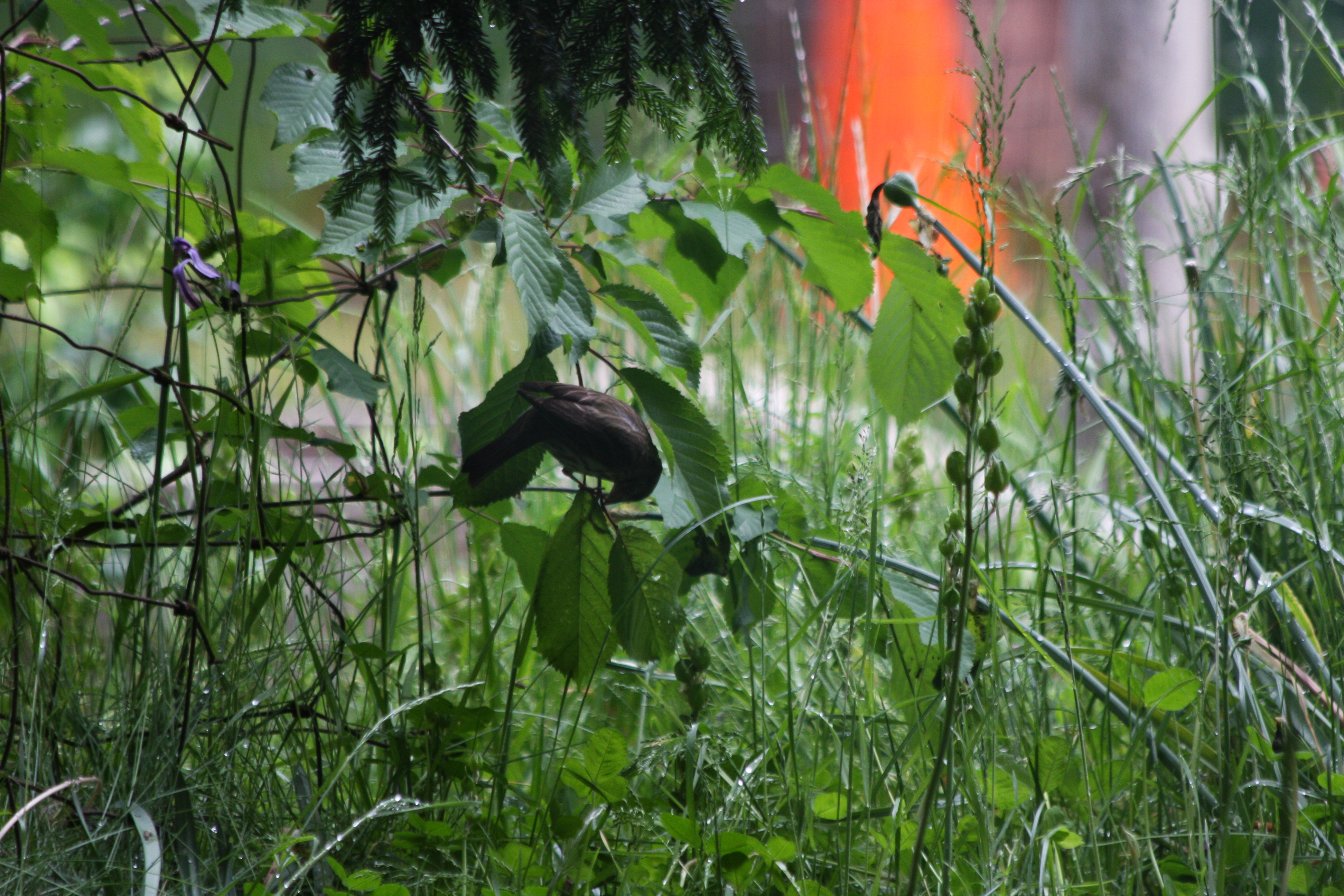
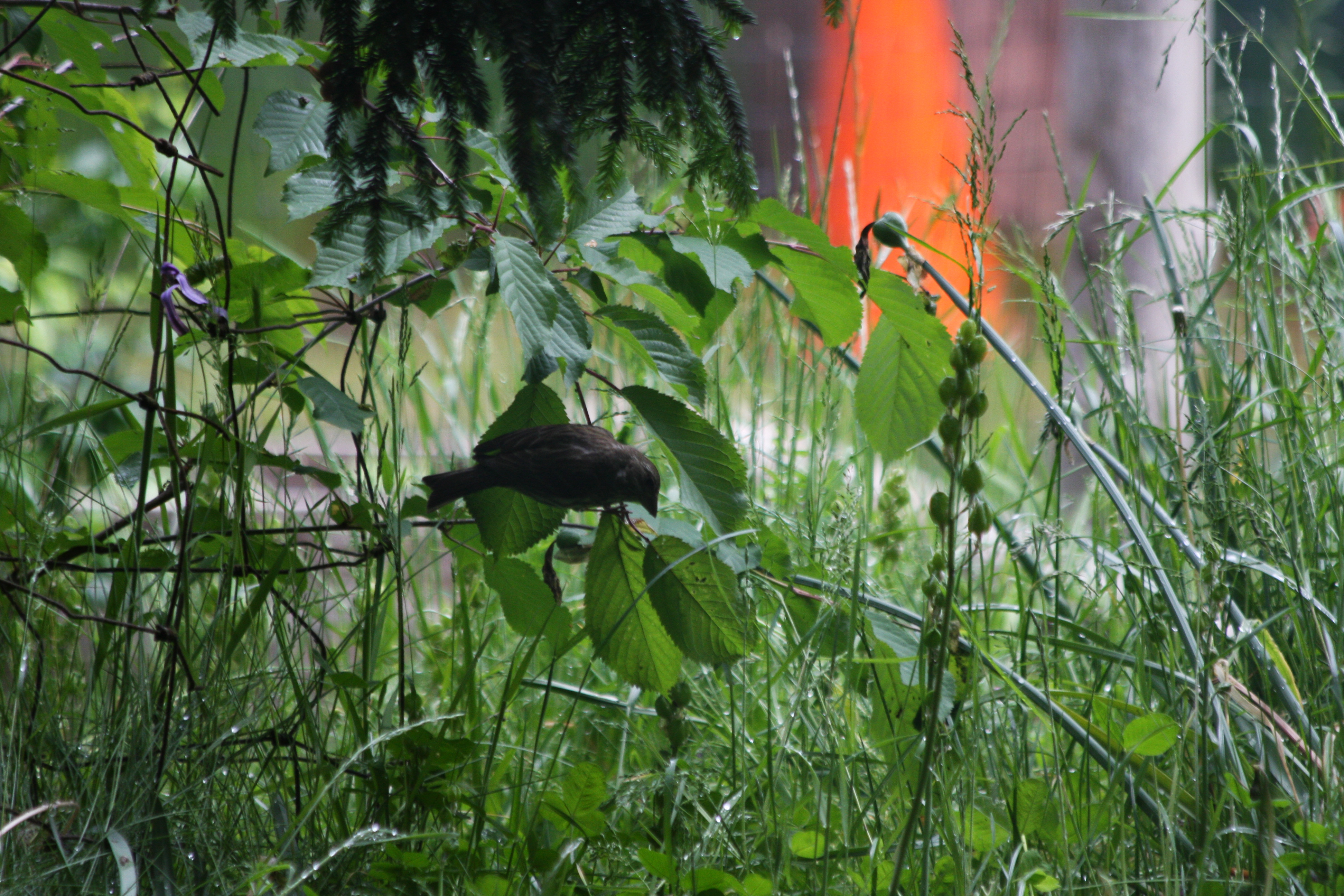
Today, when I looked out the window though, I saw something challenging the fearsome Formica ants. There were birds inside the tree caging and they were hungrily pecking and even tearing at the leaves with aphids. I grabbed and clumsily set up my camera to video the scene.

Birds attacking aphids farmed by Formica ascerva ants

I saw finches first, then there was a chickadee, and even a hummingbird. I thought I saw bumble bees, but they wouldn’t have been eating the aphids. Perhaps they were visiting the extrafloral nectaries or maybe even sipping honeydew produced by the aphids, but I wasn’t close enough to be certain.

Afterwards, I went out to survey the damage. I saw one leaf with lots of shreds. Aphid parts scattered about. Ants wandering somewhat aimlessly. Another leaf had an ant that died courageously in battle protecting his little flock.

I wanted to share my observations with you because a lot of folks really dislike aphids. Others also dislike ants and don’t understand their role in nature’s ecosystems. Maybe this will help others to understand there are a lot of hungry birds that eat aphids (and ants). Without them, the birds might not find enough food to feed their nestlings. It’s all part of the cycle of life.

If you see aphids your garden that you are worried about, you can mitigate some of their feeding damage by hanging a hummingbird feeder nearby. The hummingbirds have to have protein along with all that carbohydrate sugar water and they will most certainly find your aphids delicious. In fact, insects and spiders make up about 85 % of the diet of hummingbirds. Birds need bugs. And not all ants are pests. Some are extremely beneficial. I challenge you to take up bird and bug watching. You will not be disappointed!

Thanks for reading!

Below are more images of the birds feeding on the aphids inside the caged tree.

References and further reading

Bentley, B. L. (1977). Extrafloral Nectaries and Protection by Pugnacious Bodyguards. Annual Review of Ecology and Systematics8, 407–427. http://www.jstor.org/stable/2096735

Bugguide. 2024. Formica Ascerva. https://bugguide.net/node/view/497956

You Have to Be More Careful With an Island – Please reconsider using those pesticides. They aren’t necessary.

Button Designed and Produced by Nancy May Knapp of Orcas Island, WA

If you live in San Juan County, WA, my blog topic today is for you. I’m seeing some posts on social media lately about pest control that I’m not too crazy about. We have so many people moving to our island now, many bringing with them the mainland suburbia mentality of spraying insecticides all over their yards and homes. Can we help folks understand the slogan, “You Have To Be More Careful With an Island?” 

If you know someone who is concerned about caterpillars, ants, termites, wasps, mosquitoes, or spiders, and they are willing to talk to someone (me), I am more than happy to take a phone call or email to answer questions on how to AVOID use of unnecessary chemicals that can pose health risks to humans, pets, wildlife, and contaminate soil and water.  Most , if not all, use of pest control services are completely unnecessary.   Instead, learning about these organisms can go a long way to reducing fear and being able to coexist and/or tolerate living with them around our homes and properties.  Some species of bugs are extremely critical to keeping our ecosystem healthy and balanced.  ALL of them are part of the greater food web.   With the intense development and land use changes happening in the islands, we need to remember to landscape with intentionality towards keeping our island healthy and oriented towards providing habitat for native species instead of displacing everything.  

How to spread the word? You can message me here. I will respond. You may also reach me on Facebook at Bugs of the San Juan Islands. It’s a great spot to learn about the amazing bugs we have living alongside us.

Thanks for reading!