Tag Archives: Formicidae

Spiny Fungiculturists, a short species profile from my recent trip to Quintana Roo, MX
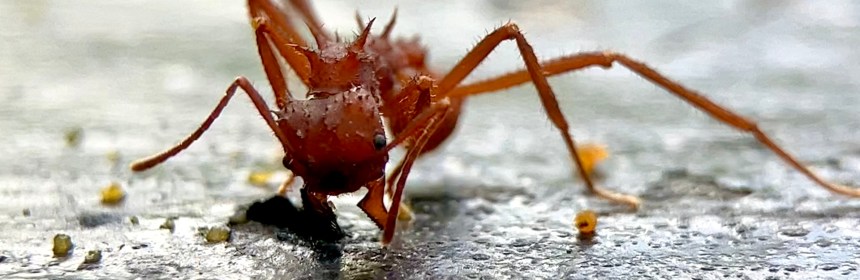
Acromyrmex octospinosus scraping something off the railing that led down to the Cenote. I’m not sure what the bird species was in the background. Location: Tulum, Quintana Roo, MX

This is a Neotropical leaf cutter ant, Acromyrmex octospinosus, a taxonomically challenging species complex of fungus farming ants found ranging from Brazil to Northern Mexico, and including Cuba and the Lesser Antilles (Mera-Rodriguez et al.,2025).

I observed more than a few of these while we were visiting in Quintana Roo, MX in late January. This one was on the handrail of the steps leading down to a cenote in a shaded area in Tulum. I also found specimens daily in the swimming pool at the property where we lodged during our stay.

These spiky, dark-red leaf cutter ants practice what is known as fungiculture, meaning they utilize fresh vegetation, including flowers, to grow their obligate fungal symbionts. The spiny projections on the exoskeleton of the ant help it to maneuver vegetative material around on their backs. These fungus-farming ants provide their fungal cultivars with food, dispersal, waste management services, and protection.

This fungus farming practice is extraordinarily sophisticated and the ants’ investment in labor even includes “weeding” their food garden. The ants even have their own sanitizing and pharmacy tools on hand. They have special infrabuccal pockets https://sci-hub.su/10.1016/j.asd.2022.101154 to filter the material they collect for their fungus gardens, screening out spores of fungal contaminants that might interfere with the ants’ specialized garden (Quinlan, 1978). They are also able to produce antimicrobials to protect their fungi from pathogens. The ant farmers utilize the fungi they cultivate as their main food source for themselves and their larvae.

Leaf Cutter Ant in Tulum, MX

I don’t have time to go into an extensive write-up about them, but did link some interesting papers and websites for your review in case you’re interested in learning more.

Thanks for reading! 🙂

References

AntWiki. 2026. Acromyrmex octospinosus. https://www.antwiki.org/wiki/Acromyrmex_octospinosus#Life_History_Traits
Barke, J., Seipke, R. F., Grüschow, S., Heavens, D., Drou, N., Bibb, M. J., … & Hutchings, M. I. 2010. A mixed community of actinomycetes produce multiple antibiotics for the fungus farming ant Acromyrmex octospinosus. BMC biology, 8(1), 109.

iNaturalist. 2026. Acromyrmex. https://www.inaturalist.org/taxa/50162-Acromyrmex#articles-tab

Mera‐Rodríguez, D., Fernández‐Marín, H., & Rabeling, C. 2025. Phylogenomic approach to integrative taxonomy resolves a century‐old taxonomic puzzle and the evolutionary history of the Acromyrmex octospinosus species complex. Systematic Entomology, 50(3), 469-494.

Quinlan, R.J., Cherrett, J.M. 1978. Studies on the role of the infrabuccal pocket of the leaf-cutting ant Acromyrmex octospinosus (Reich) (Hym., Formicidae). Ins. Soc 25, 237–245 . https://doi.org/10.1007/BF02224744

Quinlan, R.J. and Cherrett, J.M. 1978, Aspects of the symbiosis of the leaf-cutting ant Acromyrmex octospinosus (Reich) and its food fungus. Ecological Entomology, 3: 221-230. https://doi.org/10.1111/j.1365-2311.1978.tb00922.x

Therrien, P. 1986. Behavioral ecology of the leaf-cutting ant, Acromyrmex octospinosus (Reich), in Guadeloupe, F.W.I. (T). University of British Columbia. Retrieved from https://open.library.ubc.ca/collections/ubctheses/831/items/1.0097339

Wang, Chu, Alessio Cocco, Chung-Chi Lin, Johan Billen. 2022. Morphology and ultrastructure of the infrabuccal pocket in Strumigenys ants. Arthropod Structure & Development. Volume 68, 101154. ISSN 1467-8039.
https://doi.org/10.1016/j.asd.2022.101154. https://www.sciencedirect.com/science/article/pii/S1467803922000159

Wetterer, James. 1991. Foraging Ecology of the Leaf-Cutting Ant Acromyrmex Octospinosus in a Costa Rican Rain Forest. Psyche. 98. 361-371. 10.1155/1991/46737.

Western Thatching Ants (Formica obscuripes)

Formica obscuripes, Western Thatching Ant

I went for a walk yesterday on Three Corner Lake Road just to get out of the house. Springtime on San Juan Island has been cold and dreary, but sometimes there’s a moment or two when the sun peeks out, giving a bit of hope that the winter doldrums are coming to an end. Don’t get me wrong, I love the Pacific Northwest, but the Visitor Center’s claim that San Juan gets 247 days of sunshine a year is a stretch. I think they actually count the days when it is overcast and rainy as long as the sun peeks out for just a minute before the clouds darken the day again.

It was cold and I wasn’t expecting to see any insect activity, so I was surprised to find this long time ant colony with a mass of individuals near the top of the nest. The sun had been out intermittently, so I believe what was happening was the workers were at the surface to warm themselves (thermoregulating). There were a few straggling workers carrying thatch debris (conifer needles) to the nest from the forest. If the weather had been nicer, I would have enjoyed plopping myself into a chair to ant watch for an hour or so. They are quite pretty when you see them up close.

Western Thatching Ants (Formica obscuripes) are native to our region. They seem to like forest edge habitat, and you’ll find the nests situated in areas where there is some clearing to take advantage of the sun’s warmth. These ants are considered general omnivore-predators. They scavenge or prey upon insects and other arthropods for food. Foraging activity takes place both on the ground and on vegetation, including high in trees. Thatch ants also harvest honeydew from aphids and other homopterans as well as from extrafloral nectaries. You can read more about extrafloral nectaries or EFN’s (little nectar producing glands on plants) here https://bygl.osu.edu/node/1774 or check out one of my earlier blog posts about them here https://buggingyoufromsanjuanisland.com/2022/05/17/what-are-extra-floral-nectaries%EF%BF%BC/

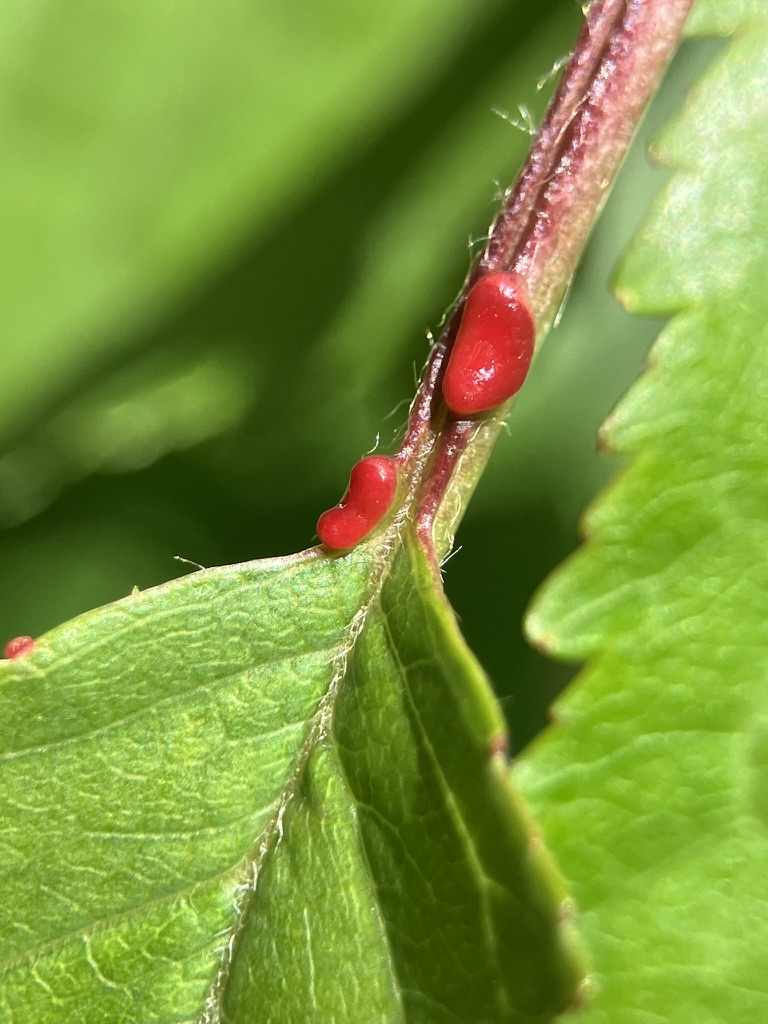
Extrafloral nectary on Fruitless Cherry Tree

The ant workers are considered weakly polymorphic, which means they have only slight variations in size and shape within the worker caste as opposed to other species where workers may be monomorphic (all the same size and shape), or strongly polymorphic (a high degree of variability between worker sizes and shapes). You can read more about polymorphism in ants here https://www.antwiki.org/wiki/images/1/1c/Wheeler_1908f.pdf .

Given all the information you’ll find from pest control companies online about these ants and others, you might ask, why or if there is any benefit to having these ants around. The answer is YES! Western Thatching ants are beneficial in ecosystems because they not only aerate the soil with their burrowing practices in nest construction, but they also provide FREE pest control, helping regulate populations of other insects that defoliate forests, fruit trees, and even our vegetable gardens. They also help clean up the environment through scavenging dead animals. There is no need to eradicate these nests and if you get into ant watching, they might provide a bit of intriguing summer entertainment. Pull up your lawn chairs and sit and watch with your friends. As long as you aren’t poking the nest, they are not inclined to bother you at all.

Thanks for reading!

References:

Formica obsuripes. 2025. Bugguide.net. https://bugguide.net/node/view/31269

Formica obscuripes. 2025. AntWiki. https://www.antwiki.org/wiki/Formica_obscuripes

McIver, J.D., Torolf, T.R., Cimon, N.J. 1997. A supercolony of the thatch ant Formica obscuripes forel (Hymenoptera: Formicidae) from the Blue Mountains of Oregon. Northwest science., Vol.71(1), pp.18-29. https://rex.libraries.wsu.edu/esploro/outputs/journalArticle/A-supercolony-of-the-thatch-ant/99900502747101842