Life in Miniature: A Scaly Barklouse (Pteroxanium kelloggi)
Key words: Barkfly, Barklouse, Pteteroxanium kelloggi, Lepidopscocidae, aerial plankton, Psocoptera, Psocodea, cosmopolitan

Last week, I went out to poke around in the yard. The weather has been so dismal and gray. Bug watching is typically an uplifting activity for me. It gives me a chance to escape the troubling news in the world of late. I keep telling myself things will be okay, but I have doubts all the time these days.
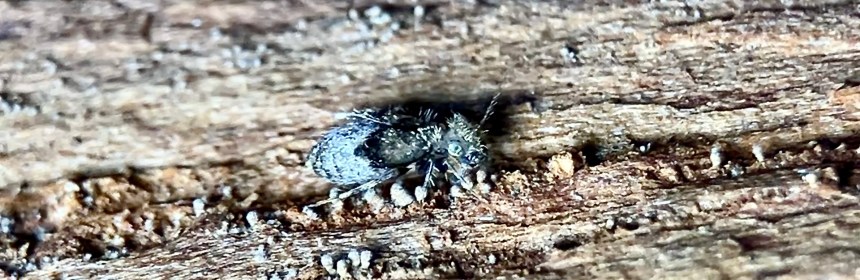
I saw this tiny critter scurry across the rotted log I turned over in our driveway last week. It was HAIRY. I’d never seen one of these before. Hurriedly, I ran inside to grab my light and camera, hoping I would spot it again when I returned. Lucky me. It was still there, but the first photos I took were just really terrible. Terrible, but enough to tentatively ID this critter as one of the scaled barklice.
Barklice are sometimes called barkflies. Even though they have wings, they are not known to be very good fliers. Taxonomically, they aren’t flies at all. Formerly classified in the insect order Psocoptera, they are now categorized as Psocodea (Barklice, Booklice, and Parasitic Lice). Taxonomic revision information can be found here – https://genent.cals.ncsu.edu/insect-identification/order-psocodea/ .
Much of the literature I found about barklice in North America was by one primary author, a man named L.E. Mockford. I was quite sorry to learn he is deceased. I would have enjoyed reaching out to him directly. I wanted to learn more. I’m going to refer to the barklouse as a “friend.” I found no records indicating it does any harm. It seems harmless to anything or anyone. In fact, calling it a louse seems rather derogatory.
This barklouse is in the family Lepidopscocidae. Etymology is fascinating to me. Let me translate this one for you as well. Lepido means scales. Psocus comes from Ancient Greek psōkhos (ψῶχος) or the verb psōchein (ψώχειν). It means “gnawed,” “rubbed,” or “ground.” This describes the chewing mouthparts psocids use to grind fine organic matter like lichen, fungi, and detritus. In layman’s jargon, A scaly gnawer.
The Latin binomial name for this little one should be Pteroxanium kelloggi. Translation: Pteros = wing. I looked up xanium in A Dictionary of Entomology by Gordh and Headrick (2011). I found that “xanthos” in Greek translates to yellow. I believe it refers to the golden shimmer of the hairs.
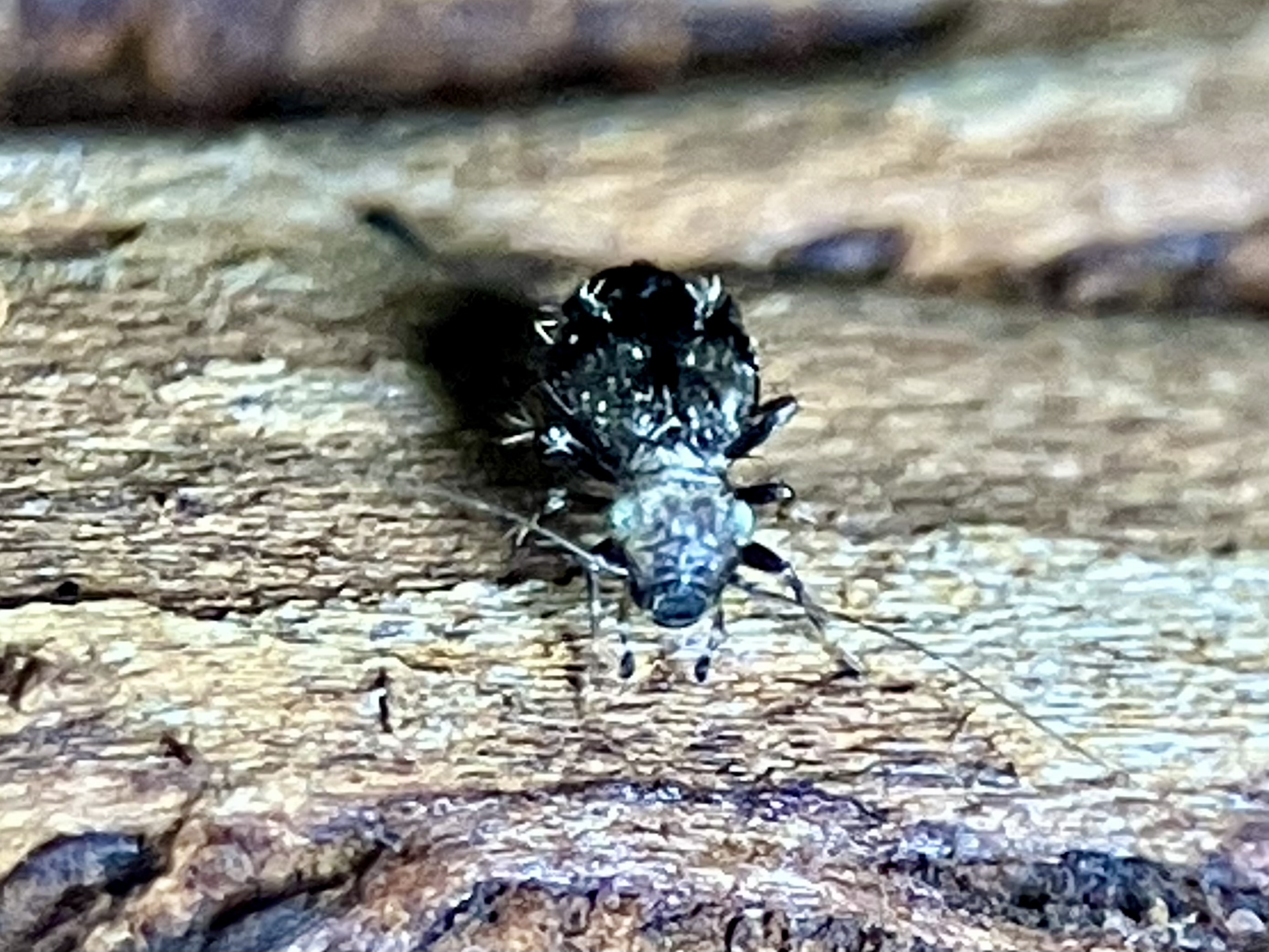
At maybe 2mm in size, it was difficult to photograph. The dark and gloom of the PNW in winter added to the challenge. Even with a handheld light, I was still not satisfied with the images I managed to get. I went back the next day, turned the log over, and I found my friend again.
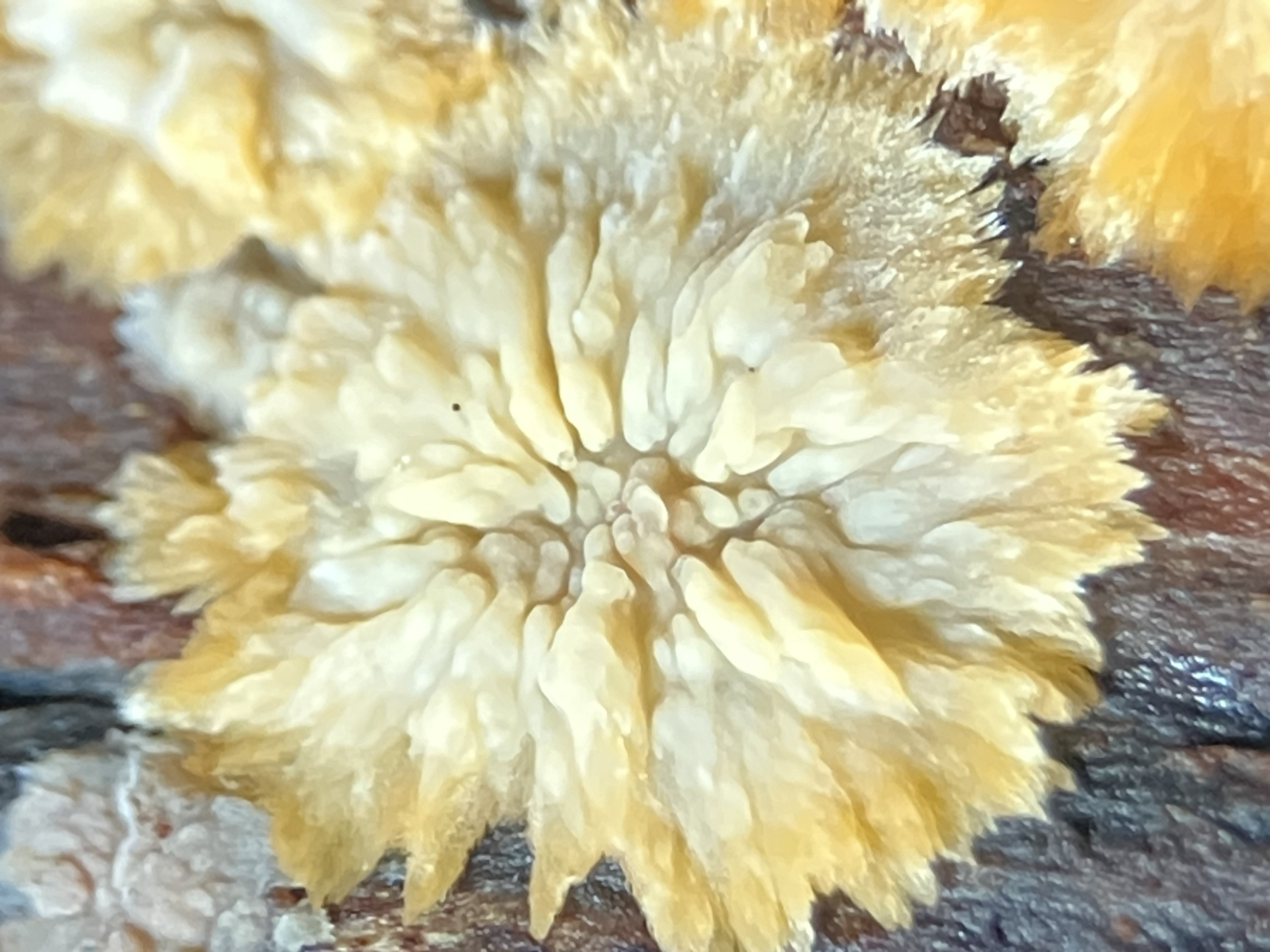
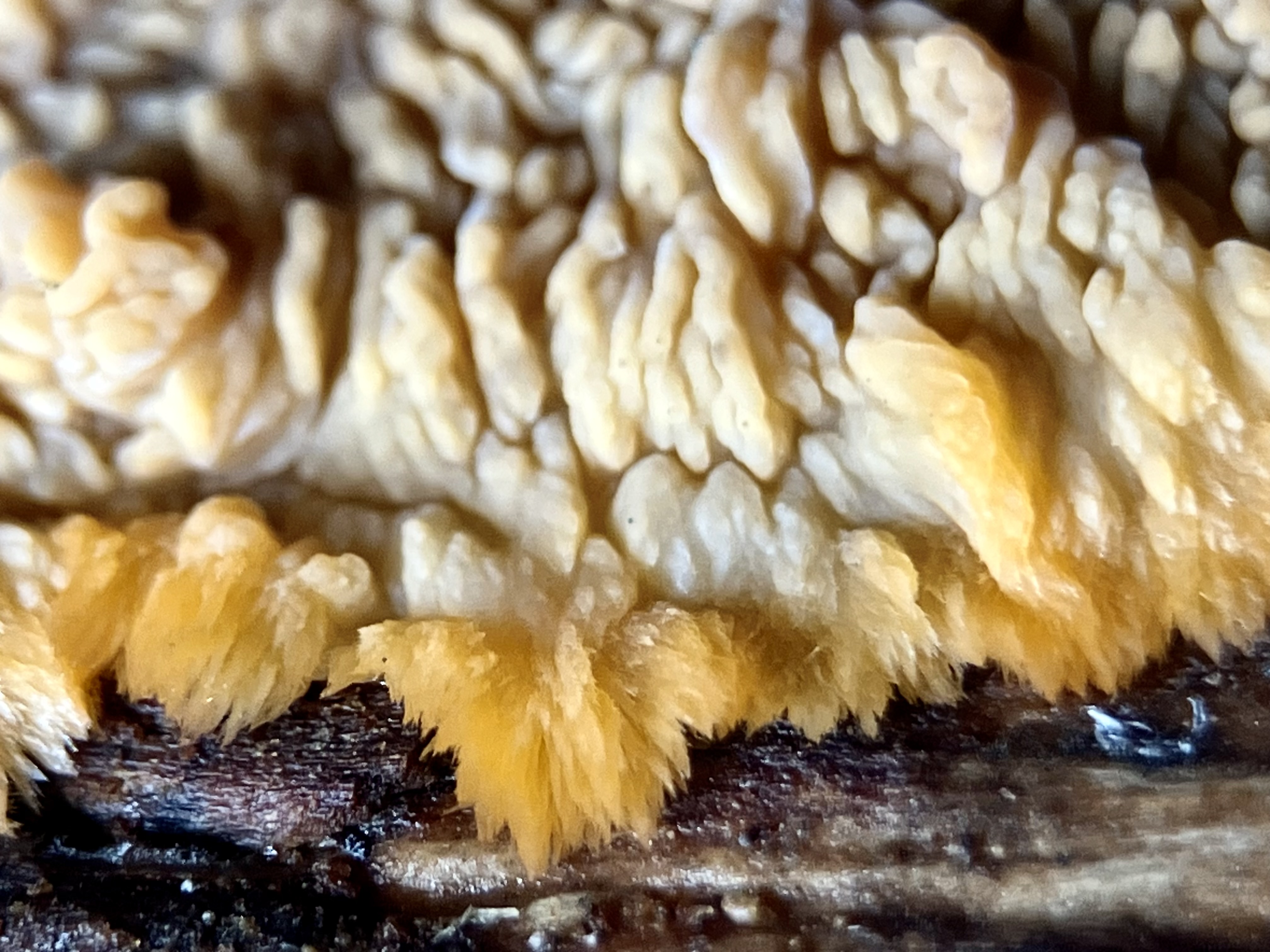
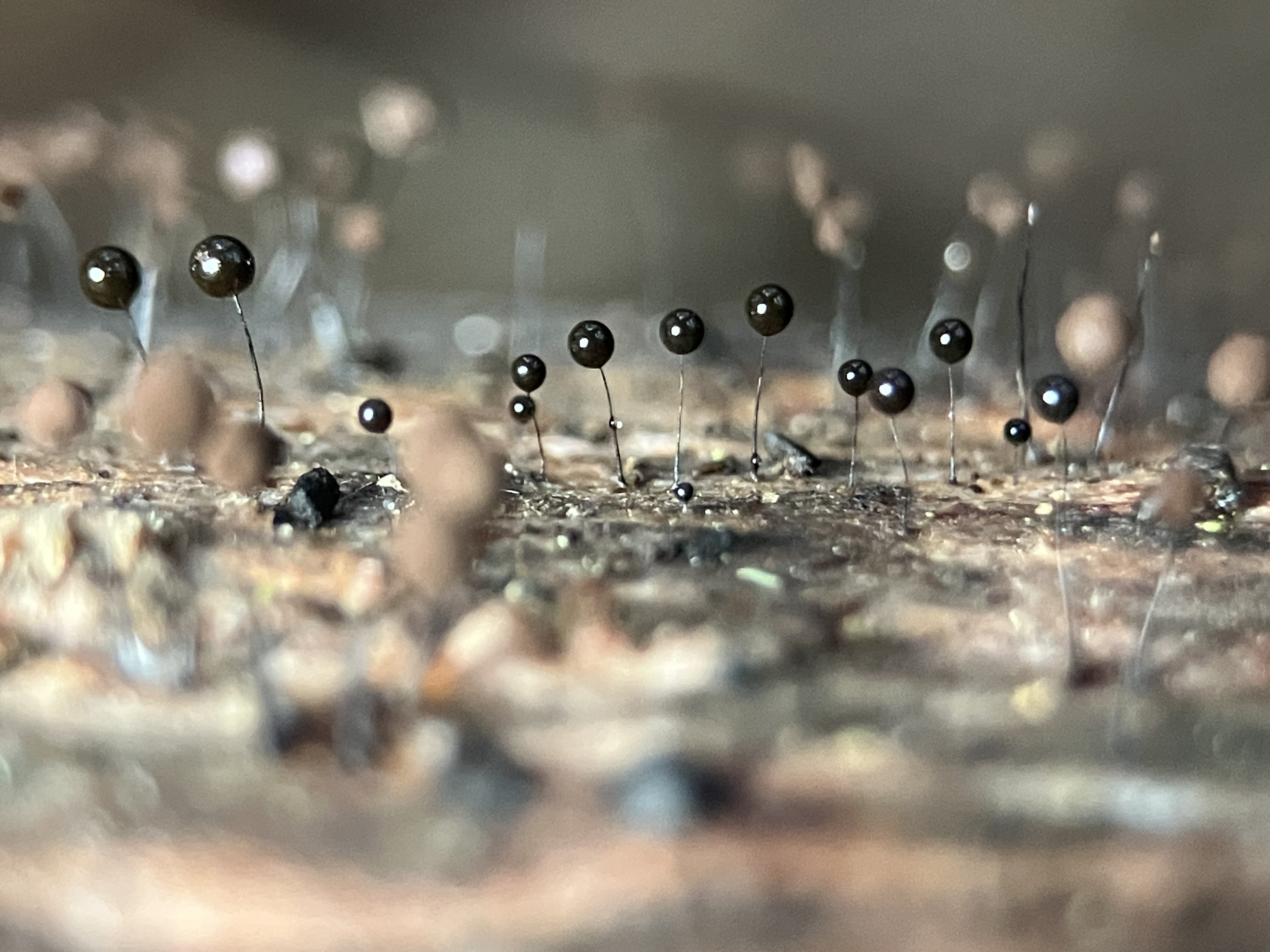
The second set of images were improved, but still not great. I noticed the underside of the log had growing patches of a crust fungi in the family Meruliacae (Genus Phlebia). There was also a little patch of slime molds (Comatricha nigra) in the family Amaurochataceae. The louse seemed to want to stay within these areas of fungi. I observed that it didn’t appreciate the light I was using to illuminate my photo taking. It was negatively phototaxic and would scurry to a shaded spot, out of the light beam.
Geographic Distribution
P. kelloggi has been recorded from North America, Argentina, Australia, and New Zealand. A few sources included other countries, like Belgium (Lock et al. 2016), and some omitted North America entirely. It was confusing. Geographic distribution records need updating.
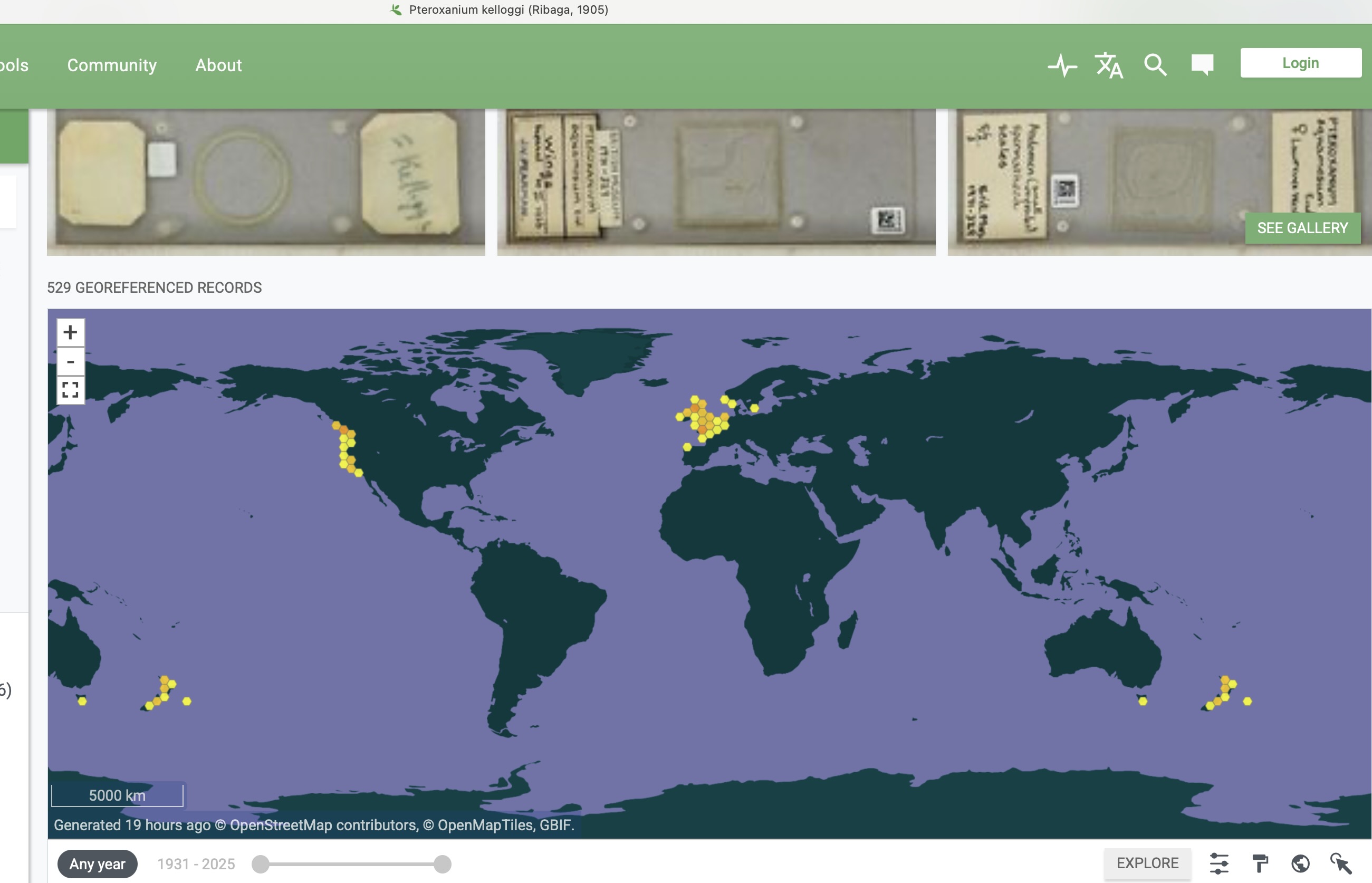
Mockford (2012), described this species as having a “cosmopolitan” geographic distribution that includes Western North America. Cosmopolitan means they are found in many areas worldwide. P. kelloggi is most likely an introduced species that has now adapted to living here. Mockford (2012) stated that this species’ mode of dispersal was probably as aerial plankton or long-distance wind transport. Wind currents carry so many things around. Who knows where they’ll land? There is another paper I found about aerial plankton by Lanna Cheng and M. Birch (2008). It’s titled Insect Flotsam. Flotsam is what happens when the insects don’t make it to land.
Life History and Morphology
While geographic distribution records for this insect species call for revision, I’d say the life history and morphology of P. kelloggi also need updates. Wikipedia and iNaturalist describe this species as feeding on “ash, cedar, gorse, ivy, larch, oak, pine, yew, and rhododendrons.” I believe this is incorrect. They do not feed directly on trees or shrubs.
I ended up reviewing studies by Saville (2010), Mockford (2012), and Footit et al. (2018) and found they yielded more helpful information. Saville (2010) studied the feeding and egg-laying preferences of bark dwelling Psocids, and Foottit et al. (2018) provided detail about the feeding behavior. They also offered an in-depth description of the feeding mechanisms (mouthpart anatomy) of Psocids. Saville (2010) documents evidence of P. kelloggi feeding on algae and Mockford (2012) documents the family group as feeding on epiphytic and epigaeic algae and lichens. I believe this information to be most representative of the family Lepidopsocidae. It also fits with the habitat of the individual I found on the rotting log.
Mockford, in Foottit et al. (2018) describes morphology for Lepidopsocidae with adults measuring about 1.5-3 mm in body length. The body typically is covered with scales or dense hairs. Psocoptera (Psocodea) typically have a relatively large, rounded head. They have well-developed, multifaceted compound eyes. An exception to this would be the one record of a blind, cave-dwelling species on St. Helena Island in the Atlantic Ocean.
Antennae are filiform with eleven or more segments. Mouthparts are chewing type, with strong mandibles that generally bear a pointed incisor tip and large, grinding molar region. They have laciniae. These are blade-like or styli-form “pricker” or “chisel.” They are developed as a pair of rods with “splayed, enlarged, often denticulate (tooth-like) tips.” It is believed the laciniae are utilized as stabilizers and thrust into the substrate to secure positioning. This allows the insect to bite or chew into tough material (Footit et al., 2018). The modified hypopharyx is a remarkable apparatus for obtaining water molecules from the atmosphere (Mockford, 2012; Footit et. al, 2018; Rudolph, 1982a; Rudolph, 1982b). I’ve linked both of Rudolph’s papers in the reference section. You can find wonderful microscopic images of the mouthparts in Rulolph (1982b).
Barklice may be tiny, but they play an important role in natural ecosystems. They serve as clean up crews eating molds, algae, and fungi and decaying matter. They also are consumed by other organisms. If you’re interested in learning more, please DO check out the reference section. 🙂
Thanks for reading
References
Bugguide. 2013. Pteroxium kelloggi. Bugguide.net. Iowa State University. https://bugguide.net/node/view/344970
Cheng, Lanna & BIRCH, M.. 2008. Insect flotsam: an unstudied marine resource. Ecological Entomology. 3. 87 – 97. 10.1111/j.1365-2311.1978.tb00907.x. https://resjournals.onlinelibrary.wiley.com/doi/abs/10.1111/j.1365-2311.1978.tb00907.x
Foottit, R.G., H. Adler, P. and Mockford, E.L. 2018. Biodiversity of Psocoptera. In Insect Biodiversity (eds R.G. Foottit and P. H. Adler). https://doi.org/10.1002/9781118945582.ch16
iNaturalist. 2025. https://www.inaturalist.org/taxa/318307-Pteroxanium-kelloggi
Lock, Koen & Wallys, Henk & Claerebout, Stéphane & Soors, Jan. 2016. Pteroxanium kelloggi (Ribaga, 1905) and Mesopsocus fuscifrons Meinander, 1966: two Psocoptera new to Belgium. Bulletin de la Société royale belge d’entomologie. 195-197.
Mockford, L., E. 2012. Aspects of the Biogeography of North American Psocoptera (Insecta). InTech. doi: 10.5772/33413
New, T. R. (1987). Biology of the Psocoptera. Oriental Insects, 21(1), 1–109. https://doi.org/10.1080/00305316.1987.11835472
New, T. R. (1974). Psocoptera. Handbooks for the Identification of British Insects, 1(7). https://www.royensoc.co.uk/shop/publications/out-of-print-handbooks/psocoptera/
North Carolina State Agricultural and Life Sciences. 2015. Psocodea. General Entomology. North Carolina State University. https://genent.cals.ncsu.edu/insect-identification/order-psocodea/
Perotti MA, Clarke HK, Turner BD, Braig HR. 2006. Rickettsia as obligate and mycetomic bacteria. FASEB J. Nov;20(13):2372-4. doi: 10.1096/fj.06-5870fje. Epub 2006 Sep 28. PMID: 17012243. https://faseb.onlinelibrary.wiley.com/doi/10.1096/fj.06-5870fje
Pteroxanium kelloggi (Ribaga, 1905) in GBIF Secretariat (2023). GBIF Backbone Taxonomy. Checklist dataset https://doi.org/10.15468/39omei accessed via GBIF.org on 2026-01-08.
Rudolph, D. 1982a. Occurrence, properties, and biological implications of the active uptake of water vapour from the atmosphere in Psocoptera. Journal of Insect Physiology 28: 111–121. https://sci-hub.se/10.1016/0022-1910(82)90118-4
Rudolph, D. 1982b. Site, process and mechanism of active uptake of water vapour from the
atmosphere in the Psocoptera. Journal of Insect Physiology 28: 205–212. https://sci-hub.se/10.1016/0022-1910(82)90078-6
Saville, R. E. 2010. An initial study of the feeding and egg-laying preferences of bark dwelling Psocids (Psocoptera) using composite bark blocks. Entomologist”s Record and Journal of Variation, 122(1), 35. https://schemes.brc.ac.uk/barkfly/downloads/Ent%20Rec%20122%20pp35-42.pdf
Smithers, C. N., 1972. The classification and phylogeny of the Psocoptera.
Australian Museum Memoir 14: 1–349. [31 December 1972].
doi:10.3853/j.0067-1967.14.1972.424
Yinghua Su, Ho-Chen Lin, Li Szhen Teh, Fabienne Chevance, Ian James, Clara Mayfield, Kent G. Golic, James A. Gagnon, Ofer Rog, Colin Dale. 2022. Rational engineering of a synthetic insect-bacterial mutualism, Current Biology, Volume 32, Issue 18, pp. 3925-2938.e6 ISSN 0960-9822, https://doi.org/10.1016/j.cub.2022.07.036
 Bugging You From San Juan Island