Oreas Anglewing (Polygonia oreas)
I posted a few images last week to my iNaturalist page to see if I could get help from some experts in the butterfly community to ID this Polygonia butterfly past genus. It sparked a lively amount of conversation and I finally received a comment in the thread from West Seattle-based nature guide, ecological consultant and botanist, Stewart Wechsler, stating, “@cyndibrast Looks like you have the first confirmed Polygonia oreas iNaturalist observation for the San Juan Islands!” I would also throw out that the first person to correctly speculate the ID for this is my friend, lepidopterist David Droppers, who suggested I post in a wider audience to see what feedback I might receive.
Cool! So, I have the first Oreas Anglewing iNat. Sighting for San Juan County. 😀

Have there been others? Probably. Not everyone is using iNaturalist, so some sightings may not be on the radar for other bug enthusiasts. I like it to keep all my bug sightings organized and categorized and all that stuff and using iNaturalist makes it easy to find things when I want to go back to reference one. If you don’t have the iNat. app, give it a try. It makes your outdoor experiences a lot more interesting in a nerdy, scientific way. You can be a naturalist on your hike. It’s fun!
Here’s a bit of information about this interesting butterfly, now officially recorded on San Juan Island. Links to sources included below.
Oreas Anglewing (Polygonia oreas)
*From (C. LaBar 2013) and (Björklund, N.H. 2018-2022)*
SIZE: Wingspan of 40 to 50 mm (up to 2 inches)
Key ID Features: Above orange with black blotches and spots, often with very jagged wing edges, submarginal row of yellow chevrons and brown to black marginal band. HW above has yellow patches adjacent to dark marginal band. Below dark gray to black, with lighter gray striations, and prominent white flattened “v” (pointed at the bottom, often looking like a gull in flight) with no hooks in center of HW.
Similar species: Darker below than other comma species, white “v” mark on HW below lacks barbs. Other comma species either have stronger green submarginal shading below or the “comma” mark on HW below is curved (not a pointed “v”) or barbed or both.
Male: rusty orange and gold with black spots, dark brown wing margin with row of bright yellow spots. Ventral is variegated in contrasting shades of dark brown and black. White comma on VHW.
Female: slightly lighter dorsal and ventral colors and less-distinct ventral mottling.
Egg: green.
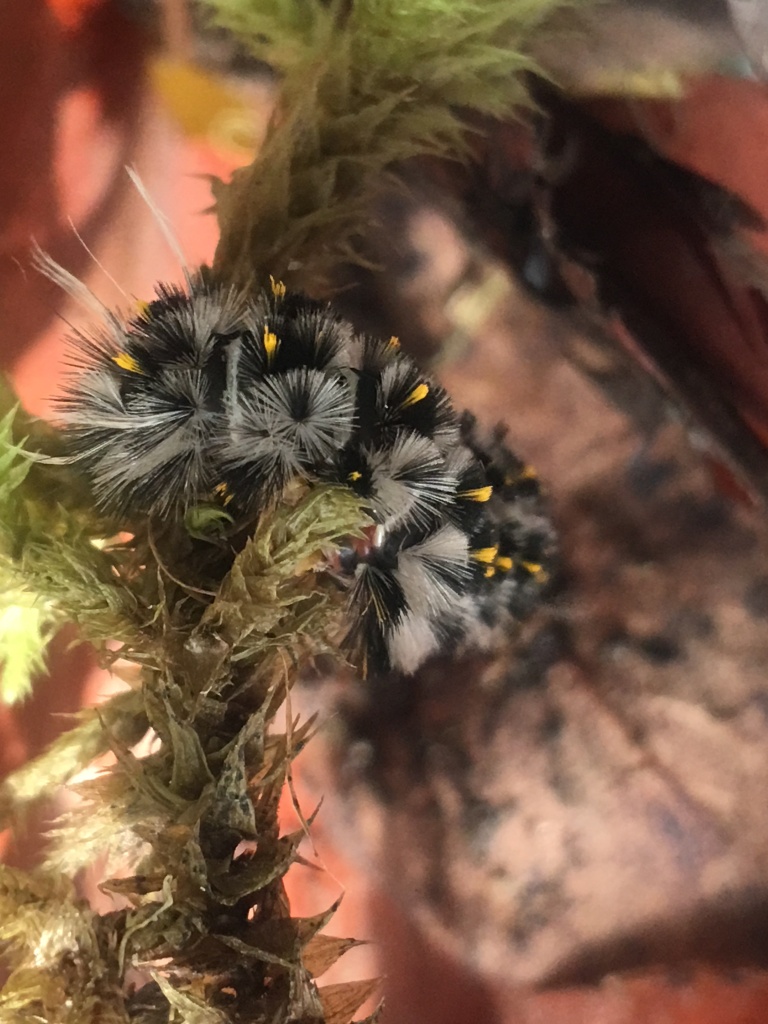
Larva: first two instars are brown and pale beige with black hairs and spines. Last three instars are mostly black with thin, white or yellowish bands around each segment and covered with rows of yellow-orange spines.
Pupa: mottled reddish brown, white and gray, with three pairs of silver spots.
Larval hostplants: currants (Ribes), primarily swamp currant (R. viscosissimum), also including R. divericatum (straggly gooseberry), and R. lacustre (swamp gooseberry).
Habitat: Forest fringes, especially in older stands, riparian areas and ravines, subalpine meadows.
Range: Coast Range, Willamette Valley, Western Cascades, east slope of Cascades, Wallowa Mtns, Blue Mtns.
Season: Late February to mid-September
Abundance: Uncommon
Conservation Status: Secure
References and Further Reading
1. Bugguide.net. Polygonia oreas. https://bugguide.net/node/view/25041
2. Björklund, N.H. 2018-2022. Butterflies of Oregon. Oreas comma. https://www.butterfliesoforegon.com/polygonia-oreas
3. Brast, C. 2015-2023. iNaturalist Profile and recorded sightings https://www.inaturalist.org/people/cyndibrast
4. LaBar, C. , 2018. Northwest Butterflies. http://northwestbutterflies.blogspot.com/2018/03/species-profile-polygonia-anglewings.html and https://northwestbutterflies.com
5. Nicholson, M. 2013. Into the woods with Stewart Wechsler. Westside Seattle. https://www.westsideseattle.com/west-seattle-herald/2013/07/18/woods-stewart-wechsler
6 .Scott, J. A. 1984. A Review of Polygonia progne (oreas) and P. gracilis (zephyrus)(Nymphalidae), including a new Subspecies. Journal of Research on the Lepidoptera 23(3):197-210 https://web.archive.org/web/20220513003524id_/https://www.biodiversitylibrary.org/partpdf/266758
7. Thompson, E. 2018. Naturalist taking inventory of Snohomish County butterflies
David Droppers, of Lynnwood, is documenting the species along popular Mountain Loop Highway trails. The Chat. https://www.heraldnet.com/life/naturalist-taking-inventory-of-snohomish-county-butterflies/



 Bugging You From San Juan Island