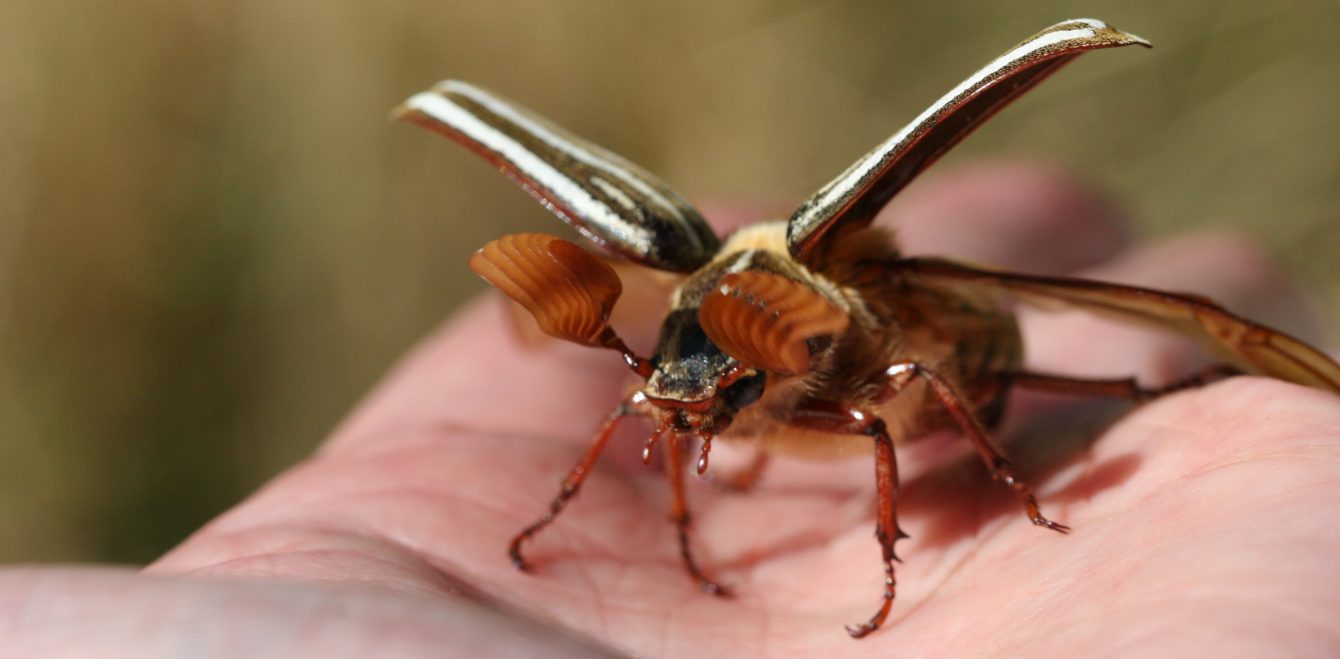
Bug Diary for October 6, 2022 ~ Metellina Spiders Share a Lunch Wrap, an Unusual Fly, Two Wandering Caterpillars, and “One- Eyed Wanda” Gets Rescued By a Seeing-Eye 👀Human.

I was eating my lunch outdoors yesterday (October 6, 2022), and considering the end of season, depauperate community of bugs. There are fewer and fewer buzzing about the lingering tiny blossoms on my mint plants, which have been well-visited this season. Many of the winged flyers die out on their own accord. Lives spent – an ending synchronized with leaves falling from the trees. They’ve lived a season, maybe longer depending on the species. As adults, they’ve mated and sewn seeds for a new generation to emerge in spring. Some though, are captured and eaten by other organisms that are fueling stores for their own reproductive event – like these Long-jawed orb weaver spiders (Metallina segmentata) I witnessed, working together to wrap up their “lunch,” a Thick-legged Hoverfly (Syritta pipiens).

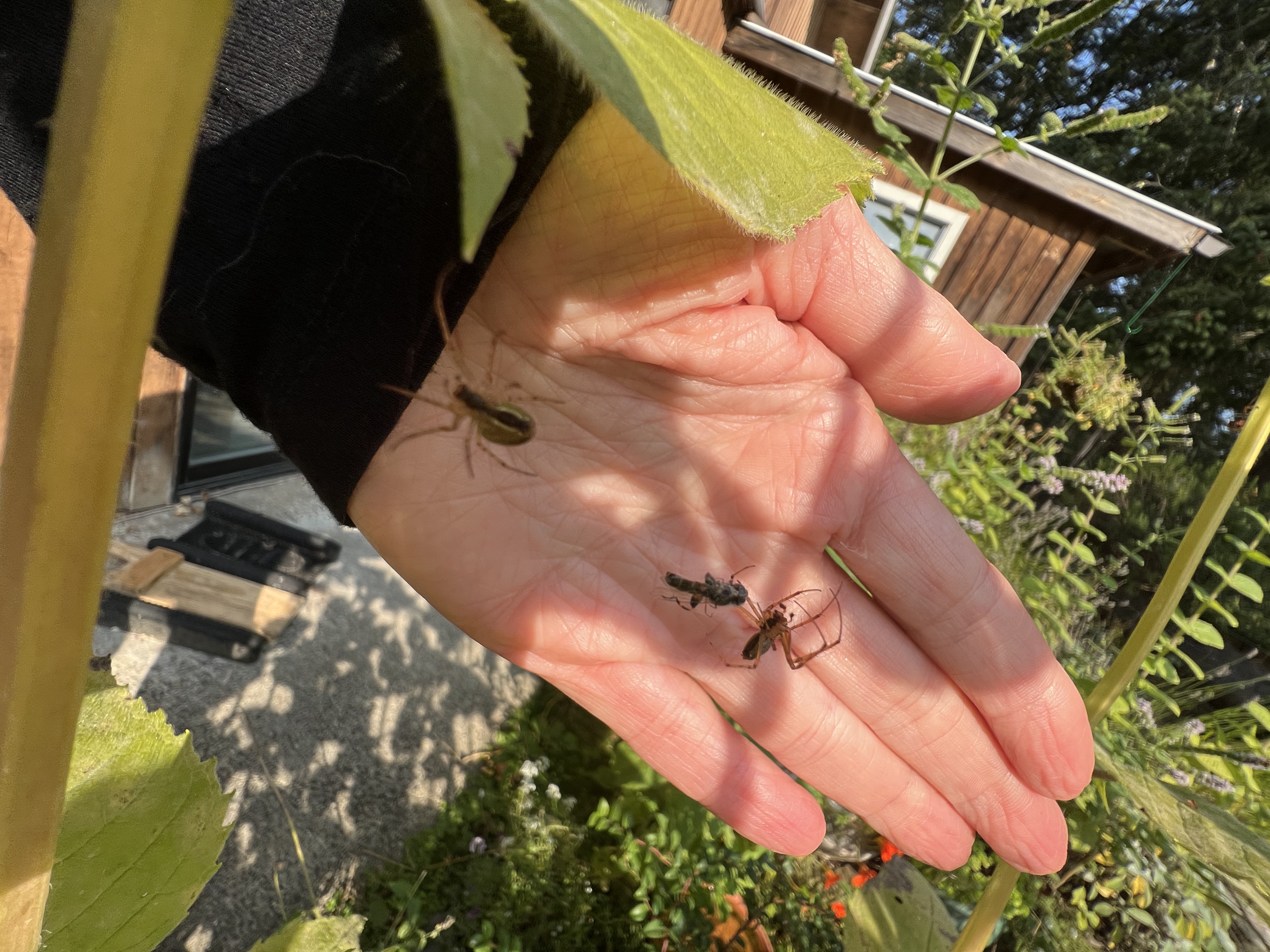

I didn’t realize it at the time, but depauperate was not to be the theme of my day!
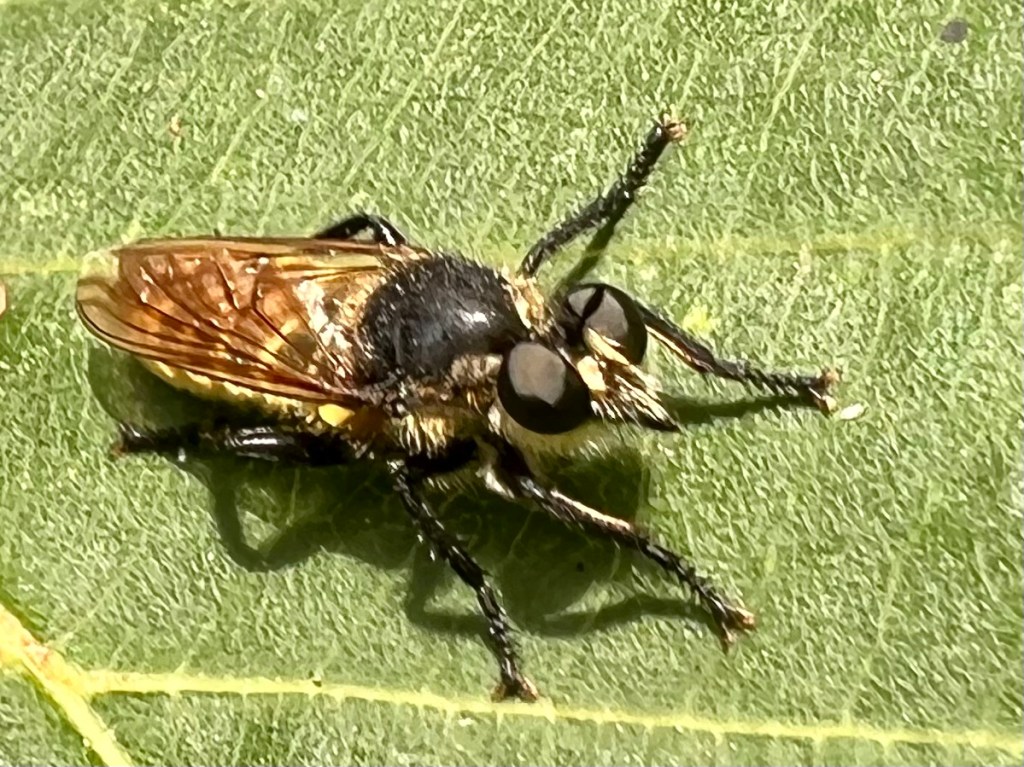
Shortly after observing and filming the spiders, I noted some buzzing around our fruitless cherry tree. I walked over, thinking to myself, “You’re getting too close to that Yellowjacket!” Well, it wasn’t a yellowjacket at all. It was a Robberfly (Laphria ventralis), I believe – and SHE was ovipositing into our tree.

Later this evening when I was showing my husband the photos, he asked what the eggs would eat when they hatch. I had to look it up. Well, Robber Fly larvae are known to prey on the eggs, larvae, and pupae of other insects, especially beetle larvae living in decaying trees. Read more about this linked here: https://www.geller-grimm.de/genera07.htm
This Robber fly was an incredible mimic of a Yellowjacket – not only in appearance, but also in the way she flew about the tree. Fascinated, I watched her find a niche under some old bark and begin to oviposit. She did not like my camera or my presence, but tolerated me to a degree. Then she buzzed right into my face with complete confidence her mimicry would chase me away. Guess what? It worked. At least temporarily.



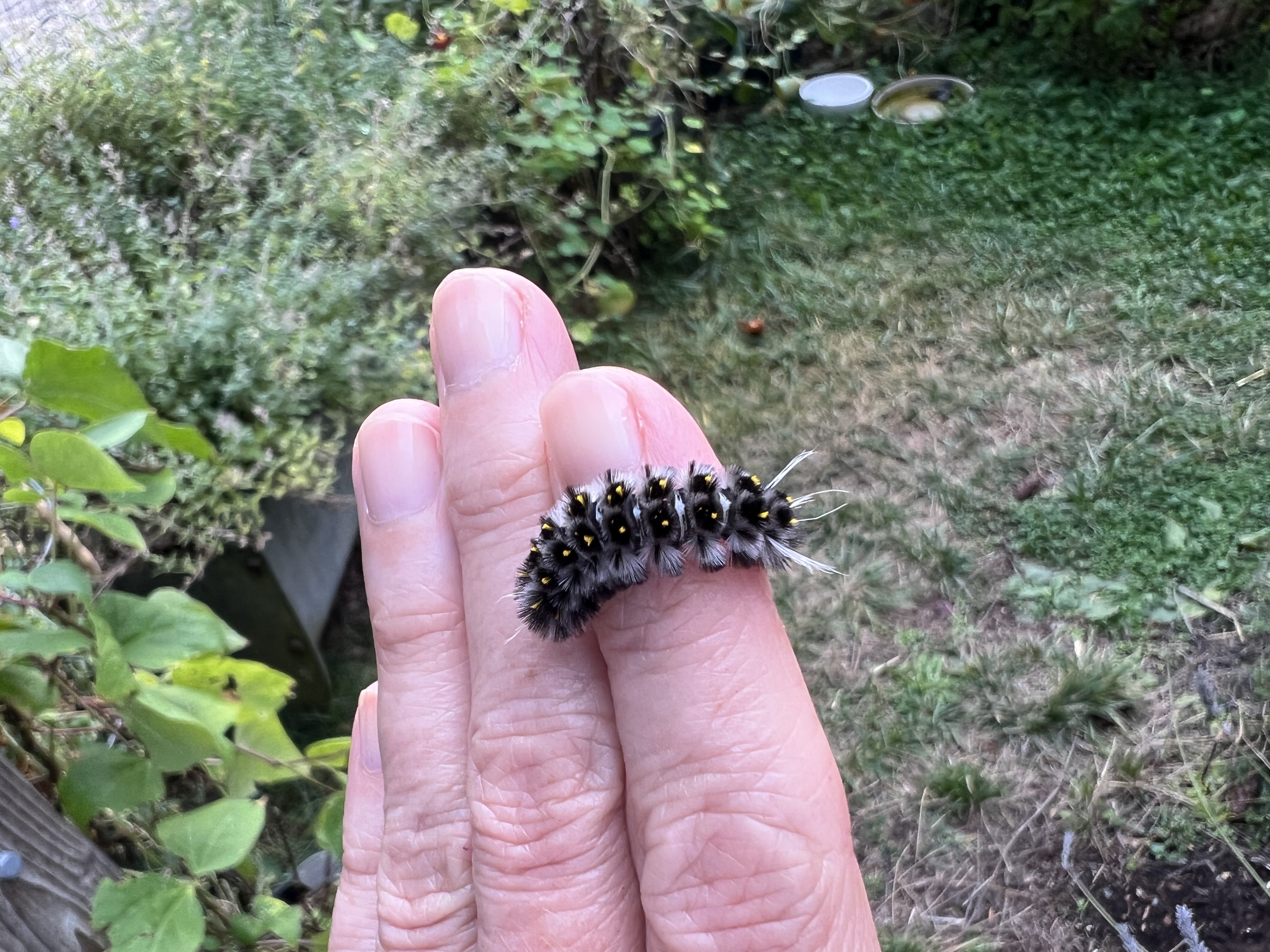
The next fun finds in Bug-landia were two caterpillars. I found an Eyed Sphinx Moth caterpillar (Smerinthus opthalmica) making headway down our driveway, undoubtedly wandering off to find a suitable location to pupate.

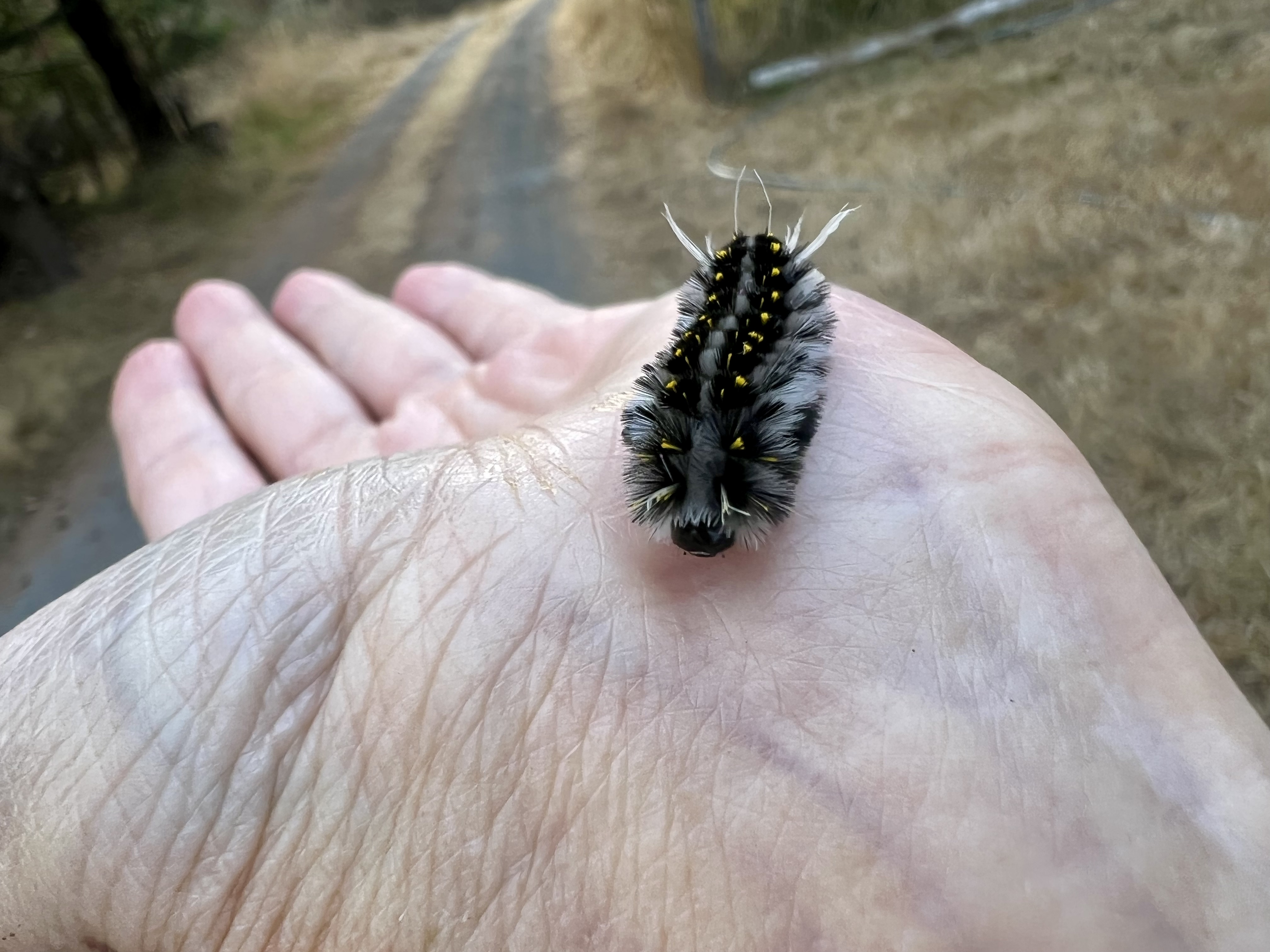
The second caterpillar I found is my absolute favorite moth species, the Rosy Aemilia moth (Lophocampa roseata). Since it was navigating down the middle of the road, I did gently relocate it to a safer spot so it wouldn’t get smooshed by the giant gravel trucks that fly up and down our once quiet country road.



Last, but not least is my new “pet.” I found her on my walk and she needed some help, so she’s come home to stay with us for some R&R, and a bit of end of life care. I’ve named her Wanda… One-Eyed Wanda. Wanda had evidently become an assault victim sometime just before I found her. The thought is that she was attacked and bitten by another female mantis – who evidently fled the scene before I got there. Poor wounded Wanda was not in great shape when I picked her up. She is missing an eye. It was not a pretty sight, but I couldn’t just leave her in the road.

She’s hanging out in the dining room tonight in a bug habitat/safe room so my indoor cats don’t batter her. I think she’s had enough battering in this life. I’m hoping she will still be able to lay an egg sack for me before she expires. Definitely plan to try and feed her tomorrow. I doctored her eye as best as I could. She can still see with the other one. Poor Wanda. 😦
Next up – Look for my post and forthcoming PowerPoint slide show about What’s Bugging Gary! Even better, check out the event (Garry Oak Conservation Symposium) in person if you’re on San Juan Island. It’s this Sunday at the Grange.
References and More Good Stuff to Check Out
Brast, C.L. 2018. Lophocampa roseata (ROSY AEMILIA). Bugging You From San Juan Island. https://buggingyoufromsanjuanisland.com/2018/10/02/lophocampa-roseata-rosy-aemilia/
Bugguide.net. 2022. Lophocampa roseata. https://bugguide.net/node/view/247272
Bugguide.net. 2022. Metellina segmentata. https://bugguide.net/node/view/153661
Cannings, R. A. 2014. The Robber Flies (Diptera: Asilidae) of Western Canadian Grasslands. Chapter 7.10.3752/9780968932179. http://staff.royalbcmuseum.bc.ca/wp-content/uploads/2014/06/Cannings-Asilidae-BSC-003-Vol4-Ch7-2014-.pdf
Cannings, R.A. 2007. Recent range expansion of the Praying Mantis, Mantis religiosa Linnaeus (Mantodeaz Mantidae), in British Columbia. Journal of the Entomological Society of British Columbia, 104, 73-80. https://journal.entsocbc.ca/index.php/journal/article/view/101
Geller-Grimm, F. Information on Robber Flies. https://www.geller-grimm.de/genera07.htm
McAtee, W.L. 1918. Key to the Nearctic Species of the Genus Laphria (Diptera, Asilidae). The Ohio Journal of Science. v19 n2 (December, 1918), 143-172. https://kb.osu.edu/handle/1811/2019
Nelson, D. 2022 Laphria Ventralis. 10,000 Things of the Pacific Northwest. Adventures of a Recreation Naturalist. http://10000thingsofthepnw.com/2021/07/31/laphria-ventralis/
Nelson, D. 2022. Metellina segmentata. 10,000 Things of the Pacific Northwest. Adventures of a Recreation Naturalist. http://10000thingsofthepnw.com/2020/10/25/metellina-segmentata/
Nelson, D. 2022. Smerinthus opthalmica. 10,000 Things of the Pacific Northwest. Adventures of a Recreation Naturalist. http://10000thingsofthepnw.com/2022/06/27/smerinthus-opthalmica/
PNW Moths. 2022. Lophocampa roseata. http://pnwmoths.biol.wwu.edu/browse/family-erebidae/subfamily-arctiinae/tribe-arctiini/lophocampa/lophocampa-roseata/
PNW Moths. 2022. Smerinthus opthalmica. http://pnwmoths.biol.wwu.edu/browse/family-sphingidae/subfamily-smerinthinae/smerinthus/smerinthus-ophthalmica/
Thanks for Reading! 🐛

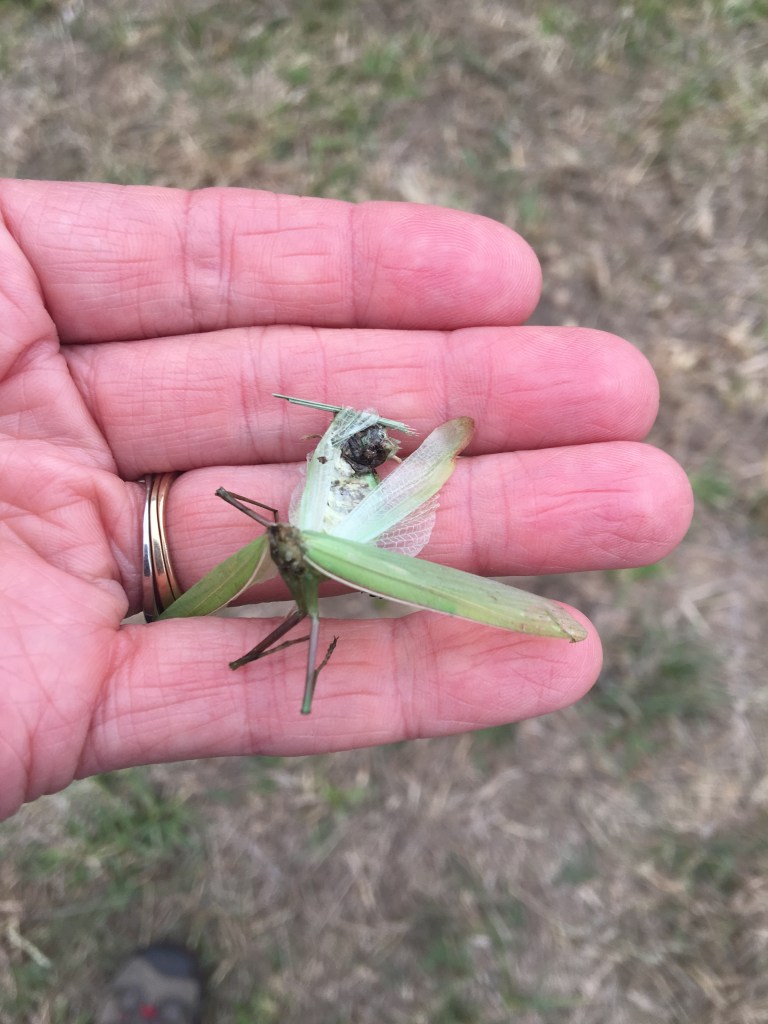

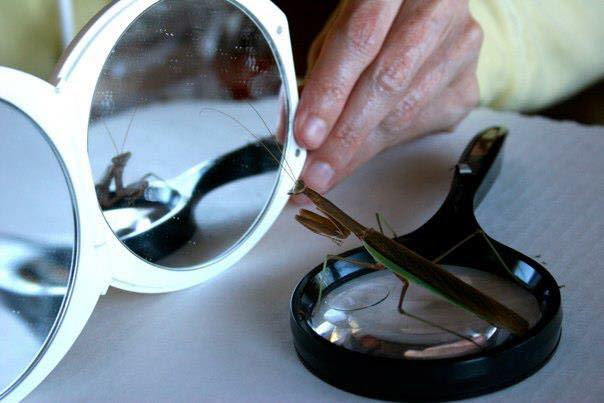

 Check out my story about praying mantids on San Juan Island! They’ve been a victim of hyper-sensationalism. Seriously. Read my article before you squish one.
 Bugging You From San Juan Island