Jumping Jehoshaphat, the grasshoppers have arrived!


In the news…
I’m wondering if anyone is following the grasshopper outbreak in Oregon? If you don’t know about this, I’ll fill you in and include some links. Perhaps we need to round up our “mean-ole, hummingbird murdering mantids” (EXTREME SARCASM HERE!) and send them south to help out. Just kidding. If you read through the attached list of sources, you’ll see in one where they’ve now determined the mantids don’t have much of an impact on controlling grasshoppers (Fries, 2021).
If they are so bad (and from historical reports, they can indeed reach proportions on the scale of a Biblical plague), what do we do about them? Why is there such an outbreak?
Grasshopper populations cycle periodically, but it’s thought they are worst when conditions are dry. One theory is that a fungus that controls populations isn’t viable in these conditions and only works when we have damper weather.
Historically, control methods have been pretty toxic – everything from arsenic bait to other drastic measures – all environmentally hazardous. If you review old agricultural journals, records of exploding grasshopper populations conjure up images of something you’d see in a horror movie, only it was real. Historical photos exist of a landscape stripped of vegetation; bare fields and trees. Handles were eaten off wooden farm implements and fenceposts were eaten too. Crops were lost, people starved. There’s a reason it’s called a PLAGUE. 🦗🦗🦗
So, this is happening now in Oregon. Aphis is coordinating aerial spraying of wide swaths (millions of acres ) of land with an insecticide called diflubenzuron. Studies have shown diflubenzuron reduces populations of bees, butterflies, beetles, and many other species of insects. Aquatic invertebrates consumed by endangered fish and trout are also vulnerable (Xerces Society, 2022). Xerces Society has a federal lawsuit against Aphis to fight this grasshopper managment strategy. Application of this insecticide directly threatens endangered species like yellow-billed cuckoos, black-footed ferrets, bull trout, Ute ladies’-tresses orchids, Oregon spotted frogs and Spalding’s catchflies which are present in multiple states in which the insecticide spraying program operates (Xerces, 2022).
What can we do if we don’t spray? Well, I would encourage folks to look at the studies about the benefits of eating grasshoppers. They aren’t much different than shrimp. At a minimum, they could be netted, dried, and manufactured into feed for poultry, fish, and swine. We have to stop the madness. Dumping chemicals is only bringing our apocalypse closer. We won’t survive. The grasshoppers probably will. 🦗🦗🦗🦗🦗🦗🦗
References and Further Reading
Brown, M. 2021. Forget cicadas. Drought-stricken West is getting plagued by voracious grasshoppers. LA Times. https://www.latimes.com/world-nation/story/2021-06-24/western-drought-brings-voracious-grasshoppers
Cannings, R.A. 2007. Recent range expansion of the Praying Mantis, Mantis religiosa Linnaeus (Mantodeaz Mantidae), in British Columbia. Journal of the Entomological Society of British Columbia. 104 https://journal.entsocbc.ca/index.php/journal/article/view/101 or https://www.researchgate.net/publication/237474147_Recent_range_expansion_of_the_Praying_Mantis_Mantis_religiosa_Linnaeus_Mantodea_Mantidae_in_British_Columbia
Fries, J. 2021. Praying mantises alive and well in Okanagan. Kelowna Daily Courier. https://www.kelownadailycourier.ca/news/article_86bd5fc4-f18b-11eb-8614-d328402eb90c.html
Handschuh, D. 2021. The Hoppers are Here. Increase in number of grasshoppers noted across the Okanagan. Castanet. https://www.castanet.net/news/Vernon/343375/Increase-in-number-of-grasshoppers-noted-across-the-Okanagan
Larson, T. 2014. The Grasshopper Plague. Ghosts of North Dakota. https://ghostsofnorthdakota.com/2014/03/16/the-grasshopper-plague/
Morgan, Adam. 2014. IN 1937, Colorado Guard used flamethrowers and explosives against plague of locusts. National Guard. https://www.nationalguard.mil/news/article-view/article/575751/in-1937-colorado-guard-used-flamethrowers-and-explosives-against-plague-of-locu/
PARKER, J. R., R. C. NEWTON and R. L. SHOTWELL. 1955. Observations on mass flights and other activities of the migratory grasshopper. USDA Tech. Bull. 1109.
Parker, J.R., Newton, R.C., and R.L. Shotwell. 1955. Observations on Mass Flights and Other Activities of the Migratory Grasshopper. U.S. Department of Agriculture https://play.google.com/store/books/details?id=KrMXAAAAYAAJ
Reinhardt and Ganzel. 2003. Grasshoppers were a plague during the 1930’s depression. Wessels Living History Farm, Nebraska. https://livinghistoryfarm.org/farminginthe30s/pests_02.html
Rush, C. 2022. ‘Biblical’ insect swarms spur Oregon push to fight pests. Info.News.CA https://infotel.ca/newsitem/us-destructive-grasshoppers/cp1339611467
Thistle, J. 2008-2009. ACCOMMODATING CATTLE: British Columbia’s “Wars” with Grasshoppers and “Wild Horses”1. BC Studies; Vancouver Iss. 160, (Winter 2008/2009): 67-70,72-91,156 https://www.proquest.com/scholarly-journals/accommodating-cattle-british-columbias-wars-with/docview/196882595/se-2 or British Columbia’s “Wars” with Grasshoppers and “Wild Horses”1https://ojs.library.ubc.ca › article › download
Xerces Society. 2022. Lawsuit Launched Challenging USDA’s Failure to Protect Endangered Species From Insecticide Sprays Over Millions of Acres in U.S. West. https://xerces.org/press/lawsuit-launched-challenging-usdas-failure-to-protect-endangered-species-from-insecticide
We can EAT them!
Imathiu, Samuel. 2020. Benefits and food safety concerns associated with consumption of edible insects. NFS Journal 18: 1-11. https://doi.org/10.1016/j.nfs.2019.11.002 https://www.sciencedirect.com/science/article/pii/S235236461930046X
Lopez-Santamarina A, Mondragon ADC, Lamas A, Miranda JM, Franco CM, Cepeda A. Animal-Origin Prebiotics Based on Chitin: An Alternative for the Future? A Critical Review. Foods. 2020 Jun 12;9(6):782. doi: 10.3390/foods9060782. PMID: 32545663; PMCID: PMC7353569. https://www.ncbi.nlm.nih.gov/pmc/articles/PMC7353569/
Shah AA, Totakul P, Matra M, Cherdthong A, Hanboonsong Y, Wanapat M. Nutritional composition of various insects and potential uses as alternative protein sources in animal diets. Anim Biosci. 2022 Feb;35(2):317-331. doi: 10.5713/ab.21.0447. Epub 2022 Jan 4. PMID: 34991214; PMCID: PMC8831828. https://www.ncbi.nlm.nih.gov/pmc/articles/PMC8831828/
Stull, Valerie. 2019. Bugs for our bugs? Edible insects and the microbiome. Global Soil Biodiversity Initiative. https://www.globalsoilbiodiversity.org/blog-beneath-our-feet/2019/2/27/bugs-for-our-bugs-edible-insects-and-the-microbiome
Swanson, S. 2019. This is a story about eating grasshoppers. Nevada Public Radio. Desert Companion Essay. https://knpr.org/desert-companion/2019-12/story-about-eating-grasshoppers
Yawaza, M. 2021. The History of Chapulines: ICE faculty and staff taste test edible grasshoppers from Mexico. ICE. https://ice.edu/blog/chapulines-mexican-food
Recipes
Grasshopper Tacos https://www.quericavida.com/recipes/grasshopper-tacos/35a7e337-7fb5-4ef3-b58b-50b7403b72ea
Recipe: Teriyaki Skewers with grasshoppers https://www.insectgourmet.com/teriyaki-skewers-with-grasshoppers/


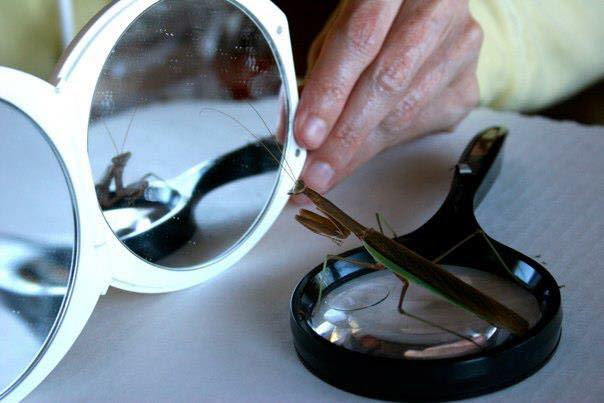
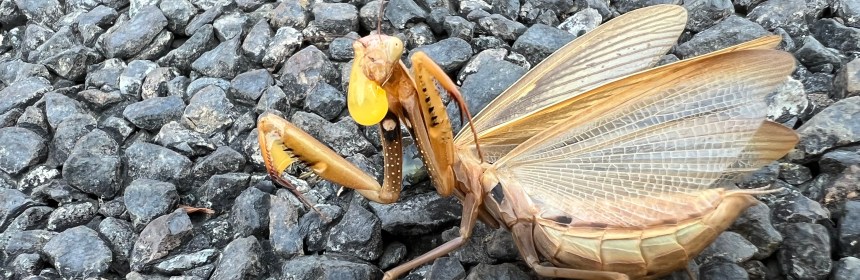
 Check out my story about praying mantids on San Juan Island! They’ve been a victim of hyper-sensationalism. Seriously. Read my article before you squish one.