Bird notes 🎶

Something happened in the yard yesterday afternoon. We have a fruitless cherry tree in a cage that I didn’t plant. At least I think it’s a fruitless cherry tree. It sort of popped up on its own.
In the beginning, I didn’t really want it there, so I cut it down – a few times. It kept coming back, intent on sticking around. A couple of years ago, I just stopped trying to get rid of it. I even put a little cage around it. That was actually for the juncos that built a nest in the grass below that little tree though, to keep them safe from the mower.
Aside from me personally whacking it down a few times, the little tree has suffered other adversities. It has been attacked by cherry slugs (sawfly larvae). They ate its leaves.

It has had a few tent caterpillars munching too. One year that it was super dry, it lost its leaves and I thought it was dead. Only it came back again. I started to pay more attention to this little tree, even watering it in the summer. It’s not very tall, but this year it looks more healthy than ever before.
Last year, I noticed in the spring that it put out these cool little red bumps on the stem just above the leaf.


Those little bumps soon had little red and black ants visiting. I learned the red bumps are extrafloral nectaries. They produce nectar that attracts pollinators to the tree. I haven’t seen any flowers, so I’m not sure what would be pollinated. Maybe the tree isn’t old enough yet. I’m still learning. I sure need to figure out if I’m right that it’s a fruitless cherry.
Well, the other thing that is interesting is shortly after the little red bumps attract the red and black ants, there are little black aphids. I’ve seen this for 2 years in a row now. The ants tend those little aphid flocks like sheep. They are guarding them in exchange for the sugary honey dew the aphids produce.

The aphids and the ants seem to multiply. I have seen 2 or 3 ants per leaf with aphids. Not all the leaves have aphids, but maybe 1/3 of the tree does, and each guarded by the ants. The ants are Formica ascerva species.
They are interesting in their own right because aside from guarding the “sheep,” they also are fierce warriors, driving away (and killing) the large Camponotus sp. carpenter ants that try to invade every spring.
This colony of Formica ants lives under a bedroom of our home. They are welcome to stay since they don’t eat wood.
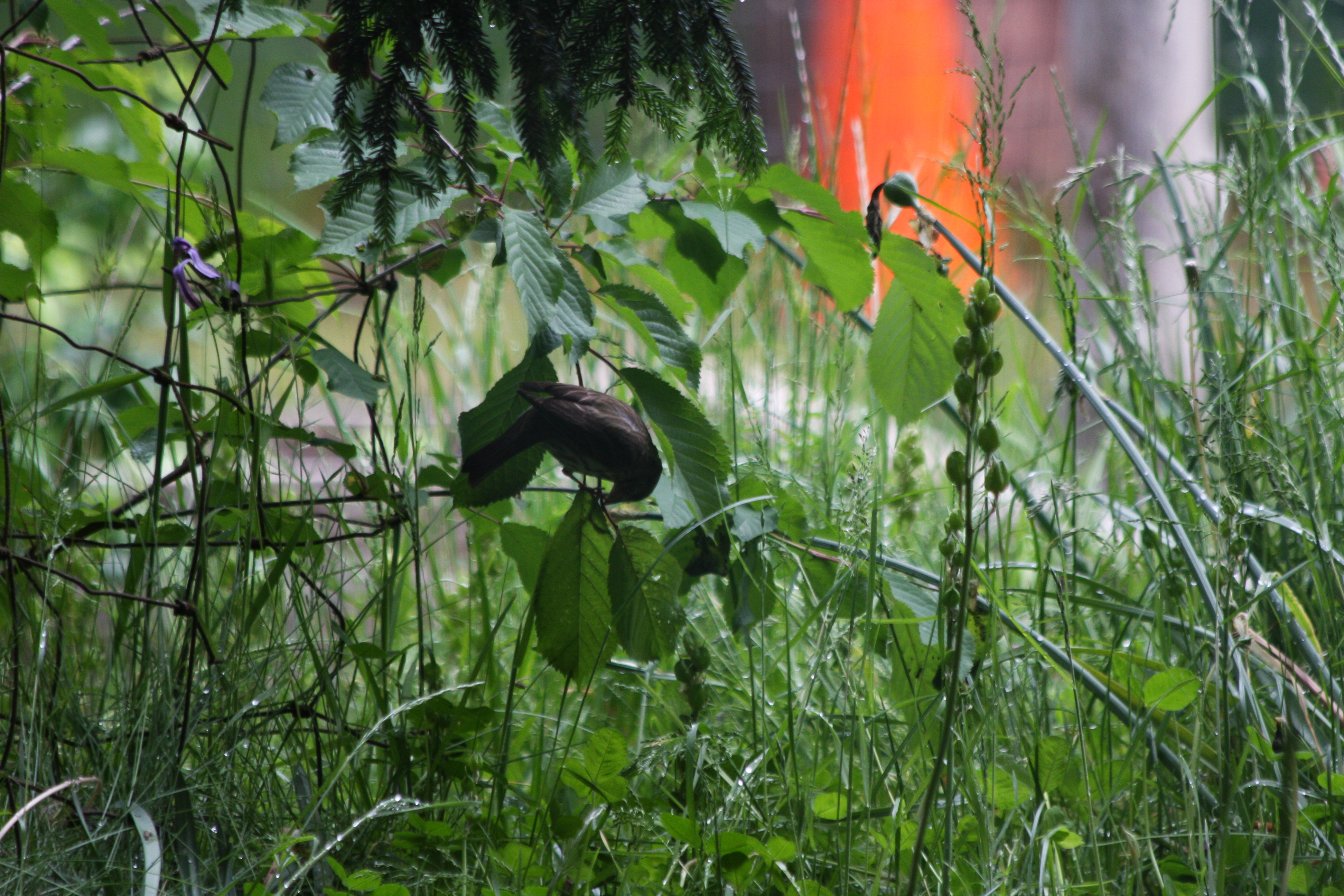
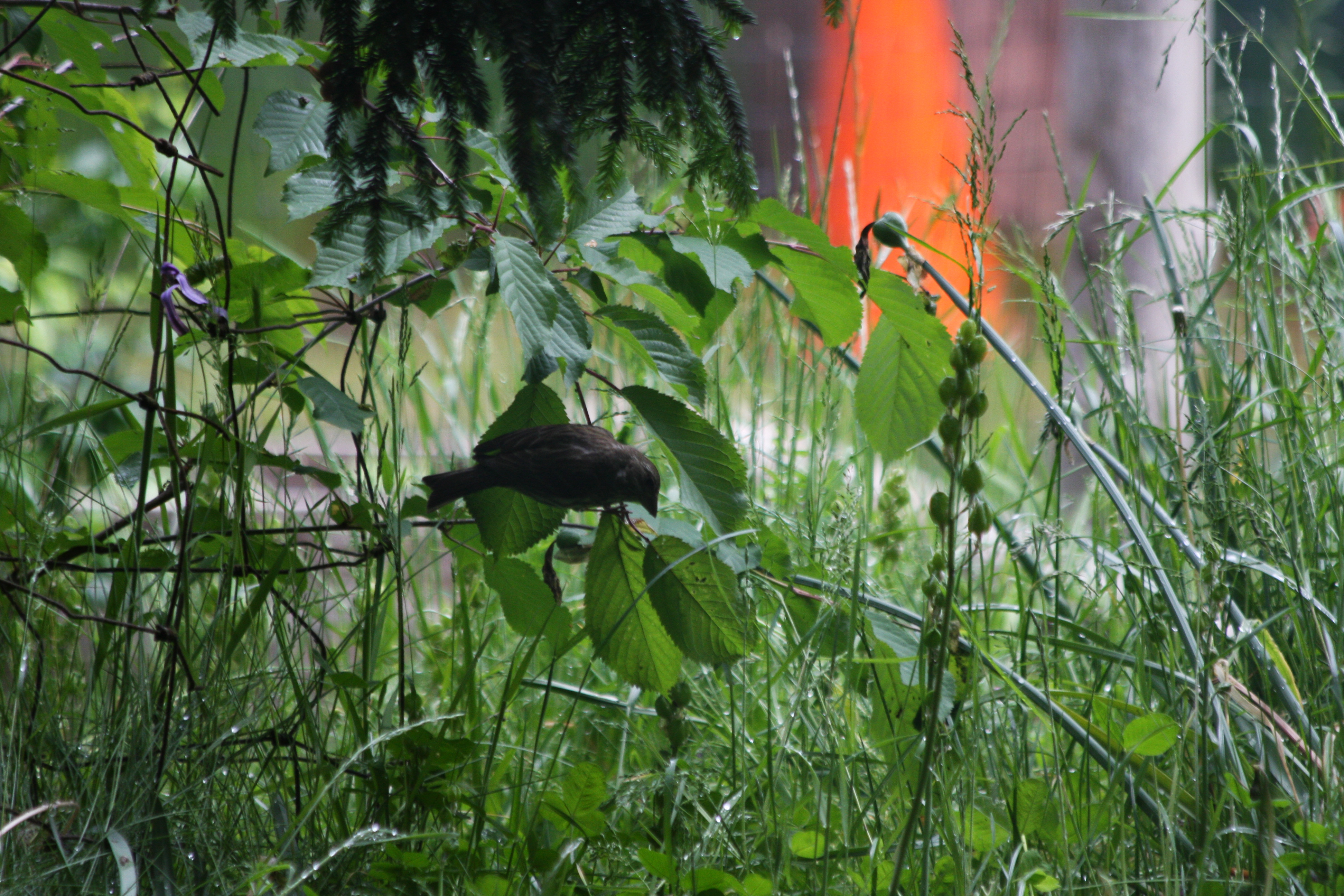
Today, when I looked out the window though, I saw something challenging the fearsome Formica ants. There were birds inside the tree caging and they were hungrily pecking and even tearing at the leaves with aphids. I grabbed and clumsily set up my camera to video the scene.
I saw finches first, then there was a chickadee, and even a hummingbird. I thought I saw bumble bees, but they wouldn’t have been eating the aphids. Perhaps they were visiting the extrafloral nectaries or maybe even sipping honeydew produced by the aphids, but I wasn’t close enough to be certain.
Afterwards, I went out to survey the damage. I saw one leaf with lots of shreds. Aphid parts scattered about. Ants wandering somewhat aimlessly. Another leaf had an ant that died courageously in battle protecting his little flock.

I wanted to share my observations with you because a lot of folks really dislike aphids. Others also dislike ants and don’t understand their role in nature’s ecosystems. Maybe this will help others to understand there are a lot of hungry birds that eat aphids (and ants). Without them, the birds might not find enough food to feed their nestlings. It’s all part of the cycle of life.
If you see aphids your garden that you are worried about, you can mitigate some of their feeding damage by hanging a hummingbird feeder nearby. The hummingbirds have to have protein along with all that carbohydrate sugar water and they will most certainly find your aphids delicious. In fact, insects and spiders make up about 85 % of the diet of hummingbirds. Birds need bugs. And not all ants are pests. Some are extremely beneficial. I challenge you to take up bird and bug watching. You will not be disappointed!
Thanks for reading!
Below are more images of the birds feeding on the aphids inside the caged tree.




References and further reading
Bentley, B. L. (1977). Extrafloral Nectaries and Protection by Pugnacious Bodyguards. Annual Review of Ecology and Systematics, 8, 407–427. http://www.jstor.org/stable/2096735
Bugguide. 2024. Formica Ascerva. https://bugguide.net/node/view/497956


 Bugging You From San Juan Island