Why You Should Appreciate Native Plants: Ocean Spray Insights

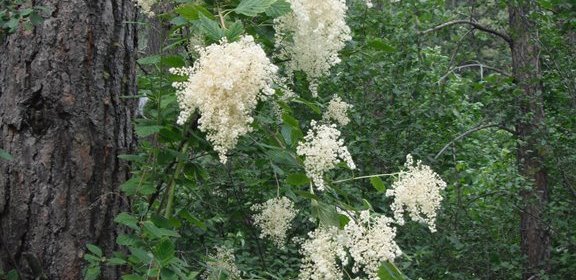
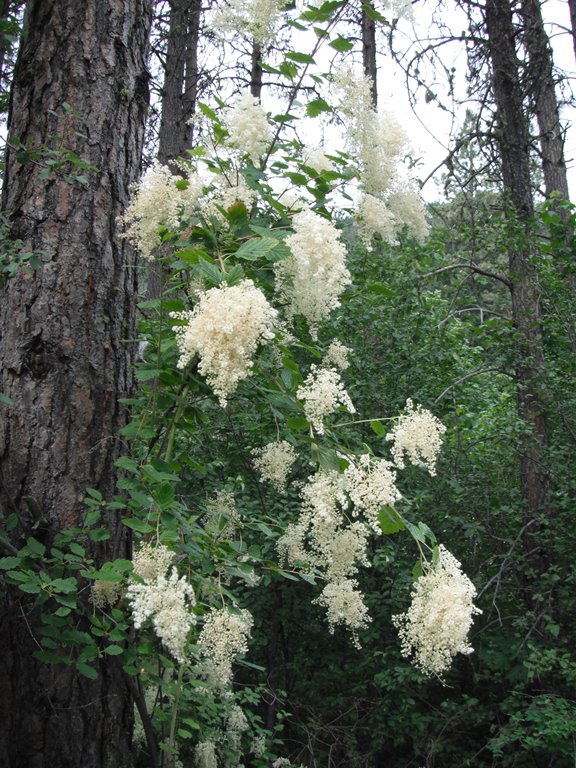
For the past few years, I have observed one of our native shrubs to see what pollinators are visiting. Calscape has recorded Ocean Spray (Holodiscus discolor) as a host plant to approximately 14 species of Lepidoptera. Yet, I have actually never seen a single pollinator visiting the cascades of snowy white, delicate blossoms. I’ve also heard from a handful of local folks on San Juan Island. They say Ocean Spray is “invasive” and should be brush-hogged. According to them, it’s a “fire hazard.” This view is disturbing to me. I felt it important to find concrete evidence of this native plant’s value in our ecosystem.
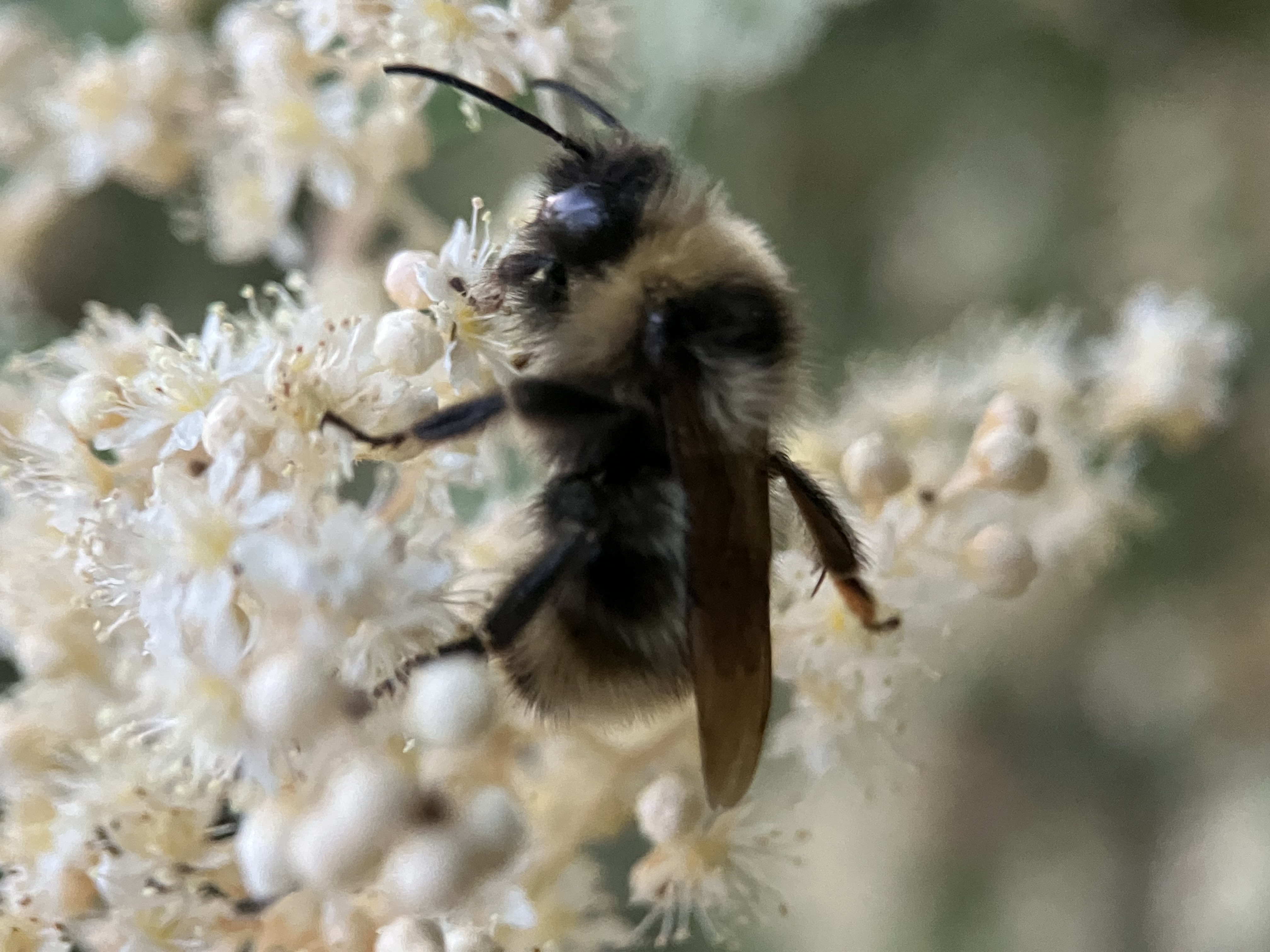
Well, the other evening, I documented the first pollinator I’ve ever seen visiting these blossoms. There is a gorgeous Ocean Spray out our bathroom window. I noticed movement in the upper portions of the shrub. It wasn’t windy, so something else was causing the movement. I went out later, around 9:00 pm, to investigate the cause of the disturbances. Can you guess what I found? Bumble bees!

I also experienced annoyance from another buzzer. A Cattail mosquito, Coquillettidia perturbans (say co-KEE-luh-tih-dee-uh PURR-tuh-binz) promptly discovered my bare arm. It slipped its hypodermic proboscis into my epidermis with effortless precision, a precision superior to any medical professional’s injection. I didn’t feel it at all.
I would describe the bites from these mosquitoes as a very mild annoyance. I didn’t have any after-reaction at all. It was certainly not anything like the bites from some of the other insects I’ve experienced here, especially not thrips. I’m definitely not a thrips fan! You can read about thrips here in case you’re interested. https://buggingyoufromsanjuanisland.com/2021/06/29/public-health-alert-and-some-free-advice/
Getting back to the other buzz in the Ocean Spray. The buzz I was so happy to discover is the bumble bee (Bombus flavidus ssp. flavidus). I didn’t make the identification to subspecies on my own. That was with the help of a fellow named John Ascher on iNaturalist. If you’re curious about his work, you can learn more here: https://extension.oregonstate.edu/podcast/pollination-podcast/137-john-ascher-problem-measuring-bee-decline
Bombus flavidus is a species of Cuckoo Bumble Bee, and one of the most widespread species in the world. These bees don’t have a worker cast like other species of bumble bees. They find nests of other bumble bees to occupy and invade these nests. The host bumble bee workers then rear the offspring of the cuckoo bumble bee along with their own offspring.
I hope my discovery leaves you curious about what pollinators visit Ocean Spray in your yard. My next goal is to make nighttime observations. I want to see what is visiting the flowers while they are still in bloom. I suspect they have nocturnal pollinators. If you find any, I hope you’ll report your findings with me. 🙂
To see more of San Juan Island’s invertebrates, please join and follow me on iNaturalist – https://www.inaturalist.org/observations?place_id=any&user_id=cyndibrast&verifiable=any . If you have never used iNaturalist, try it out! I love it because it’s a way to connect with other entomologists. It also helps me organize my findings into appropriate categories for referencing when I want to look something up.
You can also find my bug observations on Facebook at https://www.facebook.com/cynthia.brast.bormann or join one of the bug groups I help admin: Bugs of the San Juan Islands at https://www.facebook.com/groups/3594158544144419 or Pacific Northwest Bugs at https://www.facebook.com/groups/904079732957442/
Also, please don’t go crazy with the brush hog. Nature loves messy. Humans cause fires. We can do much on that end to prevent them by changing our behaviors and being more careful. Scraping the earth bare and/or parking out your parcel to be “fire wise” is actually not kind to nature. We need to protect habitat for the wild things, not eradicate it. Even mosquitoes have a role in the food web.
Thanks for reading!


References
Brast, C. 2021. IT’S ALL CONNECTED! KNOW YOUR ECOSYSTEM – BUTTERFLIES AND MOTHS LOVE OCEAN SPRAY (HOLODISCUS DISCOLOR). Bugging You From San Juan Island. https://buggingyoufromsanjuanisland.com/tag/holodiscus-discolor/
No author. 2024. Fernald Cuckoo Bee Bombus flavidus. Bumble Bee Atlas and the Xerces Society for Insect Conservation. https://www.bumblebeeatlas.org/pages/bombus-flavidus
No author. No date. Ocean Spray (Holodiscus discolor). Calscape – California Native Plant Society.
Mayer, M. 2021. Cuckoo Combo: Re-Classification Makes Bombus flavidus World’s Most Widespread Bumble Bee. Entomology Today. https://entomologytoday.org/2021/04/28/cuckoo-combo-reclassification-bombus-flavidus-worlds-most-widespread-bumble-bee/
Murray, T. 2024. Species Coquillettidia perturbans. Bugguide. Iowa State University. https://bugguide.net/node/view/26971
 Bugging You From San Juan Island