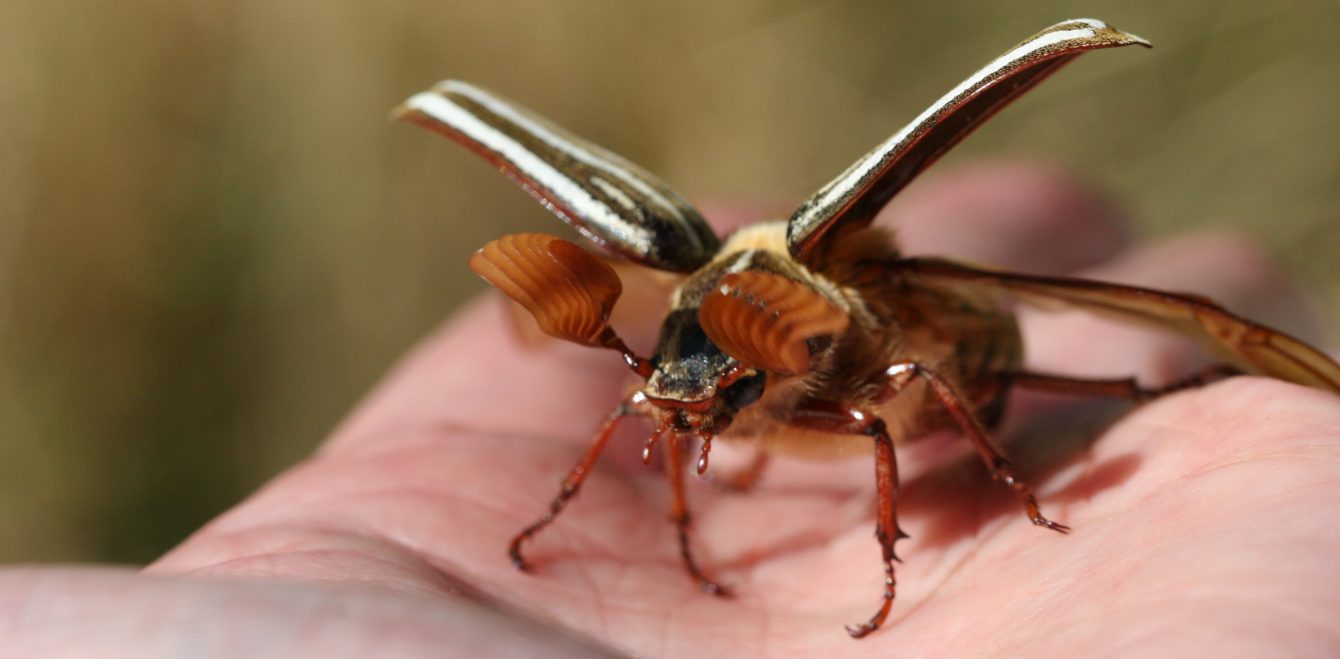
I’m doing a short write up of this fly just to get you thinking a bit. It was observed April 29, 2024 on San Juan Island, WA. While identification to Genus/Species may not be possible until I can actually catch a specimen to be keyed out, it is Family Tachinidae and Tribe Goniini. Hoping to come back with at least a Genus update at some point.
What I want to SHARE is the life history of this tribe of flies. The Goniini flies are parasites of various Lepidoptera, mostly Noctuids, Arctiids, and Lymantriids. Translating this for you a bit, it would be cutworms (if you’re a gardener) , tiger moths, and tussock moths.
How does this play out?
The female Goniini fly lays a “black microtype,” usually ovate and flattened egg, varying in size from very small to medium, on foliage utilized by the feeding host caterpillar. The caterpillar (usually Noctuids) munch the foliage, ingesting the fly egg. The caterpillar will continue feeding and then wander off to complete its life cycle as a pupa. At some point after ingestion by the caterpillar, the fly egg hatches and the fly larva develops inside the body of the pupating moth that is inside its chrysalis.
A myriad of ecological relationships exist in nature that are often unobserved. Many remain undescribed or unknown. Sometimes, they are disrupted by humans who intervene out of ignorance. If you’re one of those folks who squish what you believe are cutworm pupae in your garden bed, you might be smooshing the pest predator developing inside.
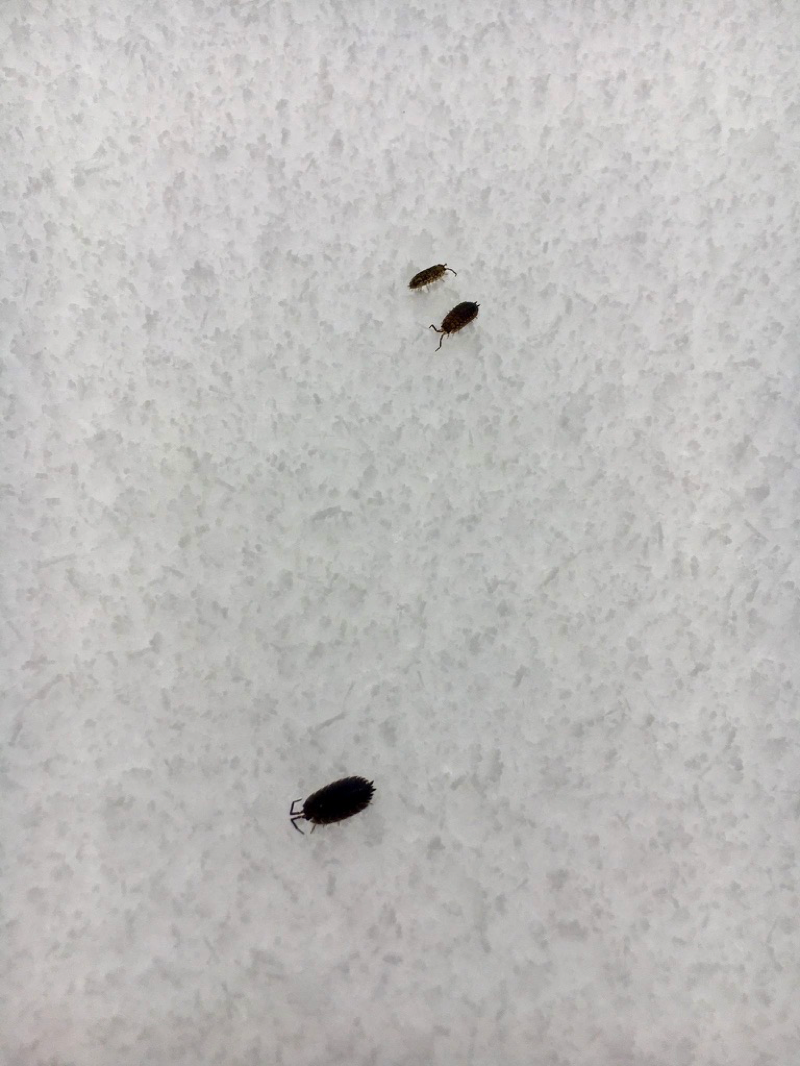
Jason Shields sent in this photo and granted permission to share. Taken on a snowy hike near Wescott Bay, San Juan Island, WA 2/13 or 2/14 2021.
The bugs in the snow in this photo are isopods, commonly known as woodlice. Jason sent the photo to me after finding them on top of the snow, scattered about, alive, but moving slowly. He asked if I might know why they were out in such cold weather like this. At the time, I could only speculate, but did some reading and came up with a possibility that could answer this curiosity.
The literature I sourced suggests that isopods like these can be infected with a helminth parasite capable of altering behavior. Several published scientific papers specifically investigated the Acanthocephalan parasite (Plagiorhynchus cylindraceus), also known as the Spiny or Thorny-head worm parasitizing isopods. For the curious, the name Ancanthcephalan comes from Greek akantha, and kephale; head, referring to the rows of hooks or spines encircling the head of the worm.
In this relationship, the acanthocephalan parasitic worm (P. cylindraceus) is what is referred to as an indirect or two-host parasite, meaning it uses two animals to complete its developmental life cycle. It is also an endoparasite, developing internally in an animal (as opposed to ectoparasite – developing on the outside of the animal).
The isopod is the initial host in this parasitic cycle. In feeding on terrestrial detritus, the acanthocephalan parasite’s eggs are ingested. The eggs exist in the environment after being excreted in the feces of songbirds, especially the American Robin (Turdus migratorius), and European Starling (Sturnus vulgaris).
Within hours of ingestion by the isopod, P.cylindraceus eggs hatch into larvae. These tiny larvae with spines soon mature into a form called a cystacanth, burrowing through the intestinal cavity of the isopod where they lodge into the body cavity, remaining attached to the intestine by a stalk. This site of attachment is important in that the worms lack their own digestive system and must gain nutrients via the host’s dietary intake. Over approximately 60-65 days, the cystocanths continue to grow and develop sexual organs. At the end of this period they are now mature enough to infest the next host (a bird).
While the exact mechanism remains unknown, the worms alter the behavior of the isopod making it “suicidal” or more susceptible to becoming prey and eaten by a bird. It is suspected that biochemical cues are responsible for inducing these behavioral changes.
Scientists have recorded infected individuals of these isopods leaving sheltered leaf litter where they are concealed, and moving into open areas where they are more visible to predators and more likely to be eaten. Inside the bird host, the worm resides in the small intestine, where it continues to grow, often becoming as long as 15 mm. At the end of development in the bird host, reproductively mature, fertilized female worms produce eggs that are excreted in the bird’s feces, repeating the cycle.
Are the isopods Jason found in the snow parasitized? Possibly. It may remain a mystery, but an intriguing one indeed.
References
Amato, José F. R., Amato, Suzana B., Araujo, Paula B., & Quadros, Aline F. (2003). First report of pigmentation dystrophy in terrestrial isopods, Atlantoscia floridana (van Name) (Isopoda, Oniscidea), induced by larval acanthocephalans. Revista Brasileira de Zoologia, 20(4), 711-716. https://dx.doi.org/10.1590/S0101-81752003000400026
Nickol, B., and G. E. Dappen (1982). Armadillidum vulgare (Isopoda) as an intermediate host of Plagiorhynchus cylindraceus (Acanthocephala) and isopod response to infection. Journal of Parasitology 68(4) 570-575. https://www.jstor.org/stable/328091



 Bugging You From San Juan Island