Tag Archives: pest predator

Discovering the Golden Paper Wasp: A Native Treasure
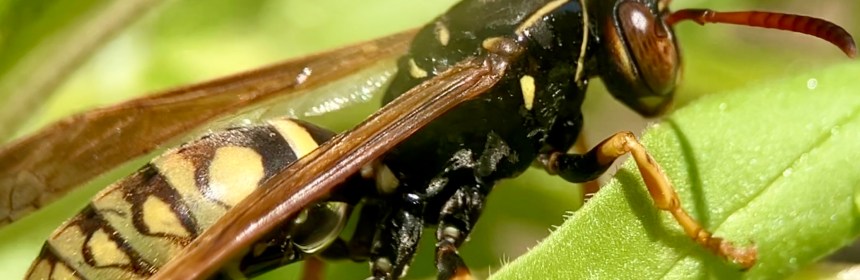
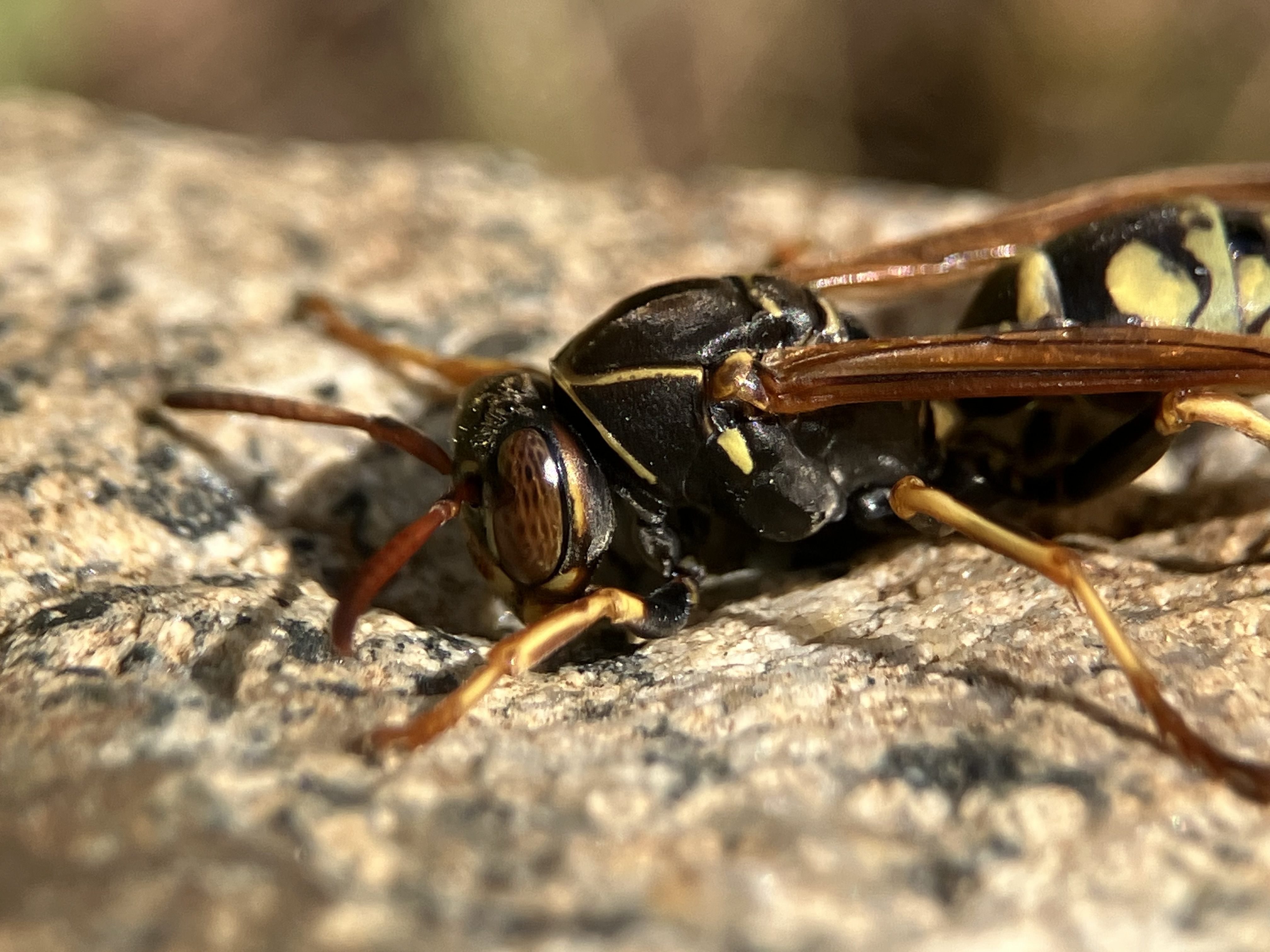
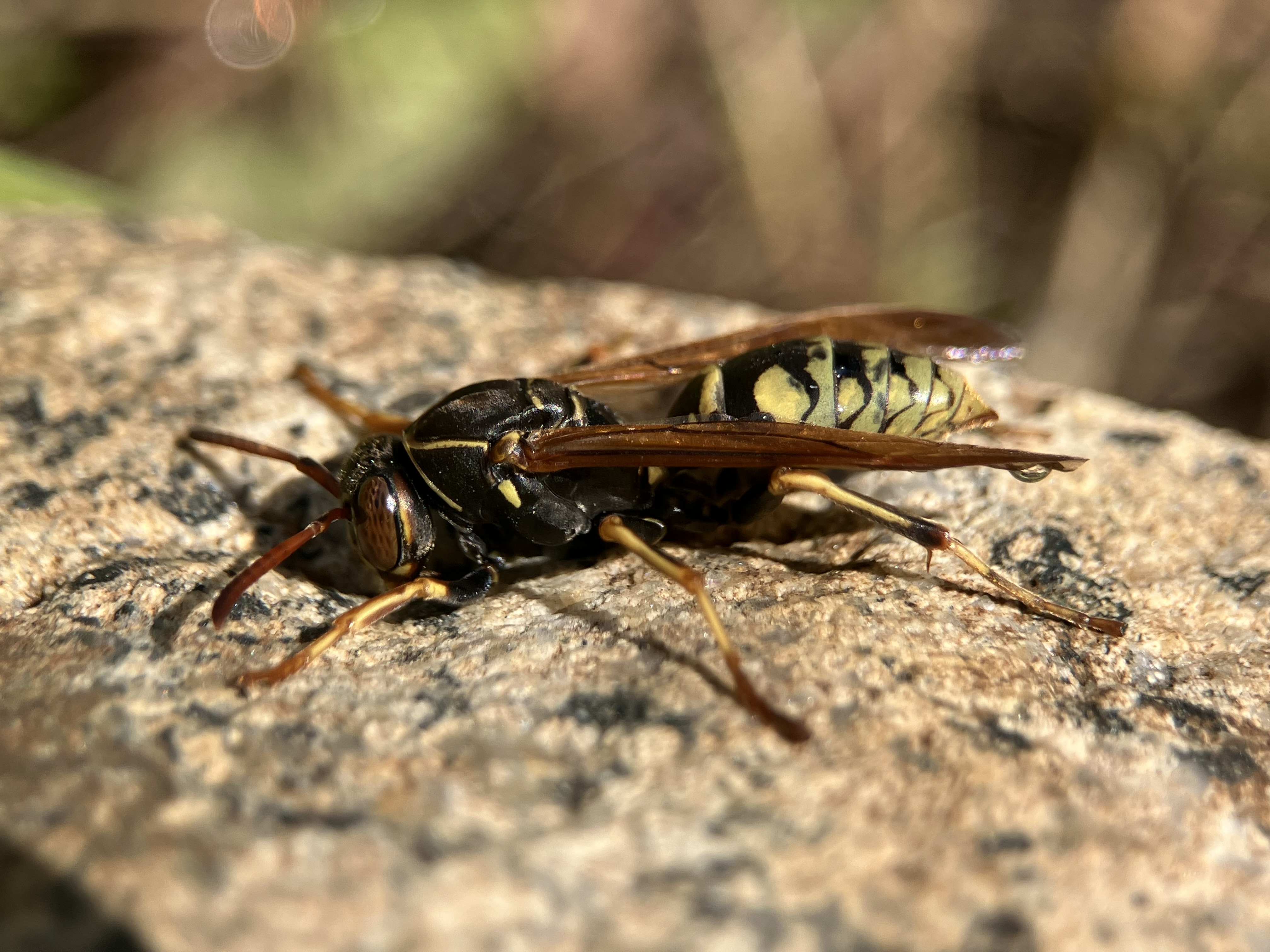
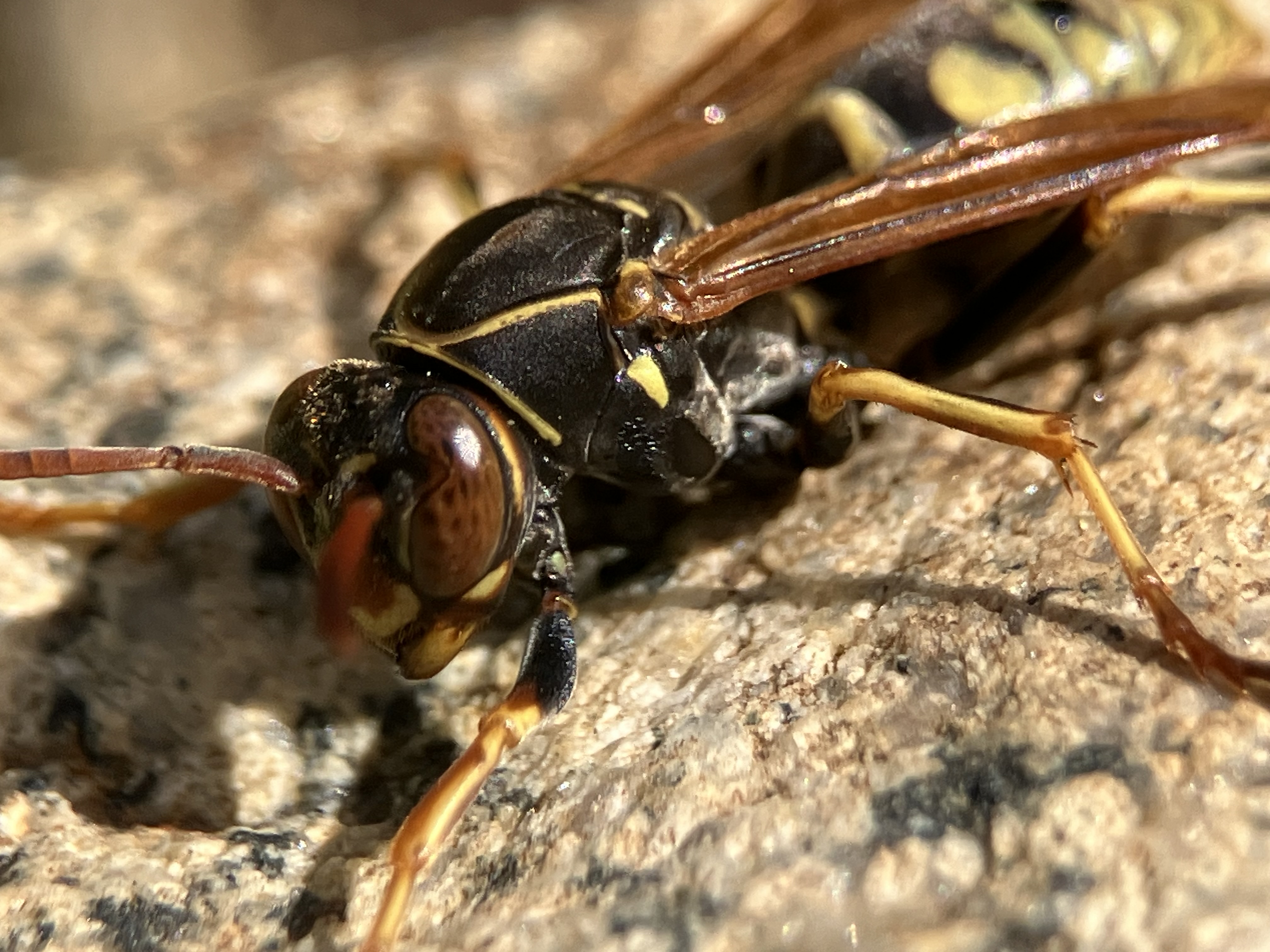
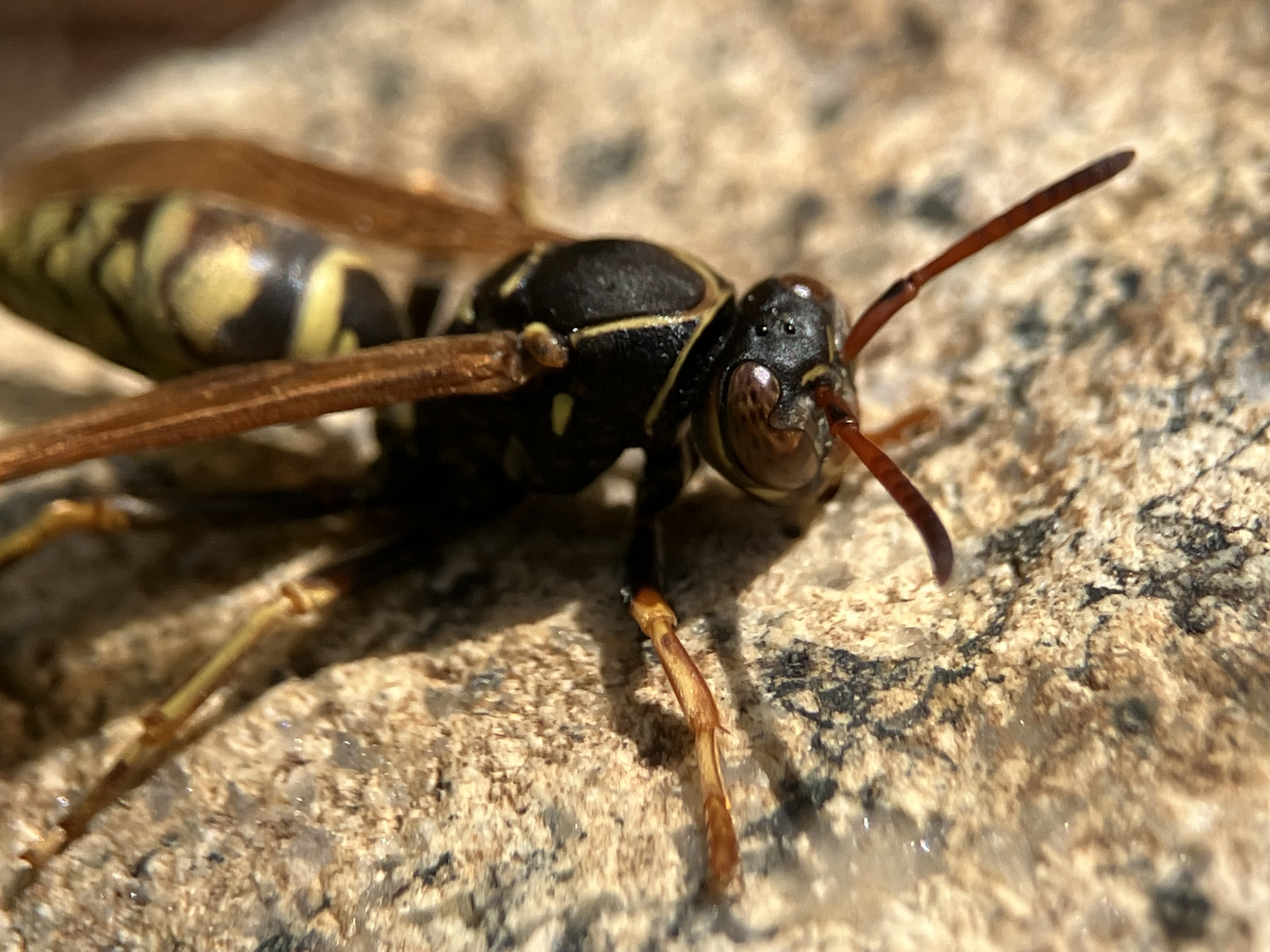
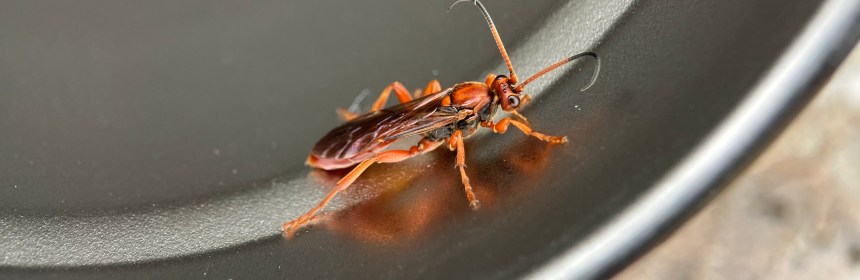
Polistes aurifer, a native paper wasp

The other morning when I was watering our garden, I spied the most beautiful creature I’ve seen in a long time, a Golden Paper Wasp (Polistes aurifer). In fact, in sixteen years of living on San Juan Island, I have only seen one colony of these wasps (April 14, 2024) at the San Juan County Land Bank’s Mount Grant nature preserve. These wasps are native to North America and once considered a subspecies of Polistes fuscatus. However, P. aurifer has a western geographic distribution ranging from BC-CA to AB-MT-w.TX; ne. Mexico (Bugguide.net).

Polistes wasps build open faced nests suspended by a petiole in varied sites. Some select relatively exposed areas under eaves of structures or in shrub-type vegetation, while others utilize more protected cavities such as abandoned rodent burrows or hollow trees. Most often, the ones we see are the non native European paper wasp species (Polistes dominula), that seem very comfortable establishing their nests under the eaves of our homes.

It is believed the more frequently observed (P. dominula) are displacing native Polistes aurifer, but since it is more difficult for scientists studying insects in natural or wild habitats, most formal observations have taken place utilizing sites associated with man-made dwellings (Liebert, 2004). Liebert published a short communication in Insectes Sociaux (2004) where she describes finding ground nesting colonies of this species at an observation site in California, and concludes that the “displacement” theory may be overstated. However, given the loss of natural areas due to habitat loss/conversion, a decline in populations of the native P. aurifer (I believe) would more accurately be attributed to humans. Humans also unfortunately resort to wasp spray to eradicate nests around their homes without understanding that most nests pose minimal or no risk to human comings and goings.

Polistes wasps (native and non-native) are generally considered to be beneficial insects. They are pest predators, capturing and dismembering caterpillars to feed larvae they are rearing. In Eastern and Southern regions of the U.S., some species of Polistes wasps exert significant pressure on the cotton bollworm and the tobacco hornworm, both pests of considerable economic significance.

If you spy one of these Western natives, you’ll know immediately because they have the most beautiful golden brown or caramel colored eyes!

Thanks for reading. 🙂
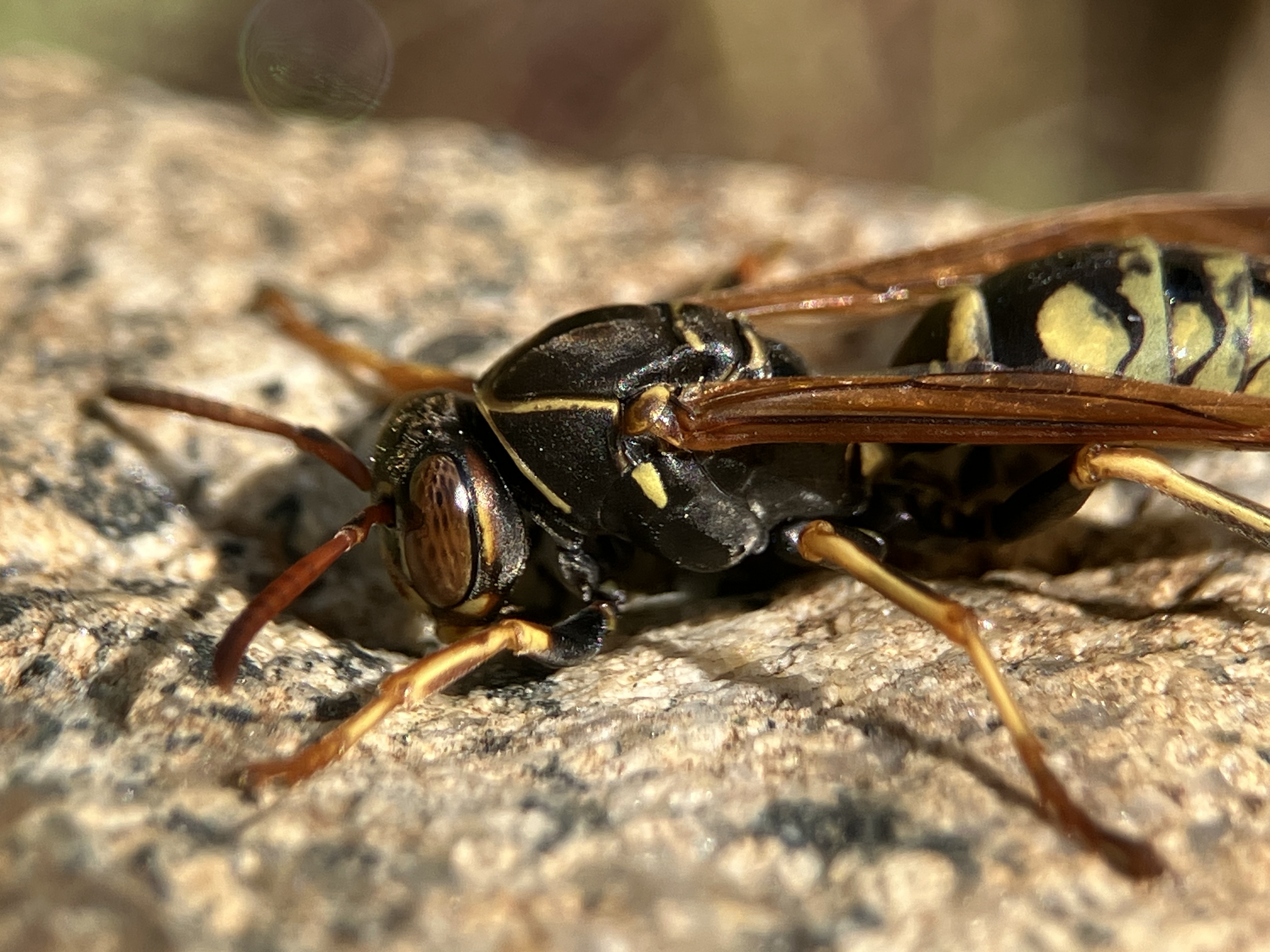
Polistes aurifer
Polistes aurifer
Polistes aurifer

References

Bohart, G. E. 1942. Notes on Some Feeding and Hibernation Habits of California Polistes (Hymenoptera, Vespidae). Pan-Pac. Ent. 18(1): 30-31. https://digitalcommons.usu.edu/piru_pubs/15/

Buck, M., Marshall, S.A. and Cheung D.K.B. 2008. Identification Atlas of the Vespidae (Hymenoptera, Aculeata) of the northeastern Nearctic region. Canadian Journal of Arthropod Identification No. 5: 492 pp. (PDF version).
Published on 19 February 2008. With 3 Tables and 1073 Figures.

Bugguide. 2023. Polistes aurifer. Bugguide.net. https://bugguide.net/node/view/24972

Liebert, Aviva. (2004). Ground nesting in the paper wasp Polistes aurifer (Hymenoptera, Vespidae). Insectes Sociaux – INSECTES SOC. 51. 99-100. 10.1007/s00040-003-0714-0.

p.s. I found another (naturally deceased) individual in our barn/shop, so perhaps we have had these around and I’ve just been missing them.

Polistes aurifer

Your Garden’s Guardian: A Soldier in Miniature (Silis sp.)

Soldier Beetle (Genus Silis)

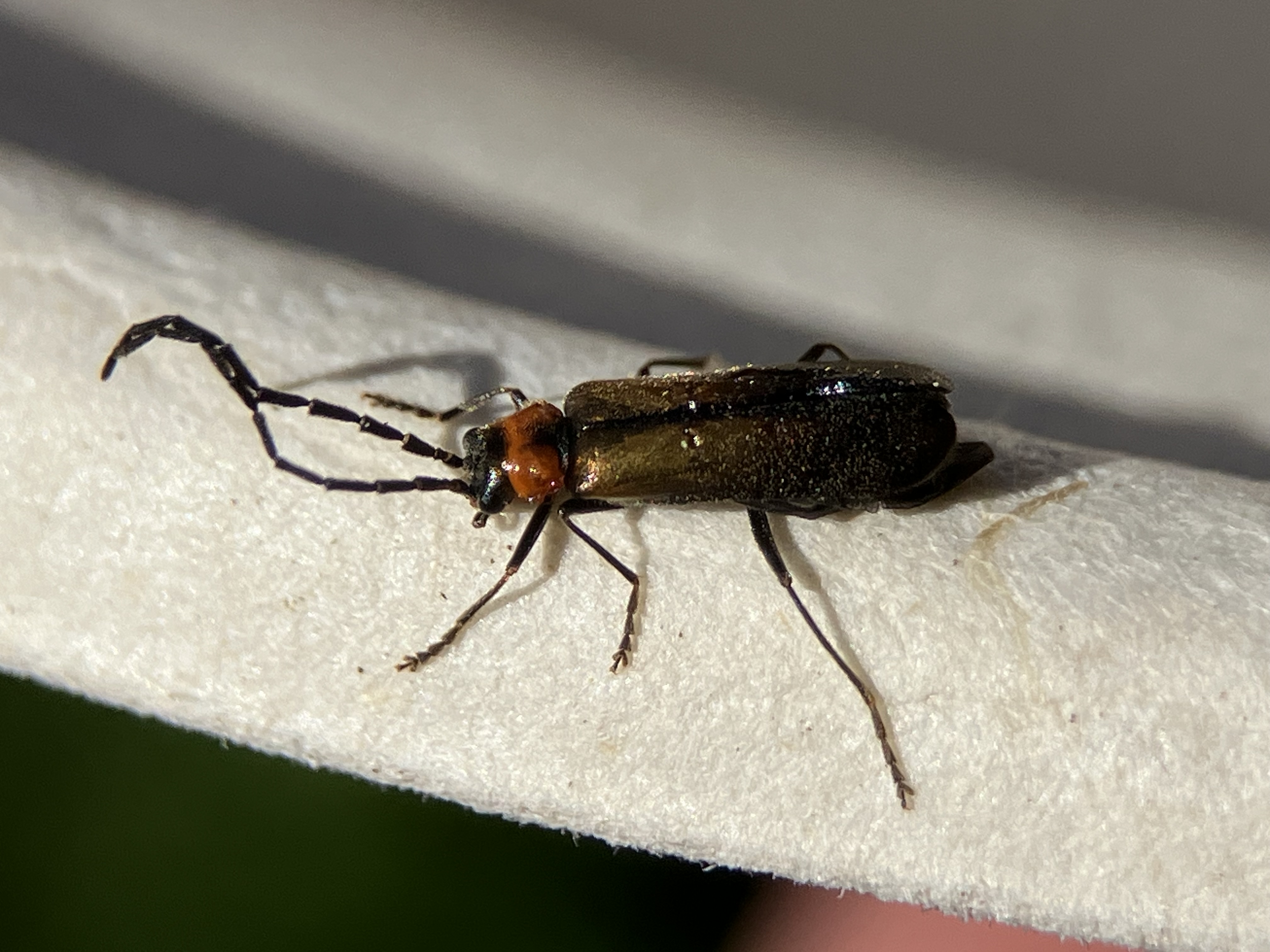
This tiny little friend (approx. 6mm) sporting a red collar is a soldier beetle in the family Cantharidae. It is in the Genus Silis, but there are so many species, that I will just leave it at the genus level for now.

Soldier Beetle (Genus Silis)

Silis beetles are quite cosmopolitan in distribution, associated with wooded areas and leaf litter, and active daytime fliers in early summer.

Adults are typically found on foliage and flowers. Primarily, they are pest predators, feeding on insects, but also serve as pollinators, feeding on nectar and pollen. Silis species are known to prey on aphid populations infesting trees, plants, and shrubs, so gardeners can appreciate them as a “friend.”

Silis beetles can also attack other groups of invertebrates, feeding on small soft-bodied specimens or consuming their eggs. However, the ecology of some species is remains to be investigated. While Fender (1973) found the larvae would eat earthworms and are mostly carnivorous in the soil, little else is known about the feeding habits in this stage. (Pelletier and Hébert , 2014).

The etymology of the nomenclature for the genus (Silis) comes from Σίλας in Greek. It is derived from the Latin name Silvanus, meaning “forest” or “wood,” and a contraction of the Greek form Silouanos, a transliteration of Silvanus. Silis or Silas is also associated with the Roman god of the countryside, Silvanus, a god who was worshipped by those who lived in wooded areas or worked with wood. Even older than the etymology is this tidbit. Silis beetles are quite ancient. Fairly recent research has identified specimens of the genus discovered in Baltic Amber (Parisi and Fanti, 2019).

Soldier Beetle (Genus Silis)

While I have now scooped a few out of our pool, thankfully in time to save them from drowning, some of them (perhaps the ones I’ve rescued) are also finding me. I have had them on my clothing and peeping in the door at me!

Thanks for reading!

Soldier Beetle (Genus Silis) looking in our door at me!

References

Bugguide 2025. Genus Silis. Iowa State University. https://bugguide.net/node/view/11961

Green, John Wagener. 1966. Revision of the Nearctic species of Silis (Cantharidae: Coleoptera). Proceedings of the California Academy of Sciences, 4th Series, 32, 447–513. https://www.biodiversitylibrary.org/part/52839

Pelletier, G., Hébert, C. 2014. The Cantharidae of Eastern Canada and Northeastern United States. Canadian Journal of Arthropod Identification No. 25. February 28, 2014. Available online doi: 10.3752/cjai.2014.25

Parisi, F. and Fanti, F. 2019. On the first Silis Charpentier, 1825 from Baltic amber (Coleoptera, Cantharidae), Foss. Rec., 22, 119–123, https://doi.org/10.5194/fr-22-119-2019

A Sedgesitter

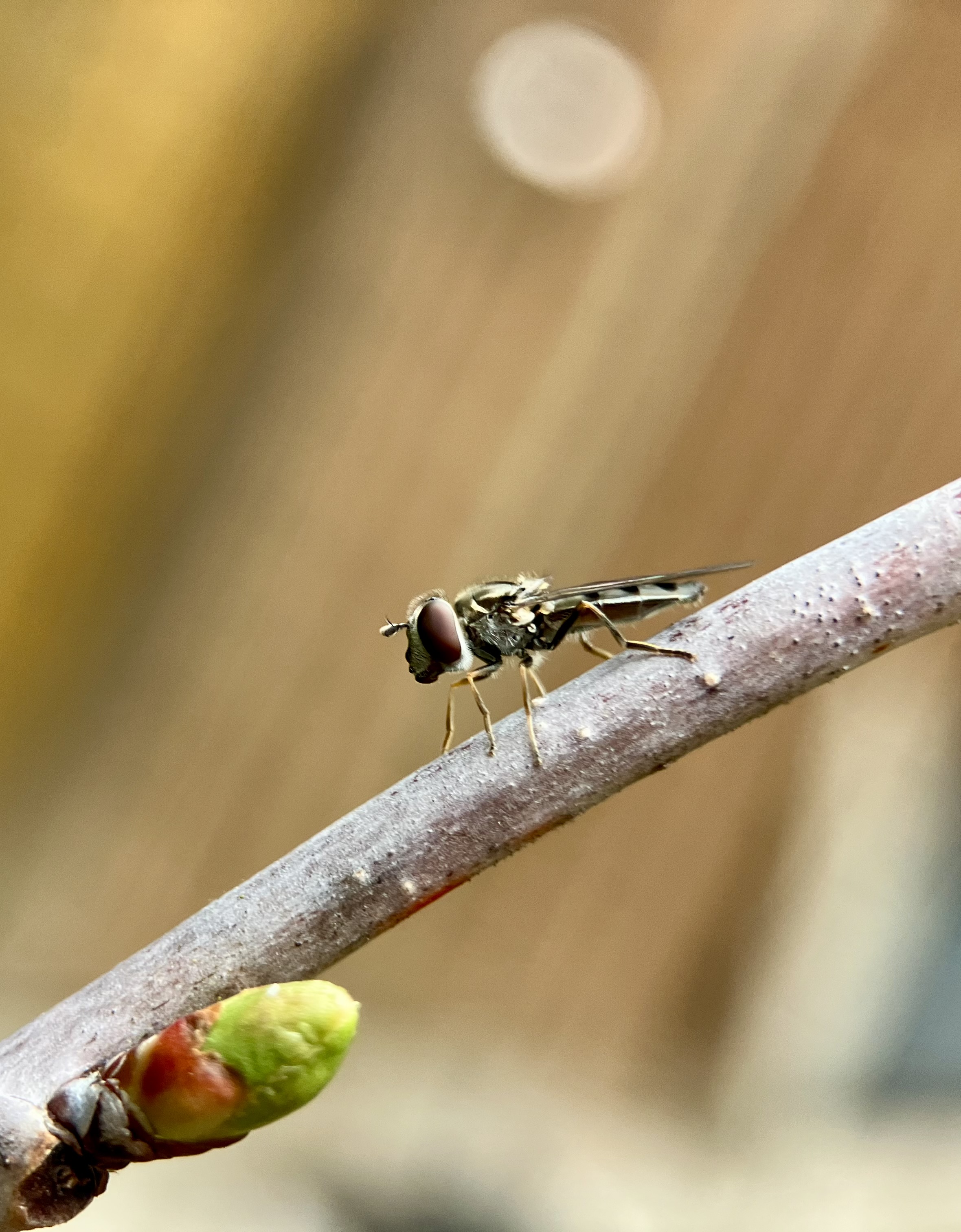
This was Wednesday’s bug of the day. I’m a day behind writing up my post. Although I have tried to get out for a quick bug search every day, it’s been overcast and/or drizzly here this past week. I was excited to see this little fly hunkered down on a twig of our fruitless cherry tree, the tree that I whacked off as an unwanted upstart for several years before I discovered how interesting it is.

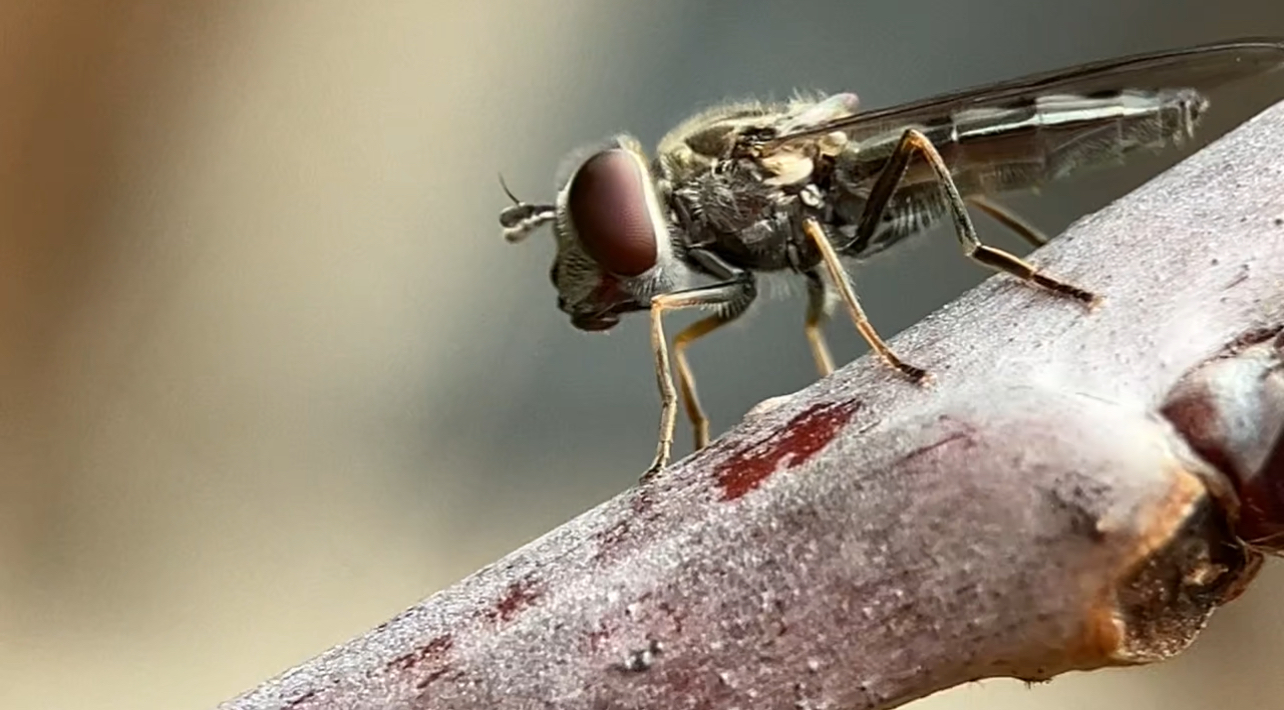
Western Forest Sedgesitter, (Platycheirus trichopus), I believe

That tree is a mini ecosystem: floral nectaries that feed the aphids, aphids, slave making ants that have fights to the death (winning) with the carpenter ants that try to invade our home every spring, and the birds that rip the leaves apart trying to get the aphids. Now I can add Syrphid flies to the list!

That’s what this is. A syrphid fly. Syrphid flies eat aphids. It would make perfect sense for this adult to lay eggs on the tree, though I’m not sure what would happen because the ants that farm those aphids are certainly willing to die defending them. I could definitely see the ants overtaking the syrphid fly larvae. Nevertheless, the fly flew off. Somewhere.

I believe this particular fly is the Syrphid fly species Platycheirus trichopus, the Western Forest Sedgesitter. While difficult to ID to species, I did reference the helpful ID guide by fly expert, Even Dankowicz. https://docs.google.com/presentation/d/19F1qRGpmNDgaGE13M2SMUBlI846JicTOYjIescjVTHw/preview?slide=id.g8918834f0e_0_92

This species, as mentioned earlier is pretty small at only about 6.8-9.4 mm. Geographic distribution ranges from the Rocky Mountains west from Alaska to Mexico (bugguide.net). Adults of this genus are known to feed on the pollen of wind pollinated plants like Willow (Salix sp.) and various grasses (Poaceae), and sedges (Cyperaceae). It is believed they are better adapted to activity in cooler temperatures and that fits with yesterday’s rather gloomy spring day.

Thanks for reading!

References:

Dankowicz, Even (2023). “Common Pipizini, Paragini, and Bacchini Species of the Southwestern U.S. (CA NV AZ UT NM CO)”The Fly Guide: Field/Photo ID for Flies. pp. 9–10.

Bugguide.net. 2025. Syrphidae. https://bugguide.net/node/view/196

The Hitch-hiker

Spilichneumon Wasp at Marketplace in Friday Harbor

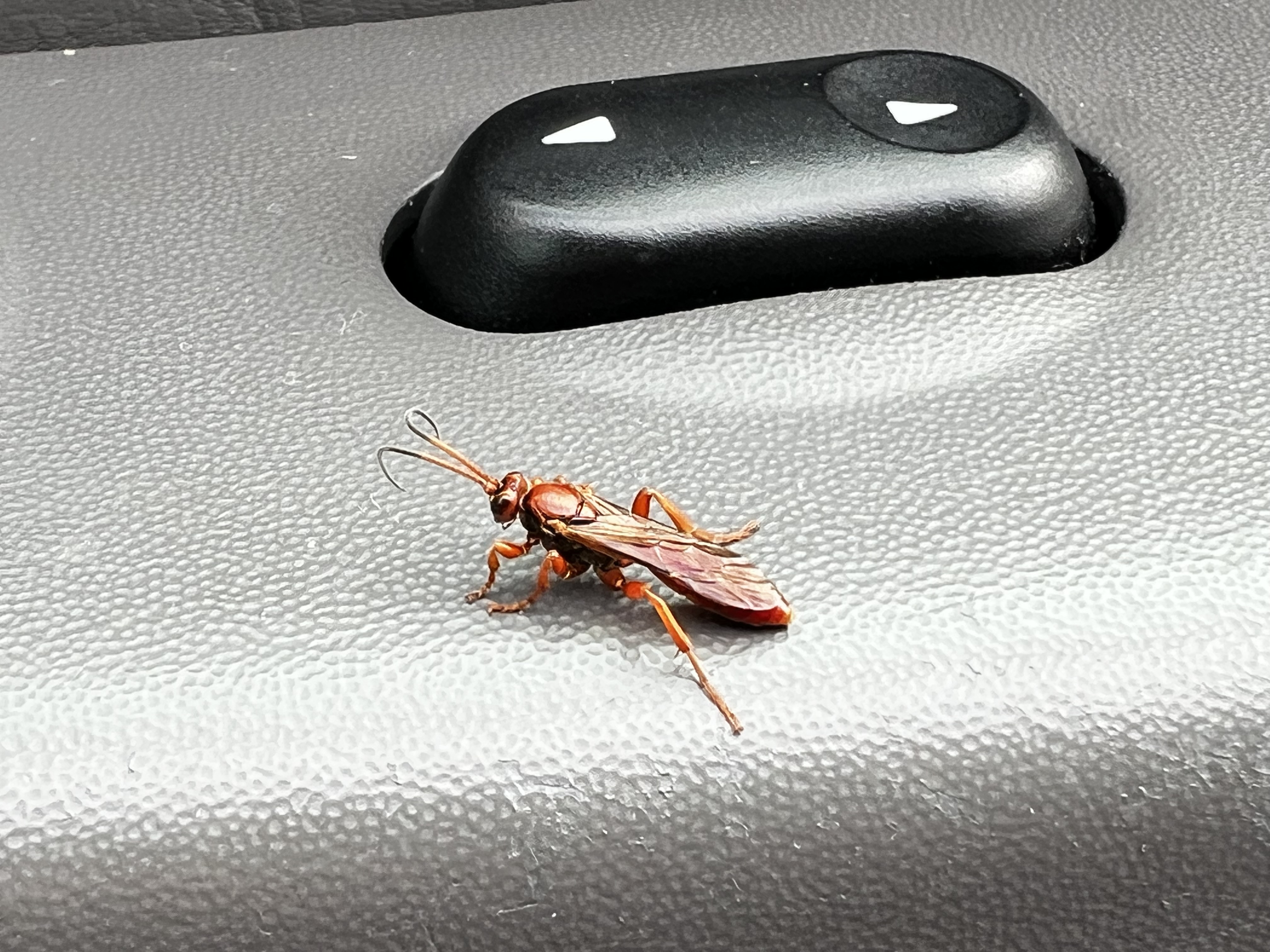
Today as I was leaving the store after grocery shopping in Friday Harbor at Marketplace (the store it took me forever to find when I first moved here, and known as the store for the “locals”), I opened the door to my truck and found this cute little red wasp on the door handle. I’m not sure how it got there, but this is one hitch-hiker I had no problem picking up. And, pick it up, I did! I conveniently scooped it to safety in a brand new insulated cup I scored on sale at our local Ace Hardware for $10. It has little bears and forest trees on it. It was also perfect for securing the wasp for our ride back to the house.

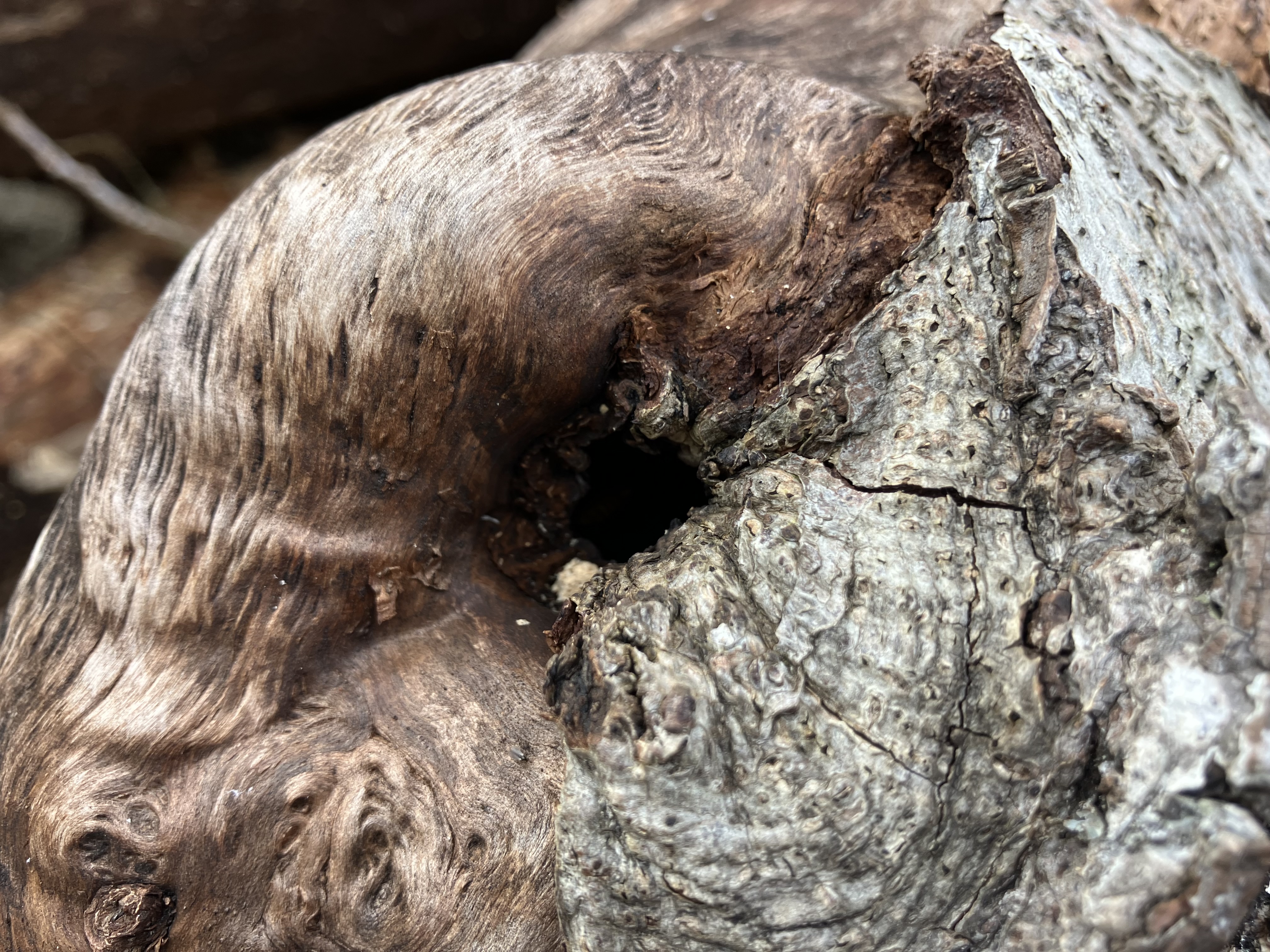
When I got home, I left the cup by the door for a bit to unload my groceries, but got my camera afterwards and carried my hitch-hiker over to a stack of alder logs we collected and piled up into a wildlife stack. Those logs are “dead” to most humans, but for all the little critters that were in them when they blew over and broke into chunks, they are FULL of life! One had a perfect knot hole that my wasp targeted right away and will probably stay holed up for the better part of next week since we have rain in the forecast. I wish more people would see dead and dying trees as something of value (other than to chip or burn). They are stores of food for birds, and shelter for many other organisms. Dead and dying trees are often more interesting to me than live ones. You just have to change your perspective and perhaps you will see what I do too!

The wasp critter is in the family Ichneumonidae. It’s in the Genus Spilichneumon, I believe. These wasps hunt and parasitize Noctuid moth caterpillars. They are most excellent pest predators! The female wasp will lay one egg inside each caterpillar she finds and then her egg will hatch and the larva will develop in the caterpillar’s body. That’s THE END of the caterpillar. 🐛

Thanks for reading!

Knothole in tree

If you are curious to learn more, here are two links to get you started. https://bugeric.blogspot.com/2012/03/wasp-wednesday-spilichneumon.html and https://bugguide.net/node/view/444129

Know Your Pest Predators – Make Friends with Eudioctria sackeni

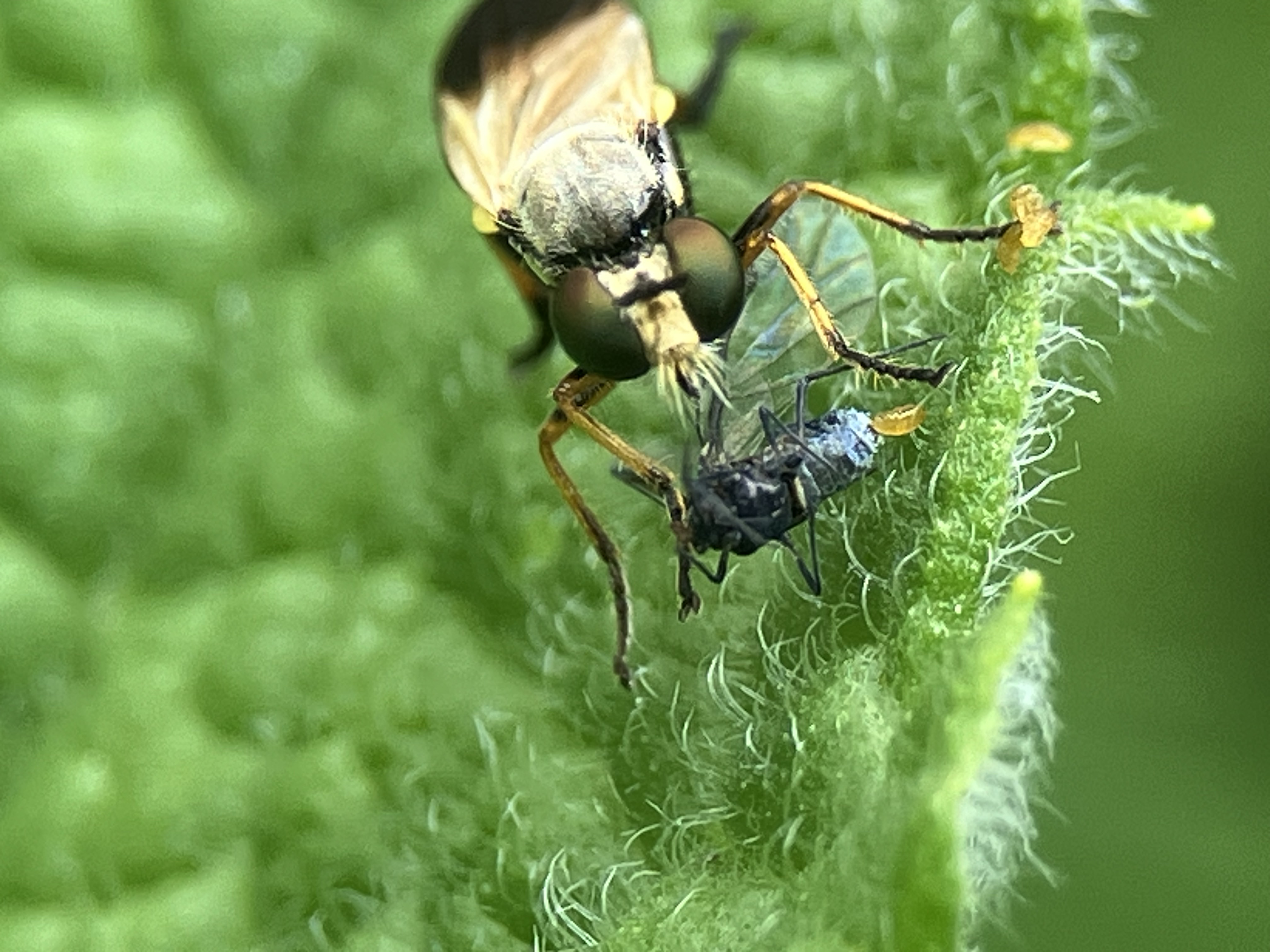
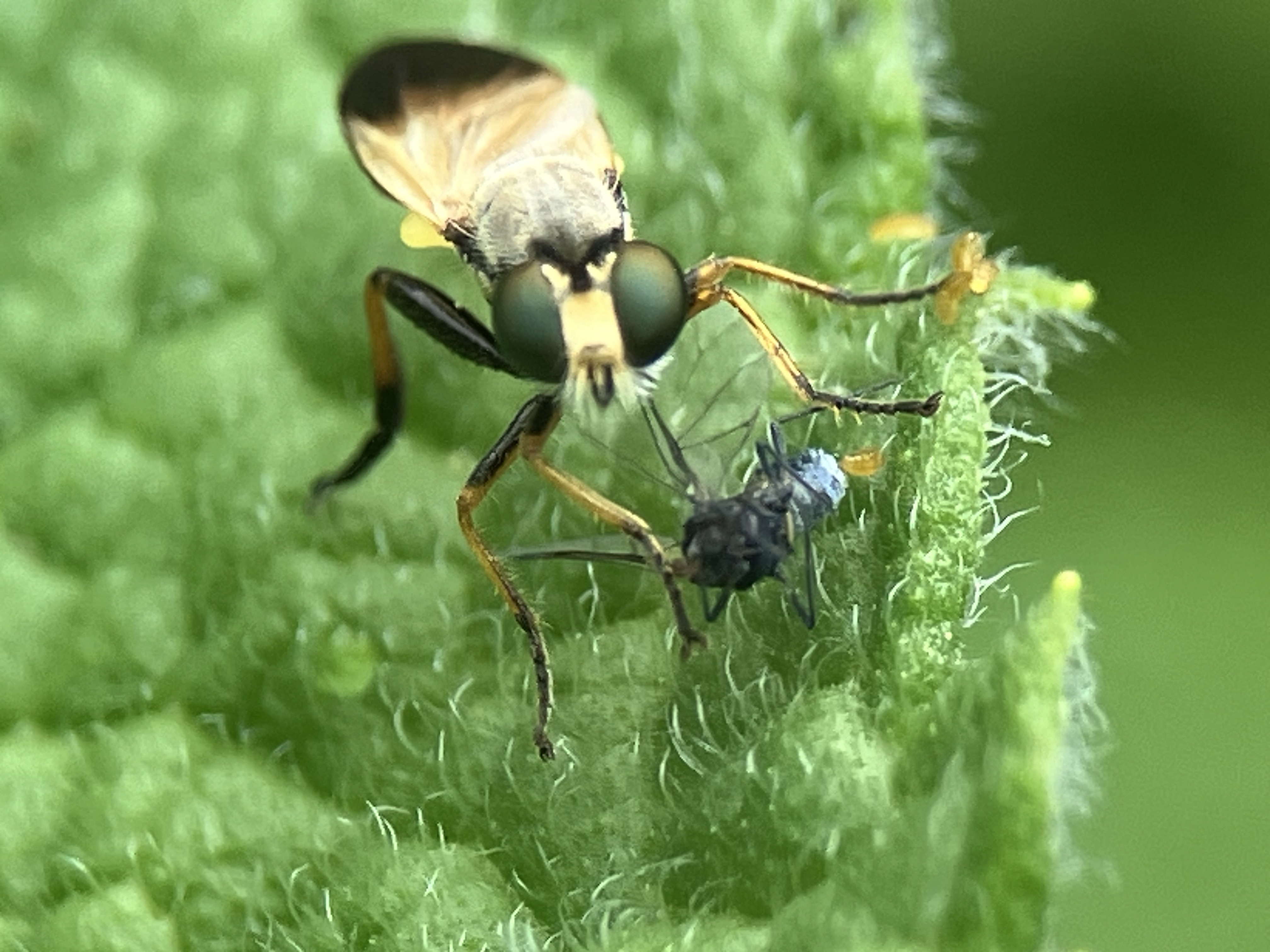
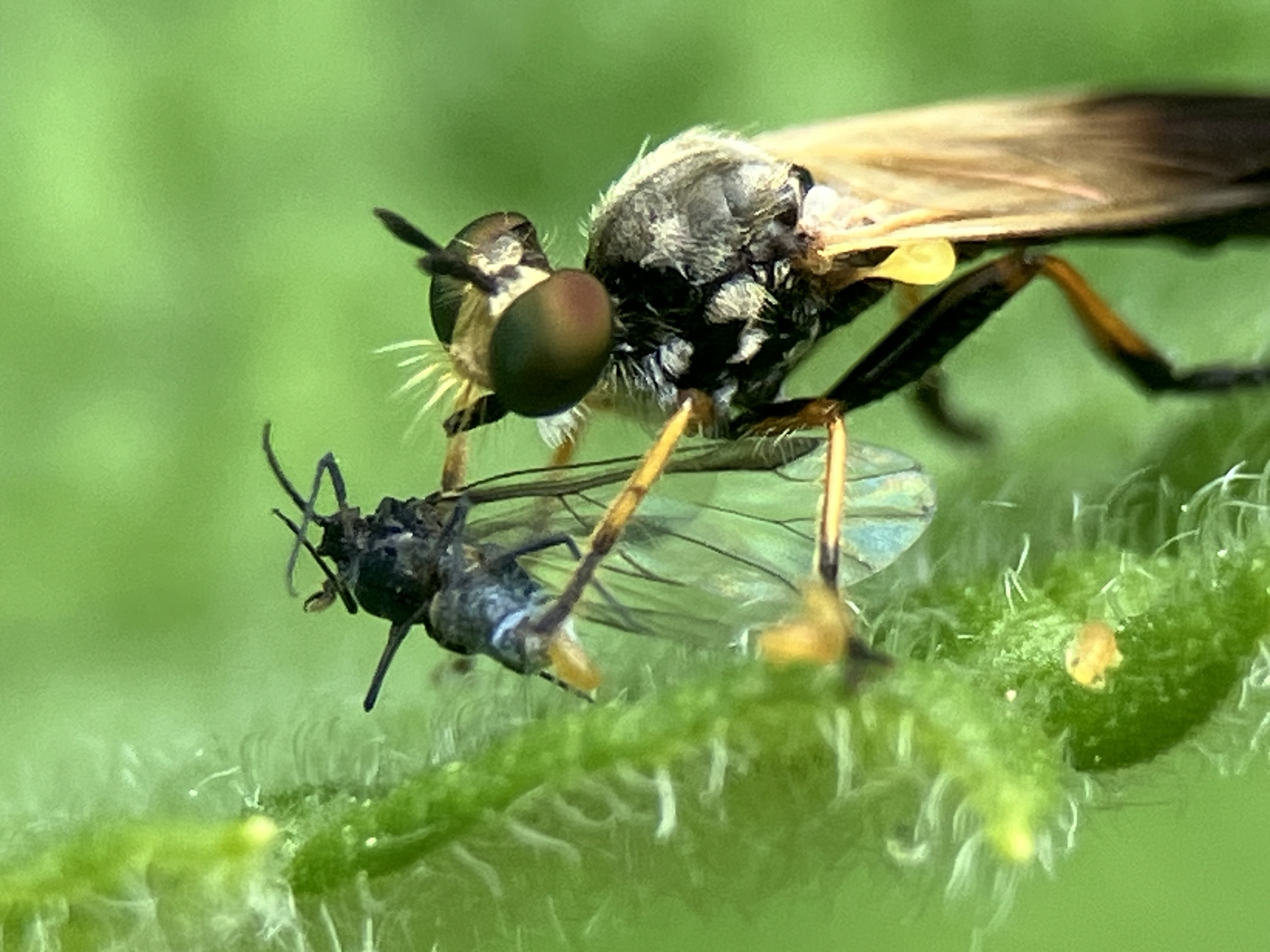
Eudioctria sackeni Robber Fly

This is one of my favorite garden residents (Eudioctria sackeni), or the Sacken Longhorn Robber. I remember the first time I saw one of these, I thought, “Wow, it’s an Ombre Fly!” If you didn’t know, “ombre” means the blending of one particular color hue to another, often from light tints to dark. The coloration in this particular fly is distinctly “ombre,” though it varies in individuals within the species.

Eudioctria flies are in the family group, Asilidae or Robber flies. They are voracious predators of small insects that can be pests of gardens and orchards. Here, you see this one enjoying a small dipteran (fly) of some variety, perched on the leaf of one of my mint plants. The mint is a popular scouting platform. On any given day in the summer, I’ll see 4 or 5 of these flies in a six foot strip of mint which has become quite abundant in the yard over the past few years. The mint seems to be quite attractive to pollinators, and it also provides shelter for other bugs and critters. Our little tree frogs love to sit in the mint too.

Reference and further reading

Species Eudioctria sackeni – Sacken Longhorn Robber. BugGuide. https://bugguide.net/node/view/60617

Mitten feet

This is one of my “Know your pest predators” posts, featuring one of our PNW flies. Flies are all too often maligned and under-appreciated. We think of flies as spreading disease and being a nuisance, yet many of them perform incredibly important jobs as pollinators and pest predators. Yesterday I was sleuthing flies in the yard and found these metallic green beauties. Here is a Dolichopus (“doe-LICK-uh-pus”) male and female. The “dolicho-“ part means “long”, and the “-pus/-pod” part means “leg” or “foot.”

Some species of Dolichopus males (like this one) have little “flags ” or “mitten” front feet they wave or flap around to woo the ladies. Reading about this very large group of flies has been interesting and you can learn more about their courtship behaviors in Van DuZee et al. (1921).

Dolichopus sp. male fly

These flies are predators of small, soft-bodied invertebrates as adults and during their larval stage. You can thank them for helping keep populations of aphids under control in your garden.

Dolichopus sp. fly (male)

You’ll find these flies in northern latitudes in North America. “Dolichopus species are among the largest and most common members of the family Dolichopodidae in North America. The majority of Dolichopus species prefer humid habitats and some are restricted to saltmarshes,” (Pollet et al. 2004).


References:

MARC A.A. POLLET, SCOTT E. BROOKS, JEFFREY M. CUMMING. 2004. “CATALOG OF THE DOLICHOPODIDAE (DIPTERA) OF AMERICA NORTH OF MEXICO,” Bulletin of the American Museum of Natural History, 283, 1-114,

Van Duzee, M. C., Cole, Fr R., and Aldrich, John Merton. 1921. “The dipterous genus Dolichopus Latreille in North America.” Bulletin of the United States National Museum. i–vi, 1-304, 16 pls. https://doi.org/10.5479/si.03629236.116.i

Key to male nearctic Dolichopus species here – https://digitallibrary.amnh.org/items/5c3c75c8-27ae-47e6-acac-59ec0c30d1cb/full

Cutworm parasite

I’m doing a short write up of this fly just to get you thinking a bit.  It was observed April 29, 2024 on San Juan Island, WA. While identification to Genus/Species may not be possible until I can actually catch a specimen to be keyed out, it is Family Tachinidae and Tribe Goniini.   Hoping to come back with at least a Genus update at some point. 

What I want to SHARE is the life history of this tribe of flies.  The Goniini flies are parasites of various Lepidoptera, mostly Noctuids, Arctiids, and Lymantriids.  Translating this for you a bit, it would be cutworms (if you’re a gardener) , tiger moths, and tussock moths.  

How does this play out? 

The female Goniini fly lays a “black microtype,” usually ovate and flattened egg, varying in size from very small to medium, on foliage utilized by the feeding host caterpillar.  The caterpillar (usually Noctuids) munch the foliage, ingesting the fly egg.  The caterpillar will continue feeding and then wander off to complete its life cycle as a pupa. At some point after ingestion by the caterpillar, the fly egg hatches and the fly larva develops inside the body of the pupating moth that is inside its chrysalis.  

A myriad of ecological relationships exist in nature that are often unobserved. Many remain undescribed or unknown. Sometimes, they are disrupted by humans who intervene out of ignorance. If you’re one of those folks who squish what you believe are cutworm pupae in your garden bed, you might be smooshing the pest predator developing inside.

Noctuid moth pupa

References

  1. No Author. 2024. Tachinidae. Spencer Entomological Collection. Beaty Biodiversity Museum. https://www.zoology.ubc.ca/entomology/main/Diptera/Tachinidae/
  2. Wood, D. M. 2013. Manual of Nearctic Diptera. Tachinidae Resources. https://www.uoguelph.ca/nadsfly/Tach/Nearctic/Manual/Manualhome.html
  3. Cole. Frank, R. 1969. The Flies of Western North America. University of California Press. Berkeley, CA.

Western Calligrapher (Toxomerus occidentalis)

I sat outside today in the sunshine, forced convalescence if you will, exhausted and achey after getting my Covid Omicron Variant booster vaccine yesterday at the San Juan County Fairgrounds. My outdoor time was unfortunately cut short because we have been inundated with construction development noise. I’m fairly certain I will be forever challenged to have an amiable relationship with our newest neighbors. In part, because they sited their VACATION home, right in front of our view. Mind you, they could have moved over 100 feet and we would not have to look across the top of our driveway at their newly constructed 2nd home. It has definitely impacted us. We’ve lost a lot of our privacy out here in the woods. It was never my desire to have close neighbors. I am a bit of a recluse….which is what the new neighbor said about his wife, yet, it begs me to ask again, WHY DID YOU BUILD YOUR HOUSE RIGHT ON TOP OF US?

Oh, and the jackhammering! That noise is enough to make a person homicidal. We had an entire summer of jackhammering from the former owners of that property. Really, truly, that property should never have been zoned for development. Not any development. It’s partly (half) wetland, and the other half is bedrock. Imagine the task of trying to excavate enough to bury your septic lines down the hill when you have solid bedrock! Also, our house is on that same shelf of bedrock, so the hammering shakes the walls and vibrates the floors of our home in the process of all this construction. The development on this lot has gone on for multiple years. I’m really tired of the disruption.

I digress. Sorry, I just had to vent. San Juan Island would be a much friendlier place for wildlife and bugs and such if we didn’t allow anyone to build a 2nd, or 3rd home here. We are outgrowing our space and it isn’t pretty.

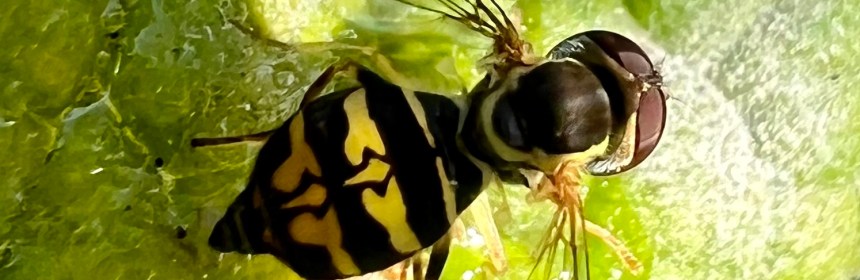
Here’s my bug of the day. This beauty is a Western Calligrapher Fly (Toxomerus occidentalis). I was mesmerized watching it rest on the mint leaf. The patterning on the dorsal side of the abdomen reminds me of some sort of totem design.

The adults of this fly species are pollinators. They lay eggs on plants near aphids and when larvae emerge they are predatory on the aphids. It is believed that late instar larvae overwinter, pupation takes place in the soil cavities in the spring and adults emerge later in summer. The name for this group of flies comes from Greek toxon ‘bow’ + meron ‘thigh’ (refers to the bow-shaped hind femur). You can see the curve in the first photo below, circled in red. Something else interesting pertaining to the adult coloration I found on bugguide.net: “Colors vary with overall temperature during pupation: if it was hot, the yellow/orange increases and the background becomes lighter, but if it was cold, the dark/black increases and the yellow/orange becomes darker like the background.”

Enjoy the last few days of sunshine and embrace our native pollinators. We are heading into the dark part of the year. For those of us who live here year round, you know what to expect. Lots and lots of rain.

Thanks for reading!

Western Calligrapher Fly (Toxomerus occidentalis)

Western Calligrapher Fly (Toxomerus occidentalis)