Tag Archives: pets

April 7, 2025 – A Million or More
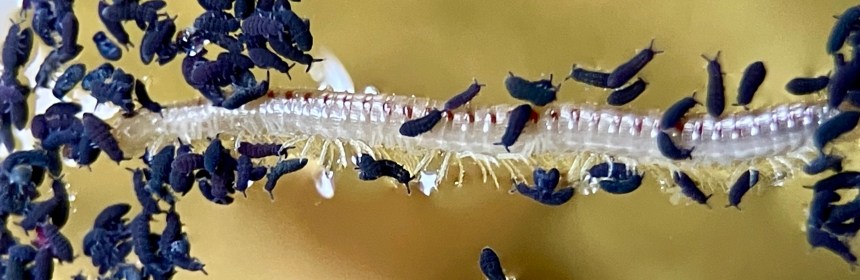
Tiny springtails (Hypogastrura sp.)

I woke up this morning feeling like my head is going to explode. Migraine sufferers will identify. The throbbing continues, regardless of whatever you might throw at it. I managed to get little Olivia to the vet by 09:40 to get her spay stitches out and our vet cleaned her ears. She had a lot of wax buildup and came home with some antibiotic ear drops to ward off any potential infection that might be developing. Olivia is our latest rescue cat. She’s a sweet little Tortie Persian. Age 2. It’s been a delight to have her sharing our space and she’s made fast friends with our other two resident kitties (Herman and Nimbus).

Olivia the cat

After I got back home from town, I went back outside to walk around the yard a bit hoping the cool air would calm down my headache. I wandered over to look in the above ground pools we have for water catchment. One is in the shade and the other is in the sun. It’s pretty cool how they each have their own mini ecosystems going on.

Hypogastrura sp. Springtails and a millipede raft

The shaded pool was the active one today. It was literally covered with a million or more of these teeny aquatic springtails. Initially, I believed the species to be Podura aquatica in the family Poduridae, but someone has suggested a different family (Hypogastruridae) altogether as a possibility. I may have to revisit my ID. Springtails or Collembola are tiny hexapods. The ones in my photo looked to be approx. 1mm in size. The blue-ish ones you see in the photo are mature specimens and the pinkish/orange ones are juveniles. I believe this could be a mating aggregation (Sánchez-García et. al, 2018). *** note *** Updating ID to family Hypogastruidae (Genus Hypogastrura) after looking at these under a microscope and seeing they have a reduced furcula (the little appendage on the back end that helps them jump).

Hypogastrura sp. springtails

There were so many of these that it looked as if the surface of the pool had been sprinkled with pepper. I found some in a water dish I had on the ground that were easier to photograph. There were a few rafting on a poor little millipede that somehow ended up in the water. It was still alive, so I fished it out and moved it to a nice damp spot in the soil.

An aggregation of tiny springtails (Hypogastrura sp.)
Hypogastrura sp. springtails

Some species of springtails are semi aquatic, living in fresh water. Others are common in soil and leaf litter where they influence decomposition processes and nutrient availability. Some are arboreal and are abundant in rain forest canopies. There are even springtails living successfully in polar regions (Hopkin,1997 ; Sanchez-Garcia et al, 2018).

Springtails hanging out with a deceased backswimmer (Notonectidae)

Raft of Hypogastrura sp. springtails photographed March 27, 2025 – San Juan Island, WA

Check out the reference list I have attached below for further reading. Some of these are really interesting!

References

Ádám Egri, György Kriska. 2019. How does the water springtail optically locate suitable habitats? Spectral sensitivity of phototaxis and polarotaxis in Podura aquatica. J Exp Biol 222 (9): jeb199760. https://journals.biologists.com/jeb/article/222/9/jeb199760/688/How-does-the-water-springtail-optically-locate

Bellini, B. C., Weiner, W. M., & Winck, B. R. 2023. Systematics, Ecology and Taxonomy of Collembola: Introduction to the Special Issue. Diversity, 15(2), 221. https://doi.org/10.3390/d15020221

Bugguide. 2025. Hypogastrura.

Childs, G. H. 1915. Some observations on the life history of the water springtail (Podura aquatica – 1758). MSc thesis, University of Minnesota, Minneapolis.

Heckman, C. W. 2018. Ecological Strategies of Aquatic Insects. Boca Raton: CRC Press, Taylor & Francis Group.

Hopkin SP. 1997. Biology of the Springtails (Insecta: Collembola). New York: Oxford Univ. Press.

Möllerke A, Brasse G, Bello J, Vidal DM, Dettner K, Zettel J, Berg MP, Scheu S, Leinaas HP, Schulz S. 2024. The unique epicuticular chemistry of Collembola – A cross-species analysis. iScience. 27(8):110416. doi: 10.1016/j.isci.2024.110416. PMID: 39139403; PMCID: PMC11321324.

Noble-Nesbitt, J. 1963. A site of water and ionic exchange with the medium in Podura aquatica L. (Collembola, Isotomidae). J. Exp. Biol. 40, 701-711.

Ortega-Jimenez VM, Challita EJ, Kim B, Ko H, Gwon M, Koh JS, Bhamla MS. 2022. Directional takeoff, aerial righting, and adhesion landing of semiaquatic springtails. Proc Natl Acad Sci U S A. 119(46):e2211283119. doi: 10.1073/pnas.2211283119. Epub 2022 Nov 7. PMID: 36343251; PMCID: PMC9674249.

Silje Marie Kristiansen, Katrine Borgå, Jan Thomas Rundberget, Hans Petter Leinaas, Effects on Life‐History Traits of Hypogastrura viatica (Collembola) Exposed to Imidacloprid Through Soil or Diet, Environmental Toxicology and Chemistry, Volume 40, Issue 11, 1 November 2021, Pages 3111–3122, https://doi.org/10.1002/etc.5187

Rusek, J. 1998. Biodiversity of Collembola and their functional role in the ecosystem. Biodiv. Conserv. 7, 1207-1219. https://doi.org/10.1023/A:1008887817883

Sánchez-García A, Peñalver E, Delclòs X, Engel MS. 2018. Mating and aggregative behaviors among basal hexapods in the Early Cretaceous. PLoS ONE 13(2): e0191669. https://doi.org/10.1371/journal.pone.0191669

Schulz, S., Messer, C., & Dettner, K. 1997. Poduran, an unusual tetraterpene from the springtail Podura aquatica. Tetrahedron Letters, 38(12), 2077–2080. doi:10.1016/s0040-4039(97)00341-9

Silje Marie Kristiansen, Katrine Borgå, Jan Thomas Rundberget, Hans Petter Leinaas, 2021. Effects on Life‐History Traits of Hypogastrura viatica (Collembola) Exposed to Imidacloprid Through Soil or Diet, Environmental Toxicology and Chemistry, Volume 40, Issue 11, Pages 3111–3122, https://doi.org/10.1002/etc.5187

Yule, Catherine & Yong, Hoi Sen. (2012). 33. Collembola. https://www.researchgate.net/publication/233727118_33_Collembola
April 6, 2025 – A Wet Spring Day

Last night, I did manage to get my moth light working again and set things up to see what I might find this morning. While I didn’t really want to get out of bed at 7:30, keeping a routine is important to me. I find it tremendously helpful in managing the ups and downs of one’s mental perspective. You’ll have to bear with me a bit though. I will get to the moths, but have to vent about something that upset me. One of my three cats was chattering at the sliding door when I walked towards the kitchen. I looked out to see what he was watching, and there was a little bird on the ground, obviously suffering from some unfortunate injury (most likely from our neighbor’s free roaming cat). That made me feel sad and angry and it wasn’t the best start to my day.


Don’t get me wrong. I love cats, but I don’t agree that it is OK to allow your feline friend to maim and kill wildlife. I do take my kitties outside with me into our fenced area for supervised recess, but I DO NOT ever leave my cats out alone and certainly do not allow the killing of wildlife. Not even bugs. Drago the lizard may get away with bug murder on occasion, but his impact is quite minor compared to the magnitude of damage done by free roaming cats when it comes to decimating wildlife.

We need to get people to change and become more responsible pet owners. If you disagree with me on this, I might add that I also saw someone’s cat was literally ripped apart on their front porch by two unleashed huskies in Friday Harbor yesterday. That also makes me sad and angry. I blame the cat owner AND the dog owner. It was senseless and preventable.

I think humans need a license to own a pet. We also need ANIMAL CONTROL in San Juan County. There is none and these huskies have been loose and killed cats before. However, if the cat owner was allowing the cat to roam outside unsupervised and unprotected, that’s another layer to the incident. What if someone had left their baby in a stroller long enough to run inside for keys, a purse, etc.? No one should own a husky as a pet. They are notorious for getting loose and killing things. But humans are not all that smart are they?


I did go out to check on the bird. It sort of looked like a finch, or maybe even a female cowbird (except it was too small to be a cowbird). Let’s just say the head looked like a female cowbird’s, but the body was more finch like in size.

It can hop. I put a bit of seed out on the ground and left it alone. It would just stress the bird for me to try and capture it. Maybe it will recover.

Please don’t say, it’s just nature, because cats are not native here. Also, my neighbor’s cat dug up all of my garden pea starts last year and pooped in the garden bed. Pea starts are expensive. People need to keep their cats indoors, or in a catio, or just supervise them outside so they don’t cause problems or be killed by dogs that should not be owned by humans as pets.

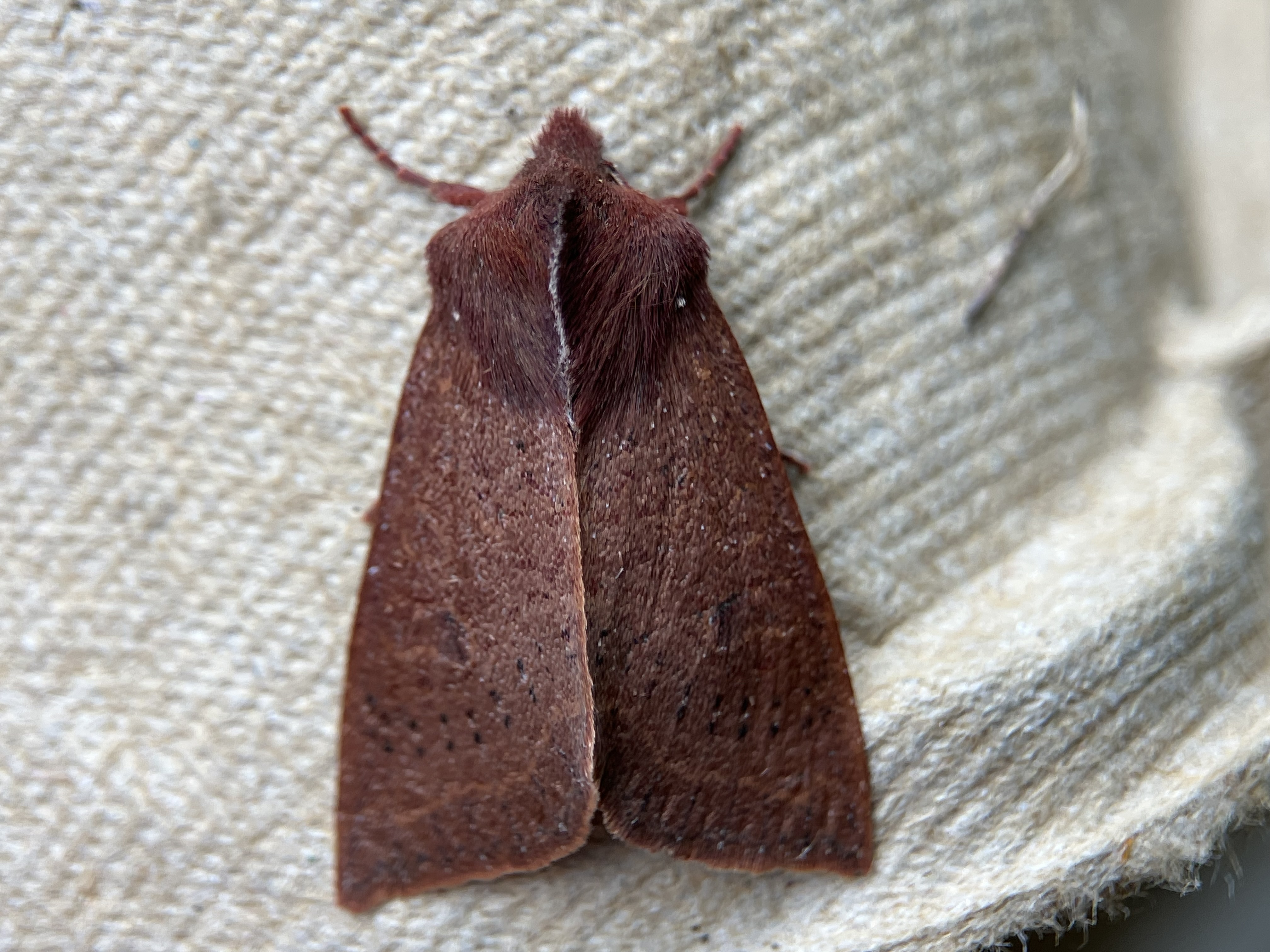
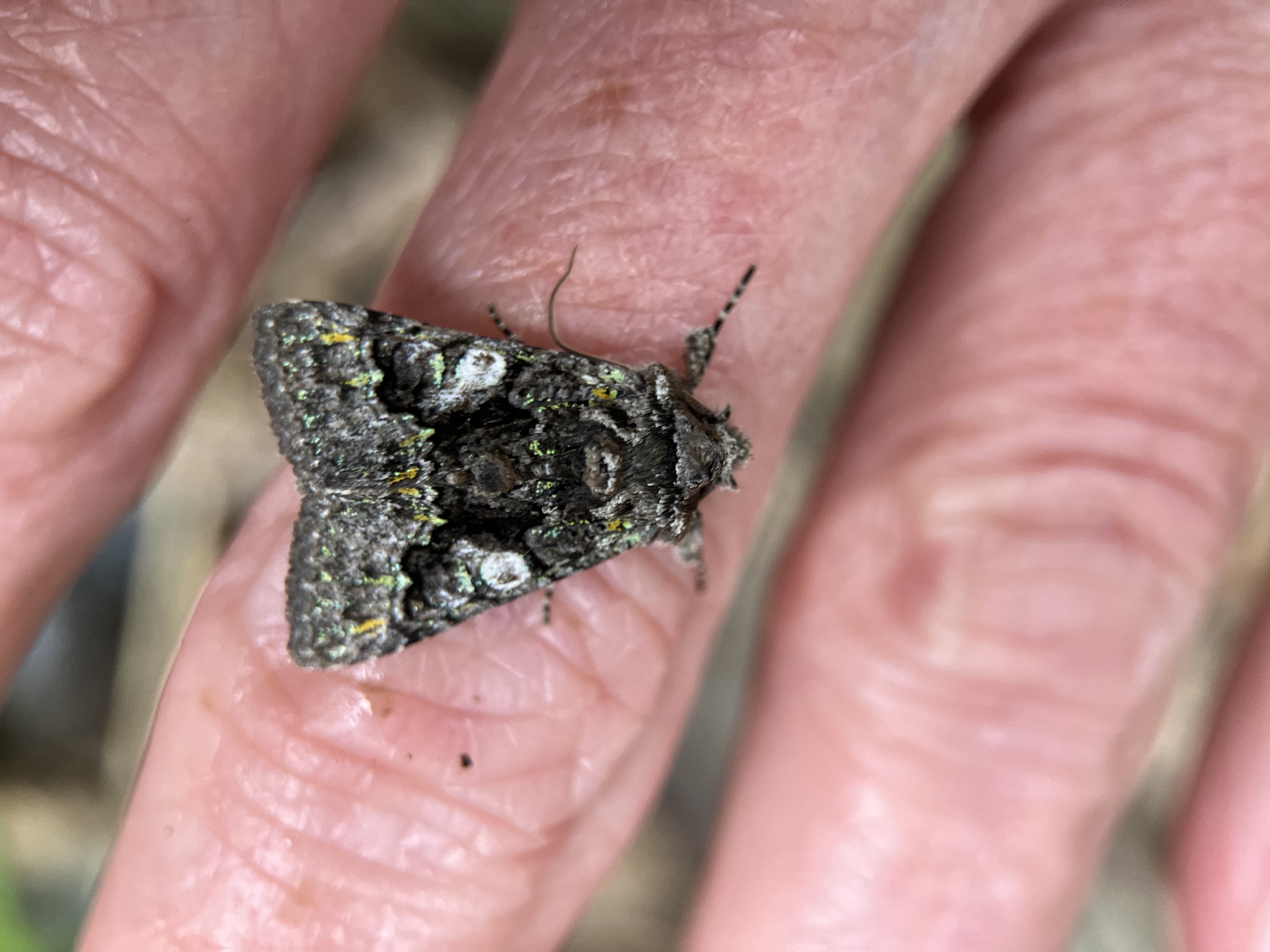
After I checked on the bird, I did go and look at my moth bucket. There were 7 specimens. Not many, but I went through them and here’s what I found. Six moths and one wasp.

Cerastis enigmatica, the Enigmatic Dart Moth
Orthosia hibisci, the Speckled Green Fruitworm Moth
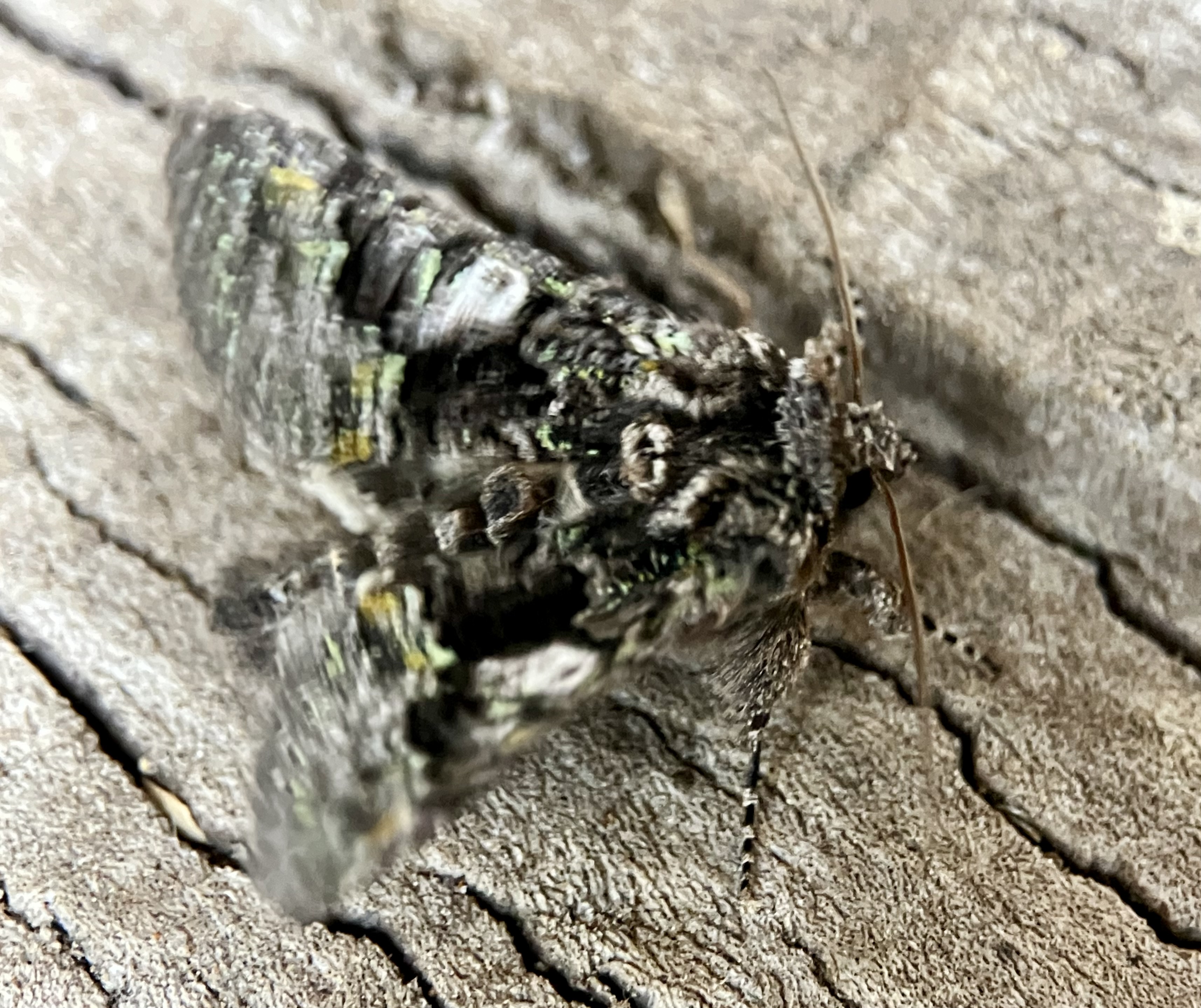
Egira crucialis , I believe. Egira for certain though
Orthosia sp. I am undecided about species for this one.
Ophion wasp.

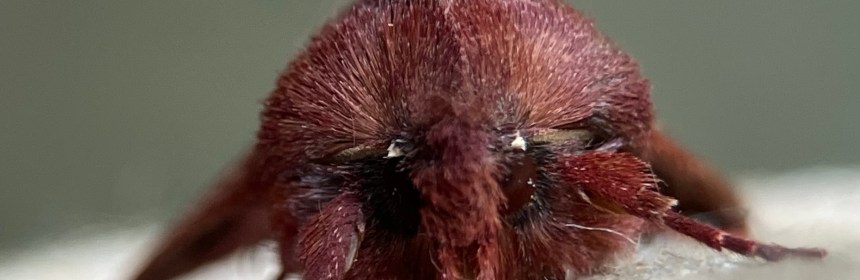
The next moth below looks like it has a little pixie cap on. It’s one of my favorites. The red colors are so pretty. It’s in genus Orthosia like some of the others above, but I believe this one is Orthosia transparens.

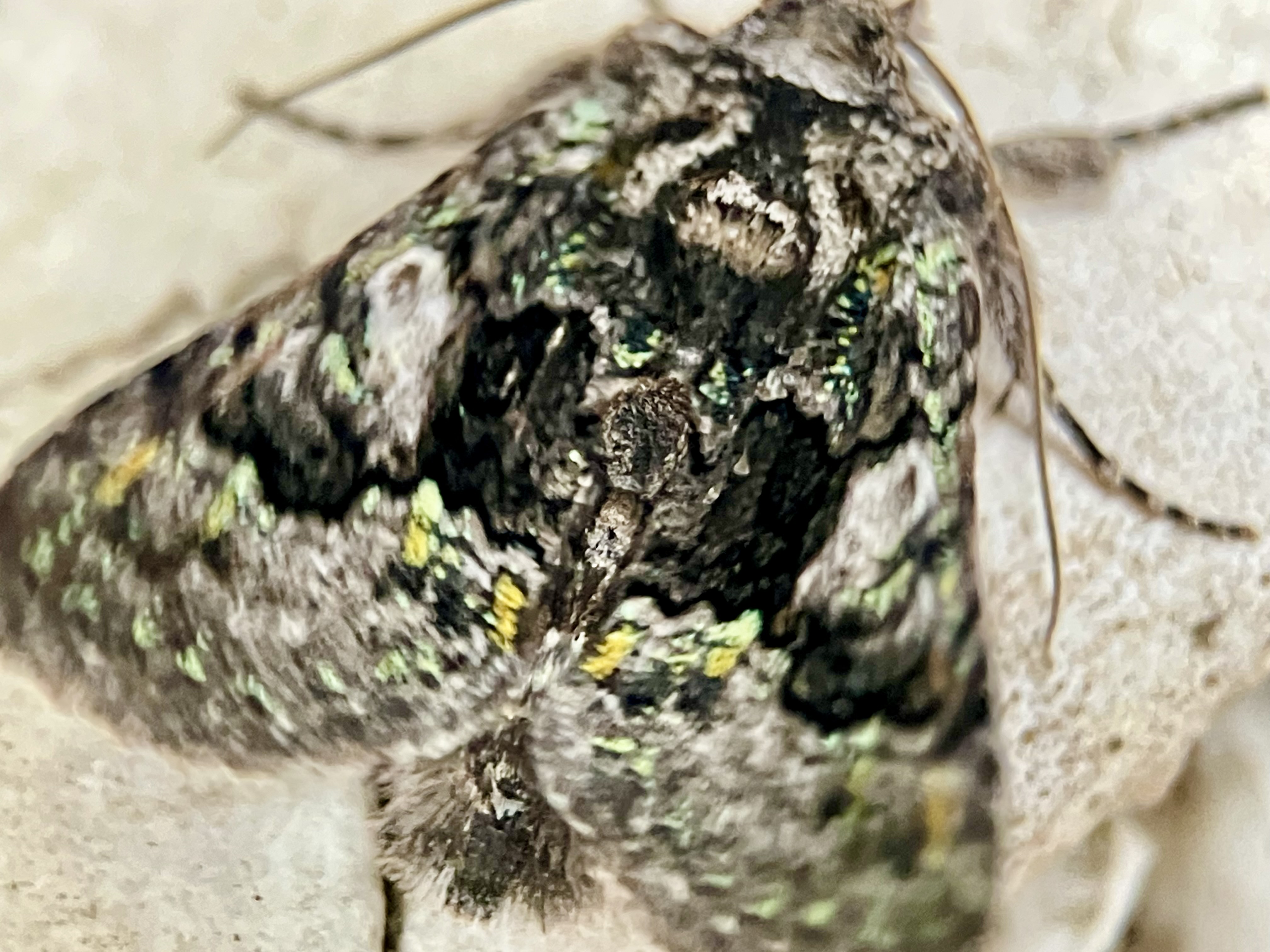
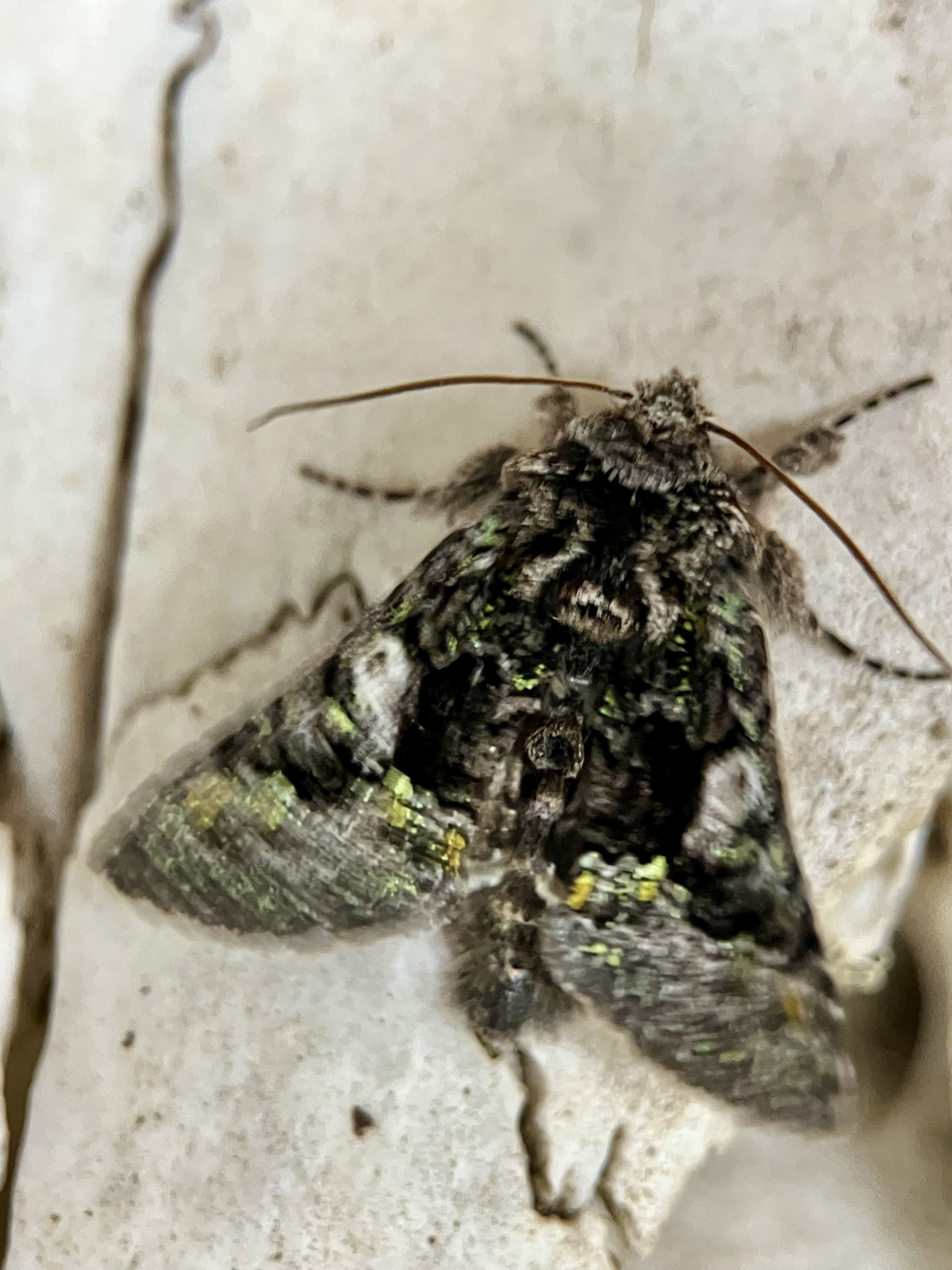
I saved the best one for last. I have only seen this moth on two other occasions, but it one so remarkable, you remember it well. This is an owlet moth called Behrensia conchiformis. I would love to discover what makes the interesting metallic colors in the wings. The larvae of this species are foodplant specialists. They feed only on honeysuckle (Lonicera spp.) and snowberry (Symphoricarpos spp.) in the Caprifoliaceae.

Thanks for reading…especially for reading my rambling rants of the day. While I’d like to stick to just bugs, I am finding it somewhat therapeutic to include my feelings here, and to interject some of my opinions. They are mine and yours may be different. I respect that, but I hope perhaps upon reflection, even someone who might initially disagree with my perspective, might have a change of heart.

Where ARE all the pollinators?

Yellowish Cuckoo Bumble Bee (Bombus flavidus)

Lots of folks are asking, “Where are the pollinators?”  I’m getting comments and questions about the absence of bees.  Should we be concerned? Probably.

It’s been a weird spring/summer with lots of temperature fluctuations.  That impacts when things bloom and what food is available.  Bumble bees can fly when the temperatures are lower and I did see and hear them when our Golden Chain tree was in full bloom about two weeks ago.   They may be on other blooming florals right now – like blackberries.  If you have Catmint (Nepeta), Lavender, and Tomatoes or Nasturtiums about, the bumble bees should find these in another week or so.   Usually I see them on Foxglove (Digitalis) and also in our Rhododendrons, but Foxglove is biennial and we don’t have any blooming this year, and I believe the Rhododendrons are already done blooming for the season.

In general though, I am noticing an overall decline in abundance of many insect species.  We have two above ground, freshwater pools for water catchment and in years past, there have been lots and lots of insects needing rescue because they fell in and couldn’t get out.  I was skimming bugs twice a day and this year, I might have found 4 or 5 needing rescue.  That’s 4 or 5 total – when I used to find 20-30 floating in the morning.

That said, there are a few species where populations seem quite abundant.  I’ve found lots of the tiny and very cute Broom Seed Beetles (Genus Bruchidius) everywhere in the yard.   If you see these little black peppercorn-sized beetles, they are friends (a biocontrol for scotch broom).  

Broom seed beetles on Nasturtium

So, is the overall decline in invertebrate populations because of climate change or something else?  I think the decline of invertebrate species is due to a multitude of factors:  habitat loss due to land use changes, weather fluctuations/climate change, introduction of pathogens as species move into previously unoccupied territory (due to climate shifts), but especially from pollution and contamination by all the products we use. These are additive and include anything and everything that leaves trace residues behind.   It’s multifactorial and complex.  Humans and our practices are altering ecosystems.  

How to help?  I don’t have any great answers.  Can the few who actually care initiate changes and change the minds of the masses of people who don’t care and don’t want to change?  Our education system isn’t helping.  We continue to promote attitudes (even as adults who should know better) that evoke fear responses around insects, spiders, (and don’t even get me started on snakes) in our children.  Instead of teaching children about ecology, biology, and life sciences, we shriek when we see a spider or a roach or mosquito and grab the can of raid.   We want to garden and seek out gardening advice, but historically, even the extension communities have been pretty un-environmental in their approach to insects.  For that matter, most of our Land Grant Universities’ agricultural and entomology  departments have been funded by the large agrochemical industry.  They have promoted use of pesticides over cultural practices.  The agrochemical industry makes tons of pesticides that are applied all over the world every year.  It’s a huge part of our economy.  MONEY trumps nature.

My advice? Be curious about what you are using.  Learn about ecology and food webs.  OBSERVE nature.  Investigate where your food comes from.  When you buy garden or landscape plants, ask the company about what practices they are using to grow these plants.  Choose native plants for landscaping.  Look around your home and read the labels on what products you are using – especially for any products going down the drain.   If you have pets, look up the ingredients on the products you use for treating fleas and ticks.  Flea and tick treatments have neonicotinoids that are excreted in urine and poo.  Ask your vet about alternatives. We all need to think about the implications of this.  Neonicotinoids are killing our pollinators and other invertebrates.  

References and further reading

Bonmatin JM, Giorio C, Girolami V, Goulson D, Kreutzweiser DP, Krupke C, Liess M, Long E, Marzaro M, Mitchell EA, Noome DA, Simon-Delso N, Tapparo A. 2015. Environmental fate and exposure; neonicotinoids and fipronil. Environ Sci Pollut Res Int. Jan;22(1):35-67. doi: 10.1007/s11356-014-3332-7. Epub 2014 Aug 7. PMID: 25096486; PMCID: PMC4284396. https://pubmed.ncbi.nlm.nih.gov/25096486/

Webb DT, Zhi H, Kolpin DW, Klaper RD, Iwanowicz LR, LeFevre GH. 2021. Emerging investigator series: municipal wastewater as a year-round point source of neonicotinoid insecticides that persist in an effluent-dominated stream. Environ Sci Process Impacts. May 26;23(5):678-688. doi: 10.1039/d1em00065a. PMID: 33889902; PMCID: PMC8159912. https://www.ncbi.nlm.nih.gov/pmc/articles/PMC8159912/

University of Sussex. 2020. Pesticides commonly used as flea treatments for pets are contaminating English rivers. ScienceDaily. 17 November http://www.sciencedaily.com/releases/2020/11/201117085940.htm https://www.sciencedaily.com/releases/2020/11/201117085940.htm#:~:text=Researchers%20at%20the%20University%20of,far%20exceeded%20accepted%20safe%20limits

Beyond Pesticides. 2018. Victory! State Finds Imidacloprid Insecticide Too Risky For Use in Willapa Bay. Daily News Blog. https://beyondpesticides.org/dailynewsblog/2018/04/victory-imidacloprid-risky-use-sensitive-bay-permit-request-denied/

Beyond Pesticides. 2017. Poisoned Waterways. https://www.beyondpesticides.org/assets/media/documents/bp-37.1-PoisonedWaterways-cited2.pdf