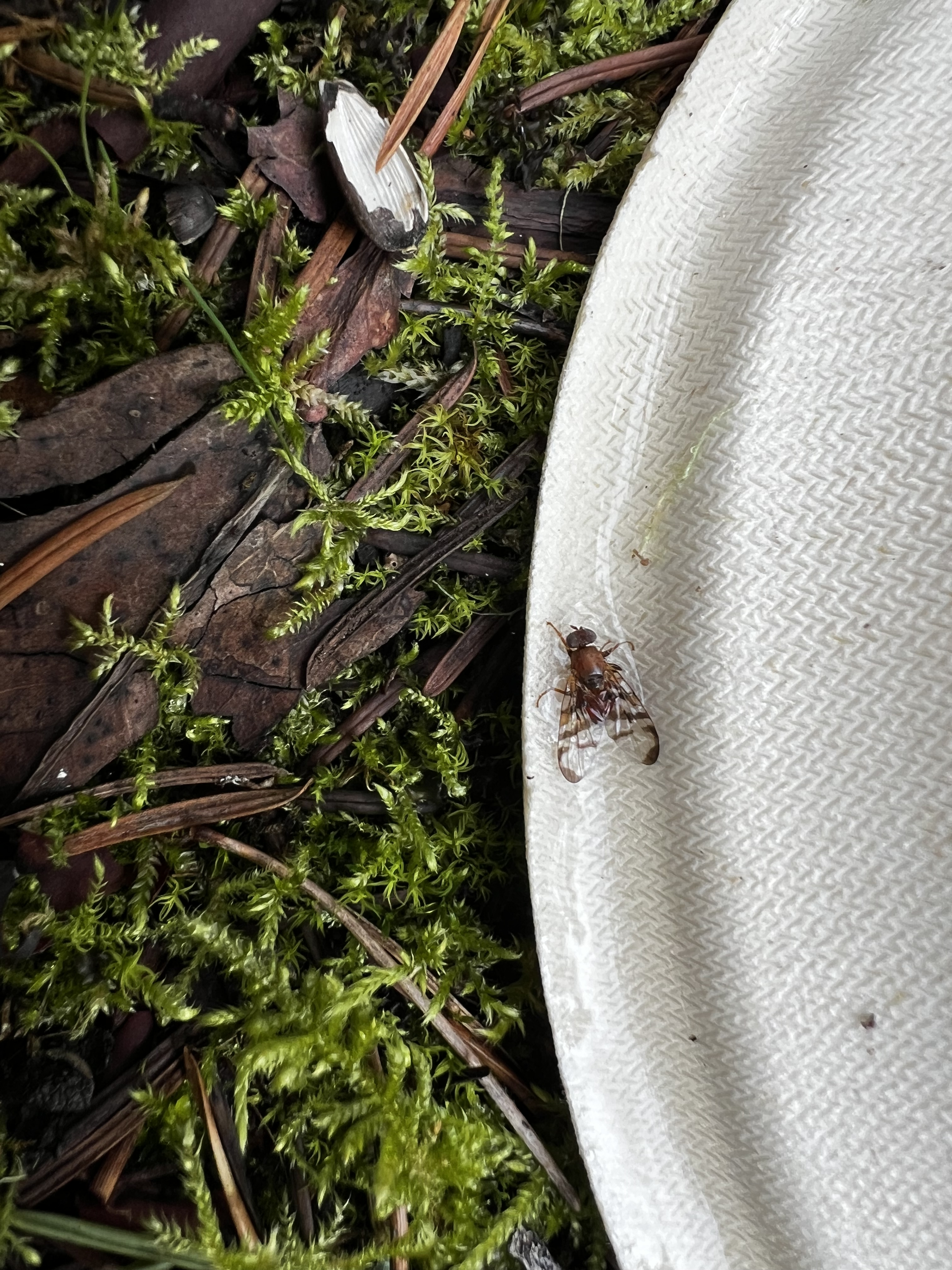
Here’s a unique specimen I have to show you. I found this fly on Wednesday after lunch when I went to look for a different species of fly around our above ground pool. I was actually looking for Woodpecker Flies when I found this one. Since I’ve committed to doing a presentation about them for the Scarab Society in September, I’m hoping to observe these weird Woodpecker flies again in the wild and take additional photos and videos to add to what I have collected already.
I didn’t expect to see anything IN the pool. Mostly, I was looking at vertical surfaces, like the sides of the pool and the sides of a nearby tree. When I glanced across the surface of the water, this little one stood out right away. I got a paper bowl to gently scoop it out, expecting it was deceased. It surprised me when it moved just a bit, then wiggled and flipped off the bowl onto the ground.
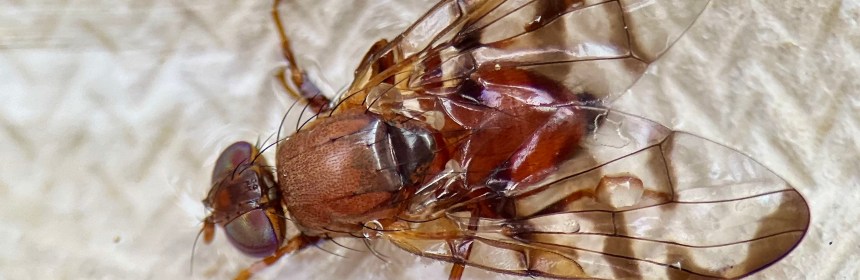
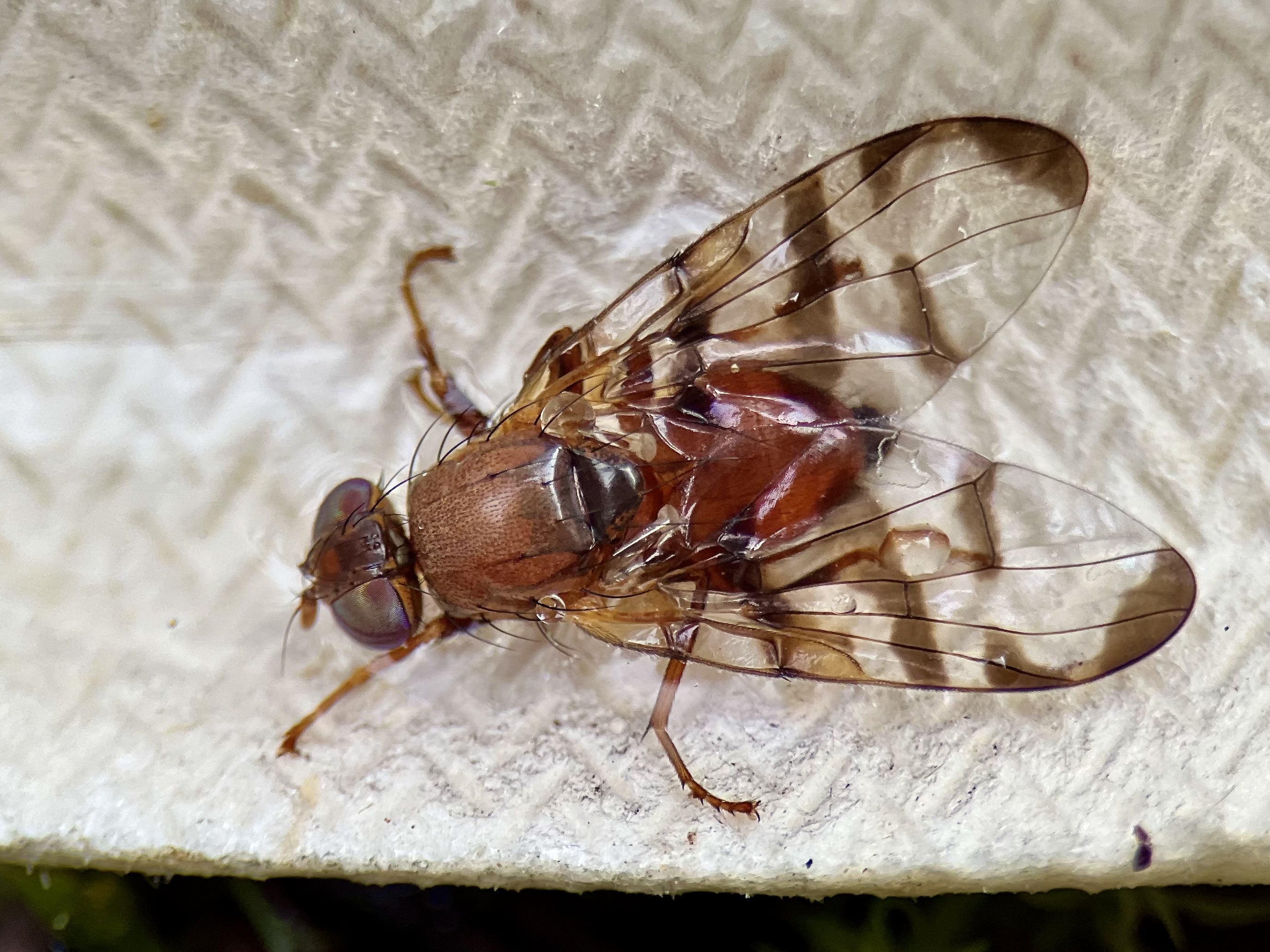
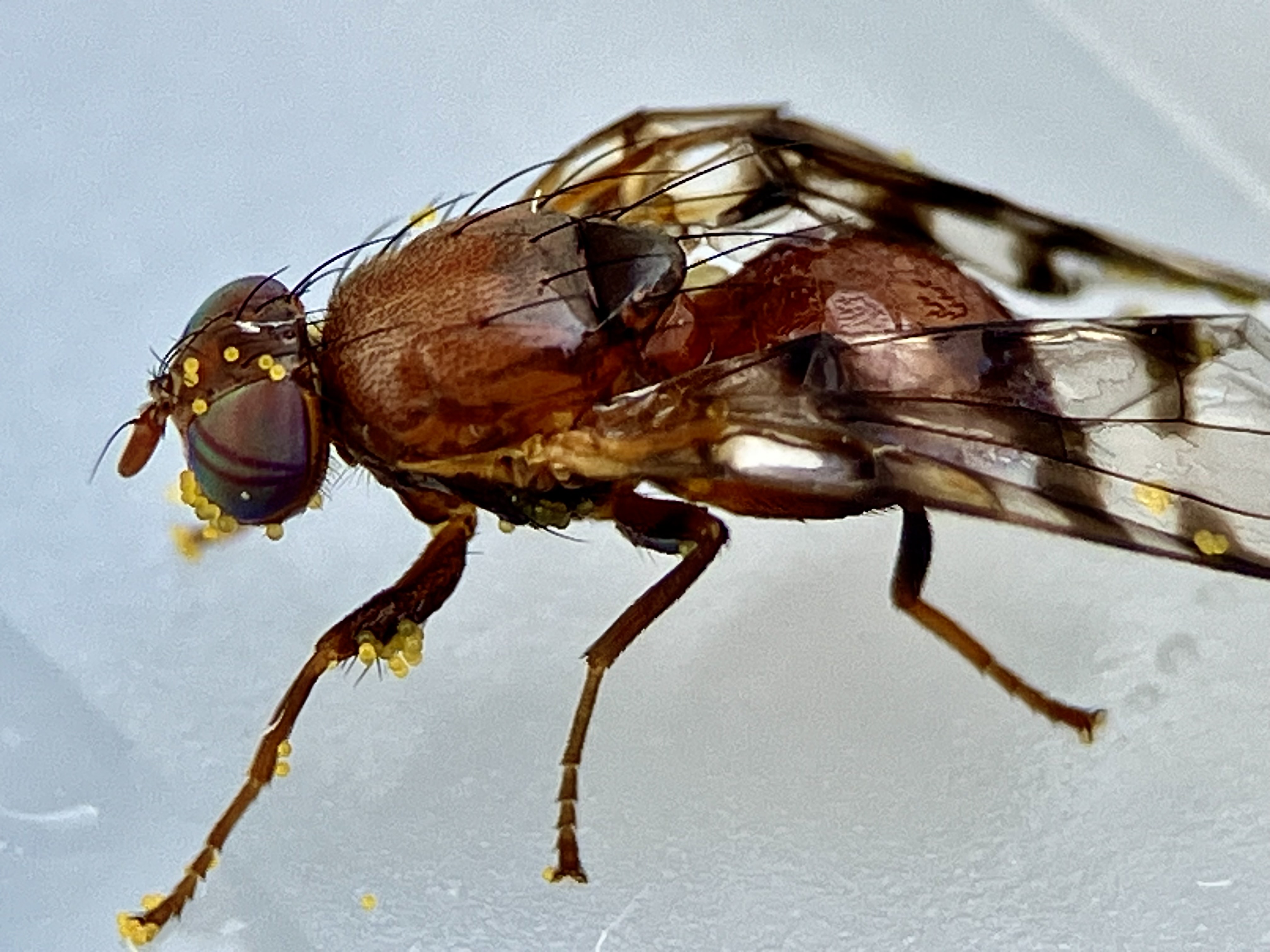
Chetostoma californicum
I bent down to inspect it, and when I touched it, it flipped around again like a fish out of water. Strange.
I had a plastic cup, so I managed to recapture the fly, wet and bedraggled as it was. I took it back into the house long enough for me to get my other camera. The lighting was better outside, so back out we went.
In case you are wondering, this is one of the Picture Wing Flies in the family Tephrididae. Also known as Fruit Flies. “Picture” references the patterned spots or stripes on the wings. There are other flies, like Drosophila sp., called fruit flies that aren’t actually fruit flies at all. THIS is a true fruit fly.
Many species of fruit flies are known for their pest status, however, there are over 4,300 described species in this family and the great majority of them are not pestiferous at all. They are merely a part of the local, natural ecosystem at large.
I used a key and geographic distribution records to determine the species for this one and believe it to be Chetostoma californicum. Trying to find host plant information led to me to do some deeper digging and to actually order a few more reference books on Tephridid flies. I have another fruit fly specimen I found when we were in Mexico, and plan to share that one with you next Friday. As I learn more about this particular one though, I will update my blog post accordingly.
The reference material I did find about Chetostoma californicum was largely from California and Arizona. Inferring from the documented host plant relationships recorded, it is likely one relationship possible in our immediate area is with native honeysuckle (Lonicera sp.). I also read adults of this species have been collected from Pines (Pinus sp.). We have a Pine tree just next to our above ground pool where the fly was collected.
Chetostoma californicum, identified by the oral edge of bucca (cheek) with a row of about 10 coarse, black bristles with a few finer black setae at the posterior end of the row. (LeBlanc, 1959)
The only additional personal record I have of this fly on San Juan Island is from February 16, 2024. I would conclude, based on my own observations, that this fly is not particularly an abundant species here. In checking for reports of the species on San Juan, my two posted observations are two of three total for the county.
Now if I can just find out what’s behind the fish flippy behavior…..stay tuned!
Chetostoma californicum (with pollen stuck to it after I accidentally dropped it into a Crocus flower)
Cole, F. 1969. The Flies of Western North America. University of California Press. Berkeley and Los Angeles.
Foote, R.H. and Blanc. F.L. 1963. The Fruit Flies or Tephritidae of California. Bulletin of the California Insect Survey. University of California Press. Berkeley and Los Angeles. https://essig.berkeley.edu/documents/cis/cis07.pdf
LeBlanc, 1959. A new species of Chaetostoma from California (Diptera: Tephritidae). Pan-Pacific Entomologist. 35:201-204. https://biostor.org/reference/225819
Wasbauer MS. 1972. An annotated host catalog of the fruit flies of America north of Mexico (Diptera: Tephritidae). Occas. Pap. Calif. Dep. Agric. Bur. Entomol. 19:1–172.
Spring has arrived and with it comes beautiful daffodils popping up across the landscape, but also pollen, windy days, and those dreaded allergies many of us suffer from. I’ll bet as you’re reading, you’re might visualize little pollen grains as daggers that blow up our noses and make us sneeze! Personally, when I visualize pollen grains, I picture them as the equivalent of microscopic land mines. Even though pollen grains can be quite unique when viewed under a microscope and cause quite SHARP “achoo’s” into that handkerchief, there’s another DAGGER you’ll have to go search for in those daffodils.
Rhamphomyia fly – Dagger Fly on Daffodil
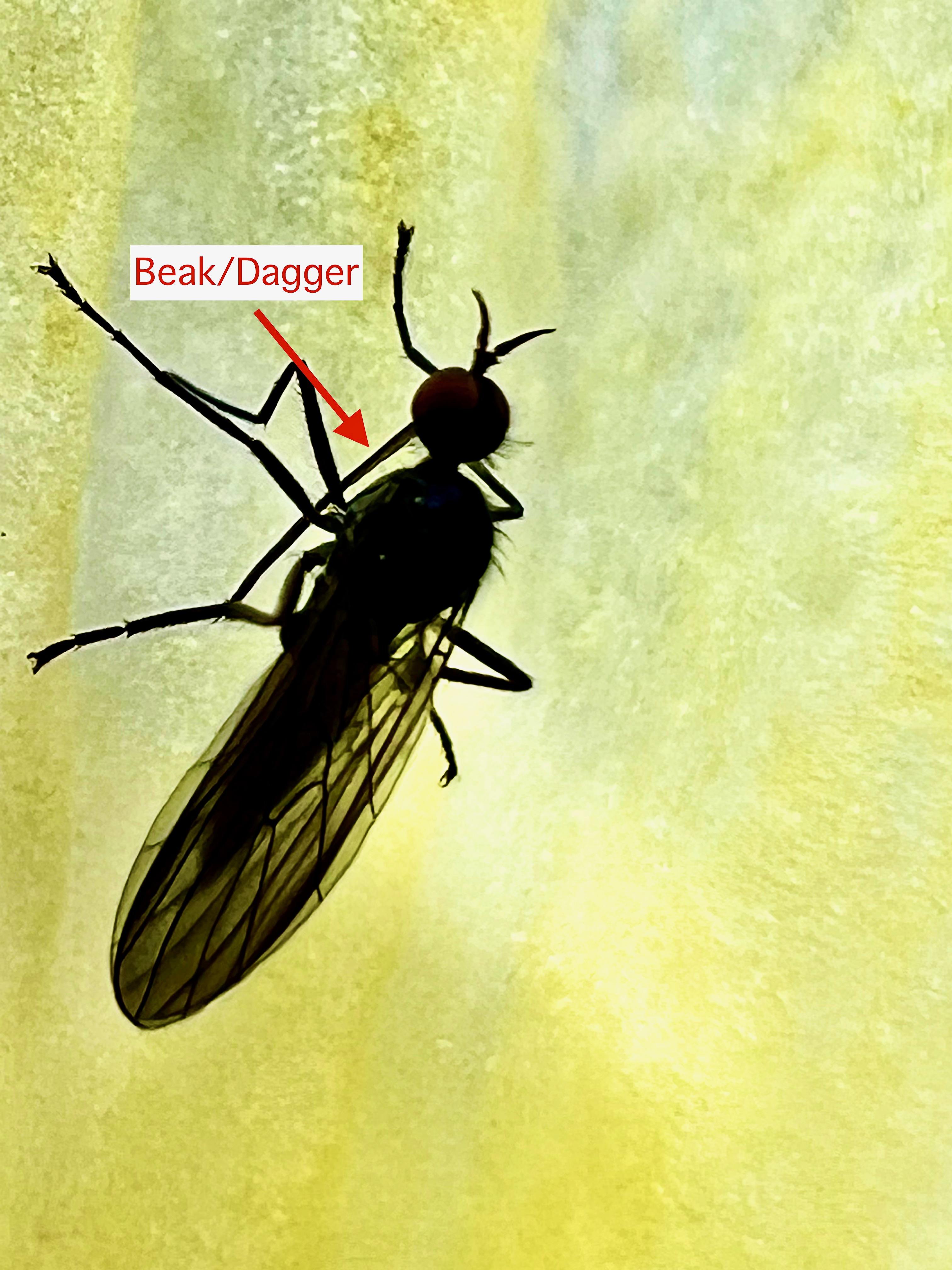
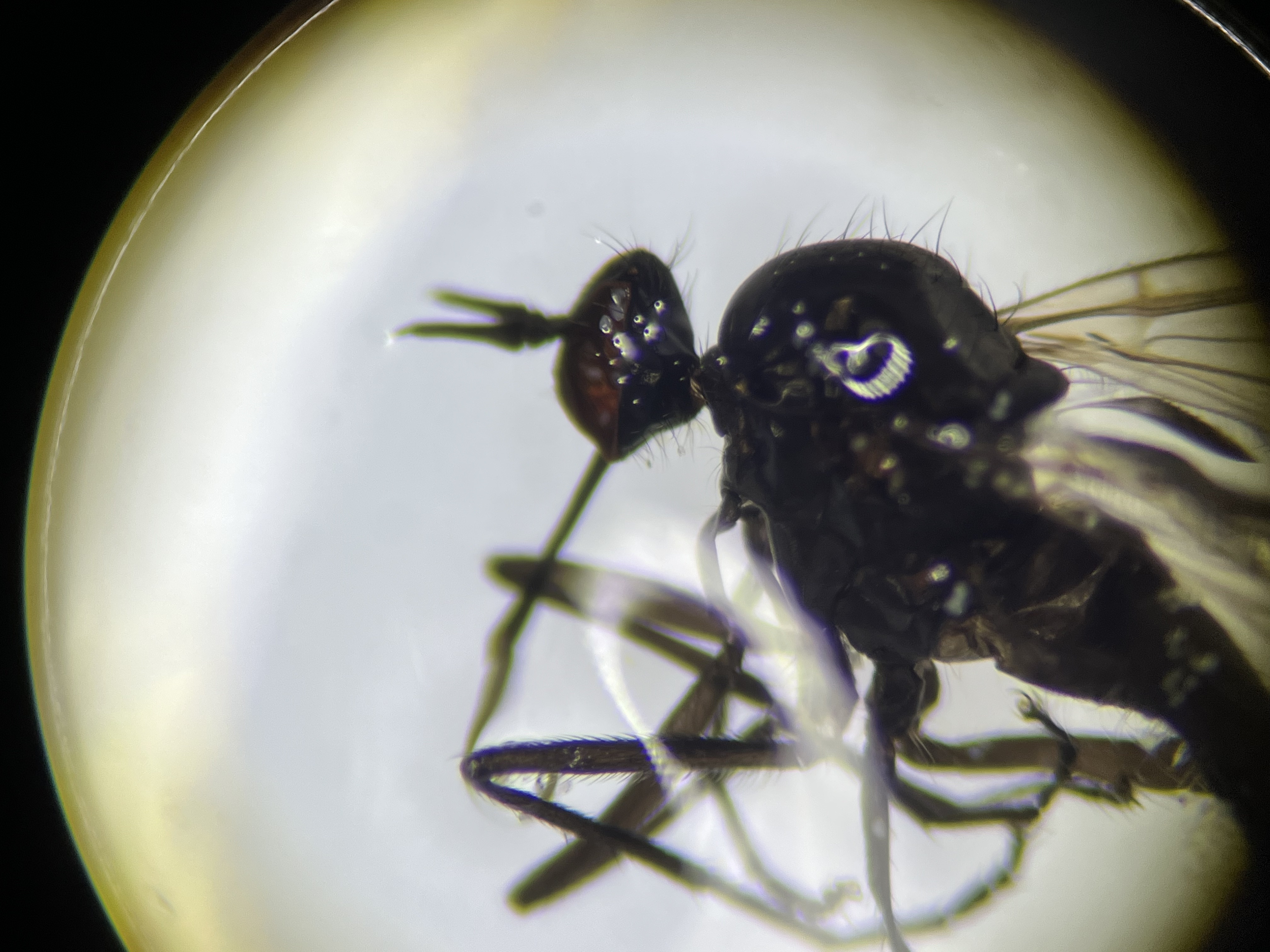
When I first saw this bug and took some photos with my phone, I didn’t realize that EXTRA leg was not a leg at all, but a beak of sorts. More close up photos yielded some images of this particular specimen that reminded me of the sinister hood worn by doctors during the Plague that looks like a giant bird beak.
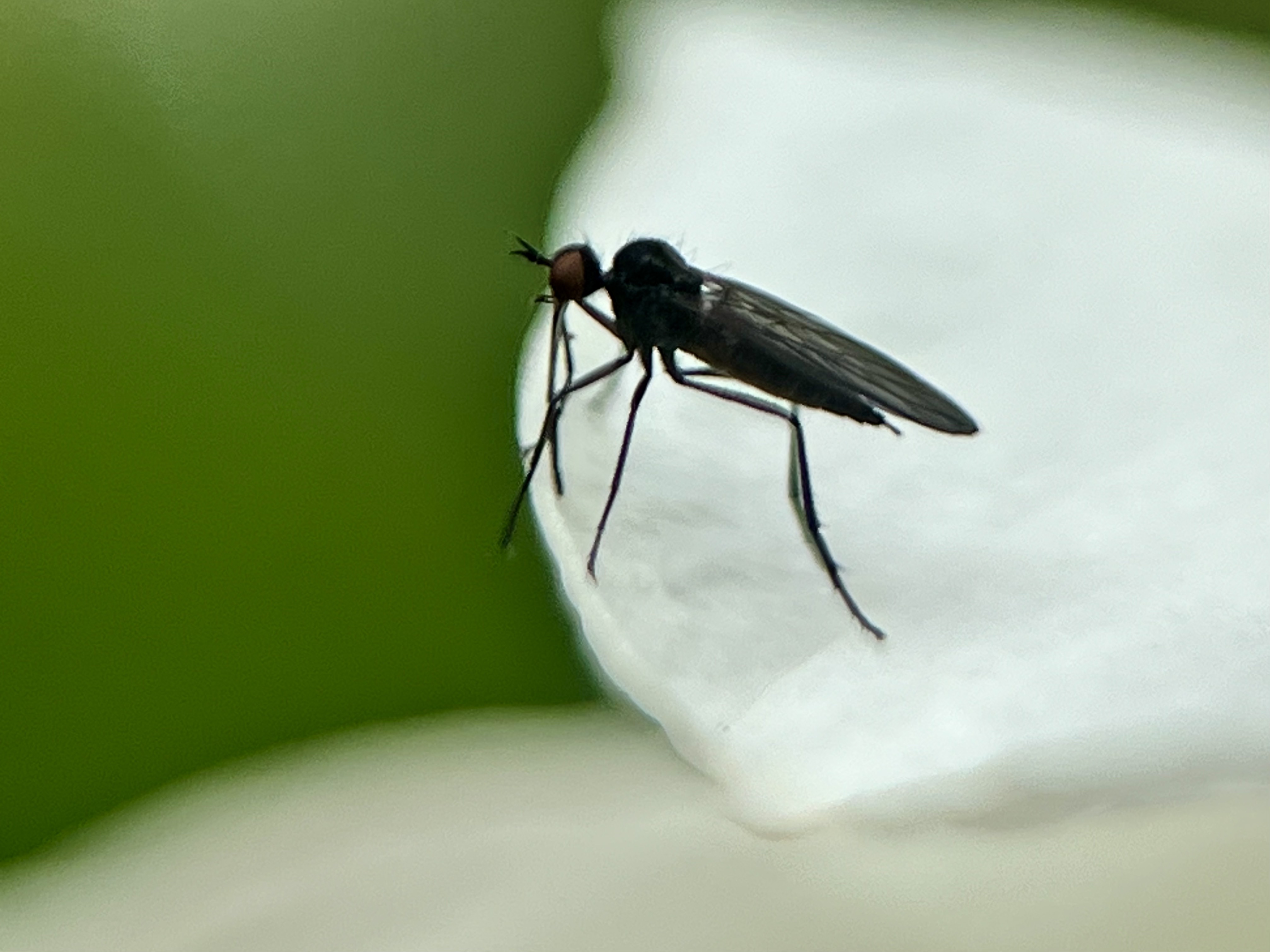
This BUG I found in the daffodils with the strange “beak” or proboscis, a scientific term for an appendage-like mouthpart of an organism, is a type a fly. The common or vernacular moniker being Dagger Fly.
Rhamphomyia fly – Dagger Fly on Daffodil
From here, I’ll take you through my process of determining the fly’s classification. First off, to understand it is a FLY, you must look at the number of wings. Flies are taxonomically categorized into the insect order Diptera. Di=two and ptera = wings. Two wings or one pair of wings = FLY. Now the Flies or Diptera are an enormously diverse and large group of organisms. Fly classification or taxonomy is one of the hardest groups I’ve ever worked through and in my rudimentary assessment, I managed to identify my specimen as far as the Family Empididae or the Dance flies. This fly wasn’t exactly “dancing” though. It was poking its beak around in the daffodil, and there were several of them in one flower – all doing exactly the same thing.
At this point, I turned to the fly group I belong to on a popular social media site. I posted my photos with date/location/and my suggested family (Empidiae), then asked if someone could help me with further classification. About two days later, I checked back. The suggestion in the comments was for Genus Rhamphomyia. It would be particularly challenging to identify this particular fly to species. Bugguide.net cites Arnett’s American Insects: A Handbook of the Insects of America North of Mexico, stating there are over 400 undescribed species in our area with 450 undescribed worldwide.
While Genus Rhamphomyia falls under the Empididae or dance flies, Rhamphomyia translates from Greek rampho ‘beak’ + plus myia ‘fly.’ Beak flies they are indeed!
Dagger Fly (Rhamphomyia sp.)
Delving past the taxonomical classification of the genus I discovered some interesting bits of information involving mating behaviors. Like other groups of flying insects, males and females will often form swarms of groups, sometimes referred to as leks. In the Rhamphomyia, these groups can be either all male or all female (a reversed-role lek) or mixed.
If the group is single sexed, it may be the opposite sex does not form a group, but rather enters the single sex group to select a mate. There may also be a group of females and a nearby group of males and individuals from each group will leave and mix with the opposite sex group to choose a mate. Different species of this genus may swarm at different times of the day. Some species may spend the entire day swarming, while others only a select time such as right before dusk or early morning. Swarm locations are selected around some sort of visual marker or landmark which may range from very specific ( a particular branch or limb overhanging a pond) or quite general (the southern slope of a hillside adjacent to a stream or a farm field).
The most intriguing behavior is the habit of male flies to collect and bring nuptial gifts to a female. Alcock (2016), describes this fascinating ritual where female flies gather in swarms low over open woodlands, high in treetops, or over grassy hayfields in early morning or late evening. The swarms lasted 1-2 hours each with female Rhamphomyia flies holding their highly ornamented legs wrapped around their abdomens. In these swarming female groups, males enter and gift their selected female a small insect for her to consume. Examples of tiny insects selected for nuptial gifts include drosophila flies, small syrphid flies, or tiny caddisflies (Alcock 2016). Kuiter, Findlater-Smith, and Lindhe (2017) recorded nuptial gifts to include “fungus-gnats (Myctophylidae), crane flies (Tipulidae), other Empididae flies, and occasionally small moths (Lepidoptera). ”
Reading a bit more led me to Funk and Tallamy (2000) who describe the plight of the female Dagger fly. She is unable to hunt for prey and wholly dependent on these nuptial gifts of protein necessary for development of her offspring. In the swarming leks, she seeks these nuptial gifts from male suitors in exchange for copulation.
While I didn’t witness the formation of swarming leks of these flies, I did find some handsome daggers hanging out in the daffodils. I kept reading and found they can use their beaks not only to pierce small insects, but also to pierce and extract nectar from flowers. As they feed, pollen collected on their bodies may be distributed to other flowers (Sezen 2015).
Rhamphomyia Dagger Fly on Daffodil
Probably the grand finale in my literature search yielded the paper written by Kuiter, Findlater-Smith, and Lindhe (2017) titled Pollination of the Bearded Greenhoods (Orchidaceae) by Dagger Flies (Diptera: Empididae). They describe a unique relationship between the orchid and another species of Dagger Fly. Located in Victoria,Australia, the authors document the case of mistaken identity – the male dagger fly is lured to the orchid by both chemical and physical attributes mimicking the female fly’s sex pheromones and her morphology.
While daffodils aren’t the orchid described by Kuiter et al, (2017), I considered their observations to offer one possible reason the flies I found could become so awkwardly stuck. Kuiter et al. (2017) suggest the flies observed bringing nuptial gifts to the Bearded Greenhood orchid (Pterostylis plumosa) are attracted by the orchids’ kairomones which mimic the Empididae female flies’ sex pheromones. In the case of this particular orchid, the hairy labellum inside the flower head acts as a visual cue, arousing the male who mistakes it for the hairy legs of a female Empididae fly (Kuiter et al, 2017). They believe the bearded orchids may have evolved the hairy labellum for holding the nuptial gift of the male fly just as females of the fly species have hairy legs for receiving the nuptial gift – a very species-specific relationship ensuring the orchid is pollinated.
I believe this relationship provides a possible explanation (at least for me) as to why I found deceased flies stuck within the filaments and stamen inside several daffodil flowers. I actually found four flowers with stuck flies, so it seemed more than merely coincidence. Is it remotely possible the species of male Dagger fly I found mistakes parts inside the daffodil flower for a female fly and cannot extricate himself from the situation? Mistaken identity? Or, did he merely shelter there in the cool of the night and expire in slumber? https://nossaorg.files.wordpress.com/2017/05/finalbeardedgreenhoodpollinatorlrs.pdf
Rhamphomyia Dagger Fly in DaffodilRhamphomyia Dagger Fly in Daffodil
I’ll end with a note of my own. Many of these relationships between plants and pollinators are highly complex, understudied, and/or, as in this group of flies, un-described. Many species of plants and animals, including and especially pollinators, are under immediate threat due to climate change, habitat loss, and land use changes. You can help by minimizing your impact and changing long-held habits. Avoid clearing around your property, try the “no-mow” approach. We mow only trails and leave the rest. Plant native plants, leave brush piles instead of making burn piles, build a smaller home, be a smart consumer. We are altering systems that enable our own survival. Get outdoors and learn about the diverse life that shares your space. Check out the iNaturalist app and see what you can record in your own backyard. These unseen living critters around us are unique, intriguing, and worth saving!
Thanks for reading!
View more photos in my Dagger fly gallery here:
Rhamphomyia Dagger Fly in DaffodilRhamphomyia Dagger Fly in DaffodilRhamphomyia Dagger Fly in DaffodilRhamphomyia Dagger Fly on DaffodilRhamphomyia Dagger Fly on DaffodilRhamphomyia Dagger Fly on DaffodilDeceasedRhamphomyia Dagger Fly in DaffodilDeceasedRhamphomyia Dagger Fly in DaffodilDeceased Dagger fly under microscopeDeceased Dagger fly under microscopeDeceased Dagger fly under microscope
Vocabulary
Leks – aggregation of (male) animals gathered to engage in competitive displays and courtship rituals, known as lekking.
Kairomone – allelochemicals where the chemical signals are favorable to the organism that receives the signal. A familiar example is the lactic acid component of human sweat that attracts the mosquito Aedes aegypti (Augustin, 2016).
Morphology -the study of the form and structure of organisms and their specific structural features.
Pheromone – semiochemicals that influence the physiology or behavior of members of the same species. They include sex attractants, alarm substances, aggregation pheromones and trail markings (Augustine, 2016).
Proboscis– tubular feeding and sucking organ of certain invertebrates such as insects.
References and Further Reading
Alcock, J. The Mating Behavior of an Undescribed Species of Rhamphomyia (Diptera: Empididae). J Insect Behav29, 153–161 (2016). https://doi.org/10.1007/s10905-016-9545-5
Funk, D. H., & Tallamy, D. W. (2000). Courtship role reversal and deceptive signals in the long-tailed dance fly, Rhamphomyia longicauda. Animal Behaviour, 59(2), 411–421. doi:10.1006/anbe.1999.1310 10.1006/anbe.1999.1310
Mischenko, M. and Frostic,M. 2009. Scanning Electron Microscope Still Image of Pollen Particles. Scientific Visualization Studio. NASA/Goddard Space Flight Center. https://svs.gsfc.nasa.gov/10394
Did you know spiders don’t just eat bugs? That’s right! You can amaze your friends when you share your knowledge about our eight-legged friends chowing down at the salad bar.
Spiderlings with Pollen Plates Orb Weaver Spider on Web
Researchers have observed various species of spiders (over 60 species worldwide) feeding on plant foods to supplement their invertebrate prey (Nyffeler et al. 2016). What exactly does this mean? Are they going to eat the leaves of your garden plants? Nah! Not to worry. They are primarily pest predators in your garden – little helpers to keep those aphids away.
Spiders have long been thought to only consume insects and other invertebrates. However, in recent studies, we are finding this isn’t entirely the case. Observations of spiders foraging in nature has broadened our understanding of the diets of our arachnid friends. Our prior assumptions were incorrect. Spiders actually eat pollen grains, floral and extra-floral nectar, Beltian and Müllerian bodies (structures produced by plants on their leaf tips or petioles, plant sap, honeydew (a plant-derived sugar produced by homopteran insects like aphids), seeds, spores, and even the vegetative material in the guts of their invertebrate prey (Nyffeler et al. 2016).
Tree Pollen collected in ground vegetation
I found several papers on this topic, but one of the most interesting to me talked about how pollen is an important source of protein for spiders in early spring when prey may be scarce. It also pointed out that pollen is a critical food source for newly hatched spiderlings. Baby Orbweavers for instance. We have these here in the San Juans. They are delightful!
Orb Weaver Spiderlings on my garden chair
Well, since the pollen floats through the air, quite a lot will stick to webs, landing exactly where the little spiders can easily access it. Smith and Mommsen (1984) even found that Orb Weaver spiderlings doubled their life expectancy by eating pollen. Eggs and Sanders (2013) concur that pollen is an important dietary supplement for Orb Weaver spiders and found that juvenile orb weaving spiders’ diets consist of approximately 25% pollen.
So, now you know! Our little spider friends, or some of them at least, are more complex than we knew. It’s a good reminder about how important it is to eat a varied and healthy diet. We can put this into practice ourselves. Good nutrition is vital for health and survival – for all living beings.
Nostalgia reigns over the little European (now re-named Western) honey bee (Apis mellifera). We think of honey in terms of “liquid gold” or perhaps reminiscent of A.A. Milne’s Winnie the Pooh, gobbing it all over himself as he dips his paw into the honey jar. Honey bees are indeed important pollinators, and the economic driver of the honey industry. You can stick the almond industry in along with them because, “without honey bees, we wouldn’t have almonds, right!” More on this if you keep reading.
If you delve into how we use honey bees for pollination, it’s hard not to be sympathetic to the plight of the honey bee. Going back to the almond industry, I can tell you it isn’t pretty. Here, and in other monoculture systems, the honey bee must collect pollen and nectar from one, single, solitary food source. Then that bee and her hive family are loaded onto a truck with many other hives, and delivered to yet another industrial monocrop to do the same thing again. Maybe this time it’s an apple orchard, or soybeans, or sunflowers. In every instance though, the nutrient deficiencies can’t be ignored. Honey bees need a diverse array of nutrients just like every other living organism. They aren’t healthy because of how we are keeping (and exploiting) them (McGivney 2020).
The honey industry brought in $321.22 million U.S. dollars in 2021 (Statistica, 2022). They are packed and stacked in boxes, driven across the country, unloaded in unfamiliar territory, hunger staved off temporarily with a jar of high fructose corn syrup, or sugar water (if they’re lucky), while they familiarize themselves with the new surroundings, and are off to work immediately. They are unpaid transient workers. Valued, and needed, but treated much like the migrant workers we count on to move about the country picking our food crops.
Of course, we are told, the nation won’t eat if we don’t have bees! Partly, this is true. The part that needs clarifying is, Which bees exactly do we need to pollinate our food crops?
I’ll disclose here that I am a former honey bee keeper. Former being the point! I quit. I became enlightened. Not by the unrealized dreams of liquid gold, not from stings received, but rather by the dings of my brain firing at the connections I started to make from my observations and from searching for scientific literature that supported what I was observing.
When I was working on my MS in Entomology and Nematology from the University of Florida, I took a beekeeping course as part of my curriculum. Part of the requirement for the course was to shadow other beekeepers and set up a hive of my own. I enthusiastically set off on these tasks. Keeping my own hives was an incredibly fascinating experience.
Here in our island community, I mentored high school students who set up a hive at the community garden and gave several public talks to various organizations as part of their senior project. I’ve acted as a consultant for other beekeepers, loaned out beekeeping equipment, suits, literature, and several extension agencies have used photos I took of honey bee queens and varroa mites in their educational materials.
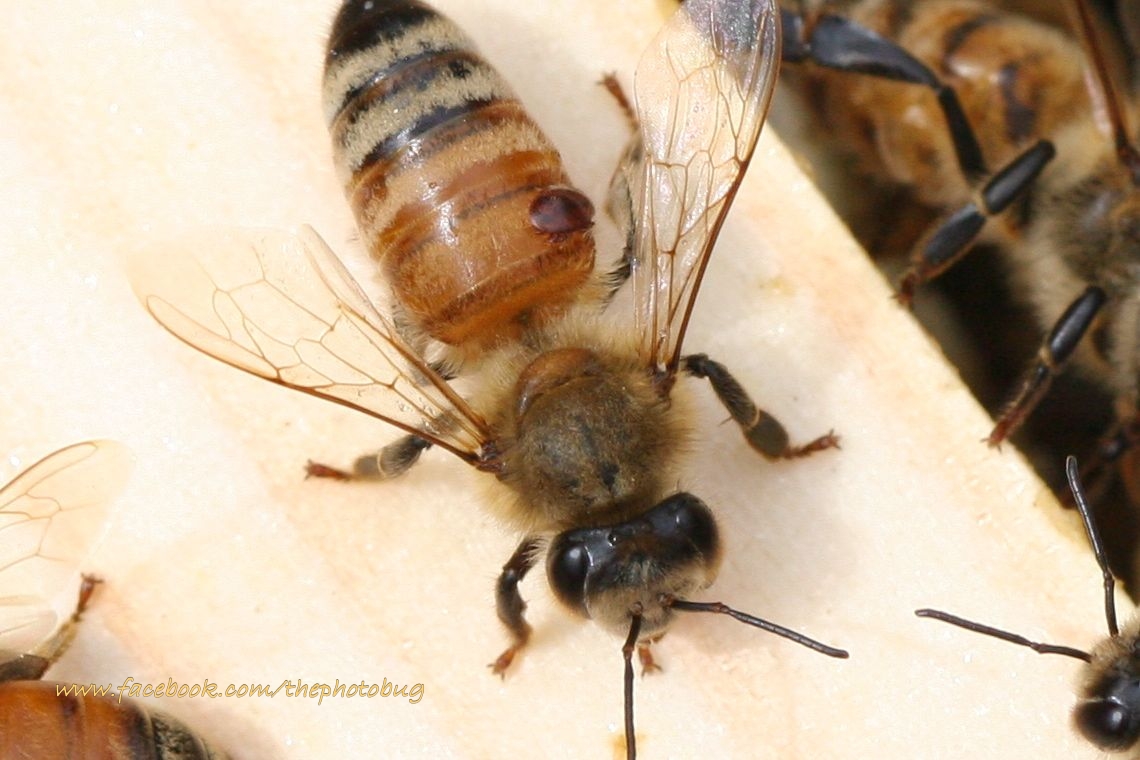
Varroa mite on European honey bee (Apis mellifera) – photo by Cynthia Brast-Bormann
Keeping honey bees was fascinating. Yes, I was stung, but it was mesmerizing to watch them working. At one place that I lived, I kept them just outside of my daughter’s bedroom, and to open the window and smell the honey bees was like entering heaven. It was intoxicating.
As to my success in keeping honey bees on San Juan Island, I can tell you it’s a mixed bag. My longest-lived colony survived three years. Mostly, later in the season, the bees would be attacked by wasps, and the hives completely raided. Honey bees died in winter from a lack of food and reduced numbers. Bees ball up together inside the hive in winter. If the population is small, they just can’t generate enough heat to stay warm.
For a few years, I bought new packages of bees. That was also a mixed bag. Some years, the queen died right away. Other packages of bees came with varroa mites. Most packaged bees for purchase are available after they’ve already been at work in other parts of the country pollinating in crop systems where the climate is warmer. They’re worn out and not necessarily healthy.
You see, many people selling bees to hobby beekeepers also make money from renting bees for crop pollination. The queens are reared separately and artificially inseminated. When your package of bees is packed for shipping, they plop the newly fertilized queen into the box with the tired little workers who have been to California, Nebraska, Iowa, or who knows where else before they arrive for you to pick up. As these packaged bees became more and more expensive, my “hobby” was yielding the most expensive, tiny jar of honey you could ever imagine.
There were multiple other things I observed when keeping bees. Like they would gang up on the poor, solitary bumble bee trying to feed on the single dandelion in the yard and kill it. Not the dandelion. They killed the bumble bee.
Honey bee killing bumble bee – photo by Cynthia Brast-Bormann
They actually killed a lot of bumble bees from my observations. I didn’t like it. I also quickly noted that with our cool spring climate, the honey bees didn’t like to come out of the hive until sometime in May or June, way after all the trees had flowered. Honey bees don’t like to fly unless the temperature is over 50 degrees Fahrenheit. I was making a lot of sugar water for them. In case you haven’t noticed, the price of sugar is becoming quite expensive.
That’s another thing. Sugar water is nutrient poor. Honey bees, or pretty much any other organism will never thrive on sugar water alone. It would be like giving your kid cans of Pepsi or Coca Cola every day and nothing else. Of course, they would not be healthy. They’d probably have a shortened life and die before they became a teenager. Honey bees, humans, and pretty much every other organism on the planet needs a diversity of nutrients to survive. Who out there remembers taking a Fred Flintstone vitamin tablet as a kid? Well, there’s a minimum daily requirement for more than humans. Honey bees need a diversity of flowers, trees, mineral rich soil, and clean water to thrive. They also need to collect anywhere from 20-130 lbs per year of pollen and 120-900 lbs per year of nectar, to sustain ONE hive (Goulson, 2003).
So, don’t we have those things out here in the San Juans? Hmmm. Let’s see. Spring temps don’t warm up until after fruit trees, forest trees, and lots of other native shrubs have already flowered or set off pollen. Our soils are poor and deficient in certain minerals like selenium. There’s a LOT of bedrock, but obviously we have some parcels that are exceptions. Summers are hot and dry. I doubt even in a good season, there’s enough pollen and nectar to support all the hobby hives we have now in the islands.
If you’ve lived here for a few seasons, you might note that summer going into fall we have a dearth of vegetation. Pretty much the only wild plants blooming are our non-native Tansy and California Poppies. Of course, the noxious weed folks urge us to pull all the Tansy. It’s toxic. We should do our best to remove it when possible because if you are keeping bees (and continue to do so after reading this), you don’t want Tansy pollen or nectar in your honey. It will damage your liver.
Back to making my point. What bees are we supposed to save? 1. Honey bees? or 2. Those other bees that don’t give honey, but might actually be better suited for pollinating things we have in the San Juans?
If you pick 2, you’re trending along with me. As an entomologist, I can suggest that supporting native bee species will be much healthier and sustainable for our fragile island ecosystem. Why? Well, native bees are already suited for this geographic climate. Bumble bees, Andrena bees, Mining Bees, Leafcutter bees, along with flies, wasps, beetles, moths, ants, and even spiders are all pollinators that work well in our island habitat. In fact, flies are probably one of our most effective early pollinators for fruit trees in the San Juans.
But won’t honey bees pollinate too? What about my garden plants or my orchard trees? Well, again, it’s really not an optimal climate. If you are still holding out, I can offer additional research that might be convincing. While not particularly applicable to the San Juans, since as I’ve already stated, honey bees aren’t going to be flying when our orchard trees are blooming, current research in mainland agro-ecosystems is indicating that wild bees actually increase fruit set in apple orchards (Mallinger & Gratton, 2014), and strawberries pollinated by wild bees are larger than strawberries pollinated by honey bees (MacInness and Forest, 2019). That’s only two papers, but if you take time to go through and read these, look at their references. You’ll find additional citations indicating similar findings in other studies.
What if we ignore everything you’ve written here and keep ordering packages of honey bees?
Good question. Certainly, you are within your right to order honey bees and keep them. Some folks may be determined to try and raise bees in an attempt to get honey. All I can say to that is good luck! I personally have switched from using honey to using agave as a sweetener, or quit using sweeteners altogether. It’s a personal choice, but also motivated by my own economics as well as my concern for preserving a diverse and sustainable population of invertebrates and conserving diverse and healthily functioning ecosystems. Also, please don’t interpret my position as “anti-agriculture.” That wouldn’t be fair. We have to eat, but I do believe in progress and making better choices as the planet becomes more populated. There are a LOT of people to feed. We need to figure out how to do this sustainably, without displacing our diversity of wildlife or injuring the planet’s ability to support life.
It’s a fact that native bees are being displaced in ecosystems under pressure from loss of habitat and competition from managed honey bees. In their 2018 literature review, Hatfield et al., state that “honey bees displace native bees from flowers, alter the suite of flowers native bees visit, and have a negative impact on native bee reproduction.” Citing Anderson & Anderson 1989; Paton 1990, 1996; Wills et al. 1990; Dafni & Shmida 1996; Horskins & Turner 1999, Hatfield et al., continue by stating, “honey bees potentially impact native bee species by removing available supplies of nectar and pollen,” essentially outcompeting native pollinators who are left without enough food to survive and reproduce.
How many hobby bee keepers are in the San Juan Islands? Are there enough to impact native populations of pollinators? Doubtful we could come up with an accurate number or assessment. It would be great to have a count and map of locations of honey bee hives in the islands. The Washington State Department of Agriculture does have a requirement for beekeepers to register their hives annually with the state (WSDA 2022). This isn’t set up to harass beekeepers, but to be able to contact you should there be an issue of concern, ranging from disease to threats from non-native species such as the Asian Giant Hornet (Vespa mandarinia), a species the state is tracking to prevent further spread. If hobby beekeepers are adhering to state laws by registering their hives, scientists will be better at assessing the impact of honey bees on populations of native pollinator species, especially under the unknown parameters of a warming earth.
What are my recommendations? Well, I’ve shared why I quit keeping honey bees. We have a small orchard and keep a little vegetable garden where my husband helps me grow some strawberries, tomatoes, peas, salad greens, and a few other things. The past few seasons, because of my affinity for bug viewing over gardening, I planted some things near my garden plants that I knew would attract pollinators. For instance, I have Nepeta varieties of catmint near my tomatoes. Those purpley-blue flowers on the catmint attract all sorts of pollinators who also happen to visit my tomatoes, peas, strawberries, and more.
Judging from the diverse collection of bugs (and birds) in our garden/orchard area, I don’t believe we need any honey bees at all for pollination. I love watching the varied native bees, especially the fuzzy bumble bees that pollinate our tomato plants. Oh, one last thing! These native pollinators aren’t out to defend a colony like the social honey bees. This means they are WAY less likely to sting you. Oh, I’ve sustained a sting or two from an occasional bumble bee, but that was because they were hanging out on my blue yoga pants, and I accidentally squeezed them when I was squatting down to pull some weeds. Bugs love the colors blue, purple, and black. I learned my lesson. Now I wear blah, sand-colored clothes when I’m gardening.
Thanks for reading. I hope you will consider my points. This is not meant to be an indictment against honey bees or honey bee keepers, merely a perspective on the impacts we may have on our island ecosystem in keeping honey bees. The bumble bees, and other native pollinators will appreciate not being displaced. They’re worth saving, and thank you for recognizing their role in our food web.
p.s. If you aren’t a beekeeper, but you’re interested in helping native pollinators on the island, establishing gardens with diverse species of native plants will help ensure they have a bounty of healthy and nourishing food sources available. You can check out Washington Native Plant Society at https://www.wnps.org , WSU’s Master Gardener Foundation of San Juan County at https://www.mgfsjc.org , or the Xerces Society – https://xerces.org/publications/plant-lists/pollinator-plants-maritime-northwest-region for native species lists.
References:
Goulson, D. 2003. Effects of introduced bees on native ecosystems. Annual Review of Ecology, Evolution, and Systematics 34:1-26.
Hatfield, R.G., S. Jepsen, M. Vaughn, S. Black, E. Lee-Mäder. 2018. An Overview of the Potential Impacts of Honey Bees to Native Bees, Plant Communities, and Ecosystems in Wild Landscapes: Recommendations for Land Managers. 12pp. Portland, OR: The Xerces Society for Invertebrate Conservation.
MacInnis, G, Forrest, JRK. 2019. Pollination by wild bees yields larger strawberries than pollination by honey bees. J Appl Ecol. 56: 824– 832. https://doi.org/10.1111/1365-2664.13344
Mallinger, R.E. and Gratton, C., 2015. Species richness of wild bees, but not the use of managed honeybees, increases fruit set of a pollinator-dependent crop. J Appl Ecol. 52: 323-330. https://doi.org/10.1111/1365-2664.12377







 Bugging You From San Juan Island