It was 51 and sunny to partly cloudy yesterday afternoon about 4pm when I meandered down to our unkempt orchard to look for pollinators. The temps had dropped the night before to around 34-35, so you could say it is still pretty chilly here in the PNW on San Juan Island. At least it is in our neck of the woods.
We have a couple of Yellow Plum trees in bloom. Don’t ask me the species. I don’t know. I might get ONE or TWO plums a year if I get lucky. It’s not for lack of fruit. It’s my lack of ambition or desire to go down and collect them all and I am NEVER EVER peeling plums again to make jam or anything like that ever again in my life. The time I did, it took my wrists months and months to recover. Also, I just don’t want to be a homesteader. Don’t get me wrong, I love living on 7 acres, but it is not because I can have a garden. It’s largely because I didn’t want to have close neighbors. I won’t get into that here, but let me tell you that 7 acres is nowhere near large enough. You need a hundred, and your house needs to be in the middle.
So, what flies do I have to show you today? There were four species I counted, maybe five, but the fifth one was so tiny, I didn’t work on any identification for that one. There was only one solitary bee. I’ll point out here that there were ZERO honey bees. #1, it’s too cold, and #2 because they can’t fly in temps over 50, they are not going to be the ones pollinating your fruit trees. It’s largely flies, moths, and maybe some ants and beetles. Mostly it is flies.
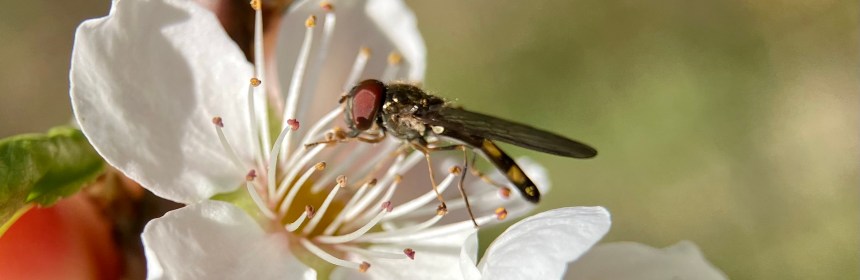
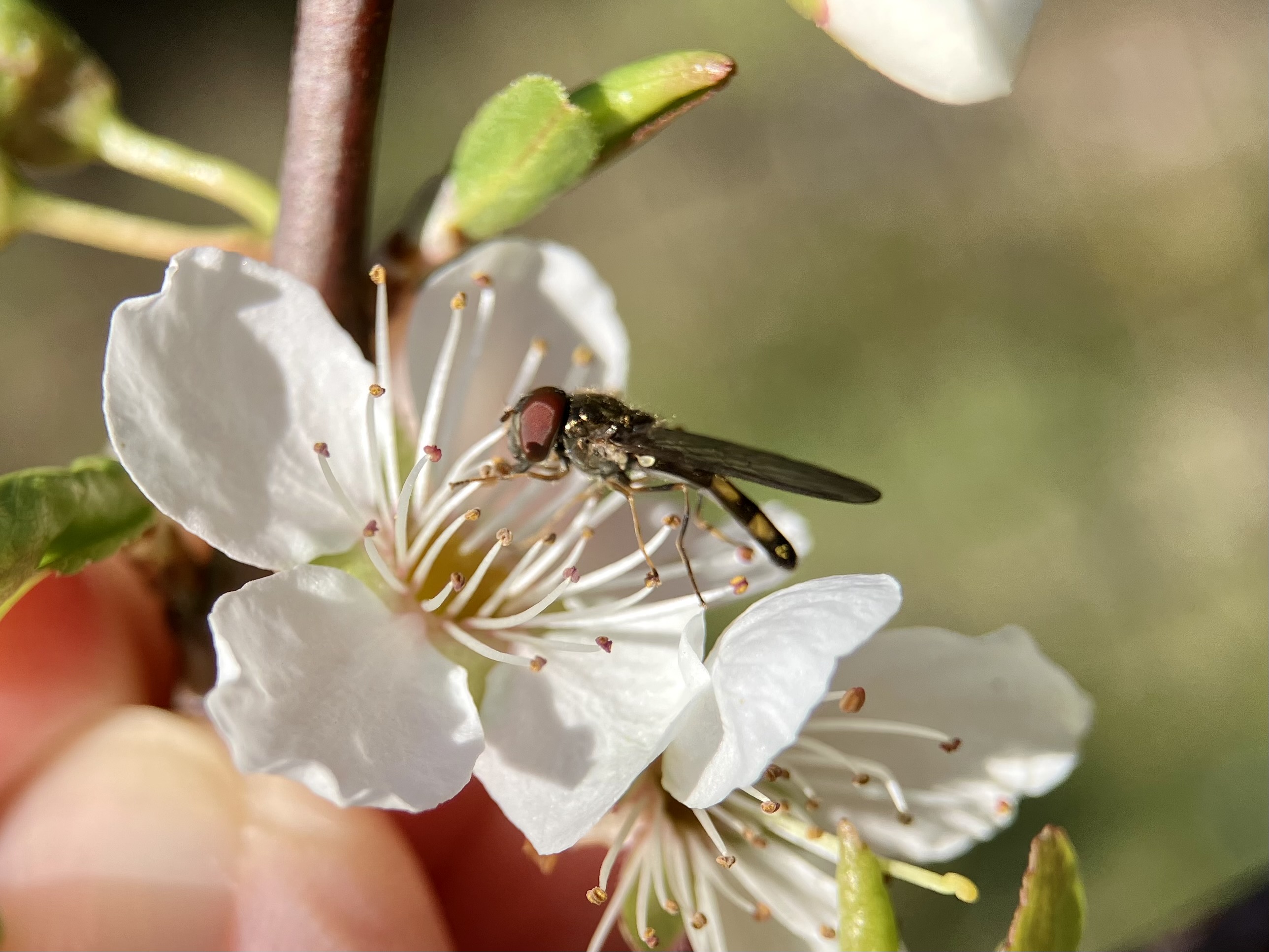
(Melanostoma mellinum) Variable Duskyface Fly
(Melanostoma mellinum) Variable Duskyface Fly
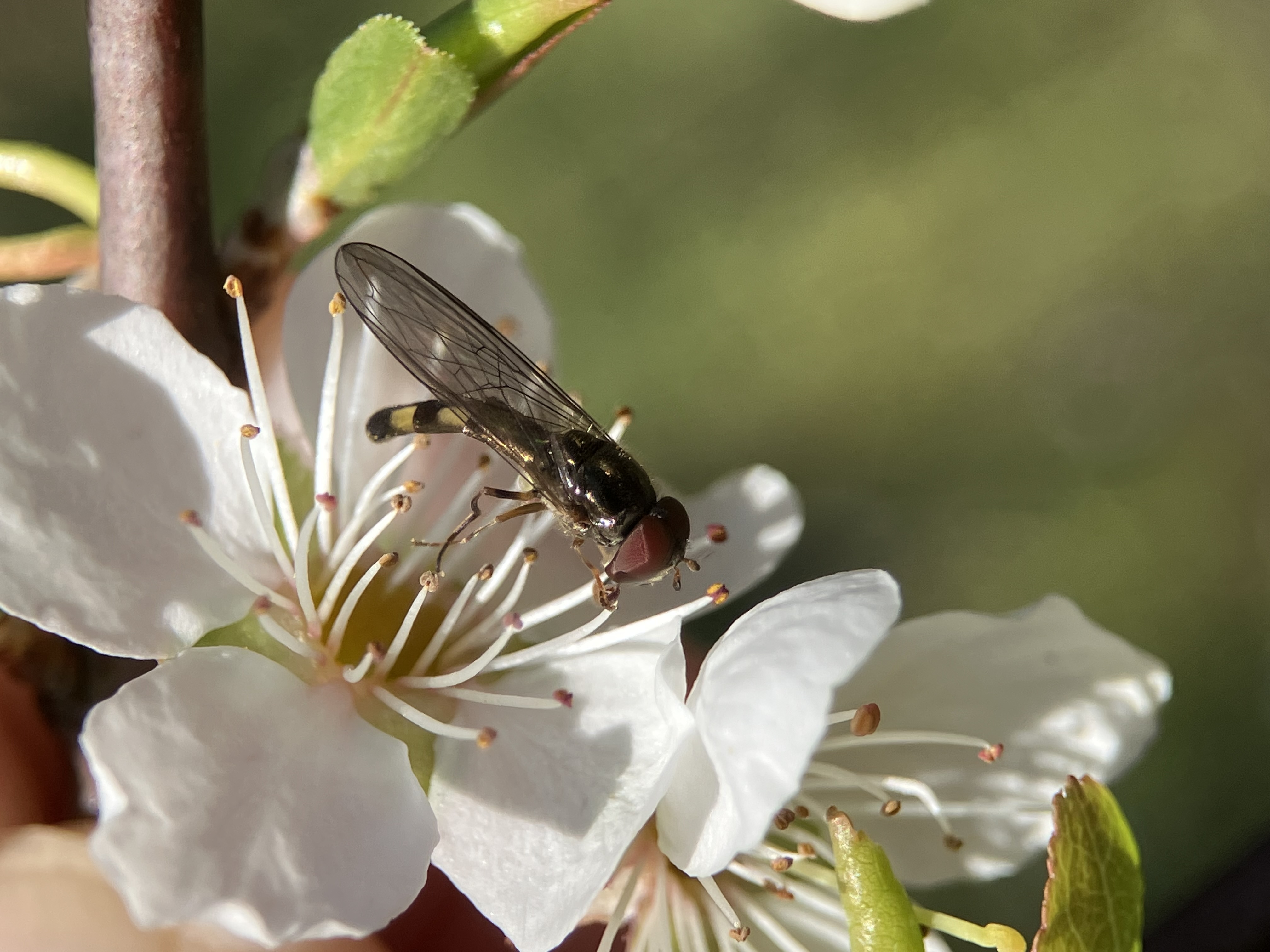
Fly #1 The Variable Duskyface Fly (Melanostoma mellinum). This is a species of Syrphid Fly and I believe my specimen to be male. Syrphid flies are wonderful in gardens and orchards. They not only pollinate, but they scavenge aphids away in their larval form. Watch this one in action here
(Melanostoma mellinum) Variable Duskyface Fly
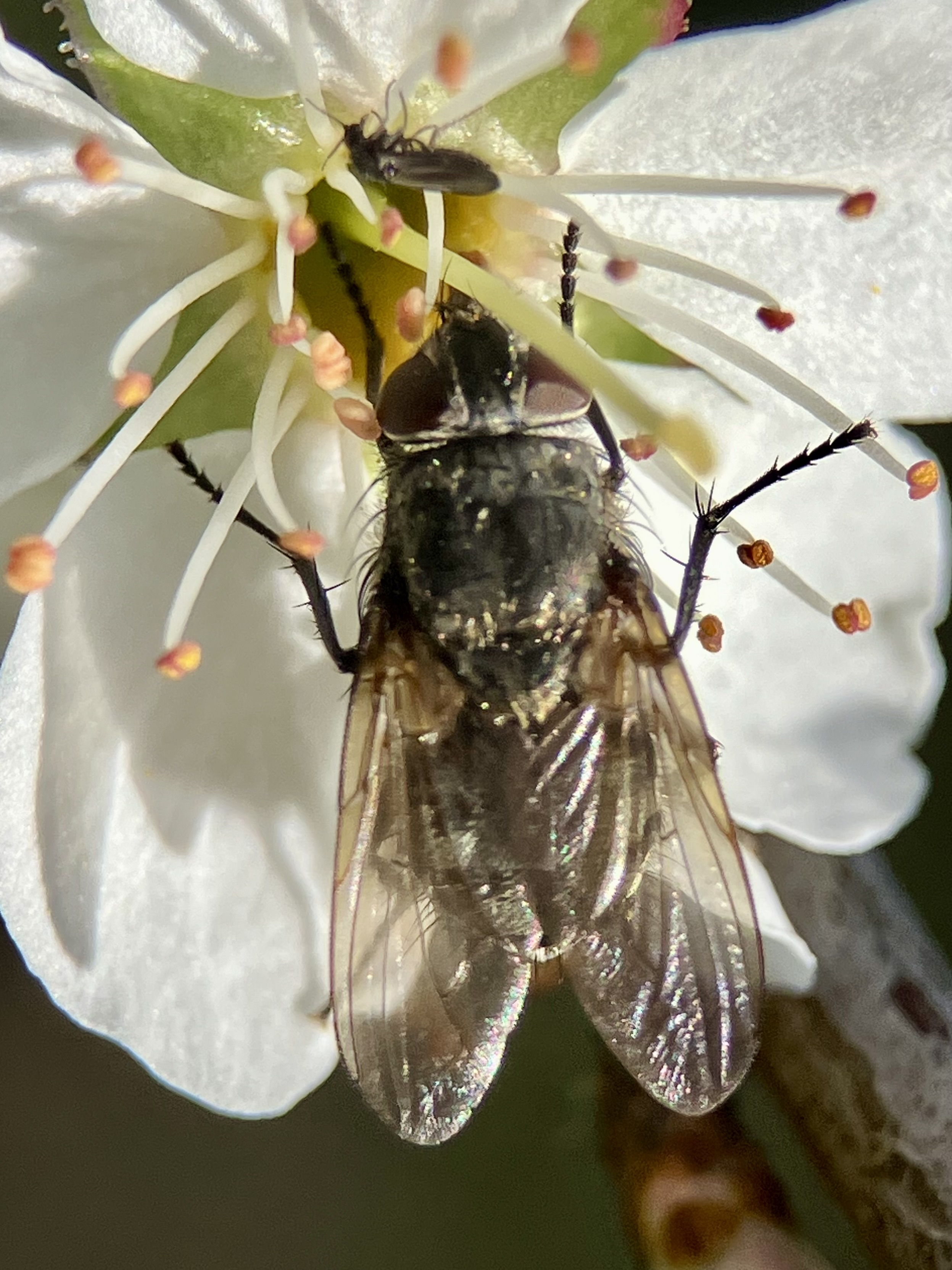
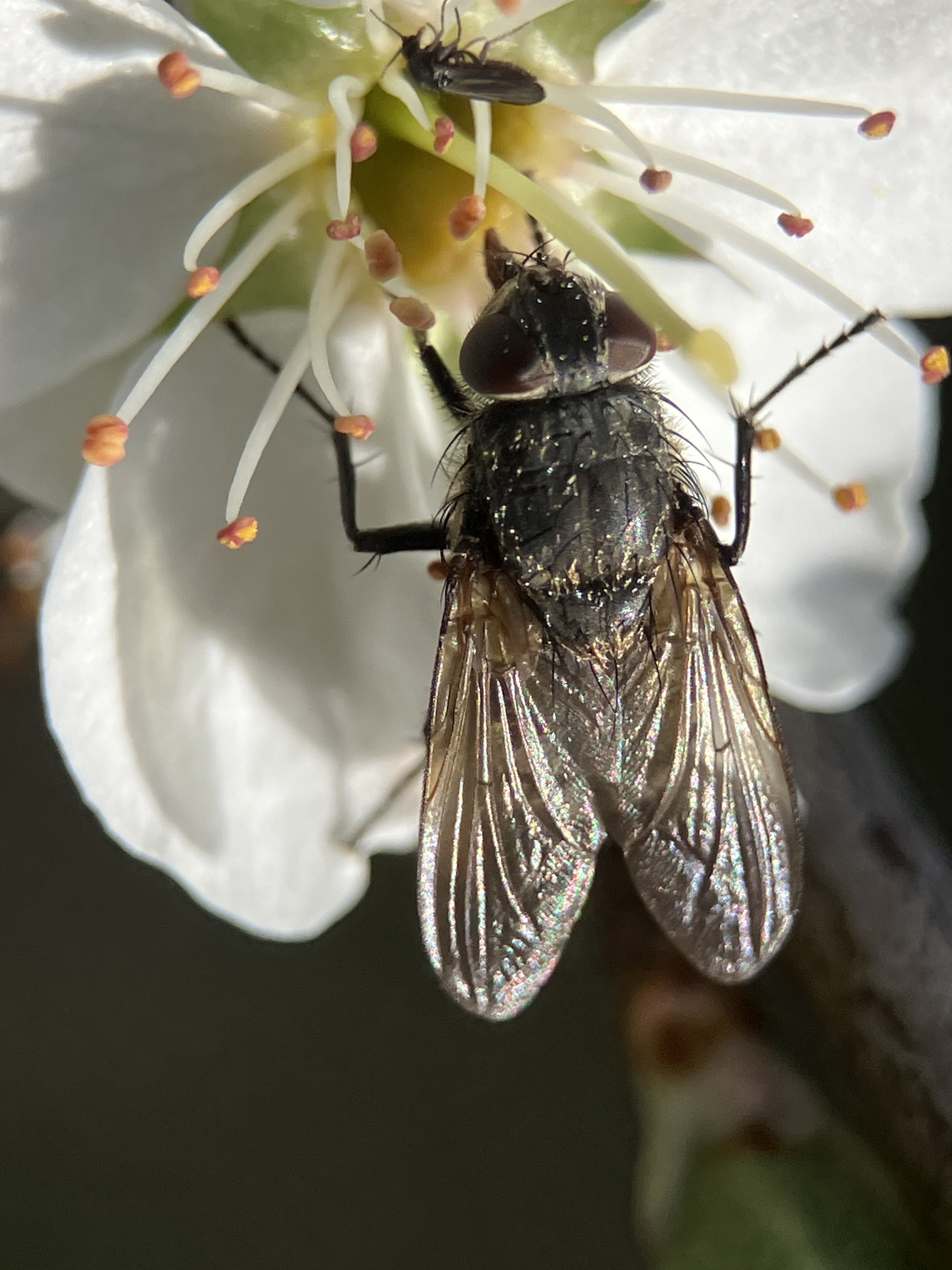
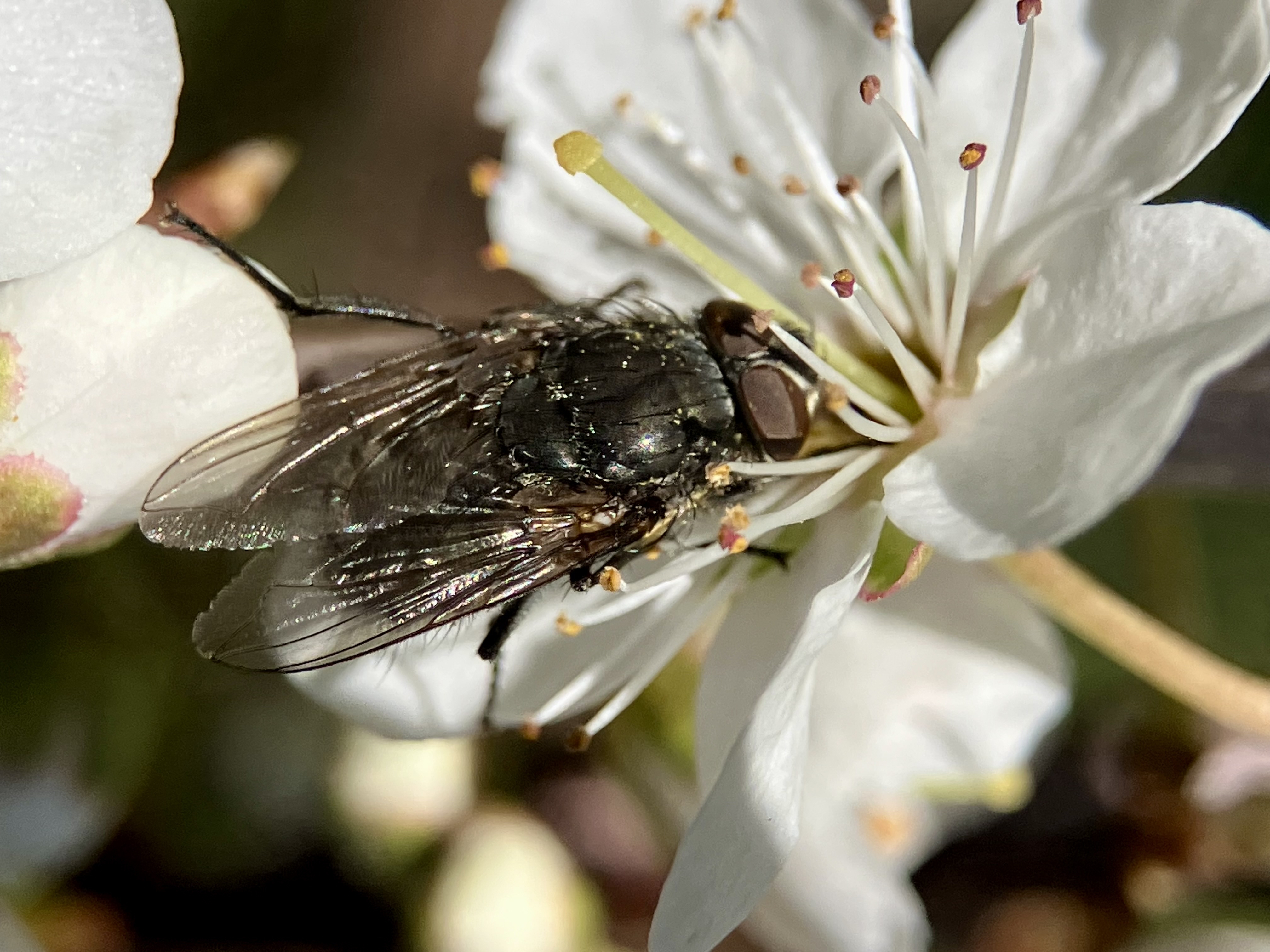
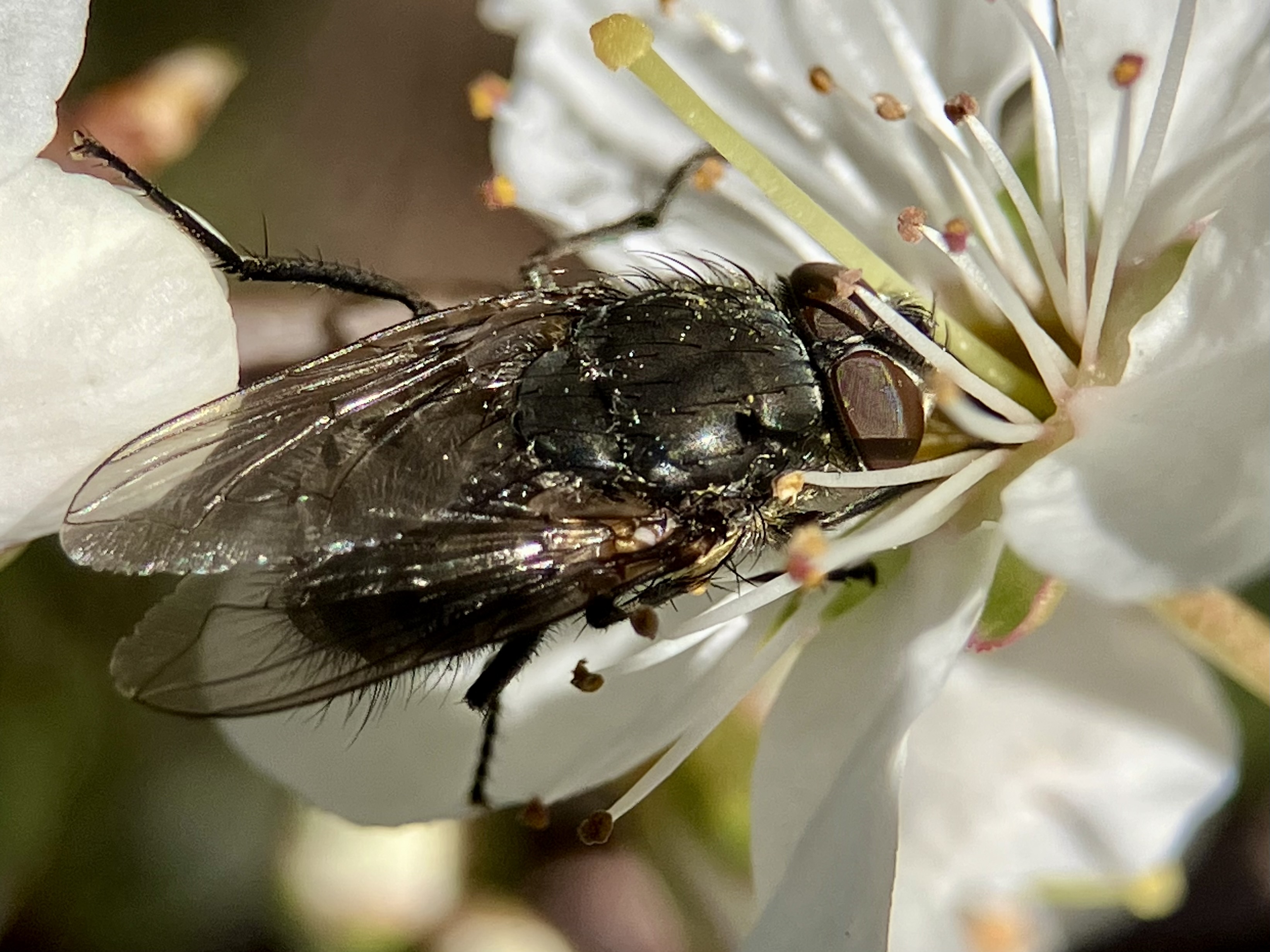
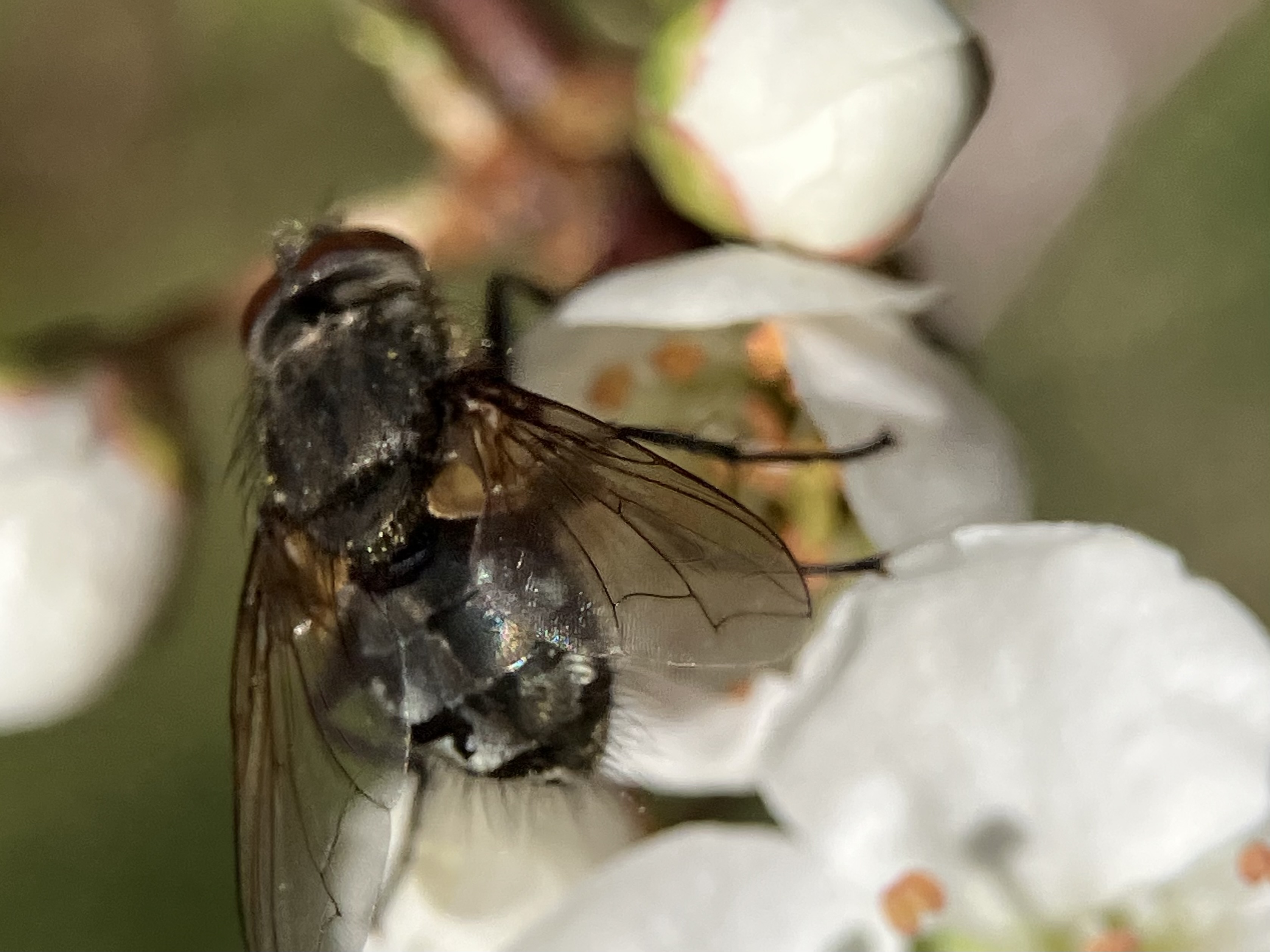
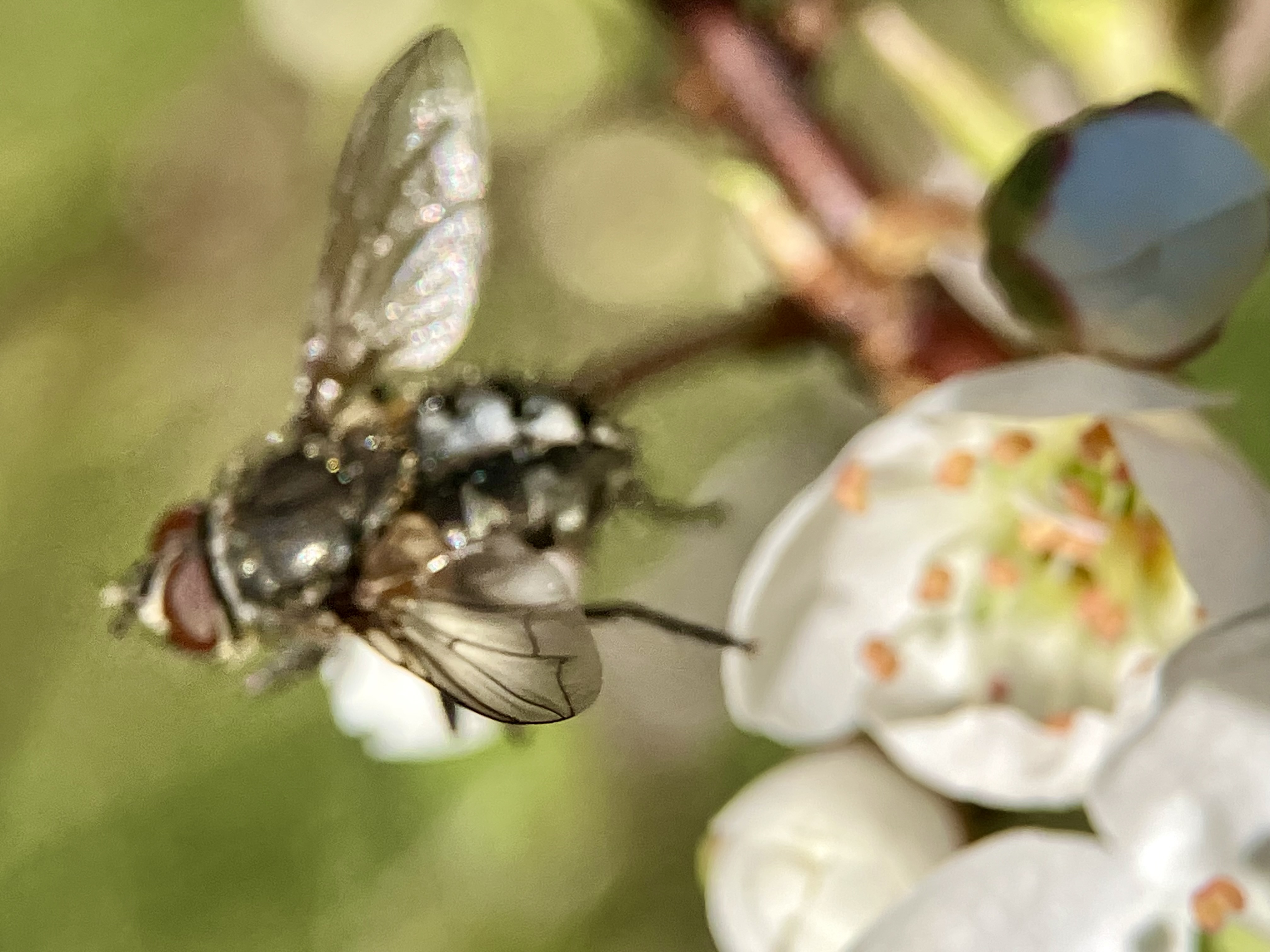
Fly #2 The Cluster Fly (Pollenia sp.) Pollenia flies have had some taxonomic revisions that I am not completely up to speed with, but suffice to say that they are now in their own family (Pollenidae) and I’ll attach some references at the end if you want to deep dive into the literature and try and figure out the species here.
What I can tell you about these flies is they got their name because they will sometimes overwinter in human structures (clustering). They are an Old World group, so these are not native to North America. They are parasites of earthworms, or at least one of the species in the Genus is. They also were ALL over the plum tree. I bet I counted fifty of these.
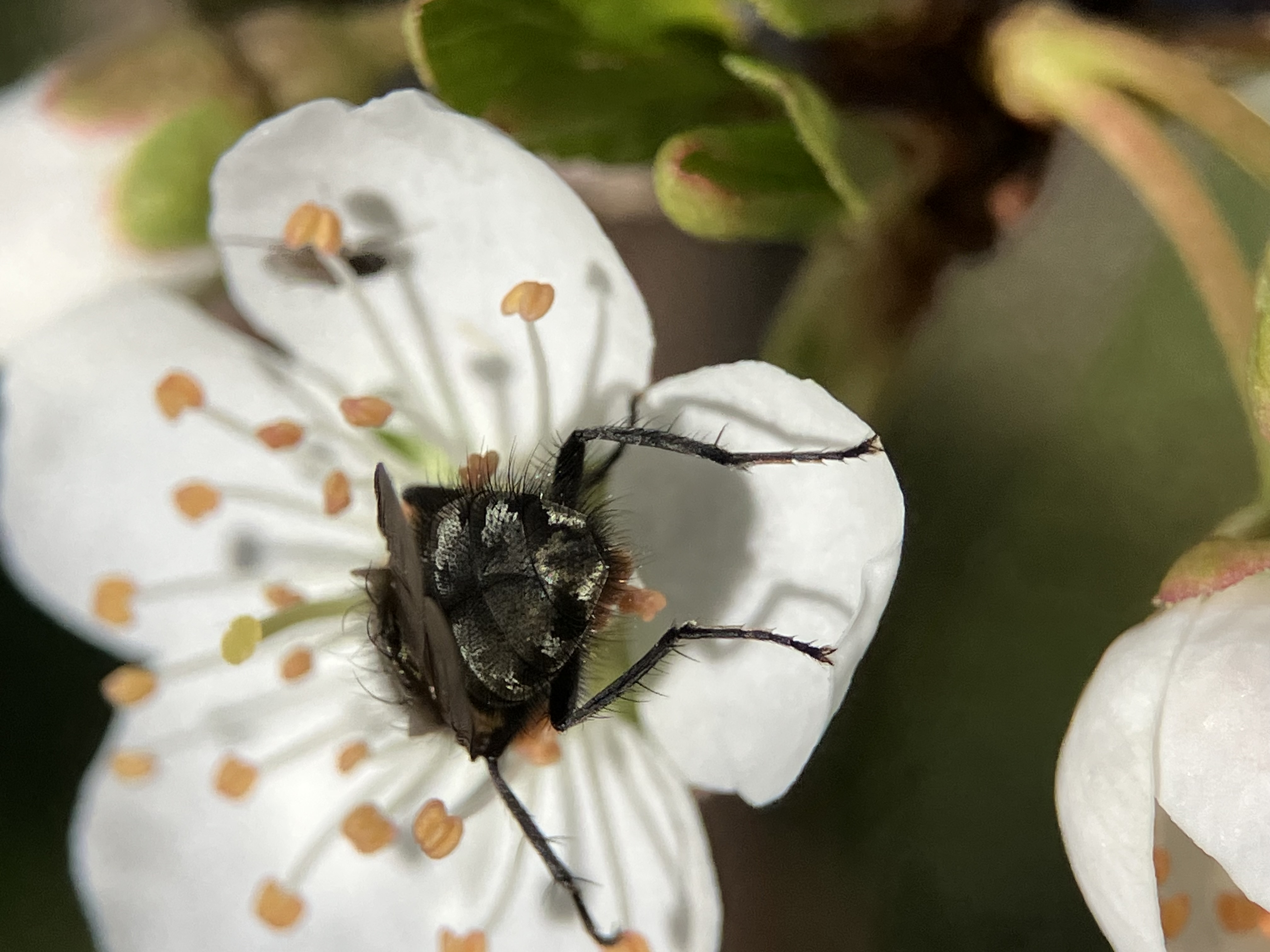
Fly #3, I believe this one (below) is the Greater Spring Blacklet (Cheilosia grossa), a species of Hoverfly in the family Syrphidae. This species is native to Europe and was introduced to the United States as a biocontrol for thistles. The adult is obviously enjoying its role as a plum tree pollinator and its offspring (the larvae) will help manage the thistles on our property, I suppose.
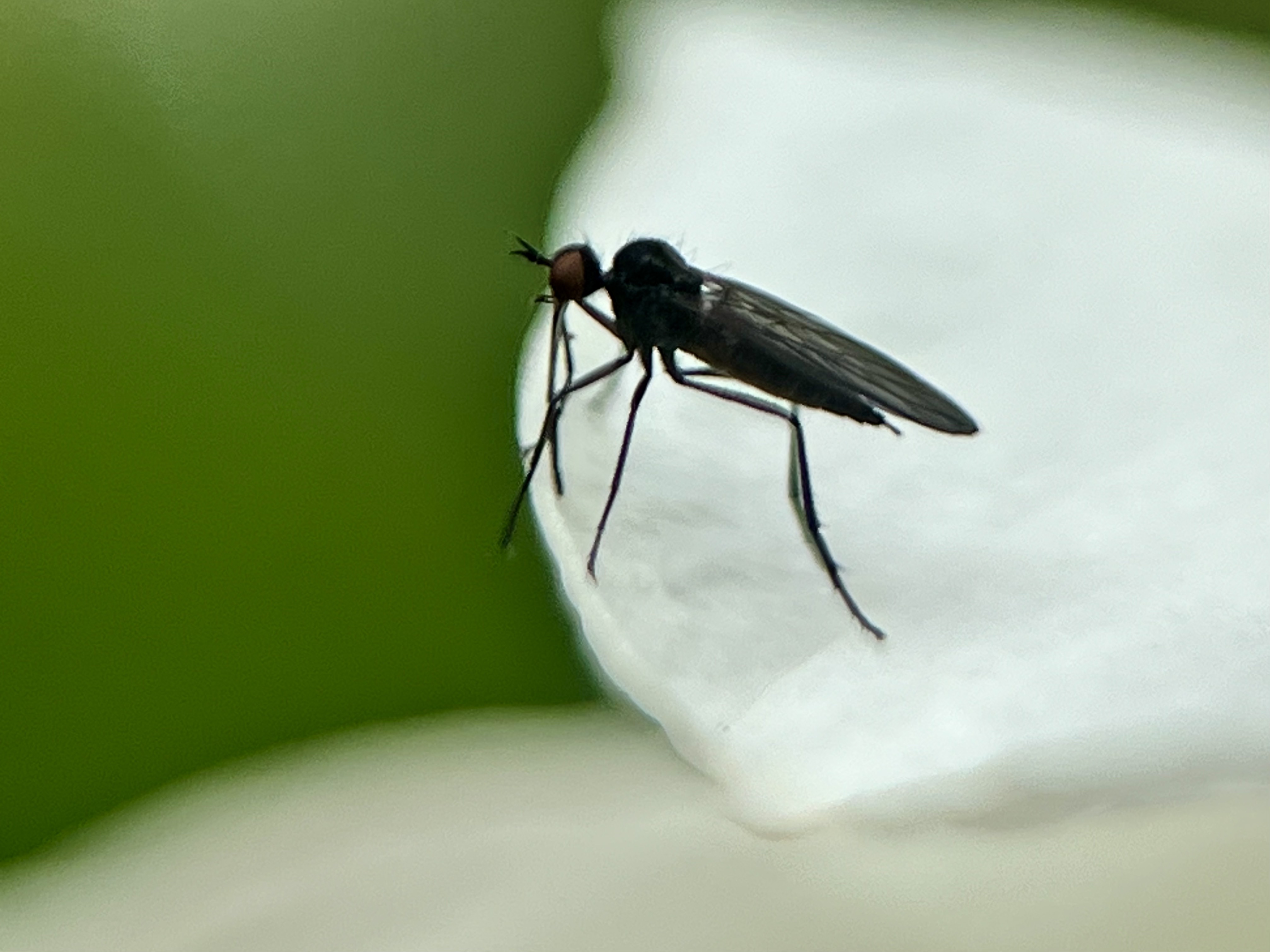
Fly #4 is Empis barbatoides, a Dance Fly. I had to stand on my tippy toes to try and get this video clip for you. I love this species of fly. They are so cool. The males catch other fly species, like March flies (Bibionidae) and make little balloon packets to woo a female. If you don’t believe me, you can read one of my earlier blog posts about them. I know a spot where the males seem to gather together to dance too. I keep hoping I’ll get some good video of them dancing to share.
And that’s all for tonight. It’s late and I’m going to bed. Just remember to repeat to your friends that FLIES are your friendly pollinators, and some of them are pest predators too. We need more people to advocate for them. They aren’t always a pest! 🪰
References
Alcock , John. 1973. The mating behaviour of Empis barbatoides Melander and Empis poplitea Loew (Diptera: Empididae), Journal of Natural History, 7:4, 411-420, DOI: 10.1080/00222937300770301
Gisondi S, Rognes K, Badano D, Pape T, Cerretti P (2020) The world Polleniidae (Diptera, Oestroidea): key to genera and checklist of species. ZooKeys 971: 105-155. https://doi.org/10.3897/zookeys.971.51283
Jewiss-Gaines, A., Marshall, S.A., Whitworth, T.L. 2012. Cluster flies (Calliphoridae: Polleniinae: Pollenia) of North America. Canadian Journal of Arthropod Identification No. 19, 15 February 2012, available online at doi: 10.3752/cjai.2012.19
For the past few years, I have observed one of our native shrubs to see what pollinators are visiting. Calscape has recorded Ocean Spray (Holodiscus discolor) as a host plant to approximately 14 species of Lepidoptera. Yet, I have actually never seen a single pollinator visiting the cascades of snowy white, delicate blossoms. I’ve also heard from a handful of local folks on San Juan Island. They say Ocean Spray is “invasive” and should be brush-hogged. According to them, it’s a “fire hazard.” This view is disturbing to me. I felt it important to find concrete evidence of this native plant’s value in our ecosystem.
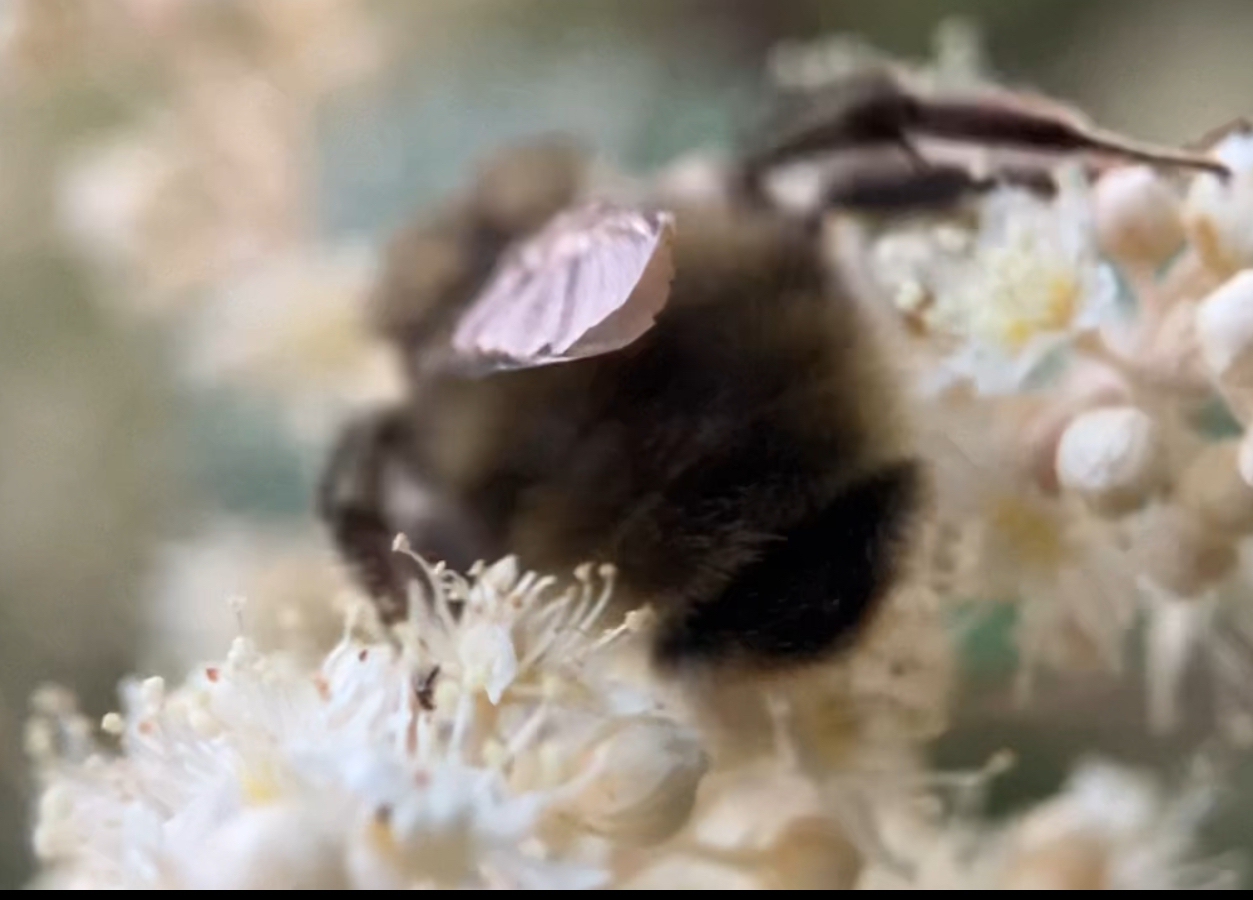
Bombus flavidus ssp. flavidus
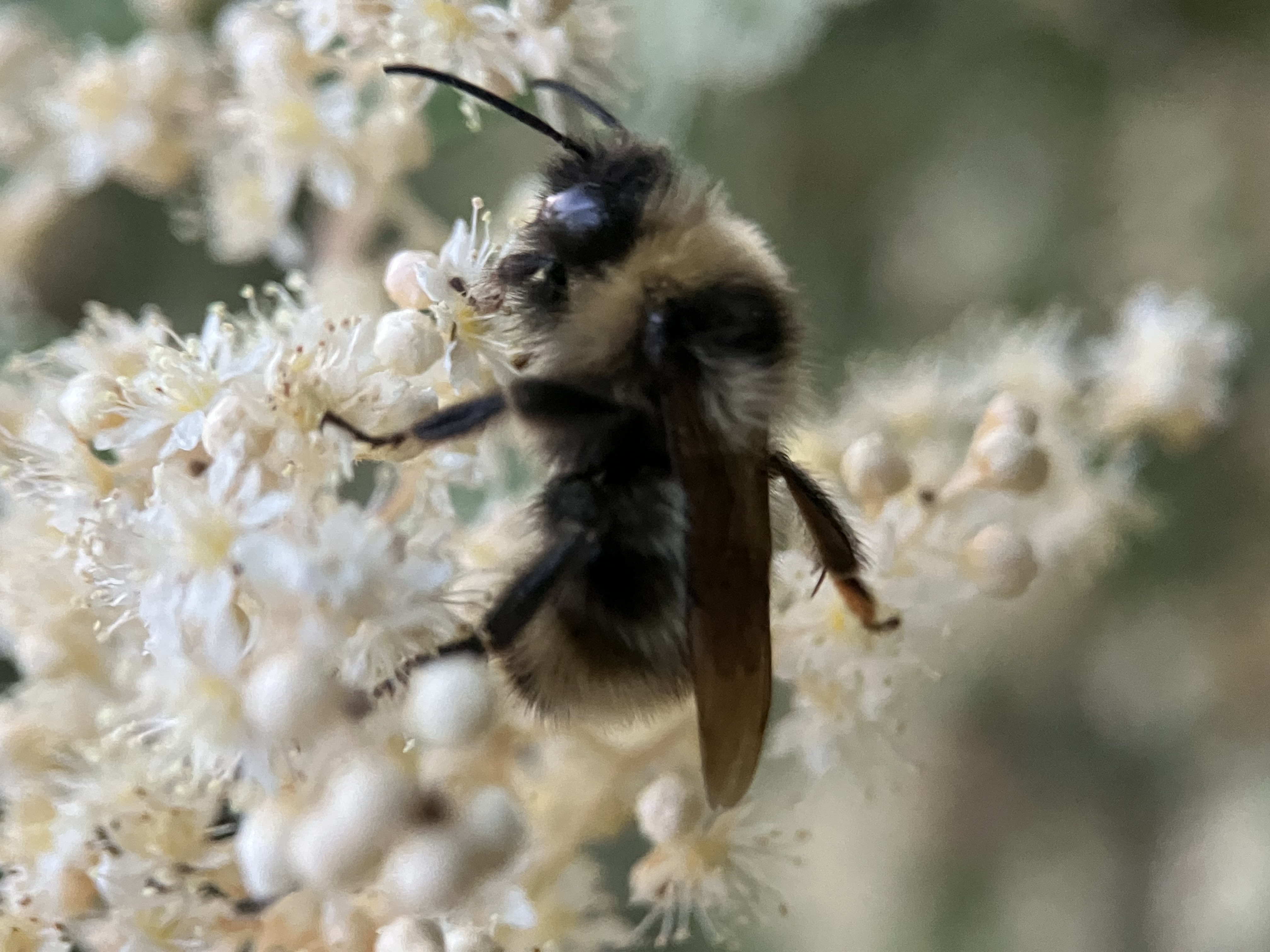
Well, the other evening, I documented the first pollinator I’ve ever seen visiting these blossoms. There is a gorgeous Ocean Spray out our bathroom window. I noticed movement in the upper portions of the shrub. It wasn’t windy, so something else was causing the movement. I went out later, around 9:00 pm, to investigate the cause of the disturbances. Can you guess what I found? Bumble bees!
Bombus flavidus ssp. flavidus
I also experienced annoyance from another buzzer. A Cattail mosquito, Coquillettidia perturbans (say co-KEE-luh-tih-dee-uh PURR-tuh-binz) promptly discovered my bare arm. It slipped its hypodermic proboscis into my epidermis with effortless precision, a precision superior to any medical professional’s injection. I didn’t feel it at all.
Cattail mosquito (Coquillettidia perturbans)
I would describe the bites from these mosquitoes as a very mild annoyance. I didn’t have any after-reaction at all. It was certainly not anything like the bites from some of the other insects I’ve experienced here, especially not thrips. I’m definitely not a thrips fan! You can read about thrips here in case you’re interested. https://buggingyoufromsanjuanisland.com/2021/06/29/public-health-alert-and-some-free-advice/
Getting back to the other buzz in the Ocean Spray. The buzz I was so happy to discover is the bumble bee (Bombus flavidus ssp. flavidus). I didn’t make the identification to subspecies on my own. That was with the help of a fellow named John Ascher on iNaturalist. If you’re curious about his work, you can learn more here: https://extension.oregonstate.edu/podcast/pollination-podcast/137-john-ascher-problem-measuring-bee-decline
Bombus flavidus ssp. flavidus
Bombus flavidus is a species of Cuckoo Bumble Bee, and one of the most widespread species in the world. These bees don’t have a worker cast like other species of bumble bees. They find nests of other bumble bees to occupy and invade these nests. The host bumble bee workers then rear the offspring of the cuckoo bumble bee along with their own offspring.
I hope my discovery leaves you curious about what pollinators visit Ocean Spray in your yard. My next goal is to make nighttime observations. I want to see what is visiting the flowers while they are still in bloom. I suspect they have nocturnal pollinators. If you find any, I hope you’ll report your findings with me. 🙂
To see more of San Juan Island’s invertebrates, please join and follow me on iNaturalist – https://www.inaturalist.org/observations?place_id=any&user_id=cyndibrast&verifiable=any . If you have never used iNaturalist, try it out! I love it because it’s a way to connect with other entomologists. It also helps me organize my findings into appropriate categories for referencing when I want to look something up.
Also, please don’t go crazy with the brush hog. Nature loves messy. Humans cause fires. We can do much on that end to prevent them by changing our behaviors and being more careful. Scraping the earth bare and/or parking out your parcel to be “fire wise” is actually not kind to nature. We need to protect habitat for the wild things, not eradicate it. Even mosquitoes have a role in the food web.
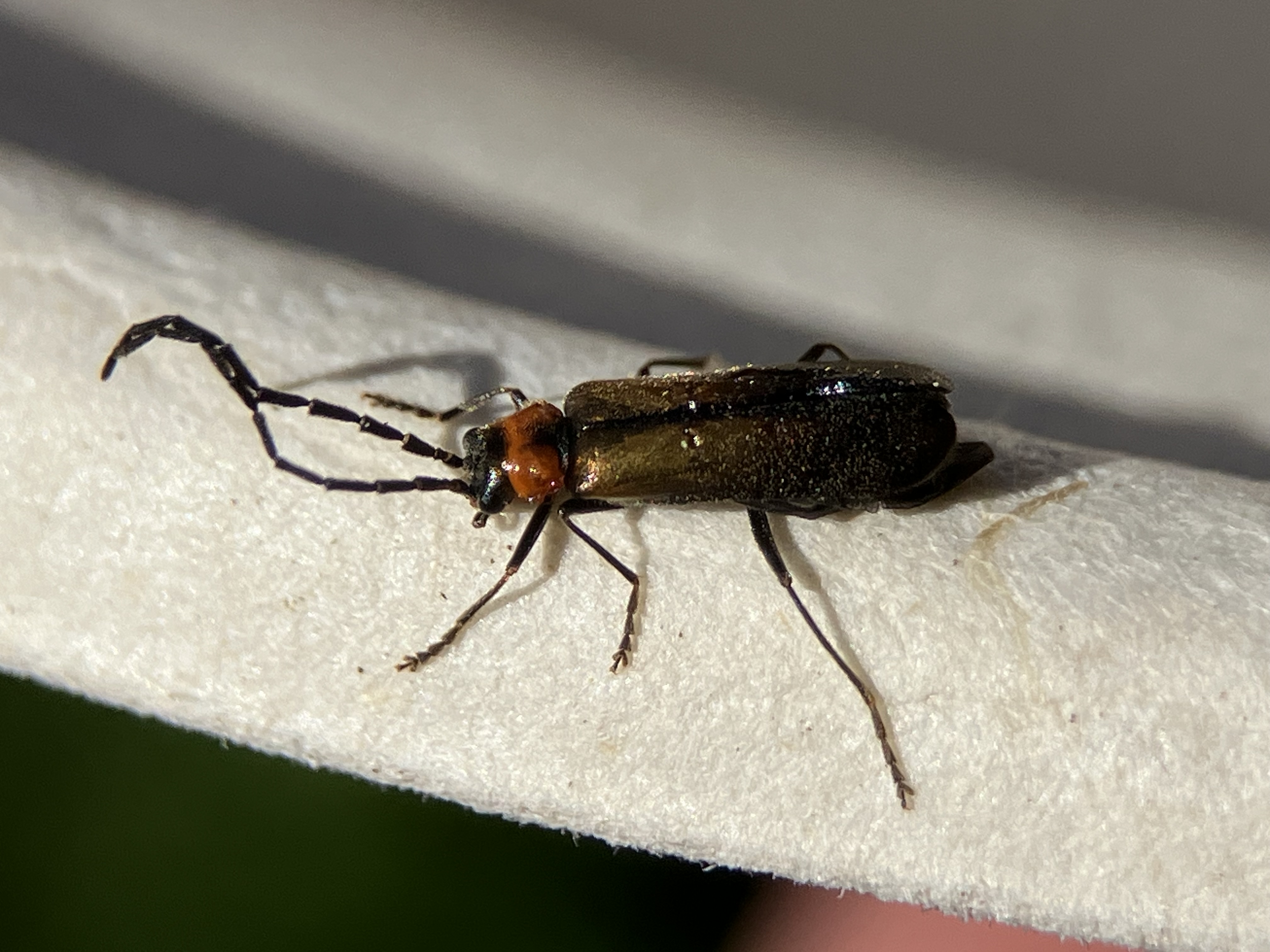
This tiny little friend (approx. 6mm) sporting a red collar is a soldier beetle in the family Cantharidae. It is in the Genus Silis, but there are so many species, that I will just leave it at the genus level for now.
Soldier Beetle (Genus Silis)
Silis beetles are quite cosmopolitan in distribution, associated with wooded areas and leaf litter, and active daytime fliers in early summer.
Adults are typically found on foliage and flowers. Primarily, they are pest predators, feeding on insects, but also serve as pollinators, feeding on nectar and pollen. Silis species are known to prey on aphid populations infesting trees, plants, and shrubs, so gardeners can appreciate them as a “friend.”
Silis beetles can also attack other groups of invertebrates, feeding on small soft-bodied specimens or consuming their eggs. However, the ecology of some species is remains to be investigated. While Fender (1973) found the larvae would eat earthworms and are mostly carnivorous in the soil, little else is known about the feeding habits in this stage. (Pelletier and Hébert , 2014).
The etymology of the nomenclature for the genus (Silis) comes from Σίλας in Greek. It is derived from the Latin name Silvanus, meaning “forest” or “wood,” and a contraction of the Greek form Silouanos, a transliteration of Silvanus. Silis or Silas is also associated with the Roman god of the countryside, Silvanus, a god who was worshipped by those who lived in wooded areas or worked with wood. Even older than the etymology is this tidbit. Silis beetles are quite ancient. Fairly recent research has identified specimens of the genus discovered in Baltic Amber (Parisi and Fanti, 2019).
Soldier Beetle (Genus Silis)
While I have now scooped a few out of our pool, thankfully in time to save them from drowning, some of them (perhaps the ones I’ve rescued) are also finding me. I have had them on my clothing and peeping in the door at me!
Thanks for reading!
Soldier Beetle (Genus Silis) looking in our door at me!
Green, John Wagener. 1966. Revision of the Nearctic species of Silis (Cantharidae: Coleoptera). Proceedings of the California Academy of Sciences, 4th Series, 32, 447–513. https://www.biodiversitylibrary.org/part/52839
Pelletier, G., Hébert, C. 2014. The Cantharidae of Eastern Canada and Northeastern United States. Canadian Journal of Arthropod Identification No. 25. February 28, 2014. Available online doi: 10.3752/cjai.2014.25
Parisi, F. and Fanti, F. 2019. On the first Silis Charpentier, 1825 from Baltic amber (Coleoptera, Cantharidae), Foss. Rec., 22, 119–123, https://doi.org/10.5194/fr-22-119-2019
Spring has arrived and with it comes beautiful daffodils popping up across the landscape, but also pollen, windy days, and those dreaded allergies many of us suffer from. I’ll bet as you’re reading, you’re might visualize little pollen grains as daggers that blow up our noses and make us sneeze! Personally, when I visualize pollen grains, I picture them as the equivalent of microscopic land mines. Even though pollen grains can be quite unique when viewed under a microscope and cause quite SHARP “achoo’s” into that handkerchief, there’s another DAGGER you’ll have to go search for in those daffodils.
Rhamphomyia fly – Dagger Fly on Daffodil
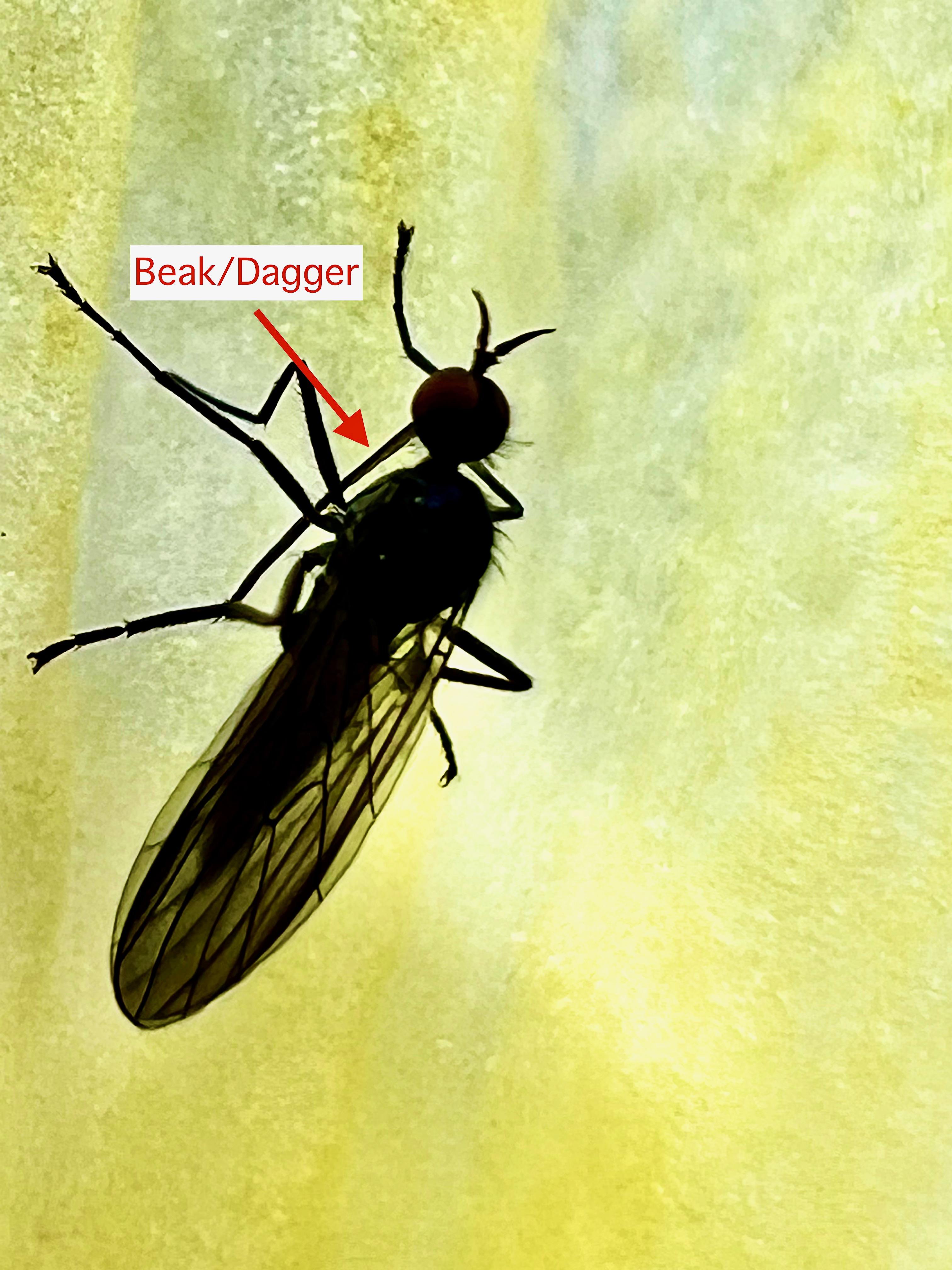
When I first saw this bug and took some photos with my phone, I didn’t realize that EXTRA leg was not a leg at all, but a beak of sorts. More close up photos yielded some images of this particular specimen that reminded me of the sinister hood worn by doctors during the Plague that looks like a giant bird beak.
This BUG I found in the daffodils with the strange “beak” or proboscis, a scientific term for an appendage-like mouthpart of an organism, is a type a fly. The common or vernacular moniker being Dagger Fly.
Rhamphomyia fly – Dagger Fly on Daffodil
From here, I’ll take you through my process of determining the fly’s classification. First off, to understand it is a FLY, you must look at the number of wings. Flies are taxonomically categorized into the insect order Diptera. Di=two and ptera = wings. Two wings or one pair of wings = FLY. Now the Flies or Diptera are an enormously diverse and large group of organisms. Fly classification or taxonomy is one of the hardest groups I’ve ever worked through and in my rudimentary assessment, I managed to identify my specimen as far as the Family Empididae or the Dance flies. This fly wasn’t exactly “dancing” though. It was poking its beak around in the daffodil, and there were several of them in one flower – all doing exactly the same thing.
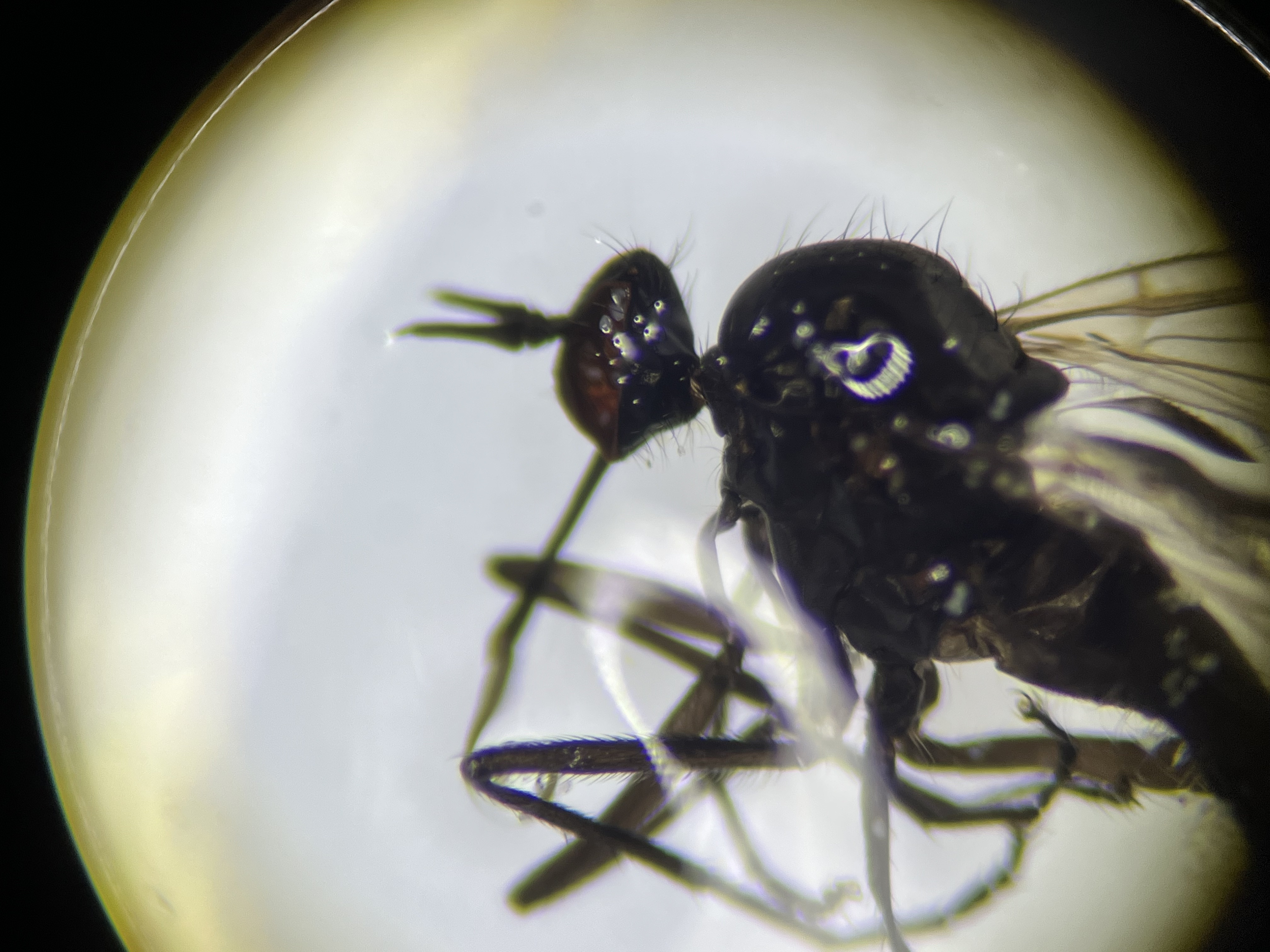
At this point, I turned to the fly group I belong to on a popular social media site. I posted my photos with date/location/and my suggested family (Empidiae), then asked if someone could help me with further classification. About two days later, I checked back. The suggestion in the comments was for Genus Rhamphomyia. It would be particularly challenging to identify this particular fly to species. Bugguide.net cites Arnett’s American Insects: A Handbook of the Insects of America North of Mexico, stating there are over 400 undescribed species in our area with 450 undescribed worldwide.
While Genus Rhamphomyia falls under the Empididae or dance flies, Rhamphomyia translates from Greek rampho ‘beak’ + plus myia ‘fly.’ Beak flies they are indeed!
Dagger Fly (Rhamphomyia sp.)
Delving past the taxonomical classification of the genus I discovered some interesting bits of information involving mating behaviors. Like other groups of flying insects, males and females will often form swarms of groups, sometimes referred to as leks. In the Rhamphomyia, these groups can be either all male or all female (a reversed-role lek) or mixed.
If the group is single sexed, it may be the opposite sex does not form a group, but rather enters the single sex group to select a mate. There may also be a group of females and a nearby group of males and individuals from each group will leave and mix with the opposite sex group to choose a mate. Different species of this genus may swarm at different times of the day. Some species may spend the entire day swarming, while others only a select time such as right before dusk or early morning. Swarm locations are selected around some sort of visual marker or landmark which may range from very specific ( a particular branch or limb overhanging a pond) or quite general (the southern slope of a hillside adjacent to a stream or a farm field).
The most intriguing behavior is the habit of male flies to collect and bring nuptial gifts to a female. Alcock (2016), describes this fascinating ritual where female flies gather in swarms low over open woodlands, high in treetops, or over grassy hayfields in early morning or late evening. The swarms lasted 1-2 hours each with female Rhamphomyia flies holding their highly ornamented legs wrapped around their abdomens. In these swarming female groups, males enter and gift their selected female a small insect for her to consume. Examples of tiny insects selected for nuptial gifts include drosophila flies, small syrphid flies, or tiny caddisflies (Alcock 2016). Kuiter, Findlater-Smith, and Lindhe (2017) recorded nuptial gifts to include “fungus-gnats (Myctophylidae), crane flies (Tipulidae), other Empididae flies, and occasionally small moths (Lepidoptera). ”
Reading a bit more led me to Funk and Tallamy (2000) who describe the plight of the female Dagger fly. She is unable to hunt for prey and wholly dependent on these nuptial gifts of protein necessary for development of her offspring. In the swarming leks, she seeks these nuptial gifts from male suitors in exchange for copulation.
While I didn’t witness the formation of swarming leks of these flies, I did find some handsome daggers hanging out in the daffodils. I kept reading and found they can use their beaks not only to pierce small insects, but also to pierce and extract nectar from flowers. As they feed, pollen collected on their bodies may be distributed to other flowers (Sezen 2015).
Rhamphomyia Dagger Fly on Daffodil
Probably the grand finale in my literature search yielded the paper written by Kuiter, Findlater-Smith, and Lindhe (2017) titled Pollination of the Bearded Greenhoods (Orchidaceae) by Dagger Flies (Diptera: Empididae). They describe a unique relationship between the orchid and another species of Dagger Fly. Located in Victoria,Australia, the authors document the case of mistaken identity – the male dagger fly is lured to the orchid by both chemical and physical attributes mimicking the female fly’s sex pheromones and her morphology.
While daffodils aren’t the orchid described by Kuiter et al, (2017), I considered their observations to offer one possible reason the flies I found could become so awkwardly stuck. Kuiter et al. (2017) suggest the flies observed bringing nuptial gifts to the Bearded Greenhood orchid (Pterostylis plumosa) are attracted by the orchids’ kairomones which mimic the Empididae female flies’ sex pheromones. In the case of this particular orchid, the hairy labellum inside the flower head acts as a visual cue, arousing the male who mistakes it for the hairy legs of a female Empididae fly (Kuiter et al, 2017). They believe the bearded orchids may have evolved the hairy labellum for holding the nuptial gift of the male fly just as females of the fly species have hairy legs for receiving the nuptial gift – a very species-specific relationship ensuring the orchid is pollinated.
I believe this relationship provides a possible explanation (at least for me) as to why I found deceased flies stuck within the filaments and stamen inside several daffodil flowers. I actually found four flowers with stuck flies, so it seemed more than merely coincidence. Is it remotely possible the species of male Dagger fly I found mistakes parts inside the daffodil flower for a female fly and cannot extricate himself from the situation? Mistaken identity? Or, did he merely shelter there in the cool of the night and expire in slumber? https://nossaorg.files.wordpress.com/2017/05/finalbeardedgreenhoodpollinatorlrs.pdf
Rhamphomyia Dagger Fly in DaffodilRhamphomyia Dagger Fly in Daffodil
I’ll end with a note of my own. Many of these relationships between plants and pollinators are highly complex, understudied, and/or, as in this group of flies, un-described. Many species of plants and animals, including and especially pollinators, are under immediate threat due to climate change, habitat loss, and land use changes. You can help by minimizing your impact and changing long-held habits. Avoid clearing around your property, try the “no-mow” approach. We mow only trails and leave the rest. Plant native plants, leave brush piles instead of making burn piles, build a smaller home, be a smart consumer. We are altering systems that enable our own survival. Get outdoors and learn about the diverse life that shares your space. Check out the iNaturalist app and see what you can record in your own backyard. These unseen living critters around us are unique, intriguing, and worth saving!
Thanks for reading!
View more photos in my Dagger fly gallery here:
Rhamphomyia Dagger Fly in DaffodilRhamphomyia Dagger Fly in DaffodilRhamphomyia Dagger Fly in DaffodilRhamphomyia Dagger Fly on DaffodilRhamphomyia Dagger Fly on DaffodilRhamphomyia Dagger Fly on DaffodilDeceasedRhamphomyia Dagger Fly in DaffodilDeceasedRhamphomyia Dagger Fly in DaffodilDeceased Dagger fly under microscopeDeceased Dagger fly under microscopeDeceased Dagger fly under microscope
Vocabulary
Leks – aggregation of (male) animals gathered to engage in competitive displays and courtship rituals, known as lekking.
Kairomone – allelochemicals where the chemical signals are favorable to the organism that receives the signal. A familiar example is the lactic acid component of human sweat that attracts the mosquito Aedes aegypti (Augustin, 2016).
Morphology -the study of the form and structure of organisms and their specific structural features.
Pheromone – semiochemicals that influence the physiology or behavior of members of the same species. They include sex attractants, alarm substances, aggregation pheromones and trail markings (Augustine, 2016).
Proboscis– tubular feeding and sucking organ of certain invertebrates such as insects.
References and Further Reading
Alcock, J. The Mating Behavior of an Undescribed Species of Rhamphomyia (Diptera: Empididae). J Insect Behav29, 153–161 (2016). https://doi.org/10.1007/s10905-016-9545-5
Funk, D. H., & Tallamy, D. W. (2000). Courtship role reversal and deceptive signals in the long-tailed dance fly, Rhamphomyia longicauda. Animal Behaviour, 59(2), 411–421. doi:10.1006/anbe.1999.1310 10.1006/anbe.1999.1310
Mischenko, M. and Frostic,M. 2009. Scanning Electron Microscope Still Image of Pollen Particles. Scientific Visualization Studio. NASA/Goddard Space Flight Center. https://svs.gsfc.nasa.gov/10394
I sat outside today in the sunshine, forced convalescence if you will, exhausted and achey after getting my Covid Omicron Variant booster vaccine yesterday at the San Juan County Fairgrounds. My outdoor time was unfortunately cut short because we have been inundated with construction development noise. I’m fairly certain I will be forever challenged to have an amiable relationship with our newest neighbors. In part, because they sited their VACATION home, right in front of our view. Mind you, they could have moved over 100 feet and we would not have to look across the top of our driveway at their newly constructed 2nd home. It has definitely impacted us. We’ve lost a lot of our privacy out here in the woods. It was never my desire to have close neighbors. I am a bit of a recluse….which is what the new neighbor said about his wife, yet, it begs me to ask again, WHY DID YOU BUILD YOUR HOUSE RIGHT ON TOP OF US?
Oh, and the jackhammering! That noise is enough to make a person homicidal. We had an entire summer of jackhammering from the former owners of that property. Really, truly, that property should never have been zoned for development. Not any development. It’s partly (half) wetland, and the other half is bedrock. Imagine the task of trying to excavate enough to bury your septic lines down the hill when you have solid bedrock! Also, our house is on that same shelf of bedrock, so the hammering shakes the walls and vibrates the floors of our home in the process of all this construction. The development on this lot has gone on for multiple years. I’m really tired of the disruption.
I digress. Sorry, I just had to vent. San Juan Island would be a much friendlier place for wildlife and bugs and such if we didn’t allow anyone to build a 2nd, or 3rd home here. We are outgrowing our space and it isn’t pretty.
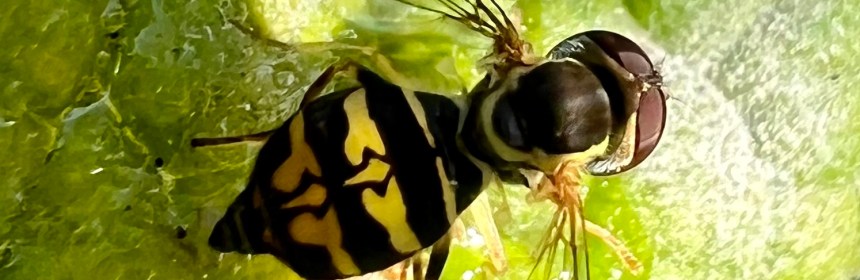
Here’s my bug of the day. This beauty is a Western Calligrapher Fly (Toxomerus occidentalis). I was mesmerized watching it rest on the mint leaf. The patterning on the dorsal side of the abdomen reminds me of some sort of totem design.
The adults of this fly species are pollinators. They lay eggs on plants near aphids and when larvae emerge they are predatory on the aphids. It is believed that late instar larvae overwinter, pupation takes place in the soil cavities in the spring and adults emerge later in summer. The name for this group of flies comes from Greek toxon ‘bow’ + meron ‘thigh’ (refers to the bow-shaped hind femur). You can see the curve in the first photo below, circled in red. Something else interesting pertaining to the adult coloration I found on bugguide.net: “Colors vary with overall temperature during pupation: if it was hot, the yellow/orange increases and the background becomes lighter, but if it was cold, the dark/black increases and the yellow/orange becomes darker like the background.”
Enjoy the last few days of sunshine and embrace our native pollinators. We are heading into the dark part of the year. For those of us who live here year round, you know what to expect. Lots and lots of rain.
Bugs like Blue. I found a bunch of these little ones yesterday floating on the surface of our above ground pool. They were also all along the outside of the pool (which is blue). I scooped out all the ones that were struggling in the water and watched as this one dried itself off. It reminded me of watching my cats grooming after finishing a meal of Fancy Feast wet cat food.
Listrus Flower Beetle on Side of Pool – April 7, 2022 – San Juan Island, WA
A Soft-Winged Flower Beetle, these are in the family Melyridae (Genus Listrus). At only about 2 mm in size, they were indeed pretty tiny. Listrus beetles feed on both pollen and nectar. They are covered with dense setae (little hairs) that pollen easily adheres to. Check out the paper reference below and learn how they have been recognized as one of the most important pollinators of plants in Western North America.
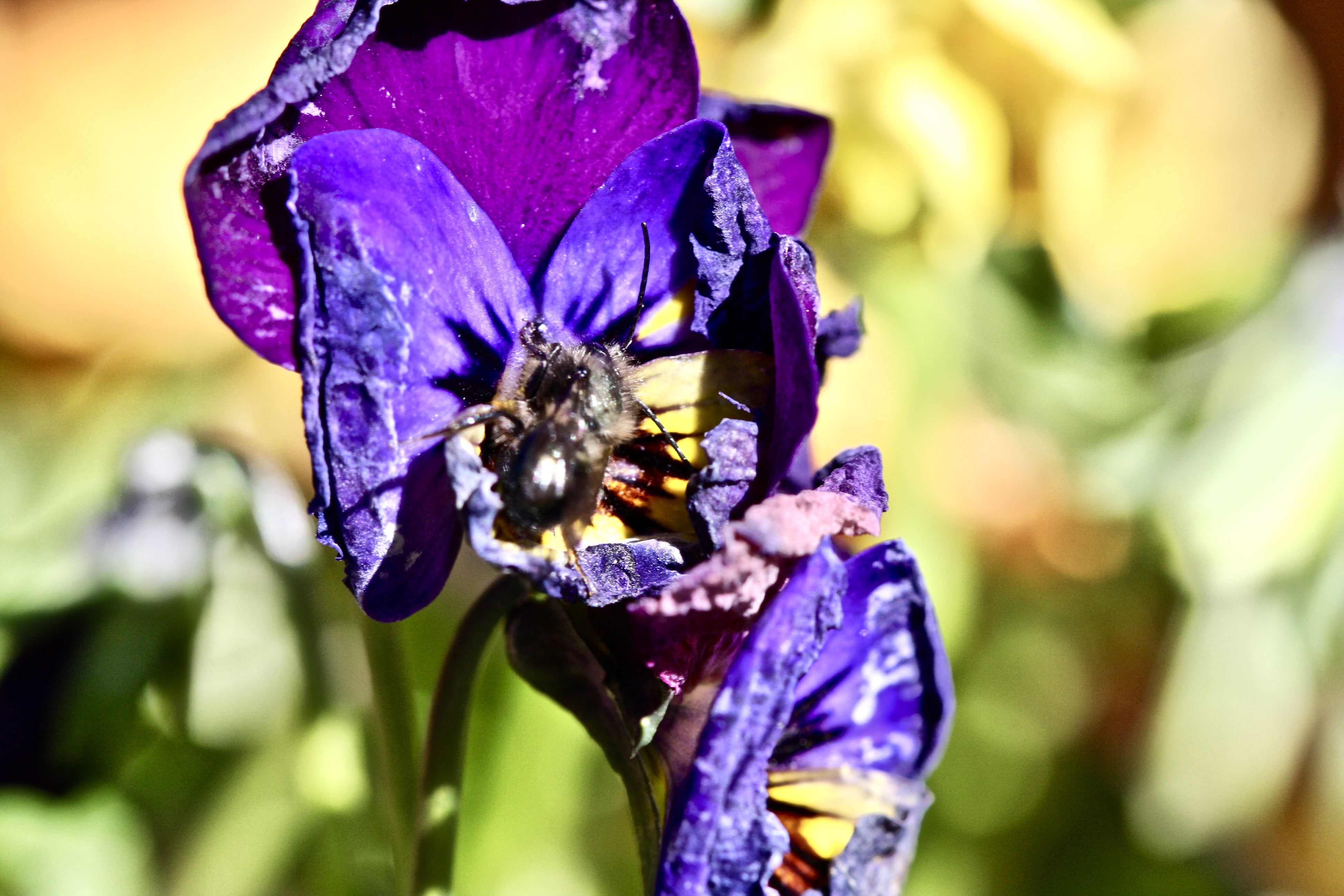
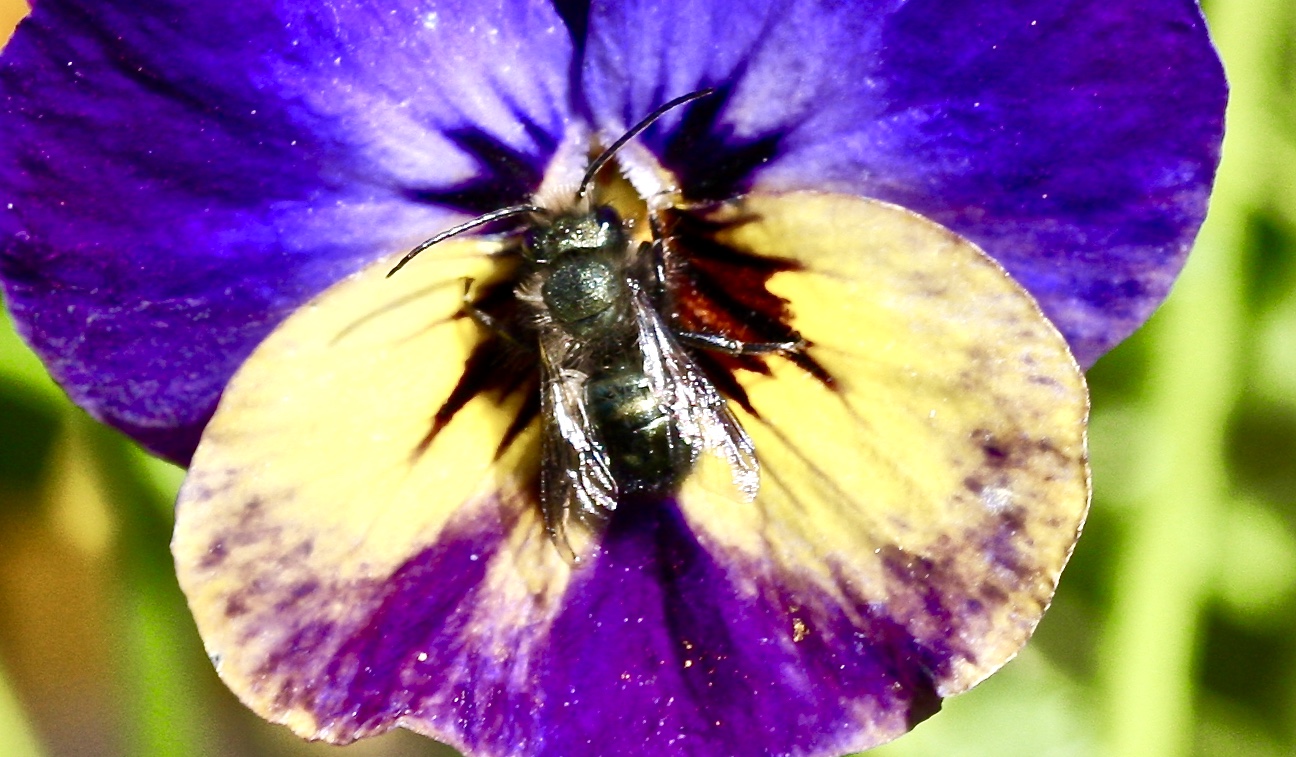
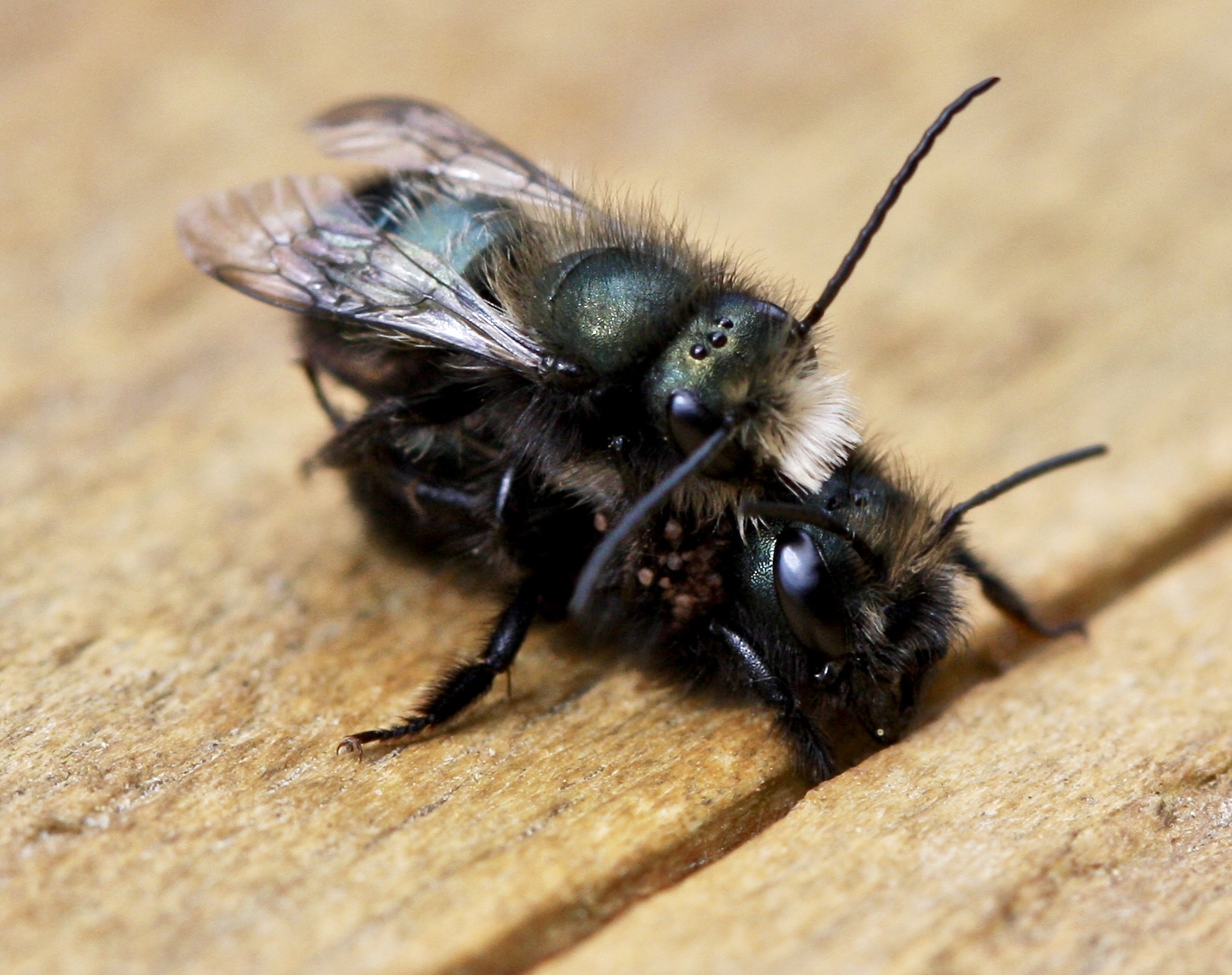
Sighted April 12, 2018, San Juan Island, WA. Blue Orchard Mason Bee (Osmia lignaria). These are important early (native) pollinators. Adults hibernate overwinter and emerge from March to May. Blue Orchard Mason Bees are being managed as orchard pollinators as they are excellent at pollinating fruit trees such as pear, cherry, plum, and apple, as well as quince and others, including blueberries. Blue Orchard Mason Bees and other solitary bees in the genus Megachilidae (like leaf-cutting bees) carry pollen on their bellies instead of special baskets on their hind legs like honey bees. The Blue Orchard Mason Bee use tubular cavities for nests, partitioning each brood cell with a wall of mud. Although similar in size, Blue Orchard bees are easy to distinguish from honey bees because they are metallic in coloring, often dark blue or blue-black.
Bombus mixtus or Mixed Bumble Bee queens emerge after overwintering to begin the process of making a nest (typically in the ground) where she will begin to make wax pots to lay her eggs in. You can help save these important pollinators by reducing use of herbicides and lawn chemicals in your yard. If you find one on a cold day, help it out by providing a boost of carbohydrate energy. You can wet a sponge or cotton with sugar water or prepackaged hummingbird food and offer it a drink. The hungry bee will thank you for it. Remember to “bee” nice to bees!
***Text and photographs copyright 2012 by Cynthia Brast. No part of this story may be reproduced in any form without the expressed written consent of the author.

















 Bugging You From San Juan Island