It was 51 and sunny to partly cloudy yesterday afternoon about 4pm when I meandered down to our unkempt orchard to look for pollinators. The temps had dropped the night before to around 34-35, so you could say it is still pretty chilly here in the PNW on San Juan Island. At least it is in our neck of the woods.
We have a couple of Yellow Plum trees in bloom. Don’t ask me the species. I don’t know. I might get ONE or TWO plums a year if I get lucky. It’s not for lack of fruit. It’s my lack of ambition or desire to go down and collect them all and I am NEVER EVER peeling plums again to make jam or anything like that ever again in my life. The time I did, it took my wrists months and months to recover. Also, I just don’t want to be a homesteader. Don’t get me wrong, I love living on 7 acres, but it is not because I can have a garden. It’s largely because I didn’t want to have close neighbors. I won’t get into that here, but let me tell you that 7 acres is nowhere near large enough. You need a hundred, and your house needs to be in the middle.
So, what flies do I have to show you today? There were four species I counted, maybe five, but the fifth one was so tiny, I didn’t work on any identification for that one. There was only one solitary bee. I’ll point out here that there were ZERO honey bees. #1, it’s too cold, and #2 because they can’t fly in temps over 50, they are not going to be the ones pollinating your fruit trees. It’s largely flies, moths, and maybe some ants and beetles. Mostly it is flies.
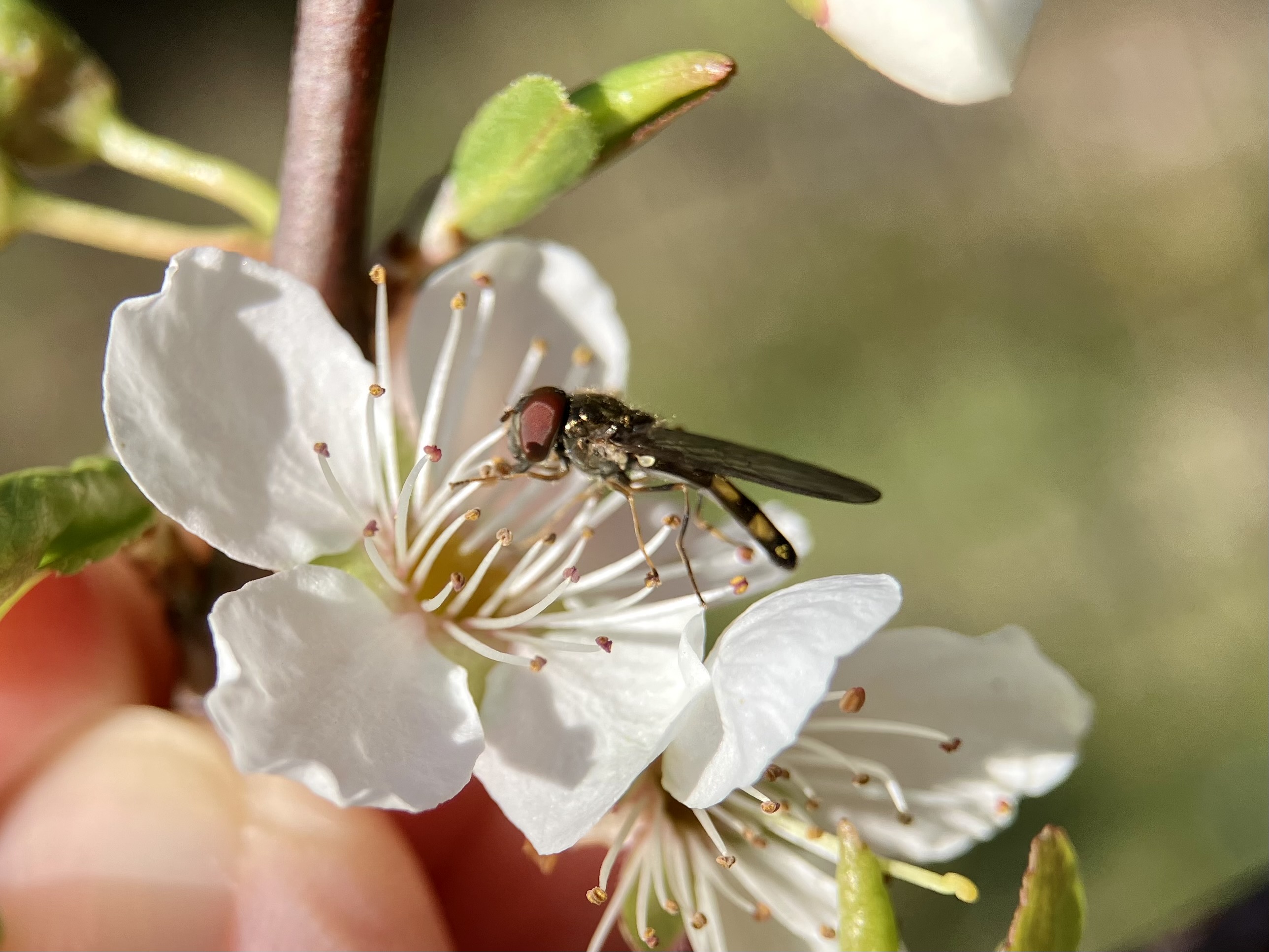
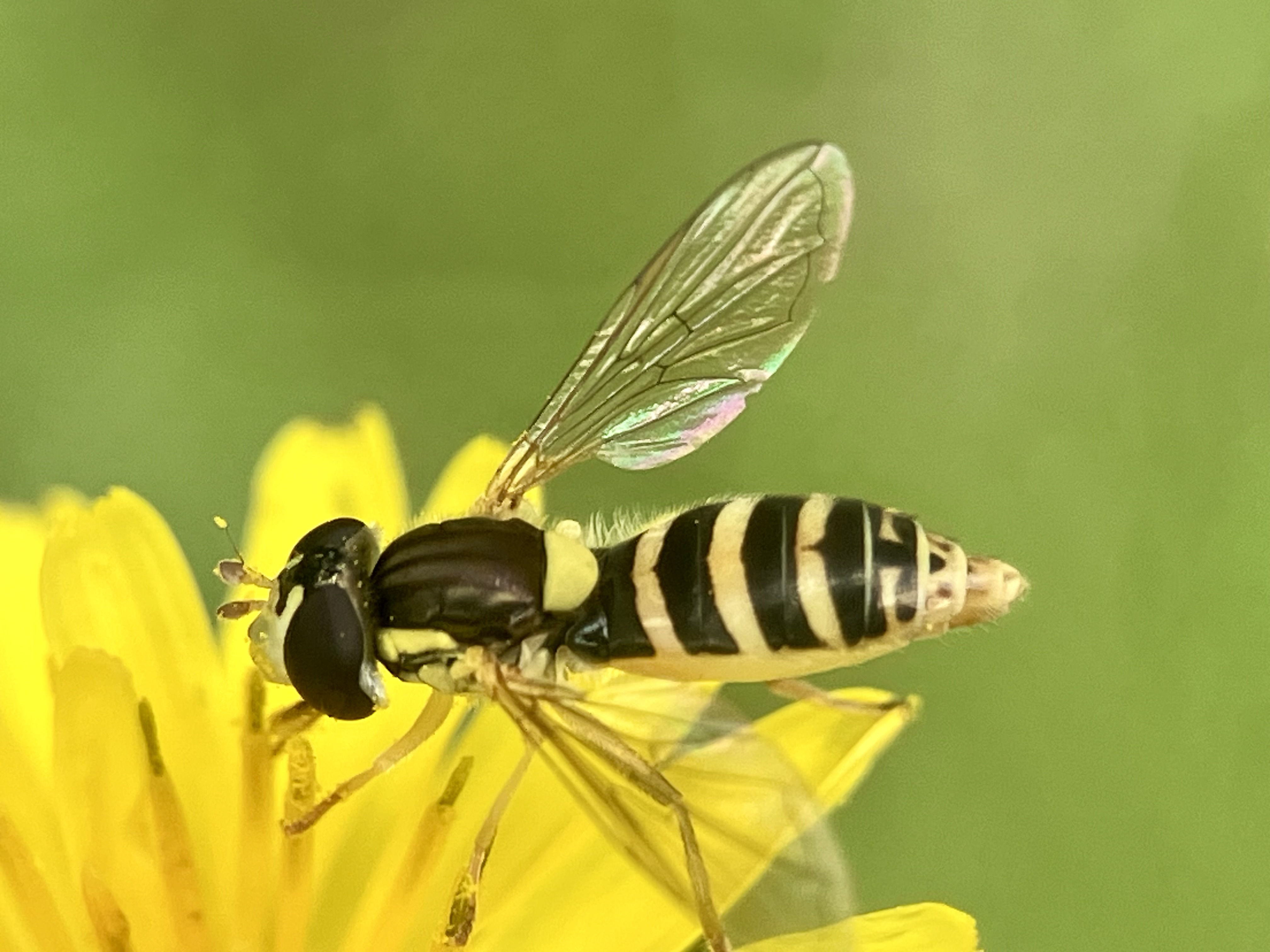
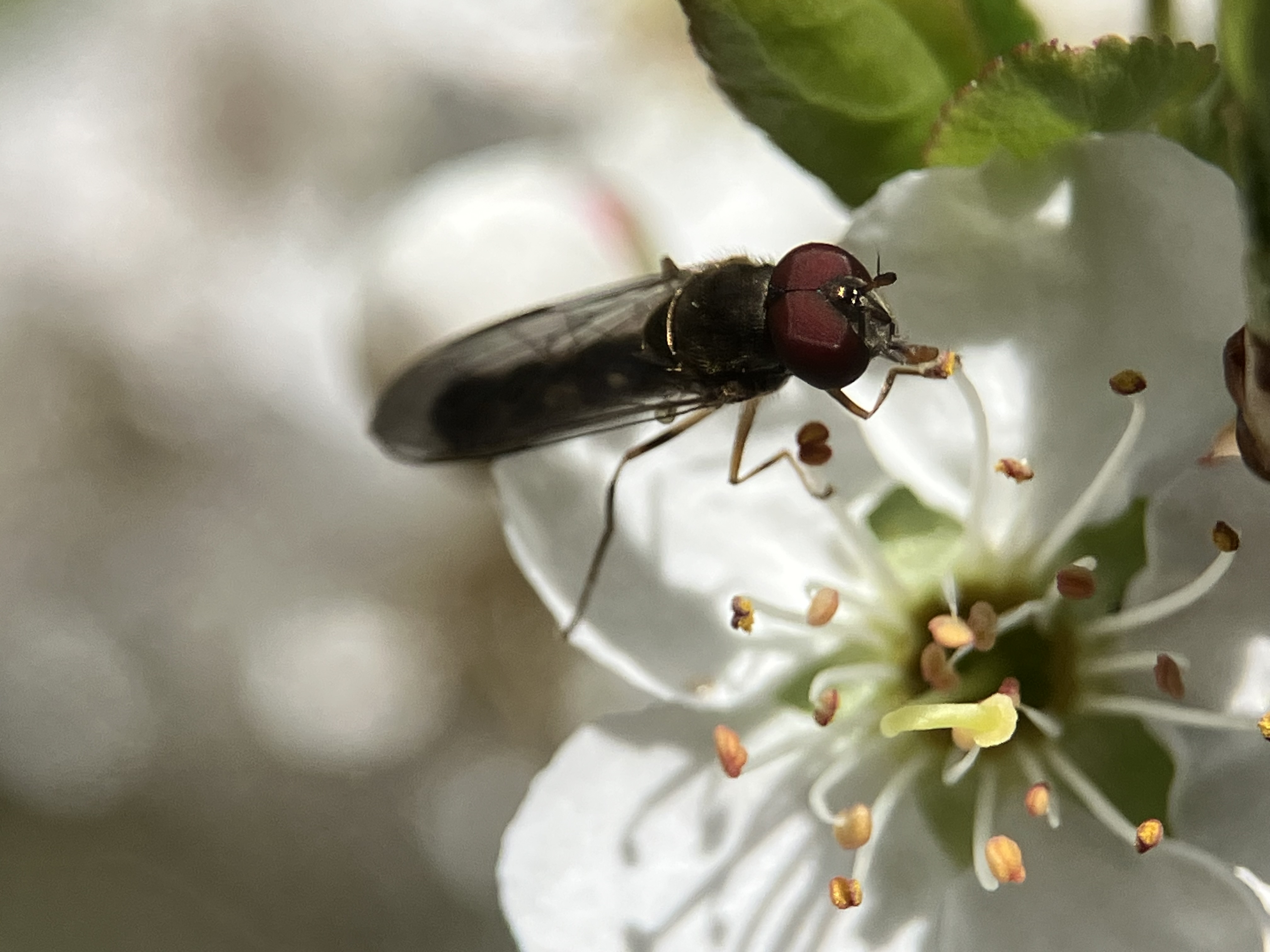
(Melanostoma mellinum) Variable Duskyface Fly
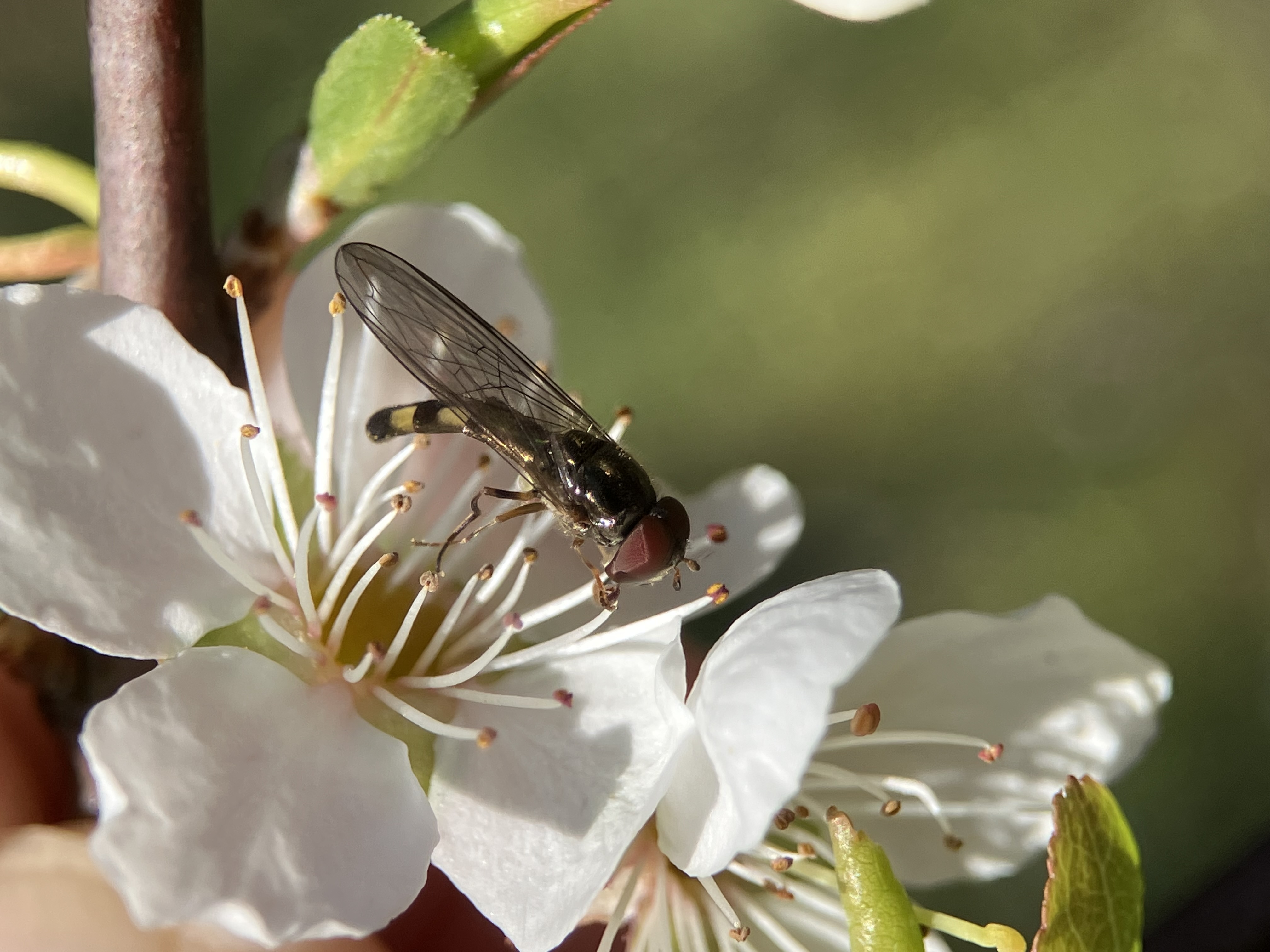
(Melanostoma mellinum) Variable Duskyface Fly
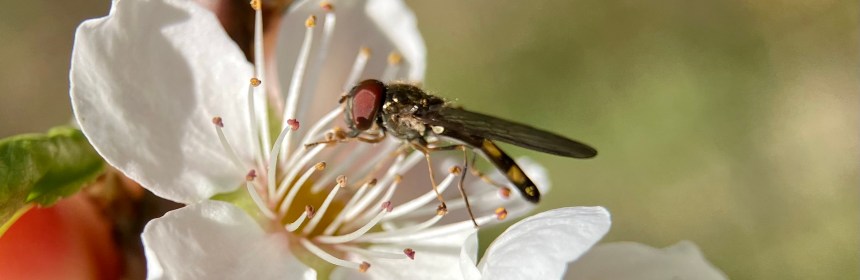
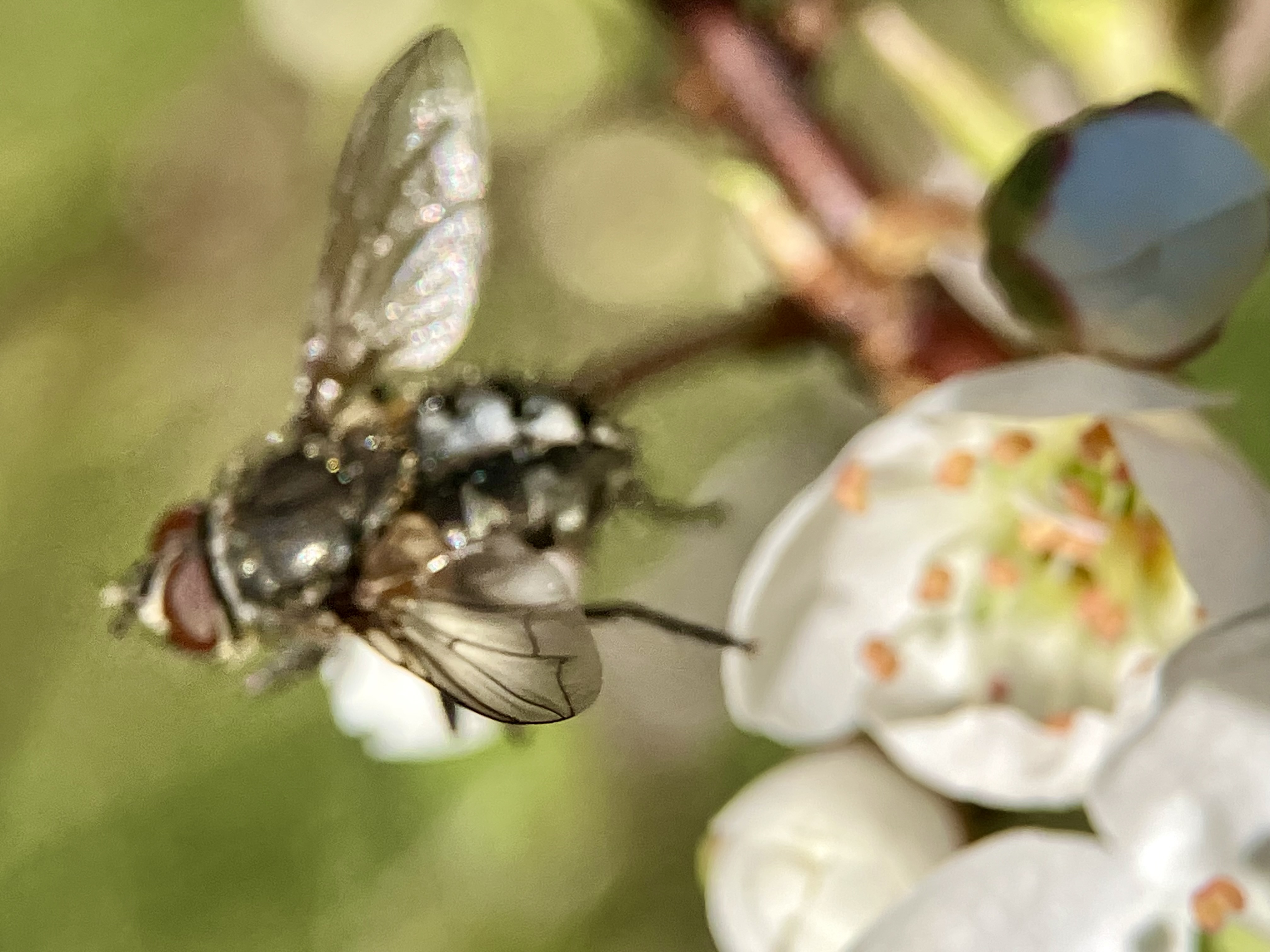
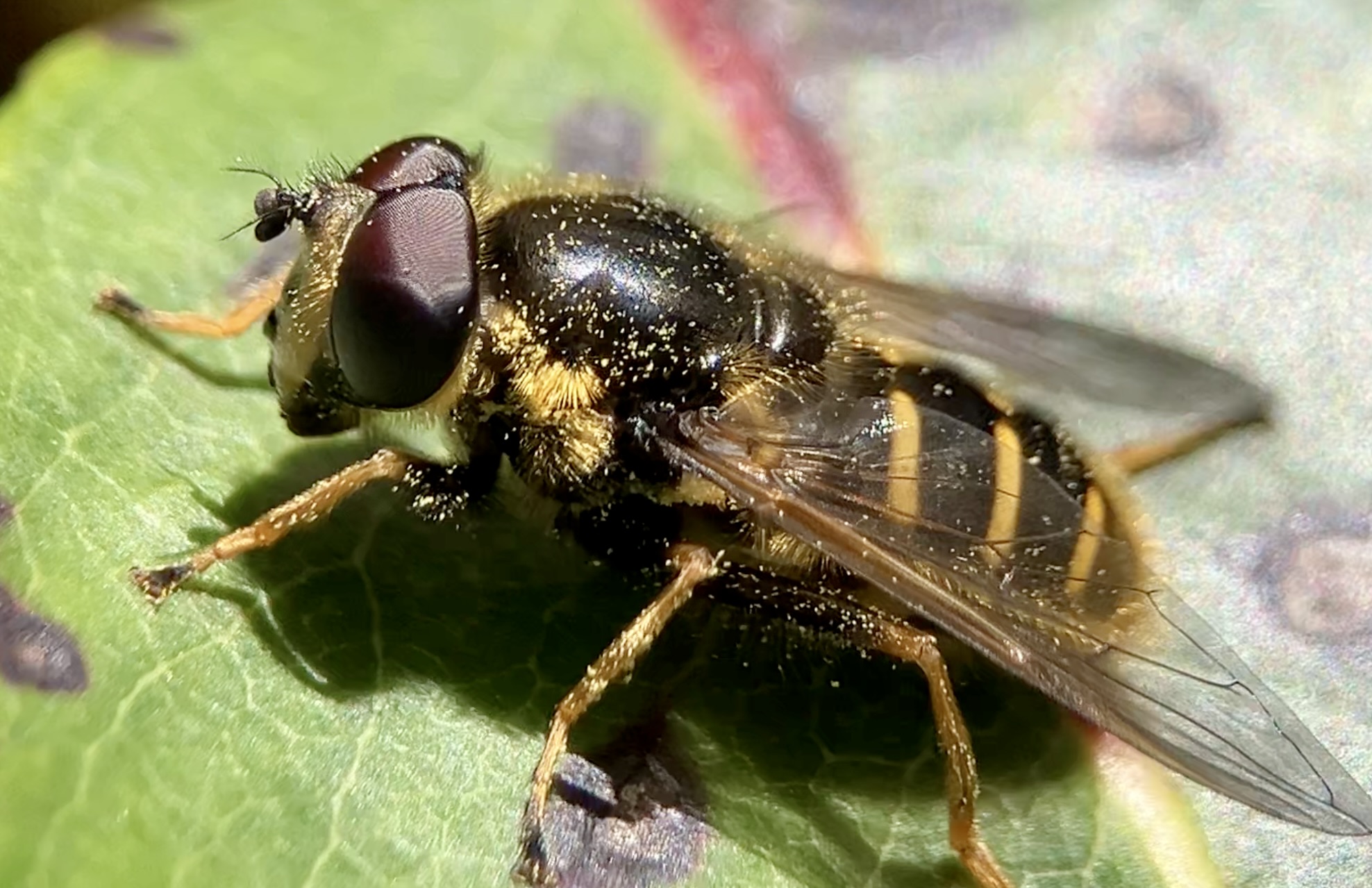
Fly #1 The Variable Duskyface Fly (Melanostoma mellinum). This is a species of Syrphid Fly and I believe my specimen to be male. Syrphid flies are wonderful in gardens and orchards. They not only pollinate, but they scavenge aphids away in their larval form. Watch this one in action here
(Melanostoma mellinum) Variable Duskyface Fly
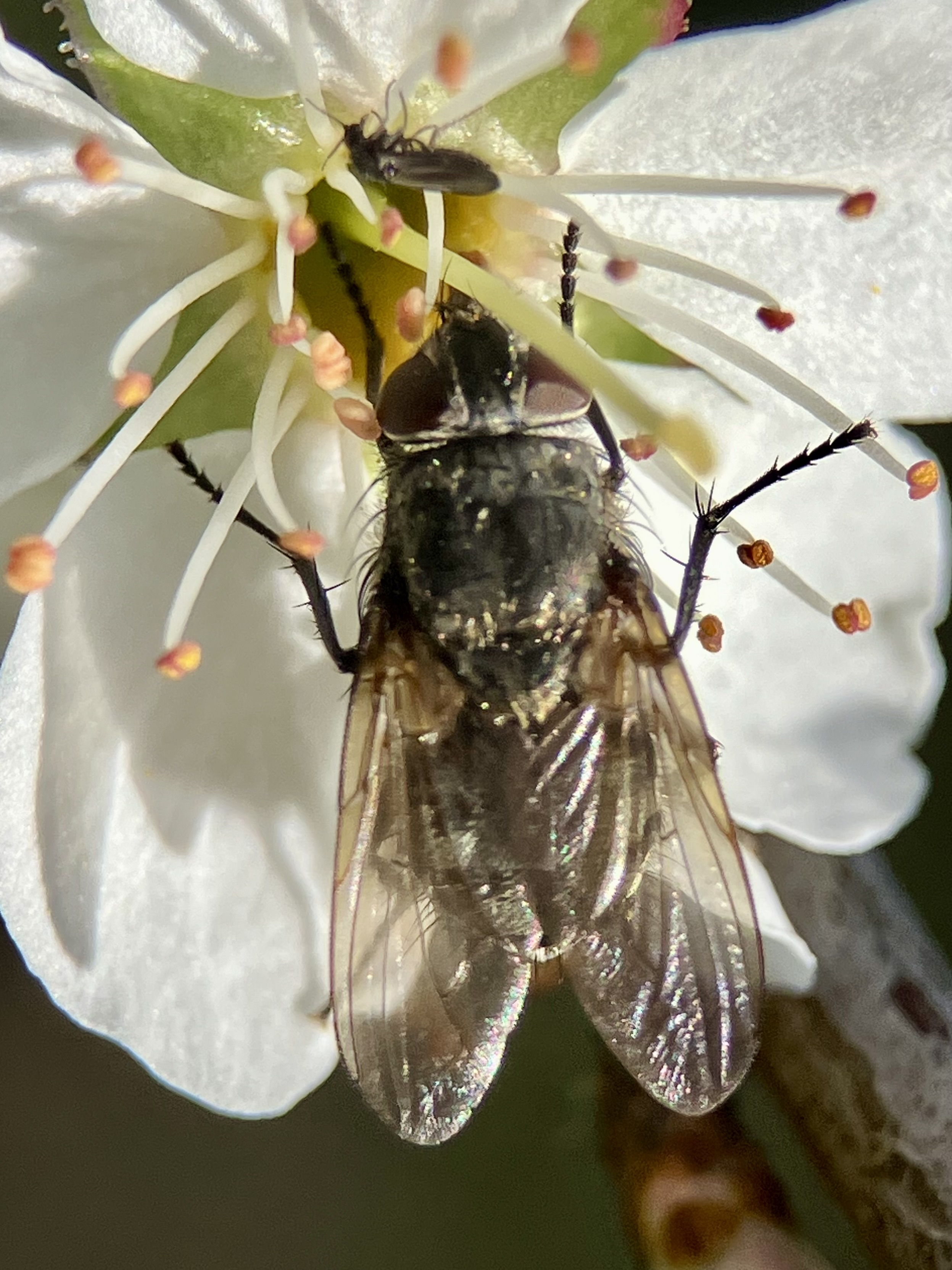
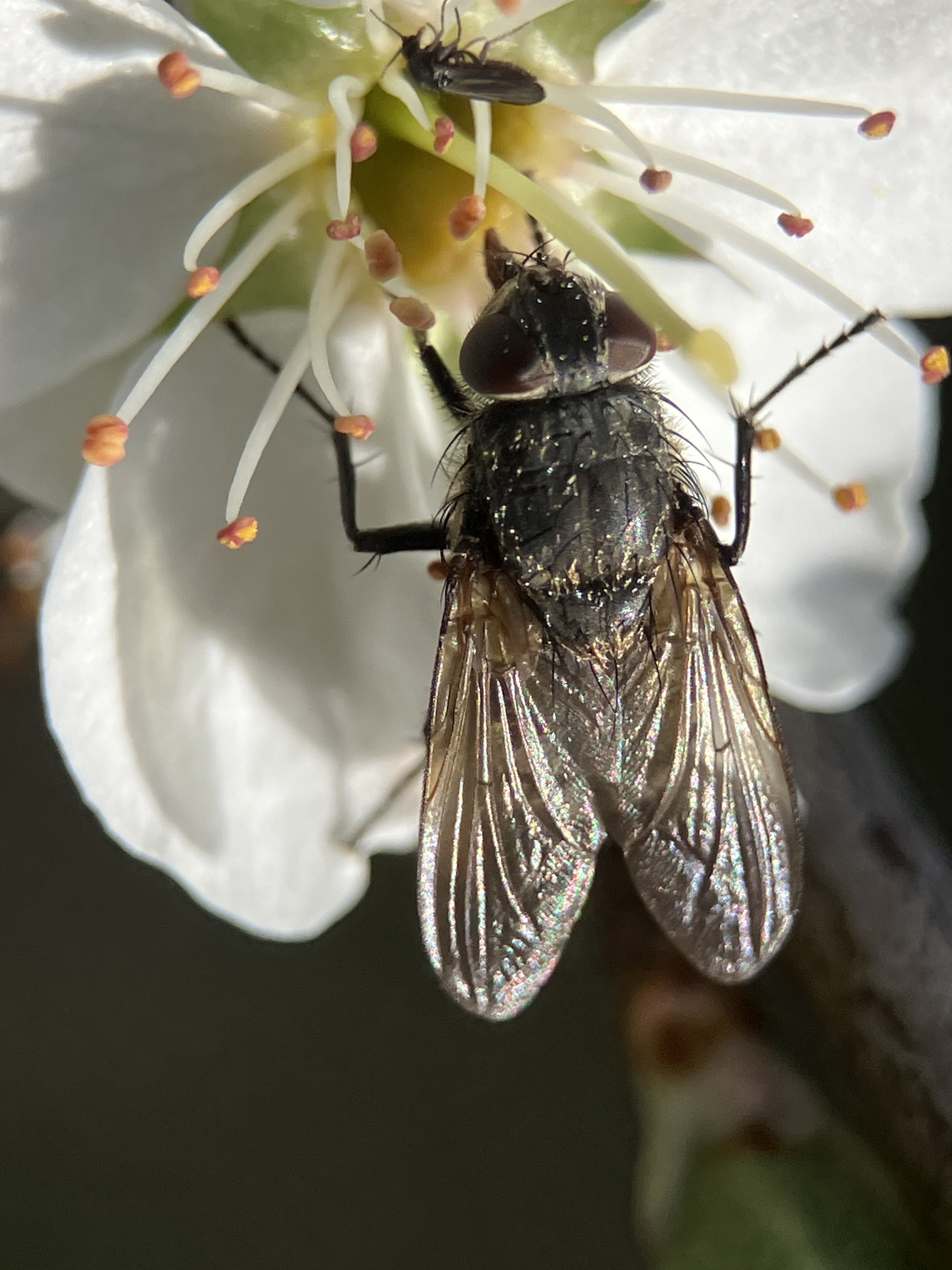
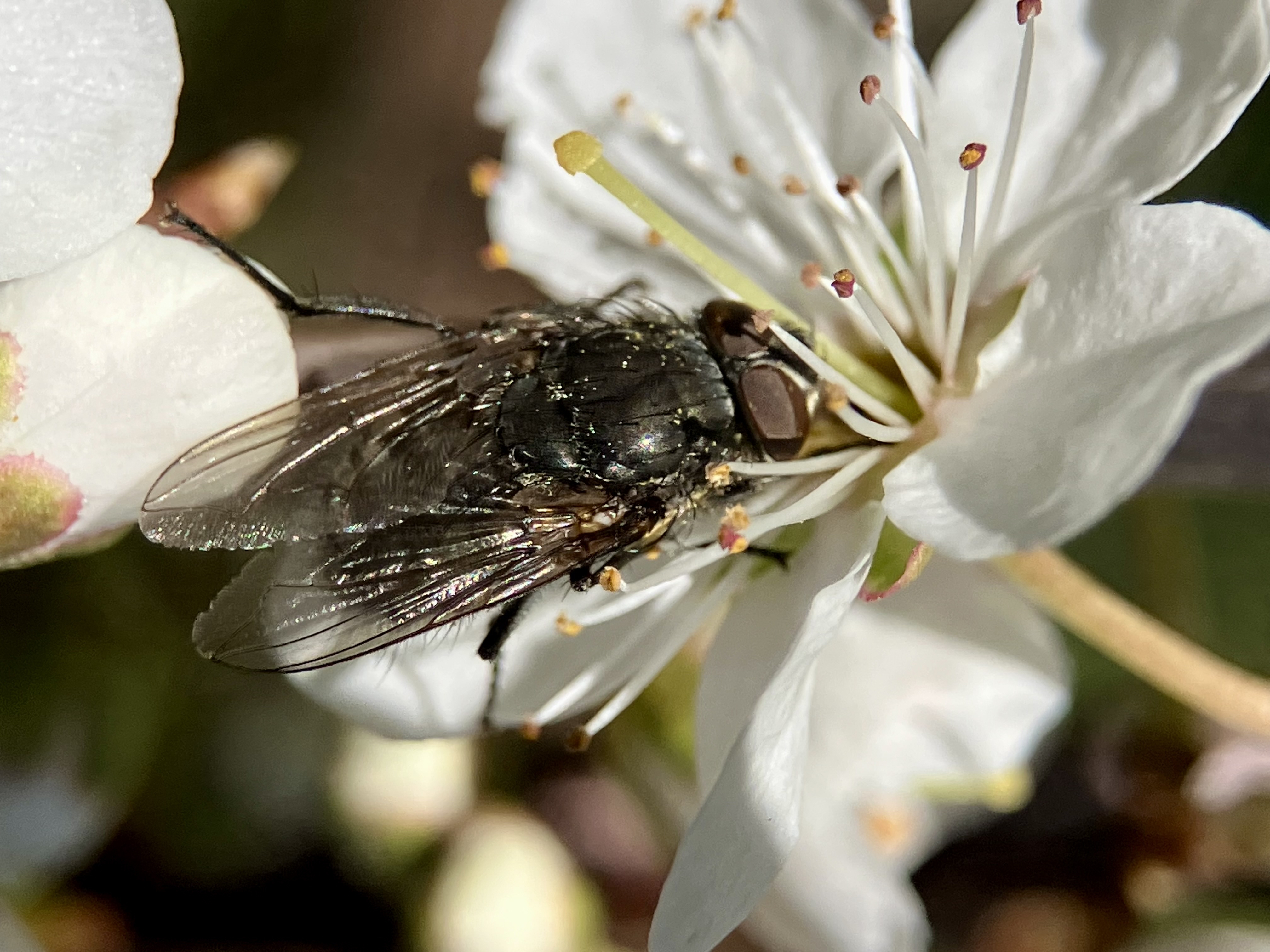
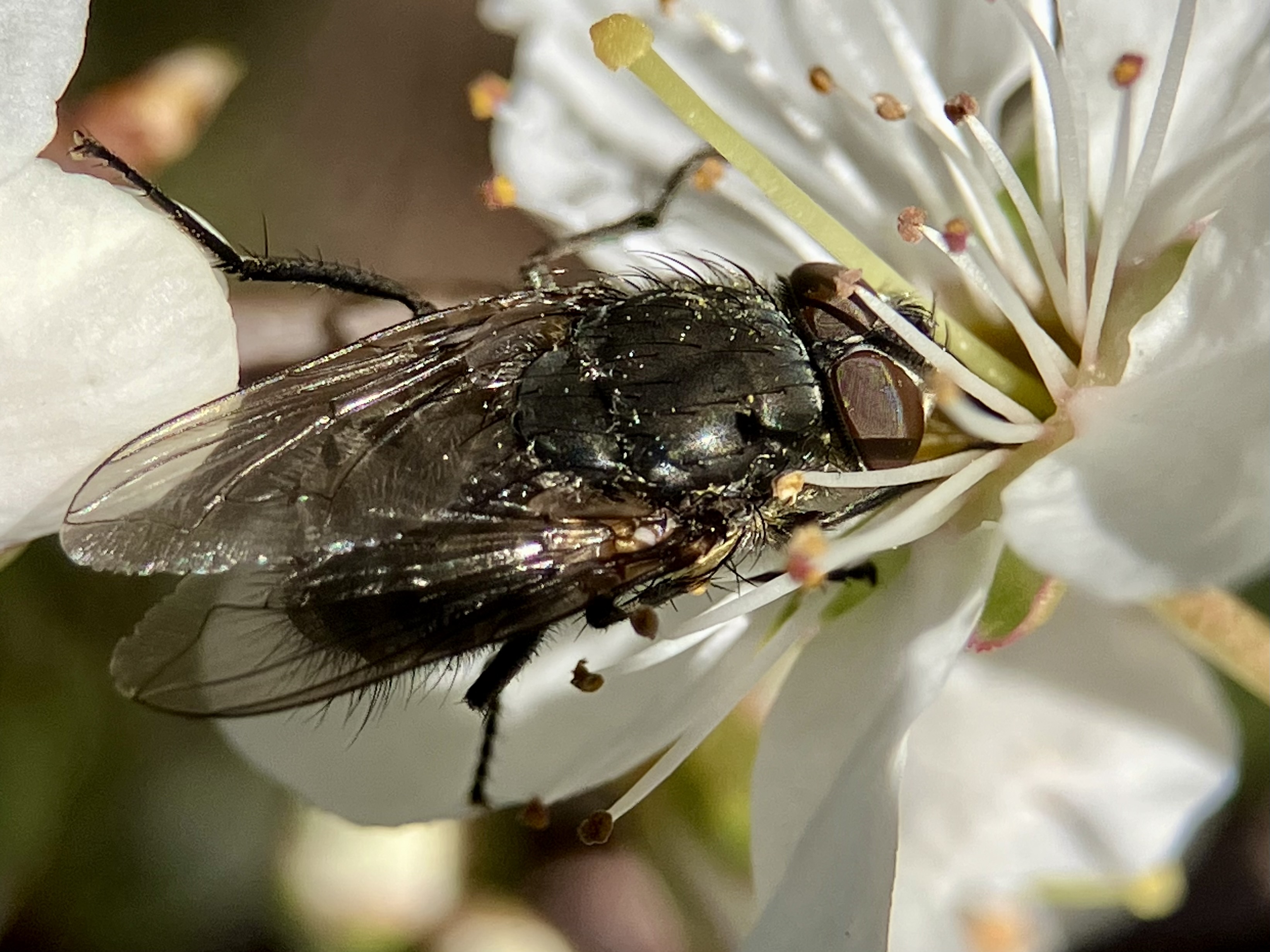
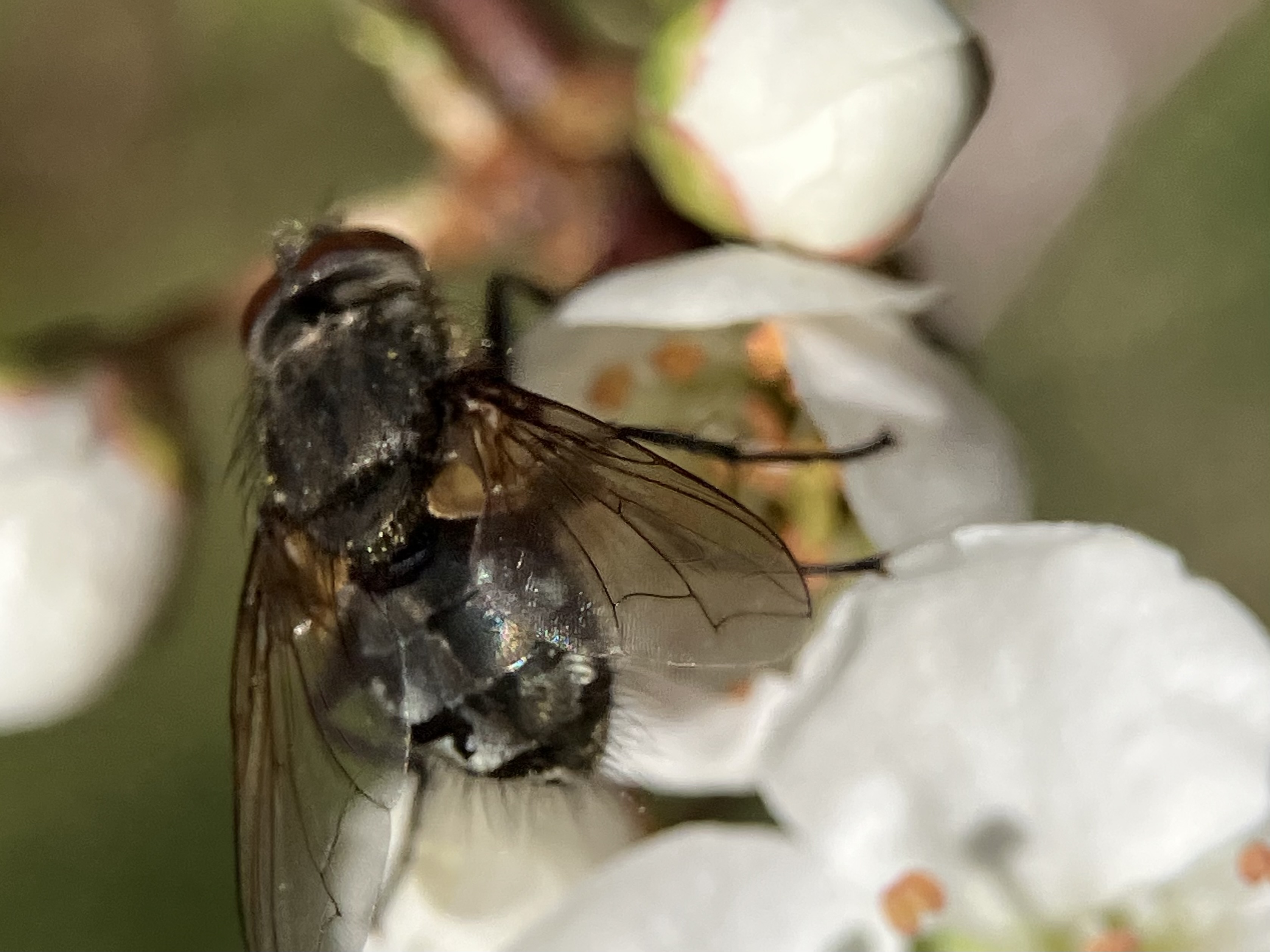
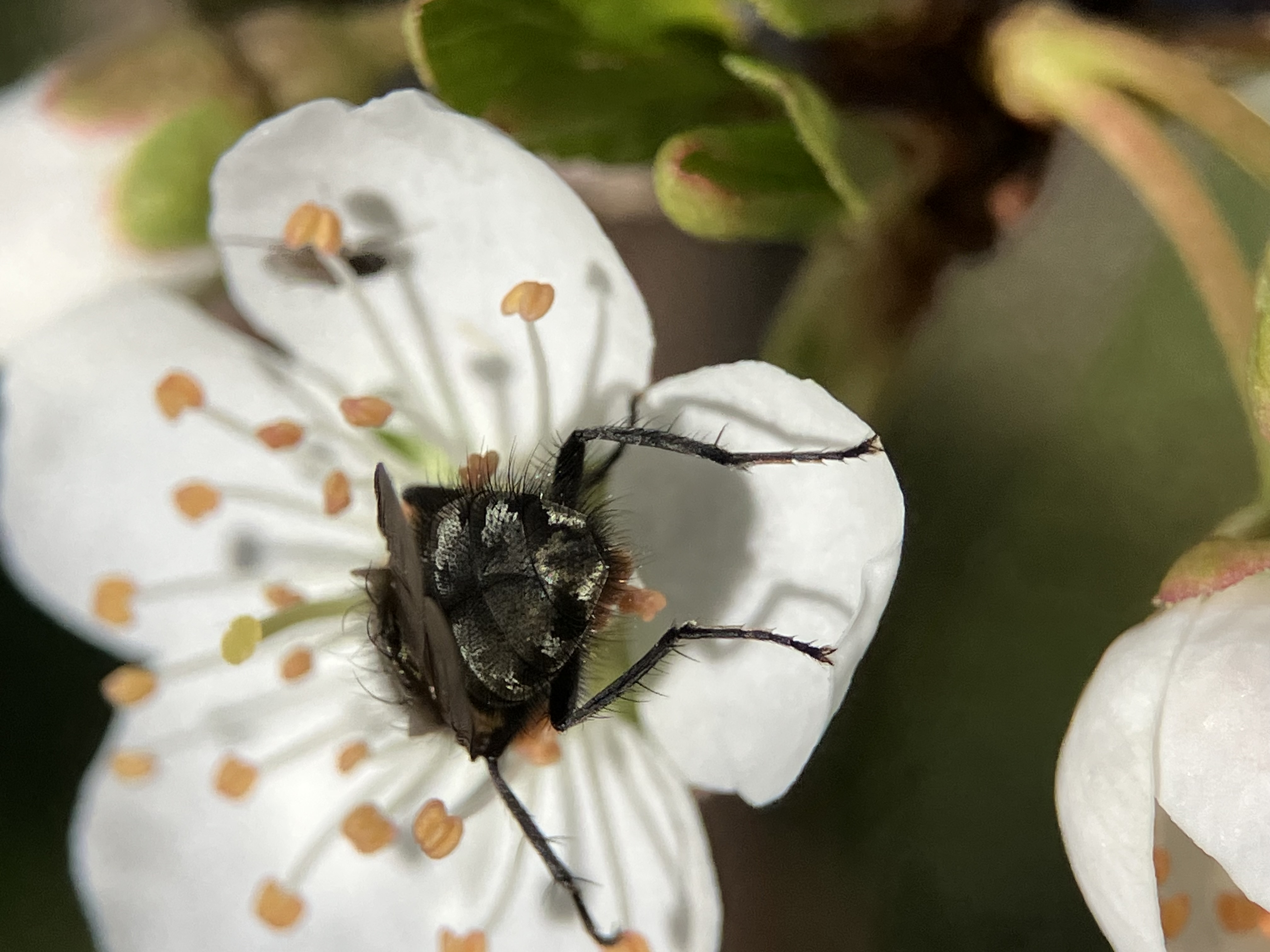
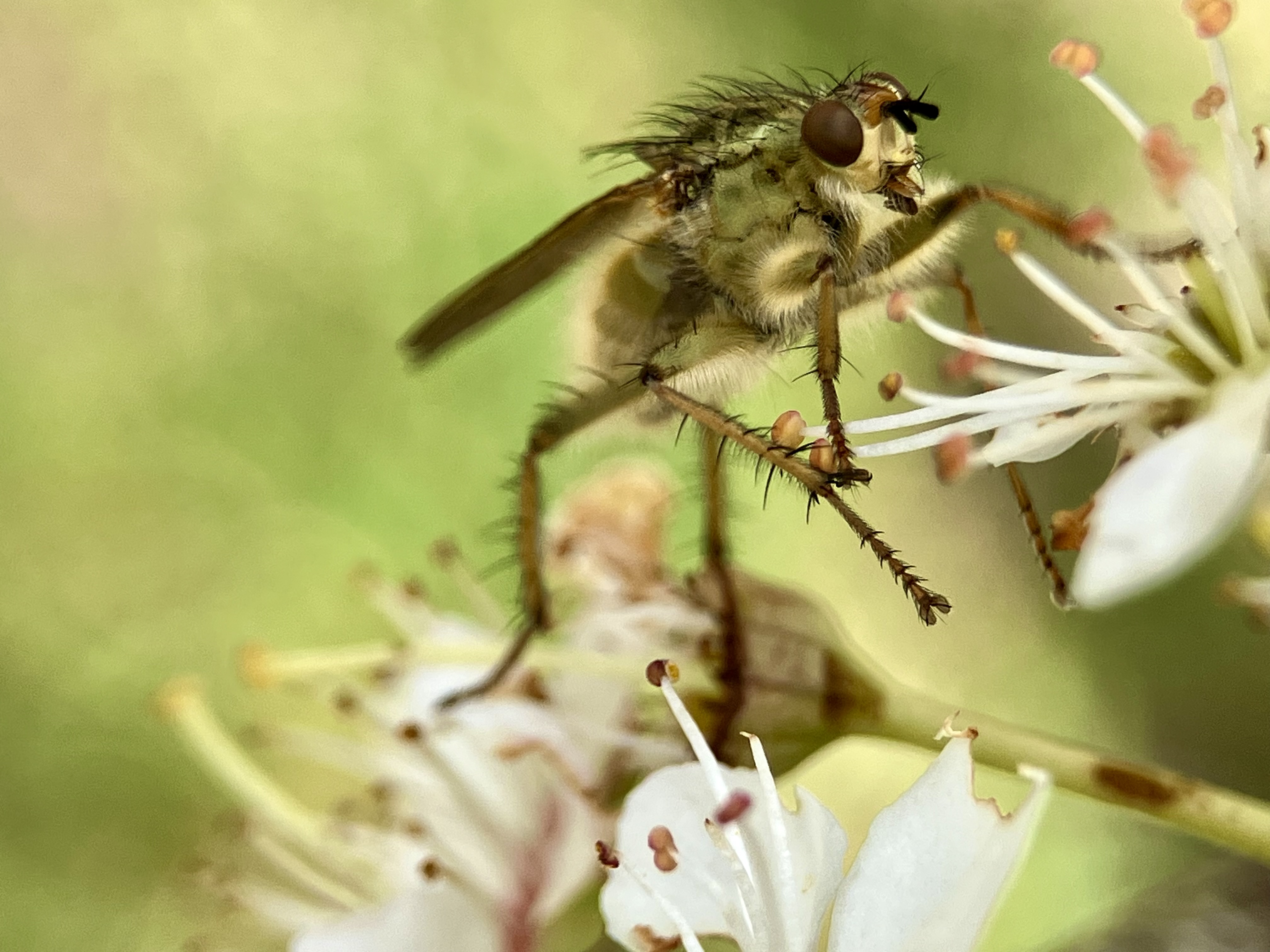
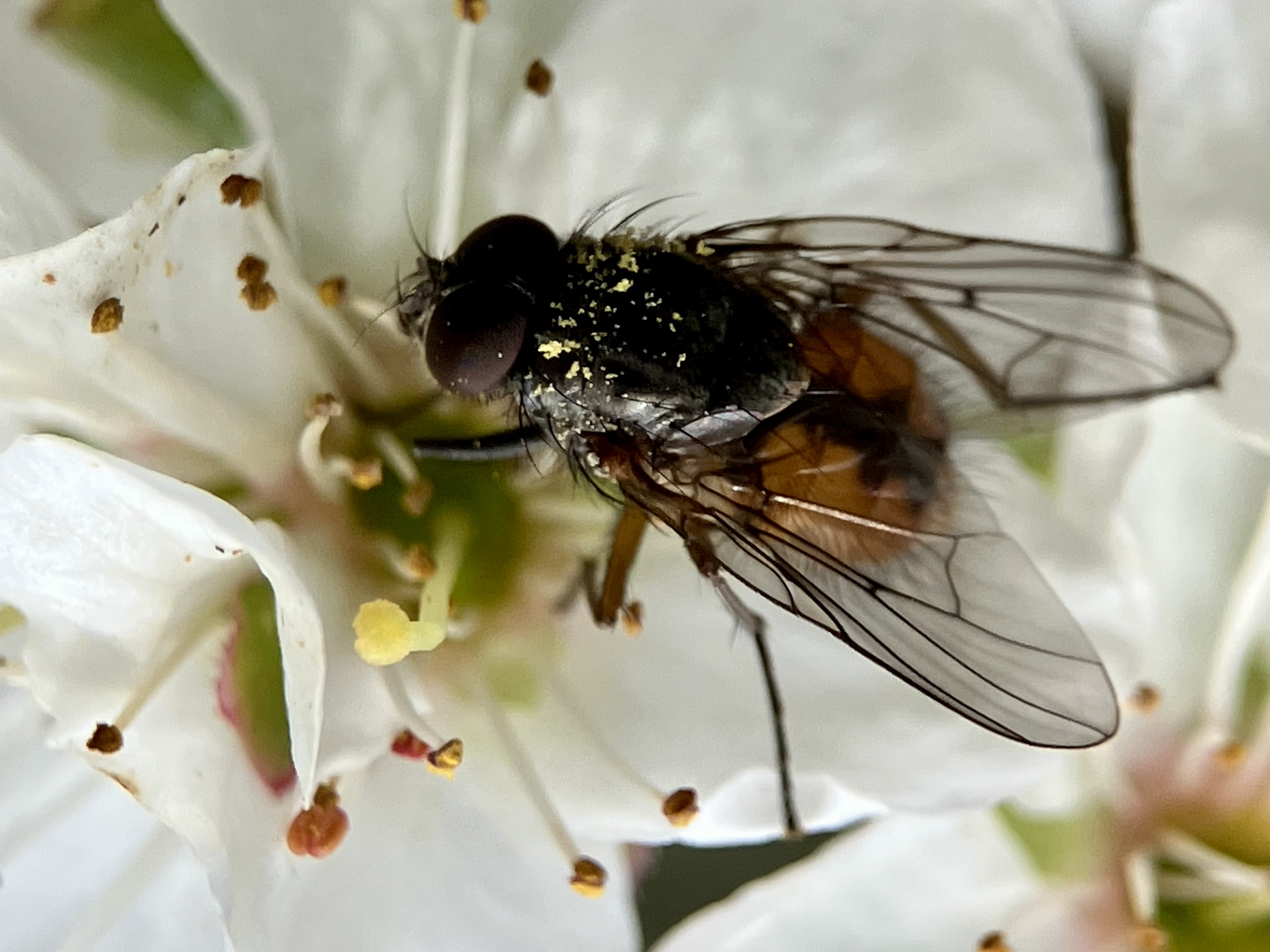
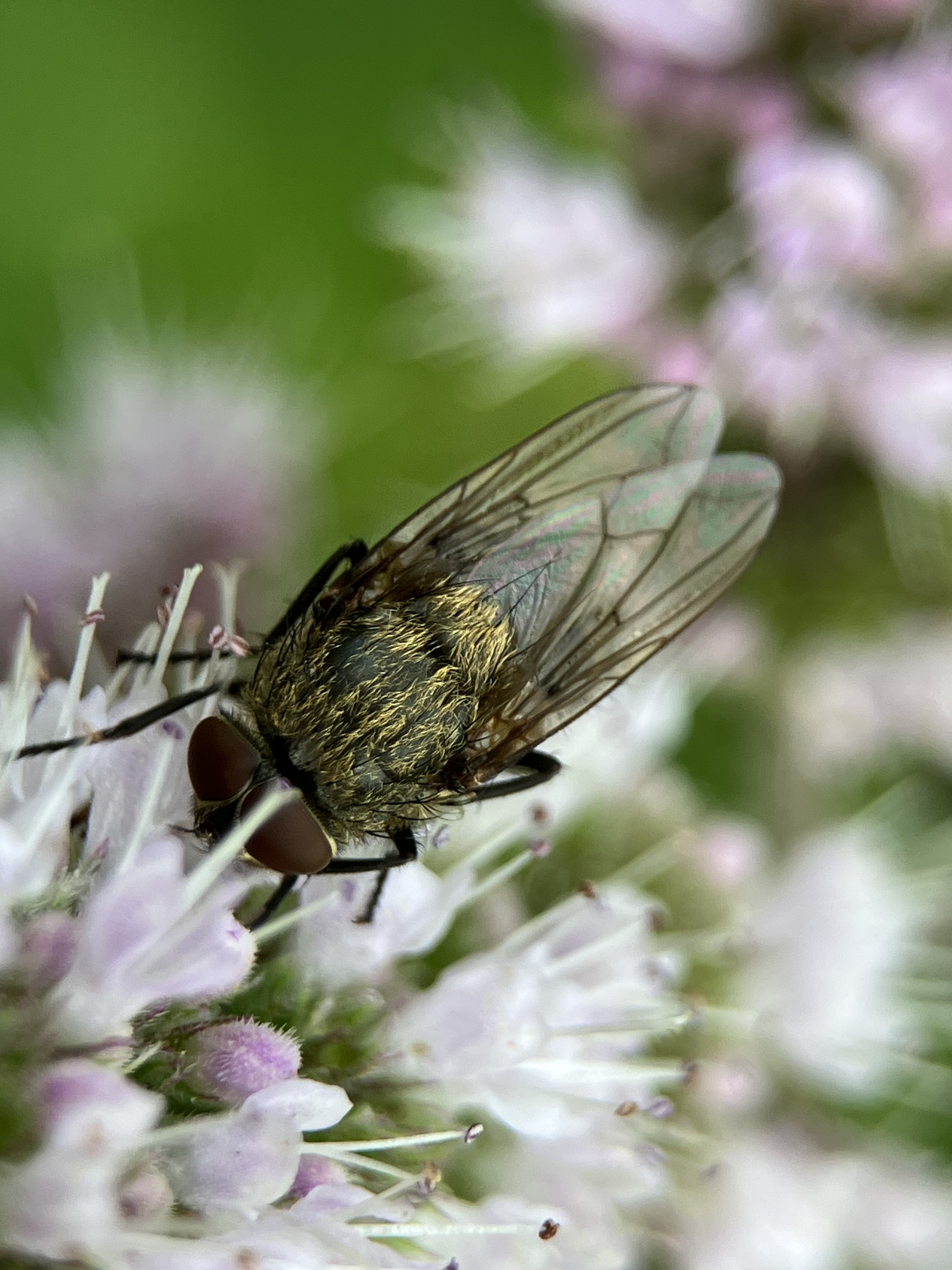
Fly #2 The Cluster Fly (Pollenia sp.) Pollenia flies have had some taxonomic revisions that I am not completely up to speed with, but suffice to say that they are now in their own family (Pollenidae) and I’ll attach some references at the end if you want to deep dive into the literature and try and figure out the species here.
What I can tell you about these flies is they got their name because they will sometimes overwinter in human structures (clustering). They are an Old World group, so these are not native to North America. They are parasites of earthworms, or at least one of the species in the Genus is. They also were ALL over the plum tree. I bet I counted fifty of these.
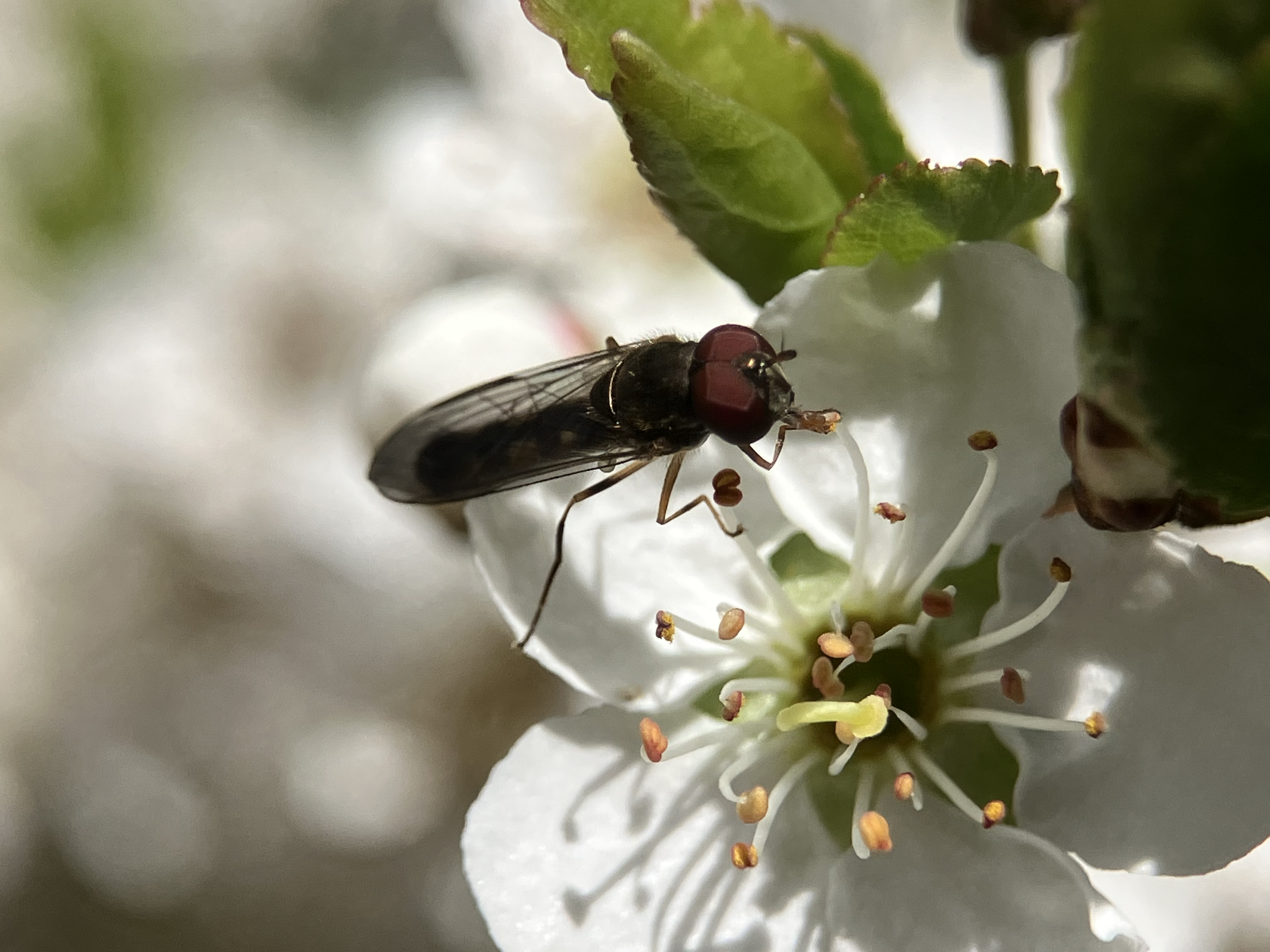
Fly #3, I believe this one (below) is the Greater Spring Blacklet (Cheilosia grossa), a species of Hoverfly in the family Syrphidae. This species is native to Europe and was introduced to the United States as a biocontrol for thistles. The adult is obviously enjoying its role as a plum tree pollinator and its offspring (the larvae) will help manage the thistles on our property, I suppose.
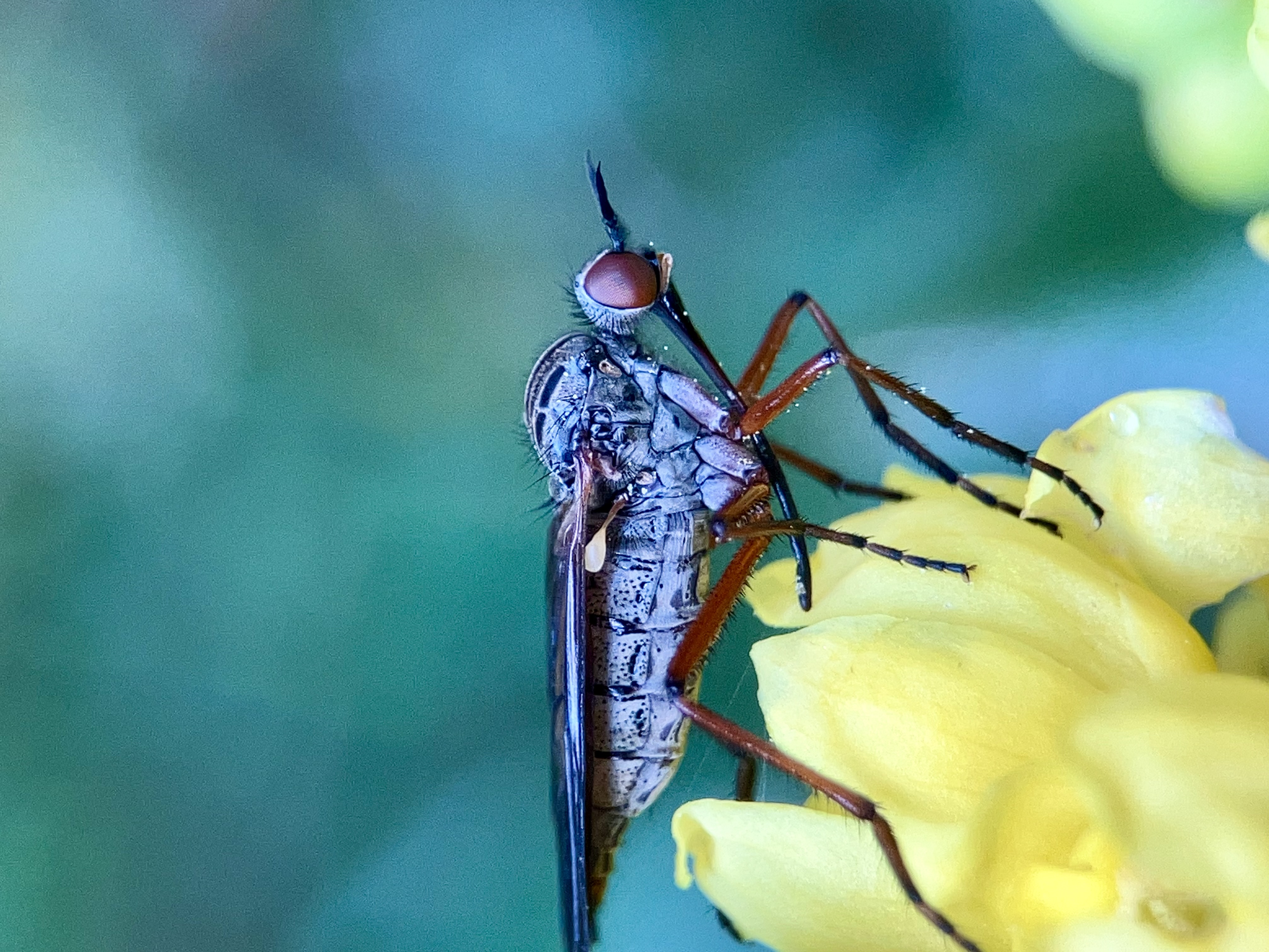
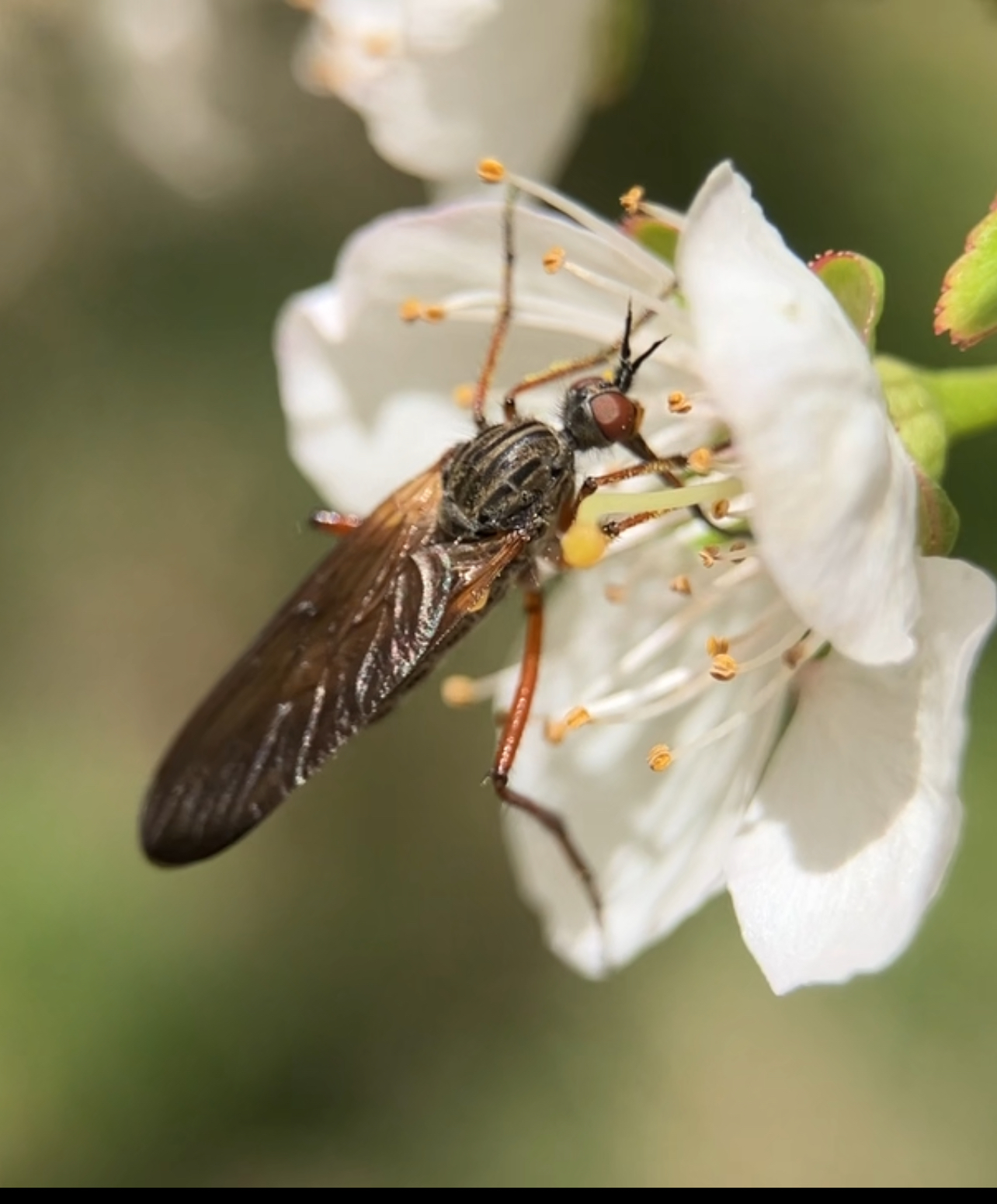
Fly #4 is Empis barbatoides, a Dance Fly. I had to stand on my tippy toes to try and get this video clip for you. I love this species of fly. They are so cool. The males catch other fly species, like March flies (Bibionidae) and make little balloon packets to woo a female. If you don’t believe me, you can read one of my earlier blog posts about them. I know a spot where the males seem to gather together to dance too. I keep hoping I’ll get some good video of them dancing to share.
And that’s all for tonight. It’s late and I’m going to bed. Just remember to repeat to your friends that FLIES are your friendly pollinators, and some of them are pest predators too. We need more people to advocate for them. They aren’t always a pest! 🪰
References
Alcock , John. 1973. The mating behaviour of Empis barbatoides Melander and Empis poplitea Loew (Diptera: Empididae), Journal of Natural History, 7:4, 411-420, DOI: 10.1080/00222937300770301
Gisondi S, Rognes K, Badano D, Pape T, Cerretti P (2020) The world Polleniidae (Diptera, Oestroidea): key to genera and checklist of species. ZooKeys 971: 105-155. https://doi.org/10.3897/zookeys.971.51283
Jewiss-Gaines, A., Marshall, S.A., Whitworth, T.L. 2012. Cluster flies (Calliphoridae: Polleniinae: Pollenia) of North America. Canadian Journal of Arthropod Identification No. 19, 15 February 2012, available online at doi: 10.3752/cjai.2012.19
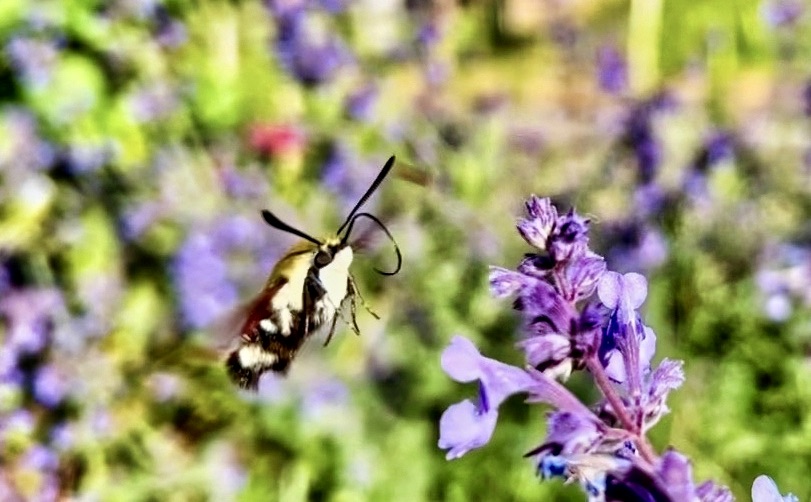
Hemaris thetis moth nectaring at Catmint (Nepeta sp.)
With spring around the corner, I thought it might be a good time to write up a post about bees. For those of you who don’t know me, I’ve been a San Juan Island resident now for over 17 years. When I was finishing my Masters Degree in Entomology and Nematology, I was required to take bee keeping as part of my advanced Apiculture coursework.
My former bee keeping days! 2010
I won’t lie, I did enjoy the bees. I had one of the hives under a bedroom window, and it smelled so wonderful to open that window and smell the bees in the house. In my studies, I learned a lot about social insects. The other thing I learned was bee keeping sure is an expensive endeavor.
Why? Well mostly because the bees had to be replaced every year after they died over the winter from starvation. They didn’t always starve, but in the 6 years or so of keeping bees on the island, I think my longest surviving hive lasted about 4 seasons. That one, I can assure you, only lasted that long because I fed them sugar water. I was feeding the bees a quart of sugar water at least twice a day. They had all of that, and I never took any honey from my hives. All the costs added up. They also sting.
In my experience, I concluded honey bees weren’t exactly the best pollinators here either. As I spent more and more time in my study of insects and moved to a property with an old orchard (plums and apple trees), I saw the insects doing most of the pollination were flies. We have some incredibly cool species of flies too! At night, the insects pollinating these trees included many moths. Just an FYI, flies and moths are particularly attracted to the color white (same color as early flowering fruit trees).
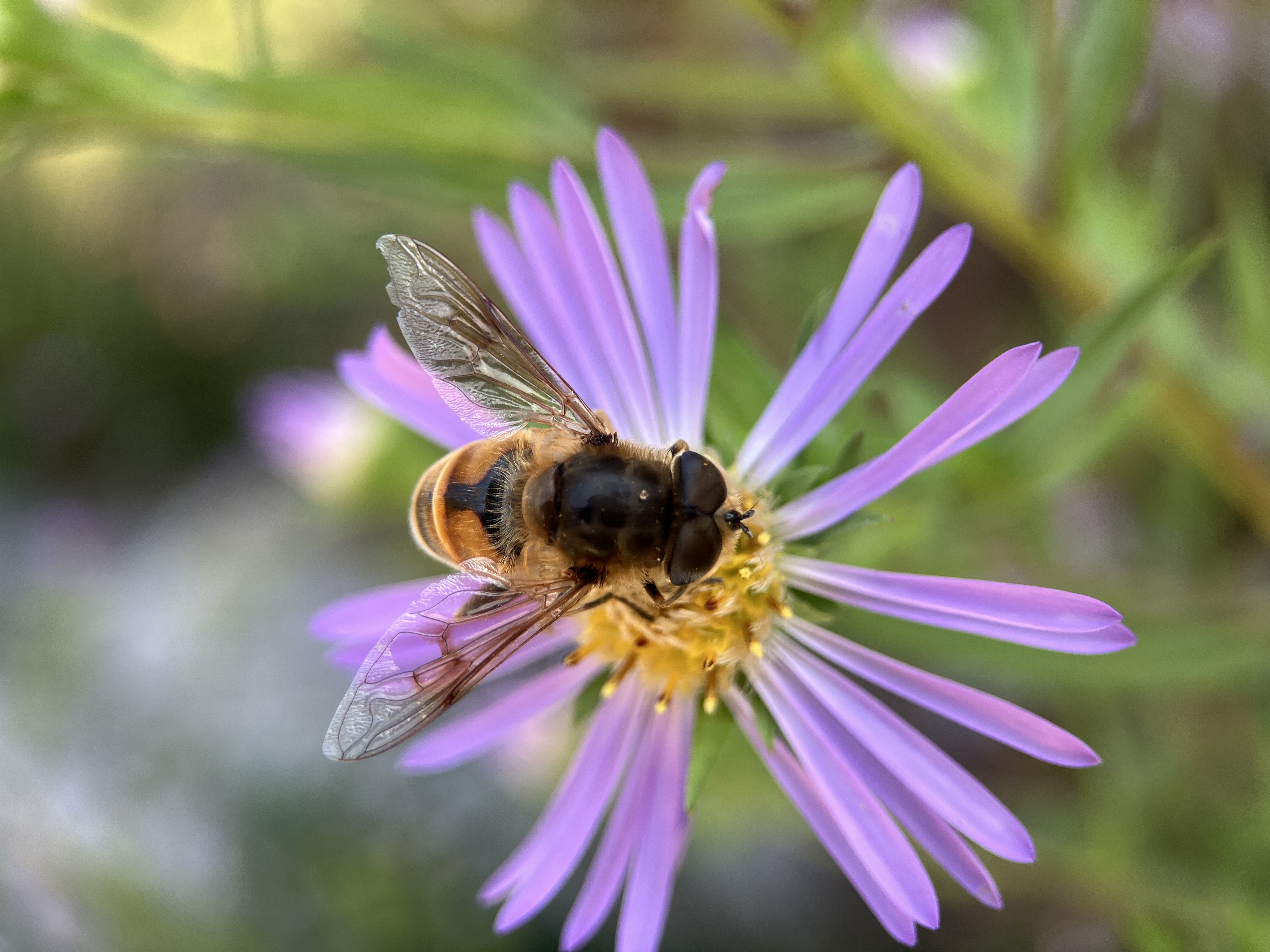
Eristalis tenax fly on Aster
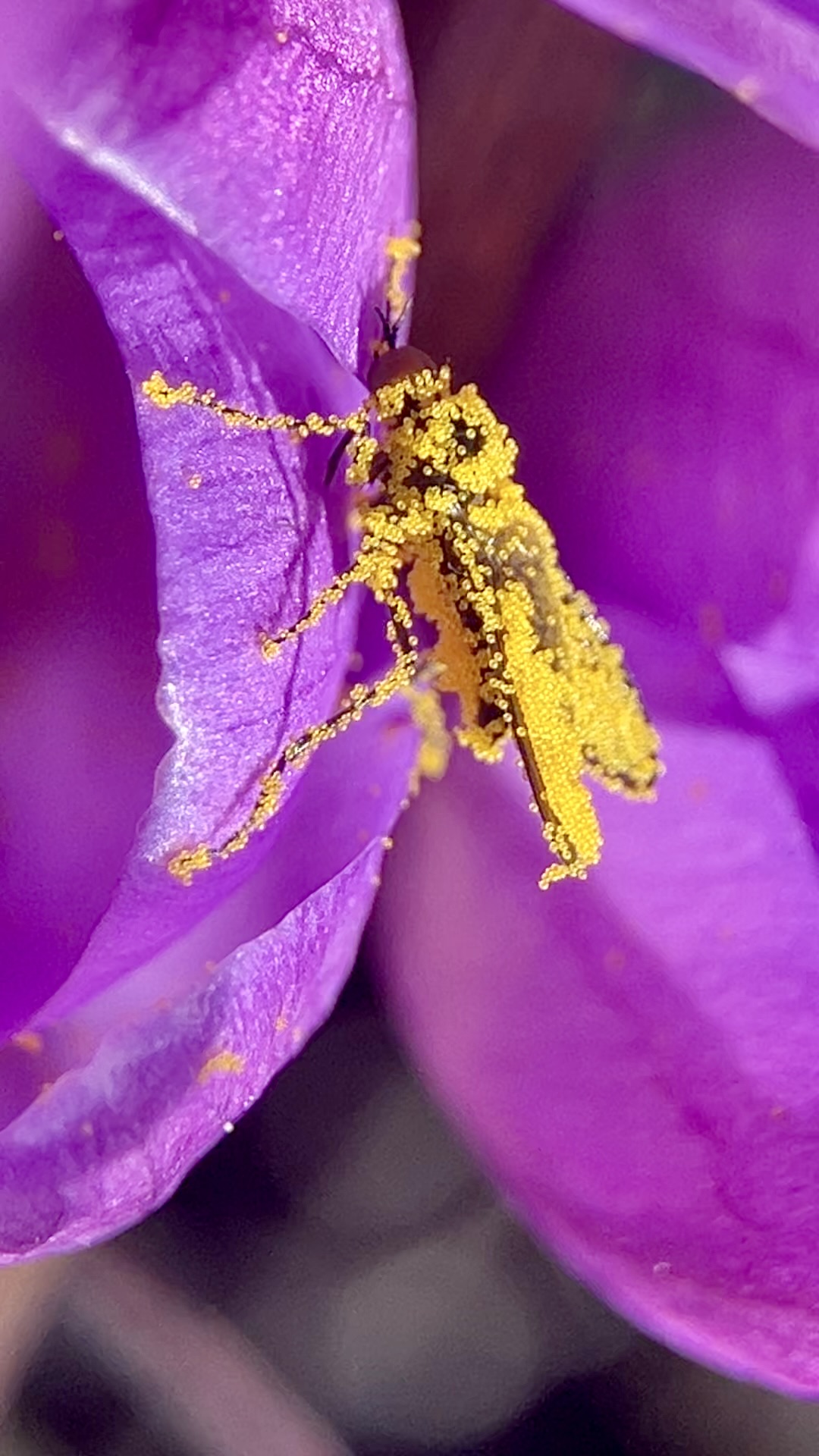
Empididae Dance Fly Covered in PollenEmpis barbatoidesEmpis sp. Golden Dung Fly (Scathophaga stercoraria) Forked Globetail (Sphaerophoria sulphuripes ), a Syrphid Fly Melanostoma mellinum Variable Duskyface Fly, a Syrphid Fly Musca sp. (I believe Musca autumnalis)Sericomyia chalcopyga – Western Pond Fly, A Syrphid FlyPollenia sp. Cluster fly
Honestly, I am not much of a food gardener, but I do love watching for insects in our garden and observing the relationships that exist. Not just between the insects and the plants, but also the relationships between different species of insects (and I’ll lump spiders in here too).
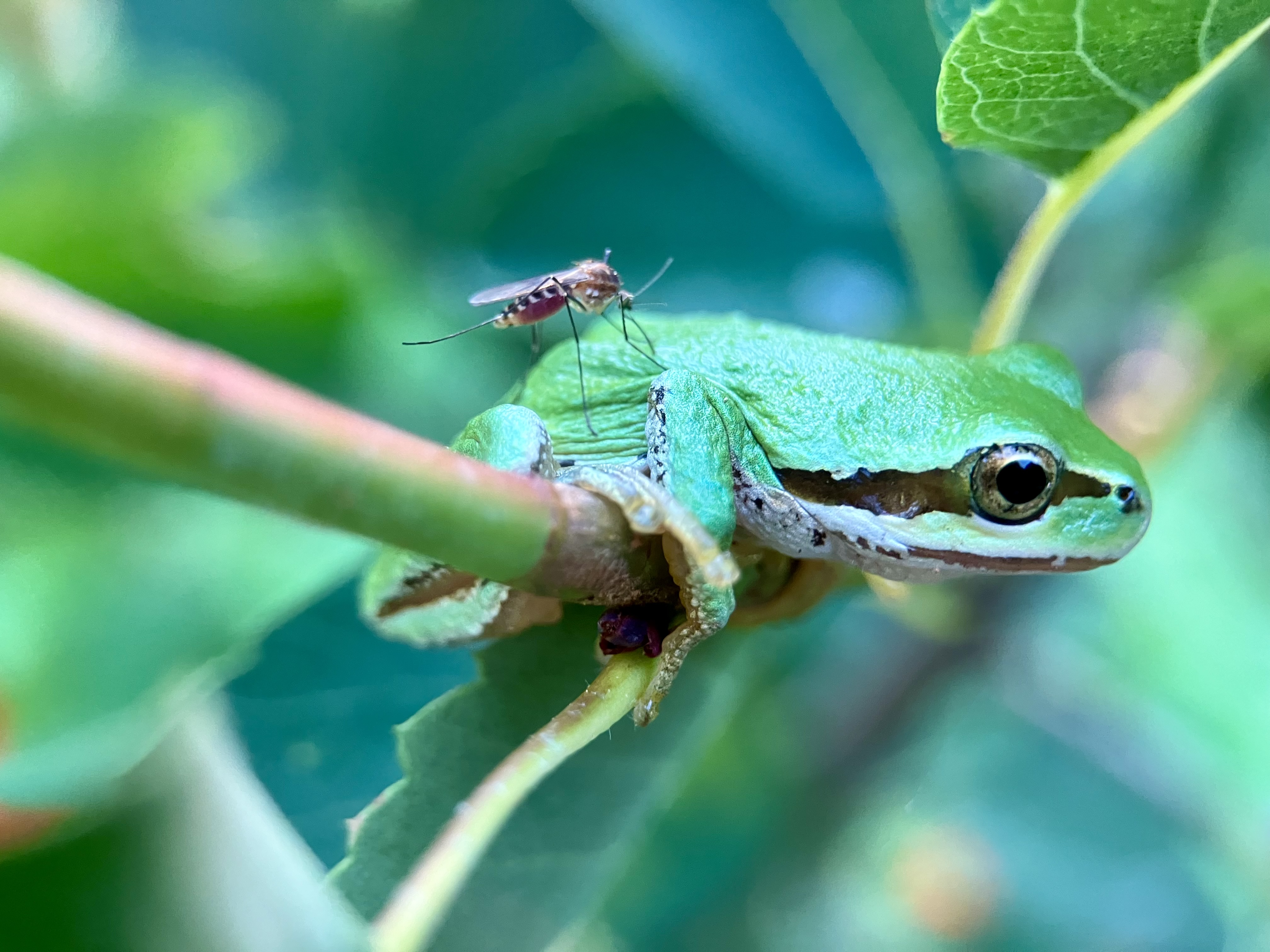
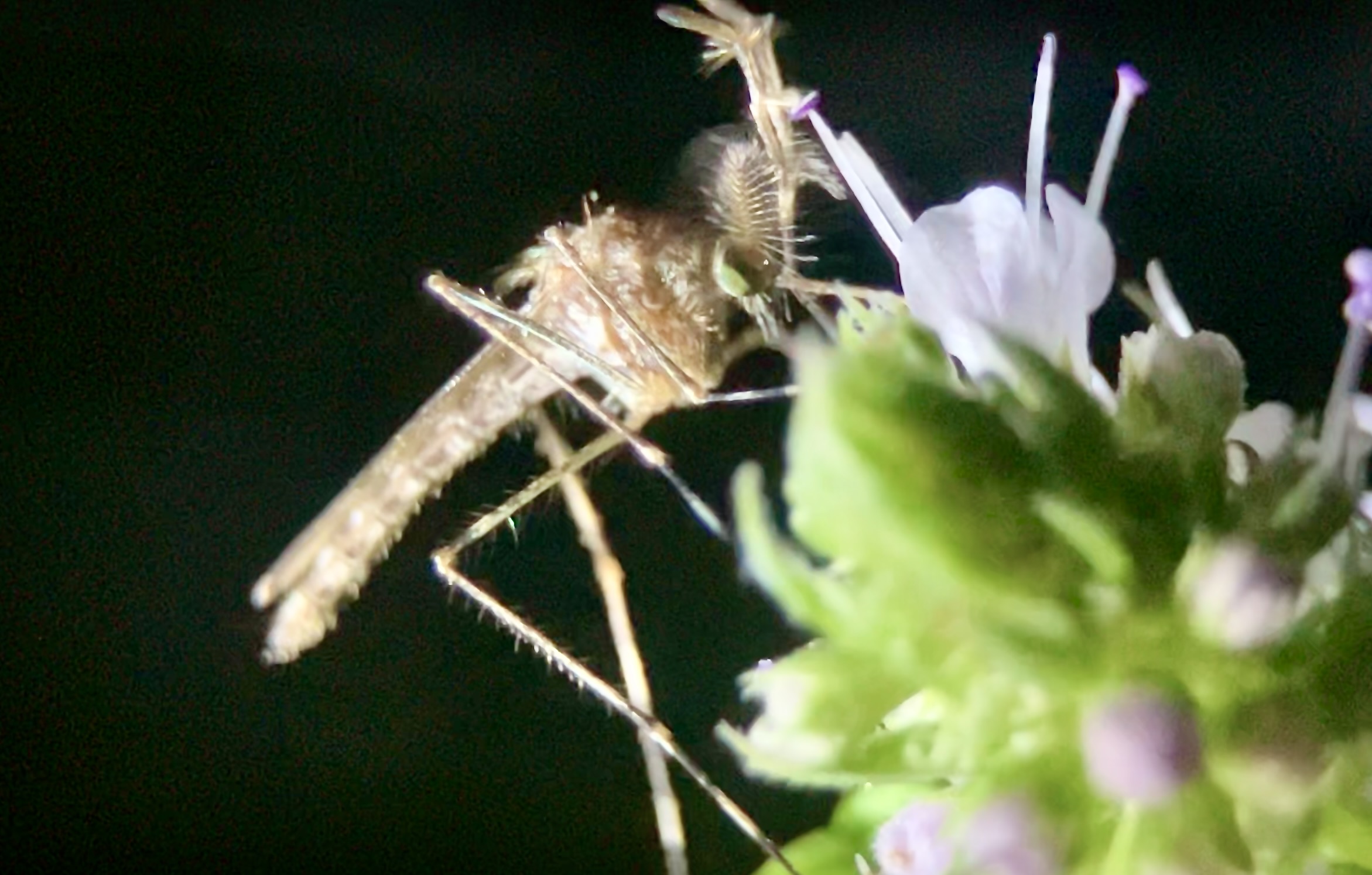
Every year, I watch our resident chickadees and nuthatches glean insects off twigs and branches. Nature’s pest control. The little tree frogs gobble bugs off garden plants. Those same frogs are also food for a species of female mosquito. Yes, you might detest mosquitoes, but even mosquitoes are pollinators. Go out at night with a flashlight and look at those fruit tree flowers!
Culex territans mosquito feeding on tree frogMale mosquito, night time pollinator
Even now, in February, I watch our year round, Anna’s hummingbirds zip along eaves of our home taking spider webbing to glue their nests together. They also eat many small bugs like fungus gnats and other small flies, even spiders!
If you just take a moment to look closely, there are many varied relationships between species at all trophic levels going on around us that have evolved to work in balance in our island ecosystem. Native species usually have multiple roles in the ecosystem. Some are pollinators, but also pest predators. Others we may consider pests, but they are also predators of pests. Most are food for some other organism in the food chain. Remember too, that just as we are healthier with a diverse diet, other organisms also stay healthy from sourcing nutrients from an assortment of food. When we lose diversity, we all suffer. We need a complex working ecosystem, and that comes from nature!
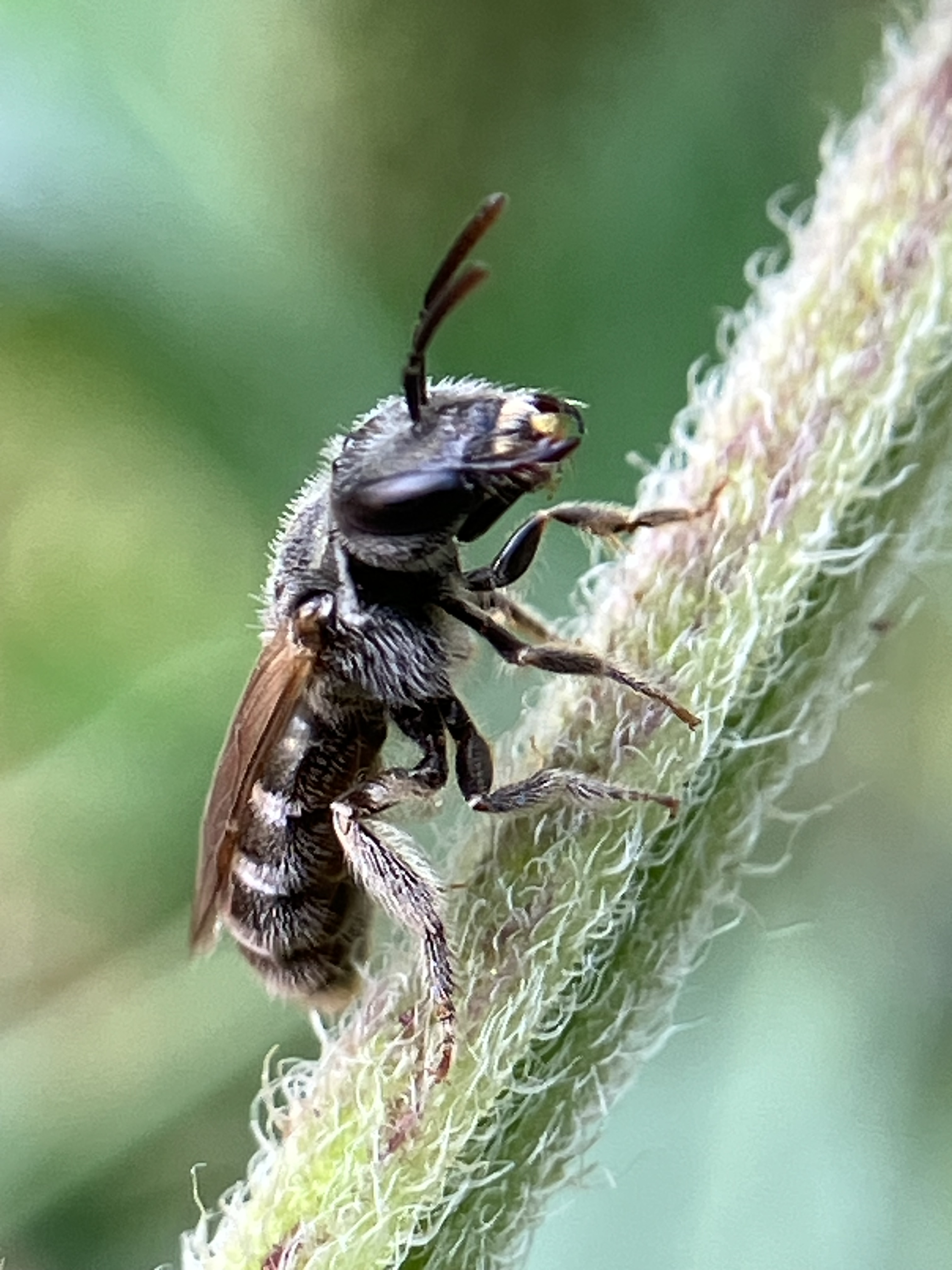
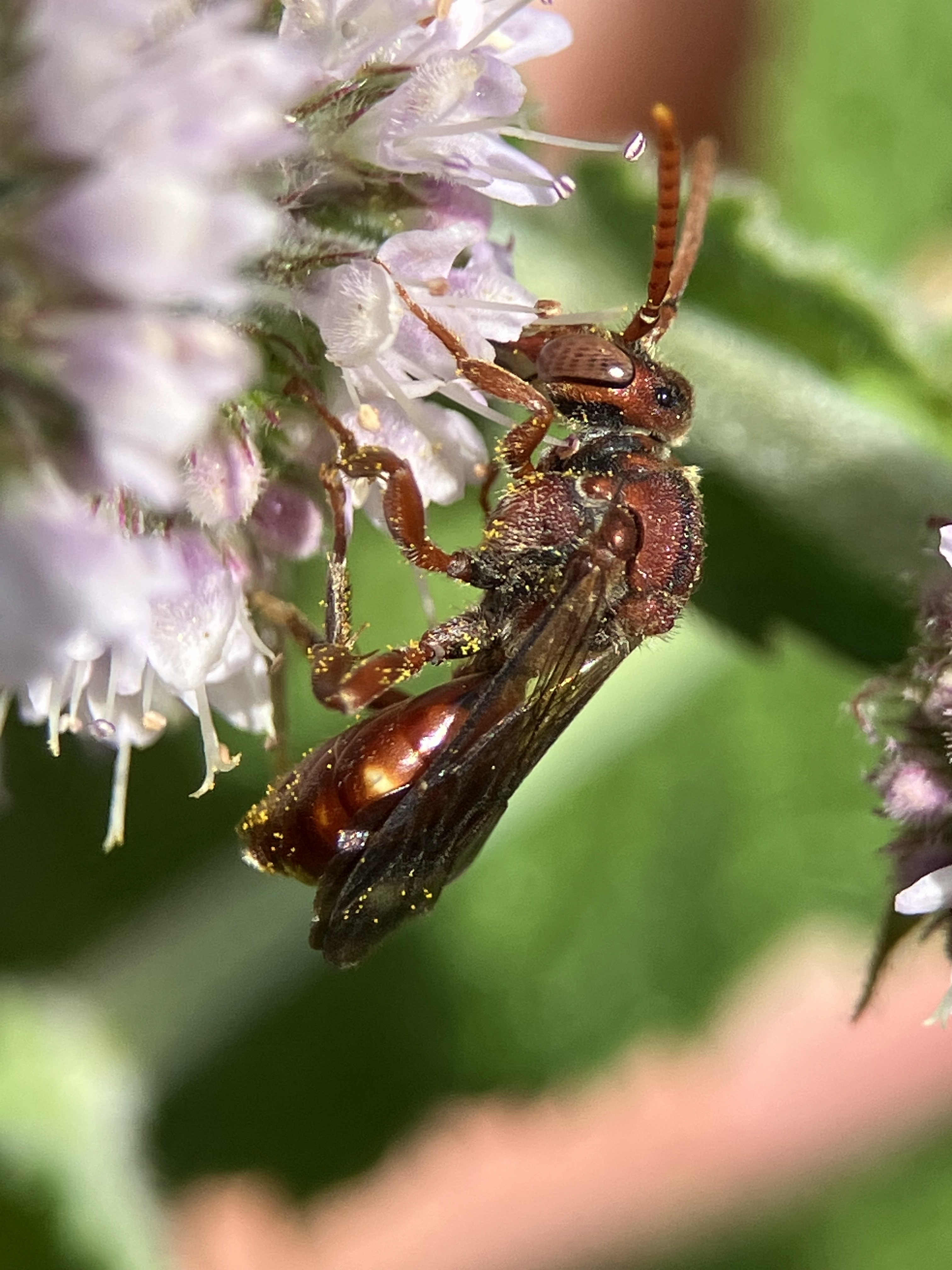
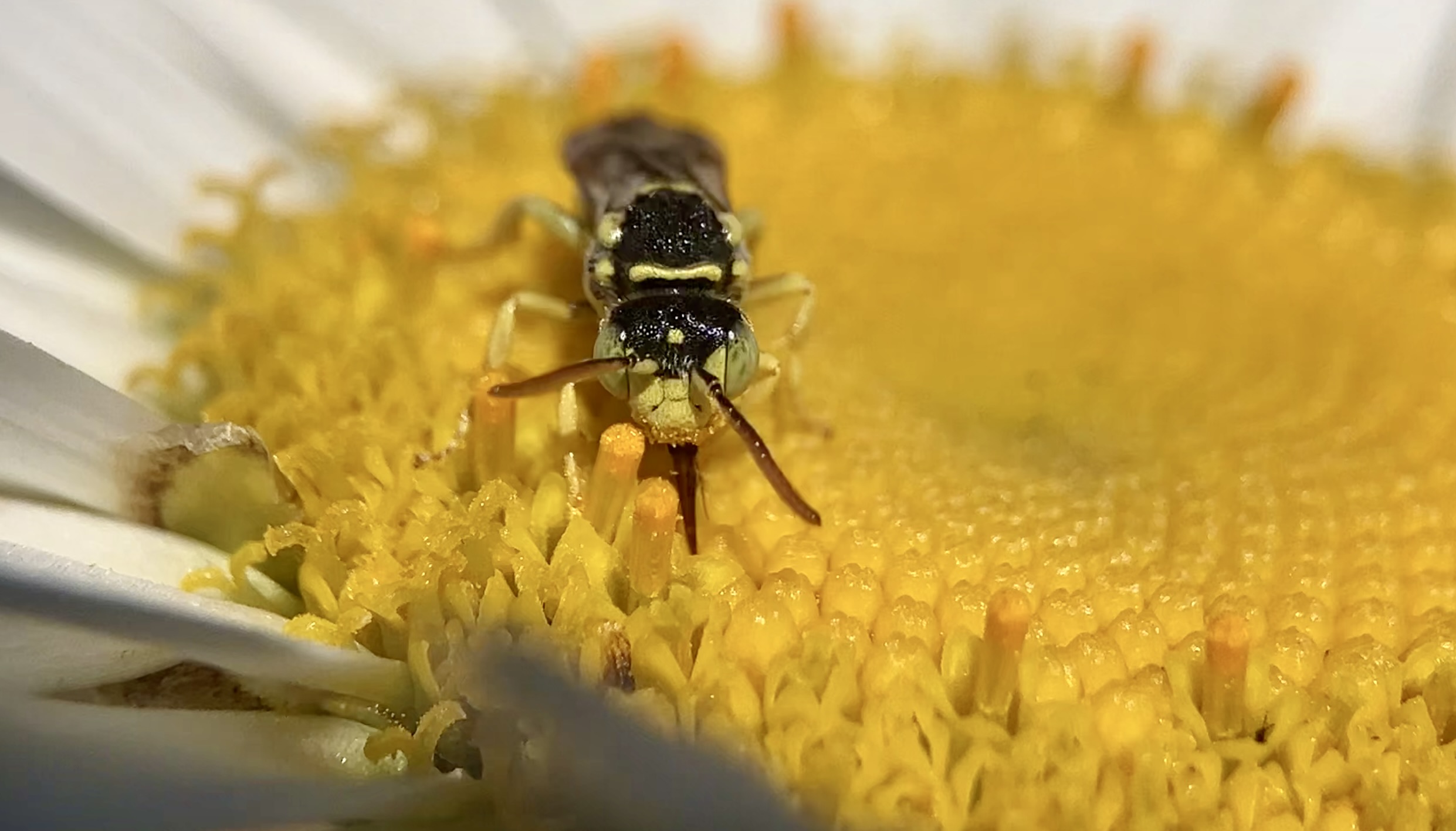
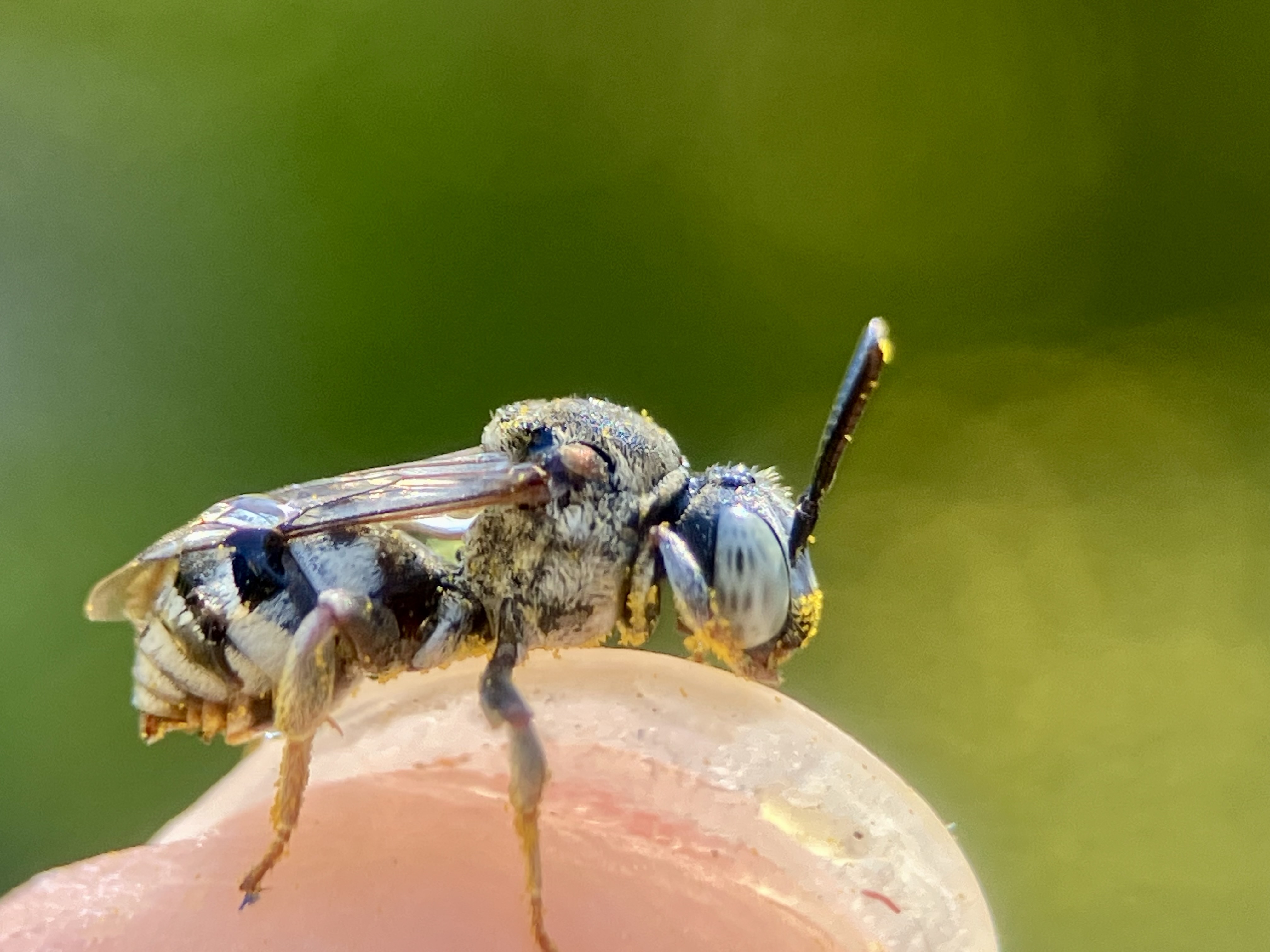
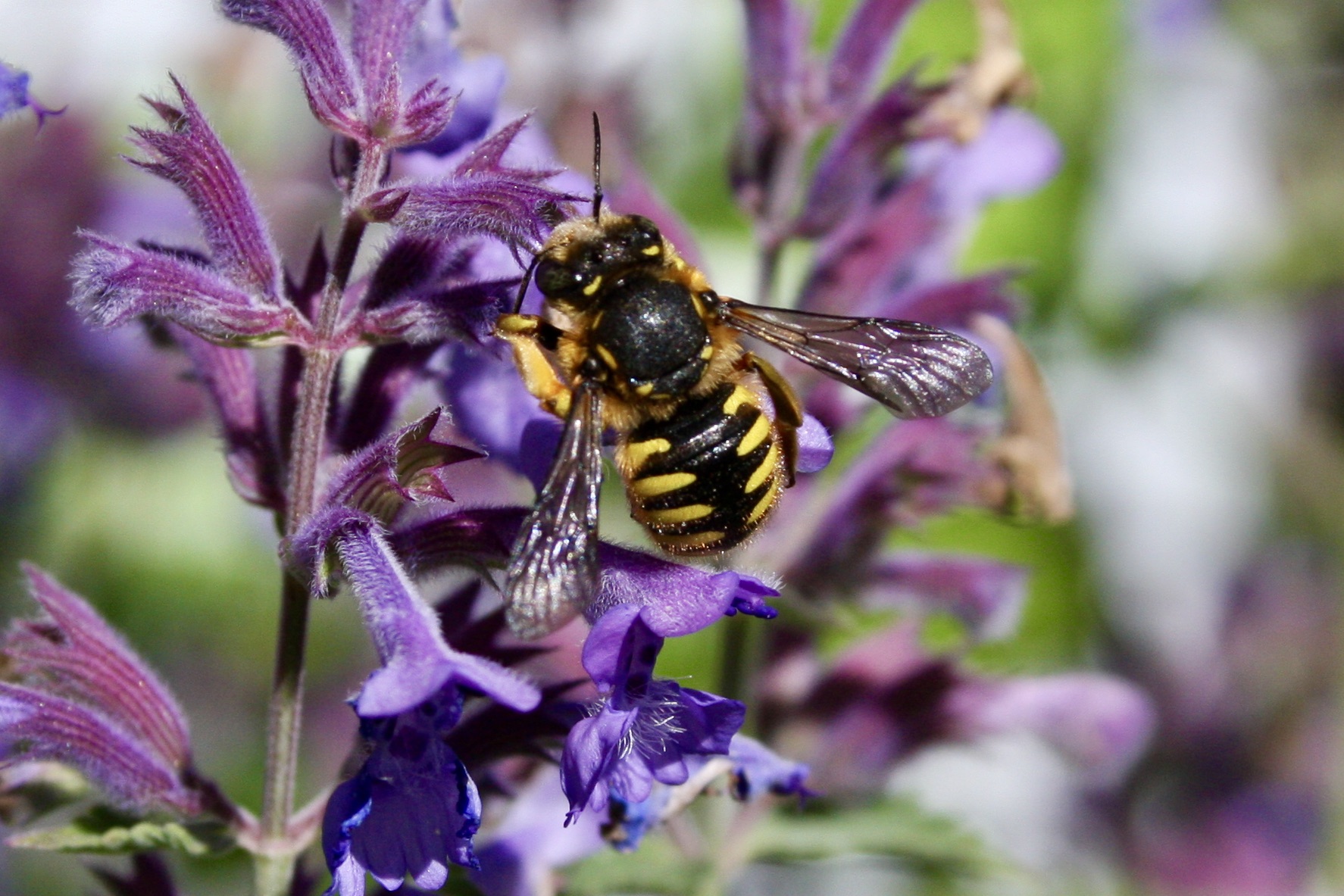
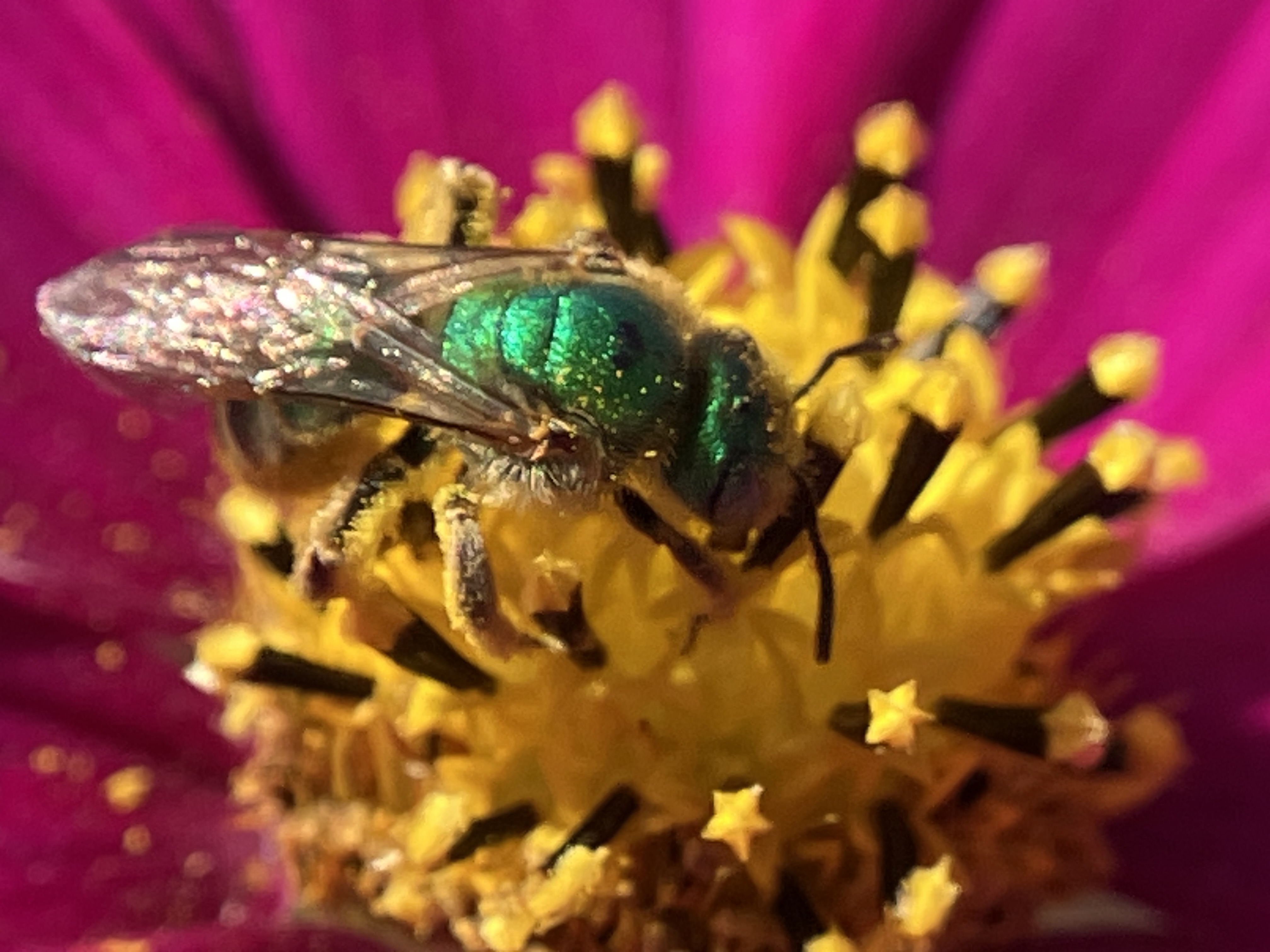
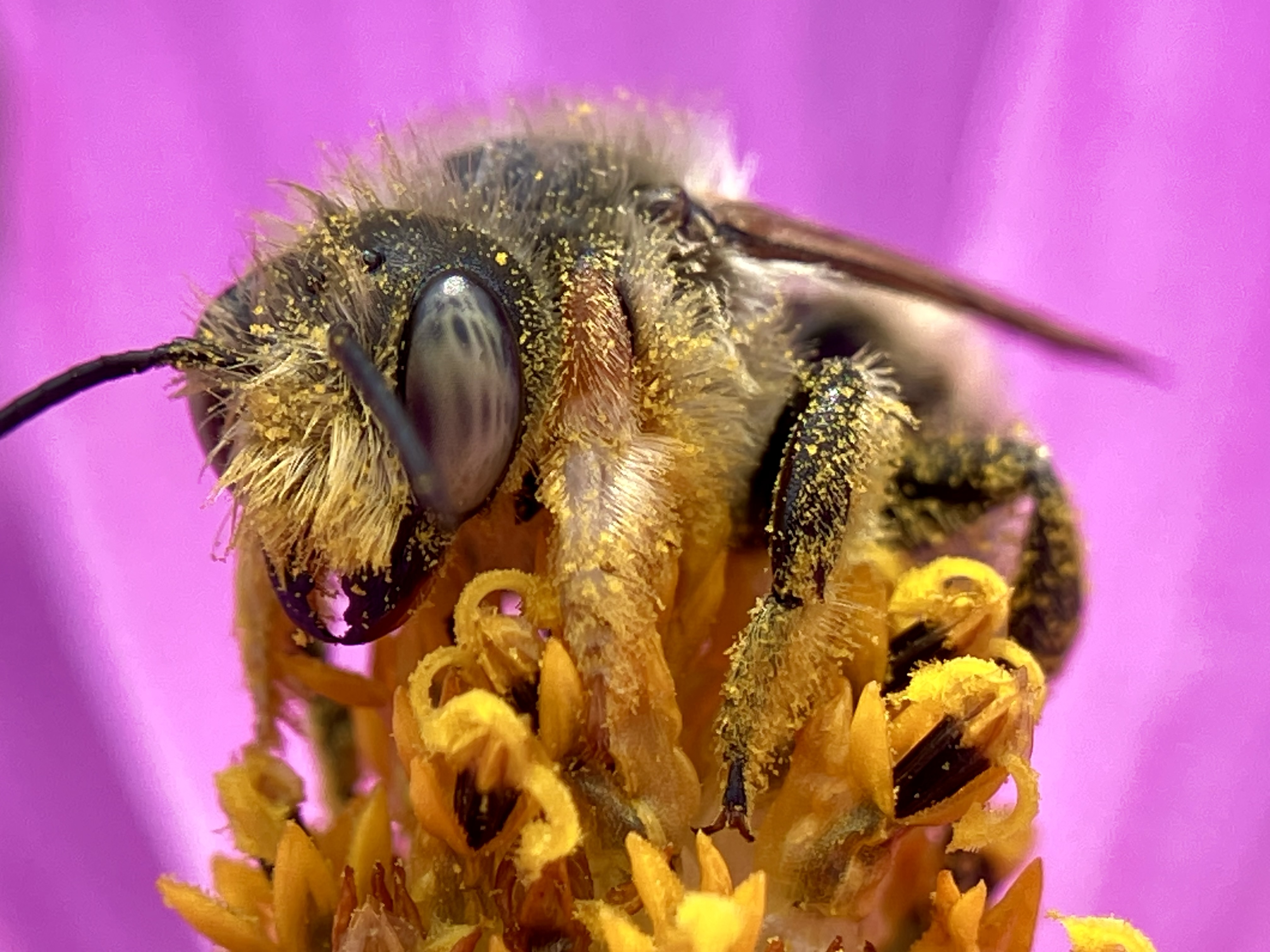
Some of our island native bee pollinators include bumble bees, sweat bees, alkali bees, blood bees, orchard bees, leaf cutter bees, nomad bees, digger bees, fairy bees, and others. These bees may not produce honey, but they are pollinators of immensely great value.
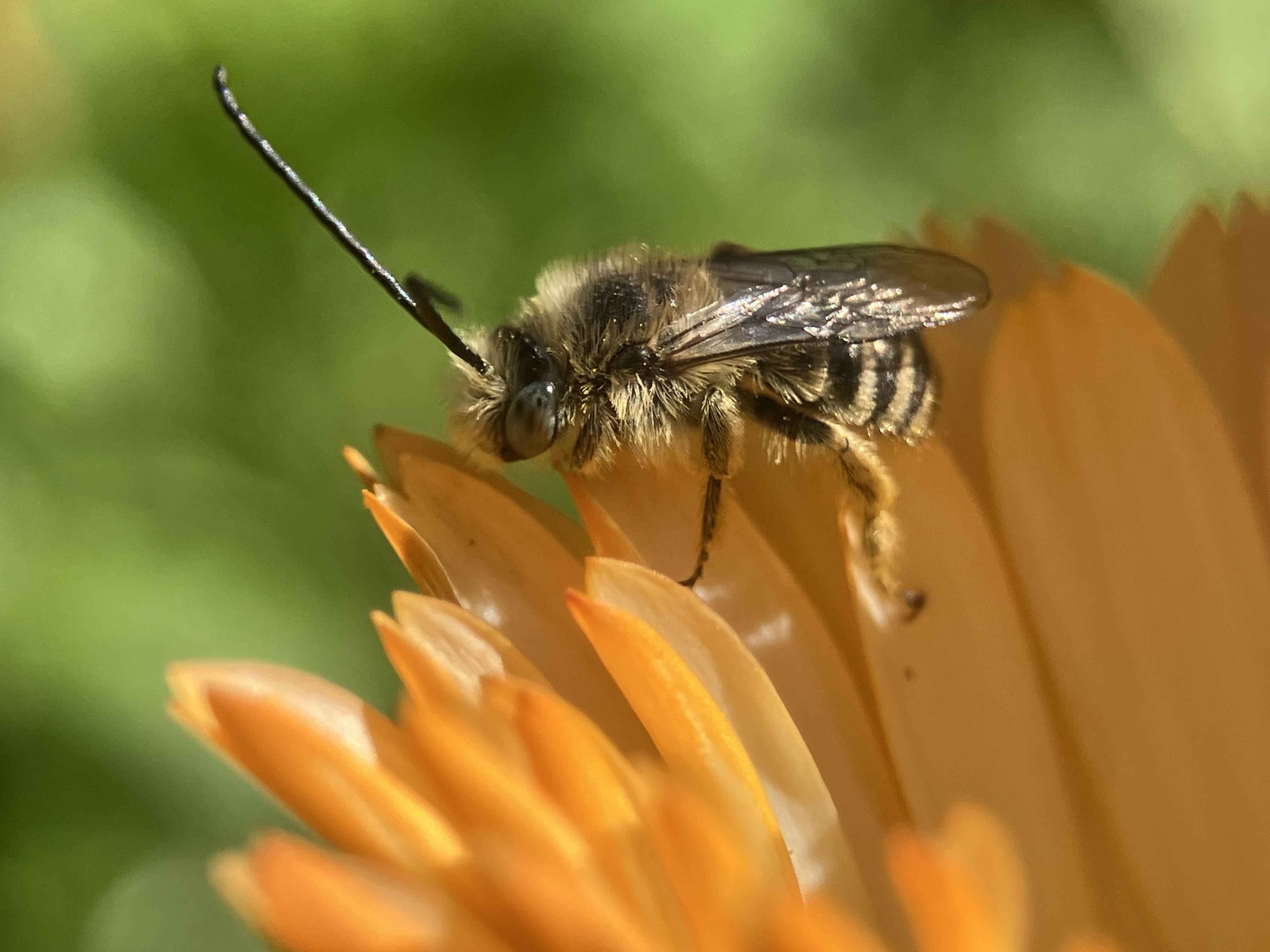
Golden Furrow Bees Subgenus Seladoniaa member of Furrow Bees Genus HalictusNomad BeeNomad BeeTriepeolus Cuckoo BeeMining Bee (Genus Andrena)Lasioglossum bee Sleeping beeAnthidium manicatum European Wool Carder Bee 06.28.2020Agapostemon Sweat beeMegachile bee
In fact, research over the past decade is illuminating just how critical these native bees and other native pollinators are for biodiversity. Biodiversity that is disappearing from our world due to habitat loss, land use changes, agricultural practices, and competition over resources with non-native species (like honey bees). You don’t have to take my word for it though. The Washington Native Bee Society and the Xerces Society will give you similar information.
Try Googling a bit on your own and you might find some pretty cool statistics about how native bees are actually better pollinators than honey bees, AND that their pollination services can yield larger, healthier fruits (like blueberries and strawberries for example). Competition over resources and displacement of native bees due to honey bee keeping isn’t limited to our island or our state. It’s been something happening world wide where honey bees are used for agricultural practices, whether for pollination or honey production. The encouraging news is that supporting native pollinators is gaining momentum. I’ve compiled a resource list for you to look at, read, and share if you are inclined.
Ceratina bee
If you are still dead set on setting up a honey bee hive, I’m happy to walk you through it. I can give you a list of everything you’ll need, provide the cost of all those supplies, and advise you on how not to get stung, why you should never eat a banana near your bee hive, what problems you can anticipate with pests and pathogens, and how to avoid losing your bees due to swarming. I will also tell you that if you set up a honey bee hive, you must file and register your colony with WSDA per state law. Hopefully, you will make your way to the same conclusion as I have. It’s cheaper and also ethically responsible to support native pollinators and conserve habitat in your own yard for pollinator diversity. It’s also quite fun and rewarding to watch and learn about native bees and the bugs you probably never even knew existed.
KEARNS, C. A. 2001. North American dipteran pollinators: assessing their value and conservation status. Conservation Ecology 5(1): 5. [online] URL: http://www.consecol.org/vol5/iss1/art5/
MacInnis, G, Forrest, JRK. 2019. Pollination by wild bees yields larger strawberries than pollination by honey bees. J Appl Ecol. 56: 824– 832. https://doi.org/10.1111/1365-2664.13344
Mallinger, R.E. and Gratton, C., 2015. Species richness of wild bees, but not the use of managed honeybees, increases fruit set of a pollinator-dependent crop. J Appl Ecol. 52: 323-330. https://doi.org/10.1111/1365-2664.12377
Angelella GM, McCullough CT, O’Rourke ME. 2021. Honey bee hives decrease wild bee abundance, species richness, and fruit count on farms regardless of wildflower strips. Sci Rep. Feb 5;11(1):3202. doi: 10.1038/s41598-021-81967-1. Erratum in: Sci Rep. 2021 Aug 17;11(1):17043. doi: 10.1038/s41598-021-95368-x. PMID: 33547371; PMCID: PMC7865060. https://pmc.ncbi.nlm.nih.gov/articles/PMC7865060/
Page, Maureen L., and Neal M. Williams. 2023. “ Honey Bee Introductions Displace Native Bees and Decrease Pollination of a Native Wildflower.” Ecology 104(2): e3939. https://doi.org/10.1002/ecy.3939
Lorenzo Pasquali, Claudia Bruschini, Fulvia Benetello, Marco Bonifacino, Francesca Giannini, Elisa Monterastelli, Marco Penco, Sabrina Pesarini, Vania Salvati, Giulia Simbula, Marta Skowron Volponi, Stefania Smargiassi, Elia van Tongeren, Giorgio Vicari, Alessandro Cini, Leonardo Dapporto. 2025. Island-wide removal of honeybees reveals exploitative trophic competition with strongly declining wild bee populations. Current Biology. 35(7) : 1576-1590.e12, ISSN 0960-9822, https://doi.org/10.1016/j.cub.2025.02.048https://www.sciencedirect.com/science/article/pii/S0960982225002623
Thomson, D. (2004), COMPETITIVE INTERACTIONS BETWEEN THE INVASIVE EUROPEAN HONEY BEE AND NATIVE BUMBLE BEES. Ecology, 85: 458-470. https://doi.org/10.1890/02-0626
For the past few years, I have observed one of our native shrubs to see what pollinators are visiting. Calscape has recorded Ocean Spray (Holodiscus discolor) as a host plant to approximately 14 species of Lepidoptera. Yet, I have actually never seen a single pollinator visiting the cascades of snowy white, delicate blossoms. I’ve also heard from a handful of local folks on San Juan Island. They say Ocean Spray is “invasive” and should be brush-hogged. According to them, it’s a “fire hazard.” This view is disturbing to me. I felt it important to find concrete evidence of this native plant’s value in our ecosystem.
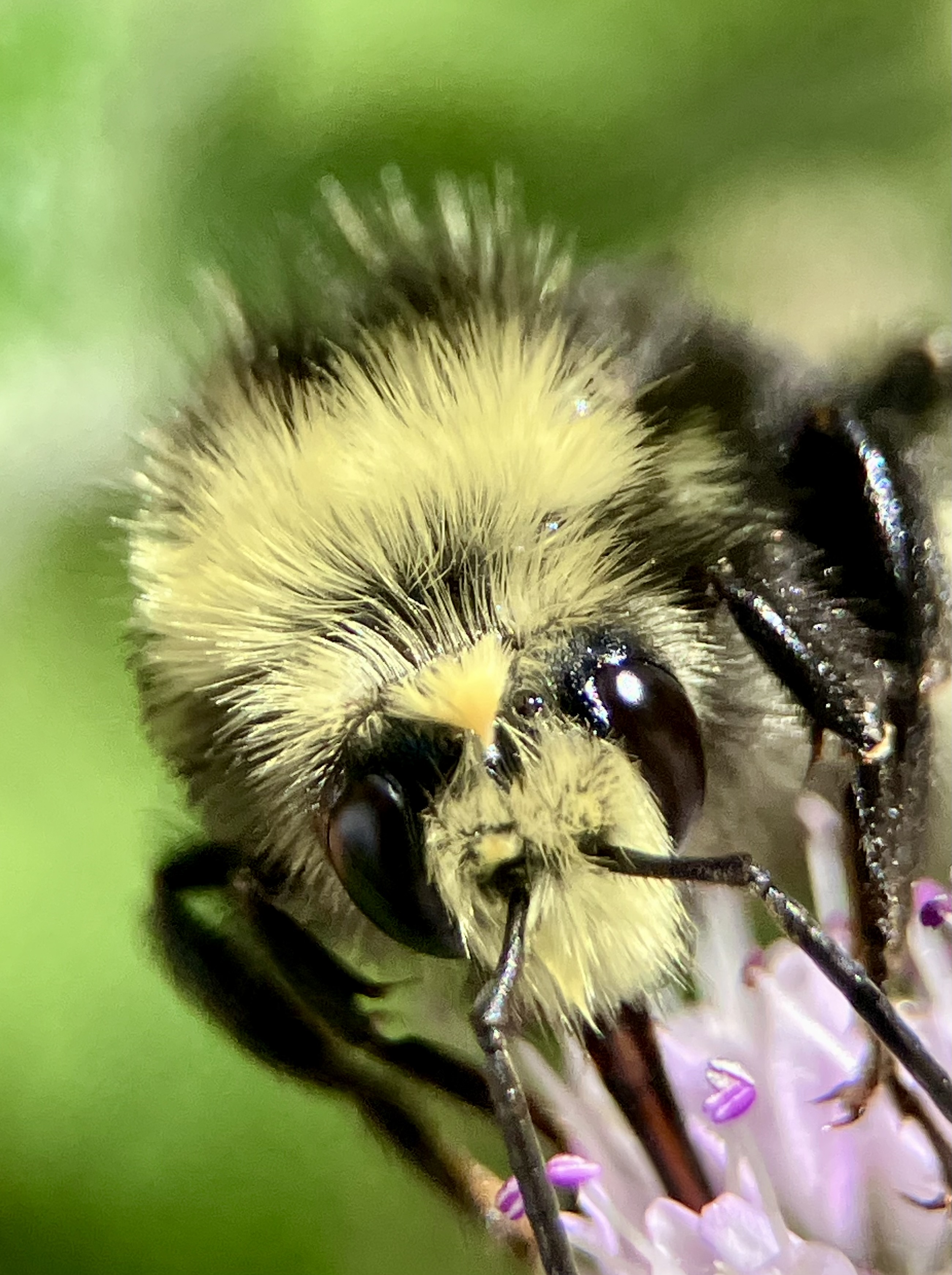
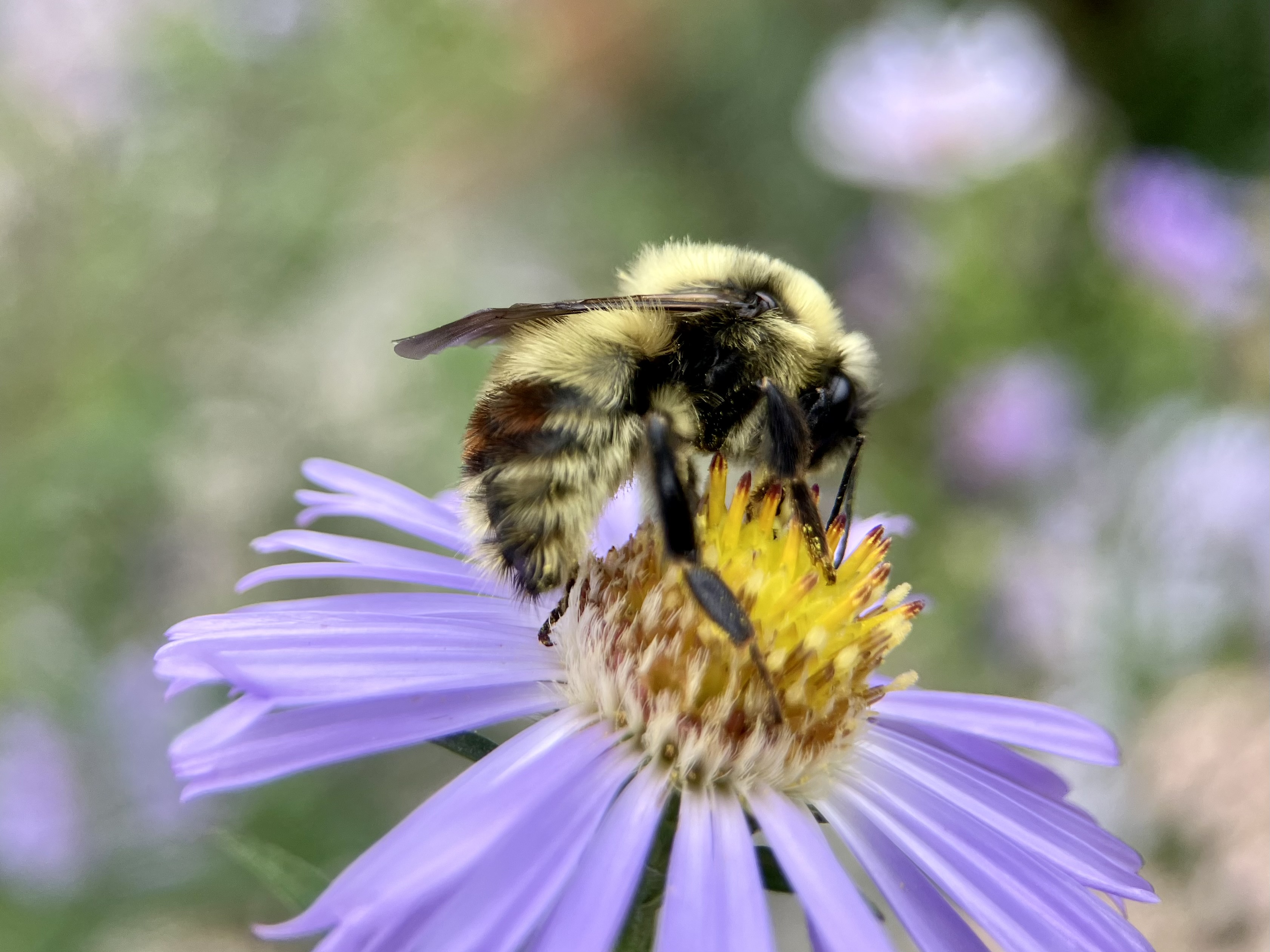
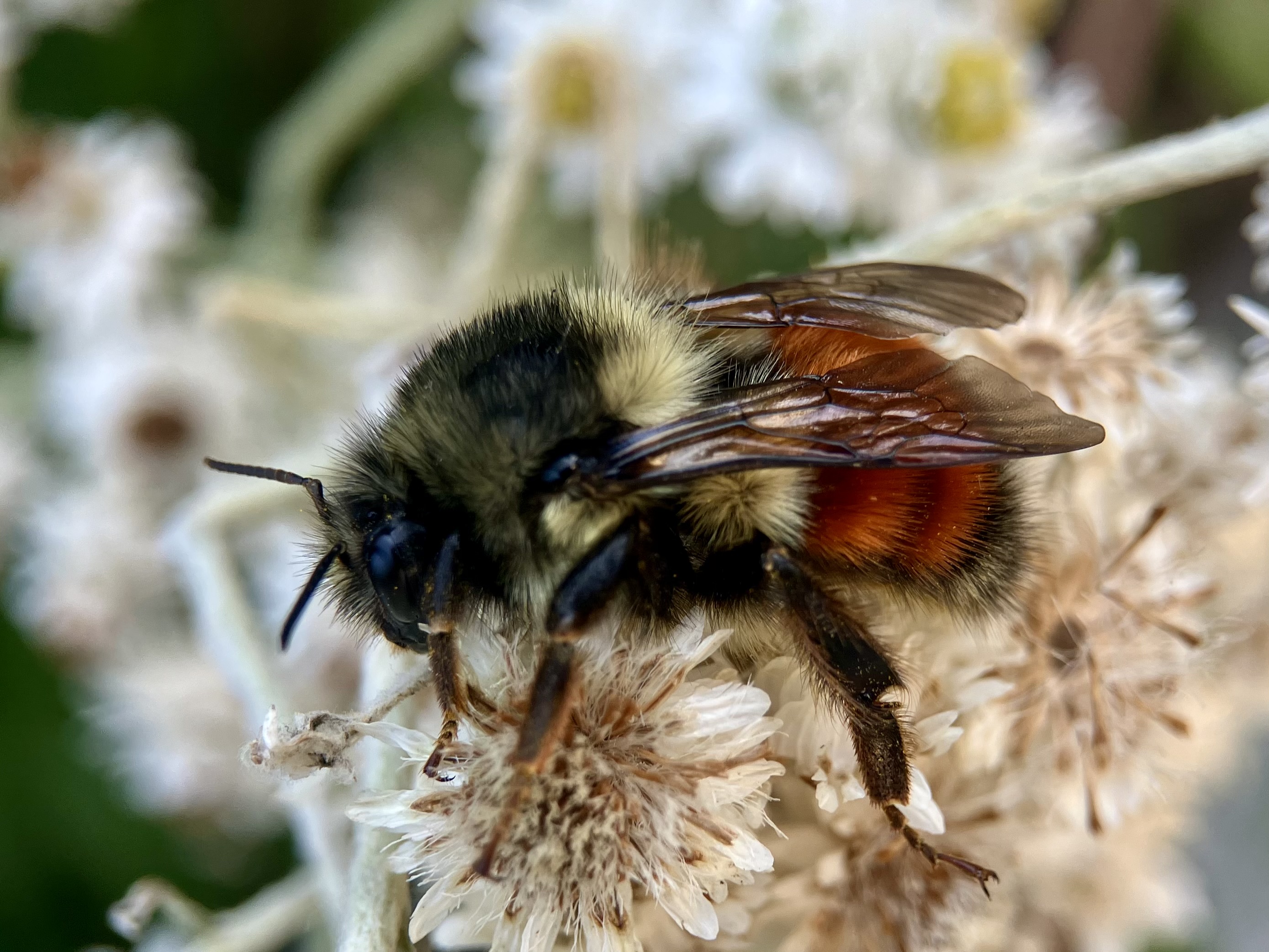
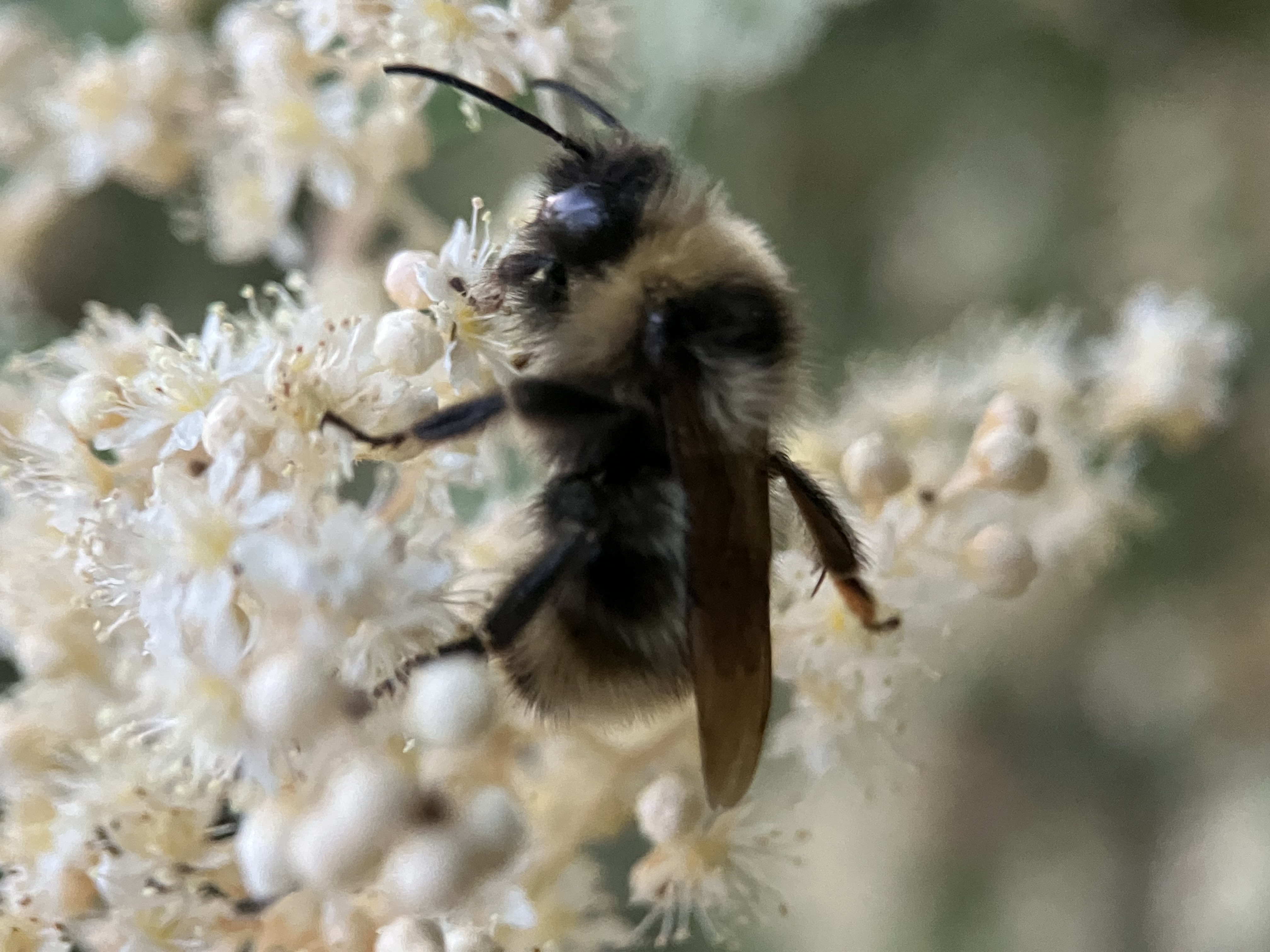
Bombus flavidus ssp. flavidus
Well, the other evening, I documented the first pollinator I’ve ever seen visiting these blossoms. There is a gorgeous Ocean Spray out our bathroom window. I noticed movement in the upper portions of the shrub. It wasn’t windy, so something else was causing the movement. I went out later, around 9:00 pm, to investigate the cause of the disturbances. Can you guess what I found? Bumble bees!
Bombus flavidus ssp. flavidus
I also experienced annoyance from another buzzer. A Cattail mosquito, Coquillettidia perturbans (say co-KEE-luh-tih-dee-uh PURR-tuh-binz) promptly discovered my bare arm. It slipped its hypodermic proboscis into my epidermis with effortless precision, a precision superior to any medical professional’s injection. I didn’t feel it at all.
Cattail mosquito (Coquillettidia perturbans)
I would describe the bites from these mosquitoes as a very mild annoyance. I didn’t have any after-reaction at all. It was certainly not anything like the bites from some of the other insects I’ve experienced here, especially not thrips. I’m definitely not a thrips fan! You can read about thrips here in case you’re interested. https://buggingyoufromsanjuanisland.com/2021/06/29/public-health-alert-and-some-free-advice/
Getting back to the other buzz in the Ocean Spray. The buzz I was so happy to discover is the bumble bee (Bombus flavidus ssp. flavidus). I didn’t make the identification to subspecies on my own. That was with the help of a fellow named John Ascher on iNaturalist. If you’re curious about his work, you can learn more here: https://extension.oregonstate.edu/podcast/pollination-podcast/137-john-ascher-problem-measuring-bee-decline
Bombus flavidus ssp. flavidus
Bombus flavidus is a species of Cuckoo Bumble Bee, and one of the most widespread species in the world. These bees don’t have a worker cast like other species of bumble bees. They find nests of other bumble bees to occupy and invade these nests. The host bumble bee workers then rear the offspring of the cuckoo bumble bee along with their own offspring.
I hope my discovery leaves you curious about what pollinators visit Ocean Spray in your yard. My next goal is to make nighttime observations. I want to see what is visiting the flowers while they are still in bloom. I suspect they have nocturnal pollinators. If you find any, I hope you’ll report your findings with me. 🙂
To see more of San Juan Island’s invertebrates, please join and follow me on iNaturalist – https://www.inaturalist.org/observations?place_id=any&user_id=cyndibrast&verifiable=any . If you have never used iNaturalist, try it out! I love it because it’s a way to connect with other entomologists. It also helps me organize my findings into appropriate categories for referencing when I want to look something up.
Also, please don’t go crazy with the brush hog. Nature loves messy. Humans cause fires. We can do much on that end to prevent them by changing our behaviors and being more careful. Scraping the earth bare and/or parking out your parcel to be “fire wise” is actually not kind to nature. We need to protect habitat for the wild things, not eradicate it. Even mosquitoes have a role in the food web.
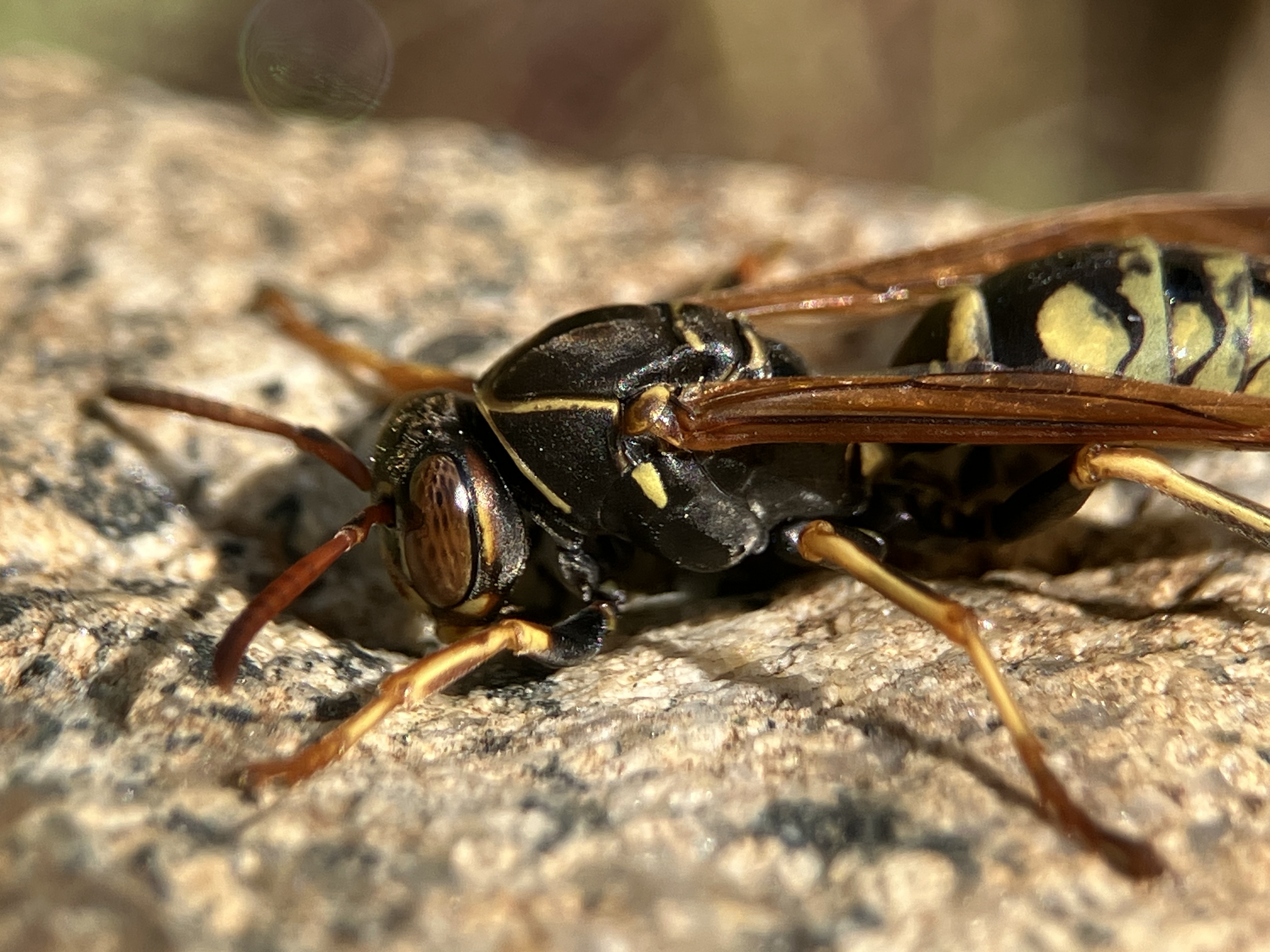
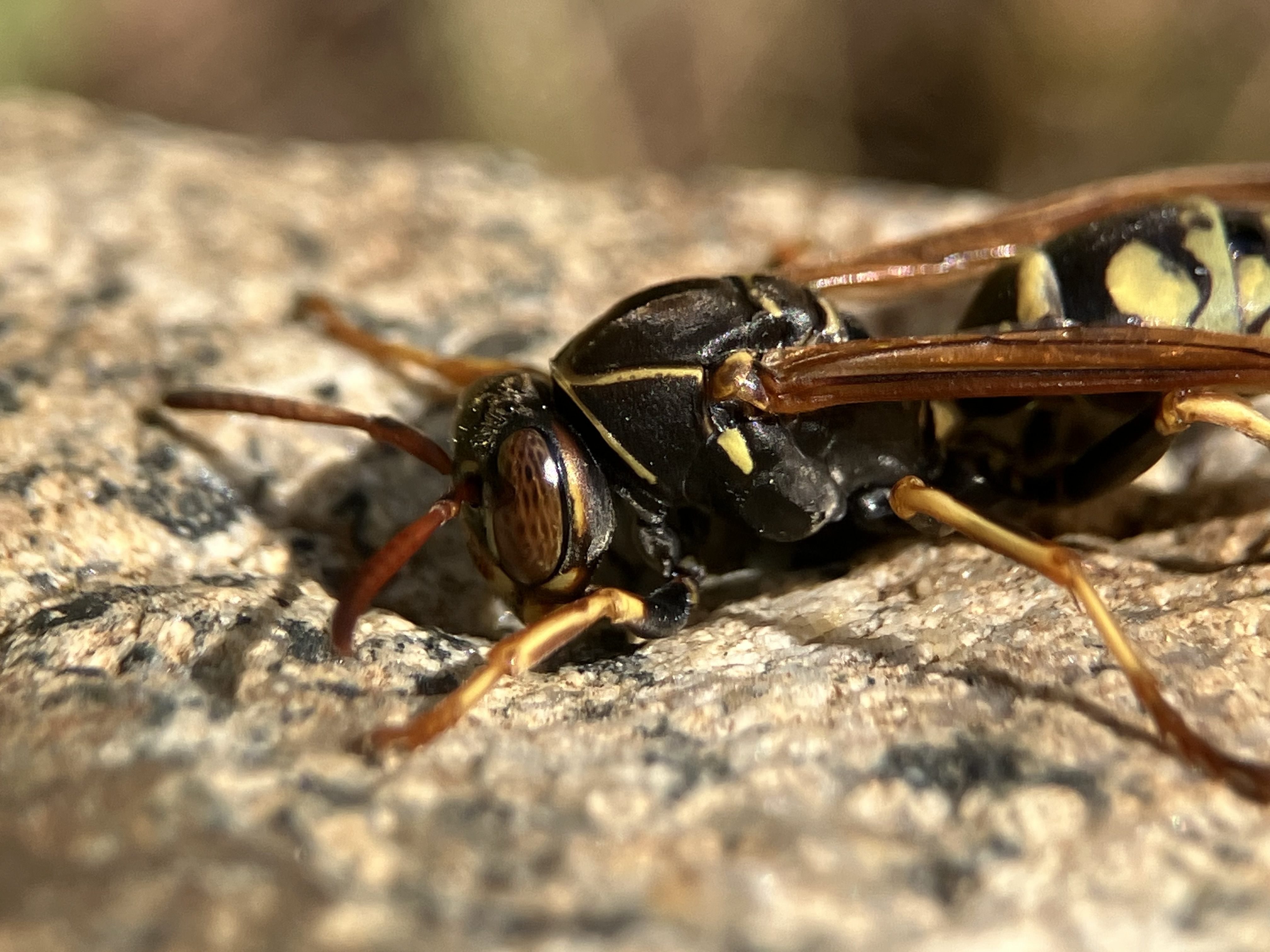
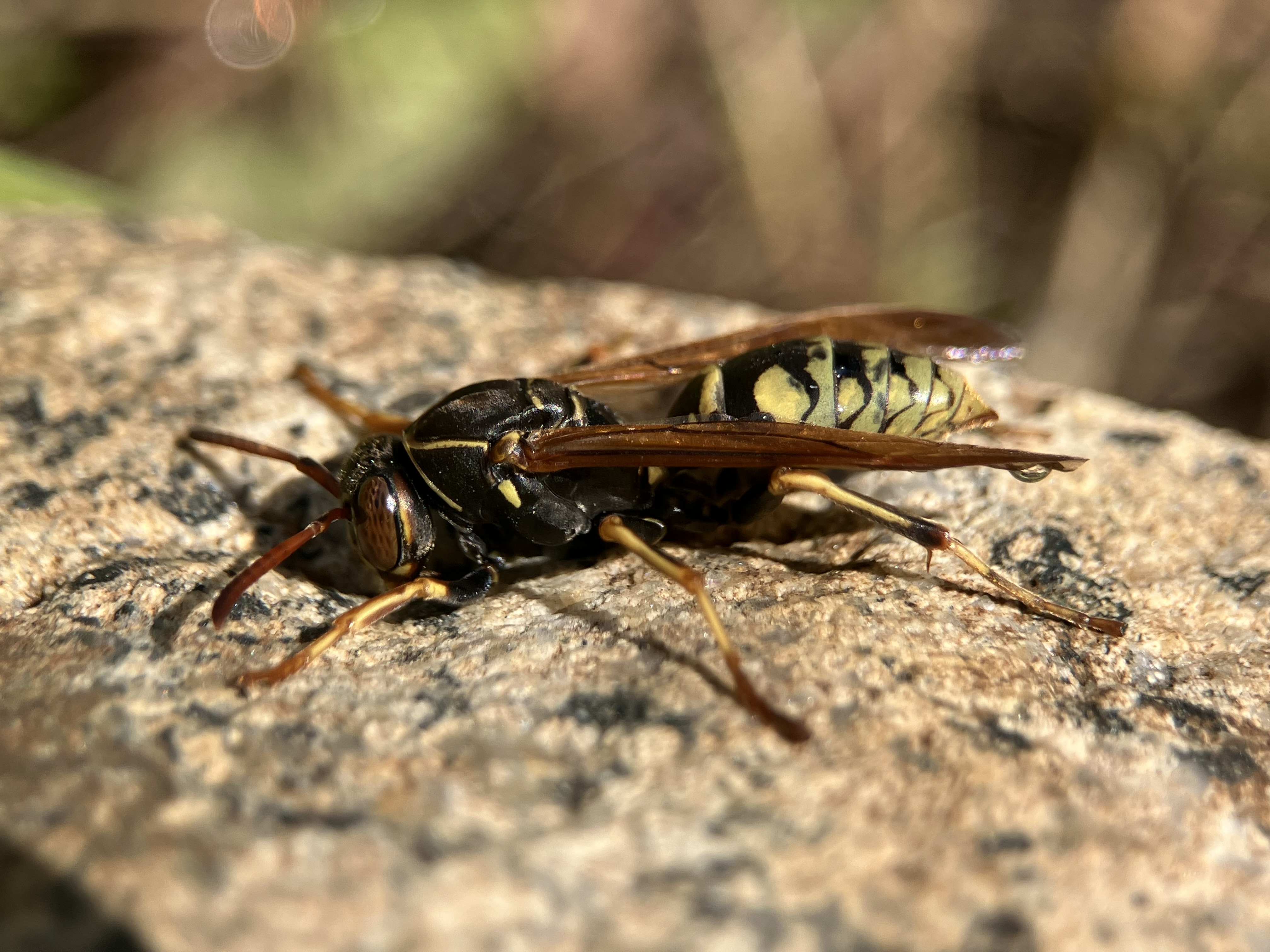
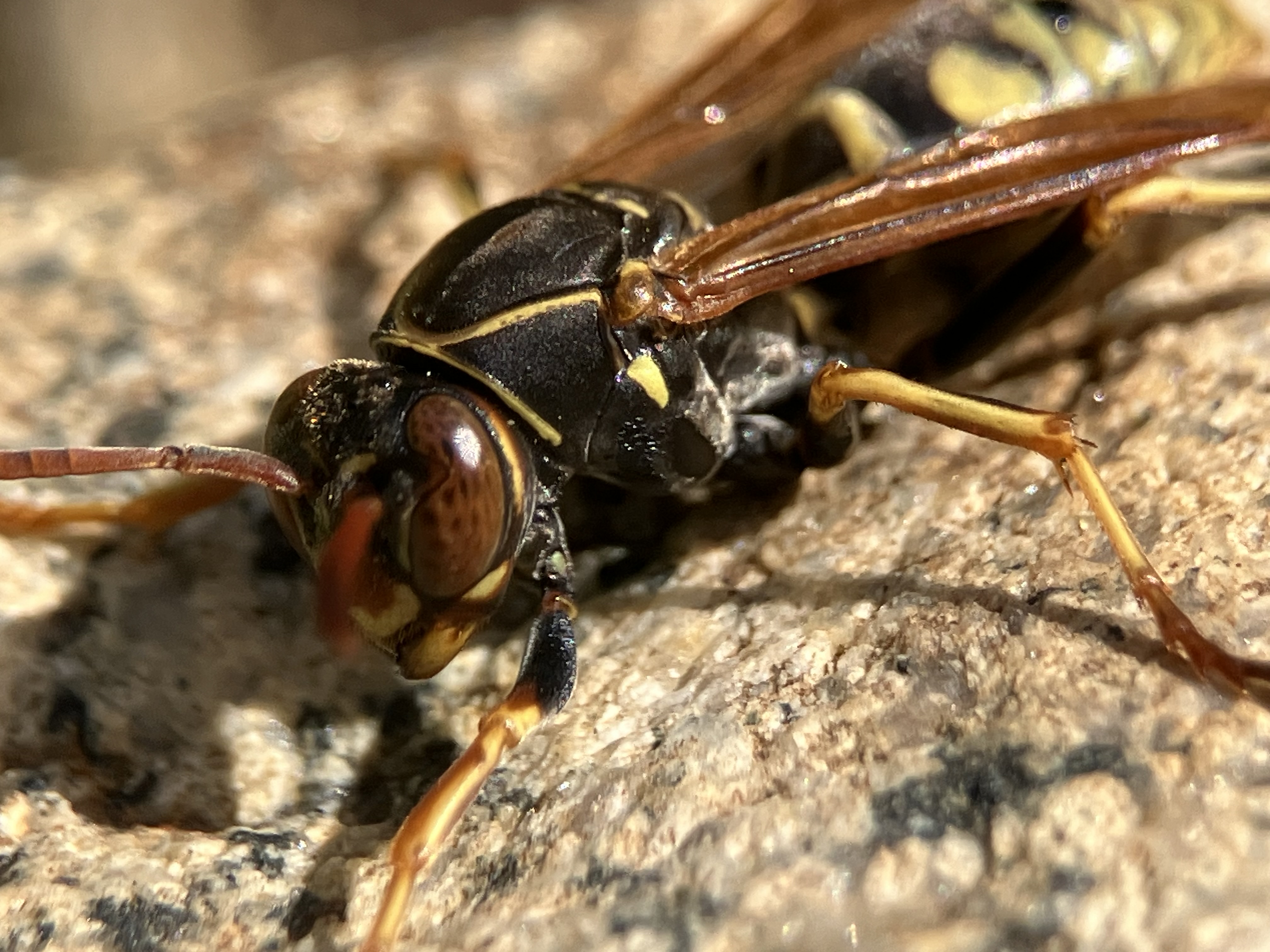
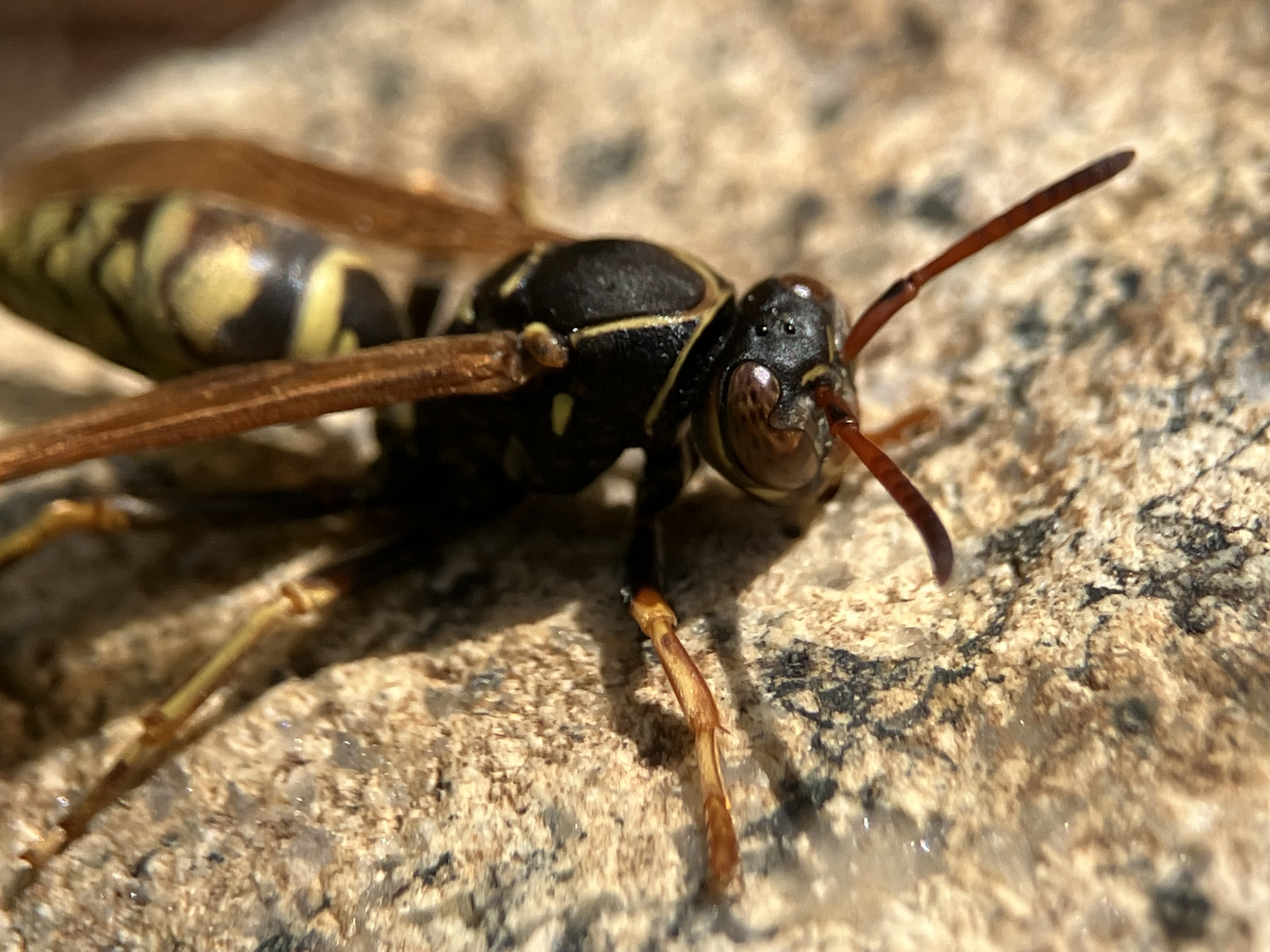
The other morning when I was watering our garden, I spied the most beautiful creature I’ve seen in a long time, a Golden Paper Wasp (Polistes aurifer). In fact, in sixteen years of living on San Juan Island, I have only seen one colony of these wasps (April 14, 2024) at the San Juan County Land Bank’s Mount Grant nature preserve. These wasps are native to North America and once considered a subspecies of Polistes fuscatus. However, P. aurifer has a western geographic distribution ranging from BC-CA to AB-MT-w.TX; ne. Mexico (Bugguide.net).
Polistes wasps build open faced nests suspended by a petiole in varied sites. Some select relatively exposed areas under eaves of structures or in shrub-type vegetation, while others utilize more protected cavities such as abandoned rodent burrows or hollow trees. Most often, the ones we see are the non native European paper wasp species (Polistes dominula), that seem very comfortable establishing their nests under the eaves of our homes.
It is believed the more frequently observed (P. dominula) are displacing native Polistes aurifer, but since it is more difficult for scientists studying insects in natural or wild habitats, most formal observations have taken place utilizing sites associated with man-made dwellings (Liebert, 2004). Liebert published a short communication in Insectes Sociaux (2004) where she describes finding ground nesting colonies of this species at an observation site in California, and concludes that the “displacement” theory may be overstated. However, given the loss of natural areas due to habitat loss/conversion, a decline in populations of the native P. aurifer (I believe) would more accurately be attributed to humans. Humans also unfortunately resort to wasp spray to eradicate nests around their homes without understanding that most nests pose minimal or no risk to human comings and goings.
Polistes wasps (native and non-native) are generally considered to be beneficial insects. They are pest predators, capturing and dismembering caterpillars to feed larvae they are rearing. In Eastern and Southern regions of the U.S., some species of Polistes wasps exert significant pressure on the cotton bollworm and the tobacco hornworm, both pests of considerable economic significance.
If you spy one of these Western natives, you’ll know immediately because they have the most beautiful golden brown or caramel colored eyes!
Thanks for reading. 🙂
Polistes aurifer
Polistes aurifer
Polistes aurifer
References
Bohart, G. E. 1942. Notes on Some Feeding and Hibernation Habits of California Polistes (Hymenoptera, Vespidae). Pan-Pac. Ent. 18(1): 30-31. https://digitalcommons.usu.edu/piru_pubs/15/
Buck, M., Marshall, S.A. and Cheung D.K.B. 2008. Identification Atlas of the Vespidae (Hymenoptera, Aculeata) of the northeastern Nearctic region. Canadian Journal of Arthropod Identification No. 5: 492 pp. (PDF version). Published on 19 February 2008. With 3 Tables and 1073 Figures.
Here’s a quick rundown of what I spied at my bug light when I checked this morning. I did move the bucket and light to a new location across from our house in our open air barn.
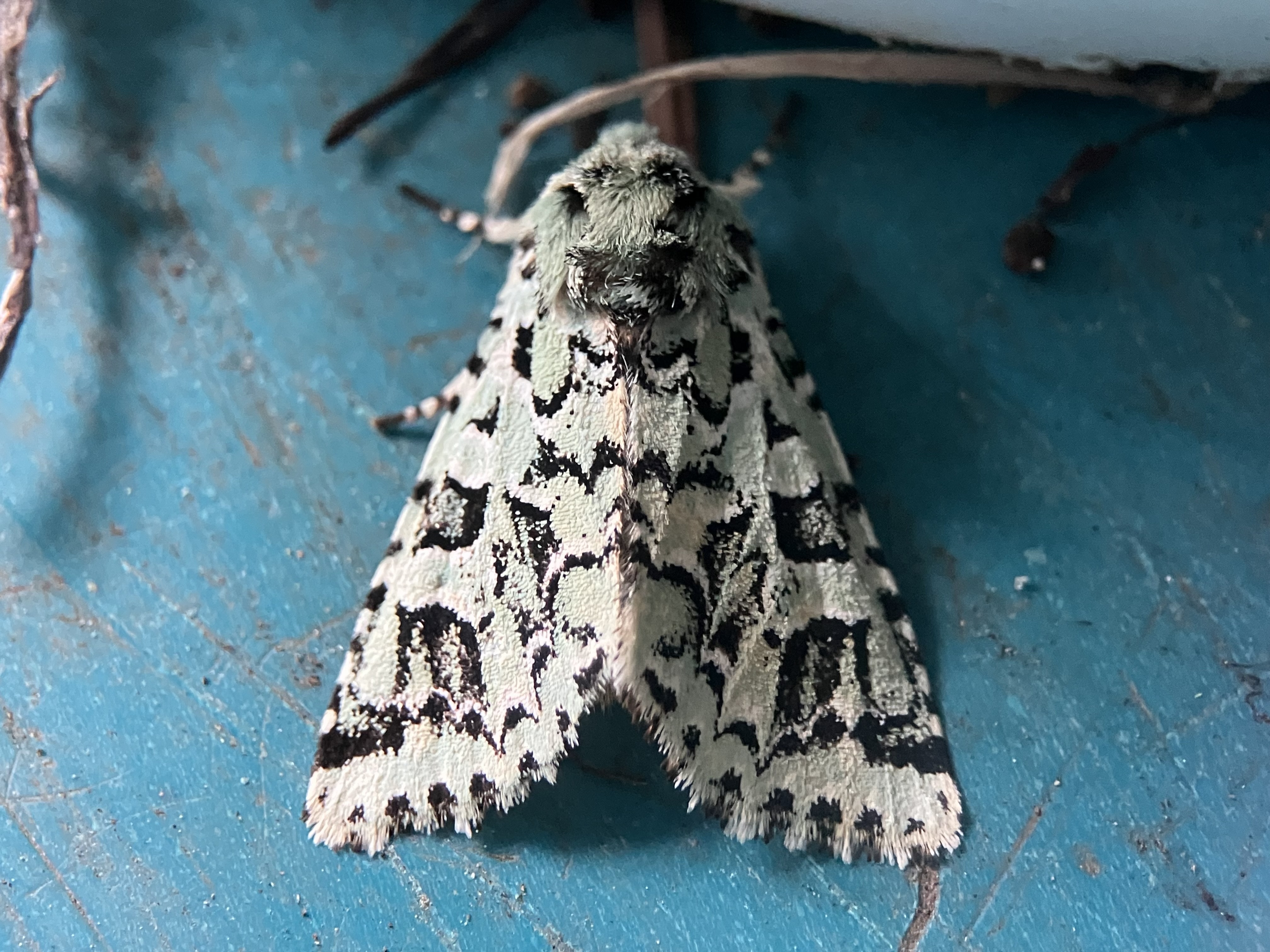
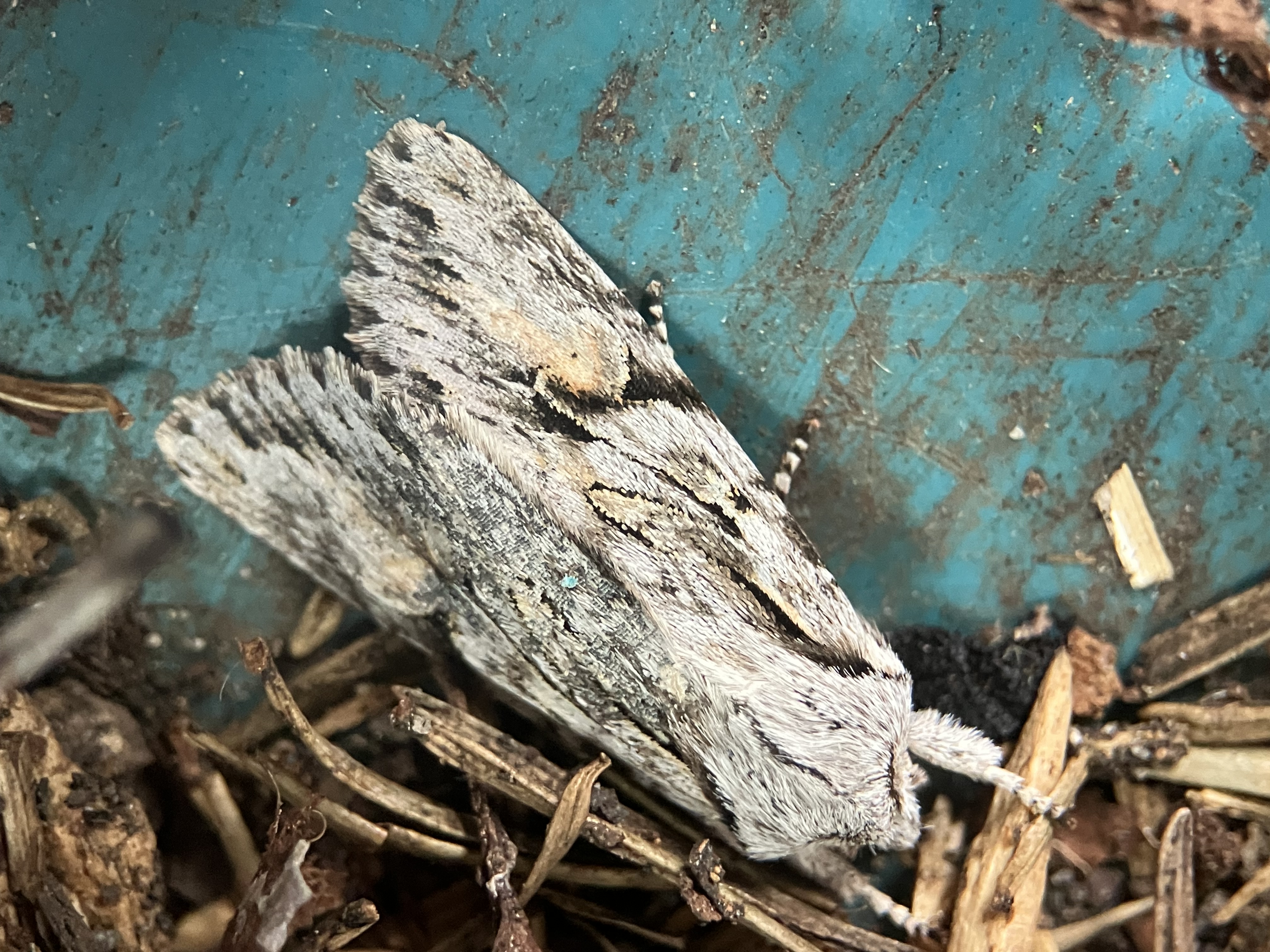
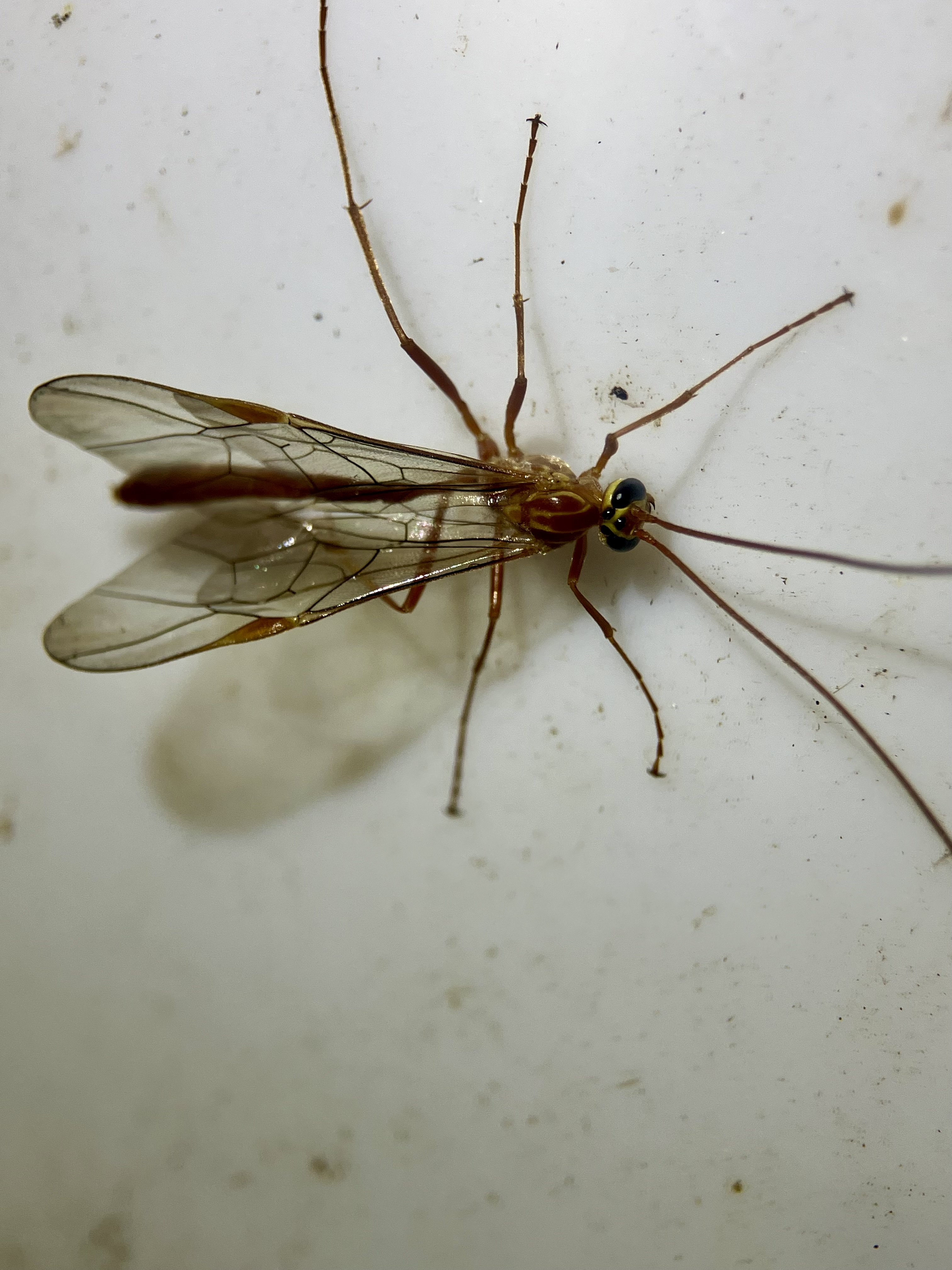
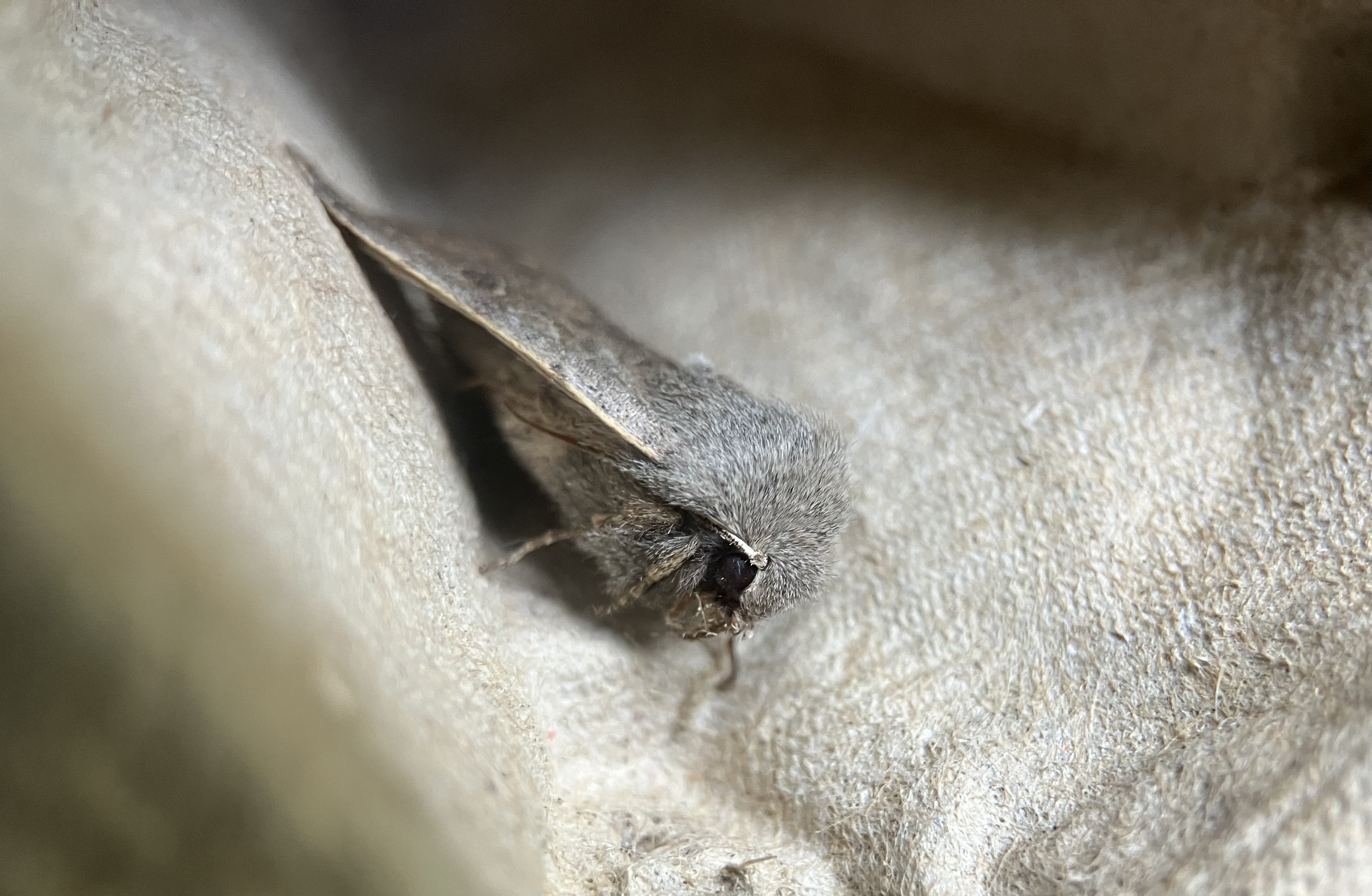
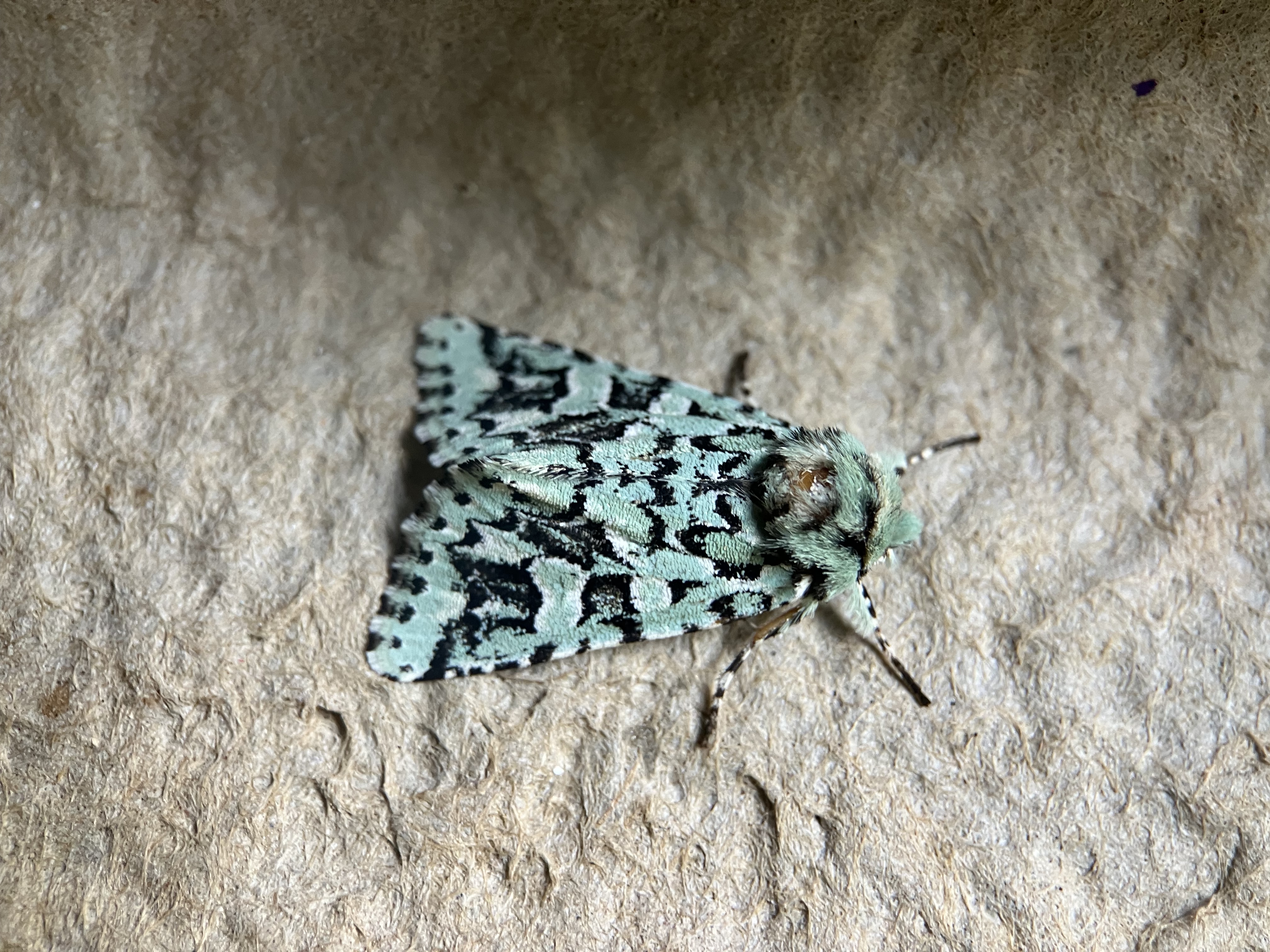
There were nine species of moths (31 individuals), two species of Coleoptera (beetles), and one wasp that I believe is Ophion sp.
Moths:
Egira perlubens = 1
Egira (either E. simplex or E. crucialis) = 3
Egira rubrica = 1
Orthosia transparens = 5
Orthosia hibisci = 8
Orthosia praeses = 8
Feralia comstocki = 2
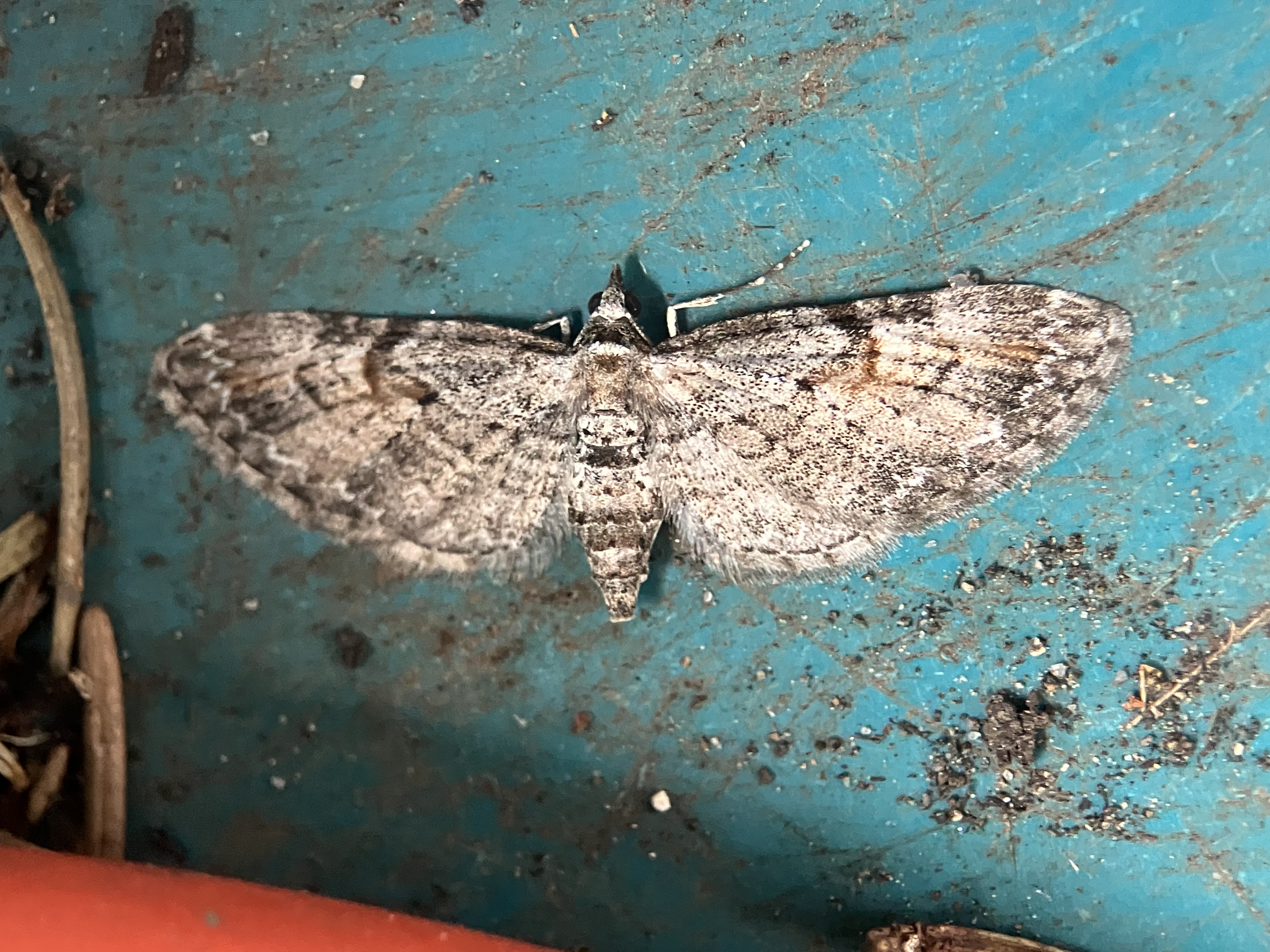
Eupithecia graefii = 2
Melanolophia imitata = 1
Beetles:
Diplotaxis sp. = 2
Strophosoma melanogrammum = 1
Wasps:
Ophion sp. = 1
Melanolophia imitataStrophosoma melanogrammumFeralia comstockiEupithecia graefiiEgira sp. (Either E. simplex or E. crucialis)Orthosia transparensOphion sp. I believeEgira rubricaOrthosia transparens Orthosia presesOrthosia hibisciFeralia comstockiOrthosia praesesDiplotaxis sp. beetle with Orthosia praesesOrthosia hibisiciEgira perlubensEgira sp. Eupithecia graefii
If I may, I’d like to leave you with something to consider. When you rake your leaves and clean your yard – especially if you are burning, chipping, or bagging and removing all those things that fall onto the ground, you are eliminating habitat for native species. If you can refrain the urge to spring clean around your property, you can help support life.
These may be somewhat drab colored moths and you may not even like them, but they sustain other organisms, including plants, because moths are also nighttime pollinators. Each species has a niche, and a role in the ecosystem (and ultimately the food web).
Please take note of nature around you. It’s actually beautiful and mysterious. Whether you like it or not though, nature is life. Nature matters. Little things like leaving the leaves can make a difference. Care.
I thought I’d write up a short post about all the wonderful flies (and a few others) pollinating our plum trees in this cool spring weather. Why feature the flies? Well, for starters, the plum tree blossoms are white and flies love the color white. Another reason to feature the flies is because they are under-recognized and under appreciated, but very important pollinators. Some fly larvae even serve as pest predators, eating aphids. Others, like the tachinid fly below, use caterpillars that defoliate trees as hosts for their larvae to develop. Flies are also awesome because they do not sting! Some even “dance!” My favorite fly hasn’t shown up yet. It’s a Conopid Fly. More about that one later though…
Tachinid Fly (Epalpus signifier)
This past week in the media, there have been so many posts about the decline in honey bees. While there are some (unwanted) honey bees showing up on days when the temperatures climb above 50 degrees, honey bees aren’t active if it is cooler. Flies, on the other hand, are quite busy at work pollinating and do just fine when it might only be 40 outside. Flies are awesome! They need our support and appreciation.
I’d like to add (and I do know something about this because of my entomology background), that honey bees are just not necessary on San Juan Island. In fact, they might even be a very bad thing. They showed up at our plum tree as the temperature warmed up the other day, and as they arrived in increasing numbers, they kicked off ALL of the native pollinators that I had been observing. 😦
For honey bees to fly out of the hive and forage, they need temperatures above 50 degrees. In my experience keeping bees (as part of my graduate school work), they typically do not survive well on the island unless they are fed supplemental sugar water. Think about the ecological footprint of growing sugar to feed the bees!
Feeding honey bees attracts (and supports) the buildup of yellow jacket populations which are attracted to honey bee hive resources (including eating the honey bee brood developing in the hive), and honey bees also bring pests and pathogens that impact native bees (especially bumble bees). One more thing! If you are growing tomatoes, bumble bees are your pollinators, not honey bees.
I hope you will read and consider this recent study published about how honey bees were negatively impacting native pollinators on Giannutri Island in Italy. They were causing a decline in the populations of wild bees. In fact, the study cited an “alarming 80% decline in wild bee abundance over 4 years” (Pasquali et al. 2025). You can access this study to read it yourself here: https://www.cell.com/current-biology/pdfExtended/S0960-9822(25)00262-3
Enjoy the gallery of the native pollinators that I was fortunate to photograph and be able to share. Be a fly fan! Be a native bee fan! Learn about our unseen, but important night time pollinators (moths), and PLEASE LEAVE THE HONEY PIGS for the mainland industrial farm operations.
KEARNS, C. A. 2001. North American dipteran pollinators: assessing their value and conservation status. Conservation Ecology 5(1): 5. [online] URL: http://www.consecol.org/vol5/iss1/art5/
That’s right! Herman the Persian found something interesting in the yard when we were outside sunning ourselves a bit this afternoon. He found one of the Bibionid March flies (a female). If you read my post yesterday https://buggingyoufromsanjuanisland.com/2025/04/04/nuptial-gifts/, you might note that Bibionid flies were being hunted by Empis flies who rolled them into little balls as nuptial gifts used to woo the lady Empids to mate.
Female Bibionid fly digging chamber to lay her eggs.
Evidently, a few of these Bibionid flies escaped that destiny and actually mated with their own kind. THIS one, that Herman found, was hard at work digging her own death chamber where she would expire soon after laying her eggs. Incidentally, the adults are very short-lived, and in fact, live only about 5-7 days with the primary objective of mating, and for the adult female to lay her fertilized eggs. In spite of their brief existence, adults are also thought to be important early pollinators of orchard trees. Yes, you heard me right! Flies don’t get nearly as much credit for pollinating as they deserve to receive.
I watched her digging with her fossorial forelegs. It seemed to be an impossible task, but she made slow and steady progress. She was still hard at work before we went back into the house about half an hour later. I marked the spot with a rock so I could go back and check, but I suspect even with the rock nearby as a marker, it will be next to impossible to detect any disturbance in the soil tomorrow. We’re supposed to get rain this evening.
In approximately 30-35 days, the eggs she lays will hatch underground. The larvae will live in the top layer of soil and feed gregariously on leaf and needle litter, decaying organic matter, and sometimes on below-ground parts of plants.
If you’re curious, you can read more about Bibionid flies in the attached links. I did see some additional Empis fly males dancing about today with their Bibionid “balloons” or nuptial gift balls for prospective mates.
Morris, H. No date. The larval and pupal stages of the Bibionidae. Entomological Department, Institute of Plant Pathology, Rothamsted ExperimentalStation, Harpenden. https://core.ac.uk/download/pdf/212009582.pdf
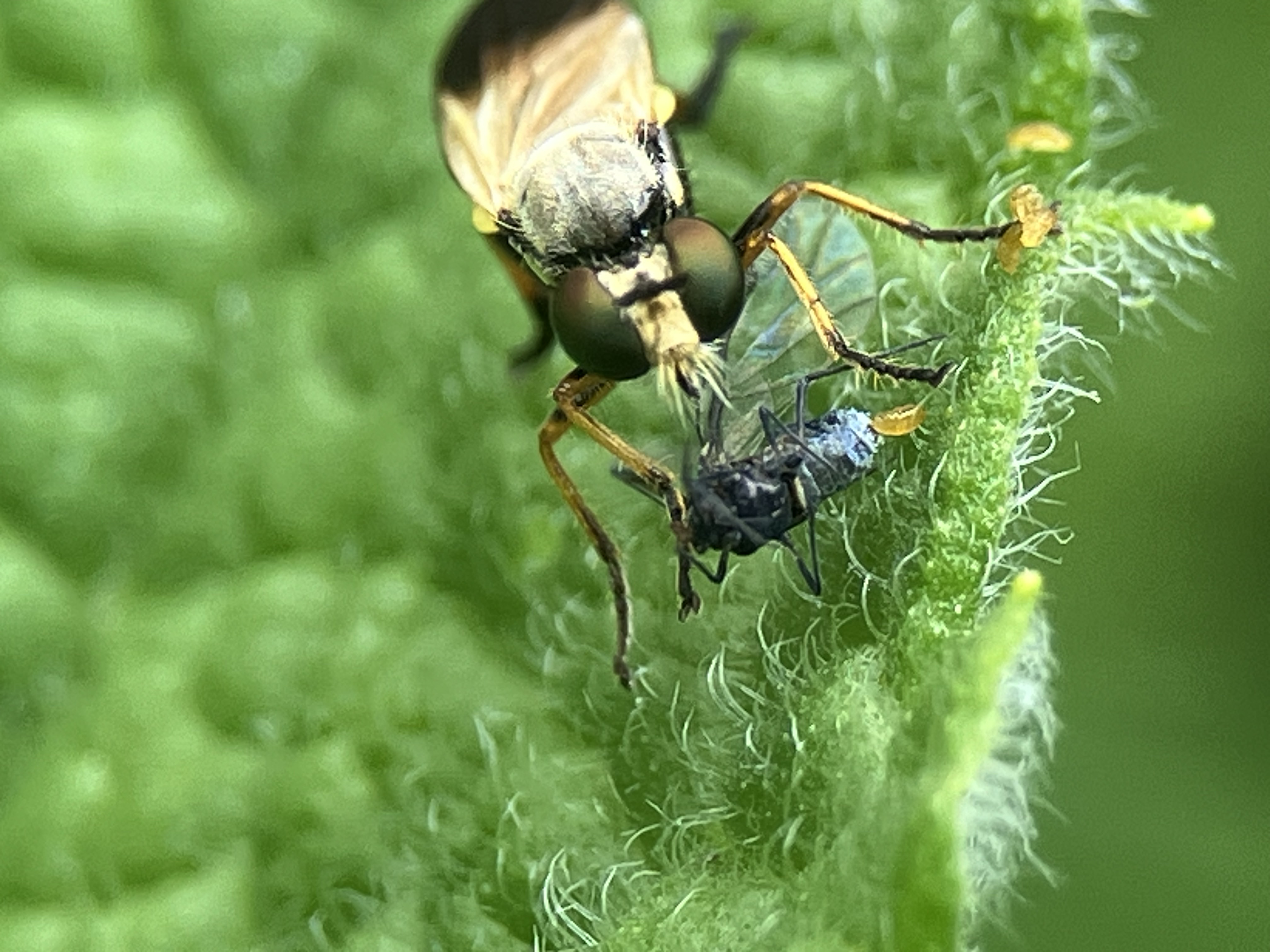
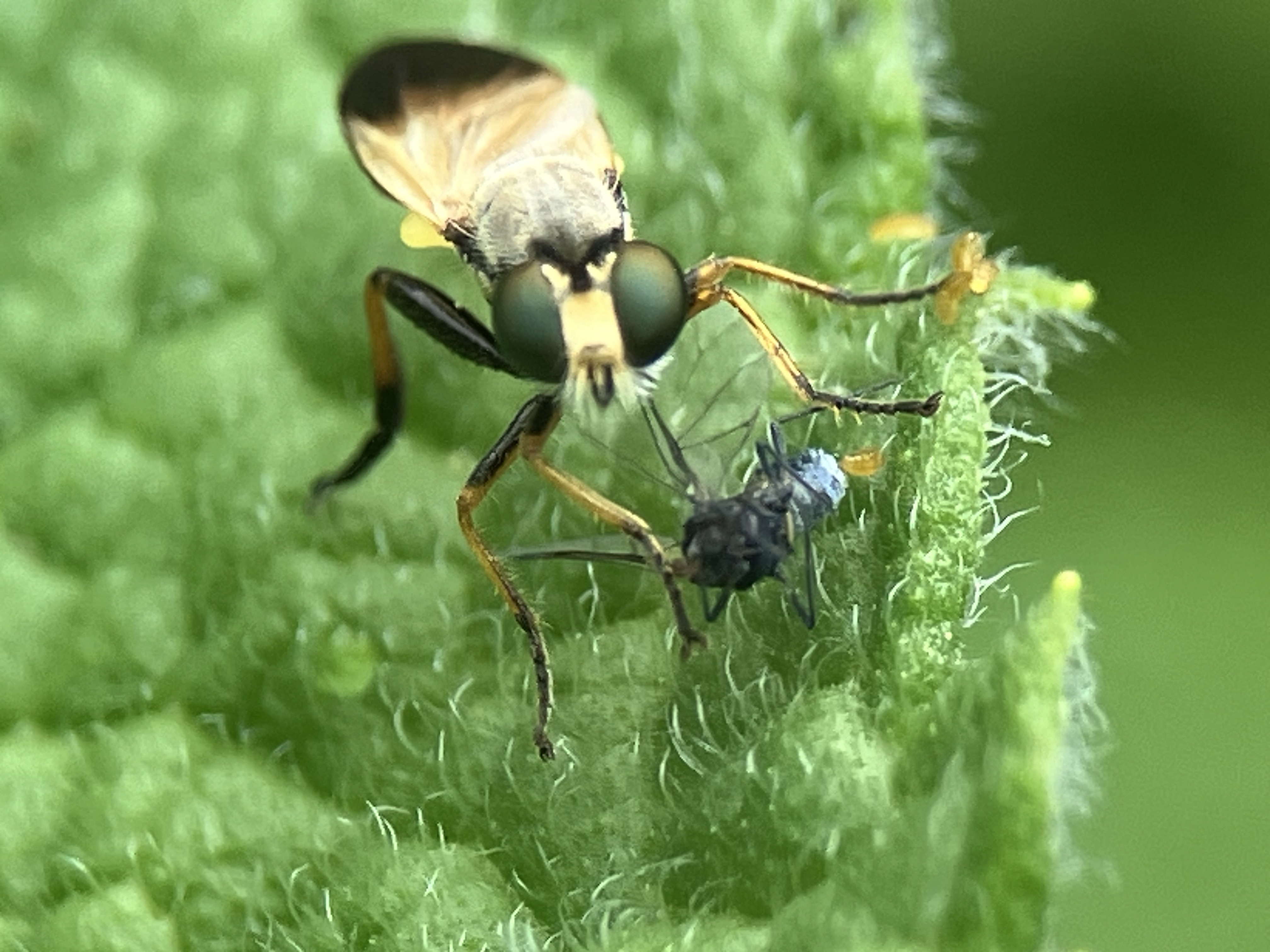
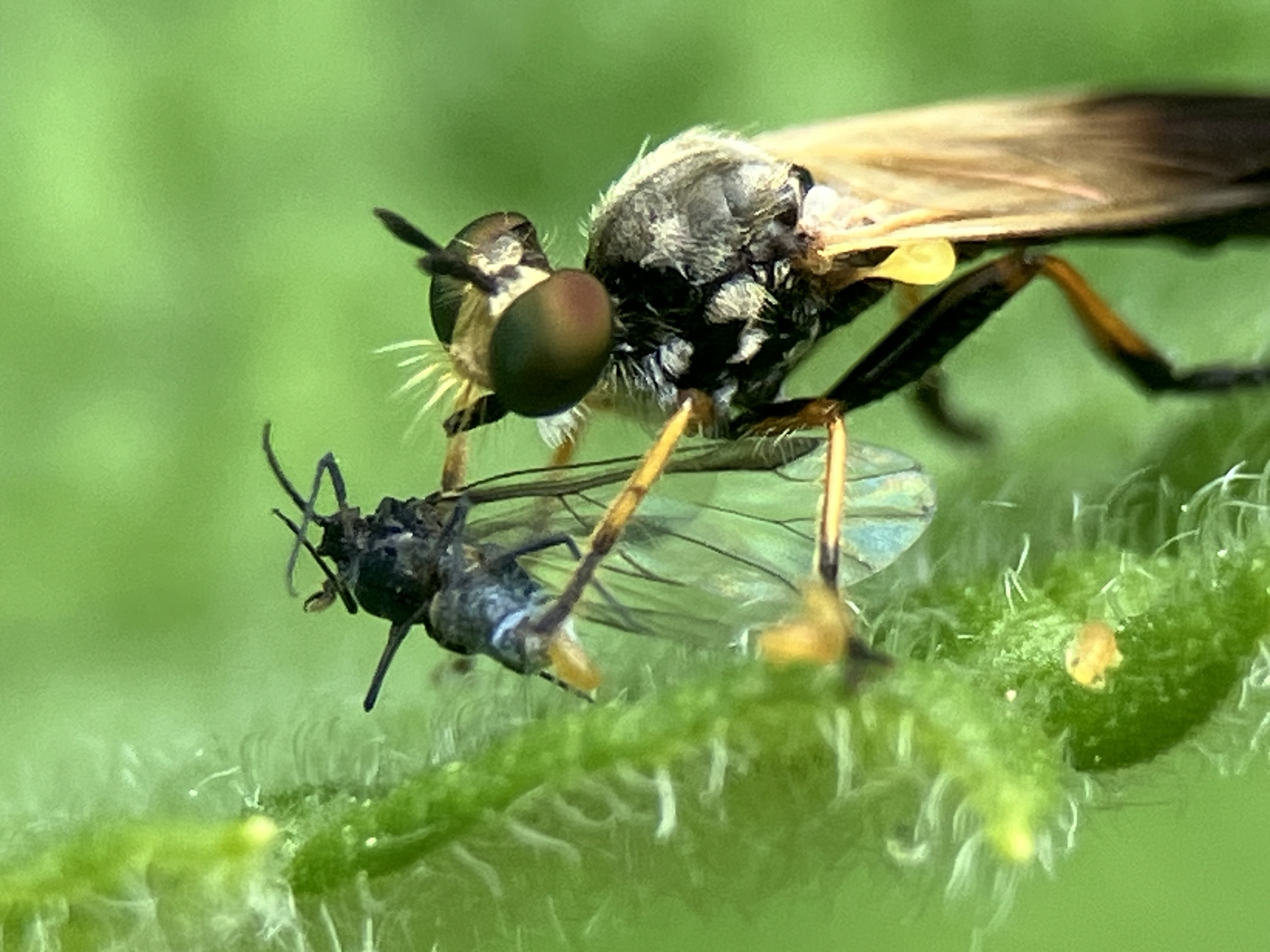
This is one of my favorite garden residents (Eudioctria sackeni), or the Sacken Longhorn Robber. I remember the first time I saw one of these, I thought, “Wow, it’s an Ombre Fly!” If you didn’t know, “ombre” means the blending of one particular color hue to another, often from light tints to dark. The coloration in this particular fly is distinctly “ombre,” though it varies in individuals within the species.
Eudioctria flies are in the family group, Asilidae or Robber flies. They are voracious predators of small insects that can be pests of gardens and orchards. Here, you see this one enjoying a small dipteran (fly) of some variety, perched on the leaf of one of my mint plants. The mint is a popular scouting platform. On any given day in the summer, I’ll see 4 or 5 of these flies in a six foot strip of mint which has become quite abundant in the yard over the past few years. The mint seems to be quite attractive to pollinators, and it also provides shelter for other bugs and critters. Our little tree frogs love to sit in the mint too.
Salal patch in forested area – San Juan Island, WA
I feel compelled to write up a short blog piece this morning before I move on to other tasks of the day. Last week, I tried to address some disturbing misinformation on social media about a native plant in the Pacific Northwest. The plant is a woody evergreen shrub, Gaultheria shallon or Salal. The misinformation is coming from a few folks insisting that Salal burns easily and should be removed in “fire-wising” around your home.
I have some genuine issues around the extreme measures some folks take in fire-wising, as well as the lack of knowledge around the impact these extreme measures have on ecological relationships. The fire-wise practices of removing all forest understory are incredibly destructive.
Removing the understory impacts your forest trees by exposing the soil to drying out much faster, it also removes habitat (shelter and food) for many many species of birds, lizards, flying squirrels, and others. When you pull out Salal, you are taking away an important winter food resource deer browse upon, the berries that feed birds, and the leaves that support the development of our native Brown Elfin Butterly (Callophrys augustinus).
Callophrys augustinus – May 27, 2023
But don’t just take my word on the importance of this native shrub. If you are still concerned about protecting your property, be resourceful and smart about what actions you take. Figure out how to cache enough water over the winter to irrigate around your property and keep things from drying out. Follow local guidelines during burn bans. Use common sense when things start to dry out more in summer/fall. Care a bit about the creatures (including the trees, shrubs, and plants) that call our island home.
For more assistance, see the various resources below. If you don’t still don’t find what you need, our local county conservation district is one of the best places to go for additional help.
Our native pollinators were slow to emerge this year in the San Juans because of the cool weather. Usually, we can rely on flies, solitary bees and wasps, and even moths, ants, and others to pollinate our fruit trees. I did see some species of flies out this spring, but again, weather conditions were poor.
We have PLENTY of “pollinators” out in our yard right now. So, in trying to explain to people when they ask me about a decline in native pollinators, I have a few points I like to throw out for consideration.
1) honey bees are poor pollinators to keep on the island. It has to be above 50 degrees for them to come out of the hive.
2) native flies and other insects like moths (which fly at night and we don’t typically see) are better at pollinating in cooler temperatures. While they also won’t be out if it’s rainy and super cold, they can fly in temperature ranges lower than 50 degrees F.
3) the critical importance of native pollinators may not be in their “pollination” services – but their role as pest predators and/or role in the food cycle for other organisms, and for creating biodiversity in our ecosystem, which helps keep everything healthier. I think this part is important. If you look at some of the plants we put in our gardens (native perennials), they actually do not require pollination to survive and reproduce, but do offer pollen and nectar to many insects, spiders, and hummingbirds. Looking further at the food web, we need a variety of native insects for more than pollination. Tachinid flies, syrphid flies, solitary wasps, ants, and even spiders can be pollinators, but also help regulate populations of orchard, garden, and forest pests.
My take on all of this is as humans, our focus has largely been on how to grow food over environmental conservation and maintaining balanced, functioning ecosystems. With climate change, many of our food growing operations may fail. Our fruit trees (at least none that I know of) are not native. In spite of the best intentions, conditions may decline to a point where we can’t produce great fruit here. Weather is only one limiting factor. We have poor soils or no soil in many locations, limited water resources, and the pressures of continuing development resulting in loss of natural habitats. I don’t have the answers for you when it comes to fruit production or any way to personally mitigate climate change, so we may have to figure out a substitute for growing apples, plums, and such.
Let’s go back to the importance of native pollinators though. If you think of our island as a living organism with many different functions, it is important to have all the essential pieces to keep the “body” healthy. These native pollinators (and the native plants they visit), and all the other myriad species of invertebrates, fungi, birds, mammals, amphibians, reptiles, soil, water, etc. are all part of the “body,” a body that has to fight off occasional or repeated assaults from being thrown off balance by exposures to external forces. Just like we need a variety of foods and minerals and other things to keep our body healthy, so does an ecosystem. We need all of these pieces (and that includes our native pollinators and all the other diverse species) to keep our island home healthy.
As to the fruit trees and other food crops requiring pollination, for now, some of these issues can be mediated by planting around your orchard and garden with plenty of diverse native species and providing habitat for all of these native species to develop. Some of our practices of cleaning and sanitizing our orchards and gardens, burning yard clippings, and applying fertilizers and pesticides can adversely affect the biodiversity needed to help our food production thrive.
I imagine it can be frustrating to see an orchard fail to produce fruit. My grandparents were tenant farmers and wholly dependent on growing cotton and corn and the bit of garden and livestock they had around the home on the property they did not own. When it was a drought year, and crops failed, things were utterly miserable. Destitute would be a better adjective. I believe we may have an inherent desire to be “part of the land,” and grow our own food, but sometimes, despite our best efforts, conditions aren’t favorable. Crops fail. Historically, we have tried (and failed) to control some of these external forces – like applying pesticides in amounts that probably will poison us forever.
I’ve gone way beyond the “pollinator” topic here, but it is next to impossible for me to see a one-dimensional issue. We have a much larger and more complex picture before us. How do we either re-create or maintain a healthy functioning system, navigate the perils of climate change, and feed ourselves? I like to believe that protecting diversity in our ecosystems is an important facet of this complex, multi-layered crisis we face.































 Bugging You From San Juan Island