Yes, it’s that time of year. You may be seeing lots of European Mantids (Mantis religiosa) about right now. They’re mate seeking. While not native, don’t worry, they aren’t taking over the island. If you’re curious about them, read my post from last year when there were rumors of them invading the San Juan’s and devouring hummingbirds (not true) https://sanjuanislander.com/news-articles/environment-science-whales/environment/28146/revenge-of-the-mantids .
While they are generalist feeders, they aren’t going to decimate our native pollinators OR eat birds. It’s far more likely they’ll be eaten (or beheaded) before they take over!
Sin City has a new attraction. It’s not the Radio City Rockettes, but they have lots of legs. It’s not a new Cirque du Soleil group, but they can jump and fly through the air with the greatest of ease. This is one animal show that even Siegfried and Roy can’t tame. In fact, most folks (unless you’re an entomologist) would prefer to miss this show when visiting Sin City. Chances are, you are going to get a front row seat whether you want it or not.
The grasshoppers are Las Vegas’ latest and greatest performers. This is NOT the name of a new hip hop, jazz, or rock band either. But there are thousands already performing and more showing up to audition every day. The “invasion” is not the name of a new dance. It’s not the grand opening of a new luxury hotel, but rather the new theme for the whole city. Grasshopper season!
This, in fact, reminds me of the crickets that invaded Highland Park Mall in Austin, TX long ago when I worked in the men’s shirts and ties department at Foleys. We had at least a 4 inch layer of crickets that made their way into the first set of entry doors. They had literally piled up on top of one another. Some had gone past the 2nd set of doors and were now in the plastic packaged shirts and the lucite display cubicles. When you tried to pick them out, they squirted out this horribly staining and smelly vomit or fecal matter that made the entire problem so much worse. When mall maintenance workers came around to suck all those crickets in the entry doors up with a vacuum, creating a horrible odor of vacuumed crickets, that did it for me. I didn’t show up for my shift ever again. No notice either. I just couldn’t handle it. (Kinda funny in hindsight that I eventually became a master’s-degreed entomologist). Check out this link to see I’m not exaggerating here one bit! https://www.dallasnews.com/news/from-the-archives/2018/08/14/invaded-crickets-dallasites-battled-swarms-clogged-clocks-plowed-doors
Now I live on San Juan Island. A small, somewhat delightful (unless it’s summertime and the height of a gazillion tourists descending up on us) rural community, accessible by small airplanes or ferry. Last year we had some residents getting pretty worked up by our invasion of praying mantises. I fielded some questions about how they might eat up our hummingbirds. Comments about them ranged from “they’re horribly invasive” to “they’re going to eat all our pollinators.” I smiled and tried to explain as politely as I could how there are only 3 officially documented cases of hummingbirds being captured and eaten by mantises in the United States since the 1800’s, and those were Chinese Mantids, not the smaller European Mantid that is making it’s way west. https://sanjuanislander.com/news-articles/environment-science-whales/environment/28146/revenge-of-the-mantids
As far as pollinators getting eaten by mantids, well, that happens. Everything in nature gets eaten by something. Native species of robber flies and dragonflies eat our cute little bees. So do native spiders and birds. Yes, mantids eat lots of things. Like grasshoppers. That’s why they were introduced to North America in the first place. Which brings me to how I’d like to hand out vintage agricultural reports from the 1930’s and 40’s to some of these panicked individuals and ask them if they’d like to have a few praying mantids on the island or a 6 inch deep layer of grasshoppers! It can happen!
As for those reveling grasshoppers in Sin City…let’s hope what happens in Vegas, stays in Vegas!
Check out my story about praying mantids on San Juan Island! They’ve been a victim of hyper-sensationalism. Seriously. Read my article before you squish one.
Revenge of the mantids!
Lots of folks are commenting about seeing praying mantises on the island lately. Rumor has it they’re highly invasive and they’re eating hummingbirds! While they are non-native, I’m hoping to dispel some of the sensationalist hysteria about their presence on the island by offering information for consideration.
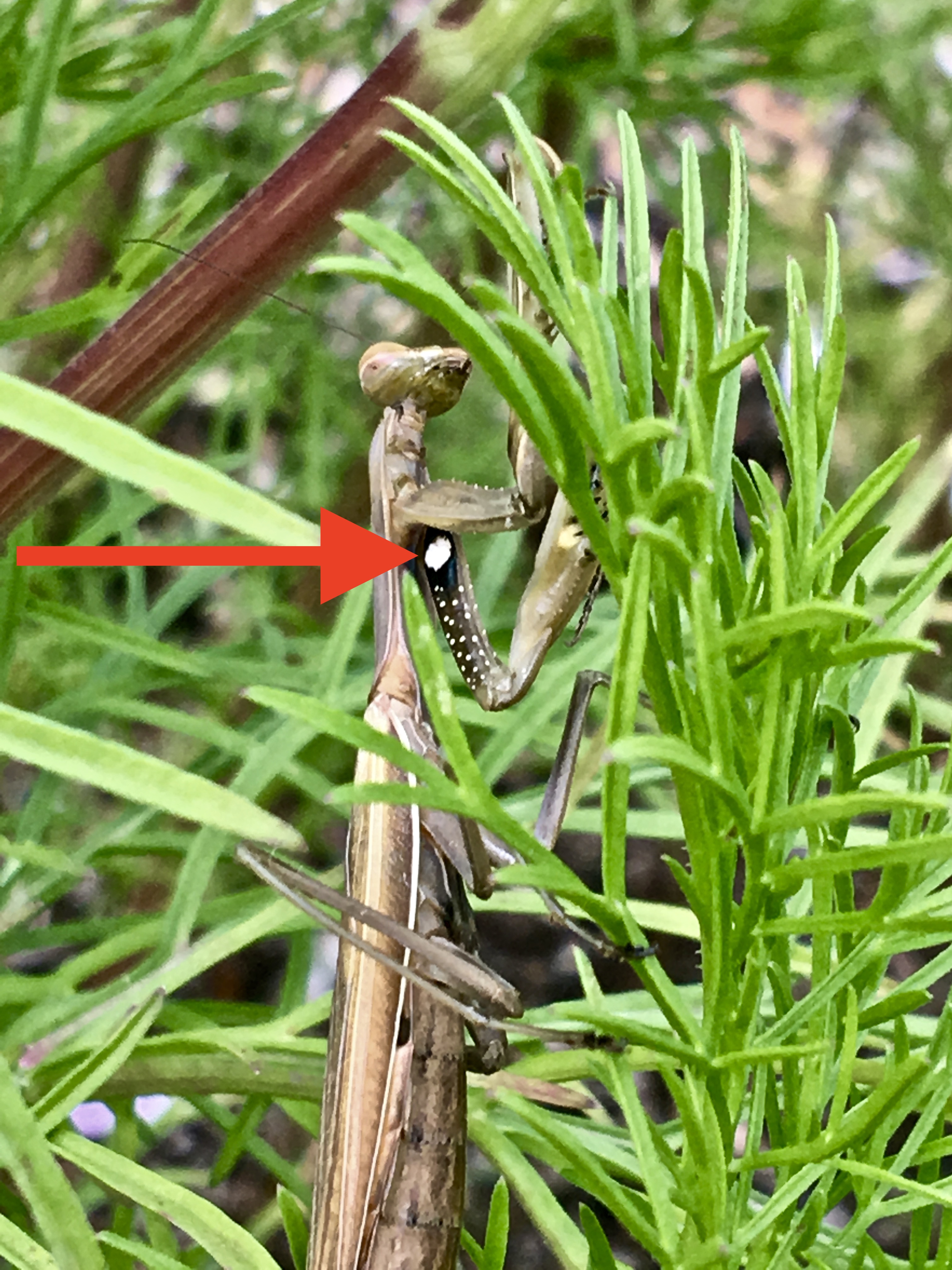
The mantids we are seeing right now are a species called Mantis religiosa, introduced into the southern interior of British Columbia to control grasshoppers in 1937-1938 and have expanded their range since the late 1990’s. They are identifiable by a black-ringed white spot on the inner base of their foreleg.
European mantis (Mantis religiosa) Photo by Cynthia Brast
This taxonomic feature differentiates them from the exotic Chinese Mantis, Tenodera aridifolia sinensis and native Ground Mantis, Litaneutria minor found in Washington, but not on San Juan Island. Egg sacks for European and other mantis species are available online and at garden centers for purchase. Aside from releasing them to control agricultural pests, lots of people keep mantids for pets!
As to the mantids eating hummingbirds…
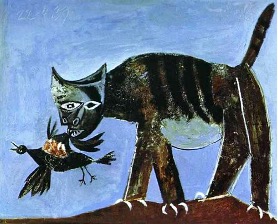
While worldwide reports exist about various mantids capturing and eating hummingbirds, these are sparse, highly sensationalized accounts, most of them not occurring in the U.S. at all. A 2017 article in Wilson Journal of Ornithology reports hummingbird predation by Mantis religiosa (the ones purportedly “invading” the San Juan Islands). However, for the ENTIRE U.S., there are only 3 substantiated reports, none of which occurred in Washington, much less on San Juan Island. If you’re worried about birds, what about outdoor kitty cats with sharp teeth and claws?
Pablo Picasso’s “Cat Catching the Bird” (1939)
The mantids are killing all our pollinators…
We’ve read about pollinator die-off due to habitat degradation, pesticides, parasites, and pathogens but are mantids a menace too? Let’s look at mantis development, and consider the impact.
The mate-seeking adult mantids will die off as temperatures drop, but need to reproduce before the end of their life cycle. A mated female’s remaining energy will be spent producing a frothy egg mass of 100-400 offspring. The mass hardens into a styrofoam-like ootheca, cemented in some cryptic spot where it will remain until spring.
In spring, mantid nymphs emerge simultaneously from the egg sack. The highly competitive and cannibalistic hatchlings eat many of their siblings. It is estimated that approximately 10% survive this first stage (Hurd and Rathet, 1986).
The hatchling Mantis religiosa nymph, a tiny replica of the adult, must complete 8 or 9 developmental stages, shedding its exoskeleton (molting) each time. During a molt, the mantis must hang upside down to shed its skin, leaving it extremely vulnerable to predation and to accidental injury. The mantis cannot fall from where it hangs or it risks becoming stuck in the old skin. With each stage of development, the mantis must find food and shelter and manage to evade predation by birds, reptiles, spiders, or even other insects like robber flies or dragonflies.
During spring and into early summer, the mantis is pretty small. Although hundreds emerged from the egg sack, very few become adults. They will prey on pollinators, but so do birds, reptiles, spiders, dragonflies, robber flies, and even certain wasps. One fact you may not know is mantis nymphs often survive in spring on pollen!
I kept two European mantids as pets for about ten months and found they preferred to dine on flies. They would eat yellowjackets, but typically only if they were really hungry and only if I cracked open the hard-shell for them first. Their appetites increased as fall approached. One night a swarm of termites emerged from a tree stump by my door. Lucky for the mantids, I had my bug net handy. One ate 30 or 40 termites that night. A few nights later, I had an egg sack cemented to the window screen. I found “Merlina” on the floor the next morning, a victim of feline curiosity.
Most islanders didn’t notice these mantids until late summer and early fall. If you saw one eating a pollinator (unless it’s a bumble bee queen or honey bee), that insect was nearing the end of its natural life cycle and doesn’t overwinter. The pollinators have done their job. The trees, garden plants, and flowers aren’t in need of pollination anymore. Winter is around the corner. If the mantis catches and eats one of these, I believe it is nature’s way of cleaning up.
About the author
Cynthia Brast has a M.S. in Entomology and Nematology from the University of Florida, Gainesville. She welcomes your bug photos and questions.
References
Cannings, R.A. 2007. Recent range expansion of the Praying Mantis, Mantis religiosa Linnaeus (Mantodea: Mantidae), in British Columbia. J. Entomol. Soc. Brit. Columbia, 104: 73-80.
Hurd, L.E., and I. H. Rathet. 1986. Functional response and success in juvenile mantids. Ecology, 67(1):163-167
Kral, K., 2014. Orientation behavior with and without visual cues in newly hatched and adult praying mantis. Journal of Insect Behavior, 27: 192. https://doi.org/10.1007/s10905-013-9415-3
Nyffeler, M., M.R. Maxwell, and J.V. Remsen. 2017. Bird predation by praying mantises: A global perspective. Wilson Journal of Ornithology, 129(2), 331-344. doi:10.1676/16-100.1


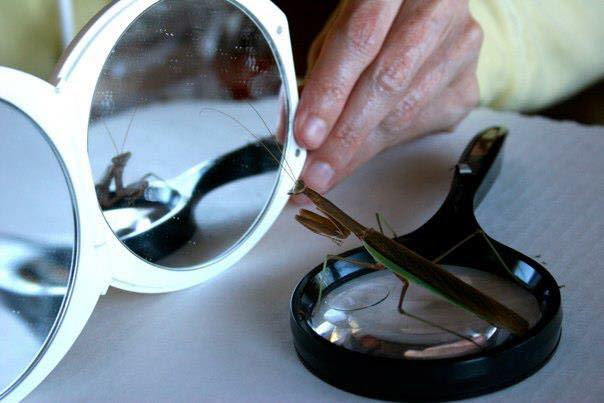

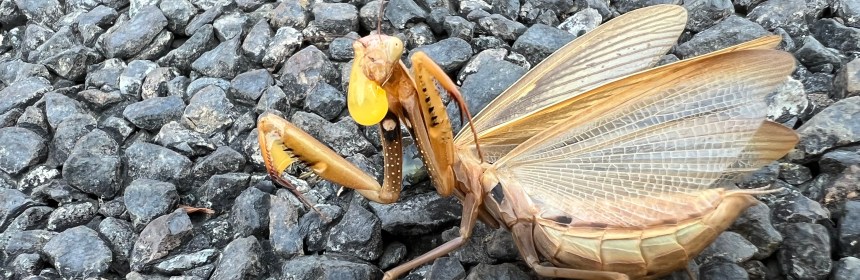
 Check out my story about praying mantids on San Juan Island! They’ve been a victim of hyper-sensationalism. Seriously. Read my article before you squish one.