I’m doing a short write up of this fly just to get you thinking a bit. It was observed April 29, 2024 on San Juan Island, WA. While identification to Genus/Species may not be possible until I can actually catch a specimen to be keyed out, it is Family Tachinidae and Tribe Goniini. Hoping to come back with at least a Genus update at some point.
What I want to SHARE is the life history of this tribe of flies. The Goniini flies are parasites of various Lepidoptera, mostly Noctuids, Arctiids, and Lymantriids. Translating this for you a bit, it would be cutworms (if you’re a gardener) , tiger moths, and tussock moths.
How does this play out?
The female Goniini fly lays a “black microtype,” usually ovate and flattened egg, varying in size from very small to medium, on foliage utilized by the feeding host caterpillar. The caterpillar (usually Noctuids) munch the foliage, ingesting the fly egg. The caterpillar will continue feeding and then wander off to complete its life cycle as a pupa. At some point after ingestion by the caterpillar, the fly egg hatches and the fly larva develops inside the body of the pupating moth that is inside its chrysalis.
A myriad of ecological relationships exist in nature that are often unobserved. Many remain undescribed or unknown. Sometimes, they are disrupted by humans who intervene out of ignorance. If you’re one of those folks who squish what you believe are cutworm pupae in your garden bed, you might be smooshing the pest predator developing inside.
I posted a few images last week to my iNaturalist page to see if I could get help from some experts in the butterfly community to ID this Polygonia butterfly past genus. It sparked a lively amount of conversation and I finally received a comment in the thread from West Seattle-based nature guide, ecological consultant and botanist, Stewart Wechsler, stating, “@cyndibrast Looks like you have the first confirmed Polygonia oreas iNaturalist observation for the San Juan Islands!” I would also throw out that the first person to correctly speculate the ID for this is my friend, lepidopterist David Droppers, who suggested I post in a wider audience to see what feedback I might receive.
Cool! So, I have the first Oreas Anglewing iNat. Sighting for San Juan County. 😀
Polygonia oreas – March 29, 2023, San Juan County, WA
Have there been others? Probably. Not everyone is using iNaturalist, so some sightings may not be on the radar for other bug enthusiasts. I like it to keep all my bug sightings organized and categorized and all that stuff and using iNaturalist makes it easy to find things when I want to go back to reference one. If you don’t have the iNat. app, give it a try. It makes your outdoor experiences a lot more interesting in a nerdy, scientific way. You can be a naturalist on your hike. It’s fun!
Here’s a bit of information about this interesting butterfly, now officially recorded on San Juan Island. Links to sources included below.
Oreas Anglewing (Polygonia oreas)
*From (C. LaBar 2013) and (Björklund, N.H. 2018-2022)*
SIZE: Wingspan of 40 to 50 mm (up to 2 inches)
Key ID Features: Above orange with black blotches and spots, often with very jagged wing edges, submarginal row of yellow chevrons and brown to black marginal band. HW above has yellow patches adjacent to dark marginal band. Below dark gray to black, with lighter gray striations, and prominent white flattened “v” (pointed at the bottom, often looking like a gull in flight) with no hooks in center of HW.
Similar species: Darker below than other comma species, white “v” mark on HW below lacks barbs. Other comma species either have stronger green submarginal shading below or the “comma” mark on HW below is curved (not a pointed “v”) or barbed or both.
Male: rusty orange and gold with black spots, dark brown wing margin with row of bright yellow spots. Ventral is variegated in contrasting shades of dark brown and black. White comma on VHW.
Female: slightly lighter dorsal and ventral colors and less-distinct ventral mottling.
Egg: green.
Larva: first two instars are brown and pale beige with black hairs and spines. Last three instars are mostly black with thin, white or yellowish bands around each segment and covered with rows of yellow-orange spines.
Pupa: mottled reddish brown, white and gray, with three pairs of silver spots.
Larval hostplants: currants (Ribes), primarily swamp currant (R. viscosissimum), also including R. divericatum (straggly gooseberry), and R. lacustre (swamp gooseberry).
Habitat: Forest fringes, especially in older stands, riparian areas and ravines, subalpine meadows.
Range: Coast Range, Willamette Valley, Western Cascades, east slope of Cascades, Wallowa Mtns, Blue Mtns. Season: Late February to mid-September Abundance: Uncommon
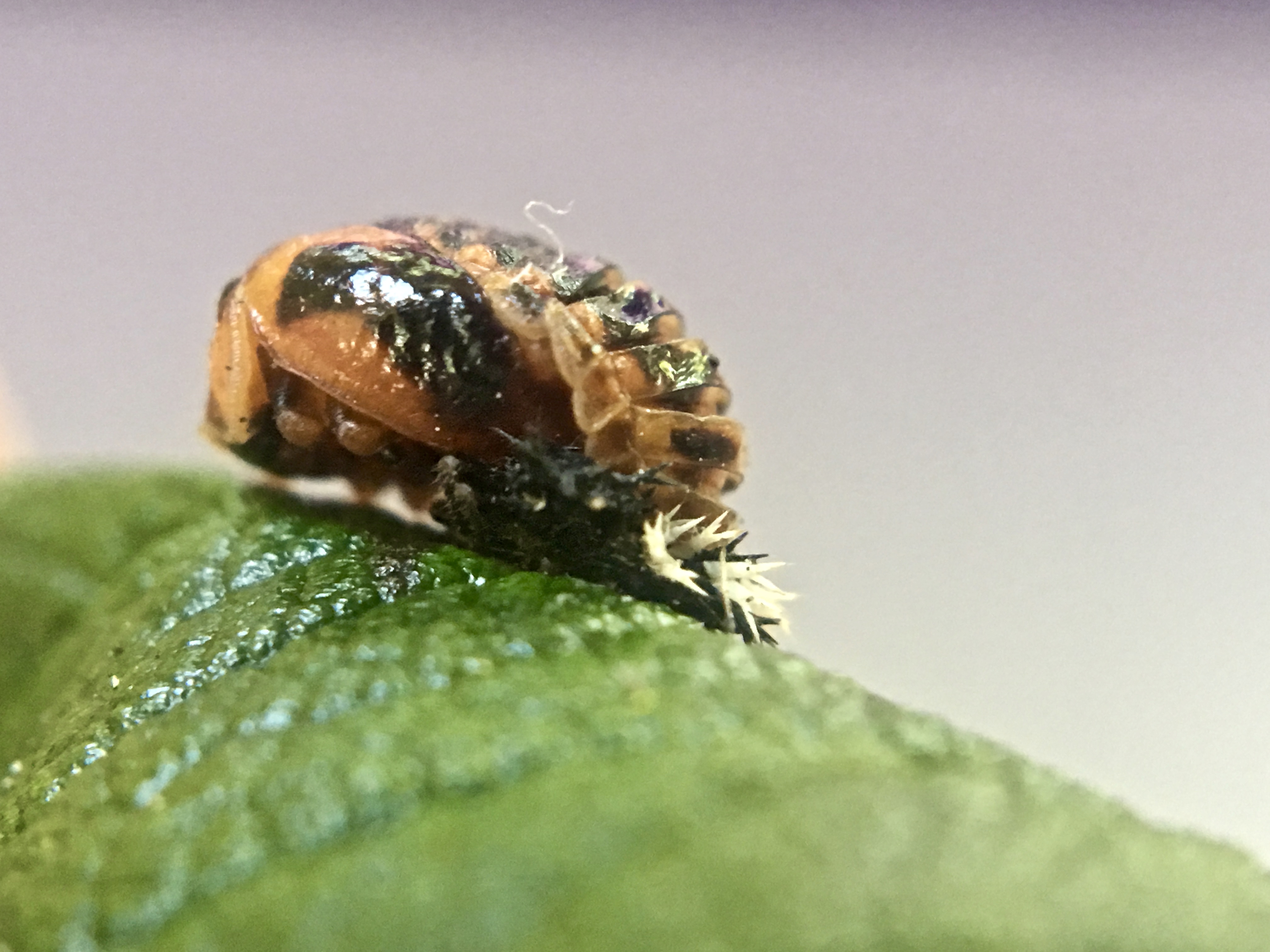
I found this weird little creature stuck to a leaf on a rose bush by the picket fence in front of the San Juan County Land Bank office on Monday, June 24, 2019 when I walked down Argyle and rounded the corner onto Caines (does anyone on the island actually use street names? Where the heck is Caines, right?)
Ladybird pupal case, June 24, 2019
Brought it home because I couldn’t resist the mystery of figuring out what it might be. What on earth are those spiny things at the end? Is it some sort of pest insect?
Ladybird pupal case June 24, 2010
After taking a few photos, I did what drives my husband crazy sometimes. I left the leaf with this little spiny-ended thing on the table, in a cup, without a lid. Yep. Just like when I left the really fat deer tick I had on my desk. The one that laid eggs…that hatched when I wasn’t paying attention. This is when it’s really handy to have sticky tape nearby, otherwise you have to vacuum every 10 minutes for about a month to finally sleep at night without feeling like things are crawling all over you and burrowing into your skin. This link should take you to my facebook page post about “Big Bertha.” https://www.facebook.com/buggingyoufromSJI/posts/2375866245969416
This morning, after my cat got me up with incessant meowing right in my ear, I sat down at the table with a cup of coffee. Millhouse (the cat) isn’t supposed to be on the table, but when my husband isn’t around, anything goes! He was staring something down that was m.o.v.i.n.g! Fortunately, I reacted faster than he did. I tipped over the little medicine cup I’d put the leaf in to thwart this little creature’s attempt at a fast getaway.
Asian Spotted Ladybird Beetle (Harmonia axyridis) July 27, 2019 San Juan Island, WA
Carefully sliding a piece of paper under the cup, I could see it looked like a ladybug. Ladybugs come in different colors, with different spots, and there are quite a few species one could encounter on San Juan Island. This beetle goes by an assortment of names. It’s often referred to as the Multi-colored Asian Lady Beetle or sometimes the Halloween Beetle because in some places they show up in large numbers at Halloween! 🎃😱
This beetle’s scientific name is Harmonia axyridis (The Asian-spotted Ladybird Beetle). It was imported to the United States as early as 1916 to help control pests as a biocontrol agent. While “Miss Harmonia” eats aphids, thrips, and scale insects (and manages these pests fantastically in soybean crops), she isn’t native and these pest insects aren’t all she eats. Asian-spotted Ladybird Beetles also eat native coccinellid beetles (native lady bugs) and even butterfly eggs. In the winter, she can bring her friends and invade your home. When handled, the ladybird beetles can excrete a stinky defensive chemical from their leg joints. This makes removal of large numbers of them from inside homes somewhat problematic. You don’t want to have them discharging this awful odor that will linger….all…winter!
Newly emerged adult (Harmonia axyridis) June 27, 2019 San Juan Island, WA
Another unfortunate consequence of importing these beetles is their love of wine grapes. 🍇 🍷 Asian-spotted ladybirds will eat grapes and then the grapes end up contaminated with an awful smell lingering on them. While I personally don’t drink wine, I know lots of people do and they’d be very unhappy if it tasted like essence of ladybug…a twist on a new aromatic bitter perhaps!
Did I squish her? Nope. I put her in the tree near our bird feeder. It’s possible she will become part of the food chain. While not all birds eat these beetles, some do. Insects and arachnids like robber flies, dragonflies, ants, various ground beetles, and cellar spiders also eat them.
If you see them, should you squish them? That’s up to you and how confident you are that you’ve identified it correctly. I wouldn’t want to mistake a helpful native ladybug as an invader. I recommend that instead of buying ladybird beetles at the garden store to release in your garden you establish native habitat to attract and support native species of ladybugs.
As I looked a bit more into the literature about Harmonia axyridis, I was intrigued with the publication of some research about the biochemistry of the liquid they secrete. It has been found to have strong antimicrobial action against strains of bacteria that are pathogenic to humans. This fluid has even been examined for its action against malaria. Perhaps these beetles don’t belong in the garden, but in your medicine cabinet instead.
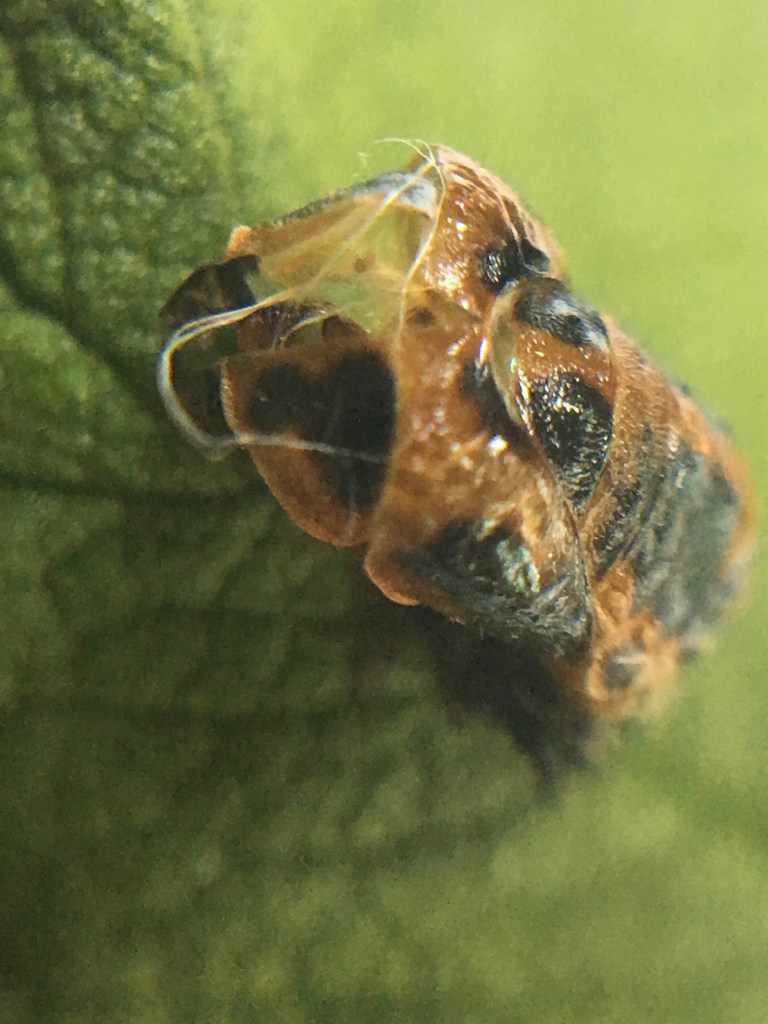
empty pupal case Asian spotted Ladybird Beetle (Harmonia axyridis) July 27 2019 San Juan Island, WA



 Bugging You From San Juan Island