Tag Archives: San Juan County Land Bank

The Owl (and others)
Today was a day of bird encounters. I saw our poor little cowbird that can’t fly because he’s been injured (likely by our neighbor’s marauding outdoor cat). He’s survived three nights so far even though he seems to have a wing injury and I haven’t figured out yet if I can capture him to check. He’s had his little mate following him around.

Cowbird male

I know it’s a cowbird and cowbirds are brood parasites, but they are actually quite beautiful little birds and I feel sympathy for wildlife that are impacted by our human “pets.” It isn’t fair and we should do much better to keep our pets under control. I don’t know what my response would be if I see this cat attacking our Tanager or one of the Grosbeaks. It is doing what cats do and the problem isn’t the cat, but the owner who evidently doesn’t care and is probably too lazy to clean a litter box and play with the cat and keep it inside. Ok. So, I vented. Sigh…

I was going out to take a walk in nature to unwind when I heard a sad little thunk on our window. We have Acopian Bird Savers https://www.birdsavers.com/make-your-own/ on the largest window, but not the smaller one. That’s gonna change. I’m going to put them on ALL our windows.

Well, I looked out and saw a tiny little nuthatch on the ground, on its back, mouth open, but it was breathing. I ran out to pick it up and when I scooped that little creature into my hand, its feet wrapped around my finger so tightly that I felt hopeful. It was a newly fledged nuthatch. I sat with it quietly in the shade under the suet feeder, my hand stretched out onto my knee into a little cup shape.

The bird closed its eyes and slept a bit. I talked to it very very softly. An adult nuthatch landed on the feeder above, eyeing me cautiously. I believe it was the parent. I spoke to the adult too, trying to convey my earnest intent not to harm her child. The little one blinked and looked about. Then it closed its eyes and slept a bit again. The parent flew over to the fruitless cherry tree to another feeder, then off, I expect to feed another hungry mouth.

After a good 15 minutes, the little nuthatch was much more alert. It kept eyeing the suet feeder and the adult bird that returned again and again. I rose slowly from sitting, carefully supporting the little one – still gripping my finger. Raising my arm, I chose a small branch just beside the suet feeder and in a breath, the little one hopped off my finger and onto the new perch.

The adult nuthatch flew onto a nearby branch and I saw the fledgling flutter its little wings like baby birds do to get their parents’ attention to be fed. In another breath, it was airborne, flying after the parent. I was so grateful for a happy end to that incident.

My walk down our road was uneventful for the most part. I did see a Clown millipede (Harpahe crossing the wetland area and squatted down to observe its somewhat awkward, but systematic locomotion. It almost looks suspended in motion over the ground. After making sure it was safely out of harm’s way and not in a car path, I continued on.

(Harpahe hayadienana) Clown millipede

My destination was the “soon to open officially” nature preserve. I have walked on this property for about 10 years now. It is an amazing place.

Giant cedars tower overhead through the wetland. Along the seasonal stream, the path I took meanders amidst the primordial assortment of ferns, swamp lanterns, and horsetail. There are creatures there in the forest. If you see them, you will leave feeling a sense of awe.
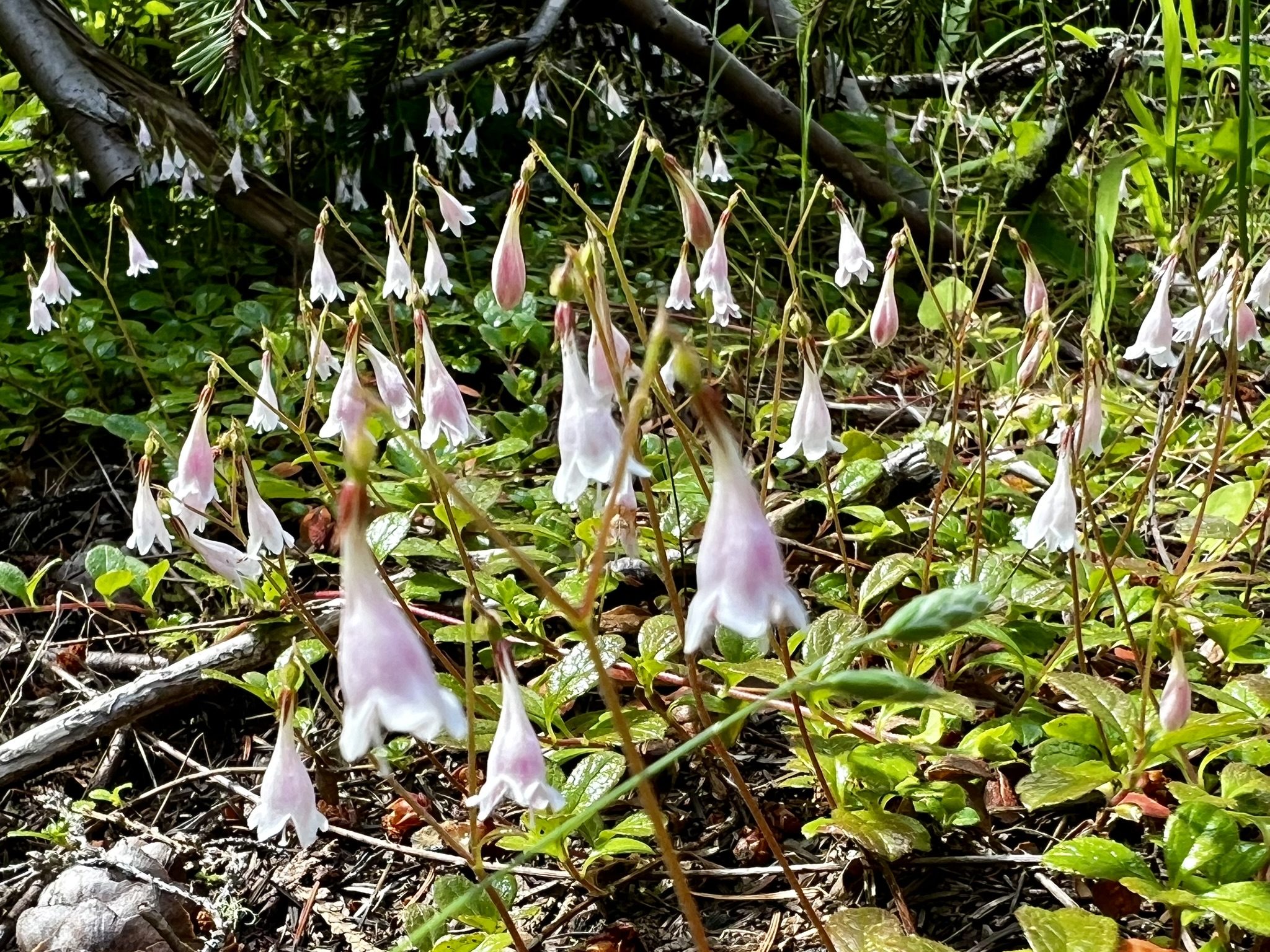
Twinflowers on the forest floor

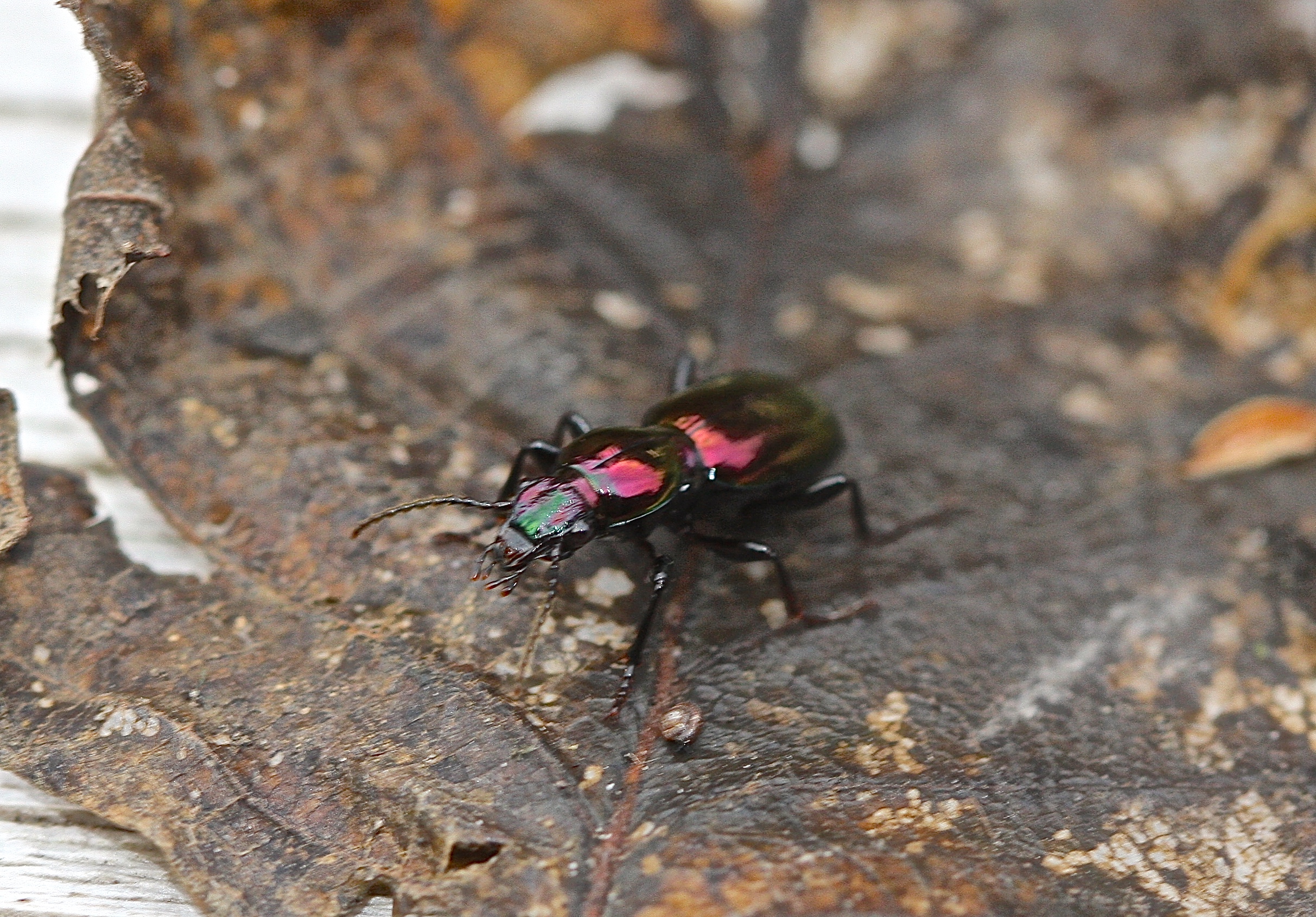
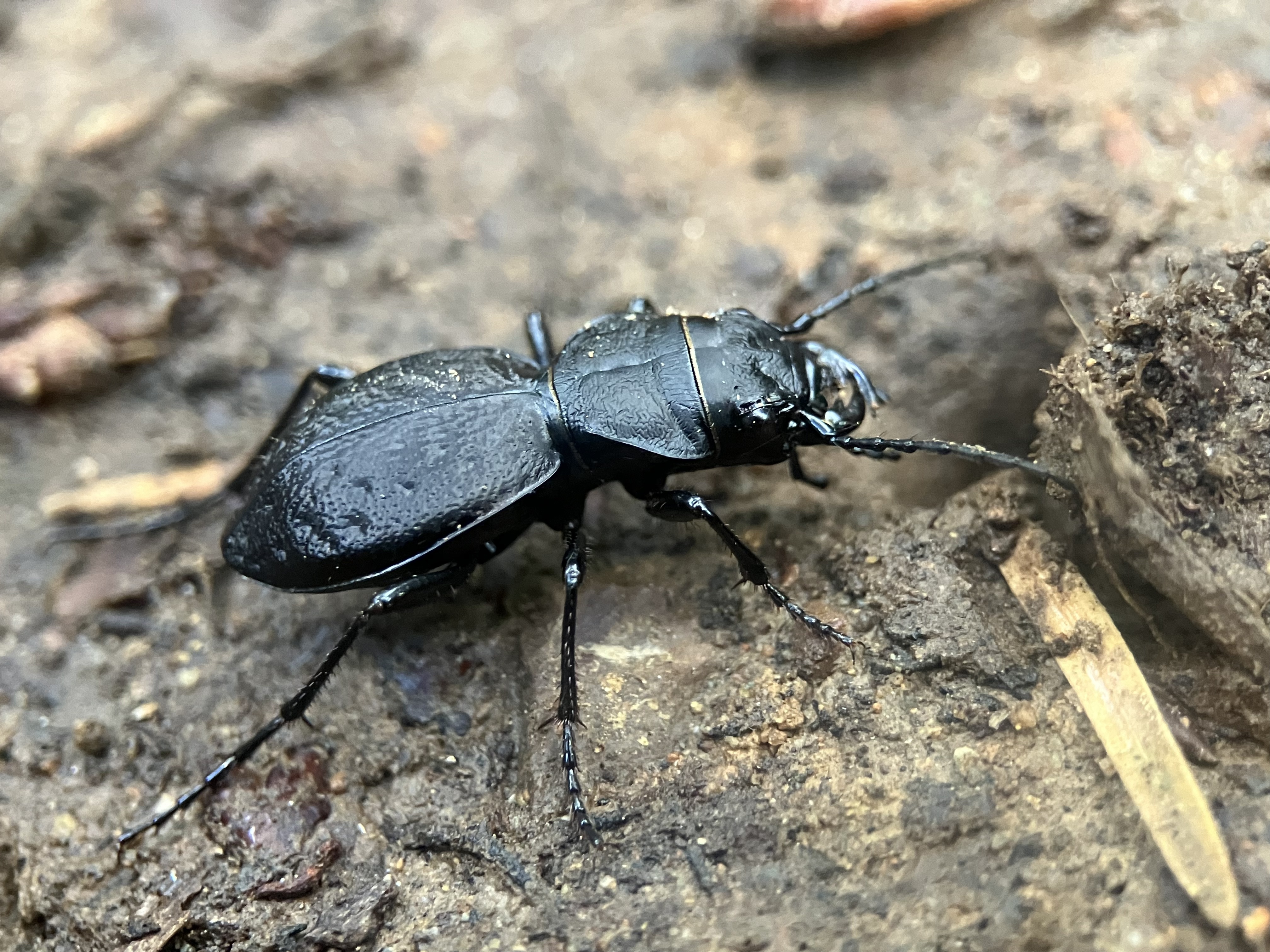
Red legged frogs, salamanders, and newts make their homes in the wetland. They dine on the myriad of invertebrates that live in the stream and mud. On the forest floor, you’ll find Night-stalking tiger beetles (Omus dejeanii) with fierce jaws hunting for prey. If you’re really really lucky, you might see the burgundy metallic carabid beetle (Zacotus matthewsii) that I’ve only seen less than a handful of times in the past decade. Overhead, you’ll hear the family of ravens that have a nearby nest. Always in the same place.
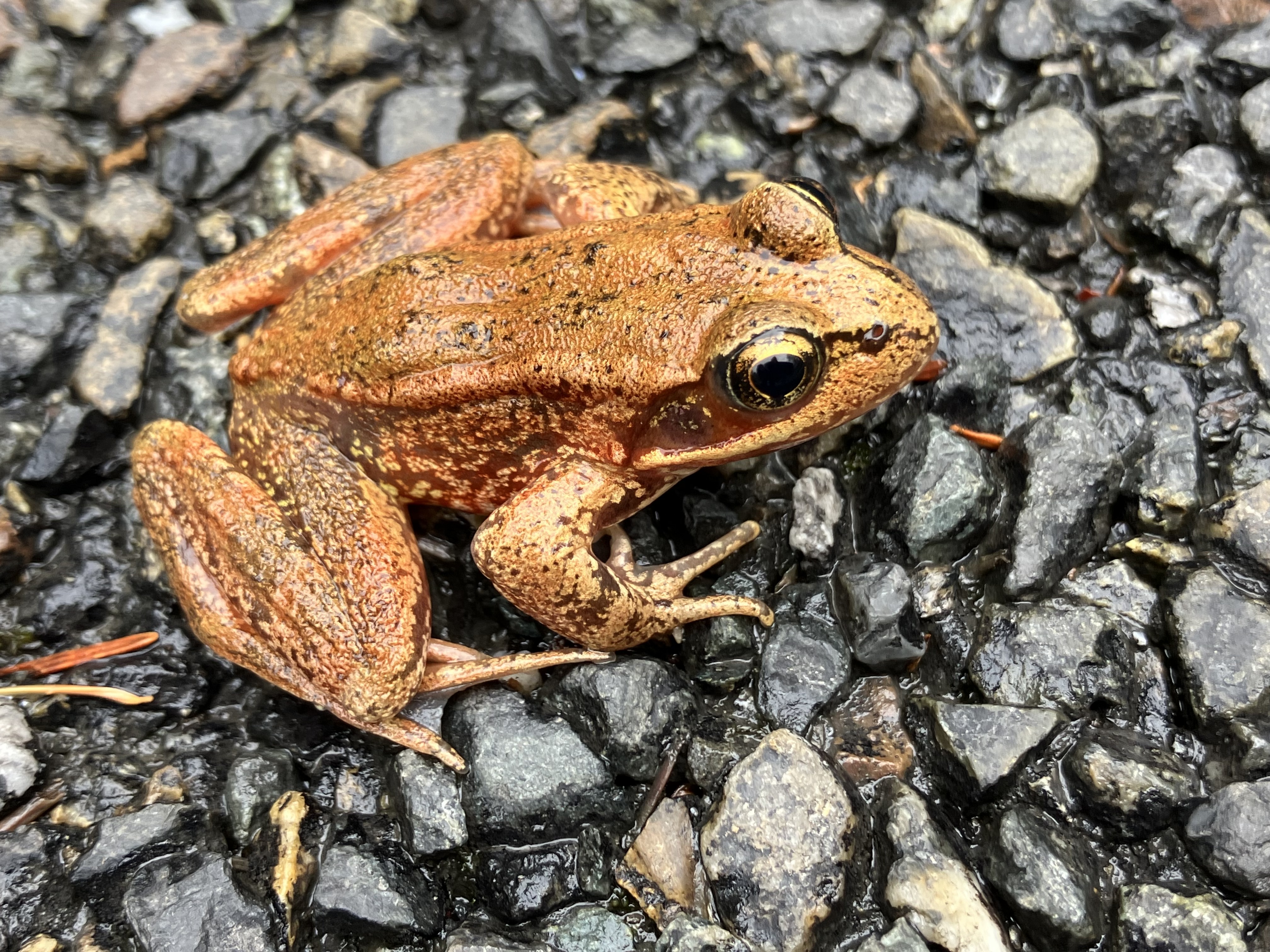
Northern Red-legged Frog Rana aurora
Greater Night Stalking Tiger Beetle (Omus dejeanii)
Zacotus matthewsii

The hawks hunt in a small clearing where the stream attracts other animals that come for a drink. There are other birds hidden too. Flycatchers nesting in rotting snags, Pileated Woodpeckers drilling after carpenter ants. And the owl.

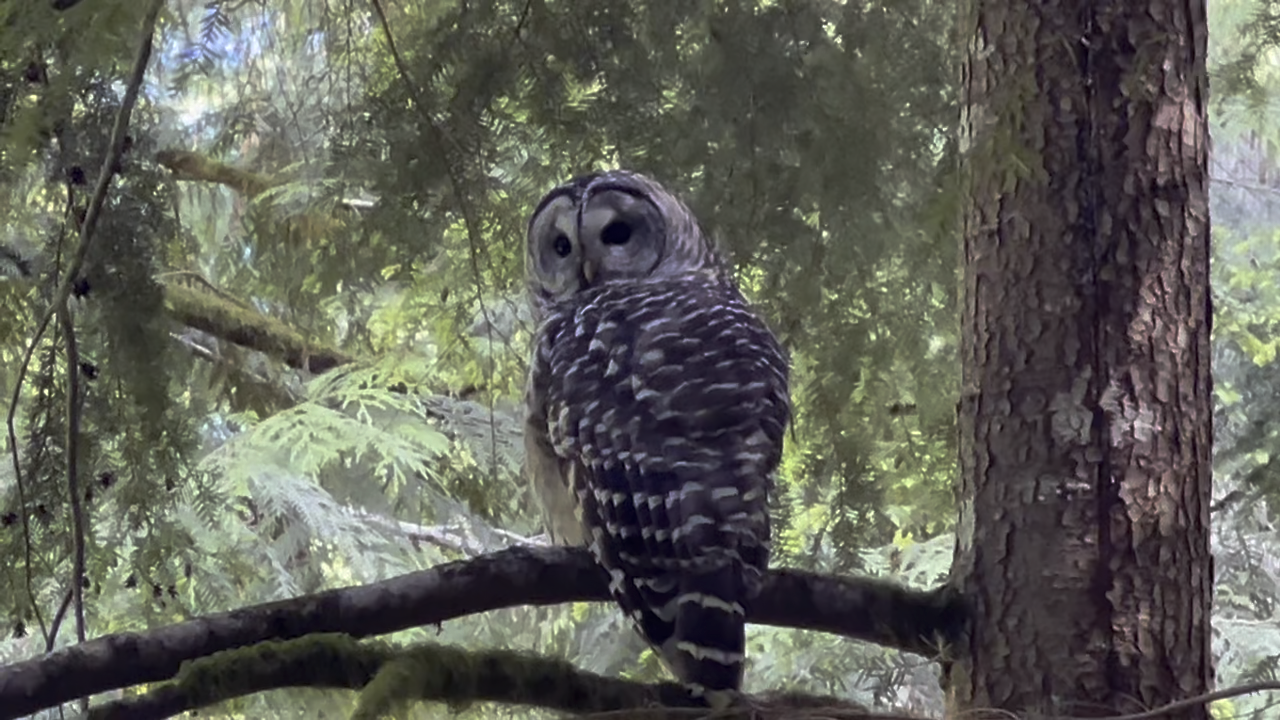
The owl has been there for a long time. You can hear it calling in the night – “Who Cooks for You?” It was wonderful before there were too many houses. Now, it is harder and harder to hear the owl over the din of barking dogs. In the woods though, the owl has a baby.

I heard it calling the other day. Screeching is more like it. I heard the noise before saw them. The mother owl was watching me cautiously from high above. A snake dangled from her mouth. In spite of this, I heard her utter sounds of caution to her child. She flew over to feed it as I quietly backed out of the area. I did not want to disrupt them and when I walk, I try always to remember that I am entering the home of others. I walk quietly and respect their spaces.

Momma owl with snake

Today, when I walked back to the place of the owl, I heard the baby again. It was calling repeatedly, but mom was nowhere to be seen. Again, I backed away quietly, hoping the owl was able to find food for her little one. They must hunt through the day and not only at night in order to rear their offspring.

I thought of the owl as I walked back to the trailhead and then I momentarily became distracted as I reached the site where I’d been poking around in a raccoon carcass on the trail. There are some very cool bugs that you find in carrion. Unfortunately, the remains were not to be found.

Stepping off the trail to look in the underbrush for any sign of the carcass, I heard a flutter overhead. I looked up and she was there. It was the mother owl.

She landed on a branch right in front of me. I was too dumbfounded to move. We stayed like that for what seemed like a very long minute. She gazed at me and I watched her in turn, not daring to blink. There was no threat. I felt like she knew me.

The robins were not happy and began to flail at her, creating a cacophony of rebuke. She ignored them. I slowly brought my phone around and took a video of her. She just looked at me.

Then she looked around, gazing through the forest at things unseen. After about five minutes, she reoriented her body, turning away from me, surveying the surrounding area. With a glance back at me, she flew away.

This encounter is why saving spaces for WILDLIFE is so incredibly important to me. These places should belong to them. When we visit a preserve, remember that. It is their home.

I hope others will reflect on what I’ve shared, and maybe there will be one less person who lets their dog off leash or one less person who throws trash onto the forest floor. Think about the creatures that call these places home. Walk softly and be respectful of their need and struggle to survive in ever-shrinking spaces.

Thank you for reading. Support Conservation. Save Spaces for Nature.

Hemipenthes morioides, a bee fly

Two weeks ago, I stopped by the San Juan County Conservation Land Bank’s office to take a look at the newly transformed “lawn-to-meadow” native plant garden. This sample meadow is an effort coordinated by Land Steward, Eliza Habagger, as part of The Salish Seeds Project (https://sjclandbank.org/the-salish-seeds-project-bringing-back-island-wildflowers/).  I was astonished at how quickly (seemingly overnight), the wildflowers planted in this small space bloomed.  Aside from being much more appealing than grass, this new wildflower meadow is hosting an assortment of pollinators.  

Hemipenthes sp. Bee Fly (Bombyliidae) at San Juan County Land Bank demonstration meadow – May 18, 2023

Here’s a species of fly I saw that, at first-glance, looks a lot like a biting deer fly.    It is actually a type of Bee Fly in the family Bombyliidae with no common name.  Its Latin genus name is Hemipenthes, and this one keys out to Hemipenthes morioides

Hemipenthes means ‘half-veiled in black’ and refers to the wing pattern seen in this group.  I used a key by Ávalos-Hernández (2009) to work out my identification and consulted with another fly specialist who agreed.  In the video clip of the fly, it looks to be ovipositing in the sand, indicating my specimen is female.  I’ll come back to this in a bit.

I believe this is Hemipenthes morioides, a Bee Fly – May 18, 2023, San Juan County Land Bank Native Plant Garden

Literature describes Hemipenthes morioides flies as hyperparasites (a parasite of a parasite) of the larvae of parasitic flies (Diptera, Tachinidae), as well as parasitic wasp larvae (Hymenoptera, Ichneumonidae).  Brooks (1952) cited this species as a predator of the tachinid fly Bessa harveyi, which is a parasite of the sawfly Pristiphora sp. (Hull, 1973).  H. morioides has been collected mainly in the western states of the USA (Ávalos-Hernández (2009). They also are known to parasitize caterpillars of moths in the family Noctuidae (Bugguide.net 2020).   Preferred habitats are forest edges and meadows.  

Of course, this leads me to ask all sorts of questions about how exactly this process of hyperparasitism takes place, especially with regard to being parasites of Tachinid flies.  That’s because most parasitic tachinid flies lay eggs directly onto their host’s body. How would the Hemipenthes fly eggs, laid in sandy substrate, get into a Tachinid fly egg laid onto another host?

Do Hemipenthes fly eggs laid into soil hatch, and then migrate through the soil to find an about-to-pupate or already pupating host?  As to finding literature specific to Hemipenthes morioides with detailed descriptions about this process in the wild, I wasn’t successful.  It seems to be such a complex relationship that chances of observing this happening in a natural setting are slim.  For now, I’ll just have to be satisfied with knowing the taxonomy.  The rest may remain a mystery…🤔


Except I like to solve mysteries, or try to at least!  I reversed direction (taxonomically) in my literature search to see what studies are published around the Family (Bombyliidae).   In The Evolutionary Pattern of Host Use in the Bombyliidae (Diptera): a diverse family of parasitoid flies by David K. Yeates and David Greathead (1997), I discovered the “ovipositing” I observed is something entirely different.  This female Hemipenthes fly was filling her “sand chamber” or “psammophore,” a ventral abdominal pocket into which the eggs are laid, and a feature unique to “higher” Bombyliidae (Yeates & Greathead, 1997; Calderwood, 2007). 

Further, Calderwood (2007) comments in Bugguide.net, “It is said that eggs are coated with sand in the chamber to fascilitate release later. I (Calderwood) think that, given the relative size of sand grains and Bombyliid eggs, the reverse is true: the tiny eggs coat sand grains in the chamber, which are heavy and easier to toss with accuracy, kind of like sticking a piece of gum to a baseball. Ovipositing looks like little aerial dipping movements accompanied by flicks of the keester. Eggs are thrown through the air.”  I agree with Calderwood’s statement, and how fascinating this behavior is!  


Two weeks later, I’m still threading through a stack of literature about Bee flies Bombyliidae.  I’ve discovered that almost all Bombyliidae bee flies (including this Hemipenthes fly) go through what is called hypermetamorphosis.  Those eggs, which were flung through the air onto vegetation or the soil substrate will hatch into what is known as a first instar planidium.  This is the form of the fly that must search to find a suitable host for development (Yeates & Greathead, 1997).  

The planidium morphology is such that it is adapted for mobility/locomotion, host-finding, and attachment.  It has an elongate body with two long setae and fleshy pseudopods at the end of its abdomen.  There are also a pair of elongate setae on each thoracic segment (Du Merle, 1972).    Examples of hypermetamorphosis and this mobile, first-instar form of larvae include quite a few other groups of insects.  One example being the one between Strepsipteran larvae (known as triungulins) and Blister Beetles (Meloidae).

I’ll leave you with a nudge to pick up the Yeates and Greathead (1997) paper.   It’s really pretty fascinating.  Complex?Yes. Studying nature is one of the most intriguing topics you can delve into. There are many intricate pieces all woven together.  Yeates and Greathead describe the chance observations of the process of development in Bombyliidae by scientists as serendipitous.  I think it’s quite serendipitous that these tiny, first instar larvae ever find a host in the first place.   More on Hemipenthes flies below.

Thanks for reading!

Taxonomy (bugguide.net, 2020)  

Family: Bombyliidae (Bee Flies)

Subfamily: Anthracinae

Tribe: Villini

Genus: Hemipenthes

Species: Hemipenthes morioides

Identification (bugguide.net, 2020)

Head: Round; dark brown to black. 

Male and female: identical, eyes of female only slightly wider, barely discernable.

Antenna: Black, very short.

Thorax: Dark brown to black with rust hairs across shoulders; sometimes thorax is bald. Thorax sides may have some yellowish hairs which do not form a definite line.

Wings: Dark brown, covering about 2/3rds of the wing, lower dark margin step-like. The dark extends to the inner margin or anal cell. Three sets of cross veins have a light mark on each side of the vein, called aureoles. One near base, one about mid-wing, and another small one below (or R4 + R5, M2 and CUP). 

Legs: Dark brown with a row of spines on front shin (tibiae). Feet lighter. 

Abdomen: Dark brown to black with small to large yellowish spots across each segment and a yellowish line across lower margin. Dark fringe mixed intermittently with some white on side edges of abdomen.

Habitat 

Forest edges and meadows.

Season 

All season in southern U.S. Late May to August in the north.

Distribution 

Canada (British Columbia), USA (Arizona, California, Colorado, Idaho, Illinois, Indiana, Iowa, Massachusetts, Michigan, Minnesota, Montana, New Jersey, New Mexico, New York, Ohio, Oregon, Pennsylvania, Utah, Washington, Wisconsin, Wyoming), Ávalos-Hernández (2009). 

References and Further Reading 

Ávalos-Hernández, Omar. (2009). A Review Of The North American Species Of Hemipenthes Loew, 1869 (Diptera: Bombyliidae). Zootaxa. 2074. 1-49. 10.5281/zenodo.187152.

Brooks, A.R. (1952) Identification of bombyliid parasites and hyperparasites of Phalaenidae of the prairie province of Canada, with descriptions of six other bombyliid pupae (Diptera). Canadian Entomologist, 84, 357–373. 

Bugguide.net. 2023. Hemipenthes morioides. https://bugguide.net/node/view/365221

Dipterists Society. Main Parts of a Fly (Fly Morphology) – https://dipterists.org.uk/morphology

Du Merle, P.  1972.  Morphologie de la Larve Planidium d’Un Diptère Bombyliidae, Villa Brunnea,Annales de la Société entomologique de France (N.S.), 8:4, 915-950, DOI: 10.1080/21686351.1972.12278123https://www.tandfonline.com/doi/epdf/10.1080/21686351.1972.12278123?needAccess=true&role=button

Finlayson, L.R. & Finlayson, T. 1958. Parasitism of the European pine sawfly, Neodiprion sertifer (Geoff.) 

(Hymenoptera: Diprionidae), in southwestern Ontario. Canadian Entomologist, 90, 223–225.

Hull, Frank M. 1973. The bee flies of the world. The genera of the family Bombyliidae Bulletin – United States National Museum (no. 286 1973). Smithsonian Institution Press. Retrieved from https://library.si.edu/digital-library/book/beefliesofworl2861973hull

Yeates, D. K., & Greathead, D. 1997. The evolutionary pattern of host use in the Bombyliidae (Diptera): a diverse family of parasitoid flies. Biological Journal of the Linnean Society60(2), 149-185.

Araneus diadematus, My Cross Orb Weaver friend named “Louisa.”

I first spotted this beauty on October 1, 2021 while I was taking a walk along our road on San Juan Island. There was a cluster of sun loving mullein (Verbascum thapsus) mixed with one or two thistles (probably Canada thistle) growing along the road. The glistening silk threads woven between them drew me over to investigate. There were several Cross Orb Weavers sharing the space here, but one of these was not like the other. The spider that caught my attention was quite a bit darker than the others. Describing it as brown just doesn’t do it justice. Brown sounds much too plain. She was a lovely brunette amongst a few redheads!

~ After you’re done reading, come back and check out this link to learn more about pigmentation in arachnids – https://www.bio.fsu.edu/~miller/Spider%20photos/spider_literature/color%20in%20spiders%20papers/Oxford_Gillespie_20xx.pdf

Since I often enjoy walking on our road on sunny days, I started looking for her when I passed her home – the Mullein “apartments.” It wasn’t just the spiders enjoying the sunny housing complex, but these units housed a few other species as well. I found some Stilt Bugs (Neoneides sp.) and some Pentatomidae hiding in the fuzzy star shaped trichomes (little hairs) of the Mullein leaves.

Now that autumn has ushered in falling leaves, falling temperatures, and a good bit of rain, I thought of my friend Louisa, the Orb Weaver out in the cold. Had she managed to find a sheltered spot to survive the recent storms? Several times over the past two weeks I’ve looked for her, but she was just gone. Since the lifespan for this species is only a year or less, I suspected she’d reached her end with our last dip in temperatures, gusty winds, and precipitation. I held out a tiny bit of hope though. Just a bit!

Today (November 6, 2021), my husband and I walked our road. It was sprinkling and the precipitation was cold. When we got down to the point on the road to turn around, shortening our walk to just the point where the old cabin used to be, I asked him to wait one second while I looked one more time at that patch of Mullein and the drying stand of thistles.

As I bent down to look closely, I saw a single strand of silk. Examining the attachment and following closely, it led me to Louisa. She was tucked under the dried nodding inflorescence of the thistle. Once a purply-pink sugar treat for pollinators, the now nodding blooms have been repurposed into a thatch roof to keep this little spider dry.

I’ve thought about relocating her so the county doesn’t mow her when they scalp the roadside vegetation. It is bound to happen at some point. For now, I’m going to leave her be, and just keep a close eye on her. Maybe I’ll make a sign! Be Nice to Spiders. ❤️ Louisa lives here!

Fun Fact! Did you know that 25% of the diet of Orb Weaver spiderlings is pollen? Check it out. Article linked in my list of sources below.

Araneus diadematus (Cross Orb Weaver) October 1, 2021 – San Juan Island, WA

Araneus diadematus (Cross Orb Weaver) October 1, 2021 – San Juan Island, WA

Araneus diadematus (Cross Orb Weaver) October 1, 2021 – San Juan Island, WA

Araneus diadematus (Cross Orb Weaver) October 13, 2021 – San Juan Island, WA
Araneus diadematus (Cross Orb Weaver) October 16, 2021 – San Juan Island, WA

This is “Louisa,” the Land Bank Orb Weaver Spider. She lives on a Mullein plant alongside the road. I’ve been watching her since October 1, 2021. Hoping she will not become a casualty of San Juan County’s pre-winter roadside mowing. She’s also an expecting mom!

This is “Louisa,” the Land Bank Orb Weaver Spider. She lives on a Mullein plant alongside the road. I’ve been watching her since October 1, 2021. Hoping she will not become a casualty of San Juan County’s pre-winter roadside mowing. She’s also an expecting mom!

Araneus diadematus (Cross Orb Weaver) November 6, 2021 – San Juan Island, WA

References and further Reading –

Eggs B, Sanders D (2013) Herbivory in Spiders: The Importance of Pollen for Orb-Weavers. PLoS ONE 8(11): e82637. https://doi.org/10.1371/journal.pone.0082637

Gucker, Corey L. 2008. Verbascum thapsus. In: Fire Effects Information System, [Online]. U.S. Department of Agriculture, Forest Service, Rocky Mountain Research Station, Fire Sciences Laboratory (Producer). Available: https://www.fs.fed.us/database/feis/plants/forb/vertha/all.html [2021, November 6]. 

Horton DR, Lewis TM (2003) Numbers and types of arthropods overwintering on common mullein, Verbacsum thapsus L. (Scrophulariacae), in a central Washington fruit-growing region. Journal of the Entomology Society of British Columbia 100, 79–87.

Oxford, Geoff & Gillespie, Rosemary. (1998). Evolution and ecology of spider coloration. Annual review of entomology. 43. 619-43. 10.1146/annurev.ento.43.1.619.

Riaz, Muhammad, Zia-Ul-Haq, Muhammad and Jaafar, Hawa Z.E.Common mullein, pharmacological and chemical aspects. Revista Brasileira de Farmacognosia [online]. 2013, v. 23, n. 6 [Accessed 6 November 2021] , pp. 948-959. Available from: <https://doi.org/10.1590/S0102-695X2013000600012&gt;. ISSN 1981-528X. https://doi.org/10.1590/S0102-695X2013000600012.

Turker AU, Gurel E. Common mullein (Verbascum thapsus L.): recent advances in research. Phytother Res. 2005 Sep;19(9):733-9. doi: 10.1002/ptr.1653. PMID: 16222647. https://onlinelibrary.wiley.com/doi/10.1002/ptr.1653

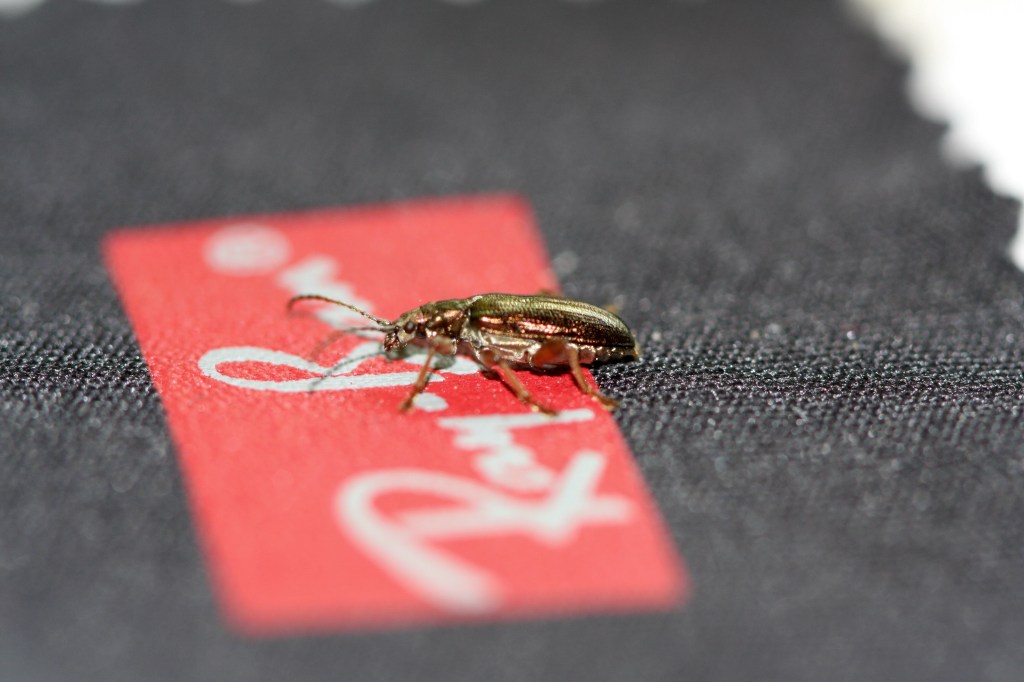
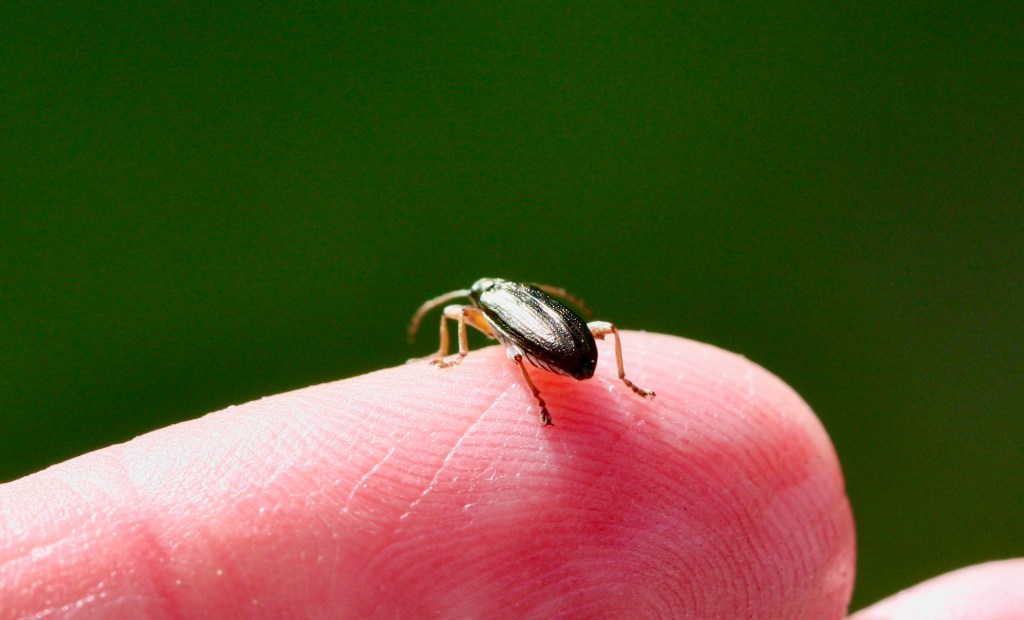
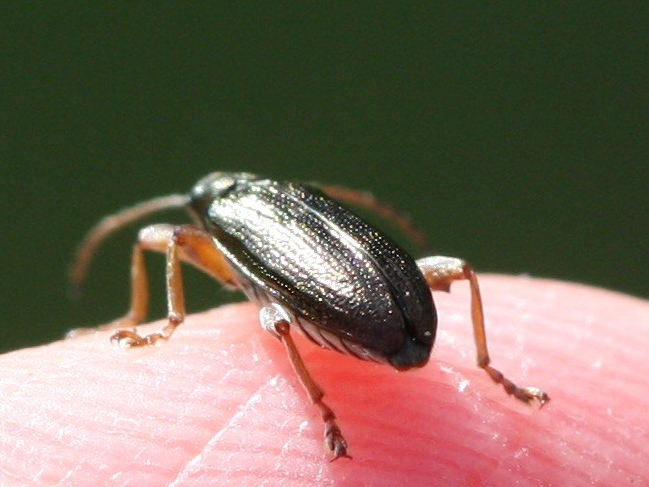
Long-horned Leaf Beetle (Plateumaris germari)

I really enjoy the days when I have an opportunity to go over insect images I’ve taken, but haven’t yet had the chance to identify. This small (approx 7-8mm), metallic beetle is a leaf beetle in the family Chrysomelidae. It’s a Long-horned Leaf Beetle (Plateumaris germari). They are associated with aquatic habitats and this specimen was found near a wetland habitat on San Juan Island, WA., May 12, 2015. Yes. I’m slow at getting around to sorting things, but was happy to share this one today.

Long-horned Leaf Beetle
Plateumaris germari
San Juan Island, WA
May 12, 2015
photo by Cynthia Brast
Long-horned Leaf Beetle
Plateumaris germari
Long-horned Leaf Beetle
Plateumaris germari
Long-horned Leaf Beetle
Plateumaris germari
Long-horned Leaf Beetle
Plateumaris germari

References: https://bugguide.net/node/view/601794

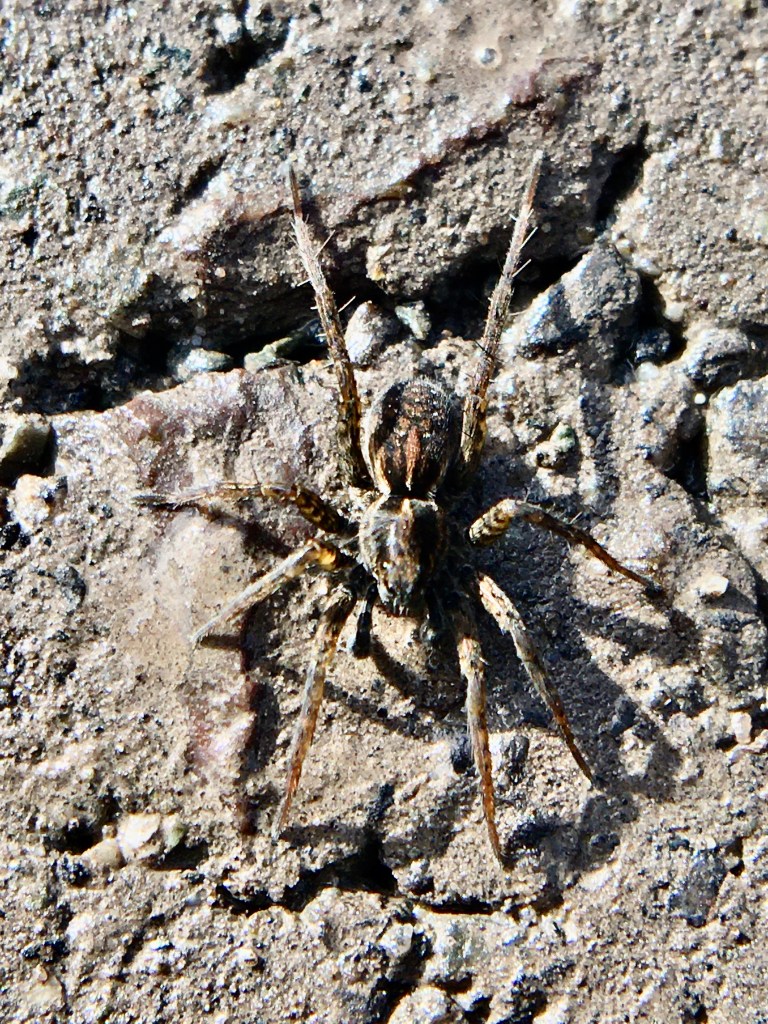
Pardosa spp. Thin-legged Wolf Spider

Here’s another spider for you. I photographed this one yesterday, February 22, 2019, on the dirt road near my home on San Juan Island, WA. There were two of them, but in the past, I’ve seen up to twenty crawling around (and they move extremely fast) in this (usually sunny) spot. My ID attempt here is that it’s some type of wolf spider. Size is approximately 3-4mm. The photos were taken with a macro clip on lens for iPhone.

Pardosa spp. Thin-legged wolf spider
2.22.2020
Three Corner Lake Road, San Juan Island, WA
ID credits thanks to A. Pelegrin and L. Paxson
Pardosa spp. Thin-legged wolf spider
2.22.2020
Three Corner Lake Road, San Juan Island, WA
ID credits thanks to A. Pelegrin and L. Paxson

The short video clip below is from the same spot in the road on April 20, 2019. On this occasion, there were LOTS of these long-legged wanderers and they are super fast!

Pardosa spp. Thin-legged Wolf Spider
San Juan Island,WA
April 20, 2019

References:

https://bugguide.net/node/view/3389

http://www.americanarachnology.org/JoA_free/JoA_v32_n1/arac-032-01-0055.pdf

Cicurina spp. February 19, 2020

This spider is in the genus Cicurina, also known as the Cave Meshweaver or Cave Spider. Pronounced “sik-uhr-EYE-nuh,” the Latin name translates to “tame” or “mild.”

From Buggide.net and according to Rod Crawford:

Cicurina of Western Washington: “C. pusilla is by far the commonest. C. simplex and C. “idahoana” (really an undescribed species related to idahoana, in my opinion) are moderately common. Cicurina tersa is less common than the previous three. The other Cicurina of western Washington are actually rare here, C. tacomaand C. intermedia.” ~Rod Crawford

Cicurina spp.
Found in Rotting Fir log. 2.19.2020. Three Corner Lake Road, San Juan Island, WA
Size – approx 5mm
Photo by Cynthia Brast-Bormann
Identified by A. Pelegrin and L. Paxson at Pacfic Norwest Bugs
Cicurina spp.
Found in Rotting Fir log. 2.19.2020. Three Corner Lake Road, San Juan Island, WA
Size – approx 5mm
Photo by Cynthia Brast-Bormann
Identified by A. Pelegrin and L. Paxson at Pacfic Norwest Bugs

References:

Adams, R.J. 1970. Field Guide to the Spiders of California and the Pacific Coast States. California Natural History Guides. University of California Press. Los Angeles.

https://www.facebook.com/photo.php?fbid=10219387419670050&set=gm.3092310434134350&type=3&theater&ifg=1

https://bugguide.net/node/view/236713

Forest Co-habitating Microfauna

Yesterday, my husband took me for a walk in the woods near our home and while I always enjoy the fresh air and the quiet beauty of the woods, I especially appreciate the opportunity to discover new bugs. I was really hoping to come across one beetle in particular, a ground beetle that I’ve only seen three times since September 2009, when I first moved to San Juan Island.

It’s called Matthews’ Angry Gnashing Beetle or Zacotus matthewsii. Zacotus means “very angry” in Greek, though I’m not sure why this beetle would ever act in an angry manner unless you were poking it with a stick. In that case, it’s likely it would attempt to defend itself by gnashing at you with its mandibles, and any bites you receive would be well deserved indeed!

The last sighting I had of a live Zacotus matthewsii was February 18, 2015 at 5:56 p.m. I’m hoping to walk along the same spot again this evening about the same time in hopes of sighting another.

These ground beetles are extremely unique. Their maroon-red metallic coloring is often ringed with a green shimmer along the margins of its body.

Zacotus matthewsii 2/18/15 Three Corner Lake Road San Juan Island, WA

Sadly, the life history of these beetles is understudied. We do know they are only associated with old growth forest ecosystems and rarely seen. When old-growth forests are cut down, the beetles disappear and our opportunity to know them is lost.

While I didn’t find one of these beetles yesterday on our walk in the forest, I did come across some equally interesting residents, cohabitating in a rotten log near a stream. I might have missed them entirely, but for my curiosity leading me to lift off a section of the log. It was a bit like lifting the roof off a house, and being able to see all the rooms and inhabitants, only instead of being a multi-family unit, this was a multi-species, multi-family unit!

I’d packed my cellphone and my handy clip on macro lens, so I was able to take some video and photos to share with you. Here’s what I found!

The first amazing creature that was exposed in the log was a centipede. This is Scolopocryptops spinicaudus. I noticed nearby, there was a grouping of eggs, so after a bit of internet searching, I discovered the very neat fact that these (and other species) of centipedes stay with their eggs.

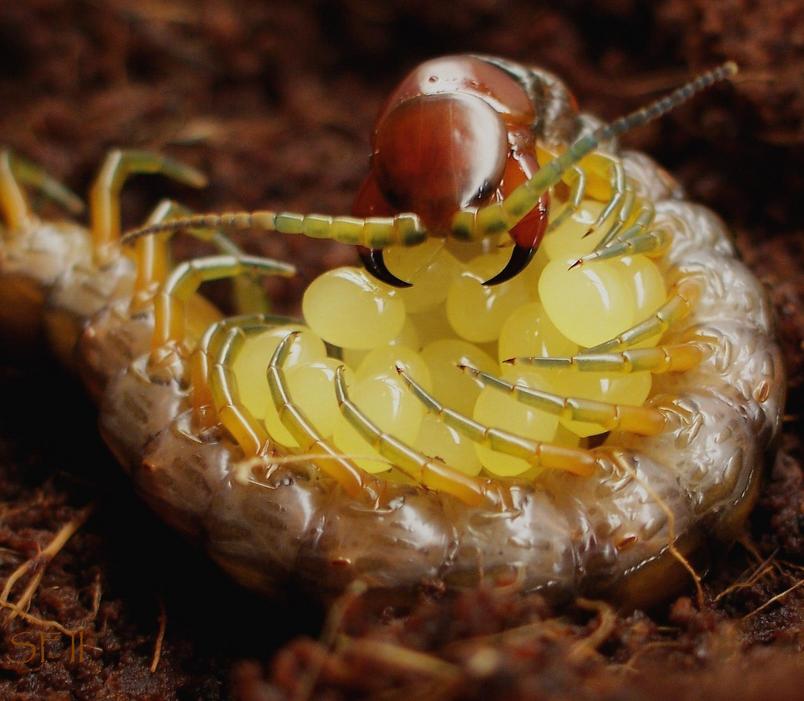
The mother will wrap herself around the cluster to better protect them, staying with her brood even weeks after they hatch, leaving them only after they are able to fend for themselves. I believe this mother centipede moved away from her eggs when I removed the section from the log in order to draw my attention away from them.

***Eggs were not disturbed and I replaced the log section after taking my photos.

Scolopocryptops spinicaudus Centipede with eggs
Scolopocryptops spinicaudus with eggs
2/16/2020
Lester Parcel
Scolopocryptops spinicaudus (Centipede) eggs 2/16/2020 Lester Parcel

Below is a photo I found when I was searching about centipedes and parental care. I find it amazing that even invertebrates show such care for their offspring!

Centipede caring for eggs
https://www.ebaumsworld.com/pictures/19-pics-that-are-just-plain-fascinating/84587206/?view=list

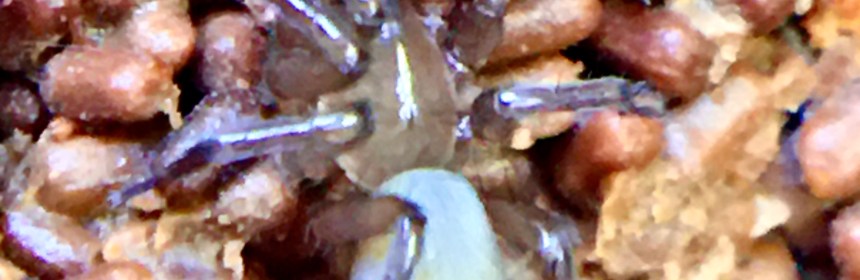
The next resident in the log that caught my eye was the very tiny, whitish-translucent, globular creature that looked a lot like a bark or booklouse, but turned out to be a “baby” termite. These were larvae of the Pacific Dampwood Termite, Zootermopsis angusticollis. I wasn’t able to get a good view, but it looked as if these were being tended by an older family member.
Dampwood termites are widespread in Pacific Northwest forests. They rarely cause damage to structures, but play a very important ecological role, recycling nutrients from decaying trees. They are also food for Pileated Woodpeckers and other birds and animals.

Pacific Dampwood Termite (Zootermopsis angusticollis) larvae
2/16/2020 Three Corner Lake Road, San Juan Island, WA
Zootermopsis angusticollis larvae

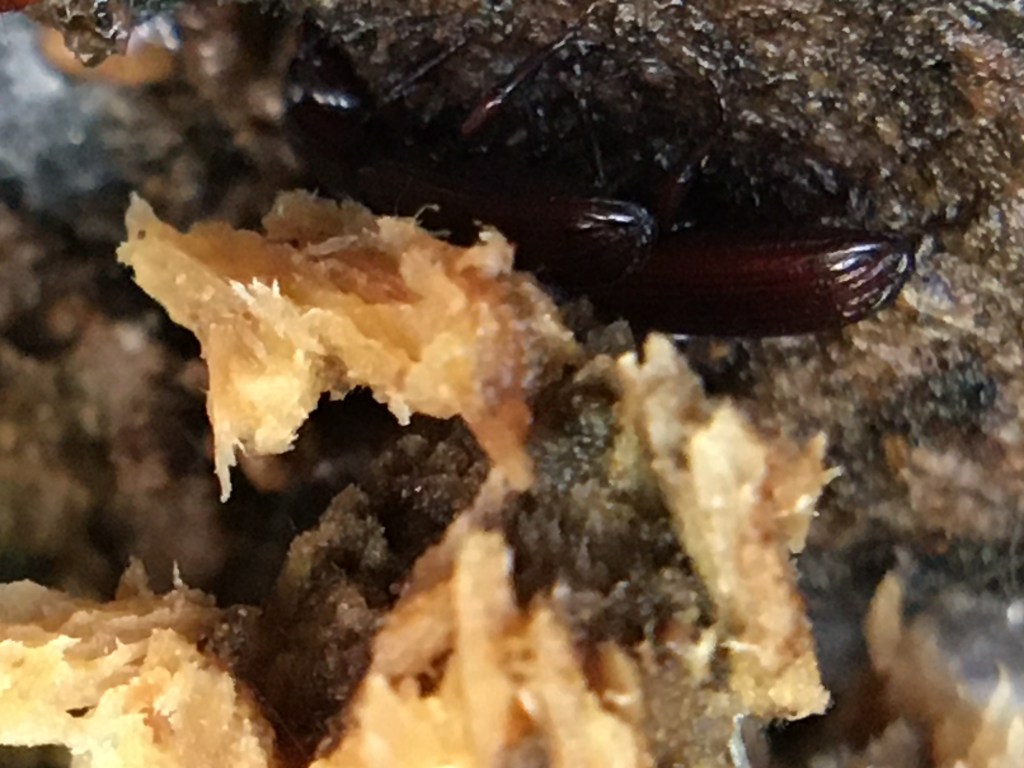
Finally, the last residents I spied cohabitating in this section of rotting log were the very tiny Wrinkled Bark Beetles (Clinidium spp.) Clinidium spp. of bark beetles feed on slime molds (Myxomycetes), found in decaying or dead hardwoods and conifers. They are in the Family Rhysodidae and there are only two genera and eight species in North America. Only two of these eight species range in the West (from California to B.C. ) (White, 1983).

At about 5mm in length, these were hard to detect with the naked eye. I took the following photos with my macro lens, showing the striations along the elytra and the lateral grooves on the basal half of the pronoun.

Wrinkled Bark Beetle (Clinidium spp) 2/16/2020

The next photo shows two adults together, presumably hibernating together in a cavity in the rotting log (White, 1983) .

Wrinkled Bark Beetle adults hibernating together (Clinidium spp) 2/16/2020

References

Lattin, John, D. 1993. Arthropod Diversity and Conservation in Old-Growth Northwest Forests. American Zoologist. 33 (6) pp. 578-587. https://www.jstor.org/stable/3883721

White, Richard. 1983. A Field Guide to the Beetles of North America. Peterson Field Guide Series. Houghton Mifflin Company, NY.

We know what happened to him!

Avec sa tête
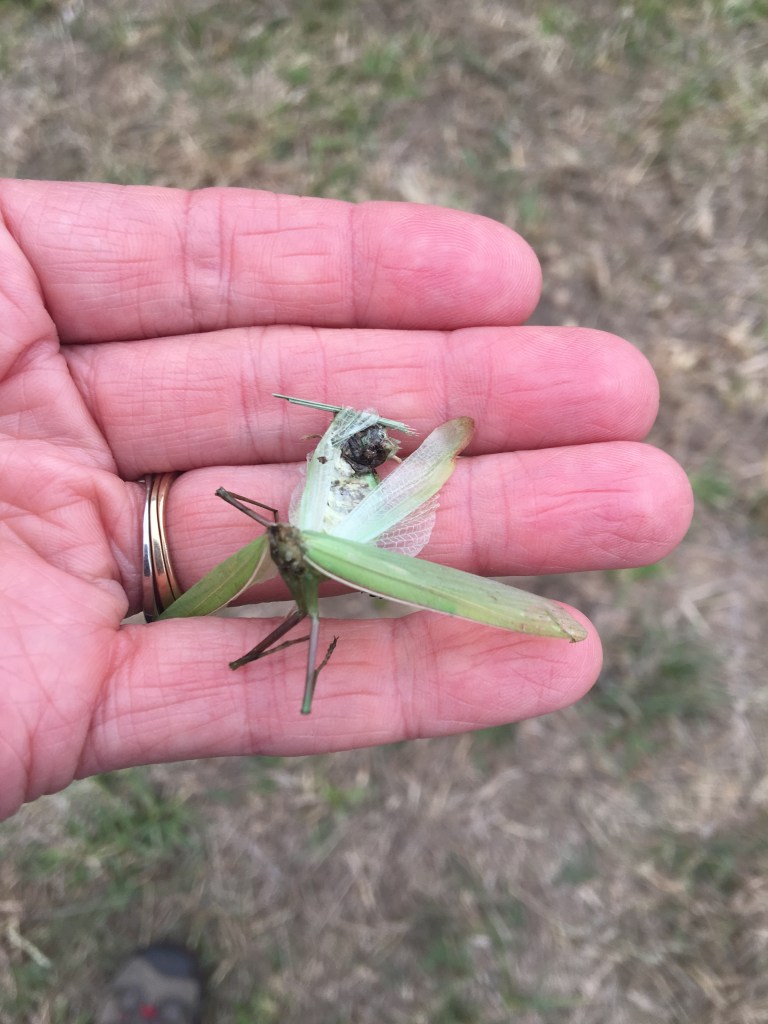
European Mantis (Mantis religiosa)
San Juan Island, WA 09-07-19

A picture says it all, right? I found this poor fellow when I attended the San Juan County Land Bank’s open house at the new Zylstra Lake Preserve on September 7, 2019 ~ http://sjclandbank.org/zylstra-lake-preserve-san-juan-island/ .

We know what activity he must have been participating in!

Lots of amazing artwork by Steve Thompson available on tees and posters here ~ https://www.redbubble.com/people/stevet3214/works/26202642-praying-mantis-family-photo?p=poster

Yes, it’s that time of year. You may be seeing lots of European Mantids (Mantis religiosa) about right now. They’re mate seeking. While not native, don’t worry, they aren’t taking over the island. If you’re curious about them, read my post from last year when there were rumors of them invading the San Juan’s and devouring hummingbirds (not true) https://sanjuanislander.com/news-articles/environment-science-whales/environment/28146/revenge-of-the-mantids .

While they are generalist feeders, they aren’t going to decimate our native pollinators OR eat birds. It’s far more likely they’ll be eaten (or beheaded) before they take over!

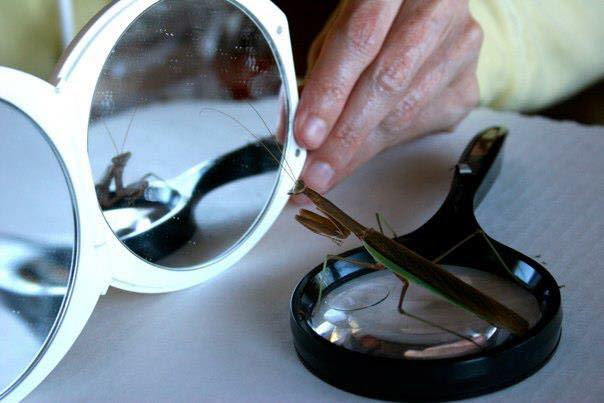
My pet mantis, Merlina
San Juan Island, 2010

The Meadow Spittlebug (Philaenus spumarius) aka “Foam Lover”

Meadow Spittlebug (Philaenus spumarius)
Zylstra Lake Preserve, San Juan Island, WA 9-7-19

I took this photo of a Meadow Spittlebug (Philaenus spumarius) on September 7, 2019 when I attended the San Juan County Land Bank’s open house at the new Zylstra Lake Preserve http://sjclandbank.org/zylstra-lake-preserve-san-juan-island/ . It was a bit cloudy, but fortunately it didn’t rain during the event.

While there weren’t many insects out and about, I was happy to get a shot of the adult version of this species. It was hanging out with some family members on the stem of a thistle growing alongside the walking path.

Meadow Spittlebugs on Thistle
Zylstra Lake Preserve
San Juan Island, WA
09-07-19

Spittlebugs are in the insect order Hemiptera and the family Cercopidae (1). You might recognize these as the mystery bug that hides as a nymph inside a frothy dollop of bubbles on stems of vegetation. This particular species is widespread in North America and very common in the Pacific Northwest (1). So, if you’re out for a walk in the springtime, you’ll see lots of vegetation that appears to have wads of spit stuck to it…and the tiny meadow nymph is hiding inside!

The Meadow Spittlebug (Philaenus spumarius) is also known as the Common Froghopper and it does indeed look very frog like to me. 🐸 Even more interesting, a Google search of the etymology of this little bug’s name yielded this (from Wikipedia):

“The genus name Philaenus comes from the Greek philein (“love”), while the species name spumarius is from the Latin spuma (“sparkling”), referred to the foam nests; the binomial Philaenus spumarius can be translated as “foam lover.”

The adult spittlebug is small (approximately 6mm in length). Both adults and nymphs (which go through 5 instars or developmental stages before reaching adulthood) feed on plant xylem and have been found to feed on over 450 species of plants (2,3,4). While they have the ability to transmit viruses and cause damage to plants from feeding, they are typically not considered serious pests unless they are present in large numbers. It was interesting to learn that the nymphs consume up to 280 times their own weight of plant sap in 24 hours (2,3,4).

Also interesting is that only the soft-bodied nymphs live in the foam. It provides them with protection from predation and from drying out (desiccation). The spittle is a fluid produced from their anus and combined with a surfactant secreted by epidermal glands near the end of their abdomen. Caudal appendages on the insect create air bubbles, turning the spittle into a frothy foam. The tiny (1/4″ long) spittlebug nymph usually rests on the plant facing downward. When the spittle is produced, it flows downward over the body and covers the nymph, concealing it and providing it with the moist habitat it requires as it develops (4).

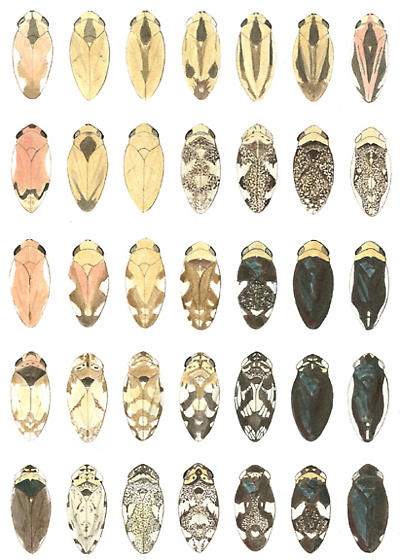
Another interesting bit about the Meadow Spittlebug is that it is quite polymorphic with no less than 16 adult color forms (1). Andy Hamilton (2006) has contributed a wonderful chart, shared on Bugguide https://bugguide.net/node/view/72602 to illustrate the color varieties of the adult forms of this highly variable species (1, 2). Because of the diversity among adult specimens within this species, many researchers have been interested in Philaenus spumarius for genetic study (4).

Andy Hamilton 2006 ~ bugguide.net

*I wanted to include a personal observation about natural enemies of spittlebugs. Hamilton (1982) gives the most detailed account of these, but I didn’t note any mention of predation by yellow jackets (Hymenoptera: Vespidae), or dragonflies (2). I have observed both of these flying through meadow grasses appearing (but not confirmed) to glean spittlebugs from plants in early summer on San Juan Island.

References:

1. Bugguide.net https://bugguide.net/node/view/7452

2. Hamilton, K.G.A., 1982, The spittlebugs of Canada: Homoptera: Cercopidae, Insects and Arachnids of Canada Handbook Series, 10, 102 http://esc-sec.ca/publications/aafc/

3. Horsfield, D., Evidence for xylem feeding by Philaenus spumarius(L.) (Homoptera: Cercopidae). Ent. Exp. Appl., 24: 95-99, 1978.

4. Yurtsever, Selcuk. (2000). On the meadow spittlebug Philaenus spumarius. Turkish Journal of Zoology. 24. 447-459.

Beetle larva versus earthworm

I love finding strange and unusual things when I’m out and about. This definitely can be categorized as one of those moments when the microfauna is weirdly charismatic. And in a parking lot no less. I came upon this European Ground Beetle larva after visiting my husband at his office. We’d gone out for a nice lunch and upon our return, I discovered we weren’t the only ones having lunch. This fellow could give those people who enter contests to eat the most hotdogs some serious competition!

« Older Entries