Tag Archives: san juan island

Aliens in the Garden

I’ve seen some pretty fascinating insects over the years, but using this clip on macro lens https://www.amazon.com/dp/B07LG651ZD/ref=sspa_dk_detail_3?psc=1&pd_rd_i=B07LG651ZD my husband bought me to use with my iPhone has opened up a whole new world. Last night we went down to our garden and while he was busy picking lettuce and tomatoes, I wandered around inspecting leaves and flowers with my new “eye.” I saw aliens! 👽

While I can’t tell you the exact names of all of these creatures, I can tell you that 7 pm must be dinnertime for some of them…like these micro beetles all over my flowering parsley. https://youtu.be/9_NRtS1HJTg

Unidentified micro beetles on Parsley blossoms
July 21, 2019
San Juan Island, WA

One of my favorites was this ladybug larva. I’ve been seeing several different species of ladybugs in the garden. This larva is probably Coccinella septempunctata or the Seven Spotted Lady Bug. A voracious predator, ladybug adults and larvae love to eat aphids. Curiously, while I saw plenty of aphids in my garden, I also saw some strangely mutant ones, so keep reading and scroll down for photos.

Ladybug larva
July 21, 2019
San Juan Island, WA
photo by Cynthia Brast-Bormann

The normal, healthy aphids look like this one. Isn’t she sort of cute watching over all her little babies on the leaf!
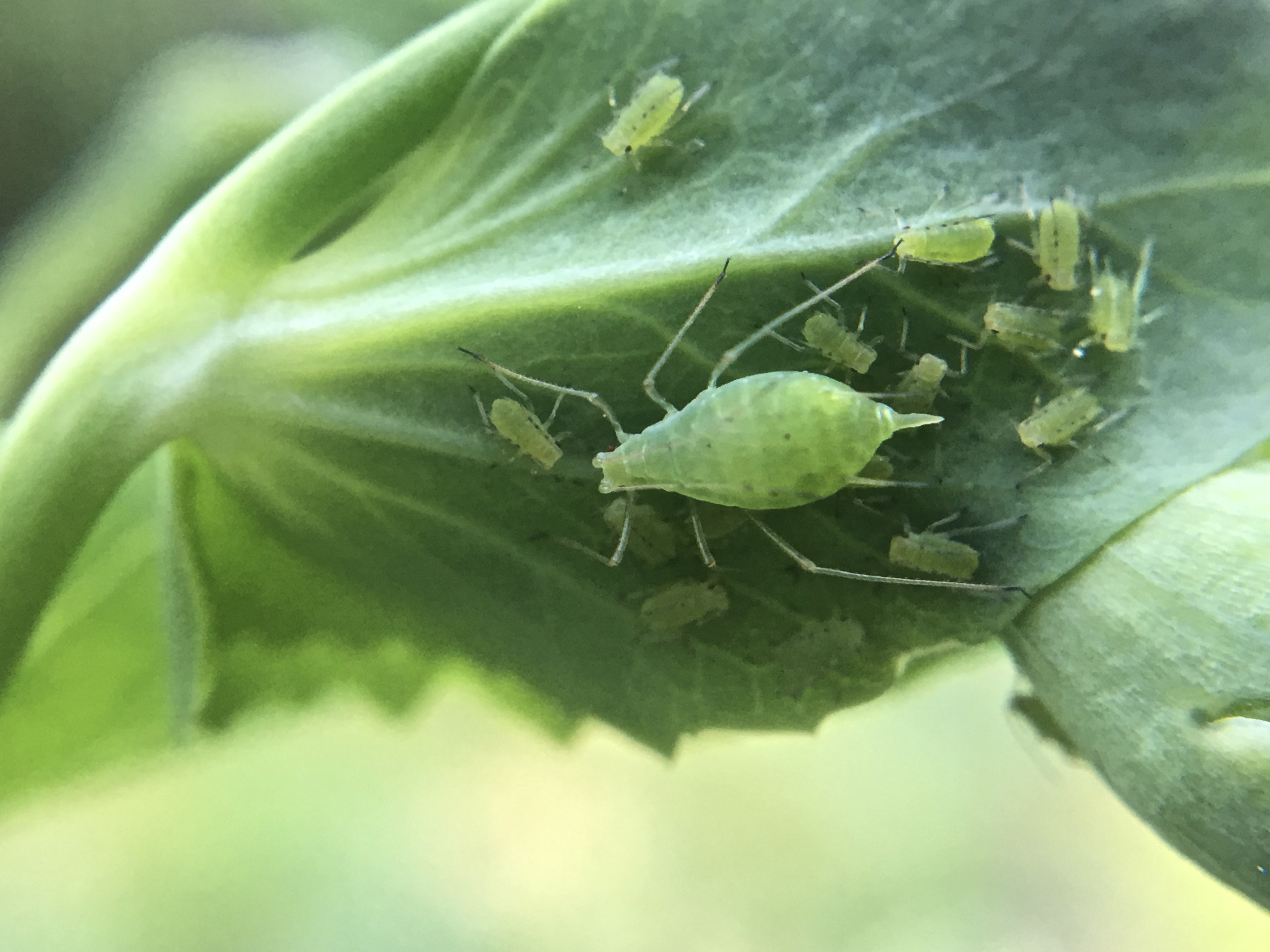
Mom aphid with young nymphs
July 21, 2019
San Juan Island, WA
photo by Cynthia Brast-Bormann
Mom aphid with young nymphs
July 21, 2019
San Juan Island, WA
photo by Cynthia Brast-Bormann

The strange aphids I noticed when I was picking peas. I am not 100% certain, but I believe this is a pea aphid that has been infected with fungi. After doing a bit of reading about these fungal pathogens, I believe it could possibly be (Pandora neoaphidis), an aphid specific entomopathogenic fungus that acts as a biocontrol for aphid populations. The taxonomy and ecological roles of fungi is beyond the scope of my knowledge and experience, so if you decide to read more about this, I suggest googling “Pandora neoaphidis” with “biocontrol.” One interesting bit I did note in my reading was that certain native ladybugs won’t eat aphids that are infected with the fungi, but that the non-native Asian ladybird beetle, Harmonia axyridis eats aphids indiscriminately, fungal infected ones too! Since I was eating peas while I was picking, I’m glad I stopped before popping the pea with these in my mouth. While I’m not entirely opposed to eating insects, I imagine my taste to be a bit more like the native lady bugs.

Pea aphid with fungal pathogen, possibly ( Pandora neoaphidis)
July 21, 2019
San Juan Island, WA
photo by Cynthia Brast-Bormann
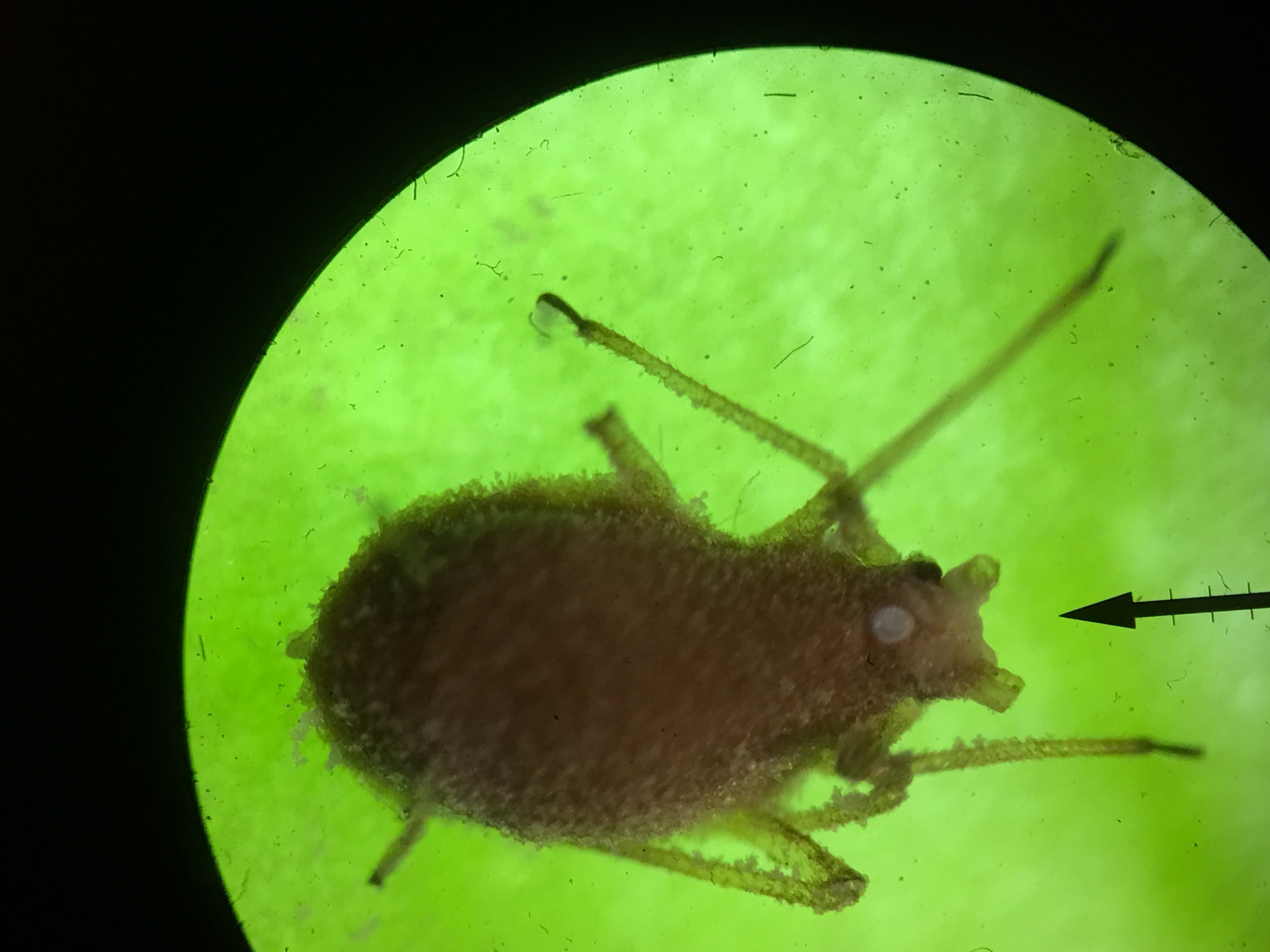
Pea aphid under the microscope
possibly infected with (Pandora neoaphidis)
July 21, 2019
San Juan Island, WA
photo by Cynthia Brast-Bormann
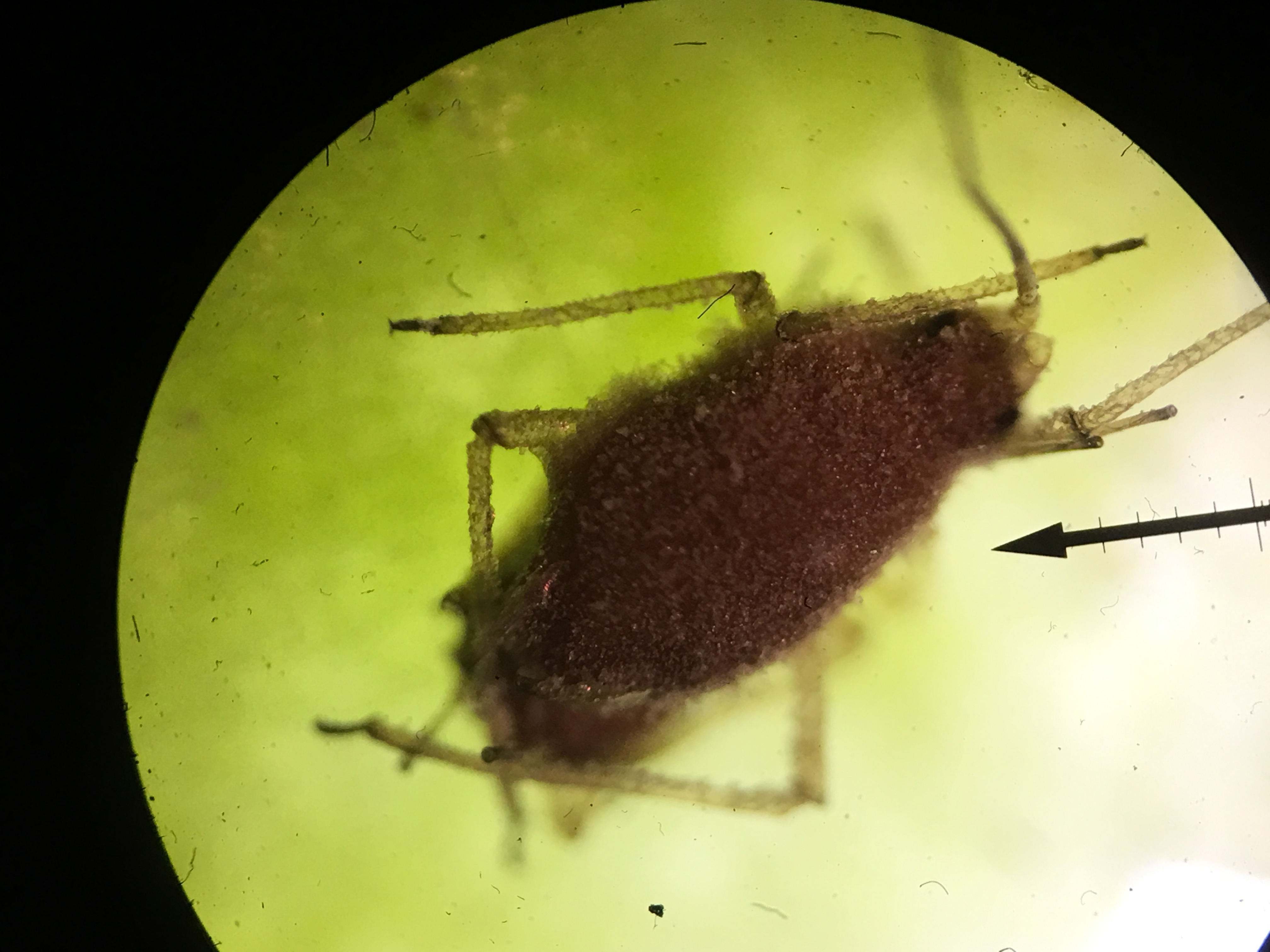
Pea aphid with entomopathogenic fungi
July 21, 2019
San Juan Island, WA
photo by Cynthia Brast-Bormann

The next image is of the weirdest looking creature yet. This is another aphid, but instead of entomopathogenic fungi, it is the victim of a parasitic wasp that has injected it with eggs that will hatch, consume the remainder of the aphid body, then eat their way out. Here’s a link to another photo I found online of this stranger-than-strange occurrence in nature. http://www.aphotofauna.com/hymenoptera_wasp_praon_mummified_aphid_22-09-14.html

The Alien
Mummified aphid infected with parasitic wasp larva
July 21, 2019
San Juan Island, WA
photo by Cynthia Brast-Bormann

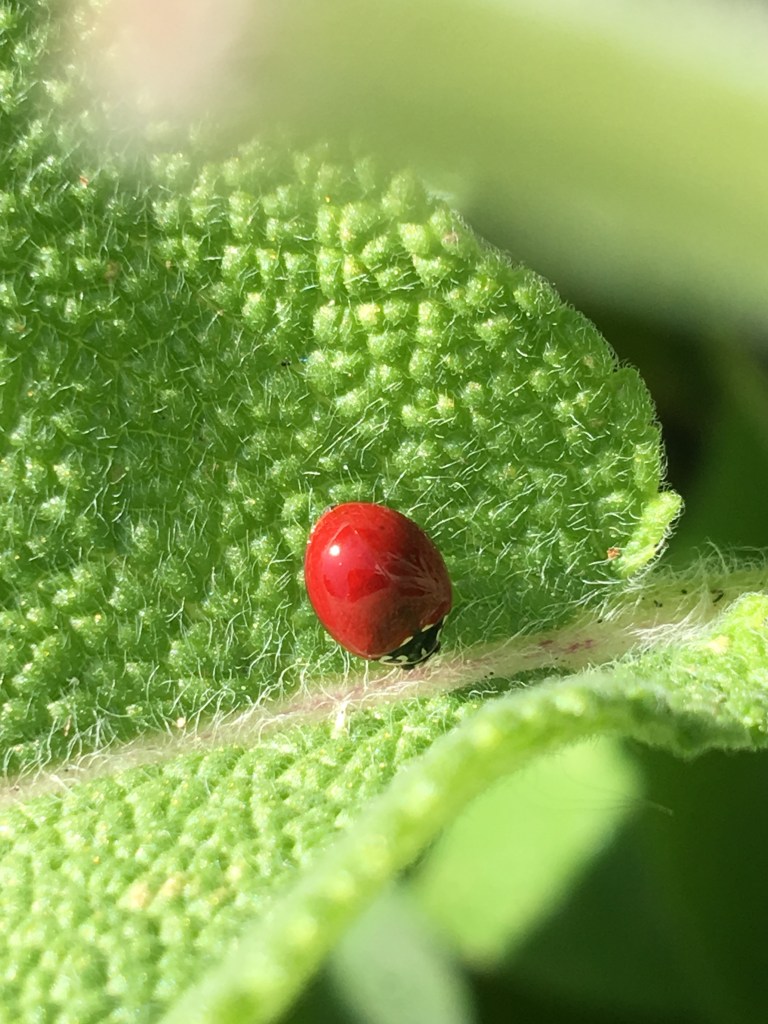
Western Blood-red Lady Beetle

I found three different species of Lady Beetles in my garden this past weekend and wanted to share a bit about them with you. I’ll start with the Western Blood-red Lady Beetle or (Cycloneda polita), also sometimes called the “Polished Lady Bug.”

If you are someone who needs reading glasses (like me) to see things up close, you could easily be fooled into thinking the spot of red on the plant leaf is a drop of blood. Given how accident prone I am, when I first spotted this one, I figured I’d poked my finger again on one of the prickly berry vines that are coming up in my raised garden beds. Upon closer inspection, I was glad I had my camera phone handy.

Western Blood-red Lady Beetle (Cycloneda polita)
July 14, 2019
San Juan Island, WA

Ladybird or ladybug beetles are a large and very diverse group of beetles. They are classified in the insect order Coleoptera, family Coccinellidae. Most are known to be highly beneficial, feeding on garden pests like aphids. The Western Blood-red Lady Beetle is one of our native ladybird beetle species. Unfortunately, research is indicating we are losing our native ladybird beetle populations as they are outcompeted by imported non-native ladybird beetles released for biological control.

Western Blood Red Ladybird Beetle (Cycloneda polita) on Daisy
July 19, 2019
San Juan Island, WA
Western Blood red Ladybird Beetle (Cycloneda polita)
July 19, 2019
San Juan Island, WA

Further information can be found by following the links below.

*Distribution of Cycloneda politahttps://www.discoverlife.org/mp/20p?res=720&see=I_JEL1585;&start=http://www.discoverlife.org/users/l/Losey,_John/JEL.html

*Lost Ladybug project http://www.lostladybug.org/files/LLP%204HSet3-6.pdf

*Bugguide https://bugguide.net/node/view/15623

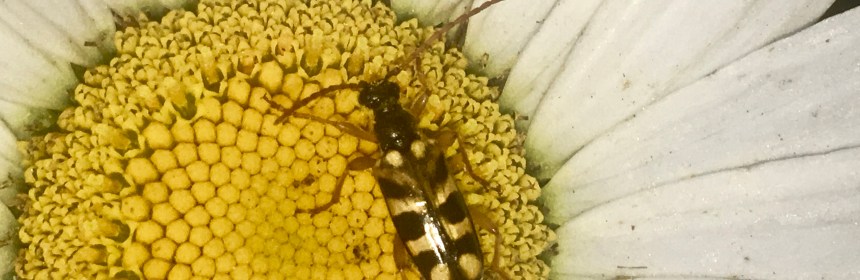
Xestoleptura crassipes

Xestoleptura crassipes
San Juan Island, WA
July 16, 2019

Xestoleptura crassipes is a species of flower longhorn beetle. Taxonomically it is placed in order Coleoptera, family Cerambycidae. The species name “crassipes” means “thick-legged.” Adults are attracted to flowers (June-September) and larvae are wood borers, found in forested areas and associated with firs and oaks. Adult body length approximately 10-17mm.

I photographed this specimen on July 16, 2019. It was the only one on the daisy plant by my front door. On the morning of July 18, there remained the single beetle (or I believed it to be the same one). That evening, I observed a 2nd beetle feeding on an adjacent flower. This morning (July 19th, 2019), they were both gone. Perhaps this was a successful meetup for finding a mate. 🌼

Xestoleptura crassipes feeding on daisy pollen

Beetle larva versus earthworm

I love finding strange and unusual things when I’m out and about. This definitely can be categorized as one of those moments when the microfauna is weirdly charismatic. And in a parking lot no less. I came upon this European Ground Beetle larva after visiting my husband at his office. We’d gone out for a nice lunch and upon our return, I discovered we weren’t the only ones having lunch. This fellow could give those people who enter contests to eat the most hotdogs some serious competition!

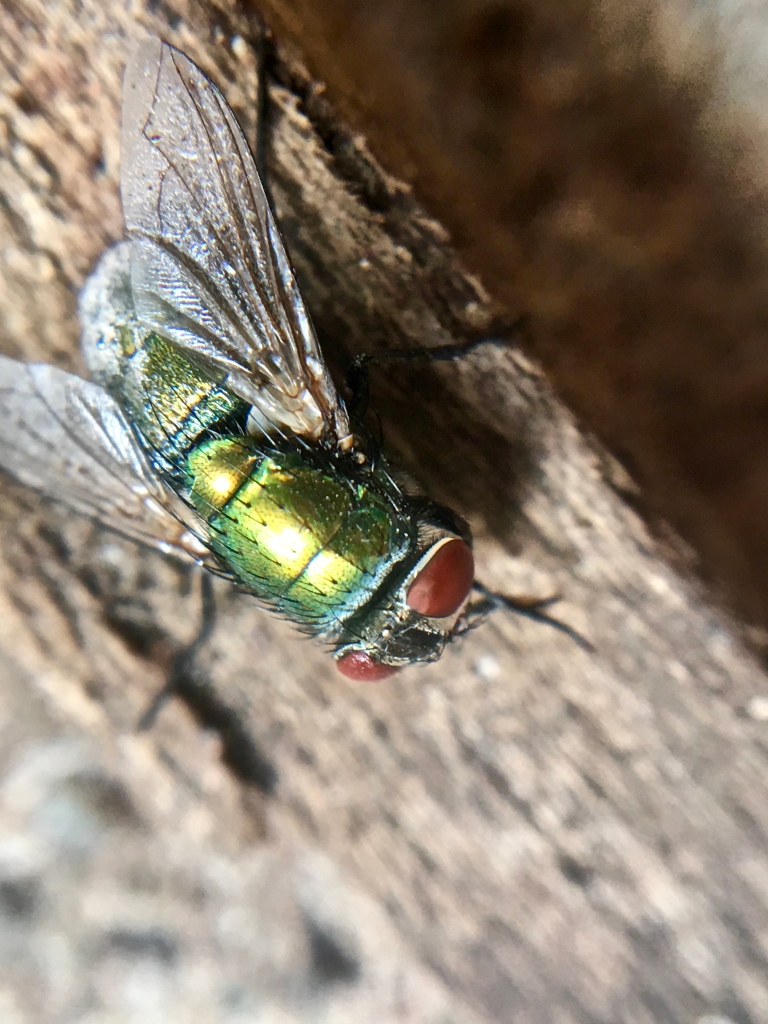
Green Bottle Fly (Lucilia sericata)

Green Bottle Fly (Lucilia sericata) July 9, 2019 San Juan Island, WA

This shiny green bottle fly, a blow fly in the family Calliphoridae, is widely distributed across North America. A frequent visitor to garbage, feces, and carrion, it can mechanically transmit disease, but it is probably more well known for other notable roles it plays in veterinary, medical, and forensic science.

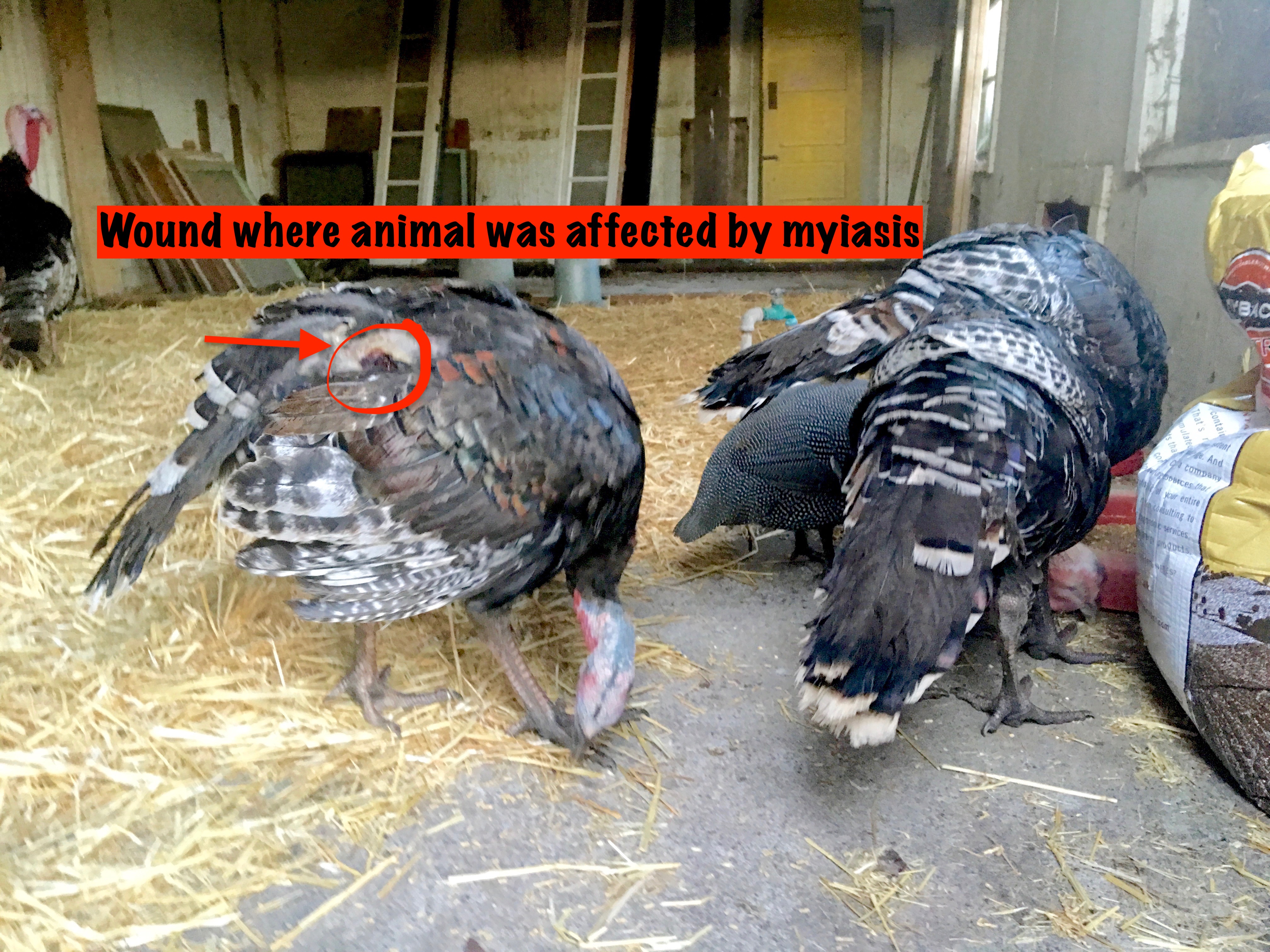
In veterinary science, Lucilia sericata can cause loss of livestock when animals are affected by the larval form of the fly in a condition known as myiasis or fly strike. Animals affected by fly strike can die when fly larva invade living tissue if they are not treated.

In July of 2016, I helped rescue some turkeys someone had dumped near our home. Upon closer examination of the photos I had taken of them, I was able to see a wound one of the turkeys had. The veterinarian who examined the turkey determined there was serious tissue damage due to fly strike and the turkey was euthanized. So, all animals (even birds) are subject to this condition. Good animal husbandry includes regular examination of animals and treating wounds promptly, with appropriate wound care/dressing to protect the animal from fly contact.

In medical science, Green bottle fly larva are known for their role in wound care. In a practice called maggot therapy, larva of Lucilia sericata are placed on an infected wound to clean out the necrotic tissue. Interestingly, as the larvae feed on the dying tissue, they secrete enzymes that are bactericidal, further aiding in healing the wound.

Finally, in forensic science, the timing of the development of this fly has been adapted and well utilized for establishing a time of death, aiding in law enforcement investigations when a body is found.

If you’d like to read more about this shiny little fly, please check out the links below.

http://entnemdept.ufl.edu/creatures/livestock/flies/lucilia_sericata.htm

htthttps://bugguide.net/node/view/53775

https://www.hindawi.com/journals/criid/2018/5067569/

https://pdfs.semanticscholar.org/d1a4/97c592968996ff73b91740b25e9005f09433.pdf

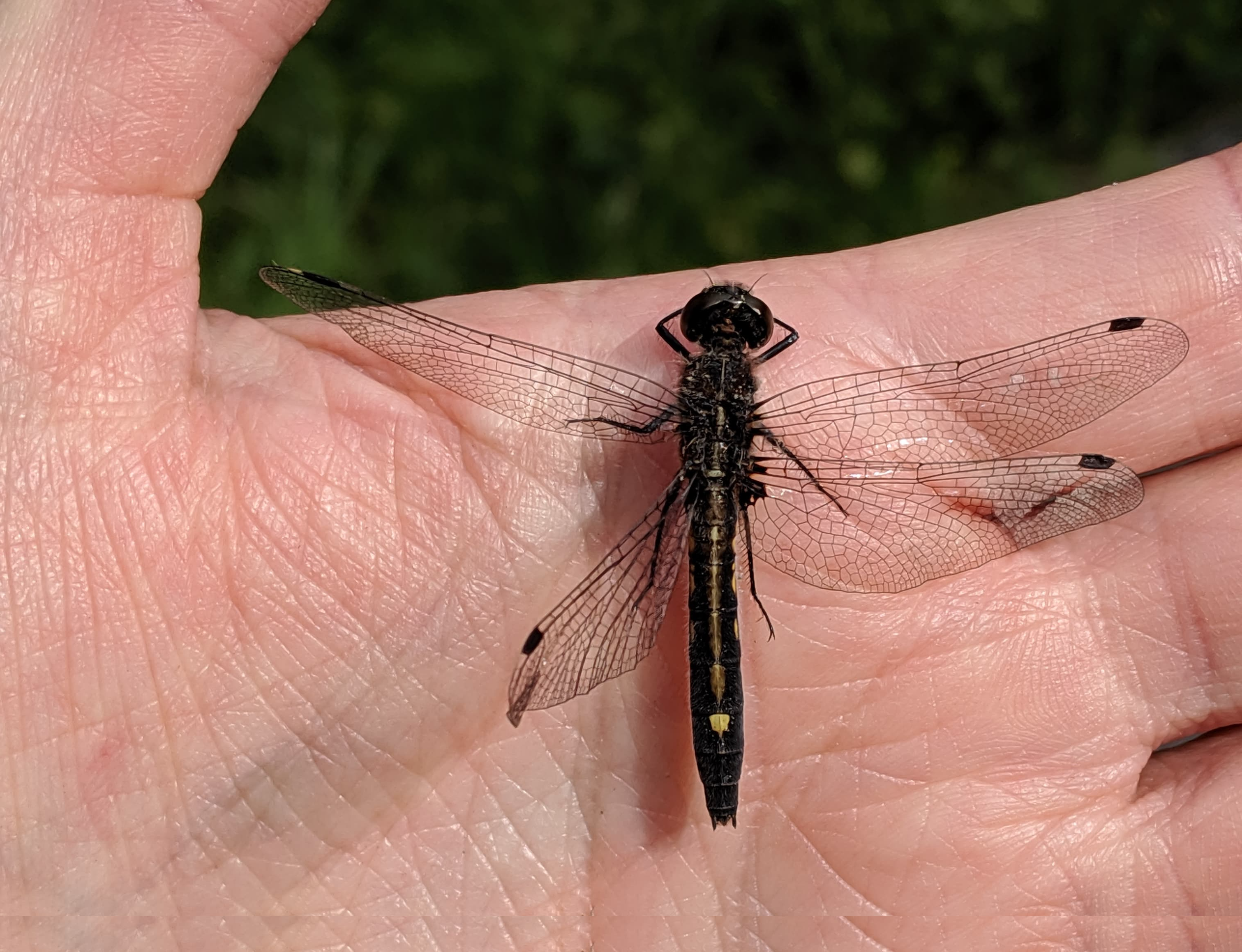
Dot-tailed Whiteface Dragonfly (Leucorrhinia intacta)

I found this Sunday morning, July 7, 2019 as I walked near my home on San Juan Island. It seemed to have been stunned by a car and was upside down in the dirt road. This dragonfly is classified as a Skimmer in the family Libellulidae. They are found Spring through Summer in vegetated areas near ponds, bogs, and wetlands. Adults of this species will eat most any soft-bodied flying insect, including mosquitoes, flies, mayflies, ant and termite alates (dispersing winged reproductives), moths and butterflies.

Harmonia axyridis, The Asian-Spotted Ladybird Beetle

I found this weird little creature stuck to a leaf on a rose bush by the picket fence in front of the San Juan County Land Bank office on Monday, June 24, 2019 when I walked down Argyle and rounded the corner onto Caines (does anyone on the island actually use street names? Where the heck is Caines, right?) 

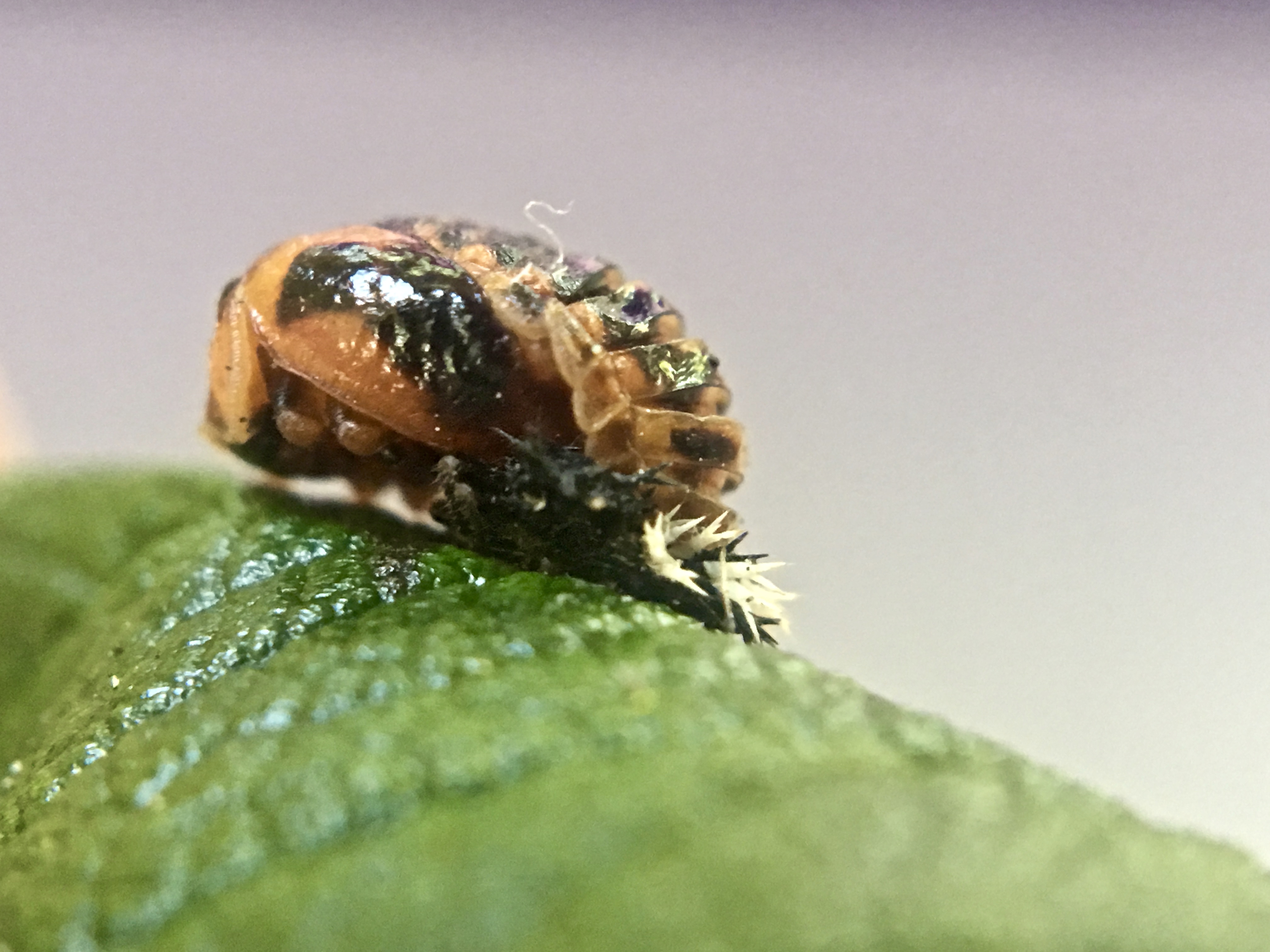
Ladybird pupal case, June 24, 2019

Brought it home because I couldn’t resist the mystery of figuring out what it might be.  What on earth are those spiny things at the end? Is it some sort of pest insect?   

Ladybird pupal case
June 24, 2010

After taking a few photos, I did what drives my husband crazy sometimes.  I left the leaf with this little spiny-ended thing on the table, in a cup, without a lid.  Yep.  Just like when I left the really fat deer tick I had on my desk.  The one that laid eggs…that hatched when I wasn’t paying attention.  This is when it’s really handy to have sticky tape nearby, otherwise you have to vacuum every 10 minutes for about a month to finally sleep at night without feeling like things are crawling all over you and burrowing into your skin. This link should take you to my facebook page post about “Big Bertha.” https://www.facebook.com/buggingyoufromSJI/posts/2375866245969416

This morning, after my cat got me up with incessant meowing right in my ear, I sat down at the table with a cup of coffee. Millhouse (the cat) isn’t supposed to be on the table, but when my husband isn’t around, anything goes!  He was staring something down that was m.o.v.i.n.g!  Fortunately, I reacted faster than he did.  I tipped over the little medicine cup I’d put the leaf in to thwart this little creature’s attempt at a fast getaway.  

Asian Spotted Ladybird Beetle (Harmonia axyridis)
July 27, 2019
San Juan Island, WA

Carefully sliding a piece of paper under the cup, I could see it looked like a ladybug.  Ladybugs come in different colors, with different spots, and there are quite a few species one could encounter on San Juan Island.  This beetle goes by an assortment of names.  It’s often referred to as the Multi-colored Asian Lady Beetle or sometimes the Halloween Beetle because in some places they show up in large numbers at Halloween! 🎃😱

This beetle’s scientific name is Harmonia axyridis (The Asian-spotted Ladybird Beetle).  It was imported to the United States as early as 1916 to help control pests as a biocontrol agent.  While “Miss Harmonia” eats aphids, thrips, and scale insects (and manages these pests fantastically in soybean crops), she isn’t native and these pest insects aren’t all she eats.  Asian-spotted Ladybird Beetles also eat native coccinellid beetles (native lady bugs) and even butterfly eggs.  In the winter, she can bring her friends and invade your home.  When handled, the ladybird beetles can excrete a stinky defensive chemical from their leg joints.  This makes removal of large numbers of them from inside homes somewhat problematic.  You don’t want to have them discharging this awful odor that will linger….all…winter! 

Newly emerged adult (Harmonia axyridis)
June 27, 2019
San Juan Island, WA

Another unfortunate consequence of importing these beetles is their love of wine grapes.  🍇 🍷 Asian-spotted ladybirds will eat grapes and then the grapes end up contaminated with an awful smell lingering on them.  While I personally don’t drink wine, I know lots of people do and they’d be very unhappy if it tasted like essence of ladybug…a twist on a new aromatic bitter perhaps! 

Did I squish her? Nope.  I put her in the tree near our bird feeder.  It’s possible she will become part of the food chain.  While not all birds eat these beetles, some do. Insects and arachnids like robber flies, dragonflies, ants, various ground beetles, and cellar spiders also eat them.   

If you see them, should you squish them?  That’s up to you and how confident you are that you’ve identified it correctly. I wouldn’t want to mistake a helpful native ladybug as an invader.  I recommend that instead of buying ladybird beetles at the garden store to release in your garden you establish native habitat to attract and support native species of ladybugs.

As I looked a bit more into the literature about Harmonia axyridis, I was intrigued with the publication of some research about the biochemistry of the liquid they secrete.  It has been found to have strong antimicrobial action against strains of bacteria that are pathogenic to humans. This fluid has even been examined for its action against malaria.  Perhaps these beetles don’t belong in the garden, but in your medicine cabinet instead.  

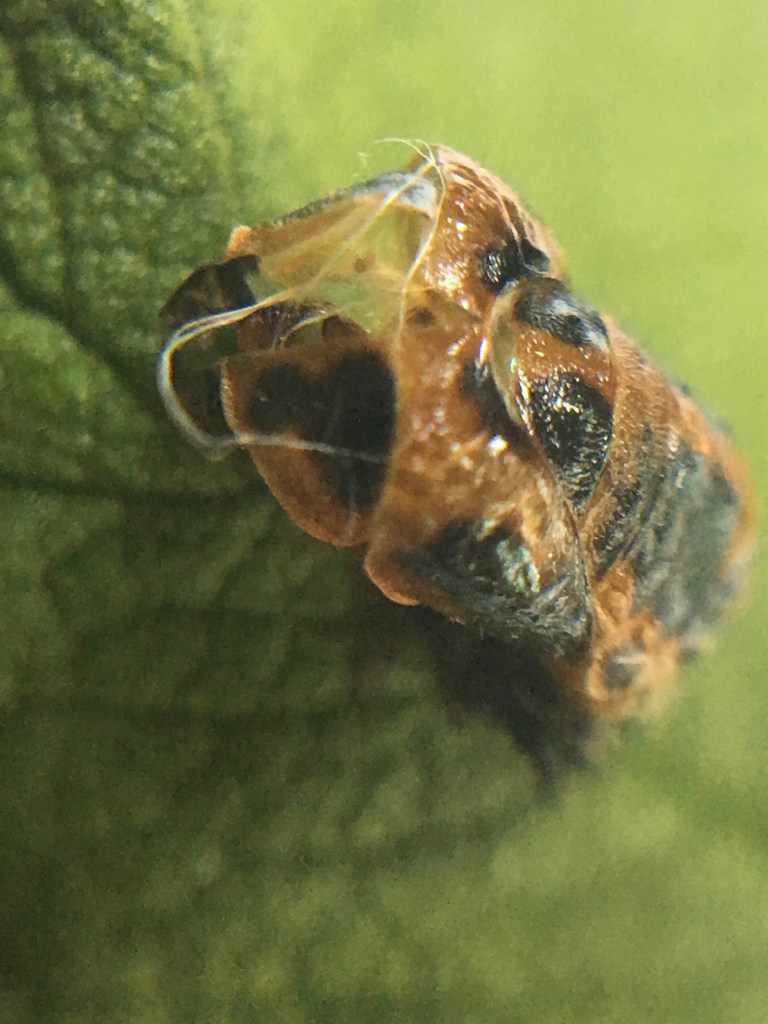
empty pupal case
Asian spotted Ladybird Beetle (Harmonia axyridis)
July 27 2019
San Juan Island, WA

References and further reading

  1. https://plunketts.net/blog/ladybugs-vs-asian-lady-beetles/
  2. https://royalsocietypublishing.org/doi/full/10.1098/rsbl.2011.0760?url_ver=Z39.88-2003&rfr_id=ori%3Arid%3Acrossref.org&rfr_dat=cr_pub%3Dpubmed&
  3. https://www.ncbi.nlm.nih.gov/pmc/articles/PMC524671/
  4. https://bugguide.net/node/view/397

Itchy-Scratchy!

Just in time for Halloween!  Yesterday I was using the Scanning Electron Microscope (SEM) at Friday Harbor Marine Labs.  I got to take some really cool photos but in order to use the SEM, your specimen has to be dried out.  Well, I had some specimens that are really tiny and very delicate and they weren’t dried out because it is a complicated process that takes a certain chemical called Hexamethyldisilazane (HMDS).  Also, drying out your specimen for viewing under the SEM renders it useless for viewing under a light microscope and you’ve lost the ability to preserve it in a collection.

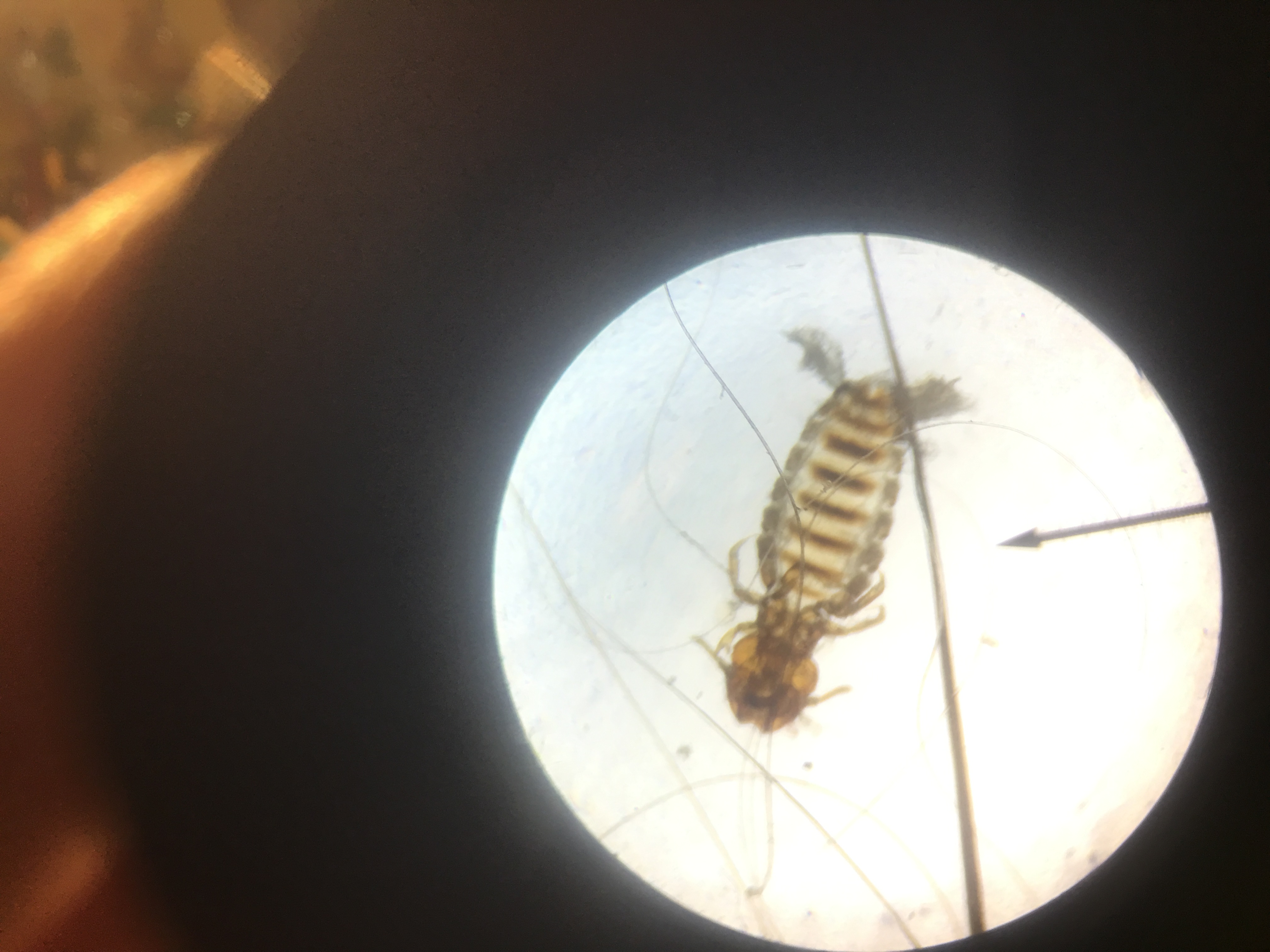
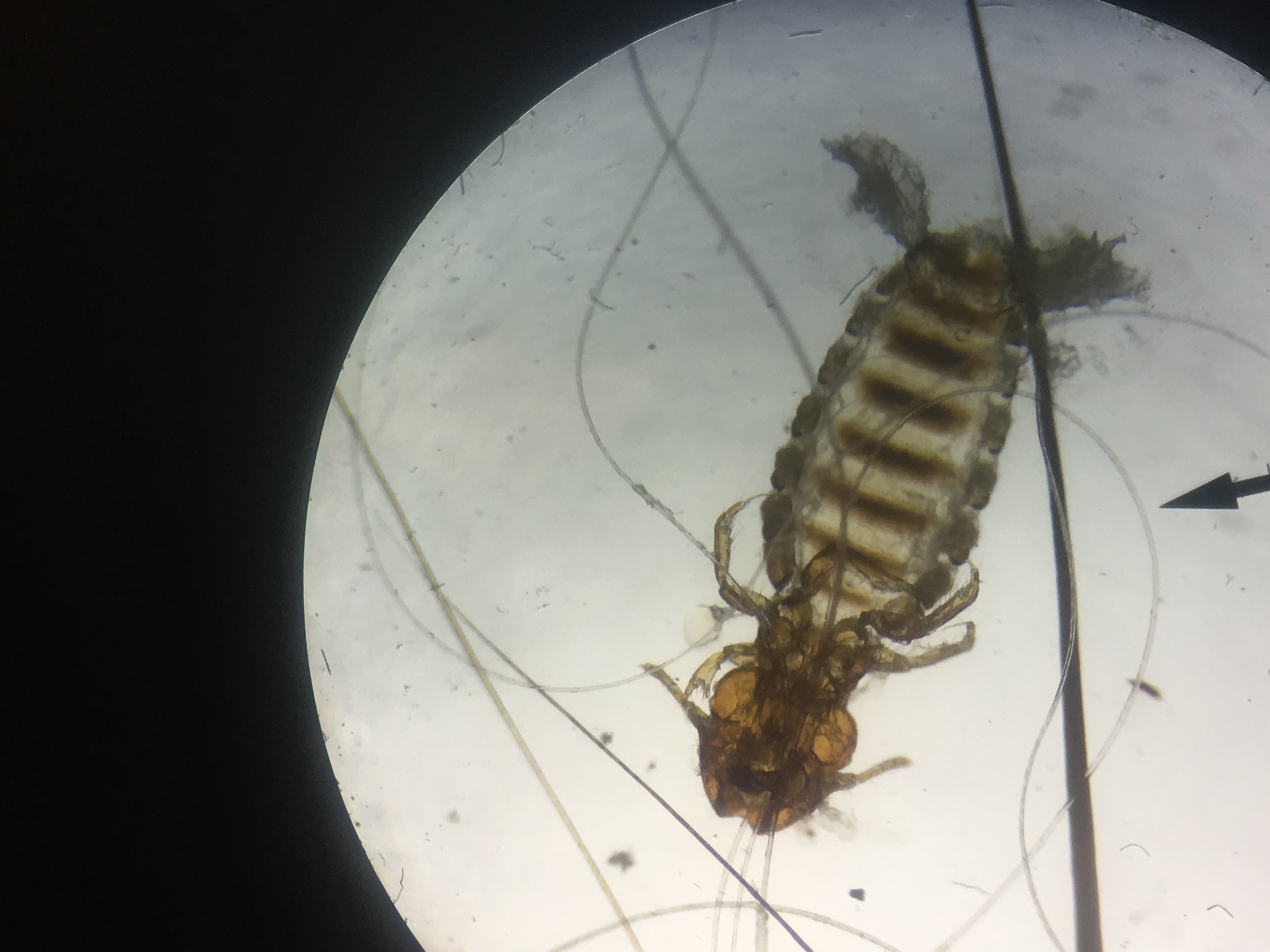
So I’m going to share how I took images of some of my specimens at home with a pretty old compound microscope, an iPhone, and a clip-on macro lens from Amazon.   First, I’ll tell you a bit about the compound microscope image posted here.  This specimen is in the genus Damalinia, most likely the exotic chewing louse, Damalinia (Cervicola).

IMG_7536

Chewing louse Damalinia spp

It lives on black-tailed deer (Odocoileus hemionus columbianus) in Washington, Oregon and California, and has been indicated in what is called HLS (Hair-loss syndrome).  They build up in large numbers on deer at certain times of the year.  One factor thought to contribute to this is lack of adequate nutrition in the deers’ diet, particularly an absence or deficiency of Selenium.

In a nutshell, these lice can reproduce at high numbers in vulnerable deer (typically old, young, and those with weakened immune systems due to nutritional deficiencies or internal parasites).  The lice cause extreme itching, irritation, and hair loss.  The deer respond to the itchiness by excessive licking and grooming.   Why hair loss? Well, these lice are called “chewing lice” because they munch on hair, skin fragments and secretions, and in some cases will feed on blood from skin wounded from scratching.  It’s a miserable condition to have.  This is what a deer looks like that is suffering from HLS caused by the chewing lice.

hairloss

Photo by Brian Murray  https://www.dfw.state.or.us/wildlife/health_program/hairloss/index.asp

Here is a larger version of my photo.  It’s not as clear as I’d like, but I’m certainly going to practice to improve. Happy Halloween and I hope you don’t spend the night scrrraatching in bed!

IMG_7537

Chewing louse Damalinia spp.

Further reading and references:

Protocol for drying insects with HDMS: https://www.cdfa.ca.gov/plant/ppd/entomology/HMDS.html

Link to Amazon clip on iPhone lens set ~

Robinson, J. (2007). Transmission of the chewing louse, Damalinia (Cervicola) sp., from Columbian black-tailed deer (Odocoileus hemionus columbianus) to Rocky Mountain mule deer (Odocoileus hemionus hemionus) and its role in deer hair-loss syndrome. Masters Thesis. Oregon State University. https://ir.library.oregonstate.edu/concern/graduate_thesis_or_dissertations/1v53k0068?locale=en

Roug, A., Swift, P., Puschner, B., Gerstenberg, G., Mertins, JW, Johnson, CK, et al. (2016). Exotic pediculosis and hair-loss syndrome in deer (Odocoileus hemionus) populations in California. Journal of Veterinary Diagnostic Investigation, 28(4), 399-407. http://journals.sagepub.com/doi/10.1177/1040638716647154

Maude, R. J., Koh, G. C., & Silamut, K. (2008). Taking photographs with a microscope. The American journal of tropical medicine and hygiene, 79(3), 471-2. https://www.ncbi.nlm.nih.gov/pmc/articles/PMC2843439/

Smartphone Microscopy by Annie Morrison.  Youtube.


Spider Sleuthing in the San Juans – Day 9 – How to get that spider out of your bathtub!

IMG_7516

Eek there’s a spider in the tub!

Eek! There’s a spider in the bathtub!  Do you really want to turn on the water and drown it?  Hopefully you are not nodding your head “yes,” but instead finding courage to overcome your arachnophobia and finding a tiny bit of compassion.  Just take a deep breath.  Get a towel, or a cup and a card, and find your brave inner self to save this poor little eight-legged individual to live out its life.   Say this mantra with me….”Be NICE to spiders!”  Then say it over and over and over to yourself.  It will make you a much more confident person. You can tell your friends and co-workers about how YOU got a spider out of the BATHTUB!

At my house, the number one threat to spiders is my cat.  Millhouse is determined his job is to be spider exterminator.  He squashes them.  He used to eat them!  Once he ate one.  He fainted.  I had to rush him to the vet.  He revived on the way.  The next time, he bit one and spit it out.  I don’t know if the spider was foaming from being punctured or if the cat was foaming because well….maybe cats foam at the mouth sometimes when they eat something they shouldn’t.  In any case, he’s evolving his kill techniques.  Now he eats too much cat food and uses his massive body weight (he thinks it’s muscle) to flatten them.

I’m on the other side.  My job is to save them. It was a good thing I saw this one before Millhouse did.  You see, Millhouse loves to drink his water out of the bathtub.  I have to leave the water dripping for him.  That’s why you’ll note the stain on the tub.  It’s from hard well water.  One day I will scrub off the yellowing, but for now, pretend it’s not there.

The first thing I recommend to get the spider out is to grab something like a hand towel or a plastic cup and some sort of paper (mailer, index card, envelop, etc.).  I used a towel.  Watch my video and see how easy it is!  The spider isn’t going to bite you.  It just wants OUT of the tub.  Probably it was thirsty.  See my post from October 27, and you can read all about how to give a dehydrated spider a drink.  At this point, it needs your help.  It is stuck.  The sides of the tub are too slippery for it to crawl out.    It’s really easy!  Here goes…

The general idea is to be extremely gentle.  You don’t want to injure the spider.  Keep chanting your mantra…”Be nice to spiders!”  Over and over and over!

Hackelmesh Weaver Callobius.severus

Safe!

See!  It’s not that hard.  The spider didn’t attack me.  Isn’t it so cute! By the way, this spider is a Hackelmesh weaver (Callobius severus) https://bugguide.net/node/view/7018 .  I checked later today and it has crawled off somewhere.  Happy to escape the cat!

The lone wolf at my door! Tarentula kochii a.k.a. Alopecosa kochii

Here’s a clip of my little Wolf Spider, Tarentula kochii a.k.a. Alopecosa kochii (ID credit to  Rod Crawford at Seattle’s Burke Museum). He ever-so-kindly responded to my email query for help.  According to Rod, this spider is “a local native wolf spider and somewhat uncommon and rare.”   I found it in the doorway two days ago (10-23-18) and worried the cat injured it, but as you can see, it is moving a little. After examining it carefully, it looks uninjured, but possibly suffering from another spider bite…recent molt…or dehydration.   I attempted to get it to drink some water using a tiny syringe but was unsuccessful…or perhaps too late.  I also got some great advice on the correct way to give spiders a drink of water from Rod, who says:  “For future reference, the way to give a spider a drink is to rest the mouth area (under the front of the “head”) directly in a drop of water.”


If you are interested in learning more about this species of Wolf Spider, here are some links to check out:

https://bugguide.net/node/view/1490575

Click to access A42-42-1990-17-eng.pdf


« Older Entries Recent Entries »