Tag Archives: san juan island

A Diurnal Firefly (and some of my thoughts about the declines of fireflies in general)

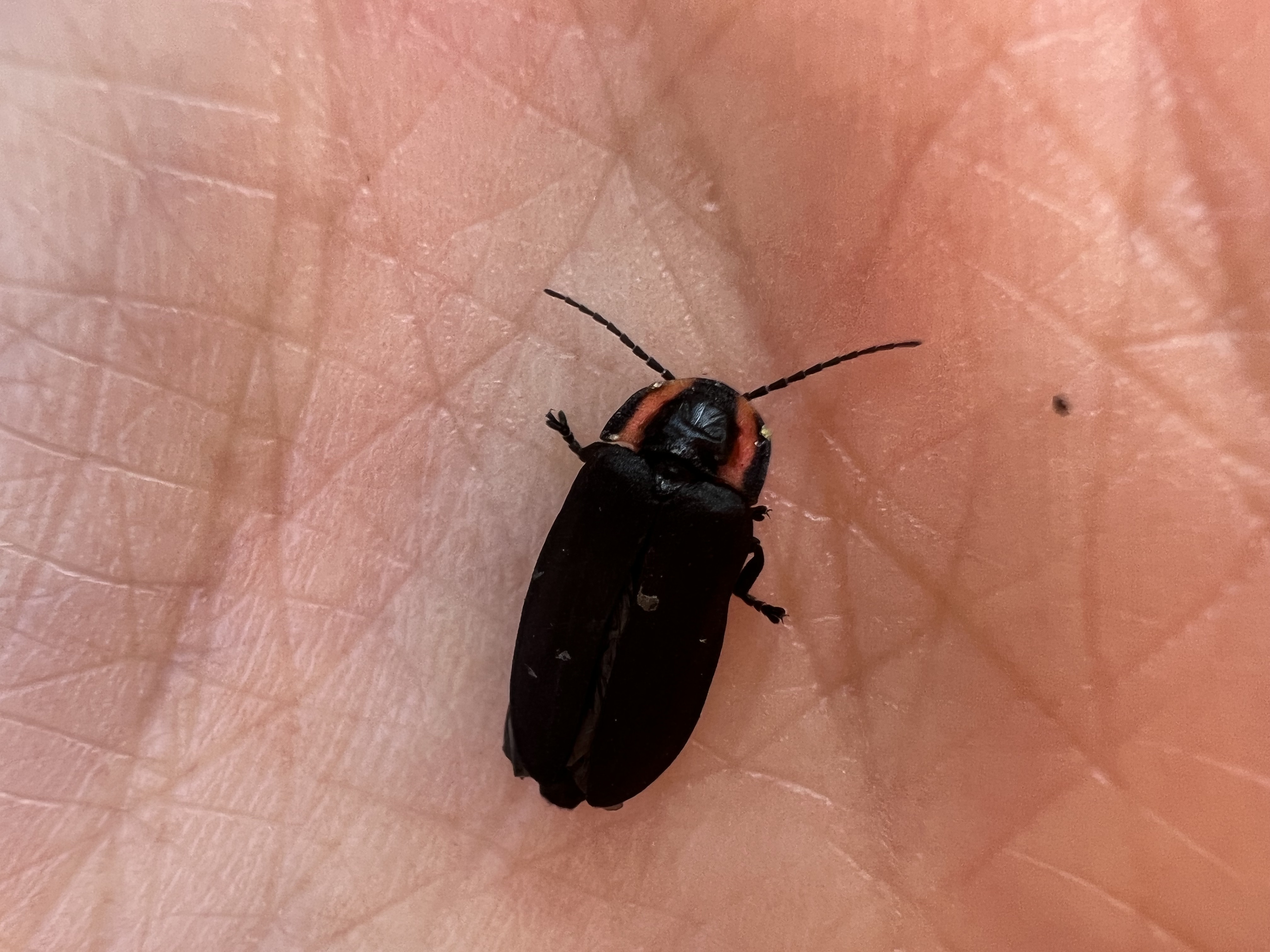
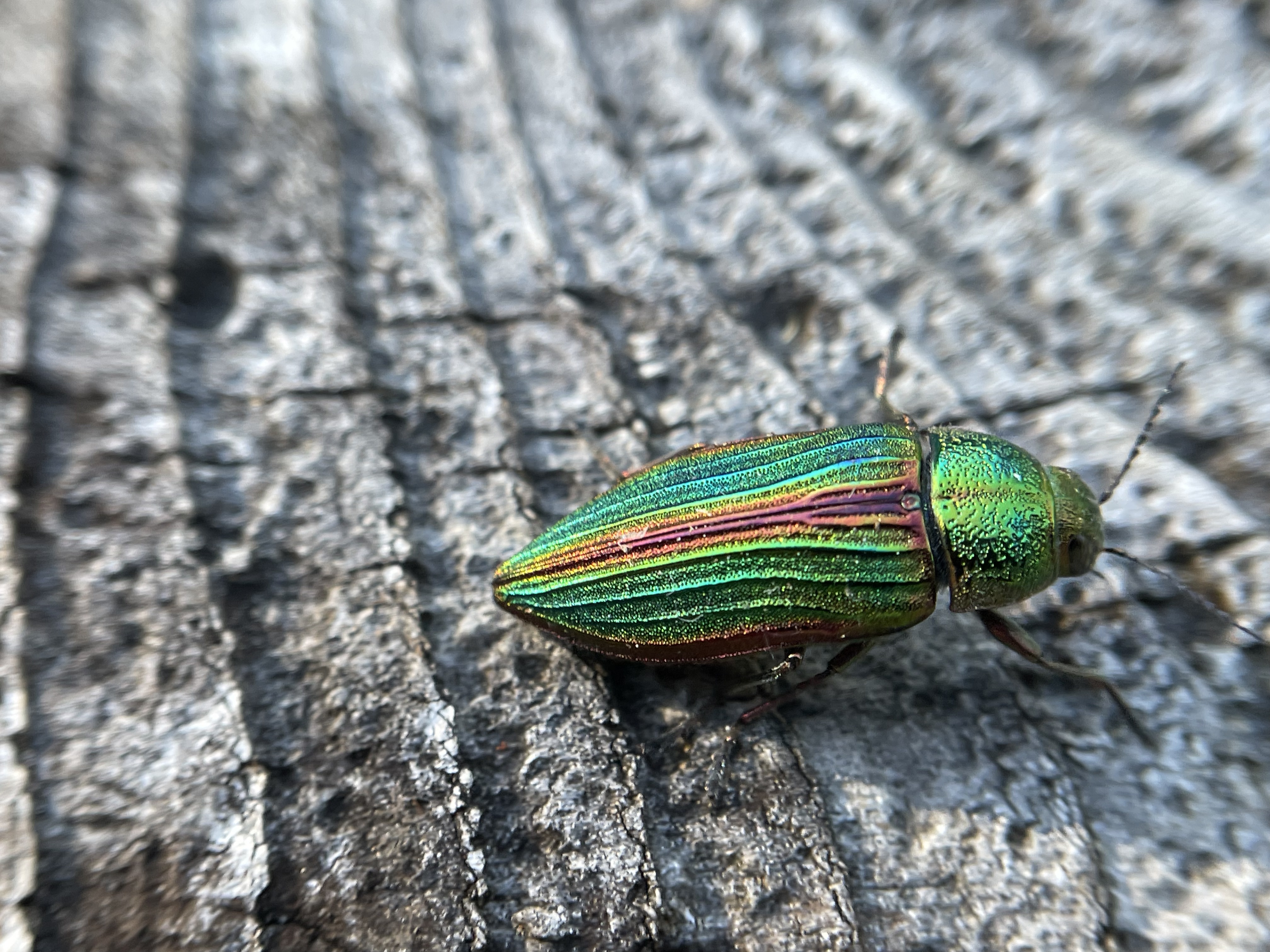
Winter Firefly (Ellychnia sp.)

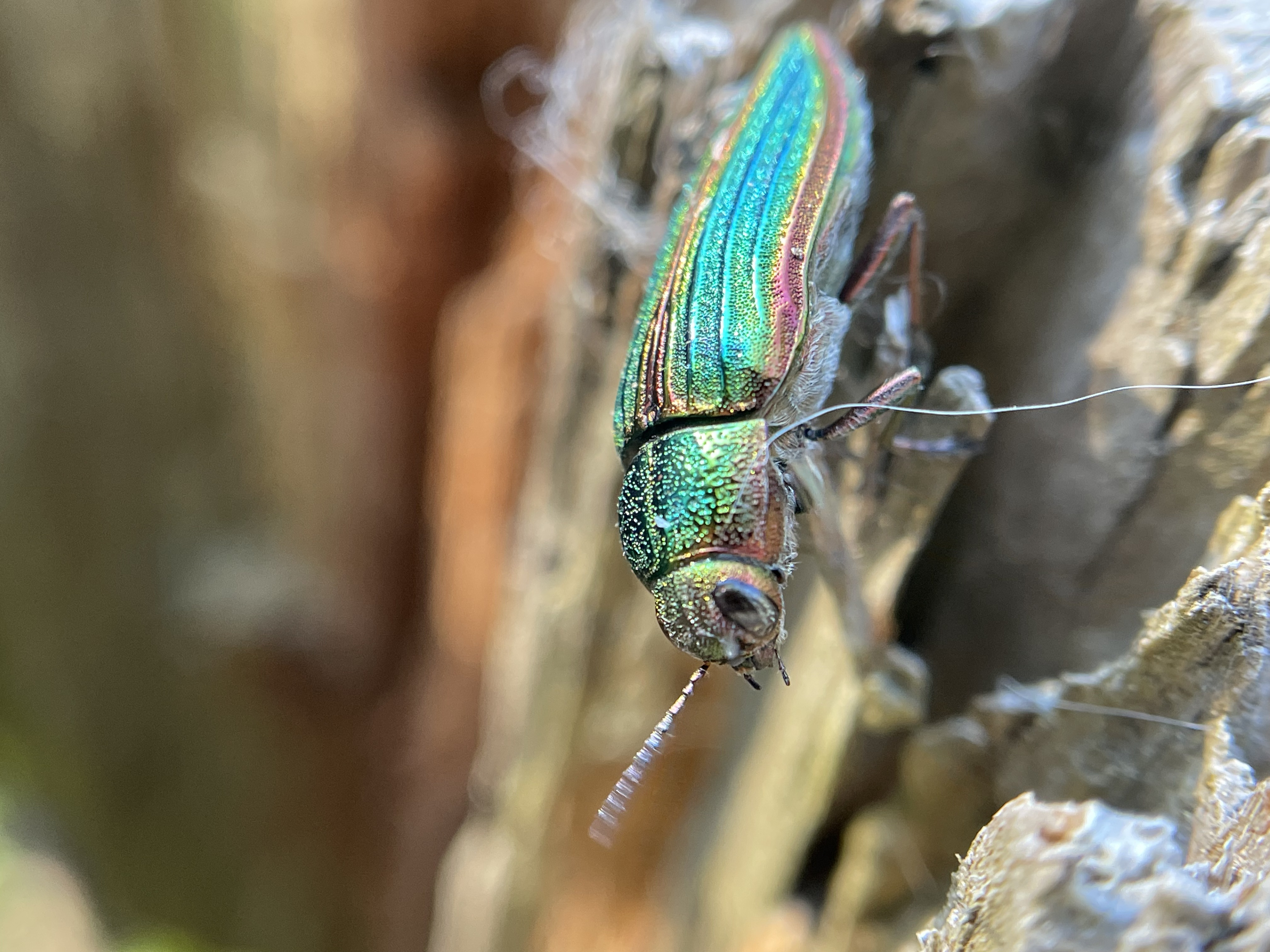
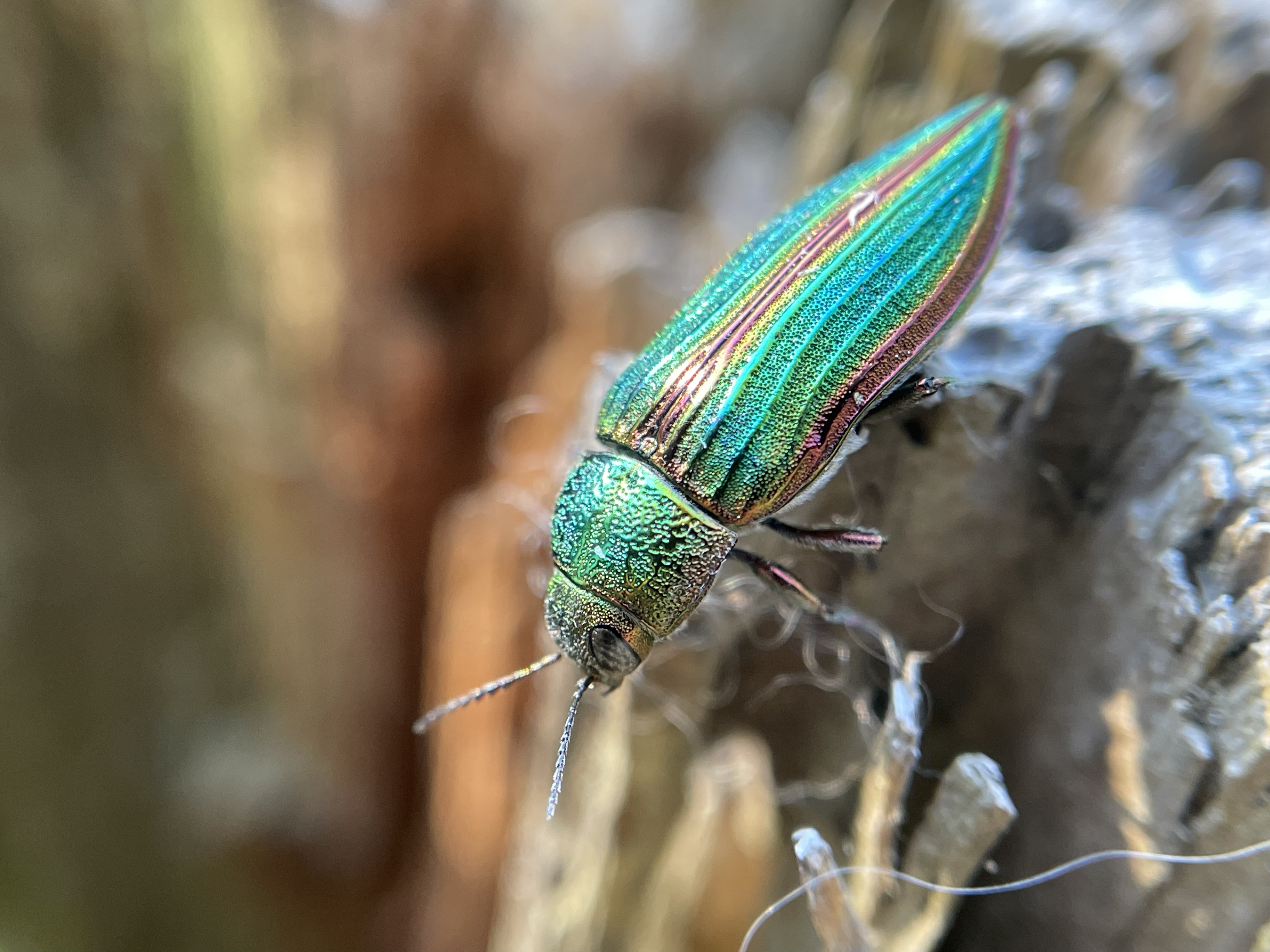
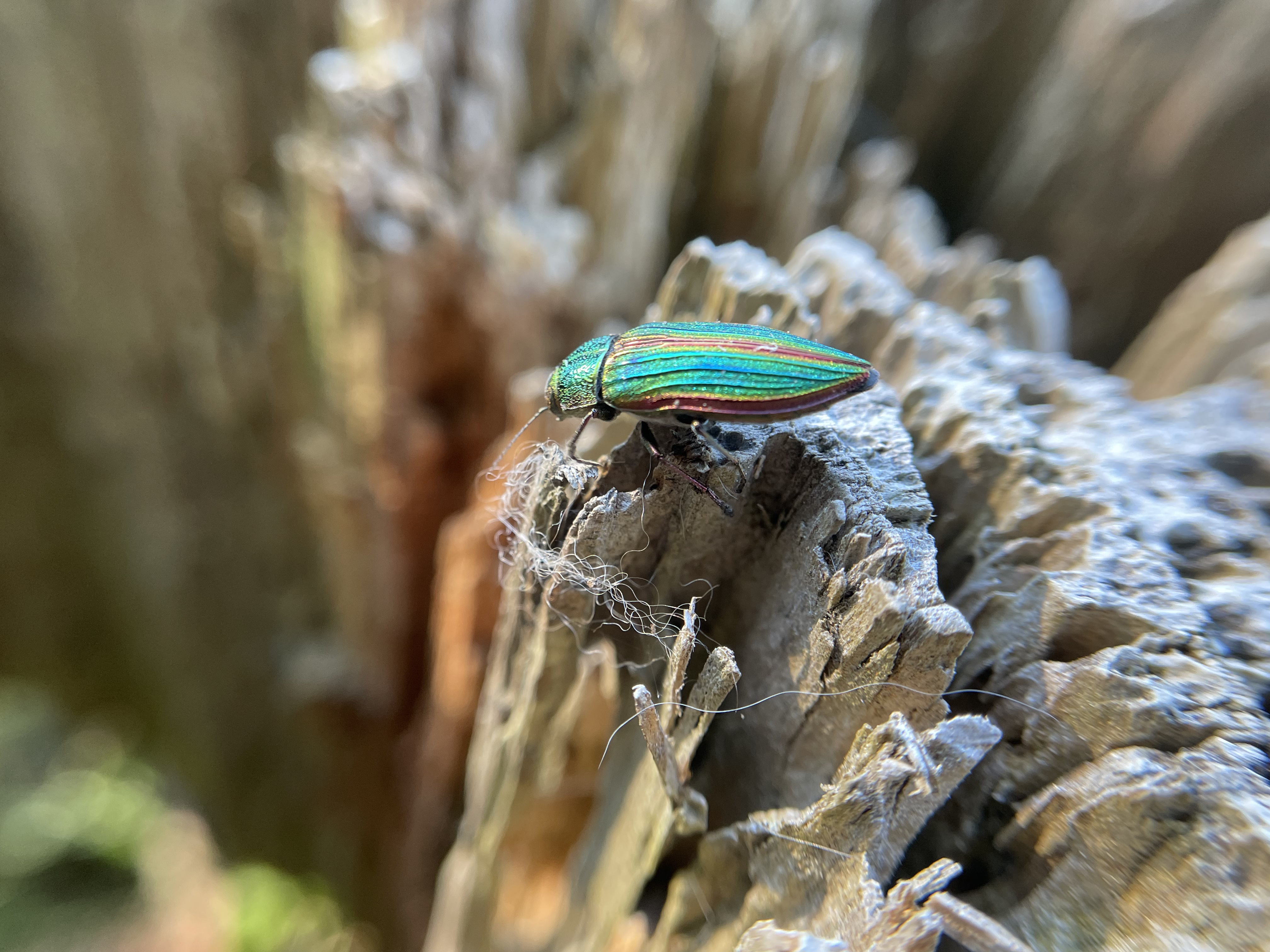
Here’s my “Bug of the day” (for Saturday, October 15, 2022).  I spied it on our wood table outside.  It’s a Diurnal Firefly in the genus Ellychnia.  The Latin name, Ellychnia, comes from Greek, lychnos, translating into ‘lamp’ or ‘lamp wick.’ Obviously, lamps are something associated with the nighttime or darkness.  However, the common name of this genus, diurnal, means “day.”   It’s only a bit confusing, right?  Also, this is a beetle in the family Lampyridae and not a fly at all.  The adults of this genus don’t light up at night or in the day either.  However, they are closely related to the fireflies that DO light up, or luminesce, at night found on the East Coast.  Since this genus, the Ellychnia, don’t have nighttime blinkers, they find their mates by detecting each other’s pheromones.   Lloyd (2002), notes however that all species of Lampyrid beetle larvae have an organ at the end of their abdominal segment 8 that bioluminesces. I’ve never found an Ellychnia larva myself, but these are referred to colloquially as “glow worms.”

Ellychnia sp. firefly

In our area, the genus Ellychnia are also known as winter fireflies.  This is because they spend the winter as adults, and are equipped to tolerate cold temperatures.  You might even see them on days when we have snow.  Larvae of this beetle genus hatch in early summer and live in leaf litter or under bark in decaying trees.  They are carnivorous predators of organisms like snails, slugs, earthworms, and soft-bodied insects.  

Winter Firefly (Ellychnia sp.)

Do we have any blinking species of fireflies in the PNW?  That’s an interesting question.  I found some literature that says we do, but I’m not certain this applies to the San Juan Islands, although a few sparse (and unsubstantiated) records from Vancouver Island, BC exist.  However, western records for flashing fireflies are known from interior B.C. (Cannings et al., 2010) and throughout the western U.S. as reported by Larry Buschman (2016).  

While fireflies that flash or bioluminesce are well known on the eastern side of the U.S. and North America, it is not exactly known how they moved all the way over to the western side.  There is an interesting commentary in the paper by Cannings et al. 2010, with the thought that perhaps at least one of the species of flashing fireflies reported in B.C., (Photinus obscurellus), may have arrived via the railways. 

Because luminescing fireflies are associated with wetlands, it would have been difficult for them to have crossed over the dry Rocky Mountain system without help. Cannings et al. (2010) report sightings across B.C. in association with railways, in fact, with most of these sightings falling within a 30 km distance from a railway.  The thought is that even going across the mountains in drier areas, most railways wound through low lying valleys where the topography is more likely to cross through wetlands.  Even the presence of railroad berms can create areas of new wetland habitat which may also have attributed to the westward distribution of these fireflies.  

Sadly, we have, and continue to degrade, pollute, drain, and lose wetlands in our continued (horrific) adherence to the destructive and entitled ideology of Manifest Destiny.  Development, ranching, hobby farms, and suburban sprawl have eliminated more than 50% of wetlands that previously existed in North America (Fallon et al., 2021).  The remainder have been seriously impacted by chemical pollutants, light pollution, and overall climate change, contributing to further declines to remaining populations.  We may lose all of the species of these iconic and charismatic summertime blinking lanterns without taking special steps to conserve and protect their habitat.   We will have no one to blame but ourselves either.  

Please support environmental conservation and protection in your community – wherever you live.  It is important to reduce our human footprint in order to preserve the natural world, its beauty, and our life support system to perpetuate for future generations.  

How can you help?  Live minimally.  Turn off outdoor lights at night.  Plant native vegetation.  Switch to use of non-toxic household products.  Don’t use lawn fertilizers or chemicals.  Better yet, get rid of your lawn and landscape with native plants.  Eat less meat.  It all adds up.  💡

References

Buschman, L. 2016. Field Guide to Western North American Fireflies. https://buggingyoufromsanjuanisland.com/wp-content/uploads/2022/10/ab7ca-westernfirefliesmarch2016a.pdf

Cannings, Robert & Branham, Marc & McVickar, R.H. 2010. The fireflies (Coleoptera: Lampyridae) of British Columbia, with special emphasis on the light-flashing species and their distribution, status and biology. Journal of the Entomological Society of British Columbia. 107. 33-41.

Fallon CE, Walker AC, Lewis S, Cicero J, Faust L, Heckscher CM, et al. 2021. Evaluating firefly extinction risk: Initial red list assessments for North America. PLoS ONE 16(11): e0259379. https://doi.org/10.1371/journal.pone.0259379

Fender, K.M. 1970. Ellychnia of western North America. (Coleoptera-Lampyridae). Northwest Science 44: 31-43.

Lloyd, J.E. 2002. Lampyridae Latreille 1817. Pp 187-196 in R.H. Arnett, Jr., M.C. Thomas, P.E. Skelly and. J.H. Frank (Eds.). American Beetles. Volume 2.

Bug Diary for October 6, 2022 ~ Metellina Spiders Share a Lunch Wrap, an Unusual Fly, Two Wandering Caterpillars, and “One- Eyed Wanda” Gets Rescued By a Seeing-Eye 👀Human.

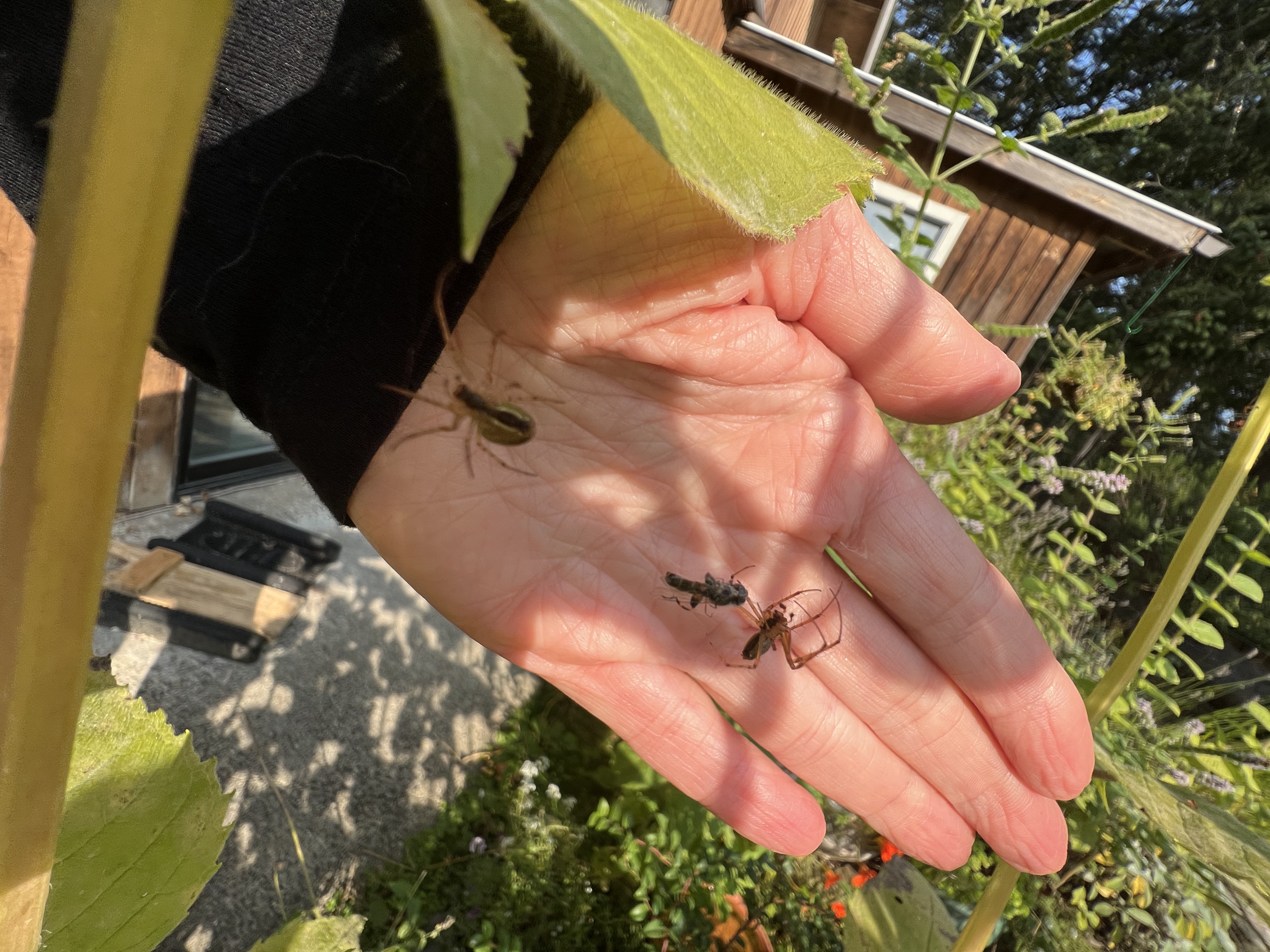
I was eating my lunch outdoors yesterday (October 6, 2022), and considering the end of season, depauperate community of bugs. There are fewer and fewer buzzing about the lingering tiny blossoms on my mint plants, which have been well-visited this season. Many of the winged flyers die out on their own accord. Lives spent – an ending synchronized with leaves falling from the trees. They’ve lived a season, maybe longer depending on the species. As adults, they’ve mated and sewn seeds for a new generation to emerge in spring. Some though, are captured and eaten by other organisms that are fueling stores for their own reproductive event – like these Long-jawed orb weaver spiders (Metallina segmentata) I witnessed, working together to wrap up their “lunch,” a Thick-legged Hoverfly (Syritta pipiens).

Metellina segmentata spiders (male and female) with lunch (Syritta pipiens) hoverfly

I didn’t realize it at the time, but depauperate was not to be the theme of my day!

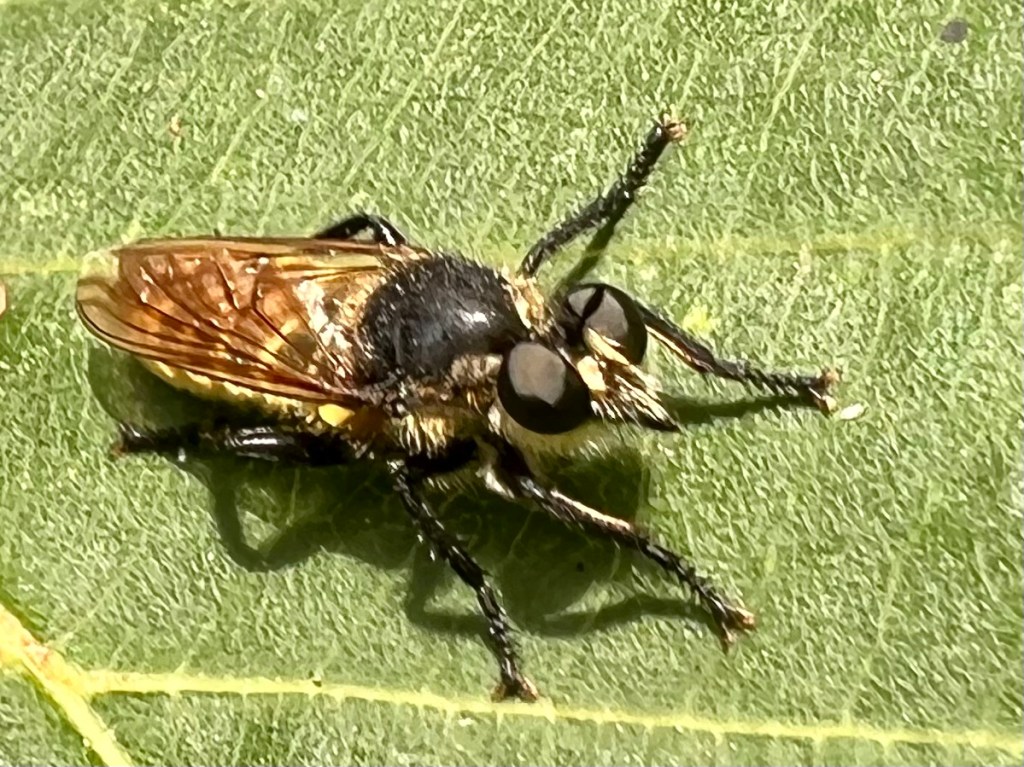
Shortly after observing and filming the spiders, I noted some buzzing around our fruitless cherry tree. I walked over, thinking to myself, “You’re getting too close to that Yellowjacket!” Well, it wasn’t a yellowjacket at all. It was a Robberfly (Laphria ventralis), I believe – and SHE was ovipositing into our tree.

Laphria ventralis Robber Fly – 10.6.22, San Juan Island, WA

Later this evening when I was showing my husband the photos, he asked what the eggs would eat when they hatch. I had to look it up. Well, Robber Fly larvae are known to prey on the eggs, larvae, and pupae of other insects, especially beetle larvae living in decaying trees. Read more about this linked here: https://www.geller-grimm.de/genera07.htm

This Robber fly was an incredible mimic of a Yellowjacket – not only in appearance, but also in the way she flew about the tree. Fascinated, I watched her find a niche under some old bark and begin to oviposit. She did not like my camera or my presence, but tolerated me to a degree. Then she buzzed right into my face with complete confidence her mimicry would chase me away. Guess what? It worked. At least temporarily.

Laphria ventralis Robber fly ovipositing 10.06.22 – San Juan Island, WA
Laphria ventralis 10.6.22 San Juan Island, WA
Buzz Off! Laphria ventralis Robber Fly 10.6.22

The next fun finds in Bug-landia were two caterpillars. I found an Eyed Sphinx Moth caterpillar (Smerinthus opthalmica) making headway down our driveway, undoubtedly wandering off to find a suitable location to pupate.

Smerinthus opthalmica (Eyed Sphinx Moth caterpillar) 10.6.22

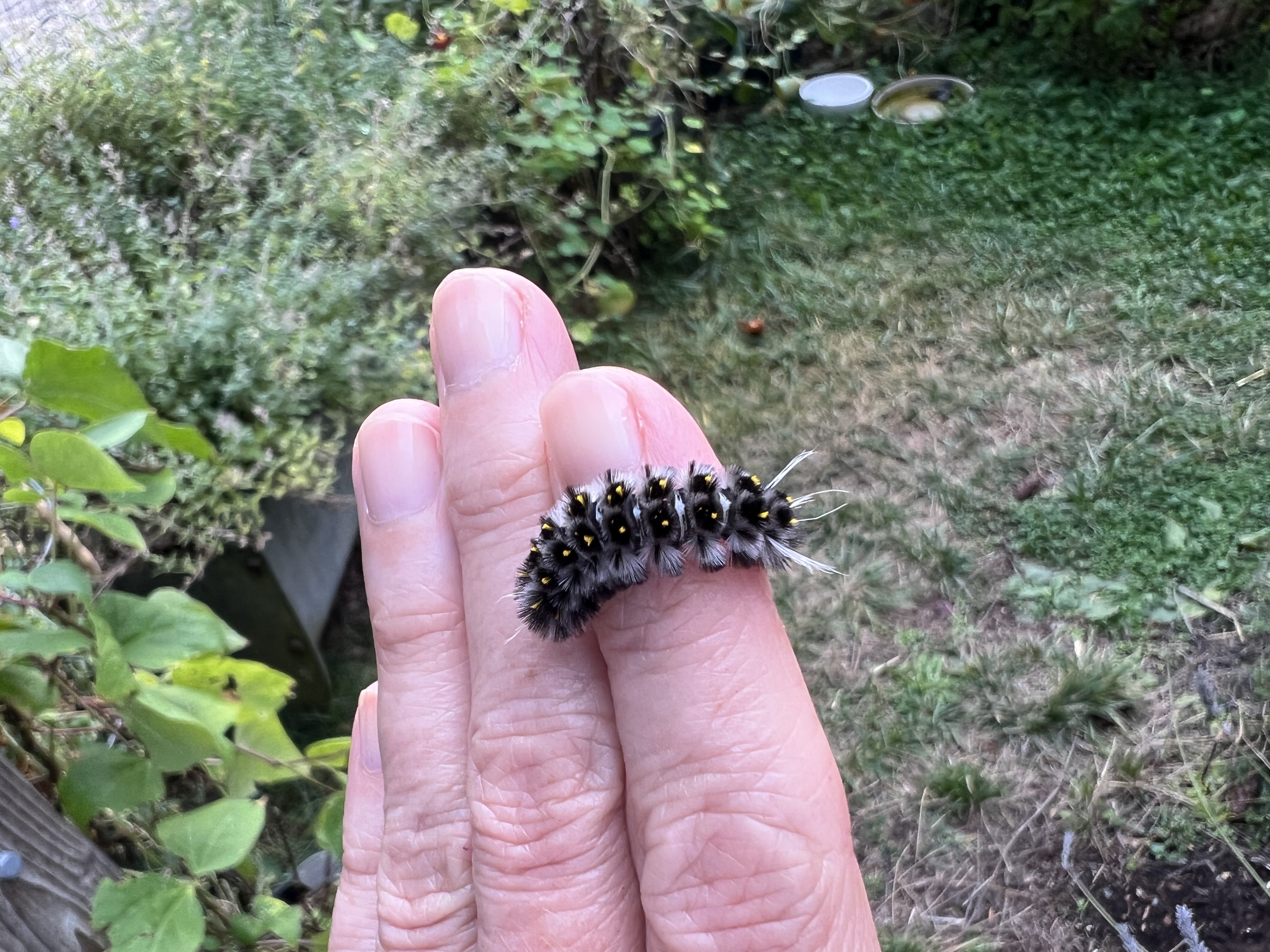
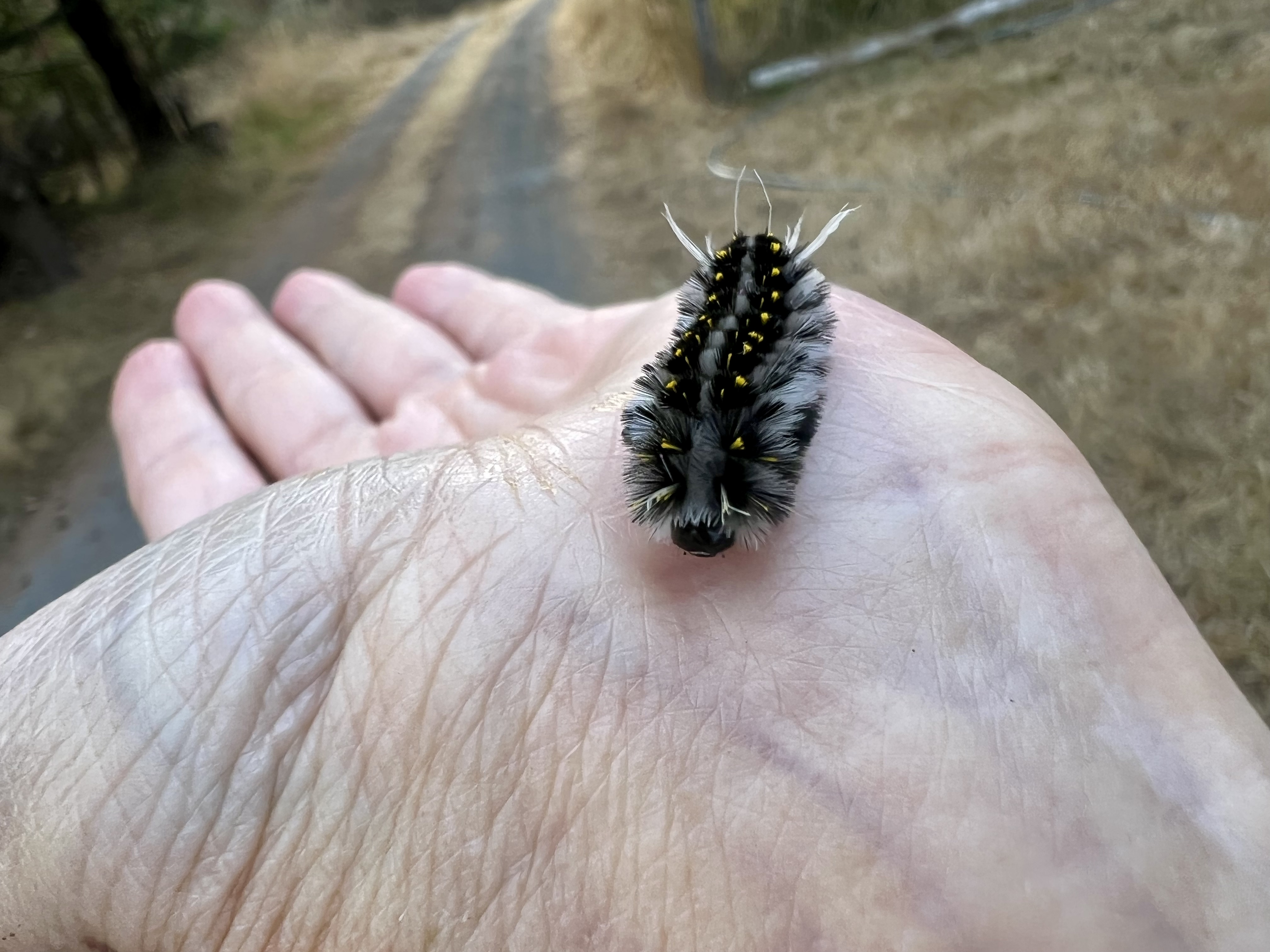
The second caterpillar I found is my absolute favorite moth species, the Rosy Aemilia moth (Lophocampa roseata). Since it was navigating down the middle of the road, I did gently relocate it to a safer spot so it wouldn’t get smooshed by the giant gravel trucks that fly up and down our once quiet country road.

Lophocampa roseata, the Rosy Amelia Moth caterpillar

Last, but not least is my new “pet.” I found her on my walk and she needed some help, so she’s come home to stay with us for some R&R, and a bit of end of life care. I’ve named her Wanda… One-Eyed Wanda. Wanda had evidently become an assault victim sometime just before I found her. The thought is that she was attacked and bitten by another female mantis – who evidently fled the scene before I got there. Poor wounded Wanda was not in great shape when I picked her up. She is missing an eye. It was not a pretty sight, but I couldn’t just leave her in the road.

Mantis religiosa (European mantis) and, “One-eyed Wanda”

She’s hanging out in the dining room tonight in a bug habitat/safe room so my indoor cats don’t batter her. I think she’s had enough battering in this life. I’m hoping she will still be able to lay an egg sack for me before she expires. Definitely plan to try and feed her tomorrow. I doctored her eye as best as I could. She can still see with the other one. Poor Wanda. 😦

Next up – Look for my post and forthcoming PowerPoint slide show about What’s Bugging Gary! Even better, check out the event (Garry Oak Conservation Symposium) in person if you’re on San Juan Island. It’s this Sunday at the Grange.


References and More Good Stuff to Check Out

Brast, C.L. 2018. Lophocampa roseata (ROSY AEMILIA). Bugging You From San Juan Island. https://buggingyoufromsanjuanisland.com/2018/10/02/lophocampa-roseata-rosy-aemilia/

Bugguide.net. 2022. Lophocampa roseata. https://bugguide.net/node/view/247272

Bugguide.net. 2022. Metellina segmentata. https://bugguide.net/node/view/153661

Cannings, R. A. 2014. The Robber Flies (Diptera: Asilidae) of Western Canadian Grasslands. Chapter 7.10.3752/9780968932179. http://staff.royalbcmuseum.bc.ca/wp-content/uploads/2014/06/Cannings-Asilidae-BSC-003-Vol4-Ch7-2014-.pdf

Cannings, R.A. 2007. Recent range expansion of the Praying Mantis, Mantis religiosa Linnaeus (Mantodeaz Mantidae), in British Columbia. Journal of the Entomological Society of British Columbia, 104, 73-80. https://journal.entsocbc.ca/index.php/journal/article/view/101

Geller-Grimm, F. Information on Robber Flies. https://www.geller-grimm.de/genera07.htm

McAtee, W.L. 1918. Key to the Nearctic Species of the Genus Laphria (Diptera, Asilidae). The Ohio Journal of Science. v19 n2 (December, 1918), 143-172. https://kb.osu.edu/handle/1811/2019

Nelson, D. 2022 Laphria Ventralis. 10,000 Things of the Pacific Northwest. Adventures of a Recreation Naturalist. http://10000thingsofthepnw.com/2021/07/31/laphria-ventralis/

Nelson, D. 2022. Metellina segmentata. 10,000 Things of the Pacific Northwest. Adventures of a Recreation Naturalist. http://10000thingsofthepnw.com/2020/10/25/metellina-segmentata/

Nelson, D. 2022. Smerinthus opthalmica. 10,000 Things of the Pacific Northwest. Adventures of a Recreation Naturalist. http://10000thingsofthepnw.com/2022/06/27/smerinthus-opthalmica/

PNW Moths. 2022. Lophocampa roseata. http://pnwmoths.biol.wwu.edu/browse/family-erebidae/subfamily-arctiinae/tribe-arctiini/lophocampa/lophocampa-roseata/

PNW Moths. 2022. Smerinthus opthalmica. http://pnwmoths.biol.wwu.edu/browse/family-sphingidae/subfamily-smerinthinae/smerinthus/smerinthus-ophthalmica/

Thanks for Reading! 🐛

San Juan County, WA Spider Information – Resource Sheet 

Scared of Spiders?  Here’s a go-to info-sheet (that I plan to update as time allows) with links to verifiable, research-backed Spider Information/Literature.  Let’s end all the misinformation and our arachnophobia.  Too often people buy into false reports.  Don’t listen to someone’s tall tale of horror.  These stories are sensationalized and inaccurate.  Know the facts.  Dispel the rumors.  Spiders are not out to kill you.  It’s just not true. 

YOU have to do the reading!  These are scientifically based, accurate studies with information related to spider bites.  

Hobo Spiders (Tegenaria agrestis) ****Medically insignificant 

*Bennett RG, Vetter RS. An approach to spider bites. Erroneous attribution of dermonecrotic lesions to brown recluse or hobo spider bites in Canada. Can Fam Physician. 2004 Aug;50:1098-101. PMID: 15455808; PMCID: PMC2214648 https://www.ncbi.nlm.nih.gov/pmc/articles/PMC2214648/pdf/15455808.pdf.

*Melissa M. Gaver-Wainwright, Richard S. Zack, Matthew J. Foradori, Laura Corley Lavine, Misdiagnosis of Spider Bites: Bacterial Associates, Mechanical Pathogen Transfer, and Hemolytic Potential of Venom From the Hobo Spider, Tegenaria agrestis (Araneae: Agelenidae), Journal of Medical Entomology, Volume 48, Issue 2, 1 March 2011, Pages 382–388, https://doi.org/10.1603/ME09224

How to identify and misidentify a Hobo Spiderhttps://s3.wp.wsu.edu/uploads/sites/2210/2015/05/PLS116_1.pdf

Brown Recluse Spiders (Loxoceles sp) – NO! I repeat “NO, none, nada!” established populations in our area.  

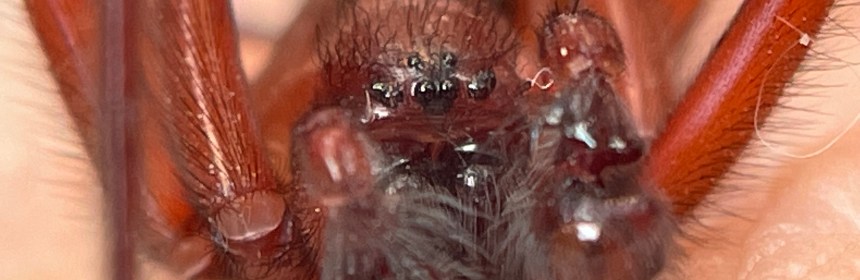
In the attached links below, you will find links to information about the Brown Recluse Spider.  Information that comes from a verified, reputable source – from an actual expert.  Brown Recluse spiders do not live in the San Juan Islands.  Caveat: this is not to say that if you move here from an area where there ARE established populations, one might be found hitching on your moving boxes.  It’s possible, BUT – they have not been able to survive and breed here.  If you see a large brown spider in your house – especially on the ceiling, it is most likely (99.99%) going to be a Giant House Spider (Eratigena duellica).  They are very common and harmless.  If you don’t like them, just catch in a cup and take it to a sheltered area outside – preferably another structure where it might have a chance to survive.  They won’t hurt you. 

Map showing distribution of Brown Recluse spiders (Please note that San Juan County is NOT found on this map)  – https://spiders.ucr.edu/spiders-map

Map of Brown Recluse Spider distribution – UC Riverside

Where else can I find reliable information on Spiders?

There are a few sources I’ll list here.  The first two are the ones you should look at first.  They are valuable resources with information from highly credentialed experts in all things arachnid-related.  If you read something written by either Rod Crawford (Seattle Burke Museum curator of the arachnid collection) or by Rick Vetter (UC Riverside Department of Entomology), you can be assured it is correct. 

As a local resource, you can also check out the Facebook Bug Group (Bugs of the San Juan Islands).  There are several group “experts” with experience identifying spiders.  These folks generously volunteer their time and knowledge, so keep that in mind and please refrain if you feel inclined to INSIST they are wrong and there are INDEED Brown Recluse Spiders living in your house in San Juan County.  If you have a spider you’d like identified, it helps to have a couple of clear photos to submit.  Try and get a shot of the dorsal (top) of the spider, and if you’re able, one of its face – showing eye pattern.   You may contact me, Cynthia Brast-Bormann at cynthiabrast@icloud.com to submit live or deceased specimens for identification.  I will help you coordinate a drop off point for collection.  Please don’t indiscriminately KILL a spider though and ask me to ID it.  It will likely make reliable identification more difficult.  Just get a cup and a lid with some air holes punched in the top.  I appreciate your showing kindness to the helpless creature you’ve caught.  I will ID and humanely release.  

Here’s a link to Rod Crawford’s site – http://staff.washington.edu/tiso/

If you’re interested, here’s a link to his blogpost of our 2022 outing on San Juan at Reuben Tarte Park collecting spiders – https://crawford.tardigrade.net/journal/album8630.html

More great links featuring Rod Crawford

  1. Spiders aren’t out to get you – https://www.seattletimes.com/seattle-news/science/seattles-real-spider-man-sets-us-straight-theyre-not-out-to-get-you/

Rick Vetter UCR  

Myth of the Brown Recluse: Fact, Fear, and Loathing

https://spiders.ucr.edu/myth-brown-recluse-fact-fear-and-loathing

Local help: 

Bugs of the San Juan Islands Facebook Group – There are at least 4 spider group experts and folks with entomology degrees or experienced backgrounds in the group who are more than qualified to help you.  https://m.facebook.com/groups/bugsofthesanjuanislands/about/

Bugging You from San Juan Island (Cynthia Brast-Bormann’s entomology blog for the San Juan Islands)  https://buggingyoufromsanjuanisland.com

Great YouTube information and fun links to watch from one of Bugs of the San Juan Island’s group experts, Arlo Pelegrin (entomologist and arachnologist) 

  1. Spiders of the West and their Medical Significance – Arlo Pelegrin at Dept of Health

Musings on the complicated topic of native pollinators, food production, and climate change

Bee Balm, nasturtiums, and Stinky daisies


Our native pollinators were slow to emerge this year in the San Juans because of the cool weather. Usually, we can rely on flies, solitary bees and wasps, and even moths, ants, and others to pollinate our fruit trees. I did see some species of flies out this spring, but again, weather conditions were poor. 

We have PLENTY of “pollinators” out in our yard right now. So, in trying to explain to people when they ask me about a decline in native pollinators, I have a few points I like to throw out for consideration.

1) honey bees are poor pollinators to keep on the island. It has to be above 50 degrees for them to come out of the hive.

2) native flies and other insects like moths (which fly at night and we don’t typically see) are better at pollinating in cooler temperatures.  While they also won’t be out if it’s rainy and super cold, they can fly in temperature ranges lower than 50 degrees F.  

3) the critical importance of native pollinators may not be in their “pollination” services – but their role as pest predators and/or role in the food cycle for other organisms, and for creating biodiversity in our ecosystem, which helps keep everything healthier.   I think this part is important.  If you look at some of the plants we put in our gardens (native perennials), they actually do not require pollination to survive and reproduce, but do offer pollen and nectar to many insects, spiders, and hummingbirds.  Looking further at the food web, we need a variety of native insects for more than pollination.  Tachinid flies, syrphid flies, solitary wasps, ants, and even spiders can be pollinators, but also help regulate populations of orchard, garden, and forest pests.  

My take on all of this is as humans, our focus has largely been on how to grow food over environmental conservation and maintaining balanced, functioning ecosystems.  With climate change, many of our food growing operations may fail.  Our fruit trees (at least none that I know of) are not native.  In spite of the best intentions, conditions may decline to a point where we can’t produce great fruit here.  Weather is only one limiting factor.    We have poor soils or no soil in many locations, limited water resources, and the pressures of continuing development resulting in loss of natural habitats.  I don’t have the answers for you when it comes to fruit production or any way to personally mitigate climate change, so we may have to figure out a substitute for growing apples, plums, and such.  

Let’s go back to the importance of native pollinators though.  If you think of our island as a living organism with many different functions, it is important to have all the essential pieces to keep the “body” healthy.  These native pollinators (and the native plants they visit), and all the other myriad species of invertebrates, fungi, birds, mammals, amphibians, reptiles, soil, water, etc. are all part of the “body,” a body that has to fight off occasional or repeated assaults from being thrown off balance by exposures to external forces.  Just like we need a variety of foods and minerals and other things to keep our body healthy, so does an ecosystem.  We need all of these pieces (and that includes our native pollinators and all the other diverse species) to keep our island home healthy.  

As to the fruit trees and other food crops requiring pollination, for now, some of these issues can be mediated by planting around your orchard and garden with plenty of diverse native species and providing habitat for all of these native species to develop.  Some of our practices of cleaning and sanitizing our orchards and gardens, burning yard clippings, and applying fertilizers and pesticides can adversely affect the biodiversity needed to help our food production thrive.   

I imagine it can be frustrating to see an orchard fail to produce fruit.  My grandparents were tenant farmers and wholly dependent on growing cotton and corn and the bit of garden and livestock they had around the home on the property they did not own.  When it was a drought year, and crops failed, things were utterly miserable.  Destitute would be a better adjective.  I believe we may have an inherent desire to be “part of the land,” and grow our own food, but sometimes, despite our best efforts, conditions aren’t favorable.  Crops fail.  Historically, we have tried (and failed) to control some of these external forces – like applying pesticides in amounts that probably will poison us forever.  

I’ve gone way beyond the “pollinator” topic here, but it is next to impossible for me to see a one-dimensional issue.  We have a much larger and more complex picture before us.  How do we either re-create or maintain a healthy functioning system, navigate the perils of climate change, and feed ourselves?  I like to believe that protecting diversity in our ecosystems is an important facet of this complex, multi-layered crisis we face. 

Resources and Further Reading

Washington Native Plant Society – https://www.wnps.org

Xerces Society – http://www.xerces.org

WSU Extension Master Gardeners of San Juan County – https://extension.wsu.edu/sanjuan/master-gardeners/

Living Jewels of San Juan

Buprestis aurulenta or Golden Buprestid Beetle

I found this little green beetle (and another sad little black and yellow beetle missing its antennae) in the pool yesterday. The black and yellow beetle is alive and… well, sort of living in a special habitat right now because of those missing antennae.

The green one was completely waterlogged and lifeless. I had left it on the table next to Drago’s enclosure last night, thinking I’d pin it and keep it in my collection. I am SO GLAD I DIDN’T stick it with a pin! This morning, I found it moving those little legs around at me. It was alive! RIP woke up.  

Golden Buprestid beetle (Buprestis aurulenta)

Golden Buprestid beetle (Buprestis aurulenta


This is a Golden Buprestid Beetle (Buprestis aurulenta). They are a native species in the Pacific Northwest. I have referred to them often as the Rip Van Winkle beetle because they take such a long time to develop from egg to adult. In fact, the record is 51 years!  


Why so long? Well, the developmental time depends a lot on the quality of what they’re eating (they develop in dead or dying trees) and miscellaneous environmental factors. When they come out as an adult, they leave behind a little oval hole. I think it adds character to your wood trim if you have them “sleeping” in timber used to build your house.

We had one in our door trim that didn’t make it all the way out and probably had been stuck for awhile before I noticed. It became a fascinating object to show anyone who came to visit our home.

Golden Buprestid stuck in door trim (March 20, 2016)

I’m not sure what gives them this beautiful iridescence, but they are undeniably one of nature’s jewels, thus the name “Jewel” Beetle. 

Golden Buprestid Beetle – San Juan Island 07.27.2022
Golden buprestid set free to fly away in the forest.

References and further reading:

Zeng, Y. 1995. University of Florida Book of Insect Records, Chapter 12 Longest Life Cycle. Department of Entomology & Nematology University of Florida, Gainesville, Florida 32611-0620 https://entnemdept.ufl.edu/walker/ufbir/files/pdf/UFBIR_Chapter12.pdf

Bugguide.net https://bugguide.net/node/view/74029

Nelson, D. 2021. Buprestis aurulenta (Golden Buprestid) 10,000 Things of the Pacific Northwest http://10000thingsofthepnw.com/2021/05/19/buprestis-aurulenta-golden-buprestid/

What are extrafloral nectaries?

Ants (Lasius sp.) on Big Leaf Maple Extra-Floral Nectary – May 17, 2022, San Juan Island, WA

When you study insects, or even birds for that matter, you start to understand you have to get to know plants a bit too.  It’s all connected.  

Plants (including trees and shrubs) provide food and shelter for many different species of animals.  Admittedly, I just don’t know a lot about the parts of plants, beyond things like a tree trunk, bark, limbs, branches, leaves, or stems or flowers, nuts, fruit.  The obvious parts.  

There are some not so obvious parts.  Like these extrafloral nectaries.  Huh? Sounds weird.  Keep reading. 

Extrafloral nectaries (EFN’s) are glands occurring on more than 2000 plant species in 64 families.  Extrafloral literally means outside of the flower. When we think of nectar, we usually think of little bees and hummingbirds flying around, visiting pretty flowers to sip nectar and in the process, pollinate all of our plants.  It’s just that plants are a bit more complex.  These glands are located in various places on plants (including trees and shrubs), and may be found on the laminae of leaves, petioles, rachids, bracts, stipules, pedices, fruit, etc.  (Mizell, 2019).  

These glandular secretions are a fascinating part of how plants attract and sustain a diverse, ecological community, providing sustenance for a multitude of species, including both pests and predators.  You can find ants, aphids, beetles (including ladybugs), bees, wasps, and possibly even birds utilizing this excretory faucet to sip what consists of mostly carbohydrate-rich sugar, but also comprised of a wide array of amino acids and other nutrients.  

Why are these important? Well, scientists are still trying to fully understand all of the diverse relationships around extra-floral nectaries. It is thought perhaps, beyond attracting organisms to a food source, they play a role in orchestrating a plant’s defense strategy against predators. They also are believed to provide a source of food and/or beneficial nutrients for various organisms during the off-season – when flowering and pollen sources are not available. They may also reduce conflict between ants and other pollinators by partitioning resources (Villamil & Stone, 2019).

Lasius sp. Ants at Extra-floral nectaries on Big Leaf Maple, 05.17.2022, San Juan Island, WA

Ant and aphid hanging out on extrafloral nectaries on Cherry Tree, San Juan Island, 05.17.2022

References

Bentley, B. L. (1977). Extrafloral nectaries and protection by pugnacious bodyguards. Annual Review of Ecology and Systematics8(1), 407-427.

Holopainen JK, Blande JD, Sorvari J. Functional Role of Extrafloral Nectar in Boreal Forest Ecosystems under Climate Change. Forests. 2020; 11(1):67. https://doi.org/10.3390/f11010067

Mizell, R. 2019. MANY PLANTS HAVE EXTRAFLORAL NECTARIES HELPFUL TO BENEFICIALS.  UF IFAS Extension Bulletin. https://edis.ifas.ufl.edu/publication/IN175

Villamil, N., Boege, K., & Stone, G. N. (2019). Testing the Distraction Hypothesis: Do extrafloral nectaries reduce ant-pollinator conflict?. The Journal of ecology107(3), 1377–1391. https://doi.org/10.1111/1365-2745.13135

No Clowning Around in the Pool Without a Life Jacket.

Yesterday I was the lifeguard. And, I had swimmers needing saving!

Hister Beetle (Genus Margarinotus I believe) – April 7, 2022 San Juan Island, WA

Here’s one of the species I used a piece of cardboard to rescue from drowning. This is a beetle in the family Histeridae, also known as a Clown Beetle. I told him no more clowning around without a life jacket. 🤣 Watch as it wrings its hindwings out, rolling them in under the leathery elytra (the outer wings).

I believe this beetle is in the genus Margarinotus. For ID beyond this, I’d need more time and a lot of patience. However, I can tell you I’ve learned some species of Hister beetles are associated with the nests of rodents, birds, and even ants and termites. They are pest predators, meaning they eat other insects at all life stages. They also are especially adept predators of fly eggs. You can often find them in leaf litter, dung, carrion, and under tree bark, or living in those ant mounds where they may be fed by ants, eat the leftovers the ants discard, or in some cases, they eat the ants!

Some other curious tidbits about these beetles include their acting ability. They play dead (Thanatosis) to deter predators. The word Hister is derived from Latin and means “Actor.”

Hister Beetle (I believe Margarinotus sp) – San Juan Island, WA

References:

Caterino, M. S. (2010). A review of California Margarinotus Marseul (Coleoptera: Histeridae: Histerinae: Histerini), with descriptions of two new species. The Coleopterists Bulletin64(1), 1-12. https://bioone.org/journals/The-Coleopterists-Bulletin/volume-64/issue-1/0010-065X-64.1.1/A-Review-of-California-Margarinotus-Marseul-Coleoptera–Histeridae/10.1649/0010-065X-64.1.1.pdf?casa_token=FFQE6VfrPhwAAAAA:6hS4kWWWX-lGeUPQFiU-7Dc2atg_nhsgP0almrxzvWjgwhxDLMShzekiAS7HWEKT5_AL2n4i

Wenzel, R. L. (1960). Three new histerid beetles from the Pacific Northwest, with records and synonymies of additional species (Coleoptera: Histeridae). https://www.biodiversitylibrary.org/page/2847194

Bugs Like the Color Blue

Bugs like Blue. I found a bunch of these little ones yesterday floating on the surface of our above ground pool. They were also all along the outside of the pool (which is blue). I scooped out all the ones that were struggling in the water and watched as this one dried itself off. It reminded me of watching my cats grooming after finishing a meal of Fancy Feast wet cat food.

Listrus Flower Beetle on Side of Pool – April 7, 2022 – San Juan Island, WA

A Soft-Winged Flower Beetle, these are in the family Melyridae (Genus Listrus). At only about 2 mm in size, they were indeed pretty tiny. Listrus beetles feed on both pollen and nectar. They are covered with dense setae (little hairs) that pollen easily adheres to. Check out the paper reference below and learn how they have been recognized as one of the most important pollinators of plants in Western North America.

Listrus sp. flower beetle

Reference: Jonathan R. Mawdsley. (2003). The Importance of Species of Dasytinae (Coleoptera: Melyridae) as Pollinators in Western North America. The Coleopterists Bulletin, 57(2), 154–160 pdf link at Bioone.org *Note* It will directly download the pdf when you click the link. https://bioone.org/journals/the-coleopterists-bulletin/volume-57/issue-2/541/The-Importance-of-Species-of-Dasytinae-Coleoptera–Melyridae-as/10.1649/541.pdf?casa_token=luFq1Z9jff4AAAAA:3-9zCg42504MZ0w5J1bfFu28XAWIA91G8bbrmDfDckmhTGAI6FTAjgcgBQVqCv847ogua3mL

Strawberry Muppets

Orthosia transparens – the Transparent Quaker Moth

I’d really love it if I could rename this moth. Strawberry muppet heart moth is what I’d call it. Check out the little heart-shaped markings on it’s wings.

Orthosia transparens – with heart mark on wing

Orthosia transparens is a medium sized (15-17mm) , brownish red Noctuid moth that flies in our region in early spring. The common name for the species is Transparent Quaker Moth.   Caterpillar food plants include salal (Gaultheria shallon), madrone (Arbutus menziesii), and rhododendron (Rhododendron macrophyllum). This species is native to the PNW region and not considered pests of economic significance. A map of the geographic distribution can be accessed here – http://mothphotographersgroup.msstate.edu/species.php?hodges=10479

Noctuidae is the family with the awful common name, “cutworm,” which leads folks to deem them evil little garden gremlins that should be stomped on or tossed out on the ground for birds to scavenge. Not all cutworms are bad, and certainly many more of us would embrace them if we knew they were going to turn out to be so cute.

I’m fine with a bit of herbivory on our salal, madrone, and rhododendrons. These little Strawberry Muppets are welcome to fly to my porch light any spring night.

Check out the gallery below for more photos and if you’re interested in reading more about this moth, check out my friend, Dan’s nice write up on his blog here – http://10000thingsofthepnw.com/2022/02/03/orthosia-transparens-transparent-quaker-moth/

Thanks for reading!

Is He Stuck or Just Sleeping?

I found this tiny bee who looked to be stuck to a thorn on my Bois D’Arc tree this afternoon. At first glance, I thought perhaps a March fly, and a dead one at that, but it turned out this is a most likely a “he” Nomad bee, and he wasn’t stuck at all, but just sleeping.

Nomad Bee – Stuck or Just Sleeping (March 26, 2022)

I learned something new today about bees that I did not know. My friend, Eric Eaton’s wife (link to Eric’s book about wasps in my Read More section) , shared with me that some bees will often sleep in this manner, attached to a substrate like this thorn or a twig, by their mandibles. Thanks Heidi! 🙂

Nomad Bee – Stuck or Just Sleeping (March 26, 2022)

Nomad Bee – Stuck or Just Sleeping (March 26, 2022)
Nomad Bee (March 26, 2022)

My bee was definitely gripping the end of the thorn with its mandibles. Before I found out my bee was only napping, I wasn’t certain what was going on. I worried maybe the bee had fallen victim to some weird fungus and was now locked in a death vise. Worries unfounded! The little bee released his grip as I was about to clip the end of the twig (with bee attached) and take it into the house to view under the microscope.

Nomad bees are pretty cool. They are cuckoo bees, cleptoparasites of other bees (usually Andrena bees or Melitta bees) and target the nest provisions gathered by the host bees for their own young. Nomad bees will find the nests of host bees using olfactory and visual cues. The fertilized female will lay her eggs in these nests, where her offspring will develop after devouring the offspring of the host bee, and eating the food the host parent had provisioned.

Nomad Bee (March 26, 2022)

Check out the video footage of this little bee as he woke up this afternoon and read more about Nomad bees in the attached links in my Read More section.

Read More About Nomad Bees Here

  1. Bugguide.net – Nomada https://bugguide.net/node/view/5211
  2. Alexander, B. A. 1994. Species-groups and cladistic analysis of the cleptoparasitic bee genus Nomada (Hymenoptera: Apoidea). University of Kansas Science Bulletin 55: 175-238. (Full Text)
  3. Eaton, Eric. 2021. Wasps: The Astonishing Diversity of a Misunderstood Insect. Princeton University Press. https://press.princeton.edu/books/hardcover/9780691211428/wasps
  4. Rankin, C. 2021. Introducing the Nomad Bees. Natural History Society of Northumbria. https://www.nhsn.org.uk/nomad-bees/

Thanks for reading!

Cynthia Brast is an independent entomologist living on San Juan Island. Check out her YouTube Channel, Bugging You From San Juan Island to see more amazing 6 and 8-legged creatures found in the San Juans. https://www.youtube.com/user/buggingyoufromsji/featured

« Older Entries Recent Entries »