Tag Archives: spiderlings

I’ll Have Some Salad Said the Spider! 

Did you know spiders don’t just eat bugs?  That’s right!  You can amaze your friends when you share your knowledge about our eight-legged friends chowing down at the salad bar.  

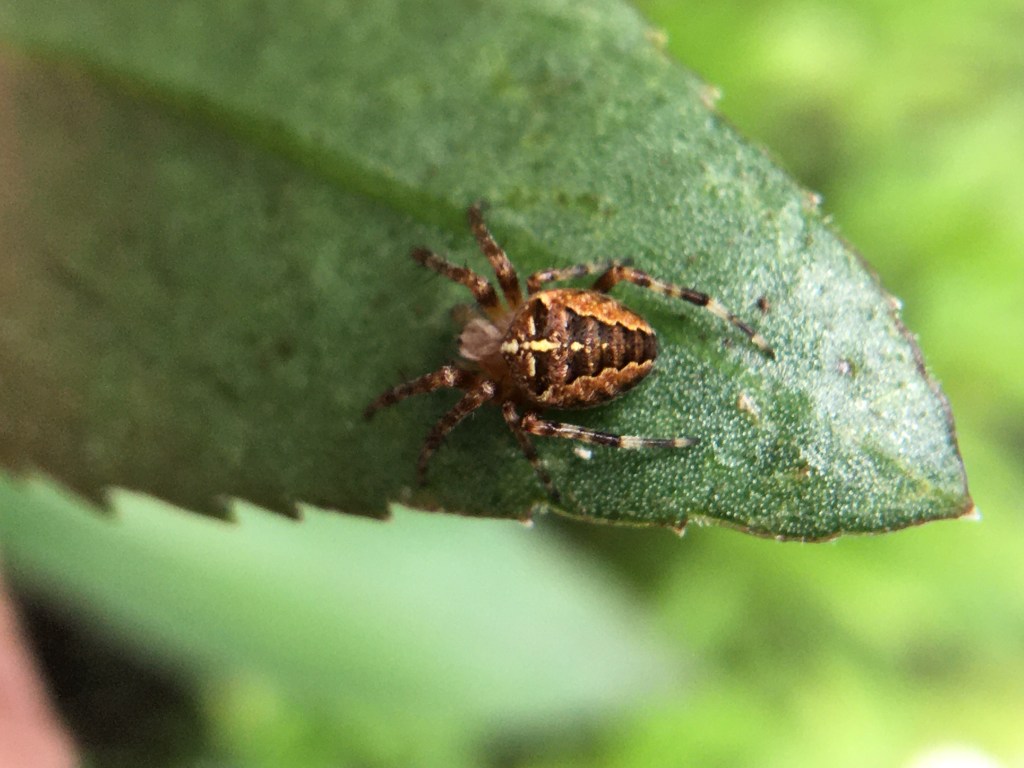
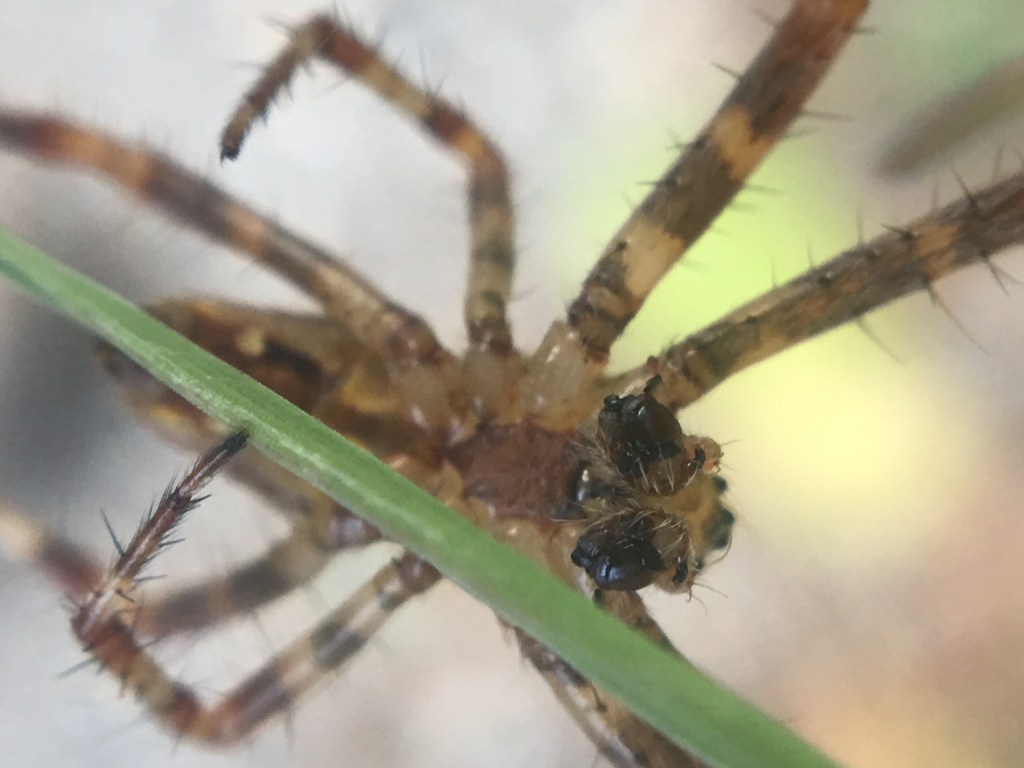
Spiderlings with Pollen Plates
Orb Weaver Spider on Web

Researchers have observed various species of spiders (over 60 species worldwide) feeding on plant foods to supplement their invertebrate prey (Nyffeler et al. 2016).   What exactly does this mean?  Are they going to eat the leaves of your garden plants?  Nah! Not to worry.  They are primarily pest predators in your garden – little helpers to keep those aphids away.  

Spiders have long been thought to only consume insects and other invertebrates.  However, in recent studies, we are finding this isn’t entirely the case.  Observations of spiders foraging in nature has broadened our understanding of the diets of our arachnid friends.  Our prior assumptions were incorrect.  Spiders actually eat pollen grains, floral and extra-floral nectar, Beltian and Müllerian bodies (structures produced by plants on their leaf tips or petioles, plant sap, honeydew (a plant-derived sugar produced by homopteran insects like aphids), seeds, spores, and even the vegetative material in the guts of their invertebrate prey (Nyffeler et al. 2016).  

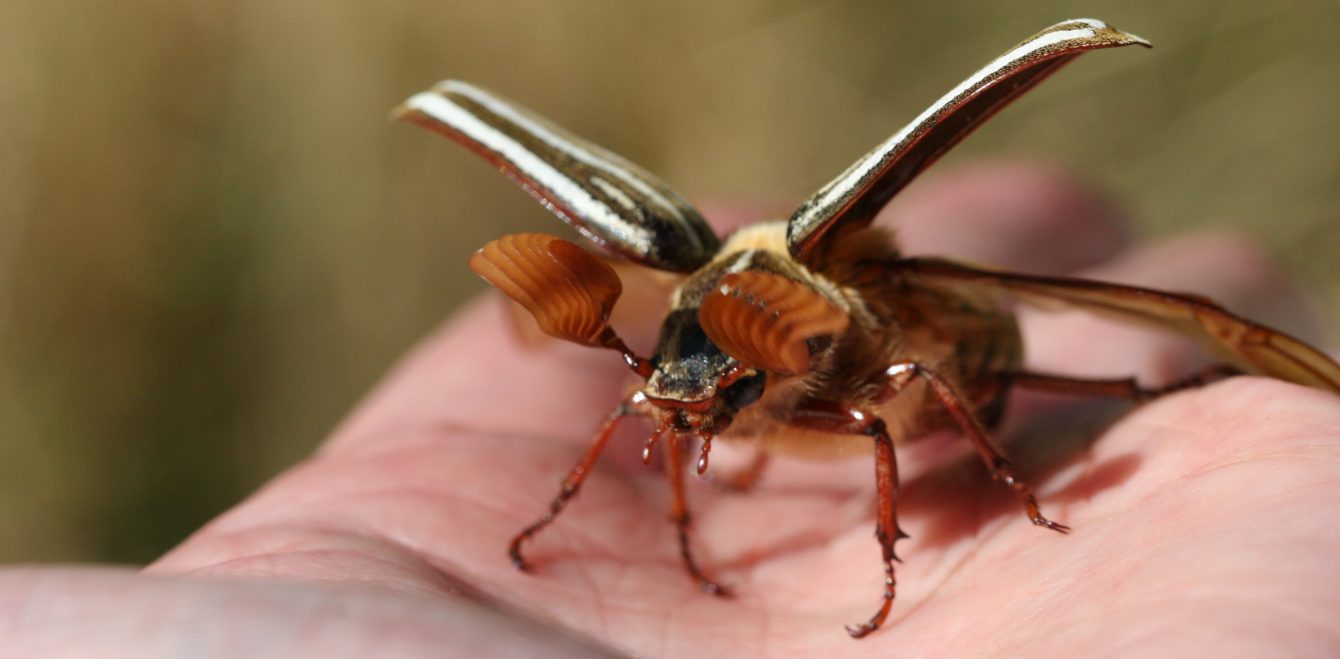
Tree Pollen collected in ground vegetation

I found several papers on this topic, but one of the most interesting to me talked about how pollen is an important source of protein for spiders in early spring when prey may be scarce.  It also pointed out that pollen is a critical food source for newly hatched spiderlings.  Baby Orbweavers for instance.  We have these here in the San Juans.  They are delightful!  

Orb Weaver Spiderlings on my garden chair

Well, since the pollen floats through the air, quite a lot will stick to webs, landing exactly where the little spiders can easily access it.  Smith and Mommsen (1984) even found that Orb Weaver spiderlings doubled their life expectancy by eating pollen.   Eggs and Sanders (2013) concur that pollen is an important dietary supplement for Orb Weaver spiders and found that juvenile orb weaving spiders’ diets consist of approximately 25% pollen.  

So, now you know!  Our little spider friends, or some of them at least, are more complex than we knew.  It’s a good reminder about how important it is to eat a varied and healthy diet.  We can put this into practice ourselves.  Good nutrition is vital for health and survival – for all living beings.  

References

Eggs B, Sanders D (2013) Herbivory in Spiders: The Importance of Pollen for Orb-Weavers. PLoS ONE 8(11): e82637. https://doi.org/10.1371/journal.pone.0082637 https://journals.plos.org/plosone/article?id=10.1371/journal.pone.0082637

Nyffeler, M., Olson, E. J., & Symondson, W. O. C. (2016). Plant-eating by spiders. The Journal of Arachnology44(1), 15–27. http://www.jstor.org/stable/24717357 https://www.google.com/url?sa=t&rct=j&q=&esrc=s&source=web&cd=&cad=rja&uact=8&ved=2ahUKEwjp9dWF97n3AhXQLTQIHTh1CF0QFnoECBsQAQ&url=https%3A%2F%2Fwww.jstor.org%2Fstable%2F24717357&usg=AOvVaw0mZYSQxF6kMinvaqvgB4UT

Smith RB, Mommsen TP. Pollen feeding in an orb-weaving spider. Science. 1984 Dec 14;226(4680):1330-2. doi: 10.1126/science.226.4680.1330. PMID: 17832631. https://www.science.org/doi/10.1126/science.226.4680.1330

September Spider Sleuthing in the San Juans – Day 8 Araneus diadematus, the Cross Orb weaver

Yesterday my husband was outside working on our deck (without much help from me). The weekend projects can be overwhelming, especially when I’m so easily distracted every time I find a BUG. This one was perfect for my post today!

Female Cross Orb Weaver, Araneus diadematus 09.07.2020

First off, it’s a SHE spider! This fall beauty is a female Cross Orb Weaver, Araneus diadematus. She was hanging out on the side of the house, just under the eave. I had to carefully climb a ladder to get a photo, but it was completely worth the risk.

Female Cross Orb Weaver, Araneus diadematus 09.07.2020

Orb Weavers are in the family Araneidae. These are some of the most beautiful and commonly seen spiders in our area. They weave the classic and typically vertical, orb-shaped web that we often see in our gardens.

March 29, 2013, Photo by Cynthia Brast-Bormann

While Araneus diadematus is not a native species and was introduced from Western and Northern Europe, it has become naturalized here and ranges across North America now. Bugguide.net gives the North American (including Canada) range for A. diadematus as the following localities – “diadematus – BC, WA, OR, MI, OH, PA, ON, NY, QC, RI, MA, NS, NL.”

Male and female specimens have different morphology (size, shape). Female body length can be from 6-20mm and they are fuller and more rounded. Male body length varies from 6-13mm and they are more narrowed in body shape.

Male A. diadematus

Typically, even though they are around in spring, we don’t notice them until later in the fall (like now). Females will be waiting on their web for a wandering male to find them. Males are not usually seen on webs since they are often on the move to find “Miss Right.”

The female A. diadematus will lay her last clutch of eggs in fall before dying, usually timed with our first frost. The eggs will overwinter. The eggs will hatch in springtime when temperatures warm, releasing hundreds of baby spiderlings!

June 13, 2013 – San Juan Island “Orb-Weaver Spiderlings”

I found this interesting poem online about Orb Weavers that I’ll leave you with today. Thanks for stopping by!

Araneus diadematus

Our cradle empty, we shall climb

To a high place, to catch the wind

And fly, strewing gossamer as we go,

Singly, flowing without will, to land

Wherever.

We shall know, by the compass

Blotched in white upon our backs,

Where to spin the spokes, and how

To spire the wheel; with one leg, feel

The trembling.

Approach too fast, and we shall quake,

And blur the whorl with shaking

From the underside, the compass

Pointing down, our legs the eight points

Taking.

At night we eat the orb, conserve

The silk, to spin again by morning,

Indelicately, cramming all

Into open mouths, every spoke

Consuming.

We spin the globes of nurture

After mating, span them so,

With loving claws, adore the

Minor worlds we make, compass

Turning.

Entwined in silk, their spinnerets

Are forming, massed bundles

Of eyes, and legs, and fangs

Entangling. Each of us

Expiring.

Source material. Veronica Godines, Araneus diadematus, http://animaldiversity.ummz.umich.edu. Theodore H. Savory, The Spiders and Allied Orders of the British Isles, London, 1945, pp. 130–131. The common “Garden Spider” has a characteristic “cross” on its back, and is the archetypal orb-weaver. Immatures, already orphans by the time they emerge, go out to seek their fortunes by abseiling more or less at random on air-currents, attached to an anchor point by nothing but a thread of gossamer.