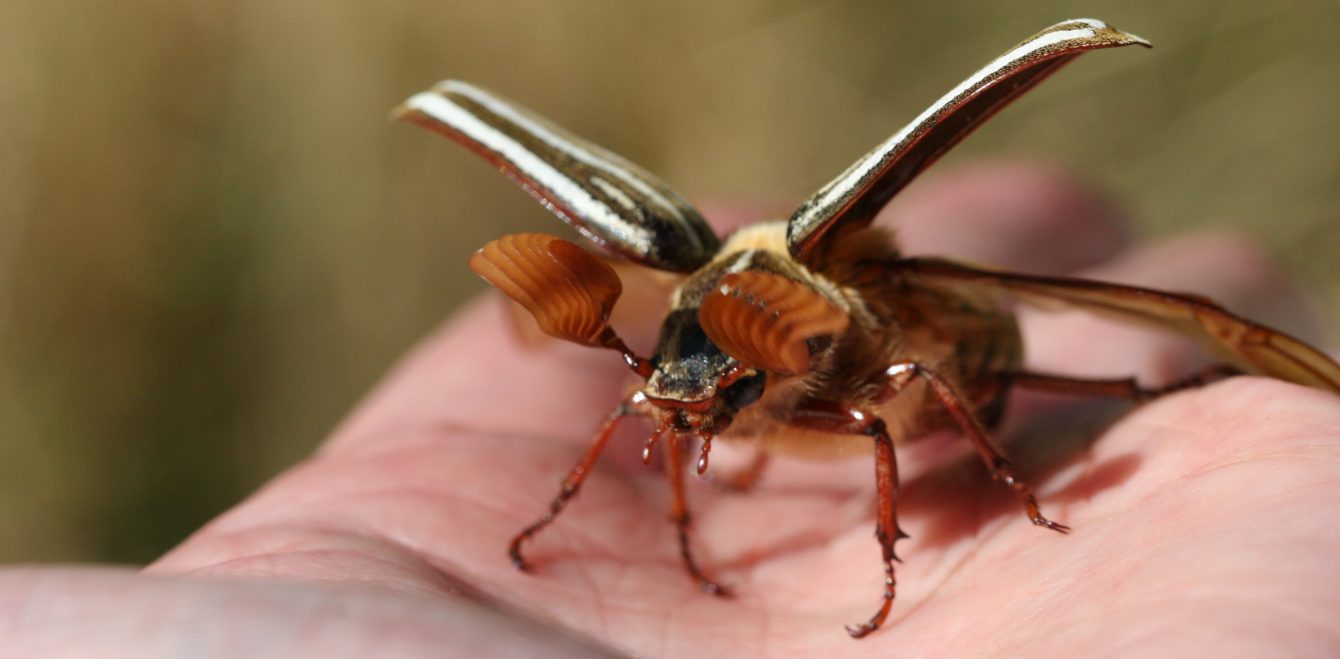
Hemipenthes morioides, a bee fly

Two weeks ago, I stopped by the San Juan County Conservation Land Bank’s office to take a look at the newly transformed “lawn-to-meadow” native plant garden. This sample meadow is an effort coordinated by Land Steward, Eliza Habagger, as part of The Salish Seeds Project (https://sjclandbank.org/the-salish-seeds-project-bringing-back-island-wildflowers/). I was astonished at how quickly (seemingly overnight), the wildflowers planted in this small space bloomed. Aside from being much more appealing than grass, this new wildflower meadow is hosting an assortment of pollinators.

Here’s a species of fly I saw that, at first-glance, looks a lot like a biting deer fly. It is actually a type of Bee Fly in the family Bombyliidae with no common name. Its Latin genus name is Hemipenthes, and this one keys out to Hemipenthes morioides.
Hemipenthes means ‘half-veiled in black’ and refers to the wing pattern seen in this group. I used a key by Ávalos-Hernández (2009) to work out my identification and consulted with another fly specialist who agreed. In the video clip of the fly, it looks to be ovipositing in the sand, indicating my specimen is female. I’ll come back to this in a bit.
Literature describes Hemipenthes morioides flies as hyperparasites (a parasite of a parasite) of the larvae of parasitic flies (Diptera, Tachinidae), as well as parasitic wasp larvae (Hymenoptera, Ichneumonidae). Brooks (1952) cited this species as a predator of the tachinid fly Bessa harveyi, which is a parasite of the sawfly Pristiphora sp. (Hull, 1973). H. morioides has been collected mainly in the western states of the USA (Ávalos-Hernández (2009). They also are known to parasitize caterpillars of moths in the family Noctuidae (Bugguide.net 2020). Preferred habitats are forest edges and meadows.
Of course, this leads me to ask all sorts of questions about how exactly this process of hyperparasitism takes place, especially with regard to being parasites of Tachinid flies. That’s because most parasitic tachinid flies lay eggs directly onto their host’s body. How would the Hemipenthes fly eggs, laid in sandy substrate, get into a Tachinid fly egg laid onto another host?
Do Hemipenthes fly eggs laid into soil hatch, and then migrate through the soil to find an about-to-pupate or already pupating host? As to finding literature specific to Hemipenthes morioides with detailed descriptions about this process in the wild, I wasn’t successful. It seems to be such a complex relationship that chances of observing this happening in a natural setting are slim. For now, I’ll just have to be satisfied with knowing the taxonomy. The rest may remain a mystery…🤔
Except I like to solve mysteries, or try to at least! I reversed direction (taxonomically) in my literature search to see what studies are published around the Family (Bombyliidae). In The Evolutionary Pattern of Host Use in the Bombyliidae (Diptera): a diverse family of parasitoid flies by David K. Yeates and David Greathead (1997), I discovered the “ovipositing” I observed is something entirely different. This female Hemipenthes fly was filling her “sand chamber” or “psammophore,” a ventral abdominal pocket into which the eggs are laid, and a feature unique to “higher” Bombyliidae (Yeates & Greathead, 1997; Calderwood, 2007).
Further, Calderwood (2007) comments in Bugguide.net, “It is said that eggs are coated with sand in the chamber to fascilitate release later. I (Calderwood) think that, given the relative size of sand grains and Bombyliid eggs, the reverse is true: the tiny eggs coat sand grains in the chamber, which are heavy and easier to toss with accuracy, kind of like sticking a piece of gum to a baseball. Ovipositing looks like little aerial dipping movements accompanied by flicks of the keester. Eggs are thrown through the air.” I agree with Calderwood’s statement, and how fascinating this behavior is!
Two weeks later, I’m still threading through a stack of literature about Bee flies Bombyliidae. I’ve discovered that almost all Bombyliidae bee flies (including this Hemipenthes fly) go through what is called hypermetamorphosis. Those eggs, which were flung through the air onto vegetation or the soil substrate will hatch into what is known as a first instar planidium. This is the form of the fly that must search to find a suitable host for development (Yeates & Greathead, 1997).
The planidium morphology is such that it is adapted for mobility/locomotion, host-finding, and attachment. It has an elongate body with two long setae and fleshy pseudopods at the end of its abdomen. There are also a pair of elongate setae on each thoracic segment (Du Merle, 1972). Examples of hypermetamorphosis and this mobile, first-instar form of larvae include quite a few other groups of insects. One example being the one between Strepsipteran larvae (known as triungulins) and Blister Beetles (Meloidae).
I’ll leave you with a nudge to pick up the Yeates and Greathead (1997) paper. It’s really pretty fascinating. Complex?Yes. Studying nature is one of the most intriguing topics you can delve into. There are many intricate pieces all woven together. Yeates and Greathead describe the chance observations of the process of development in Bombyliidae by scientists as serendipitous. I think it’s quite serendipitous that these tiny, first instar larvae ever find a host in the first place. More on Hemipenthes flies below.
Thanks for reading!
Taxonomy (bugguide.net, 2020)
Family: Bombyliidae (Bee Flies)
Subfamily: Anthracinae
Tribe: Villini
Genus: Hemipenthes
Species: Hemipenthes morioides
Identification (bugguide.net, 2020)
Head: Round; dark brown to black.
Male and female: identical, eyes of female only slightly wider, barely discernable.
Antenna: Black, very short.
Thorax: Dark brown to black with rust hairs across shoulders; sometimes thorax is bald. Thorax sides may have some yellowish hairs which do not form a definite line.
Wings: Dark brown, covering about 2/3rds of the wing, lower dark margin step-like. The dark extends to the inner margin or anal cell. Three sets of cross veins have a light mark on each side of the vein, called aureoles. One near base, one about mid-wing, and another small one below (or R4 + R5, M2 and CUP).
Legs: Dark brown with a row of spines on front shin (tibiae). Feet lighter.
Abdomen: Dark brown to black with small to large yellowish spots across each segment and a yellowish line across lower margin. Dark fringe mixed intermittently with some white on side edges of abdomen.
Habitat
Forest edges and meadows.
Season
All season in southern U.S. Late May to August in the north.
Distribution
Canada (British Columbia), USA (Arizona, California, Colorado, Idaho, Illinois, Indiana, Iowa, Massachusetts, Michigan, Minnesota, Montana, New Jersey, New Mexico, New York, Ohio, Oregon, Pennsylvania, Utah, Washington, Wisconsin, Wyoming), Ávalos-Hernández (2009).
References and Further Reading
Ávalos-Hernández, Omar. (2009). A Review Of The North American Species Of Hemipenthes Loew, 1869 (Diptera: Bombyliidae). Zootaxa. 2074. 1-49. 10.5281/zenodo.187152.
Brooks, A.R. (1952) Identification of bombyliid parasites and hyperparasites of Phalaenidae of the prairie province of Canada, with descriptions of six other bombyliid pupae (Diptera). Canadian Entomologist, 84, 357–373.
Bugguide.net. 2023. Hemipenthes morioides. https://bugguide.net/node/view/365221
Dipterists Society. Main Parts of a Fly (Fly Morphology) – https://dipterists.org.uk/morphology
Du Merle, P. 1972. Morphologie de la Larve Planidium d’Un Diptère Bombyliidae, Villa Brunnea,Annales de la Société entomologique de France (N.S.), 8:4, 915-950, DOI: 10.1080/21686351.1972.12278123https://www.tandfonline.com/doi/epdf/10.1080/21686351.1972.12278123?needAccess=true&role=button
Finlayson, L.R. & Finlayson, T. 1958. Parasitism of the European pine sawfly, Neodiprion sertifer (Geoff.)
(Hymenoptera: Diprionidae), in southwestern Ontario. Canadian Entomologist, 90, 223–225.
Hull, Frank M. 1973. The bee flies of the world. The genera of the family Bombyliidae Bulletin – United States National Museum (no. 286 1973). Smithsonian Institution Press. Retrieved from https://library.si.edu/digital-library/book/beefliesofworl2861973hull
Yeates, D. K., & Greathead, D. 1997. The evolutionary pattern of host use in the Bombyliidae (Diptera): a diverse family of parasitoid flies. Biological Journal of the Linnean Society, 60(2), 149-185.

 Bugging You From San Juan Island