Tag Archives: Termites

What does Woody eat in the Forest?
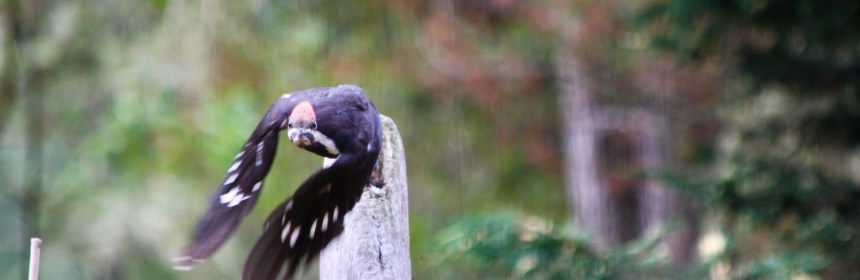
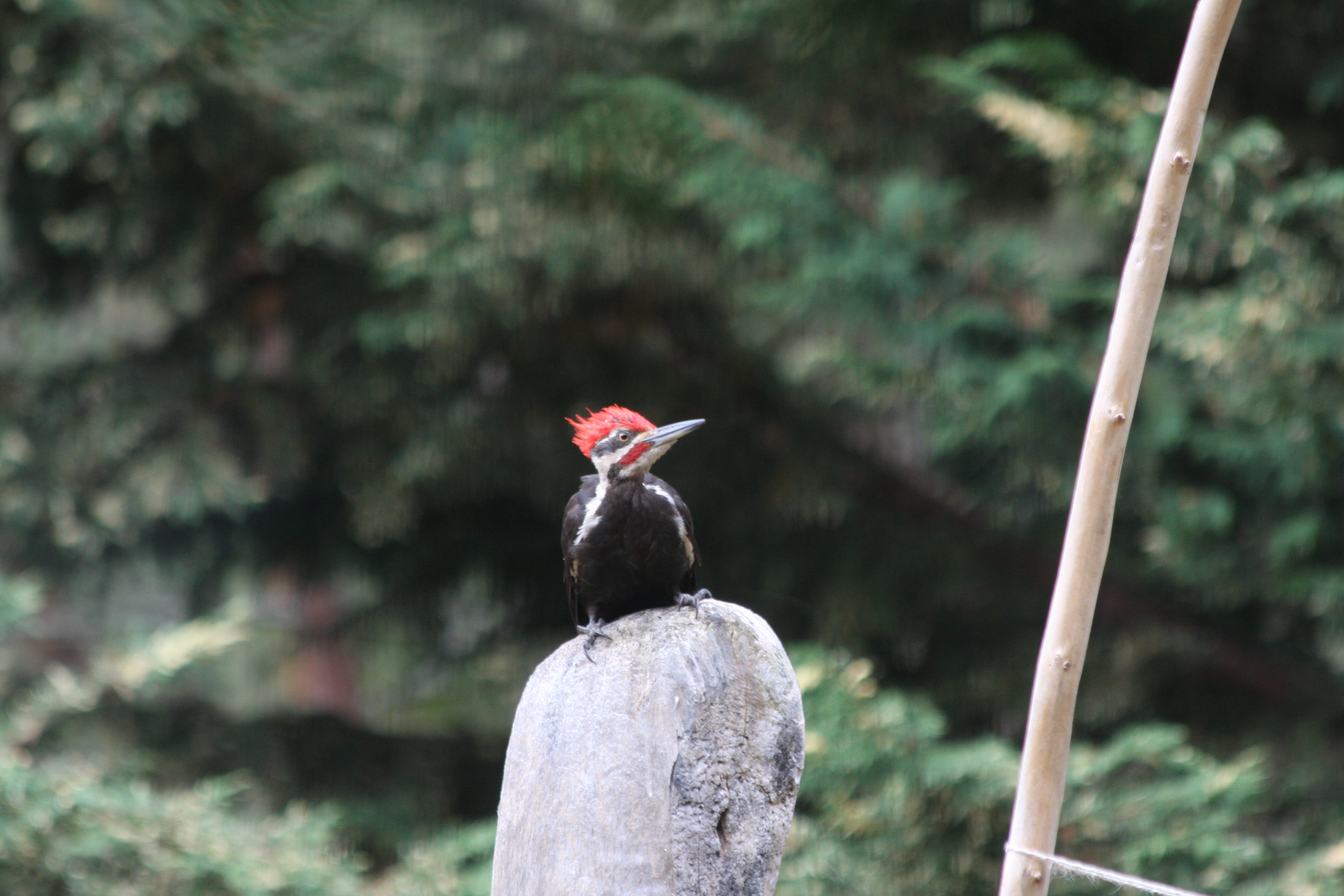
Woody Woodpecker, aka Dad

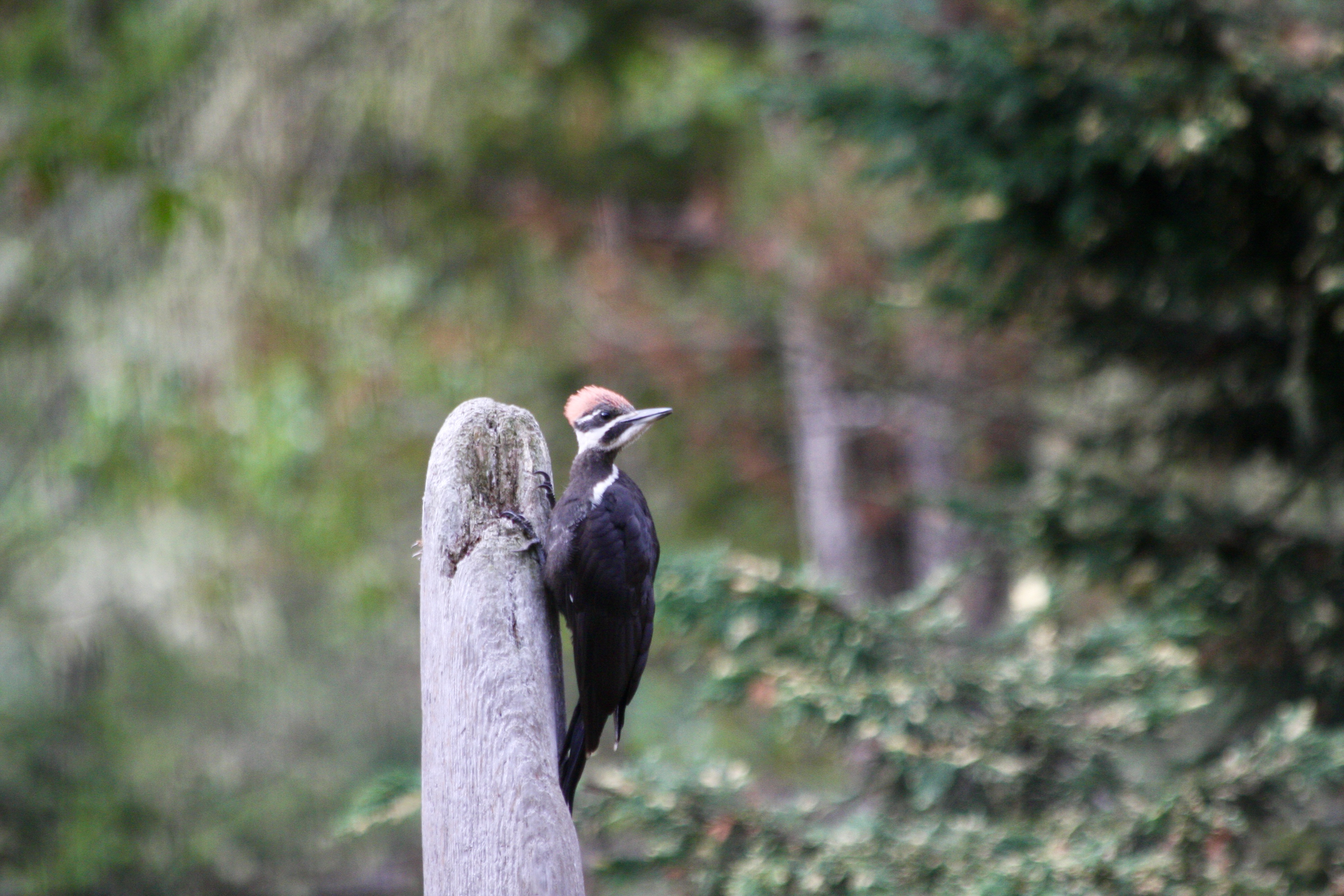
Posting a few photos of our resident Pileated woodpeckers (Dryocopus pileatus) . This is Dad, “Woody,” and “Junior.”

Junior, 2023 offspring of our Pilated Woodpeckers (Dryocopus pileatus)

What do they eat? While they are indeed visiting our suet blocks during their reproductive season and will also come by in the winter when food is scarce, the actual diets of a Pileated Woodpecker (Dryocopus pileatus) or other species of woodpeckers are comprised of many of the wood-boring, tunneling, and wood-eating invertebrates that help forests stay healthy.

How could an insect (or an insect-eating bird) that bores into trees be good for a tree? As the saying goes, “sometimes it is hard to see the forest for the trees.” While this is complicated due to climate change, our narrow views tend to see herbivory or holes in a tree, and even a dying tree as a bad thing.

We have to step back to understand the whole picture – which is – a dynamic process. A healthy ecosystem is not static, but one of renewal and regeneration, always changing. The wood boring bugs that are eating inside a tree are (typically) part of the early breakdown stages of a tree that is already dying. As they tunnel and bore though the dying tree, they help decompose the dying parts, releasing nutrients back into the system for new trees and other organisms to grow.

Compared to a human lifespan, this is not a rapid process, but an ongoing, multi-generational one that sustains many other organisms over a vast period of time. In a nutshell, the birds, like these woodpeckers, take advantage of the dying trees hosting wood boring beetle larvae and other wood-eating or wood-tunneling bugs. As the beetles, and ants, or termites tunnel, chew, or eat through a tree, they attract and feeds other organisms that feed on the insects. The insects and the birds leave behind sawdust and frass which is, in turn, broken down by other organisms – earthworms, millipedes, centipedes, etc. In actuality, the processes at hand are far more complicated, but in a nutshell, healthy ecosystems include death.

When you walk out onto your property and see a dying tree, don’t necessarily see it as a bad thing. Watch for a while. Are the woodpeckers pecking holes? The tree may not fall over for many, many years. As it dies, it will host so many various lives: from spiders in tiny crevices, beautiful moths (often unseen, but important pollinators), iridescent beetles that will emerge from some of those tunnels, woodpeckers, cavity nesting birds, including owls that need a sheltered place to rest and rear young. Just maybe, if you consider these things, you will refrain from taking down and chipping or burning that “dying” or “dead” tree and leave it to stand many years instead. When it does finally fall, perhaps you will consider leaving it to decompose on the forest floor where it will continue to host the lives of many organisms that are necessary and good for a healthy and balanced ecosystem. Nature will thank you. The San Juan Islands are a special place. Let’s not turn our home into a mainland suburbia.


*Fun fact: The diets of Pileated Woodpeckers are known to be comprised of 85% carpenter ants. Re-think your decision to put insecticidal baits out around your property. Those stumps are the equivalent of a grocery store or local co-op for these birds. Leave them to decompose naturally.

References

Bull, E. L. (1987). Ecology of the pileated woodpecker in northeastern Oregon. The Journal of wildlife management, 472-481.

Raley, C.M. and Aubry, K.B. 2006, Foraging Ecology of Pileated Woodpeckers in Coastal Forests of Washington. The Journal of Wildlife Management, 70: 1266-1275. https://doi.org/10.2193/0022-541X(2006)70%5B1266:FEOPWI%5D2.0.CO;2

You Have to Be More Careful With an Island – Please reconsider using those pesticides. They aren’t necessary.

Button Designed and Produced by Nancy May Knapp of Orcas Island, WA

If you live in San Juan County, WA, my blog topic today is for you. I’m seeing some posts on social media lately about pest control that I’m not too crazy about. We have so many people moving to our island now, many bringing with them the mainland suburbia mentality of spraying insecticides all over their yards and homes. Can we help folks understand the slogan, “You Have To Be More Careful With an Island?” 

If you know someone who is concerned about caterpillars, ants, termites, wasps, mosquitoes, or spiders, and they are willing to talk to someone (me), I am more than happy to take a phone call or email to answer questions on how to AVOID use of unnecessary chemicals that can pose health risks to humans, pets, wildlife, and contaminate soil and water.  Most , if not all, use of pest control services are completely unnecessary.   Instead, learning about these organisms can go a long way to reducing fear and being able to coexist and/or tolerate living with them around our homes and properties.  Some species of bugs are extremely critical to keeping our ecosystem healthy and balanced.  ALL of them are part of the greater food web.   With the intense development and land use changes happening in the islands, we need to remember to landscape with intentionality towards keeping our island healthy and oriented towards providing habitat for native species instead of displacing everything.  

How to spread the word? You can message me here. I will respond. You may also reach me on Facebook at Bugs of the San Juan Islands. It’s a great spot to learn about the amazing bugs we have living alongside us.

Thanks for reading!

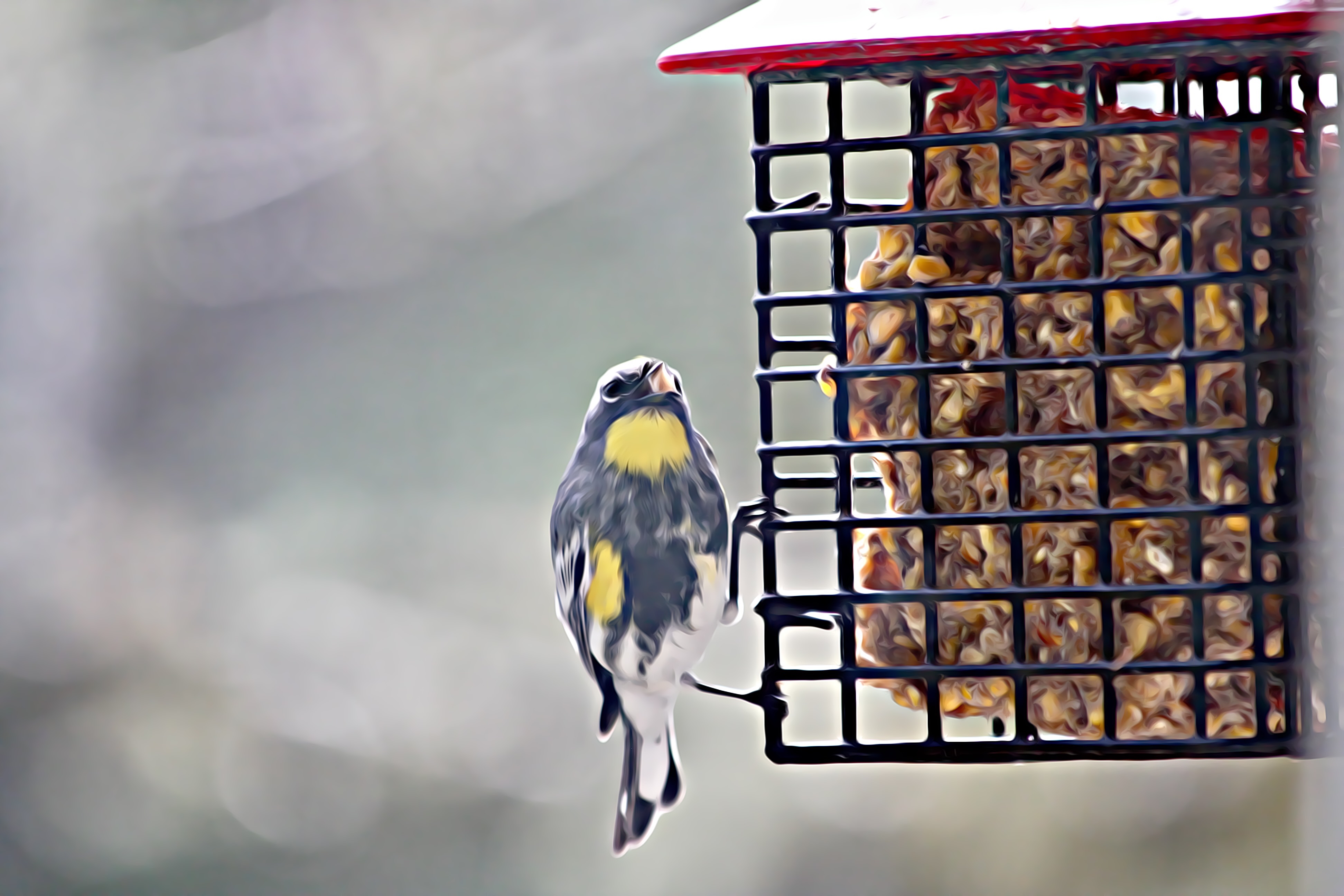
Birdie Buffet

Yellow Rumped Warbler – San Juan Island, WA

I have an observation I was fortunate enough to see in person last September (2021) that I’d like to share, including a short video or two I filmed, and a wonderful animation slide made for me by one of our local San Juan Island artists, April Randall, who I asked to illustrate what I witnessed, but did not have an opportunity to record on camera.

We are entering the season – late summer/early fall, when some species of ants and termites send out their winged reproductives, also known in scientific lingo as “alates.” These flying individuals have reached reproductive maturity and their purpose is utilitarian: to fly away from home, mate, and establish a new colony…IF they are lucky enough not to be eaten or fall to some other random fate in nature.

Over the past seven years, I’ve been able to watch as one particular colony of Western Subterranean Termites (Reticulitermes hesperus) sends out their offspring to do exactly this. The event happens annually during the first 12 days of September without fail. They swarm to the surface, exiting en-masse out of the little hole in the ground, to launch out into the great, wide world. The air is filled with their tiny black bodies and translucent wings – wings that last just long enough for them to disperse far enough away from home, so as to not compete with the parent colony.

Many, or probably it would be fair to say “most” of these winged reproductives or alates, aren’t successful, if by defining success, your measure is for them to begin a new colony. However, if you measure success from another perspective – that of Mother Nature, this event is indeed a success – for Mother Nature hasn’t forgotten the food web and the myriad of other species who must forage for food in order to survive.

In the videos below, you will see a close up of these Western Subterranean Termite alates emerging from their underground colony which lies below our driveway in a network of old Douglas fir roots that were cut down long ago by the former homeowner. As “momma” to a bearded dragon, I included some video of my pet, Drago, feasting on these termites as they emerged. Bearded Dragons are known to dine on termites in their native range in Australia, so I thought, “Why not?” Yes, he loves them! What I unfortunately don’t have video footage of is what we saw after we came back into the house. There was a little flock of Yellow-Rumped Warblers waiting for us (mostly for Drago) to leave that spot. As soon as the coast was clear, those little birds were down on the ground, eating the termites as fast as they emerged.

So here’s where I brought April into the picture. April made the animation and I think it’s important because it gives you something to share with your friends about how the food web works – or how it’s supposed to work. It’s also important because many, many people automatically see termites as something bad, a PEST. While that may be true if they are eating your home, it isn’t true in this case.

These termites have never bothered our home (not once in 7 years). We border a wooded area and there is plenty of habitat that termites need for survival. Some pest control operators will tell you right off though, that you have to be proactive. Get rid of the colony. Well, they also want you to PAY them, so don’t believe everything you hear. What I’d like you to consider is how Mother Nature is providing for these little birds – and other species of wildlife. The Warblers (and other wildlife) don’t have a grocery store to pop into whenever they are hungry. They rely on seasonal (often temporary surges) where food is abundant, so they can eat enough, storing energy to survive whenever they can’t find food. Feast or famine is a common theme for wildlife. They may even have to travel for long distances to take advantage of a resource. Because Yellow-Rumped Warblers can live for 6-7 years, they may well remember how to find this exact spot on our property each year.

Western Subterranean Termites (Reticulitermes hesperus)
Drago, the bearded dragon eats Western Subterranean Termites on San Juan Island – Sep. 12, 2021
Animation by April Randall, Orcas Island, WA

Please feel free to share with you friends and family. I hope you enjoy the animation. This year, I’m going to be waiting with my camera in hopes of capturing this special moment.

About Reticulitermes hesperus:

Lifespan of a Queen – up to 30 years

Family: Rhinotermitidae

Geographic Distribution: along the Pacific Coast (BC-CA-Mexico) east to ID & w. NV

References, Further Reading, and Artist Information

Bugguide (Reticulitermes Hesperus) https://bugguide.net/node/view/183940

Keller, Laurent. (1998). Queen lifespan and colony characteristics in ants and termites [Review]. Insectes Sociaux. 45. 235-246. 10.1007/s000400050084.

April Randall, The Windy Painter – https://www.instagram.com/windypainter/?hl=en&fbclid=IwAR26Joo9sFvw1KUnA_0tiQe2wObCAMTNh8Rzxy6pkZU1WKaMtD_vcmDEliw

Forest Co-habitating Microfauna

Yesterday, my husband took me for a walk in the woods near our home and while I always enjoy the fresh air and the quiet beauty of the woods, I especially appreciate the opportunity to discover new bugs. I was really hoping to come across one beetle in particular, a ground beetle that I’ve only seen three times since September 2009, when I first moved to San Juan Island.

It’s called Matthews’ Angry Gnashing Beetle or Zacotus matthewsii. Zacotus means “very angry” in Greek, though I’m not sure why this beetle would ever act in an angry manner unless you were poking it with a stick. In that case, it’s likely it would attempt to defend itself by gnashing at you with its mandibles, and any bites you receive would be well deserved indeed!

The last sighting I had of a live Zacotus matthewsii was February 18, 2015 at 5:56 p.m. I’m hoping to walk along the same spot again this evening about the same time in hopes of sighting another.

These ground beetles are extremely unique. Their maroon-red metallic coloring is often ringed with a green shimmer along the margins of its body.

Zacotus matthewsii 2/18/15 Three Corner Lake Road San Juan Island, WA

Sadly, the life history of these beetles is understudied. We do know they are only associated with old growth forest ecosystems and rarely seen. When old-growth forests are cut down, the beetles disappear and our opportunity to know them is lost.

While I didn’t find one of these beetles yesterday on our walk in the forest, I did come across some equally interesting residents, cohabitating in a rotten log near a stream. I might have missed them entirely, but for my curiosity leading me to lift off a section of the log. It was a bit like lifting the roof off a house, and being able to see all the rooms and inhabitants, only instead of being a multi-family unit, this was a multi-species, multi-family unit!

I’d packed my cellphone and my handy clip on macro lens, so I was able to take some video and photos to share with you. Here’s what I found!

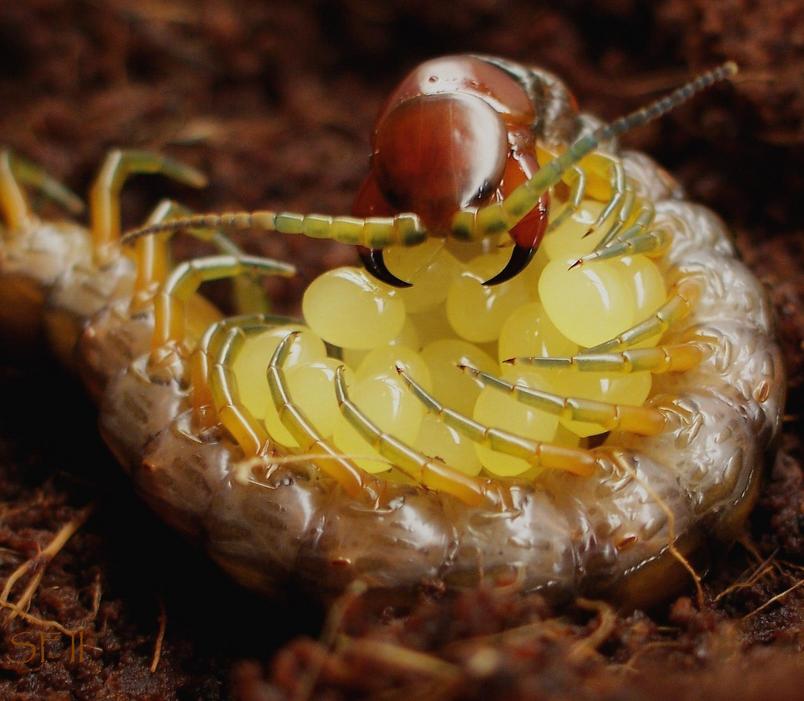
The first amazing creature that was exposed in the log was a centipede. This is Scolopocryptops spinicaudus. I noticed nearby, there was a grouping of eggs, so after a bit of internet searching, I discovered the very neat fact that these (and other species) of centipedes stay with their eggs.

The mother will wrap herself around the cluster to better protect them, staying with her brood even weeks after they hatch, leaving them only after they are able to fend for themselves. I believe this mother centipede moved away from her eggs when I removed the section from the log in order to draw my attention away from them.

***Eggs were not disturbed and I replaced the log section after taking my photos.

Scolopocryptops spinicaudus Centipede with eggs
Scolopocryptops spinicaudus with eggs
2/16/2020
Lester Parcel
Scolopocryptops spinicaudus (Centipede) eggs 2/16/2020 Lester Parcel

Below is a photo I found when I was searching about centipedes and parental care. I find it amazing that even invertebrates show such care for their offspring!

Centipede caring for eggs
https://www.ebaumsworld.com/pictures/19-pics-that-are-just-plain-fascinating/84587206/?view=list

The next resident in the log that caught my eye was the very tiny, whitish-translucent, globular creature that looked a lot like a bark or booklouse, but turned out to be a “baby” termite. These were larvae of the Pacific Dampwood Termite, Zootermopsis angusticollis. I wasn’t able to get a good view, but it looked as if these were being tended by an older family member.

Dampwood termites are widespread in Pacific Northwest forests. They rarely cause damage to structures, but play a very important ecological role, recycling nutrients from decaying trees. They are also food for Pileated Woodpeckers and other birds and animals.

Pacific Dampwood Termite (Zootermopsis angusticollis) larvae
2/16/2020 Three Corner Lake Road, San Juan Island, WA
Zootermopsis angusticollis larvae

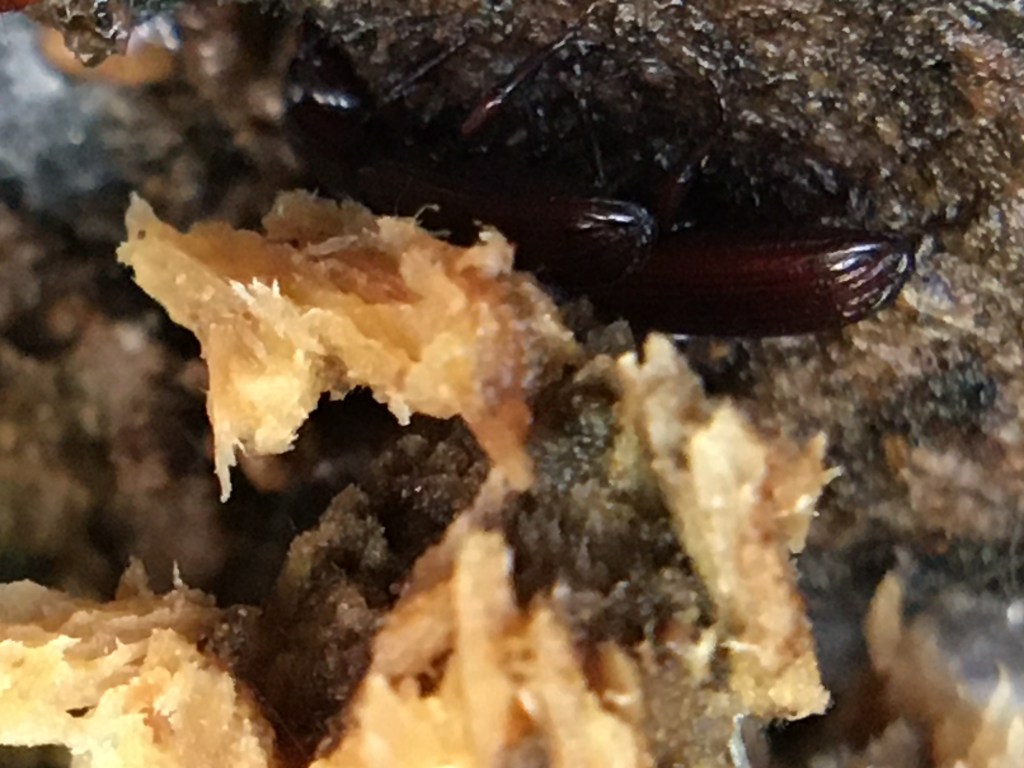
Finally, the last residents I spied cohabitating in this section of rotting log were the very tiny Wrinkled Bark Beetles (Clinidium spp.) Clinidium spp. of bark beetles feed on slime molds (Myxomycetes), found in decaying or dead hardwoods and conifers. They are in the Family Rhysodidae and there are only two genera and eight species in North America. Only two of these eight species range in the West (from California to B.C. ) (White, 1983).

At about 5mm in length, these were hard to detect with the naked eye. I took the following photos with my macro lens, showing the striations along the elytra and the lateral grooves on the basal half of the pronoun.

Wrinkled Bark Beetle (Clinidium spp) 2/16/2020

The next photo shows two adults together, presumably hibernating together in a cavity in the rotting log (White, 1983) .

Wrinkled Bark Beetle adults hibernating together (Clinidium spp) 2/16/2020

References

Lattin, John, D. 1993. Arthropod Diversity and Conservation in Old-Growth Northwest Forests. American Zoologist. 33 (6) pp. 578-587. https://www.jstor.org/stable/3883721

White, Richard. 1983. A Field Guide to the Beetles of North America. Peterson Field Guide Series. Houghton Mifflin Company, NY.