Tag Archives: Tipulidae

Tiger Craneflies (Phoroctenia vittata angustipennis)

Tiger Craneflies (Phoroctenia vittata angustipennis)
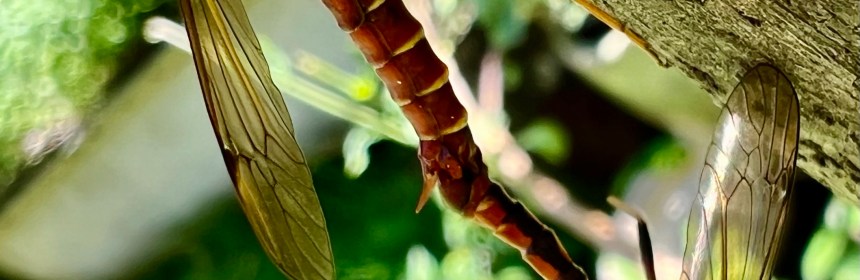
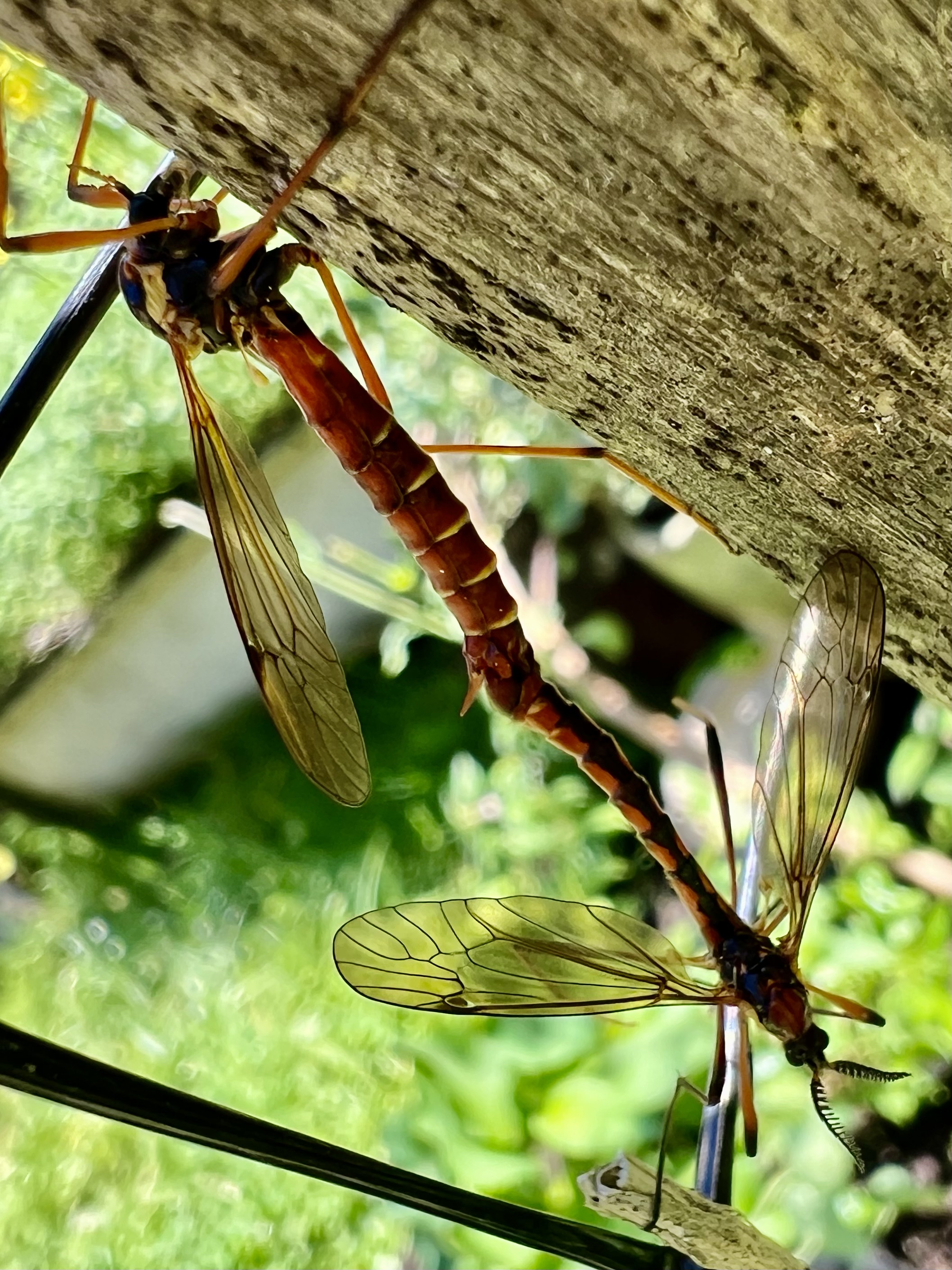
I finally got a few photos of these two after trying (and failing) in my attempts when I first spotted them on Sunday. Curiously, they were “bumping” onto tiny little cones on our fir tree, creating intermittent bursts of pollen with each “hit.” I wondered if they were perhaps eating pollen in advance of mating – with protein a necessary element in egg production.

These flies aren’t extraordinarily abundant. I checked my bug records, and the only other one I’ve seen in the yard was May 2, 2021. They are unique enough that I remembered looking them up and finding that the West Coast species is actually a subspecies, thus the 3rd name, angustipennis, tacked on to the binomial (Phoroctenia vittata).

Going back through my computer, I did find my previous source. Sometimes my computer filing system actually works and I remember to put labels and tags on my saved papers. It makes it so much easier to find them again! Re-reading the paper by Oosterbroek, Pjotr & Bygebjerg, Rune & Munk, Thorkild (2006), I was especially interested in their antennal illustrations, but found another part about the larvae interesting. They state, “the larvae of all these species develop in decaying wood of deciduous trees and might turn out to represent an especially significant conservation and monitoring element of the saproxylic fauna, as most of the species are rather scarce and some of them even very rare. Moreover, they are usually confined to old forests, orchards and similar habitats where there has been a long continuity of the presence of old, dying and fallen trees (Stubbs 2003).”

Our Landscape is Changing

The area near our home has remnants of older growth trees, though many are being cut and cleared for development, and the creation of homesteads. I worry that we will lose some of these species as the forests become more and more fragmented and the trees are more stressed with the advent of higher temperatures brought about by climate and landscape change. Yes, cutting trees = hotter spaces. We need trees! And bugs. Or will sorely regret our choices and actions when we are face to face with the reality of the great die-off of species.

Back to the antennae for these Tiger Craneflies. Can you spot the male and the female in my photos? The male antennae are quite distinctive with their comb-like shape. Entomologists describe the comb-like antennae as Pectinate. If you haven’t figured it out yet, the male is the smaller of the pair. His antennae are wider, and he’s hanging on the bottom.

Tiger Craneflies (Phoroctenia vittata angustipennis) – Note the striking comb-like antennae of the males 

Why might craneflies be useful? Well, aside from population size being an indicator for forest ecological relationships, they make great food for wildlife, especially baby birds and their parents.

Isn’t nature amazing! Thanks for reading.

References and further reading

Saproxylic definitionhttps://www.amentsoc.org/insects/glossary/terms/saproxylic/#:~:text=Saproxylic%20invertebrates%20are%20those%20invertebrates,stage%20is%20dependent%20on%20wood.

Bugguide.net Subspecies Phoroctenia vittata angustipennis https://bugguide.net/node/view/109143

Oosterbroek, Pjotr & Bygebjerg, Rune & Munk, Thorkild. (2006). The West Palaearctic species of Ctenophorinae (Diptera: Tipulidae): key, distribution and references. IEEE Transactions on Information Theory – TIT. 138-149.
https://www.researchgate.net/publication/237714614_The_West_Palaearctic_species_of_Ctenophorinae_Diptera_Tipulidae_key_distribution_and_references

Winter Crane Fly

It snowed on San Juan Island this week.  We were forecast to have LOTS of rain yesterday, but instead we got more snow.   So much snow that this former Texas gal just had to get out and experience the magic of our wooded, winter wonderland.

IMG_2168.JPG

I got my coat, hat, and boots on, grabbed my iPhone and a pair of gloves, wrapped a scarf around my neck and set off to walk down our lonely country road.

Hoping to photograph some of our year-round feathered residents, I had my camera phone in hand.  It was really cold outside and yet I couldn’t use the touchscreen wearing my glove.  Off it came.  I could sacrifice cold fingers if I could get a shot of one of the woodpeckers or maybe a Varied Thrush.

Heading down the driveway, I noted the way the limbs of the cedars and firs bowed down under the weight of the snow.  Beneath them, little birds scurried, scratching about in the damp humus or flitting about on lower branches, enjoying a protected shelter from the cold.   It took only a moment to spy a  Dark-eyed Junco near the house on a leafless limb of our cherry tree and the Varied Thrush perched just above my head…perhaps waiting to see if I brought more seed out for them.

fullsizeoutput_1993

Dark-eyed Junco (Junco hyemalis)


fullsizeoutput_1999

Varied Thrush


A bit further down the driveway, I smiled when I saw our little carved bear.  He’s not long for this world.  The carpenter ants and the damp weather are slowly turning him into sawdust….but he rallied under his snow blanket today even though his little black nose was about all you could see.

img_2154

Snow Bear


Wait…isn’t this post about a Winter Crane Fly?  Well, I’m getting to that part.   I certainly wasn’t anticipating seeing any invertebrates out on a day like this.  While I’ve heard of snow fleas (not really fleas, but tiny invertebrates known as collembolans or springtails) or snow scorpionflies (Boreus spp.) found in winter in our forested area, I’ve yet to see them.   It’s really a mystery how so many of these tiny creatures survive the extreme temperatures, but that’s also what makes them so interesting.

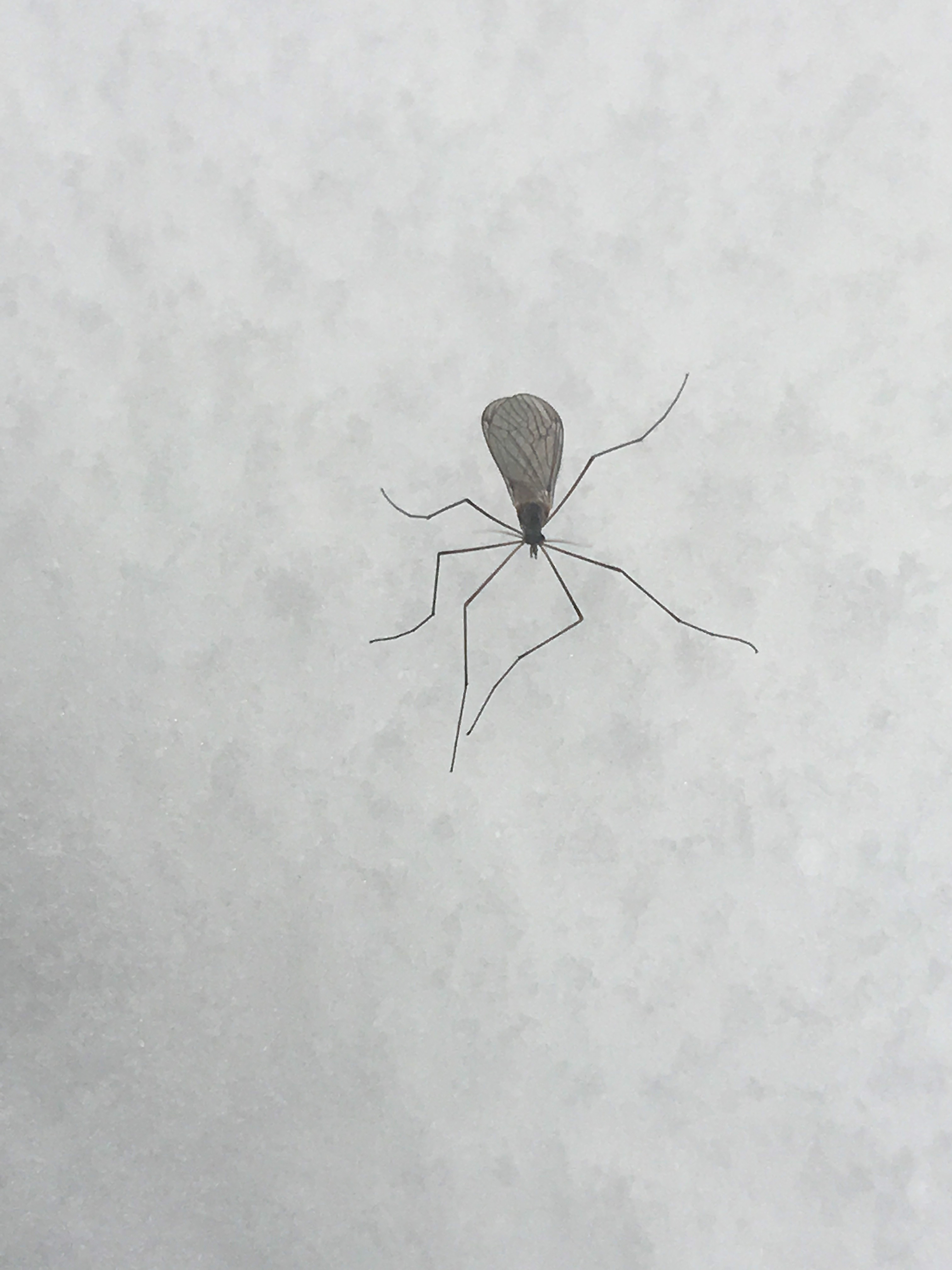
I came across the first of about ten of these tiny, winged “cranes” before I’d made it far down the road.

wintercranefly-img_2164

Winter “Crane”

We live in a somewhat densely forested area.  Not many houses or development to interfere with the important ecological processes going on in the natural world.  At first, it appeared to be a mosquito.  Go figure. Somehow they thrive in Alaska, Minnesota, even the Arctic…in spite of frigid temperatures!

Looking closer, I speculated it was in the family Tipulidae, a common, but harmless, mosquito-looking, awkward flying, long-legged fly!  I had to do some research to figure it out.  The Tipulids are a genus in the insect order (Diptera) and commonly called “Crane Flies.”  However, a bit of digging into the literature proved I was close to my ID of this creature, but not quite there.

What I discovered is that this is indeed a Crane Fly, but not a Tipulid.  It’s a WINTER Crane Fly in the genus Trichoceridae.  They are found flying on “warm sunny afternoons in fall, winter, and spring in the contiguous U.S., including Alaska and Canada” (Pratt 2003).  In his study, Pratt (2003) observed specimens “swarming above or on the snow in temperatures between 0℃ and 10℃.”  Maybe “warm” is subjective here!

This tiny Winter Crane Fly is very similar to the Tipulids or True Crane Flies with its long slender legs, but it differs in classification because the Winter Crane Fly has three ocelli (https://www.amentsoc.org/insects/glossary/terms/ocelli)  or simple eyes that act as light sensors and are found on top of the head.  The larvae of Trichocerid flies develop in the moist humus and decay of the forest floor and undoubtedly play some ecological role in this environment i.e. in decomposition or nutrient recycling.  At a minimum, they are a nice protein-rich winter meal supplement for the little birds I’ve seen on my walk today.

While I’m not certain of the exact species, in the article by Pratt (2003), adults of one species, Paracladura trichopera, are found flying even in winter in British Columbia, Washington, Oregon, and California.   Perhaps it will suffice to say that I was intrigued at the cold-hardiness of such a tiny creature.  And I DO like the name, Winter Crane Fly!

winte-crane-fly-2-jpeg

Winter Crane Fly Trichocerid spp.


References:

1. The winter crane flies of North America north of Mexico (Diptera: Trichoceridae)
Pratt H.D. 2003. Proc. Entomol. Soc. Wash. 105: 901-914.  http://www.biodiversitylibrary.org/page/16212448