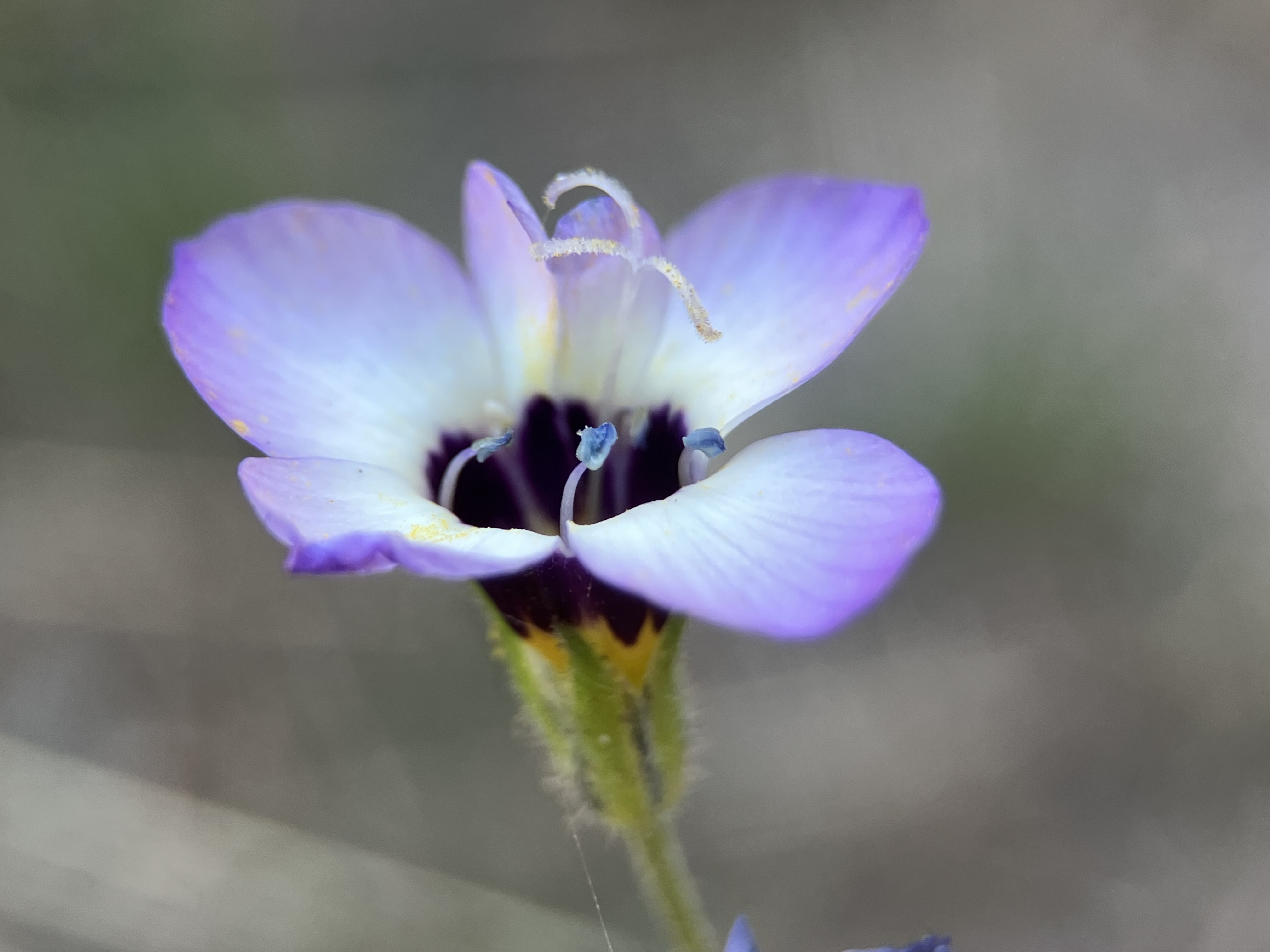
I’m quite fascinated by the rapid colonization of the very dry soil in the strip where our internet fiber cable was installed this past spring. Because disturbed soils can be great for seeding native wildflowers, I threw out several packets of a Pacific Northwest seed blend to see what might grow and I’ve been checking often to see what is coming up. In spite of the very dry weather we are having, there are some lovely Bird’s-eye Gilia (Gilia tricolor) blooming now.
Bird’s-eye Gilia (Gilia tricolor)
I see some Farewell to Spring (Clarkia sp.) popping up too, though they have not bloomed yet. There are others I have yet to identify. It’s been so hot and dry, I’m hoping the lack of water doesn’t ruin my efforts at re-wilding this spot.
In spite of the dry, cracked earth, there are Andrena sp. mining bees already claiming this strip. There are little holes everywhere.
I also saw one quite unique hole surrounded with round dirt “pebbles,” that looked to have been arranged to mark the entrance.
As I leaned closer to inspect this architectural oddity, I saw something I would never have even noticed without the help of my macro lens. It was a colony of Globular springtails (Fasciosminthurus quinquefasciatus). There were easily about 8 or so. Can you spy the one on one of the “pebbles?”
I was able to get one or two in focus. These springtails are incredibly small – perhaps only 1mm, and recognizable by the 5 transverse bands (jailbird stripes) across the dorsal abdomen. This species is unique among springtails in that while most species require moist habitats to survive, F. quinquefasciatus thrives in arid environments with little to no vegetation in areas with southern or south western exposure.
If you follow closely in the video here, you might notice that the individual I was tracking either pooped or laid an egg on that piece of straw (between the 45 and 55 second mark. I will add some still shots clipped from the video as well.
Globular springtail (Fasciosminthurus quinquefasciatus)Globular springtail (Fasciosminthurus quinquefasciatus) leaves behind a small white objectGlobular springtails (Fasciosminthurus quinquefasciatus)
A personal note ~ While our daily lives are often complicated with work and family obligations, as well as anxieties many of us have about climate change and political uncertainties, taking time to notice the natural world around, even in seemingly uninhabitable habitats can bring a bit of hope. There is life around us. We just might have to sit on the ground and get dirty to see it.
Thank you for reading and thank you for caring about nature.
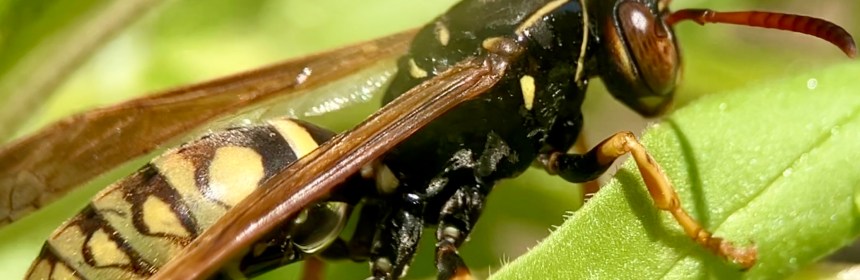
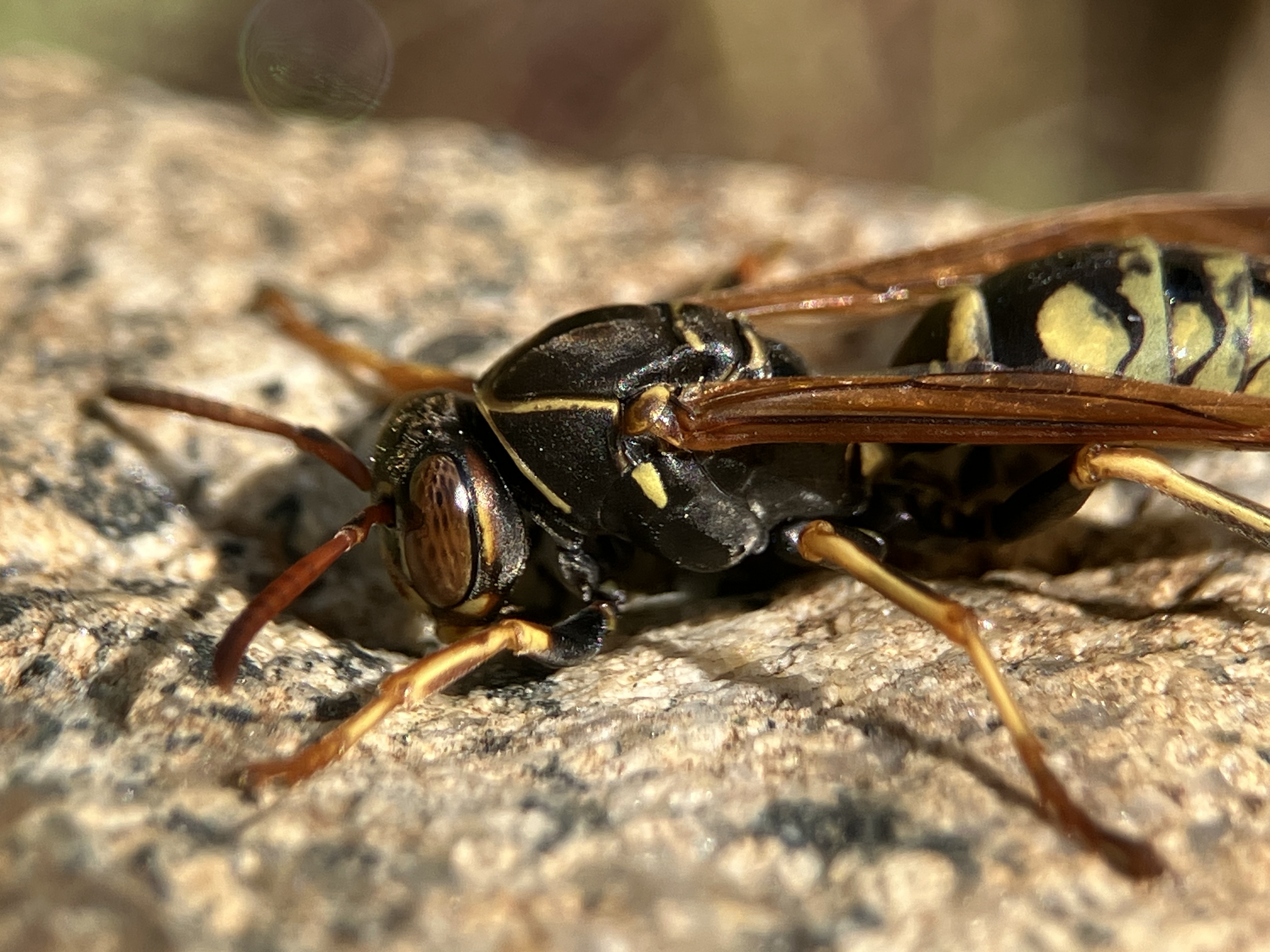
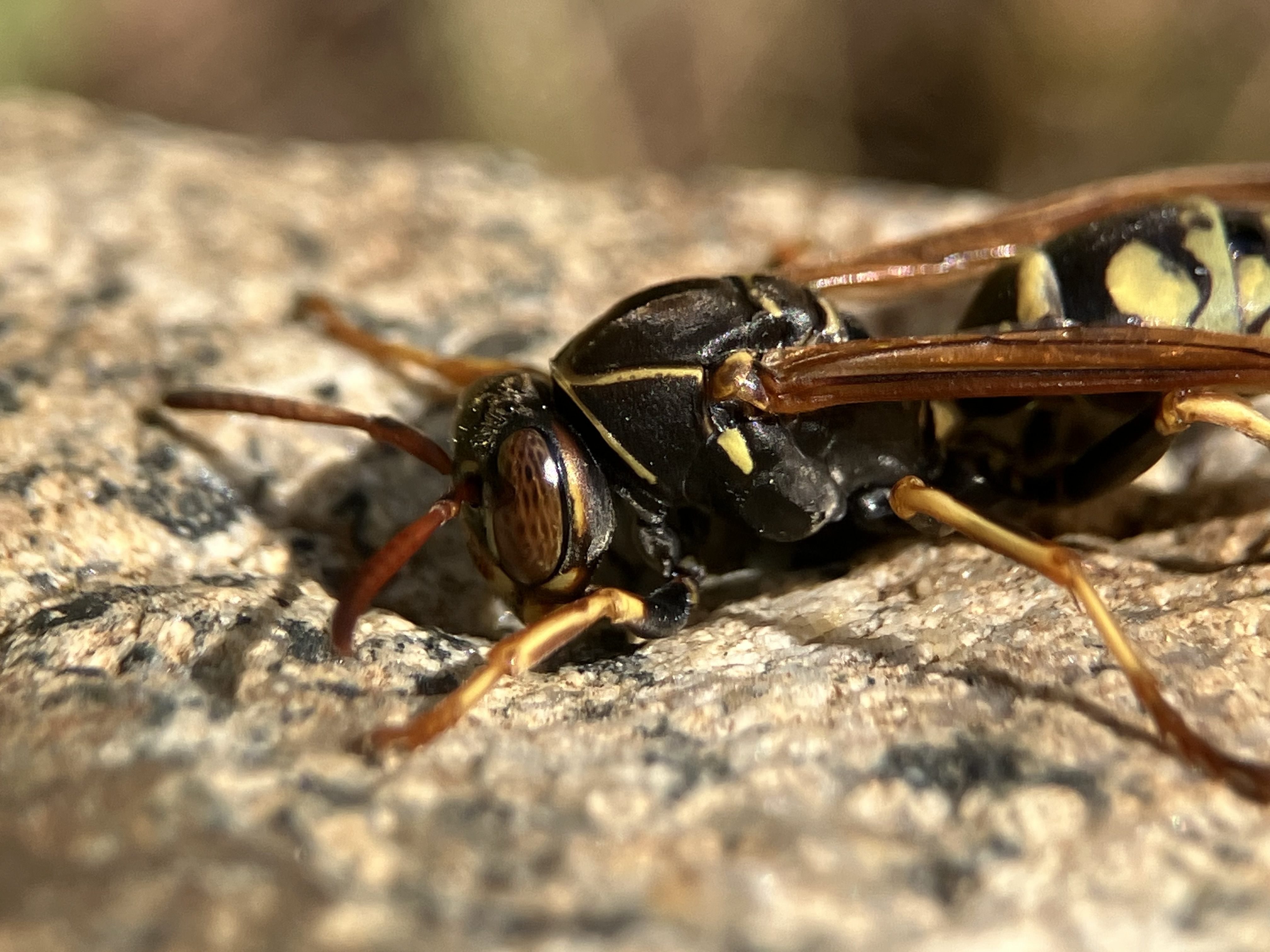
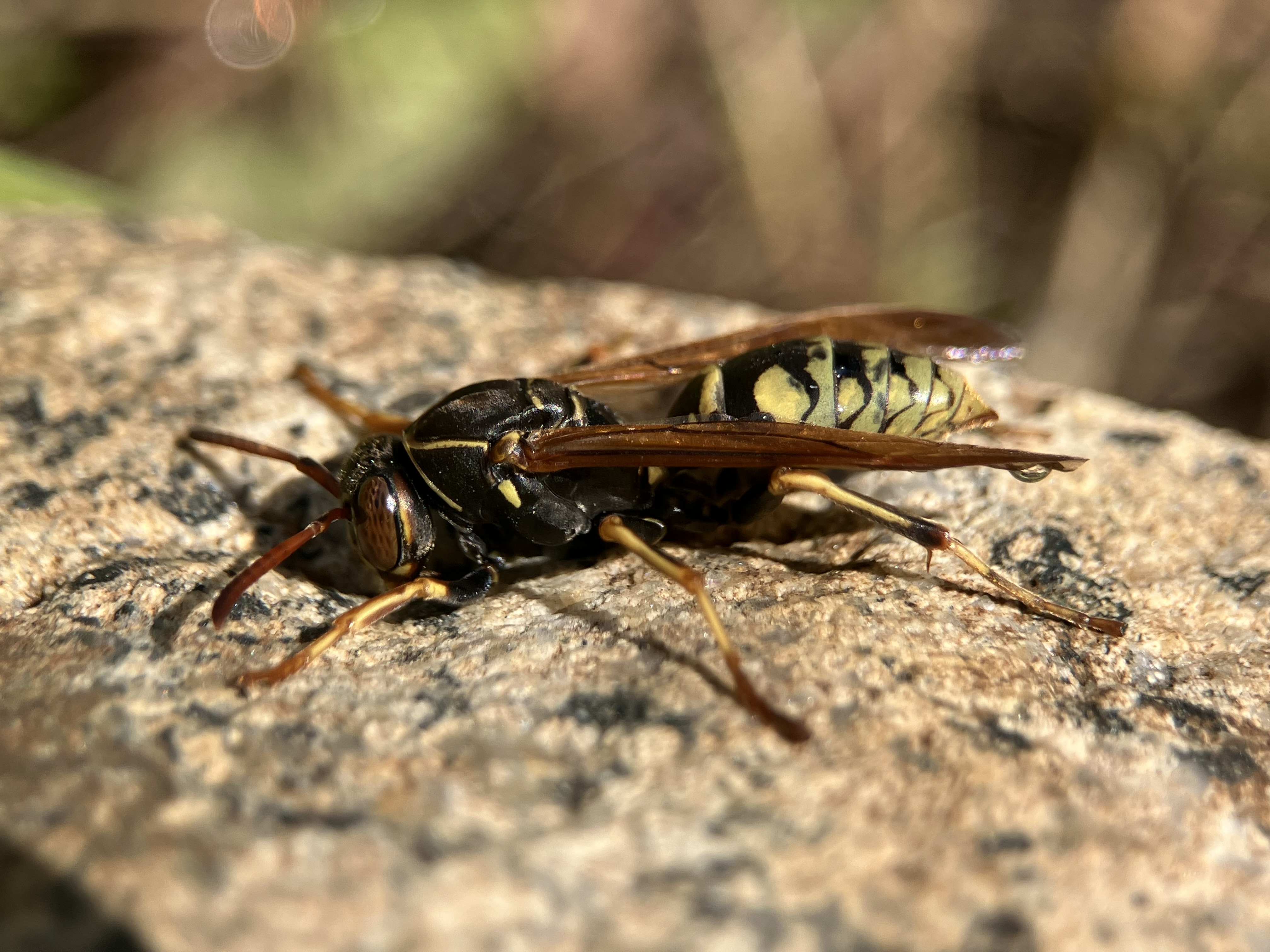
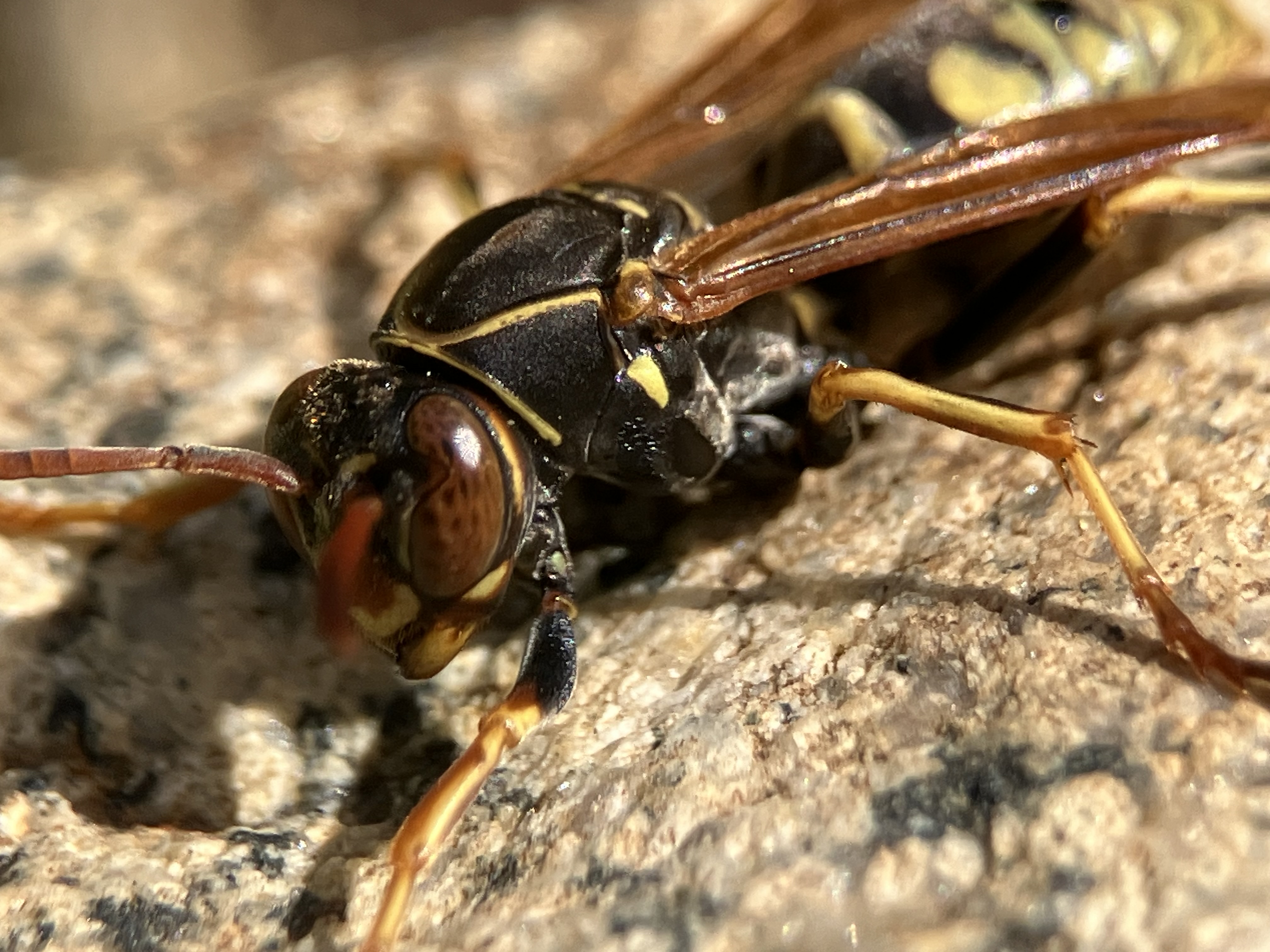
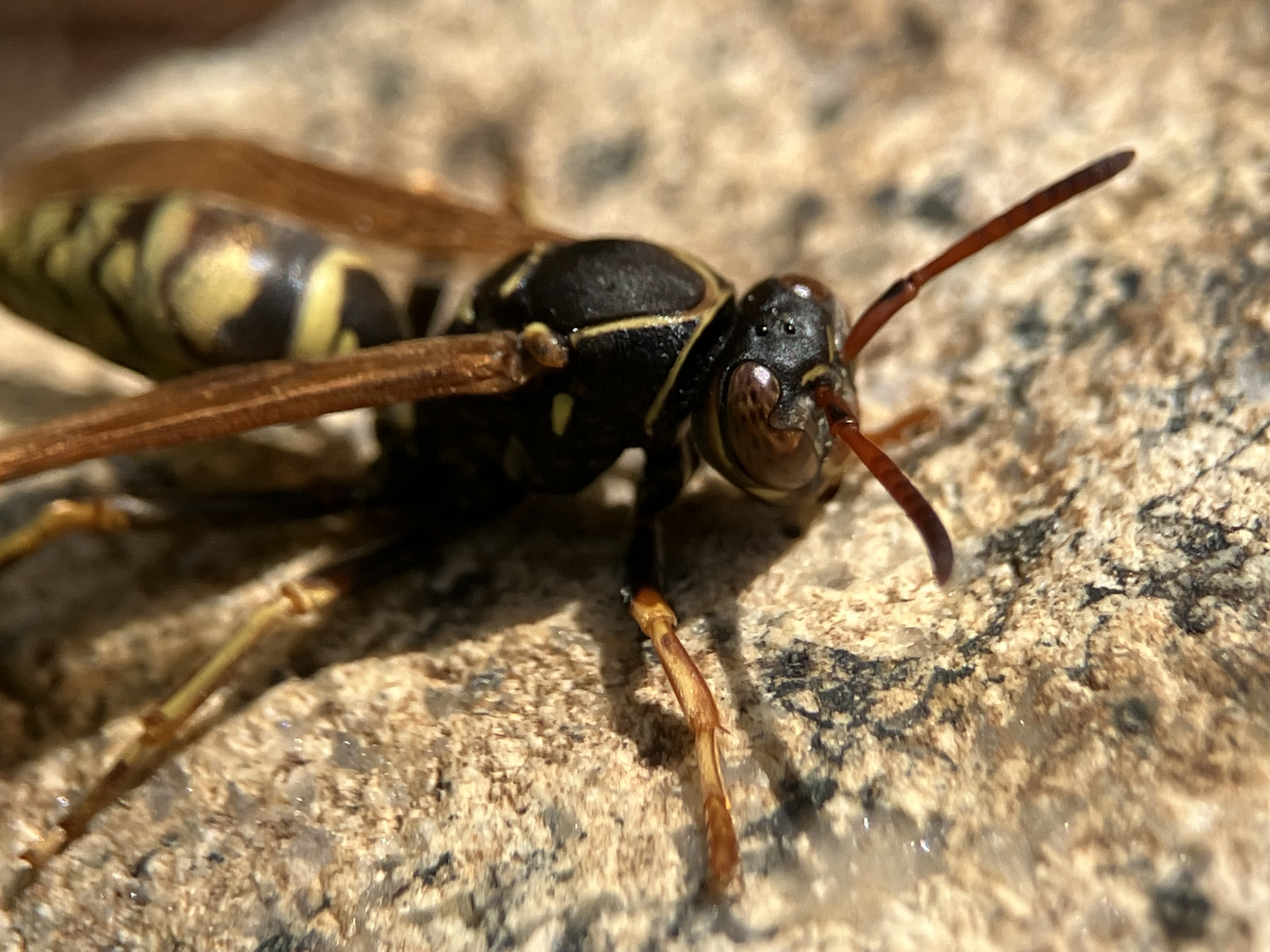
The other morning when I was watering our garden, I spied the most beautiful creature I’ve seen in a long time, a Golden Paper Wasp (Polistes aurifer). In fact, in sixteen years of living on San Juan Island, I have only seen one colony of these wasps (April 14, 2024) at the San Juan County Land Bank’s Mount Grant nature preserve. These wasps are native to North America and once considered a subspecies of Polistes fuscatus. However, P. aurifer has a western geographic distribution ranging from BC-CA to AB-MT-w.TX; ne. Mexico (Bugguide.net).
Polistes wasps build open faced nests suspended by a petiole in varied sites. Some select relatively exposed areas under eaves of structures or in shrub-type vegetation, while others utilize more protected cavities such as abandoned rodent burrows or hollow trees. Most often, the ones we see are the non native European paper wasp species (Polistes dominula), that seem very comfortable establishing their nests under the eaves of our homes.
It is believed the more frequently observed (P. dominula) are displacing native Polistes aurifer, but since it is more difficult for scientists studying insects in natural or wild habitats, most formal observations have taken place utilizing sites associated with man-made dwellings (Liebert, 2004). Liebert published a short communication in Insectes Sociaux (2004) where she describes finding ground nesting colonies of this species at an observation site in California, and concludes that the “displacement” theory may be overstated. However, given the loss of natural areas due to habitat loss/conversion, a decline in populations of the native P. aurifer (I believe) would more accurately be attributed to humans. Humans also unfortunately resort to wasp spray to eradicate nests around their homes without understanding that most nests pose minimal or no risk to human comings and goings.
Polistes wasps (native and non-native) are generally considered to be beneficial insects. They are pest predators, capturing and dismembering caterpillars to feed larvae they are rearing. In Eastern and Southern regions of the U.S., some species of Polistes wasps exert significant pressure on the cotton bollworm and the tobacco hornworm, both pests of considerable economic significance.
If you spy one of these Western natives, you’ll know immediately because they have the most beautiful golden brown or caramel colored eyes!
Thanks for reading. 🙂
Polistes aurifer
Polistes aurifer
Polistes aurifer
References
Bohart, G. E. 1942. Notes on Some Feeding and Hibernation Habits of California Polistes (Hymenoptera, Vespidae). Pan-Pac. Ent. 18(1): 30-31. https://digitalcommons.usu.edu/piru_pubs/15/
Buck, M., Marshall, S.A. and Cheung D.K.B. 2008. Identification Atlas of the Vespidae (Hymenoptera, Aculeata) of the northeastern Nearctic region. Canadian Journal of Arthropod Identification No. 5: 492 pp. (PDF version). Published on 19 February 2008. With 3 Tables and 1073 Figures.
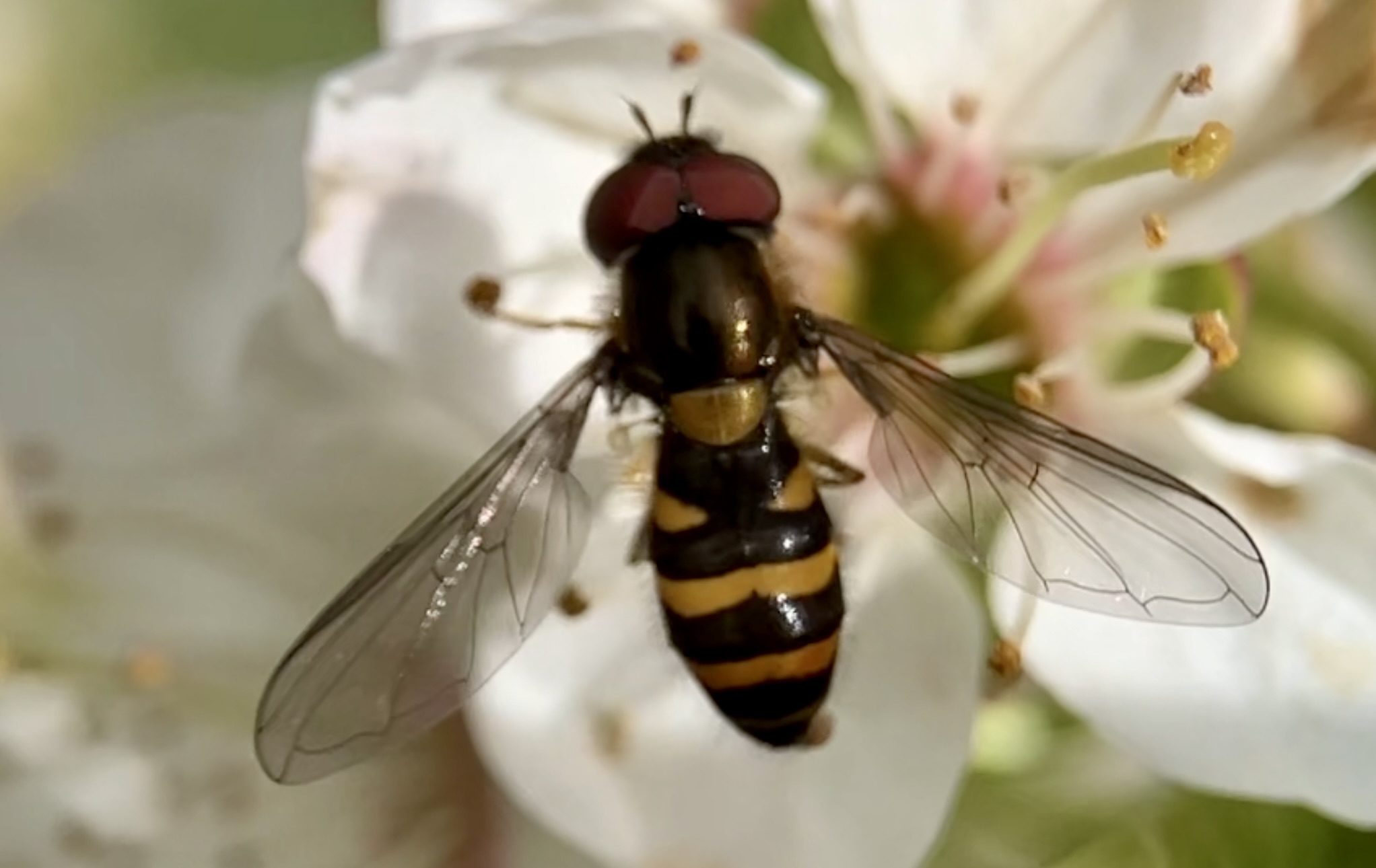
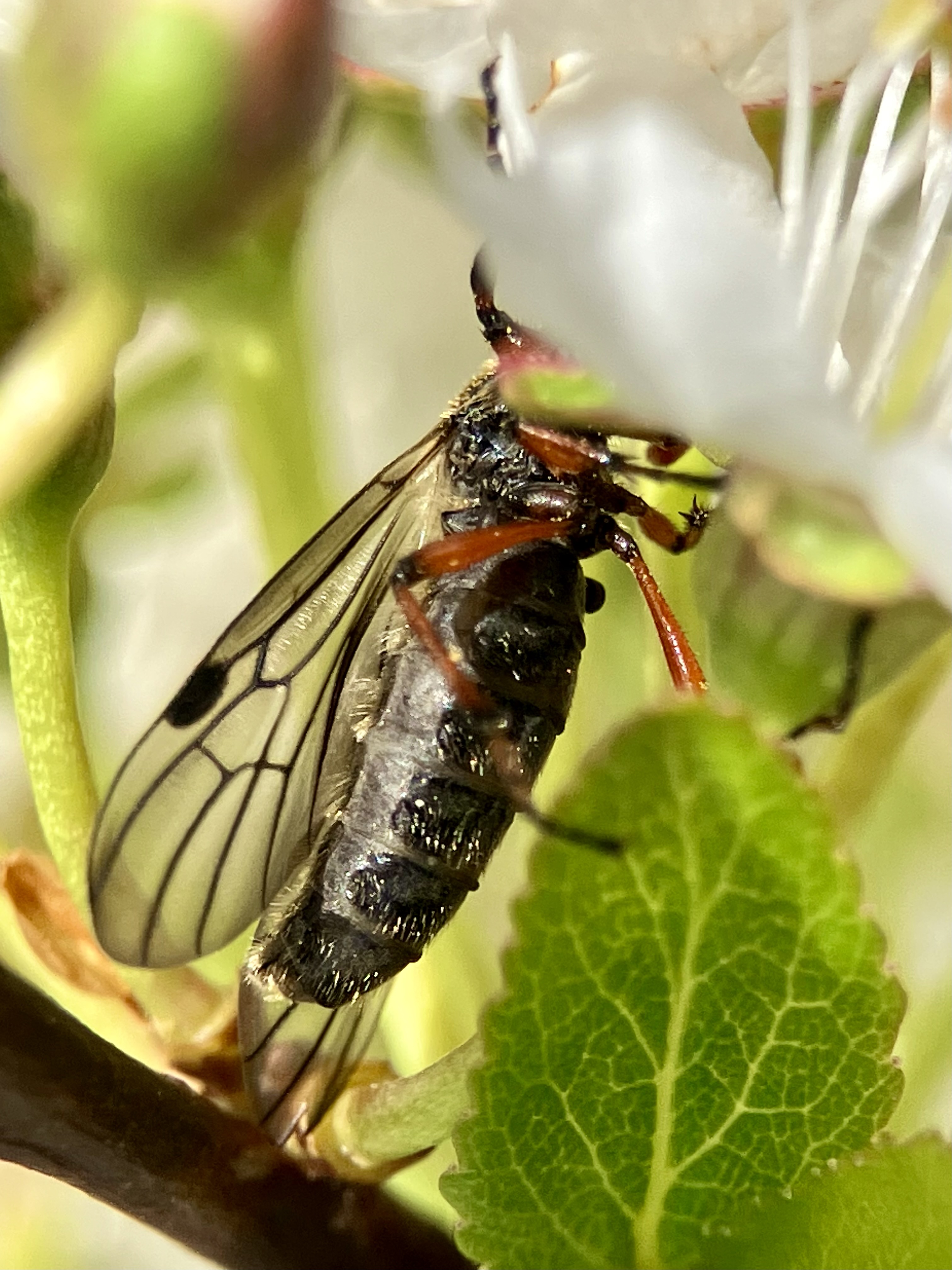
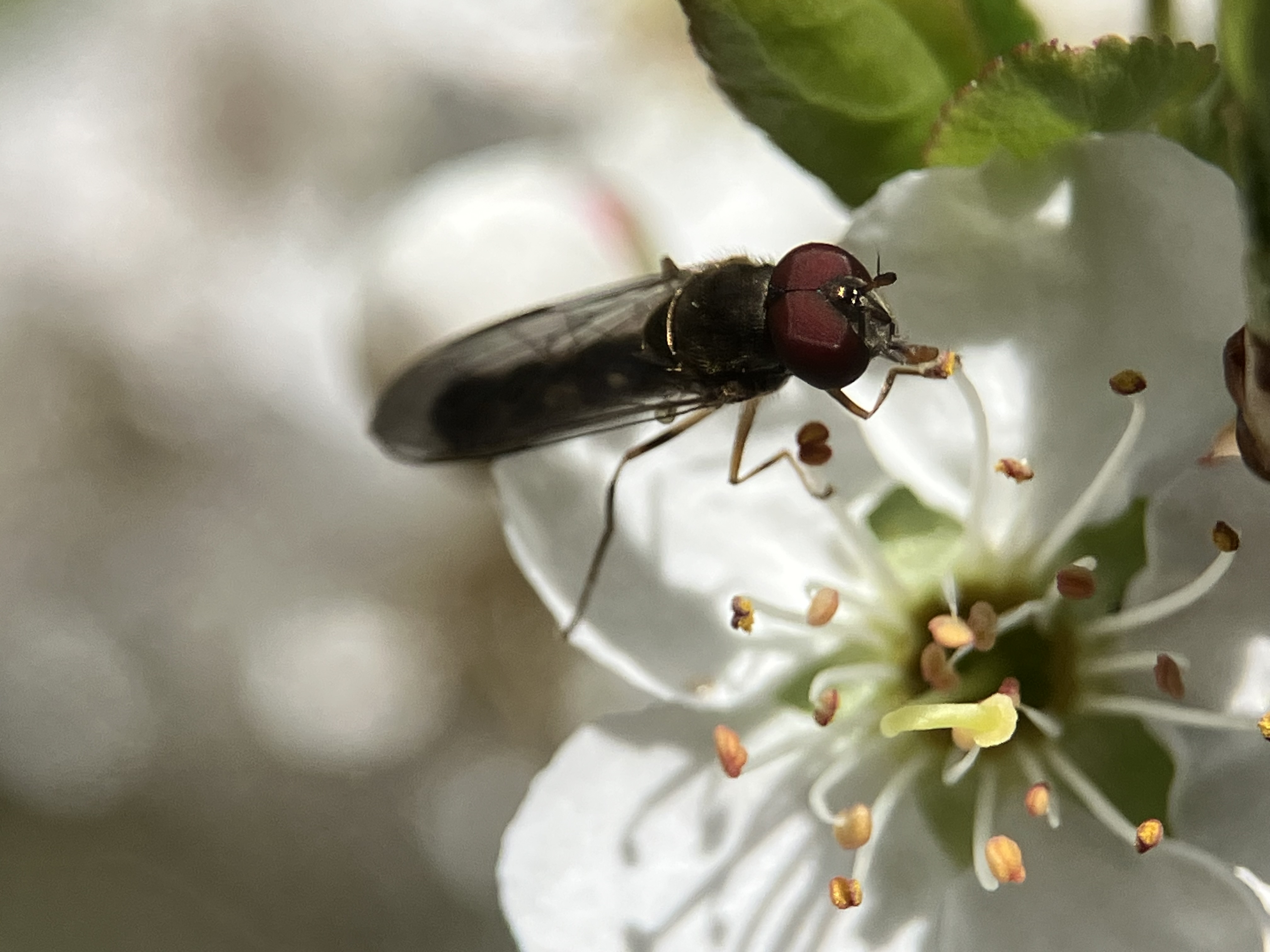
I thought I’d write up a short post about all the wonderful flies (and a few others) pollinating our plum trees in this cool spring weather. Why feature the flies? Well, for starters, the plum tree blossoms are white and flies love the color white. Another reason to feature the flies is because they are under-recognized and under appreciated, but very important pollinators. Some fly larvae even serve as pest predators, eating aphids. Others, like the tachinid fly below, use caterpillars that defoliate trees as hosts for their larvae to develop. Flies are also awesome because they do not sting! Some even “dance!” My favorite fly hasn’t shown up yet. It’s a Conopid Fly. More about that one later though…
Tachinid Fly (Epalpus signifier)
This past week in the media, there have been so many posts about the decline in honey bees. While there are some (unwanted) honey bees showing up on days when the temperatures climb above 50 degrees, honey bees aren’t active if it is cooler. Flies, on the other hand, are quite busy at work pollinating and do just fine when it might only be 40 outside. Flies are awesome! They need our support and appreciation.
I’d like to add (and I do know something about this because of my entomology background), that honey bees are just not necessary on San Juan Island. In fact, they might even be a very bad thing. They showed up at our plum tree as the temperature warmed up the other day, and as they arrived in increasing numbers, they kicked off ALL of the native pollinators that I had been observing. 😦
For honey bees to fly out of the hive and forage, they need temperatures above 50 degrees. In my experience keeping bees (as part of my graduate school work), they typically do not survive well on the island unless they are fed supplemental sugar water. Think about the ecological footprint of growing sugar to feed the bees!
Feeding honey bees attracts (and supports) the buildup of yellow jacket populations which are attracted to honey bee hive resources (including eating the honey bee brood developing in the hive), and honey bees also bring pests and pathogens that impact native bees (especially bumble bees). One more thing! If you are growing tomatoes, bumble bees are your pollinators, not honey bees.
I hope you will read and consider this recent study published about how honey bees were negatively impacting native pollinators on Giannutri Island in Italy. They were causing a decline in the populations of wild bees. In fact, the study cited an “alarming 80% decline in wild bee abundance over 4 years” (Pasquali et al. 2025). You can access this study to read it yourself here: https://www.cell.com/current-biology/pdfExtended/S0960-9822(25)00262-3
Enjoy the gallery of the native pollinators that I was fortunate to photograph and be able to share. Be a fly fan! Be a native bee fan! Learn about our unseen, but important night time pollinators (moths), and PLEASE LEAVE THE HONEY PIGS for the mainland industrial farm operations.
KEARNS, C. A. 2001. North American dipteran pollinators: assessing their value and conservation status. Conservation Ecology 5(1): 5. [online] URL: http://www.consecol.org/vol5/iss1/art5/
Last night, I did manage to get my moth light working again and set things up to see what I might find this morning. While I didn’t really want to get out of bed at 7:30, keeping a routine is important to me. I find it tremendously helpful in managing the ups and downs of one’s mental perspective. You’ll have to bear with me a bit though. I will get to the moths, but have to vent about something that upset me. One of my three cats was chattering at the sliding door when I walked towards the kitchen. I looked out to see what he was watching, and there was a little bird on the ground, obviously suffering from some unfortunate injury (most likely from our neighbor’s free roaming cat). That made me feel sad and angry and it wasn’t the best start to my day.
Don’t get me wrong. I love cats, but I don’t agree that it is OK to allow your feline friend to maim and kill wildlife. I do take my kitties outside with me into our fenced area for supervised recess, but I DO NOT ever leave my cats out alone and certainly do not allow the killing of wildlife. Not even bugs. Drago the lizard may get away with bug murder on occasion, but his impact is quite minor compared to the magnitude of damage done by free roaming cats when it comes to decimating wildlife.
We need to get people to change and become more responsible pet owners. If you disagree with me on this, I might add that I also saw someone’s cat was literally ripped apart on their front porch by two unleashed huskies in Friday Harbor yesterday. That also makes me sad and angry. I blame the cat owner AND the dog owner. It was senseless and preventable.
I think humans need a license to own a pet. We also need ANIMAL CONTROL in San Juan County. There is none and these huskies have been loose and killed cats before. However, if the cat owner was allowing the cat to roam outside unsupervised and unprotected, that’s another layer to the incident. What if someone had left their baby in a stroller long enough to run inside for keys, a purse, etc.? No one should own a husky as a pet. They are notorious for getting loose and killing things. But humans are not all that smart are they?
I did go out to check on the bird. It sort of looked like a finch, or maybe even a female cowbird (except it was too small to be a cowbird). Let’s just say the head looked like a female cowbird’s, but the body was more finch like in size.
It can hop. I put a bit of seed out on the ground and left it alone. It would just stress the bird for me to try and capture it. Maybe it will recover.
Please don’t say, it’s just nature, because cats are not native here. Also, my neighbor’s cat dug up all of my garden pea starts last year and pooped in the garden bed. Pea starts are expensive. People need to keep their cats indoors, or in a catio, or just supervise them outside so they don’t cause problems or be killed by dogs that should not be owned by humans as pets.
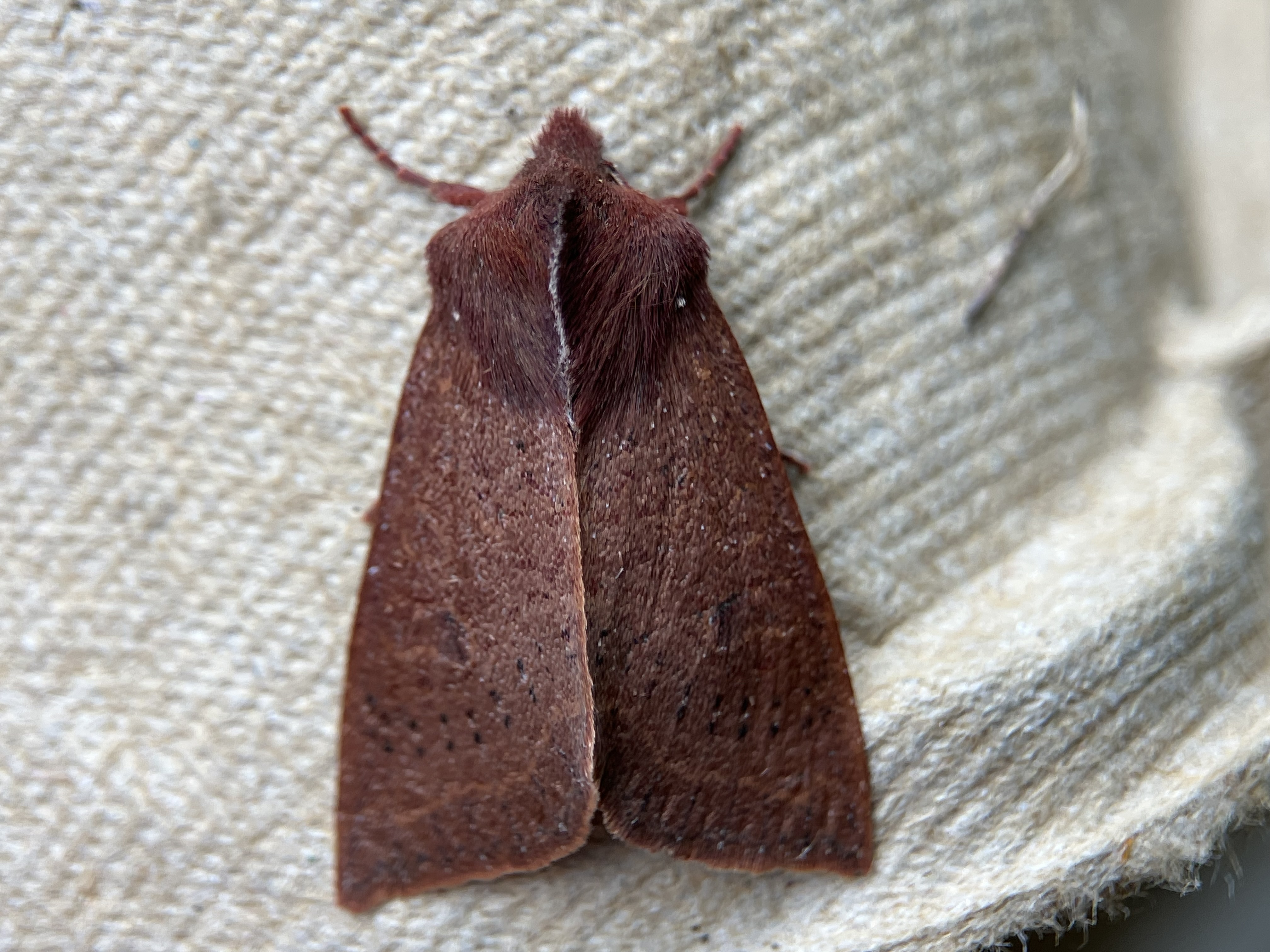
After I checked on the bird, I did go and look at my moth bucket. There were 7 specimens. Not many, but I went through them and here’s what I found. Six moths and one wasp.
Cerastis enigmatica, the Enigmatic Dart Moth Orthosia hibisci, the Speckled Green Fruitworm MothEgira crucialis , I believe. Egira for certain though Orthosia sp. I am undecided about species for this one. Ophion wasp.
The next moth below looks like it has a little pixie cap on. It’s one of my favorites. The red colors are so pretty. It’s in genus Orthosia like some of the others above, but I believe this one is Orthosia transparens.
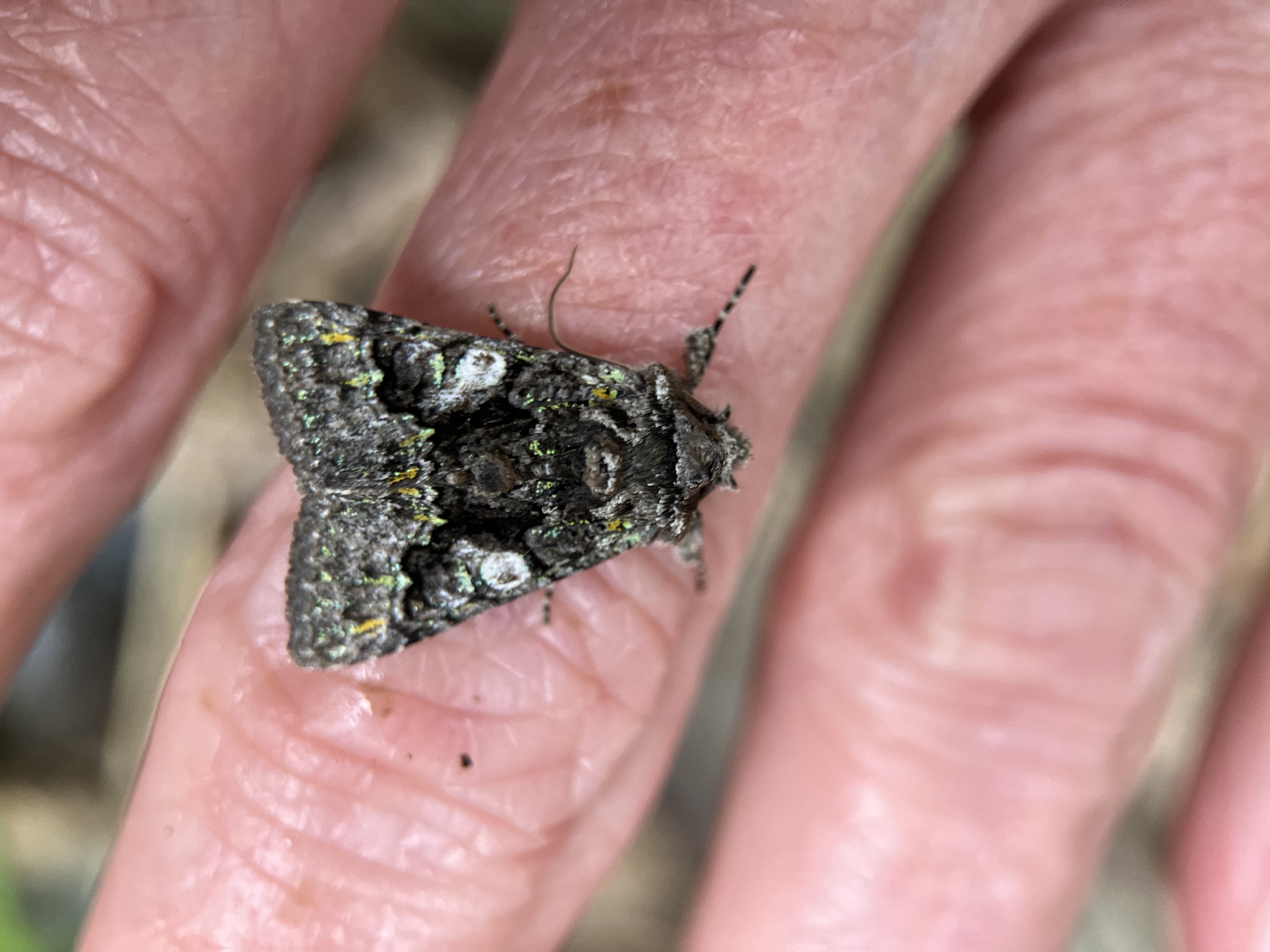
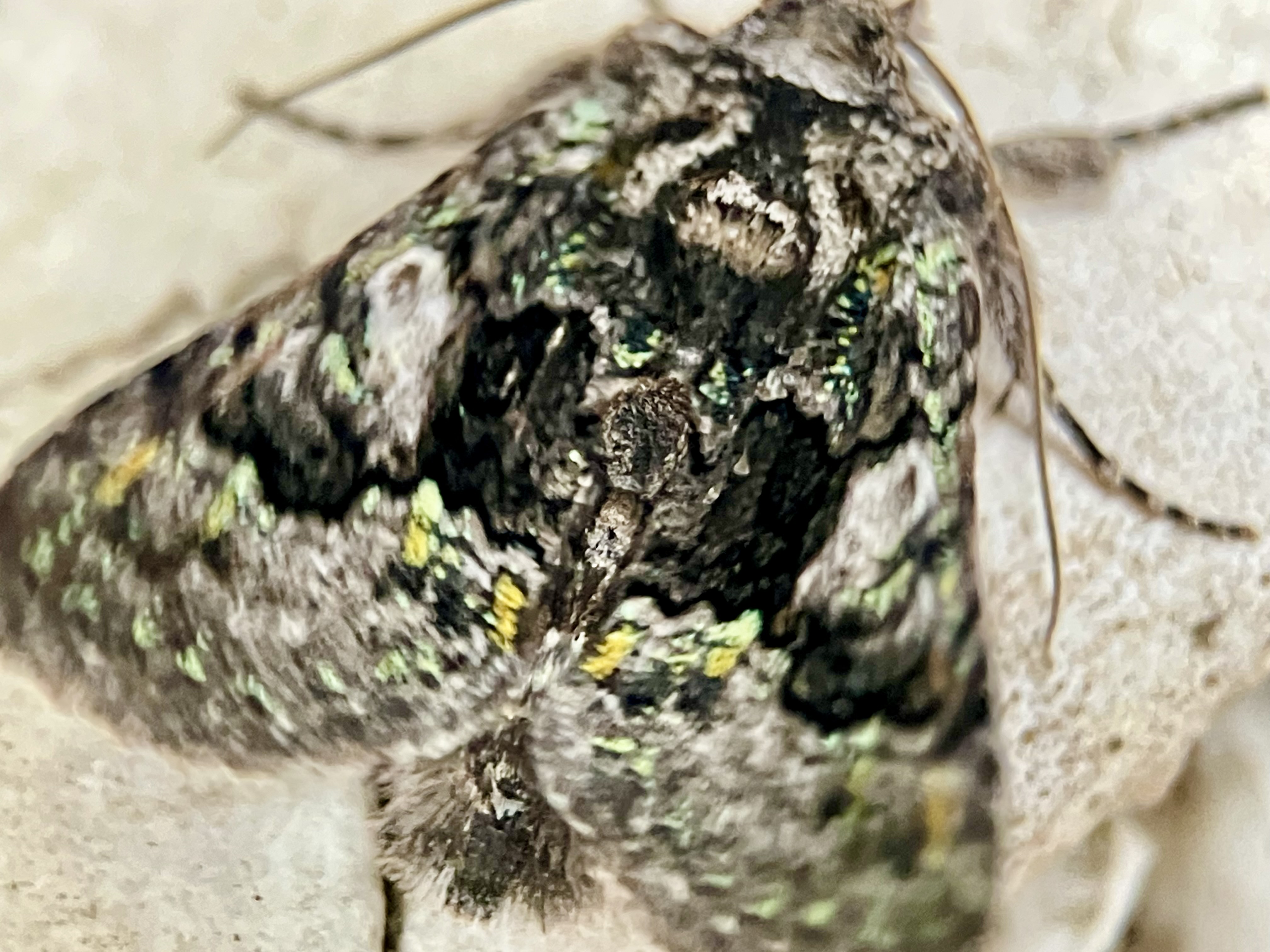
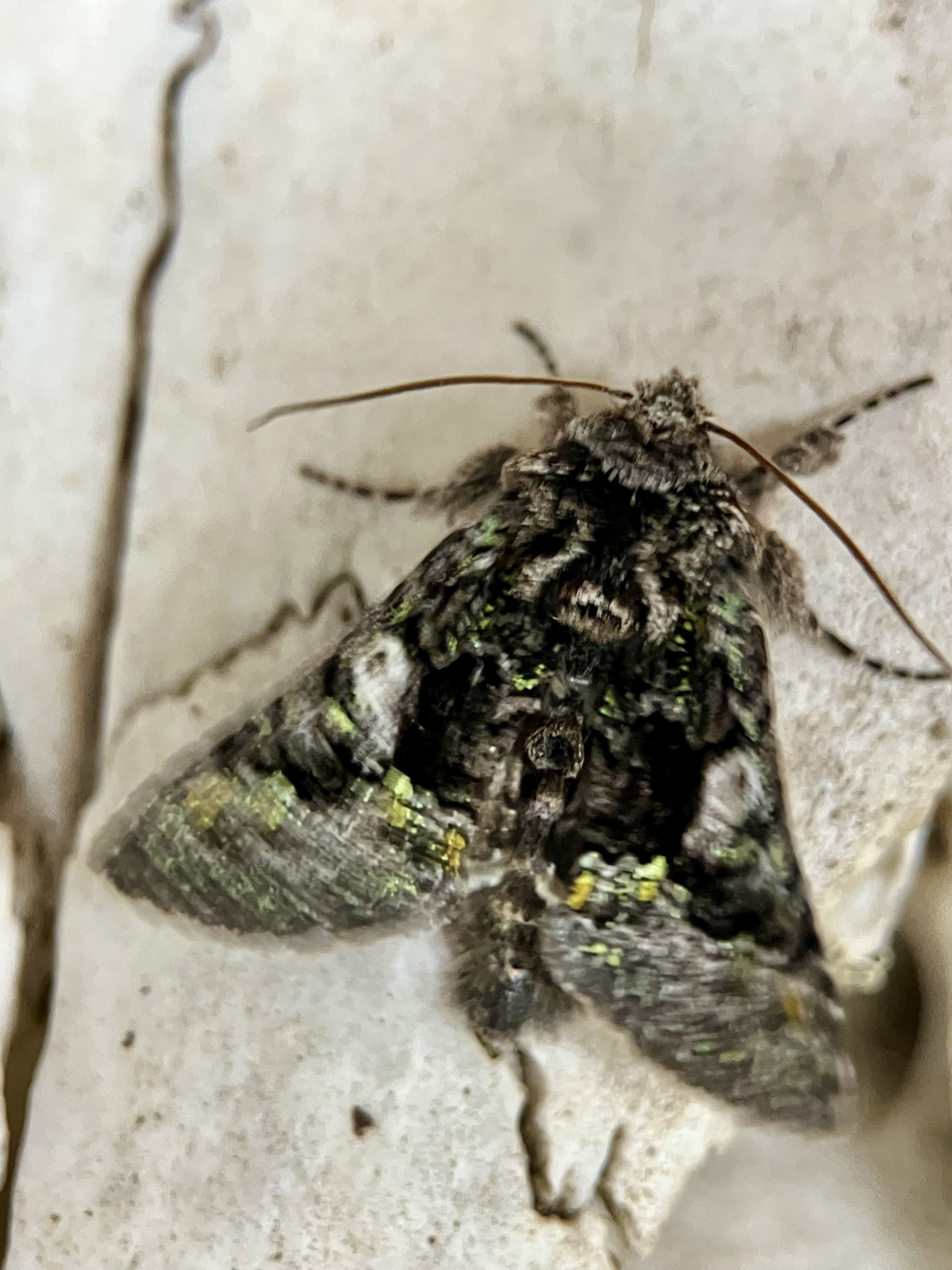
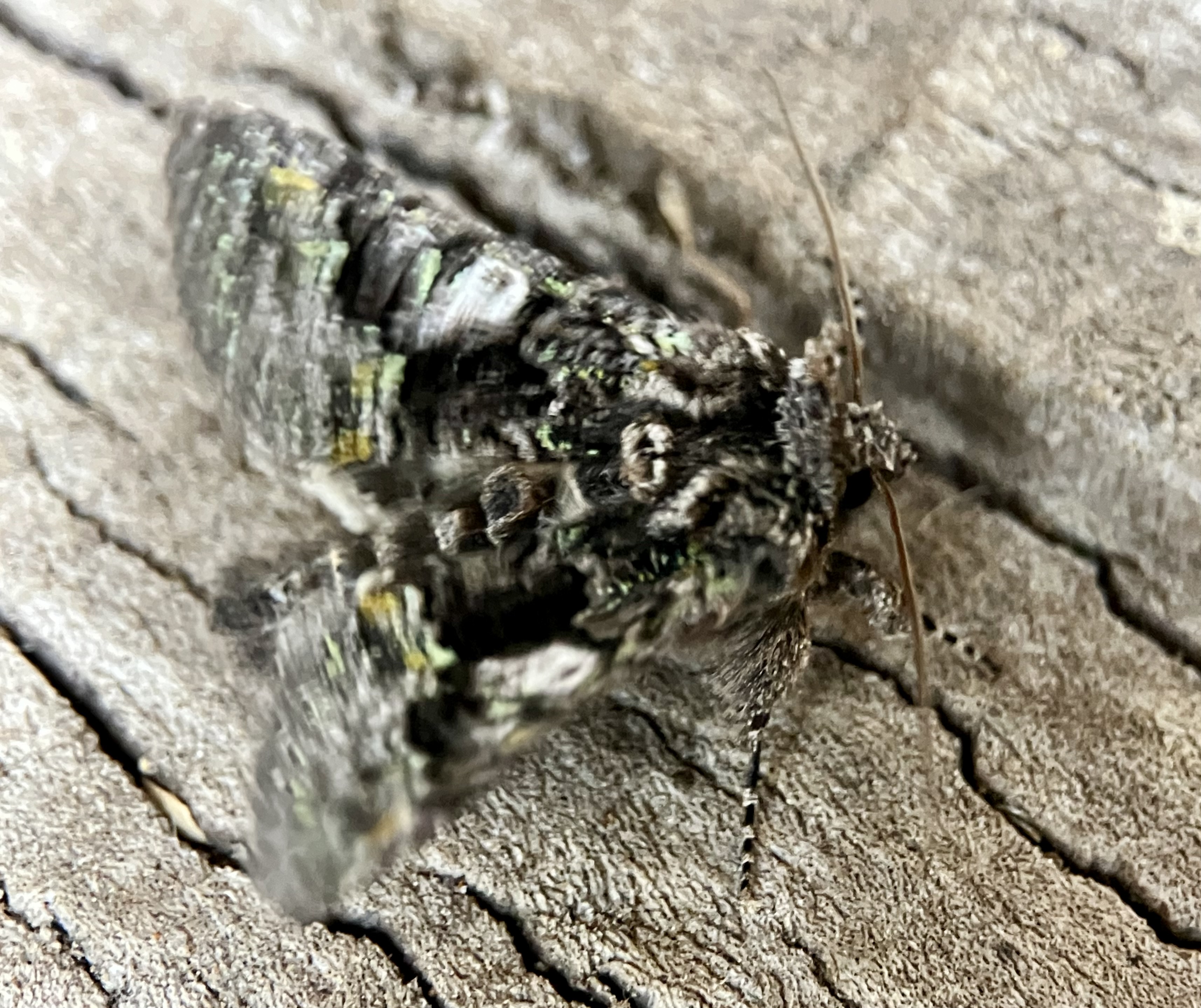
I saved the best one for last. I have only seen this moth on two other occasions, but it one so remarkable, you remember it well. This is an owlet moth called Behrensia conchiformis. I would love to discover what makes the interesting metallic colors in the wings. The larvae of this species are foodplant specialists. They feed only on honeysuckle (Lonicera spp.) and snowberry (Symphoricarpos spp.) in the Caprifoliaceae.
Thanks for reading…especially for reading my rambling rants of the day. While I’d like to stick to just bugs, I am finding it somewhat therapeutic to include my feelings here, and to interject some of my opinions. They are mine and yours may be different. I respect that, but I hope perhaps upon reflection, even someone who might initially disagree with my perspective, might have a change of heart.
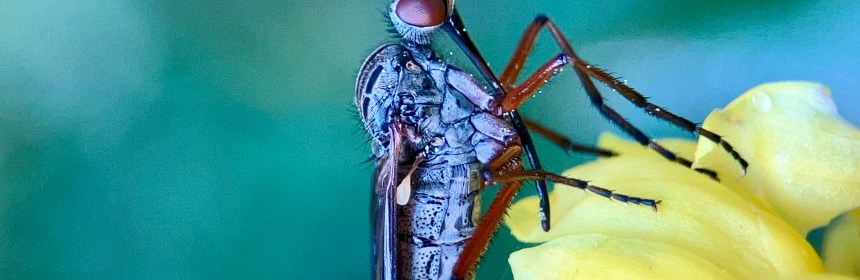
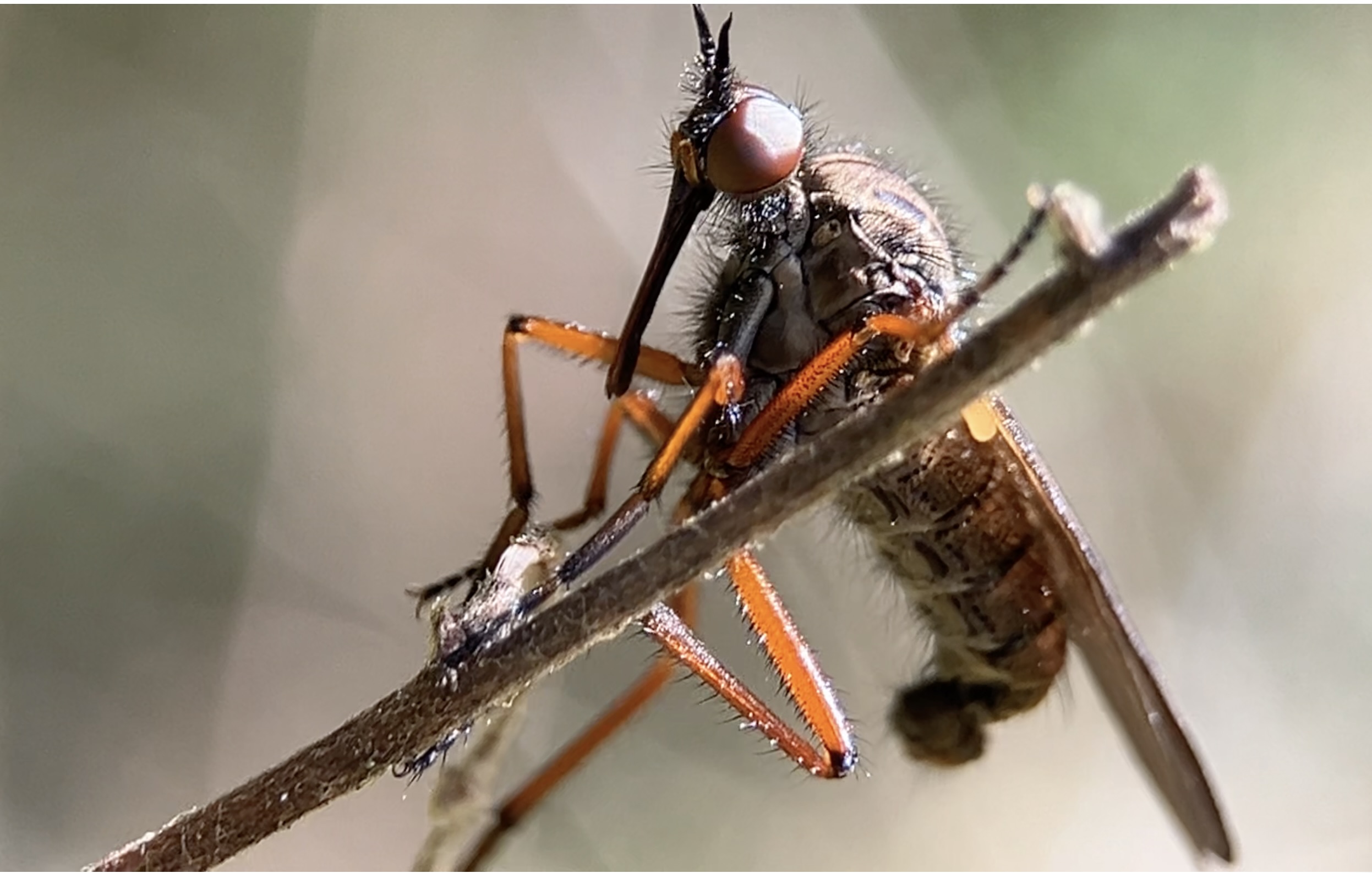
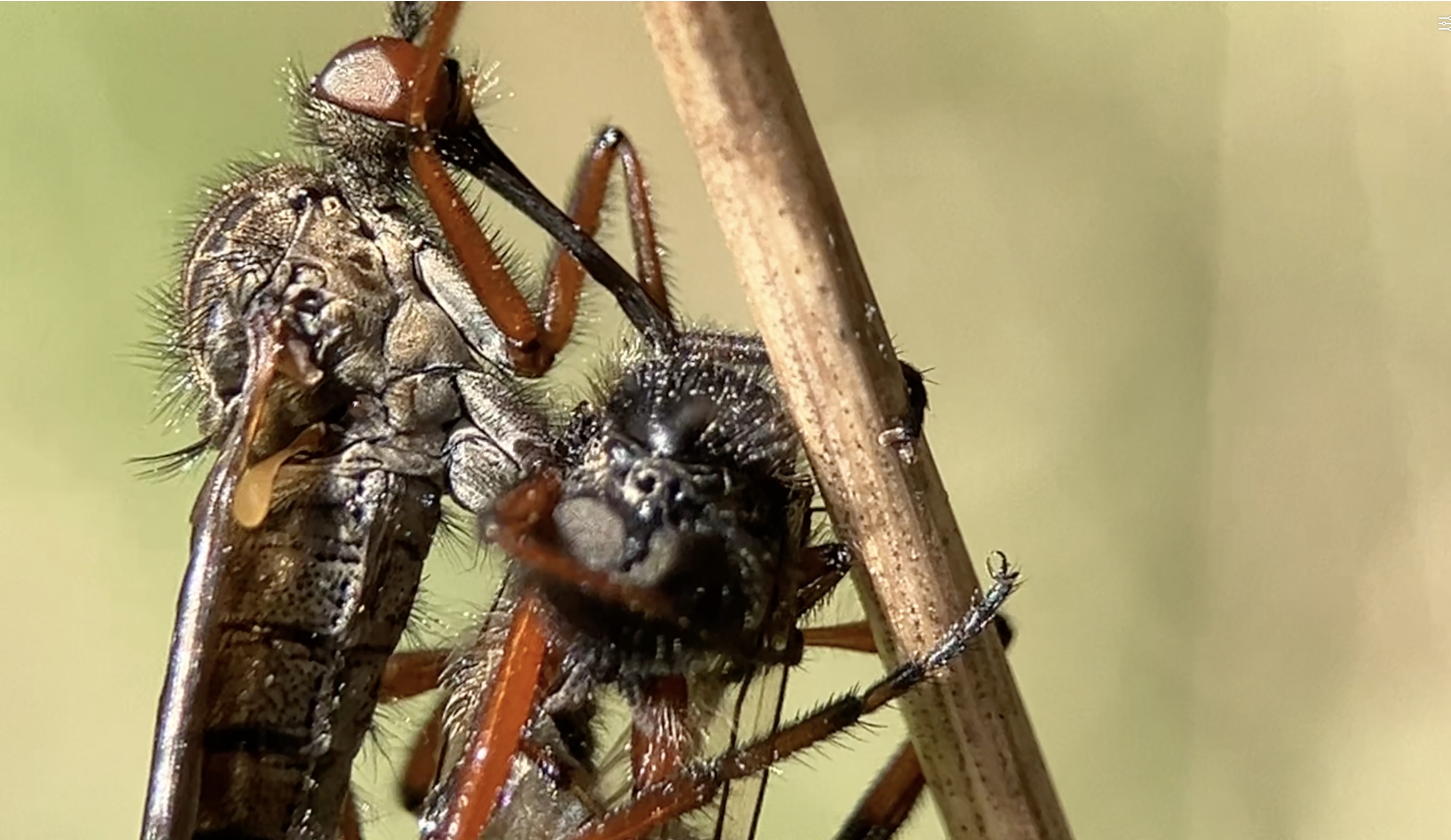
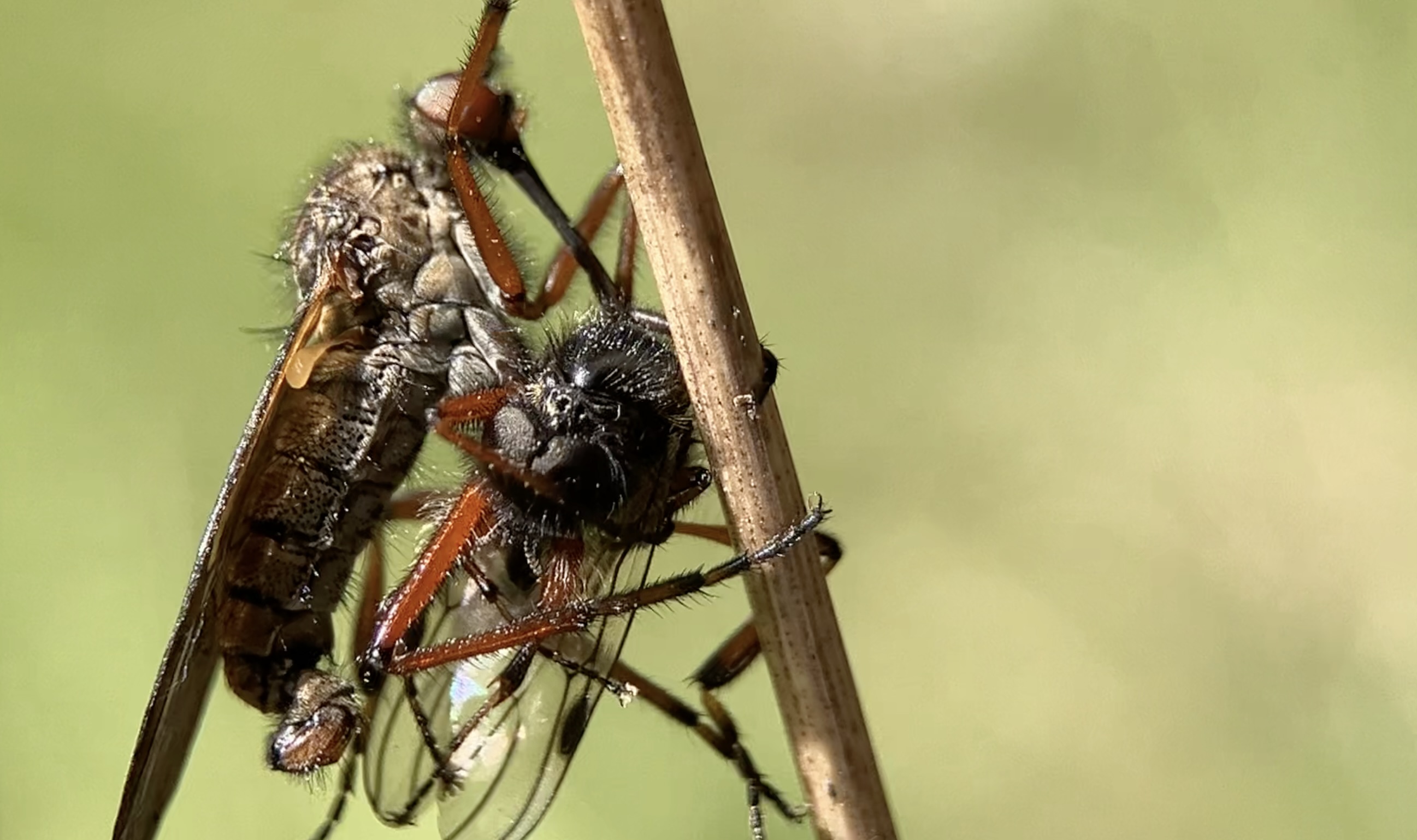
This afternoon I would rate a 10/10 for entomological adventure. It happened outside, just behind our barn about 3:30pm. I went out to feed our resident raven and took a stroll over to a sunny corner of our property. As I neared an old barbed wire fence line, I noticed an aggregation of flies bobbing around over one of the native Ocean Spray (Holodiscus discolor) shrubs. Moving closer, as stealthily as possible, I saw these were Empis dance flies and I got very excited. There seemed to be about 15-20 in the group.
Empis Dance Fly (male) with Bibionid fly nuptial gift
I watched as I stood in the sun. The sun’s warmth felt really good on my body. Hopefully, we will have more sunshine and some days of vitamin D will infuse my cells and pull me out of this funk I have been wallowing in. The flies dancing in the sun were a sight. I crept forward a bit closer, trying not to slip into the fencing, but enough so as to get some video to share.
You will have to forgive me for the shake in the footage. It is not easy to remain steady and focus on a nervous fly that leaves its perch if you so much as breathe too deeply when you are moving the camera close enough to zoom in for a good macro shot. I think I was holding my breath a lot while I was trying to take pictures.
Empis Dance Fly with nuptial offering
This fly should be classified in the genus Empis. Last year, I found Empis barbatoides in our orchard. You can read an earlier blog post I wrote about them here https://buggingyoufromsanjuanisland.com/category/dance-fly/empis-barbatoides/ I believe these may be the same species, but I say this with a caveat. I am hoping to get my hands on a copy of the revisions by Sinclair, Brooks, and Cumming I have referenced below. It appears I may need this and the updated keys to try and ID my fly beyond genus level, so I’ve emailed the lead author and hopefully will hear something back.
If you look closely, you’ll see in some of the photos the fly is holding a balled up insect. This is a species of March fly in the family Bibionidae. I saw a few hiding around in the tall grass like this one in the photo below.
March fly (Bibionidae) hiding in the grass
Evidently, they were being picked out by the male flies and rolled up into a nice nuptial gift to present to a female Empis fly to entice her to mate. The male Empis fly will carry this balled up dead insect and “dance” around to attract a female. That’s what I found so fascinating to actually watch in person. It isn’t every day you see something like this! Since flies seem to be attracted to certain spots for mating aggregations (it’s called hilltopping), perhaps this is a spot where I might be lucky enough to see this action again.
References and Further Reading:
Alcock , John. 1973. The mating behaviour of Empis barbatoides Melander and Empis poplitea Loew (Diptera: Empididae), Journal of Natural History, 7:4, 411-420, DOI: 10.1080/00222937300770301
Sinclair BJ, Brooks SE, Cumming JM. Revision of the western Nearctic species of Empis subgenus Enoplempis (Diptera: Empididae). Zootaxa. 2025 Mar 31;5615(1):1-200. doi: 10.11646/zootaxa.5615.1.1. PMID: 40173481. https://pubmed.ncbi.nlm.nih.gov/40173481/
I went for a walk yesterday on Three Corner Lake Road just to get out of the house. Springtime on San Juan Island has been cold and dreary, but sometimes there’s a moment or two when the sun peeks out, giving a bit of hope that the winter doldrums are coming to an end. Don’t get me wrong, I love the Pacific Northwest, but the Visitor Center’s claim that San Juan gets 247 days of sunshine a year is a stretch. I think they actually count the days when it is overcast and rainy as long as the sun peeks out for just a minute before the clouds darken the day again.
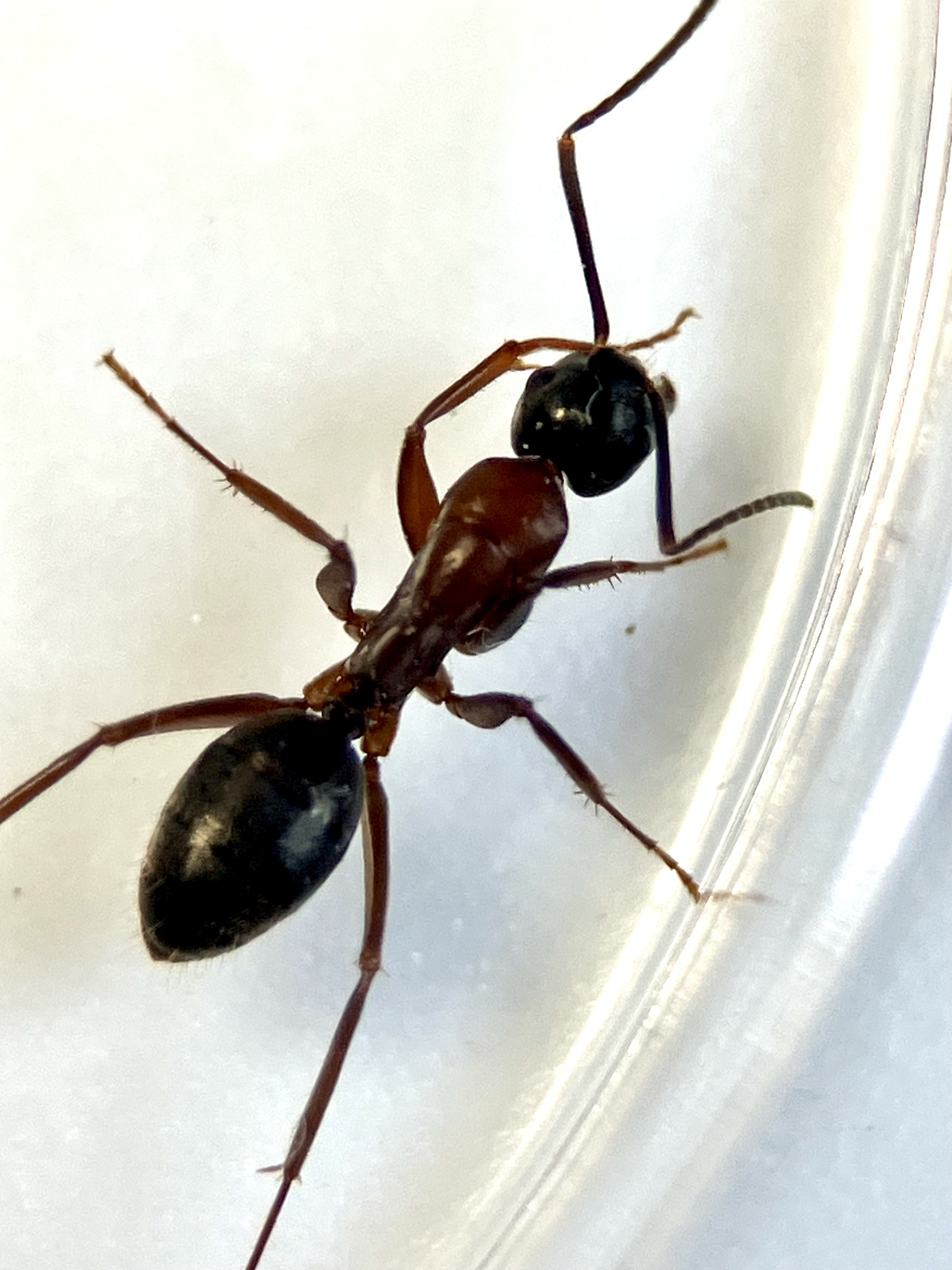
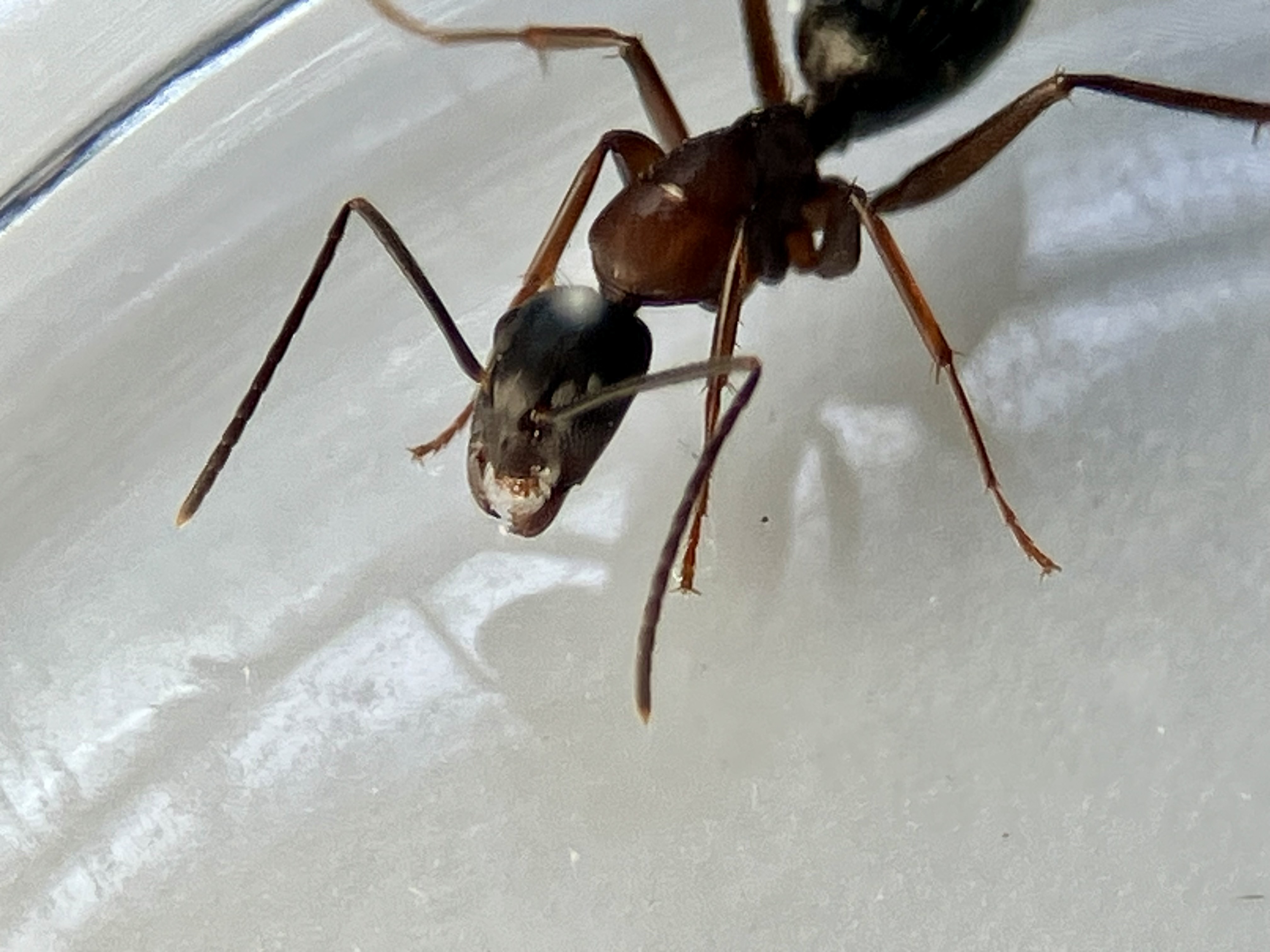
It was cold and I wasn’t expecting to see any insect activity, so I was surprised to find this long time ant colony with a mass of individuals near the top of the nest. The sun had been out intermittently, so I believe what was happening was the workers were at the surface to warm themselves (thermoregulating). There were a few straggling workers carrying thatch debris (conifer needles) to the nest from the forest. If the weather had been nicer, I would have enjoyed plopping myself into a chair to ant watch for an hour or so. They are quite pretty when you see them up close.
Western Thatching Ants (Formica obscuripes) are native to our region. They seem to like forest edge habitat, and you’ll find the nests situated in areas where there is some clearing to take advantage of the sun’s warmth. These ants are considered general omnivore-predators. They scavenge or prey upon insects and other arthropods for food. Foraging activity takes place both on the ground and on vegetation, including high in trees. Thatch ants also harvest honeydew from aphids and other homopterans as well as from extrafloral nectaries. You can read more about extrafloral nectaries or EFN’s (little nectar producing glands on plants) here https://bygl.osu.edu/node/1774 or check out one of my earlier blog posts about them here https://buggingyoufromsanjuanisland.com/2022/05/17/what-are-extra-floral-nectaries%EF%BF%BC/
Extrafloral nectary on Fruitless Cherry Tree
The ant workers are considered weakly polymorphic, which means they have only slight variations in size and shape within the worker caste as opposed to other species where workers may be monomorphic (all the same size and shape), or strongly polymorphic (a high degree of variability between worker sizes and shapes). You can read more about polymorphism in ants here https://www.antwiki.org/wiki/images/1/1c/Wheeler_1908f.pdf .
Given all the information you’ll find from pest control companies online about these ants and others, you might ask, why or if there is any benefit to having these ants around. The answer is YES! Western Thatching ants are beneficial in ecosystems because they not only aerate the soil with their burrowing practices in nest construction, but they also provide FREE pest control, helping regulate populations of other insects that defoliate forests, fruit trees, and even our vegetable gardens. They also help clean up the environment through scavenging dead animals. There is no need to eradicate these nests and if you get into ant watching, they might provide a bit of intriguing summer entertainment. Pull up your lawn chairs and sit and watch with your friends. As long as you aren’t poking the nest, they are not inclined to bother you at all.
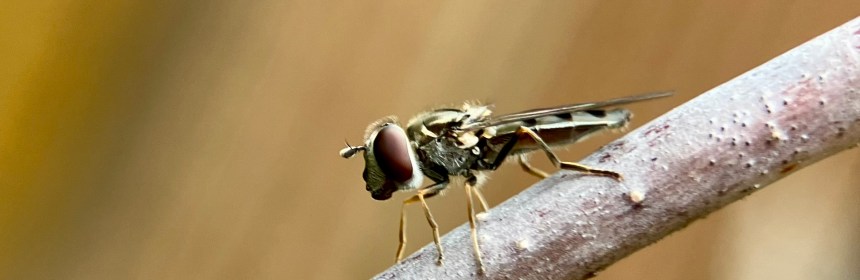
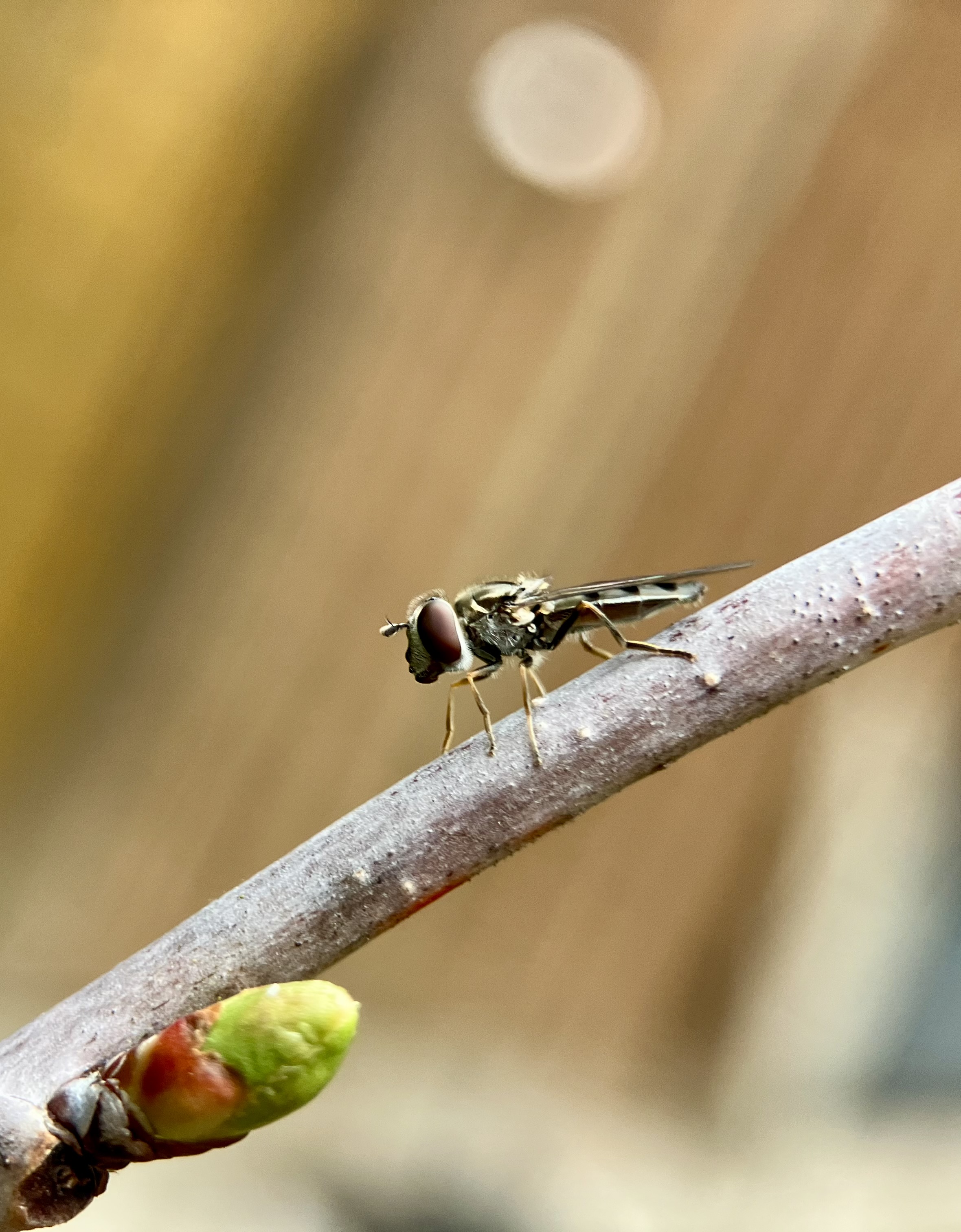
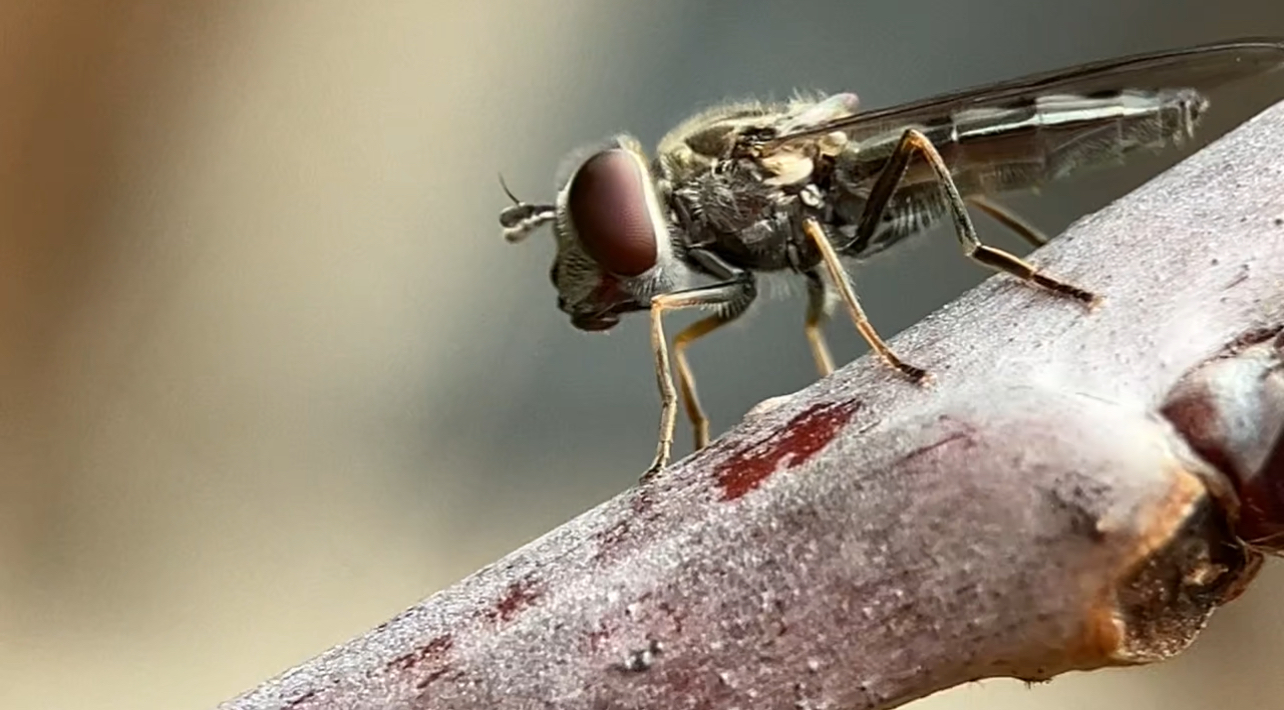
This was Wednesday’s bug of the day. I’m a day behind writing up my post. Although I have tried to get out for a quick bug search every day, it’s been overcast and/or drizzly here this past week. I was excited to see this little fly hunkered down on a twig of our fruitless cherry tree, the tree that I whacked off as an unwanted upstart for several years before I discovered how interesting it is.
Western Forest Sedgesitter, (Platycheirus trichopus), I believe
That tree is a mini ecosystem: floral nectaries that feed the aphids, aphids, slave making ants that have fights to the death (winning) with the carpenter ants that try to invade our home every spring, and the birds that rip the leaves apart trying to get the aphids. Now I can add Syrphid flies to the list!
That’s what this is. A syrphid fly. Syrphid flies eat aphids. It would make perfect sense for this adult to lay eggs on the tree, though I’m not sure what would happen because the ants that farm those aphids are certainly willing to die defending them. I could definitely see the ants overtaking the syrphid fly larvae. Nevertheless, the fly flew off. Somewhere.
This species, as mentioned earlier is pretty small at only about 6.8-9.4 mm. Geographic distribution ranges from the Rocky Mountains west from Alaska to Mexico (bugguide.net). Adults of this genus are known to feed on the pollen of wind pollinated plants like Willow (Salix sp.) and various grasses (Poaceae), and sedges (Cyperaceae). It is believed they are better adapted to activity in cooler temperatures and that fits with yesterday’s rather gloomy spring day.
Today was a day of bird encounters. I saw our poor little cowbird that can’t fly because he’s been injured (likely by our neighbor’s marauding outdoor cat). He’s survived three nights so far even though he seems to have a wing injury and I haven’t figured out yet if I can capture him to check. He’s had his little mate following him around.
Cowbird male
I know it’s a cowbird and cowbirds are brood parasites, but they are actually quite beautiful little birds and I feel sympathy for wildlife that are impacted by our human “pets.” It isn’t fair and we should do much better to keep our pets under control. I don’t know what my response would be if I see this cat attacking our Tanager or one of the Grosbeaks. It is doing what cats do and the problem isn’t the cat, but the owner who evidently doesn’t care and is probably too lazy to clean a litter box and play with the cat and keep it inside. Ok. So, I vented. Sigh…
I was going out to take a walk in nature to unwind when I heard a sad little thunk on our window. We have Acopian Bird Savers https://www.birdsavers.com/make-your-own/ on the largest window, but not the smaller one. That’s gonna change. I’m going to put them on ALL our windows.
Well, I looked out and saw a tiny little nuthatch on the ground, on its back, mouth open, but it was breathing. I ran out to pick it up and when I scooped that little creature into my hand, its feet wrapped around my finger so tightly that I felt hopeful. It was a newly fledged nuthatch. I sat with it quietly in the shade under the suet feeder, my hand stretched out onto my knee into a little cup shape.
The bird closed its eyes and slept a bit. I talked to it very very softly. An adult nuthatch landed on the feeder above, eyeing me cautiously. I believe it was the parent. I spoke to the adult too, trying to convey my earnest intent not to harm her child. The little one blinked and looked about. Then it closed its eyes and slept a bit again. The parent flew over to the fruitless cherry tree to another feeder, then off, I expect to feed another hungry mouth.
After a good 15 minutes, the little nuthatch was much more alert. It kept eyeing the suet feeder and the adult bird that returned again and again. I rose slowly from sitting, carefully supporting the little one – still gripping my finger. Raising my arm, I chose a small branch just beside the suet feeder and in a breath, the little one hopped off my finger and onto the new perch.
The adult nuthatch flew onto a nearby branch and I saw the fledgling flutter its little wings like baby birds do to get their parents’ attention to be fed. In another breath, it was airborne, flying after the parent. I was so grateful for a happy end to that incident.
My walk down our road was uneventful for the most part. I did see a Clown millipede (Harpahe crossing the wetland area and squatted down to observe its somewhat awkward, but systematic locomotion. It almost looks suspended in motion over the ground. After making sure it was safely out of harm’s way and not in a car path, I continued on.
(Harpahe hayadienana) Clown millipede
My destination was the “soon to open officially” nature preserve. I have walked on this property for about 10 years now. It is an amazing place.
Giant cedars tower overhead through the wetland. Along the seasonal stream, the path I took meanders amidst the primordial assortment of ferns, swamp lanterns, and horsetail. There are creatures there in the forest. If you see them, you will leave feeling a sense of awe.
Twinflowers on the forest floor
Red legged frogs, salamanders, and newts make their homes in the wetland. They dine on the myriad of invertebrates that live in the stream and mud. On the forest floor, you’ll find Night-stalking tiger beetles (Omus dejeanii) with fierce jaws hunting for prey. If you’re really really lucky, you might see the burgundy metallic carabid beetle (Zacotus matthewsii) that I’ve only seen less than a handful of times in the past decade. Overhead, you’ll hear the family of ravens that have a nearby nest. Always in the same place.
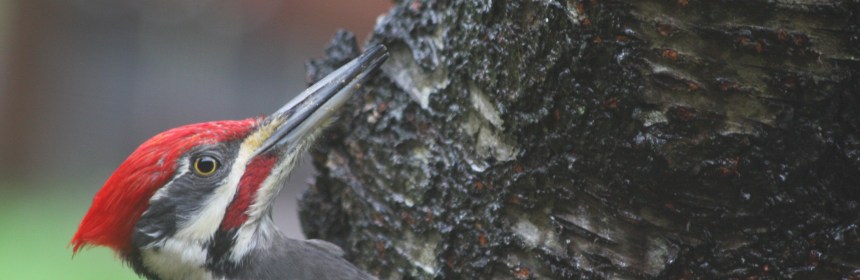
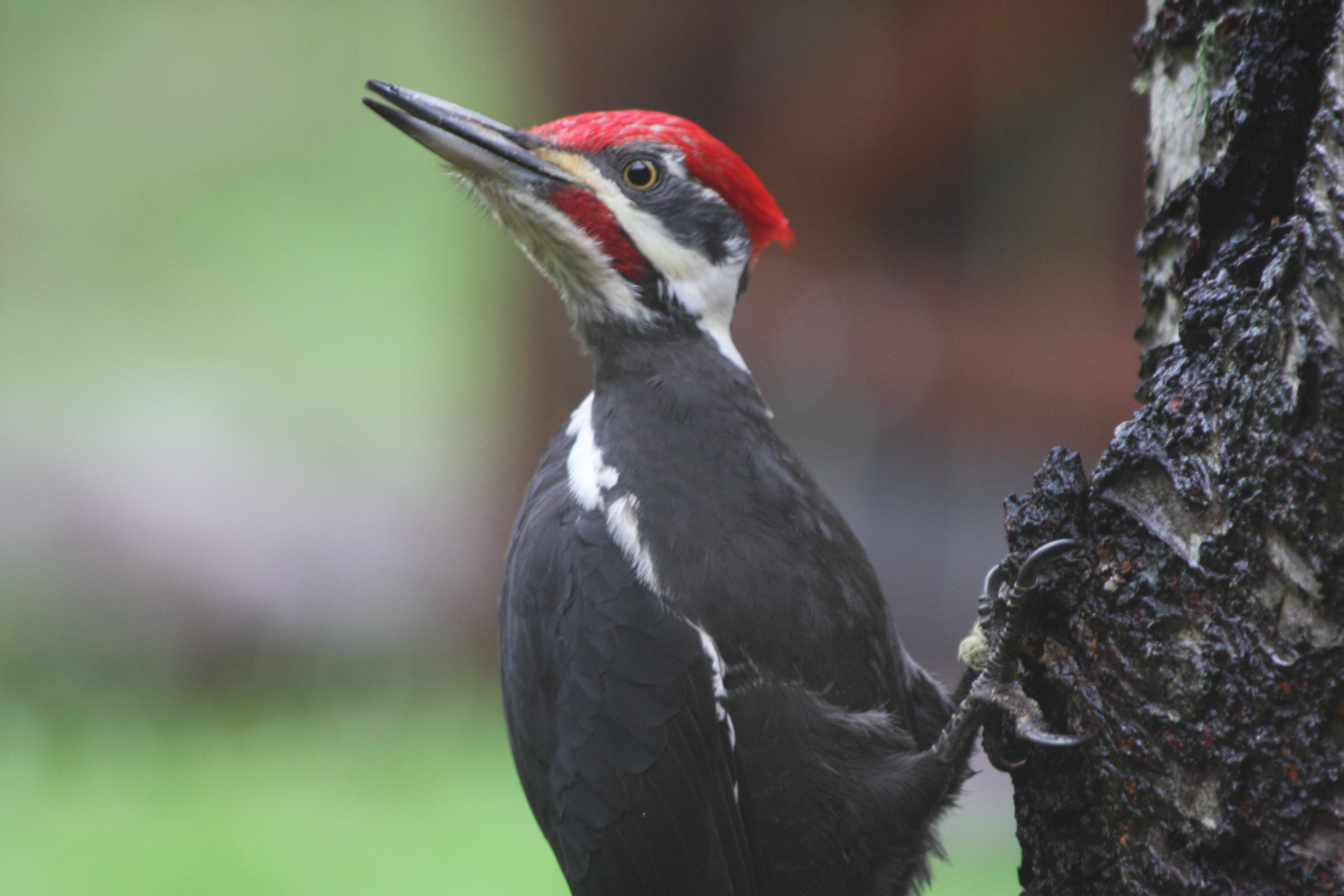
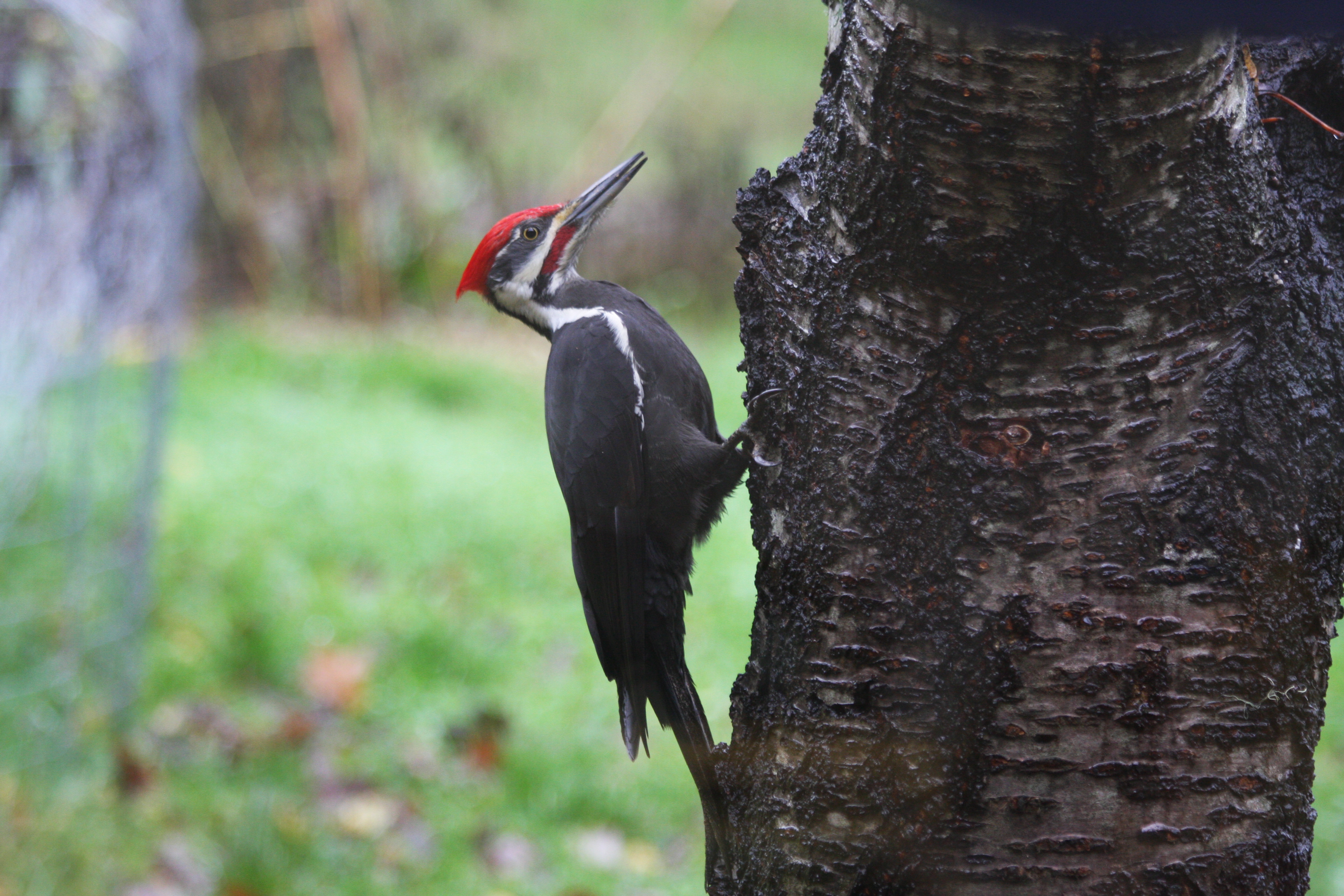
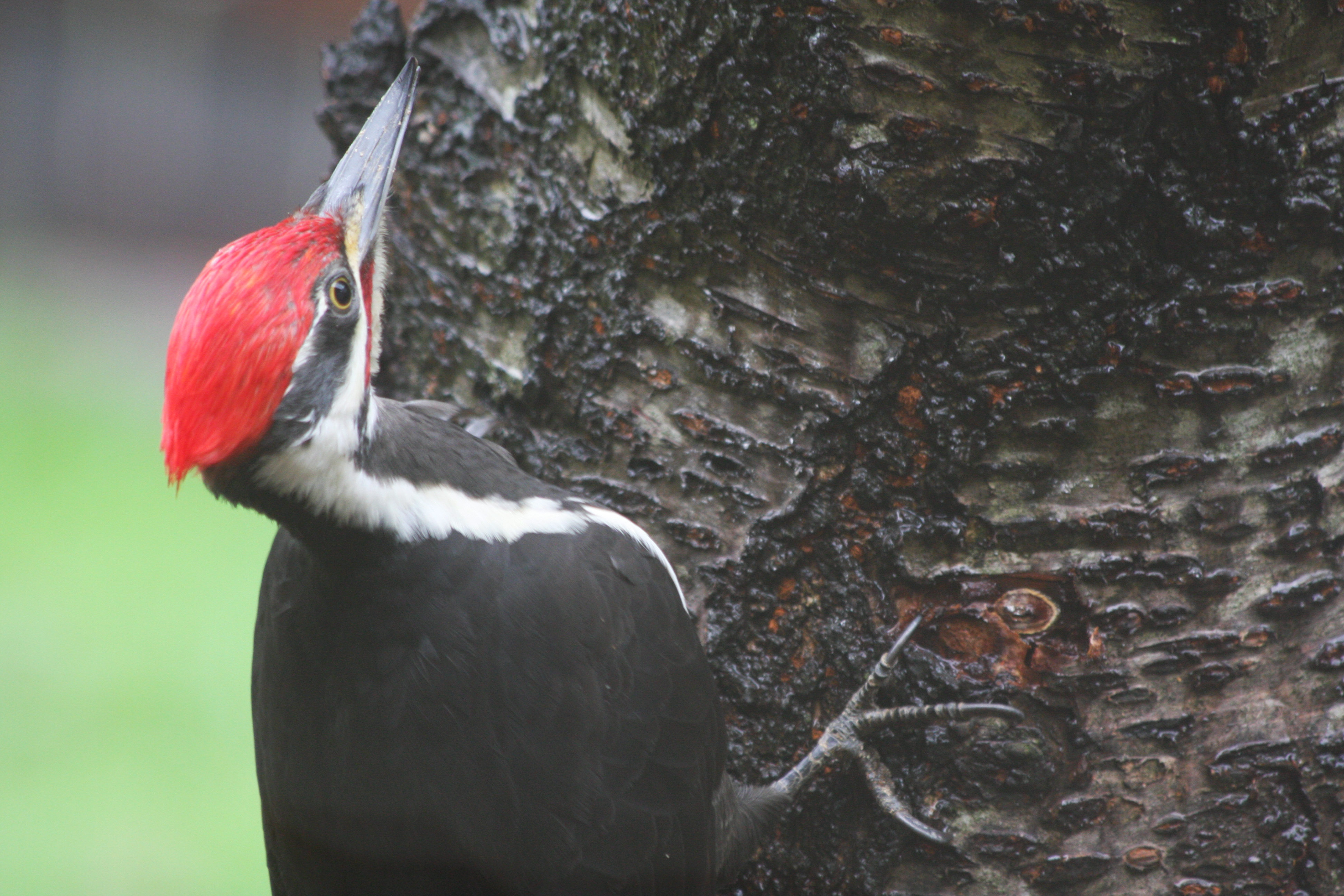
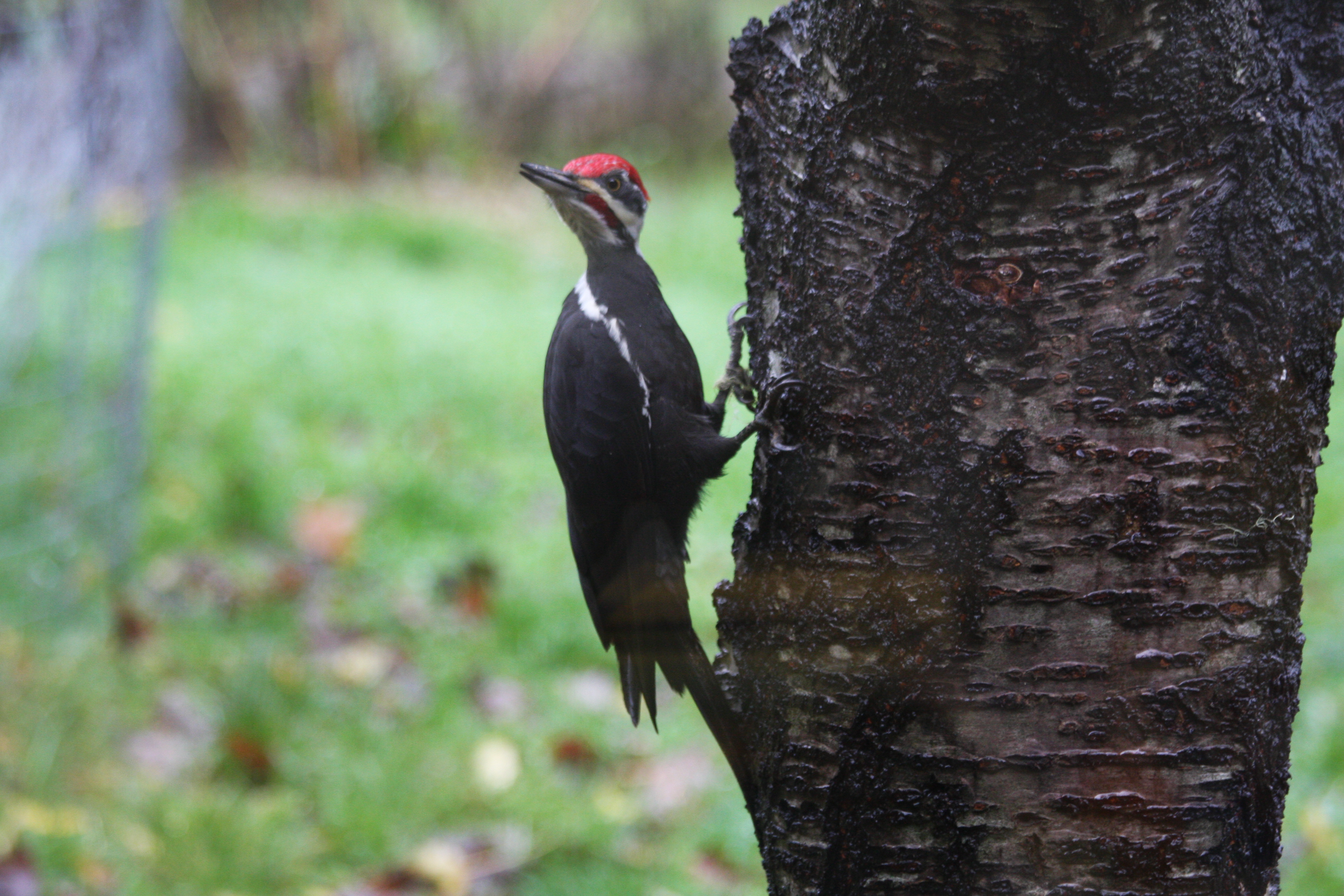
The hawks hunt in a small clearing where the stream attracts other animals that come for a drink. There are other birds hidden too. Flycatchers nesting in rotting snags, Pileated Woodpeckers drilling after carpenter ants. And the owl.
The owl has been there for a long time. You can hear it calling in the night – “Who Cooks for You?” It was wonderful before there were too many houses. Now, it is harder and harder to hear the owl over the din of barking dogs. In the woods though, the owl has a baby.
I heard it calling the other day. Screeching is more like it. I heard the noise before saw them. The mother owl was watching me cautiously from high above. A snake dangled from her mouth. In spite of this, I heard her utter sounds of caution to her child. She flew over to feed it as I quietly backed out of the area. I did not want to disrupt them and when I walk, I try always to remember that I am entering the home of others. I walk quietly and respect their spaces.
Momma owl with snake
Today, when I walked back to the place of the owl, I heard the baby again. It was calling repeatedly, but mom was nowhere to be seen. Again, I backed away quietly, hoping the owl was able to find food for her little one. They must hunt through the day and not only at night in order to rear their offspring.
I thought of the owl as I walked back to the trailhead and then I momentarily became distracted as I reached the site where I’d been poking around in a raccoon carcass on the trail. There are some very cool bugs that you find in carrion. Unfortunately, the remains were not to be found.
Stepping off the trail to look in the underbrush for any sign of the carcass, I heard a flutter overhead. I looked up and she was there. It was the mother owl.
She landed on a branch right in front of me. I was too dumbfounded to move. We stayed like that for what seemed like a very long minute. She gazed at me and I watched her in turn, not daring to blink. There was no threat. I felt like she knew me.
The robins were not happy and began to flail at her, creating a cacophony of rebuke. She ignored them. I slowly brought my phone around and took a video of her. She just looked at me.
Then she looked around, gazing through the forest at things unseen. After about five minutes, she reoriented her body, turning away from me, surveying the surrounding area. With a glance back at me, she flew away.
This encounter is why saving spaces for WILDLIFE is so incredibly important to me. These places should belong to them. When we visit a preserve, remember that. It is their home.
I hope others will reflect on what I’ve shared, and maybe there will be one less person who lets their dog off leash or one less person who throws trash onto the forest floor. Think about the creatures that call these places home. Walk softly and be respectful of their need and struggle to survive in ever-shrinking spaces.
Thank you for reading. Support Conservation. Save Spaces for Nature.
I’ve been home on San Juan Island, WA for 4 days now and clearly I picked up a bug traveling home. Not exactly the sort of bug I wanted, but it was inevitable given the crowded airplane and traveling stress. My husband came down with the BUG first. Then it hopped over to a new host – ME.
So, I’ve spent the afternoon on the couch labeling and sorting photos from one of our nature walks in Texas. This was the first of two hikes we took at the Lewisville Lake Environmental Learning Area Nature Preserve https://www.llela.org/about-llela/mission-and-vision. This area (approximately 2000 acres, I believe) has been conserved in conjunction with U.S. Army Corps of Engineers, the University of North Texas, the City of Lewisville, Lewisville ISD, the University of Texas in Arlington, and Texas A & M Agrilife Extension. It is a true jewel in the madness of the DFW metropolis where over 6.7 million people are displacing wildlife and native ecosystems are lost in the process. The BEST part of these hikes for me is the fact they do not allow dogs. NOT ANY! I am thrilled that the focus is on wildlife and habitat conservation and preservation instead of human recreation. I could actually be outdoors, enjoying nature AND viewing wildlife.
We’ve been to this preserve in prior trips to Texas. This year, we focused on hiking some trails we hadn’t been on before. Here is the gallery of some of the bugs I photographed, along with a few wonderful landscape scenes we viewed on the Redbud Trail – map here: https://www.llela.org/home/showdocument?id=9417
Please support environmental conservation wherever you are. This habitat may seem large at 2000 acres, but the former Blackland Prairie once covered 12 MILLION acres in the state of Texas. We need to set aside more if we are to weather the changes coming ahead.
Stay tuned for Bugging You From Texas, Part 3. I have more wonderful photos to share with you.
Trichopoda lanipesTrichopoda lanipesTrichopoda lanipesTrichopoda lanipesTrichopoda lanipesEastern Leaf-footed Bug
(Leptoglossus phyllopus)
Eastern Leaf-footed Bug
(Leptoglossus phyllopus)Eastern Leaf-footed Bug
(Leptoglossus phyllopus)Oblique Streaktail (Allograpta obliqua)Oblique Streaktail (Allograpta obliqua)Oblique Streaktail (Allograpta obliqua)Oblique Streaktail (Allograpta obliqua)Oblique Streaktail (Allograpta obliqua)Oblique Streaktail (Allograpta obliqua)Oblique Streaktail (Allograpta obliqua)Spotted Cucumber beetle
(Diabrotica undecimpunctata)Spotted Cucumber beetle
(Diabrotica undecimpunctata)Grass Spiders
Genus Agelenopsis
Grass Spiders
Genus Agelenopsis
Eastern hornet fly Spilomyia longicornisEastern hornet fly Spilomyia longicornisEastern Hornet Fly (Spilomyia longicornis)Eastern Hornet Fly (Spilomyia longicornis)Eastern Hornet Fly (Spilomyia longicornis)Trichopoda lanipes Feather-legged flyEastern Hornet Fly (Spilomyia longicornis)Eastern Hornet Fly (Spilomyia longicornis)Asian Lady Beetle (Harmonia axyridis)Asian Lady Beetle (Harmonia axyridis)Elm Fork of the Trinity RiverHyaline Grass Bug ( Liorhyssus hyalinus)American Bird Grasshopper (Schistocerca americana)Thyanta custator ssp. accerra
a member of Stink Bugs Family Pentatomidae
Elm Fork of the Trinity River
Lewisville Lake Environmental Learning Area Nature PreserveElm Fork of the Trinity RiverAmerican Bird Grasshopper (Schistocerca americana)I believe this is also Thyanta custator ssp. accerra
a member of Stink Bugs Family Pentatomidae
Thyanta custator ssp. accerra
a member of Stink Bugs Family Pentatomidae
Thyanta custator ssp. accerra
a member of Stink Bugs Family Pentatomidae
Thyanta custator ssp. accerra
a member of Stink Bugs Family Pentatomidae
Spotted Cucumber Beetle
Diabrotica undecimpunctata
Spotted Cucumber Beetle
Diabrotica undecimpunctataTrinity River-Elm Fork
Lewisville Lake Environmental Learning Area Nature PreserveAmerican Bird Grasshopper (Schistocerca americana)I believe this is Narrowleaf Gumweed (Grindelia lanceolata) – a native aster species.Eastern Leaf footed bug (Leptoglossus phyllopus)American Bird Grasshopper (Schistocerca americana)American Bird Grasshopper (Schistocerca americana)American Bird Grasshopper (Schistocerca americana)American Bird Grasshopper (Schistocerca americana)Eastern Leaf footed bug (Leptoglossus phyllopus)Eastern Leaf footed bug (Leptoglossus phyllopus)Insect House by Elm Fork Master NaturalistsEastern Leaf-footed Bug (Leptoglossus phyllopus)